While Liverpool have won twice on their travels this season, they now sit ninth in the league – and their main issue seems fairly clear.
They have scored just seven goals this season – just twice at Anfield – and only seven teams have managed fewer.
It was early on in the first half when the cameras panned to Alexander Isak, Cody Gakpo and Dominik Szoboszlai in the Main Stand at Anfield – all three of them were out with injuries.
Among them, the trio have scored six of Liverpool‘s seven league goals this season and on a day when Man City’s attack showed their class, Liverpool didn’t show any quality in the final third.
City (16) have scored more than double the goals Liverpool (7) have scored this season in the top flight.
Across three league games at Anfield this season, Liverpool have failed to score in two of them. That must improve.
In Isak’s absence, Lewis Koumas put in a great shift. However, the 21-year-old lacks that killer edge in front of goal at this level.
The focus must fall on summer signings Florian Wirtz and Bradley Barcola. It is this kind of game where you need a match-winning moment and neither showed anywhere near the quality that is expected when you have a price tag of over £100m.
There was one moment at 0-0 in the 55th minute when Wirtz had Milos Kerkez and Barcola in acres of space to his left, but chose to shoot and fired wide.
“You learn a lot in games like today,” Iraola said. “I am very proud of my players. They put the work rate and everything in today. It’s a loss and we didn’t get anything from the performance but I liked it a lot.”
But deep down, Iraola will know there is a lot of work to do and getting the big money signings to deliver will be high on his agenda.
Kuala Lumpur, Malaysia – The phone hasn’t stopped ringing in recent days. Raf*, a leader of refugees from Myanmar who are living in Malaysia, receives more than 100 calls a day, and they follow a common pattern.
“They are crying, asking me to do something,” Raf told Al Jazeera.
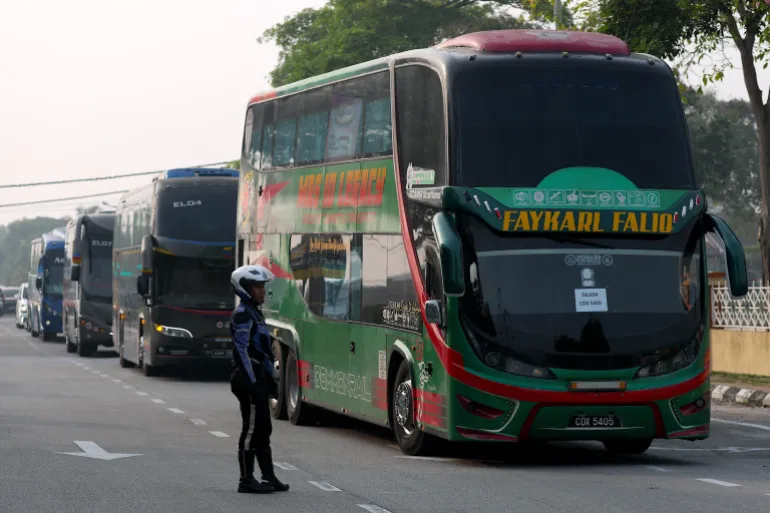
The Malaysian government on Tuesday deported nearly 1,500 refugees, part of its stated plan to send back at least 5,000 refugees as part of a deal with the military government of Myanmar. That move, from a country that had long taken in the refugees, has sparked fear among the tens of thousands of other refugees from Myanmar in the country, who have one question at the top of their minds: Who might be next?
The deportation was carried out during escalating raids on refugee communities by immigration officials, which have led to the detention of more than 50,000 refugees this year alone. Those working with refugees in Malaysia said the frequency of the raids has increased since June when Prime Minister Anwar Ibrahim announced the repatriation agreement with Myanmar.
“[We’ve seen] a sharp increase. Raids are happening every single day. There’s up to 50 raids or more happening every day,” said Heidy Quah, founder and executive director of the Malaysian nonprofit Refuge for the Refugees.
Minister of Home Affairs Saifuddin Nasution told local media that the government has conducted more than 9,700 such operations from the beginning of this year until September 17. That’s an average of 37 operations a day.
There are now more than 10,000 Myanmar nationals in Malaysia’s immigration depots, according to the Ministry of Home Affairs.
In all, Malaysia is home to more than 215,000 refugees, according to the Office of the United Nations High Commissioner for Refugees (UNHCR). Nearly 194,000 are from Myanmar. There are more than 126,000 Rohingya refugees in Malaysia, where they have been the target of widespread hate speech on social media in recent months. Apart from the Rohingya, the Myanmar refugees in Malaysia include nearly 16,000 from the Chin community and 33,000 from other Myanmar communities. The non-Myanmar refugees in Malaysia include small numbers of Pakistanis, Yemenis, Somalis, Afghans, Syrians, Sri Lankans, Palestinians and Iraqis.
The Myanmar refugee community in Malaysia has yet to identify any Rohingya among the first nearly 1,500 people deported on Tuesday, community leaders told Al Jazeera. Instead, many are from Myanmar’s other ethnic minorities, who are more likely to have valid national identification documents, community leaders said.
“The Rohingyas are a problem for deportation because Myanmar denies their citizenship,” Raf said. “So I don’t think that Myanmar will agree and accept all those Rohingyas.”
Myanmar officially treats the Rohingya as Bangladeshi immigrants despite the community’s long roots in Myanmar and their distinct ethnic identity. The Myanmar army has repeatedly cracked down on the Rohingya minority, including a wave of violence in 2017 that many rights groups have described as genocide. It set off a major refugee crisis when hundreds of thousands of Rohingya fled to Bangladesh, Malaysia, India and other neighbouring nations.
Myanmar community leaders also said the raids this year appear to have targeted locations highlighted in anti-refugee videos on social media in which content creators filmed refugee-populated areas, portraying them as hubs of chaos. These videos have been shared thousands of times on platforms such as Threads, TikTok and Facebook.
Al Jazeera contacted the Immigration Department to verify the link between the videos and raids but had not received a response at the time of publication. Accounts that had posted and shared antirefugee sentiment also did not respond to requests for comment.
Decline in resources
The increase in hostilities towards refugees in Malaysia coincides with a sharp decline in the capacity of local and international aid groups to support them, especially since the closure of the United States Agency for International Development in July 2025.
In Malaysia, this severely shrank resources for organisations helping refugees with basic needs, such as healthcare, Quah told Al Jazeera.
“Then slowly, United Nations organisations were being defunded, and even within the UN High Commissioner for Refugees in Malaysia, they lost a lot of staff,” Quah said. The job cuts reflected global retrenchments by UNHCR last year.
The agency continues to struggle with a funding crisis, saying on Tuesday that it faces a $5.79bn funding gap and, as of July, has received 32 percent of the funds it needs this year.
In Malaysia, this has led to even less protection for refugees and higher rates of exploitation, Quah said.
“Even UNHCR cardholders are arrested and remanded for about 14 days [while the] cards are verified,” she said.
For instance, an asylum-seeking woman who had scheduled an appointment to meet UNHCR representatives this month was recently detained, and immigration authorities demanded a letter from the organisation to prove that she was an asylum seeker, Quah said.
Although UNHCR confirmed the woman was seeking asylum, she remains in detention, Quah said.
An initial group of 1,476 people from Myanmar are deported from Malaysia on September 29, 2026, first my bus and then by Myanmar navy ships [Fazry Ismail/EPA]
Ongoing violence in Myanmar
UNHCR and rights groups in Malaysia have urged the Malaysian government to stop the deportations as violence continues in Myanmar.
A day before Malaysia’s deportation of the refugees on Tuesday, an air strike by Myanmar’s military was reported to have killed at least 33 people in Rakhine state, the historical home of the Rohingya. The Arakan Army group said the victims included vendors, shoppers and pedestrians. In June, the UN said Myanmar’s military was responsible for more than 700 civilian deaths over a six-month election period that started in August last year.
The Human Rights Commission of Malaysia (SUHAKAM) said that while Malaysia is not a party to the Refugee Convention of 1951, the principle of nonrefoulement has become part of customary international law and Malaysia, therefore, is bound to abide by it. The principle protects people from being returned to a place where they face a real risk of persecution, torture or other serious harm.
Particular attention should also be given to children, SUHAKAM said, highlighting that Tuesday’s deportation included 27 children, some reportedly as young as eight years old.
“No child should be returned to danger. Their safety, dignity and best interests must come first,” it said.
Myanmar community leaders in Malaysia told Al Jazeera the ships that departed on Tuesday will arrive in Yangon on Sunday.
“After that, we will [learn] whether they are allowed to leave the port safely [or are detained],” said one community leader who requested anonymity due to the increase in violence towards refugees in Malaysia.
Still, even those who are allowed to leave the port may need to spend months or years in Yangon because it is unsafe to travel across the country, the community leader said.
Rohingya refugees face evictions from their homes in Malaysia amid rising local tensions and online misinformation [File: Hasnoor Hussain/Reuters]
Call for independent access
Rights groups further criticised the Malaysian government’s framing of the deportations as “voluntary”, saying individuals should have sufficient information about conditions in their home countries before making such a decision.
“While authorities say the returns are voluntary, those returned had been held in immigration detention. This raises serious questions about whether decisions to return were genuinely free and informed,” UNHCR Assistant High Commissioner for Protection Edem Wosornu said.
The Malaysian government said people were selected for deportation based on a list of names shared by the Myanmar government in an official diplomatic note.
“Such [a] ‘voluntary’ decision must be determined by an independent authority, such as the UNHCR, and not by the Immigration Department,” SUHAKAM said .
UNHCR told Al Jazeera that it was not involved in the latest return process and did not have access to the individuals concerned. “[We were,] therefore, not in a position to independently ascertain the voluntariness of their decisions to return,” it said.
“We continue to encourage the government to ensure that return processes include individual assessments, access to protection procedures and safeguards to ensure that any decision to return is free, informed and genuinely voluntary,” it said.
Malaysian Prime Minister Anwar Ibrahim has long positioned himself as a champion of human rights but now faces criticism for the expulsion of Myanmar refugees [File: Rafiq Maqbool/AP]
Malaysia registering refugees
The deportations come at a time when Malaysia is simultaneously positioning itself as welcoming to refugees and their needs.
In 2015, the Malaysian government launched a Refugee Registration Document (DPP) programme. On paper, it is supposed to help register refugees, giving them official documentation.
Raf welcomed the DPP as long as the registration and documentation of refugees in Malaysia leads to access to work, education and healthcare.
“If these three things are provided, I think that’s a good solution for temporary refugees staying here.”
But the Malaysian branches of Amnesty International and Asylum Access said the latest deportations raise profound concerns about the purpose of the DPP. The programme should not be used to fast-track unlawful deportations, the groups said in a joint statement.
*Name changed to protect the individual’s identity
Durban, South Africa – Bishop Raphael Bahebwa is in hiding, afraid he could be attacked for speaking out for the rights of foreigners in South Africa.
“I am in hiding now because they say they are going to kill me for speaking about the rights of foreigners,” he told Al Jazeera.
Bahebwa has lived in South Africa for 26 years, after arriving as a refugee from the Democratic Republic of the Congo (DRC).
In that time, he has watched antiforeigner sentiment flare repeatedly in the country he came to call home. But he says this year feels different.
A September 30 deadline declared by March and March, an anti-immigration movement that has led protests across South Africa this year, has renewed fears of violence among migrant communities.
The group has called for undocumented foreign nationals to leave South Africa and has warned of further demonstrations if its demands are not met.
For Bahebwa and other refugees in Durban, however, the distinction between documented and undocumented migrants offers little comfort. They say the hostility they experience on the streets rarely begins with a request to see their papers.
Fears of renewed violence
South Africa will hold local government elections on November 4, in a campaign in which migration has become an increasingly prominent political and social issue.
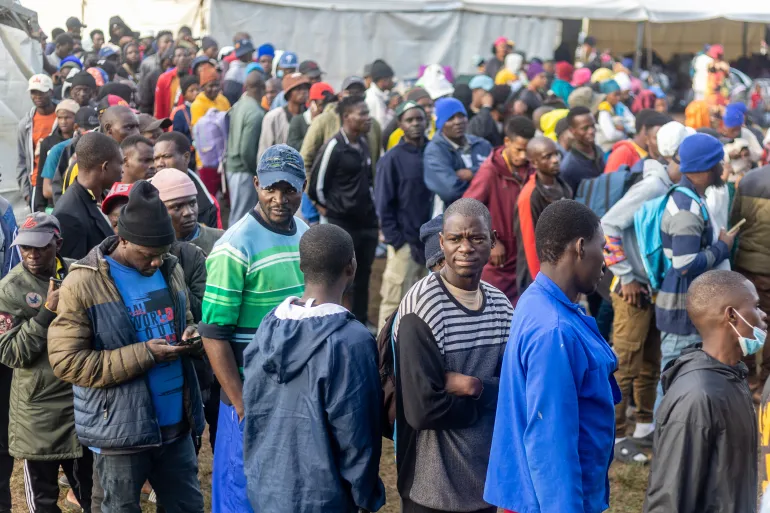
For months, Bahebwa was among hundreds of refugees and asylum seekers who slept on the pavement outside the Durban Refugee Reception Centre on Che Guevara Road.
Many were from the DRC and Burundi, with others from Uganda, Mozambique and Tanzania. They said they had fled their communities because they feared antiforeigner attacks.
They arrived outside the Department of Home Affairs (DHA) office seeking safety.
Instead, the pavement became their home.
For roughly four months, men, women and children slept outside, exposed to the elements and dependent on civil society organisations and volunteers for food and other necessities.
“It has been very tough,” Bahebwa said. “Never before have I experienced something like this.”
Some of the migrants told Al Jazeera that conditions became desperate. They described irregular access to food and medication and said one man who had tuberculosis died while living at the camp. Al Jazeera has not independently established the circumstances of his death.
The camp was also not far removed from the hostility its residents said they had fled.
On September 3, members of March and March confronted refugees and asylum seekers living outside the centre. Violence broke out, and police intervened. At least four people were reported injured.
At another protest days later, police officers stood between the two groups, forming a barrier as tensions rose.
March and March has described its mobilisation as a campaign against undocumented immigration, crime and deteriorating conditions in South African communities.
The group says the government’s response to immigration enforcement has been insufficient.
Its leaders have repeatedly rejected accusations that their campaign is xenophobic and insist their target is undocumented migration rather than foreign nationals generally.
Bahebwa said documented and undocumented migrants alike have been caught in the hostility.
Earlier this year, six refugees working in salons around Durban’s Warwick Street Market were beaten by men carrying sticks, according to public-interest news outlet GroundUp. Two were hospitalised.
Bahebwa said the migrants had also struggled to obtain help from the authorities after earlier attacks.
“Police said we can’t open cases because we are foreigners. We had nowhere to go,” he alleged. Police have not publicly responded to that specific allegation.
Nowhere obvious to return to
In mid-September, the government moved to clear the makeshift camp outside the refugee centre.
The refugees were given a choice: return to the communities they had fled or accept temporary accommodation at the Lindela facility in Gauteng, hundreds of kilometres from Durban. Lindela is a government-run immigration detention facility used to hold people facing deportation.
The choice divided them.
Malawi migrants to South Africa line up for supplies at an informal refugee camp in Sherwood, Durban, South Africa, after fleeing their homes amid fears of xenophobic attacks [File: EPA]
Some feared going to Lindela, a facility historically associated with immigration detention and repatriation. Others felt they could no longer endure life on the pavement.
On September 15, 274 people were transported by bus from Durban to Lindela. About 150 others chose to remain in Durban and began trying to find alternative accommodation.
For those who stayed behind, leaving the pavement did not resolve the problem that had brought them there in the first place.
Kafuti Muyumba, a small business owner from the DRC and a representative of the refugee community, said many were afraid to return to neighbourhoods where they had built businesses and lives.
People are afraid, he said. “Even the police allow March and March violence. They came with sticks and say we are attacking them,” Muyumba told Al Jazeera.
He said many refugees had lost their livelihoods during the months of upheaval and were now desperate to find accommodation.
“This is not the first time we are experiencing xenophobia,” he said. “In 2008 and then in 2015 we also experienced this.”
In 2008, xenophobic violence spread through townships and informal settlements, killing dozens and displacing thousands.
Further outbreaks of violence against foreign nationals followed in subsequent years.
For Muyumba, those memories make the rhetoric surrounding September 30 difficult to dismiss.
“We don’t trust the police. They are not being fair with us. Some of them are also saying we must go,” he said.
Police have said there are no plans to change their normal policing approach because of the September 30 deadline and that any protesters will be expected to remain within the law.
March and March said all it wants is for undocumented immigrants to leave the country and return home.
But Muyumba said returning to the DRC is not a viable alternative for many Congolese refugees.
“There is still war there,” he said.
A country tightening its borders
In response to ongoing protests, the South African government said it had intensified its immigration enforcement.
Between June 14 and August 20, authorities processed 86,596 foreign nationals for deportation and repatriation, according to the government’s Inter-Ministerial Committee on Migration.
Malawians made up the largest group, followed by Zimbabweans and Mozambicans.
Government data says 90 percent of those repatriated had entered South Africa illegally, while 95 percent were classified as having crossed the border outside official ports of entry.
The government says the operations form part of a broader effort to strengthen border management and enforce immigration law.
At the same time, officials have repeatedly warned private groups against taking immigration enforcement into their own hands.
March and March’s September 30 deadline has no legal authority. The government says common citizens cannot deport anyone from South Africa.
Protesters hold placards during an anti-immigration march in Durban, South Africa, calling for tighter border controls and the deportation of undocumented migrants [File: Thuli Dlamini/Reuters]
But deadlines do not need legal force to create fear, as was the case for an earlier deadline of June 30. For the refugees who spent months sleeping outside the DHA office in Durban, September 30 is another uncertainty layered on top of many others.
Some have been moved hundreds of kilometres away.
Others are trying to find new homes in the same communities they once fled. But among the migrants Al Jazeera spoke to, there is a shared anxiety that paperwork may offer limited protection when anger is directed first at being foreign.
Bahebwa has spent more than a quarter of a century in South Africa. For now, he says he is hiding and does not know what September 30 will bring.
“They are scapegoating us as foreigners,” he said. “It is not going to end on September 30. It has to do with the elections.”
A few years ago, I received a call I’ll never forget. Jeanette Epps, an astronaut aboard the International Space Station, Zoomed into my living room from 250 miles above Earth. During our conversation, she told me that one of the reasons she chose her career was a television show my father created in 1966.
She wasn’t alone. I’ve heard versions of that same story from countless people over the years. Engineers. Scientists. Astronauts. People who saw possibility on a television screen before they ever saw it in the real world.
They credit “Star Trek” for showing them a future they wanted to help build. That’s an extraordinary thing for a television series to accomplish. It didn’t just entertain millions of people. It gave many of them a direction.
And I don’t think that was because of the ships, the gadgets or the aliens. It was because, underneath all of it, was a profoundly human belief that we are capable of becoming something better.
There was a time when science fiction made a bet on humanity. A bet that humanity was worth rooting for. We need storytellers willing to make that bet again.
I don’t think we have an innovation problem. We have an inspiration problem.
We talk a lot about what we’re leaving the next generation. The debt. The climate. The geopolitical mess. But there’s another inheritance we don’t talk about enough: what we show them is possible.
Today, many visions of the future are dominated by collapse, dystopia and fear. Those stories can have value. But conflict doesn’t always have to come from destruction. It can come from discovery. Two minds encountering an idea neither had considered. A crew facing the unknown with curiosity instead of fear. That kind of conflict doesn’t leave you feeling like the world is ending. It leaves you feeling like it’s just beginning.
Most storytelling holds a mirror up to who we are. Our flaws, our failures, our contradictions. But there is another kind. Stories built around characters a step or two ahead of where humanity is. Not perfect. But people who have learned how to cooperate, how to lead, how to stay curious and how to put something larger than themselves first. Characters you don’t just recognize. Characters you want to become one day.
That distinction changes what a story asks of you. And what you walk away believing is possible.
This year, “Star Trek” celebrates its 60th anniversary.
That’s not a milestone you reach by accident. Franchises built on spectacle fade. Ones built on something people actually needed tend to stick around.
The engineers who built Silicon Valley, the astronauts who went to space, the scientists pushing the edges of medicine and artificial intelligence — many of them trace a line back to this show. That wasn’t the plan. Nobody set out to build an innovation pipeline out of a television series. But that’s exactly what happened. When you give people a future worth believing in, they go build it — or sometimes they get inspired to imagine other hopeful destinations and lead us toward them. That’s not nostalgia. That’s a model.
One thing my dad understood that I think gets overlooked: “Star Trek” wasn’t going out into the galaxy to find aliens that looked different. It was going out to find aliens that thought different.
Diversity of perspective is how a species grows. My father gave that idea a name: IDIC. Infinite Diversity from Infinite Combinations. It didn’t mean you had to abandon your own point of view. It meant staying open to someone else’s. Because that’s how you grow. That idea has never been more relevant. And it has never been more achievable.
For the first time in history, a creator anywhere in the world can tell a story that reaches everyone, and now it can come from anywhere. The future belongs to everyone. The stories that shape it should too.
That astronaut who called me from space didn’t just watch a television show. She saw a future worth dedicating her life to.
Every generation needed something to build toward before they ever picked up a tool. A vision. A direction. A story that made the future feel worth the work. And right now, we’re not building enough of that.
We need stories that don’t just entertain us, but also become our compass. We need the kind of storytelling that doesn’t ask what could go wrong, but asks what could go right.
Rod Roddenberry, founder of the Roddenberry Foundation and son of “Star Trek” creator Gene Roddenberry and actor Majel Barrett Roddenberry, is an executive producer on current “Star Trek” television shows.
Insights
L.A. Times Insights delivers AI-generated analysis on Voices content to offer all points of view. Insights does not appear on any news articles.
Perspectives
The following AI-generated content is powered by Perplexity. The Los Angeles Times editorial staff does not create or edit the content.
Ideas expressed in the piece
The article argues that optimistic science fiction can do more than entertain: it can give audiences a constructive vision of the future and inspire people to pursue careers in science, engineering and space exploration. “Star Trek” is presented as an example of storytelling that made human progress feel attainable.
It contends that contemporary culture is overly saturated with collapse, dystopia and fear. Although such stories can be useful, the article suggests that narratives centered on discovery, cooperation and curiosity can encourage audiences to imagine what might go right rather than merely anticipate disaster.
The piece maintains that aspirational characters—people who have learned to cooperate, remain curious and serve purposes larger than themselves—can function as moral examples. In this view, fiction should not only reflect present flaws but also depict people and societies worth becoming.
It further argues that “Star Trek’s” emphasis on cultural and intellectual diversity remains especially relevant. The franchise’s principle of “Infinite Diversity in Infinite Combinations” is presented as a model for learning through different perspectives, while the series’ enduring influence is cited as evidence that hopeful stories can shape real-world ambitions.[1][2]
Different views on the topic
A contrasting perspective holds that dystopian and cautionary science fiction serves an essential purpose by exposing the consequences of reckless behavior, political failure and technological overreach. Recent commentary argues that many influential works were intended as warnings or satire, not as blueprints for an attractive future.[3]
Feminist dystopian fiction offers another counterpoint: bleak speculative narratives can make systemic problems—including misogyny, violence against women, gender inequality and threats to reproductive rights—more visible. From this perspective, darkness is not simply pessimism; it can be a way to represent harms that already exist and demand attention.[4]
Critics also caution that “Star Trek’s” hopeful vision can obscure tensions within its own world. The franchise combines ideals of cooperation and equality with armed exploration, alien conflict and interventionist politics, making it both an image of peaceful progress and a vehicle for examining militarism and political failure.[2]
Consequently, the strongest science fiction may not choose between hope and warning. Utopian stories can provide direction, while dystopian stories can identify dangers and test whether an envisioned future genuinely addresses exclusion, power and conflict. Treating either mode as sufficient on its own risks producing either inspiration without scrutiny or criticism without a constructive destination.[3][4]
At just 19, Luke Littler has won every major trophy in darts.
He is a multi-millionaire with lucrative sponsorship deals and his own TV show.
But has his rapid rise turned some against him?
This past weekend the teenager was once again subjected to boos and whistles from sections of the crowd as he took to the stage at the World Series of Darts in Amsterdam.
What is surprising though is that it came as ‘The Nuke’ was on a quest to complete a darts clean sweep by becoming the first player to win all 10 major televised tournaments in a calendar year.
But Samuel Gill, editor of Dartnews.com, suggests Littler’s future in the sport could be at stake.
“There’s a real fear that within a few years he’ll just turn around and walk away from the sport,” Gill told BBC Sport.
“So, I think for fans, ‘Don’t bite the hand that feeds you’. If people keep taunting him and don’t want him to win, he might end up just walking away and not bothering anymore.”
Amsterdam was the latest tournament where Littler has faced what some might describe as an overly hostile reaction from fans.
A vibrant pantomime-style atmosphere is part and parcel of the darts experience and Dutch and German crowds are amongs the most raucous – but it is clear Littler believes he has been unfairly targeted.
The referee stopped the match during his narrow win against Nathan Aspinall in the last-16 on Saturday to warn the hostile crowd about its behaviour, before play resumed.
It followed Littler also being booed during his win against home favourite Danny Noppert on Friday.
The teenager’s quarter-final defeat to Jonny Clayton ended Littler’s quest for the clean sweep, but the Warrington native clearly felt fans had been unduly harsh towards him.
Littler has now withdrawn from a series of upcoming events.
“Just no point in me travelling, wasting my time while I’m getting booed,” said Littler.


![Rohingya refugees facing evicted from their homes amid rising local tensions and online misinformation, Kuala Lumpur, Malaysia, July 27, 2026 [Hasnoor Hussain/Reuters]](https://i0.wp.com/occasionaldigest.com/wp-content/uploads/2026/10/2026-07-27T123715Z_206813602_RC2BMMA6AR5R_RTRMADP_3_MALAYSIA-REFUGEE-1787872480.jpg?w=640&ssl=1)


![Protesters hold placards during an anti-immigration march in Durban, South Africa, calling for tighter border controls and the deportation of undocumented migrants [Thuli Dlamini/Reuters]](https://i0.wp.com/www.aljazeera.com/wp-content/uploads/2026/06/2025-11-07T155727Z_1005019881_RC2NRHA84QWK_RTRMADP_3_SAFRICA-PROTEST-1782784993.jpg?w=640&ssl=1)