As performers protest and studios sue in their war on artificial intelligence, the entertainment industry is deepening its dependence on it.
Although few places are better than Hollywood at crafting a narrative and concealing what happens off-frame, a Los Angeles Times survey of job postings sheds light on what is happening offstage.
Among hundreds of job postings in late June, more than one in 10 was likely connected to AI. The top studios’ public postings suggest they have been recruiting people to build AI tools. They are also recruiting teams to defend their intellectual property against unauthorized AI use.
“There are plenty of studios that are hiring [for AI] but never talk about it in public,” said Yoland Yan, a co-founder of ComfyUI, a company that helps studios juggle different AI tools.
Companies have been hesitant to detail how they use generative AI in film production — partly because they are concerned about consumer and union backlash.

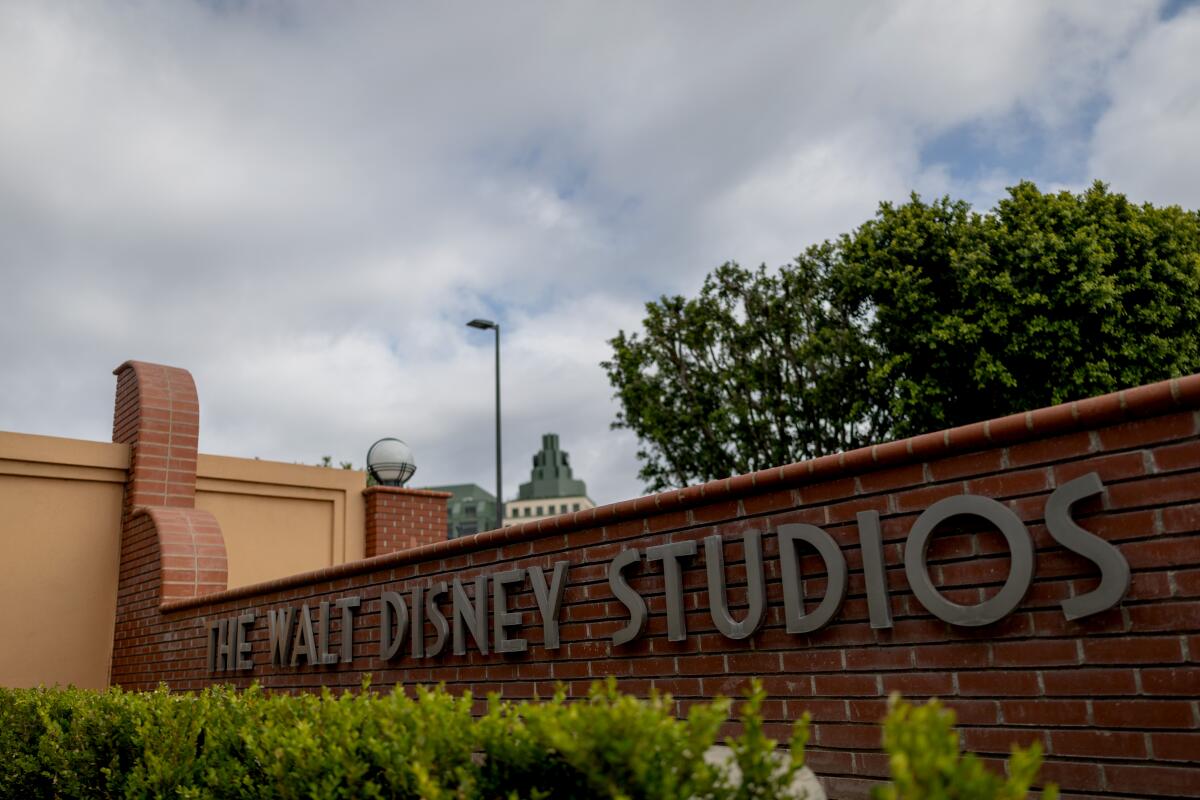
The Walt Disney Studios complex on May 3 in Burbank.
(Eric Thayer/Los Angeles Times)
Some in Hollywood described AI use as the new cosmetic surgery, where everyone knows it is happening, but few will admit to it.
Recent want ads show Amazon MGM Studios trying to find a principal AI executive and Walt Disney Studios advertising for a production innovation technologist job.
“What you’re seeing in those job postings is that adoption is already happening,” said Bryn Mooser, chief executive of Asteria, an AI film studio.
Netflix recently posted a job that didn’t exist a year ago.
The streamer was hiring for the role of “Manager, Generative Workflows,” a job to help integrate more AI into Netflix films. It promised hands-on experience with the cutting-edge technology.
“The industry is flooded with speculative GenAI roadmaps, but few are battle-tested in production,” the post said, referring to generative AI. The post said the role will work on introducing AI into Netflix’s slate of films being released in the U.S. and Canada.
Although some companies may be shy about sharing their AI plans, big stars who don’t have to answer to others have been more open about their embrace of the new technology for storytelling.

An exterior view of the Netflix sign at Netflix on Vine in Hollywood in 2025.
(Allen J. Schaben/Los Angeles Times)
Rejecting AI is like picking a horse and buggy over a car, said “Star Wars” creator George Lucas.
“Artificial intelligence means it’s much easier for us to make movies,” he told a trade magazine earlier this year. “There’s nothing you can do about it. That’s progress. It’s the future.”
Some in Hollywood have a softer stance on artificial intelligence, with studios cutting deals with AI companies, and filmmakers like Martin Scorsese backing AI companies.
Ben Affleck launched an AI film tech company then sold it to Netflix for half a billion dollars.
When launching InterPositive, Affleck said he wanted to keep “storytelling human” by building AI tools that could fix lighting, generate missing shots and other things while “keeping creative decisions in the hands of artists.”
The Times’ survey turned up two senior InterPositive roles to update the programming to apply AI to visual effects .

The Culver Studios on Feb. 12 in Culver City.
(Kayla Bartkowski/Los Angeles Times)
To gauge what is happening behind the scenes, The Times used Claude Code to build a scraper to identify job postings at Disney, Universal, Paramount, Warner Bros., Sony, Netflix and Amazon MGM. It found around 250 film studio job postings that were still public as of late June. Around 30 of those seemed to be connected to AI.
Disney, Netflix and Amazon had job postings that were about using AI on the creative side of the business. Universal, Paramount, Warner Bros. and Sony had job ads suggesting they were also using AI but for marketing, distribution and audience analytics.
The postings suggest the Disney, Netflix and Amazon studios are building repeatable AI workflows for visual effects, animation, sound and dubbing. The companies also seem to be building in-house teams to develop custom generative-AI models, while also using third-party software.
None of the jobs advertised were to create AI that wrote scripts or created AI actors.
Disney’s ten or so AI jobs showed the century-old studio building out its AI research and production muscle, while protecting its vault of beloved characters.
Mouse House is hiring PhD-level talent to study “computer graphics and AI” for Pixar and Disney films, people to “bridge the gap between research and practical studio application.”
Industrial Light & Magic, the Disney-owned visual effects shop, was searching for supervisors to “explore emerging technologies (including AI/Machine Learning)” to develop new production workflows.
The company’s audio post-production unit, Skywalker Sound, seemed to be recruiting to build proprietary AI models for soundtracks, voice separation, and voice transfer, the process of taking a speaker’s tone and pitch, and applying it to new content.
Disney was also hiring to defend itself. Three of its jobs were for “content security” to assess AI tools and guard against piracy, watermarking and rights-protection work.
The company’s public posture has so far been pursuing lawsuits against AI companies for inappropriate use of copyrighted material, and it pulled out of its plans to invest $1 billion in an equity investment deal with OpenAI.
Netflix’s posts suggested it is bringing more AI to the creative side of its business.
Netflix’s senior director of creative innovation, Girish Balakrishnan, outlined at the Runway AI film festival how AI was used to create soccer fans in “Brazil ’70” and establish shots for fight scenes in “Glory.”
Amazon, an early adopter, was hiring a principal AI executive to drive AI-tool adoption across production, plus roles in operations automation and LLM content classification, the listings revealed.
The Seattle-based streamer has been the most aggressive AI adopter in studios, and commissioned three AI animation series through its GenAI creator fund in May. Amazon has also bankrolled a Manhattan Beach production services company, Innovative Dream.
Even as studios build bigger AI teams, many in the industry are resisting, and some film fans are concerned.
The actors’ guild SAG-AFTRA in June ratified a new four-year contract with special protections against synthetic performers, and the union has backed a national bill designed to protect individuals from unauthorized, AI-generated digital replicas.
Studios have met with the union twice a year since 2023 to provide a confidential report on their AI-related activities. The studios tell the union they aren’t yet using AI that would entirely replace humans, said a person familiar with the discussions.
The union says it has no evidence that generative AI is being used to create performances, and the studios are supposed to notify the union if that happens.
Actors, writers, production staff and movie fans are still resistant to the overuse of AI and defining when and where it is acceptable, so studios are treading lightly, said AI film studio CEO Mooser.
“It’s been really a challenging thing to adopt both socially, ethically and legally, but we are seeing more adoption of it than we’ve ever seen before,” he said.