When Lane Kiffin dials a number, the person on the other end usually answers and takes the call.
Todd Monken crossed paths with Kiffin many times while both crisscrossed the country for decades, taking this job and that, as head coaches and assistants at top colleges and in the NFL.
Monken became an NFL head coach for the first time in January, taking over the Cleveland Browns. Kiffin is about to begin his first season as the Louisiana State head coach, so Monken didn’t know why Kiffin’s number popped up on his screen over the weekend.
“I wondered why Lane Kiffin reached out to me a week ago,” Monken told reporters Sunday. “Now I know. I didn’t call him back. I guess I should have.”
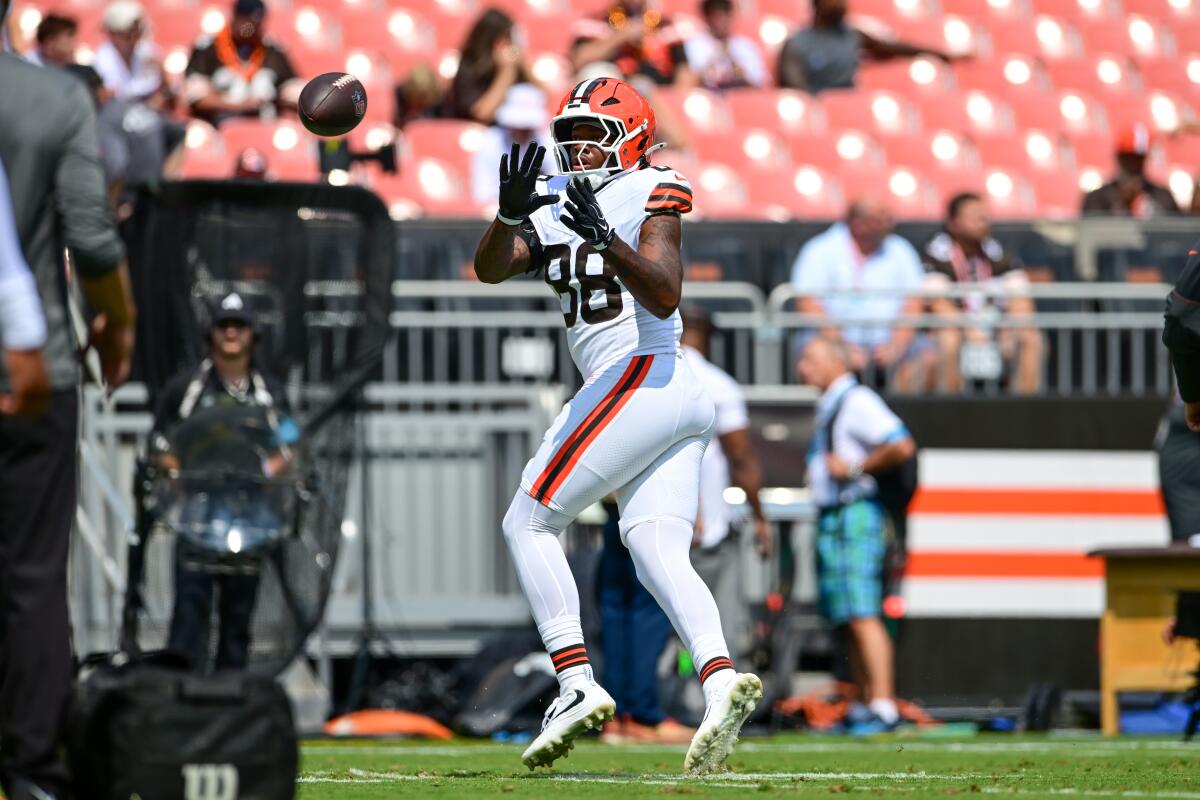
Kiffin called to tell Monken something the rookie NFL coach learned later in the day. Dae’Quan Wright, a tight end the Browns waived Sunday morning, plans to play for LSU if he clears waivers, his agents told ESPN.
Dae’Quan Wright of the Cleveland Browns warms up before a preseason game against the Buffalo Bills at Huntington Bank Field on Aug. 22.
(Nick Cammett / Diamond Images via Getty Images)
Wright, who went undrafted after playing for Kiffin at Mississippi, is believed to be the first player to have an agreement to return to college football after signing with an NFL team. He was with the Browns for fewer than two weeks after the Philadelphia Eagles signed him as an undrafted free agent and placed him on waivers in early August.
Although Wright didn’t play in the Browns’ two preseason games, he suited up Saturday against the Buffalo Bills because injuries to other players created a potential need. He never left the sideline.
Another NFL player being courted by Kiffin, however, saw action. . Tampa Bay Buccaneers rookie linebacker Jack Pyburn recorded two sacks in a preseason victory over the New York Jets on Friday.
Pyburn, who also went undrafted after playing three years at Florida and his senior year at LSU, can regain his college eligibility if he terminates his contract with the Bucs and repays earnings. Pyburn’s deal guaranteed him $115,000 and included a $15,000 signing bonus.
LSU could pay him an estimated $1 million for his NIL, exceeding the NFL full-season rookie minimum of $885,000.
“I’m kind of caught in the middle of a whirlwind,” Pyburn told the Athletic, “and I’m just trying to play football.”
Wright and Pyburn are two of about 30 athletes who filed a lawsuit in Louisiana and were granted a temporary restraining order to return to college for one more season.
The lawsuit challenges new NCAA eligibility rules that give athletes a five-year window to compete in college sports. The plaintiffs are 2022 high school graduates whose college eligibility expired last spring under the previous rules. The NCAA did not include them in implementation of age-based eligibility, prompting lawsuits.
Several state courts have ruled in the players’ favor, and they have eligibility in the upcoming school year until appeals are ruled on. Most of the plaintiffs are basketball players, but Wright and Pyburn are two of 16 football players benefiting from the temporary restraining order granted by Louisiana’s 19th Judicial District Court.
During his eight seasons as a head college football coach, Lincoln Riley often faced a frustrating conundrum when it came to playing freshmen: Were a handful of plays at the end of a blowout really worth burning a whole year of eligibility?
“I can remember at times going to a player in the game,” Riley said Tuesday. “‘We can probably play you like five to 10 plays at the end of the game. But if you do that, we can’t play you anymore, or we’re going to have to take your redshirt.’ We’re having to talk about that in-game. … You had to be ready to adjust on the fly.”
But after years of meticulously monitoring that playing time, those adjustments will no longer be necessary, after the NCAA adopted new eligibility rules in June. The new model gives athletes a blanket five years to compete, effectively eliminating the need for redshirts or special waivers. It also could alter how rosters are constructed.
Riley has been calling for the rule change since shortly after he became USC’s head coach. And it is now being implemented at the best possible time for his Trojans.
With so many highly touted freshmen from USC’s No. 1 recruiting class sure to see the field this season, there’s no need now for Riley or his staff to look four years into their future while deciding when and how to give them game-day snaps.
“Now you can just make the best decision in the moment,” Riley said. “I think that’s great for the player. … Just play the guys who deserve to play.”
For USC, it means that a fleet of first-year players are sure to see the field, not just during the nonconference slate but beyond, as Riley and his staff feel out which members of the Trojans’ 2026 class could contribute when the schedule suddenly stiffens in late September.
“Any opportunity that we get a chance to play these guys, however it comes out,” Riley said, “you love the fact to be able to do it.”
Some schools could land veteran roster reinforcements as a result of the rule change after a judge granted an injunction allowing anyone in the class of 2022 who would’ve used the fifth year of eligibility to return to claim it. The decision is being appealed by the NCAA. Former USC wideout Jay Fair has indicated on social media that he intends to pursue that route, but as of Tuesday, Fair hadn’t rejoined the program.
The Trojans stand to benefit more than most from the new eligibility rules this season. But Riley does have one issue with the new rule. It currently stipulates that a player’s eligibility clock begins with either their full-time enrollment or the academic year following their 19th birthday, whichever occurs first.
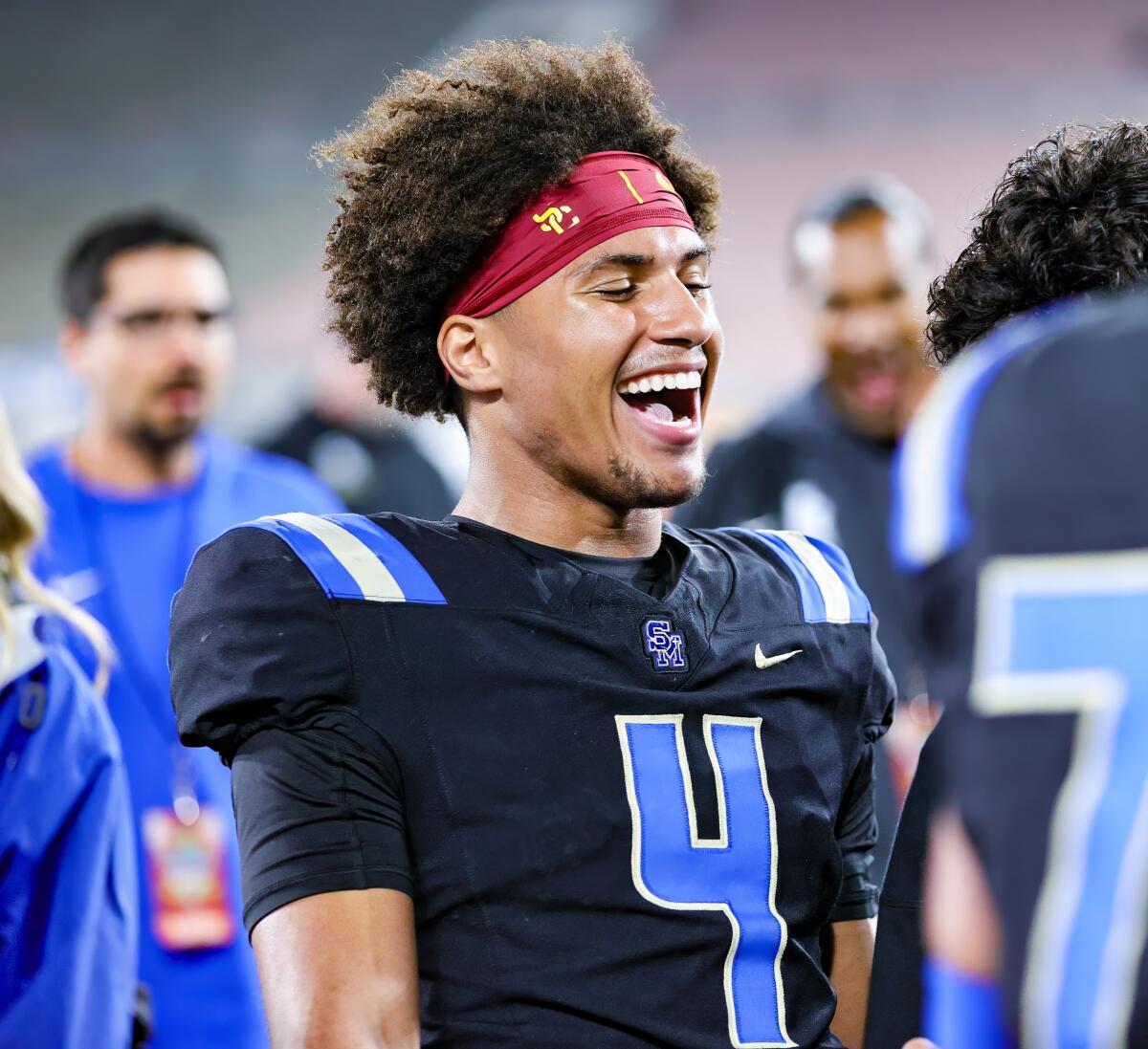
Trent Mosley smiles while leading Santa Margarita to a Division 1 title. Mosley is among the freshmen at USC who will benefit from new eligibility rules.
(Craig Weston)
So as it stands, any freshman with a birthday prior to Sept. 1, 2006, is left with one fewer year to play than their freshmen counterparts.
At USC, that affects two members of the 2026 recruiting class — wide receiver Trent Mosley and safety Madden Riordan.
For Mosley, a former Rancho Santa Margarita star, a fifth year may not ultimately matter. He’s already 20 years old and on track to potentially start in the slot as a freshman.
But USC’s coaches were quick this week to note that the Trojans’ freshmen, no matter how talented, still had some acclimating to do.
“Age is really just a number,” inside receivers coach Chad Savage said of Mosley. “When you’re a freshman and you come into college, there’s a big learning curve, right? Whether it’s playbook, whether it’s everyday life, whether it’s the weight room, whatever it may be, um, I think from a maturity standpoint, he is very mature, but it’s just one step in front of the other, every single day with Trent.”
Tanook Hines, USC’s top returning receiver, was a bit less restrained in his evaluation.
“Trent Mosley definitely stands out,” Hines said. “He seem like a vet, like he’s already been here.”
Riordan, meanwhile, is older than some of the vets on USC’s defense, including junior starting linebacker Desman Stephens, who already has 26 games under his belt at USC. It follows then that Riordan’s football IQ has made an impression with coaches early on.
He’s one of the several freshmen who might have been on the brink of a redshirt, given his weight. But Riordan added almost 15 pounds during the summer to hit 180 and could push for a place in USC’s defensive back rotation.
Riley said he believes Mosley and Riordan — and any other freshmen, for that matter — should get the chance to play all five seasons. No matter how old they are when their college careers start.
“We have a few guys that we are in the process of seeking some clarification and potentially getting some relief on that,” Riley said of the age restrictions. “Our belief is if they’re five for five coming out of high school, they should be five for five. We should keep it simple.
Whether driven by retirements or re-configuration, the insurance industry is scrambling for tech talent.
This article appears in the July/August issue of Global Finance Magazine.
Caught between a wave of retirements and a weak talent pipeline short on tech-savvy candidates, the insurance industry faces a talent shortage that could affect its ability to address cyber and other emerging risks.
“Demand is rising sharply for fluency in analytics, AI, as well as in cyber risk. These are all capabilities that are either new or that the traditional sources of talent haven’t produced at scale,” says Peter Miller, president and CEO of The Institutes, a risk management and insurance education provider.
In 2014, to help expand the talent pool, a group of risk management and insurance companies, nonprofits, and educational institutions, led by The Institutes, created MyPath, a one-stop resource for job seekers that outlines the benefits of, and pathways to, insurance careers.
The initiative remains timely because, in a November 2024 Institutes report, 66% of insurance professionals in the property and casualty sector surveyed identified the loss of institutional knowledge as the retirement wave’s greatest impact: “The result is both a talent shortage and a knowledge-transfer risk.” That means organizations must find ways to “preserve institutional expertise that took decades to build” while developing new skills.
Other Industry Observers Agree
“There is a dual-sided talent crisis,” says Margaret Milkint, global insurance practice leader at DSG Global, an executive search firm. “Organizations are losing experienced professionals faster than they can be replaced while simultaneously racing to build leadership capacity around capabilities that barely existed a decade ago.”
The talent crunch is rippling beyond primary insurers to encompass reinsurance carriers, brokerages, and risk management firms, she says. “Artificial intelligence is creating an entirely new category of roles spanning enablement, governance, ethics, and cultural integration that require skill sets the traditional insurance pipeline was never built to produce.”
The shortage of talent with tech and AI capabilities has become one of the industry’s most critical gaps as roles across underwriting, claims, and risk management become more data-driven, says Victor Harris, vice president at financial services recruiter Selby Jennings. “The shortage is slowing the pace at which many organizations can fully adopt and scale their AI strategies,” he warns.
Worsening Insurance Talent Squeeze
While they agree that AI is increasing demand for certain roles, experts at Aon observe that AI and automation are reducing demand in some entry-level and operations slots, particularly in finance and reporting.
“There is a risk of mischaracterizing the issue as a blanket shortage,” says Louisa Blain, head of insurance for human capital at Aon. “The reality is more nuanced, and linked to where the industry wants to grow versus the skills it currently has versus requirements for the future. This is less about replacement and more about reconfiguration of the workforce.”
Louisa Blain, Aon: This talent shortage is less about replacement and more about reconfiguration of the workforce.
Yet, the talent constraints could limit industry growth in specialist and emerging risk areas, argues Jeff Reider, head of Aon’s benchmarking, strategy and technology group. The Institutes’ Miller sees the shortage coming in cyber, complex liability, multinational program structuring, and cross-jurisdictional claims coverage.
“Knowledge lost to retirement can have meaningful downstream effects on compliance and strategy,” he says. “For any multinational that depends on its risk transfer partners to keep pace with growing exposure complexity, this is a material consideration.”
The infusion of capital and the emergence of new carriers and managing general agents in specialty lines have made the talent squeeze more pronounced over the last five years, says Tony Chimera, chief administrative officer at carrier Westfield Specialty.
“That has pulled talent out of the pool used by insurance carriers and brokers,” he adds, noting the talent squeeze has been building for two decades. “You do have an aging workforce. Some people are working longer, but you have a 55- to 65-year-old workforce that is probably not going to be there in the next five years.”
In addition, insurers are competing with the banking and technology sectors, which many younger professionals are turning to for more attractive careers with greater compensation. Yet, the actual compensation for some banking sector jobs, when salaries are integrated with a lack of work/life balance, can be much less desirable than insurance roles, Chimera points out: “Insurance is a great industry where you can earn a lot. And you can have a life.”
But Harris notes that many insurers’ locations in midsize cities can dissuade younger professionals intent on living in larger, more alluring metropolises. That leaves the industry with a limited pool of specialized talent.
Technical Fluency Isn’t Everything
How, then, is the industry to attract new talent?
The technology industry could be one source, Chimera says. But candidates must accompany the tech skills needed for roles in data analytics, AI, and cybersecurity with knowledge of the complex insurance business.
“Technical fluency alone doesn’t translate directly into effectiveness in risk management and insurance,” says Miller, adding that regulatory knowledge, coverage mechanics, and underwriting judgment take time to develop. “The most successful transitions involve strong technical capabilities combined with a genuine curiosity to develop insurance-specific expertise.”
While agreeing that the talent shortage has been building for years, Milkint notes that there is no clear consensus on when, or whether, it will peak. “Closing this gap,” she says, “will require the entire industry to go on the offensive and actively dismantle outdated stereotypes, confront long-standing biases, and make a compelling, unified case that insurance is not just keeping pace with the future, but helping to shape it.”
To attract more students from outside the traditional insurance and risk management programs, the industry must expand students’ awareness of career opportunities “beginning well before students reach their junior and senior years of college,” says Grace Grant, executive director at Gamma Iota Sigma. The collegiate society represents more than 7,000 students interested in careers in insurance, risk management, and actuarial science across 177 colleges and universities.
“Many students simply are not exposed to the breadth of careers available in the industry,” Grant says, adding that employers should highlight their innovation, technological sophistication, purpose-driven work, career stability, and advancement opportunities. “Students are highly motivated by careers where they can make a meaningful impact, and insurance is fundamentally about helping individuals, businesses, and communities recover from loss and manage uncertainty.”
Paula L. Green is a contributing writer based in New York City.
As performers protest and studios sue in their war on artificial intelligence, the entertainment industry is deepening its dependence on it.
Although few places are better than Hollywood at crafting a narrative and concealing what happens off-frame, a Los Angeles Times survey of job postings sheds light on what is happening offstage.
Among hundreds of job postings in late June, more than one in 10 was likely connected to AI. The top studios’ public postings suggest they have been recruiting people to build AI tools. They are also recruiting teams to defend their intellectual property against unauthorized AI use.
“There are plenty of studios that are hiring [for AI] but never talk about it in public,” said Yoland Yan, a co-founder of ComfyUI, a company that helps studios juggle different AI tools.
Companies have been hesitant to detail how they use generative AI in film production — partly because they are concerned about consumer and union backlash.
The Walt Disney Studios complex on May 3 in Burbank.
(Eric Thayer/Los Angeles Times)
Some in Hollywood described AI use as the new cosmetic surgery, where everyone knows it is happening, but few will admit to it.
Recent want ads show Amazon MGM Studios trying to find a principal AI executive and Walt Disney Studios advertising for a production innovation technologist job.
“What you’re seeing in those job postings is that adoption is already happening,” said Bryn Mooser, chief executive of Asteria, an AI film studio.
Netflix recently posted a job that didn’t exist a year ago.
The streamer was hiring for the role of “Manager, Generative Workflows,” a job to help integrate more AI into Netflix films. It promised hands-on experience with the cutting-edge technology.
“The industry is flooded with speculative GenAI roadmaps, but few are battle-tested in production,” the post said, referring to generative AI. The post said the role will work on introducing AI into Netflix’s slate of films being released in the U.S. and Canada.
Although some companies may be shy about sharing their AI plans, big stars who don’t have to answer to others have been more open about their embrace of the new technology for storytelling.
An exterior view of the Netflix sign at Netflix on Vine in Hollywood in 2025.
(Allen J. Schaben/Los Angeles Times)
Rejecting AI is like picking a horse and buggy over a car, said “Star Wars” creator George Lucas.
“Artificial intelligence means it’s much easier for us to make movies,” he told a trade magazine earlier this year. “There’s nothing you can do about it. That’s progress. It’s the future.”
Some in Hollywood have a softer stance on artificial intelligence, with studios cutting deals with AI companies, and filmmakers like Martin Scorsese backing AI companies.
Ben Affleck launched an AI film tech company then sold it to Netflix for half a billion dollars.
When launching InterPositive, Affleck said he wanted to keep “storytelling human” by building AI tools that could fix lighting, generate missing shots and other things while “keeping creative decisions in the hands of artists.”
The Times’ survey turned up two senior InterPositive roles to update the programming to apply AI to visual effects .
The Culver Studios on Feb. 12 in Culver City.
(Kayla Bartkowski/Los Angeles Times)
To gauge what is happening behind the scenes, The Times used Claude Code to build a scraper to identify job postings at Disney, Universal, Paramount, Warner Bros., Sony, Netflix and Amazon MGM. It found around 250 film studio job postings that were still public as of late June. Around 30 of those seemed to be connected to AI.
Disney, Netflix and Amazon had job postings that were about using AI on the creative side of the business. Universal, Paramount, Warner Bros. and Sony had job ads suggesting they were also using AI but for marketing, distribution and audience analytics.
The postings suggest the Disney, Netflix and Amazon studios are building repeatable AI workflows for visual effects, animation, sound and dubbing. The companies also seem to be building in-house teams to develop custom generative-AI models, while also using third-party software.
None of the jobs advertised were to create AI that wrote scripts or created AI actors.
Disney’s ten or so AI jobs showed the century-old studio building out its AI research and production muscle, while protecting its vault of beloved characters.
Mouse House is hiring PhD-level talent to study “computer graphics and AI” for Pixar and Disney films, people to “bridge the gap between research and practical studio application.”
Industrial Light & Magic, the Disney-owned visual effects shop, was searching for supervisors to “explore emerging technologies (including AI/Machine Learning)” to develop new production workflows.
The company’s audio post-production unit, Skywalker Sound, seemed to be recruiting to build proprietary AI models for soundtracks, voice separation, and voice transfer, the process of taking a speaker’s tone and pitch, and applying it to new content.
Disney was also hiring to defend itself. Three of its jobs were for “content security” to assess AI tools and guard against piracy, watermarking and rights-protection work.
The company’s public posture has so far been pursuing lawsuits against AI companies for inappropriate use of copyrighted material, and it pulled out of its plans to invest $1 billion in an equity investment deal with OpenAI.
Netflix’s posts suggested it is bringing more AI to the creative side of its business.
Netflix’s senior director of creative innovation, Girish Balakrishnan, outlined at the Runway AI film festival how AI was used to create soccer fans in “Brazil ’70” and establish shots for fight scenes in “Glory.”
Amazon, an early adopter, was hiring a principal AI executive to drive AI-tool adoption across production, plus roles in operations automation and LLM content classification, the listings revealed.
The Seattle-based streamer has been the most aggressive AI adopter in studios, and commissioned three AI animation series through its GenAI creator fund in May. Amazon has also bankrolled a Manhattan Beach production services company, Innovative Dream.
Even as studios build bigger AI teams, many in the industry are resisting, and some film fans are concerned.
The actors’ guild SAG-AFTRA in June ratified a new four-year contract with special protections against synthetic performers, and the union has backed a national bill designed to protect individuals from unauthorized, AI-generated digital replicas.
Studios have met with the union twice a year since 2023 to provide a confidential report on their AI-related activities. The studios tell the union they aren’t yet using AI that would entirely replace humans, said a person familiar with the discussions.
The union says it has no evidence that generative AI is being used to create performances, and the studios are supposed to notify the union if that happens.
Actors, writers, production staff and movie fans are still resistant to the overuse of AI and defining when and where it is acceptable, so studios are treading lightly, said AI film studio CEO Mooser.
“It’s been really a challenging thing to adopt both socially, ethically and legally, but we are seeing more adoption of it than we’ve ever seen before,” he said.
Cameras flash, capturing VIP guests emerging from luxury cars.
It has all of the makings of a Hollywood premiere.
Only the carpet that lines the entrance is royal blue instead of scarlet red. The “stars” are teenage football players on recruiting visits. The luxury car is parked on the turf of Spaulding Field. And the Hollywood show is in Westwood.
Despite the parallels, the feeling remains the same — something is brewing within the UCLA football program and it may yield awards.
And no group has felt the smoke of the Chesney Train more than the 2027 recruiting class.
Sign up for UCLA Unlocked
A weekly newsletter offering big game takeaways, recruiting buzz and everything you need to know about UCLA sports.
By continuing, you agree to our Terms of Service, which include arbitration and a class action waiver. You agree that we and our third-party vendors may collect and use your information, including through cookies, pixels and similar technologies, for the purposes set forth in our Privacy Policy such as personalizing your experience and ads.
The Bruins boast the No. 12 recruiting class in the nation and fourth best in the Big Ten, improvements of 50 and 11 spots, respectively, from the previous year, according to 247Sports’ composite rankings. UCLA had not produced a top-15 class since 2016.
Chesney’s inaugural group features 22 commits, including six four-star recruits, and is headlined by five-star defensive back Juju Johnson, who ranks as the third-best recruit from California and the second-best cornerback in the nation, per 247Sports.
However, to UCLA football general manager Darrick Yray — who spent the last four seasons at Florida State, signing a top-20 class each year — stars and rankings mean nothing without fit.
“It starts and stops with being developed in all areas, socially, academically, spiritually and athletically,” Yray said. “Those four pillars of a young man, we’re trying to attract here, but also are they going to fit in all four of those areas of what we are and what we hold our standard to. They need to be a great steward of what it means to be a student-athlete at UCLA.”
After a talk with my family and god I’m shutting my recruitment down and I’m 100% locked in with UCLA. Very happy to be apart of the bruin family and excited to ball out in my city. #GOBRUINNSSSS🧸🧸🧸🧸 @UCLApic.twitter.com/CGbD2ELDCI
Chesney underscored a similar message during spring practices, illustrating that being a Bruin does not stop once you leave the gridiron.
Talent sets the foundation for what the coaching staff looks for, but character sets the ceiling for what they can become, Yray said.
And this motto is central to the staff’s recruitment efforts.
“You want guys who are intrinsically motivated rather than extrinsically,” Yray said. “It’s easy to get up when everyone’s watching and there’s 80,000 people in front of you. It’s what you’re doing when no one’s looking, it’s how you’re working, it’s how you’re studying. We want to be consistent across the board in everything that we do.”
These efforts partly were to cultivate connections in an area saturated with talent, but also to establish relationships in an area Chesney has little experience in.
Providing accessibility also means instilling transparency.
Some players may not fit for UCLA, and UCLA may not fit for some players. And the only litmus test of finding the personnel who will thrive in the Chesney system is forming relationships off the field — allowing authenticity to rise to the top.
“It comes back to relatability. It’s not just football, it’s not just transactional, and it can’t be that way, in order for this to work,” Yray said. “I want to be genuine, and that’s what we want to be here too. This is what you’re going to get. It’s not going to change six months later. That’s how we’re going to be 24/7.”
It was this relatability and energy that drew in four-star wide receiver Kingston Celifie.
The Calabasas product — who boasted offers from California, Arizona and Kansas — first noticed Chesney’s energy on the field, seeing him run around to every position group and even get involved in drills.
But after more conversations, the staff’s collective determination to not only revitalize the program but also develop the whole individual gave Celifie confidence in UCLA, prompting the wide receiver to shut down his recruitment.
“Coach Chesney, he has great energy, which I was attracted to, and ultimately that’s why I committed. I just felt like it was home,” Celifie said. “I feel comfortable here. The official visit, everyone was celebrating all the accomplishments, and I really got to see the coaches outside of the football life, which was great.”
The acquisition of Celifie not only signified a major addition to the 2027 class, but also marked the start of the Bruins keeping homegrown talent in Los Angeles.
In making recruits feel at home when they’re on campus, it is imperative to make sure every part of their visit is tailored to them, Yray said.
While showing off the perks of the program and Los Angeles — through visits to Santa Monica and VIP tours from Dodgers manager Dave Roberts, a UCLA alum — is an integral part of the process, each recruit requires something different to ensure that the experience is what Yray called an “all-inclusive vacation.”
“What are the areas that are going to change their opinion of someplace, and are you checking off those boxes to make sure that they’re having the best experience every single time that they come here,” Yray said. “It can’t be a cookie-cutter mentality; it has to be individualized. If you were going somewhere, you want to have the best experience possible for 24 hours straight.”
Visits are not just a uniform formality, they are a one-of-a-kind experience.
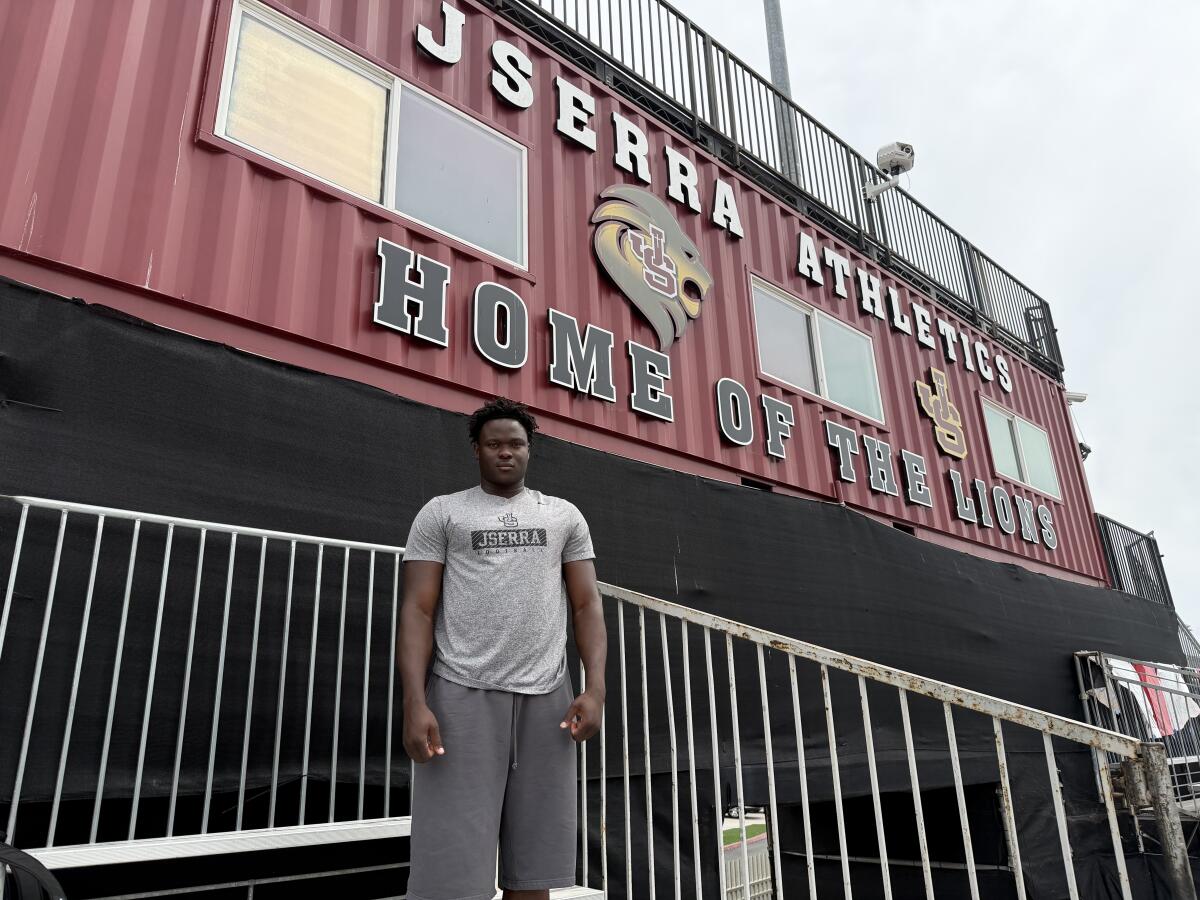
JSerra’s Godschoice Eboigbodin is a 6-foot-5, 260-pound defensive end from Nigeria.
(Eric Sondheimer / Los Angeles Times)
And no visit may have been more special than that of three-star edge Godschoice Eboigbodin.
During at-home visits with defensive ends coach Sam Daniels, the JSerra product was able to connect on a personal level with Daniels, describing him as “family” and “just another one of my friends.”
And at Eboigbodin’s official visit at UCLA, his birth family from Nigeria and host family in Southern California were able to come together for the first time, celebrating his accomplishments and giving the future Bruin confidence that UCLA was home.
“That was the first time both my families met — my real parents and my parents here. I was so excited,” Eboigbodin said. “That is why I had a really good time at my official visit at UCLA because it was really cool having them meet each other, connecting the families together. I was ecstatic.”
Chesney has yet to coach a game at UCLA, let alone one at the Power Four level. Yet, the momentum he has generated is real.
Not only is the 2027 recruiting class exceptional, but also the transfer class that will make up the majority of next season’s starters is excited to build the foundation of the program.
“Guys are bright-eyed and bushy-tailed, coming to work every single day,” Yray said. “We’re excited at the opportunity as a staff of what this presents, and we get to do this, at the greatest place in the world to do it. There’s no better location, there’s no better rich history. There’s really no excuse … to not have success here.”
Record-setting baseball team takes home hardware
From left, UCLA’s Dean West, Roch Cholowsky, Mulivai Levu and Roman Martin share pregame vibes before a 3-2 loss to Saint Mary’s during an NCAA regional at Jackie Robinson Stadium on May 29.
(Scott Strazzante/For The Times)
Since our last UCLA Unlocked newsletter, the Bruins baseball team earned more hardware.
UCLA first baseman Mulivai Levu was named an ABCA/Rawlings Gold Glove winner for the second consecutive season, becoming the first Bruin to win multiple Gold Gloves.
Levu had a .996 fielding percentage while committing two errors all season. He converted 446 putouts, had 21 assists and assisted on 42 double plays.
UCLA coach John Savage was named the Skip Bertman Coach of the Year by the College Baseball Foundation.
The Bruins were 52-8, matching the program record for wins, and their 48-6 regular-season mark was the best in school history. UCLA became the first wire-to-wire No. 1 team, opening and closing the season atop the top 25 in every major poll.
Named after the first coach inducted into the College Baseball Hall of Fame, the coach of the year award celebrates leaders on and off the field.
“I am truly honored to receive this award. Having Skip Bertman’s name on the trophy says everything,” Savage said in a news release. “He’s the legend of legends in this game. As a young coach out West, I always admired and looked up to Skip.”
Savage is the third-longest-tenured coach in UCLA baseball history and has a 776-489-2 record.
Junior shortstop Roch Cholowsky earned first-team All-America honors from Perfect Game, the National Collegiate Baseball Writers Assn., American Baseball Coaches Assn./Rawlings and Baseball America. Cholowsky hit .320 with 21 home runs, 60 RBIs and 73 runs scored while anchoring UCLA’s infield defense with a .965 fielding percentage. He ranked among the national leaders in OPS (1.088), slugging (.636) and on-base percentage (.452), starting all 60 games at shortstop.
Outfielder Will Gasparino was named a first team All-American by the NCBWA. Gasparino hit .314 with 20 home runs, 64 RBIs and 99 hits, finishing among the conference leaders in extra-base hits and total bases. He also posted a perfect 1.000 fielding percentage with 114 putouts.
Closer Easton Hawk earned first-team NCBWA and first-team ABCA/Rawlings All-America honors after posting a 1.93 ERA with 14 saves and 52 strikeouts across 34 appearances, holding opponents to a .187 average. He gave up nine earned runs all season.
Levu and pitchers Wylan Moss and Logan Reddemann earned second-team All-America honors from the NCBWA, while pitcher Angel Cervantes was named to the Perfect Game Freshman All American team.
Do you have a comment or something you’d like to see in a future UCLA newsletter? Email newsletters editor Houston Mitchell at houston.mitchell@latimes.com. To get this newsletter in your inbox, click here.