WASHINGTON — In the span of 10 days, the nation’s capital saw a cascade of ethical scandals that cut across party lines and branches of government, raising fresh doubts about whether Washington is capable of holding itself accountable.
Three members of Congress — two Democrats and a Republican — resigned within days of one another as they faced calls for their expulsion due to their alleged misconduct. A fourth lawmaker is facing the same pressure but has so far refused to step down.
A Cabinet secretary stepped down amid a months-long investigation into allegations that she pursued a romantic relationship with a member of her security detail, while her husband stood accused of sexually assaulting female staffers in her agency.
In a separate case, the Department of Homeland Security confirmed last week that it put a senior counterterrorism official on administrative leave as it investigates an ex-boyfriend’s allegations that she was seeking out wealthy men online to pay for luxury items.
The back-to-back resignations and investigations, spanning both parties and both the legislative and executive branches, have reignited a debate about whether Washington’s rules and institutions for self-oversight can keep pace with the misconduct unfolding within it. Even those charged with policing it say the system is failing.
“Clearly, we have an ethical problem,” Rep. Mark DeSaulnier (D-Concord), the top Democrat on the House Ethics Committee, said in an interview.
DeSaulnier, who has served on the committee since 2023, said the panel is long overdue for an overhaul. He would like to see the committee speed up investigations and give it more authority to root out misconduct before lawmakers can resign to avoid accountability.
“It takes too long,” he said, drawing an analogy to law enforcement standards for officers facing misconduct allegations. “If you’re a law enforcement officer, there are standards for a suspension with pay or without pay. I think we need to take a look at things like that.”
The committee’s records show that since 1976, it has investigated 28 instances in which a House member was suspected of sexual misconduct. The outcome in 13 of those cases was a loss of jurisdiction, meaning the member resigned, retired or otherwise left the House before the committee could reach a conclusion on the allegations.
“Unfortunately, there likely exist matters never reported to the Committee,” the panel said in a rare statement last week. It added that its “greatest hurdle” in evaluating allegations of sexual misconduct is “convincing the most vulnerable witnesses to share their stories.”

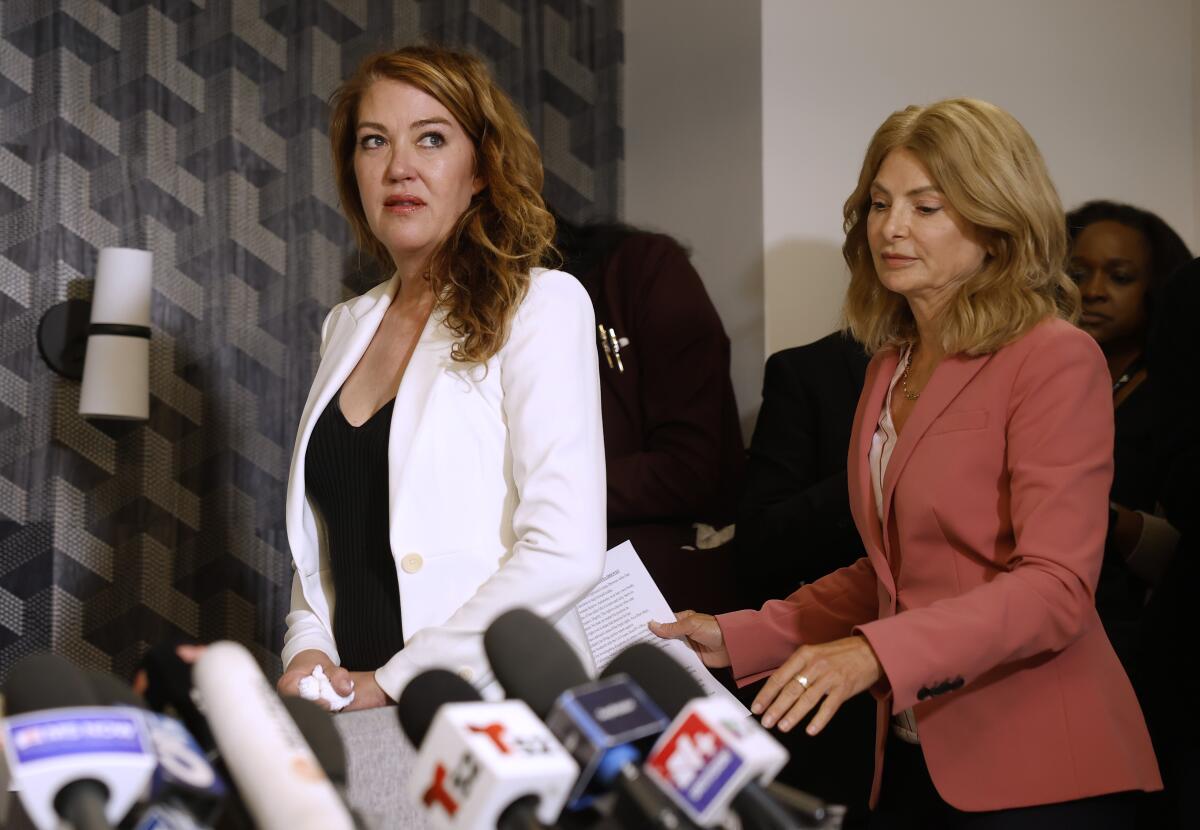
Lonna Drewes, left, and her attorney, Lisa Bloom, arrive at a news conference in which Drewes accused U.S. Rep. Eric Swalwell (D-Dublin) of sexual assault, on April 14 in Beverly Hills.
(Justin Sullivan / Getty Images)
The two most recent cases in which the committee lost jurisdiction were the investigations into former California Rep. Eric Swalwell, a Democrat accused of sexual assault who denied the allegations, and Republican former Texas Rep. Tony Gonzales, who last month admitted to a sexual relationship with a staffer who later died by suicide.
The committee is currently investigating Rep. Cory Mills, a Florida Republican, on allegations of “sexual misconduct and/or dating violence.” Mills has denied wrongdoing and declined to step down, telling CNN that House Speaker Mike Johnson told him not to resign and let the process play out.
Johnson, a Louisiana Republican, has defended his stance on ensuring there is due process for House members, telling reporters last week that representatives should not be removed based only on allegations.
“There’s got to be an element of due process,” he said at a news conference, in which he also acknowledged that “sometimes it takes a long time” to achieve that and that he is open to suggestions on how to make the process better.
House Minority Leader Hakeem Jeffries (D-N.Y.) has also expressed hesitance in ousting members before they receive due process. He said that much in relation to Rep. Sheila Cherfilus-McCormick (D-Fla.), who eventually resigned as she faced an ethics investigation and federal criminal charges of stealing $5 million in disaster relief funds. She has pleaded not guilty to the charges.

House Ethics Committee Chairman Michael Guest (R-Miss.) and Ranking Member Mark DeSaulnier (D-Concord) speak to reporters after a hearing with the House Ethics Committee on Capitol Hill on Tuesday in Washington.
(Anna Moneymaker / Getty Images)
The stance has drawn objections from 14 House Democrats in competitive swing districts, including California Reps. Mike Levin and Derek Tran.
In a letter addressed to Johnson and Jeffries, the lawmakers urged both House leaders to push the Ethics Committee to “expedite their investigation” with more transparency, including public hearings.
“We must demonstrate that no one is above the law and that serious misconduct will result in serious consequences,” the lawmakers wrote.
The calls for reform are not limited to the House.
Sen. Adam Schiff (D-Calif.) said Congress as a whole needs to increase transparency around how ethics complaints are handled and create a system that better protects junior staffers rather than members and senior aides who oversee them.
“The House of Representatives has an office that provides legal advice and representation to staff, but the Senate doesn’t appear to have such a thing,” Schiff said. “So that is also something I’m looking into.”
Schiff is also looking beyond Capitol Hill. He is pushing to install an inspector general inside the executive office of the President, a watchdog position that has never existed there despite being standard across the rest of the federal government.

Inspector General Michael E. Horowitz, left, chair of the Pandemic Response Accountability Committee, and David Smith, assistant director, Office of Investigations U.S. Secret Service, arrive for the House Oversight and Accountability Committee hearing titled Federal Pandemic Spending: A Prescription for Waste, Fraud and Abuse in Rayburn Building on Feb. 1, 2023.
(Tom Williams / CQ Roll Call via Associated Press)
President Trump has fired at least a dozen inspectors general during his second term, according to the New York Times. The dismissals of those independent watchdogs across the executive branch are likely to complicate Schiff’s efforts, which he said will need to “overcome the instinctual opposition of many in the president’s party who may view [the bill] as an indictment of the president’s actions.”
“But if we are ever going to ensure that a president and his administration are not above the law, an inspector general in the executive office is critical,” he said.
Richard Painter, a former White House ethics lawyer under President George W. Bush, said he has long advocated for installing an independent watchdog in the White House but doubts that a Congress operating under its own cloud of scandal would take that step now.
“They are not complying with their own rules,” he said. “It is a big problem.”
Painter also argued that Trump’s own conduct is itself reshaping what members of his own administration and allies in Congress believe they can get away with.
Trump, for example, entered his second term as the first president convicted of a felony — for fraud in a sex scandal involving a hush money payment to adult film actor Stormy Daniels. Separately, he was found liable by a jury for sexually abusing and defaming writer E. Jean Carroll in a decades-old incident.
The president’s past social ties to convicted sex offender Jeffrey Epstein have also received renewed scrutiny as his administration is criticized for the handling of the files. Trump has denied wrongdoing in all three matters.
“That sends a message to the entire administration and to Congress as to what is acceptable,” Painter said.
Trump, who is known for chiming in on myriad topics on social media, has not talked much about the sex scandals on Capitol Hill. But the president did call Swalwell a “sleazebag” in a recent interview with the Daily Mail.
“I don’t know anything about the charges, but he’s a bad guy,” Trump said. “He’s always been a bad guy, he’s a corrupt politician, and everyone knows it, so it’s happening to him, and we’ll see what happens. Right? Let him go defend himself.”
The president has not been as candid with his administration’s own controversies, but watchdogs in executive agencies have scrutinized some of his members.

Lori Chavez-DeRemer attends the world premiere of Amazon MGM’s “Melania” at The Trump-Kennedy Center on Jan. 29 in Washington.
(Taylor Hill / WireImage via Getty Images)
The White House declined to comment on the allegations against former Labor Secretary Lori Chavez-DeRemer, who stepped down last week after multiple allegations of abusing her position’s power, including having an affair with a subordinate and drinking alcohol on the job.
The New York Times reported that Chavez-DeRemer was under investigation by the agency’s inspector general, and that an imminent report was likely to be unfavorable toward her. The investigation had been ongoing for several months before her departure.
In a separate case, the Department of Homeland Security confirmed to the Los Angeles Times that Julia Varvaro, the agency’s deputy assistance secretary, was put on administrative leave amid an investigation into allegations that she was seeking out so-called sugar daddies online.
The scandals come as recent polling shows Americans are growing more dissatisfied with Trump and Congress.
Congress’ approval rating has plummeted to 10%, according to Gallup polling released last week. Public approval of Trump has dropped to 28%, according to a Marquette University Law School poll released earlier this month. The president’s approval ratings are tightly linked to concerns about the Iran war and the economy.
Some lawmakers, like DeSaulnier, worry the scandals will continue to erode Americans’ confidence in the government and the people who represent them.
“If they don’t have trust in these institutions and the people who are in these positions, that’s a real, serious problem for American democracy,” he said.