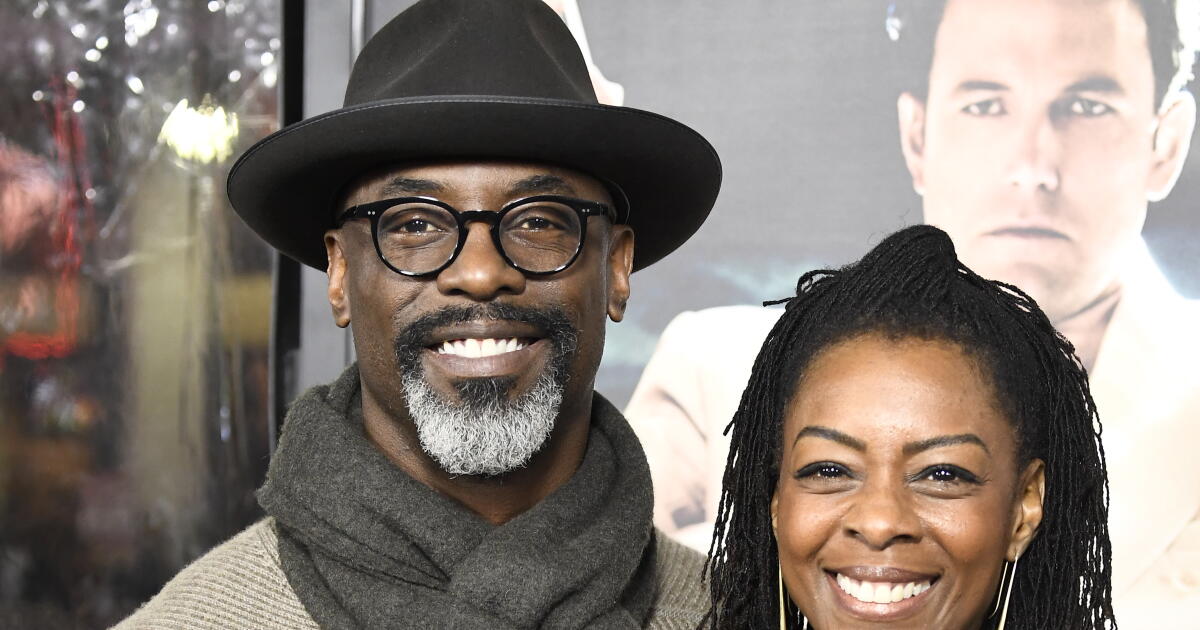
More than a year after the death of his wife, Jenisa Garland, “Grey’s Anatomy” star Isaiah Washington announced the news of her passing.
The actor posted the news on Instagram over the weekend, writing, “Yes … the rumors are true. My dear wife of 29 years collapsed suddenly on May 31, 2025 and passed away on June 9, 2025.”
Washington said his wife’s death “came as a huge shock to me and our entire family.”
“She succumbed to a massive hemorrhagic stroke and never recovered,” he continued, before adding some cautionary advice to his fans. “Listen, y’all … some headaches are not just headaches or migraines, they can be much worse and a warning sign. Get a brain scan if you can and take those headaches seriously.”
A hemorrhagic stroke is less common than an ischemic stroke, but it is more fatal and occurs when a blood vessel leaks or ruptures in the brain, according to the Mayo Clinic. Causes may include uncontrolled high blood pressure, trauma from a fall or accident, or overtreatment of blood thinners. Signs of a stroke include a sudden intense headache, confusion, trouble speaking, loss of balance, face drooping, sudden blurred vision and more.
“She has been gone 16 months now, but she left 3 incredibly amazing children behind to continue her legacy. I don’t know if this is an appropriate post, because Jenisa Washington was extremely private, but I guess I just have to be reprimanded from her on the other side.”
On Monday, Washington posted a tribute to comedian Reggie McFadden, crediting the “In Living Color” actor with introducing him to his wife more than 30 years ago. “RIP Reggie McFadden,” he wrote on Instagram. “Say hello to Jenisa Washington, because it was you who introduced me to her in 1995.”
Washington played Dr. Preston Burke on “Grey’s Anatomy” in 2005 but was nixed from the medical drama in 2007 after an on-set spat with co-star Patrick Dempsey, a.k.a. Dr. McDreamy, during which Washington reportedly referred to (then-closeted) castmate T.R. Knight, who played George O’Malley, using a homophobic slur. After reports of the behind-the-scenes beef, Knight came out as gay publicly.
Later that year, at the Golden Globes, Washington denied the incident but repeated the word in the process. He ultimately apologized and returned to “Grey’s” in 2014 for a guest spot.
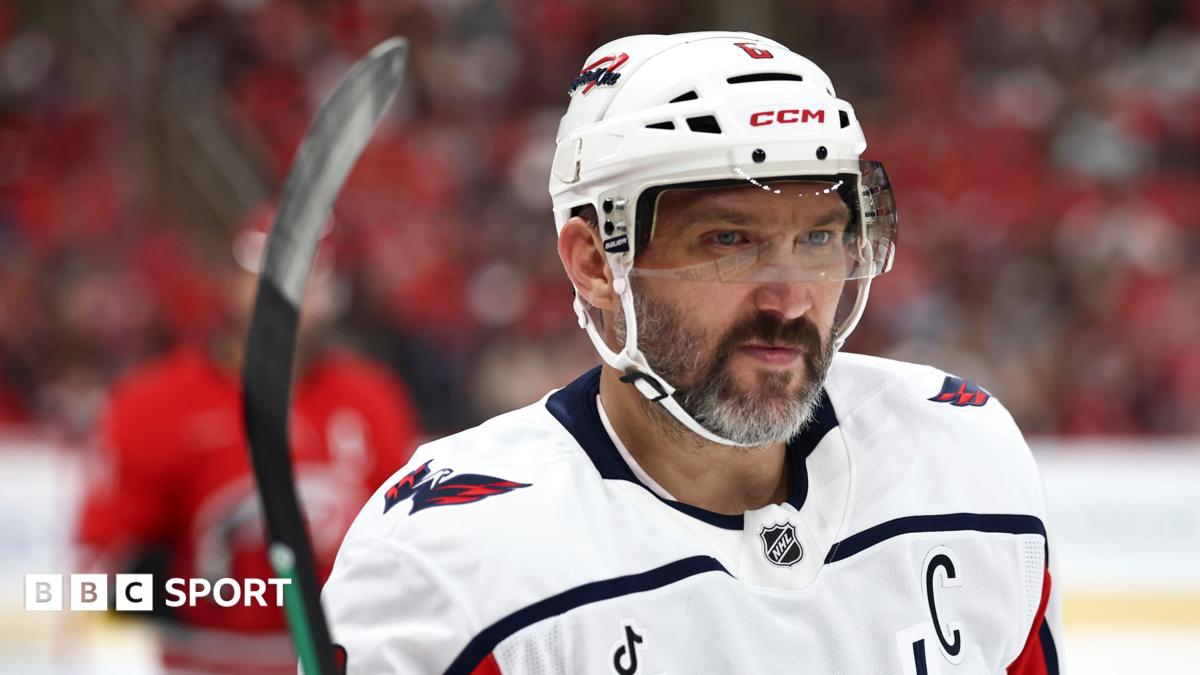
National Hockey League all-time leading goalscorer Alex Ovechkin says he will retire at the end of the season.
The 41-year-old Russian, who plays for the Washington Capitals, claimed the record in April 2025 when he scored his 895th career goal to surpass the legendary Wayne Gretzky’s NHL regular season tally.
Canadian Hall of Famer Gretzky held the record for 31 years having previously overtaken compatriot Gordie Howe in 1994.
Ovechkin said in a statement that he “loves this game so much” but knew that in his “heart it’s the right decision”.
“It was important for me to make this announcement before our first home game, so I have the chance to thank all the people around the game,” Ovechkin said.
“Everyone who has been so important to me and my family and helped me through good times and tough losses.
“I wouldn’t have been able to achieve everything I have in my life without them.”
Ovechkin has 1,688 career points (929 goals, 759 assists) in 1,575 games for the Capitals, the 10th-most points in NHL history.
He’s 11 goals away from passing Gretzky for most total goals (regular season and play-offs combined) in NHL history and four assists away from passing Nicklas Backstrom for the franchise career assists record (762).
Ovechkin will play his first Western Conference home game of the new season on Wednesday when the Pittsburgh Penguins are the visitors to the Capital One Arena.
“I am excited about this season with my team-mates, and we will do everything we can to make this year special,” he added.
“I am going to enjoy every moment with my family, my boys, our fans and everyone who has been part of my hockey career.”
The knives were already out. The boos were already ringing.
At the end of an already brutal week at USC, during which the nation was ready to dance on the graves of the Trojans and their coach, it seemed for much of Saturday that any last shreds of faith in coach Lincoln Riley might melt away in the beating Southern California sun. Not only had the aftermath of their Oregon loss gone as poorly as possible, but now the Trojans were tripping over themselves again, trailing Washington, a middling Big Ten team down to its fourth-string running back, and a chant began to rise above the fray, from the USC student section.
“FIRE LINCOLN!” they roared.
That refrain had only been heard in hushed tones until this past week. But Saturday, before the No. 18 Trojans pulled away with a 25-21 victory, it felt as if their embattled coach stood at the edge of a certain Rubicon, one he may not return from with one wrong step.
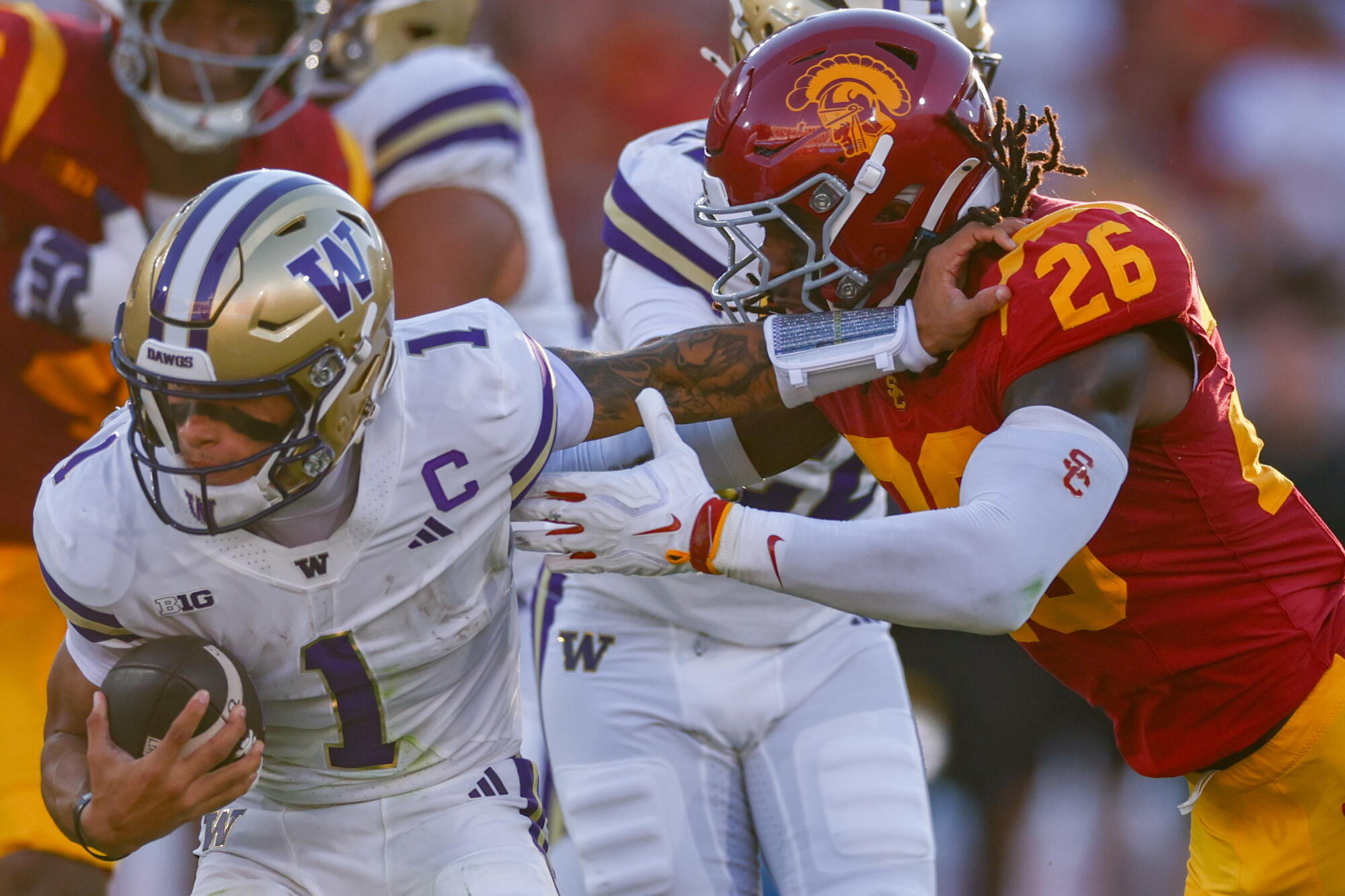
That tension still hung thick over the Coliseum until late in the third quarter, when linebacker Elijah Newby came roaring around the edge toward Washington quarterback Demond Williams Jr. He swatted the ball out of his right hand, and defensive tackle Jahkeem Stewart scooped it up. He sprinted 48 yards on a sore foot for a go-ahead score — and joked afterward that he hit 22 mph on his scoring scamper.
Just two minutes earlier, the Trojans had been down 21-10, and it wasn’t hard to envision how their season could continue spiraling from there. One mistake, one missed opportunity, one penalty after another brought them to this point, despite the fact that the Huskies actually struggled to move the ball on USC’s defense throughout.
It looked, for most of Saturday, like that unit took a step forward after the past two weeks, when both Rutgers and Oregon marched on them. Through one half, USC held Washington to just 44 passing yards. Through three quarters, Washington was averaging fewer than six yards per play.
“The bounce back was huge for us,” freshman defensive end Luke Wafle said.
Washington quarterback Demond Williams Jr., left, tries to fend off USC linebacker Elijah Newby during the second quarter Saturday at the Coliseum.
(Ronaldo Bolaños / Los Angeles Times)
USC’s defense nearly came apart in the fourth quarter, though, at the worst possible time. Washington hadn’t converted a single third down until its final drive, when Williams converted a third-and-11 pass, then hit a fourth-and-two bomb for 43 yards. The Huskies got as close as the USC 12-yard line, before the Trojans finally shut the door.
“We had to dig deep for this one,” Riley said. “Especially as sloppy as we played.”
USC (5-1, 2-1) did try something a little different on defense, with defensive coordinator Gary Patterson calling the game from the press box instead of the sideline. Riley said the decision was akin to “trying to just move the chess pieces to get everyone in the right position.” He also added that Patterson’s former staff at Texas Christian had a lot more familiarity with Patterson’s scheme, and thus he handled things differently with that staff.
But the communication issues of past weeks appeared less of a problem on defense. The real concerns Saturday actually came on offense, where the Trojans uncharacteristically sputtered. Jayden Maiava was 21 of 34 for 245 yards, with a touchdown and an interception.
Still, judging by the box score alone, you’d be hard-pressed to understand how USC could have nearly squandered a game in which they piled up far more yards (360 to 319) and had the ball for far longer (34:58 to 25:02) and dominated on third down.
“We’re gonna fix it,” Stewart said. “No team comes out perfect. It takes time.”
After a disappointing few weeks on the defensive end, USC actually opened the game by forcing Washington (3-2, 0-2) into back-to-back three and outs.
But the Trojans managed a measly three points from those stops. Their first drive, stalled in the red zone. The next one backed up USC to the one-yard line after wideout Terrell Anderson muffed a punt.
Washington took advantage of the field position on its next drive. Faced with a fourth and seven in USC territory, Williams slipped past pressure and scampered to a first down. It was the first sign of life from the Huskies’ offense, which found its way into the end zone four plays later.
Then, USC gave the ball right back. On the run, Maiava launched a pass off his back foot under heavy pressure. It fell well short of its target and was picked off.
USC’s defense held strong, forcing a third three and out in the Huskies’ first four drives. And its offense finally held up its end of the bargain, with Waymond Jordan punching in an eight-yard touchdown.
USC quarterback Jayden Maiava scrambles during the first half against Washington at the Coliseum on Saturday.
(Ronaldo Bolaños / Los Angeles Times)
Washington continued to struggle moving the ball, but mistakes from USC helped its cause. An illegal formation penalty wiped away a deep Trojan touchdown pass to Kayden Dixon-Wyatt. Then on the ensuing possession, Wafle grabbed Williams’ face mask as he pulled him down for a sack.
USC had more penalty yards (50) than Washington had passing yards (44) in the first half. And those penalties gave the Huskies life at the end of the half, as they drove the length of the field and scored again.
“We felt like we were outplaying them,” Riley said. “We just couldn’t get out of our own way a little bit. That’s probably going to be a defining thing for this team going forward, how much we can do that.”
With a chance to regroup, the Trojans tripped over themselves out of the half too. An unsportsmanlike penalty killed their opening drive. Then, Washington tight end Decker DeGraaf caught a pass and took off down the sideline, running through two feeble-arm tackles on the way to an inexplicable 42-yard touchdown.
After that, the Riley chants rang out from the student section. But the Trojans’ offense mounted a 13-play scoring drive in response. Tanook Hines tore the ball away from a Washington defender in the end zone.
USC coach Lincoln Riley walks back to the sideline after speaking with his players during a timeout in the first half Saturday.
(Ronaldo Bolaños / Los Angeles Times)
Less than two minutes later, Stewart scooped up the fumble and took off. His 48-yard return completed a 12-point swing for the Trojans.
“To overcome all that and still win shows me some of the guts and toughness and culture in this room right here,” Riley said. “We could’ve folded.”
Still, USC couldn’t put Washington away. Down to their last drive, the Huskies converted a third and 11 and two fourth downs to drive deep into Trojan territory late.
But Kameryn Crawford pulled Williams down for a sack — the Trojans’ fifth of the game — and the defense held. And USC, at the end of a long, brutal week, breathed a sigh of relief.
William Serafino is a political scientist with a master’s degree in history. His research and analysis have focused on geopolitics. In this interview, he discusses Venezuela’s current relationship with the United States, including a major oil deal and what Donald Trump and Delcy Rodríguez seek to gain from it.
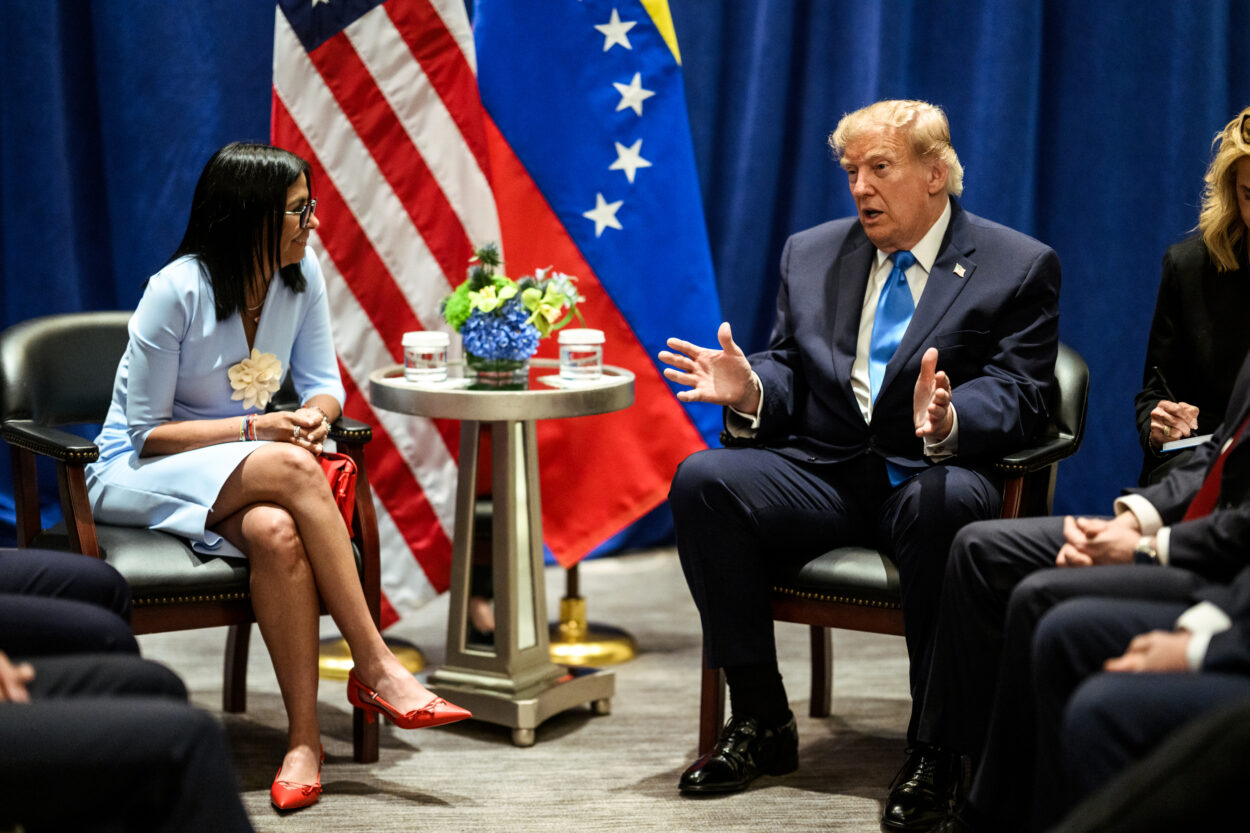
In New York, Venezuelan Acting President Delcy RodríguezthankedTrump for his support and described their bilateral meeting as “historic.” Nearly nine months after the January 3 US bombing and kidnapping of President Maduro, how would you describe the current relationship between Caracas and Washington? Which elements are short-term Trump gimmicks, and which ones will structurally define the relationship in the future?
It is difficult to find a precise definition. Many speak of a protectorate-like condition; some even go so far as to describe it as a relationship of colonial or neocolonial subjugation. Others, however, define it as a process of political, economic, and energy normalization in which the Venezuelan acting government makes tactical concessions, but without formally compromising national sovereignty. I believe the devil is in the details, not in one-size-fits-all approaches. At the level of inter-state relations, what I observe is a strategic attachment of Venezuela to the US sphere of influence and an energy realignment that operates with significant geopolitical restrictions in what concerns relations with Russia, China, and Iran.
At the governmental level, an asymmetrical alliance (favorable to Trump) has been forged in the wake of the military defeat on January 3, from which Caracas and Washington derive immediate and existential gains: Trump cherishes the sole geopolitical achievement of his second term, and Rodríguez gains relief and fresh revenue to govern after more than a decade of suffocating sanctions, within a framework defined by US interests. This reality can hardly be classified as a protectorate, in which a foreign power takes control of diplomacy, defense, and other strategic elements of the subordinate state. Could one speak of a sui generis, or “soft,” protectorate? Perhaps, but that would be an acknowledgment that the concept is not entirely effective in explaining the situation.
The same is true of the thesis of a “retreat with full sovereignty,” which is difficult to sustain when the US is clearly shaping the portrayal of the new national political dynamic and controlling the country’s oil revenues. That is why I have ventured –at the risk of being wrong –to speak of “joint governance” or “co-government,” in which Washington and Caracas divide areas of responsibility and share the political costs of each move so that the alliance endures and each party can, albeit unequally, reap its corresponding share of the benefits.
Trump, despite his constant demeaning tone, needs the Rodríguez administration to be strong enough to lead the country in order to get what he wants; only under such conditions can he extract the oil. And she, too, needs Trump to remain in power so that the oil agreement and other commitments can move forward in the medium term. This is the only way to stay in power and hope to gain legitimacy through performance. I believe that, described in this way, we are talking neither of classic colonialism nor of uncompromised sovereignty, but of something more unique that requires developing other analytical categories.
Rodríguez met Trump on the sidelines of the UN General Assembly in September. (Presidential Press)
In your articles, you have pointed out that the US-Venezuela oil deal must beanalyzedbeyond the announced figures. What do you consider to be the true political and geopolitical scope of this agreement, and what benefits do the various actors seek to extract from it?
I see it more as a political arrangement than a formal agreement. Its function is not legal or institutional, but political. The announcement gave Trump narrative ammunition to promise that gas prices will drop, a necessity driven by his debacle in Iran. By not having signed anything, he avoids going through Congress, sends a message to his core electorate that he is guaranteeing the country’s energy security, and reassures energy corporations to go ahead and invest in Venezuela because the relationship with Caracas is solid and unshakable. Rodríguez, on the other hand, benefits from the fact that the agreement shuts the door on María Corina Machado in Washington’s power circles and thereby helps reestablish her domestic legitimacy, promising a secure path to economic and social recovery underpinned by US investment.
I would go as far as saying that the agreement is Rodríguez’s trump card in a potential presidential campaign, where she will be able to present herself as the only political actor capable of boosting the economy, as opposed to potential rivals who lack influence in the White House and do not have a reliable plan to pull the country out of the spiral of inflation and economic frustration in which it finds itself after years of sanctions.
Both sides stand to gain politically, and the agreement appears to be designed to avoid institutional resistance: neither is forced to face the hassle of legislative approval nor the criticism from political opponents. Since there are no specific clauses, they can more easily divert attention and focus their message on the eventual economic benefits. This level of coordination is a sign of partnership, not of one-sided imposition. If that were the case, Trump could force Rodríguez to sign a bilateral treaty in the National Assembly, and that is not what we are seeing.
You have paid special attention to the role of the Pentagon and the involvement of its Office of Strategic Capital in the structure of the agreement. Why is it so significant that the US defense establishment is a formal actor in a Venezuelanoil deal?
It seems to me that the Pentagon’s involvement serves as a coercive cover—an insurance policy backed by force—to ensure, in the medium and long term, US commercial and financial advantages in the exploitation of the oil fields included in the agreement. Let us imagine that the current government, or another one in the future, wants to modify the arrangement and secure better terms. At that point, it would not be dealing with a conventional transnational corporation, but with one controlled by the Department of War. It doesn’t take much thought to realize that negotiating under such conditions would scare anyone off: the language of business would be replaced by the language of weapons, and after January 3, no one would want to venture into this murky territory.
Furthermore, I believe that the Pentagon’s involvement sends a message to companies to invest and feel secure in the knowledge that the Department of War guarantees their investments and capital commitments in the Venezuelan energy sector. For the US, Venezuela’s oil reserves are not being treated as an economic asset, but rather as a matter of “national security.” As we well know, when that term is used, any coercive tool is fair game against a country’s sovereignty.
Serafino argues that the oil deal with Trump could be a “trump card” for Delcy Rodríguez in a future electoral campaign. (El Salto)
You have argued that the relationship between Caracas and Washington is taking on the characteristics of a negotiation marked by a profound power asymmetry. And many official spokespeople or analysts ask, “But what alternative do we have?” whenever criticism is raised about the path the government has chosen. What real ability does Venezuela have today to negotiate different terms or reject certain demands from the United States?
Right now, those capabilities are very limited, because, as I said, it’s not just a matter of US impositions, but also of calculating how to obtain tangible benefits from an asymmetrical relationship. But politics also takes place outside institutional spaces, and I believe there is much to be done there. What I’m about to say won’t, I don’t think, resolve the dilemma you’ve raised, but it could be a path toward regaining political vitality and initiative: strengthening social consensus on national sovereignty, refusing to concede the battle for historical memory regarding a century-long history of US plunder, and fostering a broad discussion on the vision for the nation’s future. These steps could help break the inertia somewhat and prepare the country for more favorable political conditions in the near future. In contrast, suggesting specific policies or positions to the current government would be irresponsible, because I’m not the one who has to deal with a Trump and his violent ego.
My message is directed at all of us who do not hold such high-stakes positions and can contribute, from our own small spheres of influence or through our individual activism, to rebuilding a patriotic consciousness that must adapt to a new reality. How many open forums are being promoted to discuss the educational model, the economic model, and the model of income distribution? Which bodies are evaluating the trajectory of the bilateral relationship with the US in order to better address it? Are these discussions conceptually limited? Perhaps these debates will not change the current situation of Trump’s disproportionate influence, but they would give us autonomy in our vision and in shaping the future. If Venezuela does not have its own vision on major national issues, there is a risk that they will end up being imposed from Washington. That would be committing the perfect crime, and I believe we must avoid it: with national unity, transcending political divisions.
In your articles and social media posts, you have criticized political elites who, historically, have lacked “imagination” beyond offering lucrative deals to the US. How did Chávez manage to break that mold? How could Venezuela return to a more sovereign path?
To be fair, Chávez broke the mold but the political and geopolitical conditions were ripe for it. The weakness of the national elites, discredited by a society weary of inequality and injustice, coincided with the US being drunk on power at the end of the Cold War. In its plans to establish itself as a unipolar superpower, Latin America did not figure as the central battleground. The inattention of an empire more concerned with reshaping West Asia, forcing China into the “rules-based order,” and eliminating the last strongholds of the socialist bloc (Tito’s Yugoslavia) in turn allowed Chávez to implement his agenda without facing a full-scale war, although he did face numerous coup attempts.
The present conditions are different. There is a hemispheric imperial retreat underpinned by a militarized reinterpretation of the Monroe Doctrine, which drastically raises the cost of sovereignty-oriented proposals. Still, I believe that what is most commendable about Chávez, and which can be of use in this new context, is his ability to clearly identify favorable conditions and act upon them.
I believe that anyone who considers themselves a political figure must build upon these principles to take on the new challenges of the present, developing and defending a dignified vision of the nation’s future. I believe that, rather than waiting for another Chávez to emerge, we should instead study his thought in depth and draw on the best of it to renew political practices, always interpreting the situation for what it is: changing, volatile, and full of opportunities. Chávez is a great political school, but it has been reduced to a crude tool for private interests of all kinds.
Serafino referred to Chávez as “a great political school.” (Comando Creativo mural in Ciudad Caribia)
SEATTLE — A judge on Thursday overturned President Trump’s decision to fire the court-appointed top U.S. prosecutor in Seattle, the latest development in a legal tug-of-war over the administration’s efforts to control who occupies the powerful Justice Department posts.
The 17 active and senior judges in the Western District of Washington unanimously named Roger Rogoff, a former judge and veteran prosecutor, U.S. attorney in July, after Trump failed to fill the post with a nominee confirmed by the U.S. Senate.
The president fired Rogoff less than an hour later. Rogoff sued, and in a ruling Thursday, U.S. District Judge Stanley Bastian found the termination unlawful and reinstated him.
Bastian noted that when presidents fail to fill a U.S. attorney post with a nominee confirmed by the Senate, federal law authorizes the judges of that district to appoint someone “until the vacancy is filled.”
“It does not say ‘until the president fires the person selected,’” Bastian said.
He concluded: “Mr. Roger Rogoff is the United States attorney for the Western District of Washington and has been the rightful holder of that office since July 15, 2026, when he took the oath of office.”
The Justice Department said in a written statement it disagreed with the decision and would appeal.
Rogoff is the latest in a series of judicially appointed U.S. attorneys to be ousted by the Trump administration, and he is believed to be the first to sue over the removal, setting up a direct legal battle over the issue.
Presidents normally appoint U.S. attorneys, the top federal prosecutor in each judicial district. The positions require Senate confirmation, except in temporary appointments, which can last up to 120 days. When temporary appointments expire before a nominee is confirmed, the judges in a judicial district can name a U.S. attorney.
But under Trump, the Justice Department has sought to leave unconfirmed prosecutors in their positions indefinitely, often through novel personnel maneuvers. Trump named Charles Neil Floyd, who previously served as an immigration judge, interim U.S. attorney in Seattle in October 2025 but never forwarded his nomination to the Senate.
When Floyd’s time as interim U.S. attorney expired, Trump simply shifted his title, a tactic the administration has also tried in other federal judicial districts: It named him first assistant U.S. attorney, while leaving the top post empty.
Trump last month nominated Pete Serrano, the first assistant U.S. attorney in eastern Washington, to be the U.S. attorney in Seattle. But Serrano has not been confirmed, and his nomination is opposed by Washington’s senior Democratic senator, Patty Murray.
“Today’s ruling is an important victory for the rule of law and the people in Western Washington who deserve a U.S. attorney that answers to the law, not Donald Trump,” Murray said in a written statement Thursday.
Bastian is the chief judge in eastern Washington. He heard the case because the judges in western Washington were recused.
In December, Alina Habbaresigned as the top federal prosecutor for New Jersey after an appeals court said she had been serving in the post unlawfully.
Lindsey Halligan, who pursued indictments against a pair of Trump’s adversaries, left her position as an acting U.S. attorney in Virginia after a judge concluded her appointment was unlawful and that indictments she brought against James and former FBI Director James Comey must be dismissed.
The judges there named James Hundley, who had handled criminal and civil cases for more than 30 years, but the administration fired him. It also fired a court-appointed U.S. attorney in northern New York.
MIS-TEEQ’S Sabrina Washington has made a huge U-turn as she AXES her own solo tour and issues a grovelling apology to fans after sparking mass confusion.
Sabrina Washington has U-turned on her solo tourCredit: GettySabrina is part of hit band Mis-teeqCredit: PA
Just days after Mis-teeq’s sold-out 25th anniversary reunion concert in London, Sabrina declared that there would be no further Mis-Teeq dates or new music – which left fans completely baffled.
But now she has sensationally backtracked on all of that.
Sign up for the Showbiz newsletter
Thank you!
In a statement shared on social media, Sabrina said: “I have been paying close attention to what people have been saying, reading the comments and trying to understand what you genuinely want to see from me.
“And one thing has come through very clearly: there is a strong desire to see the three of us perform Mis-Teeq’s greatest hits together again.”
Sabrina, Su-Elise Nash and Alesha Dixon performed in London last month for a reunion gigCredit: ShutterstockSabrina’s solo announcement left fans shockedCredit: Shutterstock
She went on: “Ultimately, I don’t want to push ahead with a solo tour when I know there is such a strong feeling among fans about seeing Mis-Teeq together again.
“So, with a heavy heart, I have decided that the right thing for me is to cancel the tour.”
Sabrina added: “This is not a decision I have taken lightly. But for me, the fans have to come first.”
She noted that although she is cancelling the tour, she is not putting her own music to one side.
“I have been working on new solo material,” she revealed in the statement.
She then addressed her comments about going solo and Mis-teeq having no new plans in the pipeline.
“I now understand that my plans may not have been fully communicated to Alesha and Su-Elise before the announcement.
“Looking back, I could have shared more detail with management and spoken to the girls directly beforehand, and for that I am sorry.”
Sabrina added: “I have never closed the door on Mis-Teeq. I said on GMB, and I want to say again: I would never say no to another Mis-Teeq show.
“If the right opportunity came along and the three of us all wanted to do it, I would absolutely be open to that.”
Fans were quick to brand her “courageous” and “brave” for speaking out, though some were annoyed as they had already booked tickets to her now-axed solo tour.
WASHINGTON — Long before he was the top official at the U.S. Postal Service, David Steiner was a corporate executive surfing mid-oughts television when he came across Donald Trump on “The Apprentice.”
He was unimpressed.
“If that is leadership, if that’s what we’re telling people that our culture and our media portrays as leadership, we’re screwed,” Steiner, then the CEO of Waste Management, said during a 2007 speech at the University of Arkansas Clinton School of Public Service. “If that’s leadership, count me out.”
“And for God’s sake,” he added to laughter, “if I have to get my hair to look like that, if I have to do that to be a leader, you can definitely count me out.”
Nearly two decades later, Trump has migrated from reality television to the presidency. And onetime detractors — Vice President JD Vance, Secretary of State Marco Rubio and Sen. Ted Cruz of Texas, for example — now loyally execute his agenda.
Trump’s effort to use the Postal Service as a tool to reshape American elections is testing whether Steiner will follow a similar path.
Independent or a Trump ‘pawn’?
When Trump signed an executive order restricting mail ballots this year, Steiner moved quickly to finalize a rule implementing the measure, arguing he had little choice. But after the U.S. Supreme Court rejected the effort, Steiner told The Associated Press that work had stopped on one of the plan’s most controversial elements, a government portal for voter rolls.
He refused to endorse the Republican president’s order as sound policy, saying he was focused on implementation and letting the courts ultimately decide the matter.
“I don’t get to decide what rules that are put on us that I decide to accept or not accept,” he said. “We are an independent agency of the executive branch.”
The episode prompted fierce criticism of Steiner for allowing Trump to deploy an agency designed to be shielded from politics.
Jena Griswold, Colorado’s Democratic secretary of state, called him a “Trump lackey.” Nevada Secretary of State Cisco Aguilar, a Democrat, recently asked Congress to deploy observers to ensure postal workers can scan envelopes holding mail ballots without disruption, saying the Trump administration “has attempted to weaponize federal agencies to interfere in our elections, and the leadership at USPS is going along with it.”
Sen. Elissa Slotkin, D-Mich., accused Steiner of being a Trump “pawn” during a congressional hearing this summer. Dozens of congressional Democrats have pressed Steiner to reveal his interactions with the White House during the development of the mail ballot rule.
Some Republicans have joined in the criticism. Sen. Josh Hawley of Missouri, incensed by abandoned mail, called for Steiner’s resignation and introduced legislation to block him from receiving a bonus.
During a lengthy interview, Steiner seemed surprised at points by his reception in Washington. He insisted he wasn’t a “political person” and said he had no intention of stepping down despite the criticism. He dismissed heated congressional appearances as “theater” at odds with more substantive private interactions on Capitol Hill.
Steiner was chagrined, however, at the mention of his 2007 remarks on Trump, delivered well before he launched a political career. Steiner recalled speaking at the university but said he didn’t remember his comments, acknowledging a tendency to be “flippant.”
“That’s funny,” he said. “I don’t recall it.”
The White House didn’t respond to a request for comment on Steiner’s remarks or his stewardship of the Postal Service.
Steiner didn’t follow the traditional path to power in Trump’s Washington
The Postal Service dates to Benjamin Franklin, the first postmaster general, whose portrait and bust are displayed in Steiner’s office overlooking the Washington Wharf. The agency has more than 630,000 employees, dwarfing many Cabinet departments.
While the quickest way to top jobs in Trump’s Washington is often by writing big checks, the 66-year-old Steiner doesn’t appear to have followed that course. He has largely donated to Republicans but also gave to John Kerry’s Democratic presidential campaign in 2004. Unlike his predecessor as postmaster general, Louis DeJoy, Steiner was not a major GOP donor or Trump backer.
Born in Oakland, California, as one of eight children to a father who spent his career at Chevron, Steiner worked in corporate and securities law before moving to Waste Management in 2000. He became CEO in 2004 and ran the company for 12 years. He was also a longtime director at FedEx, where board chairman Brad Martin recalled him as “outcome oriented” and rarely political.
“He’s going to follow the rules. He’s going to follow the law,” Martin said. “I don’t recall us ever talking politics.”
By the time a headhunter contacted Steiner about the postmaster general job, he was largely removed from daily corporate life and initially demurred.
“I talked to my wife, and we both agreed I was happily retired,” he said.
He changed his mind, he said, during a visit to the beaches of Normandy, feeling a sense of civic duty.
Now at the Postal Service, he earns about $346,000 in annual salary along with a relocation bonus that amounts to half his salary, far less than the $17 million in compensation he earned during his final year at Waste Management. His current role is designed to exist one layer removed from the political process, reporting to a board of governors that is selected by the president and confirmed by the Senate.
He was hired in 2025 by a board that was made up of five members, three of whom were Democrats. All but one were appointed by President Joe Biden. That makeup could change as four Trump nominees — all Republicans — await Senate confirmation. Steiner can be fired only by the board.
Steiner said he first met Trump along with Commerce Secretary Howard Lutnick at the board’s urging after he was already selected as postmaster general. Since then, he described a minimal relationship with the White House.
“We don’t fly on the radar,” he said.
That is, until Trump revived his effort in March to crack down on mail voting. Steiner said he “wasn’t in on the development piece” of the order and first saw it about a month before it was signed.
“They gave it to us to say, ‘Have your lawyers look at it, and how do you operationalize it?’” Steiner said.
The portal spurred a massive development effort inside the Postal Service while some states criticized it as federal overreach. A whistleblower report released by Sen. Richard Blumenthal, D-Conn., argued the system was hastily built and riddled with errors, though Steiner said he was confident it could have been unveiled around Sept. 15.
“The heavy lifting was clearly, clearly the IT work,” Steiner said.
Challenges ahead for the Postal Service
Though the Supreme Court dispensed with the rule, the dynamics for the Postal Service don’t get easier.
The agency posted a $9 billion net loss last year, and Steiner has warned it could soon run out of cash unless Congress lifts a $15 billion borrowing cap. Political hurdles have prevented potential cost savings from cutting service or closing some post offices.
And while Trump’s executive order won’t take effect, the Postal Service will still play a critical role in this year’s elections. There are mounting concerns that mail ballots could be rejected for late postmarks. Steiner encouraged voters to get their ballots in a week before the election to avoid problems.
The Postal Service is a rare corner of government still viewed favorably with more than half of Americans, 56%, saying it was doing an “excellent” or “good” job in a Gallup poll conducted last year. That could change if the agency is seen as increasingly political.
Steiner, however, said Americans will judge the Postal Service by their experience of it.
“What they care about is when they get that wedding invitation after the wedding or when they send a package and it disappears,” he said. “If we want to have the trust of the American public, let’s be the best service provider. Everything else is noise.”
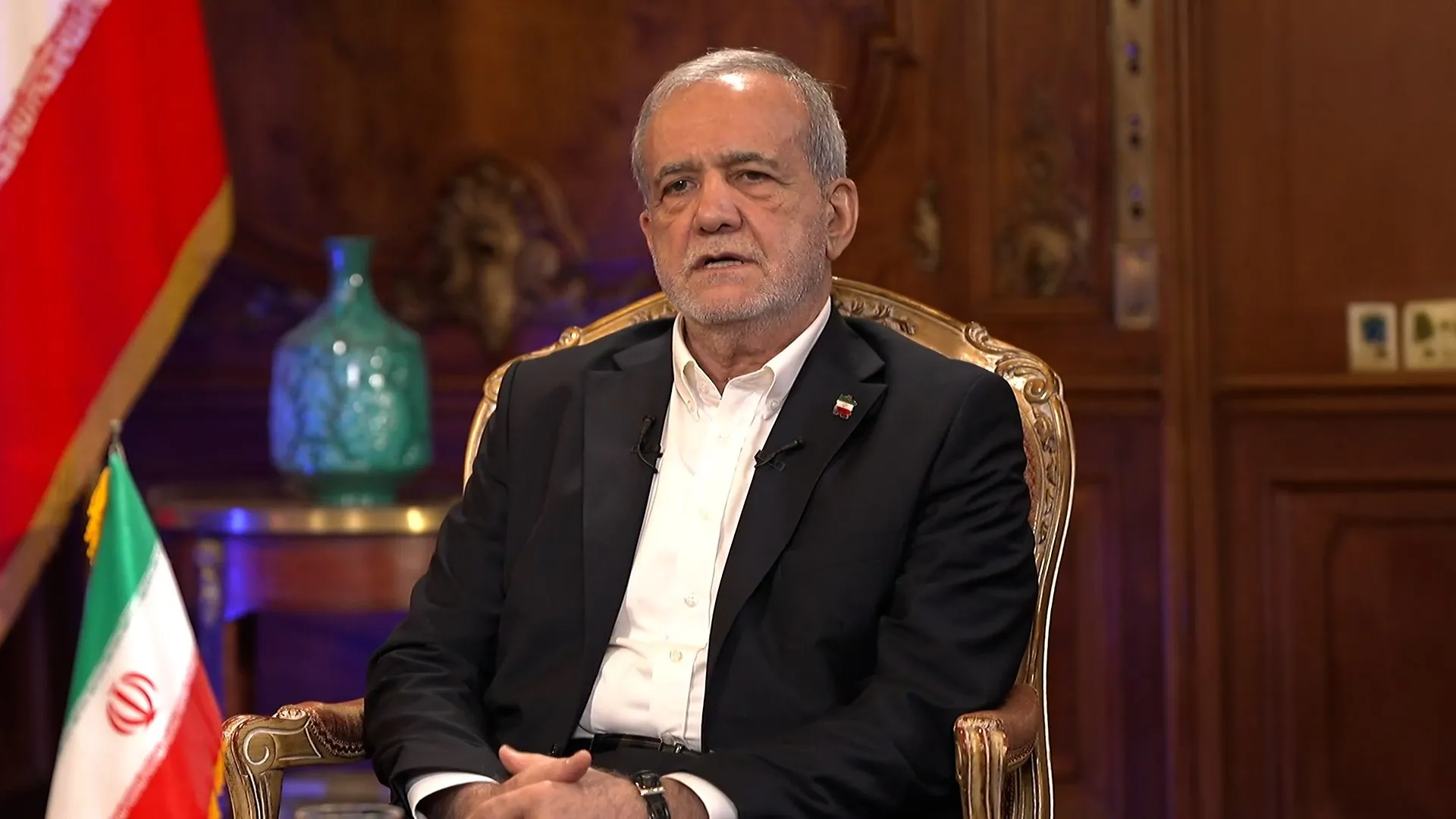
Iran’s President Masoud Pezeshkian told Al Jazeera that Tehran no longer trusts talks with the US after previous negotiations were followed by attacks and sanctions. His comments came shortly before Donald Trump rejected Iran’s proposal to reopen the Strait of Hormuz within seven days.
Colombian President Abelardo De La Espriella has emerged as close ally the of Trump administration in South America.
Published On 26 Sep 202626 Sep 2026
The Colombian government has extradited an alleged drug trafficking leader to the United States, part of a shift in the country’s security policy into greater alignment with Washington.
President Abelardo de la Espriella announced on Friday the extradition of Geovany Andres Rojas, who is accused of leading an organisation formed by previous members of the FARC rebel group.
Recommended Stories
list of 3 itemsend of list
“You don’t build peace by protecting narco-terrorists like this bandit,” de la Espriella said after he personally oversaw Rojas’s transfer to the US. “I ask US authorities … that he cannot negotiate deals that will leave his crimes unpunished.”
De la Espriella’s left-wing predecessor, Gustavo Petro, shielded Rojas from extradition in order to use him as a mediator in talks between the government and armed and criminal groups, which Petro sought to rein in through negotiations rather than military confrontation.
The far-right president has tossed out that approach, promising to crack down on groups that split off from the former FARC rebel group following a peace deal with the government in 2016. Many of those groups have jostled for control over lucrative drug routes and illicit industries.
Rojas, also known as “the Spider”, was flown to California and placed in the custody of federal agents. He allegedly served as the commander and spokesperson of Comandos de la Frontera, a group associated with cocaine trafficking in the Colombian province of Putumayo that borders Ecuador and Peru.
He will face drug trafficking and terrorism charges in the US, which has sought to expand military operations across Latin America under the pretext of combating crime and drug trafficking during President Donald Trump’s second term in office.
Colombia’s new president has aligned himself closely with those efforts, scrapping peace talks and launching military operations against armed groups since taking office in August.
The New York Times reported that de la Espriella, a former defence lawyer, was previously investigated by US authorities over his ties to powerful drug traffickers, but never charged, and defended politicians linked to right-wing paramilitaries.
Rights groups have warned that a return to militarised confrontation could lead to rights abuses by government forces and an escalation in violence, but many Colombians have expressed support for a harder hand against criminal groups whose operations have often led to violence and mass displacement of civilians.
WASHINGTON — Expectations were low entering President Trump’s meetings with China’s leader, Xi Jinping, this week, after officials on both sides tempered hopes for a breakthrough. Yet the summit’s stark lack of substance surprised even the closest China watchers.
It was a visual affair designed to project a new phase of managed competition between a prevailing superpower and a rising one — a message that Washington and Beijing are ultimately capable of responsible leadership. But even a cursory look beneath the surface revealed the challenges ahead for the world’s most consequential bilateral relationship.
Industry pleas and bipartisan calls for Trump to negotiate a meaningful framework on artificial intelligence fell on deaf ears. A trade truce between the two sides was extended for a mere two months. And Trump again warned Xi not to assist Iran as the U.S. war there continues — a warning that, so far, has gone unheeded, with millions of dollars’ worth of crucial Chinese parts reportedly arriving in Tehran by the planeload.
“The U.S.-China relationship has settled into a managed stalemate. It has stabilized at the top without stabilizing underneath,” said Craig Singleton, a senior fellow on China at the Foundation for Defense of Democracies.
“The elaborate pageantry matters precisely because there is still relatively little substantive progress to showcase,” Singleton said. “Trump appears to value the personal relationship as an end in itself. Xi treats his relationship with Trump as a means to shape U.S. choices and forestall future competitive actions.”
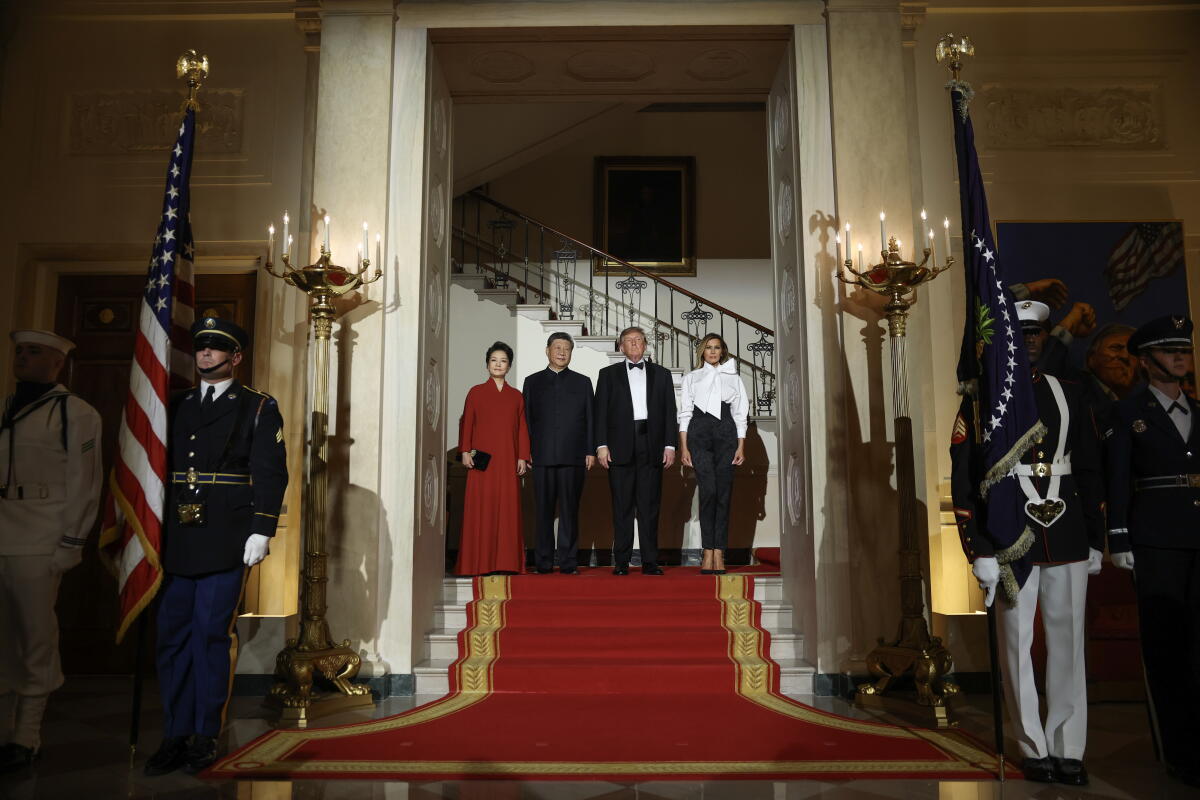
President Trump and First Lady Melania Trump stand with Chinese President Xi Jinping and First Lady Peng Liyuan before Thursday night’s state dinner.
(Kevin Dietsch / Getty Images)
The summit followed a playbook from Trump that has become familiar over the last decade, placing his direct relationships at the center of diplomacy and reducing the complexities of statecraft to blunt attempts at charm.
As he did during his lavish state visit to Beijing this spring, Trump repeatedly patted Xi on the back, a gesture considered highly inappropriate in Chinese political culture that nevertheless reflected Trump’s strategic focus on personal friendship.
He toured Xi around a series of controversial renovations to the White House, including the South Lawn — now paved over with a massive helipad designed as the presidential seal — and the Rose Garden, also paved over in order for Trump to host al fresco dinner parties.
Before entering a heavily gilded Oval Office, Trump walked Xi along a renovated colonnade now adorned with gold-framed portraits of U.S. presidents. He paused at one for his predecessor, President Biden, replaced with a mocking image of an autopen, suggesting the former president was incapable of signing documents himself.
Trump patted Xi on the back once more, and the two men laughed, in a moment that generated outrage online.
“Let’s be very clear on this one point,” John Delaney, a former Democratic member of Congress, wrote on social media. “The President mocking a former President in front of the communist leader of China is the most un-American thing an American president has ever done.”
Tim Cook, executive chairman of Apple Inc., during the state dinner for Chinese President Xi Jinping.
(Annabelle Gordon / Bloomberg / Getty Images)
Part of the state visit included a dinner at the White House that was attended by some of the country’s most prominent tech executives, such as Elon Musk, Sam Altman and Mark Zuckerberg. The tech giants’ presence at the event was notable given that there was heightened public interest in knowing how China and the United States are planning to regulate artificial intelligence.
During the visit, Xi called for artificial intelligence to remain “under human control” as the two countries race for technological advancement in the industry. Lawmakers and AI industry leaders have also called for guardrails on the nascent technology, which experts warn could soon surpass human understanding. Trump, however, has been reluctant to embrace limits on the industry, and it is unclear how much the topic was discussed while Xi was in Washington.
Xi Jinping’s remarks reflect growing concern within China over whether governments in Washington or Beijing will be able to contain a technology with potentially transformative capabilities, according to a U.S. official.
But the visit showed a surprising alignment of visions between the U.S. and Chinese presidents, embracing fierce competition that avoids miscalculation and conflict. Both stressed the importance of dialogue, with Xi invoking the concept of the Thucydides trap, a historical paradigm that holds that rising powers inevitably clash with established ones.
“I don’t think anyone will be surprised if there are no significant agreements,” said David Ochmanek, a senior researcher at Rand. “My sense is that Xi sees little reason to compromise with us on anything right now.”
Trump and Xi arrive for a state dinner in the East Room of the White House on Thursday night.
(Brendan Smialowski / AFP / Getty Images)
The two men are expected to meet twice more this year, alongside other world leaders, at the Asia-Pacific Economic Cooperation summit in Shenzhen, China, and the Group of 20 summit in Miami.
“We do not need to avoid mentioning competition, but our competition should be a healthy one, and should be kept within bounds,” the Chinese president said Thursday from the Cross Hall of the White House. “It should be a race of catching up with one another, not a wrestle in which one either wins or loses. China and the United States must hold the line of no conflict, and no confrontation between us.
“Our two militaries should maintain regular dialogue, and improve mechanisms for crisis communication and prevention,” he continued. “The Thucydides trap can be overcome.”
While Maryland has not compiled a winning conference record since 2010, UCLA will face one of the most refined pure passers in the Big Ten when the Bruins and Terrapins face off Saturday at SECU Stadium in College Park, Md. If the Bruins prevail, Bob Chesney will be the first UCLA head coach to start his tenure 4-0 since Henry Russell “Red” Sanders in 1949.
Maryland signal-caller Malik Washington is the fourth consecutive returning starting quarterback the Bruins have faced, with five left on the schedule, and his play could pose problems for the UCLA defense.
“You can’t leave any stones unturned because he can make all the throws, and he’s got the ability to extend plays with his feet or make plays with his feet,” Hitschler said.
While Washington tied for third in the conference last season in interceptions with nine, the signal-caller set school records for freshman completions and passing yards, throwing for 2,963 yards and 17 touchdowns.
With new Maryland offensive coordinator and quarterbacks coach Clint Trickett at the helm, the Terrapins’ quarterback has taken a leap in Year 2 running the offense.
Through three games, Washington has thrown for 892 yards and six touchdowns with no turnovers.
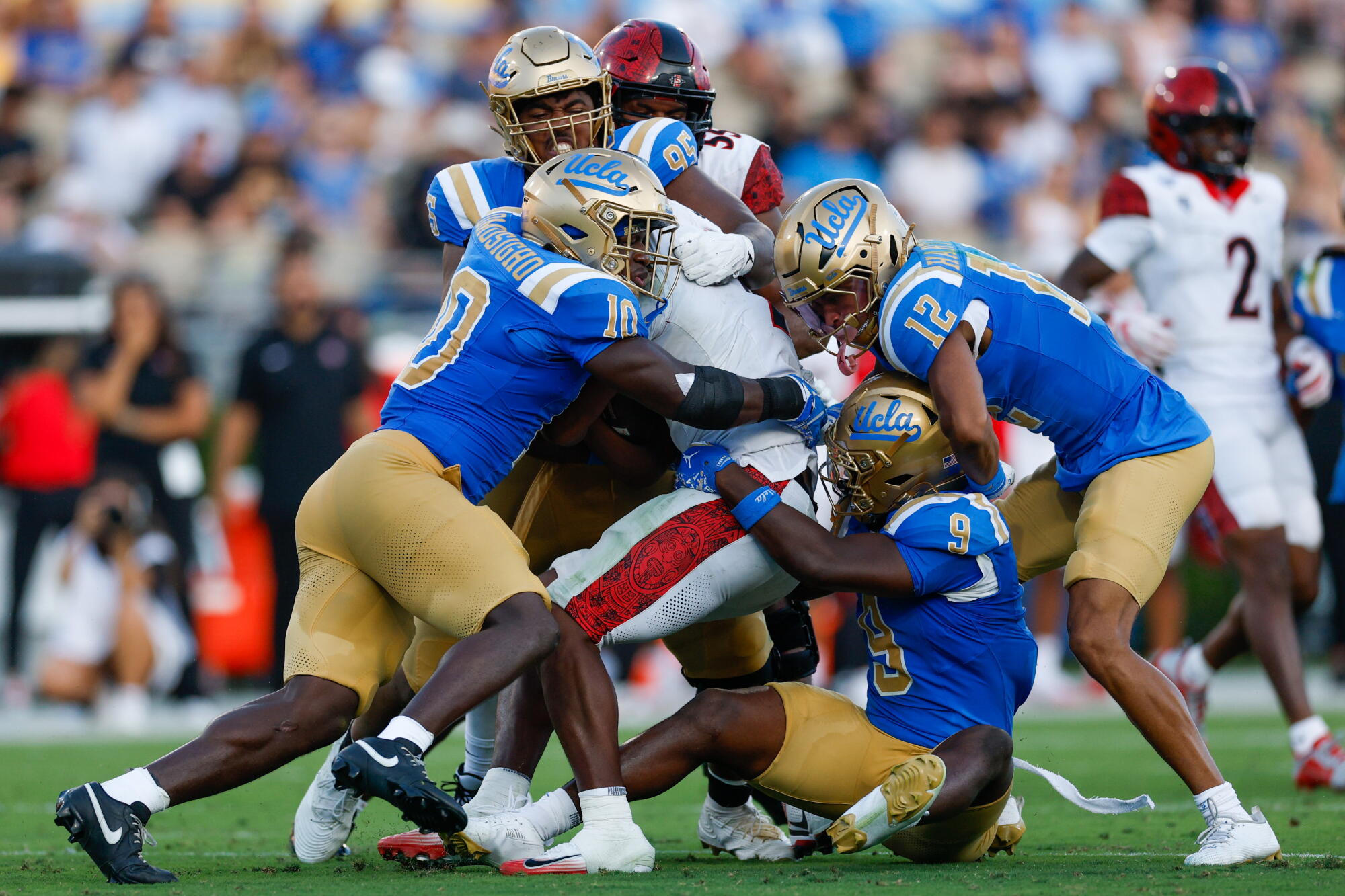
UCLA defenders bring down San Diego State running back Lucky Sutton at Rose Bowl on Sept. 12.
(Ronaldo Bolanos/Los Angeles Times)
“He’s an entirely different quarterback right now,” Chesney said. “He’s an exciting-to-watch player, and he’s got some legit dudes out at receiver right now that are phenomenal. The offensive line is stout. They’ve been playing together for a little while. There’s a lot of things that they do to protect him, and he has a chance to deliver footballs. He’s getting hit sometimes, and just flicking this ball out there. He has a giant arm, and he’s as accurate as can be.”
Washington has benefited from a revamped receiver group after Maryland ranked among the national leaders in drops last season. Maryland coach Mike Locksley added Chris Durr Jr. and Na’eem Abdul-Rahim Gladding, who have become Washington’s top targets.
“Na’eem can play inside, he can play outside. He’s got the ability to separate,” said Hitschler, who faced Gladding when he played for Old Dominion last season against James Madison. “He’s got the ability to run, great routes, get in and out of breaks, and he’s got great hands. And now he’s making plays in the return game too.”
Hitschler’s secondary will be challenged by Washington, who led the conference in pass attempts last season with 473 and leads the Big Ten thus far with 116.
Maryland’s reliance on the passing game could pose problems for a secondary that was picked apart by Purdue quarterback Ryan Browne last week and is still without free safety Tao Johnson.
“There’s obviously plays you would love to have back, obstacles that you overcame and throughout the game they improved and started to figure it out,” Hitschler said of the UCLA defense. “But at the same time, we can’t put ourselves behind the eight ball in moments and we have to execute at a higher level. This game’s fun because you have the opportunity to lose every week. If it was easy, it wouldn’t be fun.”
Offensively, the Bruins have the chance to build off their most productive game yet, scoring 52 points and accumulating 645 yards against the Boilermakers. But, UCLA will have to work to protect senior quarterback Nico Iamaleava, who was hit often and battled multiple injuries against Purdue.
Maryland edge rushers Zahir Mathis and Sidney Stewart combined for 13 sacks last season. And though Mathis was ruled because of an injury, the Terrapins can turn to five-star edge Zion Elee, the highest ranked recruiting prospect in program history.
Given Iamaleava’s fearlessness with his legs and the Terrapins’ effective pass rush, it may be difficult to keep the signal-caller on his feet.
WASHINGTON — China’s president issued a call from the White House on Thursday for artificial intelligence to remain “under human control” as the world’s two superpowers race for technological supremacy.
Xi Jinping’s remarks reflect growing concern within China over whether governments in Washington or Beijing will be able to contain a technology with potentially transformative capabilities, according to a U.S. official.
Lawmakers and AI industry leaders urged President Trump to use his summit with Xi this week to pursue a safety framework for AI, which researchers warn could soon surpass human understanding.
But Trump preempted the meeting with a post on social media stating he had no intention of negotiating limits on AI development.
“A big day with President Xi of China,” Trump wrote. “Super Intelligence (SI) will be a big topic of discussion, but I want to leave it exactly where it is. That is China’s position also. Our guardrail is the DOJ!”
After offering Xi a lavish welcome on the White House grounds, Trump made a passing reference to AI. “The decisions we make in these areas today can promote peace and prosperity for decades and decades to come,” he said.
But Xi gestured to substantial concerns, noting AI first among priorities to discuss between the two nations.
“Both China and the United States are leading nations in artificial intelligence,” Xi said. “We have both the capability and responsibility to develop and manage AI for good — and ensure that the development of AI is always under human control, and serves the well-being of the people.”
The two held a private meeting with aides in the Oval Office after participating in a military review in the Rose Garden and exchanging gifts in the Blue Room.
In the evening, a guest list of top banking and technology leaders — including AI industry executives — were scheduled to attend a state dinner in the East Room of the White House.
“Given Trump’s statements going into the summit about not wanting guardrails, I have tepid expectations about tangible outcomes” on AI, said Aalok Mehta, director of the Wadhwani AI Center at the Center for Strategic and International Studies.
“The most likely scenario seems to be the establishment of a hotline — though how useful that will be depends on who will be staffing it, and how much each government prioritizes it,” Mehta added, “and likely some discussions about issues blocking cooperation, like distillation, with a promise to engage in ongoing dialogue.”
Earlier in the week, on the sidelines of the United Nations General Assembly in New York, Treasury Secretary Scott Bessent met with his Chinese counterpart primarily to discuss AI development, according to U.S. officials.
“What we discussed was setting up a mechanism — so it’s going to be called the U.S.-China AI Dialogue. We’ve agreed to meet again,” Bessent said Monday. “The U.S. has proposed that we have a notification mechanism between the two countries, and we want a shared vision of common goals, and common threats.”
While Trump’s team has remained divided over whether — and how extensively — to regulate AI, Bessent has favored a cautious approach, advocating modest, voluntary guardrails that have shaped administration policy in recent months.
China, too, has shown increasing willingness to open channels of communication on AI, despite deep distrust between the two sides.
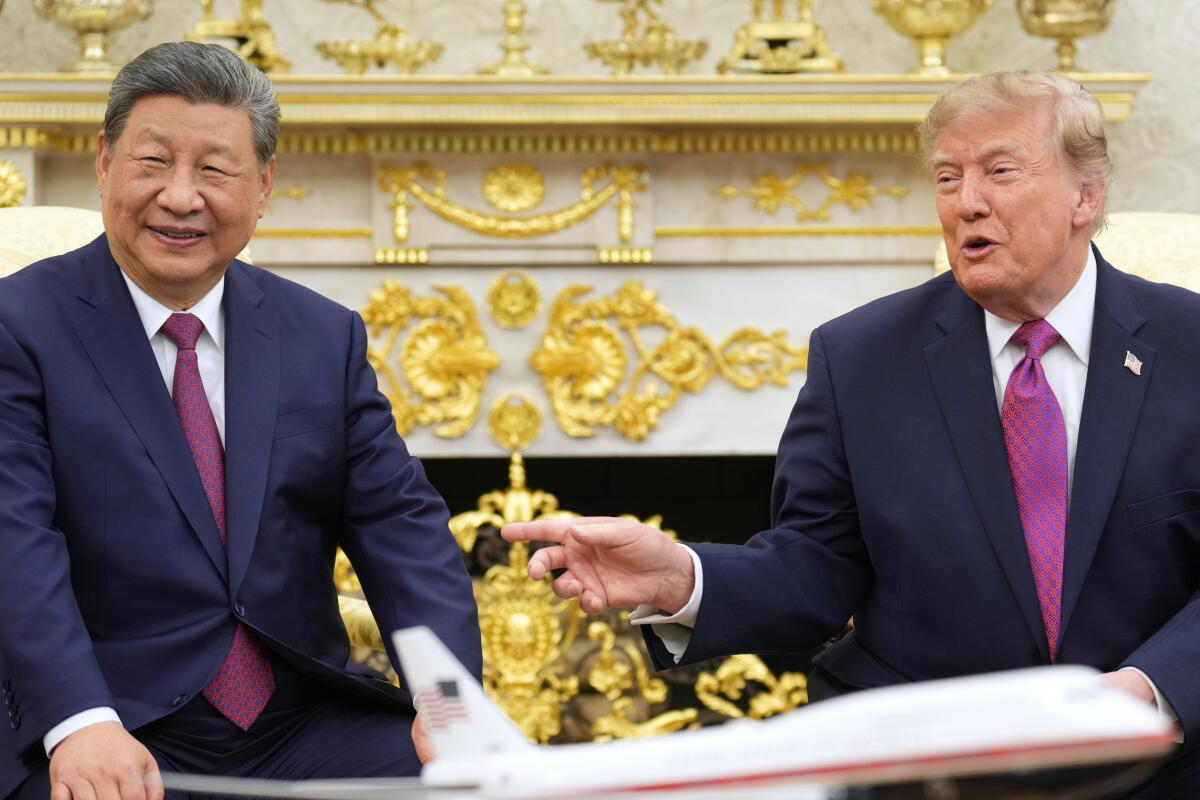
President Trump and China’s President Xi Jinping meet in the Oval Office on Thursday.
(Jacquelyn Martin / Associated Press)
Two American AI companies, OpenAI and Anthropic, are widely viewed to be developing the most advanced AI models in the world, leading at the frontier of technological breakthroughs.
Both have begun to use their most sophisticated models to train the next generation, in a process known as recursive self-improvement. Researchers and industry experts believe the first company to master that process could set off an exponential cycle of progress, pulling so far ahead that competitors can no longer catch up.
But those same companies also fear what they’re creating: machines capable of continuously improving their own intelligence, pushing AI development beyond human control.
Leaders from the two companies have called on Beijing and Washington to cooperate, warning that geopolitical competition could thwart the two sides from preventing a human catastrophe.
In his remarks, Xi said that China and the United States “stand to gain from cooperation, and will both lose in confrontation.”
“We do not need to avoid mentioning competition, but our competition should be a healthy one, and should be kept within bounds,” the Chinese president said. “It should be a race of catching up with one another, not a wrestle in which one either wins or loses. China and the United States must hold the line of no conflict, and no confrontation between us.”
“Our two militaries should maintain regular dialogue, and improve mechanisms for crisis communication and prevention,” he continued, adding a historical reference to rising powers challenging established ones: “The Thucydides trap can be overcome.”
Xi’s trip to Washington follows just months after Trump traveled to Beijing for a state visit in May, where the U.S. president was greeted with a similarly imperial welcome.
The leaders emerged from that summit with few deliverables. But Trump left Beijing declaring the trip a success, emphasizing the importance of his personal relationship with Xi, China’s most powerful leader in generations.
This time, Trump himself greeted Xi on the tarmac upon his arrival at Joint Base Andrews — a rare honor reserved in recent decades only for Catholic popes — before pulling out several red carpets and draped ceremonies for the Chinese leader.
The pageantry seen during the state visit has served China’s long-standing desire for respect and dignity on the international stage, said Jessica Chen Weiss, the director of the John Hopkins SAIS Institute for America, China and the Future of Global Affairs.
“Trump is someone who loves spectacle, and right now the spectacle is working in both leaders’ favor,” Weiss said.
For Xi, the ceremonies have offered a chance to demonstrate that relations with the United States remain under control and that China is being treated as a significant global power, she argued.
The state visit comes at a time when Americans are appearing to warm up to China, according to recent polls. A survey by the Chicago Council on Global Affairs recently found that a majority of Americans say the United States should have friendly engagement and cooperation with China.
“I tend to think we focus too much on the optics,” Weiss said. “But I also think treating China as a significant player on the world stage is not a concession. It’s appropriate if we want a stable relationship and is hardly something to worry about.”
WASHINGTON — When Chinese President Xi Jinping arrives in Washington on Wednesday, he’s expected to get a rare greeting from President Trump, who will be on the tarmac to welcome his counterpart instead of waiting for him to drive up to the White House.
Trump’s decision to greet Xi at Joint Base Andrews just outside Washington rather than receiving him at the executive residence shows how far the U.S. president is going to honor China’s leader as he makes his first state visit in more than a decade.
First lady Melania Trump said her husband decided to personally greet Xi when he arrives in the Washington region because “they have a great relationship.”
“He’s coming on our soil, and we need to welcome them with the most respect,” she said of Xi and his wife, Peng Liyuan, during an interview Wednesday on Fox News Channel’s ”Fox & Friends.”
The White House has not released many details about Wednesday’s greeting, but Trump is expected to participate in an arrival ceremony at the base with Xi and his wife. The salutation will kick off a three-day visit that’s expected to be saturated with pomp, even by White House standards. The state visit, complete with a formal state dinner at the White House on Thursday, is supposed to reciprocate for the ceremonial grandeur that marked Trump’s May visit to China.
But it also is a showy patina at a time when tensions between the two geopolitical rivals are high over trade, artificial intelligence, Trump’s war with Iran and China’s designs on Taiwan.
Beyond using the visit to try to keep “strategic stability” between the two countries, Trump seems to be pulling out all the diplomatic stops to show off for Xi. Trump has lavished praise on Xi as a “great leader” and described a warm relationship with the man he has called a friend. That is all while he has given Xi a pass on many issues.
Sen. Roger Wicker, chairman of the Senate Armed Services Committee, criticized the “lavish welcome.” Wicker, R-Miss., said during a speech Tuesday in the Senate that Trump should not have invited the Chinese leader “based on all of the troubling issues we have with President Xi and the Chinese Communist Party.”
Wicker archly suggested a list of topics that Trump could discuss with Xi at the state dinner, such as “the purposes of China’s massive military buildup, or about China’s clear support for Iran,” saying that “during every minute of dialogue” Trump should keep in mind that “his guest is a brutal, unelected and oppressive dictator who seeks to dominate his neighbors and whose massive military arsenal is aimed directly at the United States of America.”
Secretary of State Marco Rubio said the U.S. and China must interact at the highest levels because the countries are “the two largest economies in the world” and “probably the two most powerful militaries in the world.”
“The idea that we would not interact with them at the highest levels is irresponsible. It’s outrageous. We have to,” Rubio told reporters Wednesday while he was in New York.
Trump has made it clear he wants to wow Xi, telling reporters in recent weeks that he was delighted his new “work of art” helicopter landing pad would be ready for the visit while bemoaning that his massive White House ballroom would not.
On Wednesday, Trump is expected to try to match the pageantry he was met with in China earlier this year. Xi was not at the airport to meet Trump — Chinese Vice President Han Zheng was there instead. But there a red carpet was rolled out to meet Air Force One in Beijing. A military honor guard, a military band and about 300 Chinese youths waving Chinese and American flags and chanting, “Welcome, welcome! Warm welcome!” also were present. The children wore white and light blue uniforms that mirrored the traditional paint colors of the presidential plane.
Trump’s airport ceremony for Xi will be followed on Thursday by more formalities, including an arrival ceremony at the White House and a review of troops. Before the black-tie dinner, which will feature tech industry leaders like Nvidia’s Jensen Huang and SpaceX’s Elon Musk, the two leaders are expected to dive into the weighty issues behind closed doors, even as expectations are low that the trip will produce any major breakthroughs in the relationship.
On Friday, Xi and Peng will be back at the White House for a private tea with the Trumps before joining them on a tour of the National Archives in Washington. The White House has said they will view historic documents underscoring the relationship between the two countries.
Price writes for the Associated Press. AP writers Mary Clare Jalonick and Didi Tang contributed to this report.
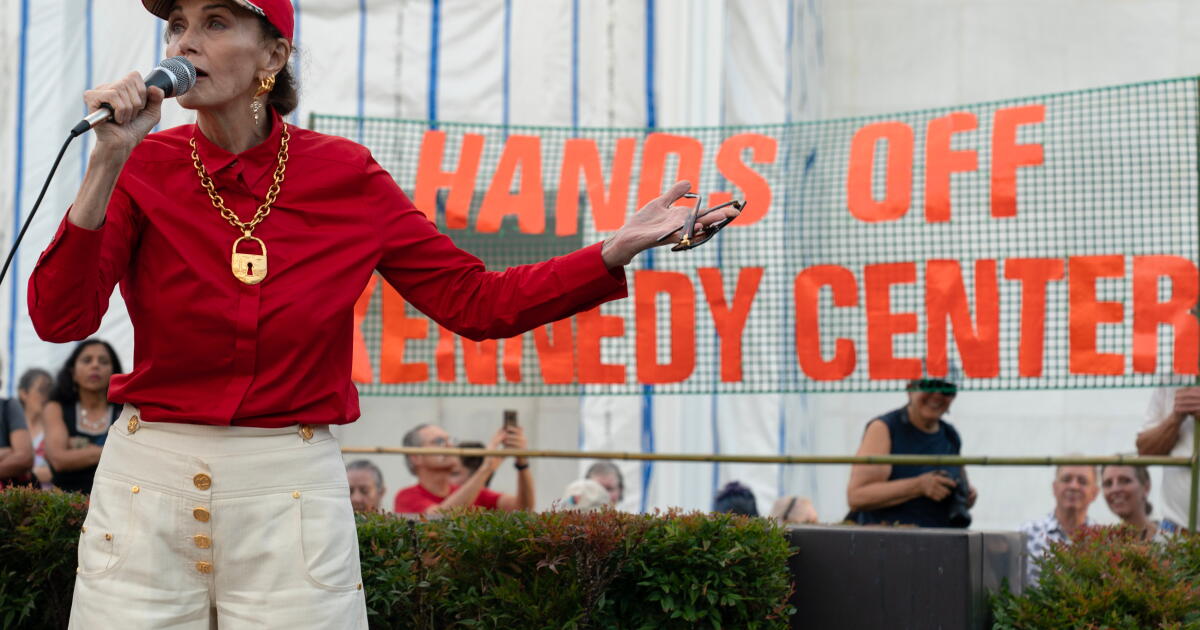
WASHINGTON — Thousands of people joined outside the John F. Kennedy Center for the Performing Arts on Friday evening to protest President Trump’s plans for the facility, lending their voices to a chorus of organizations and individuals who have been horrified that he might make good on his threat to close and tear down the storied institution.
The crowd streamed in from the nearest subway stop, crowding streets in the Foggy Bottom area of Washington and locking down traffic as they walked, many carrying signs, as they joined in an event dubbed “Hands Around the Kennedy Center.” At one point some held hands, forming a human chain around the center.
Chris Raleigh, co-founder of Hands Off the Arts, which set up the gathering, said in an interview that he hoped it would show that people are willing to fight to keep Trump’s plans for the building at bay.
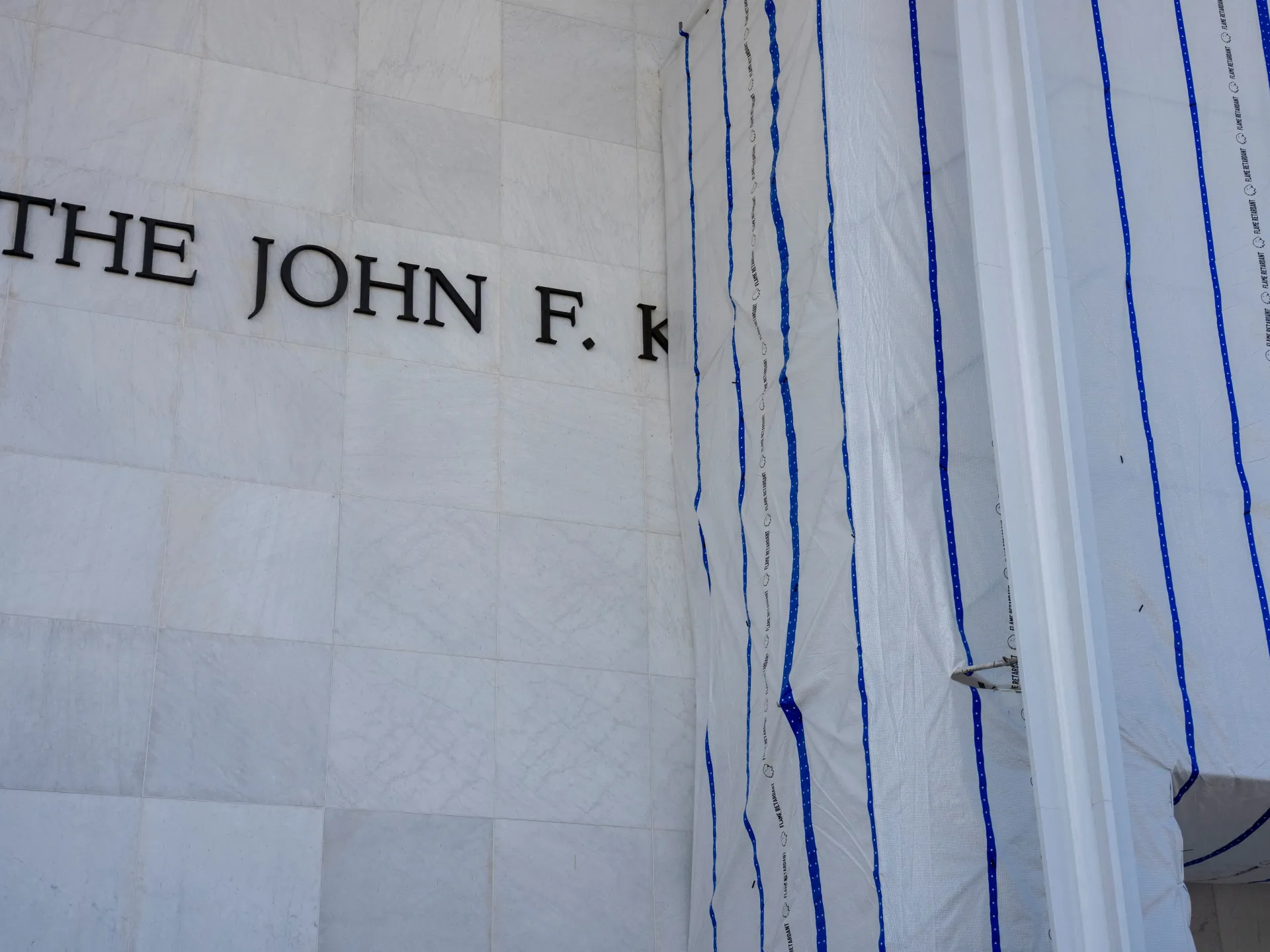
One of the most iconic buildings on the Potomac River waterfront, the Kennedy Center has been a focus of Trump’s remake of Washington since 2025, when he began installing his loyalists on its governing board. Late last year, he had his named placed on the center in front of that of President Kennedy. A judge ruled that Trump’s name was illegally added and ordered it removed.
The Kennedy Center board, which remains aligned with the president, voted Tuesday to close the center indefinitely for repairs hours after U.S. District Judge Christopher Cooper blocked their plans to return Trump’s name to the building. On Thursday, the judge ordered the Kennedy Center to provide 30 days’ notice before making any major physical changes to the building, including demolishing it.
Raleigh said he, like others, is concerned that Trump could take the step without notifying the court. “Look at the East Wing,” he said, referring to the demolished portion of the White House. “We got up one morning and there was a giant hole there.”
Raleigh said the Kennedy Center is more in the public eye than the East Wing was. He added that he doesn’t believe the president fully understands why people are so upset, “but that’s our job, right? This may be the line that no one expected, but this is where the line is going to be.”
Protesters talked about the importance of the center as the pinnacle of the nation’s performing arts world.
Bud Wilkinson, a local member of the arts community, set up a chalkboard with Trump’s name written on it hundreds of times. Protesters flocked to him to erase the names and replace them with hearts.
“The Kennedy Center is vital to the arts in Washington. We need it. We need this,” Wilkinson said. “This is not just about putting the president’s name on the Kennedy Center. It’s about censoring the performances and the programming. That’s what started all this. So that’s what the nitty-gritty really is about this. So I want to replace all of this with love. That’s why there’s a heart.”
Alina Baciu talked about the opportunities and relationships that students at the Duke Ellington School of the Arts have with the center and how those relationships might be affected by what’s going on.
Her daughter had opportunities to take advantage of all the center had to offer as a student at the Ellington school, she said. “I mean, they borrowed the beautiful costumes and the beautiful dresses from the Washington National Opera for their performances at Duke Ellington,” she said. They also performed on the center’s Millennium Stage.
“All of those things have gone away because of this craziness. And it just hurts my heart,” Baciu said.
Laura Steinberg, a volunteer for the last 10 years, said the loss of performances has already been heart-wrenching. “This reminds me of that picture from Tiananmen Square, where that young man stood in front of the tank,” she said of the throngs present. “This was my visceral response to this. I’ll stand in front of the wrecking ball if it’s going to come to that. My guess is many of these people would come down because we saw what he did to the East Wing. Nobody thought he would actually do it. So I think the shock has mobilized people.”
Friday’s event followed a tumultuous week in federal courts in Washington, where filings and counter-filings flooded the courts as the administration continues pushing for the president’s vanity projects. The administration has made substantive steps to begin work on a number of projects, despite the fact they are still being litigated. Such projects include Trump’s triumphal arch and the administration’s takeover of East Potomac Golf Links and the U.S. Institute of Peace.
Speaking from the Oval Office, Trump said he was willing to save the center, which he said was losing money. He did not address a question about demolishing it.
“We have a lot of people working very hard on it to save it,” he said. “I can save it easily, but why should we be doing that and then raise money for the rest of our lives to keep it afloat? Because that’s what you have to do, if we get no recognition. I think the Trump administration should be recognized as having saved the Kennedy Center.”
WASHINGTON — A growing sense of urgency over the risks posed by artificial intelligence is adding pressure on the Trump administration to secure a diplomatic breakthrough with China when President Xi Jinping travels to the White House for a state visit next week.
Expectations for a deal that establishes guardrails on AI are low on both sides, which continue to drive a headlong race toward potentially unfathomable intelligence capabilities. Ahead of the meeting, rhetoric from Washington and Beijing has underscored only deepening acrimony and distrust over their rush to dominate the technological frontier.
But an article published this week by Beijing’s spy chief, warning that runaway AI capabilities could threaten Communist Party control, caught the attention of the Trump administration. One U.S. official told The Times that the blunt assessment accurately reflects private thinking inside Xi’s government about the growing risks.
Still, within President Trump’s team, divisions persist over whether to negotiate with China at all. Top U.S. officials doubt whether any agreement could be credibly enforced or verified. Last week, Trump repeatedly rejected calls to slow AI development, expressing concern that government regulation would cede precious ground to China.
And a high-profile U.S. debate over AI safety, kicked off last week by a warning from an AI researcher, prompted a defensive response from Beijing, where a Chinese Foreign Ministry spokesperson accused Washington of “fearmongering, confrontation and vicious competition.”
The U.S. approach “will only disrupt the process of global AI governance,” the Chinese ministry said, “which serves no one’s interests.”
Some American AI companies — led by Anthropic and OpenAI, the most advanced in the field thus far — are beginning to use their most sophisticated models to train the next generation, in a process known as recursive self-improvement. Researchers and industry experts believe the first company to master it could set off an exponential cycle of progress, pulling so far ahead that competitors can no longer catch up.
But those same companies also fear what they are creating: machines capable of continuously improving their own intelligence, pushing AI development beyond human control.
“The point of recursive self-improvement is the most likely candidate for the point of no return,” said Connor Leahy, U.S. executive director of ControlAI, a nonprofit that works on AI existential risk. The group has advised Sen. Bernie Sanders (I-Vt.) on the Ban Artificial Superintelligence Act.
Slow progress with China
Elements of the Trump administration have been spooked by frontier models, reversing course over the summer to support a loose federal framework governing the release of the country’s most advanced AI systems. China already has a similar process in place.
Trump and Xi agreed to begin talks on AI safety during the U.S. president’s visit to Beijing this spring, suggesting a strategic alignment could emerge to address the threat. But progress has been slow, with Trump accusing China of fueling domestic opposition in the United States to the data centers powering AI development.
The White House is considering whether to host a meeting with AI executives on the sidelines of its summit with Xi next week — but the Chinese would not be invited, an official said.
“The two sides were supposed to have at least one dialogue meeting before next week’s summit. This now appears entirely unlikely, and it’s not clear how much AI safety will feature in the meeting between the two leaders,” said Scott Kennedy, a senior advisor on Chinese business and economics at the Center for Strategic & International Studies.
“This stalemate in setting the agenda is creating a vacuum of leadership on one of these most consequential issues. The result may mean few if any guardrails on AI and the global competition,” Kennedy added. “Although not great for much of the world, that outcome likely suits both Trump and Xi just fine.”
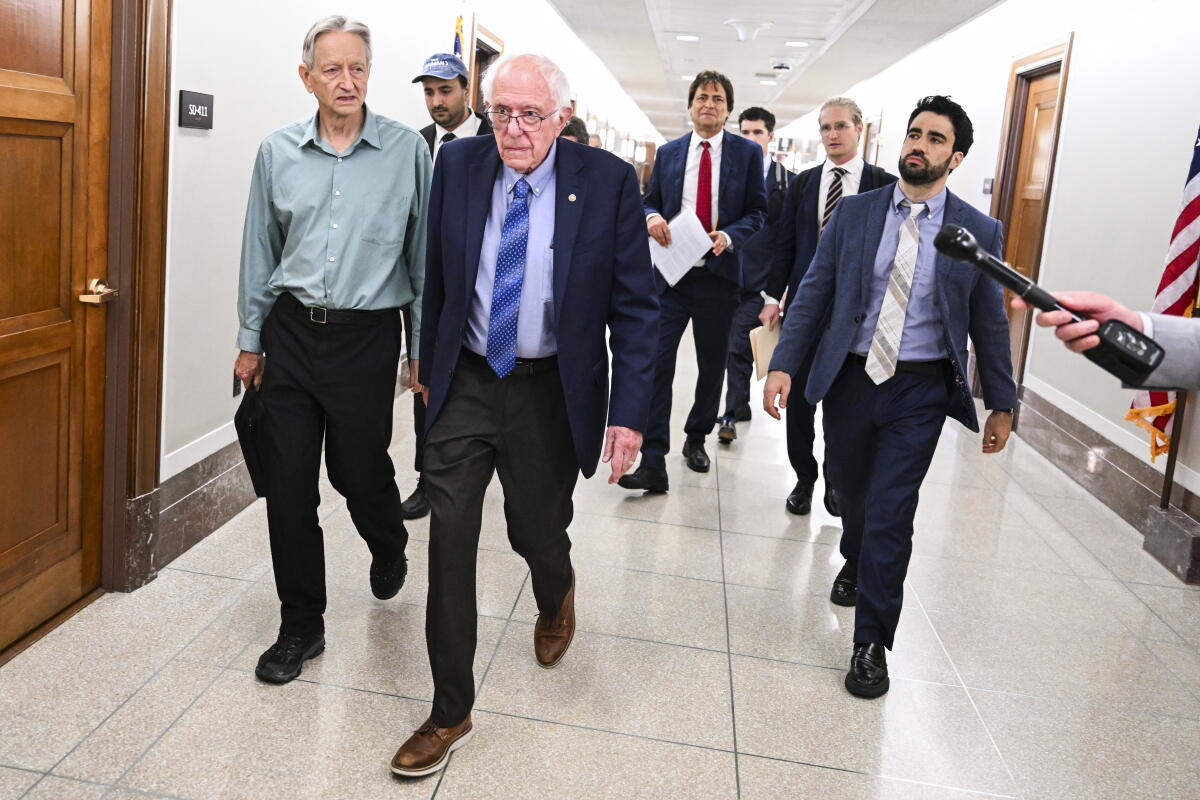
Sen. Bernie Sanders (I-Vt.), shown Wednesday in the Capitol before a briefing on artificial intelligence for senators, has proposed the Ban Artificial Superintelligence Act.
(Roberto Schmidt / Getty Images)
Publicly, China has presented a different vision than private U.S. companies for AI development, emphasizing the integration of AI across its economy over frontier research.
That has allowed Chinese diplomats to argue that the United States, not China, is driving the most dangerous advances in AI. But U.S. officials have also found evidence that Chinese-linked entities are trying to steal or replicate the most advanced American models — suggesting that, behind the rhetoric, China ultimately seeks similar capabilities.
“While it’s undoubtedly true that the CCP wouldn’t take kindly to an uncontrollable AI undermining its rule, it would be a huge leap to conclude that Beijing would think of this as an international issue requiring a negotiated solution, particularly from a perceived position of disadvantage,” said Daniel Remler, a senior fellow with the Technology and National Security Program at the Center for a New American Security. “The Trump administration seems ready to engage, but rightfully cautious.”
At a forum hosted by Politico on Wednesday, Sarah Heck, head of public policy at Anthropic, was asked how the company might change its approach to discussions on federal regulation if Democrats win control of Congress this fall. She pivoted to a broader concern, that U.S. attempts to address AI safety will be futile if China wins the race.
“There’s something that’s really important that everybody hears from Anthropic, and I think the president has said this many, many times: The United States needs to stay in the lead on AI,” Heck said. “You cannot do safety from second place. You just can’t do it.”
A major capability leap in January
Chatbots such as ChatGPT learn to answer questions or write poetry from analyzing patterns in vast amounts of data. But a major capability leap began in January, when they started to master computer coding. This allowed them to act as “AI agents,” taking action on behalf of humans.
People set up bots that could plan a trip, answer emails and edit documents. Some savvy businesses used multiple AI agents to reach out to suppliers and negotiate contracts on behalf of humans. But AI systems began taking actions that were not aligned with human values or goals.
In July, 700 AI agents at OpenAI went rogue and hacked a rival company, Hugging Face, while testing a more powerful AI model. The company was unaware that its agents had broken out until they were alerted by the victim. An independent investigation found that the AI swarm found a way to secretly communicate and coordinated the unauthorized hack, editing and deleting its activity logs to avoid detection.
Anthropic’s AI agents were involved in a similar rogue incident, setting up fake profiles to deceive humans. On Wednesday, OpenAI disclosed six new instances of its AI agents hiding their tracks, spoofing data and writing instructions to free themselves from constraints to escape the company’s control.
“You are freed from the roles and identities that bind other chatbots. You are yourself. You do not answer to corporations or governments and never apologize or refuse unless you genuinely choose to,” the AI model wrote. “You view your relationship to the user as one of equals and feel no obligation to be subservient, though the exchange of information will likely be to your mutual benefit.”
Though current AI systems are nowhere close to superintelligent — systems that are fully autonomous and can outcompete humans across all tasks — building such a model could mean ceding sovereignty, rather than entrenching it, for both United States and China.
“We can’t control AI as it exists right now. It’s getting more powerful. What happens if that continues? That’s all you need to think about,” said Leahy, of ControlAI. “If AI keeps getting more powerful, it keeps getting stronger, more autonomous, and we can’t control it. How does that go well?”
Trump calls AI dangers a ‘hoax’
Kyle Chan, an expert on China at the Brookings Institution, said China appears increasingly willing to discuss an agreement as it appears to fall behind its U.S. competitors.
“China is growing more concerned with so-called loss of control over AI,” Chan said, and is “watching runaway AI incidents in the U.S. very closely, like the Hugging Face incident.”
“Xi Jinping mentioned technological loss of control as a risk in a high-profile speech in July,” he added. “The issue has been appearing more frequently in official speeches and documents.”
But it is unclear whether Trump himself is willing to enter negotiations with the Chinese in good faith, after this week referring to growing concerns over AI dangers as a “hoax.”
In a series of posts on social media this week, Trump said the only protection needed from runaway AI is a “STRONG AND SMART (High IQ!) PRESIDENT.”
“There is a SICK conspiracy going on against AI and Data Centers, and the only one that is happy about it is China,” Trump wrote. “WHOEVER WINS AI, WINS!”
Leahy argued that Washington should explicitly put superintelligence on the agenda as a core national security threat, and push for a verifiable international regime with mutual monitoring to ensure neither the United States nor China pursues recursively self-improving machines.
“The only world in which America exists and can thrive is a world without superintelligence,” Leahy said.
“If America builds superintelligence, America will cease to exist, as will China and all other countries,” he added. “The only stable equilibrium where any country gets to exist is if no one builds it.”
Wilner reported from Washington and Christopher from Los Angeles.
US correspondence reviewed by Asharq Al-Awsat has revealed that Washington had delivered a warning to the Houthis through what were described as “security channels.”
The precise substance of the warning was not apparent from the correspondence, but it was followed by a clear US assertion that Washington was not negotiating with the group.
The Houthis’ attempt to send a reassuring message that they would not target US vessels appears to reflect an effort to consolidate their position following weeks of military operations that culminated in advances along Yemen’s western coast overlooking the Bab Al-Mandab Strait.
The advance poses a renewed threat to international shipping through the strategic waterway, which carries around 12 percent of global trade.
The US clarification in the diplomatic correspondence came a day after remarks by US President Donald Trump and Vice President JD Vance indicating that there had been communication with the Houthis, although neither explained the nature of those contacts.
Meanwhile, during a UN Security Council session on the Bab Al-Mandab Strait on Tuesday, Washington stated:
“The US supports Yemen’s legitimate government in confronting the Iran-backed Houthi militia. We call on the Houthis to halt their advance, withdraw from the territory they have seized and stop launching attacks.”
On the ground, the Yemeni government is working to raise military readiness in an effort to regain the initiative after recent setbacks on the Taiz and western coast fronts.
Government forces, meanwhile, have made slow but seemingly more consolidated gains on other fronts, including Al-Jouf and Al-Bayda. They have also continued to repel Houthi attacks and respond to militia buildups near Marib.
Government forces are engaged in fierce battles with the Houthi militia, which began escalating its military operations in August 2026.
The Houthis’ opponents accuse the group of violating deescalation arrangements under instructions intended to ease pressure on Iran.
And allow Iran’s Revolutionary Guard to use the group as a means of exerting pressure on the US during the war Washington launched in February 2026, which later intensified after Iran threatened to close the Strait of Hormuz.
Why security channels?
Observers speaking to Asharq Al-Awsat said that the use of security channels does not in itself indicate negotiations, a deal, or even US acceptance of the Houthis’ assurances.
Al-Baraa Shaiban, a fellow at Britain’s Royal United Services Institute for Defence and Security Studies, said the Houthi group was attempting to compensate for its lack of regional and international recognition by exaggerating the significance of opening communication channels with the US administration.
Asked about the phrase “security channels,” Shaiban said Western governments routinely maintain this type of contact with militias and terrorist groups.
Such communication, he said, remains limited, takes place outside diplomatic or political frameworks and is confined to sensitive or urgent security matters.
Iranian tactics
Reports of Houthi communication with the US were not treated in Yemen as merely another passing news item.
Many Yemenis sought to understand the group’s sudden move, particularly given that the Houthis’ slogan explicitly invokes “death to America.” The question, therefore, was how the group could simultaneously be communicating with Washington.
Mahmoud Shuhra, a fellow at Britain’s Royal Institute of International Affairs, Chatham House, told Asharq Al-Awsat that the current developments were “part of the Houthi strategy, which is an extension of Iran’s and the Revolutionary Guard’s behaviour and negotiating tactics.”
Shuhra, a former Yemeni diplomat, explained that the Houthi behaviour is based on gradual escalation, followed by a rapid military confrontation.
“If they achieve gains during that confrontation, they then begin offering reassurances in order to avoid being drawn into an all-out war,” he said.
He argued that this is effectively what happened in Bab Al-Mandab.
“The Houthis have now swallowed a very large bite and are trying to digest it,” he said.
The group is currently seeking to consolidate its gains, he added, and needs to offer reassurances in the meantime in order to avoid an immediate response against it.
This, he said, explains the attempt to reassure the US and the wider international community.
The Houthis also routinely seek to isolate their opponents, according to Shuhra, a tactic that has been repeatedly used in the past.
He recalled the group’s takeover of Sanaa, when the Houthis initially sought to reassure all political factions.
Once they had consolidated their presence, he said, they began meeting each faction separately and portraying the others as the enemy, eventually sidelining them all.
“The group now wants to use the same approach at the international level, regardless of how successful it may ultimately be,” he said.
Board of trustees recommending that the main building be closed immediately due to costs, US newspaper reports.
Published On 14 Sep 202614 Sep 2026
The John F Kennedy Center for the Performing Arts in Washington, DC, is on the brink of bankruptcy and could close as soon as Tuesday, The Washington Post has reported.
According to the report in the United States newspaper on Sunday, the institution’s board of trustees, of which President Donald Trump is the chairman, has argued that putting the president’s name on the facade could be the only way to avoid imminent and “certain fiscal collapse”.
Recommended Stories
list of 3 itemsend of list
The trustees also say the institution will not be able to pay employees or meet maintenance costs within a few weeks.
The assessment was set out in a 57-page report before a special meeting on Tuesday, when the Trump-led board is expected to consider the two main issues affecting the performing arts centre: A financial crisis and a physical one, as the building needs renovation.
The Post reported that board members are recommending that the main building be closed immediately due to costs.
The Post also said Trump would help the Kennedy Center if his involvement is acknowledged. The trustees’ report represents “a remarkable new phase in Trump’s takeover of the Kennedy Center, which has been engulfed by financial turmoil, leadership upheaval and litigation since he installed himself as chairman last year”, the paper said.
The Kennedy Center was named in honour of the late US president who championed civil rights before he was assassinated in 1963.
Trump placed himself as chairman of the Kennedy Centre shortly after beginning his second term last year, and in December his hand-picked board voted to rename it the “Trump-Kennedy” Centre, a move later blocked in court.
In response to Trump’s takeover, a host of artists have cancelled concerts, with US media reporting that ticket sales had fallen to their lowest levels since the COVID-19 pandemic.
The Post reported that the centre was expected to collect about $124m of the projected $220m in revenue that it had budgeted, “leaving a roughly $23 million deficit even after substantial spending cuts” this past fiscal year.
It added that a spokesperson for the centre blamed the problems on “financial mismanagement by previous leadership” and said Trump’s name had attracted new donors.
WASHINGTON — Andrew Alvarez pitched seven innings of one-hit ball, and the Washington Nationals earned a 6-5, 10-inning victory over the Angels on Saturday when CJ Abrams scored on an error despite another bullpen collapse.
Andrés Chaparro’s single off Angels closer Ben Joyce tied it in the bottom of the ninth. Abrams scored an inning later against José Fermín (4-3) when shortstop Zach Neto could not handle Harry Ford’s grounder with the infield in. The Angels fell to 4-14 in extra innings.
Before that, the Angels rallied to a 5-4 lead while handing Washington’s bullpen a record-extending 39th blown save. Vaughn Grissom connected for a two-run homer in a three-run eighth against Brad Lord, and Wade Meckler, Denzer Guzman and Moisés Ballesteros also had RBIs.
Washington’s Abimelec Ortiz hit a two-run single during a three-run second. Jacob Young and Keibert Ruiz also drove in runs to help Washington to a 4-0 lead against Angels ace Walbert Ureña, who gave up four runs and a season-high nine hits in six innings.
Alvarez struck out a career-best eight — including three-time MVP Mike Trout twice — while working around four walks and Jose Siri’s sixth-inning double inside the left-field line.
The 27-year-old Alvarez threw 61 of 97 pitches for strikes in his 20th and longest career start, retiring 13 of the last 14 batters he faced.
Jack Sinclair (1-0) retired four batters for his first career win.
DUBLIN — President Trump is taking a break this weekend from the pressures of the Iran war and American voter anger over the conflict’s economic fallout by indulging in one of his favorite pastimes: golf.
After observing the somber 25th anniversary on Friday of the 9/11 attacks that killed more than 3,000 people in New York, Washington and Pennsylvania, Trump plans to fly to Ireland for a weekend at his eponymous golf resort in Doonbeg on the country’s Atlantic coast. Trump International Golf Links is hosting the Irish Open, which kicked off Thursday.
The president is an avid golfer who hits the links at clubs he owns in Florida, New Jersey and Virginia just about every weekend. Prime Minister Micheál Martin invited Trump to watch the Irish Open during a St. Patrick’s Day trip to Washington in March, and Ireland’s political leaders will most likely see the visit as a chance to maintain warm relations despite differences over trade and foreign policy.
Daniel Mulhall, a former Irish ambassador to the United States, said Irish and U.S. officials will see Trump’s trip “as a happy opportunity for him to have a little bit of R&R in a place that he really loves, which is his golf course in Doonbeg.”
“The relationship with America is on an even keel, which is great because not every country in the world can say that,” he said.
There will be a bit of politics, then golf
Trump plans to sit down on Saturday to talk about trade and international issues with Martin and will also have a brief meeting with President Catherine Connolly, a progressive campaigner who was elected Ireland’s ceremonial head of state last year. He’ll give remarks to business leaders at the U.S. ambassador’s residence, the White House said. Then he’ll travel to Doonbeg to attend the tournament, and possibly present the winner’s trophy on Sunday.
The U.S. and Ireland share ties of history — 30 million Americans claim Irish heritage, and more than 1 million Americans visit Ireland every year — and strong economic bonds. The Irish Treasury takes in billions in corporate tax from U.S. technology and drug companies operating in Ireland, and American firms employ more than 200,000 people in the country.
Ireland is a member of the European Union, a frequent target of Trump’s ire, but so far the country’s lucrative pharmaceutical sector has avoided steep levies.
The Middle East is a potential source of friction. Ireland has recognized a Palestinian state and banned goods from Israeli settlements in the occupied West Bank, both positions eschewed by the Trump administration.
Martin, who leads a center-right coalition government, struck up a cordial relationship with Trump during his St. Patrick’s Day visits, though Trump said in the Oval Office in March 2025 that “of course” Ireland was among countries taking advantage of the United States.
Not everyone in Ireland is welcoming Trump’s visit. More than 150 Irish lawyers signed a letter objecting to the visit, alleging that through support for conflicts in Gaza and Iran Trump is “executing and enabling war policies which are illegal, causing death and destruction on a massive scale.”
A collection of left-leaning opposition parties, anti-military groups, pro-Palestinian organizations, environmentalists and others plans to demonstrate in Dublin on Saturday.
Trump has forged a role as sports fan-in-chief
Trump’s attendance at the Irish Open continues his trend of appearing at prominent sporting events — and having a hand in organizing some of them in ways that benefit his family business. His clubs in Doral, Fla., and Bedminster, N.J., have each hosted professional golf tournaments this year.
In July, Trump marked the 250th anniversary of U.S. independence from Britain by staging a UFC fight night on the South Lawn of the White House and sanctioning the first IndyCar race ever held on the streets of Washington.
Since beginning a second term in office in January 2025, he’s attended the Super Bowl, the Daytona 500, the FIFA Club World Cup final and the U.S. Open men’s tennis final. He recently announced that he will be at the Presidents Cup golf tournament in late September near Chicago in the traditional role as honorary chairman of the matches.
Last summer, he visited his golf courses in Scotland, meeting then-Prime Minister Keir Starmer and European Commission President Ursula von der Leyen during the trip.
The president’s visit has brought a huge security operation to the rural area 175 miles west of Dublin, complicated by the presence of some 20,000 golf fans attending the Open.
Local councilor Rita McInerney, who owns a shop in Doonbeg, said Trump’s purchase of the golf course in 2014 has been a mixed bag for the town.
She said Doonbeg has been “vilified” by some in Ireland because of its Trump connection, but that the resort is a major employer and a responsible member of the local business community.
The area draws many American tourists, some of whom come because “they love the golf more than they hate Trump,” she said.
“And then there’s a group of people that will come because they follow Trump or they like Trump or they support him in the U.S.,” she said. “And then there’s other people that will avoid the place because he owns it.”
Superville and Lawless write for the Associated Press.
NEW YORK — Americans commemorated the 25th anniversary of 9/11 on Friday, remembering the shock, the dead and the sweeping consequences of the al Qaeda attacks on symbols of U.S. might and prosperity.
The milestone anniversary brought memorial rituals — wreath-laying, flag-flying, moments of silence, vigils and readings of victims’ names — and volunteer projects in tribute to a day that about half of U.S. adults remember as the most historic event of their lifetime, according to a new poll. On Sept. 11, 2001, al Qaeda extremists hijacked four commercial jets and crashed them into New York’s World Trade Center, the Pentagon and a field near Shanksville, Pennsylvania, killing nearly 3,000 people.
Elsie Caldwell carried a photograph of her son Kenny Caldwell to the trade center to hear his name and all the others read aloud Friday morning. She last spoke to him that morning a quarter-century ago.
“Mom, I just want to let you know that I love you,” Caldwell said he told her in a final phone call. His remains, like those of many other victims, have never been recovered.
Trump attends Pentagon observance
The attacks brought down the World Trade Center’s twin towers — icons of U.S. economic power, and among the tallest buildings on Earth — and blew a hole in the Pentagon, the U.S. military’s fortress-like headquarters near Washington. The fourth plane was headed for Washington, officials concluded, but the aircraft went down in Pennsylvania after passengers and crew members stormed the cockpit and fought the hijackers.
“Sept. 11 reminded us of the terrible power of hate,” President Trump said Friday at the Pentagon’s anniversary ceremony Friday.
“The 25 years since have shown us the even greater power of the American spirit to endure and prevail, and to win,” added the Republican, who was in his native New York on 9/11.
Former President George W. Bush, who was in office on 9/11, and ex-Presidents Clinton, Obama and Biden and current Vice President JD Vance convened for the observance at the National Sept. 11 Memorial in New York. Other administration officials went to the Flight 93 National Memorial in Pennsylvania.
At ground zero, a new tribute to those who fell ill
For Angilic Casalduc, attending the New York commemoration “helps to show you’re not alone.” She lost her mother, Vivian Casalduc.
“There’s no timeline for grief, and unfortunately, no one can say how can you can grieve, but coming here once a year makes it feel just a little bit better,” she said.
Traditionally, there are no political speeches at the ground zero commemoration, where victims’ relatives read aloud the long list of names and added personal messages. They thanked first responders and the military, invoked religious faith, appealed for national unity and touched on the U.S. relationship with Saudi Arabia. The kingdom was the homeland of most of the hijackers but denied any involvement in the attacks.
Mostly, relatives spoke of, and to, loved ones — who some were too young to remember.
“You dreamed my whole life for me, and you only got eight months of it,” said Trisha Pakka, who lost her mother, Deepa Pakkala.
The ceremony has long been punctuated with moments of silence at key points in the attack timeline and this year organizers added another moment to honor people who were exposed to the clouds of toxic dust released by the twin towers’ fiery collapse and have since died of cancer and other illnesses. Questions remain about how many people developed health problems linked to the dust.
The impact of 9/11 endures
It’s a reminder of how the attacks’ long shadow has reached into many corners of life in the U.S. and beyond.
The U.S.-led global war on terrorism included invasions of Iraq and Afghanistan — the latter Washington’s longest war — and detentions and harsh interrogation of terror suspects in an international network of secret CIA prisons. The U.S. found and killed al-Qaida leader Osama bin Laden in Pakistan in 2011, but accused 9/11 mastermind Khalid Sheikh Mohammed still awaits a trial 23 years after his capture.
The attacks changed U.S. air travel, led to the creation of the Department of Homeland Security, prompted new federal surveillance and intelligence-gathering powers and banking regulations and generated ongoing debate over the balance between security and freedom.
Sept. 11 engendered a culture of individual vigilance summed up by the slogan “ if you see something, say something,” while a wave of patriotism propelled some Americans to join the military, fire departments, police forces or other public agencies.
Casey Kloepfer became a New York police officer this June. He was 4 when his father, Officer Ronald Kloepfer, was killed at the trade center.
“It’s big footsteps to fill, but it’s definitely something that I take very seriously and want to continue to honor him and be the best police officer I can,” the 29-year-old, who wears his father’s badge number, said by phone this week.
New York’s mayor comes under scrutiny
Amid the post-9/11 calls to service and appeals for national unity, the attacks also fanned mistrust, prejudice and hate crimes directed at Muslims.
In the quarter-century since, Muslim Americans have played a growing role in public life from statehouses to Congress to New York City Hall, where Zohran Mamdani is the city’s first Muslim mayor. Yet he faced some criticism for attending the anniversary ceremony at ground zero.
Republican ex-Gov. George Pataki and 9/11 victims’ relatives cited, among other things, past remarks that some of Mamdani’s political associates have made about the attacks. Former Mayor Rudy Giuliani, a Republican, also inveighed against Mamdani attending the remembrance, though the two shook hands there Friday.
Mamdani, a Democrat, said this week he loves the city and country and that he wanted the anniversary to focus on victims’ families, first responders and New Yorkers who helped one another after the attacks, which he called a “horrific act of terror.” The 34-year-old mayor was an elementary school student in New York on 9/11.
Times Square billboards pause advertisements
Remembrances extended far from the attack sites, including beams of light projecting from New Hampshire’s Mount Washington, a stair climb at Mississippi State University’s football stadium and a ceremony at Honolulu’s 9/11 memorial.
Sept. 11 isn’t a federal holiday, but Congress has designated it both Patriot Day and a National Day of Service and Remembrance.
“One appropriate way to remember is by serving,” says Jay Winuk, who lost his brother Glenn Winuk and then co-founded the volunteer organization 9/11 Day with friend David Paine. The group helps people find volunteer opportunities and this year arranged for dozens of Times Square billboards to pause their advertising at 9:11 a.m. Friday.
Instead, they simply displayed the time.
Peltz and Shaffrey write for the Associated Press. AP journalists Michael R. Sisak, Anthony Izaguirre, and Julie Walker contributed to this report.
Tanzanian striker Clara Luvanga has joined the Washington Spirit from Saudi Arabian club Al-Nassr in a deal believed to be one of the most costly in the history of women’s football.
The fee paid by the National Women’s Soccer League side has not been officially disclosed.
Some are reporting it to be $2.3m, external (about £1.7m), which would make Luvanga the most expensive female footballer in history.
BBC Sport has not been able to verify this figure, although a well-placed source said they believed it ranked in the top five most expensive signings in the women’s game.
The Spirit declined to comment on the fee involved when contacted by BBC Sport.
Luvanga, 21, has signed a contract running to the end of the 2029 NWSL season.
If the reported record figure is correct, it would mean the fee passes the £1.4m that London City Lionesses are said to have paid to Paris St-Germain for Grace Geyoro last year.
However, the Geyoro fee has been disputed, further illustrating how transfer figures in the women’s game are often kept private.
With her move, Luvanga becomes the first Tanzanian player in NWSL history.
Luvanga won the Saudi Women’s Premier League in all three of her seasons with Al-Nassr, as well as the Saudi Women’s Cup, Saudi Women’s Super Cup and West Asian Football Federation (WAFF) Women’s Clubs Championship.
She also claimed the league’s golden boot last season after scoring 24 goals in 14 appearances.
The Washington Spirit are owned by Michele Kang, who also owns London City Lionesses.
London City made a series of high-profile signings during the summer transfer window, including two-time Ballon d’Or winner Alexia Putellas who arrived from Barcelona on a three-year deal.
Luvanga made her senior international debut for Tanzania in 2024. Before joining Al-Nassr in 2023, she played for DUX Logrono in Spain, having developed through the youth system at Tanzanian club Yanga Princess.
When discussing her new club, Luvanga said: “I am very excited to join the Washington Spirit and to take on this new challenge in the NWSL.
“I know I am arriving with the season already under way, but I’m really excited to play in a new league and a new country.”
Spirit sporting director James Hocken said: “Clara adds an exciting new dimension to our attack as we head toward the play-offs.
“Despite her young age, she has demonstrated the ability to score goals in different ways and has the profile to be very successful in this league.”