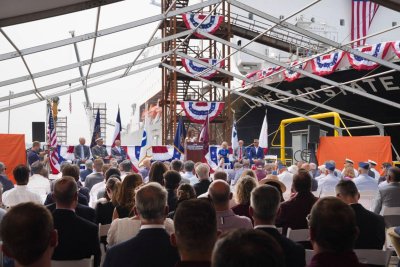

The national security multi-mission vessel Lone Star State is christened at Hanwha Philly Shipyard in Philadelphia on July 17. Photo courtesy of Hanwha group
July 23 (Asia Today) — South Korea and the United States have opened a shipbuilding cooperation center in Washington, moving their partnership beyond government declarations and preliminary agreements toward developing and implementing commercial projects.
The Korea-U.S. Shipbuilding Partnership Center will serve as a base for $150 billion in planned shipbuilding investment, U.S. shipyard modernization, workforce development and joint research.
The center’s opening was accompanied by 15 agreements involving South Korea’s three largest shipbuilders, U.S. shipyards, technology companies, universities and research institutions.
The agreements give the Make American Shipbuilding Great Again initiative, known as MASGA, a more detailed framework. Its success, however, will depend on how quickly the center can generate ship orders, maintenance contracts and actual investments.
South Korea’s Ministry of Trade, Industry and Resources and the U.S. Department of Commerce jointly held the opening ceremony Thursday at the Mayflower Hotel in Washington.
About 130 government, congressional, corporate and industry officials from the two countries attended, including South Korean Trade, Industry and Resources Minister Kim Jung-kwan and U.S. Commerce Secretary Howard Lutnick.
Acting Navy Secretary Hung Cao and U.S. Ambassador to South Korea Michelle Steel also attended.
The center was established as a follow-up to the Korea-U.S. Shipbuilding Partnership Initiative signed May 8. Operations began about two months after the two governments reached the agreement.
“KUSPC is an unprecedented cooperation platform in the global shipbuilding industry and a symbol of South Korea’s firm commitment to helping rebuild the U.S. shipbuilding industry,” Kim said.
Kim said the center would help South Korean shipbuilding technology take root across U.S. coastal industrial regions.
He also said the planned $150 billion shipbuilding investment would be implemented promptly and called on the United States to provide continuing ship orders, investment incentives and regulatory relief.
‘Team Korea’ formed for U.S. market
The center will connect South Korean shipbuilders with U.S. shipyards, technology companies and research institutions.
Its work will include improving shipyard productivity, training skilled workers, developing equipment supply chains, supporting joint technology projects and identifying direct investment opportunities.
Center President Lee Jong-geon said the organization would link the two governments with shipyards, universities, research institutions and investors.
He said the center would support workforce training, productivity consulting and joint technology development to help restore the fundamental competitiveness of the U.S. shipbuilding industry.
The 15 agreements announced at the ceremony cover four areas: the creation of Team Korea, supply chain cooperation, workforce development and joint technology research.
HD Hyundai Heavy Industries, Hanwha Ocean and Samsung Heavy Industries joined the Korea Offshore & Shipbuilding Association, the Korea Research Institute of Ships and Ocean Engineering and the new center to form Team Korea for coordinated expansion in the U.S. market.
The three shipbuilders will focus on shipyard modernization and the development of equipment supply chains. The research institute will handle studies and demonstrations of future maritime technology while the center will provide local market information and business networks.
HD Korea Shipbuilding & Offshore Engineering agreed to work with Siemens Digital Industries Software on digital systems for next-generation ship design and production.
The company also plans to provide Fraser Industries with shipyard productivity assessments and support for the introduction of automation technology.
Hanwha Ocean will work with the Chamber of Commerce for Greater Philadelphia to help local manufacturers enter the shipbuilding supply chain.
South Korean marine equipment company JJ & Companies will provide equipment and vessel repair technology to Nichols Brothers Boat Builders and Everett Ship Repair to strengthen local maintenance, repair and overhaul capacity.
HD Hyundai Samho also signed a contract to supply four port cranes to Washington United Terminals at the Port of Tacoma, extending the partnership beyond shipyards to port modernization.
Workforce programs target labor shortage
The center will also support programs designed to address the shortage of skilled shipbuilding workers in the United States.
Hanwha Philly Shipyard will provide welding, painting and other technical training at Delaware County Community College in Pennsylvania. The program will connect classroom instruction with internships and employment at the shipyard.
Samsung Heavy Industries and Vigor Marine Group plan to establish a workforce training center equipped with virtual reality and augmented reality welding systems.
The Korean research institute, shipbuilding association and partnership center will also work with the American Bureau of Shipping to develop technical certification, safety training and qualification programs.
The South Korean government plans to dispatch retired engineers and production specialists to U.S. shipyards to advise on process efficiency, yard operations, quality control and environmental management.
U.S. shipyard managers and engineers will also be offered one- to two-month training placements at South Korean shipyards.
Joint research to combine Korean production and U.S. technology
South Korea plans to invest 120 billion won, or about $80.4 million, over five years in joint shipbuilding research with the United States.
Seven South Korean companies and institutions and nine U.S. organizations will carry out eight projects combining South Korean shipbuilding and production capabilities with U.S. artificial intelligence and robotics technology.
The projects include AI-based ship design optimization, 3D printing of marine components measuring up to 16 feet, autonomous welding of aluminum naval vessel panels and automated painting of large ship sections.
Other projects include autonomous transporters for large ship blocks, fully automated pipe-spool production, AI-based virtual reality training and autonomous navigation and engine controls for software-defined unmanned vessels.
HD Hyundai Heavy Industries will work with U.S. defense technology company Anduril Industries to develop and test autonomous navigation and engine automation platforms for unmanned vessels.
Samsung Heavy Industries will collaborate with Saronic Technologies on unmanned surface vessels and the application of automation systems at U.S. shipyards.
Hanwha Ocean will jointly design a global fast sealift vessel with Leidos subsidiary Gibbs & Cox.
HD Korea Shipbuilding & Offshore Engineering will also work with ABSG Consulting to develop and verify an operating platform for next-generation autonomous vessels.
The center will begin operations with 6.6 billion won, or about $4.4 million, in government funding this year.
Its initial operating period runs from 2026 through 2028 with a budget of 19.93 billion won, or about $13.4 million. It will operate as a nonprofit organization from the Korea International Trade Association’s Washington office.
The government also plans to link the center with a bilateral shipbuilding investment council established in June.
South Korea’s strategic investment corporation and state-run financial institutions, including the Export-Import Bank of Korea, Korea Development Bank and Korea Trade Insurance Corp., will provide financing for investments in U.S. shipyards and vessel construction projects.
Orders and long-term contracts remain key test
South Korean shipbuilders said the center represents a shift from government-level pledges to the development of specific commercial projects.
They said South Korean strengths in ship design, production management and smart shipyard technology could support U.S. shipyard modernization while creating opportunities in workforce training and equipment supply.
U.S. requests for information on combat vessels and military support ships have also raised expectations for future cooperation.
Industry officials cautioned, however, that the number of agreements signed will be less important than the volume of actual orders and investments they produce.
South Korean shipbuilders have begun entering the U.S. Navy maintenance, repair and overhaul market. Stable profitability will require the companies to move beyond individual repair assignments toward multiyear contracts and bundled service agreements.
The pace of shipyard investment will also depend on how the $150 billion financing package is structured and what conditions are attached to it.
Other unresolved questions include how much work can be awarded to South Korean shipbuilders, how investment responsibilities will be divided between companies and state financial institutions and whether U.S. regulations and domestic-content requirements will be eased.
Industry officials said the center must become more than a liaison office and establish itself as a business development organization connecting the U.S. government, Congress, ship purchasers and local shipyards.
They said MASGA’s performance will ultimately be judged by commercial and naval vessel orders, long-term maintenance contracts and completed shipyard investments.
— Reported by Asia Today; translated by UPI
© Asia Today. Unauthorized reproduction or redistribution prohibited.
Original Korean report: https://www.asiatoday.co.kr/kn/view.php?key=20260723010008621