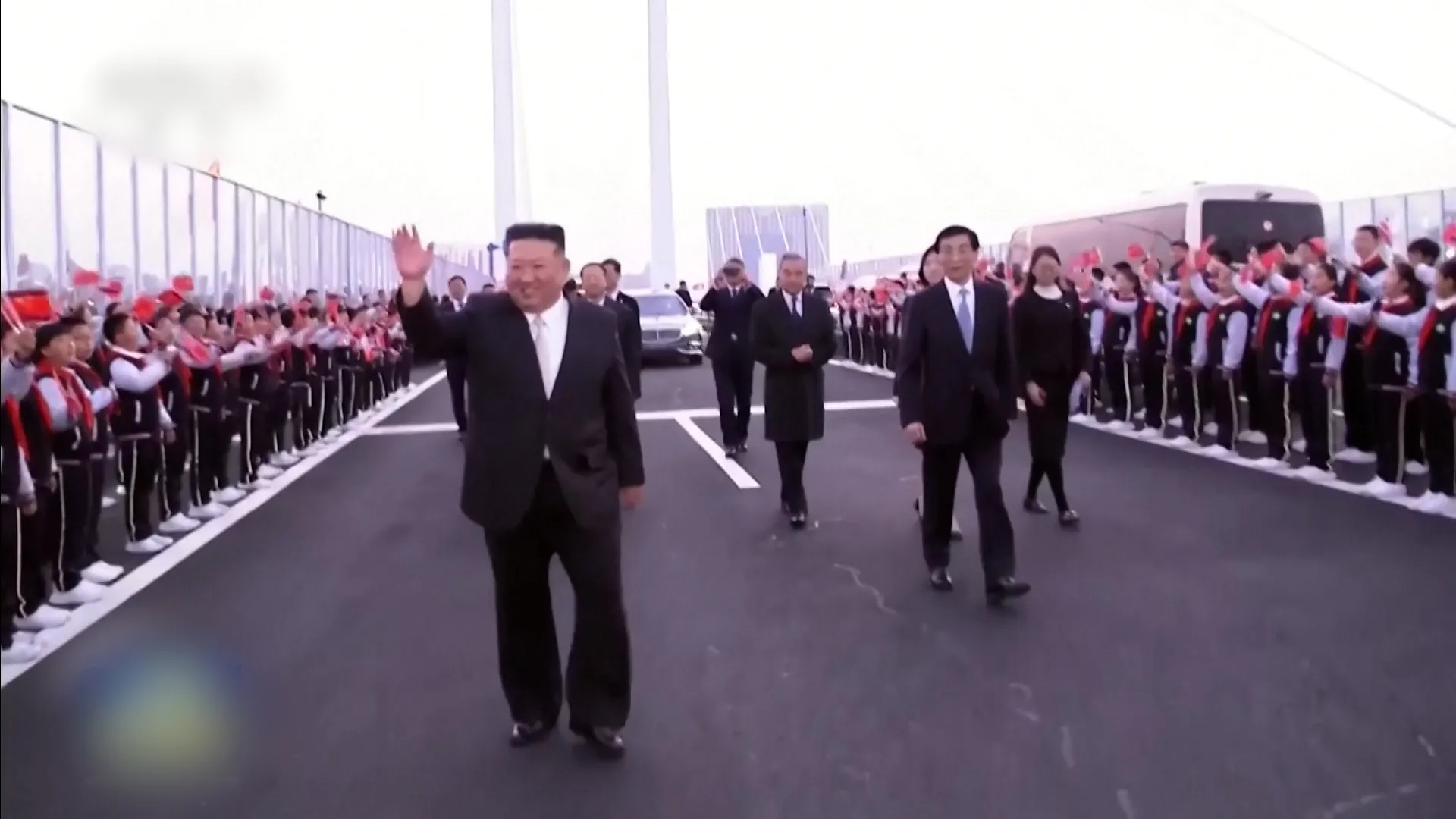
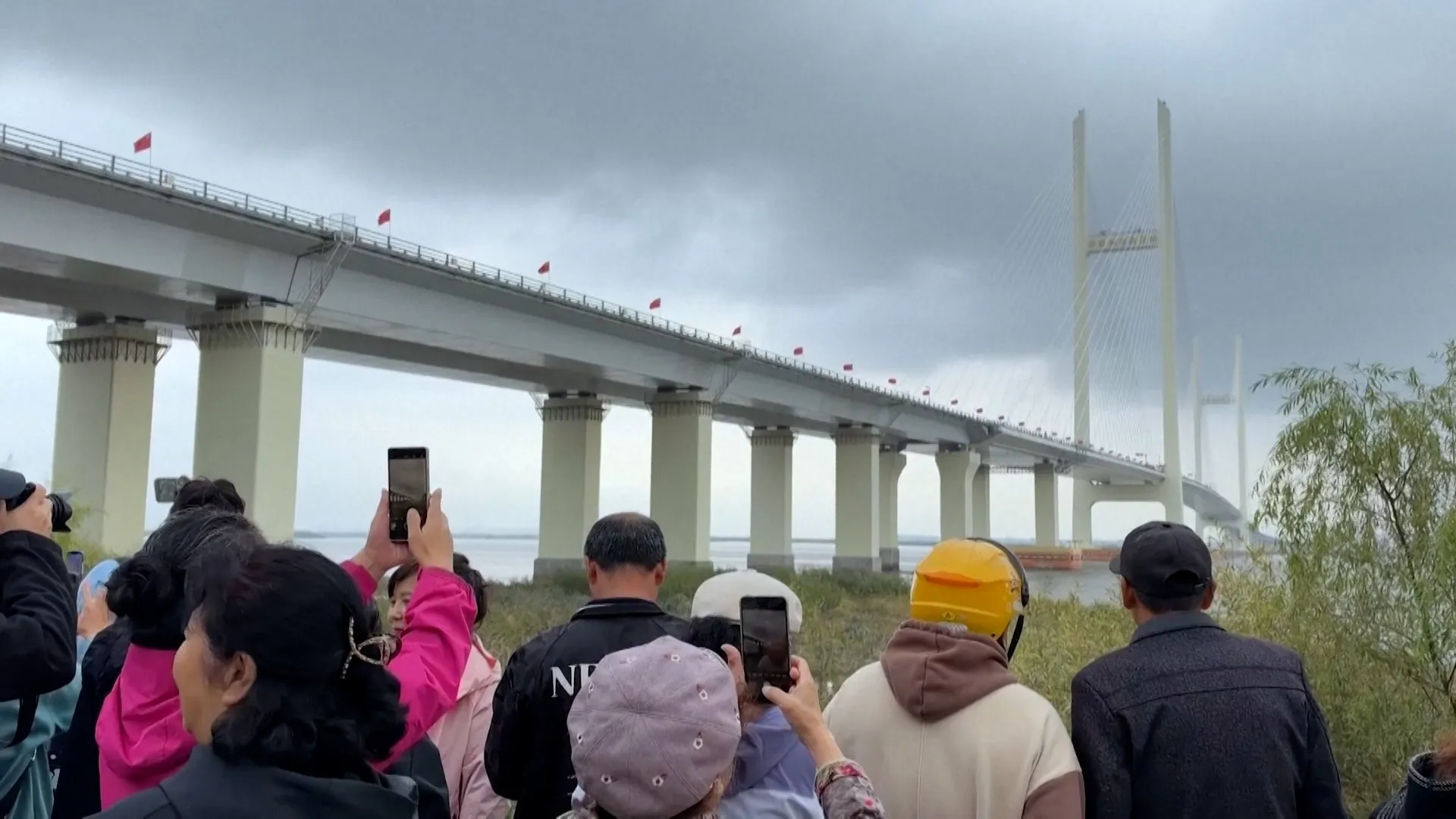
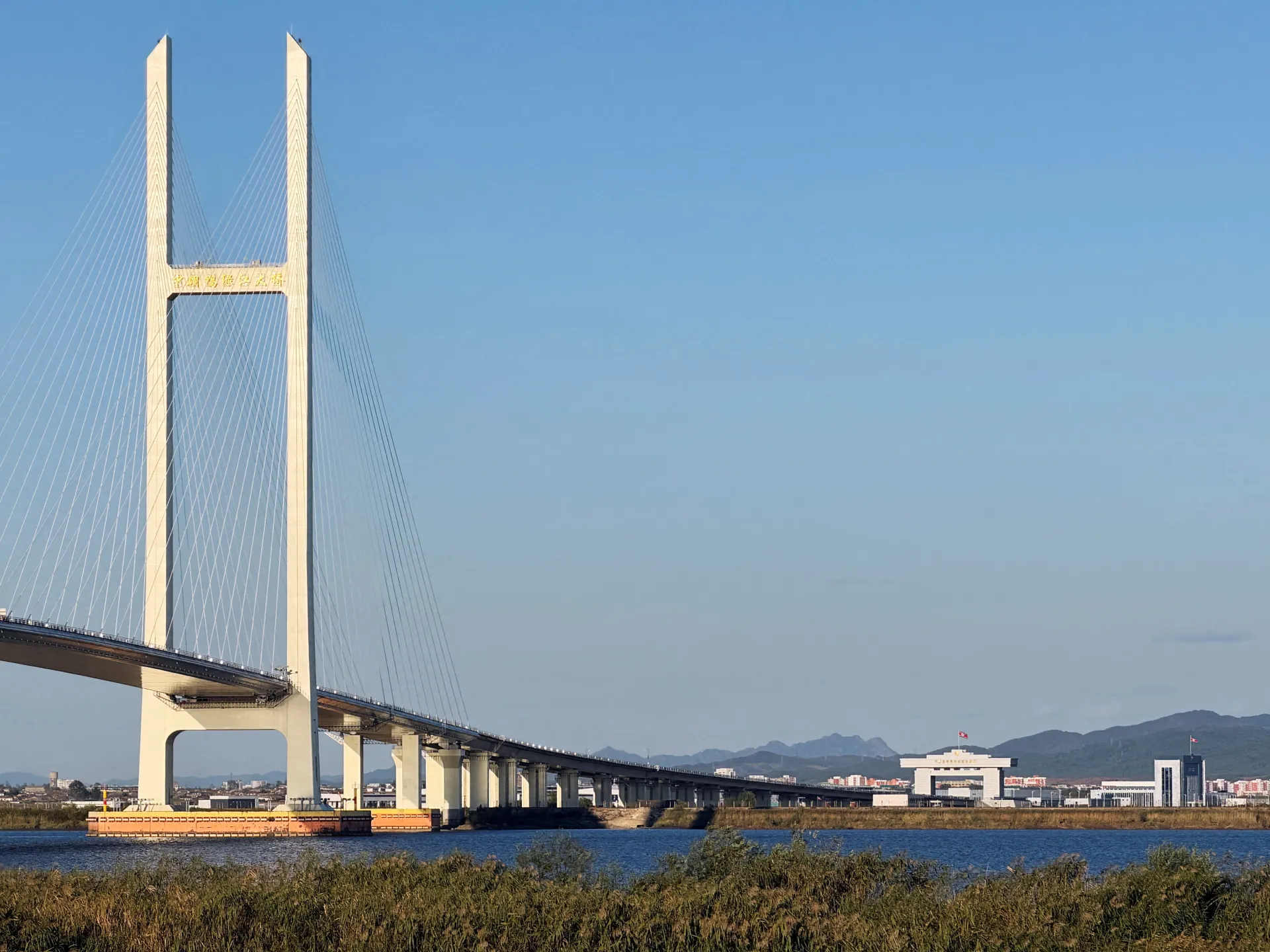
North Korean leader Kim Jong Un waved to crowds as he crossed a newly opened bridge linking his country with China, Chinese state media reported. The Yalu River Bridge is seen as a strategic link in expanding trade ties between the two nations.
The proposal comes days after Pyongyang says it moved new military units into ‘firing positions’ along the border.
Published On 23 Oct 202623 Oct 2026
South Korea has proposed holding military talks with North Korea in a bid to calm rising tensions over their heavily fortified border.
Seoul said on Friday that it had invited Pyongyang to discuss restoring communication channels. The offer was made as military activity on the border increases.
Recommended Stories
list of 4 itemsend of list
Talks with North Korea would aim to “mutually confirm” the precise location of the land Military Demarcation Line (MDL), “discuss ways to restore military communication lines and prevent accidental clashes in border areas”, Kim Hong-cheol, deputy minister for national defence policy, told reporters.
“Specific dates and locations could be discussed through Panmunjom,” Kim said, referring to the symbolic truce village on the North-South border where soldiers from both Koreas stand face to face.
He added that the South was open to three-way talks involving the United States-led United Nations Command and hoped for “a positive response from North Korea”.
It remains unclear whether North Korea would agree to talks. Leader Kim Jong Un has taken a hardline approach towards Seoul and suspended virtually all dialogue and cooperation with the South in recent years.
Meanwhile, Pyongyang has raised its military activity along the border and continues to do so.
On Wednesday, Kim Yo Jong, the powerful sister of the North Korean leader, announced that new military units have been moved into “firing positions” along the border.
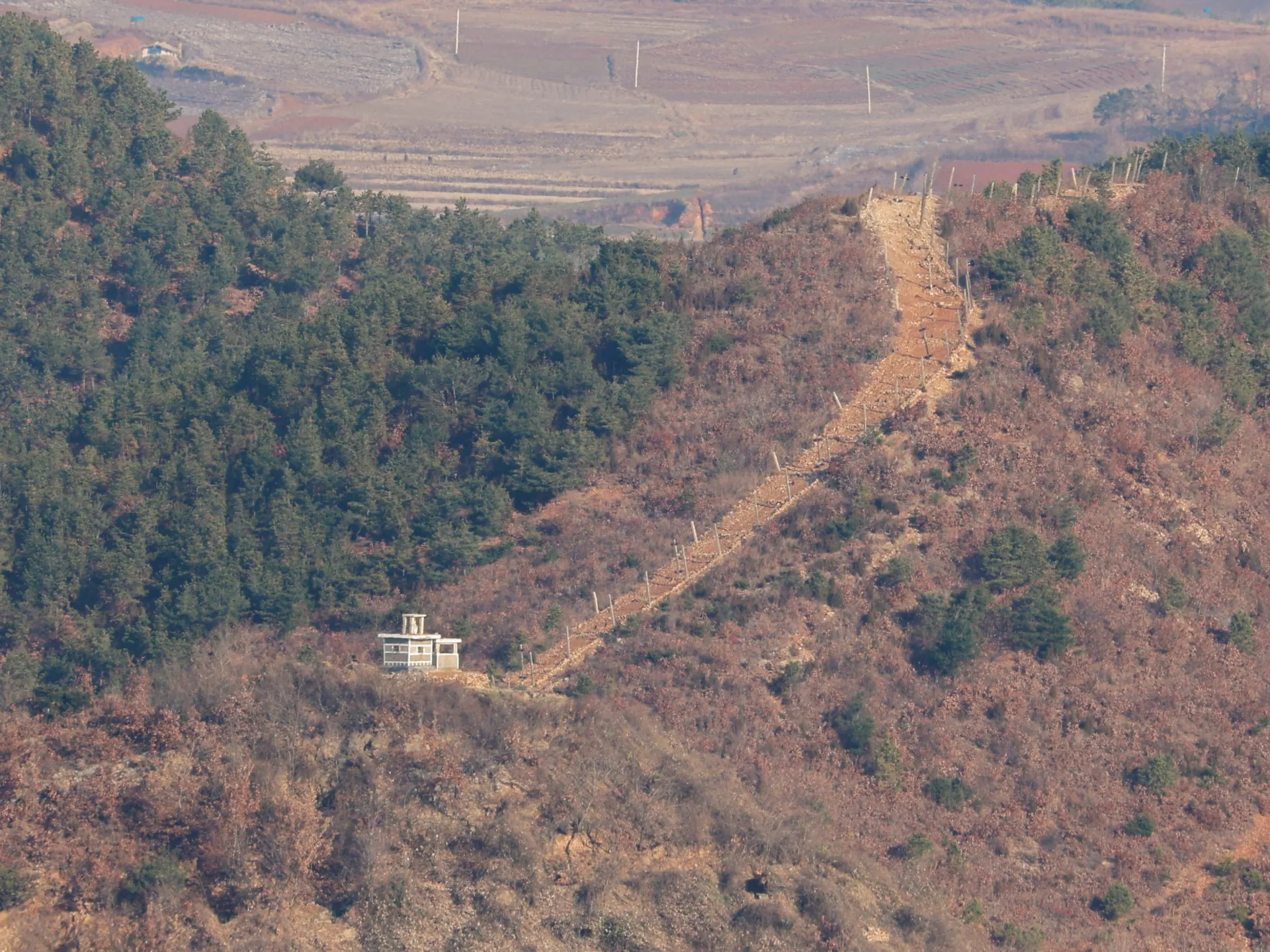
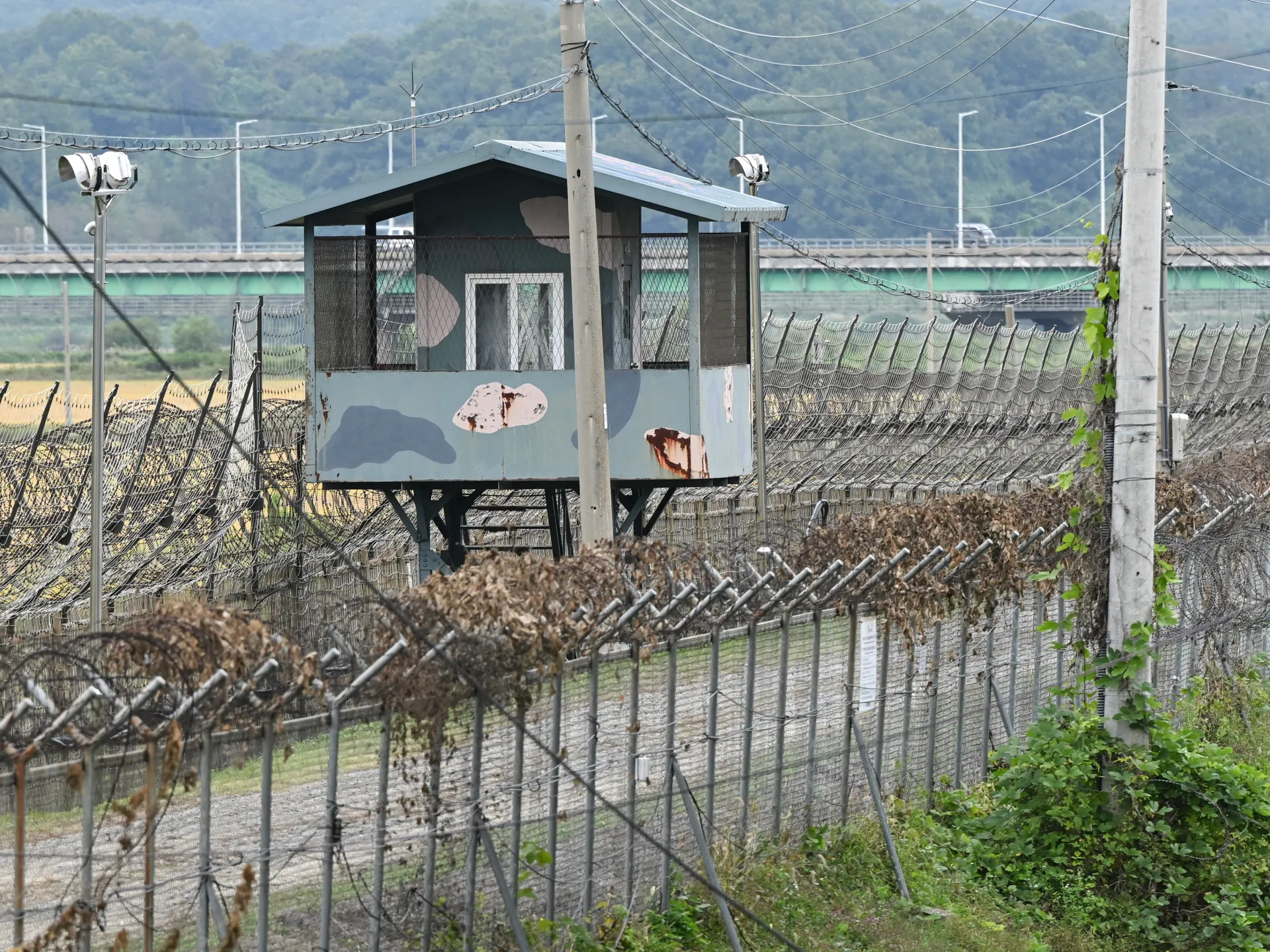
Mines, barbed-wire fences, tactical roads, antitank walls and other fortifications have also been added to one of the world’s most heavily armed borders.
Tensions have worsened since last month when three South Korean soldiers were injured by explosions near the military demarcation line in the western section of the Demilitarized Zone, the buffer zone that runs between the Koreas, commonly known as the DMZ.
Seoul’s Ministry of National Defence said on Friday that it was difficult to predict “what further incidents could occur if this situation is allowed to continue unaddressed”.
The ministry noted that a proposal for talks last year did not receive a response from Pyongyang.
South Korean President Lee Jae Myung has called for the North to return to dialogue. However, Kim Yo Jong responded by slamming the suggestion of bilateral talks as “the climax of the farce”.
North Korea has said it plans to resume broadcasting anti-South Korea propaganda along the armed border between the two countries, as Seoul urged Pyongyang to discuss easing tensions.
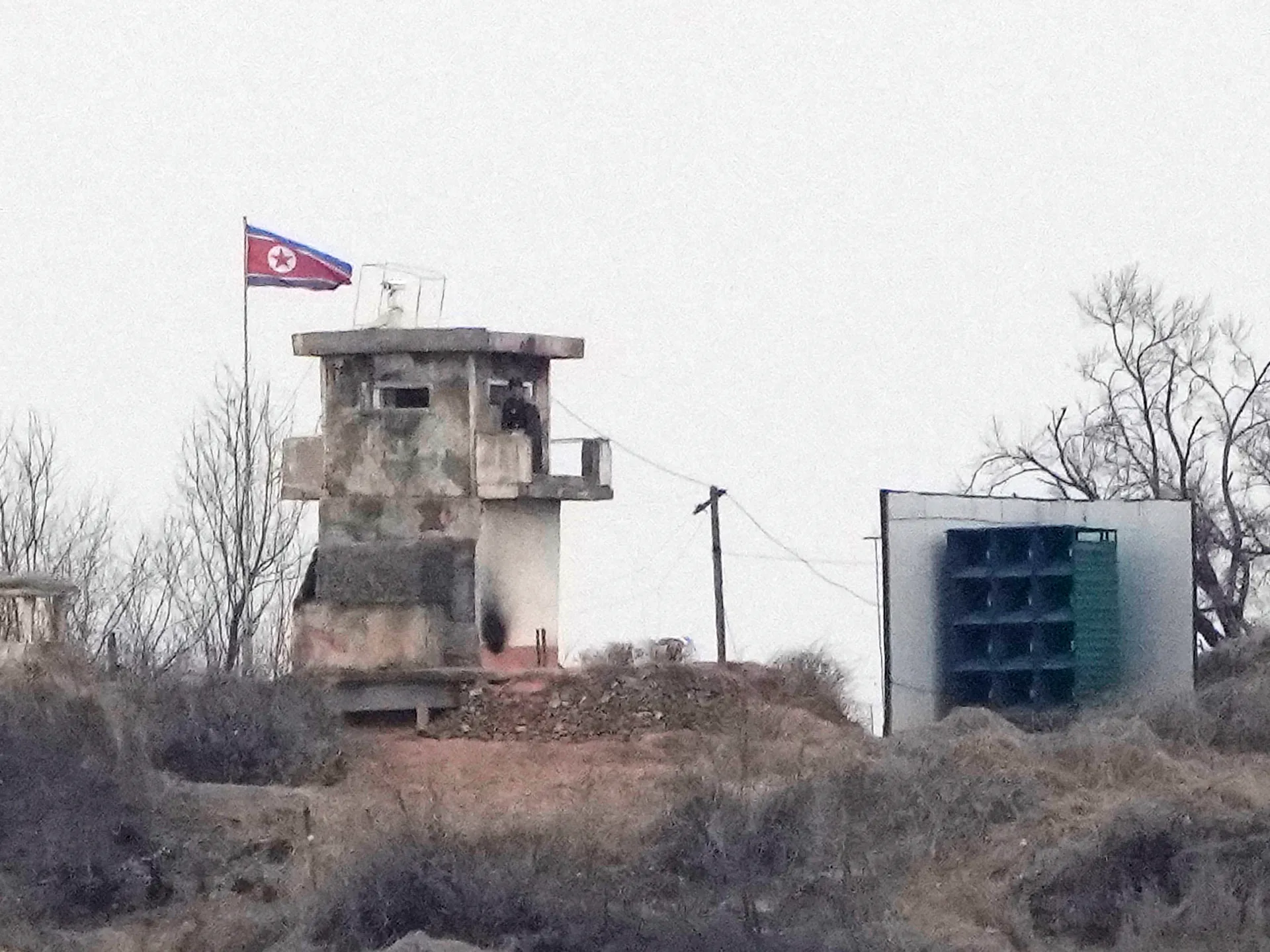
Kim Yo Jong, a senior North Korean official and the sister of leader Kim Jong Un, said on Wednesday that North Korea will place loudspeakers along the entire border, following a visit with top military officials to fortifications along the contested frontier.
Recommended Stories
list of 3 itemsend of list
Kim warned Seoul of “the most horrible and distressing situation” if South Korea continued what Pyongyang calls interference in the North’s internal affairs.
She added in a follow-up statement on Thursday that North Korea would place “new counter means” on alert along the border, without elaborating, and have its loudspeakers on “standby” within days.
A landmine blast last month that wounded three South Korean soldiers in the Demilitarized Zone (DMZ) between the two countries has ratcheted up tensions. Seoul accused North Korean troops of deliberately laying mines in the border zone as part of the North’s fortification work.
Kim had denied the allegation, calling the incident a South Korean fabrication. She said North Korean tactical units had taken up new positions, and accused South Korean troops of conducting warning broadcasts and firing warning shots at multiple locations near the border.
Seoul said the warning shots were fired as “legitimate and defensive measures”.
North Korea has been adding mines, barbed wire fences, anti-tank barriers and other fortifications to what is already one of the world’s most heavily armed borders.
South Korea’s Ministry of National Defence urged North Korea on Thursday to discuss measures to ease tension at the border and prevent any accidental military clash, its spokesperson said.
Pyongyang had cut off a military hotline with the South after declaring it would no longer seek dialogue or unification with what it called its “foe”.
Loudspeaker propaganda
Both North and South Korea have historically used loudspeakers to broadcast propaganda across the border, with South Korean broadcasts featuring K-pop music and news that have long irked Pyongyang and prompted tit-for-tat responses.
The two Koreas are separated by the DMZ, established after the 1950-53 Korean War ended in an armistice.
North Korea has been reinforcing its side of the DMZ with mines, barriers and fencing since 2024 as it seeks to establish what it calls a permanent border with South Korea.
Earlier this month, South Korea recalled its ambassador from Kyiv after Zelenskyy disclosed the prisoner transfer.
Published On 20 Oct 202620 Oct 2026
South Korea’s Ministry of Foreign Affairs says it will withdraw additional embassy personnel from Ukraine following Kyiv’s lack of “constructive response” in a dispute about North Korean prisoners of war (POWs).
Seoul had told Kyiv of its position via multiple channels but had not received a sufficient response from Ukraine, ministry spokesperson Park Doo-soon said on Tuesday.
Recommended Stories
list of 3 itemsend of list
Earlier this month, South Korea recalled its ambassador from Kyiv after President Volodymyr Zelenskyy told the United Nations General Assembly (UNGA) that Ukraine had transferred two captured North Korean soldiers to the South.
The disclosure angered Seoul, which said the operation should have remained confidential to protect the soldiers’ families in North Korea.
“This measure was taken because we judged it necessary to facilitate an amicable resolution of the issue and restore trust between the two countries,” Park told a regular press briefing, without saying how many staff members would leave.
A charge d’affaires would stay on in Kyiv to maintain diplomatic communication along with all consular staff to protect South Korean nationals, Park added.
Persistent threats of air strikes across Ukraine had also made it difficult to ensure staff safety, he said.
Seoul previously summoned the Ukrainian ambassador and threatened unspecified “further measures”.
‘Situation resolved’
Ukraine has insisted that “diplomacy must prevail over emotions” in relations between the countries, and also said Kyiv considered “the situation resolved”.
South Korea’s Foreign Minister Cho Hyun said earlier this month that Ukraine had sent a message that “included words of apology” over Zelenskyy’s disclosure, but it fell short of “the level” Seoul had in mind.
Under South Korea’s constitution, all North Koreans are considered citizens of the Republic of Korea, as the country is officially known, and those who reach its territory and seek to defect are generally allowed to stay.
As China and North Korea cut the ribbon on New Yalu River Bridge this week, officials described the new border crossing in momentous terms.
Chinese Premier Li Qiang said the 3km (1.9-mile) bridge, which links China’s Dandong and North Korea’s Sinuiju, would “vigorously promote” trade and “strengthen emotional bonds”.
Recommended Stories
list of 4 itemsend of list
North Korean Premier Pak Thae-song expressed his belief that the crossing would “accelerate the advance for the prosperity of the two countries” and “add fresh vigour” to their economic cooperation.
Analysts on China-North Korea ties are much more circumspect.
While the bridge is a concrete symbol of China and North Korea’s efforts to revitalise relations that have waned from their Cold War-era peak, the prospects for trade are hindered by obstacles ranging from international sanctions to a North Korean leadership that prioritises security above all else, experts say.
“It reflects China’s renewed effort to strengthen its relationship with North Korea at a time of changing regional alignments,” Phillip Park, a professor at the University of North Korean Studies in Seoul, South Korea, told Al Jazeera.
“But whether this leads to substantially deeper economic integration, greater North Korean dependence, or a significant shift in Pyongyang’s strategic orientation remains an open question.
“The bridge could facilitate trade and logistics, but it does not remove international sanctions,” Park added.
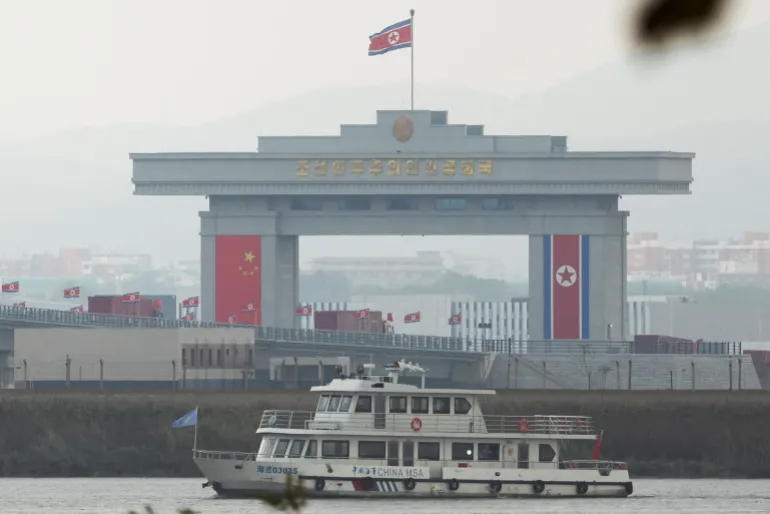
A Chinese maritime patrol vessel travels along the Yalu River as trucks adorned with Chinese flags cross the newly opened New Yalu River Bridge into North Korea’s Sinuiju from China’s Dandong New Zone, as seen from Dandong, Liaoning province, China, on October 15, 2026 [Florence Lo/Reuters]
China, whose troops fought alongside Pyongyang in the 1950-53 Korean War, has long been North Korea’s most crucial economic benefactor.
China accounts for as much as 95 percent of official trade with the secretive country, which is among the world’s most diplomatically and economically isolated states.
Before the four-lane New Yalu River Bridge officially opened on Thursday, road and rail freight between Dandong and Sinuiju, the main route for China-North Korea trade, travelled exclusively via the ageing Sino-Korean Friendship Bridge.
Opened in 1943, the bridge, which has a single-lane road and a rail track, can only carry vehicles weighing a maximum of 20 tonnes.
Jae-woo Joo, a professor of Chinese foreign policy at Kyung Hee University in Seoul, said the new bridge could “tremendously” boost trade between the sides, including the transfer of components banned under sanctions against Pyongyang’s nuclear and missile programmes.
“It is therefore really significant to open this bridge with China,” Joo told Al Jazeera.
After coming under strain from North Korea’s nuclear weapons tests in the mid-2000s, Beijing-Pyongyang ties have warmed under Chinese President Xi Jinping and North Korean leader Kim Jong Un.
At Xi and Kim’s most recent meeting in June, their seventh summit since 2018, the leaders pledged to enhance cooperation in areas spanning trade, defence, agriculture, law, science and technology.
Analysts have, in part, cast Beijing’s deepening engagement with Pyongyang as a response to the latter’s growing ties with Moscow, which have included the deployment of thousands of North Korean troops to the front lines of Russia’s war in Ukraine.
Last month, North Korean and Russian officials opened the first road bridge linking their countries across the Tumen River.
Chinese President Xi Jinping walks with North Korean leader Kim Jong Un, right, to a reception following a military parade to commemorate the 80th anniversary of Japan’s World War II surrender held in front of Tiananmen Gate in Beijing, China, on September 3, 2025 [Mahesh Kumar/AP]
North Korea and China’s two-way trade grew 25 percent in 2025 to reach $2.74bn, according to figures from China’s General Administration of Customs.
Bilateral trade has continued to grow in 2026, jumping nearly 20 percent to reach $1.5bn in the first half of the year, putting it on track to reach its highest volumes since the COVID-19 pandemic.
But while growing, trade remains relatively minuscule in the context of global commerce.
With China’s overall trade hitting $6.36 trillion in 2025, North Korea’s contribution to the total was a little more than 0.04 percent.
Official trade between the neighbours also remains substantially below its 2010s heyday.
Trade hovered around $5-6bn throughout much of the decade, peaking at $6.45bn in 2013.
Economists have offered explanations for the slowdown that range from tightened sanctions to China’s waning reliance on imports amid its efforts to boost economic self-reliance.
Christopher Green, a senior consultant for the Korean Peninsula at International Crisis Group, said the new border crossing’s significance should not be overstated, considering that China-North Korea trade “is fundamentally driven by politics”.
“Lack of cross-border transit routes is not the main obstacle,” Green told Al Jazeera.
“If the bridge opening signifies a political desire on both sides to give political cover to rising trade volumes, then a boost to trade should follow,” Green said, describing ties up until now as “steady-as-she-goes” economic engagement.
“Time will tell. But the key is the politics of national security, not economics.”
Vehicles drive through a new bridge linking China and North Korea as it opened in North Phyongan province, North Korea, on October 15, 2026 [Cha Song Ho/AP]
As much as officials have hailed the New Yalu River Bridge as a reflection of Chinese-North Korean cooperation, the project had a long and torturous road to completion.
Construction began in 2011 and was finished on the Chinese side in 2014.
But North Korean authorities only completed roads and customs facilities on their side of the river this year following repeated pauses in construction amid tensions with Beijing.
“The 12-year delay certainly suggests that economic cooperation is more conditional than the language of friendship might imply,” Marco Mari, a PhD researcher at Bocconi University in Italy who studies China-North Korea economic ties, told Al Jazeera.
“The bridge can facilitate supplies and economic activity, while Russian support gives North Korea alternatives that diminish Beijing’s leverage,” Mari added.
“This does not necessarily imply broader economic reform or a comparable improvement in ordinary people’s lives.”
Chinese Premier Li Qiang, on screen, makes a speech through video conference as a new bridge linking China and North Korea opens in North Phyongan province, North Korea, Thursday, October 15, 2026 [Jon Chol Jin/AP]
Weiqi Zhang, an associate professor at Suffolk University who studies relations between North Korea and China, said the history of China-North Korea economic ties is littered with abortive projects, such as the Hwanggumpyong Special Economic Zone, a North Korean-Chinese development near Dandong.
“There were cases, like the Hwanggumpyong Special Economic Zone – established by China and North Korea – where China built infrastructure on its side, but North Korea didn’t even pave the road on their side,” Zhang told Al Jazeera.
“One reason is that, unlike its neighbours, North Korean government doesn’t really pay much attention to trade for economic development,” Zhang said.
“International trade is used by North Korea more like a foreign policy tool.”
With China wishing to demonstrate its “indispensability” as a trade partner and North Korea eager to strengthen their economic ties, trade is likely to grow, said Edward Howell, a lecturer in international Relations at the University of Oxford.
Even so, economic engagement will be subject to political considerations, Howell said.
“North Korea will obviously want to avoid facing any Chinese influence to change its economic model, but Pyongyang will want to reap the economic benefits of trade with its principal economic benefactor,” Howell told Al Jazeera.
China and North Korea have officially opened the New Yalu River Bridge after a 12-year delay. The 3 kilometre bridge is expected to become the main land route between the two countries as they seek to improve relations.
The long-delayed bridge will formally open on Thursday, according to China’s state-run Xinhua news agency.
Published On 14 Oct 202614 Oct 2026
China and North Korea will officially open the New Yalu River Bridge to traffic on Thursday, China’s state-run Xinhua news agency reports.
China completed its side of the bridge in 2014, hoping to boost trade ties. However, North Korea left its side unfinished for years as relations soured after Beijing supported United Nations sanctions over Pyongyang’s nuclear tests.
Recommended Stories
list of 4 itemsend of list
The first bridge connecting Russia and North Korea also opened earlier this month.
China-North Korea Relations
China’s exports to North Korea rose to a six-year high of $2.3bn last year, a 25 percent increase from the previous year. Chinese President Xi Jinping was welcomed in Pyongyang in June for the first time since 2019.
Since 2018, Beijing has tried to repair ties with Pyongyang, which also briefly began improving relations with Washington around the same time.
The China-North Korea relationship was forged during the Korean War. In 1961, the two countries signed the Treaty of Friendship, Cooperation and Mutual Assistance, which remains China’s only formal military alliance.
The treaty contains a mutual defence clause committing either side to assist the other if one comes under armed attack.
Although China was North Korea’s main diplomatic partner and protector for decades, relations strained after Beijing in 2017 supported tightening sanctions on Pyongyang for its nuclear weapons programme.
Analysts say North Korea’s recent growing relationship with Russia may have changed the balance of Pyongyang’s diplomatic dependence, reducing its reliance on Beijing.
North Korea and Russia signed a comprehensive strategic partnership treaty in 2024, including a mutual defence provision. Military and political ties between the two countries have grown considerably stronger, with North Korea deploying thousands of troops to fight in Russia’s war on Ukraine.
United States President Donald Trump also signalled an interest in repairing relations with Pyongyang last month, after his talks with North Korean leader Kim Jong Un abruptly ended in 2019. In his second term, Trump has floated meeting Kim again, though no official meeting has been set.
North Korea has not yet resumed issuing tourism visas to Chinese citizens, who once made up the bulk of its overseas visitors.
While North Korea’s trade with Russia largely involves military supplies, exchanges with China could arguably involve goods North Korea needs to develop its civilian economy, analysts have said.
General Atomics Aeronautical Systems (GA-ASI) and Hanwha Aerospace completed operations in a simulated battlefield scenario with the Mojave short take-off and landing (STOL) drone on September 16. The testing formed part of a Defense Drone Technology Exhibition and included Mojave operating from an austere short runway at the Seungjin Training Field in Pocheon-si. The flying portion of the trials also saw the Mojave operating down at low level to demonstrate its ability to terrain mask to avoid potential threats and to support ground forces at close quarters.
TWZ’s Jamie Hunter spoke to Matt Petraitis, senior manager of U.S. Army programs at GA-ASI, at the AUSA 2026 trade event being held this week in Washington D.C. about how the Mojave landed on a rough maneuver trail typically used by tanks and artillery vehicles, and about the company’s plans for Mojave in partnership with Hanwha Aerospace.
General Atomics Mojave Drone Completes Austere Testing in Korea
Latest missile launch appears to be a show of force since South Korea’s hypersonic missile test-fire, Seoul says.
Published On 12 Oct 202612 Oct 2026
North Korea has fired multiple ballistic missiles towards the sea off its east coast, South Korea’s military says.
South Korea’s Joint Chiefs of Staff (JCS) said one of the missiles flew more than 900km (559 miles) from the Pyongyang area on Monday. The joint chiefs did not specify how many missiles were detected.
Recommended Stories
list of 3 itemsend of list
Japan’s coastguard said on Monday that North Korea had fired two unidentified projectiles, believed to be ballistic missiles, which appeared to have already fallen.
South Korea’s presidential office said that Pyongyang’s repeated missile launches violate United Nations Security Council resolutions, urging an immediate stop.
Monday’s missile launch adds to heightened tensions on the Korean Peninsula, as both countries have been conducting weapons tests.
Escalating tensions
JCS spokesperson Jang Do-young said the latest missile launch appears to be a show of force since South Korea’s hypersonic missile test-fire.
On Thursday, South Korean President Lee Jae Myung oversaw the country’s first test-firing of a hypersonic missile, a rare public showcasing of a missile test by a South Korean president.
Lee’s office said the hypersonic weapon, once fully developed, would enhance South Korea’s ability to strike key targets by surprise in the “Korean Peninsula theatre of operations”.
On October 3, North Korea also tested a hypersonic intermediate-range missile designed to evade missile defences in South Korea and Japan.
Last week, Seoul demanded an apology after a landmine blast wounded three soldiers in the Demilitarized Zone between South and North Korea. A joint South Korean-UN investigation concluded that two landmines were planted by North Korean forces about a year ago. Pyongyang dismissed the claim and accused South Korea of provocation.
Prior to the border mine blast, Seoul said it was conducting “preliminary coordination efforts” to facilitate dialogue between Pyongyang and Washington.
Lee pledged to reopen dialogue with North Korea in his first speech after taking office in 2025.
North Korean leader Kim Jong Un continues to flaunt his nuclear weapons programme, while rejecting US and South Korean offers to resume stalled diplomacy.
Talks between Kim and US President Donald Trump abruptly ended in 2019. Kim Jong Un’s government continues to demand that Washington abandon its “hostile” policy towards Pyongyang and drop demands for North Korea’s denuclearisation as a condition for talks.
The South Korean government has released images from its first successful test of a domestically developed hypersonic boost-glide vehicle. This includes shots of the vehicle impacting the water at the end of its flight. A weapon of this kind would give South Korea a significant new way to hold targets in North Korea at risk amid an ever-deepening arms race on the Peninsula.
South Korea’s Presidential Office, more commonly referred to as the Cheong Wa Dae or the Blue House, announced the test in a Korean-language press release yesterday. The Blue House initially released a video of President Lee Jae Myung and others observing the test from a conference room at the Anheung Proving Ground, which is located in South Chungcheong Province on the country’s western coast. South Korea’s Agency for Defense Development (ADD) manages testing at Anheung. A series of still images from the test itself was subsequently posted on the Blue House’s website.
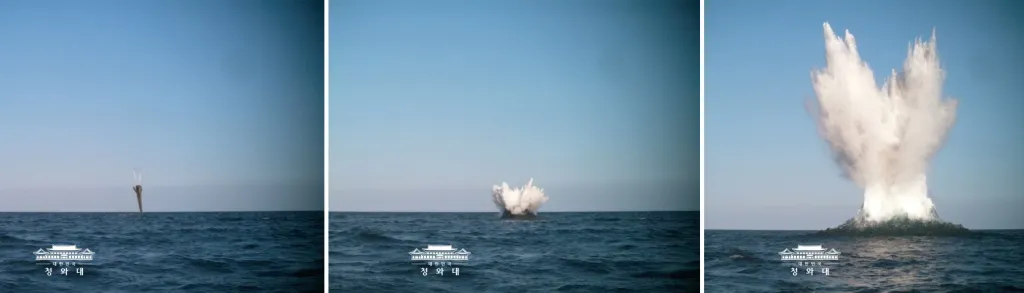
A trio of pictures showing South Korea’s new hypersonic boost-glide vehicle impacting the water during the test yesterday. The Blue HouseAnother view of the impact at the end of yesterday’s South Korea hypersonic test as seen through what looks to be an electro-optical video camera on an aircraft. The Blue House
Included in the still image gallery are shots showing the launch of the missile, a formal name for which has not yet been disclosed, from a wheeled transport-erector-launcher on a platform sitting just off the coast. The low resolution of the pictures makes it hard to tell whether the missile and/or the TEL are of an existing South Korean design or are based on one. We will come back to this later on.
A picture showing the launch of the hypersonic weapon from the platform off the coast. The Blue HouseAnother picture from the test showing the missile after launch. The Blue House
As mentioned, there are also pictures of the hypersonic boost-glide vehicle hitting the water. At first glance, the vehicle looks to have a broadly conical design with stabilizing fins at the base. However, at least one of the fins looks to be truncated. Closer inspection of the available images shows further indicators that might point to it actually having a more wedge-shaped design with a distinct top and bottom, though it is still not definitely clear given the low resolution. Conical boost-glide vehicles are generally understood to be easier to design, relatively speaking, than wedge-shaped ones. Historically, hypersonic boost-glide vehicles of any kind have proven to be technically complex and challenging to turn into viable operational weapons, even by countries with extensive past experience with their development.
Another close-up look at the hypersonic boost-glide vehicle test yesterday, showing what looks to be a truncated fin on one side. The Blue House
“This test launch was conducted to verify, for the first time, the vehicle’s core technologies in a hypersonic flight environment: the performance of ultra-high-temperature heat-resistant materials, guidance and control capabilities, and the ability to perform irregular flight maneuvers at low altitudes,” the Blue House said in its release yesterday, per a machine translation of the Korean text. “The HGV [hypersonic boost-glide vehicle] successfully separated after ascending to the target altitude and executed its planned flight path within the hypersonic environment without any issues.”
With all this in mind, the fact that the vehicle just remained intact through to impact is noteworthy. At the time of writing, South Korean authorities do not appear to have disclosed more specific details about the test, including how far the boost-glide vehicle traveled before hitting the water or what peak speed it reached. Important questions also remain about how the vehicle is guided during the mid-course and terminal phases of flight, challenges that do not appear to have been addressed by this particular test.
In general, unpowered hypersonic boost-glide vehicles need to be brought first to an optimal altitude and speed. This is typically achieved using a sufficiently sized rocket booster, with existing ballistic missile designs often serving as a starting point.
Once released from the booster, a boost-glide vehicle flies along a relatively shallow flight path within the Earth’s atmosphere. The vehicle is able to maneuver along the way, sometimes erratically, while traveling at hypersonic speeds, generally defined as anything about Mach 5.
A graphic showing, in a very rudimentary way, the differences in trajectories between a traditional ballistic missile, a hypersonic boost-glide vehicle, an aero or quasi-ballistic missile, and an air-breathing hypersonic cruise missile. GAO
All of this sets hypersonic weapons of this kind apart from traditional ballistic missiles, even ones with advanced maneuverability capabilities, which all follow a broadly arcing trajectory to their targets. The combination of speed, flight trajectory, and maneuverability offered by hypersonic boost-glide vehicles creates distinct challenges for opponents. They are hard to spot and track, let alone attempt to intercept, and there is less time for defenders to react overall. This ability to penetrate enemy air defenses and cover ground rapidly makes these weapons particularly attractive for strikes on very high-value and time-sensitive targets.
“The HGV [hypersonic boost-glide vehicle] is a ‘key strategic asset capable of changing the game on the battlefield,’ as its unpredictable flight trajectory and overwhelming speed allow it to launch surprise strikes against key strategic targets during contingencies,” the Blue House’s release explicitly noted, again according to a machine translation.
With all this in mind, South Korea does have an entire family of domestically-produced ground-launched ballistic missiles that could be suitable starting places for launching an unpowered hypersonic boost-glide vehicle. President Lee was notably shown a TEL for the country’s newest Hyunmoo-5 ballistic missile at Anheung yesterday, though no explicit connection has been drawn between that weapon and the hypersonic test. The Hyunmoo-5 is itself still a relatively new development, having only entered service around the end of last year.
President Lee Jae Myung and others inspect a Hyunmoo-5 TEL on October 8, 2026. The Blue House
When it comes to new South Korean arms developments, the Hyunmoo-5, which entered service around the end of last year, has been and continues to be a major point of discussion by itself. It is officially categorized as a short-range design, despite how big it is (35 tons gross weight), which is said to be due largely to the equally substantial size of its warhead (17,000 pounds). Past reports have raised the possibility that it could be capable of flying out to intermediate ranges if the warhead weight were reduced. Short-range ballistic missiles are defined as ones with ranges between 190 and 620 miles (300 and 1,000 kilometers), while intermediate-range ballistic missiles can hit targets out to between 1,864 and 3,418 miles (3,000 to 5,500 kilometers). Medium-range ballistic missiles (MRBM) fall in between these two categories.
A Hyunmoo-5 transporter-erector-launcher seen during a parade in 2024. Kim Jae-Hwan/SOPA Images/LightRocket via Getty Images
With its massive unitary warhead, the Hyunmoo-5 already gives South Korea an important new way to hold deeply buried and otherwise hardened targets in North Korea at risk. This fits in directly with the country’s broader Korea Massive Punishment and Retaliation (KMPR) policy, as TWZ has previously written:
“While the Hyunmoo-5 has been widely reported as a future pillar of the KMPR, its specific ability to penetrate deeply buried bunkers, such as those used by the North Korean leadership, the same functions mean that it can also fulfill elements of the ‘kill chain.’ In this way, it could be used as part of a pre-emptive strike, to try and knock out North Korea’s launch capability by targeting its hardened command-and-control facilities and missile storage areas.“
By virtue of the very high speeds they reach in the terminal phase of flight, hypersonic boost-glide vehicles also offer bunker-busting benefits on top of the other aforementioned advantages they bring to the table.
In addition, the hypersonic boost-glide vehicle test reflects a broader arms race that has been expanding in scale and scope for years now. South Korea is also developing an air-breathing hypersonic cruise missile, seen in the composite image below, as well as new air- and sea-launched ballistic missiles, the latter of which will be loaded on new surface warships and submarines.
via X
Though there are always questions about the actual maturity and viability of the designs, North Korea continues to churn out its own new missile developments. This includes two separate test launches of purported new hypersonic designs just in recent weeks. Tit-for-tat missile launches are not entirely uncommon on the peninsula, but there are limits to how quickly a test like the one South Korea conducted yesterday involving an emerging technology can reasonably be staged.
A picture of one of two new purported hypersonic missiles North Korea says it has tested in the past few weeks. North Korean State Media
An operational hypersonic boost-glide vehicle capability would also expand South Korea’s capacity to challenge opponents regionally beyond North Korea. Though the regime in Pyongyang represents the most proximate national security threat to the country, China and Russia have also been growing points of concern for South Korean authorities in recent years.
“We must secure our national security through our own strength,” President Lee said after yesterday’s hypersonic test, per the Blue House’s release. “The government must not rest on today’s success but must further advance the technology so that the hypersonic glide vehicle can establish itself as a robust strategic asset safeguarding our future security.”
South Korea’s President Lee Jae Myung, at center, and others applaud after yesterday’s test. The Blue House
South Korea’s very public test of its new hypersonic boost-glide vehicle underscores the country’s still-expanding efforts to broaden its options for striking even the best-defended targets in North Korea, as well as projecting power elsewhere regionally. At the same time, it remains to be seen when the South Koreans may field a real operational capability in this regard.
Ukrainian reports of South Korean fuel exports to Russia come amid strained tensions between Seoul and Kyiv.
Published On 8 Oct 20268 Oct 2026
South Korea’s Ministry of Foreign Affairs has said the government will take legal action over illegal fuel shipments to Russia if allegations from an adviser to Ukrainian President Volodymyr Zelenskyy are confirmed.
The Foreign Ministry said on Thursday it had not confirmed whether South Korean fuel, including diesel, had been exported to Russia.
Recommended Stories
list of 3 itemsend of list
It added that exports of some products, such as diesel and jet fuel for commercial purposes, were not included in a South Korean exports control list to Russia.
On Wednesday, the South Korean presidential office dismissed a statement by Vladyslav Vlasiuk, an adviser to the Ukrainian president on sanctions policy, that 176,000 tonnes of fuel were shipped from South Korea to Russia via sanctioned tankers in July and August.
Ukraine’s top sanctions official said the alleged findings run counter to South Korea’s sanctions policy towards Russia.
“Since Russia’s invasion of Ukraine, our government has consistently implemented sanctions and export controls against Russia in close cooperation with the international community,” South Korean presidential spokesperson Kang Yu-jung said on Wednesday, according to the Yonhap news agency.
“We ask that Ukraine also refrain from distorting the relevant policies of the Republic of Korea without sufficient verification of the facts and making public remarks that can damage international trust,” she added.
Relations between South Korea and Ukraine have been strained for the past couple of weeks after Seoul accused Zelenskyy of having “unilaterally disclosed” to the United Nations General Assembly that Kyiv had transferred two North Korean prisoners of war to South Korea.
Seoul Korea demanded an official apology from Kyiv, claiming the Ukrainian president had breached a non-disclosure agreement. Kyiv said no such agreement was in place.
Pyongyang and Moscow, meanwhile, have deep ties, with the two countries having signed a mutual defence treaty in 2024. According to Ukrainian and South Korean estimates, about 14,000 to 15,000 North Korean soldiers were sent to support Russia’s war efforts against Ukraine.
North Korea and South Korea remain technically at war because the 1950–1953 Korean War ended in an armistice rather than a peace treaty.
South Korea signals cuts to military exemptions for gold medallists after backlash over athletes’ Asian Games comments.
Published On 7 Oct 20267 Oct 2026
South Korea’s sports minister says the government will review the military service exemption for gold-medal-winning athletes after public backlash to some controversial comments from winners at the Asian Games.
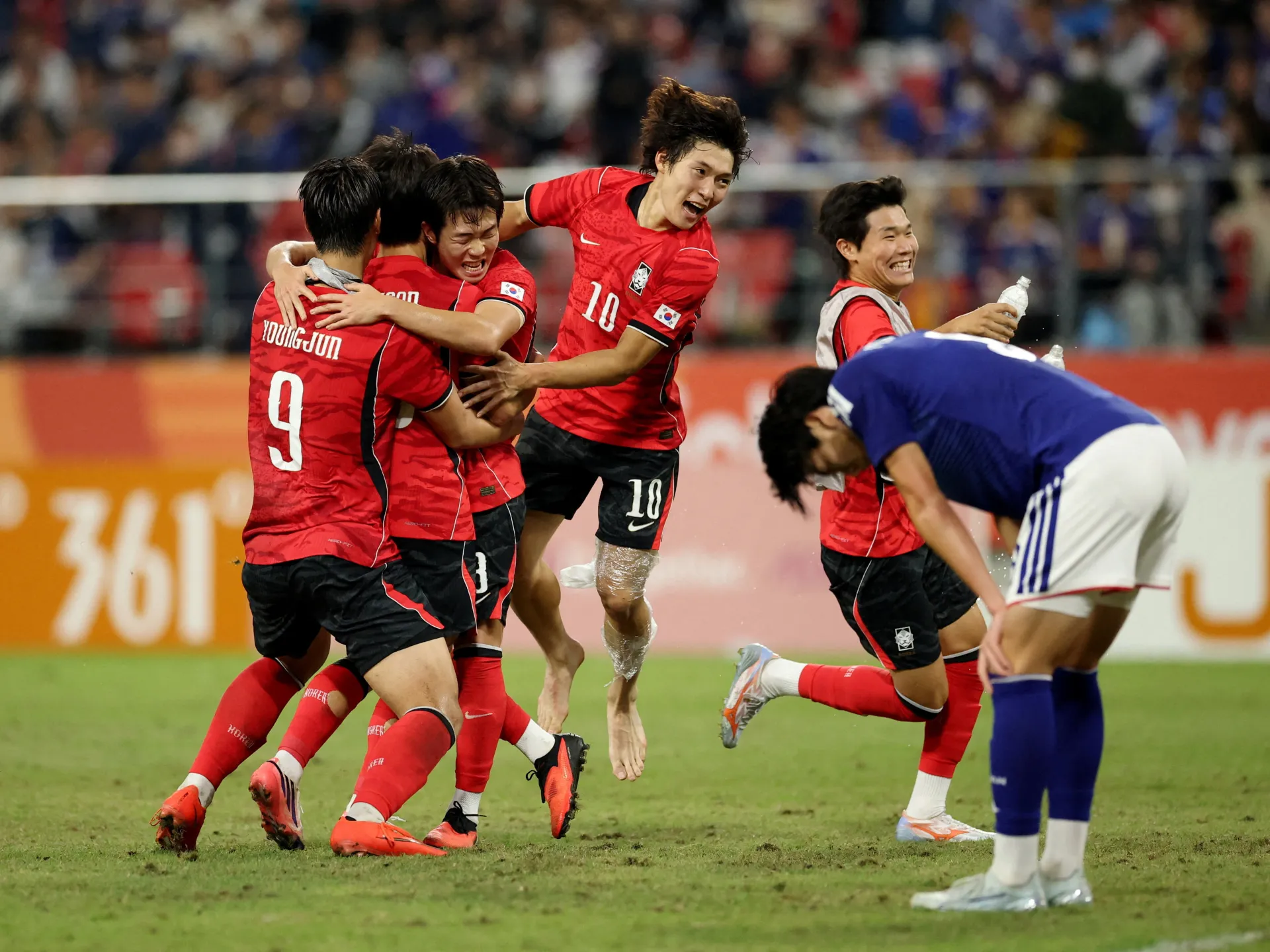
Three players from the men’s football team came under fire for comments following South Korea’s 1-0 win over Japan in the Asian Games final last weekend in Japan.
Recommended Stories
list of 4 itemsend of list
All three apologised, but a broader debate had already reignited over whether athletes should receive special treatment for sporting achievements, particularly as common citizens, as even members of BTS – the globally famous K-pop group – had to complete their mandatory service.
Al Jazeera Sport takes a closer look at the furore surrounding the comments at the Asian Games.
Culture, Sports and Tourism Minister Choi Hwi-young on Wednesday said the alternative military service exemption system for artists and athletes “will inevitably have to be scaled back”.
“It is true that the system has contributed to helping outstanding artists and athletes maintain and develop their abilities,” Choi told the National Assembly’s Culture, Sports and Tourism Committee.
“However, the values attached to fairness and public perceptions of military service have changed. I agree that the system should be comprehensively reviewed once again.”
What does military service look like in South Korea?
Most South Korean men must complete 18 to 21 months of military service by the age of 28.
Since 1973, however, Olympic medallists and Asian Games gold medallists have been able to replace the full term with a supplementary service, which consists of three weeks of basic training.
Three of the footballers, including Yang Min-hyuk, who assisted the winning goal against Japan, made comments that were viewed as insensitive.
“The medal and winning the championship weren’t important. I played the game with only one thing in mind – the reward of a military service exemption,” Yang, who joined Tottenham Hotspur in 2025 and is currently on loan at Belgian club Westerlo, said.
Newcastle United midfielder Park Seung-soo posted a photo on social media showing him wearing a cap associated with soldiers who have completed their service. In a post-match interview, captain Lee Gi-hyuk held up his gold medal and said, “I’m not going to the military.”
What has been said elsewhere in South Korea about the controversy?
A number of politicians, including Ahn Cheol-soo of the People Power Party, said it was time to change the system.
“Some players’ remarks after the match were outrageous,” Ahn posted on social media. “Even the captain bragged about not having to serve in the military. Are all the young people who enlist every year fools?”
Former lawmaker Yoo Seong-min said the flippant comments had provoked resentment and asked: “Is it really fair that BTS has to serve in the military while Asian Games gold medallists are exempt?”
In a Korea Herald editorial on Tuesday, the newspaper declared that the practice was outdated.
“South Korea now stands shoulder to shoulder with the world’s leading nations,” the newspaper said. “The days when finishing first in Asia could meaningfully enhance the country’s national prestige are long gone. It is time to reconsider.”
That was the message from Defence Ministry spokesperson Chung Binna during a press briefing in Seoul.
“Ultimately, we have plans to cut back or scrap the supplementary service, including one designed for artists and athletes,” Chung said.
What other athletes gained military-service exemptions?
The footballers were among many winners from the Asian Games who qualified for the military exemption.
Golfer Tom Kim won the men’s singles on Saturday after flying across the Pacific when the Presidents Cup competition ended so he could compete in Japan. Asked about the military exemption, he took the gold-medal approach.
“I’m more proud that I’m able to bring a medal for my country,” he said.
Sixteen South Korean baseball players are also exempt after defeating Japan 3-1 in the Asian Games final. So are three South Koreans who won gold in esports, an event at the Asian Games.
Seoul has urged the North to remove any other mines planted on the southern side of the military demarcation line.
Published On 6 Oct 20266 Oct 2026
South Korea is weighing measures to force an apology from North Korea over a recent landmine blast that wounded three soldiers in the Demilitarized Zone (DMZ) between the two countries, a Defence Ministry spokesperson has said.
A joint South Korean-United Nations investigation concluded on Monday that two landmines that exploded last month in the DMZ were planted by North Korean forces about a year ago, prompting Seoul to demand an official apology.
Recommended Stories
list of 3 itemsend of list
“We are not ruling out any options or prejudging anything when it comes to additional measures,” Defence Ministry spokeswoman Chung Bin-na told reporters on Tuesday when asked if steps were being planned to force an apology from Pyongyang.
Chung did not offer specifics about what actions might be employed.
Seoul has also called on nuclear-armed North Korea to remove any other mines planted on the southern side of the military demarcation line (MDL) that runs through the DMZ, the heavily fortified frontier that has divided the Korean Peninsula since the 1953 Armistice Agreement.
Pyongyang has denied responsibility for the September 21 blast, with Kim Yo Jong, the powerful sister of North Korea’s leader, slamming the call for an apology as “despicable”.
Chung said Seoul is calling on Pyongyang to come to the table to discuss a misalignment of the MDL. Differing views of the border line are one factor contributing to tension in the area, she said.
The comments come a day after South Korea’s military carried out a mine-clearing operation south of the MDL. It pledged to continue with clearing operations in the area if Pyongyang fails to remove the remaining explosives. The United States-led UN Command (UNC) confirmed the mine placement violated the 1953 agreement.
Defence Minister Kang Shin-chul told the Yonhap news agency on Tuesday that the military’s “decisive” response was “unprecedented in history”.
“All responsibility lies with North Korea,” Kang told reporters, adding that armed forces would “respond decisively” to any actions threatening national security.
The escalation comes as Pyongyang rejected diplomatic overtures from Seoul. Unification Minister Chung Dong-young proposed on October 2 that both sides jointly resurvey the MDL, noting that only about 200 of 1,292 original boundary markers remain intact and that Seoul and the UNC differ on roughly 60 percent of border coordinates.
Kim Yo Jong rejected the proposal as a “wild dream”, declaring Pyongyang would define its sovereign boundary “by the use of force, not by means of negotiation”.
A ballistic missile is fired from the North Korean port city of Wonsan, South Korean military says.
Published On 2 Oct 20262 Oct 2026
South Korea’s military says North Korea has fired at least one ballistic missile towards the sea off its east coast.
South Korea’s Joint Chiefs of Staff said on Saturday morning that its northern neighbour fired a ballistic missile from the port city of Wonsan on the eastern shore of the Korean Peninsula.
Recommended Stories
list of 3 itemsend of list
The South Korean military raised an alert for further launches.
Japan issued an emergency alert on Saturday, saying: “North Korea has launched a suspected ballistic missile.”
The launch came a day after Kim Yo Jong, the powerful sister of North Korean leader Kim Jong Un, ridiculed South Korean demands for the North to apologise over landmine blasts that South Korea and the US-led United Nations Command said were caused by North Korean mines planted south of the Military Demarcation Line.
The blasts seriously injured three South Korean soldiers on a reconnaissance mission inside the 4km-wide (2.5-mile) border zone that stretches across the Korean Peninsula.
South Korea has also called on the North to halt recent efforts to fortify its border, including the installation of mines and anti-tank barriers.
Kim Yo Jong dismissed Seoul’s demands as “utterly pathetic”, saying the North intends to permanently cut ties with the South.
Saturday’s launch was the latest in a series of North Korean military displays in recent weeks, including tests of a purported hypersonic missile system, live-fire exercises and the commissioning of a new warship.
South Korea’s President accused Ukraine of undermining him and called on Kyiv to apologise.
Published On 2 Oct 20262 Oct 2026
South Korea’s President Lee Jae Myung has expressed anger at Ukraine over comments by Ukrainian President Volodymyr Zelenskyy in a speech at the UN which appeared to reveal a secret deal by which Kyiv would transfer North Korean prisoners of war to Seoul.
In a social media post on Friday, Lee accused Ukraine of undermining him and warned that Zelenskyy’s remarks about an imminent military clash between North and South Korea amounted to invoking the risk of war on the Korean Peninsula.
Recommended Stories
list of 3 itemsend of list
The diplomatic row pits two US-aligned states with powerful militaries against each other, potentially complicating US efforts to shore up a united global front to contain Russia, China and North Korea.
The South Korean president also expressed regret over Ukraine’s response and called on Kyiv to acknowledge the agreement and apologise.
“This is a matter concerning the honor of the Republic of Korea’s people and nation, we cannot overlook it,” Lee said.
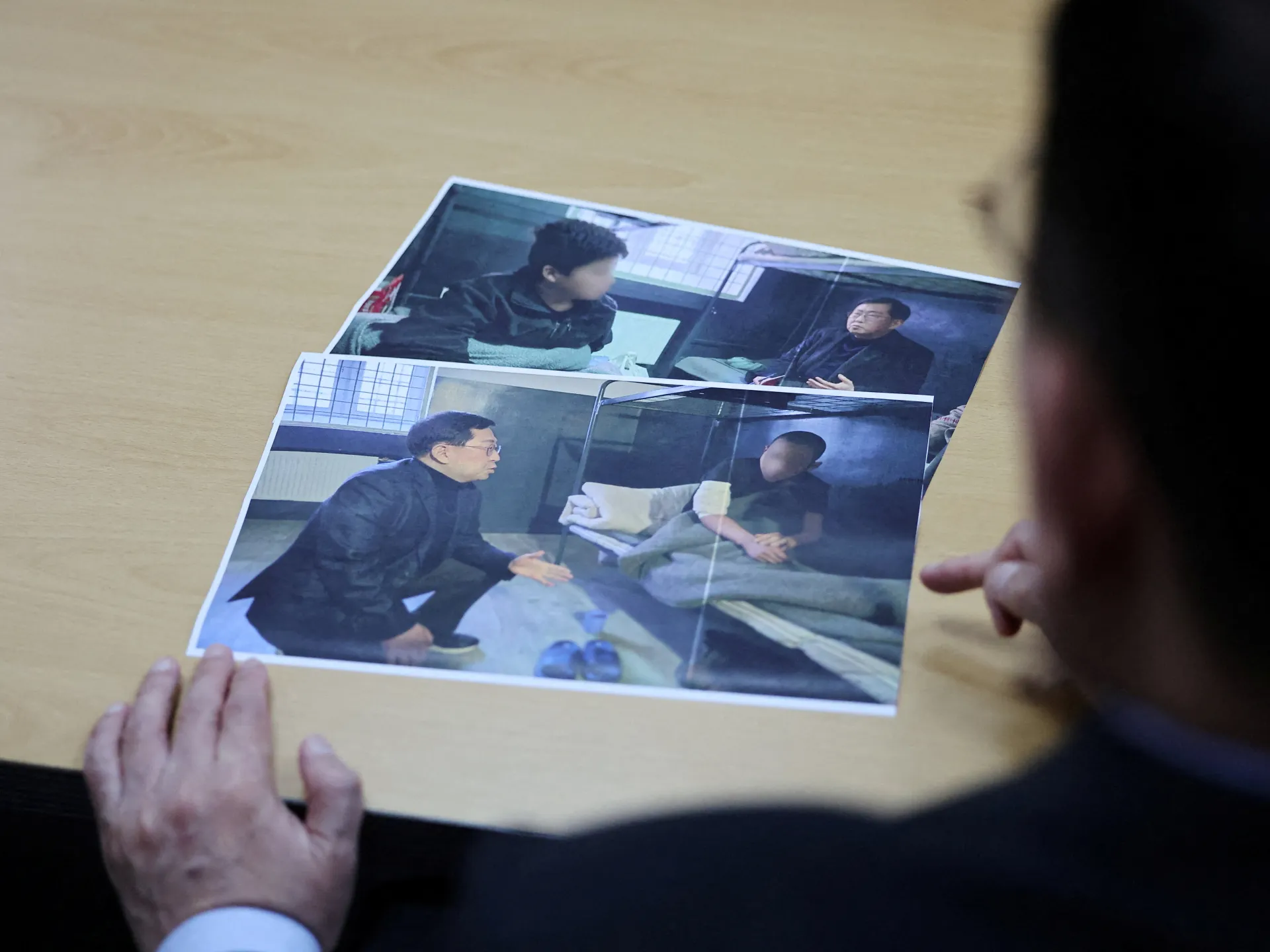
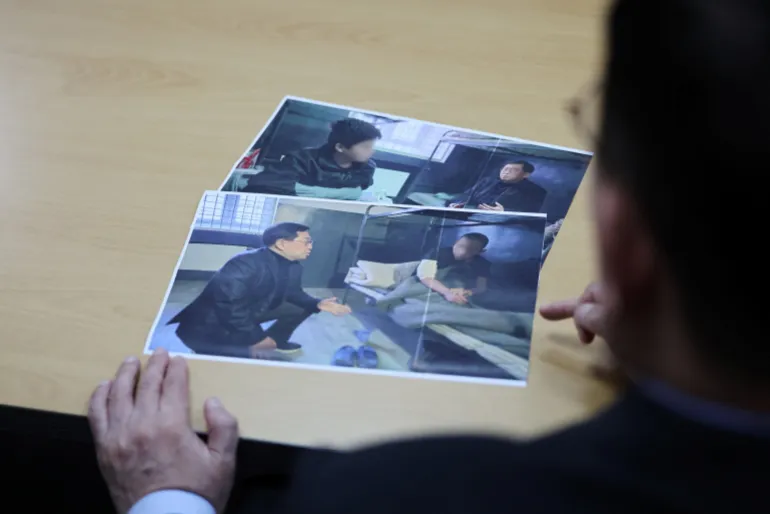
South Korean Lawmaker Yu Yong-weon explains pictures, showing two North Korean POWs who were recently transferred from Ukraine to South Korea. Face of POWs are blurred due to security reason by the source. [File: Kim Hong-Ji/Reuters]
Lee also referred to an interview with Ukraine’s Foreign Minister Andrii Sybiha published by RBC-Ukraine and other Ukrainian outlets on Thursday which sought to reduce bilateral tensions.
Sybiha had said he would “not like to call it an incident”, describing it instead as a “diplomatic misunderstanding”.
“South Korea is an important country for us. And I very much hope for momentum, continued cooperation, and concrete results that we are indeed achieving with them,” he said.
Ukrainian President Volodymyr Zelenskyy said during the UN General Assembly that Kyiv had transferred two captured North Korean soldiers to South Korea after they were caught fighting for Russia in the Kursk region.
South Korea demanded an official apology and explanation from Ukraine, accusing Kyiv of disclosing the transfer of the two North Korean POWs to Seoul.
South Korea’s senior presidential secretary Seong Ghi-hong said in a statement that Ukraine had repeatedly discussed the prisoners’ transfer with Seoul through various channels and had requested secrecy. However, Kyiv has said no secrecy agreement existed.
A landmine explosion which injured three South Korean soldiers in the Korean Demilitarized Zone last week, has prompted Seoul to accuse North Korea of deliberately planting mines south of the Military Demarcation Line. Pyongyang denies the allegations and has threatened to retaliate. Al Jazeera’s Jack Barton reports from the DMZ.
South Korea calls for a formal apology from North Korea over the DMZ explosion that injured three soldiers.
Published On 30 Sep 202630 Sep 2026
South Korea’s military has demanded an apology from North Korea over landmine explosions earlier this month in the border zone between the two countries that wounded three soldiers.
Three South Korean soldiers were injured in two explosions on September 21 near the military demarcation line in the western section of the Demilitarized Zone, a heavily fortified border buffer zone between the Koreas that is commonly known as the DMZ.
Recommended Stories
list of 3 itemsend of list
Kang Hyunwoo, the South Korean joint chiefs of staff’s director of operations, said the military “strongly urges” North Korea to apologise for the blasts and take “responsible measures” to prevent a recurrence.
“This is a clear violation of the Armistice Agreement and undermines the spirit of existing inter-Korean agreements; it must be stopped immediately,” he said on Wednesday, adding “we strongly urge an apology and responsible measures”.
Defence Minister Kang Shin-chul said South Korea would consider unspecified “corresponding measures” if a complete investigation confirms the North was responsible.
Kim Yo Jong, the sister of North Korean leader Kim Jong Un, said the South Korean assessment is a “conspiratorial farce” and accused Seoul of making groundless claims to create a pretext for provocation against Pyongyang.
She also criticised the South for broadcasting warnings and firing warning shots at North Korean troops conducting front-line fortification work, adding “our soldiers have never crossed the border”.
“If the [South Korean] military gangsters fire at our soldiers carrying on the permanent project for the southern border, not warning shots, our border units will take immediate and merciless retaliatory action,” she said.
The United Nations Command said on Wednesday it had “identified an active Democratic People’s Republic of Korea (North Korea’s) anti-personnel mine on the ROK side of the Military Demarcation Line”, in a joint investigation with Seoul’s military.
“Based on the findings of the investigation, UNC determined that an Armistice Agreement violation occurred,” it added.
The UN Command is a US-led multinational military force charged with overseeing the armistice agreement that halted fighting in the Korean War and administers the southern side of the DMZ.
South Korea’s presidential office criticises Ukraine for denying POW nondisclosure agreement.
Published On 27 Sep 202627 Sep 2026
The South Korean president’s office has expressed “strong regret” over Ukraine’s disregard for a nondisclosure agreement with Seoul in the transfer of two North Korean prisoners of war (POWs) to Seoul, South Korean media reported.
Last week, Ukraine’s President Volodymyr Zelenskyy said in an address to the United Nations General Assembly (UNGA) that his country transferred two North Korean POWs to South Korea.
Recommended Stories
list of 3 itemsend of list
President Lee Jae Myung’s office “expresses strong regret over Ukraine’s unilateral disclosure [of the transfer] and its subsequent false announcement that there had not been a non-disclosure agreement”, the Yonhap news agency quoted Seong Ghi-hong, South Korea’s senior presidential secretary for public relations, as saying in a statement on Sunday.
The office said the nondisclosure agreement aimed to safeguard the soldiers from dangers they could face if their transfer were to be disclosed, in accordance with international law and humanitarian principles.
According to Yonhap, a South Korean media outlet, the Ukrainian presidential office said it had disclosed the transfer of the POWs without extensive details on the process, claiming that it would have been strange to keep the entire transfer a secret. Ukrainian media outlets reported a Ukrainian presidential source as denying the existence of a confidentiality agreement with Seoul, Yonhap said.
The South Korean presidential office said the Ukrainian presidential office’s “false” denial of the confidentiality agreement “seriously hampers” bilateral trust and causes serious disruptions to bilateral friendship.
Seong Ghi-hong said the government was considering additional measures over the issue, if necessary, Yonhap added.
North Korean POWS
Ukrainian forces captured the two North Korean soldiers in Russia’s Kursk region in January 2025.
Mounting evidence, including from intelligence reports and testimonies of defectors, has indicated that North Korean soldiers resorted to self-detonation or other forms of suicide rather than be captured.
In his UN address, Zelenskyy said, “These guys are not easy to capture alive.” He added, “One of them, when he realised he was going to be taken prisoner, tried to kill himself. And he was shocked that fate did not let him die.”
South Korean media reported that the two captured soldiers had expressed their desire to defect to South Korea.
The issue of North Korean prisoners of war was a key topic during the NATO summit in Ankara, Turkiye, where Lee met Zelenskyy in July.
Senior presidential spokesperson Kang Yu-jung stated afterwards that both leaders agreed to resolve the status of North Korean POWs in accordance with international law. This built on a prior agreement reached during the South Korea-Ukraine foreign ministers’ meeting in March, where both nations pledged to cooperate on the POW issue.
According to South Korean intelligence, North Korea is estimated to have deployed approximately 14,000-15,000 soldiers to support Russia’s efforts in its war with Ukraine since 2024, primarily in the Kursk border region. South Korean, Ukrainian and Western officials said they suffered heavy casualties, with more than 6,000 North Korean soldiers killed in the fighting.
The transfer comes as South Korea has backed efforts to revive dialogue with North Korea, while United States President Donald Trump has renewed his willingness to engage with Pyongyang.