washington

Trump to headline 250th anniversary event after artists drop out

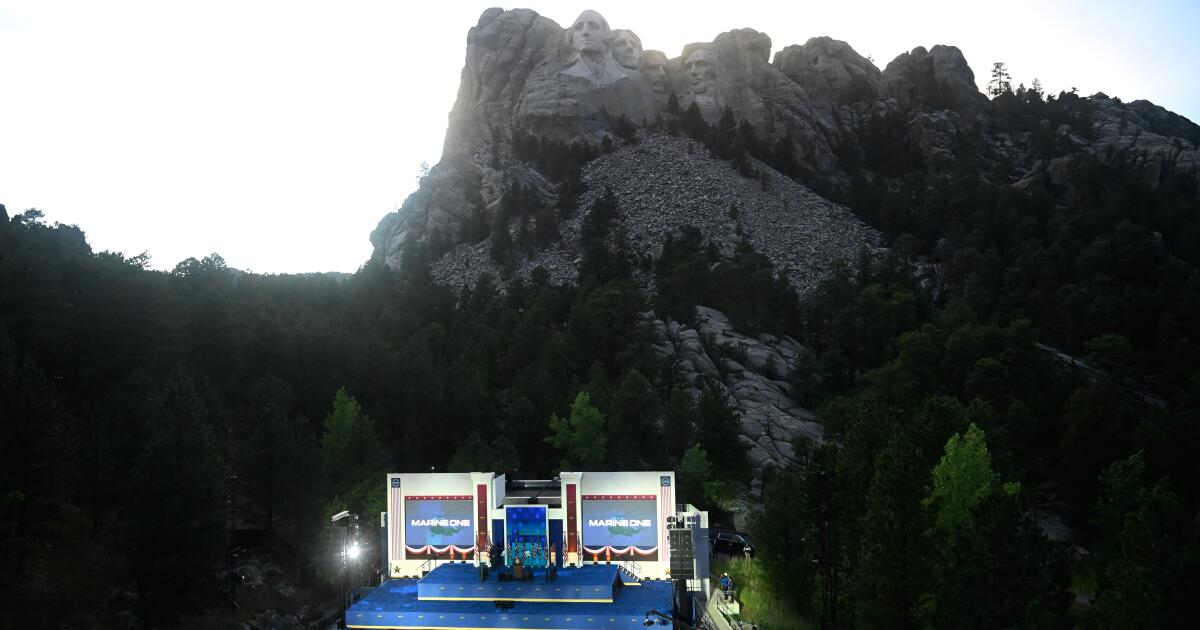
An upcoming celebration of the nation’s 250th anniversary, “The Great American State Fair,” recently had several musical guests back out, partly over the event’s ties to President Trump. Now, Trump himself is slated to headline the festivities.

“I understand Artists are getting ‘the yips’ having to do with their performance,” Trump posted on his social media platform Saturday. With a boastful and derisive flourish, he adding that he was thinking of bringing “the man who some say is the Greatest President in History (THE GOAT!), DONALD J. TRUMP, to take the place of these highly paid, Third Rate ‘Artists.’”

The group organizing the June fair on Washington’s National Mall, Freedom 250, confirmed the billing in a statement Saturday, writing, “We are excited to announce that President Trump will personally kick off this historic celebration on Wednesday, June 24.”

Danielle Alvarez, a spokesperson for Freedom 250, said the fair that is officially scheduled from June 25 through July 10 will feature exhibits, family friendly attractions, flyovers and musical performances — by those still remaining on the program.

Trump was dismissive of the acts that backed out, insulting them and suggesting in a follow-up post that the solution is to “Cancel it.”

“We should have a giant MAKE AMERICA GREAT AGAIN RALLY, for 250, instead of having overpriced singers, who nobody wants to hear, whose music is boring, and yet who do nothing but complain,” he wrote.

Freedom 250 is billed as nonpartisan, but it was launched last year by Trump and is led by a former State Department appointee from the president’s first term. Several artists, including Bret Michaels, the Commodores and Martina McBride dropped out last week.

Michaels and other artists have said that they were misled about the theme of the shows or were otherwise wary of being caught up in a political fight. McBride, in a statement on Instagram, said she had been “presented with an opportunity to perform at a nonpartisan event but that turned out to be misleading.”

Other artists plan to attend, including Flo Rida, Fab Morvan of Milli Vanilli and Vanilla Ice. The latter’s representative previously said that the “Ice Ice Baby” rapper was “proud to help celebrate America’s 250th Anniversary!”

Bedayn and Binkley write for the Associated Press. AP writer Eric Tucker contributed to this report.

Source link

Xavier Becerra faces attack, some unwarranted, from Washington

Xavier Becerra has spent nearly four decades in elected office. To some that speaks of extensive experience and a deep grounding in policy. To others, it smacks of political careerism and a long-term investment in the failed status quo.

Wired or tired?

It all depends on your perspective.

Becerra, a California native, emerged from the hothouse of Latino politics on Los Angeles’ Eastside. He was elected to the state Assembly in 1990, served 12 terms in Congress, was California attorney general and then, for nearly four years, ran the Department of Health and Human Services under President Biden.

It’s that latter stint that’s become a particular focus in the final days of California’s long and winding gubernatorial primary.

As Becerra surged from inconsequence to front-runner, opponents — led by chief Democratic rival Tom Steyer — have hammered Becerra’s performance in the Biden administration, suggesting he was AWOL during the COVID-19 pandemic and inept in his handling of unaccompanied migrant children, 85,000 of whom were supposedly “lost” on Becerra’s watch.

Politics is about persuasion and emotion, not rocket telemetry, so it’s not hard to figure out what’s going on.

“You look at Xavier and he seems to be perceived as a thoughtful, credible, trustworthy choice. That’s what I hear when I talk to regular people who aren’t political insiders,” said Darry Sragow, a Democrat strategist who’s spent decades running California campaigns. “So you see the people who want to take him out going after one of the words I just used here, which is ‘trustworthy’ and, to some extent, ‘credible.’”

A recent Steyer mail piece — which, naturally, features a grim-faced portrait of Becerra — accuses him of “mismanagement,” “scandal” and “incompetence,” and cites a 2024 quote from Susan Rice, a former Biden domestic policy advisor, describing the ex-Cabinet member as an “idiot.” (Apparently “bitch-a—,” another Rice epithet from the same Axios news report, was deemed unsuitable.)

The mail piece also quotes Xochitl Hinojosa, a Justice Department spokesperson in the Biden administration, saying Becerra “was not effective in government,” though several people who worked in the White House could not think of any occasion, or any reason, Hinojosa would have meaningfully interacted with Becerra.

Pretty weak sauce. But at least Hinojosa, who delivered her gibe on one of CNN’s talking-head shows, was willing to publicly attach herself to the criticism.

Six former Biden administration officials were quoted by Politico “reacting with a mix of incredulity, mockery and resignation” to Becerra’s sudden ascendance in the governor’s race. Critics also unloaded to NBC News and other outlets. All of them spoke anonymously.

Therefore, it’s impossible to discern their motivations. Jealousy? Ego? An attempt to stay politically relevant?

Or maybe Becerra was, indeed, a feckless, flailing and thoroughly awful Cabinet member, deserving of scorn and shame.

Ron Klain, who was Biden’s chief of staff during the first two years of his presidency, doesn’t believe so.

I think he did an excellent job as HHS secretary and I think the record shows that,” Klain said, citing, among other accomplishments, Becerra’s work helping negotiate a drop in the price of prescription drugs and expanding healthcare coverage under the Affordable Care Act.

On COVID-19, Becerra wasn’t confirmed until several months into the Biden administration. Dr. [Anthony] Fauci had been on the job and was quite a well-known figure to Americans. So, of course, he became more the face of the COVID response.”

“On immigration,” Klain went on. “Xavier’s part was small and discreet. He wasn’t the secretary of Homeland Security. He didn’t run the border. He oversaw an office called the Office of Refugee Resettlement” responsible for processing children who crossed the border alone. “I was in meetings where he was a passionate and forceful advocate for these minors,” Klain said.

Still, there are legitimate questions, notwithstanding Becerra’s deflections — Trump! MAGA! Trump! — about his handling of the migrant children, some of whom died, suffered horrible abuse or were catastrophically injured, according to revelatory reporting by the New York Times. It’s worth noting, however, that Becerra inherited a plan to deal with unaccompanied minors that was drafted and phased in by Rice and her Domestic Policy Council.

There is an unhappy history between the two; apparently Becerra was not alone in drawing Rice’s ire. In 2022, an article in the American Prospect accused her of creating an “abusive and dehumanizing workplace,” in which Rice routinely berated others, including the Health and Human Services secretary.

On social media, Rice has made no secret of her continued contempt for Becerra, a display that carries no small whiff of ax-grinding and score-settling. She highlighted the refusal of Biden’s Homeland Security chief, Alejandro Mayorkas, to endorse Becerra in the governor’s race, though it would be surprising if Mayorkas, Biden, Kamala Harris or any high-level Democrat picked a favorite in such a fiercely contested primary.

Becerra “had big things to do and he got them done,” said Neera Tanden, who succeeded Rice as head of Biden’s Domestic Policy Council and has vigorously defended Becerra against attacks on social media.

“I am not on or coordinating with the Becerra campaign,” Tanden said. “I just know these attacks are ridiculous.”

If Becerra makes it past Tuesday’s primary to the November runoff, his career merits careful scrutiny — and not just those years spent in the Biden Cabinet. Many voters are still getting to know Becerra, who is the likeliest candidate to be California’s next governor. Anonymous quotes, drive-by commentary and incendiary mailers may be standard campaign fare. But voters deserve better.

Source link

US official says Washington, Tehran reach preliminary deal to reopen Strait of Hormuz: Reports – Middle East Monitor

The US and Iran have agreed in principle to a deal that would reopen the Strait of Hormuz, in exchange for Tehran’s commitment to dispose of its highly enriched uranium, a US official said, according to a report by The New York Times on Sunday.

The official said that the agreement has not yet been signed and remains subject to final approval by US President Donald Trump and Iran’s Supreme Leader Mojtaba Khamenei, a process that could take several days, noting that the method for disposing of Iran’s highly enriched uranium is still being negotiated.

The proposed deal does not address Iran’s missile stockpile nor include a moratorium on uranium enrichment, the official said, adding that these issues are expected to be handled in future rounds of talks.

According to a Fox News report on Sunday, the official suggested that the US could consider “significant accommodations” on sanctions relief if Iran agrees to make similar concessions regarding its enriched uranium stockpile.

READ: Iran ready to reassure world it is not pursuing nuclear weapons, president says

“Our plan is to deal with all of their stockpile of the enriched material,” the official said, adding that Washington sees Tehran making “serious accommodations” not previously seen in earlier negotiations, according to the report.

The official also rejected the idea of any “tolling” mechanism for the Strait of Hormuz, saying such an arrangement would not be acceptable and had not been proposed by either side, the report noted.

According to a separate CBS News report, the official said the administration views the emerging agreement as stronger than the 2015 nuclear deal reached under former US President Barack Obama, which allowed uranium enrichment up to certain levels.

As part of the agreement, the US would lift its blockade on vessels entering and leaving Iranian ports. The official said the US Central Command and Gulf partners would coordinate to ensure safe passage, stressing this should not be viewed as a toll system.

The official also said US Vice President JD Vance, Middle East Envoy Steve Witkoff, and Trump’s son-in-law Jared Kushner have been involved in the talks, adding that Washington is seeking to include all regional allies in the process, the report added.

READ: Trump says Iran talks ‘constructive’ but blockade will remain until final deal is reached

Source link

One dead, nine missing following implosion at Washington paper mill

May 26 (UPI) — Nine people remained missing Tuesday evening following an implosion at a paper manufacturing facility in Washington that killed one person and injured nine others, authorities said.

The incident at the Nippon Dynawave Packaging facility in Longview, Wash., occurred around 7:15 a.m. PDT. Officials told reporters during a Tuesday evening press conference that a 900,000-gallon tank containing a chemical used in the production of paper in what authorities described as an implosion.

Officials believe that the tank potentially contains up to 90,000 gallons of the chemical known as white liquor — a water solution of sodium sulfide and sodium hydroxide, according to the Environmental Protection Agency — posing a threat to responders and hampering recovery efforts.

“Crews are actively assessing the structural integrity of that tank and were working on plans to stabilize that tank before additional recovery operations can safely proceed,” Scott Goldstein, chief of the Cowlitz 2 Fire and Rescue, said.

Battalion Chief Matt Amos of the Longview Fire Department added that the recovery efforts would resume Wednesday morning if safe.

“Due to the instability of the site, some areas remain inaccessible at this time,” he said. “All impacted families have been notified.”

The officials said 10 people injured in the incident were transported to area hospitals, including one person who died. Of the nine injured, eight were employees of the plant and one was a firefighter who has since been released.

The severity of the injuries of those taken to the hospital was not made public, but Amos said several suffered “critical injuries.” Longview Fire earlier said several suffered chemical burns. The department also said the victims were transported to hospitals in Longview and Vancouver.

Sen. Patty Murray, D-Wash., said she knows the public has many questions concerning about how the implosion occurred and that she will continue to apply pressure to get them answers.

“This community deserves that,” she said.

The Longview Fire Department said there was no immediate threat to the public.

Washington State Department of Ecology spokeswoman Anna Izenman told The Seattle Times that spill responders were on site evaluating any potential environmental impacts from the incident. She said white liquor cannot be collected and cleaned up in the same manner as oil; it can only “self-neutralize” with water over time.

Source link

Chemical tank rupture kills multiple people in US state of Washington | Health News

Several injured people have been transported to hospitals to be treated for chemical burns.

A chemical tank has imploded at a Nippon Dynawave Packaging facility in the US state of Washington, killing several people and critically injuring others, authorities said.

Emergency responders on Tuesday remained at the site in the city of Longview in Cowlitz County, about 70km (45 miles) north of Portland, Oregon, the Longview Fire Department said in a joint written statement with Nippon and the Cowlitz County Sheriff’s Department.

Recommended Stories

list of 3 itemsend of list

Multiple patients who suffered from chemical burns and other injuries were transported to nearby hospitals. Authorities said the implosion posed “no immediate threat to the surrounding community”.

The statement said that officials “can confirm fatalities related to the incident” along with “multiple critical injuries”, but did not provide figures.

At least nine workers and one firefighter were taken to hospitals from the site, said Scott Goldstein, the Cowlitz 2 Fire and Rescue chief who was among those who responded. The number of deaths was “undetermined”, he said at a news conference.

PeaceHealth St John Medical Center in Longview told ABC News it had seen nine patients related to the incident, including one who had died. Six of the patients were in fair condition, and two other patients had been transferred to other facilities, the hospital told ABC.

The joint statement said that a tank containing “white liquor”, a chemical solution of sodium hydroxide and sodium sulfide used in the production of paper pulp, had ruptured at about 7:15am local time (14:15 GMT).

Goldstein said at the news conference that the 80,000-gallon (about 300,000-litre) tank was approximately 60 percent full.

In southern California, meanwhile, authorities have been monitoring an overheating industrial tank containing methyl methacrylate, a highly flammable chemical used in the production of plastics. The worst-case possibility of an explosion was ruled out on Monday at the GKN Aerospace facility in Garden Grove after a crack relieved some of the mounting pressure, officials said.

Orange County Fire Authority spokesman Greg Barta said in an update on Tuesday morning that the temperature in the tank was holding steady and that crews were working to ensure that people evacuated could get home as soon as possible.

Source link

Implosion at Washington paper mill kills multiple people

May 26 (UPI) — An implosion at a manufacturing facility in Washington killed multiple people and injured 10 others, including a firefighter, local authorities said Tuesday.

The implosion at the Nippon Dynawave Packaging facility in Longview, Wash., happened around 7:20 a.m. The facility is a pulp and paper mill, and the implosion involved a vat of a chemical used in paper treatment called white liquor.

White liquor is made of sodium hydroxide, sodium sulfide and disodium carbonate, Cowlitz County fire chief Scott Goldstein told NBC News.

The Longview Fire Department said there was no immediate threat to the public, but the implosion killed multiple people and caused chemical burns and other injuries to others. Officials transported multiple people — including one firefighter — to hospitals in Longview and Vancouver.

Officials haven’t specified how many were among the dead. The Seattle Times reported that emergency responders were also searching for potentially missing people.

Goldstein said some of the injuries were minor while others were more critical.

Washington State Department of Ecology spokeswoman Anna Izenman told The Times that spill responders were on site evaluating any potential environmental impacts from the incident. She said white liquor can’t be collected and cleaned up in the same manner as oil; it can only “self-neutralize” with water over time.

Source link

Ryan Porter, beloved L.A. jazz trombonist, dies at 46

Ryan Porter, the acclaimed trombonist and fixture of the West Coast Get Down jazz ensemble, has died. He was 46.

Porter died Saturday from injuries sustained in a “severe” car crash on April 28, Porter’s bandmate Tony Austin wrote on Instagram. “Despite the best medical care, his condition deteriorated,” Austin wrote, noting that Porter “took his last breath, peacefully surrounded by his loved ones.”

Porter was a pivotal figure in contemporary Los Angeles jazz, beginning with his studies under legendary educator Reggie Andrews in the Multi-School Jazz Band in Watts. Porter formed close friendships and musical connections with saxophonist Kamasi Washington, multi-instrumentalist Terrace Martin, bassist Thundercat and the key players that would later form the West Coast Get Down.

“When it comes to keeping the lineage of jazz in L.A. alive, there have been people who were selfless and sacrificed a lot,” Porter told The Times in 2024. “For me back then, it was hard to understand why they cared so much. But it was because they saw potential in all of us so early, so we could see it for ourselves.”

That group cultivated a following at Leimert Park’s beloved venue the World Stage. They would go on to craft dense, experimental and spiritually yearning compositions for Kendrick Lamar’s 2015 LP “To Pimp a Butterfly,” among countless other LPs in the L.A. jazz scene, including Washington’s 2015 breakthrough “The Epic.”

Porter released four solo albums in his career — 2018’s “The Optimist,” 2019’s “Force for Good,” and 2022’s “Resilience,” along with his 2017 children’s album “Spangle-Lang Lane” — each featuring arrangements from his lifelong bandmates. In 2024, he released a documentary film, “Resilience,” focused on the impact of free music education programs in Los Angeles and how they helped build the city’s modern jazz scene.

“In the inner city, you can be a gang member or drug dealer, but most kids want to take their best steps,” Porter said in 2024. “Friends and music teachers inspired me through their work ethic, giving us a place to perform where we could take advantage of that expertise. Now it’s our turn to take care of them for the next generation.”

Washington, Porter’s frequent collaborator, remembered Porter in a poignant statement on Instagram. “I love you Ryan Porter, I miss you, and you will always have a space in my heart and soul. I will cherish the many years we had together, I thought we would have more, but I am thankful for what we had,” he wrote, adding, “You have been my friend for most of my life. I’ve looked up to you since I was 11 years old. We learned from each other, we supported each other, we created beautiful music together and shared it with people all over the world.”

“You would always tell me that you wanted more than anything else to be a FORCE FOR GOOD and you did it, you are the complete embodiment of that,” Washington continued. “You did so much good Ryan, your life made this world better.”

Porter is survived by two daughters, both of whom are preparing for college, according to a GoFundMe page set up by his friends to contribute to funeral costs and support his children. “Beyond the stage and beyond the music, Ryan’s greatest pride was being a father and provider for his family,” the fundraiser states.


Source link

Design plan for Trump’s proposed Washington arch is approved by key federal agency

The U.S. Commission of Fine Arts on Thursday approved the design for the triumphal arch that President Trump wants built at an entrance to the nation’s capital.

Commissioners, all of whom were appointed by Trump, approved the design despite overwhelming opposition from the public. Approval is a key step in the project’s process.

The proposed arch is one of several projects the Republican president is pursuing alongside a White House ballroom to leave his imprint on Washington.

He has said some of his other projects, such as adding a blue coating to the interior of the Lincoln Memorial Reflecting Pool, will beautify the city in time for July 4 celebrations of America’s 250th birthday.

The U.S. Commission of Fine Arts approved the concept for the arch at its monthly meeting in April.

As presented to the federal agency, the arch itself would stand 250 feet tall from its base to a torch held aloft by a Lady Liberty-like figure on top of the structure. The statue would be flanked on top by two eagles and guarded at the base by four lions — all gilded. The phrases “One Nation Under God” and “Liberty and Justice for All” would be inscribed in gold lettering atop either side of the monument.

A public observation deck on top would provide 360-degree views of the surroundings.

The commission’s vice chairman, architect James McCrery II, said in April that he preferred the arch without the figures on top. Removing them would significantly reduce the arch’s height by about 80 feet. Critics of the project, including an overwhelming number of people who submitted public comment in April, said the arch would be taller than any other monument in the capital city and dominate the skyline.

At a height of 250 feet, the arch would dwarf the Lincoln Memorial, which is 99 feet tall, and be close to half the height of the Washington Monument, an obelisk that is about 555 feet tall.

McCrery also recommended that the lions on the base be removed because that animal is “not a beast natural to the North American continent.” And he objected to plans for an underground tunnel for pedestrians to get to the arch, which would be built on a traffic circle between the Lincoln Memorial and Arlington National Cemetery in Virginia.

Preliminary surveys and testing of the site began last week.

A group of veterans and a historian have sued the Trump administration in federal court to block construction on grounds that the arch would disrupt the sightline between the Lincoln Memorial and Arlington House at Arlington National Cemetery, among other reasons.

Trump and Interior Secretary Doug Burgum have argued that Washington is the only major Western world capital without such an arch. Burgum’s department includes the National Park Service, which manages the plot where Trump wants to put the arch.

Trump’s rehab of the Lincoln Memorial Reflecting Pool is also the subject of a court challenge brought by the Cultural Landscape Foundation, which said the administration’s moves to repaint the bottom of the Reflecting Pool blue without first undergoing relevant reviews ran afoul of federal preservation laws governing historic sites.

The nonprofit group argued in a lawsuit filed last week that the changes at the Reflecting Pool are part of Trump’s broader effort to push through dramatic renovations in Washington without proper reviews and undermine the tone of the area.

A hearing in the case was scheduled for Thursday afternoon in federal court in Washington.

Superville writes for the Associated Press.

Source link

The GOP’s YOLO caucus is small but growing. That may spell trouble for Trump’s congressional agenda

The YOLO caucus is in session.

In a Republican-led Congress defined by deference to President Trump, there’s a small but steadily growing cohort who have found themselves more willing to break with the White House. Although the president maintains a firm grip on Republican voters, the expanding club could hinder his agenda on everything from the Iran war to immigration funding at a moment when his party holds a tenuous majority on Capitol Hill.

Sen. Bill Cassidy of Louisiana is the newest member of the club. Just days after losing his primary to a Trump-backed challenger, Cassidy on Tuesday reversed himself on legislation involving the war in Iran and voted with Democrats to rein in U.S. military action.

“The way our Constitution is set up, Congress should hold the executive branch accountable,” he told reporters the day before.

Sen. John Cornyn of Texas could be next after Trump endorsed Ken Paxton, Cornyn’s rival for the Republican nomination in next week’s runoff.

Rep. Thomas Massie of Kentucky is perhaps a founding member of the YOLO caucus — slang for “you only live once,” used to punctuate unbothered or even foolhardy behavior. He frustrated Trump since the president’s first term, and his status was solidified after losing his primary on Tuesday to a Trump-backed challenger. Massie has enraged Trump by voting against his signature tax and spending bill and by pushing for the release of the Jeffrey Epstein files.

He hinted there’s more to come before he leaves office.

“I got seven months left in Congress,” Massie said with a grin during his concession speech as the crowd erupted.

More Republicans feel free to shrug off Trump

Other similarly situated Republicans include Sen. Thom Tillis, who was a fierce critic of former Homeland Security Secretary Kristi Noem and has more recently turned his attention to Defense Secretary Pete Hegseth. There’s also Sen. Lisa Murkowski of Alaska, who joined Democrats last week in a bid to curb Trump’s war powers in Iran. Sens. Susan Collins of Maine and Mitch McConnell of Kentucky have voted against some of Trump’s Cabinet picks. And in the House, Rep. Don Bacon of Nebraska has pushed to reclaim congressional power over tariffs.

“If the legislative branch always votes with the president, we do have a king,” Massie said in his concession speech Tuesday.

This hardly amounts to a revival of the Never Trump movement that some Republicans unsuccessfully hoped would curb the president’s excesses during his first term or block him from returning to office. Many in the party, including Trump’s occasional detractors, have either stood by or been unable to block the president as he launched the war in Iran and presided over an aggressive immigration enforcement operation and the dismantling of the federal workforce.

Today’s unencumbered Republicans don’t fit into an ideological box. But they are united by a sense of emboldening that can only be attained in a few ways in Trump’s Washington.

Many, like Tillis, McConnell and Bacon, have decided to retire and can cast votes knowing they’ll never again have to face Republican primary voters. Others like Collins and Murkowski have more leeway because they represent states that tend to reward political independence. And some like Massie banked on the idea that voters could support both Trump and someone who occasionally crossed him.

It’s a paradox for Trump. As he demands total loyalty and pushes out Republican dissenters, he’s left with a growing cohort who, for one reason or another, owe Trump nothing.

Democrats look to capitalize

That could be a problem for Senate Majority Leader John Thune and House Speaker Mike Johnson, who are already governing with threadbare majorities. Shifting loyalties of even a few Republican lawmakers could dramatically complicate the ability for either chamber to pass substantial legislation ahead of the November midterm elections.

Thune called Cornyn a “principled conservative” and “very effective senator” on Tuesday.

“None of us control what the president does,” he said.

The next tests could come later this week as Thune pushes a funding package for Immigration and Customs Enforcement and Customs and Border Protection designed to pass on a party line basis.

Democrats are eager to pounce.

Speaking at an event in Washington on Tuesday sponsored by the Center for American Progress, House Democratic leader Hakeem Jeffries said he would aim to drive a wedge between Republicans by using a so-called discharge petition to bring issues directly to the floor for a vote.

That tactic has been successful in securing House passage on issues including the Epstein files and temporary protection of Haitian immigrants.

“When we’re disciplined and when we’re focused and when we put pressure in particular on the so-called swing seat Republicans, they have been breaking with us,” Jeffries said.

California Gov. Gavin Newsom told reporters on Tuesday that Trump’s endorsement of Cornyn’s rival was a sign that his political power lies within the Republican base — not the American public at large.

“He’s showed the only influence he has, and that’s an outsize influence within the base of the party,” the potential 2028 Democratic presidential contender said. “Otherwise he’s shown little to no influence with the American people.”

Counting the votes

That leaves Republicans gaming out how they might cobble together the votes needed to pass legislation.

Sen. John Hoeven of North Dakota called Cassidy a “good friend” and said the loss was “tough for him.” He said Cassidy “will always vote in line with what he thinks is best” but doubted he will become a less reliable Republican vote.

His fellow Louisianan, Sen. John Kennedy, said Cassidy deploys power “rationally and maturely” and “will continue to do the same thing.”

Cassidy repeatedly rejected the notion that he will spend his final months in Washington as a troublemaker for Trump, saying he’s going to do “what’s good for my country and my state.”

Yet the independent streak that ended his political career quickly resurfaced. A week after Trump visited China, Cassidy spoke of a Western alliance that’s “totally falling apart” and will be unable to “push back on the threat China represents.” He seemed stunned that the administration would create a nearly $1.8-billion fund to compensate Trump allies who they believe have been unjustly investigated and prosecuted.

“I just came off the campaign trail,” he said. “People are concerned about making their own ends meet, not about putting a slush fund together without a legal precedent.”

Sloan and Cappelletti write for the Associated Press. AP writer Stephen Groves in Washington contributed to this report.

Source link

Trump shows reporters ballroom site amid $1-billion security request

Shouting over the banging and clanging sounds from heavy construction equipment, President Trump on Tuesday gave a group of reporters a closer look at the construction for the White House ballroom he’s building on the site of the former East Wing to mount a defense for the project that has hit a speed bump in Congress.

The administration has asked for $1 billion from taxpayers for security additions on the White House campus, including for the ballroom. But the Senate parliamentarian ruled the proposal could not be included in a bill to fund immigrant enforcement agencies for three years, and several Republican lawmakers have balked at the price tag in an election year where voters are grappling with gasoline, grocery and other prices spurred to new heights by the Iran war and the disruption in oil supplies.

So Trump, ever the pitchman, surprised White House reporters by bringing them to a platform overlooking the construction site on a hot and breezy morning as workers in hard hats and fluorescent yellow vests milled about below.

Easels were set up to display renderings of the ballroom building and at least one of them blew off in the wind. “Give that to me, I’ll hold it,” Trump told an assistant.

“There will never be another building like this built, that I can tell you,” Trump told reporters.

He highlighted the security aspects of the building, notably its “dead flat” roof made of “very strong steel” and said it is “drone-proof” because “if a drone hits it, it bounces off, it won’t have any impact — but it’s also meant as a drone port, so it protects all of Washington, the roof of the building.”

He said the military will “stay on it” to keep watch over the city.

There’s no air conditioning or other equipment on the roof for safety reasons, Trump said, explaining that all duct work and equipment like it was hidden within the walls of the complex, which will serve as a “shield” for a military hospital, research facilities, offices for the first lady and her staff, and a full-service kitchen — in addition to a ballroom big enough for 1,000 people.

He said the ballroom building goes down six stories underground and is really “complex” because “everything is intertwined.”

“The roof goes with the ground floor, the ground floor goes with the roof. The roof also goes down into the basement,” the president said. “This is one well-knit building. One thing doesn’t work without the other.”

Trump says the ballroom is a ‘gift’ to the country

He reiterated that the $400-million ballroom cost will be covered by donors, including him, and that the work is being done “in strict coordination” with the military and U.S. Secret Service.

“This is not going to be paid for by the taxpayer,” Trump said. “This is a gift to the United States of America.”

But it’s somewhat of an unwanted present as polling shows most Americans oppose the ballroom, which is embroiled in litigation in federal court. A Washington Post/ABC News/Ipsos poll conducted in April found that a majority, 56%, of U.S. adults oppose Trump’s decision to tear down the East Wing to make way for the ballroom, while only 28% are in support.

The National Trust for Historic Preservation sued to halt construction until Congress approves plans for the building.

Trump insisted he will have “very little” time to use the ballroom. He recently announced that it will be ready in September 2028, less than six months before his term ends.

“This is really for other presidents,” he said.

Trump sidestepped a question about whether he’ll kick in any more of his own money if Congress rejects the $1-billion funding request.

White House spokesperson Davis Ingle said Trump’s tour was not in response to the difficulties brewing in Congress. “President Trump is the most transparent president of all time and was excited to showcase to the press and American people the amazing gift he is giving to the White House and generations of future presidents to come,” Ingle said.

Trump also touched on some of the other beautification projects he’s undertaking across the city, such as restarting dormant park fountains. He claimed to be spending much less to clean up the Lincoln Memorial Reflecting Pool than did his immediate predecessors — both Democrats.

“I’m doing a job on the Reflecting Lake for a fraction of what they paid,” Trump said. He’s having the surface coated in a shade of blue and wants to reopen it by July 4. A separate nonprofit group, the Cultural Landscape Foundation, has sued to halt this project.

Superville writes for the Associated Press.

Source link

Democrats test a new red state strategy: Back independents over their own nominees

Democratic leaders, desperate to compete in red states where their party brand is toxic, are embracing something new this midterm season: not backing Democrats.

In states like Nebraska and Alaska, Democratic officials are, in some cases, looking past their own party’s candidates while subtly encouraging — or even openly promoting — independent candidates they hope can outperform the Democratic label. The Democratic National Committee and some of its allies in Washington are quietly supporting the new strategy.

Meanwhile, some of the independent candidates are chatting in a group text about their approach as they plot a path that could shake up Congress, which is consumed by partisan gridlock.

Nebraska Democrats this week chose a nominee for U.S. Senate, Cindy Burbank, who said a major campaign priority was to ensure a Democrat wouldn’t be on the fall ballot to pull support from independent Dan Osborn. Shortly after polls closed, Burbank reiterated her plan to drop out in the coming weeks during a private conversation with a party official, according to state Democratic chair Jane Kleeb.

Democratic leaders believe Osborn, who came within 7 percentage points of winning a Senate seat in 2024, has the best chance to defeat Republican Sen. Pete Ricketts.

Democrats’ pivot toward independents is part of an intentional strategy in some places — and something closer to a wink and a nod in others — that covers a handful of high-profile Senate and House and even statehouse contests. Independent Senate candidates are also running in states like Idaho, South Dakota and Montana, where Democratic leadership has so far been unwilling to fully embrace the independents, although many view them as the Democrats’ best chance to stop Republicans this fall.

“For some states, and Nebraska is one of them, where Democrats are 32% of the electorate, this is a long-term strategy for us,” said Kleeb, who also serves as a vice chair to the Democratic National Committee.

Kleeb said her state party is backing independents in at least four state legislative seats in addition to the U.S. Senate: “We have to build a coalition with independents in order to win elections so we can do good work for the people. Period.”

Some of the Democratic Party’s national political machine appears to be on board.

The Democrats’ fundraising site, ActBlue, serves some of the independent candidates, as do popular Democratic-allied website builders. At the same time, some of the party’s campaign committees in Washington quietly provide logistical support in some cases, while avoiding public criticism of the independent candidates even in some races where there is a Democratic nominee.

“The Democratic Party’s brand is awful right now,” said Democratic strategist Josh Schwerin. “The combination of the brand problem and the existential nature of the threat that our country is facing requires us to have a big tent and look for candidates who can win.”

There are risks for the Democratic Party

Some Democratic donors, strategists and party leaders from other states have privately pushed back, insisting Democrats should not look past their own nominees for short-term political gain. They want Democratic officials, in Washington and on the ground in red states, to work harder to make the Democratic brand more attractive — even if it takes several more years to be competitive.

“What’s the independent going to do for the Democratic Party if they win?” asked Democratic strategist Mike Ceraso, who sees the shift toward independents as an attempt to disguise Democrats in some cases. “We’re the party of truth and honesty and integrity, but we’re playing these stupid political games?”

And there is no guarantee that the independent candidates, if elected, would support all of the Democrats’ policy priorities or even Democratic leadership in Congress.

In Idaho, independent Senate candidate Todd Achilles, an Army veteran and former Democratic state legislator, said he won’t be caucusing with either party if elected. He explained his politics as “straight down the middle,” and said he believes in individual liberties.

“Idahoans should be able to live how they want,” he said. But the Democratic Party was a bad fit because it “has given up on little red states like Idaho.”

On his list of problems with Democrats is that the party made a big mistake by initially running Joe Biden again for president in 2024. But he also said “the shine is coming off” Trump, whom Idaho voters backed by 36 points in 2024.

Achilles said he and other military veterans running for Senate as independents chat in the text chain and are “very much on the same page.” He says the group wants to see “guardrails,” including term and age limits and campaign finance reform.

“The priority is to get Congress functioning again,” he said. “We gotta break the grip of the two-party system.”

‘I’ll never vote for a Democrat’

In South Dakota, Navy and Air Force veteran Brian Bengs has launched an independent bid to defeat Republican incumbent Sen. Mike Rounds, who’s seeking a third term this fall.

Bengs ran as a Democrat against Senate Majority Leader John Thune four years ago and lost by 43 points.

A lifelong independent, he said he got turned down by the party this time when he sought to run with its organizational support but without the label. Still, he insists he can win without the party’s formal backing.

One key lesson from his 2022 campaign, he says, was how hard it was to break through with the Democratic Party label.

Voters would immediately ask, “What are you?” he recalled.

“When you say, ‘I’m a lifelong independent running as a Democrat,’” Bengs said, the response was quick. “‘I’ll never vote for a Democrat.’ And that was it,” he said.

“So that takeaway soured me on running again in any party system, because it was just a soul-sucking experience.”

In Alaska, some Democrats believe that commercial fisherman Bill Hill, a retired school superintendent, may represent their best hope in defeating first-term Republican Rep. Nick Begich for the state’s only House seat.

Hill, a lifelong independent, raised more than $780,000 in the first three months of the year, besting Democrat Matt Schultz, a pastor, who raised $578,000 from last October through March.

The state Democratic Party declined to endorse Schultz at its recent convention, which Hill also attended. The House Democrats’ campaign committee in Washington has also declined so far to promote Schultz’s candidacy. Hill, meanwhile, is racking up local union endorsements.

Hill’s message to voters, he said, is the same for Republicans, Democrats and independents: “You need to be pragmatic about who you choose to support in this election cycle, because at the end of the day, we need a change in the House seat in Alaska.”

A spokeswoman for the National Republican Senatorial Committee criticized independents like Osborn, Bengs, Achilles and Seth Bodnar, who is running in Montana, as “fake Independents who would push liberal Democratic policies in the Senate.”

Currently, there are two independents in the Senate: Maine Sen. Angus King and Vermont Sen. Bernie Sanders. Both caucus with Democrats.

In an interview, Hill said he’s unlikely to caucus with Republicans in Washington if elected, but he’s not committing to joining Democrats either. He was reluctant to criticize the Democratic Party or Trump.

Hill acknowledged the challenge of running for Congress as an independent, but said there are benefits, too.

“There’s freedom,” he said. “I can truly represent the working people of Alaska.”

Peoples and Catalini write for the Associated Press.

Source link

Israel-Lebanon talks held in Washington as expiration of ceasefire nears | Israel attacks Lebanon News

NewsFeed

Al Jazeera’s Manuel Rapalo reports from Washington, where the first of two days of US-mediated ambassador-level talks between Israel and Lebanon concluded on Thursday. A ceasefire between them expires on Sunday, though Israel has killed 512 Lebanese since its implementation on April 17.

Source link

Trump-Xi talks in Beijing: What’s at stake

President Trump’s first visit to China in nine years is a high-stakes trip reflecting the rivalry and mutual dependence of two superpowers hoping to avoid a collision course — even if Trump cast it more as a meeting between close friends and business partners.

Speaking to reporters before departing Washington on Tuesday, Trump downplayed tensions between the two countries, including on trade, calling Chinese President Xi Jinping a “wonderful guy” and a friend and saying the working relationship between the two countries is “very good.”

Trump acknowledged China’s might — saying that the Asian nation and the United States are clearly the world’s two superpowers — and that the focus of the meeting “more than anything else will be trade.”

“We’re gonna have a great relationship for many, many decades to come,” Trump said. “My relationship with President Xi is a fantastic one. We’ve always gotten along, and we’re doing very well with China, and working with China’s been very good — so we look forward to it.”

Trump also downplayed the importance of the meeting for the war in Iran. He said Xi might be able to help the United States reach a deal to end the war, but that he doesn’t need it, “because we have Iran very much under control.”

The state visit marks the first by an American president to China since Trump’s trip here in 2017, only months into his first term. President Biden never came, becoming the first to not do so since diplomatic ties were normalized, an absence that underscored simmering distrust and animosity between Washington and Beijing that has only worsened since.

  • Share via

In the capital, security forces sealed off an area around the Temple of Heaven roughly the size of 400 football fields ahead of the U.S. president’s visit, anticipating a stop at the monument to imperial China and Confucian thought.

On his previous trip, Trump received the rare honor of a state banquet inside the Forbidden City. This time he is expected to dine at the Great Hall of the People, an imposing structure off Tiananmen Square that hosts high-level gatherings of the Chinese Communist Party.

Trump’s positive spin on Tuesday aside, his agenda for meetings beginning Thursday with Xi highlights the vast array of American interests that depend on — and often clash with — Beijing’s policies.

After launching a trade war against China at the beginning of his second term, Trump now comes hat in hand requesting an extension of a tariff truce, fearful Xi might follow through on his threats to halt the export of rare earth minerals to the United States that are vital to the manufacturing of American goods, including everyday consumer equipment and advanced defense technologies.

His visit comes as a ceasefire in the war with Iran, brokered with help from Beijing, is on “massive life support,” according to the president. Trump is expected to appeal to Xi for assistance in getting Tehran to restore free and open passage through the Strait of Hormuz.

And in a dramatic reversal, the Trump administration has begun discussions with the Chinese about establishing a channel of communication on artificial intelligence, alarmed that recent technological leaps could pose global risks.

All of these requests are expected to come at a cost.

A man in a dark suit and wind-blown gold-colored tie

President Trump departs the White House on May 12, 2026, for his second state visit to China.

(Kevin Dietsch / Getty Images)

In earlier remarks before the trip, Trump said he expected U.S. arms sale to Taiwan — including one already approved by Congress — to become a chip in the negotiations.

“I’m going to have that discussion with President Xi,” Trump said. “President Xi would like us not to, and I’ll have that discussion. That’s one of the many things I’ll be talking about.”

The notion that U.S. support for Taiwan is a negotiable matter is sure to rattle America’s allies throughout the region, from Japan to the Philippines, which are reliant on U.S. security guarantees amid China’s Indo-Pacific military aggression.

Despite geopolitical tensions, both sides are expected to announce business and investment agreements, underscoring how deeply intertwined the world’s two largest economies remain.

China plans on making a significant purchase of Boeing aircraft, and the president has brought 17 American corporate leaders with him on the trip to discuss additional opportunities, including Apple’s Tim Cook, BlackRock’s Larry Fink, Meta’s Dina Powell McCormick and Tesla’s Elon Musk.

The two leaders are expected to have other opportunities to talk in person throughout the coming year, including potential meetings at the Group of 20 summit in Florida, the APEC summit in Shenzhen, China, and a state visit in Washington that Trump said he will host for Xi at some point in the coming months.

Trump on Tuesday said Xi’s visit will be “toward the end of the year” and “exciting.” He also lamented that the ballroom he is building on the White House grounds — on the site of the historic East Wing he demolished — won’t be ready in time.

Jennifer Hong, senior director at the Institute for Indo-Pacific Security, said her concern is that the state visit becomes part of a “tyranny of calendaring,” where the Chinese agree to schedule more high-level meetings sought by Trump that put off vital U.S. decision-making.

“I do think this trip is necessary for the U.S. government — I think that there are things that are on hold because he doesn’t want to rock the boat,” Hong said, noting the Trump administration’s delay in arms sales to Taiwan, despite the packages already having received congressional approval.

“I’m just worried this will be a stringing along of promises, or maybe some reprieve for a year or so,” she added, “as we continue to handicap ourselves on national security matters for the sake of more meetings.”

Trump on Tuesday repeatedly dismissed China’s potential help in resolving the war in Iran, which has driven up prices domestically and around the world as oil shipments through the strategic Strait of Hormuz have been badly disrupted and U.S. efforts to fully reopen the channel have so far been unsuccessful.

“I don’t think we need any help with Iran, to be honest with you,” Trump said. “They’re defeated militarily.”

Trump also said the financial pain many Americans are feeling from the war, including at the gas pump, simply isn’t a factor — “not even a little bit,” he said — in his ongoing negotiations with Iran.

“The only thing that matters when I’m talking about Iran [is that] they can’t have a nuclear weapon,” he said. “I don’t think about Americans’ financial situation. I don’t think about anybody.”

Source link

Washington wins NBA draft lottery, Clippers land fifth pick

The league’s worst team this season is getting the No. 1 pick in the NBA draft.

The Washington Wizards won the draft lottery on Sunday and are poised to pick first overall for the first time since choosing John Wall in that spot in 2010. Wall was the Wizards’ on-stage representative for the lottery.

Washington had a 14% chance of winning No. 1, tied with Brooklyn and Indiana for the best odds. The Wizards had basically a 50-50 chance of getting either a top-four pick or the No. 5 spot.

But three consecutive years of losing — the three worst seasons in the franchise’s 65-year history — finally paid off Sunday for the Wizards, who went 17-65 this season and even allowed Miami’s Bam Adebayo to score 83 points for the league’s second-highest single-game total ever.

The Wizards swung deals to land Trae Young and Anthony Davis last season, and now they have a chance to add an immediate impact player with the No. 1 pick.

Utah will pick No. 2, Memphis will pick No. 3 and Chicago will pick No. 4.

The Clippers got the fifth pick — via a trade with the Pacers — followed by No. 6 Brooklyn, No. 7 Sacramento, No. 8 Atlanta, No. 9 Dallas, No. 10 Milwaukee, No. 11 Golden State, No. 12 Oklahoma City, No. 13 Miami and No. 14 Charlotte.

The draft begins June 23 in New York. The draft combine in Chicago starts on Monday.

No. 1 pick possibilities

There are four candidates that generally are considered front-runners to be the No. 1 pick, all of them entering the draft after their freshman years of college. They are:

— BYU’s AJ Dybantsa, who led the nation in scoring at 25.5 points per game in his lone college season.

— Duke’s Cameron Boozer, the AP player of the year who averaged 22.5 points and 10.1 rebounds.

— Kansas’ Darryn Peterson, who averaged 20.2 points in 24 games for the Jayhawks.

— North Carolina’s Caleb Wilson, who averaged 19.8 points and 9.4 rebounds on 58% shooting.

All four of those players, and a few other likely first-round selections, were all among those in the studio for the announcement of the lottery results Sunday at Chicago’s Navy Pier.

“Standing here is kind of crazy,” Dybantsa said. “One of these teams is going to be home.”

Last of this format (probably)

This was the eighth, and likely final, year of this version of an NBA draft lottery, with the worst teams having a 14% chance of winning.

Framework fell into place last month on changes meant to further discourage tanking, and the league’s Board of Governors is expected to ratify that plan in the next few weeks — with general managers meeting in Chicago on Tuesday to discuss them presumably for one last time.

The three worst teams, starting next season, would have a 5.4% chance of winning — with the next seven teams all having an 8.1% chance of winning. The lottery would grow from 14 to 16 teams if the plan, as expected, is approved.

Reynolds writes for the Associated Press.

Source link

Rubio presses Europe on Iran action as he seeks to mend ties with Italy and Vatican

U.S. Secretary of State Marco Rubio urged European allies Friday to move beyond rhetoric and take concrete action against Iran, even as he sought to repair strained ties with Italy and the Vatican during a two-day visit following tensions over the U.S.-Israeli war in Iran.

Speaking after meetings with Premier Giorgia Meloni and Foreign Minister Antonio Tajani, Rubio warned that Tehran was attempting to assert control over the strategic Strait of Hormuz, calling the move “unacceptable” and a threat to global security.

“Everybody says Iran is a threat. Everybody says that Iran can’t have a nuclear weapon … but you’ve got to do something about it,” Rubio told reporters in Rome. “If the answer is no … then you better have something more than just strongly worded statements to back it up.”

Clear ‘red line’

Rubio said Iran was trying to normalize control over an international waterway, a precedent he warned could encourage similar actions elsewhere. He also cautioned Tehran against targeting U.S. maritime assets, saying the United States had thwarted attacks on three Navy ships in the strait.

“The red line is clear. They threaten Americans, they are going to be blown up,” he said.

Rubio said Washington was pursuing a diplomatic track, including a proposed U.N. Security Council resolution aimed at preserving freedom of navigation. He added the U.S. was awaiting Iran’s response on Friday to ongoing diplomatic efforts.

Rubio’s visit comes after weeks of sharp disagreements between Washington and Rome over the Iran war, tariffs and President Trump’s criticism of both Meloni and Pope Leo XIV.

Differences remain over Iran war

Meloni described her meeting with Rubio as “constructive, frank and productive,” focused on both bilateral relations and major international issues. She said the talks covered strategic topics, including the Middle East, freedom of navigation in the Strait of Hormuz, Ukraine, China and areas of Italian interest such as Libya and Lebanon.

“We both understand how important the trans-Atlantic relationship is, but we also understand that each country must defend its own national interests,” Meloni stressed after the meeting.

Tajani struck a more conciliatory tone after meeting his U.S. counterpart, reaffirming the importance of the trans-Atlantic alliance.

“I am convinced Europe needs America — Italy needs America — and the United States also needs Europe and Italy,” Tajani said, adding he hoped “tensions have been calmed.”

He said discussions covered the Iran conflict and its spillover into Lebanon, as well as Venezuela and Cuba. The U.S. State Department said Rubio also raised the need to protect economic interests and end the war in Ukraine.

Despite the effort to ease tensions, differences remain over the Iran conflict. Italy has opposed the U.S.-Israeli bombing campaign, with Meloni calling it “illegal,” and has resisted involvement in offensive operations.

Tajani said Italy would be prepared to contribute naval forces to demine the Strait of Hormuz once a permanent ceasefire is reached, and would maintain its role in the U.N. peacekeeping mission in Lebanon. He also stressed the importance of continued U.S. troop presence in Europe amid concerns about possible reductions.

No final decision on NATO troops adjustments

Rubio said “no final decision” had been made on NATO troop adjustments, noting that any changes would depend on U.S. national interests and global priorities.

The U.S. has announced a decision to pull 5,000 military personnel from Germany and Trump has threatened to withdraw more troops from Italy and Spain over their stance on the war.

Italy, a key logistics hub for U.S. and allied operations in the Mediterranean and beyond, has already signaled limits to its cooperation. In March, it declined to allow U.S. bombers bound for the Middle East to use a base in Sicily without parliamentary approval, reflecting constitutional constraints and strong domestic opposition to the war.

Meloni, weakened by a recent referendum defeat and facing public unease over the conflict, has insisted that any use of Italian bases for offensive operations would require parliamentary backing.

The war has also raised economic concerns in Italy, with Meloni warning that disruptions in the Strait of Hormuz risk driving up energy costs and inflation, while U.S. tariff threats weigh on the country’s export-driven economy.

An attempt to de-escalate at the Vatican

Rubio also sought to ease tensions with the Vatican following Trump’s criticism of the pope’s calls for peace. After a lengthy meeting on Thursday with the pontiff and Vatican Secretary of State Cardinal Pietro Parolin, Rubio said Washington remained committed to a “productive and fruitful” relationship with the Catholic Church.

“The president’s perspective is clear. He thinks that Iran is a threat, and it needs to be addressed. And that position remains unchanged,” Rubio said.

Rubio confirmed that Cuba was also discussed at the Vatican, with Washington hoping the church’s Caritas charity organization would continue distributing humanitarian aid.

Rubio said the U.S. has provided about $6 million in humanitarian aid to Cuba, to be distributed through Caritas, should the Cubans allow it. He added Washington has also offered up to $100 million in additional aid, but the Cuban government has not accepted it so far. Rubio blamed Cuba’s government for blocking assistance and worsening conditions, describing it as “incompetent.”

U.S. officials said the Vatican talks underscored strong bilateral ties and a shared commitment to promoting peace, even as differences over the Iran war persist.

Zampano and Winfield write for the Associated Press.

Source link

California under pressure — again — as redistricting wars escalate

When the U.S. Supreme Court sharply curtailed a key provision of the Voting Rights Act last week, Democrats in Washington had a message: The rules of redistricting have changed, and California — the nation’s biggest blue bastion — may have a further role to play.

Rep. Alexandria Ocasio-Cortez (D-N.Y.) said Democrats should “play by the same set of rules” as Republicans. House Minority Leader Hakeem Jeffries (D-N.Y.) vowed to fight in “the Deep South and all over the country.” And Rep. Terri Sewell, an Alabama Democrat, was blunt: “I’ll take 52 seats from California, I sure would. And 17 seats from Illinois.”

The calls for action came as Republican governors in Louisiana, Alabama, Mississipppi and Tennessee called special legislative sessions to redraw congressional maps ahead of this year’s midterm elections. Florida has also approved new maps that could give the GOP four more seats in the House, and President Trump urged other Republican states to follow suit.

The Republican response has intensified the pressure on Democrats to act, including those in California — where the ruling could upend not just congressional maps, but also legislative and local races.

“We can’t allow this national gerrymandering effort of Republicans to go unanswered,” said Rep. Robert Garcia (D-Long Beach). “If Republicans go for it, I think we have to leave all options on the table.”

For now, California’s response is far from settled.

A woman with brown hair, wearing glasses and a dark jacket, gestures while speaking before a microphone

Rep. Sydney Kamlager-Dove (D-Los Angeles) cautioned against “accelerating a race to the bottom.”

(J. Scott Applewhite / Associated Press)

The chair of the California Democratic Party said there are no current plans to redraw maps — just months after voters approved a constitutional amendment authorizing a mid-decade redistricting backed by Gov. Gavin Newsom.

The Democratic consultant who drew the state’s current congressional district boundaries says an all-blue map, while possible to create, would probably hurt Democrats more than help them in the long run. And some of the state’s congressional Democrats are worried the impulse to match Republican partisan efforts would be bad for the American electorate.

“Rather than accelerating a race to the bottom, the next step is to dial it down because you can reach a point of no return,” said Rep. Sydney Kamlager-Dove (D-Los Angeles), one of the state’s most prominent Black lawmakers. “And that’s where we’re headed.”

What California decides — and when — will matter at the national level. With 52 congressional seats, no state has more to offer Democrats in a redistricting war. But experts, lawmakers and party officials say the path forward is more complicated than the calls from Washington suggest.

California could see 48 blue seats, out of 52

That’s in part because California already acted. In 2025, voters approved Proposition 50, which drew new congressional district lines designed to favor Democrats for the 2026, 2028 and 2030 elections. The new maps, which could yield as many as 48 Democratic seats out of 52, are already in effect, and voters have begun receiving their mail-in ballots.

Going farther is not currently on the table — at least not yet.

“We have yet to fully win the seats in the map that was drawn in 2025. It seems a step too far to say we’re going to go back to the drawing board and redraw the map,” said Rusty Hicks, the chair of the California Democratic Party.

Hicks said it doesn’t mean the issue could not become part of a future discussion, but he said Democrats in other states should not look past what California has already done.

“We’re trying to pick up 48 of them. How much more do you want us to pick up? You want us to make it 52 blue? Well, you all should get into the fight,” Hicks said. “You all should pick up some seats. Let’s all do this together, because California cannot do it alone, it will take the rest of the country.”

Others are not convinced the most aggressive option makes the strategic sense in California.

Paul Mitchell, the Democratic redistricting consultant who drew California’s Proposition 50 congressional maps, said the push for a 52-0 delegation reflects a fundamental misunderstanding of how a partisan map would perform in the state over time.

“A 52-to-zero map would have the potential of backfiring,” Mitchell said. “In 2026, we could pick up 52 seats. But then in 2028 or 2030 — a bad year for Democrats, let’s say — Democrats lose 11 of those seats. You’ve drawn these districts so demonically to a Democratic advantage in a good year that in a bad Democratic year, they don’t have the ability to withstand the challenge.”

Ruling could jeopardize state’s voting rights law

The political debate over congressional maps has so far dominated the conversation in Washington. But legal scholars and redistricting experts say the ruling could also have consequences in California’s city hall, school board and county supervisor races.

The justices’ ruling, decided by the court’s conservative majority, says states cannot consider race to create majority-minority electoral districts while allowing them take partisan interests into account.

“A purely partisan map is actually more defensible now than one drawn with racial considerations,” said Rick Hasen, an election law professor at UCLA. “It turns the world on its head.”

The ruling now puts at risk any district drawn at any level of government that relied on the Voting Rights Act to justify its boundaries, Hasen said.

And in California, that uncertainty extends to districts drawn under the state Voting Rights Act, which extends protections for minority voters beyond the federal law, he said. The state law was not directly at issue in the Supreme Court ruling, but Hasen argues the court’s reasoning could provide new legal grounds to challenge the state law as potentially unconstitutional.

Cities including Santa Monica and Palmdale have faced lawsuits alleging their at-large City Council elections diluted the Latino vote. Palmdale settled its case and agreed to switch to district-based elections; Santa Monica’s case is ongoing. Hasen argued that the cities, as well as other bodies, such as school boards, could now return to court to challenge whether district maps drawn as a result of the California Voting Rights Act are unconstitutional.

“That has not been tested yet,” he said, but he fears the same arguments made to challenge the federal Voting Rights Act could be made against the state law.

At the state level, Republican strategist Matt Rexroad sees the ruling affecting the California Legislature as well. He argues the boundaries drawn for the state Assembly and Senate districts are racial gerrymanders.

“Those legislative lines, I would argue, are unconstitutional,” Rexroad said. “And those lines are probably going to change by 2028.”

But Rexroad’s biggest concern goes beyond any single set of maps: It is the future of California’s independent redistricting commission, the nonpartisan body he has spent years defending.

A threat to independent redistricting

Rexroad sees a scenario in which the national political environment gives California Democrats little incentive to return the map-making power to the commission. If Republican states continue to aggressively redraw maps, Democrats will have another justification to keep power in the Legislature’s hands, the same argument made to pass Proposition 50, he said.

“I don’t think the California redistricting commission has ever been in greater jeopardy than it is right now,” he said.

J. Morgan Kousser, a historian who has testified as an expert witness in voting rights cases for 47 years, said California’s commitment to the commission may depend on how aggressive Republican states act in redistricting.

“If we go back to an all-white South in Congress, California may not go back to a fairness standard,” Kousser said. “It may not disarm. It may rearm.”

Mitchell, the redistricting consultant, said that he hopes California and other states choose the path of disarmament and that there is a national push for independent commissions in every state.

“This isn’t good for anybody,” he said. “This was all basically a nerd war over lines that didn’t actually improve any districts anywhere.”

Source link

Police arrest protester after five-days atop Washington bridge | US-Israel war on Iran

NewsFeed

Police have arrested an anti-war protester after he ended a five-day sit-in atop Washington’s Frederick Douglass Memorial Bridge. Guido Reichstadter, opposed to the war on Iran, started the protest to rally others into non-violent opposition.

Source link

Judge asks why jail placed suspect in White House correspondents’ dinner attack on suicide watch

A federal magistrate judge on Monday pressed a jail official to explain why a man charged with trying to storm the White House Correspondents’ Assn. dinner and attempting to kill President Trump was placed on restrictive suicide watch after his arrest.

Officials at the city jail in Washington removed Cole Tomas Allen from its designated “suicide status” over the weekend after his attorneys complained that he had been unnecessarily confined in a padded room with constant lighting, repeatedly strip-searched and placed in restraints outside his cell.

But the relaxed conditions didn’t satisfy U.S. Magistrate Judge Zia Faruqui’s concerns that Allen may have received disparate, punitive treatment in violation of his due process rights. Faruqui noted that the D.C. jail routinely houses convicted killers and others charged with violent crimes without placing them on 24-hour lockdown.

“It could drive a person crazy to be in that situation,” he said.

Faruqui apologized to Allen over his confinement conditions. In response to a news report on that apology, U.S. Atty. Jeanine Pirro criticized him in a social media post that said Faruqui “believes a defendant armed to the teeth and attempting to assassinate the president is entitled to preferential treatment in his confinement compared to every other defendant.”

Allen’s lawyers said he wasn’t showing any suicidal risk factors after his arrest. But a jail psychiatrist evaluated him and initially concluded that he posed a suicide risk, according to Tony Towns, acting general counsel for the city’s corrections department.

“Every case is different, your honor,” Towns said.

Allen was moved into protective custody after the jail lifted the suicide prevention measures. His attorneys didn’t object to his new confinement status. They had asked the magistrate to cancel Monday’s hearing, but Faruqui forged ahead with it due to his “grave concerns” about Allen’s treatment in jail.

Allen was injured but was not shot during the April 25 attack at the Washington Hilton, which disrupted one of the highest-profile annual events in the nation’s capital.

Allen was armed with guns and knives when he ran through a security checkpoint and pointed his weapon at a Secret Service agent, who fired back five times, authorities said. Pirro has said that Allen fired a shot that struck the agent’s bullet-resistant vest.

Allen later told FBI agents that he didn’t expect to survive the attack, which could help explain why he was deemed to be a possible suicide risk, said Justice Department prosecutor Jocelyn Ballantine.

Allen, 31, of Torrance, is charged with attempted assassination of the president and two additional firearms counts. He faces up to life in prison if convicted of the assassination count alone.

Defense attorney Eugene Ohm said Allen was prohibited from having anything in his cell. He asked for a Bible and a visit from a chaplain but hasn’t received either, according to Ohm.

Kunzelman writes for the Associated Press.

Source link

Judge in dispute over Washington golf course tells Trump officials not to cut trees without notice

A federal judge told the U.S. government Monday not to cut down more than 10 trees without first providing notice amid a legal dispute at a historic Washington golf course that President Trump plans to renovate.

U.S. District Judge Ana Reyes said during a remote hearing that she wasn’t going to issue a temporary restraining order just yet in the case brought by the DC Preservation League. She also told the National Park Service that it should first discuss any plans with government lawyers if it was going to cut down more than 10 trees.

Monday’s hearing came after the plaintiff’s emergency petition seeking to stop work at the course, citing news reports that major renovations were to begin Monday.

Kevin Griess, the superintendent of the National Mall and Memorial Parks for the Park Service, said during the hearing there was no plan to begin such work Monday but added that a safety assessment was underway.

Reyes told the parties she didn’t want to play the role of the “Parks and Rec” department, an allusion to the sitcom, but said she also didn’t want trees being bulldozed.

“I’m no Amy Poehler,” she said referring to the show’s star.

At one point during Monday’s hearing, the judge said she was made aware that closure signs had been put up at the site, which led to Griess’ asking someone to check. He later reported that there were no such signs. Reyes asked that if any such signs were found that the government’s attorney be told.

The complaint filed against the Department of the Interior argues that the Trump administration’s reconstruction of East Potomac Park, including the East Potomac Golf Course, would violate the congressional act that created the park in 1897. The roughly 130-year-old act established the park for the “recreation and the pleasure of the people.” The course itself opened in 1919.

Trump, an avid golfer, also plans on renovating a military golf course just outside Washington that has been used by past presidents going back decades.

Source link

One hurt in shooting near the Washington Monument

May 4 (UPI) — The U.S. Secret Service shot a man near the Washington Monument on Monday after spotting a person with a gun nearby and called for backup.

An ensuing shootout with the man while he tried to run resulted in a child near the monument being injured before the suspect was also shot, and both have been hospitalized, NBC Washington, Fox 5 DC and Politico reported.

The incident comes just over a week since a man rushed security at the White House Correspondents Association Dinner in Washington, D.C., in an alleged attempt to assassinate President Donald Trump and other members of the administration that were in attendance.

The suspect had been under surveillance for some time before he was approached based on officers observing what they termed a “suspicious” person.

“Whether or not it was directed to the president or not, I don’t know, but we will find out,” said Matthew Quinn, deputy director of the secret service, adding that the agency is patrolling the area — the monument is about half-a-mile from the White House — “24/7, hard core” after recent events.

Law enforment officials were patrolling near the monument, down the street from the White House, when they observed the person and approached.

The suspect pulled out a gun and fired toward them, resulting in an exchange of gunfire, which resulted in both the suspect and a nearby child.

The child suffered a graze would to his lower body, was taken to an ambulance and was treated for non-life-threatening injuries, Quinn told reporters.

Streets were blocked off after the incident and members of the White House Press Pool were evacuated from the area during the incident, which occurred as Trump was holding a small business event inside the White House and reportedly was not aware of what happened.

President Donald Trump signs a series of executive orders in the Oval Office of the White House on Thursday. Trump signed an order to expand workers’ access to retirement accounts. Trump also signed legislation ending a 75-day partial shutdown of the Department of Homeland Security after the House voted in favor of funding. Photo by Aaron Schwartz/UPI | License Photo

The U.S. Secret Service and the Metropolitan Police Department both said that their investigations are ongoing.

Source link

U.S. will issue commemorative passports with Trump’s picture for America’s 250th birthday

The State Department said that it is preparing a limited release of commemorative U.S. passports celebrating America’s 250th birthday that feature a picture of President Trump, who would be the first living president to be featured in the travel document.

The concept for the special passport, including a rendering of Trump’s stern-looking visage, had been under consideration for months before finally being approved late Monday and publicly announced Tuesday. Between 25,000 and 30,000 of the new passports will be available to applicants at the Washington passport office beginning shortly before July 4.

It’s the latest instance of Trump having his name and likeness added to buildings, documents and other highly visible tributes. There are efforts to put Trump’s signature on all new U.S. paper currency, also a first for a sitting president, as well as to include his image on a gold commemorative coin to celebrate the country’s founding.

The commemorative passport will be the default document for people applying in person at the Washington office, although those who want a standard passport will be able to get one by applying online or outside Washington, officials said.

“As the United States celebrates America’s 250th anniversary in July, the State Department is preparing to release a limited number of specially designed U.S. passports to commemorate this historic occasion,” State Department spokesman Tommy Pigott said.

“These passports will feature customized artwork and enhanced imagery while maintaining the same security features that make the U.S. passport the most secure documents in the world,” he said.

The limited release passport will feature Trump’s picture over a gold imprimatur of his signature to an interior page, while the cover will feature the words “United States of America” in bold gold print at the top and “Passport” at the bottom — a reversal of the standard cover.

In addition, a small gold laminate American flag, with the number 250 encircled by stars, will be at the bottom of the back cover.

The Bulwark reported earlier on the commemorative passports.

The only presidents featured in current U.S. passports are in a double-page depiction of Mount Rushmore in South Dakota — George Washington, Thomas Jefferson, Theodore Roosevelt and Abraham Lincoln.

Other depictions include the Statue of Liberty, the Liberty Bell and Independence Hall in Philadelphia, and scenes of the Great Plains, mountains and islands. Current passports also contain quotations from Martin Luther King Jr. as well as Presidents Washington, Jefferson, Roosevelt, John F. Kennedy and Dwight Eisenhower.

The addition of Trump’s picture and signature to the passport book is the newest step his aides have taken to increase the president’s visibility, including adding his name to the U.S. Institute of Peace building and the Kennedy Center performing arts venue.

Trump also has made waves with his plans for a new White House ballroom and a massive arch to be built at one of the entrances to Washington from Virginia.

Lee writes for the Associated Press.

Source link

Jimmy Kimmel explains ‘expectant widow’ comment, declines to apologize

ABC late-night comedian Jimmy Kimmel explained his controversial joke about First Lady Melania Trump, but declined to apologize for offending her.

On Monday, President Trump repeated his demand that ABC fire the longtime show host over a joke that aired on the L.A.-based “Jimmy Kimmel Live!” program two days before the White House Correspondents’ Assn. dinner in Washington. Kimmel, who has headlined that event before, staged a pretend roast during his Thursday night broadcast that featured spliced-in footage of Melania Trump, Defense Secretary Pete Hegseth, Vice President Vance and others.

During the bit, a tuxedo-clad Kimmel called the first lady “beautiful,” saying she had “the glow of an expectant widow.” There wasn’t much reaction to Kimmel’s comment at the time, Kimmel said during Monday’s show.

On Saturday, the White House Correspondents’ Assn. gala, to celebrate the 1st Amendment, was interrupted when a gunman sprinted past security at the Washington Hilton, where the event was being held. He did not reach the ballroom. The suspect, Cole Tomas Allen, of Torrance, has since been charged with attempting to assassinate the president.

“There was no big reaction to [the joke] until this morning, when I greeted the day facing yet another Twitter vomit storm and a call to fire me from our first lady,” Kimmel said during Monday night’s telecast.

“Obviously, it was a joke about their age difference and the look of joy we see on her face every time they’re together,” Kimmel said.

“It was a very light roast joke about the fact that he’s almost 80 and she’s younger than I am,” Kimmel said. “It was not, by any stretch of the definition, a call to assassinate. And they know that.”

Kimmel added that he has long been vocal “speaking out against gun violence,.”

Melania Trump, who appeared visibly shaken during the Saturday night scare, expressed her outrage in a social media post earlier Monday.

“Kimmel’s hateful and violent rhetoric is intended to divide our country,” she wrote. “His monologue about my family isn’t comedy- his words are corrosive and deepens the political sickness within America. People like Kimmel shouldn’t have the opportunity to enter our homes each evening to spread hate. A coward, Kimmel hides behind ABC because he knows the network will keep running cover to protect him.”

ABC has not commented about the flap.

Source link