Prince Ali bin Hussein said nobody was allowed to speak, question, debate or talk with the media at the AFC Congress.
Published On 25 Oct 202625 Oct 2026
The head of Jordan’s Football Association (JFA), Prince Ali bin Hussein, has accused FIFA President Gianni Infantino of hijacking the Asian Football Confederation Congress for political purposes ahead of his re-election bid for a fourth term.
At the AFC’s extraordinary congress in Tokyo on Friday, its president Sheikh Salman bin Ibrahim Al-Khalifa endorsed Infantino’s bid for re-election as FIFA president.
Recommended Stories
list of 4 itemsend of list
Months after the confederation accused Infantino of a “fundamental breach of trust” over the abandoned FIFA Forward Enterprise (FFE) proposal, Sheikh Salman told the congress that Asia was now united behind Infantino.
But JFA’s Prince Ali, who has been a vocal critic of FIFA’s leadership, painted a starkly different picture of events in Tokyo.
“Having come back from Tokyo where the AFC Congress took place, the first two days were about football, which we all serve. The last day was pure politics at the behest of Gianni Infantino,” Prince Ali wrote on X.
“There were reports that Asia has a united position when it comes to electing the next FIFA President. In fact, nobody was allowed to speak, question, debate or talk with the media.
“Lack of transparency leads to lack of accountability. No amount of coercion, threats or bribes should be allowed.”
Prince Ali did not elaborate on his statement.
Al Jazeera reached out to FIFA and the AFC for a comment but had not received a response at the time of publication.
Infantino also addressed the AFC Congress, giving Sheikh Salman his backing for another term.
In August, Prince Ali launched a public attack on Infantino, accusing him of “blackmail” and saying FIFA had offered to help solve the kingdom’s problems in exchange for his endorsement.
Two days later, Prince Ali confirmed Jordan’s players and staff had received outstanding reward money for their participation in the 2025 Arab Cup.
The association had been waiting since December for prize money for reaching the Arab Cup final in Qatar.
On Saturday, Infantino laughed off questions about whether he had considered resigning in the wake of the failed FFE proposal, pointing to what he described as overwhelming support from member associations around the globe.
The Swiss-Italian administrator’s re-election prospects were strengthened significantly after the AFC endorsement, leaving Europe increasingly isolated and exposing the lack of a challenger.
LONG BEACH, Wash. — Tourist dollars are drying up in this small town at the edge of the Pacific Ocean. Foot traffic is down. Visitors have less to spend on souvenirs.
And beachgoers now bring packed lunches instead of stopping at Captain Bob’s Chowder Sisters, said Melissa Huddleston, waiting for customers at her sister-in-law’s shop on Sunday.
Huddleston, 60, is depressed about the state of the country, and while she’s planning to vote in the Nov. 3 midterms, she hasn’t decided who she’ll vote for. This swing district, Washington’s 3rd, is home to a tight congressional race that will help determine the balance of power in the U.S. House.
Huddleston doesn’t think anyone in Congress can really do what she wants: Bring decorum back to the national discourse and bring the economy back to life. She isn’t a particular fan of Rep. Marie Gluesenkamp Perez, the independent-leaning Democratic incumbent, nor is she persuaded by state Sen. John Braun, the Trump-endorsed Republican challenger.
“I don’t know which one is better,” Huddleston said, shaking her head. “I really don’t.”
Melissa Huddleston waits for customers at Captain Bob’s Chowder Sisters in Long Beach, Wash.
(Justine McDaniel/Los Angeles Times)
As the battle to persuade midterm voters intensifies in the election’s final stretch, its fever pitch is evident in places like this largely rural stretch of southwest Washington — a rare three-time Trump-voting district with a Democratic incumbent.
Republican-aligned groups are pouring money into flipping the district red, considering it one of the GOP’s best chances to gain a House seat in an increasingly unfavorable environment, while Democrats see retaining the district as urgent to their effort to secure control of the chamber.
The contest offers a glimpse into a purple region a time when both parties are testing strategies for winning voter loyalty — not just in the midterms but looking ahead to 2028. And the dynamic in the candidates’ race to capture swing voters reflects the national debate gripping both parties about how moderate to be.
As Democrats debate whether progressives or centrists should chart the party’s path, Gluesenkamp Perez has modeled an independent streak that has helped her win two elections but disappointed some in her own party. And as Republicans grapple with low public support for Trump, Braun has packaged his conservatism as balanced while assuring supporters that he’s rowing in the same direction as the president and party leaders.
Interviews with more than 30 voters across the district revealed a mix of support for the two candidates, largely based on partisan politics, views about Trump and concern with which party controls the House.
“This is a very pivotal time, and this area has a history of being more of a swing [district],” said Mark Maxwell, 46, of Vancouver, Washington, who planned to vote blue. “It’s a chance for our voice to be heard.”
A sign for Washington State Sen. John Braun, R-Centralia, is displayed among other campaign signs near I-5, Saturday, Oct. 10, 2026, in Ridgefield, Wash.
(Lindsey Wasson/Associated Press)
The number of congressional battlegrounds nationwide has shrunk with gerrymandering and political polarization, making the district one of about two dozen races that will decide the House majority. The West’s other highly competitive contests include three in California — those of Republican Rep. David Valadao and Democratic Rep. Adam Gray in the Central Valley and the open seat of retiring Republican Rep. Darrell Issa in the San Diego area.
In southwest Washington, polling has indicated the congressional race may be essentially tied. A late September poll commissioned by Oregon Public Broadcasting had Braun up by one point. A July Emerson College poll showed the same. Earlier this month, election forecaster Cook Political Report moved the race from a toss-up rating to lean-Democrat.
‘Stubborn loyalty’
Across the district last week, left-leaning voters said they were backing Gluesenkamp Perez — some precisely because of her maverick streak.
“She’s voted against the Democrats and I know she’s voted against the Republicans, which is what one would hope,” said Helios Ovando, 69, of Battle Ground, Wash., who decided this year to volunteer for Gluesenkamp Perez’s campaign for the first time. “She’s more about the local scene.”
Ovando has been turned off by what he sees as Republicans’ adherence to the party line; Gluesenkamp Perez’s willingness to “buck the system” gives him more confidence in her integrity, he said.
July 2026 photo of Rep. Marie Gluesenkamp Perez (D-WA)at a House Appropriations Committee hearing on Capitol Hill.
(Anna Moneymaker/Getty Images)
Gluesenkamp Perez, 38, who ran an auto shop with her husband before being elected to Congress, frames her mission as one built around the practical needs of her district. She argues that Democrats should break the Republican hold on rural districts and talks about reestablishing voters’ confidence that the Democratic Party is “listening to and reflective of working people.”
“When you have people come to Congress with a very stubborn loyalty to their communities, you get better federal policy,” Gluesenkamp Perez said in an interview.
“That’s the value of breaking up the monopolization of politics in rural America,” she added. “It gets you to a better place from a policy lens.”
She points to funding wins and work to mitigate pressures on public schools and housing costs in Congress. On Saturday evening, she talked to a crowd at a brewery about restoring shop class to junior high schools and creating measures that facilitate repairing rather than replacing electronics and appliances.
Gluesenkamp Perez’s independence has also earned her critics. She twice helped House Republicans advance their legislative agenda in September, angering Democratic leaders, and voted to fund the Department of Homeland Security in January. In each case, she said the packages contained secondary measures that aligned with her constituents’ values.
At a “No Kings” protest last weekend in Vancouver, the district’s urban center, several Democratic voters said they weren’t happy with Gluesenkamp Perez but still planned to back her.
Rep. Marie Gluesenkamp Perez, D-Wash., speaks during an interview at a canvass launch at Recreation Park Penny Playground, Saturday, Oct. 10, 2026, in Chehalis, Wash.
(Lindsey Wasson/Associated Press)
“I will vote for her even though I don’t like her policies,” said Carol Rochat, 71, of Vancouver. “We need all the Democrats we can get, at least to get the majority, and then we’ll still work on her to try to be a little bit more progressive.”
‘Win their trust’
Gluesenkamp Perez ran against a hard-right candidate in her first two races, but this time she’s facing a less-polarizing and better-funded opponent in Braun, 59, a business owner and former Navy captain who has represented a slice of the district in the state Legislature for 13 years.
He made his pitch to a group of supporters at Long Beach’s historic train depot, framing his mission as balancing out the state’s Democratic voices in Congress and helping government “get out of the way” of its citizens.
“That’s sort of the American dream,” he said. “Government doesn’t create success for each of us, but we can set the framework for each of us to go out and find whatever success means for us.”
Braun talks about reforming tax and energy policy, funding infrastructure improvements and backing the military. He argues for balancing the federal budget, envisioning doing detailed, line-level work to find cuts that will reduce the national debt.
“He’s in line with my thinking,” said Liz Glenn, 63, of Raymond, Wash., listing Christian values, support for law enforcement and “protecting children” as some of her top concerns. A retired bookkeeper who is concerned about immigration and wants to see the House seat turn red, Glenn said she viewed maintaining a Republican majority as critical.
“It’s the only way to protect our country’s growth,” she said, adding, “Without the Republicans fighting against the perversions of the world, there’s so much non-American value being brought in.”
May 2023 photo of Washington state Sen. John Braun speaking in Olympia, Wash.
(Karen Ducey/Associated Press)
Braun told supporters that Trump’s endorsement had helped bring in financial support for his campaign. But, like other Republicans across the country, he has tried to appear independent on issues such as the war in Iran, which Braun has said the United States needs a plan to end.
“This district is a very independent district. I think it gives an opportunity to go make your case directly with the voters and win their trust … regardless of what the national picture is,” Braun said in an interview.
Pattie Gray, 66, who chairs the county Republican Party and watched Braun stump at the train depot, said Braun’s legislative and military experience made her view him as a “natural fit” for the seat.
“We need somebody who’s representing us the way we want to be represented,” Gray said. “He sees what this state needs.”
Gray, who is running for a Pacific County commissioner seat, has been door-knocking for Braun and other local Republican candidates. She’s optimistic about the chances to flip the seat, though it’s not “a shoo-in,” she said.
“We have to work really hard,” Gray said of turning out voters. “We’ve only got a couple more weeks.”
Huddleston, at the chowder shop, didn’t cast a ballot in 2024, unable to stomach supporting either party. She is motivated to vote this time because she wants to back a local Republican sheriff, whose campaign sign hung on the shop door.
But she’s upset with Trump’s brand of political divisiveness and where it has taken the country. She would prefer a Democratic majority in Congress, she said, to see if they can help fix the economy.
That might, Huddleston mused, lead her to support Gluesenkamp Perez when she fills out her ballot. But if so, it won’t be with gusto.
“Our country is horrible now,” Huddleston said. “How can you be enthusiastic about an election?”
WASHINGTON — Two former FBI intelligence officials who specialized in foreign election interference were charged on Friday with making false statements to Congress about their roles in investigating Hunter Biden’s laptop in the run-up to the 2020 presidential election.
Nikki Floris and Bradley Benavides surrendered Friday and made their first appearance in federal court in Washington, where their lawyers pressed for a speedy hearing at which they could contest the allegations against them.
The Department of Justice says Floris and Benavides lied to Congress in 2023 about the involvement of a specialized foreign-influence task force in investigations into Biden as well as their knowledge of the laptop.
Floris’ attorneys called her “a patriot” and said she has “served our nation as a dedicated FBI intelligence officer for nearly 20 years.”
“Yet today, the DOJ has accused her falsely of a crime on the say-so of politicians, not on the facts,” her attorneys said in a statement. “It’s no coincidence the government is filing these nonsense charges now, years later, on the eve of an election.”
The case was filed 10 days before the Nov. 3 elections and marks the latest in a series of splashy and politically charged investigative actions the Department of Justice has undertaken in the run-up to the midterm contests.
The prosecution, a rare Department of Justice criminal case against a former employee, revisits a tangled and peculiar saga that roiled the final weeks of the 2020 race. It also comes amid a broader, backward-looking effort by FBI Director Kash Patel, who before taking over the nation’s premier law enforcement agency was a harsh critic of it, to scrutinize high-profile episodes from the bureau’s recent past that for years have animated President Trump’s conservative base.
“Lying to Congress by senior FBI officials strikes at the heart of our system. No one is above the law,” Patel said in a statement posted on X.
The revelation of the laptop’s existence in October 2020 injected a thorny storyline in the race between Trump, the Republican incumbent, and Hunter Biden’s father, Joe Biden, Trump’s Democratic challenger, who went on to win the race.
The laptop’s contents were publicized by the New York Post, which said it had obtained from Trump ally Rudy Giuliani a hard drive of a computer dropped off by Hunter Biden at a Wilmington, Delaware, repair shop. The laptop contained emails that appeared to show discussions of the younger Biden’s foreign business dealings.
The peculiar circumstances of the laptop’s discovery raised concerns among Democrats and former intelligence officials about the possibility of Russian disinformation, particularly when the Trump administration’s own intelligence community was assessing that Russia was attempting to interfere on Trump’s behalf in the election and as Giuliani had traveled abroad looking for dirt on the Bidens.
Hunter Biden was subsequently charged with, and convicted of, gun and tax offenses during his father’s administration. President Biden pardoned him in his final weeks in office.
The Justice Department historically looks to avoid public and overt investigative acts in the direct lead-up to an election that involve candidates or that risk influencing an outcome. But officials in the last two weeks have made a series of bold moves in cases with political undertones, including a search of Democratic Rep. Ilhan Omar’s house in an immigration fraud investigation and a corruption indictment unsealed Thursday against powerful Democratic Virginia state Sen. L. Louise Lucas.
Floris and Benavides, two experienced intelligence officials, led the FBI’s since-disbanded Foreign Intelligence Task Force, or FITF, when the laptop was discovered. They are accused by the Justice Department of making false statements in Congress in 2023 by saying that the FITF was not involved in investigations related to Hunter Biden when contemporaneous messages proved otherwise, according to a criminal complaint filed against them.
The case brings renewed attention to the work of the task force, which was established in the first Trump administration to police influence campaigns staged by Russia and other nations aimed at sowing discord, undermining democracy and spreading disinformation. The task force became a magnet of congressional Republican criticism during the Biden investigation and was disbanded in February 2025 by then-Attorney General Pam Bondi in one of her first acts on the job.
WASHINGTON — President Trump’s latest embrace of Russian President Vladimir Putin is deepening alarm in Washington and among America’s allies that the White House pressure campaign could leave Ukraine vulnerable as Moscow advances.
Trump’s push to end the war, which has raged since 2022, comes on the cusp of a midterm election that could give Democrats partial or full control of Congress, expanding their oversight powers, and as polls show more than two-thirds of Americans disapprove of the president’s handling of foreign policy and support Kyiv’s fight against Russian aggression.
On Monday, Trump dismissed Russia’s ongoing assault on its neighbor, telling reporters that “they haven’t been doing much,” even as Russian forces bombed a park in Kharkiv that day, killing a mother and her 14-month-old child in her stroller.
Two days later, in St. Petersburg, Trump’s special envoy, Steve Witkoff, described Putin as a “humanitarian,” despite his invasion unleashing Europe’s deadliest conflict since World War II.
“You talk so much about my president, President Trump, being a humanitarian. You are a humanitarian also, sir,” Witkoff said after securing the release of a detained U.S. citizen from the Kremlin. At least two other Americans, both from Los Angeles, remain wrongfully detained by Russia. “I salute you, and I commend you,” he added.
Rep. Don Bacon (R-Neb.) described Witkoff’s remarks as “another embarrassment” after a steady stream of entreaties to Moscow from the Trump administration.
The diplomatic push follows Trump’s decision two weeks ago to import Russian diesel, a move that could bolster Moscow’s war effort and violate U.S. law. Days later, after Ukrainian President Volodymyr Zelensky publicly condemned the move, Trump ally Elon Musk reportedly throttled the speed of Starshield, a military-grade satellite internet service from Starlink that Kyiv relies on to defend itself against Russian attacks.
The Trump administration failed to provide Kyiv with intelligence warnings of incoming ballistic missile strikes, blaming the weather. The president waived sanctions on Russia that were passed just months earlier with overwhelming bipartisan support in the aftermath of the death of Sen. Lindsey Graham, a Trump ally and Ukraine supporter. And Trump declined to approve the transfer of interceptor missiles to Ukraine — more defensive weaponry used to protect the country from Russian strikes that have increasingly targeted civilian areas.
The developments have raised fresh questions over whether Trump has exceeded his legal authority in reshaping U.S. policy on Ukraine.
Russian diesel imports could violate a 2022 federal ban, the Ending Importation of Russian Oil Act, and throttling Starshield, withholding intelligence and delaying missile transfers could breach contractual or statutory obligations set forth by Congress — all potential subjects of investigation for a willing Congress.
And Trump’s push comes at a moment of political peril, as he faces the prospect of a Democratic-led legislature and a Republican Party ready to move beyond his lame-duck presidency.
But freedom from political obligation could also allow Trump to pursue his agenda without the needs for coalitions or popular support.
The prospect of an unchecked Trump has stoked fears on Capitol Hill that the White House could abandon Kyiv altogether.
Nine senators from both parties have asked the Pentagon’s inspector general to investigate the Starlink episode, while lawmakers across the aisle have condemned the speed restrictions. And should they take power after the midterms, Democrats are also weighing whether to make Defense Secretary Pete Hegseth’s resignation a condition of further defense funding, citing his criticism of Ukraine, according to a report in the newspaper the Hill.
“Congress will unequivocally reaffirm that Ukraine is an indispensable ally to the United States, that Russia is a self-declared enemy of the United States, and that the United States will 100% support and defend the people of Ukraine in their fight for their own freedom against this brutal, illegal, and unprovoked Russian invasion,” said Rep. Brian Fitzpatrick (R-Pa.).
“The United States must provide any and all defensive equipment that Ukraine needs to defend itself,” Fitzpatrick added. “Anyone who attempts to limit the use of Starshield for Ukraine will be fully investigated and will be held fully accountable, to include public congressional oversight hearings.”
Marco Rubio, the president’s secretary of State and national security advisor, was initially silent on Trump’s moves. But he ultimately defended them when confronted by reporters on a recent visit to Central Asia.
“We’re no longer going to be defensive about this topic,” Rubio said. “If it were not for the assistance of the United States, including under the Trump administration, there would be no Ukraine right now. Ukraine, as a sovereign state, would not exist.”
Still, Rep. Michael R. Turner (R-Ohio), a former chair of the House Intelligence Committee, said Sunday that Rubio’s explanation of Ukraine’s loss of Starlink access was “absolutely not” sufficient.
“This is something where there needs to be an investigation, there needs to be a congressional investigation,” Turner told CBS. “Lives are at risk, and lives are lost over these things.”
Trump has told reporters in recent days that his goal remains to secure a peace deal that ends the world’s deadliest conflict since World War II. But Mitt Romney, a former GOP senator from Utah and the Republican presidential nominee in 2012, dismissed Trump’s arguments as a break from U.S. values.
“Churchill could have shortened WW2 by years if he had just ‘done a deal’ with Hitler,” Romney wrote on social media. “George Washington could have done a deal to end the American Revolution.”
Zelensky “is in good company,” he added.
Europe, too, is preparing for a new confrontation with the Trump administration over the defense of Ukraine.
Germany’s chancellor rejected Trump’s approach, saying of Europe, “We are the firewall.” And the European diplomatic service responded with derision to Trump’s waiver of sanctions.
“When Russia escalates aggression against Ukraine,” the European Union’s diplomatic service said in a statement, “Europe responds with more pressure on the aggressor.”
Trump has floated a trilateral summit with Putin and Chinese President Xi Jinping in Shenzhen, China, next month, fueling European fears that he could strike a deal on Ukraine without Kyiv at the table.
The Russians and Ukrainians agreed this week in principle to begin peace talks at a technical level moderated by the United States. No timeline or framework has been set for the talks.
In an interview on Fox News, Zelensky said that he was prepared to agree to a peace deal that froze the existing battle lines, ceding nearly a quarter of Ukrainian land to Russian control. Over the last year, Russia has demanded that Kyiv also relinquish land in the Donbas region that it has failed to conquer through military means.
“Right now, we have to freeze. And I think this is a real way to end this war. We call this ceasefire,” Zelensky said. “This is minimum what we need from Russia today.”
“The most important is peace, and secure peace,” he added, “not to be afraid that occupation will come back, aggression will come back, killing will come back.”
WASHINGTON — Xavier Becerra was dubbed a “rising star” before he even entered the halls of Congress.
His June 1992 Democratic primary victory over Los Angeles school board member Leticia Quezada in California’s 30th Congressional District earned the 34-year-old candidate that description in The Times.
When the boyish, affable congressman became the first Latino lawmaker appointed to the powerful House Ways and Means Committee in his second term, national outlets took notice.
Thirty years later, in the final weeks of his gubernatorial race with Republican Steve Hilton, Becerra now finds himself poised to lead the most populous state in the country.
An examination of Becerra’s more than 25 years in Washington shows a politician who was skilled at building important alliances and amassing power on Capitol Hill, but had some stumbles along the way and faced criticism for his performance in his highest profile role.
Becerra built his reputation as a diligent consensus-builder — a workhorse rather than a show horse, to use an analogy favored by political scientists — but also revealed himself to be an ambitious political operator in key moments.
“He’s an affable person who’s not afraid to pull out a knife in politics while smiling,” said Christian Grose, a political science professor at USC.
Becerra’s campaign declined to comment on his time in Washington.
Becerra’s origin story traces back to his youth in Sacramento, and a moment when a high school friend was about to throw out a blank, unused application to Stanford University. The elite university was only 125 miles away, but it might as well have been across the ocean from the working-class world Becerra was raised in. Still, he applied.
He earned a law degree there four years later, and it was at Stanford that he met his wife, Carolyn Reyes, who became a physician.
After living in Boston while Reyes attended Harvard Medical School, Becerra moved to Los Angeles to work for state Sen. Art Torres. Within a few years he was tapped by Henry Lozano, then chief of staff to trailblazing Latino Rep. Edward Roybal, to run for state Assembly in 1990; and then, two years later, to succeed Roybal, who was retiring after 30 years in Congress.
Roybal endorsed Becerra, whose victory in the heavily Latino district that included Central and Eastside Los Angeles communities, was seen as a passing of the torch to the next generation.
Frank Villalobos, the founder and president of Barrio Architects, was among the leaders in East L.A. who encouraged Becerra to run for political office, and he said he was impressed early on by Becerra’s genuine commitment to the community and his ability to unite the area’s sometimes divided political factions.
“I thought if we kept this going, someday he’ll become the governor,” Villalobos said.
Becerra was part of a wave of young Latino lawmakers entering Congress, and his growing power within Democratic ranks helped him escape Roybal’s long shadow. Soon after Becerra’s barrier-breaking appointment to the Ways and Means Committee — which writes tax legislation — Becerra became chair of the Congressional Hispanic Caucus, a position he held from 1997 to 1999.
An early test
He put his growing stature to the test a few years later when he decided to enter the L.A. mayor’s race in 2001.
It didn’t go well.
Former state Assembly Speaker Antonio Villaraigosa was also running, and Becerra — who had slept on Villaraigosa’s couch when he first ran for Congress — faced criticism for potentially splitting the Latino vote.
Becerra performed poorly, winning only 6% of the vote in the Democratic primary. His nice-guy reputation took a hit when his campaign was found to have been behind automated phone calls attacking Villaraigosa by a woman who falsely gave the impression that she was county Supervisor Gloria Molina, whose endorsement had been crucial in Becerra’s first run for Congress.
Becerra also faced criticism for his role in contacting White House staffers as part of an effort to push for the release of convicted L.A. cocaine dealer Carlos Vignali, whose father was a political contributor to Becerra. Vignali’s sentence was commuted by President Clinton on his last day in office; Becerra acknowledged calling the White House several times to discuss the possibility of Vignali’s release. Villaraigosa also wrote a letter on Vignali’s behalf.
Becerra told The Times in 2001 that he wasn’t lobbying for Vignali’s release, but merely asking White House officials to review the details of the conviction on behalf of the family.
“If I was going to try to put pressure on, I would have tried to call the president,” Becerra said at the time.
Villaraigosa fared better than Becerra but ultimately lost the 2001 election to City Atty. James Hahn, then rebounded to win the first of two terms as mayor in 2005.
Becerra got the better of Villaraigosa in their rematch this year in the Democratic gubernatorial primary, and won Villaraigosa’s support after.
“We’ve been friends a long time and, yes, we’ve been adversaries as well, but most of the time we’ve been friends,” Villaraigosa told The Times. “He’s got the experience and the wherewithal to lead this state.”
As for Becerra as a house guest during his first run for Congress?
“He makes his bed. He was neat,” said Villaraigosa. “He was pretty inconspicuous.”
Capitol Hill climbing
After his mayoral defeat, Becerra’s focus returned to Washington, where an alliance with another powerful Californian was a boon to his career on Capitol Hill.
Becerra was a close ally of former House Speaker Nancy Pelosi (D-San Francisco), serving as assistant to the speaker from 2007 to 2009.
John Lawrence, Pelosi’s former chief of staff, said that Becerra’s standing within the California delegation and particularly among Latino lawmakers was a big part of his appeal.
“Speaker Pelosi had set a goal of elevating minorities and women who had historically been excluded from leadership,” he said.
Their relationship took a hit after Becerra told progressive lawmakers in 2009 that he believed party leadership gave up too easily on including a public option in the Affordable Care Act, which was signed into law the following year.
“I understand I have tire tracks on my back because Xavier threw me under the bus,” Pelosi said during a Democratic Party leadership meeting in 2009, Politico reported.
And Pelosi would later question Becerra’s appointment in 2021 to be secretary of Health and Human Services. She has not endorsed Becerra in the gubernatorial race.
But any bad blood between the two didn’t stop Becerra from continuing to advance within the party ranks.
He became chair of the House Democratic Caucus in 2012, leading weekly meetings of all Democrats in the House and uniting the party’s members.
Former Wisconsin Democratic Rep. Ron Kind said Becerra was an excellent listener and skilled at building consensus.
“He could get in the room with anyone and find common ground,” Kind said.
Becerra joined several high-stakes negotiations, notably a 2013 bipartisan effort to pass comprehensive immigration reform, in the wake of the “Gang of Eight” deal struck in the Senate.
John Yarmuth, a Democratic congressman from Kentucky who was also part of the House negotiation, said Becerra was “an amazing positive force” in the process.
“I think he, more than anyone else, was focused on fixing the problem,” Yarmuth said.
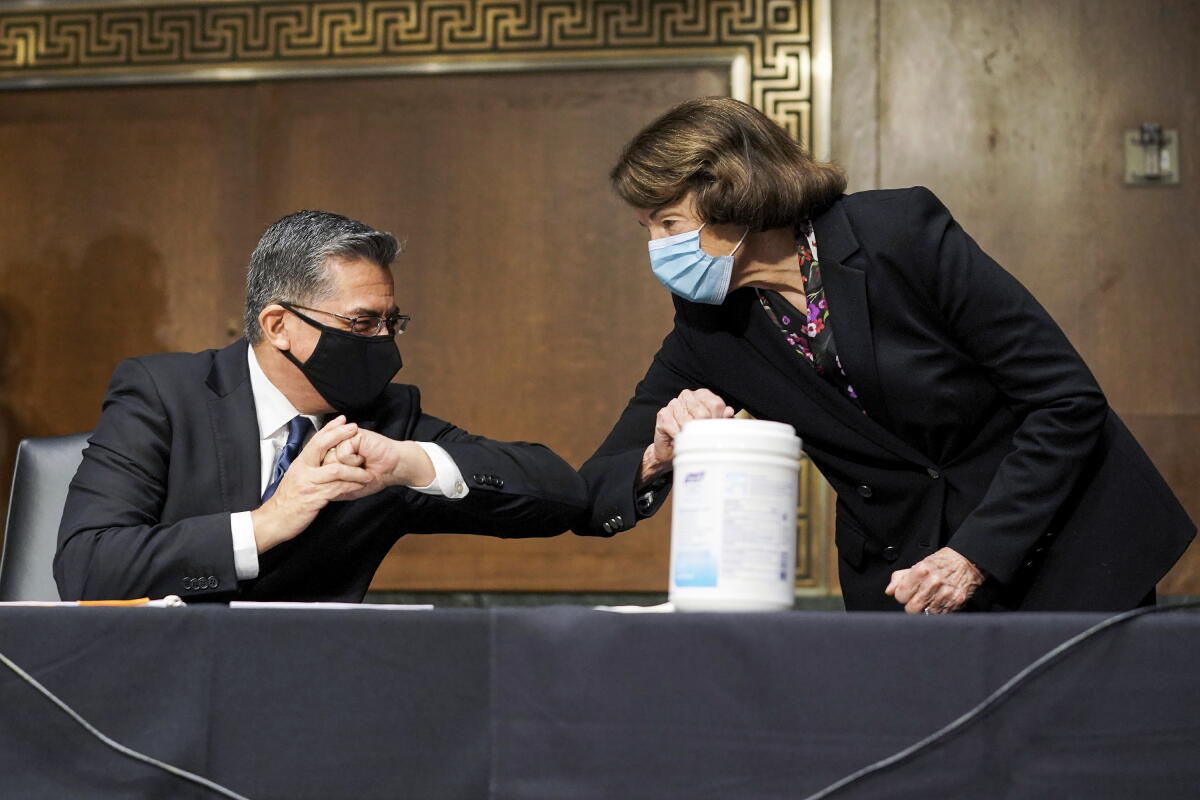
Xavier Becerra bumps elbows with U.S. Sen. Dianne Feinstein (D-Calif.) before his Senate committee confirmation hearing for Health and Human Services secretary in 2021.
(Greg Nash / Associated Press)
The group was able to achieve a compromise, but it never saw the light of day.
Then-House Speaker John Boehner, an Ohio Republican, later blamed then-President Obama, whom he accused of “poisoning the well” on an immigration compromise. Yarmuth said Republicans were spooked about potential blowback.
Several potential off-ramps appeared during Becerra’s time in Washington. He was considered by Obama for U.S. trade representative in 2008, but Becerra declined the offer. After flirting with the idea of running for outgoing U.S. Sen. Barbara Boxer’s seat, Becerra declined to enter the race, ultimately won by then-California Atty. Gen. Kamala Harris. He was briefly floated as a potential running mate for Hillary Clinton in the 2016 presidential election, but that didn’t materialize either.
In late 2016, Becerra found himself at a crossroads.
After more than a decade on the Ways and Means Committee, he faced the possibility of becoming the top Democrat on the committee and had the endorsement of the outgoing top Democrat, Rep. Sander Levin of Michigan.
But Harris’ victory in the 2016 Senate race created a vacancy for state attorney general.
Becerra decided to return home to Sacramento to take the role and spent the next four years as the state’s top law enforcement official, serving as “defender-in-chief” of the state, as USC’s Grose put it, against the Trump administration.
Fraught second act in D.C.
Becerra returned to Washington in 2021 for a second act that would prove to be far more controversial than his first.
Despite having no background in healthcare, Becerra was nominated to be the secretary of Health and Human Services and confirmed, over significant opposition by Republicans.
He took the reins of the healthcare agency as the country was still grappling with the COVID-19 pandemic and struggled to establish a clear role for himself in a response effort that was centered in the White House.
In his first year in office, he was called out by reporters for failing to hold regular press briefings.
And he faced criticism when health officials under his purview offered contradictory information in late 2021 about reduced quarantine requirements for people testing positive for COVID-19.
And Becerra’s chief of staff at Health and Human Services and longtime advisor, Sean McCluskie, pleaded guilty last year to participating in a scheme to use campaign funds from a dormant Becerra state political committee to pay for McCluskie’s frequent travel between Washington and California.
Dana Williamson, a longtime political consultant for Becerra and former chief of staff to Gov. Gavin Newsom, pleaded guilty earlier this year for her role in the scheme. McCluskie and Williamson are scheduled to be sentenced in December. Neither Becerra nor Newsom were accused of wrongdoing.
Democratic operative Xochitl Hinojosa, who served as the spokesperson for the Department of Justice in the Biden administration, earlier this year offered a blunt assessment of Becerra’s performance.
“He was not effective in government, and I think that a lot of people in the Biden administration are talking about this because they realize that he was not an effective HHS secretary,” Hinojosa said on CNN in May.
While other members of the Biden administration have defended Becerra’s performance, his time at the helm highlighted an issue that even allies concede has bedeviled Becerra in the past, his tendency to sometimes recede into the background.
Loretta Sanchez, a former Democratic congresswoman from Orange County who credits Becerra with encouraging her to run for Congress, put it simply.
“Will Xavier be bold?” she said. “I hope he takes those bold moves, because California needs it.”
Barbara Leaf, former US Assistant Secretary of State for Near Eastern Affairs, tells Al Jazeera that public opposition to the war with Iran could threaten Republican control of Congress, as economic fallout fuels voter anger.
Protesters in Guadalajara, Mexico, were seen climbing on the windows of Jalisco’s state government building on Sunday, spray painting it with graffiti. It was the second protest by residents demanding clean tap water.
BANGOR, Maine — Ever the optimist, Speaker Mike Johnson said he believes Republicans will hold on to their U.S. House majority, defying a surge of Democratic momentum in the final stretch of the midterm elections that will determine control of Congress.
It’s the crowds he says he’s seeing as he crosses the country campaigning for GOP candidates. The caliber of recruits and incumbents he calls workhorses, not show horses. And the nearly half a billion he has raised for House Republicans.
He also has faith.
“We run to win, and that’s biblical: You run to win,” he told the Associated Press during a campaign stop in Maine.
“And I believe that we will.”
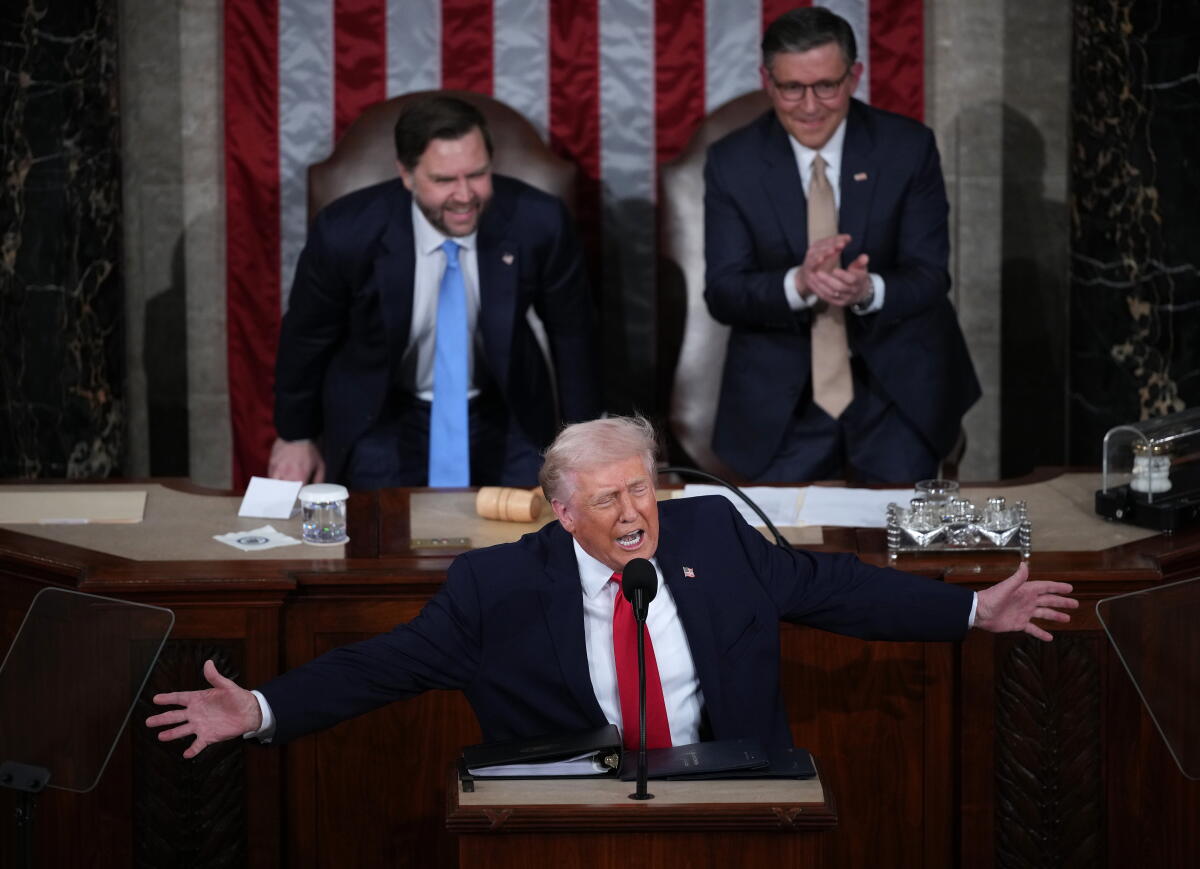
House Speaker Mike Johnson, right, applauds along with President JD Vance as President Trump delivers his State of the Union address during a joint session of Congress in February in Washington.
(Andrew Harnik / Getty Images)
The speaker of the House is one of the most consequential elected officials in the United States, second in line of succession to the president. While Johnson quipped to Fox News recently that he may return to his hometown of Shreveport, La., to start a lawn care business if Republicans lose power on Nov. 3, he fully expects to buck an American midterm tradition that often sees the president’s party dumped in Congress.
It can be said that Johnson, who has drawn so close to President Trump that he routinely fields 1 a.m. calls — they spoke the night before as Trump rallied in Alaska — walks on the sunny side of the street. That’s despite voter frustration over high prices and the Iran war, and his own challenge of leading one of narrowest House majorities in modern times.
In his three years as speaker, Johnson has pushed past the doubters and naysayers, holding his thread-thin GOP majority together to deliver Trump’s agenda. He notably led passage of the big tax breaks and social service cuts bill. Most days he does not have a single vote to spare.
“So many times everybody had written off, there was no way he was going to be able to pull off a particular vote,” said Republican Rep. Mark Harris of North Carolina, who joined the speaker on the campaign swing. “Yet he always seems to pull out the win in the end.”
In the interview, Johnson did not speak brashly about expanding the House majority on election day, as he has in the past. But on track to visit more than 20 states and 40 congressional districts though November, he said the political mood reminds him of the 2024 election that swept Republicans to control of Congress and the White House.
“It’s not going to be a giant majority,” he said. “But I genuinely believe that we will have a working majority.”
Emboldened by Trump
Johnson first fell into the speaker’s job almost by accident, a desperate choice by his GOP colleagues after a contingent of renegade Republicans ousted his predecessor, then-Rep. Kevin McCarthy of California in 2023.
Johnson had been a lower-level member of House leadership, but distinguished himself before the Jan. 6, 2021, attack on the Capitol by organizing support for Trump’s false claims of widespread fraud in the election that he lost to Democrat Joe Biden.
In the time since, Johnson has secured proximity to Trump’s power. He joined Trump at a UFC fight in New York and once gifted the president a speaker’s gavel as Trump signed the “One Big Beautiful Bill” into law. It was a symbolic act, but one that critics saw as giving away the authority of a coequal branch of government.
More recently, Johnson abruptly sent lawmakers home early rather than face a vote forced by Republican Rep. Thomas Massie of Kentucky to impeach Defense Secretary Pete Hegseth as lawmakers tried to halt the Iran war, which has not been authorized by Congress.
Over coffee in Bangor, after rallying for House candidate Paul LePage, a former governor, Johnson brushed back criticism that Congress has eroded under his watch as Trump works to amass executive power.
“Absolute nonsense,” Johnson said.
“We did not yield Article 1 authority to the president,” he said, referring to the powers spelled out in the Constitution. “We used our own,” he said, to muscle GOP priorities past Democratic opposition.
Trump agenda at risk
Johnson has focused the election on Democrats he portrays as “communists.” A handful of far-left liberals, backed by the Democratic Socialists of America, are on the ballot.
Rep. Hakeem Jeffries of New York, the House Democratic leader who is in line for the speaker’s gavel if his party sweeps to power, is preparing a first-100 days agenda for when the new Congress convenes in January, if there is a change in control.
What the Republicans will do if they retain power is less defined.
“Lots of plans,” Johnson said, “along the same course of what we’ve been doing — less taxes, less regulation.”
Trump “wants to go big for his legacy,” he said. “We have big things on the horizon that we can do.”
The president has essentially purged the House GOP ranks of those perceived to be disloyal. Among them are Massie, who lost his primary, and Marjorie Taylor Greene of Georgia, who retired early after breaking with Trump over release of the Jeffrey Epstein files.
Pressed how he would keep Republicans in line, Johnson said he is preparing to change the House rules if he returns as speaker.
“There’s going to be some changes that are going to make the machinery work smoother,” he said.
Praying for the speaker, and the country
Faith has often been strong among House leaders. Two former speakers, Nancy Pelosi and Newt Gingrich are Catholics, as is John Boehner, who invited Pope Francis to address Congress.
Johnson, a former constitutional lawyer who was first elected alongside Trump in 2016, is expected to win his own reelection next month.
“My faith is a huge component of how I think and how I act and what I do,” said Johnson, who led a public prayer on the National Mall as part of the nation’s 250th anniversary.
He is drinking lots of coffee these days, he said, cutting back on the Celsius, and still has 1,413 unread text messages, a slight dip from the frightful number reported a few months ago by the Wall Street Journal.
One text is from someone praying for him.
Johnson said he is grateful for the outpouring of prayers he receives, for him and the country.
“I pray for God’s will. And I believe God’s will is for us — and not the communists — to be in charge of America,” Johnson said.
“And it does say in the New Testament, you run the race to win,” he said, citing 1 Corinthians 9:24. “This is a biblical admonition. So we will.”
WASHINGTON — President Trump’s abrupt decision to waive sanctions on Russia days before they were to take effect drew outrage Saturday from members of Congress, which had overwhelmingly passed the legislation in a bipartisan display of American support for Ukraine in the war with Russia.
Lawmakers from both parties blasted the executive order late Friday, the latest in a series of steps that the Republican president has taken drawing the United States closer to Russia’s Vladimir Putin. Trump recently announced a diesel deal with Putin to import Russian energy in a long-shot effort to curb high gas prices in the U.S. that are roiling the midterm elections on Nov. 3.
“Beyond irresponsible,” said Sen. Thom Tillis (R-N.C.), on social media, hours after Ukrainian President Volodymyr Zelensky expressed hope that the sanctions that were supposed to take effect Sunday targeting Russian’s economy could be revived.
“What part of enforcing a law passed 86-11 by the Senate does the President and his advisors not understand?” Tillis said. “It’s unconscionable that this administration is capitulating to a Russian dictator who illegally invaded Ukraine.”
Tillis said that if Trump wants to actually bring down energy prices, he should resolve the Iran war, which is largely blamed for the spike at the pump, and “not by doing a solid for Vladimir Putin.”
Republican Sen. John Cornyn of Texas said, “Lindsey would be appalled,” referring to the late Sen. Lindsey Graham (R-S.C.), who worked endlessly on the bill before he died this summer. The bill is known as the Lindsey Graham Russian Sanctions Act.
Sen. Elizabeth Warren (D-Mass.) said Trump is “thumbing his nose” at Congress and “enabling Vladimir Putin to continue his war of aggression.” She urged her colleagues to take action to reverse course.
Trump’s actions come as Ukraine is bracing for a stark winter confronting Russia’s ongoing attacks on its energy infrastructure to heat homes and keep the lights on. Zelensky, who has endured a rocky relationship with Trump but stayed close to the U.S. lawmakers, urged supporters to speak out on behalf of the sanctions.
The next steps are highly uncertain with the House and Senate on recess until after election day. Trump said he was waiving the sanctions indefinitely, citing national security concerns. It is unlikely Congress would be in a position to take any action to challenge Trump’s moves until lawmakers return to Washington.
It took almost a year for Graham to persuade Trump to agree to the Russian sanctions package. It was designed to impose steep tariffs on countries that import large amounts of Russian oil and energy products and was promoted as way to halt the flow of funds fueling Putin’s four-year war against Ukraine.
But even as Zelensky had watched from the visitor gallery as the Senate advanced the package after Graham’s death, skeptics in Congress warned Trump would be unlikely to follow the bill once he had signed it into law a month ago.
Last week, a bipartisan group of senators urged the Trump administration to more quickly clamp down on Russia, particularly the “shadow fleet” of tankers that Moscow is using to transport oil and bypass America’s sanctions. The senators noted that the bulk of the new law’s provisions were to be effective Sunday.
Instead, Trump soon announced the diesel deal with Putin, saying that Russia had agreed to supply tons of fuel to the U.S., where gas prices have skyrocketed in some areas and voters saying affordability issues are a top concern.
Outraged lawmakers have pledged to stop the Trump-Putin deal.
New York Rep. Gregory Meeks, the ranking Democrat on the House Foreign Affairs Committee who had led opposition to the Graham bill — warning that Trump would flout the law — introduced legislation Friday that would block Trump’s diesel deal with Putin.
“At a time when the United States should be increasing pressure on the Kremlin, Donald Trump is cozying up to Putin and striking self-enriching deals instead of standing with Ukraine,” Meeks said in a statement.
He called the deal “corrupt” and said it “goes against everything the United States stands for.”
Mascaro writes for the Associated Press. Associated Press writers Kevin Freking and Mary Clare Jalonick contributed to this report.
JUNEAU, Alaska — In the thick of Alaska’s primary election season this summer, independent Bill Hill took a break from his U.S. House campaign to return home to Bristol Bay.
The world’s biggest sockeye salmon run was beginning, and that meant he needed to get back to work.
“I told my team that I have got to fish,” he said, adding: “Commercial fishing is the way that we pay the bills.”
Hill, 57, grew up in a tiny southwest Alaska village where he said his family had no phone and had to haul water from a nearby lake for cooking and bathing. Today, while he no longer has to fetch water, his lifestyle is not much different. He lives in a remote fishing community of about 430 people that he has called home for nearly half his life.
A retired teacher and school administrator, Hill has positioned himself as a working-class candidate who can relate to Alaskans’ frustrations with high fuel and other costs. He has made affordability and pushing back against billionaires a central theme in his campaign against Republican Nick Begich, who’s seeking a second term in Congress.
“We are pedal to the metal, making sure that every Alaskan knows about this campaign, every Alaskan knows what we stand for and every Alaskan knows that it’s really one of them going to Congress,” Hill told people at a campaign event this week in Juneau, wearing his standard campaign uniform of jeans, a zip-up vest and cap with a fishing company logo. “I need your help getting there.”
The race has become a concern for Republicans as they are trying to hold onto their majority in the U.S. House. Vice President JD Vance held a rally this week for Begich and Dan Sullivan, the U.S. senator who also is in a tight reelection race. President Trump is scheduled to do another in the coming week.
Begich and Republican political action committees have ratcheted up ad spending in the House race since the primary.
Planes, ferries and four-wheelers on the campaign trail
Hill, a first-time candidate who is Alaska Native, faces an incumbent from a prominent family long associated with the state’s politics. Begich’s late grandfather once held the state’s only U.S. House seat. Begich’s uncle Mark was a U.S. senator. Both were Democrats. Nick Begich is a lifelong Republican and has aligned himself with Trump, who has carried Alaska in his White House runs.
Hill’s campaign said he has traveled more than 20,000 miles in the state, including by plane, ferry and all-terrain vehicle, to introduce himself to voters and promote his message.
Begich’s name recognition presents a hurdle for Hill’s campaign, but some Democrats tried to clear a better path for Hill. One suspended his campaign before the August open primary and endorsed Hill. Two other Democrats with virtually no name recognition withdrew after the primary despite being in line to advance.
One candidate registered as a Democrat remains in the top four, Eric Hafner. He has no apparent ties to the state and is incarcerated in New York.
Hafner received 3.8% of the vote, enough to qualify for the ranked vote general election on Nov. 3. His submitted candidate biography appearing in state election materials makes no reference to his stint in federal prison, where he is serving time for making threats against police officers, judges and others.
Hill’s campaign has shared stickers showing Hafner in an orange jumpsuit and calling him a “fake ‘Democrat.’”
“We want to make sure that the Alaskan people are well-informed,” Hill said.
Begich gets support from Trump and the U.S. House speaker
The contest has received national attention, with spending by groups that include the National Republican Congressional Committee and House Majority PAC, which seeks to flip the U.S. House to Democrats.
In early August, U.S. House Speaker Mike Johnson, R-La., held a rally for Begich that was closed to reporters. Vance called Begich a “machine” and effective legislator during his rally in Fairbanks, where Vance also gave support to Sullivan, who faces a challenge from Democrat Mary Peltola, a former congresswoman.
Trump has cited Begich’s support of his signature package of tax breaks, social service cuts and immigration enforcement that was passed last year. The president plans to headline a rally Tuesday in Wasilla, hometown of Sarah Palin, the party’s 2008 vice presidential nominee.
Hill said the visits show Republicans are nervous.
“I was not going to get into this race to waste people’s time, to waste people’s money,” he said. “I did my due diligence before jumping in to ensure that there was a path to victory.”
Begich’s campaign did not respond to messages from the Associated Press. On social media, the campaign has highlighted events such as Begich’s visit to the Alaska State Fair and recently has taken swipes at Hill.
Zach Bannon, an NRCC spokesperson, said Begich has delivered “commonsense wins for Alaska,” including support of expanded oil and gas development. He called Hill a “far-left Democrat.”
Hill was endorsed by Democrats but asserts his independence
Hill, who was endorsed by the Alaska Democratic Party, said he is a lifelong independent. He said he will not be beholden to a “party boss” or party line, and he rankled some voters earlier in the campaign by not explicitly saying which party he would caucus with in the House if he were elected.
He has said he is willing to work with anyone on what is best for Alaska. He also has called for bans on congressional stock trading and for limiting the influence of money in elections.
Hill said he wants to help build coalitions, saying he “can be a big part of a small group that makes big changes.”
Democrat Bill Brown came to the Juneau event planning to vote for Hill but wanting to talk with him directly. He said they aligned on numerous issues, including support for the environment, schools and ending “forever” wars.
The retired economics professor said policy is important, but in this political moment he finds himself “most interested in the integrity of the candidate. Bill Hill convinced me on that issue.”
Hill, who is Dena’ina Athabascan, said the top concerns he hears about from Alaskans are the price of fuel and overall cost of living. He said he had to fly home earlier this year and pump fuel oil from the textile manufacturing business he runs with his wife and bring it back to his house in a barrel because the community had run out.
He said fuel prices jumped from about $6.70 per gallon to about $9 per gallon after a barge shipment to his town earlier this year. Prices also have been higher elsewhere, particularly in communities accessible only by air or water. On social media, Hill’s campaign calls out Begich for his support of the Iran war as it posts photos of fuel prices around the state.
Steve Davis, a voter at Hill’s Juneau event this week, called him authentic and a “really good dude.” He said he was drawn to Hill in part because he wants to see Congress reclaim its oversight role. Hill drew applause during the gathering when he said Congress must reassert itself as a separate but equal branch of government.
“We don’t need a unified executive, we don’t need kings,” Davis said. “We need a Congress that actually functions.”
President Trump must cancel any remaining television commercials paid for with millions of dollars in taxpayer money to promote his political message, a federal judge ordered Sunday night, even as the administration said the ad campaign was coming to an end.
U.S. District Judge Jennifer L. Rochon in New York sided with a coalition, including the nonpartisan watchdog Common Cause, that challenged the ads and called them an illegal misuse of funds. She told the administration to cancel any remaining ads, including any set to air Sunday night, in granting a temporary restraining order.
“Defendants shall not enter into, renew, or expand any agreement authorizing the development, creation, dissemination, placement, or airing of the challenged advertisements” during the two-week duration of her order, the judge said.
The White House did not immediately respond to an email requesting comment Sunday night. In a court filing late Saturday, the Justice Department argued that the temporary restraining order was unnecessary because “the alleged offending conduct will end tomorrow.”
The Department of Homeland Security tapped $20 million in taxpayer money for the ads. Legal experts have suggested that violated a federal statute against congressionally appropriated money being used for “publicity or propaganda” and potentially other laws.
“We are pleased the court acted swiftly to prevent more taxpayer dollars from being used for such blatantly unlawful political propaganda,” the plaintiffs said in a statement issued by Democracy Forward, the nonprofit legal organization that represents them. “There is no legal justification — and no precedent — for the president to use the machinery of the government and funds set aside by Congress for other uses to influence electoral outcomes that further his own agenda.”
In a court declaration Saturday, senior Homeland Security official Holly Mehringer wrote that the money came from funds appropriated by Congress that are “available for, among other things, ‘commemorating efforts and events related to border security.’”
The White House has defended the ads as public service announcements akin to what past administrations have done to promote various policies. But the recent ads differ from many past public service announcements in that they aren’t aimed at helping members of the public benefit from specific government programs.
The ads, which began airing in late September, glorify Trump and echo his political messaging going into the midterms. One features a clip of the president talking about the threat of communism and another is a replay of an ad from his last presidential campaign. The fifth ad in the campaign began airing Tuesday, focusing on his administration’s capture of Venezuelan leader Nicolás Maduro.
The use of public funds to pay for the ads drew heavy criticism — including from some in the GOP.
“It shouldn’t be paid for with taxpayer dollars,” Senate Majority Leader John Thune (R-S.D.) told reporters.
The Democratic National Committee has separately sued the Republican administration over the ads.
Amid the backlash, Trump said he would start paying for the ads with a campaign account. A White House official said there were no immediate plans to reimburse the government for money already spent.
Johnson writes for the Associated Press. Johnson reported from Seattle. AP reporters Collin Binkley in Washington and Ali Swenson contributed to this report.
WASHINGTON — A bipartisan group of six senators — four of them Republicans — called Sunday for the Trump administration to “immediately reverse course” on a plan to purchase diesel from Russia as part of an effort to lower high fuel prices.
President Trump shocked lawmakers when he announced on social media Friday that he had struck a deal with Russian President Vladimir Putin in a phone call. He said Russia will immediately supply more than 300,000 tons of diesel to the American and global market, followed by an additional 500,000 tons in November and 1 million tons “immediately thereafter.” Russia will deliver an additional 3 million tons “within a short period of time” after that, he wrote.
Four Republican senators and two Democratic senators signed onto the statement released Sunday protesting the deal. They said the administration failed to consult with Congress or submit any explanation to justify its decision as required by statute.
“The United States should not provide Putin with a financial lifeline while Russia continues to kill Ukrainian civilians. The Administration must immediately reverse course,” they wrote.
The Republican senators who signed onto the statement are Sens. Susan Collins of Maine, Lisa Murkowski of Alaska, Thom Tillis of North Carolina and John Curtis of Utah. The Democratic senators are Sens. Jeanne Shaheen of New Hampshire and Richard Blumenthal of Connecticut.
Tillis, in an interview that aired Sunday on NBC’s “Meet the Press,” said there’s a legitimate case for saying the president is not following the law if the administration goes through with its diesel purchase plan.
“We were very clear that Russia is the aggressor. Russia is the one who can end this war by backing out of territory that they occupied,” Tillis said.
Trump’s announcement came just a few weeks after Congress passed legislation that directed Trump to impose substantial tariffs on the top importers of Russian oil or natural gas, with an exception for countries that import less than 15% of Russia’s natural gas exports and have taken significant steps to reduce those imports.
The congressional effort was aimed at cutting the flow of money Russia receives from oil and gas sales to finance its war against Ukraine.
The lawmakers also noted that Congress explicitly banned Russia energy imports in 2022 — after Russia’s full-scale invasion of Ukraine — to prevent the United States from financing the war.
“Congress was clear: the U.S. should not import oil from Russia until it ends its aggression against Ukraine and ceases threats against our NATO Allies,” the six lawmakers wrote in their statement. “President Trump’s decision to allow Russian diesel imports to the U.S. runs directly counter to that law.”
Sen. John Barrasso (R-Wyo.), when asked whether the president’s action would be in violation of U.S. law, said Trump is focused on reducing the cost of energy.
“The president is balancing and has to make tough decisions,” Barrasso said on CBS’ “Face the Nation.”
He also encouraged Trump to enforce the sanctions law that Congress passed last month.
“This is just another point of leverage for the president to use against Putin in an effort to get a long-term solution in that part of the world,” Barrasso said.
Trump has recently sought to blame record U.S. diesel prices on Ukraine rather than the U.S.-led war in Iran, which has elevated world energy prices.
“We need people in Congress who have the background, the training, the knowledge to basically hold this administration accountable,” Pan said last week on a baking 100-degree day in the Sacramento suburbs.
“I know what it’s like to be on the front lines,” said Pan, who spent a dozen years teaching and practicing pediatrics before being elected to the Assembly in 2010. “I’ve seen measles, right?”
The political organization 3.14 Action — its name a decimal approximation of pi — has recruited and helped elect hundreds of candidates from STEM backgrounds (science, technology, engineering and mathematics) and endorsed more than 500 of those running this year, including Pan in his race in Sacramento and in neighboring Placer and Yolo counties.
Dr. Richard Pan meets Dr. Teah Harris-Johnson and her daughter before participating in a roundtable discussion at Liberty Towers Church in Sacramento.
(Jose Luis Villegas / For The Times)
Shaughnessy Naughton, a chemist who worked on drug discovery and breast cancer research, founded 3.14 Action in 2016 after two unsuccessful tries for a congressional seat in the Philadelphia suburbs. When she started the organization, Naughton noted, there were more talk radio hosts on Capitol Hill than scientists and engineers. (Nearly two dozen doctors and nurses currently serve in Congress. More than 30 have run this election cycle.)
“There isn’t an issue that doesn’t benefit by having fact-based decision-makers, people that will go into office as problem-solvers,” Naughton said from Pennsylvania, which is in the throes of the nation’s worst measles outbreak in more than three decades. Health and Human Services Secretary Kennedy has downplayed the severity, even as the incidence of other vaccine-preventable diseases is rising.
“That’s essentially what scientists and physicians are,” Naughton said. “They are problem-solvers. and clearly our country is facing a lot of problems.”
Among those she cited was “the arsonist in charge of HHS.”
Like his jury-rigged political persona, Kiley seems to want it both ways on vaccines.
Before going to Congress, while serving in the Assembly, Kiley voted against Pan’s legislation cracking down on fraudulent vaccine exemptions. He’s described vaccines as a vital public health tool, but condemned government mandates and suggested vaccination should be a matter of parental choice. He claims Pan has eroded public trust by politicizing the issue.
As for Kennedy, Kiley told the San Francisco Chronicle a lot of things “that I don’t agree with,” though he’s never called out the secretary for his cuckoo-land theories — vaccines cause autism, the fluoride in public water supplies is making Americans “stupider,” and many more — or denounced his destructive policies.
That passivity, Pan said, amounts to complicity.
“It’s not just simply a talking point,” Pan said of public health policy. “It’s reality and we need to have policy based on what’s really happening, not on some ideological conspiracy theory.”
Dr. Richard Pan participates in a discussion during a Black maternal health roundtable last week at Liberty Towers Church in Sacramento.
Like most Democrats, he’s made affordability a key part of his candidacy, citing higher gas and grocery prices and, inevitably, the rising cost of healthcare and the roughly $1-trillion cut from Medicaid under last year’s Big Sop To Billionaires Bill.
The super-wealthy got tax cuts, Pan told a silver-haired audience at a 55-and-older community in Roseville, while the bill will make healthcare less accessible for millions and undermine both Medicare and Social Security. Kiley supported the legislation, the centerpiece of Trump’s second term. As a doctor and state lawmaker, Pan said, he worked to expand healthcare and address the needs of his community.
“We don’t pass laws to make lives harder,” Pan said. “That’s what he’s done.”
Later, at a forum on Black maternal health, Pan said Trump’s attacks on diversity, equity and inclusion programs and the so-called war on woke ignores glaring disparities in the treatment of Black women versus other patients. “The data is there,” said Pan, speaking before a banner decorated with purple butterflies and the proclamation, “Black Mothers Matter.”
“The facts are there,” Pan went on. “It’s a very, very real problem and it needs to be addressed and it needs to be solved.”
He brought up, somewhat sheepishly, his campaign.
“That’s why I’m running,” Pan said, to “have another person in Congress … who’s going to tell the administration we are not going to bury DEI. We’re not going to bury disparities. These are real problems.”
A new Pixar animated film, the sequel to Lionsgate’s “Michael” and a large crop of indie projects are among the latest films to be awarded a California tax credit for in-state production.
In total, 35 films — including 28 independent projects — received production incentives in the latest round of incentives.
Together, the projects are expected to contribute more than $1 billion in direct production spending in-state and hire more than 5,400 cast and crew members and more than 24,800 background actors, the California Film Commission said Wednesday.
“California is the home of entertainment, full stop,” Gov. Gavin Newsom said in a statement. “We’re not just protecting that legacy; we’re investing in its future.”
Pixar received the largest credit ($40.1 million) for an untitled animated film, followed by Lionsgate, which was awarded $30.8 million for the sequel to “Michael,” the film based on the life of Michael Jackson. Paramount Pictures got $29.3 million for an untitled crime thriller.
The latest round of tax credit awards comes less than a month after Newsom signed a bill to create the state’s first post-production incentive. Industry editors, sound mixers, visual effects artists and composers had said such a credit was necessary to lure jobs back from overseas.
On a national level, a bipartisan coalition of lawmakers is pushing to create a federal tax credit for film and TV. The bill is expected to be introduced in Congress in early November and backers are aiming to get it passed by Dec. 11, when the current Congress ends. If passed, the credit would take effect in 2027 and would be stackable with states’ production incentives.
A former FBI intelligence analyst has alleged that President Trump ordered the FBI to launch unconstitutional investigations into immigration enforcement protesters from the Los Angeles area, according to a whistleblower report made public Tuesday by Sen. Alex Padilla (D-Calif.).
She also contended that substantial FBI resources were diverted to such probes, and that she was retaliated against for questioning their legality.
The White House and the top federal prosecutor in Los Angeles both denied the allegations.
Jill Fields, a former supervisory intelligence analyst based in L.A., said in a letter addressed to Congress from her attorneys that she was told Trump had ordered FBI Director Kash Patel to launch the probes after seeing a social media video of protests against U.S. Immigration and Customs Enforcement and U.S. Customs and Border Protection operations in Alhambra in February 2025.
Fields said an initial assessment “determined that the protesters’ actions — video recording, use of a megaphone, and verbal objection — were constitutionally protected under the First Amendment and never crossed the line into impeding arrest or being a threat,” but that she and others were nonetheless directed to open investigations.
She said that a supervisor — whose name was redacted in the released report — said the investigation was moving forward because “the President wants this investigation.”
Separately, Fields alleged that she was informed that then-Acting Deputy Atty. Gen. Emil Bove — Trump’s former lawyer and now a federal appellate court judge — had instructed FBI leaders in Los Angeles to investigate “any anti-ICE and CBP protesters demonstrating at federal buildings in Los Angeles,” which surprised her because “investigations against protestors solely for First Amendment activity are explicitly illegal and contrary to FBI policy.”
She said she refused to participate and isn’t sure if the investigations were formally launched, but that she “observed that personnel and analytical resources were immediately diverted from ongoing criminal investigations to address the Alhambra matter.”
Fields said she was reassigned after taking her concerns beyond her direct chain of command, and ultimately resigned.
She alleges that the conduct “had significant consequences for constitutional rights, and the integrity and effective operation of the FBI,” and that her reassignment “created a chilling effect within the workforce” by signaling to other employees that “raising constitutional or legal concerns could carry professional consequences.”
Lauren Bis, a White House spokesperson, denied the allegations.
“The First Amendment does not protect violent rioting, obstructing law enforcement, and assaulting law enforcement. Assaulting and obstructing law enforcement is a crime,” she said in a statement. “This administration has been clear: anyone who assaults or obstructs law enforcement will be arrested and prosecuted to the fullest extent of the law.”
The FBI and the Justice Department said in a joint statement that under Trump, “the Department of Justice will continue to vigorously uphold the First Amendment rights of all Americans,” but that “violence is not protected by the First Amendment” and that “politically motivated attacks will not deter us from doing our job.”
They said “conspiracies to impede federal law enforcement and assaults on federal officers are against the law.”
The Los Angeles region was a hotbed of protest amid an intense immigration crackdown by the Trump administration last year.
Federal prosecutors in Los Angeles have pursued a slew of criminal cases against protesters involved in those demonstrations, though many of the cases have been dismissed, reduced to misdemeanor charges or rejected by grand juries. Legal experts have said the failure rate raised concerns about the strength of the cases being brought by First Assistant U.S. Atty. Bill Essayli, whose leadership of the Los Angeles prosecutors office without Senate confirmation is being challenged in court, but high-ranking Justice Department officials have praised Essayli’s work.
Essayli called Fields’ claims false, including in response to a social media post Tuesday by Padilla recounting them.
“The FBI investigated those obstructing law enforcement and engaging in assault, such as punching and spitting (my office charged more than 100 individuals with such crimes),” Essayli wrote. “There is no First Amendment right to violently resist federal officers enforcing immigration laws passed by Congress.”
Padilla wrote a letter to Patel and Atty. Gen. Todd Blanche on Monday demanding answers to a slate of questions about Justice Department investigations of protesters, their origins and outcomes, and any involvement from the White House.
He wrote that Blanche and Patel have told Congress that “cases would be based only on the facts and the law, free from political interference,” but that the whistleblower report “depicts an FBI and DOJ willing to surveil individuals solely for First Amendment activity criticizing the Administration — at the behest of the White House and Trump loyalists, over the objection of senior staff, and in contravention of agency policy and the Constitution.”
The video from Alhambra that Fields said she was told prompted Trump to demand investigations, and which Padilla shared, was posted to TikTok by the League of United Latin American Citizens on Feb. 26, 2025. LULAC did not immediately respond to a request for comment Tuesday.
The video depicts protesters on megaphones calmly reminding others who appear to be the focus of nearby immigration enforcement about their legal rights and the fact that agents need a legitimate, court-issued warrant to enter their homes — and telling them not to open their doors if the agents don’t have one.
WASHINGTON — The Supreme Court justices sounded wary Monday of state-by-state lawsuits that could impose huge damage verdicts on energy producers for the impact of global climate change.
Instead, several of them suggested these local and state claims may be blocked by the federal Clean Air Act.
“Interstate air and water pollution are matters for federal law,” said Justice Brett M. Kavanaugh. “We don’t have to reinvent the wheel. This kind of pollution is a federal matter unless Congress says otherwise.”
Justice Elena Kagan appeared to agree. State-by-state lawsuits “get in way of how Congress decided to regulate greenhouse gases,” she said.
At issue before the court was the question of whether cities and states may sue oil and gas producers for the damages inflicted by climate change.
California and nearly three dozen states and municipalities have filed such claims, but none have gone to trial.
Last year, the Colorado Supreme Court ruled that Boulder County may sue for damages in a local court.
The Supreme Court agreed to hear an appeal from the oil industry backed by the Trump administration. Its lawyers argued that the Constitution and federal law do not allow for such claims to be resolved in local courts.
Chief Justice John G. Roberts sounded skeptical of opening the door to a wave of climate change lawsuits. “There will be 50 different cities. How would that work out?” he asked a lawyer representing Boulder.
For much of the two-hour argument, the justices struggled over whether federal law imposes a limit on such lawsuits, or instead whether states and their judges are free to seek damages for the harm they have suffered.
They did not signal a clear outcome but most of them sounded as though they leaned toward saying that federal law governs such far-reaching damage claims.
The energy producers turned to the Supreme Court after losing in state court.
They hope the high court will shut down more than three dozen lawsuits seeking damages for the impact of climate change.
So far, judges across the nation have been divided. Some have ruled that federal law preempts or blocks states and counties from suing under state law.
But others, including the Colorado Supreme Court, ruled the lawsuits may proceed under state law.
Justice Samuel A. Alito, a staunch conservative, said he is sitting out the case, presumably because he owns stock in oil companies that would be affected by a ruling.
If the court splits 4-4 and cannot rule, it would be major disappointment for the oil industry because it would allow all the climate-change suits to proceed, at least for now.
WASHINGTON — Late September in the Oval Office, President Trump declared, “Iran will never have a nuclear weapon. We’re gonna win that war very soon.”
It wasn’t the first time he’s described the hostilities as “war.”
On Feb. 28, the day U.S. and Israeli began bombarding Iran, he warned that “the lives of courageous American heroes may be lost, and we may have casualties. That often happens in war, but we’re doing this not for now. We’re doing this for the future, and it is a noble mission.”
But throughout seven months of back-and-forth strikes with Iran, Trump administration officials, and sometimes Trump himself, have performed verbal acrobatics to avoid the “W” word.
President Trump, addressing the United Nations General Assembly on Sept. 22, used the word “war” one time when referring to hostilities with Iran.
(Pool / Getty Images)
Senior administration officials loosely tossed around “war” during the first stages of conflict, but with polls showing the war in unpopular and congressional support waning, “war” and even “Operation Epic Fury” have become taboo among members of the Trump administration.
Trump has called attacks on Iran a “military operation,” “military decimation,” “excursion” and “skirmish.”
At a White House press briefing last month, Vice President JD Vance attempted to clear the air when a reporter asked about a potential end to what she called a “war in Iran.”
“I wouldn’t call it a war right now,” Vance said. “Major combat operations lasted for about six weeks.”
Vice President JD Vance, addressing reporters at the White House on Sept. 3, said, “I wouldn’t call it a war right now” when asked about the conflict with Iran.
(Chip Somodevilla / Getty Images)
Defense Secretary Pete Hegseth tread carefully in front of the Senate Appropriations Committee in July, repeatedly referring to a “conflict” in Iran that needed additional funding to continue.
On May 5, during the first of two delicate ceasefires with Iran, Secretary of State Marco Rubio announced an end to the objectives laid out in Operation Epic Fury and the beginning of “Project Freedom” — an effort to escort merchant ships through the Strait of Hormuz.
In April, Trump announced the blockade of Iranian ports. When asked about whether the blockade constituted an act of war, Rubio replied, “That’s not an act of war, that’s a defensive measure. It’s a counter to what they have decided to do.”
Senior Trump officials have maintained that the conflict can no longer be viewed as war because the intensity of strikes between the two countries has been reduced.
The “end” of Operation Epic Fury, the name Trump used when he announced hostilities on Feb. 28, was declared on May 5 — 60 days after the fighting began.
The timing was no coincidence. Under the War Powers Resolution of 1973, a president must cease all hostilities abroad after 60 days if there is no congressional declaration of war.
Legal and political considerations
Under the Constitution, only Congress declares war, but past presidents have routinely circumvented this rule by exercising their authority to direct the military and initiate strikes on targeted nations.
Nearly every modern president, from Dwight D. Eisenhower to Trump, has used this justification to undertake military action without the declaratory approval of Congress.
Congress can also choose to approve an Authorization for Use of Military Force, which grants the president legal authority to conduct military operations overseas.
Unless Congress sets a time limit on the authorization, authority to use the legal justification to launch military strikes can theoretically span multiple administrations.
Rep. Jamie Raskin (D-Md.), a former constitutional law professor at American University, said that presidents of both parties have avoided the term “war” when attempting to evade congressional approval of hostile action abroad.
“Trump has followed some of his predecessors in playing word games with the war power,” Raskin said. “What makes his case so extreme is that he proudly described it as a war and depicted it in glorified military terms.”
In March, seven days into the fighting, Trump said, “The war itself is going unbelievably. It’s as good as it can be.”
Congress has not officially declared war since World War II. The Vietnam War, the invasion of Afghanistan and both wars in Iraq were all approved by Congress under the umbrella of an Authorization for the Use of Military Force.
This year Congress has not approved such an authorization for the action with Iran. Fourteen Senate votes for a War Powers Resolution to curb Trump’s war efforts have failed in the chamber so far.
According to a CNN/SSRS poll last month, only 26% of Americans approve of the Trump administration’s handling of the Iran war.
Raskin said that he believes Trump’s terminology has shifted with the public mood, adding that he hasn’t heard any of his Republican colleagues “play along with the semantic games.”
“When things have turned south in the fortunes of this war, he has tried to pretend it’s something else,” Raskin said. “I think that has just further enraged the population.”
Past handling of congressional war power
The administration’s declaration that Operation Epic Fury had concluded echoed May 2003, when then-President George W. Bush stood in front of a banner reading “Mission Accomplished” aboard the USS Abraham Lincoln, approximately six weeks after Operation Iraqi Freedom began.
“Major combat operations in Iraq have ended,” Bush said. “And now our coalition is engaged in securing and reconstructing that country.”
President George W. Bush speaks aboard the aircraft carrier USS Abraham Lincoln off the California coast on May 1, 2003.
(J. Scott Applewhite/AP)
Despite the victory lap, combat operations in Iraq and across the Middle East continued through the aughts. The Iraq war wouldn’t officially end until 2011, with President Obama’s signature.
Obama himself relied heavily on the 2001 Authorization for the Use of Military Force — passed by Congress under Bush — in his military campaign against Islamic State during his presidency.
According to Council on Foreign Relations data, Obama launched 542 drone strikes and killed 3,797 people in Yemen, Pakistan and Somalia without renewed approval from Congress.
A case more analogous to Trump’s comes in former President Truman’s unilateral decision to deploy U.S. troops to Korea in 1950. The Truman administration forwent congressional approval altogether and used United Nations Security Council resolutions to justify the intervention against Communist forces in the north, according to a White House news release from the time.
There were many critics of this exercise of executive war powers, most notably, Ohio Republican Sen. Robert A. Taft, who argued that Truman had usurped congressional war powers.
However, that Congress still provided monetary support, granting Truman military funds and extensions to the draft to raise additional troops for the Korean War effort. According to historical Gallup polls, 78% of Americans in 1950 approved of U.S. intervention in Korea.
Trump sticking with ‘war’
While Vance and other administration officials continue to avoid “war,” it does slip out now and then. Trump has been, perhaps, the most discordant messenger of the administration when discussing Iran.
After referring to the “war” on social media and public interviews more than a dozen times, Trump backed Vance’s comments about the Iran war no longer being active as he spoke to reporters in the Oval Office in September. He refuses to call the conflict a “war,” Trump said, because “you are supposed to get approval.”
“I call it a military conflict, because it’s small potatoes for us,” Trump said.
President Trump is promising more payments to voters just ahead of the Nov. 3 midterm elections — this time, to more than 20 million seniors, who each would get $90 to help pay for Medicare premiums.
The announcement, made late Friday night by Trump on social media, comes after he said last month about 1 million people would get rebate checks of $500 for Affordable Care Act premiums. It also comes after his One Big Beautiful Bill Act last year slashed funding for Medicare, disqualifying thousands from eligibility and raising fees for the rest, and for the ACA, raising premiums for millions by eliminating tax credits.
Trump has also promised on the campaign trail to send every American adult $5,000 if Republicans retain control of the House and Senate in the midterm elections.
His latest promise — which, like the others, would require approval from Congress — would probably cost more than $1 trillion, adding to the ballooning deficit and worsening inflation.
Polls show Americans increasingly blame Trump for the high cost of gasoline and groceries, with just 17% approving of his handling of inflation. Rising healthcare costs are also a key component of the affordability struggles many face across the country.
The president has sought to shrug off concerns about affordability, claiming the economy is booming.
The White House said the $90 payments for seniors would come from the Medicare Improvement Fund, established by Congress in 2008 as flexible funding to improve program operations and payments to healthcare providers.
As proposed, Medicare Part B enrollees would receive a one-time payment in October, either through direct deposit or by check, the White House said. Total monthly costs for the program — which covers costs like doctor’s visits, ambulance services and lab tests — start around $200 and vary with income.
To be eligible, seniors must be living in the U.S. and not be already receiving premium assistance from Medicaid or paying adjusted monthly premiums based on income, according to the Centers for Medicare and Medicaid Services. Seniors enrolled in Medicare Advantage, a private plan alternative to traditional Medicare coverage, would not be eligible for the payment. More than half of eligible Medicare beneficiaries have Medicare Advantage, according to healthcare research nonprofit KFF.
Previous administrations have not used the Medicare Improvement Fund in this way, although Congress has periodically taken out money from the fund to pay for other priorities, said Larry Levitt, KFF’s executive vice president for health policy. For example, $20.74 billion was used for the creation of the Affordable Care Act in 2010.
“The Medicare Improvement Fund language is quite broad and gives substantial discretion to the administration,” Levitt said.
QUANTICO, Va. — Defense Secretary Pete Hegseth confirmed Wednesday that the U.S. military will cut 20% of its generals and admirals as he delivered what he is calling his “State of the Force” address.
Hegseth was speaking to junior officers and enlisted leaders at the Marine Corps Base Quantico in Virginia, the second year in a row that he has given such an address. This time, the U.S. military is seven months into a war with Iran with no clear end in sight, has captured Venezuelan leader Nicolás Maduro and killed more than 200 people in strikes on alleged drug trafficking boats in Latin America, among other actions worldwide.
The speech is not a usual fixture among Pentagon leaders. While Hegseth’s predecessors regularly addressed troops and top officers, they traditionally have done so in small or private settings.
The Pentagon chief, however, again focused on how he has drastically retooled the U.S. military by targeting what he calls “woke” culture — through a rollback of diversity programs, a review of ground combat units with female troops and a new screening program for “testosterone deficiency” among male personnel.
Pentagon officials had previewed that Hegseth would announce more cuts to the number of generals and admirals. He directed all military services to double the 10% reduction he ordered last spring for roughly 800 flag and general officer positions, making it a total 20% decrease to be completed by Jan. 1.
“I call it accountability and long overdue,” he said.
Several senators viewed Hegseth’s move as nothing short of a “purge” of the military’s top ranks that will take years to rebuild.
“He’s got some kind of like deep-seated grievance about leadership in the military,” said Sen. Mark Kelly, D-Ariz., the former Navy combat pilot and NASA astronaut, who has been critical of Hegseth. “He’s purging a generation of great leaders of the military, and it’s going to take a generation to recover from it.”
Republican Sen. Mike Rounds of South Dakota, a member of the Senate Armed Services Committee, said he wanted to understand Hegseth’s reasoning behind the decision.
“If it’s simply a matter of eliminating a very heavy top, there may be some validity to it, but I want to see it first,” Rounds said.
Hegseth and President Trump already have fired or pushed to retire more than two dozen military leaders since taking office, including the Army’s top uniformed officer, Gen. Randy George, a move that angered both Republicans and Democrats in Congress. The purge also has included a number of senior officers who are women or people of color.
Previous leaders who were ousted include Joint Chiefs Chairman Gen. CQ Brown; Chief of Naval Operations Lisa Franchetti; and Vice Adm. Shoshana Chatfield, the U.S. military representative to the NATO Military Committee.
Although Hegseth never gave specific reasons for those firings, most were tied to the belief that they endorsed or spoke openly in support of diversity, equity and inclusion programs, which have been targets of Hegseth and Trump.
As part of last year’s cuts, Hegseth also ordered the active duty military to shed 20% of its four-star general officers — the highest-level leaders — and the National Guard to shed 20% of its top positions, but it is unclear if all those cuts have been made. The new cuts could include any one-star general or above, or an officer of equivalent Navy rank.
When Hegseth first announced the effort to trim the highest levels of the military ranks, he argued it was intended to remove “redundant force structure to optimize and streamline leadership.” In a memo released in May 2025, he said the aim was to free the military from “unnecessary bureaucratic layers.”
The number of general officer positions in the military is set by law, but it is possible to let positions remain unfilled by not submitting replacements to Congress.
Hegseth’s efforts have extended well beyond personnel changes among the top ranks. He oversaw Trump’s ban on transgender troops while announcing new directives for “gender-neutral” or “male-level” standards for physical fitness.
Toropin and Finley write for the Associated Press. AP writers Lisa Mascaro and Meg Kinnard contributed to this report.
After being securely held for nearly four decades by one of the most preeminent politicians in California history, the House seat to represent bright blue San Francisco in Congress is up for grabs in November — and dividing the Democratic Party.
Rep. Nancy Pelosi (D-San Francisco), 86, the powerful former House Speaker who’s held the seat since 1987, announced last year that she would not run again. In May, she passed over state Sen. Scott Wiener (D-San Francisco) — a prolific California legislator long considered a potential successor — to endorse San Francisco Supervisor Connie Chan, a local progressive with less legislative experience but strong support from labor.
Pelosi’s endorsement sent Chan, who had been languishing in polls, surging past Democratic tech millionaire Saikat Chakrabarti in the June primary. Chan finished with nearly 30% of the vote and Chakrabarti took 18%. Wiener won, with nearly 41% of the vote.
Both Wiener, a gay man and staunch advocate for the city’s large LGBTQ+ community, and Chan, who immigrated to the city from Hong Kong at age 13 and has deep ties to its large Chinese and immigrant communities, would make history by winning. Wiener would be the first out LGBTQ+ person to represent the city in Congress, and Chan the first Asian American immigrant woman.
The race has sharply divided the state’s Democratic establishment as a rare intraparty showdown between a deft legislator who has driven liberal California policy for years and a rising progressive with the powerful imprimatur of the icon they seek to replace.
Both acknowledge they would take the same or similar positions on many issues, and fiercely oppose President Trump’s agenda. But they also say San Franciscans face a real choice between them that will help define the city for years.
“There is a clear cut between the two of us,” Chan said. “He has long enjoyed establishment support and industry support, and we’ve been grassroots, on the ground, [Asian American and Pacific Islander] community, working people and labor unions — in collaboration and coalition building.”
“We need Democrats who are willing to fight — to fight in a smart way, and to fight in an aggressive way, to defeat Donald Trump and to lower the cost of living,” Wiener said. “We are past the time where we need Democrats in office who were just going along to get along, or who, like Connie Chan, are just part of the status quo.”
Wiener is a MAGA target
Wiener, 56, has lived in the Castro neighborhood since 1997 and was a deputy city attorney and local Democratic Party chair before being elected to the Board of Supervisors in 2010. He was elected in 2016 to the state Senate, where he’s had a massive influence, authoring more than 100 bills that have been signed into law. Allies and critics say he is a workhorse, and at times both effective and divisive.
Wiener has been endorsed by the state and local Democratic parties; a slew of state leaders including California Atty. Gen. Rob Bonta, state Senate President Pro Tempore Monique Limón (D-Santa Barbara) and Assembly Speaker Robert Rivas (D-Hollister); various queer and labor groups including AFSCME; more than half the city’s supervisors; and various members of Congress.
Wiener has passed some of the state’s most progressive laws on LGBTQ+ rights, including protections for gender-affirming care, and challenged federal immigration agents in California. He has also pushed progressive laws — backing safe injection sites, extending bar hours until 4 a.m., decriminalizing psychedelic drugs — that have put some of his fellow Democrats in uncomfortable spots when forced to vote on the controversial issues.
Some in San Francisco label him a moderate, though that designation would draw laughs elsewhere in the country and even in Sacramento. Wiener is one of the most reviled state politicians on the conservative right nationally, and has received scores of death threats for his work, particularly on transgender issues. His website touts a laundry list of profane and homophobic attacks from MAGA loyalists — Elon Musk called him a “scumbag,” former Rep. Marjorie Taylor Greene called him a “communist groomer” — that he wears as a badge of honor.
On housing, Wiener has pushed for deregulation and development near transit hubs statewide to solve the housing and affordability crises, riling some homeowners averse to increased density and some progressives who say his plan favors developers and threatens existing rent-controlled housing. On tech, Wiener has pushed for artificial intelligence regulation but also been criticized for taking a technocratic approach with buy-in from wealthy tech leaders.
Wiener has passed laws protecting net neutrality, capping prescription costs and mandating mental health parity, ending mandatory minimum sentences for nonviolent drug offenders, and requiring corporations disclose their greenhouse gas emissions. He has received substantial financial support from tech leaders and opposes Proposition 40, the ballot measure that seeks to impose a one-time tax on the state’s billionaires.
Rep. Robert Garcia (D-Long Beach), also gay and a former Long Beach mayor, said he considers Wiener a friend but also a generational legislator who has “led the country” on LGBTQ+ rights and housing policy. “I don’t think there’s a better legislator in the United States on housing,” Garcia said.
Rep. Laura Friedman (D-Glendale), who worked with Wiener for years in the state Legislature, said he has been a champion for many issues important to Californians — including the environment — while holding big industry accountable and backing labor. She said while many politicians decide to either rack up easy wins with legislation that barely moves the needle or focus on “progressive value signaling” without accomplishing much of anything, Wiener “takes on some of the most difficult and controversial progressive issues and really gets them done.”
Nancy Tung, the local Democratic Party chair, said many San Francisco politicians “recede” from the city’s raucous local policy debate once they reach higher office, but Wiener is “still is in the knife fight,” especially on housing and affordability issues — showing he cares about the city and making him “such a good fit” for Congress.
Tung said she understands the appeal of sending a fellow Asian American woman to Congress in this political moment, but that Chan “just does not have the legislative record that Scott has.”
Chan for ‘working people’
Chan, 47, who lived in a rent-controlled Chinatown apartment after immigrating with her mother and younger brother, now lives with her firefighter husband and son in the Richmond neighborhood. She was a community and legislative aide for years — including for then-Dist. Atty. Kamala Harris — before being elected to the Board of Supervisors in 2020. She has served as budget chair since 2023 and has centered her campaign, largely funded by Pelosi’s network, around what she calls her “career fighting for working people.”
Chan has been endorsed by a host of Congress members, including Pelosi and Sen. Adam Schiff (D-Calif.); major labor groups including the California Federation of Labor Unions and the California Teachers Assn.; various progressive organizations and fellow and former supervisors; former mayor and S.F. power broker Willie Brown; and Chakrabarti, who since the primary has shared his campaign staff and funding with her.
Chan, who supports Proposition 40, has helped create a $400-million reserve fund in San Francisco to make up for federal cuts to Medicaid and housing subsidies. She also passed a supplemental budget to fund immigration defense services for people targeted by the Trump administration and passed various labor-friendly measures, including a minimum wage increase for in-home workers and cost-of-living adjustments for city service workers.
Pelosi said Chan “understands that budgets are statements of our values,” has “championed justice and progress for working families” and “brings an important lived experience to this moment” as an immigrant woman. Schiff said Chan has impressed him as “a very powerful voice for those who are disenfranchised” and someone with “the potential of growing into” a leader like Pelosi.
Kim Tavaglione, executive director of the San Francisco Labor Council, said she encouraged Pelosi to endorse Chan because Chan “supports San Francisco values,” listens to labor and is a great strategist.
Cleve Jones, the San Francisco activist who has fought for gay political representation since Harvey Milk’s historic 1977 election to the Board of Supervisors, said Wiener “has done some very good things, particularly around LGBTQ issues and HIV/AIDS,” but also angered some in the LGBTQ+ community by repeatedly showing up to an annual Trans March that organizers ask politicians not to attend.
Wiener, who is Jewish, was aggressively heckled at this year’s march, namely for his stance on the Israeli war in Gaza, which he was slower than other progressives to label a genocide. Conservatives mocked him for being targeted by his base, and Wiener ended up fundraising off the incident — which Jones said was “so cynical.”
He said Wiener’s “loyalty is to big developers, big tech and big real estate,” and that he “doesn’t really see the urgency of yet another white man elected to Congress” when San Francisco can send a stronger message by electing Chan, an immigrant woman of color.
Affordability and Trump
Chan said she is a “pragmatic” progressive who has balanced the city’s budget while protecting “healthcare, education, immigration resources” and other working-class priorities. She said Wiener is focused on deregulation for market-rate housing development, whereas she has prioritized tenants’ rights and protecting existing rent-controlled housing in her push for affordable units.
Chan said she will “walk and chew gum at the same time” in Washington by working for affordability while battling Trump, including by reversing his healthcare cuts, expanding Medicaid, providing affordable childcare, abolishing U.S. Immigration and Customs Enforcement and finally figuring out meaningful immigration reform.
“I’m not sugarcoating it as if it’s easy. But we gotta be able to find ways to work together to push those things forward,” she said.
Wiener said he and Chan share the goal “of getting Trump and MAGA out of office, and then making sure that people never feel tempted to flirt with authoritarianism again.”
But he said the way to do that is to advance policies that will “lower people’s cost of living and make people’s lives more sustainable” — including by passing universal healthcare, building millions of new homes, creating low-cost child care and leading a clean energy transition — and that he is the only candidate in the race with a proven ability to do that.
“This is a race to succeed the most effective and operational member of Congress in modern American history,” Wiener said. “San Francisco should send someone who actually has a track record, a proven track record, of being able to deliver.”
WASHINGTON — The Senate on Monday is expected to approve a bipartisan bill that would give the NCAA and its member conferences the authority to enforce uniform national rules on college athletics.
If the bill is passed by the Senate, it would move to the House and, if approved, on to President Trump for his signature to become law.
What the Protect College Sports Act would do
Under the Protect College Sports Act — co-authored by Sen. Maria Cantwell (D-Wash.) and Sen. Ted Cruz (R-Tex.) — the NCAA would be granted a limited antitrust exemption that would allow the organization to create standardized rules around athlete eligibility, limit conference realignment and prevent the creation of a super league — a private-equity model for college sports that would replace NCAA subdivisions.
The bill is also an attempt to codify the $2.8-billion antitrust settlement reached last year in House vs. NCAA, which allowed Division 1 schools to share revenue with their current players and compensate past players. The new bill would increase the revenue sharing cap to around $50 million per school from $21.5 million, albeit with a more strict and enforceable model.
Under Name, Image and Likeness deals, wealthier schools were able to circumvent the “soft” $21.5-million cap by lining up lucrative corporate sponsorships and endorsements for prospective athletes. The bill would allow the NCAA to crack down on attempts to bypass the limit by incorporating booster or affiliated-entity money into total revenue sharing calculations, while also giving schools an additional $27 million in the funding cap to retain current athletes.
Potential boost for smaller schools
A potential consequence of the bill could be that big-name programs lose their ability to draw the best college athletes with promises of massive compensation, allowing smaller programs to compete under NCAA regulations.
The NCAA and its affiliates have spent tens of millions of dollars lobbying for congressional intervention on its rule-making power over the last seven years. Supporters of the bill, including Cruz, have said the bill would bring order and consistent regulation to college sports.
“If we’re going to be having a national competition … it is only Congress that can establish a clear and enforceable legal rule book,” Cruz said on the Senate floor last week.
Influential figures in college sports, including former Alabama head football coach Nick Saban and ESPN analyst Pat McAfee, have publicly called on Congress to pass the measure. It has also drawn support from 24 of the NCAA’s athletic conferences.
“Congress does need to fix the mess in the courts and create a national framework so the people inside college sports can enforce fair rules,” Saban said during a Senate Commerce, Science and Transportation committee hearing in June. “Without that legal certainty, every rule becomes another lawsuit, every standard becomes another risk, and the system keeps drifting toward a professional model.”
What the opponents say
The legislation is not without its opponents. Some players, labor organizations and members of Congress argue that the bill would prevent highly sought-after college athletes from participating in their own negotiation process.
“What this bill does, at its core, is protect a system of exploitation,” Sen. Chris Murphy (D-Conn.) said in an AFL-CIO trade union press release. “This bill protects the billions of dollars that coaches and executives are making by suppressing compensation for some of the most highly valued athletes in the world.”
The Congressional Black Caucus and the NAACP have also brought forward concerns that the bill does not allow Black athletes — who make up a majority of players in the football and basketball programs — into the collective bargaining process.
The NCAA plans to enforce a five-year eligibility rule, cap agent fees at 5%, put penalties on second transfers and codify student-athlete protections, such as 10-year degree completion assistance and post-eligibility healthcare. If the bill passes, all challenges to these rules would have to be handled in federal court.
Some senior Republican officials in the House, including Rep. Tim Walberg (R-Mich.) and Rep. Brett Guthrie (R-Ky.), have expressed some hesitance in passing the legislation without clarity as to whether student-athletes will be considered employees and if further limits should be placed on international student-athletes. If changes are made in the House, the bill would be returned to the Senate for another vote.
Support from Trump
Trump, on the other hand, has expressed strong support for the bill.
“THE PROTECT COLLEGE SPORTS ACT is a great Bill, and the Senate will hopefully stay in D.C. until it passes,” he wrote on Truth Social last month. “Without this Bill, millions of young Athletes will be hurt, programs will be canceled … the fans will be robbed, and Universities will go broke”