congress

California Senate calls on Congress to change immigration laws

A watered-down resolution calling for Congress to “repair” the nation’s “historically broken” immigration laws won bipartisan support by the state Senate on Monday.

The Senate voted 32 to 0 to support Senate Joint Resolution 8 by Sen. Lou Correa (D-Santa Ana).

The measure originally called for illegal immigrants to have access to “a logical and streamlined path to citizenship,” but it was changed to provide that path for “individuals after they gain legal status.”

The resolution also originally said: “This reform should also include a way to help families remain together throughout the lengthy bureaucratic process,” but that provision was removed. It now calls for the reform to “recognize the societal and cultural benefits of keeping the family unit intact.”

Senate Republican leader Robert Huff of Diamond Bar noted that California is home to a large number of illegal immigrants, many of them providing important work in agriculture, and he said immigration laws are not working.

“The status quo is hurting our state,” Huff said.

Sen. Anthony Cannella of Ceres is among the Republicans who have supported proposals in Washington that include a path to citizenship for illegal immigrants.

“We must recognize the hard work and contribution of our immigrant community,” Cannella told his colleagues Monday.

ALSO:

Brown goes electric to lure Chinese tourists

Brown’s first day in Shanghai is heavy on ceremony

Skelton: Special interests give Brown a free ride to China

patrick.mcgreevy@latimes.com

Source link

How the DHS deal unraveled and split Republican leaders

For several hours Friday, in the stillness before dawn, the Senate appeared to have finally figured out how to fund most of the Department of Homeland Security before it faced the longest partial shutdown in U.S. history.

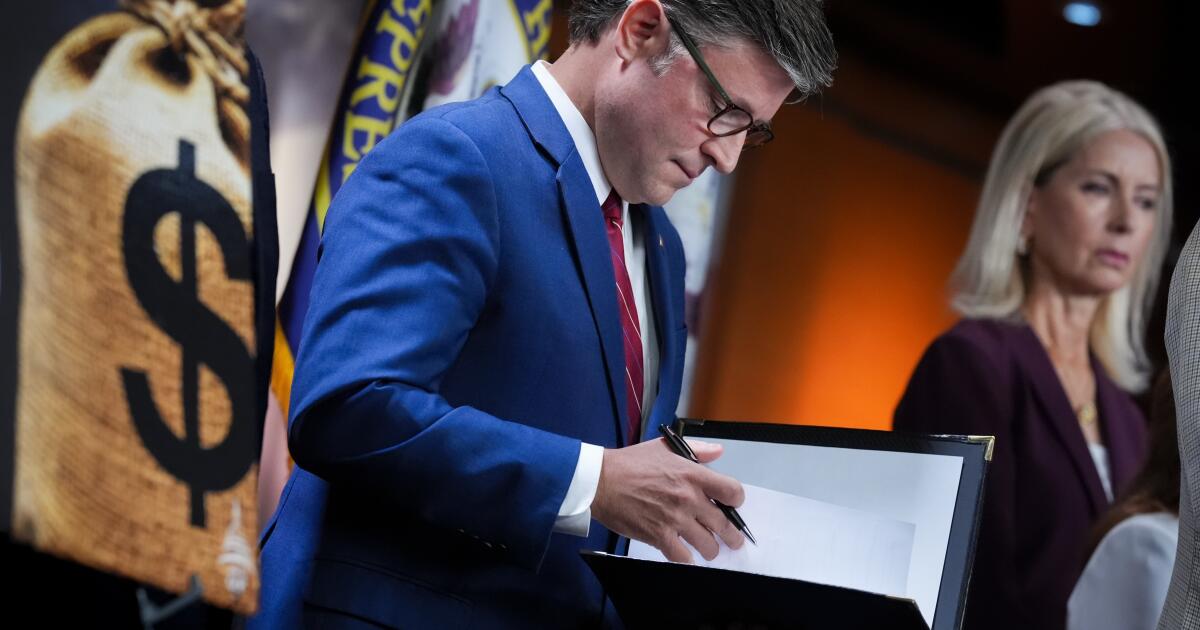
Senators handed House Speaker Mike Johnson (R-La.) their deal and headed for the airports, seemingly confident of success.

Then it collapsed. Spectacularly.

An incensed Johnson marched out of his office Friday afternoon. He angrily denounced the plan that the Senate had unanimously agreed to as a “joke.”

“I have to protect the House, and I have to protect the American people,” Johnson told reporters.

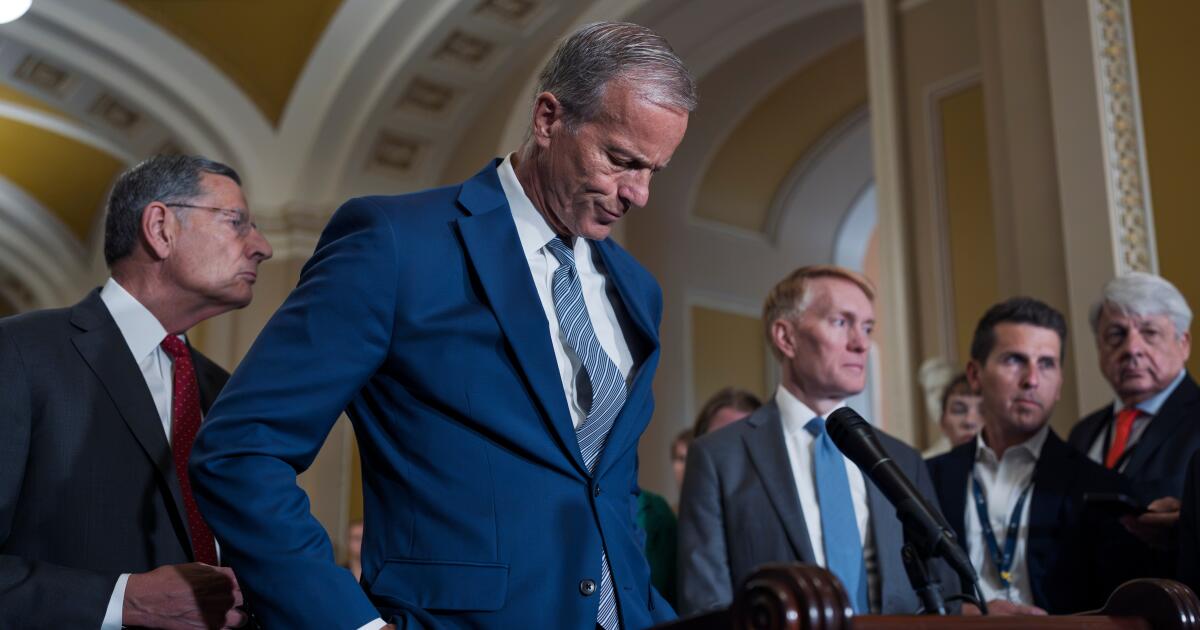
It was a dramatic denunciation of a deal that his counterpart, Senate Majority Leader John Thune (R-S.D.), had negotiated after weeks of effort, and was the latest abrupt turn in a funding saga that has bedeviled top Republicans for much of the year.

The collapse of the deal leaves Congress, now on a two-week spring break, with no easy way out of the impasse that has put the Homeland Security Department into a shutdown since mid-February. It also has exposed a rare rupture between the two Republican leaders in Congress, testing their alliances as they labor to move another set of President Trump’s priorities into law before the November elections.

Nothing ahead is likely to be easy.

How the deal collapsed

Thune had a deal with Democratic senators after negotiating for weeks on their demands for new restrictions on the department’s immigration enforcement work. Offers were traded several times. The talks moved along at a stop-start pace. Votes failed again and again.

Out of time and patience, senators essentially settled on a draw for the bill: They would not include funding for U.S. Immigration and Customs Enforcement and for U.S. Border Patrol, as Democrats had proposed repeatedly in the last week, but while setting aside all the Democratic demands for new limits on the agencies.

Thune pointed out that Congress had allotted money for immigration enforcement and he told reporters that “we can get at least a lot of the government opened up again and then we’ll go from there.”

Asked if he had cleared the compromise with Johnson, Thune said the two had texted.

“I don’t know what the House will do,” the senator said early Friday as the deal came together.

But as House Republicans woke up to the news, their outrage was swift.

Rep. Nick LaLota (R-N.Y.) said that on a GOP conference call that morning to discuss their path forward, a few dozen members ranging from moderates to hard-line conservatives spoke in opposition to what the Senate had done.

“The Senate chickened out,” he said. “The cowards there, only a few of them in the middle of the night with I think only three to five senators present on the floor, chickened out because they wanted to go home for two weeks. We need to raise the bar.”

What’s next for Republicans?

The bitter split threatens to make the job for Republican leaders more difficult as they try to advance their priorities while they still have guaranteed control of both chambers. Trump has said that legislation to impose strict new proof of citizenship requirements on voting is his top priority, but there is no real path for that plan in the Senate with its 60-vote threshold for advancing legislation.

Some Republicans have pushed instead for a budget package that could potentially put some parts of the voting law in place. Republicans are also contemplating how to pass an expected request from the White House to fund the war with Iran that could total more than $200 billion, among other priorities.

Meanwhile, the flop of the funding deal has given Democrats another chance to pin the partial shutdown on House Republicans.

“They know this is a continuation of the shutdown because the Senate is gone,” said Massachusetts Rep. Katherine Clark, the No. 2 Democratic leader. “So they know fully well what they’re doing.”

It is not clear what the Senate will do next. A quick resumption of talks is unlikely. Negotiations ended acrimoniously on both sides, with each blaming the other as moving the goalposts along the way.

Senate Democratic leader Chuck Schumer of New York said he was proud of his caucus for “holding the line.” But Republican Sen. Susan Collins of Maine, who leads the Senate Appropriations Committee, said Democrats were “intransigent and unreasonable.”

Thune said he believed that Democrats never wanted a deal and would not vote for ICE funding under any circumstances.

“I felt like from the beginning, they just didn’t want to get to ‘yes,’” Thune said after the vote.

The dynamic left senators convinced that the deal was the only way to move past their disagreements and reopen the Homeland Security Department.

But House Republicans on Friday night seemed to revel in the fact they had defied the wishes of the Senate. GOP members said that they work from a perspective that is closer to the will of their constituents.

To Rep. Virginia Foxx (R-N.C.), the Senate’s proposal was “nothing more than unconditional surrender masquerading as a solution.” She said the House ”will not bend itself into submission by acquiescing.”

Those searching for a way out of the shutdown seemed discouraged.

“This takes two chambers to get the job done,” said Pennsylvania Rep. Brian Fitzpatrick, a moderate Republican. “Apparently, there’s not enough communication between those chambers.”

Groves, Jalonick and Cappelletti write for the Associated Press. AP writer Kevin Freking contributed to this report.

Source link

Florida congresswoman Cherfilus-McCormick committed 25 ethics violations, House panel finds

Democratic Rep. Sheila Cherfilus-McCormick of Florida committed numerous violations of House rules and ethics standards, the House Ethics Committee found Friday in a ruling that could add weight to Republicans’ potential push to expel her from Congress.

After meeting into early Friday morning following a seven-hour hearing, the ethics panel of four Democrats and four Republicans found that Cherfilus-McCormick had committed 25 ethics violations, including breaking campaign finance laws. The panel said it would recommend a punishment in the coming weeks.

The allegations center around Cherfilus-McCormick’s receipt of millions of dollars from her family’s healthcare business after Florida made an overpayment of roughly $5 million in disaster relief funds. Cherfilus-McCormick is accused of using that money to fund her 2022 congressional campaign through a network of businesses and family members.

The congresswoman, who is running for a fourth term representing a southeastern Florida district, has denied wrongdoing, and her attorney stridently criticized Thursday’s public hearing — the first open proceeding in nearly 15 years. But the ruling from the Ethics Committee could fuel a potential vote on her expulsion and divide a Democratic caucus that is trying to make a comeback to power in the November midterm elections.

Cherfilus-McCormick also faces federal charges for allegedly stealing the $5 million in COVID-19 disaster relief funds and using it for purchases like a 3-carat yellow diamond ring. Her brother, former chief of staff and accountant were also charged. She has pleaded not guilty to those charges, and her attorney indicated Thursday that the trial is expected to start in the coming months.

What did the ethics panel find her guilty of?

The congresswoman declined to testify during Thursday’s ethics hearing, citing her 5th Amendment right against self-incrimination. Her attorney, William Barzee, sparred with some of the lawmakers on the ethics panel and argued that they should have allowed a thorough ethics trial, where he could present witnesses and evidence to counter the conclusions of House investigators.

Barzee accused the panel of giving further momentum to the effort to “throw a woman out of Congress who was duly elected by her constituents” based primarily on bank records.

Committee investigators laid out 27 violations of House ethics standards and rules in a 242-page report. The report accused Cherfilus-McCormick of winning a 2022 special election by portraying her campaign as self-financed when it was actually funded through the $5-million overpayment her family’s company received from Florida for coronavirus vaccination services.

Barzee had argued that “she was entitled to that money,” pointing to a document that broke down how her family would share the proceeds from the healthcare business. But lawmakers on the ethics panel were skeptical of that argument.

The panel found Cherfilus-McCormick guilty of all but two of the ethics violations proposed by investigators. Lawmakers declined to find her guilty of one allegation of receiving political help from an organization run by an advisor and her husband that received funding from the Haitian government. The panel also did not find her guilty of refusing to cooperate with the ethics investigation.

Will there be a push to expel Cherfilus-McCormick?

The full House Ethics Committee said it would meet after Congress returns from a two-week break in April and consider what punishment to recommend for a vote in the House.

Rep. Greg Steube, a Florida Republican, told reporters Thursday that once the committee makes a determination he “will move on the floor to expel.”

House Democratic leaders have declined to condemn Cherfilus-McCormick and said they wanted to see the ethics process play out. A couple of members of the Congressional Black Caucus, one of the most powerful groups of Democratic members, also showed up to the start of the ethics hearing Thursday in an apparent show of support for Cherfilus-McCormick.

But Democratic Rep. Marie Gluesenkamp Perez, a moderate member from Washington state who often breaks with her caucus, posted on social media Friday morning that “since she was found guilty, she should resign or be removed.”

The last member to be expelled from Congress was Republican Rep. George Santos of New York in 2023. He argued at the time that the House would be “haunted” by the precedent of expelling a member before a criminal trial played out. House Speaker Mike Johnson (R-La.) voted against expulsion at the time, expressing the same concern.

It takes a two-thirds majority in the 435-member House to expel a member.

Groves and Kinnard write for the Associated Press. Kinnard reported from Columbia, S.C.

Source link

Trump orders pay to TSA workers as Congress hits standstill

March 27 (UPI) — The U.S. Department of Homeland Security announced Friday that Transportation Security Administration employees will begin receiving paychecks as the department’s shutdown continues.

There was movement on Capitol Hill toward ending the shutdown and partially funding DHS on Friday. After the Senate unanimously voted to pass a bill that would fund the department, aside from Immigrations and Customs Enforcement, the U.S. House rejected the bill outright.

House Speaker Mike Johnson, R-La., said the House will pursue its own bill that would fully fund the department for 60 days. Johnson said the Senate’s bill would not move forward because it did not include funding for ICE.

President Donald Trump was also critical of the Senate-passed bill, saying it “wasn’t appropriate.” He signed an executive order to direct payment toward the more than 60,000 TSA employees.

“Today, at the direction of President Trump and the Secretary of Homeland Security Markwayne Mullin, TSA has immediately begun the process of paying its workforce,” a DHS spokesperson said in a statement to UPI. “TSA officers should begin seeing paychecks as early as Monday, March 30.”

Alan Fyall, associate dean of the University of Central Florida’s Rosen College of Hospitality Management, told UPI that news of TSA receiving pay is welcome, though for some it may be too late.

“If they’re going to get paid, that’s excellent,” Fyall said. “I’m sure there are quite a few who have left and probably won’t return.”

As of Friday, TSA agents were on their second pay period without receiving a paycheck.

On Wednesday, Ha Nguyen McNeill, deputy administrator of the TSA, told the House Homeland Security Committee that more than 480 workers have resigned and workers have missed $1 billion in pay.

“Most people in lower to middle salaries, if you miss two paychecks, that’s a problem,” Fyall said. “That’s not unique to TSA agents. As they would say, ‘do the math.'”

This is the second time the government has at least partially shut down, affecting the pay of TSA workers, in the past six months. The TSA has been shut down for more than 85 days this fiscal year.

“Many of our workforce have missed bill payments, received eviction notices, had their cars repossessed and utilities shut off,” McNeill told the House committee. “Some are sleeping in their cars, selling their blood and plasma and taking on second jobs to make ends meet.”

When the shutdown ends, Diego Bufquin, professor of practice at the Freeman School of Business at Tulane, told UPI he expects relief to come to TSA workers and travelers quickly, though the end of spring break adds to the long lines.

“We’re not going to have this resolved by this weekend,” Bufquin said. “Lines are going to be very long this weekend. There will be lots of complaints from passengers for sure.

“The thing is that the job market right now is not looking fantastic either,” Bufquin said. “I don’t think those TSA agents who are now considering switching jobs are in a good spot to easily find jobs in other sectors, given the current job market.”

Fyall said that the air travel industry as a whole is “resilient,” though the repeated government shutdowns will cause some travelers to change their habits, opting for direct flights when possible.

“If it’s a one-off, everybody complains but life gets back to normal pretty quickly,” Fyall said. “One of the things about the long queues is you might be waiting 3 or 4 hours, but that tells you that they’re doing their job properly. You want to get on your plane and be secure.”

President Donald Trump stands with U.S. Secretary of Agriculture Brooke Rollins during an event celebrating farmers on the South Lawn of the White House on Friday. Photo by Aaron Schwartz/UPI | License Photo

Source link

Trump says he will sign an emergency order to pay TSA agents

President Trump said Thursday he would sign an order instructing the Homeland Security secretary to immediately pay Transportation Security Administration agents as Congress struggled to reach a deal to end a budget impasse that has jammed airports and left workers without paychecks.

Trump announced his decision in a social media post saying he wanted to quickly stop the “Chaos at the Airports.”

“It is not an easy thing to do, but I am going to do it!” the president posted.

With pressure mounting, the White House had floated the extraordinary move of invoking a national emergency to pay TSA agents, while senators were reviewing a “last and final” offer from Republicans to Democrats to end the funding impasse at the Department of Homeland Security.

Details of the president’s plan were not immediately available, but a national emergency declaration would be politically fraught and almost certain to face legal challenges. Instead, the president may simply be shifting money from other sources.

Democrats have been refusing to fund Homeland Security as they seek changes to rein in Trump’s immigration enforcement operations. The Senate came to a standstill and senators, ready to leave town for their own spring break, had prepared to stay all night to reach a deal.

“The president is doing absolutely the right thing,” said Sen. John Barrasso (R-Wyo.), the GOP whip. “The TSA agents are going to be paid.”

Sen. Susan Collins (R-Maine), the chair of the Appropriations Committee, has said there is funding elsewhere that can be legally used to pay the TSA as well as the Coast Guard without declaring a national emergency.

The funding shutdown, now in its 41st day, has resulted in travel delays, missed paychecks and even warnings of airport closures. TSA workers are coming up on their second missed payday Friday, with thousands refusing to show up for work.

Multiple airports are experiencing greater than 40% callout rates of TSA workers and nearly 500 of its nearly 50,000 transportation security officers have now quit during the shutdown. Nationwide on Wednesday, more than 11% of the TSA employees on the schedule missed work, according to DHS. That is more than 3,120 callouts.

Trump, who has largely left the issue to Congress to resolve, had warned he was ready to take action, even threatening to send the National Guard to airports, in addition to his deployment of ICE agents who are now checking travelers’ IDs — a development drawing concerns. The White House has been considering a menu of options.

“They need to end this shutdown immediately or we’ll have to take drastic measures,” Trump said during a morning Cabinet meeting at the White House.

At George Bush Intercontinental Airport in Houston, Melissa Gates said she would not make her flight to Baton Rouge, Louisiana, after waiting more than 2½ hours and still not reaching the security checkpoint. She said no other flights were available until Friday.

“I should have just driven, right?” Gates said. “Five hours would have been hilarious next to this.”

A ‘last and final’ offer on the table

Earlier Thursday, Senate Majority Leader John Thune (R-S.D.) announced he had given the final offer to Democrats.

Thune did not disclose details of the new framework, but he said that it picked up on what had been the Republican offer over the weekend, before talks with the White House and Democrats had broken off.

“Enough is enough,” he said.

But as senators retreated to privately discuss the new plan, the action stalled out.

Democrats argue the GOP proposals have not gone far enough at putting guardrails on officers from ICE, Customs and Border Protection and other federal agencies that are engaged in the immigration sweeps, particularly after the deaths of two Americans protesting the actions in Minneapolis.

They want federal agents to wear identification, remove their face masks and refrain from conducting raids around schools, churches or other sensitive places. Democrats have also pushed for an end of administrative warrants, insisting that judges sign off before agents search people’s homes or private spaces.

Senate Democratic leader Chuck Schumer of New York said they needed to see real changes. “We’ve been talking about ICE reforms from day one,” he said.

Any deal will almost certainly need to involve a compromise as lawmakers on the left and right flanks revolt. Conservative Republicans have panned their own GOP proposals, demanding full funding for immigration operations and skeptical of the promise from leaders that they would address Trump’s proof-of-citizenship voting bill in a subsequent legislative package.

Republicans said after a private lunch meeting that there were other options to shift money than invoking the national emergency.

The GOP’s big tax cuts bill that Trump signed into law last year funneled billions to DHS, including $75 billion for ICE operations, ensuring the money is flowing for his immigration and deportation agenda even with the funding shutdown. ICE and other immigration officers are still being paid.

Republicans say the Trump administration has already made strides to meet Democrats’ demands, particularly after swearing in former Oklahoma Sen. Markwayne Mullin as the new homeland security secretary to replace Kristi Noem. He has given a nod to the need for the judicial warrants for searches.

Airport lines grow as TSA workers endure hardships

“This is a dire situation,” the acting TSA administrator, Ha Nguyen McNeill, testified at a House hearing Wednesday.

She described the multiple hardships facing unpaid TSA workers — piling-up bills and eviction notices, even plasma donations to make ends meet — and warned of potential airport closures if more employees refuse to come to work.

“At this point, we have to look at all options on the table,” she said.

McNeil also said TSA officers working at the nation’s airports had experienced a more than 500% increase in the frequency of assaults since the shutdown began.

“This is unacceptable,” McNeill said.

Source link

Missed paychecks and airport delays: Pressure mounts on Congress to end the funding shutdown

Pressure is mounting on Congress to end the funding shutdown that has resulted in travel disruptions, missed paychecks and even warnings of airport closures, but lawmakers have yet to resolve the underlying issue of reining in President Trump’s immigration enforcement operations.

Senators intend to vote Thursday on a Republican proposal that would fund the Transportation Security Administration and much of the Department of Homeland Security, except the enforcement and removal operations conducted by U.S. Immigration and Customs Enforcement. That plan is expected to fail.

Democrats argue it does not go far enough at putting guardrails on officers from ICE, Customs and Border Protection and other federal agencies who are engaged in the immigration sweeps, particularly after the deaths of two Americans protesting the actions in Minneapolis.

Trump, who has largely left the issue to Congress to resolve, threatened to send the National Guard to airports, in addition his deployment of ICE agents who are now checking travelers IDs — a development drawing concerns.

“They need to end this shutdown immediately or we’ll have to take drastic measures,” Trump said Thursday during a Cabinet meeting at the White House.

With Congress set to leave town by week’s end for its own spring break recess, calls are intensifying for an end to the 41-day stalemate that’s put the livelihoods of TSA officers at risk as they provide airport security without pay.

Multiple airports are experiencing greater than 40% callout rates of TSA workers and more than 480 of its nearly 50,000 transportation security officers have now quit during the shutdown. Nationwide, nearly 11% of TSA workers — more than 3,200 on a single day — missed work.

Trump stays out of the fray

The Republican president initially signed off on the plan the GOP senators brought to him late Monday. By Tuesday, he said he would not be happy with any deal.

Trump did not directly address the status of negotiations late Wednesday evening during an annual fundraising dinner for the House Republicans’ campaign committee as Speaker Mike Johnson, R-La., works to keep majority control of the chamber in the November elections.

But Trump criticized Democrats for refusing to settle their demands on immigration changes. On Thursday, he revived his campaign for senators to end the filibuster as a way to overpower opposition to GOP policies, something most Republican senators do not want to do.

The GOP’s big tax cuts bill that Trump signed into law last year funneled billions to DHS, including $75 billion for ICE operations, ensuring the money is flowing for his immigration and deportation agenda even with the funding shutdown. ICE and other immigration officers are still being paid.

The situation is partly of Trump’s making, a strategy the president put in place last fall when he cut a deal with Democrats to end a previous federal shutdown. At that time, Trump agreed to fund the federal government, except for DHS, which was then put on temporary funding that has expired.

A stopgap measure

The Republican offer added one new restraint on immigration officers, funding the use of body cameras that had previously been agreed to. It excluded other policies that Democrats have demanded, such as that federal agents wear identification, remove their face masks and refrain from conducting raids around schools, churches or other sensitive places.

Senate Democratic leader Chuck Schumer of New York said they needed to see real changes. “We’ve been talking about ICE reforms from day one,” he said.

Democrats had been in several days of talks with the White House, including with border czar Tom Homan, that appeared to be making progress toward a deal. The White House presented its own offer with several items Democrats had been demanding, including officer IDs and training.

But those negotiations broke down over the weekend.

Republicans say Democrats are putting the country at risk. They say the Trump administration has already made strides to meet Democrats’ demands and has shown a new approach to its immigration operations, swearing in Oklahoma Sen. Markwayne Mullin as the new homeland security secretary to replace Kristi Noem.

But conservative Republicans also panned the proposal, demanding full funding for immigration operations and skeptical of the promise from GOP leaders that they would address Trump’s proof-of-citizenship voting bill in a subsequent legislative package.

Senate Majority Leader John Thune, R-S.D., said late Wednesday that if Democrats put a “more realistic offer on the table, we’ll be back in business.”

Asked if Congress would consider a stopgap measure to temporarily fund the department, Thune said: “We’ll see.”

Airport lines grow as TSA workers endure hardships

Passengers are facing more four-hour waits to clear security at George Bush Intercontinental Airport in Houston.

The airport’s website said Thursday morning that travelers should expect to wait two hours, 30 minutes in the security line at one of its open terminals and four hours at the other.

Lines and wait times are expected to grow Thursday and Friday because of “significantly higher passenger traffic,” according to an update on the airport’s website.

“This is a dire situation,” the acting TSA administrator, Ha Nguyen McNeill, testified at a House hearing Wednesday.

She described the multiple hardships facing unpaid TSA workers — piling up bills and eviction notices, even plasma donations to make ends meet — and warned of potential airport closures if more employees refuse to come to work.

“At this point, we have to look at all options on the table,” she said. “And that does require us to, at some point, make very difficult choices as to which airports we might try to keep open and which ones we might have to shut down as our callout rates increase.”

She cited the growing financial strain on the TSA workforce.

“Some are sleeping in their cars, selling their blood and plasma, and taking on second jobs to make ends meet,” she said.

McNeil also said TSA officers working at the nation’s airports have experienced a more than 500% increase in the frequency of assaults since the shutdown began.

“This is unacceptable, and it will not be tolerated,” McNeill said.

Mascaro and Freking write for the Associated Press. AP writers Rebecca Santana and Ben Finley in Washington; Wyatte Grantham-Philips in New York; Rio Yamat in Las Vegas; Russ Bynum in Savannah, Ga., and Gabriela Aoun Angueira in San Diego contributed to this report.

Source link

Divided Supreme Court weighs the right to seek asylum at the southern border

The Trump administration urged the Supreme Court on Tuesday to rule that it may block migrants from applying for asylum at ports of entry along the southern border.

The administration’s lawyers argued that the right to asylum, which arose in response to Nazi Germany and the Holocaust, does not extend to those who are stopped just short of a border post in California, Arizona or Texas.

They pointed to part of the immigration law that says a non-citizen who “arrives in the United States … may apply for asylum.”

“You can’t arrive in the United States while you’re still standing in Mexico. That should be the end of this case,” Vivek Suri, a Justice Department attorney, told the court.

Immigration rights advocates called this claim “perverse” and illogical. They said such a rule would encourage migrants to cross the border illegally rather than present themselves legally at a border post.

The justices sounded divided and a bit uncertain over how to proceed. But the conservative majority is nonetheless likely to uphold the administration’s broad power over immigration enforcement.

Several of the justices noted, however, the Trump administration is not currently enforcing a “remain in Mexico” policy.

Liberal Justices Sonia Sotomayor and Ketanji Brown Jackson questioned why the court would make a major decision on immigration and asylum with no immediate, practical impact.

The case posed a fundamental clash between the government’s need to manage surges at the border and the moral and historic right to offer asylum to those fleeing persecution.

In 1939, more than 900 Jewish refugees who were fleeing Nazi Germany aboard the MS St. Louis were turned away by Cuba and the United States. They were forced to return to Europe and more than 250 of them died in the Holocaust.

The worldwide moral reckoning spurred many nations, including the United States, to adopt new laws which offer protection to those fleeing persecution.

In the Refugee Act of 1980, Congress said that non-citizens either “physically present in the United States” or “at a land border or port of entry” may apply for asylum.

To be eligible for asylum, a non-citizen had to demonstrate a well-founded fear of persecution in their home country due to their race, religion, nationality, membership in a particular social group, or political opinion.

Only a small percentage of applicants win their asylum claims, and only after years of litigation.

But faced with overwhelming surge of migrants, the Obama administration in 2016 adopted a “metering” policy that required people to wait on the Mexican side of the border.

The Trump and Biden administrations maintained such policies for a time.

Immigrant rights advocates sued, contending the metering policy was illegal. They won before a federal judge in San Diego who ruled the migrants had a right to claim asylum.

In a 2-1 decision, the 9th Circuit Court of Appeals agreed in 2024.

“To ‘arrive’ means ‘to reach a destination,’” Judge Michelle Friedland wrote for the appeals court. “A person who presents herself to an official at the border has ‘arrived.’”

The Trump administration appealed.

Solicitor Gen. D. John Sauer said the “ordinary meaning of ‘arrives in’ refers to entering a specific place, not just coming close to it. An alien who is stopped in Mexico does not arrive in the United States.”

On Tuesday, the Justice Department attorney said the court should reverse the 9th Circuit and uphold the government’s broad power to block migrants approaching the border.

“I can’t predict the next border surge,” Suri said.

“For more than 45 years, Congress has guaranteed people arriving at our borders the right to seek asylum, consistent with our international treaty obligations,” said Kelsi Corkran, Supreme Court director of the Institute for Constitutional Advocacy and Protection, who argued the case. “Yet this administration believes that Congress gave it discretion to completely ignore those requirements, and turn back those who are seeking refuge from persecution at its whim.”

“The people turned away at our border are fleeing rape, torture, kidnapping, and death threats. You cannot tell families running for their lives to go back and wait in danger because their suffering is inconvenient,” said Nicole Elizabeth Ramos, border rights project directo at Al Otro Lado which was the plaintiff in the case. “We brought this case because the United States made a legal and moral commitment to protect people fleeing persecution.”

Source link

Trump casts Florida mail ballot as he pushes Congress to severely limit that voting option

President Trump has cast another mail ballot in Florida as he continues to publicly bash the voting method as a source of fraud and push Congress to curtail the practice.

Palm Beach County voter records show the president voted by mail in a Tuesday special election for state legislative seats and that his ballot has been counted. Early in-person voting in the contest ran through Sunday, when Trump was still at his south Florida estate.

The White House said Tuesday that Trump’s ire is at states using universal mail-in voting, not individual instances of voters needing accommodations to vote by mail. A spokeswoman pushed back specifically at the idea that his voting practice contradicts his push for new federal voting rules.

“As President Trump has said, the SAVE America Act has commonsense exceptions for Americans to use mail-in ballots for illness, disability, military, or travel — but universal mail-in voting should not be allowed because it’s highly susceptible to fraud,” said White House spokeswoman Olivia Wales in a statement.

A report by the Brookings Institution published in 2025 found that cases of mail voting fraud occurred in only 0.000043% of total mail ballots cast, or about four cases out of every 10 million mail votes.

Wales added: “As everyone knows, the President is a resident of Palm Beach and participates in Florida elections, but he obviously primarily lives at the White House in Washington, D.C. This is a non-story.”

Nonetheless, Trump has in the last week called mail-in voting “cheating” and “corrupt as hell.” He is urging Congress to pass the SAVE Act. The sweeping bill would bar universal mail ballots and, as Wales noted, limit the options to a select few voters such as those with disabilities, military commitments or who are traveling on Election Day. The measure faces steep odds in the closely divided Senate even with the president’s pressure.

Trump has fixated on mail ballots since he began falsely claiming that his 2020 presidential election loss to Democrat Joe Biden was the result of fraud. Multiple U.S. courts and Trump’s own attorney general have found no evidence of fraud that affected the outcome, despite the COVID-19 pandemic increasing the share of the electorate that cast mail ballots that year.

“We’re the only country in the world that does it that way. Corrupt as hell,” Trump said last week at the White House when hosting Irish Prime Minister Micheál Martin.

Dozens of countries, including European democracies that are traditional U.S. allies, use some form of mail-in voting.

Trump said last week that the SAVE Act was the “biggest thing” pending in Washington, even as Congress and administration grapple with the Iran war and a partial shutdown of the Department of Homeland Security.

Last August, Trump used a White House meeting with Ukrainian President Volodymyr Zelensky to blast mail voting.

“We’re going to start with an executive order that’s being written right now by the best lawyers in the country to end mail-in ballots because they’re corrupt,” Trump said. “And it’s time that the Republicans get tough and stop it because the Democrats want it. It’s the only way they can get elected.”

The president, who changed his official personal residence and voter registration from New York to Florida during his first term, does not have a standing vote-by-mail request for all elections, according to the county records. That means he has to request a mail ballot for any individual election.

The ballot today includes Florida state House District 87 and Senate District 14.

Trump offered an endorsement late Monday in the House contest via his Truth Social platform.

“There is a very important Special Election tomorrow, Tuesday, March 24th, for Florida State House District 87 in beautiful Palm Beach County. … TO ALL GREAT PATRIOTS IN FLORIDA STATE HOUSE DISTRICT 87: GET OUT AND VOTE FOR JON MAPLES! Polls are open from 7:00 A.M. to 7:00 P.M.” Trump wrote, without mentioning that he had voted by mail or at all.

The Florida election comes one day after the Supreme Court heard oral arguments in a Mississippi case questioning whether states can count mail-in ballots that are postmarked by Election Day but not received until later. Trump has criticized those allowances in 14 states and the District of Columbia.

Barrow writes for the Associated Press.

Source link

Congress looks for Trump’s exit plan as the Iran war drags on

President Trump took the United States to war without a vote of support from Congress, but lawmakers are increasingly questioning when, how and at what cost the war with Iran will come to an end.

Three weeks into the conflict, the toll is becoming apparent. At least 13 U.S. military personnel have died and more than 230 have been wounded. A $200-billion request from the Pentagon for war funds is pending from the White House. Allies are under attack, oil prices are skyrocketing, and thousands more U.S. troops are deploying to the Middle East with no endgame in sight.

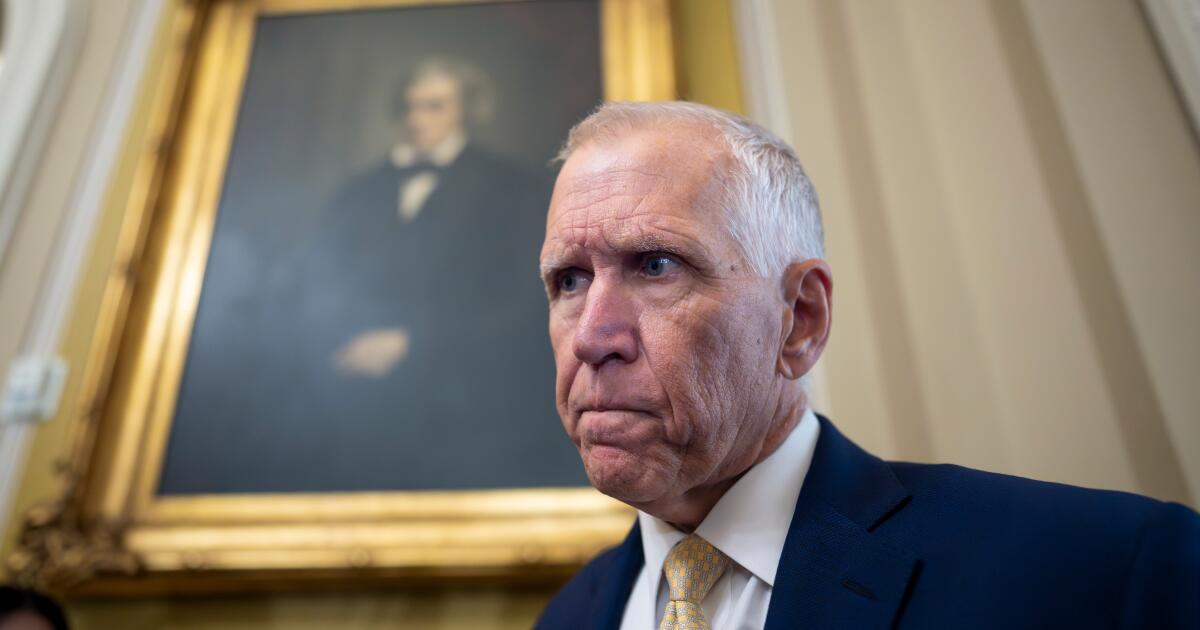
“The real question is: What ultimately are we trying to accomplish?” Sen. Thom Tillis (R-N.C.) told the Associated Press.

“I generally support anything that takes out the mullahs,” he said. “But at the end of the day, there has to be a kind of strategic articulation of the strategy, what our objectives are.”

Trump said late Friday that he was considering “winding down” the military operations even as he outlined new objectives and goals and despite the continued buildup of forces in the region.

Congress stands still

The president’s decision to launch the U.S.-Israeli war on Iran is testing the resolve of Congress, which is controlled by his party. Republicans have largely stood by the commander in chief, but will soon be faced with more consequential wartime choices.

Under the War Powers Act, the president can conduct military operations for 60 days without approval from Congress. So far, Republicans have easily voted down several resolutions from Democrats designed to halt the war.

But the administration will need to show a more comprehensive strategy ahead or risk blowback from Congress, lawmakers said, especially as they are being asked to approve billions in new spending.

Trump’s casual comment that the war will end “when I … feel it in my bones” has drawn alarm.

“When he feels it in his bones? That’s crazy,” said Virginia Sen. Mark R. Warner, the top Democrat on the Senate Intelligence Committee.

House speaker says mission is ‘all but done’

The president’s party appears unlikely to directly challenge him, even as the conflict drags on. House Speaker Mike Johnson (R-La.) has said the military operation will be over quickly.

“I do think the original mission is virtually accomplished now,” Johnson told the AP and others at the Capitol this week.

“We were trying to take out the ballistic missiles, and their means of production, and neuter the navy, and those objectives have been met,” he said.

Johnson acknowledged that Iran’s ability to threaten ships in the Strait of Hormuz is “dragging it out a little bit,” especially as U.S. allies have largely rebuffed the president’s request for help.

“As soon as we bring some calm to the situation, I think it’s all but done,” Johnson said.

But the administration’s stated goals — of ending Iran’s ability to obtain a nuclear weapon and degrading its ballistic missile supplies, among others — have perplexed lawmakers as shifting and elusive.

″Regime change? Not likely. Get rid of the enriched uranium? Not without boots on the ground,” Warner said.

“If I’m advising the president, I would have said: Before you take on a war of choice, make the case clear to the American people what our goals are,” he said.

The power of the purse

The Pentagon has told the White House that it is seeking an additional $200 billion for the war effort, an extraordinary amount that is unlikely to win support. Senate Democratic leader Chuck Schumer of New York called the amount “preposterous.”

The Defense Department’s approved appropriations from Congress this year are more than $800 billion, and Trump’s tax breaks bill gave the Pentagon an additional $150 billion over the next several years for various upgrades and projects.

Sen. Mazie Hirono (D-Hawaii) said the country has other priorities.

“How about not taking away funding for Medicaid, which will impact millions of people? How about making sure SNAP is funded?” she said, referring to the healthcare and food assistance programs that were cut as part of last year’s Republican tax reductions.

“These are things that we should be doing for the American people,” she said.

Many lawmakers have recalled the decision by President George W. Bush in the aftermath of the Sept. 11, 2001, attacks to come to Congress to seek an authorization for the use of military force — a vote to support his proposed military actions in Afghanistan and later Iraq.

Tillis said Trump has latitude under the War Powers Act to conduct the military campaign, but that will soon shift.

“When you get into the 45-day mark, you’ve got to start articulating one of two things — an authorization for the use of military force to sustain it beyond that or a very clear path on exit,” he said.

“Those are really the options the administration needs to be thinking about.”

Mascaro writes for the Associated Press.
Source link

Contributor: A Democratic takeover of the Senate is now imaginable

I’ve seen enough. It’s time to revise our expectations about the midterms.

For more than a year now, conventional wisdom has been that Democrats would take back the House — but not the Senate — in the November midterms.

That’s because this year’s Senate map would require Democrats to win numerous seats in red states.

In fact, if you had asked me a couple of months ago, I would have told you that, yes, Democrats have a shot at the Senate, but in the same way my teenage son has a shot at someday dating Sydney Sweeney. Which is to say, technically possible but cosmically unlikely.

But recent developments (such as President Trump’s plunging approval ratings on the economy) are encouraging me to revise my thinking.

I’m not alone. Independent journalist Chris Cillizza recently observed that for the first time ever, prediction markets like Polymarket and Kalshi showed Democrats with a narrow edge.

Now, prediction markets are not scientific. Neither, for that matter, is licking your finger and holding it up to the wind — but both have outperformed political polling at various times in the last couple of years.

The difference is that in prediction markets, people are wagering actual money, which tends to sharpen the mind in ways that answering a pollster’s call during dinner does not.

Of course, you probably haven’t heard much about this revised political outlook. That’s because nobody has any incentive to shout it from the rooftops.

Democrats don’t want to inflate expectations and risk turning a solid win into a perceived disappointment. Republicans, meanwhile, are not eager to advertise that their Senate majority is wobbling like a shopping cart with a bad wheel. And we pundits, chastened by having been burned, are reluctant to get too far out over our skis.

Even Cillizza still leans Republican on balance. But if I had to bet today — and I tend to define bet as “regret later” — I’d put my chips on the Democrats. Not because it’s a sure thing, but because almost every political and economic development seems to be trending in their direction.

History helps. The “out” party in the midterms usually does well. Current events help. Policies, including the war in Iran and rising gas prices, tend to sour voters on whoever’s in charge. And candidate quality helps. Voters do occasionally notice who’s actually on the ballot, and Democrats are serving up a semi-respectable offering.

Let’s pause to appreciate what’s at stake. Control of the Senate isn’t just about who gets the nicer office furniture. It determines judicial confirmations, including the possibility that Trump could fill a fourth Supreme Court vacancy (if one opens up in 2027 or 2028).

Now, it would be irresponsible of me to just drop this idea without delving into some logistical details.

For Democrats to flip the Senate, they need to net four seats. That means defending everything they already have while winning four more. The encouraging news (if you’re rooting for the Democrats) is that there are at least eight plausible opportunities for that to happen.

In North Carolina, incumbent Gov. Roy Cooper, a Democrat, is widely expected to win. In Maine, Republican Sen. Susan Collins once again finds herself in a political knife fight — her natural habitat, though perhaps not her preferred one. She will face Maine’s current governor or a flamboyant and controversial oysterman. I’m not sure who’d be the tougher opponent.

Out in Ohio, former Sen. Sherrod Brown benefits from the rare political skill of being a Democrat who still seems at home in Ohio.

The Democrat running in Alaska is a former member of Congress (and the first Alaska Native elected to Congress). And for the open seat in Iowa, Democrats seem likely to nominate a two-time Paralympic gold medalist who represents the reddest state house seat held by a Democrat.

Then there’s Texas, the perennial Democratic mirage — always shimmering on the horizon. But this year, it might come into clear view. James Talarico has emerged for Democrats, while Republicans are stuck choosing between scandal-plagued Atty. Gen. Ken Paxton and incumbent Sen. John Cornyn — a process that currently resembles a family feud conducted with vicious attack ads.

Meanwhile, in Nebraska and Montana, Democrats aren’t even pretending to compete. Instead, they’re relying on independents who — like Sens. Bernie Sanders and Angus King — would likely caucus with them.

In Nebraska, independent Dan Osborn already proved he can make it close: He lost in 2024 — a bad year to run against a Republican. And in Montana, the sudden announced retirement of Sen. Steve Daines has created an opening that didn’t exist five minutes ago (in political time).

Let’s not get carried away. The idea that Democrats could sweep all these races is still the kind of thing you say after your third drink. But winning half of them? That’s no longer fantasy. That’s … plausible. Maybe even more likely than not.

This isn’t a safe bet. It’s not even a comfortable one. But for the first time, it’s starting to look like smart money isn’t laughing at the idea anymore — it’s quietly sliding chips across the table.

Matt K. Lewis is the author of “Filthy Rich Politicians” and “Too Dumb to Fail.”

Source link

Rep. Swalwell, candidate for California governor, has an AI side gig

During the Los Angeles writers’ strike in 2023, Democratic Rep. Eric Swalwell wanted to reach out to his donors in Hollywood and ask what he could do to help them. But he didn’t have an easy way to find the screenwriters who backed his many campaigns.

So Swalwell and his congressional chief of staff launched an AI technology company that sifts and analyzes campaign fundraising data.

The company has since been used by dozens of political campaigns, including by Sen. Adam Schiff (D-Calif.) and Rep. Jimmy Gomez (D-Los Angeles). Even Swalwell’s current campaign for California governor hired the artificial intelligence company, called Findraiser.

But some details of Swalwell’s private venture remain unclear, including the company’s investors.

Craig Holman, a governmental ethics expert with the nonprofit consumer advocacy organization Public Citizen, said it’s common and legal for candidates to use their own businesses to promote their campaigns or the campaigns of others, as long as all business interactions are charged at market value.

He said Swalwell can talk about his business privately but cannot do so in relation to his role in Congress, to avoid running afoul of ethics rules barring using one’s position for personal monetary gain.

Holman called it “odd and politically unwise” that Swalwell’s business will not publicly disclose all of its investors.

Swalwell, who has represented Northern California in Congress since 2013, is among the top Democrats in the governor’s race, according to a recent poll, but thus far none of the candidates has a breakaway lead.

Findraiser is close to profitability, his onetime chief of staff, current campaign manager and Findraiser CEO Yardena Wolf said in a podcast interview that aired in October.

The company received more than $67,400 from congressional campaigns in the 2025-26 cycle, according to filings with the federal government.

Members of Congress are not barred from owning outside companies or accepting a small outside salary, with exceptions. Swalwell makes no income from the company, according to filings he has made with the state of California, though he could benefit if the company was ever sold.

“Findraiser is a platform like hundreds of other tools in the market that helps Democratic campaigns communicate more efficiently,” a Swalwell spokesperson said. “Congressman Swalwell and the Findraiser team consulted the House Committee on Ethics on the conception and implementation of the tool every step of the way.”

Still, it highlights how mixing public service and private business can raise ethics questions.

Wolf told The Times that none of Findraiser’s investors have business before Congress, but she declined to reveal the names of the backers.

The fair market value of Findraiser is between $100,001 and $1 million, according to campaign finance documents filed with the state this month.

Swalwell stated on the documents that he is a part owner. Besides the Congress member and Wolf, the other member of the company listed with the state is Paul Mandell, who runs an event business.

The company’s website boasts that it provides a “straightforward AI-powered chatbot that supercharges your fundraising database searches. This first-of-its-kind tool sits on top of your political fundraising database, allowing you to ask simple, intuitive questions and receive the results you need instantly.”

The website also contains testimonials, including from former Democratic National Committee Chair Jaime Harrison, who says Findraiser provides the AI technology that makes it “easier than ever for campaigns to connect with the right donors and raise what they need to win.”

The amount of money campaigns are paying to use Findraiser is nominal, federal campaign finance records show. During the 2025-26 cycle, Swalwell’s campaign for Congress reported paying Findraiser $6,630. His campaign for governor paid the company $975.

Wolf, in an interview with The Times, declined to provide details about the company’s staff or how much it charges customers.

In her interview with the political podcast “The Great Battlefield,” she recounted that the writers’ strike was the impetus for Findraiser and said Swalwell came up with the name.

She conceded that it is “pretty unusual” for a member of Congress to start a company with his chief of staff. She also said there was “a lot of ethics back and forth — of lawyers and all of that, to make sure that we were aboveboard and that everything is kosher.”

Among other things, Findraiser has helped Swalwell’s campaigns pull in more money, she said. For example, the campaign could identify donors who gave small amounts to Swalwell but larger checks to other politicians, Wolf said.

“We’ve been able to set up meetings with people like that, and they’ve increased their contributions.”

Aside from Wolf, one other staff member who works for both Swalwell’s campaign and his government office is also being paid via a contract to do digital work for Findraiser, Wolf confirmed.

Michael Beckel, director of money in politics reform at Issue One, a bipartisan advocacy group, said that although there is no prohibition on a member of Congress hiring his own company, voters may perceive an issue.

“Voters may see self-dealing as evidence that a candidate is prioritizing personal enrichment over public service, which damages confidence in elections and governmental institutions,” he said.

“If donors give money knowing it will personally benefit the candidate, that undermines the integrity of the political system.”

Swalwell’s campaign declined to respond to Beckel’s statements.

Wolf in her podcast interview last year said the business was “going really well.”

“We have PACs that use it. We have first-time candidates, as well as 20-year incumbents who are using it. We have congressional races and Senate races,” Wolf said.

Around 2024, the company began offering beta testing, she said.

“Obviously, both Eric’s and my network are people who are in the political space and just in our day to day, as we were talking to people, we had people say, ‘Well, I want to use it,’” Wolf said. “And so we had a group of people who ended up beta testing.”

A spokesperson for Swalwell’s campaign said that “Findraiser spread through word of mouth among campaigns across the country. Any decision by a campaign or candidate to utilize the tool is based on their choice and their organization’s strategic prioritization.”

The Times contacted 16 congressional campaigns that reported using Findraiser in recent federal filings. None would tell The Times how they came to hire the company.

Both Schiff and Gomez have endorsed Swalwell in his campaign for governor.

Schiff’s paid about $2,000 for two months of Findraiser services last year. However, Wolf, in her podcast interview, said Findraiser works with Schiff “a lot.”

Ian Mariani, a spokesperson for Schiff’s campaign, said the company “is one of many campaign vendors used by our team, and it helped us engage with several people.”

Source link

Atty. Gen. Pam Bondi subpoenaed to answer questions from Congress about the Epstein files

Atty. Gen. Pam Bondi was subpoenaed Tuesday to answer questions from Congress about the Justice Department’s sex trafficking investigation of Jeffrey Epstein and the agency’s handling of millions of files related to the disgraced financier.

Bondi was ordered to appear for a deposition on April 14 by the Committee on Oversight and Government Reform after a vote earlier this month that five Republicans supported.

The Justice Department’s failure to fend off the subpoena from the Republican-led committee underscores widespread discontent among President Trump’s own base over Bondi’s management of the review and release of a trove of documents from the criminal investigation into Epstein.

“The Committee has questions regarding the Department of Justice’s handling of the investigation into Jeffrey Epstein and his associates and its compliance with the Epstein Files Transparency Act,” Rep. James Comer, the Republican chairman, said in a letter to Bondi.

“As Attorney General, you are directly responsible for overseeing the Department’s collection, review, and determinations regarding the release of files pursuant to the Epstein Files Transparency Act, and the Committee therefore believes that you possess valuable insight into these efforts,” he wrote.

The department on Tuesday called the subpoena “completely unnecessary.” Bondi and Deputy Atty. Gen. Todd Blanche were expected to provide a private briefing Wednesday to members of the committee.

“Lawmakers have been invited to view the unredacted files for themselves at the Department of Justice, and the Attorney General has always made herself available to speak directly with members of Congress,” the department said in a statement. The agency said it looks forward to “continuing to provide policymakers with the facts.”

The Trump administration has faced constant political headaches since the rollout of the files began in December, with critics accusing the department of hiding certain documents and over-redacting files. In other cases, victims have slammed the department for sloppy redactions that revealed their sensitive information.

The Justice Department has fiercely defended its handling of the Epstein files, saying it worked as quickly and diligently as possible to review and release millions of documents required under the law. The department has denied any accusations that it used redactions to protect certain people or improperly withheld certain materials. And it has said it immediately worked to fix any redaction errors raised by victims.

Richer writes for the Associated Press.

Source link

10 aviation CEO’s ask Congress to fund TSA, avert air travel chaos

March 15 (UPI) — A group of aviation CEOs sent a letter to Congress asking it to end the partial government shutdown and pay TSA, customs and air traffic controllers, as they said the overwhelming number of Americans wants them to.

Airlines for America, a trade association for passenger and cargo airlines, sent an open letter to Congress asking it to fund the Department of Homeland Security so that government employees at airports responsible for the safety of air travel receive their salaries.

This is the second time in six months that the federal government has at least been partially shutdown and follows a 43-day shutdown of nearly all of the government that was the longest in U.S. history.

The letter includes a plea to end the shutdown, on behalf of travel and shipping services that are essential to the nation, and to pass laws that guarantee air traffic controllers, customs agents and TSA agents all continue to be paid in the event of future shutdowns.

“Americans — who live in your districts and home states — are tired of long lines at airports, travel delays and flight cancellations caused by shutdown after shutdown,” the CEOs wrote in the letter. “Yet, once again, air travel is the political football amid another government shutdown.”

The CEO’s who sign the letter include those from Alaska Air, American Airlines, Atlas Air, Delta Air Lines, FedEx, JetBlue Airways, Southwest Airlines, United Airlines, UPS and Airlines for America.

The CEO’s predict that with spring break, the World Cup, America’s 250th birthday and anything else that an expected 171 million passengers will travel for in the coming months, the chaos similar during the shutdown last fall is likely to happen again.

“TSA agents just received $0 paychecks,” they wrote in the letter. “That is simply unacceptable. It’s difficult, if not impossible, to put food on the table, put gas in the car and pay rent when you are not getting paid.”

Last year’s shutdown was ended when Congress agreed to fund the government through Jan. 30, with plans to pass appropriations bills to then fund the government through the rest of the year.

Amid the Trump administration’s immigration crackdown, after the deaths of two U.S. citizens in three weeks at the hands of U.S. Customs and Border Control agents, Democrats and some Republicans in Congress held back an appropriations bill for the Department of Homeland Security.

While the agencies handling the administration controversial crackdown are under DHS, the department also is responsible for the Transportation Security Administration, which handles air travel.

Democrats have refused to vote for the funding until guardrails are put in place with the funding for the department’s immigration enforcement efforts, including limits and certain tactics and requiring officials in the field to wear body cameras.

TSA employees missed their first paycheck of the current shutdown this weekend, after Republicans refused a proposal to fund TSA, the Coast Guard, the Federal Emergency Management Agency and the Cybersecurity and Infrastructure Agency, while continuing to hold back funding for those for immigration-related agencies for further debate.

In addition asking the government to fund TSA, the CEOs asked Congress to pass the Aviation Funding Solvency Act, the Aviation Funding Stability Act and the Keep America Flying Act would guarantee that federal aviation workers get paid in the face of future government shutdowns.

President Donald Trump speaks during an event celebrating Women’s History Month in the East Room of the White House on Thursday. Photo by Bonnie Cash/UPI | License Photo

Source link

How Congress became an afterthought in the war with Iran

Secretary of State Marco Rubio had some explaining to do when he arrived on Capitol Hill for a classified briefing with lawmakers in early March.

Members of Congress wanted to know why, two days earlier on Feb. 28, the United States and Israel had attacked Iran and killed its supreme leader — without notifying them first. After the briefing, Rubio told reporters the U.S. preemptively struck Iran to get ahead of an Israeli attack. A day later, he tried to clarify his remarks.

“The bottom line is this: The president determined we were not going to get hit first,” Rubio said. “It’s that simple, guys.”

For members of Congress, the moment underscored how marginal a role Congress has been able to play in a war that, two weeks in, has spread into more than a dozen neighboring countries, led to the deaths of at least 13 American service members and cost billions of dollars.

In the two weeks since the war began, Congress has largely been sidelined. Lawmakers have cycled through classified briefings, TV interviews and hallway scrums with reporters, but have taken little formal action related to Trump’s war efforts — just two unsuccessful votes aimed at limiting the conflict.

Most of the debate has taken place online, where some GOP lawmakers have drawn rebukes from colleagues for saying America “needs more Islamophobia” and other Islamophobic rhetoric about Iran and its people.

At the same time, Trump has pressed Congress to focus instead on a controversial voting law, signaling to the Republican-led Congress that he wants their focus on the election rather than a historic moment abroad. The president, meanwhile, has offered shifting explanations on how much longer he intends to be at war in the Middle East, telling Fox News’ Brian Kilmeade on Friday that he will conclude the hostilities when “I feel it in my bones.”

Taking Trump’s statements at face value, Democrats and some Republicans have begun to worry that more American troops could be deployed inside Iran to complete the mission — and lawmakers are still trying to understand the war’s threat to the global energy markets as fighting encroaches on the Strait of Hormuz and Americans face soaring gas prices.

The Republican majorities have for the most part rallied behind President Trump, and have blocked measures in both the House and Senate that would have halted the war against Iran and forced him to seek congressional approval for additional hostilities.

House Speaker Mike Johnson (R-La.) likened efforts to rein in Trump’s war efforts to siding “with the enemy.” Sen. Lindsey Graham (R-S.C.) was even more effusive, arguing there is a precedent for presidents using military force without congressional authority.

“The norm in this country is not to declare war by Congress, but for the military to be used by the commander in chief. Sometimes authorization from the Congress is requested, sometimes it is not,” Graham said during a Senate floor speech. “More than not, it is not requested.”

Presidents have frequently used military force without a formal declaration of war — including in Korea, Vietnam and Iraq — but experts argue there is a difference between bypassing a formal declaration and sidelining Congress altogether.

Former Defense Secretary Leon Panetta, who served under President Obama, pointed to the 2011 raid that killed Osama Bin Laden, the mastermind behind the Sept. 11, 2001, attacks, as an example of how the process once worked.

Even though it was a covert Special Forces operation, Panetta said, he personally briefed key congressional leaders before Bin Laden’s killing took place.

That kind of consultation, he said, no longer happens. Instead, lawmakers learn about military operations the same way ordinary Americans do — by watching the news — and then demand to be briefed, he said.

“By that time, the country is pretty much committed to war,” Panetta said.

Presidents of both parties have expanded their power to wage war unilaterally, but Panetta said he believes Trump has crossed a new threshold by dispensing not just with congressional approval but with the courtesy of a briefing.

“It’s not good for our democracy. It’s not a good process,” he said. “It’s not what our forefathers would have wanted.”

Rubio, however, has argued the administration has kept congressional leaders apprised. He told reporters there is no legal requirement to notify all members of Congress and that he briefed the Gang of Eight — a group made up of the top Republicans and Democrats in the House and Senate, as well as the leaders of the respective intelligence committees — within 48 hours of the attack against Iran.

“We notified congressional leadership,” Rubio said. “The law says we have to notify them 48 hours after beginning hostilities. We’ve done that.”

In the statement issued Friday, the White House defended the president’s approach to the war in relation to how its involved Congress, adding that Trump and administration officials “continue to keep bipartisan lawmakers in Congress apprised of the operation as the United States continues to dominate.”

“Past presidents have talked about this for 47 years — but only President Trump has had the courage to do something about it,” White House spokesperson Olivia Wales said.

Democrats say they’re ‘flying blind’

Democratic lawmakers, including some who have been included in classified briefings, have accused administration officials of keeping them “in the dark” and are beginning to demand public congressional hearings.

“I want this administration to testify in public, under oath, regarding a bunch of questions we have in order for the American people to see for themselves,” said Rep. Jimmy Gomez (D-Los Angeles). “I do believe this administration has lied to the American public and Congress.”

Gomez, a member of the House Permanent Select Committee on Intelligence, said he never expected that he would have to spend so much time trying to discern if the administration is lying to lawmakers.

“I think it’s that’s what makes the job harder,” he said.

Democrats, who are in the minority, have limited power to call those briefings, but have continued to put pressure on the administration in a public way.

Senate Democrats last week sent a letter to Defense Secretary Pete Hegseth, demanding answers by Wednesday about reports that a U.S. airstrike hit an Iranian elementary school.

Iranian officials said the explosion killed at least 175 people, most of them children. The U.S. has not taken responsibility for the attack, and Hegseth has said the matter is under investigation. Trump, without providing evidence, has claimed Iran was responsible for the attack.

Seeking answers has been a common theme among Democrats since the start of the war. Sen. Richard Blumenthal (D-Conn.), for instance, said after a classified briefing last week that he had “left with more questions than answers” and a real concern about the possibility of deploying American troops to Iran.

Power of the purse

If the war continues, Congress still retains some leverage.

Under the War Powers Resolution passed by Congress in 1973, unauthorized deployments into hostile situations must end after 60 days unless Congress votes to declare war or passes legislation authorizing the use of the military.

Rep. Brad Sherman (D-Sherman Oaks), who sits on the House Foreign Affairs Committee, said he has told Hegseth and Rubio that if they violate that provision it will be like “stealing money” for actions that are not approved by Congress and warned they could be held civilly liable.

The 60-day deadline will be a key moment for Congress to step in, Sherman said; otherwise there will be growing concern about Trump having “unchecked power.”

So far, he thinks Republicans in control view their job as “butler to the president,” and that the Constitution already gives Trump “too much power over the military.”

“If Congress is controlled by people who want to be servants to the president, it’s going to do an incredibly bad job of being a check on the president,” he said.

Beyond the War Powers Resolution, lawmakers also have power over the appropriations process and could deny the administration’s request to boost military funding.

“The Congress can stop military action by cutting off funding. If you don’t like the war in Iran, say we won’t pay for it. We have the constitutional power of the purse,” Graham said in a Senate floor speech early in March.

The Trump administration’s war with Iran cost $11.3 billion during its first six days, according to the Associated Press.

But Rep. Mike Levin (D-San Diego), who sits on the House Appropriations Committee, says he is aware of the figure only because of news reports — not because the Pentagon has been transparent.

“We are flying blind in the sense that we just don’t know. We don’t know how much is being spent or what it’s being spent on,” Levin said.

Levin says the military will probably need to bolster its munitions stockpile at the rate the conflict is going.

If the Pentagon does request more money, Levin said, he would try to ensure that “not one more dollar goes toward any of this without clear answers and a clear plan.”

Source link

Contributor: Federal power grabs on elections are not about fraud

Fans of the musical “Hamilton” know three things about the nation’s first Treasury secretary because of Lin-Manuel Miranda’s brilliance. First, that Alexander Hamilton cheated on his wife, Eliza. Second, he was killed by the vice president, Aaron Burr. Third, and most importantly, he was considered a highly principled man. And when it came to the topic of nationalizing elections, do you know how this Revolutionary War vet and founding father characterized doing so?

A threat.

Referring to corruptible public officials, Hamilton wrote in the Federalist Papers: No 59: “With so effectual a weapon in their hands as the exclusive power of regulating elections for the national government, a combination of a few such men, in a few of the most considerable States, where the temptation will always be the strongest, might accomplish the destruction of the Union, by seizing the opportunity of some casual dissatisfaction among the people to discontinue the choice.”

Hamilton’s prescient views became the framework for the Election Clause in the Constitution. And since returning to the White House, President Trump has been searching for ways to usurp it. Last month he made calls to nationalize elections. This month he’s at it again.

He’s also pushing Congress to pass his so-called SAVE Act, which would require voters to show proof of citizenship when they register to vote. It sounds innocuous until you realize a driver’s license isn’t good enough; a passport would often be required. But half the country doesn’t have a passport, and it costs roughly $200 and a few weeks to get one. The logistical burden is unreasonable and cruel: Consider that this year, during primary season, we’ve already witnessed natural disaster — such as the tornadoes that recently ripped through the Midwest or the fires in Texas — upend entire communities. Many people would not have been able to vote, simply because they had been separated from their papers during the disaster.

The financial obstacles that would be created by the SAVE Act are at least as onerous: Why would Congress choose to financially burden voters — with what is essentially an unlawful poll tax — at a time when the unemployment rate and gas prices are up and the approval rating for nearly everyone in office is down? There are a couple of reasons. One is that the party controlling Congress hopes to suppress voting in order to defy the will of the American majority and cling to power.

Another reason lawmakers support this terrible bill is simply that Trump wants it. Some Republicans in office are so afraid of angering a vengeful president that they would rather entertain his authoritarian tendencies than go through the fire of his opposition during a primary.

For politicians such as Sen. John Cornyn (R-Texas), who this week changed his long-held position on the filibuster in order to push the SAVE Act, it’s simply about political survival. He needs the president’s endorsement heading into the runoff for his Senate seat.

Trump has called the election overhaul bill his top priority — not the war he started with Iran, not returning the billions collected from illegal tariffs, not justice for Jeffrey Epstein’s victims. Before there was a Constitution, there was a warning, written by Hamilton and other founders, whose concerns about nationalized elections are well documented and have proved to be well founded.

You would think a nation in the midst of beating its proverbial chest about our 250th birthday would take more heed from the country’s founders. But nope: This week Florida state lawmakers, in an attempt to appease their state’s most powerful resident, passed an election overhaul law that mirrors the federal SAVE Act. More red states are likely to follow, not because a national wave of voter fraud has been unearthed by authorities, but because the authorities want to stay in the good graces of someone who has yet to prove any widespread fraud other than his own.

The party that famously railed against “the bridge to nowhere” is now offering bills that solve nonexistent problems. Or in some cases, creating problems, particularly for women who changed their names after marriage so their state IDs don’t match their birth certificates.

Cornyn is not alone in exchanging his principles for Trump’s favor; he’s just the most recent. However, the manner in which he announced his flip flop was particularly tone deaf.

“If a man takes a swing at you and barely misses, that doesn’t make him a pacifist — it just means he has bad aim,” Cornyn wrote in an op-ed about the bill for the New York Post, the newspaper founded by Hamilton in 1801. “Standing still and giving him a second free swing wouldn’t be wise or honorable: it would be foolish.”

In 2016, then-candidate Trump took his first big swing at our elections when he implied — without evidence — that his opponent, Sen. Ted Cruz, had rigged the election after losing to him in the Iowa Republican caucus. Reportedly Trump even tried to get the state’s party chair to overturn the result. He’s been throwing jabs at our elections ever since. The Jan. 6 riot was a haymaker that barely missed. Given the president’s propensity to hand out Trump 2028 hats, it seems passing the SAVE Act would be, in Cornyn’s words, setting voters up to stand there while Trump takes another swing at our democracy.

YouTube: @LZGrandersonShow

Insights

L.A. Times Insights delivers AI-generated analysis on Voices content to offer all points of view. Insights does not appear on any news articles.

Viewpoint
This article generally aligns with a Center Left point of view. Learn more about this AI-generated analysis
Perspectives

The following AI-generated content is powered by Perplexity. The Los Angeles Times editorial staff does not create or edit the content.

Ideas expressed in the piece

  • Alexander Hamilton, writing in Federalist No. 59, warned that exclusive state power over federal elections posed an existential threat to the Union, cautioning that “a combination of a few such men, in a few of the most considerable States” could “accomplish the destruction of the Union” through control of election regulations[1]

  • The SAVE Act requiring proof of citizenship to vote imposes unreasonable logistical and financial burdens on voters, effectively functioning as a poll tax by requiring passports costing approximately $200 that roughly half the country does not possess[1]

  • Natural disasters and unforeseen circumstances already disrupt voting access, and citizenship verification requirements would further prevent Americans from voting by separating them from necessary documentation during emergencies such as tornadoes or fires[1]

  • The stated rationale for election overhaul legislation—addressing voter fraud—is not supported by evidence, as authorities have failed to unearth a national wave of voter fraud despite repeated claims[1]

  • Republicans supporting the SAVE Act are motivated by partisan interests rather than election security concerns, with some lawmakers abandoning long-held principles to secure Trump’s political endorsement during primary races[1]

  • Election nationalization efforts represent an authoritarian threat to democracy that the nation’s founders specifically warned against, making it imperative to heed historical lessons about centralized electoral control[1]

Different views on the topic

  • Hamilton argued in the Federalist Papers that the national government required ultimate authority over election regulations to prevent state legislatures from abandoning their responsibility to choose federal representatives, which could render “the existence of the Union entirely at their mercy”[4]

  • The Constitution’s design allocates election regulation authority primarily to states with a federal backstop, recognizing that the national government must possess a check on state power to maintain union stability and prevent states from exploiting their regulatory control[3][4]

  • Federalist No. 60 establishes that the system of separated powers—with the House elected directly by people, the Senate by state legislatures, and the president by electors—creates structural safeguards preventing any single faction from monopolizing electoral control[2]

  • Voter identification requirements serve legitimate election integrity purposes, with proponents arguing that citizenship verification represents a reasonable measure to ensure eligible voter participation[1]

Source link

Senate passes bipartisan housing bill to improve access and affordability

The Senate passed a broad bill on Thursday to make U.S. housing more accessible and affordable, a rare bipartisan effort in Congress to address a growing national problem.

The bill, which passed 89 to 10, would reduce regulations, regulate corporate investors and expand how housing dollars can be used to build affordable homes and rentals. It will now head back to the House, which passed a similar bill earlier this year.

“We have a housing shortage all across America,” said Sen. Elizabeth Warren (D-Mass.), who worked with Republicans to win overwhelming support from both parties for the legislation. “We need more housing of every kind. More housing for first-time home buyers, more housing for renters, more housing for seniors, more housing for people with disabilities, more rural housing, more urban housing, more, more, and more.”

The legislation, she said “will help drive down prices.”

Senate Banking Committee Chairman Tim Scott (R-S.C.), led the effort with Warren. He said ahead of the vote that the Senate could “do what so many people failed to do in this legislative body for the last few decades, and that is pass consequential legislation that makes it easier to become a homeowner.”

Roadblocks ahead for the legislation

Despite the overwhelming bipartisan vote in the Senate, It’s unclear whether the House will pass the legislation again — or if President Trump will sign it.

Trump has strongly backed the bill through the bipartisan negotiations, but he has also slowed its momentum with a declaration last weekend that he won’t sign any new measures unless Congress passes legislation that would require voters to show proof of citizenship and end most mail-in balloting. The Senate is expected to begin consideration of that bill next week, but it is unlikely to pass as all Democrats oppose it.

At the same time, House leaders have indicated that they are unlikely to accept the Senate version of the housing legislation and have suggested they could launch a formal conference process to negotiate a final deal between the chambers — a process that could take months.

Senate Majority Leader John Thune (R-S.D.) said ahead of the bill’s passage on Thursday that conference negotiations are a possibility, “but obviously the quickest way to do this would be to pick up the Senate bill and pass it.”

If the White House wants that to happen, he said, “they’ll probably have to make that argument to House leadership.”

Making housing more attainable

The bill would give local governments more power on housing issues, allow banks to invest more in affordable housing and lift limits on the number of units in a public housing development that can receive private financing through Section 8 funding that helps rehabilitate properties.

“You’ve got many provisions in this bill that stop treating the U.S. like one single housing market and start giving local leaders the tools they need to fix their unique regional puzzle,” said Peter Carroll with Cotality, a company that tracks housing data.

The bill aims to make homebuilding easier by streamlining some regulations that require environmental reviews and inspections. It also eliminates a limit on a grant for emergency shelter beds and street homelessness outreach.

As many affordable housing developers are leaning on manufactured and modular homes that can be transported to areas that need housing, the legislation also lifts the requirement that they have to be built on a permanent chassis, making them easier to build and design.

Housing advocacy and policy groups say they wish the bill went further by investing money in building more housing and assisting renters.

“This legislation is the product of essentially senators and House members wanting to come up with something that could pass with both Democratic and Republican votes, which means it’s inherently less ambitious,” said Yonah Freemark, a researcher at Urban Institute.

Corporate investors

One of the more contested provisions of the bill would bar institutional investors from buying single-family homes — a top priority for Trump.

The bill defines such investors as any that directly or indirectly own 350 or more single-family homes. Investors of any size would not be required to sell single-family homes bought before the date that the bill becomes a law.

They would still be allowed to buy or build single-family homes if they rent them out, but would be required to sell them to an individual homebuyer after seven years and offer that buyer “price concessions” and give tenants a 30-day “first-look” period when the time comes to sell the home.

A need for reform

The U.S. housing market has been in a slump dating back to 2022, when mortgage rates began to climb from pandemic-era lows.

Sales of previously occupied U.S. homes have been hovering close to a 4-million annual pace now going back to 2023 — well short of the 5.2-million annual pace that’s historically been the norm. They slowed last year to a 30-year low and have remained sluggish so far this year, declining in January and February versus a year earlier.

A sharp run-up in home prices, especially in the early years of this decade, and a chronic shortage of homes nationally worsened by years of below-average home construction have left many aspiring homeowners priced out of the market.

Meanwhile, while the median U.S. monthly rent has been declining for more than two years, it was still 15.2% higher in January than it was at the start of 2020, according to data from Realtor.com.

The trends have ratcheted pressure on lawmakers this year, with midterm elections looming in November, to show they’re working on ways to make homeownership and rental housing costs more affordable.

Kramon, Veiga and Jalonick write for the Associated Press. Kramon reported from Atlanta and Veiga reported from Los Angeles.

Source link

Long-serving Democrat Jim Clyburn of South Carolina will run for an 18th term in Congress

U.S. Rep. Jim Clyburn, the dean of South Carolina’s Democrats, said Thursday that he will run for an 18th House term, a move that could position him as an influential elder statesman in Congress if his party regains the majority in November.

The decision by the 85-year-old lawmaker cuts against calls for generational change within the party. Clyburn is one of several veteran Democrats running again instead of stepping aside for younger politicians whose frustration increased in the wake of President Biden’s failed reelection campaign.

“I’m here today to say I do believe that I’m very well equipped and healthy enough to move into the next term, trying to do the things that are necessary to continue that pursuit of perfection,” Clyburn said at state party headquarters in Columbia. “And so I will run a very vigorous campaign.”

Clyburn is among the oldest Democrats serving in Washington, and the only member of the last Democratic leadership team who is looking to stick around. Former Speaker Nancy Pelosi of California and former Majority Leader Steny Hoyer of Maryland both plan to retire at the end of their current terms.

Clyburn said that he sought counsel from his three daughters before making his announcement. One of them — Mignon Clyburn, a former member of the Federal Communications Commission — said she was concerned about the political vitriol that her father would face in Washington.

“Her interest was in her daddy and what she thought I might be subjected to,” Clyburn said. “When Mignon finally had decided that she could live with it, I’m here.”

Clyburn said he heard from another woman that “‘we don’t listen to them people up there, and you should not. You should listen to the people down here, and we don’t want you to leave.’ And so I’m responding to the people that are here.”

Clyburn served as majority whip and assistant Democratic leader. Remaining in Congress for another term could give him a chance to serve alongside the first Black speaker of the House as Rep. Hakeem Jeffries of New York is in line for the gavel should Democrats win control. Clyburn for many years was the highest-ranking Black lawmaker in the House.

On Thursday, asked about the prospect of being able to advise Jeffries, Clyburn said the two spoke recently about a possible working relationship in the next Congress.

“He expressed an interest in my being a part of his leadership, if we were to take the House back,” Clyburn said. “It made me feel necessary.”

Four years ago, when Clyburn announced his bid for a 16th term, he told the Associated Press that he intended to keep campaigning as long as his health and support from his family remained stalwart.

“I’ve told them, if you ever see that I need to go to the rocking chair or spend my spare time on the golf course, let me know,” he said describing his daughters’ counsel.

Clyburn won his 2024 reelection by more than 20 percentage points. First elected in 1992, he represents the district that sweeps from areas around the capital of Columbia through rural central and eastern counties down to Charleston.

Should he serve an 18th term, Clyburn would become the longest-serving South Carolinian ever in the U.S. House. Time horizons are longer for the state’s U.S. senators, two of whom — Republican Strom Thurmond and Democrat Fritz Hollings — served 48 years and nearly 39 years, respectively.

Filing for election in this year’s elections in South Carolina opens Monday and closes March 30. South Carolina’s primary elections will be held June 9.

Whenever Clyburn does leave office, the competition to be his successor will be fierce. He is the only Democrat representing his state in Washington.

As to whether his 18th term could be his last, Clyburn called that an “open question.”

“I’m looking forward to the day that I can spend more time reading, writing and playing golf, and so this could very well be to my last term,” he said. “And it could very well not be.”

Kinnard writes for the Associated Press.

Source link