For more than a year, a Texas oil firm has clashed with California officials over controversial plans to restart offshore oil operations along the Santa Barbara County coast.
Now, California’s feud with Sable Offshore Corp. has spread to the Trump administration.
On Friday, California Atty. Gen. Rob Bonta announced that he had filed suit against the federal government, alleging that the Pipeline and Hazardous Materials Safety Administration had usurped jurisdiction of Sable’s oil pipelines in an “unlawful power grab.”
“California has seen first-hand the devastating environmental and public health impacts of coastal oil spills — yet the Trump Administration will stop at nothing to evade state regulation which protects against these very disasters,” Bonta said in a statement Friday. “California will not stand idly by as the President endangers California’s beautiful coastline and our public health to increase profits for his fossil fuel industry friends.”
Signs warn of an oil pipeline owned by Sable Offshore Corp.
(Al Seib/For The Times)
The attorney general’s petition, filed in the U.S. 9th Circuit Court of Appeals, challenges PHMSA’s attempt to federalize oversight of the onshore pipelines and its recent approval of Sable’s restart plan. Along with the Office of the State Fire Marshal, the agency that had been working to review Sable’s restart plan, the attorney general argues that PHMSA’s decisions violate the Administrative Procedure Act and asked the court to overturn them.
The federal pipeline agency falls under the U.S. Department of Transportation. Officials with the agency did not immediately respond to a request for comment on the new case.
Regulatory oversight of the pipelines has become a major sticking point in the Houston-based company’s plan to revive three drilling rigs in federal waters off Santa Barbara County’s coast.
The pipelines are part of a network that connects the offshore platforms to to an onshore processing plant near Goleta and then further inland. The two lines in question are located entirely onshore. One of them burst in 2015 near Refugio State Beach, causing one of the biggest oil spills in the state’s history.
The former owner shuttered operation after that spill, but Sable announced in 2024 that it planned to restart oil production — a move that has sparked fear and concern among locals, environmental activists and state and local regulators.
But in December, PHMSA officials reclassified the pipelines as “interstate” pipelines, citing their link to offshore rigs along the Outer Continental Shelf in federal waters.
Soon after that, the federal agency approved the pipelines for a restart, shocking many who had been working for more than a year to ensure Sable’s compliance with state and local laws.
Bonta on Friday called both those findings incorrect and illegal, saying the federal agency had “no right to usurp California regulatory authority … of potentially hazardous pipelines.”
Sable has repeatedly clashed with state and local officials.
Last year, the California Coastal Commission found that Sable had failed to adhere to the state’s Coastal Act despite repeated warnings and fined the company $18 million. In September, the Santa Barbara County district attorney’s office filed criminal charges against the company, accusing it of knowingly violating state environmental laws while working on repairs to oil pipelines that have sat idle since a major spill in 2015.
The company also remains entangled in severalongoinglawsuits, including one brought by the Central Coast Water Board — represented by Bonta’s office — that alleges the company repeatedly failed to follow state laws and regulations intended to protect water resources, repeatedly putting “profits over environmental protections.”
Sable Offshore Corp.’s Las Flores Canyon Plant operates in Goleta.
(Al Seib/For The Times)
The company denies that it has broken any laws and insists that it has followed all necessary regulations.
Bonta’s new lawsuit doesn’t directly address Sable’s restart plans, but focuses on Trump administration actions over the last few weeks, including its “attempt to evade state regulation.” Bonta argues the administration has put the state’s environment and residents at risk.
Bonta also argues that the change in oversight directly contradicts a consent decree reached after the 2015 oil spill, which determined the state fire marshal would review and approve any possible restart of the onshore pipelines.
“PHMSA’s current position represents a significant departure from this agreement and the way in which PHMSA historically viewed the pipelines,” Bonta’s office said in a statement.
A federal judge ruled Friday that President Trump’s administration must keep federal funds flowing to childcare subsidies and other social service programs in five Democratic-controlled states — at least for now.
The ruling Friday from U.S. District Judge Vernon Broderick extends by two weeks a temporary one issued earlier this month that blocked the federal government from holding back the money from California, Colorado, Illinois, Minnesota and New York. The initial temporary restraining order was to expire Friday.
Broderick said Friday that he would decide later whether the money is to remain in place while a challenge to cutting it off works its way through the courts.
The U.S. Department of Health and Human Services sent the five states notices in early January informing them it would require justifications for spending the money aimed at helping low-income families. It also said it would require more documentation, including the names and Social Security numbers of the beneficiaries of some of the programs.
The programs are intended to help low-income families
The programs affected by the restrictions at the heart of this case are the Child Care and Development Fund, which subsidizes childcare for 1.3 million children from low-income families nationwide; the Temporary Assistance for Needy Families program, which provides cash assistance and job training; and the Social Services Block Grant, a smaller fund that provides money for a variety of programs.
The states say that they receive a total of more than $10 billion a year from those programs — and that the programs are essential for low-income and vulnerable families, including paying about half the cost of shelters for homeless families in New York City.
For TANF and the Social Service Block Grant, the request required the states to submit the data, including personal information of recipients beginning in 2022, with a deadline of Jan. 20.
Government lawyers said Friday that the department was working on more guidelines about what exactly was required before the initial restraining order was put in place.
The administration says it took action because of concerns about fraud
The U.S. Department of Health and Human Services said earlier this month that it was pausing the funding because it had “reason to believe” the states were granting benefits to people in the country illegally. At the time, it didn’t explain why.
But in Friday’s hearing, Mallika Balachandran, a federal government lawyer, said that the concerns were raised by media reports, though she told the judge she did not know which ones. Federal officials have previously cited a video by a right-wing influencer who claimed fraud by Minneapolis day care centers operated by people with Somali backgrounds.
Broderick asked whether the government picked the five states first and then did research into whether there were fraud claims there. Balachandran said she didn’t know that either.
Broderick said he didn’t understand why the government made it harder for the states to access money for the programs before any wrongdoing had been found.
“It just seems like the cart before the horse,” he said.
The states, which all have Democratic governors, say the move was instead intended to damage Trump’s political adversaries.
Around the same time as the actions aimed at the five states, the administration put up hurdles to Minnesota for even more federal dollars. It also began requesting all states to explain how they’re using money in the childcare program.
States call the action ‘unlawful many times over’
In court papers last week, the states say what they describe as a funding freeze does not follow the law.
They say Congress created laws about how the administration can identify noncompliance or fraud by recipients of the money — and that the federal government hasn’t used that process.
They also say it’s improper to freeze funding broadly because of potential fraud and that producing the data the government called for is an “impossible demand on an impossible timeline.”
Jessica Ranucci, a lawyer in New York’s attorney general’s office arguing on behalf of the five states, told the judge that she was told only about a half-hour before the hearing that the government had been developing more information about what states needed to provide. That wasn’t mentioned in the court filings, she said.
The administration says it’s not a freeze
In a court filing this week, the administration objected to the states describing the action as a “funding freeze,” even though the headline on the Department of Health and Human Services announcement was: “HHS Freezes Child Care and Family Assistance Grants in Five States for Fraud Concerns.”
Federal government lawyers said the states could get the money going forward if they provide the requested information and the federal government finds them to be in compliance with anti-fraud measures.
The administration also notes that it has continued to provide funding to the states.
The lawyer for the states said that most of the funding, though, was not accessible until after the restraining order was entered.
This isn’t the only case where the federal government has threatened to cut off funding recently. Trump has said this month that “sanctuary cities” that resist his administration’s immigration policies — and their states — could lose federal funds.
This week, his budget office told other federal departments and agencies to collect information about money several states receive — but said it wasn’t to withhold money.
The Trump administration on Thursday said it has completed the United States’ withdrawal from the World Health Organization, which is led by Director General Tedros Adhanom Ghebreyesus. File Photo by Fabrice Coffrini/EPA-EFE
Jan. 23 (UPI) — The United States has completed its exit from the World Health Organization, the Trump administration said, one year since it began the withdrawal process.
“Like many international organizations, the WHO abandoned its core mission and acted repeatedly against the interests of the United States,” Secretary of State Marco Rubio and Secretary of Health and Human Services Robert F. Kennedy Jr. said in a joint statement on Thursday.
“Although the United States was a founding member and the WHO’s largest financial contributor, the organization pursued a politicized, bureaucratic agenda driven by nations hostile to American interests.”
Trump initiated the process to withdraw the United States from the United Nations’ intergovernmental health body on the first day of his second term in office via executive order.
Under U.S. law, the United States could withdraw from the WHO after a one-year notice. It also requires the United States, the WHO’s largest financial contributor, to fulfill its financial obligations to the organization for the fiscal year in which the notice was given.
Rubio and Kennedy said the WHO has refused to return the American flag that hung outside its headquarters, asserting that the organization has not approved the United States’ withdrawal due to outstanding payments.
The pair neither confirmed nor denied whether the United States was negligent on its bills but said that on its way out, “the WHO tarnished and trashed everything that American has done for it.”
“From our days as its primary founder, primary financial backer and primary champion until now, our final day, the insults to America continue,” they said.
The U.S. engagement with the WHO will be limited to completing the withdrawal and “to safeguard the health and safety of the American people.”
“All U.S. funding for, and staffing of, WHO initiatives has ceased,” they said.
UPI has contacted the WHO for comment.
Trump originally withdrew the United States from the WHO during his first term in office, accusing the organization of allegedly enabling China to cover up the origins of the COVID-19 pandemic and its early outbreak of the disease.
President Joe Bidenreversed Trump’s decision on his first day in office in January 2021.
Then, on his first day of his second term in the White House, Trump, via executive order, pulled the United States from the WHO, citing its “mishandling” of the pandemic as well as its seeking “unfairly onerous payments from the United States, far out of proportion with other countries’ assessed payment.”
Trump has sought to distance the United States from the United Nations and its affiliated agencies, and more broadly from multilateral institutions and forums and intergovernmental engagement, under his America First international policy.
Earlier this month, the White House announced the U.S. withdrawal from 35 non-U.N. entities and 31 entities under the U.N. umbrella. Rubio said the organizations affected were deemed “contrary to the interests of the United States.”
Critics and Democrats have chastised Trump and his administration for seeking to pull the United States from the greater global community.
Ronald Nahass, president of the Infectious Diseases Society of America, called the U.S. withdrawal from the WHO “a shortsighted and misguided abandonment of our global health commitments.”
“Withdrawing from the World Health Organization is scientifically reckless,” Nahass said in a statement. “It fails to acknowledge the fundamental natural history of infectious disease. Global cooperation is not a luxury; it is a biological necessity.”
On the other hand, Mike Waltz, the U.S. Ambassador to the U.N., celebrated the move.
“We stand proud in our commitment to American sovereignty,” he said on X.
SACRAMENTO — Over opposition from the Wilson Administration, a legislative committee Thursday approved fast-track legislation authored by Assembly Speaker Willie Brown that would impose a $1.5-billion sales tax increase to help repair damage from the Northridge earthquake. Similar to a law enacted after the 1989 Loma Prieta earthquake, the new bill would add a tax of one-quarter of a cent on the dollar starting March 1. It would expire April 30, 1996.
The Senate Revenue and Taxation Committee approved the proposal by a 6-1 margin over Republican opposition, but it faces a rough road ahead without Republican Gov. Pete Wilson’s support. It needs a two-thirds favorable vote of both the Senate and Assembly, which can occur only with GOP backing.
Brown and Senate President Pro Tem Bill Lockyer (D-Hayward) indicated, however, that a compromise likely would evolve. Each said he would vote for virtually any plan that could win two-thirds approval.
Other options under discussion include submitting a major bond issue to voters, a gasoline tax increase for highway repairs, or possibly some combination of all three. Brown said he wants a sales tax because it would produce extra revenue immediately for reconstruction.
The action represented the first significant step that the Legislature has taken to help finance the recovery efforts. Statewide, the sales tax currently varies from a low of 7.25% to a high of 8.5%, depending on local sales tax rates.
Wilson, who is running for reelection, has refused to commit himself to a state earthquake recovery program because firm government estimates of the massive damage have not been completed and it is unknown how much emergency aid the federal government will provide.
In Washington on Thursday, the House approved $8.6 billion in federal earthquake aid for California. Funds from the Brown bill would augment the federal assistance and be spent on a variety of services, ranging from housing and transit facilities to public schools and colleges.
Steve Olsen, deputy director of the state Department of Finance, reiterated Wilson’s position to the Democratic-dominated committee Thursday. He said it would be premature to approve the tax bill.
Brown disagreed, saying the Legislature must move swiftly to get a recovery program ready for implementation when damage estimates are final.
In an indirect criticism of Wilson, he told reporters, “It makes no sense 17 days after the quake for the state government to have done nothing except accept photo ops.”
Recalling the cooperation in 1989 between the Legislature and GOP Gov. George Deukmejian in quickly enacting a sales tax increase after the Loma Prieta disaster in Northern California, Brown said Deukmejian “just responded as human beings would respond. He did not weigh the political ups or downs.
“Gov. Wilson is probably more sensitive to the politics than George Deukmejian was,” Brown said, noting that Deukmejian was not running for reelection at the time.
Brown’s bill, hastily fashioned Monday from another bill that dealt with bank and corporation taxes, had proposed a half-cent increase in the sales tax for 13 months. But the committee reduced it to a quarter-cent for 26 months, chiefly because a new poll shows the public is more favorable to a smaller increase that would be spread over a longer period.
Freshman Sen. Tom Campbell (R-Stanford) argued for delaying action until there are more definitive damage estimates and until decisions are made on whether certain labor-backed laws should be relaxed during the rebuilding process.
Campbell told Brown, “I might support the bill and I might not support the bill . . . I have not yet heard from the governor’s office.”
The remark infuriated Sen. Tom Hayden (D-Santa Monica), whose constituents suffered heavy losses. “To say that you are not for it, but want to be clear you are not against any of these measures is not a profile in the kind of leadership we need,” Hayden scolded Campbell. “To say you want to wait for him into another week is to beg the question of leadership.”
All five of the committee’s Democrats and an independent, Sen. Quentin Kopp of San Francisco, voted for the bill. Campbell abstained while Republican Sen. Rob Hurtt of Garden Grove voted against it. Hurtt said he favored cutting the state budget rather than raising the tax.
A hike of a quarter-cent would raise the sales tax in Los Angeles to 8 1/2 cents on the dollar.
President Trump’s budget office this week ordered most government agencies to compile data on the federal money that is sent to 14 mostly Democratic-controlled states and the District of Columbia in what it describes as a tool to “reduce the improper and fraudulent use of those funds.”
The order comes a week after Trump said he intended to cut off federal funding that goes to states that are home to “sanctuary cities” that resist his immigration policies. He said that would start Feb. 1, but hasn’t unveiled further details.
A memo to federal departments and agencies did not explain why those states were targeted. All but one — Virginia — were either included last year on the administration’s list of sanctuary places or were home to at least one jurisdiction that was. In Virginia, one of Democratic Gov. Abigail Spanberger’s first acts after taking office Saturday was to rescind a directive by Republican former Gov. Glenn Youngkin that required law enforcement cooperation with immigration officials.
There is no strict definition for sanctuary policies or sanctuary cities, but the terms generally describe limited cooperation with U.S. Immigration and Customs Enforcement.
The memo, while unusual, stops far short of suspending money.
“This is a data-gathering exercise only,” it said. “It does not involve withholding funds.”
Trump said at a White House news conference Tuesday — the same day the memo went to federal departments — that he still intended to cut off funding.
“We’re not going to pay them anymore. They are sanctuary for criminals,” he said. “They can sue us and maybe they’ll win, but we’re not giving money to sanctuary cities anymore.”
Latest way Trump has targeted Democratic-controlled states
The memo, obtained by the Associated Press, directs federal agencies to submit information by Jan. 28 to the president’s budget office.
It asks for a swath of information about money flowing to California, Colorado, Connecticut, Delaware, Illinois, Massachusetts, Minnesota, New Jersey, New York, Oregon, Rhode Island, Vermont, Virginia, Washington and the District of Columbia. All but Minnesota are controlled by Democratic legislatures and all but Vermont have Democratic governors.
The list of targets includes all fully Democratic-controlled states except Hawaii, Maryland and New Mexico. And it includes all the states with nearly all the sanctuary jurisdictions. But it does not include some other states that are home to cities or counties on the list: Louisiana, Maryland, Michigan, New Mexico and Pennsylvania.
Trump’s administration has been focused deeply in recent weeks on the idea that federal money is being used fraudulently in blue states.
Earlier this month, the administration tried to put on hold funds for childcare subsidies and other aid for low-income families in California, Colorado, Illinois, Minnesota and New York, citing the possibility of fraud. A judge paused that effort.
Request is for information on most government funding streams
The memo applies to all federal departments and agencies except the Department of Defense, which the administration now refers to as the Department of War, and the Department of Veterans Affairs.
It asks for details about grants, loans and other federal funds provided to the states and local governments in those states, along with institutions of higher education and nonprofits in the states.
The agencies are being told not to report on the use of at least some money that goes directly to individuals, such as federal student aid.
Mulvihill writes for the Associated Press. AP reporters Olivia Diaz and Ali Swenson contributed to this report.
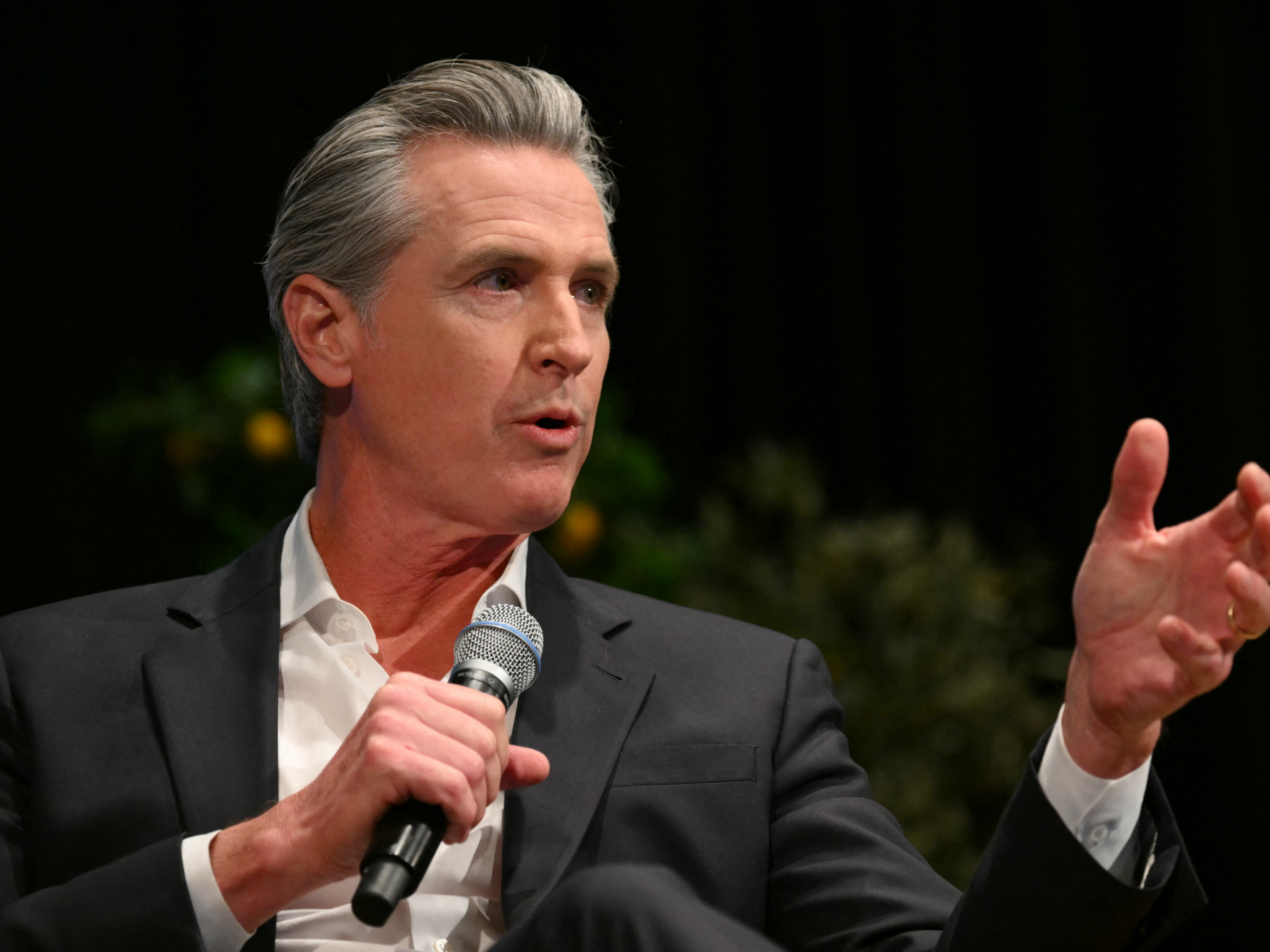
SACRAMENTO — California Gov. Gavin Newsom sharply criticized world leaders while attending the World Economic Forum in Davos, Switzerland, this week, faulting them for their “complicity” and failure to confront President Trump’s aggressive posture on issues such as Greenland and trade.
Speaking to reporters there, Newsom urged European and other global leaders to “stand tall and firm” and to “have a backbone,” bemoaning that too many have been “rolling over” in the face of Trump’s actions and rhetoric.
He quipped that he “should’ve brought a bunch of kneepads for all the world leaders,” a retort Newsom has become fond of leveling against those he feels are supine in their duties. He admonished the suggestion that Europeans could continue to approach diplomacy with Trump as they have previous presidents. Newsom called Trump a “T-Rex.”
“You mate with him, or he devours you, one or the other,” Newsom said.
His comments came as the forum grappled with heightened geopolitical tensions, particularly debates over Trump’s controversial push involving Greenland — a flashpoint that has drawn warnings from European leaders and underscored wider concerns about the erosion of traditional alliances and global norms.
On Tuesday, stocks slumped on Wall Street after Trump threatened to hit eight European countries with new tariffs over his attempts to assert American control over Greenland.
Trump is scheduled to speak Wednesday at the World Economic Forum, where he is expected to try to convince Americans he can make housing more affordable. However, many onlookers will be watching what Trump has to say about his desire to acquire Greenland.
The annual event opened Monday and is a four-day gathering of world leaders with the stated mission of engaging in “forward-looking discussions to address global issues and set priorities.”
Trump’s attendance comes after his administration opted to skip the annual United Nations climate policy summit in Belém, Brazil, in November, with Newsom instead attending as a proxy for the United States.
While in Switzerland, Newsom announced Tuesday that California surpassed 2.5 million cumulative new zero-emission vehicle sales since 2010. The state had set a goal of putting 1.5 million zero-emission vehicles on the road by 2025, with that target eclipsed despite setbacks in clean energy brought on by the Trump administration.
“California didn’t reach 2.5 million zero-emission vehicles by accident — we invested in this future when others said it was impossible,” Newsom said in a statement.
Democratic lawmakers and candidates for office around the country increasingly are returning to the phrase, popularized during the first Trump administration, as they react to this administration’s forceful immigration enforcement tactics.
The fatal shooting of 37-year-old Renee Nicole Good by an Immigration and Customs Enforcement agent this month in Minneapolis sparked immediate outrage among Democratic officials, who proposed a variety of oversight demands — including abolishing the agency — to rein in tactics they view as hostile and sometimes illegal.
Resurrecting the slogan is perhaps the riskiest approach. Republicans pounced on the opportunity to paint Democrats, especially those in vulnerable seats, as extremists.
An anti-ICE activist in an inflatable costume stands next to a person with a sign during a protest near Legacy Emanuel Hospital on Jan. 10 in Portland, Ore. The demonstration follows the Jan. 7 fatal shooting of Renee Nicole Good in Minneapolis as well as the shooting of two individuals in Portland on Jan. 8 by Immigration and Customs Enforcement (ICE) agents.
(Mathieu Lewis-Rolland / Getty Images)
“If their response is to dust off ‘defund ICE,’ we’re happy to take that fight any day of the week,” said Christian Martinez, a spokesperson for the National Republican Congressional Committee. The group has published dozens of press statements in recent weeks accusing Democrats of wanting to abolish ICE — even those who haven’t made direct statements using the phrase.
Rep. Ken Calvert (R-Corona) amplified that message Wednesday, writing on social media that “When Democrats say they want to abolish or defund ICE, what they are really saying is they want to go back to the open borders policies of the Biden administration. The American people soundly rejected that idea in the 2024 election.”
The next day, Rep. Shri Thanedar (D-Mich.) introduced the “Abolish ICE Act,” stating that Good’s killing “proved that ICE is out of control and beyond reform.” The bill would rescind the agency’s “unobligated” funding and redirect other assets to its parent agency, the Department of Homeland Security.
Many Democrats calling for an outright elimination of ICE come from the party’s progressive wing. Rep. Ayanna Pressley (D-Mass.) said in a television interview the agency should be abolished because actions taken by its agents are “racist” and “rogue.” Jack Schlossberg, who is running for a House seat in New York, said that “if Trump’s ICE is shooting and kidnapping people, then abolish it.”
Other prominent progressives have stopped short of saying the agency should be dismantled.
A pair of protesters set up signs memorializing people who have been arrested by ICE, or have died in the process, at a rally in front of the Federal Building in Los Angeles on Friday.
(Genaro Molina/Los Angeles Times)
Sen. Alex Padilla, (D-Calif.) who last year was forcefully handcuffed and removed from a news conference hosted by Homeland Security Secretary Kristi Noem, joined a protest in Washington to demand justice for Good, saying “It’s time to get ICE and CBP out,” referring to U.S. Customs and Border Protection.
“This is a moment where all of us have to be forceful to ensure that we are pushing back on what is an agency right now that is out of control,” Rep. Robert Garcia, the top Democrat on the House Oversight Committee, said on social media. “We have to be loud and clear that ICE is not welcome in our communities.”
Rep. Ken Calvert (R-Corona) said Democrats seeking to abolish ICE “want to go back to the open borders policies of the Biden administration.”
(Jose Luis Magana / Associated Press)
Others have eyed negotiations over the yearly Homeland Security budget as a leverage point to incorporate their demands, such as requiring federal agents to remove their masks and to turn on their body-worn cameras when on duty, as well as calling for agents who commit crimes on the job to be prosecuted. Seventy House Democrats, including at least 13 from California, backed a measure to impeach Noem.
Rep. Mike Levin (D-San Diego), who serves on the House Committee on Appropriations, said his focus is not on eliminating the agency, which he believes has an “important responsibility” but has been led astray by Noem.
He said Noem should be held to account for her actions through congressional oversight hearings, not impeachment — at least not while Republicans would be in control of the proceedings, since he believes House Judiciary Committee Chairman Jim Jordan (R-Ohio) would make a “mockery” of them.
“I am going to use the appropriations process,” Levin said, adding that he would “continue to focus on the guardrails, regardless of the rhetoric.”
Chuck Rocha, a Democratic political strategist, said Republicans seized on the abolitionist rhetoric as a scare tactic to distract from the rising cost of living, which remains another top voter concern.
“They hope to distract [voters] by saying, ‘Sure, we’re going to get better on the economy — but these Democrats are still crazy,’” he said.
Dozens of Angelenos and D.C.-area organizers, along with local activists, rally in front of the Federal Building in downtown Los Angeles on Friday. Democrats have for years struggled to put forward a unified vision on immigration — one of the top issues that won President Trump a return to the White House.
(Genaro Molina/Los Angeles Times)
Democrats have for years struggled to put forward a unified vision on immigration — one of the top issues that won President Trump a return to the White House. Any deal to increase guardrails on Homeland Security faces an uphill battle in the Republican-controlled Congress, leaving many proposals years away from the possibility of fruition. Even if Democrats manage to block the yearly funding bill, the agency still has tens of billions of dollars from Trump’s One Big Beautiful Bill Act.
Still, the roving raids, violent clashes with protesters and detentions and deaths of U.S. citizens and immigrants alike increased the urgency many lawmakers feel to do something.
Two centrist groups released memos last week written by former Homeland Security officials under the Biden administration urging Democrats to avoid the polarizing language and instead channel their outrage into specific reforms.
“Every call to abolish ICE risks squandering one of the clearest opportunities in years to secure meaningful reform of immigration enforcement — while handing Republicans exactly the fight they want,” wrote the authors of one memo, from the Washington-based think tank Third Way.
“Advocating for abolishing ICE is tantamount to advocating for stopping enforcement of all of our immigration laws in the interior of the United States — a policy position that is both wrong on the merits and at odds with the American public on the issue,” wrote Blas Nuñez-Neto, a senior policy fellow at the new think tank the Searchlight Institute who previously was assistant Homeland Security secretary.
Roughly 46% of Americans said they support the idea of abolishing ICE, while 43% are opposed, according to a YouGov/Economist poll released last week.
Sarah Pierce, a former policy analyst at U.S. Citizenship and Immigration Services who co-wrote the Third Way memo, said future polls might show less support for abolishing the agency, particularly if the question is framed as a choice among options including reforms such as banning agents from wearing masks or requiring use of body cameras.
“There’s no doubt there will be further tragedies and with each, the effort to take an extreme position like abolishing ICE increases,” she said.
Laura Hernandez, executive director of Freedom for Immigrants, a California-based organization that advocates for the closure of detention centers, said the increase in lawmakers calling to abolish ICE is long overdue.
“We need lawmakers to use their power to stop militarized raids, to close detention centers and we need them to shut down ICE and CBP,” she said. “This violence that people are seeing on television is not new, it’s literally built into the DNA of DHS.”
Rep. Shri Thanedar (D-Mich.) introduced the “Abolish ICE Act.”
(Paul Sancya / Associated Press)
Cinthya Martinez, a UC Santa Cruz professor who has studied the movement to abolish ICE, noted that it stems from the movement to abolish prisons. The abolition part, she said, is watered down by mainstream politicians even as some liken immigration agents to modern-day slave patrols.
Martinez said the goal is about more than simply getting rid of one agency or redirecting its duties to another. She pointed out that alongside ICE agents have been Border Patrol, FBI and ATF agents.
“A lot of folks forget that prison abolition is to completely abolish carceral systems. It comes from a Black tradition that says prison is a continuation of slavery,” she said.
But Peter Markowitz, a law professor and co-director of the Immigration Justice Clinic at the Cardozo School of Law, said the movement to abolish ICE around 2018 among mainstream politicians was always about having effective and humane immigration enforcement, not about having none.
“But it fizzled because it didn’t have an answer to the policy question that follows: If not ICE, then what?” he said. “I hope we’re in a different position today.”
A federal judge on Thursday dismissed a U.S. Justice Department lawsuit demanding California turn over its voter rolls, calling the request “unprecedented and illegal” and accusing the federal government of trying to “abridge the right of many Americans to cast their ballots.”
U.S. District Judge David O. Carter, a Clinton appointee based in Santa Ana, questioned the Justice Department’s motivations and called its lawsuit demanding voter data from California Secretary of State Shirley Weber not just an overreach into state-run elections, but a threat to American democracy.
“The centralization of this information by the federal government would have a chilling effect on voter registration which would inevitably lead to decreasing voter turnout as voters fear that their information is being used for some inappropriate or unlawful purpose,” Carter wrote. “This risk threatens the right to vote which is the cornerstone of American democracy.”
Carter wrote that the “taking of democracy does not occur in one fell swoop; it is chipped away piece by piece until there is nothing left,” and that the Justice Department’s lawsuit was “one of these cuts that imperils all Americans.”
The Justice Department did not immediately respond to a request for comment late Thursday.
In a video she posted to the social media platform X earlier Thursday, Assistant Atty. Gen. Harmeet Dhillon — who heads the Justice Department’s Civil Rights Division — said she was proud of her office’s efforts to “clean up the voter rolls nationally,” including by suing states for their data.
“We are going to touch every single state and finish this project,” she said.
Weber, who is California’s top elections official, said in a written statement that she is “entrusted with ensuring that California’s state election laws are enforced — including state laws that protect the privacy of California’s data.”
“I will continue to uphold my promise to Californians to protect our democracy, and I will continue to challenge this administration’s disregard for the rule of law and our right to vote,” Weber said.
The Justice Department sued Weber in September after she refused to hand over detailed voter information for some 23 million Californians, alleging that she was unlawfully preventing federal authorities from ensuring state compliance with federal voting regulations and safeguarding federal elections against fraud.
It separately sued Weber’s counterparts in various other states who also declined the department’s requests for their states’ voter rolls.
The lawsuit followed an executive order by President Trump in March that purported to require voters to provide proof of citizenship and ordered states to disregard mail ballots not received by election day. It also followed years of allegations by Trump, made without evidence, that voting in California has been hampered by widespread fraud and voting by noncitizens — part of his broader and equally unsupported claim that the 2020 presidental election was stolen from him.
In announcing the lawsuit, Atty. Gen. Pam Bondi said in September that “clean voter rolls are the foundation of free and fair elections,” and that the Justice Department was going to ensure that they exist nationwide.
Weber denounced the lawsuit at the time as a “fishing expedition and pretext for partisan policy objectives,” and as “an unprecedented intrusion unsupported by law or any previous practice or policy of the U.S. Department of Justice.”
The Justice Department demanded a “current electronic copy of California’s computerized statewide voter registration list”; lists of “all duplicate registration records in Imperial, Los Angeles, Napa, Nevada, San Bernardino, Siskiyou, and Stanislaus counties”; a “list of all duplicate registrants who were removed from the statewide voter registration list”; and the dates of their removals.
It also demanded a list of all registrations that had been canceled due to voter deaths; an explanation for a recent decline in the recorded number of “inactive” voters in California; and a list of “all registrations, including date of birth, driver’s license number, and last four digits of Social Security Number, that were canceled due to non-citizenship of the registrant.”
Carter, in his ruling Thursday, took particular issue with the Justice Department’s reliance on federal civil rights laws to make its case.
“The Department of Justice seeks to use civil rights legislation which was enacted for an entirely different purpose to amass and retain an unprecedented amount of confidential voter data. This effort goes far beyond what Congress intended when it passed the underlying legislation,” Carter wrote.
Carter wrote that the legislation in question — including Title III of the Civil Rights Act of 1960 and the National Voter Registration Act (NVRA) of 1993 — was passed to defend Black Americans’ voting rights in the face of “persistent voter suppression” and to “combat the effects of discriminatory and unfair registration laws that cheapened the right to vote.”
Carter found that the Justice Department provided “no explanation for why unredacted voter files for millions of Californians, an unprecedented request, was necessary” for the Justice Department to investigate the alleged problems it claims, and that the executive branch simply has no power to demand such data all at once without explanation.
Jan. 14 (UPI) — The Trump administration has paused immigrant visa-processing services for citizens of 75 nations due to a likelihood that they will need public support.
The decision does not affect tourist, business, student, temporary work, exchange visitor, medical treatment, and crew and transit visas, officials said.
The State Department issued a memo on Wednesday saying it indefinitely will pause the immigrant visa processing Jan. 21 while assessing how the processing is done.
“The State Department will pause immigrant visa processing from 75 countries whose migrants take welfare from the American people at unacceptable rates,” the department said in a post on X.
“The freeze will remain active until the U.S. can ensure that new immigrants will not extract wealth from the American people.”
The visa-processing pause comes a day after Department of Homeland Services Sec. Kristin Noem said conditions in Somalia have improved to such an extent that the country no longer qualifies for temporary protected status, which ends for Somalian migrants March 17.
“Allowing Somali nationals to remain temporarily in the United States is contrary to our national interests,” Noem said. “We are putting Americans first.”
Somali nationals who voluntarily leave the United States will be given a free plane ticket and $1,000.
The State Department also paused the processing of asylum cases by U.S. Citizenship and Immigration Services and halted green card and citizenship applications for citizens of 19 initial nations, most of which are located in Africa.
The processing changes come amid reports of widespread fraud in Minnesota and other states in which federal and state programs are targeted, often by members of ethnic communities from specific countries, such as Somalia.
The Trump administration has said many migrants are draining taxpayer dollars and state and federal resources, including those engaged in fraud.
The administration has targeted Minnesota with increased immigration law enforcement and federal investigations of alleged fraud via 14 state-run aid programs for child care, child nutrition, autism, housing assistance and more.
Somalians, some of whom are U.S. citizens, account for 82 of 92 defendants in active investigations in Minnesota, according to the U.S. attorney’s office for that state.
The Department of Justice also is investigating claims of fraud in Ohio, California and other states.
The investigations and halting visa processing likely will cause many immigrant families to hesitate when considering filing for public assistance, Migration Policy Institute Associate Director Julia Gelatt said on Wednesday.
The State Department said the 75 nations subject to the visa-processing halt are: Afghanistan, Albania, Algeria, Antigua and Barbuda, Armenia, Azerbaijan, Bahamas, Bangladesh, Barbados, Belarus, Belize, Bhutan, Bosnia, Brazil, Burma, Cambodia and Cameroon.
Also, Liberia, Libya, Macedonia, Moldova, Mongolia, Montenegro, Morocco, Nepal, Nicaragua, Nigeria, Pakistan, Republic of the Congo, Russia, Rwanda, Saint Kitts and Nevis, Saint Lucia, Saint Vincent and the Grenadines, Senegal, Sierra Leone, Somalia, South Sudan, Sudan, Syria, Tanzania, Thailand, Togo, Tunisia, Uganda, Uruguay, Uzbekistan and Yemen.
WASHINGTON — State and local officials are once again on the defensive after President Trump renewed threats Wednesday to strike federal dollars from “sanctuary” jurisdictions such as California and Los Angeles, which have long opposed cooperation with immigration enforcement agencies.
“Effective Feb. 1, no more payments will be made by the federal government to states for their corrupt criminal protection centers known as sanctuary cities. All they do is breed crime and violence. If states want them, they will have to pay for them,” he said.
The U.S. government is supplying $175 billion to California this fiscal year — about a third of the state’s total 2025-26 spending plan, according to state budget records.
Last year, the U.S. Department of Justice created a list of dozens of state and local governments identified as “sanctuary” jurisdictions based on policies that limit cooperation with federal immigration enforcement.
Those policies generally do not block federal authorities from carrying out immigration actions, but restrict how local resources can be used.
California Department of Justice officials were quick to point out that courts have repeatedly sided against the president on this matter, most recently in August, when a judge ruled the federal government cannot deny funding to Los Angeles and 30 other cities over policies that limit cooperation on immigration enforcement.
The ruling, by U.S. District Judge William Orrick, extended an earlier injunction that established Trump’s efforts to cut federal funding were probably unconstitutional and violated the separation of powers doctrine.
But at a December hearing, a 9th Circuit Court of Appeals panel signaled it might overturn the injunction, as judges questioned whether the administration’s latest orders actually require agencies to cut funding in a way that exceeds their authority.
A final ruling on the appeal is pending.
California Atty. Gen. Rob Bonta’s office said in a statement Wednesday that the substance of White House threats wasn’t clear.
“While details here are in short supply, we’ll have to take a look at whatever the president actually does,” Bonta said. “We remain prepared to take action as necessary to protect our state and uphold the law.”
Bonta has also defeated the administration over its attempts to impose illegal immigration enforcement conditions on transportation, homeland security and Victims of Crime Act funding.
On Tuesday, he announced a multistate challenge to Trump’s plans to freeze $10 billion in federal child care and social services funding amid unsubstantiated allegations that the state was “illicitly providing illegal aliens” with benefits.
Gov. Gavin Newsom took a moment to lean on the state’s winning legal record.
“Please pray for the president as he struggles with cognitive decline. He already forgot he tried this before — multiple times — and we sued him and won,” Newsom said in a statement Wednesday.
Though the White House wouldn’t comment on a specific legal framework or dollar amount for this wave of funding cuts, Spokesperson Abigail Jackson said Wednesday that sanctuary cities are “incredibly dangerous” and put law-abiding Americans at risk.
She added that the Trump administration is considering “a variety of lawful options” to implement this policy.
The issue of executive overreach is at the fore for Senate Democrats, too, who are challenging the president over military action in Venezuela.
“Let me be clear: Congress—not the White House and not Donald Trump — holds the power of the purse,” said Sen. Alex Padilla (D-Calif.).
Los Angeles City Atty. Hydee Feldstein Soto confirmed the city would take legal action to protect its access to federal dollars.
Mayor Karen Bass said she plans to work with partners at every level of government to ensure Angelenos continue to receive government services.
“Hardworking, honest Americans should not have to pay the price for the president’s continued political attack on blue states and cities,” she said in a statement.
WASHINGTON — Michigan Sen. Elissa Slotkin has been notified that the Trump administration is investigating her after she organized and appeared in a video with other Democrats urging military service members to resist “illegal orders.”
Slotkin, a former CIA analyst, said in a video statement released Wednesday that prosecutors were investigating her over the 90-second video she first posted on her X account in November. Slotkin said the office of U.S. Atty. Jeanine Pirro, the Justice Department’s chief prosecutor in the nation’s capital, reached out last week asking to interview her.
“This is the president’s playbook. Truth doesn’t matter. Facts don’t matter. And anyone who disagrees with him becomes an enemy,” Slotkin said. “And he then weaponizes the federal government against them. It’s legal intimidation and physical intimidation meant to get you to shut up.”
Pirro’s office said it would neither confirm nor deny whether an investigation is taking place. Slotkin first disclosed the investigation to the New York Times.
The inquiry marks another escalation in President Trump’s reaction to a video that he and his aides have labeled as “seditious” — an offense Trump said on his social media account was “punishable by death.” Slotkin and the other Democratic lawmakers who participated in the video said in November that the FBI has contacted them to begin scheduling interviews. Pirro’s involvement represents an elevation of the matter for Slotkin.
It is not clear what laws could have been violated in the video message. In it, the lawmakers, all of whom have military and national security experience, tell troops to follow established military protocols by not following commands that defy the law.
Defense Secretary Pete Hegseth has censured Sen. Mark Kelly (D-Ariz.), a former Navy pilot and astronaut, for participating. Hegseth is attempting to retroactively demote Kelly from his retired rank of captain. The senator is suing Hegseth to block those proceedings, calling them an unconstitutional act of retribution.
Reps. Jason Crow of Colorado, Chris Deluzio of Pennsylvania, Maggie Goodlander of New Hampshire and Chrissy Houlahan of Pennsylvania also appeared in the video. It was not clear whether any other participants are being targeted by Pirro’s office or other arms of the Justice Department beyond the FBI questioning.
Slotkin was among the Democrats’ bright spots in the 2024 election, winning an open Senate seat despite Trump carrying Michigan in the presidential election. She delivered the Democratic response to his congressional address in 2025.
Cappelletti writes for the Associated Press. AP writer Bill Barrow in Atlanta contributed to this report.
WASHINGTON — President Trump’s administration has made good on its pledge to label three Middle Eastern branches of the Muslim Brotherhood as terrorist organizations, imposing sanctions on them and their members in a decision that could have implications for U.S. relationships with allies in the region.
The Treasury and State departments announced the actions Tuesday against the Lebanese, Jordanian and Egyptian chapters of the Muslim Brotherhood, which they said pose a risk to the United States and American interests.
The State Department designated the Lebanese branch a foreign terrorist organization, the most severe of the labels, which makes it a criminal offense to provide material support to the group. The Jordanian and Egyptian branches were listed by the Treasury Department as specially designated global terrorists for providing support to militant group Hamas.
“These designations reflect the opening actions of an ongoing, sustained effort to thwart Muslim Brotherhood chapters’ violence and destabilization wherever it occurs,” Secretary of State Marco Rubio said in a statement. “The United States will use all available tools to deprive these Muslim Brotherhood chapters of the resources to engage in or support terrorism.”
Rubio and Treasury Secretary Scott Bessent were mandated last year under an executive order signed by Trump to determine the most appropriate way to impose sanctions on the groups, which U.S. officials say engage in or support violence and destabilization campaigns that harm the United States and other regions.
Bessent said in a post on X that the Muslim Brotherhood “has a longstanding record of perpetrating acts of terror, and we are working aggressively to cut them off from the financial system.” He added that the Trump administration will “deploy the full scope of its authorities to disrupt, dismantle, and defeat terrorist networks wherever they operate in order to keep Americans safe.”
Muslim Brotherhood leaders have said they renounce violence, and the Muslim Brotherhood branches in Egypt and Lebanon denounced their inclusion.
“The Egyptian Muslim Brotherhood categorically rejects this designation and will pursue all legal avenues to challenge this decision which harms millions of Muslims worldwide,” it said in a statement, denying any involvement in or support for terrorism.
The Lebanese branch of the Muslim Brotherhood, known as Al Jamaa al Islamiya (the Islamic Group), said in a statement that it is “a licensed Lebanese political and social entity that operates openly and within the bounds of the law” and that the U.S. decision “has no legal effect within Lebanon.”
In singling out the chapters in Lebanon, Jordan and Egypt, Trump’s executive order noted that a wing of the Lebanese chapter had launched rockets on Israel after Hamas’ Oct. 7, 2023, attack in Israel that set off the war in Gaza. Leaders of the group in Jordan also have provided support to Hamas, the order said.
The Muslim Brotherhood was founded in Egypt in 1928 but was banned in that country in 2013. Jordan announced a sweeping ban on the Muslim Brotherhood in April.
Egypt on Tuesday welcomed the designation and praised Trump’s efforts to combat global terrorism.
“This is a significant step that reflects the extremist ideology of this group and the direct threat it represents for regional and international security and stability,” the Egyptian Foreign Ministry said in a statement.
Nathan Brown, a professor of political science and international affairs at George Washington University, said other allies of the U.S., including the United Arab Emirates, would likely be pleased with the designation.
“For other governments where the brotherhood is tolerated, it would be a thorn in bilateral relations,” including in Qatar and Turkey, he said. While the Turkish ruling party has been associated with members of the Muslim Brotherhood in the past, the government of Qatar has denied any relationship with it.
Brown also said a designation on the chapters may have effects on visa and asylum claims for people entering not just the U.S. but also Western European countries and Canada.
“I think this would give immigration officials a stronger basis for suspicion, and it might make courts less likely to question any kind of official action against Brotherhood members who are seeking to stay in this country, seeking political asylum,” he said.
Trump, a Republican, weighed whether to designate the Muslim Brotherhood a terrorist organization in 2019 during his first term in office. Some prominent Trump supporters, including right-wing influencer Laura Loomer, have pushed his administration to take aggressive action against the group.
Two Republican-led state governments — Florida and Texas — designated the group as a terrorist organization this year.
Hussein and Lee write for the Associated Press. Fatma Khaled in Cairo contributed to this report.
U.S. Secretary of the Treasury Scott Bessent listens as President Donald Trump holds a meeting with his Cabinet in the Cabinet Room of the White House in Washington, D.C., on December 2. The Treasury and State Department designated branches of the Muslim Brotherhood as terrorist organizations on Tuesday. File Photo by Yuri Gripas/UPI | License Photo
Jan. 13 (UPI) — The U.S. Treasury and State Departments designated branches of the Muslim Brotherhood as terrorist organizations on Tuesday.
The press release by the Department of the Treasury alleges that chapters of the Muslim Brotherhood in Egypt and Jordan support terrorism by supporting terrorist groups such as Hamas.
“The Muslim Brotherhood has a longstanding record of perpetrating acts of terror and we are working aggressively to cut them off from the financial system,” Treasury Secretary Scott Bessent said in a statement. “This administration will deploy the full scope of its authorities to disrupt, dismantle and defeat terrorist networks wherever they operate in order to keep America safe.”
The move follows President Donald Trump‘s direction, laid out in an executive order signed in November. Trump directed the Treasury and State Department to evaluate whether any chapter of the Muslim Brotherhood should be designated as a foreign terrorist organization.
The Muslim Brotherhood was founded in Egypt in 1928. It renounced the use of violence in the 1970s, though the treasury said its branches promote and support terrorism.
Hamas was founded as a branch of the Muslim Brotherhood in the 1980s. It has since become an independent organization.
The Office of Foreign Asset is directed to block all property and property interests related to the sanctioned Muslim Brotherhood branches. This includes property that is at least 50% owned by a person associated with the organization.
Central bank chair condemns ‘intimidation’ following grand jury subpoenas.
Published On 12 Jan 202612 Jan 2026
Share
United States President Donald Trump’s administration has opened a criminal investigation into Federal Reserve Chair Jerome Powell, in a development set to heighten concerns about the independence of US monetary policy.
Powell said on Sunday that the central bank had been served with grand jury subpoenas related to his testimony about renovations to the Fed’s headquarters in Washington, DC.
Recommended Stories
list of 4 itemsend of list
“The threat of criminal charges is a consequence of the Federal Reserve setting interest rates based on our best assessment of what will serve the public, rather than following the preferences of the president,” Powell said in a rare video message.
“This is about whether the Fed will be able to continue to set interest rates based on evidence and economic conditions – or whether instead, monetary policy will be directed by political pressure or intimidation.”
A few months into President Trump’s second term, federal appeals court Judge J. Harvie Wilkinson III — a conservative appointee of President Reagan — issued a scathing opinion denouncing what he found to be the Trump administration’s unlawful removal of Kilmar Abrego Garcia to his native El Salvador, despite a previous court order barring it.
“The government is asserting a right to stash away residents of this country in foreign prisons without the semblance of due process that is the foundation of our constitutional order. Further, it claims in essence that because it has rid itself of custody that there is nothing that can be done,” Wilkinson wrote. “This should be shocking not only to judges, but to the intuitive sense of liberty that Americans far removed from courthouses still hold dear.”
Young ruled the cuts were “arbitrary and capricious” and therefore illegal. But he also said there was a “darker aspect” to the case that he had an “unflinching obligation” to call out — that the administration’s actions amounted to “racial discrimination and discrimination against America’s LGBTQ community.”
“I’ve sat on this bench now for 40 years. I’ve never seen government racial discrimination like this,” Young said, explaining a decision the Supreme Court later reversed. “Have we fallen so low? Have we no shame?”
In the year since an aggrieved and combative Trump returned to the White House, his administration has strained the American legal system by testing and rejecting laws and other long-standing policies and defending those actions by arguing the president has a broad scope of authority under the U.S. Constitution.
Administration officials and Justice Department attorneys have argued that the executive branch is essentially the president’s to bend to his will. They have argued its employees are his to fire, its funds his to spend and its enforcement powers — to retaliate against his enemies, blast alleged drug-runners out of international waters or detain anyone agents believe looks, sounds and labors like a foreigner — all but unrestrained.
The approach has repeatedly been met by frustrated federal judges issuing repudiations of the administration’s actions, but also grave warnings about a broader threat they see to American jurisprudence and democracy.
When questioning administration attorneys in court, in stern written rulings at the district and appellate levels and in blistering dissents at the Supreme Court — which has often backed the administration, particularly with temporary orders on its emergency docket — federal judges have used remarkably strong language to call out what they see as a startling disregard for the rule of law.
In response, Trump and his supporters have articulated their own concerns with the legal system, accusing judges of siding with progressive groups to cement a liberal federal agenda despite the nation voting Trump back into office. Trump has labeled judges “lunatics” and called for at least one’s impeachment, which drew a rare rebuke from Chief Justice John G. Roberts Jr.
After District Judge Brian E. Murphy temporarily blocked the administration from deporting eight men to South Sudan — a nation to which they had no connection, and which has a record of human rights abuses — Solicitor Gen. D. John Sauer, the administration’s top litigator, called the order “a lawless act of defiance” that ignored a recent Supreme Court ruling.
After District Judge James E. Boasberg began pursuing a criminal contempt investigation into the actions of senior administration officials who continued flights deporting Venezuelan nationals to a notorious Salvadoran prison despite Boasberg having previously ordered the planes turned back to the U.S., government attorneys said it portended a “circus” that threatened the separation of powers.
While more measured than the nation’s coarse political rhetoric, the legal exchanges have nonetheless been stunning by judicial standards — a sign of boiling anger among judges, rising indignation among administration officials and a wide gulf between them as to the limits of their respective legal powers.
“These judges, these Democrat activist judges, are the ones who are 100% at fault,” said Mike Davis, a prominent Republican lawyer and Trump ally who advocates for sweeping executive authority. “They are taking the country to the cliff.”
U.S. District Judge James E. Boasberg began pursuing a criminal contempt investigation into the actions of senior administration officials who continued flights deporting Venezuelan nationals to a notorious Salvadoran prison.
(Valerie Plesch / Bloomberg via Getty Images)
The judges “see — and have articulated — an unprecedented threat to democracy,” said UC Berkeley Law School Dean Erwin Chemerinsky. “They really are sounding the alarm.”
“What the American people should be deeply concerned about is the rampant increase in judicial activism from radical left-wing judges,” said Abigail Jackson, a White House spokesperson. “If this trend continues it threatens to undermine the rule-of-law for all future presidencies.”
“Regardless of which side you’re on on these issues, the lasting impact is that people mistrust the courts and, quite frankly, do not understand the role that a strong, independent judiciary plays in the rule of law, in our democracy and in our economy,” said John A. Day, president of the American College of Trial Lawyers. “That is very, very troubling to anybody who looks at this with a shred of objectivity.”
California in the fight
Last month, California Atty. Gen. Rob Bonta announced his office’s 50th lawsuit against the Trump administration — an average of about one lawsuit per week since Trump’s inauguration.
The litigation has challenged a range of Trump administration policies, including his executive order purporting to end birthright citizenship for the U.S.-born children of many immigrants; his unilateral imposition of stiff tariffs around the world; the administration’s attempt to slash trillions of dollars in federal funding from states, and its deployment of National Guard troops to American cities.
The battles have produced some of the year’s most eye-popping legal exchanges.
In June, Judge Charles R. Breyer ruled against the Trump administration’s decision to federalize and deploy California National Guard troops in Los Angeles, after days of protest over immigration enforcement.
An attorney for the administration had argued that federal law gave Trump such authority in instances of domestic “rebellion” or when the president is unable to execute the nation’s laws with regular forces, and said the court had no authority to question Trump’s decisions.
But Breyer wasn’t buying it, ruling Trump’s authority was “of course limited.”
“I mean, that’s the difference between a constitutional government and King George,” he said from the bench. “This country was founded in response to a monarchy. And the Constitution is a document of limitations — frequent limitations — and enunciation of rights.”
U.S. District Judge Charles Breyer ruled against the Trump administration’s decision to federalize and deploy California National Guard troops to Los Angeles.
(Santiago Mejia / San Francisco Chronicle)
Francesca Gessner, Bonta’s acting chief deputy, said she took Breyer’s remarks as his way of telling Trump and his administration that “we don’t have kings in America” — which she said was “really remarkable to watch” in an American courtroom.
“I remember just sitting there thinking, wow, he’s right,” Gessner said.
The U.S. 9th Circuit Court of Appeals subsequently paused Breyer’s order, allowing the troops to remain in Trump’s control.
In early October, U.S. District Judge Karin J. Immergut barred the deployment of Oregon National Guard troops to Portland, finding that the conditions on the ground didn’t warrant such militarization. The next day, both Oregon and California asked her to expand that ruling to include California National Guard troops, after the Trump administration sent them to Portland in lieu of Oregon’s troops.
Before issuing a second restraining order barring deployments of any National Guard troops in Oregon, a frustrated Immergut laid into the Justice Department attorney defending the administration. “You’re an officer of the court,” she said. “Aren’t defendants simply circumventing my order, which relies on the conditions in Portland?”
More recently, the Supreme Court ruled against the Trump administration in a similar case out of Chicago, finding the administration lacked any legal justification for Guard deployments there. Trump subsequently announced he was pulling troops out of Chicago, Los Angeles and other Democratic-led cities, with California and other states that had resisted claiming a major victory.
Bonta said he’s been pleased to see judges pushing back against the president’s power grabs, including by using sharp language that makes their alarm clear.
U.S. District Court Judge Karin J. Immergut, shown at her 2018 confirmation hearing, barred the deployment of Oregon National Guard troops to Portland.
(Win McNamee / Getty Images)
“Generally, courts and judges are tempered and restrained,” Bonta said. “The statements that you’re seeing from them are carefully chosen to be commensurate with the extreme nature of the moment — the actions of the Trump administration that are so unlawful.”
Jackson, the White House spokesperson, and other Trump administration officials defended their actions to The Times, including by citing wins before the Supreme Court.
Atty. Gen. Pam Bondi said the Justice Department “has spent the past year righting the wrongs of the previous administration” and “working tirelessly to successfully advance President Trump’s agenda and keep Americans safe.”
Sauer said it has won rulings “on key priorities of this administration, including stopping nationwide injunctions from lower courts, defending ICE’s ability to carry out law enforcement duties, and removing dangerous illegal aliens from our country,” and that those decisions “respect the role” of the courts, Trump’s “constitutional authority” and the “rule of law.”
‘Imperial executive’ or ‘imperial judiciary’?
Just after taking office, Trump said he was ending birthright citizenship. California and others sued, and several lower court judges blocked the order with nationwide or “universal” injunctions — with one calling it “blatantly unconstitutional.”
In response, the Trump administration filed an emergency petition with the Supreme Court challenging the ability of district court judges to issue such sweeping injunctions. In June, the high court largely sided with the administration, ruling 6 to 3 that many such injunctions likely exceed the lower courts’ authority.
Trump’s policy remains on hold based on other litigation. But the case laid bare a stark divide on the high court.
In her opinion for the conservative majority, Justice Amy Coney Barrett wrote that universal injunctions were not used in early English and U.S. history, and that while the president has a “duty to follow the law,” the judiciary “does not have unbridled authority to enforce this obligation.”
Supreme Court Justice Amy Coney Barrett accused Justice Ketanji Brown Jackson of pursuing a “startling line of attack” that unconstitutionally aggrandized the powers of judges at the expense of the president.
(Mario Tama / Getty Images)
In a dissent joined by fellow Justices Elena Kagan and Ketanji Brown Jackson, Justice Sonia Sotomayor wrote that enforcement of Trump’s order against even a single U.S.-born child would be an “assault on our constitutional order,” and that Barrett’s opinion was “not just egregiously wrong, it is also a travesty of law.”
Jackson, in her own dissent, wrote that the majority opinion created “a zone of lawlessness within which the Executive has the prerogative to take or leave the law as it wishes, and where individuals who would otherwise be entitled to the law’s protection become subject to the Executive’s whims instead.”
As a result, the president’s allies will fare well, the “wealthy and the well connected” will be able to hire lawyers and go to court to defend their rights, and the poor will have no such relief, Jackson wrote — creating a tiered system of justice “eerily echoing history’s horrors.”
Barrett accused Jackson of pursuing a “startling line of attack” that unconstitutionally aggrandized the powers of judges at the expense of the executive. “Justice Jackson decries an imperial Executive while embracing an imperial Judiciary.”
Jackson questioned why the majority saw a “power grab” by the courts instead of by “a presumably lawless Executive choosing to act in a manner that flouts the plain text of the Constitution.”
What’s ahead?
Legal observers across the political spectrum said they see danger in the tumult.
“I never have been so afraid, or imagined being so afraid, for the future of democracy as I am right now,” Chemerinsky said.
He said Trump is “continually violating the Constitution and laws” in unprecedented ways to increase his own power and diminish the power of the other branches of government, and neither Republicans in Congress nor Trump’s cabinet are doing anything to stop him.
While the Supreme Court has also showed great deference to Trump, Chemerinsky said he is hoping it will begin reaffirming legal boundaries for him.
“Is the court just going to be a rubber stamp for Trump, or, at least in some areas, is it going to be a check?” he said.
Davis said Trump has faced “unprecedented, unrelenting lawfare from his Democrat opponents” for years, but now has “a broad electoral mandate to lead” and must be allowed to exercise his powers under Article II of the Constitution.
“These Democrat activist judges need to get the hell out of his way, because if they don’t, the federal judiciary is gonna lose its legitimacy,” Davis said. “And once it loses its legitimacy, it loses everything.”
Bonta said the Constitution is being “stress tested,” but he thinks it’s been “a good year for the rule of law” overall, thanks to lower court judges standing up to the administration’s excesses. “They have courage. They are doing their job.”
Day, of the American College of Trial Lawyers, said Trump “believes he is putting the country on the right path” and wants judges to get out of his way, while many Democrats feel “we’re going entirely in the wrong direction and that the Supreme Court is against them and bowing to the wishes of the executive.”
His advice to both, he said, is to keep faith in the nation’s legal system — which “is not very efficient, but was designed to work in the long run.”
WASHINGTON — The killing of a Minnesota woman by an Immigration and Customs Enforcement officer is reverberating across Capitol Hill where Democrats, and certain Republicans, are vowing an assertive response as President Trump’s aggressive deportation operations spark protests nationwide.
Lawmakers are demanding a range of actions, including a full investigation into Renee Nicole Good’s shooting death, policy changes over law enforcement raids, the defunding of ICE operations and the impeachment of Homeland Security Secretary Kristi Noem, in what is fast becoming an inflection point.
“The situation that took place in Minnesota is a complete and total disgrace,” House Democratic leader Hakeem Jeffries of New York said as details emerged. “And in the next few days, we will be having conversations about a strong and forceful and appropriate response by House Democrats.”
Yet there is almost no consensus among the political parties in the aftermath of the death of Good, who was behind the wheel of an SUV after dropping off her 6-year-old at school when she was shot and killed by an ICE officer.
The killing immediately drew dueling narratives. Trump and Noem said the ICE officer acted in self-defense, while Democratic officials said the Trump administration was lying and they urged the public to view the viral videos of the shooting for themselves. The videos appear to contradict at least some aspects of the Trump administration’s assertions.
Vice President JD Vance blamed Good, calling it “a tragedy of her own making,” and said the ICE officer may have been “sensitive” from having been injured during an unrelated altercation last year.
But Good’s killing, at least the fifth known death since the administration launched its mass deportation campaign, could change the political dynamic.
“The videos I’ve seen from Minneapolis yesterday are deeply disturbing,” Sen. Lisa Murkowski (R-Alaska) said in a statement last week.
“As we mourn this loss of life, we need a thorough and objective investigation into how and why this happened,” she said. As part of the investigation, Murkowski said she is calling for policy changes, saying the situation “was devastating, and cannot happen again.”
Homeland Security funding up for debate
The push in Congress for more oversight and accountability of the administration’s immigration operations comes as lawmakers are in the midst of the annual appropriations process to fund agencies, including the Department of Homeland Security, to prevent another federal government shutdown when money expires at the end of January.
As anti-ICE demonstrations erupt in the aftermath of Good’s death, as seen in many U.S. cities this weekend, Democrats have pledged to use any available legislative lever to apply pressure on the administration to change the conduct of ICE officers.
“We’ve been warning about this for an entire year,” said Rep. Maxwell Frost (D-Fla.).
The ICE officer “needs to be held accountable,” Frost said, “but not just them, but ICE as a whole, the president and this entire administration.”
Congressional Democrats saw Good’s killing as a sign of the need for aggressive action to restrain the administration’s tactics.
Several Democrats joined calls to impeach Noem, who has been under fire from both parties for her lack of transparency at the department, though that step is highly unlikely with Republicans in control of Congress.
Other Democrats want to restrict the funding for her department, whose budget was vastly increased as part of Republicans’ sweeping tax and spending bill passed last summer.
Connecticut Sen. Chris Murphy, the top Democrat on the subcommittee that handles Homeland Security funding, plans to introduce legislation to rein in the agency with constraints on federal agents’ authority, including a requirement that the Border Patrol stick to the border and that Homeland Security enforcement officers be unmasked.
“More Democrats are saying today the thing that a number of us have been saying since April and May: Kristi Noem is dangerous. She should not be in office, and she should be impeached,” said Democratic Rep. Delia C. Ramirez, who represents parts of Chicago where ICE launched an enhanced immigration enforcement action last year that resulted in two deaths.
Immigration debates have long divided Congress and the parties. Democrats splinter between more liberal and stricter attitudes toward newcomers to the United States. Republicans have embraced Trump’s hard-line approach in trying to portray Democrats as radicals.
The Republican administration had launched the enforcement operation in Minnesota in response to an investigation of the nonprofit Feeding Our Future. Prosecutors said the organization was at the center of the country’s largest COVID-19-related fraud scams, when defendants exploited a state-run, federally funded program intended to provide food for children.
Heading into the November midterm election, which Democrats believe will hinge on issues such as affordability and healthcare, national outcry over ICE’s conduct has pressured lawmakers to speak out.
“I’m not completely against deportations, but the way they’re handling it is a real disgrace,” said Rep. Vicente Gonzalez (D-Texas), who represents a district along the U.S.-Mexico border.
“Right now, you’re seeing humans treated like animals,” he said.
Other ICE shootings have rattled lawmakers
In September, a federal immigration enforcement agent in Chicago fatally shot Silverio Villegas Gonzalez during a brief altercation after Gonzalez had dropped off his children at school.
In October, a Customs and Border Protection agent also in Chicago shot Marimar Martinez, a teacher and U.S. citizen, five times during a dispute with officers. The charges the administration had brought against Martinez were dismissed by a federal judge.
To Rep. Chuy Garcia (D-Ill.), Good’s death “brought back heart-wrenching memories of those two shootings in my district.”
“It looks like the fact that a U.S. citizen, who is a white woman, may be opening the eyes of the American public, certainly of members of Congress, that what’s going on is out of control,” he said, “that this isn’t about apprehending or pursuing the most dangerous immigrants.”
Republicans expressed some concern at the shooting but most stood by the administration’s policy, defended the officer’s actions and largely blamed Good for the altercation.
“Nobody wants to see people get shot,” said Rep. Rich McCormick (R-Ga.).
“Let’s do the right thing and just be reasonable. And the reasonable thing is not to obstruct ICE officers and then accelerate while they’re standing in front of your car,” he said. “She made a mistake. I’m sure she didn’t mean for that to happen, nor did he mean for that to happen.”
WASHINGTON — After President Trump ordered strikes that led to the capture of Venezuela’s president, Nicolás Maduro, celebrations erupted in Venezuelan communities across the U.S.
But for many of the hundreds of thousands of Venezuelan immigrants facing possible deportation, their relief and joy were cut by the fear about what comes next from an administration that has zeroed in on Venezuelans as a target.
“Many of us asked ourselves, ‘What’s going to happen with us now?’” said A.G., a 39-year-old in Tennessee who asked to be identified by her initials because she lacks legal status. Even so, Maduro’s ouster gave her a lot of hope for her mother country.
Venezuelans began fleeing in droves in 2014 as economic collapse led to widespread food and medicine shortages, as well as political repression. Nearly 8 million Venezuelans are now living outside the country — including 1.2 million in the U.S.
Venezuelans migrants walk toward Bucaramanga, Colombia, in 2019.
(Marcus Yam/Los Angeles Times)
A.G. and her now-18-year-old son arrived at the southern border in 2019. Since then, she said, they have built a good life — they own a transport company with delivery trucks, pay taxes and follow the law.
Maduro’s fall left her with mixed feelings.
“He’s obviously a dictator, many people have died because of him and he refused to give up power, but the reason that they entered Venezuela, for me what President Trump did was illegal,” she said. “Innocent people died because of the bombs. I’m asking God that it all be for good reason.”
Dozens of Venezuelans and others were killed in the U.S. invasion — more than 100, a government official said — including civilians.
The Trump administration is framing its Venezuela operation as an opportunity for Venezuelans like A.G. “Now, they can return to the country they love and rebuild its future,” said U.S. Citizenship and Immigration Services spokesman Matthew Tragesser.
Katie Blankenship, a Miami-based attorney with Sanctuary of the South who has represented many Venezuelans facing deportation, sees a less promising future.
“We’re going to see increased targeting of Venezuelans to force them to leave the U.S. into a political and socioeconomic environment that’s likely only more destabilized and subject to more abuse,” she said.
The Venezuelan community in the U.S. swelled, in part, because the Biden administration expanded pathways for them to enter the country.
Volunteer help a Venezuelan immigrant at the storage units from a volunteer-run program that distributes donations to recently arrived Venezuelan immigrants in need, in Miami, Fla., in 2023.
(Eva Marie Uzcategui / Los Angeles Times)
One of those programs allowed more than 117,000 Venezuelans to purchase flights directly to the U.S. and stay for two years if they had a U.S.-based financial sponsor and passed a background check. Other Venezuelans entered legally at land ports of entry after scheduling interviews with border officers.
By the end of the Biden administration, more than 600,000 Venezuelans had protection from deportation under Temporary Protected Status, a program used by both Republican and Democratic administrations for immigrants who cannot return home because of armed conflict, natural disaster or other “extraordinary and temporary conditions.”
On the campaign trail, Trump repeatedly referred to Venezuelan immigrants as criminals, singling them out more than any other nationality — in 64% of speeches, an Axios analysis showed. He has said repeatedly, without evidence that Venezuela emptied its prisons and mental institutions to flood the U.S. with immigrants.
One of Trump’s first acts as president was to designate the Venezuelan gang Tren de Aragua as a foreign terrorist organization. Within two months, he invoked an 18th century wartime law, the Alien Enemies Act, to deport 252 Venezuelan men accused of being Tren de Aragua members to El Salvador, where they were imprisoned and tortured despite many having no criminal histories in the U.S. or Latin America.
Later, the Trump administration stripped away protections for Venezuelans with financial sponsors and TPS, with Homeland Security Secretary Kristi Noem calling the latter “contrary to the national interest.”
In a September Federal Register Notice, Noem said that TPS for Venezuelans undercut the administration’s foreign policy objectives because one result of allowing Venezuelans in the U.S. was “relieving pressure on Maduro’s regime to enact domestic reforms and facilitate safe return conditions.” In other words, if Venezuelans returned home, that would pressure the government to enact reforms.
Secretary of Homeland Security Kristi Noem, along with U.S. Atty. Gen. Pam Bondi, left, and Louisiana Gov. Jeff Landry, right, participates in a news conference near Camp 57 at Angola prison, the Louisiana State Penitentiary and America’s largest maximum-security prison farm, to announce the opening of a new Immigration and Customs Enforcement (ICE) facility that will house immigrants convicted of crimes in West Feliciana Parish, Louisiana, on Sept. 3, 2025.
(Matthew Hilton / AFP via Getty Images)
The administration has offered contrasting assessments of conditions in Venezuela. Noem wrote that although certain adverse conditions continue, “there are notable improvements in several areas such as the economy, public health, and crime.”
Throughout the year, though, the State Department continued to reissue an “extreme danger” travel advisory for Venezuela, urging Americans to leave the country immediately.
Conditions for Venezuelans in the U.S. grew more complicated after a man from Afghanistan was accused of shooting two National Guard members in November; in response, the administration froze the immigration cases of people from 39 countries, including Venezuela, that the administration considers “high-risk.” That means anyone who applied for asylum, a visa, a green card or any other benefit remains in limbo indefinitely.
After a panel of the U.S. 5th Circuit Court of Appeals struck down the Trump administration’s use of the Alien Enemies Act in September, the Justice Department appealed. In a support brief filed in December, the Justice Department cited escalating tensions with Venezuela.
David Smilde, a Tulane University sociologist and expert on Venezuelan politics, said that invading Venezuela could justify renewed use of the Alien Enemies Act.
The law says the president can invoke the Alien Enemies Act not only in times of “declared war,” but also when a foreign government threatens or carries out an “invasion” or “predatory incursion” against the U.S.
“Now it will be difficult, I think, for the court to say, ‘No, you can’t use this,’” Smilde said.
With U.S. officials promising improved conditions in Venezuela and encouraging citizens to return, Smilde said, they could invoke the Alien Enemies Act to quickly deport undocumented immigrants who don’t leave willingly.
“There’s several layers to this,” he said, “and none of it looks very good for Venezuelan immigrants.”
This couple from Venezuela shared their story of why they left their three children back in their home country and spoke of the the experiences of their travel to the United States at the Parkside Community Church in Sacramento on June 16, 2023.
(Jose Luis Villegas / For The Times)
Jose, a 28-year-old Venezuelan living east of Los Angeles, fled Venezuela in 2015 after being imprisoned and beaten for criticizing the government. He lived in Colombia and Peru before illegally crossing the U.S. border in 2022, and now has a pending asylum application. Jose asked to be identified by his middle name out of fear of retaliation by the U.S. government.
The news this week that an ICE agent had shot and killed a woman in Minnesota heightened his anxiety.
“You come here because supposedly this is a country with freedom of expression, and there is more safety, but with this government, now you’re afraid you’ll get killed,” he said. “And that was a U.S. citizen. Imagine what they could do to me?”
People visit a memorial for Renee Nicole Good on Jan. 7 in Minneapolis.
(Scott Olson / Getty Images)
Jose qualifies for a work permit based on his pending asylum, but his application for one is frozen because of the executive order following the National Guard shooting.
The news of Maduro’s arrest was bittersweet, Jose said, because his mother and grandmother didn’t live to witness that day. He said his mother died last year of kidney failure due to lack of medical care, leaving him as the primary breadwinner for his two young sisters who remain in Venezuela with their father, who is disabled.
Still, he said he’s happy with what Trump has done in Venezuela.
“People are saying he’s stealing our petroleum,” he said, “but for 25 years, Cuba, China and Iran have been stealing the petroleum and it didn’t improve our lives.”
Many Venezuelans were encouraged by news that Venezuela would release a “significant number” of political prisoners as a peace gesture.
For Jose, that’s not enough. Venezuela’s government ordered police to search for anyone involved in promoting or supporting the attack by U.S. forces, leading to detentions of journalists and civilians.
“Venezuela remains the same,” he said. “The same disgrace, the same poverty and the same government repression.”
A.G. said she was heartened to hear Noem say Sunday on Fox News that every Venezeulan who had TPS “has the opportunity to apply for refugee status and that evaluation will go forward.” But the administration quickly backtracked and said that was not the case.
Instead, Noem and other administration officials have doubled down on the notion that Venezuelans without permanent lawful status should leave. Noem told Fox News that there are no plans to pause deportation flights despite the political uncertainty in Venezuela.
Tragesser, the U.S. Citizenship and Immigration Services spokesman, said the agency’s posture hasn’t changed.
“USCIS encourages all Venezuelans unlawfully in the U.S. to use the CBP Home app for help with a safe and orderly return to their country,” he said.
Opposition groups say release triggered by ‘political chess moves’ following US abduction of Venezuela’s Nicolas Maduro.
Published On 10 Jan 202610 Jan 2026
Share
Nicaragua’s left-wing government has announced the release of dozens of prisoners following pressure from United States President Donald Trump’s administration.
The government of President Daniel Ortega said in a statement on Saturday that “tens of people who were in the national penitentiary system have gone home to their families”.
Recommended Stories
list of 3 itemsend of list
The statement did not specify the exact number of people freed, or whether they had been detained for political reasons.
While the government described the move as a gesture to commemorate 19 years of Ortega’s government, Nicaragua is under considerable pressure from the US over its human rights record and a years-long crackdown on opposition leaders and activists.
Saturday’s prisoner release also reflects the growing pressure that left-wing governments in Latin America face to appease demands from the Trump administration, which has moved to exert greater dominance across the Americas region.
Tensions have soared since the US military attacked Venezuela on January 3 and abducted the country’s president, Nicolas Maduro, who is facing US charges of narcoterrorism and drug trafficking, which he denies.
On Friday, the US Embassy in Nicaragua praised the release of opposition figures in Venezuela following Maduro’s removal from power, calling on Ortega’s government to follow suit.
“In Nicaragua, more than 60 people remain unjustly detained or missing, including pastors, religious workers, the sick, and the elderly. Peace is only possible with freedom!” the Embassy posted on social media.
A human rights NGO that tracks political prisoners in Nicaragua identified 19 people released on Saturday, the Reuters news agency reported.
Opposition leader and former prisoner Ana Margarita Vijil told Reuters that she did not know the exact number of people released, but said the group included a former mayor, Oscar Gadea, and an evangelical pastor, Rudy Palacios.
Palacios was detained in July after criticising the Nicaraguan government for human rights violations. He had also supported demonstrators who took to the streets to demand Ortega’s removal in 2018.
Ortega responded to those protests with a crackdown that left at least 350 people dead and hundreds detained.
Liberales Nicaragua, a coalition of opposition groups, praised the prisoners’ release on Saturday.
They said in a statement that there was “no doubt” that it resulted from “political pressure exerted by the US government on the dictatorship” and “political chess moves triggered by events in Venezuela”.
NEW YORK — Reviving a campaign pledge, President Trump wants a one-year, 10% cap on credit card interest rates, a move that could save Americans tens of billions of dollars but drew immediate opposition from an industry that has been in his corner.
Trump was not clear in his social media post Friday night whether a cap might take effect through executive action or legislation, though one Republican senator said he had spoken with the president and would work on a bill with his “full support.” Trump said he hoped it would be in place by Jan. 20, marking one year since his return to the White House.
Strong opposition is certain from Wall Street and the credit card companies, which donated heavily to his 2024 campaign and to support his second-term agenda.
“We will no longer let the American Public be ripped off by Credit Card Companies that are charging Interest Rates of 20 to 30%,” Trump wrote on his Truth Social platform.
Researchers who studied Trump’s campaign pledge after it was first announced found that Americans would save roughly $100 billion in interest a year if credit card rates were capped at 10%. The same researchers found that while the credit card industry would take a major hit, it would still be profitable, although credit card rewards and other perks might be scaled back.
Americans are paying, on average, between 19.65% and 21.5% in interest on credit cards, according to the Federal Reserve and other industry tracking sources. That has come down in the last year as the central bank lowered benchmark rates, but is near the highs since federal regulators started tracking credit card rates in the mid-1990s.
Trump’s administration, however, has proved particularly friendly until now to the credit card industry.
Capital One got little resistance from the White House when it finalized its purchase and merger with Discover Financial in early 2025, a deal that created the nation’s largest credit card company. The Consumer Financial Protection Bureau, which is largely tasked with going after credit card companies for alleged wrongdoing, has been largely nonfunctional since Trump took office. His administration killed a Biden-era regulation that would have capped credit card late fees.
In a joint statement, the banking industry opposed Trump’s proposal.
“If enacted, this cap would only drive consumers toward less regulated, more costly alternatives,” the American Bankers Assn. and allied groups said.
The White House did not respond to questions about how the president seeks to cap the rate or whether he has spoken with credit card companies about the idea.
Sen. Roger Marshall (R-Kan.), who said he talked with Trump on Friday night, said the effort is meant to “lower costs for American families and to [rein] in greedy credit card companies who have been ripping off hardworking Americans for too long.”
Legislation in both the House and the Senate would do what Trump is seeking.
Sens. Bernie Sanders (I-Vt.) and Josh Hawley (R-Mo.) released a plan last February that would immediately cap interest rates at 10% for five years, hoping to use Trump’s campaign promise to build momentum for their measure.
Hours before Trump’s post, Sanders noted that the president, rather than working to cap interest rates, had taken steps to deregulate big banks that allowed them to charge much higher credit card fees.
Reps. Alexandria Ocasio-Cortez (D-N.Y.) and Anna Paulina Luna (R-Fla.) have proposed similar legislation. Ocasio-Cortez is a frequent political target of Trump, while Luna is a close ally of the president.
Sweet and Kim write for the Associated Press and reported from New York and West Palm Beach, Fla., respectively.
BOSTON — A federal judge said Friday that she expects to temporarily block efforts by the Trump administration to end a program that offered temporary legal protections for more than 10,000 family members of citizens and green card holders.
U.S. District Judge Indira Talwani said at a hearing that she planned to issue a temporary restraining order but did not say when it would be issued. This case is part of a broader effort by the administration to end temporary legal protection for numerous groups and comes just over a week since another judge ruled that hundreds of people from South Sudan may live and work in the United States legally.
“The government, having invited people to apply, is now laying traps between those people and getting the green card,” said Justin Cox, an attorney who works with Justice Action Center and argued the case for the plaintiffs. “That is incredibly inequitable.”
This case involved a program called Family Reunification Parole, or FRP, and affects people from Colombia, Cuba, Ecuador, El Salvador, Guatemala, Haiti and Honduras. Most of them are set to lose their legal protections, which were put in place during the Biden administration, by Wednesday. The Department of Homeland Security terminated protections late last year.
The case involves five plaintiffs, but lawyers are seeking to have any ruling cover everyone that is part of the program.
“Although in a temporary status, these parolees did not come temporarily; they came to get a jump-start on their new lives in the United States, typically bringing immediate family members with them,” plaintiffs wrote in their motion. “Since they arrived, FRP parolees have gotten employment authorization documents, jobs, and enrolled their kids in school.”
The government, in its brief and in court, argued that Homeland Security Secretary Kristi Noem has the authority to terminate any parole program and gave adequate notice by publishing the termination in the federal registry. It also argued that the program’s termination was necessary on national security grounds because the people had not been property vetted. It also said resources to maintain this program would be better used in other immigration programs.
“Parole can be terminated at any time,” Katie Rose Talley, a lawyer for the government told the court. “That is what is being done. There is nothing unlawful about that.”
Talwani conceded that the government can end the program but she took issue with the way it was done.
The government argued that just announcing in the federal registry it was ending the program was sufficient. But Talwani demanded the government show how it has alerted people through a written notice — a letter or email — that the program was ending.
“I understand why plaintiffs feel like they came here and made all these plans and were going to be here for a very long time,” Talwani said. “I have a group of people who are trying to follow the law. I am saying to you that, we as Americans, the United States needs to.”
Lower courts have largely supported keeping temporary protections for many groups. But in May, the Supreme Court cleared the way for the Trump administration to strip temporary legal protections from hundreds of thousands of immigrants for now, pushing the total number of people who could be newly exposed to deportation to nearly 1 million.
The justices lifted a lower-court order that kept humanitarian parole protections in place for more than 500,000 migrants from four countries: Cuba, Haiti, Nicaragua and Venezuela. The decision came after the court allowed the administration to revoke temporary legal status from about 350,000 Venezuelan migrants in another case.
The court did not explain its reasoning in the brief order, as is typical on its emergency docket. Two justices publicly dissented.
MINNEAPOLIS — Minnesota leaders urged protesters to remain peaceful Saturday as people gathered nationwide to decry the fatal shooting of a woman by a federal immigration officer in Minneapolis and the shooting of two protesters in Portland, Ore.
On Friday night, a protest outside a Minneapolis hotel that attracted about 1,000 people escalated as demonstrators threw ice, snow and rocks at officers, Minneapolis Police Chief Brian O’Hara said during a news conference Saturday. One officer suffered minor injuries after being struck with a piece of ice, O’Hara said. Twenty-nine people were cited and released, he said.
Minneapolis Mayor Jacob Frey stressed that while most protests have been peaceful, those who cause damage to property or put others in danger will be arrested. He faulted “agitators that are trying to rile up large crowds.”
“This is what Donald Trump wants,” Frey said. “He wants us to take the bait.”
Minnesota Gov. Tim Walz echoed the call for peaceful demonstrations.
“Trump sent thousands of armed federal officers into our state, and it took just one day for them to kill someone,” Walz posted on social media. “Now he wants nothing more than to see chaos distract from that horrific action. Don’t give him what he wants.”
The demonstrations in cities and towns across the country come as the Department of Homeland Security pushes forward in the Twin Cities with what it calls its largest immigration enforcement operation yet. Trump’s administration has said both shootings were acts of self-defense against drivers who “weaponized” their vehicles to attack officers. Video of the Minneapolis shooting appeared to contradict the administration’s assertions.
Steven Eubanks, 51, said he felt compelled to get out of his comfort zone and attend a protest in Durham, N.C., on Saturday because of what he called the “horrifying” killing of Renee Nicole Good in Minneapolis.
“We can’t allow it,” Eubanks said. “We have to stand up.”
Indivisible, a social movement organization that formed to resist the Trump administration, said hundreds of protests were scheduled in Texas, Kansas, New Mexico, Ohio, Florida and other states. Many were dubbed “ICE Out for Good,” using the acronym for Immigration and Customs Enforcement. Indivisible and its local chapters organized protests in all 50 states last year.
In Minneapolis, a coalition of migrant rights groups called for a demonstration at Powderhorn Park, a large green space about half a mile from the residential neighborhood where the 37-year-old Good was shot Wednesday. They said the rally and march would celebrate her life and call for an “end to deadly terror on our streets.”
Protests held in the neighborhood have been largely peaceful, in contrast to the violence that hit Minneapolis in the aftermath of the murder of George Floyd by police in 2020. Near the airport, some confrontations erupted Thursday and Friday between smaller groups of protesters and officers guarding the federal building used as a base for the Twin Cities crackdown.
O’Hara said city police officers have responded to calls about cars abandoned because their drivers have been apprehended by immigration enforcement. In one case, a dog was left in the vehicle.
He said that immigration enforcement activities are happening “all over the city” and that 911 callers have been alerting authorities to ICE activity, arrests and abandoned vehicles.
Three congresswomen from Minnesota who attempted to tour the ICE facility in the Minneapolis federal building on Saturday morning were initially allowed to enter but then told they had to leave about 10 minutes later.
Democratic Reps. Ilhan Omar, Kelly Morrison and Angie Craig accused ICE agents of obstructing members of Congress from fulfilling their duty to oversee operations there.
“They do not care that they are violating federal law,” Craig said after being turned away.
A federal judge last month temporarily blocked the Trump administration from enforcing policies that limit congressional visits to immigration facilities. The ruling stems from a lawsuit filed by 12 members of Congress who sued in Washington, D.C., to challenge ICE’s amended visitor policies after they were denied entry to detention facilities.
The Trump administration has deployed thousands of federal officers to Minnesota under a sweeping new crackdown tied in part to allegations of fraud involving Somali residents. More than 2,000 officers were taking part.
Some officers moved in after abruptly pulling out of Louisiana, where they were part of an operation in and around New Orleans that started last month and was expected to last until February.
Santana writes for the Associated Press. AP writers Allen Breed in Durham, N.C., and Scott Bauer in Madison, Wis., contributed to this report.
The White House is pushing oil corporations to invest in Venezuelan oil operations under US control. (Reuters)
Caracas, January 9, 2026 (venezuelanalysis.com) – US President Donald Trump hosted executives from major Western energy corporations at the White House on Friday after touting a US $100 billion investment plan in Venezuela’s oil industry.
The Trump administration has moved to claim control over the Caribbean nation’s most important economic sector in the wake of the January 3 bombings and kidnapping of President Nicolás Maduro.
“We’re going to discuss how these great American companies can help rapidly rebuild Venezuela’s dilapidated oil industry and bring millions of barrels of oil production to benefit the United States, the people of Venezuela and the entire world,” the US president told reporters.
The meeting featured representatives from Chevron (USA), Shell (UK), Eni (Italy), Repsol (Spain) and 13 other energy and trading firms. Chevron has been the only major US company to maintain operations in Venezuela amidst US sanctions.
Trump added that the corporations would be “dealing” with the US directly and not with Venezuelan authorities. Multiple US officials in recent days have claimed that proceeds from crude sales will be deposited in accounts run by administration before being rerouted to Venezuela. Venezuelan state oil company PDVSA has confirmed “negotiations” to resume oil shipments to the US but has not commented on the rumored terms.
In his press conference, Trump said the White House would “devise a formula” to ensure that Caracas receives funds and corporations recover their investments while the US government would get any “leftover funds.” He added that Washington would offer the corporations “security guarantees” to operate in Venezuela.
Despite the Trump administration’s incentives, oil conglomerates have expressed reservations on committing to major investments in Venezuela.
Friday’s meeting at the White House also included executives from ExxonMobil and ConocoPhillips, two companies that refused to accept the new conditions from the former Chávez government’s oil reforms in the 2000s.
Both companies pursued international arbitration. ExxonMobil was compensated to the tune of $1.6 billion, significantly below its demands, while ConocoPhillips is looking to enforce awards totaling $12 billion. The Houston-headquartered enterprise will collect part of the debt via the forced auction of Venezuela’s US-based refiner CITGO.
ExxonMobil CEO Darren Woods stated that the company would need “significant changes” to Venezuela’s legal infrastructure before considering a return to the country.
In parallel to the White House gathering, India’s Reliance Industries, the country’s largest conglomerate, is reportedly seeking a US greenlight to resume purchases of Venezuelan crude. Reliance was a significant PDVSA customer before being driven away by US sanctions threats.
Venezuela’s oil sector, the country’s most important revenue source, remains heavily targeted by US unilateral coercive measures, including financial sanctions, an export embargo, and secondary sanctions.
Washington has maintained pressure on Caracas to impose oil conditions by enforcing a naval blockade and seizing tankers attempting to sail away with Venezuelan crude. On Friday, the US Navy seized the fifth tanker since early December, the Timor Leste-flagged Olina which had sailed from Venezuelan shores days ago as part of a flotilla attempting to break the US blockade.
Trump claimed that Venezuelan authorities assisted in the capture of the Olina tanker. According to the New York Times, US naval forces are chasing multiple tankers into the Atlantic, while others that left are reportedly heading back toward Venezuela.
Washington’s interest in controlling the Venezuelan oil industry has already seen the US Treasury Department issue sanctions waivers to global traders Vitol and Trafigura. The two companies were represented in the January 9 White House meeting.
Asked about Venezuelan Acting President Delcy Rodríguez, Trump said that the Venezuelan leader “seems to be an ally.” A US State Department delegation landed in Caracas on Friday to evaluate conditions for the reopening of the US embassy in the Venezuelan capital.
Amidst US official statements and diplomatic pressure, Venezuelan authorities have likewise sought meetings with some of its main allies, including Russia and China.
Rodríguez met with Chinese Ambassador Lan Hu Thursday, thanking Beijing for its condemnation of the US attacks and Maduro abduction. While US officials have pledged to reduce Chinese economic ties with Venezuela, Rodríguez stated in a recent broadcast that Caracas would maintain “diversity” in its economic and geopolitical relations.
Also on Thursday, Venezuelan Foreign Minister Yván Gil hosted Russian Ambassador Sergey Melik-Bagdasarov. Gil acknowledged Moscow’s support in the wake of the US January 3 attacks and expressed the two nations’ joint commitment to dialogue and sovereignty.