Trump ramps up fraud investigations of immigrants as election approaches
WASHINGTON — President Trump has alleged that elections, public benefit programs and federal grants to nonprofits are rife with fraud. Now, he is increasingly focusing on fraud in his effort to detain and deport more immigrants.
Recent, high-profile flash points include 28 lawful permanent residents accused this week of illegally voting in California and the federal investigation into Somali-born Rep. Ilhan Omar (D-Minn.).
The broader crusade takes many forms, including allegations of fraud in immigration applications, illegal voting by noncitizens and misuse of federal benefits by immigrants who don’t qualify.
“This administration has purposefully mischaracterized immigrants and asylum seekers as fraudsters,” said Royce Murray, a former senior official at the Department of Homeland Security under the Biden administration. That, she said, “serves a narrative that immigrants are not to be trusted and are here to take something rather than contribute, with an end goal of trying to make Americans less welcoming and more comfortable with a mass deportation agenda.”
On Tuesday, Trump and Vice President JD Vance announced a $25-million program under the Justice Department to encourage the public to report suspected fraud in the U.S. government.
This administration has purposefully mischaracterized immigrants and asylum seekers as fraudsters
— Royce Murray, former Department of Homeland Security official
The White House said the first check, for $10,000, will go to right-wing influencer Nick Shirley, who posted a video last year alleging that Somali residents in Minnesota were running fake child-care centers to collect federal subsidies. Dozens of people were convicted in connection with a sprawling, $250-million children’s food assistance scheme that predated this administration, though more charges have been announced in recent months.
Also Tuesday, administration officials launched another nationwide anti-fraud crackdown, this time targeting immigrants who they allege have illegally collected SNAP benefits. Homeland Security highlighted the arrests of five people, calling them “the opening salvo in a sustained, large-scale ICE operation.”
“From day one of my administration, we’ve waged an unprecedented war on corruption and fraud, and will not let our country be looted and plundered by thieves and pirates and foreign fraudsters and basically scum,” Trump said during a news conference announcing the Fraud Whistleblower Incentive Program.
Earlier this year, the White House created a task force to eliminate fraud and the Department of Justice created a fraud enforcement division, in part, to target immigration-related offenses. Prosecutors have put aside thousands of other cases to zero in on immigration enforcement.
The focus on fraud has noticeably accelerated in the weeks leading up to the election.
In California, some of the green card holders arrested this week over voter fraud said they didn’t remember registering to vote. The daughter of one defendant, Omar Muñoz, 72, of Belize, said she wondered whether her father had been confused with his U.S.-born son of the same name, who is a registered voter.
California officials pounced on the small number of people alleged to have cast illegal ballots. Illegal voting by immigrants “is so rare that the Trump admin is parading around town about .0001% of California voters,” Gov. Gavin Newsom’s office wrote on X.
In the last seven weeks alone, the State Department said, 112 noncitizens across 20 states have been charged with illegal voting and registration offenses. Overall, since Trump returned to the White House, 155 people have been charged with voting fraud-related offenses.
Mullin and Atty. Gen. Todd Blanche said earlier this month that Homeland Security agents had secured 10 convictions and detained 100 others for civil immigration violations since August.
During the Biden administration, voter fraud charges were brought in just 13 cases, Blanche added.
Studies and audits of state voter rolls have repeatedly found that voting by noncitizens is rare and hasn’t swayed any elections.

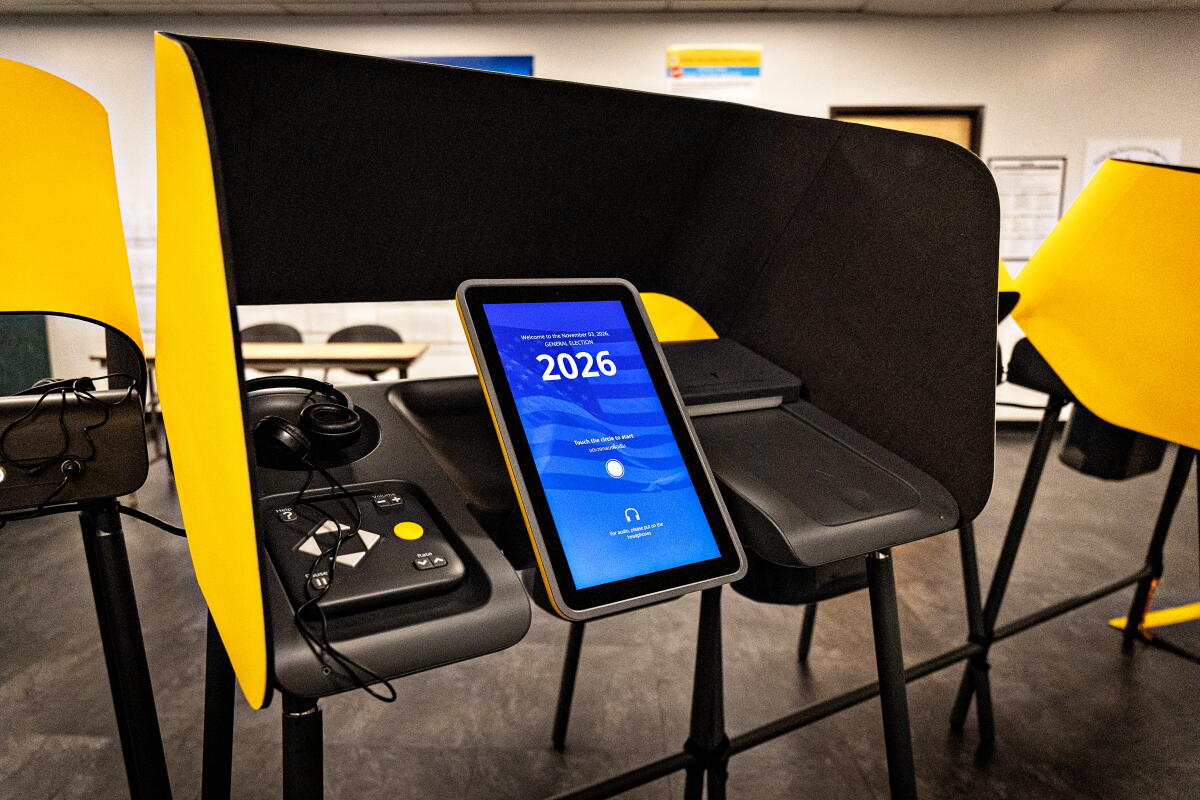
Ballot machines at the Los Angeles County Registrar-Recorder in Norwalk this week. Early voting has started for the 2026 midterm election.
(Jason Armond / Los Angeles Times)
Last week, with mail-in voting already underway, the Justice Department sued California, asking a federal court to bar the state from counting the ballots of 20,000 voters who were flagged by federal officials as “likely noncitizens.” Los Angeles County officials reviewed a sample of 200 of those voter registrations and found that nearly 40% indicated they were born in the U.S.
That number of flagged ballots — 20,000 — is a substantial reduction from the 190,000 noncitizens the administration alleged were on state voter rolls earlier this year, though federal authorities this week said they had found a “separate batch of 17,000 voting records potentially tied to noncitizens.”
California leaders pointed to other states, such as Nevada, where similar accusations have proved meritless.
Murray, the former Homeland Security official, said she believes the administration is “trying to sow the seeds of doubt that the midterm outcomes will be trustworthy, so that if the Republican Party loses as badly as they’re predicted to, they can characterize it as due to fraud.”
Murray said the Trump administration has largely misconstrued what it means to commit fraud.
“Fraud is a very specific thing — it’s essentially lying,” she said. “Because you don’t get asylum does not mean you committed fraud, it just means you were ineligible.”
In September, a Homeland Security whistleblower told Sen. Alex Padilla (D-Calif.) that hundreds of U.S. Citizenship and Immigration Services employees had been tasked with quickly reviewing the voter information of thousands of people in search of suspected noncitizen voters, and were given a quota of investigating 40 subjects per day.
On Wednesday, a federal judge restricted Homeland Security agents from carrying out sweeping field operations aimed at rooting out voter fraud in nine states, including California.
It is against federal law for immigrants who are not naturalized citizens to vote or register to do so. Penalties can include fines, jail time and even deportation, though authorities rarely pursued that option.
Eric Balliet, a former special agent with Homeland Security Investigations, the criminal investigative arm of ICE, said he takes no issue with investigating fraud, but the timing of this operation and significant resources dedicated show it is “highly politically charged.”
Balliet worked for various administrations, including Trump’s first, before retiring in 2024. Homeland Security Investigations agents typically focused on transnational criminal investigations such as drug smuggling and human trafficking.
Instead of initiating investigations based on tips or specific information, agents are now taking aggregated data and using algorithms to produce suspect lists, Balliet said. That’s not how law enforcement should operate, he said, calling it a massive privacy overreach against millions of law-abiding citizens.
“It’s the epitome of Big Brother,” he said.
Beyond the allegations of voter fraud, the Trump administration has also increasingly targeted immigrants on suspicion of lying to obtain a visa, green card or citizenship.
Omar’s family fled civil war in Somalia and immigrated to the U.S. in 1995 when she was 12. After agents searched her residence this month looking for evidence that her immigration paperwork contained falsehoods, she called the allegations baseless.
Last month, Homeland Security Secretary Markwayne Muillin suggested the outcome of the investigation could be deportation. Years ago, the agency declined to move forward with a probe based on similar allegations against Omar, according to the Washington Post.
The congresswoman is not alone.
Emiliano Andrade-Covarrubias, 56, who died of unknown causes last week at an ICE facility in Texas, was arrested because the agency alleged he had fraudulently obtained his green card. ICE sought to deport him, saying he had failed to disclose a 2004 arrest for theft, but his daughter told the Texas Tribune that he did bring up his criminal record during the application process for his permanent residency.
Immigration lawyers say their clients are facing more intense scrutiny and that some have battled false accusations of fraud after applying for a green card or citizenship.
U.S. Citizenship and Immigration Services spokesperson Zach Kahler blamed the Biden administration for lax vetting that allowed bad actors to exploit immigration programs.
“These abuses are not harmless,” he wrote in a statement. “Meritless claims clog the system, drain limited resources, and delay relief for legitimate victims of crime. USCIS is taking aggressive action to identify, expose, and eliminate fraud.”
Erin O’Neil, an attorney based in Connecticut, said some of her clients are now in deportation proceedings triggered by allegations of fraud over minor inconsistencies that have no bearing on the case. In one case that resulted in a denial based on fraud, she said, the allegation was simply that her client failed to disclose a two-week work assignment in another state.
“In the past, the worst that would happen is your citizenship application would be denied,” O’Neil said. “Now we have seen through several of my clients that, not only is the citizenship application denied, but they are placed into removal proceedings.”