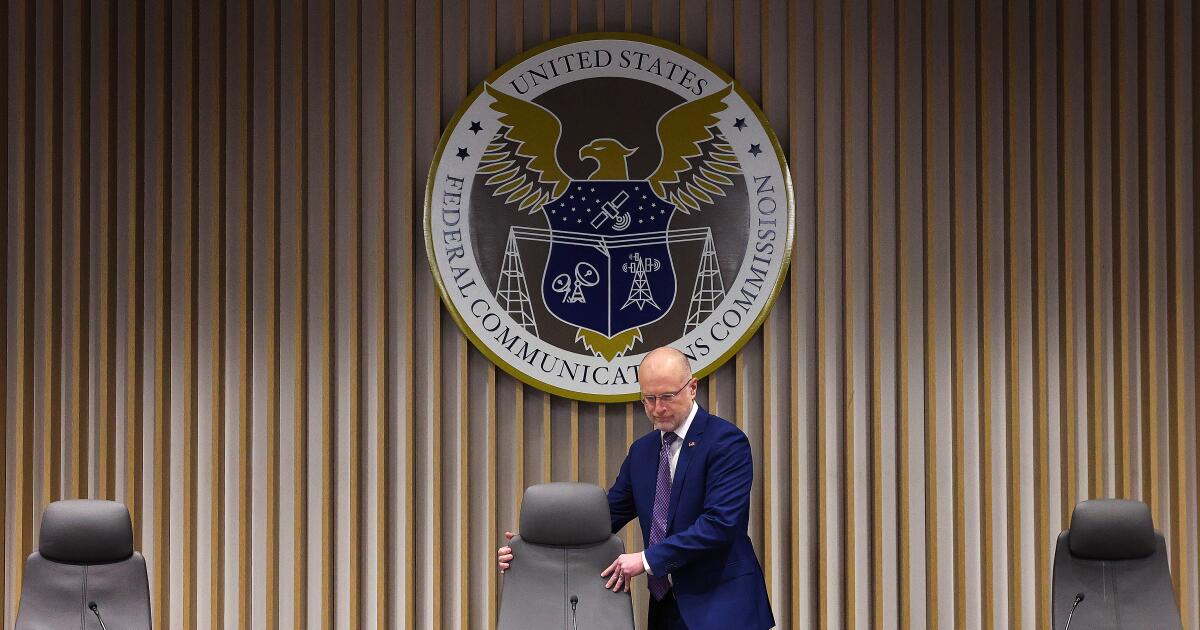
Federal Communications Commission Chairman Brendan Carr is using his bully pulpit to push back against coverage of the U.S. military action in Iran that his boss President Trump doesn’t like, marking an extraordinary escalation in his clashes with the media.
On Saturday, Carr posted a message on X suggesting TV stations could lose their government licenses to use the public airwaves if they “don’t operate in the public interest.”
Underneath his statement, Carr shared a social media post from Trump, who complained about the New York Times and Wall Street Journal stories on the five refueling tankers were hit during an Iranian missile strike on the Prince Sultan Air Base in Saudi Arabia.
Carr seized on Trump’s missive to issue a warning to TV outlets, which are frequently threatened by the president when he is angry at their coverage.
It’s the latest attempt by the FCC chair to apply pressure on media companies that irritate Trump with critical coverage of his administration.
Since becoming FCC chairman last year, Carr has repeatedly threatened to use the levers of power he has to punish TV and radio stations when they get in Trump’s crosshairs. His behavior has alarmed free speech advocates.
“Broadcasters that are running hoaxes and news distortions — also known as the fake news — have a chance now to correct course before their license renewals come up,” Carr wrote, without providing evidence to back up his claims. “The law is clear. Broadcasters must operate in the public interest, and they will lose their licenses if they do not.”
Carr’s threats are based on his assertions that said he wants to enforce the FCC’s public interest obligation for broadcasters that use the airwaves. He made similar remarks in the fall, which prompted two major TV station groups to keep ABC’s “Jimmy Kimmel Live!” off the air for a week due to remarks the host made regarding slain right-wing activist Charlie Kirk.
Trump and Defense Secretary Pete Hegseth have repeatedly attacked news organizations for any reporting that doesn’t say the war in Iran is anything but a rousing success.
On Friday, Hegseth said took aim at CNN and said “the sooner David Ellison takes over that network the better.”
Ellison, the chief executive of Paramount who, along with his father, has forged strong ties to the White House, will have control over CNN in addition to CBS if the company’s deal to acquire the news outlet’s parent Warner Bros. Discovery is completed.
Carr made the appointment of an ombudsman for CBS News a condition to approve Ellison’s Skydance Partners deal to acquire Paramount last year. Paramount also drew scrutiny over its controversial decision to pay $16 million to settle Trump’s legal salvo against “60 Minutes” over the editing of an interview with his 2024 opponent, then-Vice President Kamala Harris. Most legal analysts viewed the case as frivolous.
The FCC has no jurisdiction over CNN, which is why most of Carr’s barbs are aimed at ABC, CBS and NBC, which air on local TV stations. He once wrote on X, “More Americans trust gas station sushi than the legacy national media.”
Trump said in a social media post Sunday that he was “thrilled” with Carr’s remarks and would support his efforts to go after what he called “Highly Unpatriotic ‘News’ Organizations.”
“They get Billions of Dollars of FREE American Airwaves, and use it to perpetuate LIES, both in News and almost all of their Shows, including the Late Night Morons, who get gigantic Salaries for horrible ratings,” Trump wrote.
Andrew Jay Schwartzman, a Washington-based public interest communications attorney, believes Carr’s conduct and threats violate the 1st Amendment, adding that any serious attempt to revoke licenses would be tied up in legal challenges.
“Even if he started to try to deny a license renewal as quickly as he could, Brendan Carr would be long gone before that case would be over,” Schwartzman said. “The law intentionally sets out a very steep burden for the FCC to deny a license renewal; the process takes many years, during which time the licensee continues to operate normally under ‘continuing operating authority.’”
Carr’s remarks Saturday drew immediate blowback from Democrats and 1st Amendment advocates, noting the FCC’s role does not include policing the free press.
“Once again, this FCC pretends it has the power to control news coverage,” FCC Commissioner Anna Gomez said Monday in a statement. “In reality, the FCC has vanishingly little power over national news networks. It licenses local broadcast stations, not networks, and no licenses are up for renewal until 2028.”
Calif. Gov. Gavin Newsom weighed in as well, posting, “If Trump doesn’t like your coverage of the war, his FCC will pull your broadcast license. That is flagrantly unconstitutional.”
Sen. Ron Johnson (R-Wis.), usually a reliable voice of support for the Trump administration, expressed his concerns over Carr’s remarks.
“I’m a big supporter of the 1st Amendment,” Johnson told Fox News on Sunday. “I do not like the heavy hand of government no matter who’s wielding it. I’d rather the federal government stay out of the private sector as much as possible.”
Gomez added that while attempts to pull licenses border on folly, Carr’s threats and attacks on the media can create a chilling effect and erode the public’s confidence in the press.
“Over the past year, this FCC has attacked the media as part of a years-long campaign by this Administration and its allies to discredit factual, independent coverage while blaming the press for growing public distrust,” Gomez said. “Meanwhile, it is the FCC’s own credibility and public trust that are rapidly eroding.”
Trump is not the first president to target TV station licenses in response to negative news coverage. At the height of the Watergate scandal in the 1970s, Richard Nixon’s allies attempted to challenge the TV licenses for three stations owned at the time by the Washington Post.
The effort didn’t get far.
The last Los Angeles outlet to lose its broadcast license was KHJ in 1987, when the station was part of RKO General, a media company owned by the General Tire and Rubber Co. The case was related to corporate malfeasance and not broadcast content on the stations.
The process to revoke the RKO licenses took seven years from the moment the FCC voted in favor of the move.
“Since then, only small mom-and-pop radio stations have been litigated,” Schwartzman said. “The cases nearly always involve lying to the government, felony convictions or failure to pay regulatory fees. In one recent case, a small owner convicted of tax evasion still kept his license.”
There would be other logistical hurdles to the FCC making good on Carr’s threats.
As Gomez noted, Carr’s FCC only has regulatory control over the TV stations that carry the network signals. If stations were drop network programming for any reason, they could violate their affiliation contracts and lose the right to carry NFL football and other content that delivers big ratings and revenue.
Sinclair Broadcast Group wanted Kimmel to apologize to Kirk‘s family and contribute to his organization Turning Point USA before putting the host’s late night show on the air.
That did not happen and “Jimmy Kimmel Live!” returned to Sinclair’s stations anyway.