“I’m not going to start a war. I’m going to stop wars.”
— Donald Trump, in his victory speech Nov. 6, 2024
It’s bad enough that President Trump has broken that oft-repeated pledge and unilaterally started a war, without engaging either Congress or the American public. And that, by his war of choice against Iran, he has in the most perilous way to date betrayed his signature “America First” standard, at least as longtime proponents Marjorie Taylor Greene, Megyn Kelly, Steve Bannon, Tucker Carlson and others mean it, and as many people thought he did too.
What’s even worse than Trump’s mendacity about stopping foreign wars is the broader truth that his war on Iran underscores: In the major theaters of U.S. foreign policy — the Mideast, Europe and Asia — he is essentially letting foreigners set his course, America’s course. And to state the obvious: Israeli Prime Minister Benjamin Netanyahu, Russia’s Vladimir Putin and China’s Xi Jinping do not have America’s interests at heart.
It has long been a defining contradiction of Trump that the wannabe strongman repeatedly shows himself to be in thrall to the world’s actual strongmen. His affinity for them has for years puzzled observers in this country and abroad. Trump strikes a pose — say, on negotiating with Iran about its nukes program, promising peace in Ukraine, hitting China with tariffs — only to crumple after a phone call, a meeting or a slap back from his opposite number.
It’s always hard for a person without a strong core to maintain a stand.
Obviously different factors are at play in Trump’s relationships with Israel, a U.S. ally, with longtime adversaries Russia and China and, more specifically, with each nation’s leaders. But all three cases reflect a personalization of foreign policy that is dangerously unique to Trump. For him, it’s less “what’s good for my country” than “what’s good for me” and “who likes me.” Time and again, he’s been explicit about that.
For all Trump’s cosplaying as a strongman, he shows his weakness as a national leader when he lets foreign counterparts share the wheel with him. As a consequence, he’s driving America erratically at best. At worst, he’s steering into another costly, bloody “forever war” of the sort he railed against for decades.
He’s gone in a direction in the Middle East that, polls show, pluralities or even majorities of Americans didn’t want to go. Trump has received none of the initial rally ’round support that past presidents enjoyed after initiating military operations. That’s a hazardous place to be domestically. Most Republicans are behind Trump on the war, but not by the usual high numbers. After all, it was disgust with forever wars in Iraq and Afghanistan that sent many people flocking to Trump’s “America First” banner to begin with.
For years he warned that other presidents and presidential candidates would start a war in Iran, World War III even. Yet here we are. And after days of what Kelly derided on air as the “10,000 different explanations” that Trump has given for attacking Iran and killing its top political and military leaders, on Monday, Secretary of State Marco Rubio emphatically provided just one: Because Israel was going to strike Iran first, the United States had to join the attack to protect U.S. personnel and assets in the region from Iran’s retaliation.
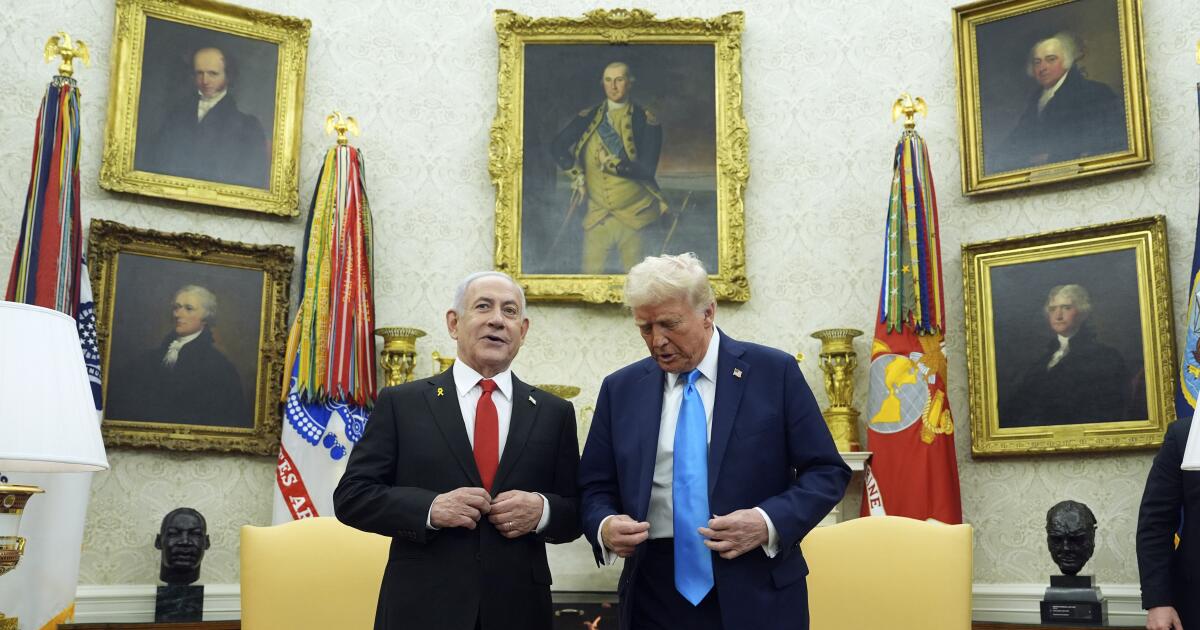
Cue the blowback in MAGA world: “He’s flat out telling us that we’re in a war with Iran because Israel forced our hand,” MAGA pundit Matt Walsh lashed out online. And then Trump contradicted his secretary of State on the rationale for the attacks. Yet Rubio wasn’t the only one citing Israel’s plans as the war’s predicate. So did House Speaker “MAGA Mike” Johnson. On Tuesday, Trump himself said he had to act fast because the Iranians “were getting ready to attack Israel.”
As Democratic Sen. Mark Warner of Virginia, vice chairman of the Senate Intelligence Committee, responded, “If we equate a threat to Israel as the equivalent of an imminent threat to the United States, then we are in uncharted territory.”
Similarly, in June, Trump ordered a devastating one-off strike on Iran’s nuclear facilities to support Israel’s 12-day war against Iran. For months after, Netanyahu hounded Trump to stop the subsequent peace talks with Iran and go back on offense with Israel. So now Trump has complied, striking even as negotiations with Iran were ongoing. Sen. Lindsey Graham, the once respected Republican from South Carolina, offered his sycophantic spin: “Bibi and Trump are the modern Roosevelt-Churchill combination.”
The latters’ grave sites surely trembled.
As for Asia, Trump talks a good game against China, and, yes, he’s imposed big tariffs. But just as often he’s backtracked, often after talking with Xi. Trump’s admiration of the Chinese autocrat and his eagerness to please him is palpable. In fact, in dealing with Xi, Trump in both of his terms has violated his own words in “The Art of the Deal”: “The worst thing you can possibly do in a deal is seem desperate to make it. That makes the other guy smell blood, and then you’re dead.”
No one is more worried about Trump’s regard for Xi than the Taiwanese, living under threat from China. Just recently Trump delayed arms sales to Taiwan approved by Congress lest he upset Xi ahead of their Beijing meeting in April.
In Europe, meanwhile, Trump continues to be played by Putin at the “peace” table to end Russia’s war in Ukraine — the war that candidate Trump said he’d settle in a day. More than a year later, he continues to harangue Ukraine’s Volodymyr Zelensky to make concessions to the invader, never demanding anything from Putin.
Most heinously, Trump’s 28-point “peace” plan last November incorporated everything that Putin/Russia dreamed of extracting from Ukraine, and for good reason: The proposal came from Moscow, passed from Putin’s flunky to Trump’s. That followed Trump’s humiliating summit with Putin last August in Alaska, giving the globally reviled Russian an American stage and pageantry and serving no purpose for the United States, only for Trump the showman. All the while, Russia continued ravaging Ukraine.
So much for Trump’s election promise. He doesn’t stop wars (his repeated claims to the contrary). But he does start them.
Bluesky: @jackiecalmes
Threads: @jkcalmes
X: @jackiekcalmes