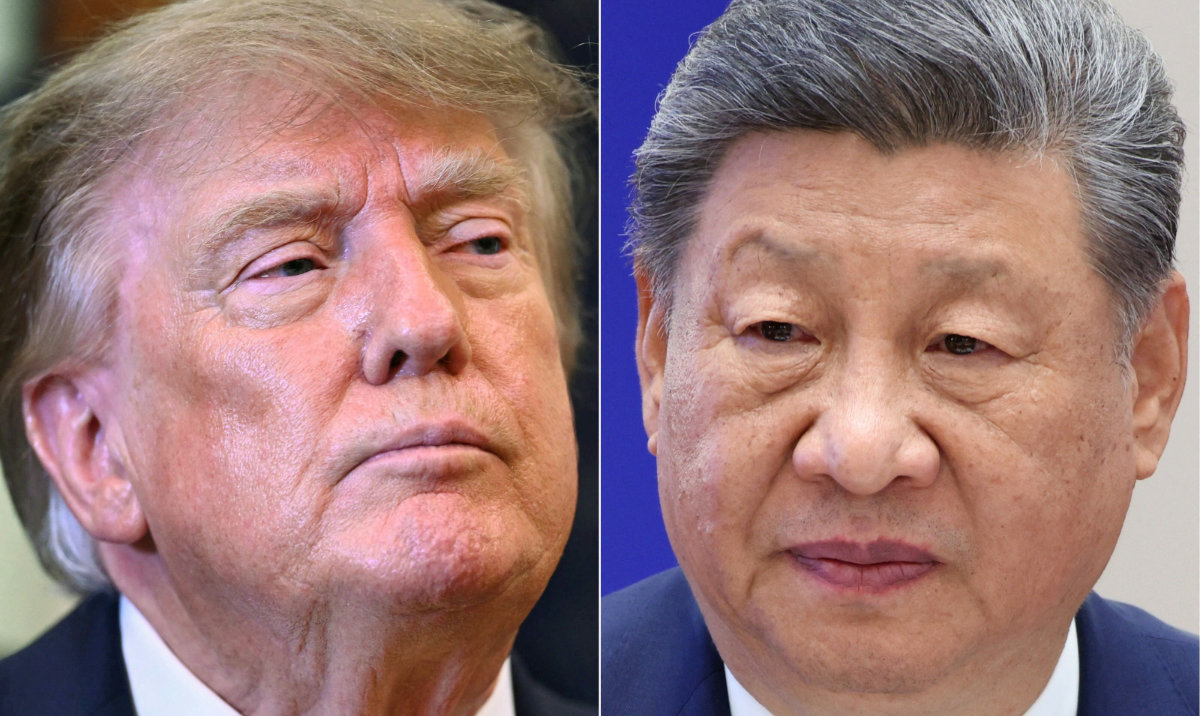
Xi Jinping

China dismisses Vice Minister of Foreign Affairs Sun Weidong | Xi Jinping News

Vice Foreign Minister Sun Weidong’s sudden dismissal comes amid a wave of removals amid anticorruption campaign.

Senior Chinese diplomat Sun Weidong has been dismissed from his post as vice minister of foreign affairs, in the latest case of a high-ranking official being removed from office by Beijing.

The Ministry of Human Resources announced the news in a brief post on its website on Tuesday, citing a decision of the State Council, the highest body of state power in China.

Recommended Stories

list of 4 itemsend of list

The post did not say why or when Sun had been dismissed, but the Ministry of Foreign Affairs website shows his last public engagements were meetings with the ambassadors of Brunei and Malaysia to China on March 13.

Two days earlier, Sun had met Pakistan’s ambassador to China to discuss bilateral cooperation, according to a post on diplomat Khalil Hashmi’s X account.

Dismissals of this kind in the Chinese government usually indicate high-level disciplinary action and are often followed by news of an investigation.

Sun’s dismissal notice included the removal of another official, An Lusheng, from his post as deputy director of the National Railway Administration.

Since coming to power in 2012, President Xi Jinping has carried out a wide-ranging anticorruption campaign targeting “tigers and flies”, meaning high- and low-ranking officials.

Last year, China investigated more than one million corruption cases and disciplined 938,000 people, according to its Central Commission for Discipline Inspection and National Supervisory Commission.

The list of cases involving disciplinary action included 69 provincial or ministerial-level officials, 4,155 bureau-level officials, 35,000 county-level officials, and 125,000 township-level officials, according to the commission’s year-end report.

Senior Chinese military officials have also been caught up in Xi’s anticorruption campaign sweeps.

Source link

Taiwan opposition leader calls for ‘reconciliation’ after meeting Xi | Xi Jinping News

Taipei, Taiwan – Opposition leader Cheng Li-wun and Chinese President Xi Jinping have met in Beijing, where both leaders stated their opposition to Taiwan independence and expressed a desire for a “peaceful” resolution to the long-running dispute over the island’s future.

They posed for photos at the Great Hall of the People and exchanged public remarks, in addition to holding their closed-door meeting.

Recommended Stories

list of 4 itemsend of list

Cheng is the highest-ranking Taiwanese leader to meet Xi since President Ma Ying-jeou talked with the Chinese leader in Singapore in 2015. They met again in China two years ago when Ma was a private citizen.

Both Cheng and Ma are members of the Kuomintang, the conservative-leaning Taiwanese political party that advocates for greater engagement with China by Taiwan’s self-ruled democratic government.

During her public remarks, Cheng stressed that Chinese and Taiwanese leaders should work to “transcend political confrontation and mutual hostility”.

“Through the unremitting efforts of our two parties, we hope the Taiwan Strait will no longer become a potential flashpoint of conflict, nor a chessboard for external powers,” Cheng said, according to an English translation.

“Instead, it should become a strait that connects family ties, civilisation and hope – a symbol of peace jointly safeguarded by Chinese people on both sides,” she said.

Cheng’s remarks were sprinkled with well-known Chinese Communist Party talking points, praising its success in eradicating absolute poverty to its goal of achieving the “great rejuvenation of the Chinese nation.”

“During their open-door meeting, Xi also emphasised Taiwan and China’s shared history and culture, stating that “people of all ethnic groups, including Taiwanese compatriots,” had “jointly written the glorious history of China.”

“All sons and daughters of China share the same Chinese roots and the same Chinese spirit. This originates from blood ties and is deeply embedded in our history – it cannot be forgotten and cannot be erased,” Xi said.

He added that together with the KMT and other members of Taiwanese society, Beijing was ready to “work for peace” across the Taiwan Strait.

Both leaders said they oppose “foreign meddling” in Taiwan-China relations – a reference to US interference – while Cheng suggested that she would slow Taiwan’s military build up, according to Wen-ti Sung, a nonresident fellow with the Atlantic Council’s Global China Hub.

“She talked about the ‘institutional arrangement for war prevention,’ which was a euphemism for saying that under her leadership, the KMT would not be seeking a defence and deterrence-oriented approach to war prevention,” he told Al Jazeera.

The message, in short, was that “Taiwan ought to slow down on defence buildup and buying US arms,” Sung said.

Taiwan’s military expansion has been a hotly debated issue in the legislature, where the KMT has for months blocked a $40bn special budget to acquire US weapons. The opposition party alleges that the defence bill is too large and too vague. It offered a smaller $12bn alternative instead.

Writing on Facebook ahead of the meeting, Taiwanese President Lai Ching-te of the Democratic Progressive Party (DPP) wrote that the KMT continues to “deliberately avoid cross-party negotiations” while delaying approval of the special defence budget.

Lai said that his government also supports peace, but not “unrealistic fantasies”. Despite promises of peace from Xi, China has steadily ramped up its military presence in the waters and airspace around Taiwan in recent years. Since 2022, China’s armed forces have had six rounds of multi-day live-fire military drills in the Taiwan Strait, the 180-kilometre wide waterway dividing Taiwan from mainland Asia.

“History tells us that compromising with authoritarian regimes only sacrifices sovereignty and democracy; it will not bring freedom, nor will it bring peace,” Lai wrote on Facebook.

China accuses the ruling DPP’s leadership of pushing a “separatist” agenda. The DPP advocates for a distinct Taiwanese identity and, over the past decade, has tried to raise Taiwan’s profile on the world stage — which has provoked anger in Beijing.

The Chinese leadership cut off formal contact with Taipei shortly after the DPP came to power in 2016, although it continues to communicate through different groups, including the KMT.

That is partly why Cheng’s trip to China has been viewed with scepticism in some corners of Taiwan, particularly among the ruling DPP.

Speaking to reporters after the meeting, Cheng sidestepped questions of whether she supported Taiwanese and Chinese unification, but said her main goal was to seek “reconciliation” based on shared history and culture.

However, the KMT and the Chinese Communist Party have not always got along.

They fought a bloody civil war from the 1920s to the 1940s during China’s republican era, only pausing to fight the Japanese during the Second World War.

The KMT-led Republic of China government later retreated to Taiwan, a former Japanese colony, in the late 1940s, vowing to one day return to China. The conflict was never fully resolved. The CCP continues to claim Taiwan as a province, and remains committed to annexing it one day, peacefully or by force.

Taiwan’s Mainland Affairs Council – which sets Taiwan’s policy towards China – said this week that Cheng’s talking point that Taiwan and China are “one family” mischaracterises Taiwan’s sovereignty dispute as an internal disagreement rather than one between two governments.

While still formally known as the Republic of China, Taiwan has undergone a cultural and political sea change since democratisation in the 1990s, accompanied by a rise in Taiwanese nationalism.

In 2025, a national identity survey by the National Chengchi University in Taiwan found that 62 per cent of respondents identified as “Taiwanese”, up from 17.6 per cent in 1992, the first year of the survey.

The percentage of respondents who identify as “Taiwanese and Chinese” has fallen from 46.4 per cent to 31.7 per cent over the same period, while respondents identifying as “Chinese” fell from 25.5 to 2.5 per cent.

Source link

Ex-Trump official predicts Trump-Kim summit could take place this fall

Fred Fleitz, former chief of staff of the NSC, predicted Wednesday that U.S. President Donald Trump could meet with North Korean leader Kim Jong-un for a summit sometime this fall. Fleitz made the comment at the Asan Plenum in Seoul. Photo courtesy of Asan Institute of Policy Studies

A former Trump administration official predicted Wednesday that U.S. President Donald Trump could meet with North Korean leader Kim Jong-un for a summit sometime this fall, citing Trump’s continued indications of interest in resuming dialogue with the reclusive leader.

Fred Fleitz, a former chief of staff of the National Security Council under the previous Trump administration, made the remarks as speculation persists that Trump and Kim may resume dialogue around the time when Trump visits China for summit talks with Chinese President Xi Jinping, in May.

“I believe there is a good chance of a Trump-Kim summit this fall,” said the vice chair of the America First Policy Institute at a press event on the sidelines of a forum hosted by the Asan Institute of Policy Studies.

“President Trump has often indicated that he wanted to resume a successful personal diplomacy … It is something that Trump believes in that this was a big success that he has to build upon,” he said.

Fleitz pointed out that although Trump is open to meeting Kim again, he would not back away from the U.S. demand for denuclearization.

“The Trump administration might join talks with North Korea but will be pushing for denuclearization,” he said. “I would strongly advise the Trump administration that another progress should be that North Korea has to stop sending weapons (to Russia for its war) in Ukraine.”

“They are helping a disastrously bloody war and I don’t think it’s a lot to ask for Trump to say that to Kim Jong-un.”

On a similar note, Victor Cha, Korea chair at the Center for Strategic and International Studies, gave an outlook of a “more than 50 percent chance” that Trump will meet Kim, after he meets Xi in Beijing.

“I don’t think Xi Jinping will want a meeting (between Trump and Kim) before his summit with Trump,” he said. “There is a greater than 50 percent chance that they could meet after their (Trump-Xi) meeting in Beijing.”

Cha also noted that unlike the approach to China, Russia or Iran, Trump shows that he puts North Korea in a “different basket” in terms of his potential engagement with Kim.

“I think he clearly wants to engage with him, which is just fascinating,” he said.

Copyright (c) Yonhap News Agency prohibits its content from being redistributed or reprinted without consent, and forbids the content from being learned and used by artificial intelligence systems.

Source link

Trump delays trip to China to focus on Iran

President Donald Trump and China’s President Xi Jinping arrive at a state dinner at the Great Hall of the People in Beijing in 2017. Trump announced Tuesday that he is delaying his planned trip to visit Xi. File Photo Thomas Peter/EPA

March 17 (UPI) — President Donald Trump told reporters Tuesday that he has delayed his trip to China for “five or six weeks” to focus on the war against Iran.

Trump told the Financial Times Sunday that he would postpone the trip if Chinese President Xi Jinping wouldn’t help secure the Strait of Hormuz.

“It’s only appropriate that people who are the beneficiaries of the Strait will help to make sure that nothing bad happens there,” Trump said. He said that 90% of China’s oil comes from the Middle East.

“We’re resetting the meeting, and it looks like it’ll take place in about five weeks,” Trump said. “We’re working with China. They were fine with it.”

The trip was scheduled for March 31 to April 2 and focused on trade.

Treasury Secretary Scott Bessent said Monday that “we will see whether the visit takes place as scheduled,” adding that if the trip were delayed, “it wouldn’t be delayed because the president’s demanded that China police the Straits of Hormuz,” NBC News reported.

After Bessent’s comments, White House press secretary Karoline Leavitt told Fox News that the president’s “utmost responsibility right now as commander in chief is to ensure the continued success of Operation Epic Fury, as he’s doing 24/7 here at the White House and here at home.”

Official Chinese customs data show that in 2025, China got less than half of its oil from the Middle East. Russia supplied just under one-fifth of China’s oil, and sanctioned Iranian oil accounted for 11.5 %.

President Donald Trump meets with Taoiseach of Ireland Micheal Martin in the Oval Office of the White House on Tuesday. They will both attend a Friends of Ireland luncheon on Capitol Hill for St. Patrick’s Day. Photo by Yuri Gripas/UPI | License Photo

Source link

China restarts military flights near Taiwan

Taiwan on Sunday reported a sudden surge in Chinese military aircraft flying near the island and crossing its air defense alert zones after a two week period of relatively few of the flights. The Taiwanese Defense Ministry noted, however, the China’s Navy — its Shandong aircraft carrier can be seen during a Chinese military exercise in 2025 — continued to circle the island daily. File Photo by Taiwan Military News Agency/EPA-EFE

March 15 (UPI) — Taiwan’s defense ministry on Sunday said that more than two dozen Chinese military aircraft and several naval vessels were detected near the island, which comes after a period with relatively few such incursions.

After decreased presence of Chinese incursions into the island’s air defense identification zone (ADIZ) during the last two weeks, China sent 26 aircraft that were spotted around the island – 16 of which violated the ADIZ – and seven naval vessels sailed toward it, The Independent and The Wall Street Journal reported.

China considers Taiwan to be its territory. On a regular basis, it sends military aircraft and naval vessels toward the island, but during 10 of the last 16 days — from Feb. 27 to March 5 and March 7 to 10 — no flights near the island were reported.

On the other days, there were as few as two flights detected.

Taiwan regards the incursions into its airspace and waters as routine harassment, for the most part, but China also has held military exercises close to what Taiwan considers its territory and has threatened to take the island by force if it deems it necessary.

Wellington Koo, Taiwan’s defense minister has said that although there has been a noticeable decrease in aircraft nearing or crossing the ADIZ, the island nation’s military planned to stay on guard.

“We cannot rely on a single indicator like the absence of aircraft,” Koo told The Journal, because naval vessels still circle the island daily.

Analysts have suggested that the decrease in incursions is timed to a meeting of the Chinese legislature, which has happened previously, or be part of a diplomatic or strategic play before U.S. President Donald Trump and Chinese President Xi Jinping meet in Beijing at the end of the month.

An Iranian man raises a portrait of new supreme leader Mojtaba Khamenei during a rally on Revolution Street in Tehran on March 9, 2026. Photo by Hossein Esmaeili/UPI | License Photo

Source link

China’s key NPC meeting comes to a close as lower growth target set | Politics News

The National People’s Congress signals firm stance against corruption as China’s 15th five-year plan is approved.

China’s annual legislative meeting is wrapping up after setting the country’s lowest economic growth target in nearly 30 years, excluding during the COVID-19 global pandemic.

Nearly 3,000 delegates participating in the National People’s Congress (NPC) were due on Thursday to formally approve an economic growth target of “4.5 to 5 percent”, as set out in China’s latest five-year plan.

Recommended Stories

list of 4 itemsend of list

The 15th iteration of the five-year plan, an economic roadmap for 2026 to 2030, also set targets for inflation, the fiscal deficit ratio and urban unemployment.

China has set the longterm goal of becoming a “moderately developed” country by 2035 and raising gross domestic product (GDP) per capita to $20,000. The figure was $13,303 in 2024, according to the World Bank.

Planners in Beijing also continue to grapple with deep economic problems driven by the collapse of the property sector, low consumer confidence and a prolonged period of deflation.

China’s targets for the next five years include industrial self-reliance and increased state support for industries such as AI, aerospace, aviation, biomedicine and integrated circuits, as well as the development of “future energy, quantum technology, embodied artificial intelligence, brain-computer interfaces, and 6G technology”, according to China’s state-run Xinhua news agency.

Beijing also aims to expand the use of the digital yuan, known as the e-CNY, to improve cross-border payments, according to the Reuters news agency. The digital currency is currently under development by the People’s Bank of China, the country’s central bank.

Among the most closely watched elements of the NPC over the past week has been the release of government “work reports” from China’s many government ministries, which give insight into China’s progress in meeting its goals and the direction of its future policy.

The NPC’s Standing Committee released a work report indicating that China will soon pass a law on combatting cross-border corruption, Xinhua said.

The measure is seen as an extension of Chinese President Xi Jinping’s long-running anticorruption drive across the Chinese state, military and private sector.

The campaign appears to be gaining momentum as the Supreme People’s Court, China’s highest court, reported a 22.4 percent increase in corruption cases last year involving 36,000 individuals, according to Xinhua.

The state also recovered 18.14 billion yuan ($2.63bn) as part of its anticorruption crackdown in 2025, Xinhua said.

China’s military also identified combatting corruption as an important target in its annual work report, as well as ensuring political loyalty to Xi and the Chinese Communist Party.

The NPC typically runs for a week, and it is held alongside the Chinese People’s Political Consultative Conference, a political advisory body.

The meetings are known as the “Two Sessions”, and they bring thousands of delegates to Beijing to approve short- and mid-term policy measures.

Source link