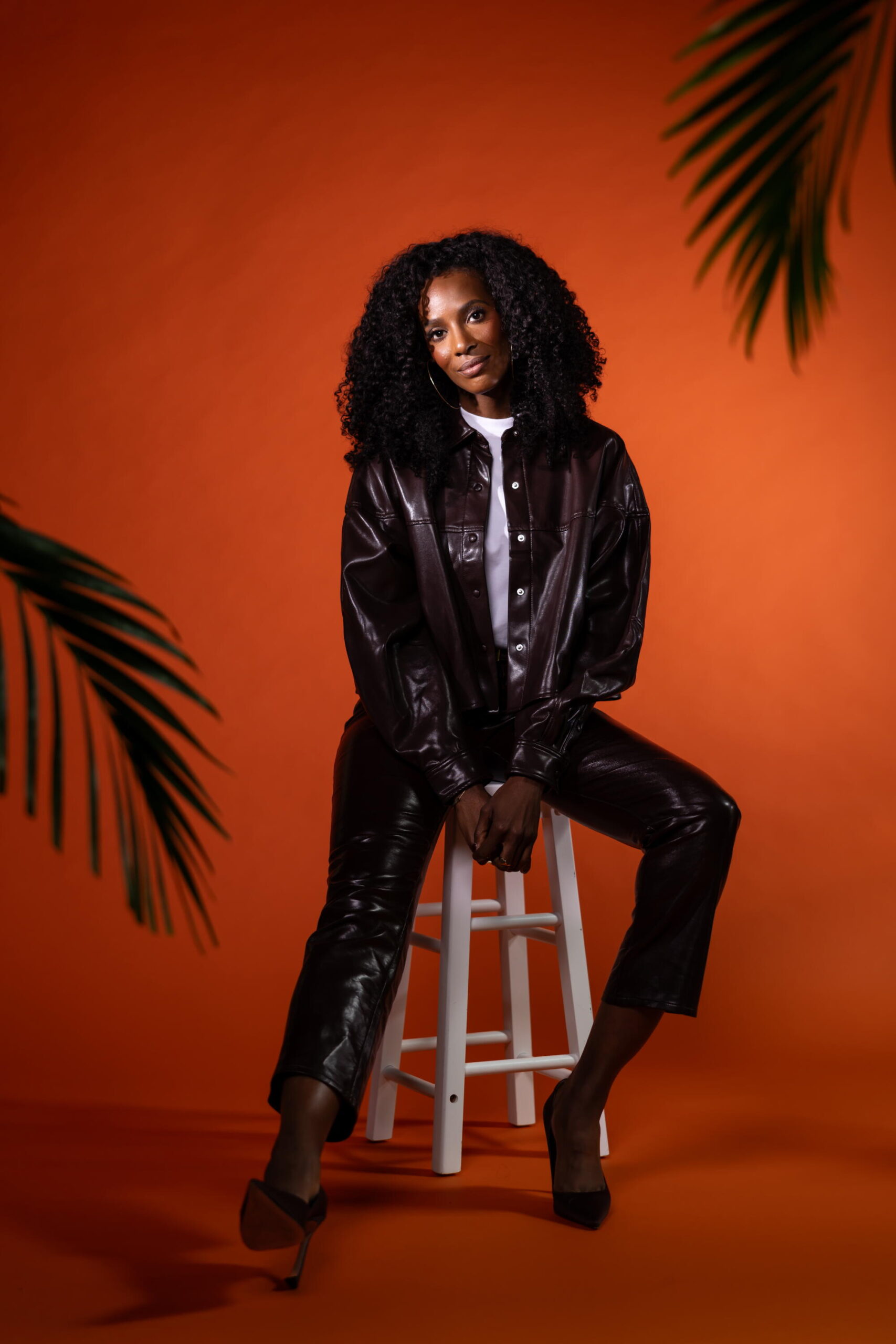
Zainab Johnson believes in optimism — to a somewhat alarming degree. Not just because she usually presents as smart and happy and sharply dressed on stage or because she’s doing incredibly well in her comedy career, or even just because she’s a millennial. She’s happy in spite of every aspect of life that conspires to bring her down because it’s the ultimate power move. From surviving a near deadly car crash that broke both her legs to fighting for every opportunity to become successful in stand-up only to realize there’s more work at the top of the mountain, Johnson’s attitude towards it all has been to keep smiling. It’s no wonder she named her newly-arrived second special “Toxically Optimistic” (the first stand-up special produced by the Obama’s Higher Ground Productions).
But the unbridled joy is also the byproduct of a weight she’s lifted off herself in this new hour on Netflix — the pressure of always having to keep it real in her comedy. As a Black female stand-up it’s the box she says she’s often put in when she goes on stage and audiences are expecting her to air out her true-life trauma and make it funny as if she’s got nothing else to offer. Those who know her know better. Johnson’s mode as a storyteller has always been to dig for the deeper meaning in things, and in this new special she uses an opossum — her unlikely spirit animal — to get the job done.
This conversation has been edited for length and clarity
Having optimism is tough these days, especially for people glued to their algorithms and, of course, watching too much news. Is it a challenge as a comedian to be able to get people out of that and get them into the positive mode of thinking?
It’s not difficult because it’s kind of what they want. People come to comedy shows because they want to feel good. Ultimately, they do want to come to hear you say the things that they can’t say. They want to hear your opinion on the things happening in the world that we’re all experiencing. They want to be affirmed by you. They want to be challenged by you, but ultimately they want to feel good. A comedy club is like a restaurant for the soul. Nobody likes to eat and then not feel good afterwards, right? And so I think that what I do in my comedy is I always like to put medicine in the candy. And “Toxically Optimistic,” is another medicine in the candy.
What were some things that you took from your first special “Hijabs Off” that helped you craft “Toxically Optimistic?”
My first special “Hijabs Off” was me laying the groundwork. I just wanted people to understand my foundation of who I am and know that whatever I give them after that, this is who it’s coming from. I think that “Hijabs Off” taught me to have fun, to really trust myself in the moment. There’s really spontaneous moments that I have in “Toxically Optimistic” and watching at home, you might not know that they’re spontaneous. You might think that I wrote that and I have been performing that all along. Some things in that special that night was the first night I said it… I don’t shy away from things. If anybody watched “Hijabs Off,” one of the most talked about moments was when my hair was like getting unruly because of the temperature in the room, and I can’t see myself, but I could I could feel it, and I called it out in that moment, like comedically. You see everybody on camera all the time, and so it liberated every woman in the room to “OK, good, she knows her hair is going crazy right now.” I was glad that I trusted myself at that moment, and so I just leaned more into that with “Toxically Optimistic.”

Johnson says Black women comedians often face pressure to deliver authenticity and personal meaning, while some white male peers can roam freely into the absurd; her bit nudges audiences to expect more.
(Christina House / Los Angeles Times)
The people that know you now through that special know your story of being one of 13 siblings. If that doesn’t make you funny. I don’t know what will.
A lot of people say “you must be so funny being one of 13.” But I don’t know if that can take responsibility for me being funny.
I think it helps at least when it comes to fighting to be heard. I know because I’m one of a bunch.
How many specifically?
Well, I’ve got four in my immediate group, but my dad had 14 total.
Oh wow, look at papa, a Rolling Stone.
[Laughs] So I understand what it is to like fight for space in the conversation or to do anything. So maybe for you it was something like that?
I definitely think that it is. I can attribute that to being one of 13, being on stage with stand-up. Because with comedy, you could choose improv, you could choose sketch, right? But I think I do like that I’m carving out time almost every night that I get to be the center of attention, whether it’s for 15 minutes at a time or an hour at a time. But yeah I think my family’s so funny. They just don’t have the guts to do it in front of people over and over again, which is why I try to bring them as characters to life on stage. I feel like I might be the messenger.
You talk specifically about one of your sisters in your new special and how close you are with her as well as her mental state.
I think she would be called neurodivergent but I don’t really like that term. Every time I see a movie with “divergent” in it, the divergent is bad. Anytime you see a sci-fi movie and they talking about a divergent, the divergent is like not a good thing.

“I’m not a person that gets on stage and just talks about something for the joke of it,” Johnson said. “I’m always looking not just on stage, but in my life, for the deeper meaning, or the ‘why’ in things.”
(Christina House / Los Angeles Times)
I think it’s worth noting that you don’t necessarily treat your sister any different.
Oh no, no. I talk about that on stage a lot. Like any time we have taboo topics or taboo-like scenarios different from the “norm” we get really precious about it. Even in comedy clubs, people get awkward and stuff. The only way to normalize it is we have to get comfortable talking about like it is not something different. My sister is getting roasted like everybody else. She’s having a say like everybody else. She has a voice like everybody else — and we wouldn’t have it any other way. However, that’s inside the house. Now, outside the house, protection is different. I’m not like, “Oh yeah, you could talk to her like you would talk to me.” No, no, no. Talk to her nicely or you’re gonna have 12 other people to deal with.
In comedy specials there’s a difference between storytelling for a cheap laugh and showing us an allegory or something with a deeper meaning within the story. I love that you take that route with kind of an unlikely character.
I love talking about comedy when you’re not trying to give away the punchline.
I’m trying.
You’re trying to save the bit. Like they gotta go watch the bit. Yeah. But you want to talk about the bit!
What was the key for you about going beyond the joke or the story in that particular part of your special?
I am aware of the point that I’m making. The point that I ultimately end up making, I’m hyper aware of that because I’m living in that every day. Eugene, the opossum [the main character of the bit in question], was something that was really happening to me, and so these were like these two simultaneous situations — what does it mean for me to now be on stage as a Black woman every night trying to deliver comedy, but also I got this wild animal in my backyard every night and like, how am I dealing with this? And at some point on stage, I found the connection. I found it because I’m not a person that gets on stage and just talks about something for the joke of it. I’m always looking not just on stage, but in my life, for the deeper meaning, or the “why” in things. And when I found [it], I know it’s a trip to just give the audience this [wild story] but I’m gonna use it to prove a point. I’m gonna use it to illustrate something that I think is really important for the audience to be aware of. And when I figured that out, I felt really good. Watching it, you’re like “Where is she going with this?” And then when you get there, you’re like “it’s a great destination, thank you so much for bringing me here.”
And I think that destination brings up a big issue about what Black women are and aren’t allowed to say or how they’re “allowed” to be comedic. Why was that topic important for you to put out there to the world?
A few reasons. One, I am an observer as much as I am a doer, and I would be doing these really fun shows with really big comedians…I remember Mark Maron put me on a show with him and Zach Galifianakis, who’s hilarious and can speak very deeply about things in the world. I remember he went out in front of this audience, and I mean the stuff he was saying was so wildly imaginative. I was kind of like, “Hold on a second, they’re not even requiring him to be based in reality.” Like they were eating it up, you know?
And I was like, “What would happen if I did that?” That’s just a question that I asked myself… I watch someone who’s fully capable of being accountable not have to be accountable at all and kill in front of this audience. But the moment I went out there [on stage], I felt the pressure. I don’t know if it’s from me or from [the audience]. I can’t tell. But the pressure is there. It’s pungent, for me, like to “Give us something real, give us something valuable. Tell us who you are.” And [Galifianakis] didn’t have to do that. And I was like, “What does it feel like to not have to do that?”

“I don’t know if I should say that, but sometimes I’m watching things, and sometimes I’m up there as a performer, and I want the audience to want more,” Johnson said. “I want the audience to be smarter.”
(Christina House / Los Angeles Times)
Does the freedom from “being real” as a Black female comedian feel like an unboxing for you?
I think this is an unboxing. I’m naturally so scared to be trapped. It’s crazy because I’m usually not a person that’s trapped, but it’s because I’m so scared to be trapped. But also, the thing that I love about the Eugene [opossum] bit is that I say, you know, that there’s this comedian talking about a horse. A horse is a majestic animal. It’s a respected animal, nobody’s afraid of a horse, people love horses, horses signify beauty. But the opossum? To make an audience love an opossum is very difficult because I would go out on a road, and the moment I would say, “Anybody know what an opossum [is]?” Immediately, the audience would be like, oh, like their reaction to an opossum is like, “Girl, don’t even. I’m not trying to think about that right now. I’m sitting here enjoying some chicken wings at a comedy and you about to make me think about a big a— rat!” So even just to get them to sort of endear an animal that usually gives people a sort of like a reaction of like “ugh,” just that alone is a win for me. But then to turn up the heat and say also, I want you guys to know that I walked you through something that you had no idea that I was walking you through, and here’s why, you know. And I hope that it trains the audience in a way.
I don’t know if I should say that, but sometimes I’m watching things, and sometimes I’m up there as a performer, and I want the audience to want more. I want the audience to be smarter. I want the audience to be more sophisticated. I don’t want them to have less fun. I don’t want them to be less silly. I knew every time I did that bit, I was challenging them without letting them know. Like I’m about to challenge you guys to do something, and when you leave here, I hope that you, you know, I hope that you don’t do it just for me, but every other person that you see that is not a straight cis white male.
I think wanting better for the audience, especially a comedy club audience, is the most toxically optimistic thing I’ve ever heard. But it’s a pursuit I think you’ve achieved. I also walked away with a greater respect and love for possums.
I love that. I think most people do. I was at an event last night, it was an event solely focused on beauty and makeup and that sort of stuff, right? And the amount of women that came up to me and were like, “How’s Eugene?” The special was not out yet at this point, but they saw me working out this bit, And it reminded me of the process. To get up on stage and just do that [bit], it’s not easy. It’s easier to do it once I’ve already given you a full, nice 40 minutes of comedy. Now I’m gonna go into the experiment. But [the women who saw the early version of the bit] reminded me “Yeah, Zainab, you’re bold. You, you’re not doing it the way most comedians do it.”