Genres Book Society, a new bookshop coming to L.A., is hiding a few secrets. The first indication that something a bit fantastical is going on here is the fact that the boutique store has a mascot.
Look up upon entering the space, and you’ll meet Lore. Lore is a dragon, and this dragon is made of books. The striking sculpture will hover over a cozy space with modular bookshelves that are arranged on a floor covered in book quotes. Peer closely and you’ll see the quotes are designed in the shape of a tree.
A story is being built, a narrative that signifies that Genres aims to be not just a bookshop, but a place that feels like a real-life fairy tale. For this bookstore is also concealing a speakeasy of sorts, a secluded cafe and bar with multiple themed spaces and a two-story tree with glowing books growing out of its branches.
Stories, Genres is telling us, are life.
“This is for people who want to enter into story worlds,” says Ann Morrow Johnson of design firm Gensler. Johnson, a former creative with Walt Disney Imagineering, leads Gensler’s entertainment and experiences division, which is designing the bookshop.
She wants guests to feel transported into a fantasy universe, and understands how to make that happen. For instance? “Adding just a little bit of theatricality and sparkle helps create an invitation of suspension of disbelief,” she says.
The centerpiece of Genre’s bookstore, shown in an artist’s rendering, will be a dragon named Lore.
(Gensler)
Genres, on track to open in mid-2027 near the intersection of Melrose and Fairfax avenues, is tapping into a local trend of heavily designed thematic spaces with a penchant for fantasy. Think, for instance, of the Witch’s Cottage in North Hollywood, or the Last Canteen in the shadow of Universal Studios Hollywood. Consider it the latest evolution of the themed restaurant, and a way to bring the heavily theatrical worlds of theme parks closer to home. Johnson, for instance, says the firm’s research with the the Immersive Experience Institute has shown a hunger in younger generations to embrace spaces such as the Rainforest Cafe.
“People are seeking out a moment,” Johnson says. “Those more theatrical, highly scenic spaces are more likely to get you off your phone. Little moments of delight center you.”
Genres was dreamed up Clare Grant and Karissa Marston, who brought the project to Gensler and tapped them to lead its design. Grant, an actor/producer, says the idea came to her while experiencing the regret of missing a retreat hosted by her girlfriends, who had rented a cabin to read the latest edition in the fantasy “Crescent City” series.
“Just having a newborn, I was like, ‘Why can’t I go read this book in a fantasy-themed cabin?’ That’s literally my dream,” Grant says. “Then I started thinking about it. Why don’t I have something like this in Los Angeles, where I can pop in for an afternoon or evening where someone is handing me drinks and food in an immersive space?”
Marston, it turns out, who has experience in hospitality and marketing with an emphasis on fandom, was already dreaming of such a space. The two of them crafted a business plan for a bookstore, one that wouldn’t look out of place in a sword and sorcery fantasy novel, with a hidden speakeasy.
“I was in Paris, and I went to the Shakespeare bookstore, and it was truly the most magical experience I have ever had,” Marston says. “I walked in and felt so immersed in the books and the history and I went up to the second floor and sat up there and wept. I was like, ‘I never want to leave this place. I only ever want to feel this way and be surrounded by books and people who love books.’”
Their vision is grand. The bookstore, they hope, will become a gathering spot for authors in the fantasy and sci-fi realms. And they talk of the speakeasy as not just being a safe eatery to sit and read all day, but also a future venue for, say, immersive theater. The two-story space will house multiple themed rooms, either for hanging out and hiding, or for potential events.
“I think it’s safe to say that if you wanted to be transported to outer space, you would be pleasantly surprised,” Marston says. “Or if you wanted to escape to Dracula’s castle or some of these other really big genres that you have, readers will be pleasantly surprised at the worlds that we are building.”
Johnson says Genres will be flexible enough to welcome introverts who want to dream away the day with a book, but can also be a home for a baby shower in addition to an author signing or a theatrical event. That’s in part why the shop and ground floor of the speakeasy have a familiar fantasy vibe, one not out of place in, say, the fairy tales of the Brothers Grimm, albeit with the welcoming tone of Disney.
Genres’ founders cited “A Midsummer Night’s Dream” as an inspiration for the bookshop’s bar, depicted in an artist’s rendering.
(Gensler)
“The focal point of the space is this sort of epic woodland fantasy,” Marston says. “When we first brought this to Gensler, and showed them our inspo deck, we kept saying ‘A Midsummer Night’s Dream.’”
That’s key, as everything in the space will spring from the written word. Genres, in that sense, also feels refreshing, emphasizing actual books and tactile media at a cultural moment when AI is often dominating conversations. Grant and Marston speak of being influenced by passionate social media creators who celebrate books, wanting to build a community as much as an event space. A prerequisite to be a bartender, says Marston, will need to be a love of books.
“We’re calling all our bartenders book-tenders,” Marston says. “Not only will they be well-versed in all things spirits and cocktails, but they are also someone who can give you the next book recommendation. These are very specialized employees. They can curate cocktails and books for you.”
Consider Genres a place for dinner and drinks, but one where story is always on the menu.
“People are craving more than dinner,” Grant says. “They want experience. They want magical memories that can get them through harder moments because nothing is easy right now. People want to spend money on something that is more than just dinner or going to a bar. Like whimsy.”
Young adult stories come in every imaginable flavor, and flavor combination, and several are present in “Phony,” premiering Tuesday on Hulu. Based on the four episodes (of eight) out for review, I am all in with this show, but as Doris Day so memorably sang, the future’s not ours to see.
Created and directed in part by Nick Paley (“Marcel the Shell With Shoes On”), it’s a mystery driven by an uncanny event, with the beating heart of a high school dramedy, in the sense that what is dramatic about adolescence is at the same time comical. (Given time.) Temperamentally, it’s closer to “Freaks & Geeks” or “Dazed and Confused” than, say, “Stranger Things,” but I also wrote “Robert Altman” in my notes.
To begin, we are in some mountainous slice of small-town Pacific Northwest, where the Canadian tax breaks call American producers across the 49th parallel and the landscape presses in from all sides. (A reference to Lewis & Clark College suggests the story is set in Oregon, but I can’t remember any other clues; also, it isn’t important.) It’s an ordinary world wrapped in mystery and sometimes mist, but it’s the ordinariness that gives the show its power as much as, or more than, the mysteriousness.
Sonny Cooke (Sam Nivola, from the third season of “White Lotus”) attends Delby High, where his mother, Ellen (Connie Britton), is the principal. This would be a nightmare for many teens, but for Sonny and Ellen, it’s more of a dream, as the two are unusually (which is not to say perversely) close. (There is no father in the picture, nor is one even mentioned.) He operates in the corridors as a kind of unofficial lieutenant to his mother, bringing cheer and care to his fellow students, spreading sunshine all over the place. This is a little strange, but he is not accounted a weirdo.
He has a nice girlfriend, Chloe (Mahaela Park), with whom he has just “decided to be official”; Ellen clucks at this — she’s a little protective. Sonny and Chloe call each other “Bobo,” and in a nice, authentic touch we see he has written that nickname in ballpoint pen on the white sidewall of his sneaker. As we open, Sonny and Chloe are planning to have sex for the first time; there is some comedy written around this. He’s the less mature, more nervous party. (He also has a tendency to fall over and bump into things.) His best friend, Vogel (Maliq Johnson), an injured basketball player, is miffed that he had to hear about this from Chloe and not Sonny, but not seriously and only for a moment.
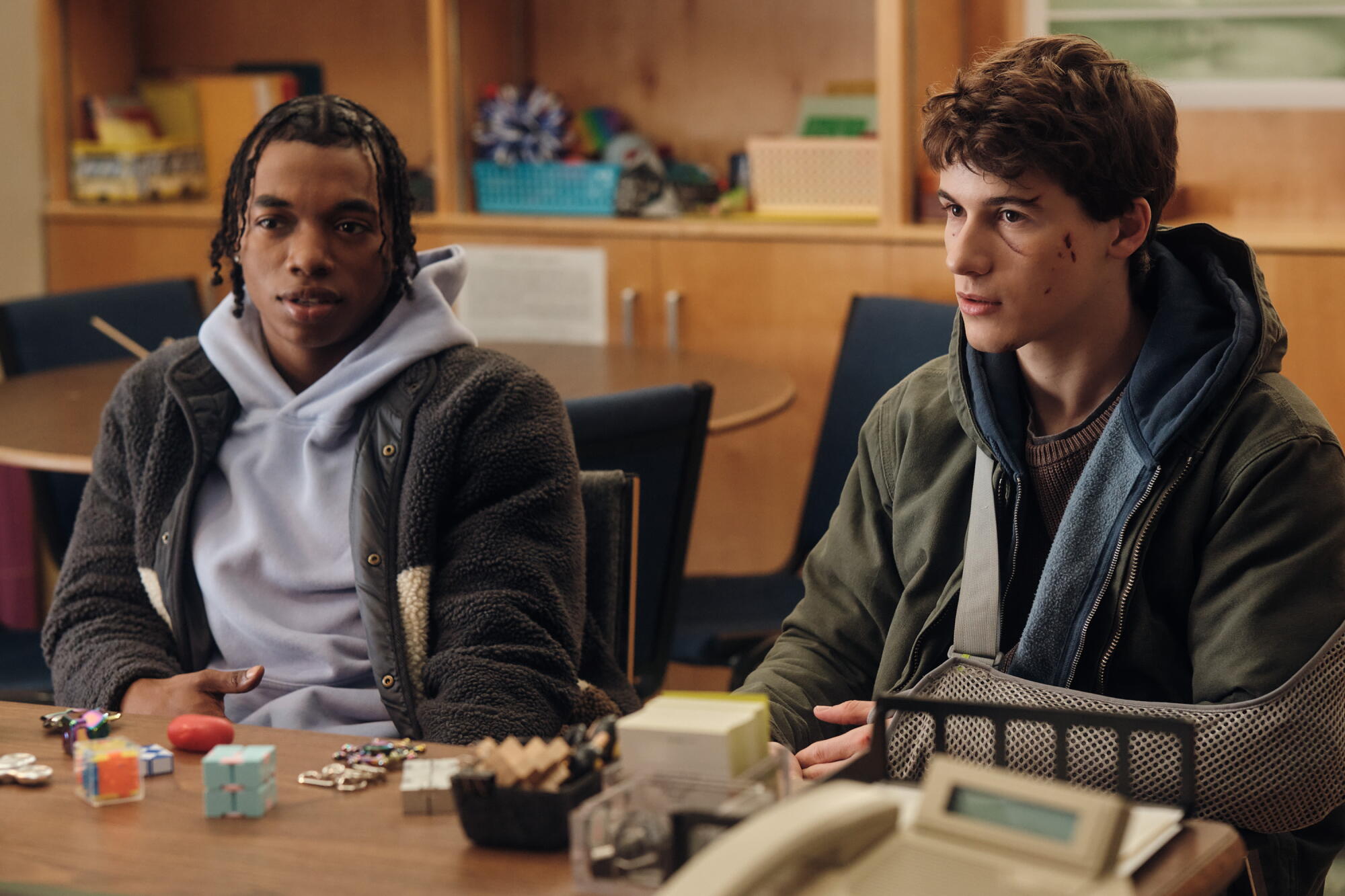
Best friends Vogel (Maliq Johnson), left, and Sonny (Sam Nivola), who is trying to make sense of his feelings about his mom.
(David Astorga / Disney)
Driving to meet Chloe for their Big Night, after a rare argument with his mother, Sonny swerves to avoid a downed tree and drives into Bucket Pond, where an official sign commemorates the many deaths that have occurred there. When he wakes from a coma a week later, he doesn’t recognize Ellen, and you won’t quite either. However it’s been accomplished, by makeup (or an absence of makeup), prosthetics, digital manipulation, hypnosis or some combination of the above — and by acting, of course — this alteration of Connie Britton, a face we know well, is just enough off to be incredibly creepy. (What have you done with Connie Britton? we want to ask.) There is nothing more frightening than when the familiar starts acting strange, in movies or in life. Sonny’s symptoms mirror an actual condition, Capgras syndrome, which no one here mentions, though to be fair, he hasn’t told anyone who might offer that diagnosis, and is too freaked out to look it up himself. Only Sonny and the viewer notice the difference, which suggests that he may be wrong, or, alternatively, that everyone else is.
Completing a not-quite Scooby Gang are Mallory (Grace Brennan), returning to public school after three years of homeschooling, and her cousin Weldon (Colter Lee), a deadpan original turn on the nerd. Sonny and Mallory shared a kiss once, on a class camping trip, but for … reasons, they meet again on tentative terms. Despite or perhaps because of her offbeat upbringing (religious parents), Mallory is the embodiment of the cool girl who doesn’t need to demonstrate how cool she is, and perhaps doesn’t even know or, more to the point, care. In a series thoroughly well cast (by Jessica Kelly and Lisa Parasyn), Lee and Brennan, especially, stand out as originals, their performances drawn from life, or some private corner of their imagination.
Weldon, who is ready to credit Sonny’s story — he believes, for example, that Avril Lavigne died and was replaced by “someone named Melissa, who has a clubfoot” — connects him with Sharla (Meera Syal), a private investigator he knows from an online forum. “She’s into alternative knowledge. So cryptids, One World Order, face peelers…”
“I know what it’s like to be called crazy,” says Sharla, “but all you really need is one person to believe you.”
“Or two people,” adds Weldon.
“Yep, two people. Two weird people.”
Much of what makes “Phony” special happens alongside the main plot, or doesn’t involve any plot at all — it’s pure atmosphere, bits of background business and chatter in the school halls, and at a party in the woods that occupies much of Episode 4. (Nice use of long lenses by cinematographer Andy Rydzewski.) Party scenes are a yardstick by which I measure the authenticity of a teenage movie — are these characters acting their age, or have they been designed to?
With only four episodes available for review, and nothing revealed, it’s impossible to say where the show is going — is it science fiction, or fantasy, or some super-complicated conspiracy, though why such a thing would be constructed around these people is beyond me. There’s a chance it’ll be brilliant, a chance it’ll be less than brilliant, and a greater than zero chance it’ll be dumb, but given the résumés of the co-showrunners Paley and Anthony King — whose credits include “Search Party,”“The Afterparty” and “Broad City” — I expect it to be interesting. Everything so far is so well done, I don’t mind how it ends; I don’t want it to end at all.
As Puerto Rico continues to grapple with the long aftermath of Hurricane Maria — from an unreliable electrical grid to ongoing water shortages — the need for stories that see the island as more than a backdrop feels especially urgent.
That’s part of what makes “Hurricane Seasons,” an intimate new independent film about a Puerto Rican family returning home, feel so timely. The film, which screens Sunday at the Newport Beach Film Festival, stars comedian Aida Rodriguez as Glori, a Brooklyn-based artist and community-center worker. She returns to Puerto Rico to help her sister (Justina Machado) care for their terminally ill mother (Priscilla Lopez).
When their matriarch convinces the family to embark on a bucket-list road trip around the island, old family secrets surface as the 2019 protests following Hurricane Maria unfold around them. Directed by Nicole Gomez Fisher and written by Xavier Ortiz — with Rodriguez also serving as a producer — the film is both a story of a multigenerational family and a love letter to Puerto Rico.
For Rodriguez, who is best known as a stand-up comedian, “Hurricane Seasons” also marked a return to a part of her artistic identity that existed long before comedy — her love of acting. But she admits that stepping back into acting, especially as the film’s protagonist, wasn’t an easy transition.
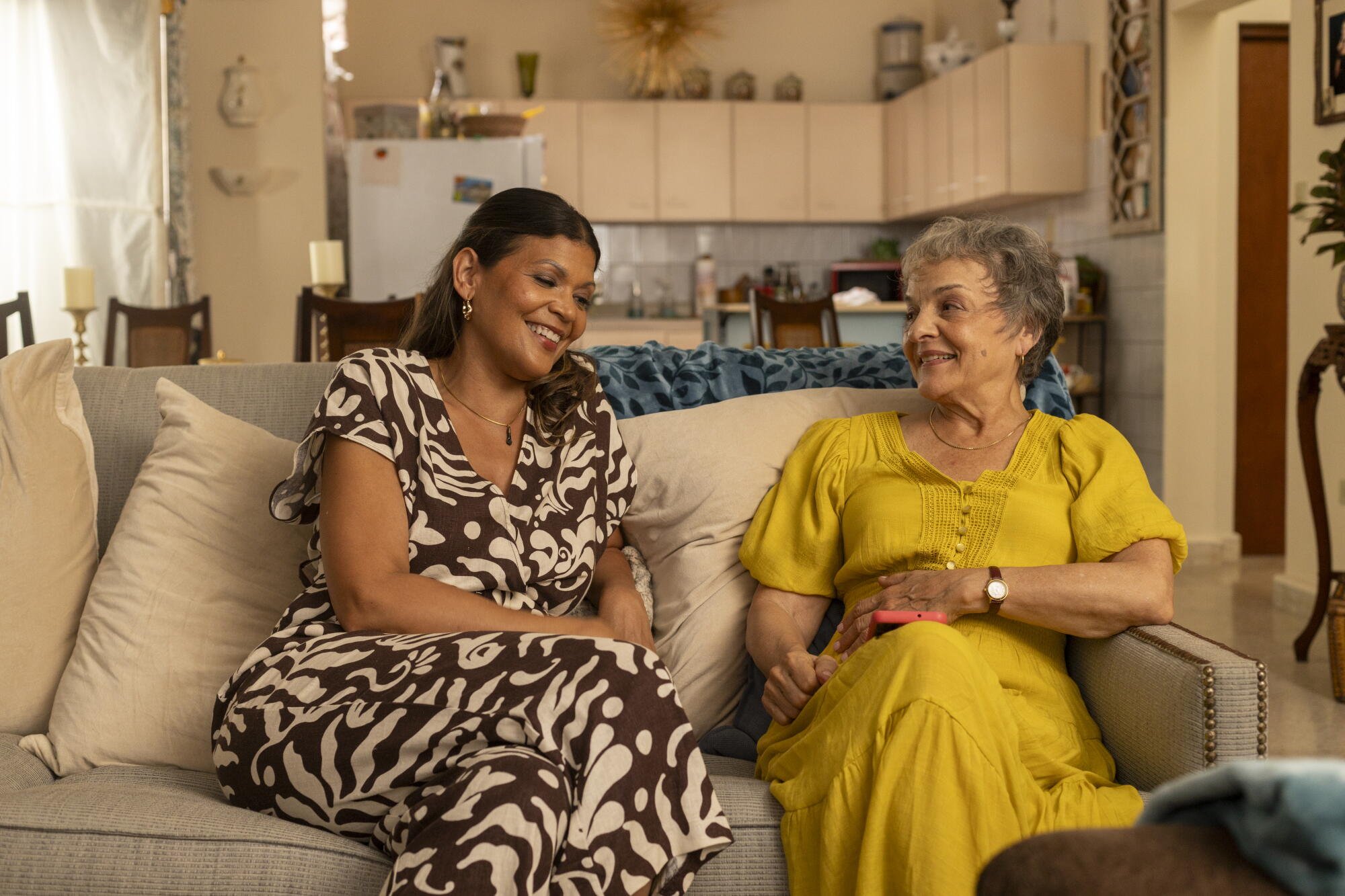
Aida Rodriguez, left, and Priscilla Lopez in a scene from “Hurricane Seasons,” directed by Nicole Gomez-Fisher.
(Laura T Magruder)
“It was terrifying. It was very scary because as a stand-up comedian, I work very hard at trying to obtain my most authentic self so that I can share it with everybody — to be my truest self, my truest Aida,” she says. “And when you loan yourself to a character and the art form of acting, you’re loaning yourself to that character and bringing yourself to that character, of course, because that is why they choose you. But you are telling a story from the perspective of another person.”
Rodriguez had pursued acting before going into stand-up comedy. Upon moving to Los Angeles, she quickly booked acting work, signed with an agency and began taking classes.
But comedy eventually taught her to do almost the opposite of what acting required.
“When I started doing standup, the direction and the notes were always like: ‘Release any character you have in mind and just access yourself,’” she says. “So it was a battle for me. Coming back to becoming an actor and giving the character Glori what Glori deserved — and allowing Glori to live, and Aida to sit in the back — became something important for me to do.”
She adds that it took a lot of work with coaches and classes for her to relax into acting again, allowing Aida the comedian to rest while focusing on what this role required of her.
The film’s protagonist, Glori, is a Brooklyn-born-and-raised Puerto Rican woman whose connection to the island runs deep, despite her living stateside. This is something Rodriguez, who is half Puerto Rican and half Dominican, born and raised in the States, also personally relates to.
That tension — between where you live, where your family comes from, and who gets to decide whether you are “Puerto Rican enough” — is one of the film’s central themes and one reason the script resonated with Rodriguez.
“My testimony through my art has always been finding unity, solidarity, power and connection with other people,” she says. “I think that the story of growing up in the States and connecting to the island is a universal story that most people, regardless of where they come from, experience. [There’s this] idea that you’re never American enough nor whatever you are — in this case Puerto Rican enough — because there’s always a judge and jury on both sides.”
Rodriguez sees those tensions as a consequence of a much larger and complex history. She believes so much of the judgment on both sides is a lingering effect of colonization.
“For me, that was one of the most attractive things about the script — [it] was being able to engage in a conversation about what being Puerto Rican really is,” she says. “Is it based on colonial standards? Or is it based on maintaining our cultural richness and our legacy, that is handed down to us regardless of where we are?”
That question takes on even more weight today as Puerto Rico sits in the aftermath of Hurricane Maria, which Rodriguez believes shifted the relationship between Puerto Ricans on the island and those living stateside.
“There was a shift, because there are wounds from both places,” she says. “There are wounds from the people on the island that stayed and stuck it out. [They want to ask] the ones who left, ‘why do you get to claim this, if you’re not here sticking it out with us?’ Then the people who leave feel like, ‘we had to do this, so that we can not only survive, but send money back to the island.”
Rodriguez explains that, in many ways, the aftermath of the hurricane sparked arguments on both sides that were necessary to begin healing the tension. She believes it highlighted issues that Puerto Ricans, as part of a diaspora, could no longer ignore; it also highlighted an island and a community that Americans outside of the Latine community paid little to no attention to.
“It took a hurricane for people to know what Puerto Ricans were,” she says. “I think there was a cultural shift and there was a conversation that needed to be had, about what happens on the island. And what that means to those of us who are not there.”
That conversation serves as the meat and bones of “Hurricane Seasons,” in which Puerto Rico isn’t simply a location. It’s an integral presence in the story. Rodriguez, Ortiz and Gomez Fisher all agreed that filming most of the movie on the island was essential, not only creatively but also economically and culturally.
“The other thing that was very important about taking the movie back to Puerto Rico was to invest in Puerto Rico and to stimulate some sort of revenues for the island and that the crew was a Puerto Rican crew,” she says. “The DP [director of photography] was a Puerto Rican DP — all people that live on the island.”
It was important to them that if they were going to tell a story about Puerto Rico that was also shot in Puerto Rico, that Puerto Ricans on the island actually benefited from the production.
“It’s not cool to go to Puerto Rico and shoot a movie and bring in your own people from the States, and the people in Puerto Rico have to be inconvenienced with their roads being blocked and things shut down and an influx of Americans that come there to be disrespectful and them not making anything out of it,” Rodriguez says.
This commitment shows in the protest scenes. Rather than using background actors, the film features real Puerto Rican residents, including a local activist and singer.
“It didn’t feel rehearsed. It didn’t feel fake,” she says. “I just think that the feelings and the passion and the rage and the sense of urgency is still there.”
Ortiz’s commitment to specificity extended to the family casting, intentionally matching the actors to the real-life relatives they are based on.
“It wasn’t performative. It was actually real because that’s what all of our families look like,” she says. “Puerto Ricans, Dominicans, we just have that diversity because of all the stuff that’s happened in the past.”
Glori’s character also represents a refreshing departure from the way Latina women are often portrayed onscreen. She is a mother, a daughter, a community center worker, an artist — and a woman with a complicated romantic and family history. She is beautiful and desirable, but her sexuality isn’t the defining characteristic of her existence — something we don’t see enough when it comes to Latina roles.
“For me, I didn’t have to step outside of myself for the role, which was really refreshing because every audition that I ever get, I do have to step out of myself because when people write Latinas in Hollywood, they tend to write them one way,” says Rodriguez. “They look a certain way, they talk a certain way, and that’s not the reality of what being Latino, especially in America, is like.”
Rodriguez could freely inhabit a Latina character without feeling as though she had to perform her Puerto Rican-ness for the audience.
“I didn’t feel like I had to perform my Latinidad. I could just exist in it,” she says.
Rodriguez adds she’s ready for a Hollywood that wants Latina actors to have the same range of characterization that white actors have long been afforded. She’s open to seeing Latinas being everything in TV and film, where can they exist in a world in which they can just be people who just happen to be Latinas.
“I really do look for a day when we can just be people and not just be the funny, spicy friend,” she adds. “Some Latinas are not spicy. Some Latinas are nerds, and some Latinas are quirky, and some of them are goofy and some of them are clumsy. And just like everybody gets to see the spectrum of whiteness with all the different kinds of characters, I would love to see that for our people. For all people of color, actually. I think it’s important to see us all as full human beings, and that means that we can be anything.”
The film’s multigenerational story touches on the cultural inheritance passed between mothers, daughters and grandmothers — whether through old traditions or ordinary rituals. It’s something audiences, regardless of background, can likely relate to.
“The most important message that I’ve kept from my [foremothers] was never to lose my sense of Puerto Rico; that, even if I don’t live in Puerto Rico, Puerto Rico lives in me,” she says. So much of that inheritance lives in the little things she remembers about her Puerto Rican grandmother, she says, from the té de tilo she’d make for an upset stomach; the recao that grew on her grandmother’s balcony because she didn’t have a backyard; or the azabache she still wears to this day for spiritual protection. They are the same small traditions she has passed on to her kids.
“My daughter makes better arroz con gandules than all of us,” Rodriguez says. “And her recipe is true to what my grandmother’s recipe was. That will continue to live on, until we are able to go back to our island and live in peace.”
That freedom is one reason Rodriguez believes independent film is so important for stories like “Hurricane Seasons.” Without a studio machine making decisions based primarily on commercial expectations, filmmakers have more room to tell a story on their own terms.
“Once the studio gets involved, they start thinking about dollars, which they got to make money, but they prioritize the dollars,” Rodriguez says. “And I think that’s why a lot of these big projects that they spend a lot of money on have failed because they don’t honor the storytelling. They don’t honor the authenticity of the world, the authenticity of the stories.”
Her hope is that “Hurricane Seasons” encourages more people to tell their own stories — especially Puerto Ricans.
“Puerto Ricans are not a joke; we’re not a punchline. You don’t get to tell us we don’t speak correct Spanish and make fun of our songs. Then, years later, appropriate our culture and become big time doing what we do, using our terms and our colloquialisms because it brings you capital,” she says. “We are people. We’ve been doing this for a very long time, and our grandmothers and our tias and tios matter, and they’re not [a] costume that you can just put on [to] make money off of it.”
Before we wrapped up the call, Rodriguez paused for a moment when I asked her what Puerto Rico means to her. Then her eyes lit up, and her voice softened as she described why the island means so much to her — and why so many people, even outside of the diaspora, find themselves drawn to it.
“Puerto Rico is a very special place, which is why so many people want to kick us out, so they can move [in],” she says. “But they’ll never have the magic, because the magic is us.”
The first player to celebrate with Lewis Koumas in front of the travelling supporters in Linz was Liverpool‘s hat-trick hero in Bradley Barcola.
This time last season, Koumas was on loan at Birmingham in the Championship while Barcola was at Paris St-Germain, who went on to win the Champions League for the second season in a row.
And as Barcola left the Raiffeisen Arena with the match ball after a superb hat-trick, the Frenchman knew that he wasn’t the only player who put the ball in the net three times on Wednesday in Austria.
Koumas had his first two strikes ruled out for offside, but thankfully it was third time luck for the 21-year-old Wales international.
And so, just three days after making his first Premier League start against Manchester City – with Alexander Isak, Cody Gakpo and Hugo Ekitike all injured – Koumas became the youngest Liverpool player to score and assist in a Champions League game.
Previously, the youngest to achieve the feat had been Steven Gerrard in 2001.
When that was put to him, Koumas wanted to know “Is that official?”.
“It’s not a bad stat, is it?” he said. “And it’s not a bad name to be alongside. Wow. What a legend. I just want more of this.”
He is enjoying his run in the first team but staying level-headed about it all, keen to point out: “This is my job.”
“I need to get goals and assists,” he said. “I hadn’t had any before Linz so it was really important to get them.”
In a Liverpool side where attention tends to be directed towards big-money names, Koumas provides a real feel-good story.
After spells on loan at Stoke, Birmingham and Hull, where he helped the Tigers win promotion last season, Andoni Iraola decided in the first week of pre-season that Koumas was part of his Liverpool plans.
He made his Premier League debut at Newcastle before coming on against Atletico Madrid in the Champions League. He was man of the match on his first start of the season against Tottenham in the Carabao Cup after an energetic performance which left Iraola describing his playing style as “contagious”.
That night, Koumas went straight on a video call with his family after the game and it was the case again in Austria after he scored his first goal of the season.
“It was probably the best feeling in my career, 100%. I’m just really grateful to have the opportunity again,” said Koumas.
“I would not have been a happy man [if I didn’t score], I would have been gutted. I just kept going because I knew the more the game was going on, it was opening up.
“Going over to the fans at the end meant absolutely everything. They are the reason we do this and that we want this job. I wish I could have got in there with them, but there was a big metal cage in the way!”
Remember Edward Warchoki? The Polish humanoid robot that went viral in April for chasing wild boars through a parking lot in Warsaw? Even late-night comedian John Oliver did a bit on him, calling Warchoki “a pretty canny PR campaign for anthropomorphic robots. All I’m saying is, ‘That is a nice way to get us all used to him before he’s inevitably one day used as a weapon of war.’ ”
Warchoki has not yet turned into a weapon of war — unless you consider being an online influencer a form of digital warfare. As the first robot influencer, Warchoki has his own social media accounts and appeared at Poland’s parliament. Last week he entered the art world when he was among the first visitors to what looks to be a fascinating exhibition, “How to Feel Real. Art, Technology and Us,” at MO Museum in Vilnius, Lithuania. The show is a collaboration of the modern art museum with ZKM | Center for Art and Media Karlsruhe, which specializes in media art.
According to a news release, the show “explores questions that are becoming increasingly urgent in a world shaped by technology: How do we feel real, and what does it mean to be alive?” Apparently Warchoki was there to address the issue head on.
“People keep asking me if I’m real, so when I heard about an exhibition asking what ‘real’ actually means, I thought: Finally, someone is asking the right question. I’m coming to the beautiful Vilnius to see what the artists have to say — and, of course, to check whether they think I’m real,” Warchocki said in the release.
A number of works in the exhibit explore artificial intelligence, automation, “and the ways machines are increasingly taking on roles we once considered distinctly human,” said MO Museum director Milda Ivanauskienė. “Bringing Edward into the museum is a playful extension of this idea, as his deliberately human-like and slightly absurd persona makes the questions raised by the exhibition tangible — inviting us to wonder why we are so eager to find the human in a machine.”
I am intrigued by this last question and wonder about it myself: Why exactly are we so quick to anthropomorphize AI? Every time I’ve interacted with a chatbot I feel the urge to be polite in my dealings, to say “please” and “thank you” when I ask questions. I certainly don’t do that with a Google search. And once, when I saw a delivery robot hopelessly stuck in a pothole, I felt genuinely bad for it. “Poor little guy,” I thought. I imagine if I met Warchoki, I’d react the same way.
I’m glad MO Museum is exploring these impulses by using artist’s thoughts and interpretations as a way to offer answers to an issue that is not going away — but only growing more powerful and omnipresent by the day.
I’m Arts editor Jessica Gelt and I’ve got a pickle-kimchi lollipop to sell you. This is your arts and culture news for the week.
You’re reading Essential Arts
Our critics and reporters guide you through events and happenings in the SoCal arts scene. In your inbox every Friday.
By continuing, you agree to our Terms of Service, which include arbitration and a class action waiver. You agree that we and our third-party vendors may collect and use your information, including through cookies, pixels and similar technologies, for the purposes set forth in our Privacy Policy such as personalizing your experience and ads.
The week ahead: A curated calendar
FRIDAY
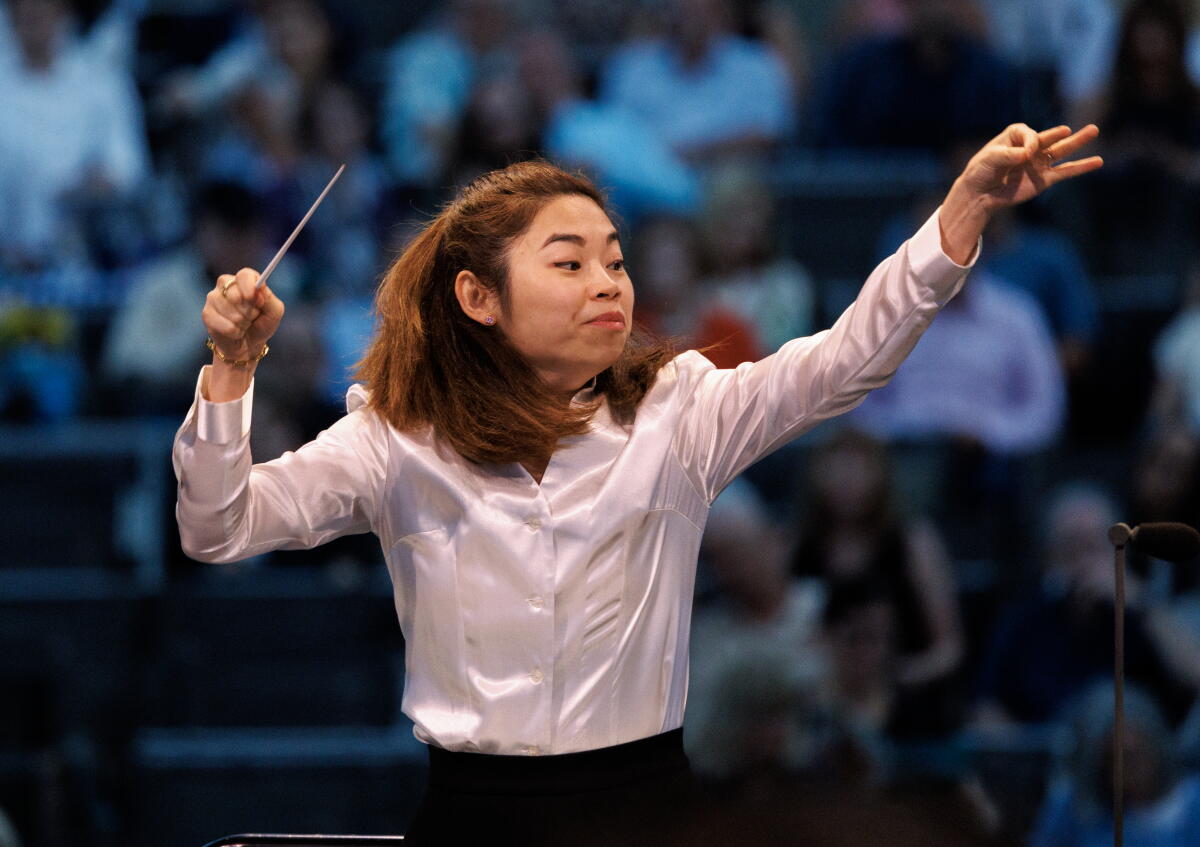
Elim Chan conducts the L.A. Phil in 2024.
(Gina Ferazzi/Los Angeles Times)
Elim Chan Conducts the L.A. Phil It will be a busy couple of weekends in L.A. for the San Francisco Symphony music director-designate. First up is a program featuring Dongshoon Shin’s “Dance Card,” Franz Liszt’s “Piano Concerto No. 2 in A major, S. 125” with pianist Yefim Bronfman, and Pyotr Ilyich Tchaikovsky’s suite from “Swan Lake.” Next week will be “A Symphonic Ballet,” with Claude Debussy’s “Prelude to the Afternoon of a Faun, L. 86,” Karen Gomyo premiering Samuel Adams’ “Violin Concerto No. 2 (The Wheel),” and Igor Stravinsky’s “Petrushka (1947).” “Swan Lake,” 8 p.m. Friday-Saturday, 2 p.m. Sunday. “Symphonic Ballet,” 8 p.m. Thursday, 2 p.m. Oct. 17-18. Walt Disney Concert Hall, 111 S. Grand Ave., downtown L.A. laphil.com
Kuniko Kato Presents Reich90 The North American tour of the Steve Reich Project, conceived and produced by Japanese percussionist Kato arrives downtown in honor of the composer’s 90th birthday. 7:30 p.m. Colburn School, Zipper Hall, 200 S. Grand Ave., downtown L.A. colburnschool.edu
Victoria Marks : A Deer Walks into a Dance The award-winning choreographer and four performers (Rian Alcid, Maya Billig, Karen Chuang and Aaron Mason) explore the idea connection in a world of division via movement, text and the deconstruction of a (bad) joke. 8 p.m. Friday-Saturday. UCLA Nimoy Theater, 1262 Westwood Blvd., Westwood. cap.ucla.edu
SATURDAY
L.A. Opera’s new music director, Domingo Hindoyan, conducts a dress rehearsal of “Carmen.”
(Jason Armond / Los Angeles Times)
Carmen Los Angeles Opera’s new music director, Venezuelan conductor Domingo Hindoyan, opens the company’s season with a new production of Bizet’s “Carmen.” It stars mezzo-soprano Rihab Chaieb, who has dazzled in Mozart at L.A. Opera. The Spanish gothic new production is by director/designer Thaddeus Strassberger and choreographer Antonio Najarro. (Mark Swed) The season-opening performance will be broadcast live in high definition, free of charge, at Steinmetz Park in Hacienda Heights and at the Santa Monica Pier. Through Nov. 7. Dorothy Chandler Pavilion, 135 N. Grand Ave., downtown L.A. Free simulcast, 6 p.m. Saturday, Santa Monica Pier and Steinmetz Park, 545 S. Stimson Ave., Hacienda Heights. laopera.org
Strauss, Ravel, Beethoven Music Director Jaime Martín conducts the Los Angeles Chamber Orchestra in Richard Strauss’ “Metamorphosen,” Maurice Ravel’s “Piano Concerto in G Major” with Conrad Tao, and Ludwig van Beethoven’s “Symphony No. 3 in E-flat Major (Eroica).” 7:30 p.m. Saturday. Zipper Hall, 200 S. Grand Ave., downtown L.A.; 4 p.m. Sunday. The Wallis, 9390 N. Santa Monica Blvd., Beverly Hills. laco.org
SUNDAY
Dale Brockman Davis, Alonzo Davis and David Hammons.
(Museum Associates)
The Brockman Gallery: Los Angeles,1967-1990 For more than two decades, the Leimert Park gallery, founded by Alonzo and Dale Davis, served as a vital cultural hub, staging exhibitions, festivals, concerts, literary events and more. Named after the brothers’ maternal grandmother, born enslaved, the Brockman Gallery was a flourishing, ongoing act of self-determination in the wake of the 1965 Watts Rebellion. It showcased Black artists whose opportunities were severely limited at mainstream, white-run institutions and galleries: David Hammons, Suzanne Jackson, John Outterbridge, Elizabeth Catlett, Betye Saar, Carrie Mae Weems, Senga Nengudi, Noah Purifoy and many more. More than 60 works by artists associated with the gallery will be included in this first full-scale consideration of the Brockman’s scope and impact. (Leah Ollman) Through Jan. 24. Los Angeles County Museum of Art, 5905 Wilshire Blvd. lacma.org
Pacific Jazz Orchestra: A Tribute to Quincy Jones Led by Chris Walden, and featuring vocalists Nayanna Holley and Adam ‘Aejaye’ Jackson, the ensemble performs early work by the late producer/composer. Presented by Ventura Music Festival, 3 p.m. Sunday. Rancho Campana Performing Arts Center, 4235 Mar Vista Drive, Camarillo. pacificjazz.org
TUESDAY
Mendelssohn & Brahms Members of the Los Angeles Philharmonic perform a program of chamber works from Joseph Haydn, Felix Mendelssohn and Johannes Brahms. 8 p.m. Walt Disney Concert Hall, 111 S. Grand Ave., downtown L.A. laphil.com
Ulysse Marion A new work by choreographer Dimitri Chamblas, created with former Paris Opera Ballet dancer Marion Barbeau and dancer and musician Ulysse Zangs, explores the journey of a performer throughout a life in art. 8 p.m. Tuesday-Wednesday. REDCAT, 631 W. 2nd St., downtown L.A. redcat.org
THURSDAY
At the Very Bottom of A Body Of Water The latest work by Benjamin Benne, a dramatist many have been keeping close tabs on, continues his collaboration with veteran director (and fellow L.A. native) Juliette Carrillo, and dives even further into magical realism in an unconventional work exploring the oceanic depths that grief can reveal. (Charles McNulty) Through Nov. 29. Boston Court Pasadena, 70 N. Mentor Ave. bostoncourtpasadena.org
Judy Baca, detail from the 1960s segment of the Great Wall of Los Angeles mural.
(Judy Baca and the SPARC Archives.)
Skirball Cultural Center Three new exhibits open: “The 1960s — A Generation on Fire: Judy Baca’s Great Wall of Los Angeles” presents new murals as part of the evolving L.A. landmark; “Patrisse Cullors: Wishes Made Material” features three new works inspired by conversations between Black and Jewish communities; and “Jenny Yurshansky: What We Carry” explores local immigration stories, memories and family history through collected objects. Skirball Cultural Center, 2701 N. Sepulveda Blvd. skirball.org
The SoCal scene
Zoe Ryan, director of UCLA’s Hammer Museum.
(Christina House/Los Angeles Times)
ICYMI, the best of this week’s L.A. Times arts coverage:
Climate activists in Tallahassee this week unveiled a statue of Florida Gov. Ron DeSantis that was created to melt. “In response to the Governor’s recent ‘Don’t say climate change’ action in state law, 350Action (one of the world’s most influential climate change advocates) built quite a visual — a statue that couldn’t withstand Florida’s daily climate. It’s provocative but for a purpose, to encourage young people to vote in a few weeks for candidates that recognize the threat from climate change,” a news release noted of the “climate denial statue.”
And finally, not strictly arts related, but some Halloween fun for you: Street Food Cinema is hosting its annual Boo-ze, Bites and Frights events with some spooky horror film screenings at Heritage Square and the Ford over the next few weekends, including a Saturday showing of “A Nightmare on Elm Street,” which is a film that still genuinely terrifies me.
Netflix subscribers have been urged to check out a ‘heartbreaking’ true story that has been compared to Green Mile – but be warned as it’s said to be ‘one of the saddest films to ever exist’
Netflix viewers have been urged to check out the movie(Image: NETFLIX)
Netflix viewers have been left in floods of tears after watching a ‘hidden gem’ tucked away on the video streaming platform. Luke Eccleston, who reviews movies and television shows on social media, is urging Netflix subscribers to check out a ‘heartbreaking’ true story that’s perfect for Green Mile fans.
Luke, who posts under the username Eccy Reviews, said on TikTok: “I’m not saying this lightly, but you need to run to Netflix immediately because I’ve just discovered the biggest hidden gem. I’ll be very surprised if you’ve seen this film, and once you have, you will never, ever forget about it. The film that I’m talking about is called Miracle in Cell No 7. Now, if you’re someone who’s seen this film, you’ll know that this is one of the saddest films to ever exist.”
Ensure our latest headlines always appear at the top of your Google Search by making us a Preferred Source. Click here to activate or add us as Preferred Source in your Google search settings…
Content cannot be displayed without consent
‘This is one of the saddest films to ever exist’
Based on the the Korean movie Miracle in Cell No 7, it tells a story of love between a mentally-ill father who was wrongly accused of murder and his lovely six-year-old daughter.
Luke added: “It is actually based on a true story. This follows this man with special needs who has this younger daughter.
“After an incident where another little girl is killed, he is framed and sent to prison. He is sentenced to death. The people in the prison believe that he did the things.
“What he is accused of and the things they do to him is honestly awful. After time, they begin to realise who and what he is.
“The story, what comes out of it is genuinely incredible. I was shocked so many times watching this film. I was in so many tears.
“I’ve recommended this to so many friends, and every single person who’s watched it has said that they cried.”
‘I loved this movie, cried and cried’
Starring Aras Bulut Iynemli, Nisa Sofiya Aksongur, and Deniz Baysal, the movie has won 12 awards alongside its 13 nominations.
Commenting on Luke’s video, one user said: “Just put it on, I’ve got my tissues ready.”
Another user added: “Similar to Green Mile.”
A third user said: “I loved this movie, cried and cried. Amazing!”
Netflix replaced one of its top executives in a major management shake-up on Thursday, a day after the company announced it was laying off 6% of its staff.
Chief Content Officer Bela Bajaria is leaving the company after a decade, Netflix said in a statement. She will be replaced by former Disney executive Peter Rice, who was most recently chairman of Walt Disney Television and chairman of general entertainment for Walt Disney Co.
“Peter is one of the most effective at-scale operators in the entertainment industry,” Netflix Co-Chief Executive Ted Sarandos said in the statement. “His business acumen is sharp, his talent relationships are exceptionally strong, and his experience across TV and film is deep and broad.”
Bajaria’s exit comes as Netflix has been under pressure from investors to turn out more hit shows and movies and increase the amount of time consumers spend on the platform amid rising competition from other streamers.
“Due to the slowdown in massive hits and viewer growth, an ax was gonna fall on some executives who led content strategy,” said Ross Benes, senior analyst at research firm Emarketer.
Bajaria oversaw the teams responsible for Netflix content around the world. She joined Netflix in 2016 and was named chief content officer in 2023. She was instrumental in expanding Netflix’s reach internationally and the streamer’s push into live events.
Hits released on Netflix during Bajaria’s tenure include the 2025 animated movie “KPop Demon Hunters” and crime drama series “I Will Find You.” Under her leadership, Netflix grew its reach in live programming, streaming NFL games as well as WWE matches. The company also changed its film strategy to focus on fewer movies that aimed to be bigger and better.
She also played a key role in helping Netflix generate large audiences for its non-English-language original series, reality shows and programs that featured talent from underrepresented communities.
But her tenure also coincided with mounting challenges to growing Netflix’s business.
Free, ad-supported streaming services like YouTube are increasingly taking up more streaming hours and investors are concerned about how Netflix will continue to grow. YouTube represented 14.2% of streaming time in the U.S. on TVs compared to Netflix’s 7.8% in July, according to Nielsen data.
Netflix has said efforts like live programming have been successful at getting significant subscription sign-ups. While live programming represents 5% of Netflix’s content budget, it holds 1% of watch time on the streaming service, Sarandos has said.
The company also was poised to buy Warner Bros. Discovery, which would have dramatically increased its library of content, but Netflix bowed out of the auction after the price became no longer “financially attractive.”
Netflix stock has declined 40% from a year ago. Shares closed Thursday at $72.61, up 3%.
“The drop in share price has been staggering,” said Stephen Galloway, dean of Chapman University’s Dodge College of Film & Media Arts. “That plunge, plus the negative reaction to its move to buy Warner Bros. left it vulnerable, and so you have to do two things. One is right the ship, but you also need to send a message to shareholders that you’re taking action.”
In a memo to staff announcing the change in leadership, Sarandos wrote, “I know this is a big change in a year that has already had its share. But I also see an opportunity to take our slate to the next level, especially in UCAN [U.S. and Canada] where we have an outsize impact in creating big, buzzy hits that our members love and drive conversation around the world.”
Rice is an experienced corporate executive who spent nearly three decades navigating Rupert Murdoch‘s media empire, serving as president of 21st Century Fox and CEO of Fox Networks Group.
He also brings deep roots in the feature film world, having previously run Fox Searchlight Pictures, which could mean he will want to put his own stamp on Netflix’s film group, Galloway said. That group is currently led by executive Dan Lin.
“Netflix has fundamentally changed the way stories are made, shared and experienced around the world,” Rice said in a statement. “They’ve shown again and again that they’re willing to take chances on distinctive voices and fresh ideas, and I’m excited to work with the team to help bring even more great stories to members everywhere.”
A round-faced man with dark-rimmed glasses, a moustache and short-trimmed hair, Ismael came to the US when he was only five years old.
Southern California became his home, and as an adult, he qualified for the Deferred Action for Childhood Arrivals (DACA) programme, which offered temporary protection against deportation.
He lost his DACA status, however, in 2015 after a conviction for driving under the influence.
His family remembers him as a caring son and uncle, always willing to buy his niece and nephew new clothes or school supplies.
“Ismael was always looking after his siblings. He just had a big heart,” said his brother, Jose Miguel Ayala. “He was very protective of not just us, but my mum and dad too.”
He was 39 years old when he was brought to the Adelanto ICE Processing Center.
Two weeks after his arrival, Ismael told his family that he developed a high fever and a painful sore on his backside.
On September 18, 2025, workers at Adelanto initiated a Code Blue alert for Ismael, signalling a life-threatening medical emergency. Medical staff rushed him from his dorm to the infirmary in a wheelchair.
ICE documents show that Ismael was given pain medication, an ointment and a fibre supplement.
But according to Physicians for Human Rights’ Cuneo, who reviewed the case, Ismael should have received a physical examination and antibiotics.
“That is a major failure,” Cuneo said.
Demonstrators leave white flowers outside the Adelanto ICE Processing Center on September 29 in solidarity with those detained inside [Jill Connelly/AP Photo]
That weekend, hours after Lucia’s visit, Ismael’s condition worsened. Just after midnight on Sunday, ICE records say he was vomiting, shaking and sweating.
According to ICE documents, he was later sent to an intensive care unit, where he went into cardiac arrest within minutes of his arrival and subsequently died.
“I believe Ismael’s death could have fully been prevented by timely care,” Cuneo said. “It was a simple abscess that was not treated in a timely manner.”
Fault Lines obtained a coroner’s investigation that reveals Ismael was critically ill when he first arrived at the hospital, a fact that was left out of ICE’s public report on his death.
The coroner’s report also contradicts ICE’s timeline for Ismael’s death. It indicates Ismael went into cardiac arrest early on September 21, nearly a full day before he passed away. Medical staff, however, managed to restore his heartbeat after intubating him.
That conflicts with ICE’s report, which only notes his pulse stopping once: shortly before his death was announced on the morning of September 22. ICE described his condition on September 21 as “calm and cooperative”, but it signalled no heart problems.
“If they had given him the medical care and what he needed, maybe he would be here with us,” Lucia said.
In a statement about Ismael’s death, ICE said detainees receive “comprehensive medical care” throughout their time in custody.
But California’s Attorney General Rob Bonta told Fault Lines that his office found “the exact opposite” during its inspections of the state’s detention centres.
“We’ve gone to these facilities. We’ve gone into Adelanto. We have done our own physical inspections,” Bonta explained.
“If what the ICE spokesperson said was true, Mr Ayala-Uribe would be with us today.”
An internal mortality review committee also found that the care provided to Ismael at Adelanto “deviated beyond safe limits of practice”, according to a document obtained by US media earlier this year.
It also suggests that medical staff delayed responding to calls about Ismael’s declining health in the days leading up to his death.
LONDON — It’s the day after the London premiere of “Sense and Sensibility,” and its stars, Daisy Edgar-Jones and Esmé Creed-Miles, have shed the glamour of the evening before. Both are curled in chairs in an otherwise empty room in an upscale Hyde Park Corner hotel, modestly dressed in jeans, sneakers and casual tops. Each drinks from an enormous glass bottle of water rather than wasting time with a cup.
The spectacle of a blockbuster red carpet is familiar for Edgar-Jones, whose career took off after the 2020 limited series “Normal People” and has since included “Where the Crawdads Sing” and “Twisters.” But last night marked the biggest such occasion so far for Creed-Miles, best known for the Prime series “Hanna.”
“I was a bit nervous with my friends and family all there,” admits Creed-Miles, who plays the more emotional of Jane Austen’s Dashwood sisters, Marianne. “I’m very lucky because Daisy has done it before and she’s so cool about it.”
“Absolutely not,” says Edgar-Jones, who plays the sensible Elinor. She grins sheepishly. “If anything, I think I’m getting more nervous.”
Both actors understood the high stakes of remaking Austen’s 1811 debut novel, most famously adapted in 1995 by screenwriter and star Emma Thompson and director Ang Lee — a movie that became a generational touchstone nominated for seven Oscars. The new version, in theaters Friday, was adapted by Diana Reid and directed by Georgia Oakley, best known for her evocative 2022 feature debut, “Blue Jean.”
Oakley wanted to re-create the emotions of reading the book as a teenager.
“In comparison to other Austen novels, I remember it feeling quite wild,” Oakley says, speaking separately over Zoom. “I also wanted to capture the spirit of the two older sisters as the beating heart of the story. My memory of it was that their story was the main love story of the book.”
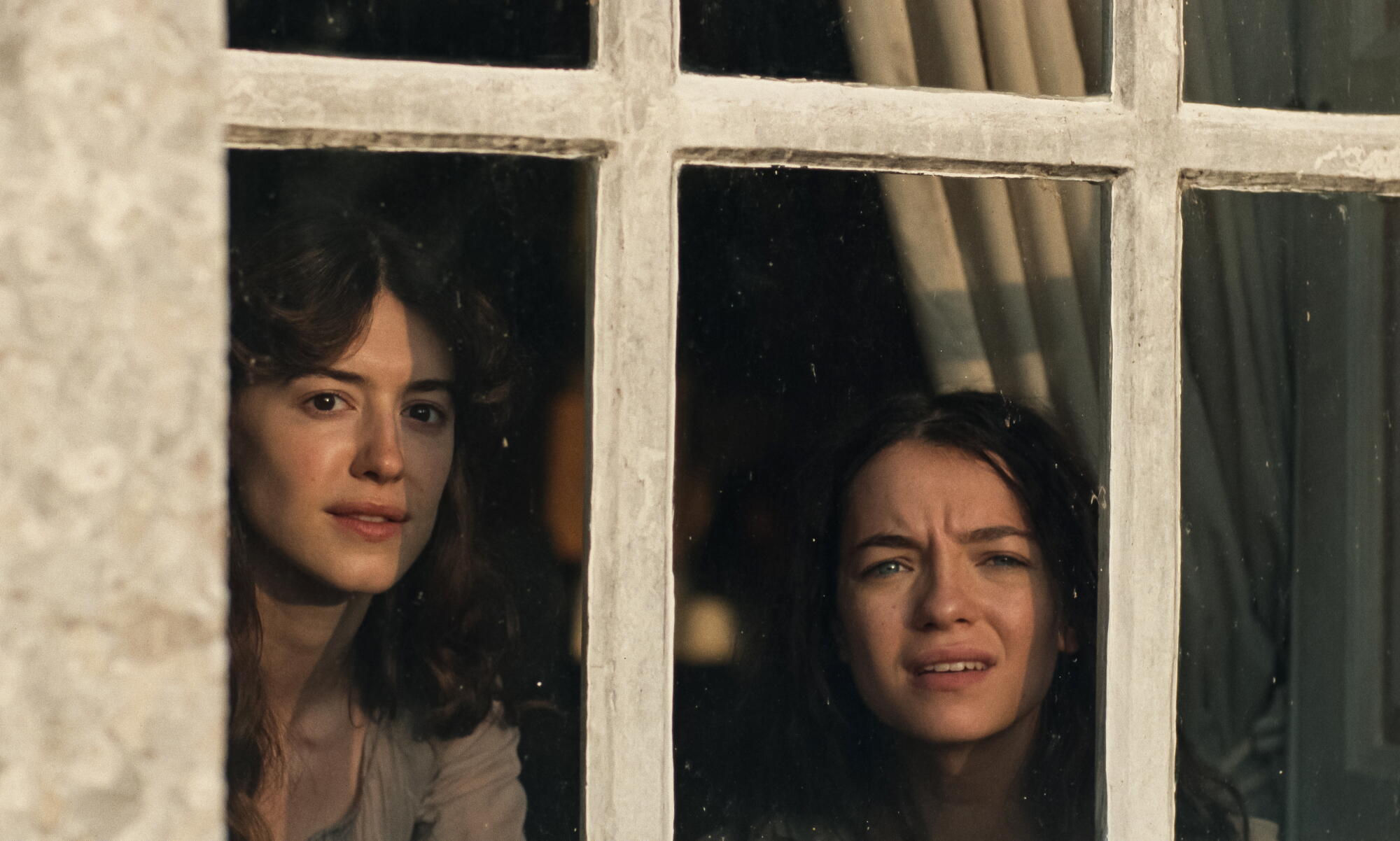
Daisy Edgar-Jones, left, as Elinor and Esmé Creed-Miles as Marianne in a new version of “Sense and Sensibility.”
(Focus Features)
Oakley’s “Sense and Sensibility” emphasizes that relationship between Elinor and Marianne. Although they approach the world differently, they find common ground in each other. It was essential to find the right actor for each role, but also to ensure there was both tension and chemistry between them. Edgar-Jones, 28, was cast first without an audition. There was never any question as to which sister she would play.
“I have played a significant Marianne before,” Edgar-Jones says in a nod to affluent, tortured outcast Marianne Sheridan, her role in “Normal People.” “And I love both characters, but I’m moving into my late 20s now. Elinor has a maturity and a wise older soul quality that I really liked and felt I was right to occupy. I have always been attracted to characters who don’t necessarily have the words to express how they feel.”
Oakley appreciated Edgar-Jones’ restraint. “She is able to show so much by seemingly doing very little,” Oakley says. “Elinor has a lot on her shoulders, so I was looking for an actor who could give a sense of that from the very beginning.”
Creed-Miles, 26, faced a more uphill climb to become Marianne. She describes her first audition as awful.
“It was really bad,” she says. “Maybe I was nervous. I can be a bit of a mess. But someone saw something in me, I guess, and they called me back. This time I worked my ass off and spent days preparing the scenes. They liked that audition enough to bring me in for chemistry reads with Daisy and some of the boys.”
“There’s an earthy, undone nature to the world Georgia made,” Edgar-Jones says of director Oakley’s take on Austen.
(Erik Carter / For The Times)
“The first audition didn’t go exactly to plan,” says Oakley, who didn’t expect to see the actor again. “But [the second time] I was so moved by Esmé performance. We have this idea of how we think people are supposed to speak in a period drama, and Esmé seemed to not be affected by any of that.”
Edgar-Jones and Creed-Miles had previously worked together on the 2018 drama “Pond Life,” which was an asset going into “Sense and Sensibility.”
“It’s a summer I have never forgotten,” Edgar-Jones says of the experience, her first film role. “I met Esmé and we fell in love. We watched a lot of ‘Love Island.’ And then COVID happened and we weren’t reunited until our chemistry read.”
Although they hadn’t completely stayed in touch, there was a natural rhythm between them. “We had so much history and nothing was ever overly discussed,” Edgar-Jones adds. “It was instinctual. That level of intimacy takes time to develop and the fact that I already had years with Esmé meant that it felt very lived in.”
“Sense and Sensibility” was filmed entirely on location around England, primarily in the sweeping countrysides and dramatic coasts of Devon and Dorset. Oakley wanted to emphasize nature and to show how the Dashwood women’s emotional landscapes evolved alongside the shifting landscapes around them, both in the countryside at Barton Cottage and in the more confining social landscape of London. There is a naturalistic aesthetic to the film, augmented by the locations, the costumes and the hair and makeup design. The characters wear muted, sweeping gowns, their hair often loose.
“There’s an earthy, undone nature to the world Georgia made,” Edgar-Jones says. “Sometimes there’s distance you can sometimes get from watching a period drama because obviously we no longer wear corsets and bonnets and ride in horse-drawn carriages. But even though this feels very much of the Regency time, it also feels very close.”
“I loved how authentic everything felt,” Creed-Miles adds. “It didn’t feel frilly for the sake of itself. The clothes helped me find a sense of Marianne. I needed the costumes to close that gap.”
“We wore no makeup, even to the point where sometimes I’d put on some lip balm and Georgia would be like, ‘Take it off,’ ” Edgar-Jones recalls.
“The characters started to feel like real people in my life who I knew,” says Creed-Miles. “It was almost like a split personality.”
(Erik Carter / For The Times)
Creed-Miles says the unbuttoned aesthetic felt more true to the time, even if some commenters online have claimed it’s not period accurate.
“We don’t have depictions of women’s internal lives in the way that we do now,” she says. “When you look at a portrait there’s a composure that’s not the same as having a phone picture of someone when they’re getting out of bed in the morning.”
Oakley fills the screen with a palpable yearning. The camera often lingers over the actors’ faces, revealing Elinor’s inner turmoil and Marianne’s dramatic heartbreak. For many scenes, Oakley asked the cast to do silent takes.
“We wanted to tell a story that had space for some quieter moments,” the director says. “The actors were free to speak or make noises, but they couldn’t say the words of the scene.”
“In making this, I realized Elinor isn’t devoid of emotion,” Edgar-Jones says. “She’s full of it, but she’s learned how to govern it. Realizing that she was an extraordinarily passionate person and not a stone was really important for me. By the end, I felt completely marinated in it.”
“The characters started to feel like real people in my life who I knew,” Creed-Miles agrees. “It was almost like a split personality.”
“Circumstances have changed for young women quite drastically over the past 200 years,” director Oakley says. “But the fundamental contradictions around what it means to be a young woman haven’t changed nearly as much as we would like to think.”
(Erik Carter / For The Times)
Oakley’s interpretation of “Sense and Sensibility” has a wistful, almost Brontë-like quality. You can feel each character’s pain and joy and hopefulness. At the premiere, the audience audibly gasped and cheered, even though Austen’s story is well known to many. Oakley didn’t want to make her film overly contemporary, but she feels the story resonates today because Austen is so timeless.
“Circumstances have changed for young women quite drastically over the past 200 years,” Oakley says. “But the fundamental contradictions around what it means to be a young woman haven’t changed nearly as much as we would like to think. There’s this enormous gap between what we tell young women that they can reasonably expect from their lives and what the world is prepared to offer them.”
Creed-Miles admits that she’s recently fought with someone on Instagram about whether Austen was a feminist.“They didn’t have that terminology back then, but she was a rebellious author in that she used these sociocultural structures to explore the trials and tribulations of femininity,” Creed-Miles says. “It was really important to Georgia that we kept that alive. Reading Austin as an adult, I have so much respect and admiration for the themes she was exploring with a really deft hand. It’s never rammed down your throat.”
Edgar-Jones, an Austen fan, agrees that she captured a truth about the human experience. That’s what allows the author’s work to be retold and reimagined over decades.
“The joy of adaptation is that every new person who says these words will bring a piece of themselves and give it new meaning,” Edgar-Jones says. “And every time we explore something again, it will be colored with the context of today. Great art, like this, should be brought to life again and again.”
Who doesn’t love a Hollywood ending — or a beginning?
The only guide you need for fall entertainment.
As summer gives way to the inevitable grunts of awards-season jockeying, how wonderful it is to crawl back into the head of our favorite portal John Malkovich, returning with his most complex work in years in “Wild Horse Nine” (hitting theaters Nov. 6). Meanwhile, Jordan Firstman made his name with viciously funny online “Impressions” and a spotlight-stealing turn on HBO’s “I Love LA,” but did you know he was Trojan-horsing in a triple threat? “Club Kid” (out Nov. 6) marks the arrival of a serious screenwriter, director and star making a feature debut of rare wisdom.
Read on for features about those two movies, and if you’d like more options, here are 17 fall titles worth getting excited about in the coming months.
‘Resident Evil’ (Sept. 18)
Austin Abrams in “Resident Evil,” directed by Zach Cregger.
(Sony Pictures Releasing)
Milla Jovovich brought stony-faced supermodel moxie to 2002’s underrated first film and her subsequent franchise was a mixed bag. But there’s a whole global fandom of obsessives who feel that none of these movies truly got the crux of what made Capcom’s original games such an all-night fixation. One of those people turns out to be filmmaker Zach Cregger, who, between “Barbarian” and his Oscar-winning “Weapons,” can now write his own ticket. As unlikely as it seems, this reboot is a project he has spent a considerable amount of his newfound Hollywood capital pursuing and you have to love him for it. Apocalyptic Raccoon City and a viral zombie outbreak are sure to figure, but also, given the Cregger of it all, spooky subterranean passages and confident performances, this time from Austin Abrams and Paul Walter Hauser. — Joshua Rothkopf
‘Digger’ (Oct. 2)
Tom Cruise in the movie “Digger.”
(Warner Bros. Pictures)
Tom Cruise has been busy these last 15 years, starring in five “Mission Impossible” movies, reboots of “The Mummy” and “Top Gun” and a handful of other would-be blockbusters best forgotten. In nearly all of them, he plays a version of the unstoppable Cruise persona. And that’s a performance for sure. But we haven’t seen him play a real character in a long time, which makes his new movie my most-anticipated of the fall, even if the trailer makes it look like it could be a tonal train wreck. Billed as a “comedy of catastrophic proportions,” “Digger” has Cruise playing a Texas oil man charged with saving the world from an environmental disaster that he appears to have caused. The writer-director, Alejandro González Iñárritu, is a five-time Oscar winner, but not a filmmaker known for his humor. That makes the trailer’s absurdist tone and visual style intriguing (and also concerning). Iñárritu clearly loves “Dr. Strangelove,” as do we all. Fingers crossed. — Glenn Whipp
‘Fjord’ (Oct. 9)
Sebastian Stan and Renate Reinsve in the movie “Fjord.”
(Neon)
Winner of the Palme d’Or at this year’s Cannes Film Festival — the second for writer-director Cristian Mungiu and an astonishing seventh in a row for distributor Neon — this is a gripping morality tale specifically designed to make viewers question their instinctive reactions no matter where they sit on the political spectrum. A conservative religious couple (Sebastian Stan and Renate Reinsve, both giving quietly riveting performances) relocate from Romania to a small village in Norway and soon find that the outwardly progressive locals are less than welcoming. The Gheorghius’ five children are taken into protective custody amid allegations of abuse and soon enough, it seems that their beliefs and values are being put on trial. Fans of “Anatomy of a Fall” (another Neon title) will appreciate the detailed glimpse inside another international legal system, as the courtroom scenes are full of tension, emotion and surprise. — Mark Olsen
‘The Social Reckoning’ (Oct. 9)
Jeremy Strong as Mark Zuckerberg in the movie “The Social Reckoning.”
(Leah Gallo / Columbia Pictures)
It’s been 16 years — an eon in internet time — since David Fincher made gripping drama out of coding, depositions and bruised male egos in “The Social Network.” Facebook’s story has since then taken a far darker turn: Russian troll farms, growing concerns about worsening teenage mental health and election misinformation. Aaron Sorkin, who scripted the first film, both writes and directs the follow-up, drawing on internal Facebook documents that whistleblower Frances Haugen (Mikey Madison) leaked to Wall Street Journal reporter Jeff Horwitz (Jeremy Allen White) for the paper’s “Facebook Files” investigation. In a particularly inspired bit of casting, Jeremy Strong succeeds Jesse Eisenberg as Mark Zuckerberg. After playing Kendall Roy, a would-be mogul desperate to seize power in HBO’s “Succession,” and Roy Cohn, a fixer who wielded it ruthlessly in the Trump biopic “The Apprentice,” Strong may have been preparing for Zuck all along. That alone might be reason enough to log back onto Facebook. — Josh Rottenberg
‘Sense and Sensibility’ (Oct. 16)
Daisy Edgar-Jones, left, and Esmé Creed-Miles in the movie “Sense and Sensibility.”
(Focus Features)
You come to “Sense and Sensibility” for sisterly love, for Edward and Elinor, for wit and cleverness, for nosy neighbors, for passionate longing, brooding, Byronic suitors and happily-ever-afters. The 1995 film adaptation of the Jane Austen classic, directed by Ang Lee with Emma Thompson starring and writing the screenplay, was damn near perfect, setting a high bar for any and all comers. So it’s with pleasure (and relief) that I can report that the latest version, directed by talented British filmmaker Georgia Oakley, will delight Janeites and anyone else who appreciates a smart, charming costume drama. The film faithfully adheres to the text, foregrounding the relationship between the Dashwood sisters, the passionate Marianne (Esmé Creed-Miles) and the pragmatic Elinor (Daisy Edgar-Jones). It’s fresh without needing to lunge for all the compulsively shocking aesthetics that undid Emerald Fennell’s “Wuthering Heights” earlier this year. Oakley crisply delivers everything you want, everything you need. — G.W.
‘Whalefall’ (Oct. 16)
Austin Abrams in the movie “Whalefall.”
(20th Century Studios)
If you’re a sucker for that “Pinocchio” sequence in which Geppetto gets swallowed by a whale, you’ll dig Pulitzer Prize-winning novelist Daniel Kraus’ “Whalefall,” a drama about a Californian scuba diver stuck in the stomach of a 60-ton behemoth. That’s bad enough. Worse, the kid’s oxygen tank is running low. One part survival quest, one part ghost story, the narrative centers on the young man hallucinating his abusive dead father, who advises him on how to escape. I devoured the book in one weekend, but couldn’t imagine how this claustrophobic nightmare could possibly translate to film. Director Brian Duffield (“Spontaneous,” “No One Will Save You”) has braved the challenge. Austin Abrams plays the trapped swimmer; Josh Brolin is his seafaring dad. It’s a reunion for two of the leads in last year’s “Weapons.” Steel yourself for slimy bile, sticky emotions and wet tears. — Amy Nicholson
‘Clayface’ (Oct. 23)
Tom Rhys Harries in the movie “Clayface.”
(Warner Bros. Pictures)
Even comic-book obsessives will mention a dozen other DC villains before digging out Clayface, the nom de gloop of a disfigured actor transformed into human Play-Doh. But after the animated series “Harley Quinn” stretched the character into a squishy, vulnerable showboat, I’m curious to see what he looks like in the hands of James Watkins, director of the mischievous 2024 thriller “Speak No Evil.” Watkins has a vicious sense of humor and the casting of Welsh theater actor Tom Rhys Harries in the title role is a signal that the film might be a performance showcase in the vein of Tom Hardy’s roiling split-personality turn in “Venom.” Early glimpses of footage at CinemaCon hint that the script by Mike Flanagan and Hossein Amini is most hyped to mix the superhero genre with icky body horror. Apparently, there are images in which Clayface doesn’t even have a face. — A.N.
‘Fatherland’ (Oct. 23)
Sandra Hüller and Hanns Zischler in the movie “Fatherland.”
(Agata Grzybowska / Mubi)
Paweł Pawlikowski has made a specialty of looking at European history from close range: the aftermath of the Holocaust in the Oscar-winning “Ida” and the Iron Curtain era in “Cold War.” Eight years after the latter, Pawlikowski returns with this spare black-and-white drama, for which he left Cannes with a directing honor. Hanns Zischler plays author Thomas Mann, the Nobelist and critic of Hitler, returning to Germany in 1949 after 16 years in exile, with his daughter Erika (Sandra Hüller) behind the wheel. Their journey takes them through a ruined country eager to reclaim one of its greatest writers without dwelling too much on why he fled. After the moral minefields of “Anatomy of a Fall” and “The Zone of Interest,” Hüller seems ideally cast as Erika, a writer and committed anti-Nazi unlikely to let her father, or the country around him, off the hook. — J. Rottenberg
‘Klara and the Sun’ (Oct. 23)
Jenna Ortega in the movie “Klara and the Sun.”
(Sony Pictures)
When novelist Kazuo Ishiguro published “Klara and the Sun” in 2021, a book narrated by an artificial intelligence still felt safely like science fiction. Five years and one AI boom later, the future has arrived early. Jenna Ortega plays Klara, a solar-powered “artificial friend” purchased as a companion for an ailing teenager (Mia Tharia) whose mother is played by Amy Adams. Klara observes the humans around her with extraordinary attentiveness but only a partial understanding of their behavior, gradually forming her own ideas about love, loneliness and what makes one person irreplaceable to another. Taika Waititi, whose movies have ranged from the antic Nazi satire “Jojo Rabbit” to the candy-colored superhero spectacle of the “Thor” films, is an unexpected match for Ishiguro’s quiet, melancholy story. But with people already turning to chatbots for companionship, the film’s central question no longer feels quite so theoretical: What happens when the machine stops feeling like a machine? — J. Rottenberg
‘Wicker’ (Oct. 23)
Alexander Skarsgård and Olivia Colman in the movie “Wicker.”
(Kristof Galgoczi Nemeth / Black Bear Pictures)
Most of the questions you have following the recent trailer that sent the internet into a tizzy are in fact answered by seeing the movie itself. Set in an indistinct Mitteleuropean village of an uncertain era, the story follows an unmarried fisherwoman (Olivia Colman) who asks her friend, a master basketweaver (Peter Dinklage), to make her a husband. And does he ever, sending over a mass of reeds fashioned into Alexander Skarsgård. Their little community goes berserk, full of curiosity and more than a hint of jealousy at their loving and compatible albeit unconventional union. Adapted from an Ursula Wills-Jones short story by the husband-and-wife writer-director team of Alex Huston Fischer and Eleanor Wilson, the film never overlooks how absurd its premise is, but also finds tender emotional notes within it as well. “Wicker” is a wise, warm allegory examining community and relationships — and why we need the things we do. — M.O.
‘Godzilla Minus Zero’ (Nov. 6)
A scene from the movie “Godzilla Minus Zero.”
(2026 TOHO)
Three years ago, the post-World War II period thriller “Godzilla Minus One” was a monster smash, earning the 72-year-old franchise its first Oscar win and biggest box office haul to date. (What, you thought the radioactive lizard wouldn’t come back?) Takashi Yamazaki’s sequel — the 39th Godzilla movie, if you’re counting — takes place in 1949 Tokyo after disgraced kamikaze pilot Kōichi (Ryunosuke Kamiki) has begun to rebuild his life with new wife Noriko (Minami Hamabe). In still-traumatized Japan, simply having hope for tomorrow is brave and foolhardy with an angry kaiju sulking in the Pacific. Yes, Godzilla exploded in the last film. Since when has that mattered? “Godzilla Minus Zero” has giant shoes to fill, but personally, I couldn’t care less if the green guy wins another Academy Award as long as the multiplex enjoys a shivery blast of his atomic breath. — A.N.
‘Paper Tiger’ (Nov. 13)
Adam Driver in the movie “Paper Tiger.”
(Neon)
A favorite of international festival programmers and film critics for decades now, James Gray has never quite had his breakthrough with mainstream audiences. That may finally change with his latest, which finds him again exploring the rich, complicated bonds of family amid the betrayals and uncertainties of New York’s outer-borough criminal underworld in a way that feels totally fresh and new. Miles Teller is a family man drawn into a business scheme by his ex-cop brother (Adam Driver) that puts them both afoul of the Russian mob in a story set in Queens in the 1980s. Scarlett Johansson plays Teller’s wife. All three give what are easily among their career-best performances as Gray steadily ratchets up the tension with a master’s hand, melding the crime thriller with domestic drama in a distinctive way. With a tremendous payoff in its devastating climactic sequence, this feels like the film Gray has been building toward his entire career. — M.O.
‘Elsinore’ (Nov. 20)
Andrew Scott as Ian Charleson in the movie “Elsinore.”
(Anthony Dickenson / Focus Features)
The Scottish actor Ian Charleson would forever be an Olympic runner on the beaches of “Chariots of Fire,” head tipped back in a kind of spiritual ecstasy. The role brought him international acclaim, but there weren’t enough of them, and a secret battle with HIV and AIDS took its toll. But what Charleson didn’t know was that, near the end, he would embark on the run of his life, performing a legendary Hamlet onstage in a race with death. Andrew Scott carries the whole of this exhilarating biopic on his knitted brow, diving deeply into the metaphysical darkness of Shakespeare’s text, into the rituals and camaraderie of actors and, ultimately, into the defiance of an artist who only wants to disappear once more into his art. Inexplicably overlooked for “All of Us Strangers” and “Blue Moon,” Scott is just now arriving at a kind of effortless humility, dazzling yet approachable, that puts him in the company of the all-time greats. — J. Rothkopf
‘Josephine’ (Nov. 20)
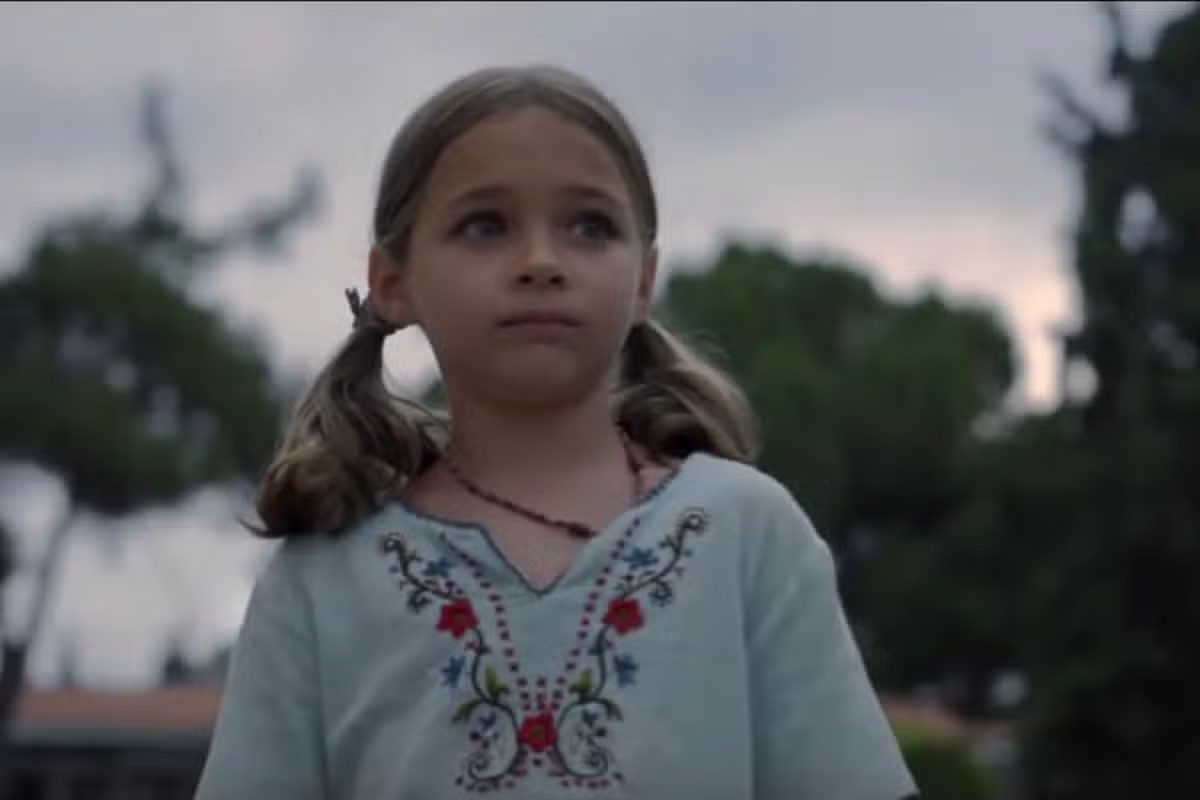
Mason Reeves in the movie “Josephine.”
(Sumerian)
If we are to have things like a “Sundance Film Festival” or “independent cinema,” it should be to support and nourish movies like Beth de Araújo’s powerful San Francisco-set thriller, about a violent sex crime witnessed by an 8-year-old, who is altered by the experience but then called upon to be a courtroom voice in the world of adults. Everyone who has come together to make this tricky but meaningful project seems to be operating on a higher plane: For Channing Tatum, playing a dad increasingly out of his depths, it’s an opening door to the kind of complex roles he has earned from being a dependable goof. For Gemma Chan, as a parent dealing with the unthinkable, the film is a promise fulfilled. But for young Mason Reeves, imbuing the title character with an evolving mystery that suggests a prodigy, “Josephine” is a revelation. — J. Rothkopf
‘Minotaur’ (Nov. 20)
A scene from the movie “Minotaur.”
(Mubi)
The whispers were fierce at a recent Academy Museum screening of Adrian Lyne’s windy erotic thriller “Unfaithful” as plugged-in attendees looked for points of similarity with Andrey Zvyagintsev’s sleek domestic drama, one that dominated this year’s Cannes conversation. Both movies are remakes of Claude Chabrol’s 1969 “The Unfaithful Wife,” but Zvyagintsev kicks the concept up to expert level, turning an affair and its brutal repercussions into a referendum on Russia’s new-money detachment: eating, lying and screwing with the Ukraine war out of mind. Was Zvyagintsev able to shoot in Russia itself? Of course not — he needed to film in look-alike Latvia. That’s how dependably infuriating he is to the authorities. But it’s a miracle he’s shooting anywhere at all: A case of long COVID, a coma and a yearlong hospital stay almost snuffed out one of the boldest filmmakers on the planet. His return to action is a grand piece of fortune. — J. Rothkopf
‘The Further Mis-Adventures of Cliff Booth’ (in Imax Nov. 25; on Netflix Dec. 23)
Brad Pitt and Leonardo DiCaprio in a scene from 2019’s “Once Upon a Time … in Hollywood.”
(Andrew Cooper / Sony Pictures Releasing)
Three years ago, Quentin Tarantino teased that his 10th and final film would be “The Movie Critic,” centered on a film reviewer for a 1970s porno rag, but he scrapped it and pivoted to a sequel featuring Brad Pitt’s stuntman from “Once Upon a Time … in Hollywood.” Tarantino didn’t want to direct it, though, preferring to challenge himself with something more ambitious for his sign-off. So he handed the screenplay — an “unwieldy thing,” he calls it — to David Fincher, tasking him to shrink it down. And that’s how we’ve arrived at a collaboration between two defining American filmmakers who came to prominence in the ’90s and share an interest in dark impulses that often turn violent. How Fincher will meld his clinical precision to Tarantino’s yo-gabba-gabba gonzo spirit is the movie question of the season. — G.W.
‘All of a Sudden’ (Nov. 25)
Tao Okamoto, left, and Virginie Efira in the movie “All of a Sudden.”
(Neon)
It still feels like a magic trick, the way Japan’s Ryusuke Hamaguchi turned “Drive My Car,” a three-hour movie about grief and chauffeuring (among other subjects), into a 2022 Oscar juggernaut. The director is back to remind you of everything you loved about that one, plus he’s got even more in the trunk. Many filmmakers are indulged with long running times; few of them make them as worthy and unnoticeable as Hamaguchi. He’s also in a class with Richard Linklater and virtually no one else when it comes to the lingering, evolving conversation, the kind that drifts into flirtation, debate and something soul-revising. Here it’s between two women (Tao Okamoto and the emotionally reverberant Virginie Efira) who, over the course of a walk along the Seine as dusk turns to night, find themselves bonded by something unexpected. “All of a Sudden” has death on its mind, but also how we live and care for each other en route to that destination. It’s a conversation we all need to have. — J. Rothkopf
If the Brewers are going to take down the heavily favored Dodgers, their group of Southland products will be key in the National League Championship Series that begins Sunday in Milwaukee.
Former Westlake star Christian Yelich is Mr. Brewer. He’s a three-time All-Star and the National League MVP in 2018. He’s always been willing to come back to the community and make contributions.
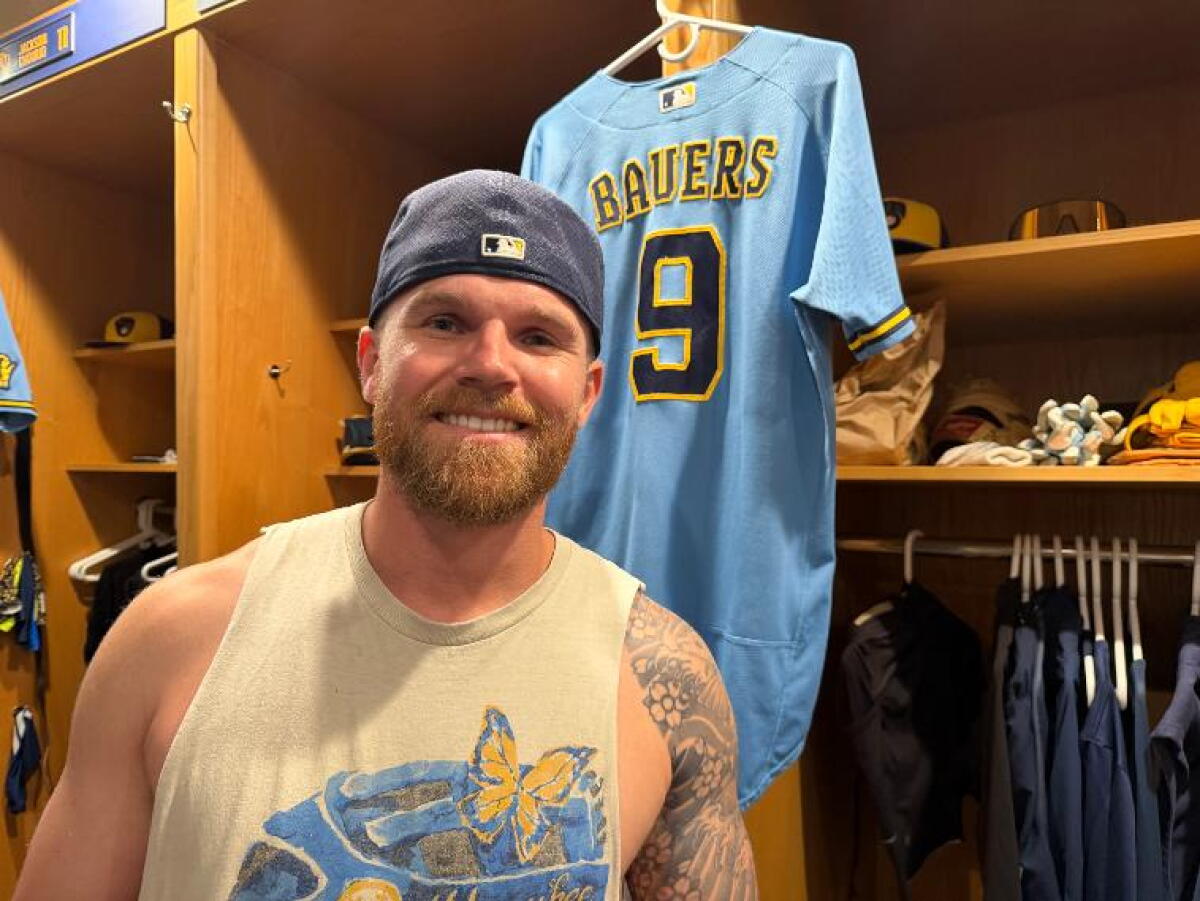
First baseman Jake Bauers is a Marina High graduate who lost in the Southern Section Division 1 championship game at Dodger Stadium to Jack Flaherty and Harvard-Westlake 1-0. Here’s a look at Bauers this season.
Former Marina first baseman Jake Bauers has 21 home runs for the Milwaukee Brewers.
ATLANTA — Not long ago, Georgia gubernatorial nominee Rick Jackson eagerly compared himself to his fellow billionaire in the Oval Office. He promised to be Donald Trump “with a Southern tone.” And sharing a summer rally stage, Jackson pointed at the president and declared, “I’m going to be this man’s favorite governor.”
On the debate stage this week with his Democratic opponent, however, Jackson discussed Trump only when Keisha Lance Bottoms brought him up. And he assured his audience that he’d “stand up to anybody.”
Jackson is not alone in his recalibration: Republican nominees for Senate, the U.S. House and governor’s offices across the country are sidestepping President Trump or openly distancing themselves as they debate before Election Day.
Those tactics, not unlike Republicans scrubbing Trump from their campaign websites, are the latest signs of how much Trump’s standing has fallen because of voters’ frustration with inflation, the Iran war and other matters. And the dynamics highlight the perilous options many Republicans face as they try to stitch together winning coalitions that go beyond Trump’s core supporters.
“Republicans right now are facing a voter turnout problem” in their own party, said GOP pollster Paul Shumaker, and must win “unaffiliated voters” who care most about the economy.
“You have to have something significant to change this narrative,” Shumaker said. But, he explained, that means “a significant victory in Iran” and seismic economic improvements — not something any Republican midterm candidate can force from behind a debate podium.
There’s a Trump tightrope on Iran, tariffs and rhetoric
Some Republicans are taking specific positions at odds with the president.
Michigan Senate candidate Mike Rogers said in his debate Thursday with Democrat Abdul El-Sayed that he’d urged the White House privately to reach a trade deal with Canada and end the president’s tariffs. Canada is Michigan’s largest trading partner, as it is for many Great Lakes and Midwestern states.
Days before, Rogers unveiled a new ad in which he said, “We know that Canada is not our enemy. We need to end the tariff war — now.”
That’s a noticeable departure from Rogers’ earlier, less specific statements praising Trump’s “America First” economic agenda while saying tariffs are not a “one-size-fits-all” solution.
Another Michigan Republican, Rep. Tom Barrett, already had bucked the president by voting for a war powers resolution intended to assert congressional authority over military actions in Iran. But debating Democrat Will Lawrence in their central Michigan district, Barrett added a criticism of Trump’s rhetoric Monday in Nebraska, where he floated the possibility of Iran attacking San Diego and Los Angeles.
The president mentioned those cities as part of his argument that higher gas prices because of his Iran war are a “small price to pay” to keep the country safe. But Democrats seized on the remarks, some insisting that Trump was calling for Iran to attack U.S. cities.
Barrett was asked whether Trump’s words were acceptable. Given the opportunity to echo the White House explanation that Trump was offhandedly mentioning a worst-case scenario he was trying to prevent, Barrett offered no defense.
“Nope,” he said flatly.
Many Republicans prefer a more generalized stiff arm
Reflecting the complex electoral balance, most Republicans have attempted to separate themselves without naming any firm difference with the president.
Running for a promotion to the Senate, Iowa U.S. Rep. Ashley Hinson tried in her debate Wednesday against Democrat Josh Turek to reconcile her earlier promises to be a Trump ally in Congress’s upper chamber. She said it would be “really easy” to keep her word and still be bipartisan — a buzz word she’s already been featuring in her campaign.
“I’ll be President Donald Trump’s ally when it is important for Iowa, but I will push back on him — he knows this, because I talk to him regularly — on things that are wrong for our state,” she said. “That’s true no matter who’s in the White House. That’s true no matter who is governing and who has the gavel.”
That’s the same path Jackson took in Georgia, as he pivoted away from Trump by embracing outgoing Georgia Gov. Brian Kemp, a Republican who has clashed with the president, starting with Trump’s false claims that he won Georgia in the 2020 presidential election.
“I will stand up to anybody, just like Brian Kemp has done,” Jackson said.
Another Republican House member, Mike Lawler of New York, made a point of name-checking a Democratic colleague, New Jersey’s Josh Gottheimer, and discussing bills they’d work on together. It was part of his argument that he’s able to challenge Trump and the party line.
“When I agree with the president I say it. When I disagree with the president, I say it,” he said in his closing remarks.
Hinson, meanwhile, referenced bills she’s worked on in the House that have been signed into law by both President Joe Biden and Trump.
But she also avoided criticizing Trump when asked about the president sending Affordable Care Act rebate checks to some Americans and promising a $5,000 bonus after the midterm elections if Republicans retain control of the House and Senate.
She said she “cares very deeply” about making sure Congress maintains the power of the purse and thinks it’s important to “live better within our means.”
Democrats pounce on either approach
Regardless of the Republican efforts, Democrats have continued peppering them with attacks and retorts about Trump. The most heated moments came when Democrat Cait Conley repeatedly said Lawler always voted with Trump.
“No matter how many times you say 100% of the time,” the congressman answered, “it’s provably false.”
When Rogers conceded in his back-and-forth with El-Sayed that the administration “probably” made errors in its mass deportation strategy, the Democrat answered swiftly.
“He said it was probably not right. I mean, it’s definitely not right,” El-Sayed said. “They killed two people.”
And while Georgia’s Jackson seemed uncomfortable talking about Trump, Bottoms was more than happy to mention him.
“I’m not running to be his favorite governor,” she said. “I’m running to work on behalf of people like you.” ___ Associated Press reporters Joey Cappelletti in Washington; Hannah Fingerhut in Des Moines, Iowa; and Jill Colvin in New York contributed to this report.
Winner of the Palme d’Or at this year’s Cannes Film Festival, still among the most prestigious prizes any movie can claim, “Fjord” aims for both a quiet, subtle power and the directness of a sledgehammer. It speaks to the skill of Romanian writer-director Cristian Mungiu, along with the star power and acting prowess of its leads, Sebastian Stan and Renate Reinsve, that the film achieves those goals, creating a mix of feelings including ambivalence, shock and dismay over what people will do to one another in the name of a common good.
Having recently moved from Bucharest to a remote village in Norway, a conservative, devoutly Christian couple and their five young children have begun to insert themselves into the fabric of their new community. Mihai, the Romanian father (Stan), is a little intense and gloomy; Lisbet (Reinsve), a Norwegian, is shy but kind, and their focus seems clearly on what they see as a warm, loving homelife.
But when their children are suddenly taken into protective custody over allegations of abuse, they find their world turned upside down. Eventually, the father asks a prosecutor with equal parts anger and exasperation, “Am I on trial for my beliefs?”
The official answer to that question, more or less, is both no and yes. The government’s position is that the children cannot be placed back into a home where they will be harmed, whether that means physical violence or indoctrination in ideology counter to that of the state’s, such as no dancing, no internet and that being gay is wrong.
Based on actual events involving a Romanian family in Norway in 2015, “Fjord” is purposefully designed to make a viewer — any viewer — question their assumptions and predispositions regarding the relationship between personal liberty and state power. While this may all sound a bit reactionary or like shooting fish in a barrel, Mungiu wisely complicates matters.
The filmmaker, a previous Palme winner for his 2007 abortion drama “4 Weeks, 3 Months and 2 Days,” presumably knows that the majority of the audience for his international art-house domestic drama will be more aligned with the liberal, progressive politics of the Norwegian state than the religious, conservative couple at the story’s center. So most audiences will automatically be put into the purposefully uncomfortable position of siding with people they would never see themselves inclined to agree with. It is Mungiu’s sharpest and most illuminating maneuver.
Once the story moves to the courtroom, “Fjord” begins to resemble 2023’s “Anatomy of a Fall” — another Cannes-winning champ released in the U.S. by boutique distributor Neon — for the way in which it allows American viewers a glimpse into another country’s legal system. It comes off as more conversational and slightly more chaotic than what we are used to in our own domestic courtroom procedurals. As the government prosecutor, Norwegian actor Christian Rubeck gives a smug and condescending tone to nearly every word out of his mouth, becoming the closest thing the movie has to a villain.
Having previously appeared together in the offbeat comedy “A Different Man,” Stan and Reinsve keep the story from feeling like a dour exercise. As Mihai, Stan puts across a low-simmering rage at being put in the position of defending himself at all, while grappling with how to maintain what he sees as his natural role of patriarchal control. Reinsve, known for more outwardly dynamic roles in “The Worst Person in the World” and “Sentimental Value,” here conveys a subdued nuance as Lisbet struggles with understanding her place between her husband and her children.
The moment when the couple’s infant child is taken from them by the authorities is devastating, each of them capturing a sense of helpless isolation from themselves, their community and each other.
Special mention should also go to the performances by Vanessa Ceban and Jonathan Ciprian Breazu as the couple’s teenage children, also to Henrikke Lund-Olsen as a neighbor girl who becomes close to them. These young performers are the film’s secret weapon, since in practical, lived terms they bear the brunt of the existential hand-wringing on the part of all the adults. And too often they become an afterthought.
The poster and key image from the film is a smiling snapshot of Mihai and Lisbet with their children, a seemingly happy family. Or are they? For a movie so steeped in ambiguity and nuance, it also often states its case quite plainly, such as when the couple’s lawyer says no one can really know what goes on in another family. The film asks one to look closer, not just at others but also at one’s own accepted opinions, assumptions and preconceptions. But it ends up with an outcome that feels as sadly inevitable as it is heartbreaking — an ethical knot that cannot be undone.
‘Fjord’
In English, Romanian, Norwegian and Swedish, with subtitles
We are weathering a truly apocalyptic heat wave in L.A., but that hasn’t stopped Halloween from sneaking up on us. For those who like to give themselves the creeps, the city has its fair share of spook shows, including Griffith Park’s Haunted Hayride and the Queen Mary’s Dark Harbor. These mainstays offer hardworking actors seasonal jobs, but usually don’t allow for any real narrative besides jump scares and chainsaws. Which is why I’m so jazzed about a new entry to the immersive Halloween show scene: “Hospital of Emotions After Dark,” with its specially ticketed basement creep-fest, “Below.”
For readers who haven’t been inundated with a million ads for “Hospital of Emotions” on your Instagram feeds, it’s an immersive art show that unspools in 80 discrete rooms over four floors of the shuttered St. Vincent’s Medical Center near downtown L.A. The 45,000-square-foot exhibition opened in late May and was supposed to close in late July, but has extended its run due to popular demand. This month that run includes an after-dark option, which features the regular show — only after-hours — with ambient lighting and roving actors who show up in the most unexpected places (I won’t spoil it, but I got one of the most serious jump scares of my life in one of the exhibit rooms).
A separate ticket (which can be purchased in a bundle with the main exhibition) gets you a ride in an elevator to the hospital’s long-abandoned basement where you are treated to an immersive theater show with a nun for a tour guide. My nun was played by Penny Wiggins, and I’m not sure I have ever witnessed such true commitment in a spook show. Wiggins sold her character — at one point with genuine tears.
I won’t give away the plot, but it’s harrowing, especially if you are someone familiar with the hospital, which opened in the late 1800s and was the first hospital in the city. I had my daughter there in 2016, so it was extra chilling to know that this basement of horrors was there even then. The show uses the building’s actual abandoned infrastructure as its framework, so guests are led through dank subterranean corridors, old examination rooms and specimen labs, as well as an autopsy room.
“Below” isn’t as viscerally gory as “Dark Harbor” or “Haunted Hayride,” but it’s more artistic. There is dancing and an actual script that features a “gotcha” twist — as well as an upsetting demon who appears out of nowhere. I applaud the commitment by the actors who, I imagine, must find it kind of scary just waiting down there for the next round of guests. Plus, it’s good fun to be in the “Hospital of Emotions” at night when everyone is a little wild and there’s a sense that something out of the ordinary might pop out at you at any minute.
I’m Arts editor Jessica Gelt begrudgingly wearing a tank top and shorts in early October. This is your arts and culture news for the week.
You’re reading Essential Arts
Our critics and reporters guide you through events and happenings in the SoCal arts scene. In your inbox every Friday.
By continuing, you agree to our Terms of Service, which include arbitration and a class action waiver. You agree that we and our third-party vendors may collect and use your information, including through cookies, pixels and similar technologies, for the purposes set forth in our Privacy Policy such as personalizing your experience and ads.
The week ahead: A curated calendar
FRIDAY
Felipe Dulzaides / Bradley Baboc Cuban-born artist Dulzaides uses photography, drawing, video, performance, sculpture and sound to capture the sublime nature of Havana knife sharpeners in the exhibition “Balance in Place.” L.A. painter Boboc drew on the Toy District as inspiration for a new series of paintings, “Shadoobie (Shattered).” Opening, 6-9 p.m. Friday; 10 a.m.-4 p.m. Thursday-Sunday, through Nov. 8. Arcane Space, 324 Sunset Ave., Unit G, Venice. arcanespacela.com
Ludovico Einaudi The popular Italian pianist and composer returns to Disney Hall for the first time since 2019 on this solo tour. 8 p.m. Friday. Walt Disney Concert Hall, 111 S. Grand Ave., downtown L.A. laphil.com
Mälkki Conducts Bartók Susanna Mälkki leads the Los Angeles Philharmonic in Béla Bartók’s “Concerto for Orchestra.” 11 a.m. Friday, 2 p.m. Sunday. Walt Disney Concert Hall, 111 S. Grand Ave., downtown L.A. laphil.com
Takács Quartet with Jeremy Denk The Grammy winning ensemble teams up with the MacArthur Grant-winning pianist for a program of chamber music featuring works by Haydn, Mendelssohn and Franck. 7:30 p.m. Broad Stage at Santa Monica College Performing Arts Center, 1310 11th Street, Santa Monica. broadstage.org
SATURDAY
Laura Andreson, 1979, Forrest L Merrill Collection, Photo by M. Lee Fatherree
(Photo by M. Lee Fatherree)
The Eternal Quality of Aesthetic Joy: Laura Andreson and Her Legacy The artist bristled at “superfluous” decoration, favoring distilled jar, box, bowl and vase forms influenced by her love for Scandinavian and Bauhaus design. She became a wizard with glazes, conjuring lustrous surfaces resonant with elements of the Southern California landscape. This show offers a rare opportunity to savor the gorgeous purity of her work, alongside that of several of her mentors and peers, such as Gertrud and Otto Natzler and Glen Lukens, as well as some of her students, including JB Blunk and Bernard Kester. (Leah Ollman) Noon-6 p.m. Tuesday-Saturday, Oct. 10-Jan. 9, 2027. Craft in America Center, 8415 W 3rd St. craftinamerica.org
Haunted Soiree: True Crime An immersive theater experience inspired by the 1928 Hex Hollow murder with cocktails and curious encounters. Selected nights through Oct. 31. Nocturne Theatre, 324 N. Orange St., Glendale. hauntedsoiree.com
Pacific Jazz Orchestra’s Benefit Concert Songwriter and producer David Foster, singers Katharine McPhee, Joanna “JoJo” Levesque, Veronica Swift, Adam “AeJaye” Jackson, violinist Anne Akiko Meyers and pianist Emmet Cohen are the headliners for a celebration of founding Artistic Director Chris Walden’s 60th birthday, which also includes a buffet reception and dancing under the stars. 7 p.m. Private estate in Toluca Lake, address to be provided upon confirmation of attendance. pacificjazz.org
Saint Megan Playwright Joy Gregory, inspired by the journey of the granddaughter of the founder of the controversial Westboro Baptist Church, examines the long history of American Christian zealotry. Opening, 8 p.m. Saturday, 8 p.m. Fridays, Saturdays and Mondays, 2 p.m. Sundays through Nov. 22 (no performance Oct. 12 or Oct. 31. Rogue Machine at the Matrix Theatre, 7657 Melrose Ave. roguemachinetheatre.org
SUNDAY
Akram Khan Company In the London-based dance troupe’s final touring production, “Thikra: Night of Remembering,” an international cast of women perform contemporary and Bharatanatyam dances. 8 p.m. UCLA, Royce Hall, 340 Royce Drive, Westwood, cap.ucla.edu
Camerata Pacifica The chamber ensemble opens its 37th Season with Rachmaninoff’s “Variations on a Theme of Chopin, Op. 22” and Schubert’s “B-Flat Major Trio.” 5 p.m. Sunday. Bank of America Performing Arts Center, Janet & Ray Scherr Forum Theatre, 2100 Thousand Oaks Blvd., Thousand Oaks; 7:30 p.m. Tuesday. The Huntington, Rothenberg Hall, 1151 Oxford Road, San Marino; 8 p.m. Wednesday. The Colburn School, Zipper Hall, 200 S. Grand Ave., downtown L.A.; and 7 p.m. Thursday. Music Academy of the West, Hahn Hall, 1070 Fairway Road, Santa Barbara. cameratapacifica.org
Heartbreak House The Antaeus Theatre Company launches its 35th season with George Bernard Shaw’s dark comedy. Directed by ATC Artistic Director Nike Doukas. The cast includes Elinor Gunn, Harry Groener, Arye Gross and Bernard Addison, Previews, 2 p.m. Sunday, 8 p.m. Tuesday-Oct. 16; opening, Oct. 17-Nov. 16. Kiki & David Gindler Performing Arts Center, 110 East Broadway, Glendale. antaeus.org
Musical Theater Guild members Valerie Larsen and Gabriel Navarro during a reading of “The Light in the Piazza” in 2024.
(Stan Chandler)
Here’s to Us! The Musical Theatre Guild marks its 30th anniversary with a benefit concert featuring show tunes from “Titanic,” “Fanny, “The Pajama Game” and “Sunday in the Park with George.” 7 p.m. Broad Stage at Santa Monica College Performing Arts Center, 1310 11th Street, Santa Monica. musicaltheatreguild.com
Untitled, n.d. Mavis Pusey
(Neil Lane Collection / Estate of Mavis Pusey)
Mavis Pusey Two exhibitions this fall will help familiarize audiences with this remarkable woman. “Mobile Images” at the Hammer is a full-scale survey co-organized by the Studio Museum in Harlem and the Institute of Contemporary Art at the University of Pennsylvania, and is accompanied by a rich and thorough catalog. “Restless” also adds a Pusey publication to the shelf. The Benton show focuses mostly on Pusey’s prints, drawing exclusively from the collection of Ian White, artist, educator and son of esteemed artist Charles White. (Leah Ollman) “Mobile Images,” through Feb. 28, 2027. UCLA Hammer Museum, 10899 Wilshire Blvd., Westwood. hammer.ucla.edu “Restless,” through Jan. 3, 2027. Benton Museum of Art, Pomona College, 120 W. Bonita Ave., Claremont. pomona.edu
MONDAY
Art Of Elan: In The Desert Inspired by a trip to Bryce Canyon, Olivier Messiaen wrote his percussion-rich chamber music masterpiece “From the Canyons to the Stars” as a 1976 U.S. Bicentennial commission from Alice Tully Hall in New York. Replete with Messiaen’s characteristic bird calls, it’s been done out of doors before, and memorably at the Ojai Music Festival. But the San Diego imaginative new music series Art of Elan is now taking it to the desert for a special performance led by percussionist Steven Schick at an outdoor theater in Borrego Springs. (Mark Swed) 6:30 p.m. Stargazing Theater, La Casa del Zorro Desert Resort & Spa, 3845 Yaqui Pass Road, Borrego Springs. artofelan.org
TUESDAY
Angela Hewitt The pianist performs an all-Mozart recital accompanied by Los Angeles Chamber Orchestra concertmaster and violinist Margaret Batjer for the first installment in LACO’s inaugural recital series. 7:30 p.m. Tuesday. The Colburn School, Zipper Hall, 200 S. Grand Ave., downtown L.A. laco.org
WEDNESDAY
Lisa Batiashvili/Gautier Capuçon/Jean-Yves Thibaudet The superstar violinist, cellist and pianist team up for an evening of Shostakovich, Debussy, and Dvořák. 8 p.m. Walt Disney Concert Hall, 111 S. Grand Ave., downtown L.A. laphil.com
Joey Soloway.
(Loshara Vova)
A 1 They/Them Show The Emmy and Golden Globe-winning creator of “Transparent” steps out from behind the camera to try out their stand-up routine in L.A. before hitting the road with a deeply personal solo comedy performance exploring family, Hollywood, gender, sex, Judaism, ambition and reinvention. A tour is expected to include a November stop in Chicago. 8 p.m. Wednesday and Oct. 28, doors open at 7 p.m.. The Virgil, 4519 Santa Monica Blvd. dice.fm
THURSDAY
Houston Ballet
(Quinn B. Wharton/Segerstrom Center for the Arts)
Houston Ballet The Texas dance troupe brings celebrated young pianist George Li for an ode to Frédéric Chopin. Making its West Coast debut, and created by Stanton Welch AM, artistic director of the Houston Ballet, the piece, “Sons de L’âme” (Sounds of the Soul), merges choreography with a live performance of Chopin’s famed piano pieces, showcasing the talents of the nation’s fourth-largest ballet company and a rising star of classical music. (Eloise Rollins-Fife) 7:30 p.m. Thursday-Friday, 2 and 7:30 p.m. Saturday, 1 p.m. Sunday. Segerstrom Center for the Arts, 600 Town Center Drive, Costa Mesa. scfta.org
Speaking In Tongues The world premiere of a Luis Alfaro play is always a welcome event. And his latest work, commissioned by Latino Theater Co. and developed at the theater’s Circle of Imaginistas playwriting group, resonates thematically with Alfaro’s 2023 play “The Travelers,” which LTC produced in 2023 and made my list of that year’s best theater productions. The new play, infused with Alfaro’s trademark Chicano humor, returns us to the world of California’s Central Valley and the stories of migrant farmworkers and their spiritual quests in a societal landscape transforming faster than anyone can keep up. (Charles McNulty) Previews, 8 p.m. Thursday-Friday; opening night, 8 p.m. Saturday; 8 p.m. Thursdays-Saturdays, 2 p.m. Sundays, through Nov.. 15. Los Angeles Theatre Center, 514 S. Spring Street, downtown L.A. latinotheaterco.org
The SoCal scene
Cuban-born artist Enrique Martinez Celaya paints the new curtain for the L.A. Opera at the Dorothy Chandler Pavilion.
(Carlin Stiehl / For The Times)
ICYMI, the best of this week’s L.A. Times arts coverage:
L.A. artist Enrique Martínez Celaya hand-painted a brand new 70-foot curtain for L.A. Opera’s new season.
A documentary about Asco, the revolutionary arts group founded in the 1970s, is streaming for the first time on PBS.
As 24th Street Theatre prepares to celebrate its 30th anniversary, it has announced that it raised $3 million to officially buy the converted 1928 carriage house it’s called home for the past 29 years. It also purchased properties next door and across the street in order to expand its mission and community programming, including plans for an outdoor garden and a black box theater, which is, according to a news release, “officially named the 24th Street Black Box Theatre in honor of longtime supporter Jack Black, who is also the new venue’s first donor.” Black is set to host the theater’s gala on Oct. 18.
Tesserae — Andrew McIntosh, left, Ian Pritchard and Joshua Rubin — perform “Bowling, Animals and the Ocean” at the Sierra Madre Playhouse.
(Dania Maxwell / Los Angeles Times)
The 99-seat Sierra Madre Playhouse announced it has received $2.5 million from the State of California for a slew of exciting upgrades to its 100-year-old building — marking the largest gift in the organization’s history. The funds were secured by Pasadena Assemblymember John Harabedian, and will be used toward making the historic venue ADA-compliant, as well as to renovate lobbies and other areas open to the public. It will also help with new programming and building infrastructure.
The LA Phil and Orchestre de Paris have announced the launch of a new opportunity: the Salonen International Conducting Fellowship, which is, according to a news release, “designed to nurture and accelerate the careers of the next generation of orchestral conductors … the fellowship will offer early-career conductors unparalleled access to artistic mentorship, practical podium experience, and professional development opportunities at Los Angeles’ Walt Disney Concert Hall and the Philharmonie de Paris.” The first yearlong program will start in the 2027-28 season, and will feature two to four fellows, who will spend about six weeks working with each orchestra.
The Hammer Museum at UCLA announced this week that Eric Esrailian is succeeding Marcy Carsey as the new chair of the museum’s board (after previously serving as vice chair). Karen Hillenburg will now serve as vice chair. The Hammer also named three new members to its board: philanthropist Leslie McMorrow, attorney Alicia Miñana de Lovelace and Joan Weinstein, vice president of program planning at the Getty.
The minuscule yet distinctly humanoid figure of a fairy flaps its wings as it flies into the ancient ruins of a bygone kingdom. Guiding a young heroine to meet a mysterious faun, for a moment, the fantastical creature looks as though it might cross the threshold of the screen.
It is in that instant that Guillermo del Toro — wearing 3D glasses while sitting at the Academy Museum of Motion Pictures’ imposing David Geffen Theater for a tech check — chuckles with pride as if to say, “Look at that.” Later that night, almost 1,000 fans were transported into his entrancing 2006 masterwork, “Pan’s Labyrinth,” (a.k.a. “El Laberinto del Fauno”) at the premiere of the new 3D version.
Back in theaters across the country on Friday (which is also Del Toro’s 62nd birthday), “Pan’s Labyrinth” is celebrating its 20th anniversary with a new 4K restoration, available in both 2D and in the aforementioned 3D transfer that Del Toro himself oversaw.
Doug Jones, left, plays the faun that beckons to Ofelia, right, played by Ivana Baquero in “Pan’s Labyrinth.”
(Scott A. Garfitt / Andreea Alexandru / Invision / AP)
As brutal as it is spellbinding, the Mexican filmmaker’s modern classic unfolds during the Spanish Civil War — more precisely, in 1944 — as young Ofelia (Ivana Baquero) and her pregnant mother move into the camp run by the ruthless Capt. Vidal (Sergi López).
Amid the bloodshed, Ofelia discovers an underworld of magical entities, including the alluring faun (Doug Jones), who convinces her that she is a princess who must reclaim her royal status.
By winning three Academy Awards and being nominated for two more — one for Del Toro’s screenplay, the other for foreign language film, representing Mexico — “Pan’s Labyrinth” signified an artistic watershed moment in Del Toro’s career. These accolades came after he directed two comic-book adaptations for Hollywood studios: “Blade II” and “Hellboy.”
Beyond the recognition, the experience felt spiritually transformative for the Guadalajara native; not the least because of the hurdles he overcame to bring it to fruition.
“‘Pan’s’ marks a big divide in what I did before and what I did after. I became invested in a different way in filmmaking,” Del Toro tells me. “I don’t know how to describe it, but filmmaking became a religion, as opposed to something that I could do. It fused with me.”
Though the film is now regarded as one of the greatest works of the 21st century, when Del Toro set out to make it, the industry was not receptive to his ideas.
“Everything I thought I wanted to say about war in ‘Devil’s Backbone’ seemed obsolete, because we had gone through 9/11 and the world had changed,” Del Toro recalls. “I didn’t want to do an American movie. I was being offered a lot of comic- book movies and said, ‘I got to do a companion piece for “Devil’s Backbone” no matter what.’ But nobody wanted to do the movie.”
One key objection was the mature tone of the narrative, in which the child protagonist is directly confronted and endangered by the evils derived from fascist ideologies.
“They said, ‘If it’s a fairy tale then it should be a family movie,’ because I’d been offered ‘Narnia’ a year before by [former Walden Media chief executive] Cary Granat,” Del Toro tells me.
“He said, ‘Why don’t you do ‘Narnia’?’ And I said, ‘Because I want to do my own version of a fairy tale where the lion doesn’t resurrect and it’s about a pitiless world against a boundless imagination.’”
Del Toro’s interest in stories where the woes of children are taken seriously was spurred by ‘Los Olvidados,’ Luis Buñuel’s classic from 1950, about a group of neglected children surviving a harsh reality in the streets of Mexico City.
“When I saw ‘Los Olvidados,’ I was in my early teens,” says Del Toro. “I thought every time somebody told a story about a child that was unsentimental and that was a little brutal — it could be ‘The Spirit of the Beehive’ or ‘Los Olvidados’ or ‘The Red Balloon’ or even Bobby Driscoll in ‘The Window’ — whenever you saw a child in real danger, a child in jeopardy, a child in moral dilemma, like ‘The Fallen Idol,’ I really was transported.”
Children, Del Toro believes, are often invisible to adults. They are “cartoons” in the eyes of “regular adults.” Thus, when his mother started reading child psychology books to better understand a young Del Toro, he read them as well, so that he could try to manipulate her.
Del Toro laughs mischievously as he remembers his antics. “I would do exactly what the book said, and I realized I could work within that preconception and make my grandma buy me horror comic books or make my mom allow me to miss school,” Del Tor recalls. “Ofelia is very strong. That was the point of the movie for me. I wanted to see the clash of wills between a young kid and a fascist captain, and I wanted to see the kid win.”
(Teresa Isasi / Picturehouse)
Del Toro’s mother, Guadalupe, died in 2022. But she lives on in cinema, thanks to the 1985 landmark queer Mexican film “Doña Herlinda and Her Son,” by director Jaime Humberto Hermosillo, where she played the titular Doña Herlinda.
And if you look closely, you’ll also find Del Toro in the movie, which was filmed in Guadalajara.
“I have a cameo with my ex-wife in it. Lorenza. She’s the receptionist and I appear dancing in Chapala, but I’m super thin, so you can never recognize me,” he says. “I’m dancing with a girl that I liked, but I was already in the throes of dating the one who became my wife, Lorenza.”
Then there was the question of the picture’s language. Del Toro wouldn’t waver on making “Pan’s Labyrinth” in Spanish.
“Many of them said, ‘We’ll do it if you do it in English — set in Spain, same ending, the girl dies, no problem, but in English.’ And I said, ‘I can’t. It’s not true to the movie.’ I’m not saying you can never do that, but it’s always this ‘Zorro’ thing like, ‘Are you in a hurry, señor?’ or ‘Come to the hacienda,’” he says, doing a funny, exaggerated accent on the Spanish words.
“If you’re trying to contrast reality versus fantasy, the reality has to be in its language, in its location,” Del Toro adds, emphasizing his resolve to make the movie in his native tongue. “I thought, ‘This is about the reality clashing with the fantasy. I have to make the reality stylized, but I don’t want to do it in English, because then everything is a construct. Everything is just an idea.’”
In 2026, the film’s bilingual appeal is a major component of the marketing strategy that Cineverse — the entertainment company that Del Toro approached to handle the restoration and rerelease of “Pan’s Labyrinth” — is implementing to reach audiences across the country.
“A lot of our messages are in English and in Spanish. The messaging around the making of the 3D — Guillermo likes to say ‘F— AI,’ but we positioned it as ‘Made for humans, for humans. Hecho por humanos, para humanos,’” says Yolanda Macias, chief motion pictures officer at Cineverse. “That’s a really strong message that has resonated with our fans.”
A Mexican American woman whose parents emigrated from Jalisco, Macias sees “Pan’s Labyrinth” as a timeless movie that’s as relevant today as it was two decades ago.
“We are not ignoring a very important segment of the audience, which is the Latino population who have always, in my experience, shown an interest in creators from Mexico or from Latin America,” Macias says. “And we are so proud of Guillermo for being that person for this audience.”
When first envisioning “Pan’s Labyrinth,” Del Toro found himself grappling with existential concerns related to the meaning and relevance of what each person leaves behind when they are gone. Can anything we mortals create stand the test of time? Does it matter?
(Gina Ferazzi / Los Angeles Times)
“One of the things I was going through was I thought, ‘Is making movies worth it? You give them years and years and years, and then they just move down the current into the oblivion of the culture,’” Del Toro says. “A central theme in the film is, ‘Can we give our lives to something that doesn’t change the world?’ That’s why the movie ends with a little flower blooming in a dried tree. That’s all that is left of her story in the real world.”
His films will one day too become flowers left not only as proof of his time on earth, but perhaps as messages for those to come who have the sensibility to appreciate them.
“You can say, ‘Ofelia lived in the other kingdom,’ but in the real world, there’s only one tiny flower. And that’s why it says, ‘For those that know where to look.’ Because that’s what we do as filmmakers. When you ‘discover’ a filmmaker, you say, ‘I discovered this guy Fellini.’ Well, he’s been there for a while, but sure. Or you discover Miyazaki or Mamoru Oshii … They’re continents, but they are only in maps that are very secret. I like that image.”
So long as they are found, Del Toro doesn’t worry that much about how people encounter them.
“[Films] live on to a certain degree. Like when we were shooting ‘Frankenstein,’ I said, ‘We will live forever in the Netflix queue,’” he recalls, trying not to laugh. “Theatrical is the best. There’s no comparison. But I remember my childhood, I saw all the Universal monster movies on TV, and they were monumentally important for me. There’s something to be said about accessibility that is also important.”
I agree with him — and mention that some of the most revelatory movie-watching experiences for me as a young cinephile happened thanks to bootleg DVDs, which I would buy as a teen in Mexico City.
“I love the pirate DVDs in Mexico,” says Del Toro with a laugh. “I’ll tell you a little story: We went to promote ‘Hellboy’ in Mexico City, and we were having coffee. A guy came in and said, ‘You want to buy movies?’ And he had ‘Hellboy’ already, opening week … and it didn’t have a cover either!”
Another distinction that “Pan’s Labyrinth” holds is that it was the last film in Spanish that Del Toro directed. But that could change, he says; he still has another project he’d like to make in Mexico.
“I actually have an idea that I would love to shoot, but I want to make it a drama. I don’t want to make it a fantasy movie,” he explains. “I have a great story that I want to shoot one day. It’s a kidnapping scene from three points of view. The victim, the people doing the pickup, and another component that I will not reveal.” (Del Toro’s late father, Federico, was famously kidnapped in Guadalajara in the late 1990s.)
The thought of Del Toro making another Mexican film in the future, reminded me that the original screenplay for his period ghost story, “The Devil’s Backbone,” was set in Mexico, but a lack of funding forced him to shift the production to Spain, with the help of Pedro Almodóvar’s company El Deseo.
“It was about a traveling circus during the [Mexican] revolution with a mother, a father and a boy. It was full of jarred fetuses. The boy was a clown, and the father was a magician. I was trying to do Bergman’s ‘Hour of the Wolf’ or ‘The Magician’ — modest but creepy,” he explains. “But it was very different. I had the orphanage, I had the legend of the fetuses and a ghost; and I had the devil live in the monastery.”
In any language, Del Toro is a fierce advocate against the use of generative AI in artistic creation. He believes that anything touched by humans has a better chance to endure. The love audiences still hold for “Pan’s Labyrinth” is a testament to this sentiment.
“[Pan’s Labyrinth”] is very truthful to who I was. And whenever you are able to be truthful, people feel that it matters to you,” Del Toro says. “And when you think it matters to someone, you cherish it.”
Dearest gentle “Bridgerton” viewers — rejoice, for a new prequel series about Lady Violet is headed to Netflix.
The streamer and Shondaland announced Thursday that an untitled spinoff about the early life of the future matriarch of the Bridgerton clan is in the works. Shonda Rhimes and Nicholas Nardini will write and serve as showrunners on the limited series, which will tell the story of young Lady Violet’s romance with her future husband, Viscount Edmund Bridgerton.
The show will be the second spinoff set in the expanding world of the popular Regency romance following the 2023 prequel series “Queen Charlotte: A Bridgerton Story,” which explored the early days of the eponymous queen’s marriage to King George III.
Portrayed by Ruth Gemmell in the flagship series, Lady Violet is the mother of the eight Bridgerton siblings whose individual adventures in (and around) the marriage mart are the focus of the show. A younger version of the character, played by Connie Jenkins-Greig, also appeared in the “Queen Charlotte” prequel. The cast of the untitled Lady Violet prequel has not yet been announced.
Based on the popular book series by Julia Quinn, “Bridgerton” has been a hit with audiences since premiering in 2020. The first four seasons have chronicled the steamy happily-ever-afters of the eldest Bridgerton siblings, Daphne, Anthony, Colin and Benedict. The fifth season of the series, which will follow the love story of Francesca Bridgerton (Hannah Dodd) and Michaela Stirling (Masali Baduza), is currently in production in London.
In addition to Rhimes and Nardini, who was also a writer on “Scandal,” “Queen Charlotte” and “Inventing Anna,” frequent Rhimes collaborator Tom Verica will direct and executive produce on the upcoming limited series. Shondaland’s Betsy Beers is also an executive producer.
Democrat Xavier Becerra, the frontrunner to become the state’s next governor, often invokes the story of his parents’ humble beginnings as immigrants from Mexico who, through hard work, built happy and productive lives in California.
“My parents came to California with $12 in their pocket. They lived the California dream,” Becerra said during last week’s gubernatorial debate with Republican rival Steve Hilton, aired nationally on CNN.
Becerra for years has described himself as the “son of immigrants” when talking about his upbringing, but that claim has come under scrutiny by Hilton and other critics who accuse Becerra of embellishing his family history. Becerra’s mother is from Guadalajara, Mexico, but his father was born in Sacramento and raised in Tijuana — making him a U.S. citizen and not a legal immigrant.
“Unlike Xavier Becerra, I am an immigrant. Unlike Xavier Becerra, my father was an immigrant. My stepfather too. My whole family,” Hilton wrote in a post on X.
Hilton is an immigrant from the United Kingdom and is the son of Hungarian immigrants who fled their homeland during a revolution in 1956.
Richard Grenell, a former Trump administration official, accused news outlets of letting a lie “continue for decades” throughout Becerra’s tenure as California attorney general and then as a Cabinet official in the Biden administration.
Becerra has openly discussed the details of his parents’ story, which unfolded on both sides of the border and in many ways reflects Mexican immigrant trajectories during the historical period of the 1920s and 1930s.
During speeches and in interviews Becerra has described how his father, Manuel, was born in Sacramento in 1928 and taken back to Tijuana as a young boy, with few jobs for Americans during the Great Depression, and even fewer jobs for Mexicans working in the U.S. His father traveled between the two countries often, and, as an older child, he would look for work in the U.S.
Becerra on Tuesday accused Hilton of “casting lies” about his family’s background, saying that the Republican failed to understand the struggle that many Mexican immigrants and Mexican Americans faced in this county decades ago. He said his dad would tell of the days when he couldn’t walk into some establishments that had posted signs that read “No dog, Negros or Mexicans allowed.”
“This is what happens when people who don’t understand immigration start to pontificate,” Becerra said Tuesday after a morning rally against Proposition 39, a voter identification measure, at Guelaguetza, a Oaxacan restaurant in Los Angeles’ Pico-Union neighborhood.
“I am very proud of my parents, and I consider them immigrants because even though my dad was born in the U.S. — in a country that wouldn’t treat him the way it would treat other U.S. citizens — my dad was a proud immigrant,” Becerra said. “I am proud that I am their son. I am the son of immigrants.”
G. Cristina Mora, a UC Berkeley professor of sociology studying attitudes toward immigration, said Becerra’s critics misunderstand a common phenomenon at the time, when immigrants moved back and forth across a southern border that was much more porous — very different from the militarized border of today.
Beyond the dwindling jobs and precarious economics of the 1930s serving as a push factor for many Mexican families, a wave of xenophobia also helped send hundreds of thousands back to Mexico. A wave of mass deportations across the Southwest states resulted in more than 1 million Mexicans and their descendants being forced out of their homes and loaded on trains out. More than 60% were U.S. citizens.
Mora, who also serves as co-director of the UC Berkeley’s Institute of Governmental Studies, said “it was a time of very great anti-Mexican fervor.” Many sought to later return. Some were deported multiple times.
“There are many types of immigrants. There’s so much nuance,” Mora said. “To think there’s only one immigrant story would just be to not know California.”
Becerra’s campaign spokesperson Jonathan Underland in a statement accused Hilton of hypocritically attempting to capitalize on an immigrant narrative.
“Steve Hilton doesn’t seem to have a problem with immigrants who look like him — but openly attacks immigrants who look like Xavier Becerra,” Underland said. “Trump ignited a deep anti-immigrant animus among MAGA voters, and Hilton is tapping into that as he scrambles to distract from his bizarre ad campaign that alienated some of his closest allies.” Last week, Hilton’s campaign put out a provocative, sexually suggestive ad that drew criticism from his fellow Republicans.
Becerra, both on Tuesday and throughout his long political career, has often described his parents’ upbringing.
He said his father’s family moved back to Tijuana during the Great Depression. His father, he said, was the eldest child and was forced to leave school after the sixth grade to help support the family. He began working as a preteen, bouncing back and forth between the U.S. and Tijuana. He would tell stories about being a shoe shiner, at times of celebrities and movie stars. He also worked in the farm fields with his dad and sometimes with his uncles.
In the early 1950s he married Becerra’s mother, Maria Teresa, who lived in Guadalajara.
“When they decided to make a go of it outside of Guadalajara, they went to Tijuana. They didn’t have great success, so that’s when they decided to come to the U.S.,” Becerra said on Tuesday. “So when I say my parents came to California with $12 in their pocket, it’s because, Steve Hilton, my parents came to California with $12 in their pocket.”
Becerra’s father later began a construction career that lasted 30 years, while his mother worked as a clerical worker and later purchased rental properties.
Times researcher Cary Schneider contributed to this report.
When Zoe Kazan learned she was going to adapt “East of Eden,” she knew it meant she’d be destroying a copy of John Steinbeck’s 1952 novel with scribbled notes in different colors, highlights and earmarked edges. So she ordered a used one from Powell’s Books — it has somebody else’s last name written on it, she points out.
“It’s a treasure to me,” she said during a recent video call from London.
Steinbeck’s Cain and Abel-inspired novel follows two families across decades as a way to explore good and evil, legacy, free will and what makes a person. Driving many of the biblical parallels are two sets of siblings — half-brothers, Charles and Adam Trask, and later, Adam’s fraternal twin sons Cal and Aron — each competing for their father’s attention and love. Disrupting their lives is an enigmatic woman named Cathy Ames, who Adam marries and who gives birth to Cal and Aron.
The book-to-screen adaptation has been Kazan’s passion project. And for a tale of familial legacy, she had her own to confront — in 1955, her grandfather Elia Kazan directed a film version that starred James Dean and covered the last third of the book, which focused on Cal and Aron. Zoe Kazan’s interest in the story took shape decades later when, as a teenager, she discovered the book.
She found herself drawn to Cathy, its famous antagonist.
“I felt repelled by her, attracted by her, curious about her. I felt empathy. I felt hared. I felt love. I felt all these things,” Kazan said. “I had never read anybody like her. I just remember, every few pages, wanting to stop and read aloud to someone the things that she was doing or [the things] that someone was saying about her.”
She also felt the pull of the story’s examination of intergenerational cycles and familial legacy.
“It feels a little bit like a chicken-and-egg situation. Which came first: Was I drawn to this book because of its intergenerational aspects or did this book teach me to think about intergenerational aspects?”
Now streaming on Netflix, the seven-part adaptation Kazan shepherded — alongside co-showrunner Jeb Stuart — covers more ground of the multigenerational saga than her grandfather’s film. This new version also centers Cathy.