The anonymous arts group known as Secret Handshake has gone international with its piquant form of satirical anti-Trump artwork, this time placing a playable video game console called “Nuuk ‘Em All” in, yes, Nuuk, Greenland. The group sent a picture of the console to The Times. It sits alone on a barren cliff above the sea, with a smallish iceberg visible in the water below. The peaked roofs of a nearby town can be seen in the distance.
Secret Handshake has created more than a dozen pieces of guerrilla art mocking Trump since last year — all of which appeared on the National Mall in Washington, D.C., until July when a golden, 10-foot tall “Iran War Participation Trophy,” cropped up in New York City. That piece arrived at the Minnesota State Capitol in early August.
Greenland is ambitious though, even for a collective that revels in creating outsize splashes with its work (see the Trump-Epstein “Best Friends Forever” sculpture). Asked via email how the group transported the full-size video game console to the country — which has weathered a series of unwelcome overtures from Trump to become part of the U.S. since he retook office early last year — a representative wrote, “You have no idea — it was honestly very difficult. A true ‘planes, trains, and automo … ships’ situation. Did you know that the arctic is actually quite far? And they’re not used to whipping over arcade games.”
“Nuuk ‘Em All” is the second satirical video game Secret Handshake has released since July when it first introduced the world to “Operation Epic Furious: Strait to Hell,” which finds Trump waging a futile war with Iran while making all kinds of bumbling choices including whether to order a Diet Coke or bomb the country.
The game arrives in Greenland shortly after the Trump administration signed an agreement with the country and Denmark to expand the U.S. military presence in the Arctic while seemingly dropping threats to annex the semi-autonomous Danish territory.
Three additional cabinets of the game were simultaneously placed at the D.C. War Memorial on the National Mall, and can be played online on any old computer. The game begins with an animation of the White House, its lawn covered with cranes and backhoes. “The year is 2026,” the scrolling text reads. “The White House is under constant construction, reconstruction and construction of the reconstruction.”
The action moves to Trump’s Mar-a-Lago headquarters where Trump is approached by Defense Secretary Pete Hegseth, who apologizes for waking Trump from his “tactical nap” to tell him about some “issues with Iran.” Trump asks if the Strait of Hormuz is 100% open and Hegseth replies, “Yes, sir. It’s so open that we’ve used up all our missiles, and gas now costs more than bourbon.”
I haven’t had the chance to play the game for long, but Secret Handshake’s email details what to expect, “In this game, Iran is going great (spoiler — it’s not), so Trump heads north to check on his new frozen frontier. Along the way, he battles unthinkable evils like Fully Vaccinated Children, Woke Yetis, and the happiest people on Earth, the Danish. All the while, the player’s greatest challenge is trying to keep President Trump from falling back asleep.”
Secret Handshake didn’t have any information about how Greenland has responded to the game, with the rep noting, “I think there is a lot of hope and relief over there right now that this agreement is the end of the barrage of bullying and threats from the US. But our feeling—and I truly hope we’re wrong— is that it’s just the beginning. Especially with Trump refusing to answer if an invasion is completely off the table now.”
Regardless of what happens in Greenland, the rep continued, “the thing I really like the most about this new game is that between all the satire, and jokes, and silliness, it actually ends up back in reality — the character is still stuck in an endless loop of war in Iran. And that, sadly, is still just as true as when we released the Iran game almost half a year ago.”
I’m Arts editor Jessica Gelt screaming into the void. This is your arts and culture news for the week.
You’re reading Essential Arts
Our critics and reporters guide you through events and happenings in the SoCal arts scene. In your inbox every Friday.
By continuing, you agree to our Terms of Service, which include arbitration and a class action waiver. You agree that we and our third-party vendors may collect and use your information, including through cookies, pixels and similar technologies, for the purposes set forth in our Privacy Policy such as personalizing your experience and ads.
The week ahead: A curated calendar
FRIDAY
Boston Marriage David Mamet’s 1999 epigram-filled comedy about two women sorting out their affairs while maintaining their standard of living at the turn of the 20th century. Directed by Bernardo Cubría. With Nicole Pacent, Heather Wake and Dulce Valencia. 8 p.m. Fridays-Saturdays (and one Thursday, Oct. 22): 2 p.m. Sundays, through Oct. 24. European House LA, 12355 Rye Street, Studio City. ticketsource.com
Yvette Janine Jackson With Radio Opera Workshop The ensemble integrates electronics, acoustic instruments, voice and images to produce new music by the award-winning composer and sound artist. Presented by CAP UCLA in collaboration with the UCLA Herb Alpert School of Music and the UCLA Center for Musical Humanities. 8 p.m. The Nimoy, 1262 Westwood Blvd. cap.ucla.edu
The Little Women Ballet in action.
(Edie Tyebkhan-Melissa O’Gara)
Little Women Ballet The dance troupe’s Autumn Immersive Experience brings audiences into the world of Louisa May Alcott through movement amid Victorian Era architecture. 6:30 p.m. Friday, 3 and 6:30 p.m. Saturday-Sunday. Heritage Square Museum, 800 Homer St., Montecito Heights. littlewomenballet.org
Outside Mullingar An Irish romance written by Pulitzer Prize and Academy Award winner John Patrick Shanley that premiered on Broadway in 2014 finds a middle-age man and woman, longtime neighbors, circling an uneasy relationship in uncertain times. Michael Kirby, Liza Seneca, Armin Shimerman and Kitty Swink star. Directed by Matthew Leavitt. 8 p.m. Fridays-Saturdays, 2 p.m. Saturdays, 4 p.m. Sundays, through Oct. 25. Sierra Madre Playhouse, 87 W. Sierra Madre Blvd. sierramadreplayhouse.org
Gretchen Parlato The jazz singer-songwriter performs music from her new album, “The Wise Ones,” joined by her band Alan Hampton on bass and guitar, Mark Guiliana on drums and percussion and Gerald Clayton on piano and keyboards. 8 p.m. Carpenter Center, 6200 E. Atherton St., Long Beach. carpenterarts.org
SATURDAY
Isaiah Collier performs Saturday at the Segerstrom Center for the Arts.
(Johanna Brinckman)
Isaiah Collier Plays Coltrane The rising jazz musician and composer pays tribute to the saxophone legend by applying his own sound and reaffirming the music’s ability to evolve. 7:30 p.m. Segerstrom Center for the Arts, Samueli Theater, 600 Town Center Drive, Costa Mesa. scfta.org
Democracy Sessions 2026 Music collective Wild Up expands upon its successful election-themed 2024 event examining how art can function as a democratic practice in this time of censorship, polarization and shifting public trust. The new month-long festival was developed in partnership with MOCA, REDCAT and CalArts, with related programming independently conceived and presented by Clockshop, 2220 Arts + Archives, Human Resources, Performance Art Museum and Living Earth, for the run-up to the Nov. 3 midterms. Saturday through Nov. 3, various locations. wildup.org
A calavera mask designed by artist Leo Limon and a paper marigold for Self Help Graphics & Art’s Dia de los Muertos Community Art Workshop Series in October 2026.
(Self Help Graphics & Art)
Día de los Muertos Community Art Workshop Series Self-Help Graphics & Art launches the holiday season with five free Saturday community art workshops. Participants of all ages will learn crafts to honor ancestors and loved ones. Each week features papel picado (tissue paper with cutout shapes) and a paper marigold craft activity, plus a special project: Stamp collages with SHG Lead Printer Dewey Tafoya (Oct. 3); Calavera (skull) masks featuring a design by artist Leo Limon (Oct. 10); Recuerdo (memory) posters with Victoria Delgadillo (Oct. 17); “Living candle” mini paintings with Ivan Zuno (Oct. 24); and Candle decorating with Nupur Behera (Oct. 31). Noon-3 p.m. Saturdays through Oct. 31. East Los Angeles County Library, Community Room, 4837 E. 3rd St. selfhelpgraphics.com
Woof A revised version of “Go Play,” written and directed by Barra Grant, featuring the same loquacious dogs with new insights into their clueless owners. Previews, 2 and 7 p.m. Saturday, 2 p.m. Sunday and Oct. 10; opens 7 p.m. Oct. 10; 2 and 7 p.m. Saturdays, 2 p.m. Sundays, through Nov. 8. Odyssey Theater, 2055 S. Sepulveda Blvd. odysseytheatre.com
SUNDAY
Come From Away The award-winning Broadway hit musical, written by the husband-and-wife team of Irene Sankoff and David Hein, tells the true story of a Canadian town that sheltered thousands of airline passengers whose flights had been diverted on Sept. 11, 2001. Directed by Julia Rodriguez-Elliott, with music direction by Rod Bagheri. Previews, 2 p.m. Sunday, 7:30 p.m. Wednesday, Thursday and Oct. 9; opens Oct. 10 through Nov. 8. A Noise Within, 3352 E. Foothill Blvd. Pasadena. anoisewithin.org
WEDNESDAY
The Best Medicine Caroline Aaron stars in the West Coast premiere of this solo comedy by playwright Robin Gerber and directed by Jane E. Unger. Previews, 8 p.m. Wednesday-Friday; Opening, 8 p.m. Saturday; 8 p.m. Fridays-Saturdays, 2 p.m. Sundays, through Nov. 15. Odyssey Theatre, 2055 S. Sepulveda Blvd. odysseytheatre.com
B+ Mom (An Enthusiastic Guide to Imperfect Parenting) Melissa Greenspan wrote and performs this solo comedy directed by Guy Picot. 7:30 p.m. Wednesdays, through Oct. 28. Rogue Machine at the Matrix Theatre, upstairs on the Henry Murray Stage, 7657 Melrose Ave. roguemachinetheatre.org
Charlemagne Palestine The Brick and Piano Spheres presents the visual artist and musician performing “Strumming Music,” which he describes as “an evolutionary liquid sound continuum process” and performed hundreds of versions over the last 50+ years. 8 p.m. The Brick, 518 N. Western Ave. the-brick.org
THURSDAY
Ronald K. Brown / Evidence The landmark African diasporic dance company led by choreographer Brown recently celebrated its 40th anniversary. West Coast fans will have the chance to experience the New York-based company’s unique blend of contemporary, African and African American dance traditions with this program of four pieces that includes tributes to some of Brown’s most enduring collaborators. (Eloise Rollins-Fife) 7:30 p.m. Thursday-Oct. 10. The Wallis, 9390 N. Santa Monica Blvd., Beverly Hills. thewallis.org
Wives East West Players presents the Southern California premiere of Jaclyn Backhaus’ feminist comedy examining a selection of “great men” in 16th century France, 1920s India and 1960s Idaho. A primarily South Asian and South Asian American cast, under the direction of Hypokrit Live Arts NYC co-founder and artistic director Arpita Mukherjee, brings this redress of women’s erasure in history to astringent comic life. (Charles McNulty) Through Nov. 1, check website for specific dates. East West Players, Union Center for the Arts, David Henry Hwang Theater, 120 Judge John Aiso St. eastwestplayers.org/wives
Yamel Cucuy Austin’s Glass Half Full Theatre returns with this production, last seen in L.A. at the Latino Theater Company’s 2024 Encuentro theater festival. The tale of a girl on the verge of adulthood facing the threat of immigration agents and haunted by specters from Mexican folklore is told through live actors, sophisticated puppetry and an original score of Indigenous percussion. Written by Gricelda Silva, Indigo Rael and Caroline Reck, with additional writing by Jesus I. Valles and Connor Hopkins. Directed by Reck. 8 p.m. Thursdays-Saturdays, 2 p.m. Sundays, through Nov. 1. Los Angeles Theatre Center 514 S Spring St. latinotheaterco.org
The SoCal scene
Wendy Raigosa, 27, Long Beach, uses repurposed materials in her art project at Kate Ingold’s bi-monthly Samizdat Sundays workshop at the Wende Museum.
(Carlin Stiehl / For The Times)
Times contributor Miranda Huang wrote about bi-monthly classes at the Wende Museum called “Samizdat Sundays” in which teacher Kate Ingold teaches participants samizdat, “a practice in which Soviet dissidents hand-typed literature, criticism and poetry to bypass state censorship. Each week, Ingold opens the workshop with a new prompt related to speech suppression — an issue with renewed currency today.”
Vincent Price Art Museum is currently staging a unique exhibit featuring the work of Anida Yoeu Ali, a Cambodian-born artist who lives in Tacoma, Wash. It’s called “The Buddhist Bug” and features a 328-foot-long orange insect, which Ali will occupy on opening day, and again on closing day. “Ali’s numerous performance-based exhibits explore her Cambodian American identity and Buddhist and Muslim religions. The bug is her ‘totally humorous take on hybridity’,” writes contributor Siran Babayan.
Ed Ruscha’s new poster for Alejandro Iñárritu’s “Digger,” featuring the Boy Scout Utility Modern font, which Ruscha designed himself and has used exclusively since around 1980.
Segerstrom Center for the Arts turned 40 last month and Times contributor Jenelle Riley made the drive to interview the organization’s leaders, including President and Chief Executive Casey Reitz, about how the campus grew out of windswept lima bean fields to become the epicenter of art and culture in Orange County.
Architecture critic Sam Lubell went to the Lucas Museum of Narrative Art last weekend and was sorry to see that the museum has erected gates around its main courtyard. Lubell, like many, had been under the impression that the courtyard was meant to function as a grand civic plaza, so he penned a piece of commentary questioning the founders’ motives for cordoning off the area. “It’s hard not to wonder whether these barriers represent something more than security: the extension into public space of the gated, closely guarded world inhabited by co-founders George Lucas, Mellody Hobson and those in their orbit,” Lubell writes.
Enjoying this newsletter? Consider subscribing to the Los Angeles Times
A rendering of the Las Vegas Museum of Art, designed by architect Francis Kéré.
(Kéré Architecture / Las Vegas Museum of Art)
Culture News
Earlier this week the long-gestating Las Vegas Museum of Art hosted a preview of its Grand Central Galleries — a multipurpose media lab and exhibition space located in Symphony Park down the street from the museum’s future main building. Scheduled to open in April 2027, the 15,000-square-foot space will act as an entry point to the museum and is slated to host a variety of exhibitions and programs while the museum’s Francis Kéré-designed building remains under construction through 2029.
The Grand Central Galleries exhibition program was organized by the LVMA in collaboration with LACMA, and will open with “A Shared Light: Monet, Impressionism, and the American Landscape,” organized by Shannon Vittoria, LACMA’s associate curator of American art, along with David Bardeen, LACMA’s assistant curator of European painting and sculpture. It features nearly 60 works by artists including Claude Monet, Paul Cézanne, John Singer Sargent, Pierre-Auguste Renoir and James McNeill Whistler.
Paul McAuley took a trip to a US city known for its altitude, passion for the natural world, and mad passion for sports, finding a lot of difference with the UK and a lot of things to love
Paul McAuley checked out Denver
Off the plane. Bam. Clouds. Not the miserable grey blanket you roll your eyes at every time you leave home back in the UK, but the kind that looks like they’ve been lifted straight out of Toy Story.
They’re so close you feel like you could reach out and squeeze them – heck, even taste them if you’re that way inclined. It’s a pretty spectacular way to be welcomed to the Mile High City, and the first clue that Denver operates on a slightly different level. Both physically and metaphorically.
Perched 5,280ft above sea level, it’s home to as much altitude as it is attitude, a feeling that only gets stronger the more time you spend in the state capital. I flew from London Heathrow to Denver with British Airways to discover what the city and surrounding region had to offer, experiencing the best of Colorado on an ultimate city break with a Rocky Mountains twist.
Do you have a travel story to share? Email webtravel@reachplc.com
Nature
In many cities, nature is something you have to seek out. In Denver, it’s constantly sitting in the background, waiting for you to notice it. I ticked off a few parks – notably Civic Center and Confluence – on a breezy 12km run that felt fitting to finish at Target, and that sums up Denver in a nutshell.
You can spend the morning surrounded by nature and, an hour later, you’re wandering around one of America’s biggest shops buying something you absolutely don’t need. In my case, Kourtney Kardashian’s Lemme. I quickly noticed how active everyone is. And who can blame them? For most of the trip, the weather was amazing.
Shorts, socks and sandals were the uniform, right up until a lightning storm rolled in on Saturday night and delayed the women’s soccer match between Denver Summit FC and Seattle Reign FC. Even the altitude becomes part of the experience.
I knew Denver is the Mile High City before I arrived, but I found it out properly when I went up Mount Blue Sky for the morning. The higher I climbed, the more ridiculous the landscape became. Wildlife appears, the air feels cleaner and, once again, you’re back within touching distance of those clouds. I didn’t spot Frank the Tank – reportedly the biggest moose on record – but I did see marmots, famous to me for shouting “Allan” in the viral video.
The night before we visited, Lily Allen headlined the amphitheatre, performing West End Girl in its entirety. Yet you’d never have guessed. There wasn’t a whiff of the night before. No evidence of thousands of people drinking and dancing until late.
Instead, just hours after the concert, people were running, doing yoga, lifting weights and generally behaving as though exercising among enormous red rocks was the most normal thing in the world. Here, outdoors is a lifestyle, not an activity.
Nightlife
For all of Denver’s obsession with fresh air, mountain views and early-morning exercise, the city doesn’t shut down too early. Denver just has a different relationship with going out than in the UK. I was told people can start clubbing at 6pm and be home by 1am, meaning the morning is saved.
That sounds horrifying to anyone accustomed to a UK night out. But somehow, Denver makes it work. Even hotel bars are busy, with people actually going there simply for drinks. Imagine asking your mate to meet you in the Premier Inn bar before heading into town.
Culture
Parts of Denver feel like they’re in the middle of a rapid transformation. Old buildings sit alongside polished new restaurants, expensive smash burgers and bars with endless taps, while colourful street murals cover walls that feel like they’re constantly being reinvented.
Take the River North Art District for example. The vibrant neighbourhour prides itself on being “where art is made” and certainly lives up to its nickname – you’re spoilt for choice when it comes to Instagram backdrops. Here you will find Denver Central Market, where I ordered a chicken Caesar salad bagel from Call Your Mother before sitting outside to bask in the heat. Around us, people wandered past in Doc Martens and oversized T-shirts.
Denver has a strong sense of itself – “a blueberry sitting proudly in a bowl of raspberries” as one of our tour guides put it. It was my first time in America, and I’ll hold my hands up and admit my perception wasn’t the greatest. I’d spent far more time associating America with Donald Trump and the endless political noise around the country than thinking about the hundreds of miles of landscapes, cities and completely different ways of life that exist beyond it.
Denver was a reminder that America is a lot bigger, stranger and more varied than the version you can sometimes from a viral TikTok clip.
Sport
Denver doesn’t have the Liverpool and Everton divide. There is one NFL team in the city and you stick with them through the good and the bad and, in the case of the Broncos’ game against the Jacksonville Jaguars, a lot of penalties. The Broncos fanbase is something else, with a waiting list stretching around 20 years for season tickets. So when game day finally came around, the sense of occasion was hard to miss.
A white horse, fireworks, 28 cheerleaders, a remix of Take Me Home, Country Roads and a devilish attempt to get inside the opposition’s head all came into play before the first plays even graced the freshly painted grass.
It was clear the experience was as much about what happened off the field as on it, with 76,472 fans at the centre of everything. The noise was ridiculous. At one point, it was so loud the game had to stop for a jokingly named “fan assistant” timeout.
And this isn’t simply a football ground, either. Much of the stadium is owned by the Walton family behind Walmart, but its identity stretches far beyond the Broncos.
It has hosted everyone from Taylor Swift and The Weeknd to AC/DC, as well as monster trucks and countless other major events. Even if American football isn’t your thing, it’s the sort of place where you can understand why people want to experience it.
Growing up in the UK, drinking is hugely intertwined with sport. In Denver, drinking feels more like an addition to the experience. At Broncos games, designated drivers can enter a lottery, with one lucky fan winning a $150 gift card for agreeing to stay sober.
I couldn’t help wondering what Linda Bolejack bought with her winnings. It’s a tiny detail, but it says a lot about the cultural differences you notice when you stop and look.
So why go?
It’s not one single thing that makes Denver memorable. It’s the collision of all of them: the mountains rising behind skyscrapers, the NFL stadium surrounded by fans, the bars filling up earlier than you’d expect, and the sense that adventure is never particularly far away.
For a few days, it becomes surprisingly easy to slip into that rhythm and forget it isn’t your everyday life.
Touchdown Trips offers a nine-night, four-game American football trip, including Denver Broncos vs Seattle Seahawks at Empower Field at Mile High, from £4,895pp. The package includes flights, transfers, game tickets and three all-inclusive tailgates.
Denver is home to seven major league sports teams: the Colorado Rockies (baseball), Colorado Rapids (men’s soccer), Colorado Mammoth (lacrosse), Colorado Avalanche (hockey), Denver Broncos (football), Denver Nuggets (basketball) and new Denver Summit FC (women’s soccer). British Airways and United Airlines fly direct daily from London Heathrow to Denver. Rooms at Limelight Denver start from £150 per night, excluding taxes and fees, based on two sharing a Deluxe King room.
If the above sounds familiar, then you might already be a Wholigan — someone who routinely listens to the long-running celebrity podcast “Who? Weekly.” Part of the fun of listening to the thrice-weekly show (one being for Patreon members), aside from its hosts contextualizing a dizzying array of tabloid headlines, is learning its lexicon. For example, “Crunch, Crunch” spoofs a bit of sponsored content the pop singer Bebe Rexha did for Lay’s Potato Chips in 2019. Other popular phrases unique to the Who-verse: “Good form, Bella Thorne.” “Scar-Jo Yummy Pop.”
Launched in 2016 by pop culture journalists Bobby Finger and Lindsey Weber, “Who? Weekly” eagerly mines the growing world of lower-tier celebrity, with the two hosts categorizing trending names under two main umbrellas: the fame-hungry “Whos” (influencers, reality stars, a pre-royal Meghan Markle) and the instantly recognizable, likely critically acclaimed “Thems” (Tom Cruise, Taylor Swift, Beyoncé). Rounding out the paradigm are the “Nahs,” or folks who aren’t well known enough to claim “Who” status.
On the Shelf
“I Want to Be Famous: When Everybody and Nobody Is a Celebrity”
By Bobby Finger and Lindsey Weber Crown, $33
If you buy books linked on our site, The Times may earn a commission from Bookshop.org, whose fees support independent bookstores.
“We came of age reading all the [gossip] bloggers, from Perez Hilton to Liz Smith,” Weber tells The Times of why she and Finger originally started “Who? Weekly,” which technically began as a newsletter before it morphed into a podcast.
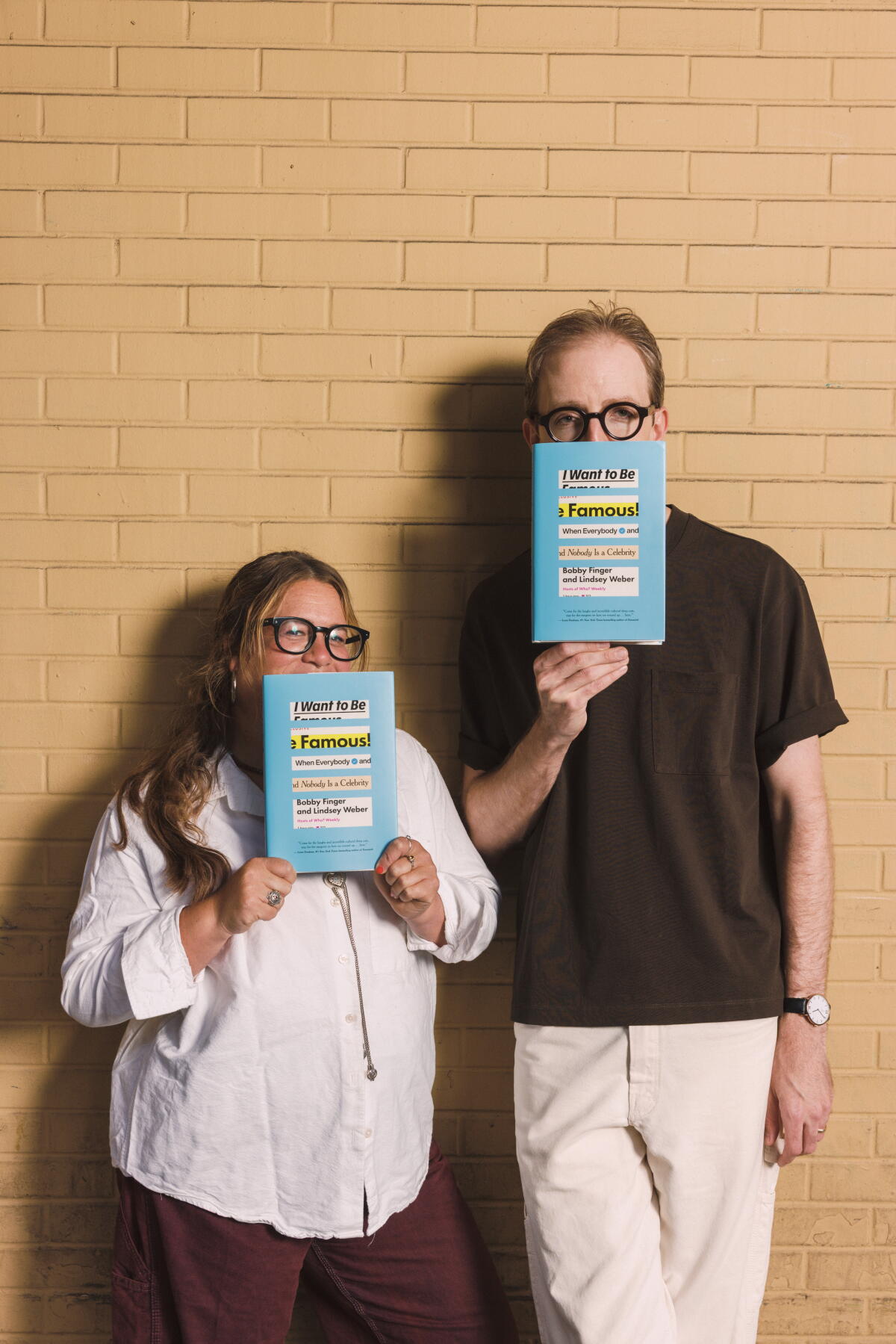
Lindsey Weber and Bobby Finger have co-written the newly released book, “I Want to Be Famous: When Everybody and Nobody Is a Celebrity.”
(Justin Jun Lee / For The Times)
Finger also cites influence from “Oh No They Didn’t,” a 2000s-era LiveJournal page that aggregated celebrity headlines and invited users to comment (kind of like a proto-Subreddit). “You read the story just as you read the comments, which were integral to the story,” Finger says. “All of the inside jokes, the additional commentary. That’s what ‘Who? Weekly’ has become, especially in our Patreon Discord. [Listeners] are always chiming in and creating their own language and extensions of the ‘Who? Weekly’ universe.”
That universe is about to expand again: In conjunction with the pod turning 10 this year, Weber and Finger are releasing a new book, “I Want to Be Famous: When Everybody and Nobody Is a Celebrity,” which looks at fame and celebrity through a historical lens while also exploring how the line between Whos and Thems got that much blurrier in the social media age. “I feel like we were always barreling towards a book,” Weber says. “Both of us are trained journalists. We were always kind of like, ‘When are we going to put our money where our mouth is?’”
To demonstrate how the binary is evolving into a spectrum, Weber and Finger revisit juicy pop cultural anecdotes (remember when Courtney Love threw her compact at Madonna at the VMAs? Or when Ariana Grande dated Pete Davidson? Or when Katy Perry flew into space on the Blue Origin?) while blanketing every chapter with an elucidation of why, no matter what decade we’re in, society just can never get enough gossip.
Meanwhile, unlike the podcast, “I Want to Be Famous” gives the hosts ample room to go deeper into the cultural framework of modern celebrity than they normally have time for. Each week, Weber and Finger dedicate one episode to unpacking a prepared list of Who-y headlines, and a follow-up episode, titled “Who’s There?,” is dedicated to listener calls. Which is to say, Weber and Finger usually spend more time explaining and trading jokes about what each micro-celeb is known for rather than how celebrity itself has evolved.
Lindsey Weber and Bobby Finger are celebrating the 10th year of their podcast “Who? Weekly.”
(Justin Jun Lee / For The Times)
“The pod is on the surface funny, [but] if you are a real fan, you’re like, ‘Oh, there’s actually some interesting stuff beneath the funny,’” Finger says. “We wanted this book to be the opposite, where it’s actually outwardly interesting and smart, and then inwardly funny when it can be.”
The writers’ tone might lean more academic within “I Want To Be Famous,” but longtime fans of the pod will recognize dozens of niche names, stories and extremely online subjects that were at one point or another discussed on the show. The authors present their grand theory of Whos and Thems by opening with the story of how former Who Meghan Markle shot to Them-dom after marrying Prince Harry. Other chapters observe what happens when Thems date or marry Whos. There’s a history of how celebrities say sorry (where there were once press releases there are now Notes app apologies) and a conversation about how nepo babies fit into the framework. As the book moves across history and demonstrates how the internet has completely upended the binary, they also show what hasn’t changed about the way fans relate to their favorites. “What we want most in a celebrity is authenticity,” Weber theorizes.
For Weber and Finger, the chance to tie the disparate threads they discuss on “Who? Weekly” was a major incentive to work on their book. “I kept being like, ‘Is this the first time anyone’s ever written about this in a book?’” Weber says with a laugh. “Because some of it was so stupid — these references to fandoms and Club Chalamet and niche things that are newer … I’m like, ‘Oh my God, are we doing this thing where now people have to read about Club Chalamet in 100 years?’ Obviously that would be incredible.”
“There’s a temporality to our show that is not the case with this book, which is very exciting,” Finger adds. “Because our show kind of exists to go in one ear and out the other. And I say that because it goes in one of our ears and out the other too, as the creators.”
Woven into the conversations around Whos, Thems, Thems behaving like Whos (see: brand deals), and Whos aspiring to be Thems is the authors’ palpable anxiety about the decaying role of entertainment journalism in an age in which celebrities can simply promote themselves via social media — or host their own podcasts. The authors are also painfully aware that most audiences have less of an appetite for reading, period. A chapter titled “The 2010s Killed the Cover Star” looks back what is thought to be the greatest piece of celebrity journalism ever written (Gay Talese’s 1966 Esquire classic, “Frank Sinatra Has a Cold”) and contrasts it with today’s style of uncritical, PR-friendly celebrity Q&As that boast nothingburger headlines that don’t tell us much of anything.
Conversations about media and journalism itself run through the podcast too, and that’s by design. “Sometimes we go so niche that it’s like, ‘Are we just making a podcast for our friends that work in media?’ And sometimes the answer is yes,” Weber says. “We can only speak from our experience. … But the most shocking thing about ‘Who? Weekly’ is that [media discourse] is actually quite interesting for lots of people.”
Finger adds, “Our past in media and our abundance of friendships with people who are still in media is like a crucial part of our show. It’s an industry we respect so much, you know, and we’re obsessed with the way it evolves. If we didn’t have that background, I don’t think the show would exist the way it does at this current moment.”
Even with a massive archive of episodes and no plans to stop, Weber and Finger are thrilled to have cemented their legacy with a book that could (and really should) be taught in media and communications classes. “Bobby and I both obviously love celebrities,” Weber says. “But we love media more.”
Brodsky is an L.A. culture and music writer. Her biography of Stevie Nicks, “Lessons & Lace,” published by Penguin Random House, is out now.
It’s never been a more terrifying time to be an undocumented immigrant in America. Despite countless protests and pushback, ICE agents continue to patrol the streets. In July, Colombian immigrant Johan Sebastián Durán Guerrero was shot and killed by an ICE officer in Biddeford, Maine, during a routine traffic stop.
But what about the white-passing undocumented immigrants that seem to slip through the system? The ones who blend in so seamlessly (despite the thick accents of some)? We forget they are also legally not supposed to be here. Specifically, those from Eastern Europe, Russia and the former Soviet Union. And what about those young, desperate women who suggestively posed for the camera as the Soviet Union collapsed all around them, hoping to be chosen by an American man?
Book Review
Ungrateful Immigrant Daughter: A Memoir From the Child of a Mail-Order Bride
By Katya Suvorova Alcove Press: 352 pages, $30
If you buy books linked on our site, The Times may earn a commission from Bookshop.org, whose fees support independent bookstores.
Katya Suvorova’s searing debut memoir, “Ungrateful Immigrant Daughter: A Memoir from the Child of a Mail-Order Bride,” out Sept. 29, is a heart-wrenching tale of immigration that pulls back the velvety red curtain to reveal one story behind the over-sexualized stereotypical post-Soviet mail-order bride narrative so ingrained in post-Cold War U.S. culture.
My own family legally immigrated to the U.S. from Soviet Belarus in the early 1990s. I grew up with the Western media narrative that Eastern European women were submissive sex symbols, desperate for financial security. Some boys in school even assumed I was “easy” because I was Eastern European.
Mostly told from a child’s point-of-view, Suvorova’s “Ungrateful” traces their journey in the ’90s from Russia to the U.S. and life thereafter, as white-passing undocumented immigrants who illegally crossed the border from Mexico — with the help of a man who replied to her mother’s mail-order-bride ad in a catalog. A catalog Suvorova would find years (and many rich American stepfathers) later while cleaning out the garage, and realize her mother had lied to her. She was not, in fact, a model, posing for a Coca-Cola ad, but a young woman with a small child desperate to leave Russia behind for the West. When Suvorova confronts her mother after finding the catalog, her mother replies: “Everyone was doing it.”
Mail-order brides shaped early colonial America. Men were often the first to settle small Western frontier towns and would in turn grow lonely for companionship. Newspaper ads for brides were normalized and proliferated in 19th century America. According to historian Elliott West, “Some mining camps in Idaho in 1870 had nine men for every woman.” The truth is that love didn’t enter the picture when it came to marriage until about the 19th century with the Victorians; before then, marriage was more like a business contract, with dowries and cows alike.
Letter brides remained ubiquitous in 20th century America and were not stigmatized until the 1970s and 1980s when it became more apparent that mail-order immigrant brides from developing Southeast Asian and Eastern European countries were being abused and exploited. It wasn’t until 2005 that the U.S. passed the International Marriage Broker Regulation Act (IMBRA), which requires background checks and other precautions meant to protect foreign brides from domestic abuse, violence and exploitation. You don’t have to dig deep to see this narrative proliferated in our culture. Jeffrey Epstein mostly recruited Eastern European women into his international sex-trafficking ring.
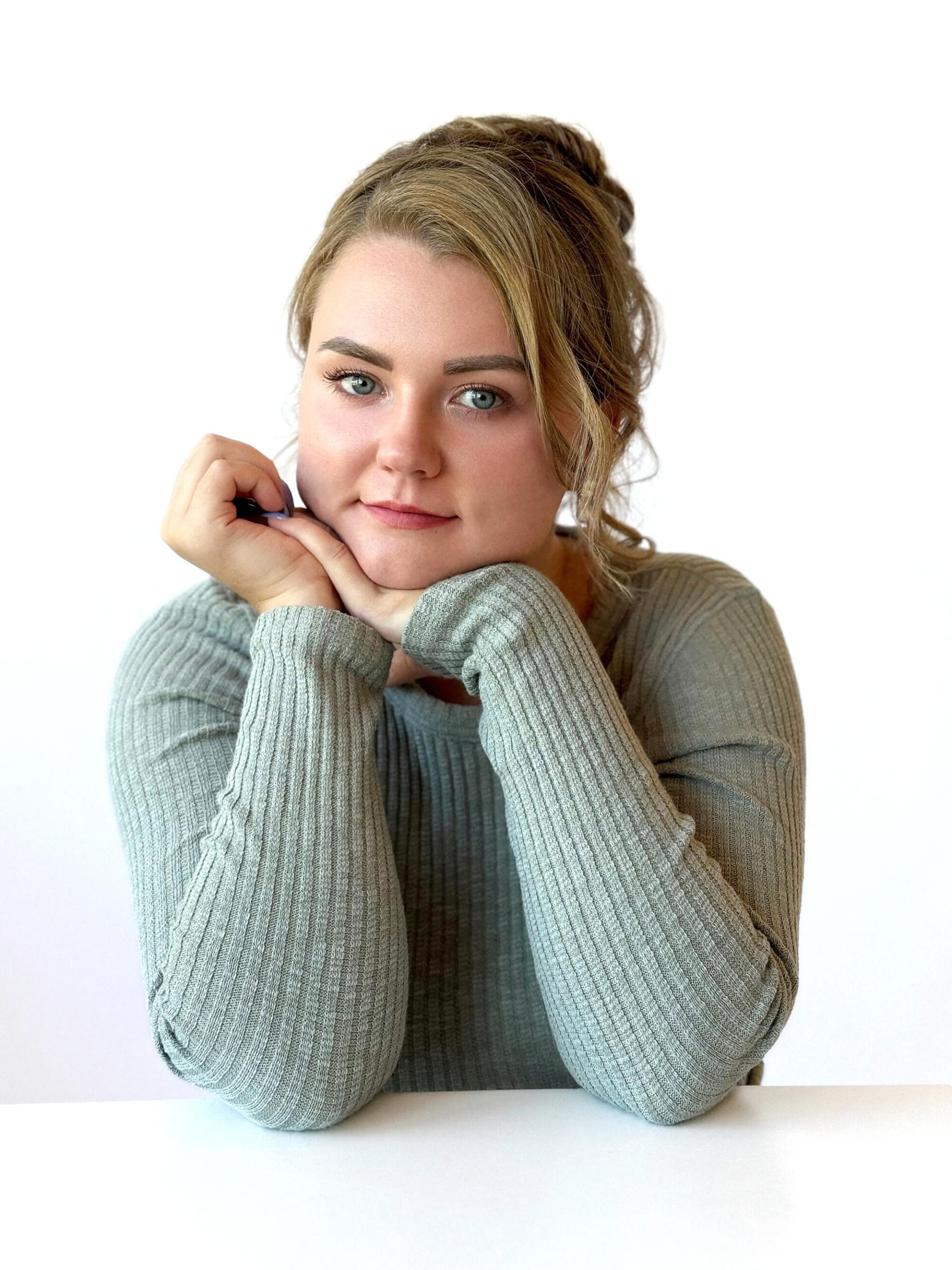
Author Katya Suvorova
(Alcove Press)
Suvorova and her mother were not spared such indignities. Abuse, both psychological and physical, permeates the pages of “Ungrateful.” From one of her earliest childhood memories of watching her mother being abused while stuck in a closet to later tales of her mother’s forced alcohol abuse and estrangement from her own mother (Suvorova’s beloved Babushka), expertly executed by her stepfather Adam — the abuse ran rampant. Suvorova herself is a victim, neglected by her mother and forced to act as a child bride to please one of the husbands. Eventually, Suvorova realizes that it wasn’t just her mother that was sold in a catalog to an American suitor, but her young daughter (Suvorova) as well. It’s no surprise that Suvorova is estranged from her mother, a topic she covers often on her social media.
Of course, there is also the “gold digger” stigma. Suvorova writes about girls in school accusing her mother of being a gold digger, intentionally choosing rich boyfriends that would eventually become rich husbands while they lived in poverty and couch surfed. Suvorova’s mother would use creative tactics to find these men: hang out in five-star hotels or fancy athletic clubs. She would have them buy her computers, clothes and expensive jewelry she could sell later. She always ordered the priciest thing on the menu and bought gift cards when the men gave her money for groceries in case the relationship did not work out. She passed down these survival tactics to Suvorova like gospel. But, ultimately, it wasn’t money that her mother was after, it was green cards for them both, the permanence and safety of American citizenship: the American Dream.
In 2012, I dressed up as a mail-order bride for Halloween. I was 22, about the age Suvorova’s mother was when they immigrated to the U.S. I wore a tight sleeveless red American Apparel dress. Shiny fake patent leather pumps. A white veil from Claire’s at the mall. I covered myself in bits of cardboard, packing tape and foam peanuts and overdid my makeup with several coats of mascara and thick black eyeliner. I thought this costume was funny, clever, appropriating and reclaiming the narrative that haunted me all my life. I thought because of where I was born, I was allowed to do this. A notoriously blunt girl who I sensed didn’t like me approached while I was waiting for the bathroom. “What are you, a slut?” she said, scanning me like a barcode.
Suvorova’s memoir effectively shows the risks immigrants were willing to take to escape the collapse of the Soviet Union and the corruption (ruled by the KGB) that followed. Without explicitly diving in, her writing sheds light on today’s Russian corruption and Putin’s endless war with Ukraine, which is ultimately a war against the West. In fact, Suvorova and many antiwar Russian immigrants today are terrified to return to their motherland due to fear of imprisonment and retaliation, as one Los Angeles woman in 2024 learned the hard way upon landing in Russia, receiving a 12-year prison sentence for donating $51 to a Ukrainian charity.
In the building I grew up in and my parents managed, a young Russian “model” and her mother lived with a much older Persian man. Without much inquiry, I simply assumed she was a mail-order bride running from a traumatic past in the motherland, ordered from a catalog to make him dinner and vacuum his carpet. Closer to my age than not, she became my friend. Gifted me jewelry. Babysat me while my parents drank tea with her mother. I later found out she cheated on the Persian man, laid out her wedding dress on the soiled carpet while he was at work, and moved herself and her mother to Las Vegas, where she started a successful business and bought a house.
Suvorova’s story is not just about the childhood trauma inflicted by her mail-order-bride mother, but it’s a redemption story about reuniting with her beloved maternal Babushka and biological father. It’s a story of self-discovery. Not unlike the bestselling memoir “Educated” by Tara Westover, who overcomes an abusive childhood in a rural survivalist Mormon family. Like Westover, Suvorova finds shelter in books, school and an education.
Like all contemporary creative nonfiction writers and memoirists who are not celebrities, Suvorova must have been told somewhere down the line that in order to sell her memoir she must gain a following on social media, and she’s done just that. With about 95,000 followers on Instagram, Suvorova uses the platform to reveal earnest roundups, tips, tragic tales of estrangement and survival, and summaries of deleted chapters of “Ungrateful” as blocks of text over grainy film photos of her as a child. Suvorova’s very active social media presence sheds light on the current state of memoir and nonfiction publishing: You must have a platform to be read.
In a bizarre meta twist of events, Suvorova must sell herself and her story on social media, like her mother sold herself (and in turn her daughter) to those American husbands. In a stroke of marketing genius, some early copies of “Ungrateful” come with book-branded condoms.
And despite revealing in the memoir that she eventually did become an American citizen, Suvorova has since moved to Europe. When I asked Suvorova over Instagram direct message why she and her husband left the U.S. for Europe, she replied: “We left because I didn’t feel safe publishing my book about growing up as an undocumented kid under the current Trump administration. I have to take medicine that, if I were detained and could not take it, would lead to organ failure. We knew ICE was detaining U.S. citizens as well and decided not to risk it. In order to still publish the book and not be detained, we left the U.S.”
How many of us have been cruel immigrant daughters (or sons)? Ungrateful. Spoiled. Unaware or unwilling to acknowledge how much our parents have sacrificed to get us here. In the case of Suvorova’s memoir — although, she does acknowledge her white privilege — she certainly has a lot to be ungrateful for.
Ruzova is a Soviet-born writer based in Los Angeles. Her essay “The Sauna” was a notable in Best American Essays 2025.
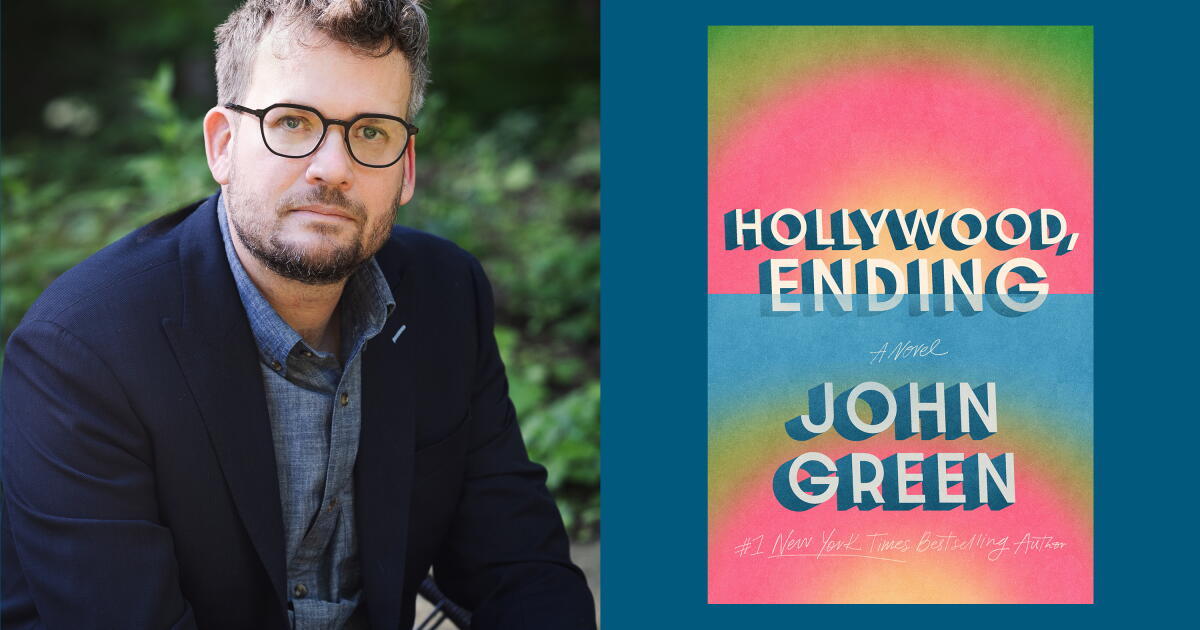
John Green’s nine-year hiatus from fiction has ended, and his adult debut, “Hollywood, Ending,” comes right on time to explore the dark side of fame.
The novel centers on former child actor Juniper Castillo and Hollywood newbie Kai Laramie, who are cast in the artsy biopic “Andy Warhol Never Gets Old,” with hotshot movie star Matthew Malone in the title role. It’s Juniper’s chance to establish herself as an adult actor and Kai’s first foray into the spotlight, a position he quickly realizes doesn’t come without a personal cost.
“There’s no way I could have written this book without spending a lot of time on film sets,” Green told The Times in a recent call.
On the Shelf
Hollywood Ending
By John Green Dutton: 304 pages, $32
If you buy books linked on our site, The Times may earn a commission from Bookshop.org, whose fees support independent bookstores.
Over the last two decades, several of the author’s bestselling young-adult novels have been adapted for the screen. His debut, “Looking for Alaska” (2005), was adapted as a Hulu limited series in 2019, the same year Netflix released the feature film adaptation of his co-authored holiday anthology, “Let It Snow” (2008). On the big screen, “Paper Towns” (2008) made its film debut in 2015, while his bestseller “The Fault in Our Stars” (2012) became a box-office hit in 2014. Most recently, his 2017 novel, “Turtles All the Way Down,” received a feature film adaptation in 2024.
“I hope the book is a love letter to movies. But I also wanted to be honest about how difficult it is to make a work of art that, in order to be commercially successful, has to be loved by millions of people,” Green said. That’s where the Hollywood machine comes in. “It’s really hard to figure out how to get millions of people to pay to watch something, and that challenge leads to all kinds of compromises and sacrifices.”
While Green’s young-adult novels have often explored the teenage experience, he never felt confined by the YA genre. “I think teenagers have infinite intellectual capacity,” he said, adding that he doesn’t really think about which shelf will hold his novels inside a bookstore. In “Hollywood, Ending,” his main characters are navigating their early 20s, a period which Green finds especially interesting.
“The questions in this novel explore how it feels in those early years of adulthood when there are still so many possibilities, so many directions you might go,” he said.
The following conversation has been edited for length and clarity.
How did you land on Andy Warhol as a celebrity figure and metaphor to use in telling this story about Kai and Juniper?
I think Andy Warhol saw so much of our world coming. He saw that three-dimensional experience was going to be rendered in two dimensions. He’s most famous for taking cylindrical soup cans and making them flat, but he also saw celebrity culture coming.
There’s the famous quote about everybody being world-famous for 15 minutes. I think he understood that normal people were going to experience celebrity, and he also saw the way that the repetition of images, as I write about in the novel, would lead to a certain desensitization. So I think everything from screen-based experience to the ways that technology was going to reshape our lives, he was the patron saint of all of that.
One of the images that really struck me is when you talk about him dying wigless and being too uncomfortable with that to have friends come and visit him in the hospital.
I think Juniper says at one point that fame is a kind of armor. I don’t know how Warhol thought of his wigs, but I wanted it to be a sort of emblem of protection for him.
Your wife, Sarah, is an Andy Warhol scholar. Was that a major strength while you were writing this?
There’s a huge advantage to being able to fact-check something by shouting down the hall. I also wanted to include Warhol partly as a love note to Sarah … She co-wrote a book about Andy Warhol’s relationship with money and business called “Andy Warhol Enterprises.” After 25 years, our way of looking at art and the art that we’ve shared together is so deeply intertwined that anything I write is unimaginable without her. She’s my first reader and most important reader … It’s only thanks to her that Warhol’s in the book.
You really humanize the young actors in “Hollywood, Ending,” which, unfortunately, is a unique thing. This is an intimate, vulnerable portrayal of behind-the-scenes Hollywood — why was that important for you to examine?
I wanted to write about the machine that takes private experience and commodifies it, and I think that machine is especially challenging to navigate when you’re young, when you’re in early adulthood, because you don’t yet have those relationships that are going to carry you through. You don’t have the love that you need to survive all that you’ve got to survive. When my work became very successful, I was in my 30s. I was married. I had two kids. I lived in Indianapolis. I had best friends. I was pretty grounded, and it was still very disorienting.
How so?
It’s a completely different life to have everybody have opinions about your work than it is to take your kids to school every day. So I was thinking partly about that, but I was also thinking about the influencers I’ve known, and the actors I’ve known who’ve had to go through that [while] much younger, and what that’s been like for them as well.
You do a really good job of examining the dark side of the attention economy. Why was this especially of interest?
Well, it used to be that the attention economy was mostly a problem for actors and other celebrities, but now the attention economy is something we all participate in. We’re all taking our private experiences and packaging them up for public consumption on Facebook and Instagram and Twitter and Reddit, and I think we gain something from that, or we wouldn’t do it. But we also lose a lot.
I wanted to try to be honest about what we gain, and also be honest about what we lose. My last novel, nine long years ago, was about a young woman with OCD. I also have OCD, and I had to make a decision when I was promoting that book, about whether I would talk about having OCD, and I decided that I would, and that became a huge part of talking about the novel — talking about my own experiences with mental illness, and it was a gift in many ways because so many people have said to me that it helped them to see that it’s possible to have a good and fulfilling life while living with a serious mental illness, and it was helpful for me because it helped me feel less alone in it.
But it was also complicated because there are real costs when you share something. It’s not yours anymore in ways that are a relief, but also in ways that are difficult.
You’re offering it up for scrutiny in a way that can be really scary.
It is really scary to have your private life scrutinized in that way, right? And there’s an element of judgment that comes with creative expression that’s a natural and healthy part of conversations about what art is and what art should be, but being in the middle of those conversations isn’t always fun.
I think you capture that in Kai’s experience.He is really pressured to come out and talk about his traumatic experience, and he doesn’t want to. The “machine” wants to sell tickets and exploit his trauma in the process.
It’s one thing to try to make good art. It’s another thing to try to make good art that lots of people interact with, and a portion of that second issue is inevitably finding ways to interest an audience, and nothing interests an audience quite like a personal story, especially a personal story of overcoming difficulty.
Was the movie star Matthew Malone based on anyone specifically?
I have aphantasia, this brain condition that causes me not to be able to imagine anything visually. I have no visual imagination, and so I can’t see actors when I’m writing. I can’t see characters when I’m writing. I can’t see anything. Everything’s made out of language, and so there’s no way I could have cast the movie in my mind or had somebody in mind for the character. It’s been great to hear all the folks who people were thinking of. I’m curious who you were thinking of.
I thought of Tom Cruise a couple of times. Have other people said that?
A couple people have said that as well. Yeah.
That’s so interesting about your work with language solely. Do you think that’s been a strength with you as a writer? Because you create such vibrant visuals for your readers.
It’s the only way I’ve ever been. I never knew that other people had this vibrant visual imagination until I was in my 40s, and my wife said I think maybe the reason you don’t have a sense of direction and you have to open up all the cabinets when you put away the dishes and you don’t know whether there’s a rug in the living room is because you don’t have a visual imagination, and I was like, of course I don’t. Nobody does, and she was like, you can’t picture an apple in your head? And I was like, no, nobody can picture an apple in their head. They say they can, but they mean it metaphorically … And Sarah explained to me that, in fact, the vast majority of people can see an apple, which still seems fictional to me, like science fiction stuff.
Some people don’t have that inner voice in their head (anendophasia).
I do have an inner voice. I think. But this all gets to something really interesting about being a person, though, which is that you’re stuck the whole time you’re here inside of one consciousness and looking at the world through one set of eyes. And I have no idea what it’s like to be you. The great thing about writing fiction for me is that act of imagination, that attempt to empathize, that attempt to escape the self and imagine what it would be like to be somebody else with some clarity, but of course, there’s always a limit to my ability to do that, and that problem has fascinated me my whole career.
Your books have meant so much to so many people, and in recent years, I’ve reported quite a bit on your book, “Looking for Alaska,” being one of the most commonly banned books. How do you feel about that?
I’m really concerned about attempts to limit intellectual freedom in the U.S., especially when it comes to libraries and schools. We have professionals we’ve trained to make collection decisions and to make curricular decisions in schools, and those professionals are teachers and librarians, and I’m very disturbed when other people come into that conversation and try to usurp the work that teachers and librarians are doing. I think a lot of times authors get most of the credit for the fight against book bans, and the truth is, all the credit should go to the teachers and librarians who are often putting their jobs on the line, making really difficult decisions to try to do the best by the kids that they’re representing and working with.
John Green will be in conversation with Julia Whelan to discuss “Hollywood, Ending” at 7 p.m. Tuesday, Oct. 13, at a ticketed ALOUD event hosted at Saban Theatre. 8440 Wilshire Blvd., Beverly Hills.
Today marks the end of an era. Mark Swed — the last full-time classical music critic at a major American newspaper — has retired. On Thursday, members of The Times editorial staff gathered to celebrate Swed, but the mood was somewhat somber. Although we were glad for our beloved colleague, this was not a happy milestone for journalism — or classical music.
Swed is the rarest of writers: a critic with deep empathy and encyclopedic knowledge who can turn the sonic details of an orchestra playing Mahler’s Seventh Symphony into an epic journey for readers. At a time when orchestra leaders struggle to find new audiences for the art form, Swed’s writing did the job for them.
And in an era when everybody is an expert on TikTok, Swed’s informed criticism was a life raft in a sea of slop. He told us why the music mattered — in its historical context, as it related to the modern landscape, and what it meant to him personally. He made us better listeners, and most importantly, he made us curious. After reading his take, we wanted to run out to a concert, an opera or a new music festival.
That this particular kind of writing — and of seeing and explaining the world to readers — is going away with Swed, is truly a tragedy. Thankfully he is leaving of his own accord, and will hopefully continue to write a monthly column, but his loss still stings.
Like many, I watched with sorrow in February as the Washington Post slashed its staff, including its classical music critic, Michael Andor Brodeur. That blow came a little less than a year after the New York Times shook up its culture desk and reassigned its classical music critic, Zachary Woolfe, to serve as the obituaries editor. (The paper is now actively searching for a new classical music critic.)
A number of staffers spoke at Swed’s retirement lunch, and deputy A1 editor John Penner was among them. In his touching speech, Penner noted that Swed was the last of his kind, adding, “with no full-time critic writing anywhere in any newspaper about classical music, American journalism will be poorer, and its readers less informed, inspired and enlightened.”
Penner continued, saying what all of us gathered in that conference room knew to be true, “Mark’s 30 years at The Times coincided with this city’s Golden Age of classical music — the era of Salonen and Dudamel and Disney Hall. L.A. has been the most important and exciting music capital in the country, if not the world. (Why else would New York be stealing Gustavo from us now?) And central to that excitement and importance has been Mark’s writing and criticism. For my money, even when there were many music critics writing for many publications, Mark set the standard for classical music criticism, while opening our ears to new and under-appreciated music.”
Hear, hear.
I’m Arts editor Jessica Gelt wishing Swed a happy retirement and humbly asking him to come back to us now and again. This is your arts and culture news for the week.
You’re reading Essential Arts
Our critics and reporters guide you through events and happenings in the SoCal arts scene. In your inbox every Friday.
By continuing, you agree to our Terms of Service, which include arbitration and a class action waiver. You agree that we and our third-party vendors may collect and use your information, including through cookies, pixels and similar technologies, for the purposes set forth in our Privacy Policy such as personalizing your experience and ads.
The week ahead: A curated calendar
FRIDAY
Demand To Be Heard Festival The Sunflower Project presents a celebration centering the voices of survivors of abuse beginning with a screening of the film “Break The Silence: The Gabby Petito Story,” followed by a panel discussion with the Gabby Petito Foundation. Saturday and Sunday is the Resident Artist Showcase, featuring the work of six survivor/artists. Also Saturday are three three arts workshops focusing on music, candle making and body movement, respectively. Film screening, 6 p.m. Friday; 6:30 p.m. Saturday-Sunday, Resident Artist Showcase. Wisteria Theater, 7061 Vineland Ave., North Hollywood. Arts workshops, 11:30 a.m., 1 and 2:30 p.m. Art Share L.A. 801 East 4th Place, downtown L.A. towardsthesun.org
Jonah Elijah: Ambiguously Free The first U.S. museum solo exhibition by the L.A.-based contemporary painter and mixed-media artist features work that blends personal memories with broader mythologies, religion and history to explore Black culture. On view through December 16. Xela Institute of Art, 2176 Pacific Avenue, Long Beach. xela.art
Joshua Redman Quartet: Words Fall Short The saxophonist performs a new program of music with his ensemble — pianist Paul Cornish, bassist Philip Norris and drummer Nazir Ebo, plus special guest Skylar Tang, an up-and-coming Bay Area-born trumpeter and composer. 7:30 p.m. The Wallis, 9390 N. Santa Monica Blvd., Beverly Hills.thewallis.org
Melrose Gallery Walk Gallery spaces, including Hostler Burrows, Lawson-Fenning, Meg Turner, Object, Seventh House, The Window and 22RE, open their doors to celebrate the local design community. Free and open to the public. 5-8 p.m. Hostler Burrows, 6819 Melrose Ave. hostlerburrows.com
SATURDAY
Midterms: This Will Hurt Someone Brightwork newmusic performs a program of contemporary works inspired by civic life and social change, including Ted Hearne’s “Bye Bye Huey,” Natalie Dietterich’s “Philosophy of Furniture,” Ian Dicke’s “Get Rich Quick” (with video), Matt Marks’ “This Will Hurt Someone,” Hesam Abedini’s “What Remains” and “Frederic Rzewsk’s “Coming Together” (with video). 8 p.m. Sierra Madre Playhouse, 87 W. Sierra Madre Blvd. sierramadreplayhouse.org
Aperghis Trilogy Long Beach Opera performs three works by experimental composer Georges Aperghis: “Le corps à corps”,” Les Sept Crimes de l’amour,” “Récitations.” Directed by James Darrah Black. Christopher Rountree conducts. 7:30 p.m. The Queen Mary, 1126 Queen’s Way, Long Beach. longbeachopera.org
The Horror Show An immersive deep dive into the movie genre presented in six themed galleries: Gothic, Psychological, Science, Slasher, Religion and Ghosts, with behind-the-scenes looks at a range of titles that includes everything from Oscar winners to drive-in classics. But first, you must pass through “The Hallway,” bwahahaha. 10 a.m.–6 p.m. Wednesday–Monday, on view through July 25, 2027. Academy Museum, 6067 Wilshire Blvd. academymuseum.org
Senon Williams: here now, now gone, gone here A solo exhibition of the artist’s work, in which he collects materials such as nails, slips of paper, fragments of language and industrial remnants, then uses assemblage to rearrange them and discover deeper meaning. Noon-6 p.m. Tuesday-Friday, on view through Nov. 15. The Philosophical Research Society, 3910 Los Feliz Blvd. prs.org
Promised Lands: California’s Unratified Treaties and Native Resilience Archival materials, contemporary objects, images and voices from local tribal communities relate the complex history of the state with its indigenous people. 10 a.m.-4 p.m. Tuesday-Friday, 10 a.m.-5 p.m. Saturday-Sunday. Autry Museum of the American West, 4700 Western Heritage Way, Griffith Park. theautry.org
Rodgers & Hammerstein’s The Sound of Music Sing-A-Long Actor and comedian Melissa Peterman hosts the annual screening of the 1965 Oscar winner for best picture complete with a costume contest and more than a few of your favorite songs. 7:30 p.m. Hollywood Bowl, 2301 N Highland Ave. hollywoodbowl.com
Daymé Arocena’s Alkemi The Grammy nominee and Juno Award–winner blends Afro-Cuban beats with neo-soul, jazz and contemporary Latin pop. 7:30 p.m. The Wallis, 9390 N. Santa Monica Blvd., Beverly Hills. thewallis.org
San Pedro Festival of the Arts The 20th annual event, presented by Los Angeles Choreographers & Dancers, features 20 dance companies demonstrating a variety of styles and cultural traditions. 1-4:30 p.m. Peck Park, Upper Green near the Community Center, 560 N. Western Ave. triartsp.com
Tokio Ueyama: The Hollows Between Mountains The first museum exhibition in California of the Little Tokyo-based Japanese artist (1889–1954) features his drawings, prints, photographs and paintings as well as artists he was associated with, including Diego Rivera, Tōyō Miyatake, Edward Weston and Henrietta Shore. 11 a.m.-6 p.m. Wednesday–Sunday, on view through Feb. 28, 2027. UC Irvine Langson Orange County Museum of Art, 3333 Avenue of the Arts, Costa Mesa. langson.uci.edu
SUNDAY
Grant Gershon conducts the Los Angeles Master Chorale at Walt Disney Hall, Nov. 16, 2025.
(David Butow/For the Times)
Brahms’ Requiem The Los Angeles Master Chorale, led by Grant Gershon, opens its silver anniversary season with a program that also includes Bruckner’s “Te Deum.” 7:30 p.m. Walt Disney Concert Hall, 111 S. Grand Ave., downtown L.A. lamasterchorale.org
WEDNESDAY
Rubén Blades & Roberto Delgado Big Band: Fotografías Tour The Panamanian salsa greats perform classic Afro-Cuban music flavored with rock, jazz and Latin American influences. Silvana Estrada opens. 8 p.m. Hollywood Bowl, 2301 N Highland Ave. hollywoodbowl.com
Menopause The Musical: 25th Anniversary Tour Four women at a lingerie sale share their experiences with “the change” through parody songs of pop hits. 7:30 p.m. Bank of America Performing Arts Center, 2100 E. Thousand Oaks Blvd., Thousand Oaks. bapacthousandoaks.com
The Broadway production of “The Outsiders.”
(Matthew Murphy)
The Outsiders The Tony Award-winning musical adaptation of S.E. Hinton’s coming-of age-novel set in 1960s Tulsa arrives with Ponyboy Curtis and his fellow greasers facing off against the upper-class Socs. Through Oct. 18. Hollywood Pantages Theatre, 6233 Hollywood Blvd., Hollywood. Oct. 20-Nov. 1. Segerstrom Center for the Arts, 600 Town Center Drive, Costa Mesa. tour.outsidersmusical.com
THURSDAY
Laura Benanti: Nobody Cares The Broadway star sings original songs and shares stories with her trademark wit in this one-woman show. Directed by Annie Tippe. 7:30 p.m. Thursday-Saturday. 2 p.m. Saturday-Sunday. The Wallis, 9390 N. Santa Monica Blvd., Beverly Hills.thewallis.org
The Dance and the Railroad Asian American theater collective Artists at Play and Latino Theater Company team up for a rare revival of an early David Henry Hwang play set during the 1867 Chinese railroad workers’ strike. Directed by Katherine Chou. Previews, 8 p.m. Thursday and Oct. 2. 8 p.m. Thursday-Saturdays, 2 p.m. Sundays, through Nov. 1. Los Angeles Theatre Center, 514 S. Spring Street, downtown L.A. latinotheaterco.org
Mahler’s Symphony No. 2: Resurrection Alexander Shelley conducts the Pacific Symphony with soprano Miah Persson, mezzo-soprano Dame Sarah Connolly and the Pacific Chorale. 8 p.m. Thursday-Oct. 2. Segerstrom Center for the Arts, 600 Town Center Drive, Costa Mesa. pacificsymphony.org
The SoCal scene
Gov. Gavin Newsom mingles with guests at the Lucas Museum of Narrative Art opening party.
(Carlin Stiehl/For The Times)
I spent my Saturday night at the Lucas Museum opening party where I got to stand in the lobby by the nifty elevators watching Gov. Gavin Newsom talk to Kim Kardashian. Later, I went to Skywalker Grill and saw U.S. Rep. Nancy Pelosi sitting at a table next to Leonardo DiCaprio and his entourage. It would be an understatement to say that the night was both bizarre and memorable.
Times theater critic Charles McNulty (the paper’s only remaining arts critic) has kept exceptionally busy this fall season. Late last week he wrote a review of “The Ford/Hill Project” At REDCAT, which transforms Senate testimony from Anita Hill and Christine Blasey Ford into a docu-play that explores the details of two of history’s most consequential Supreme Court confirmation hearings. “The restraint imposed by the production adds to its power. There’s no need to editorialize. The proceedings skewer themselves,” McNulty writes.
Huguette Caland in Stone Doorway, France, 1970.
(Huguette Caland Estate)
McNulty also drove to San Diego to see the Old Globe’s world-premiere musical adaptation of John Carney’s “Begin Again,” which explores the stories of two music-industry vets who embark on a grassroots recording project. The show features a score by rocker Pat Monahan and Train. “‘Heartwarming’ is a cliche of theater reviewing that I have studiously tried to avoid, but I’m tempted to use the word in my review of ‘Begin Again’,” McNulty writes.
McNulty penned one of his harshest reviews since last year’s take down of “Hamlet” after he went to Atwater Village Theatre to see Echo Theater Company’s world premiere production of “The Peterson Show,” by Janine Nabers. “Unfortunately, the production is hamstrung by fundamental problems in the writing, directing and acting, all pointing to a failure of control. Control of the story, control of the tone and control of the cast,” McNulty wrote of the show, which is about the impact of disgraced Bill Cosby-like star on his TV family.
Meanwhile contributor Tara Anne Dalbow wrote a beautiful story about the late, great artist Huguette Caland in advance of the largest U.S. retrospective of her work, opening Sunday at the Hammer Museum.
Ernest “Ernie” Wolfe III, owner of an eponymous gallery on Sawtelle, is dying of a traumatic brain injury and his family is looking for homes for his 15,000 pieces of African Art. Contributor Jane Horowitz writes about Wolfe‘s legacy and the (sometimes controversial) origins of his collection.
As one chapter closes with Swed’s retirement, a new one begins as we welcome our new entertainment and arts reporter, Laura Zornosa, who hit the ground running by writing three great arts stories: The first is about the private art collection of Armand Hammer (including Mary Cassatt’s “Summertime,”) coming up for auction at Sotheby’s; the second, covering opening day at the Lucas Museum where Zornosa interviewed guests on their thoughts about the place; and the third is a fun news brief about how Los Angeles Chamber Orchestra commissioned fanfares from half a dozen film composers, including John Williams and Ludwig Göransson, curated by “none other than Seth MacFarlane (best known as the creator and star of “Family Guy”).”
Enjoying this newsletter? Consider subscribing to the Los Angeles Times
Coy Middlebrook has been named the new artistic director of the Wallis.
(Jeff Lorch / The Wallis)
The Wallis Annenberg Center for the Performing Arts announced the appointment of longtime creative staffer Coy Middlebrook as its new artistic director. “Coy brings an extraordinary depth of knowledge about The Wallis and its audiences, along with deep relationships throughout the performing arts nationally and internationally. He understands both the artistic possibilities of this institution and the importance of its relationship to our community. I am excited to work with him as we build a future that is artistically ambitious, deeply connected and open to everyone,” said Wallis Executive Director and Chief Executive, Jean Davidson, in a news release.
Meanwhile Theatre Commons LA (TCLA), the nonprofit organization created and launched a year ago as part of a concerted effort by some of the city’s most prominent theater leaders to unify the city’s sprawling theater scene, has announced its first Executive Director, David E. Shane. Shane previously served as director of program services at the Alliance of Resident Theatres/New York where, according to a news release, “he set the strategic vision and goals for a robust suite of programs serving over 450 of New York’s nonprofit theaters.” He is tasked with doing the same thing in L.A. and we wish him the best of luck.
— Jessica Gelt
And last but not least
The Getty Museum has acquired the recently rediscovered 17th-century painting “Portrait of the Count-Duke of Olivares” by Spanish artist Diego Velázquez (1599-1660). It will be displayed in the museum’s East Pavilion this fall. According to ArtNews, “The acquisition means a Velázquez painting will for the first time be represented in the collection of a West Coast museum.”
Amanda Thorpe has said previously she believes her husband would still be alive had he received more support from the England and Wales Cricket Board (ECB) after leaving his coaching role. Following the inquest into his death, the ECB said it was “a profound tragedy” and added Thorpe’s passing was a “stark reminder” of the challenges many face with mental health.
Matt Beard died a month after leaving his role as manager of Burnley Women. He had been in the post for only two months. When the inquest into his death was postponed indefinitely, Burnley said they were “aware of an ongoing legal process” and would “not be making any comment at this time”.
Amanda: “Graham had been struggling for the previous year to 18 months during Covid. Graham didn’t really like following rules and there were quite a few in Covid – like playing under bubble conditions. So he had been having some medication and therapy in his job. But then Graham lost his job and he didn’t see it coming.
“He did pride himself with having been in the game his whole life. He just couldn’t believe that he was blindsided by it.
“I think at least two other people were sacked at the same time, which does happen at the end of disastrous Ashes series.
“Also he was probably drinking too much and found the whole of the last trip in Covid very stressful. He then took a playful video at the end of the tour, when they had a few drinks with the opposition. One of the players sent it to two friends and someone unfortunately leaked it, so it was in the Sydney Morning Herald.”
Simon: “Going for a few drinks with the opposition – you would think that that happens in sport all the time, but they lost?”
Amanda: “Yes. It’s OK if you win but you’re not allowed to have a drink if you lose. He was probably in shock. He couldn’t believe it. And he was embarrassed and ashamed about this stupid video, which to me he blew way out of proportion. But he was in this tunnel where he thought he’d messed it all up. So he went into a quick and steep decline.”
Simon: “During that period, what could have been done? You said that he was seeking some help. What might have made a difference, do you think?”
Amanda: “He was havingtherapy sessions. He had 10 sessions. There’s obviously the confidentiality but I found out after he made a very serious attempt on his life, when he really hurt himself very badly, that he’d mentioned suicide. I didn’t know about that at the time. Of course, I feel that if I’d known, things could have been different. And I did feel that he wasn’t really getting better. It was difficult. I felt like maybe he did need more help – maybe residential but we didn’t really know where to find that.”
Simon: “Debbie, Matt also lost his job…”
Debbie: “He did.”
Simon: “Were there any signs that he was struggling with mental health, and then was there a steep decline afterwards?”
Debbie: “I think there were changes in behaviour, looking back. Performance-wise the team weren’t doing well so there was a lot of abuse on social media. He could never really speak his truth during media interviews of what was going on behind the scenes and he used to sound off to me at home.
“I’ve found out since that he had spoken to his brother quite a lot about his mental health. But whenever I would say to Matt ‘how are things?’, he’d be, ‘I’m all right, I’m all right’, because he always wanted the best for other people.
“He didn’t want to concern me and the family that he was having these thoughts and that he was going through these different struggles.
“The sackingcame out of the blue and there was a lot of speculation around that. He was starting to drink more than he would have done normally. In terms of his behaviour, I would say he was taking a lot of risks as well. So maybe that was the start of this with him.”
Actor D’Arcy Carden stopped by early, beating the cadre of guests crowding the main plaza beneath the now-famous oculus of the 300,000-square-foot Ma Yansong-designed building. A Stormtrooper drove by on a flatbed truck, shortly before R2-D2 greeted visitors in the courtyard, wearing an official staff badge. (The line for a selfie with the droll droid stretched as far as the eye could see.) Museum leaders have long said that “Star Wars” artifacts account for about 7% of the 100,000 square feet of gallery space, but one worker quipped 90% of opening-day attendees likely had a vested interest in the franchise.
This proved true, for the most part: Many visitors clearly knew and loved “Star Wars,” and Princess Leia buns and Yoda ears abounded. (Two Padmé Amidalas ran into each other, and according to a restaurant worker, one brave soul showed up in “Star Trek” gear.)
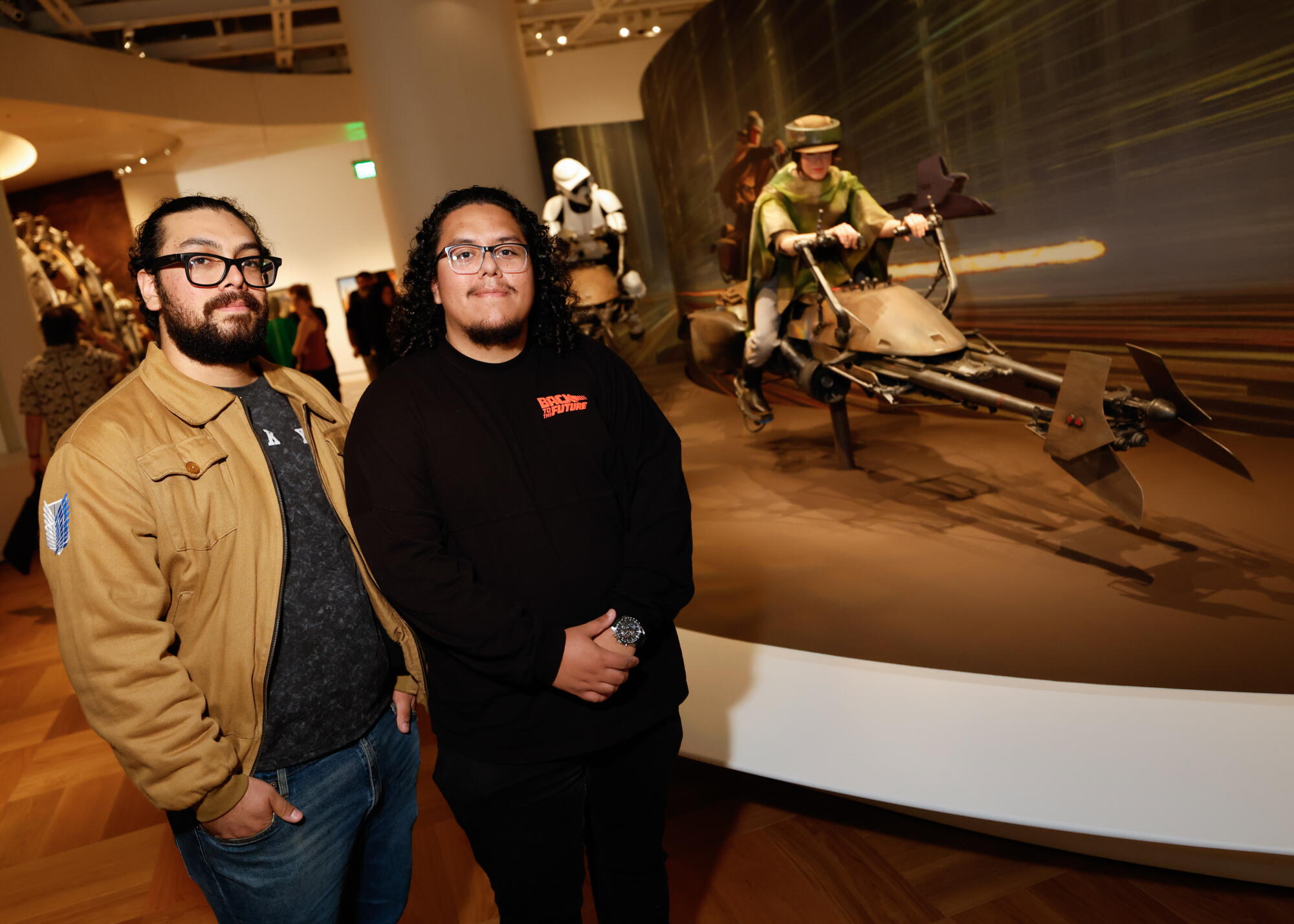
David Perez, 27, (right) donned his “Back to the Future” gear, hoping to see art from the movie. But he and his brother Carlos Perez, 28, (left) were quite pleased with the “Star Wars” artifacts in the Cinema section.
(Carlin Stiehl / For The Times)
Still, the museum, as its famous co-founder George Lucas has repeatedly said, is about more than just one story, however beloved. That sentiment cropped up repeatedly in interviews, too: Early guests seemed to believe the museum’s brochure, which notes that the galleries are about the “narrative art” of illustrating stories.
Co-founders Lucas and businesswoman Mellody Hobson (also Lucas’ wife) gave remarks early Tuesday to the first 100 visitors, consisting of students from USC, Los Angeles Technology Center, Otis College of Art and Design and Los Angeles City College, who were all handed free tickets.
A yellow Naboo N-1 Starfighter hangs above the education lobby, across from the main plaza, guarding the research library.
(Carlin Stiehl / For The Times)
“I’ve spent more than 50 years collecting the work of artists who don’t always get their due — illustrators, cartoonists, muralists, painters — because I believe their images are as vital as any other art form,” Lucas said. “They deserve to be in a museum.”
“This is a museum of the ‘people’s art’ — the images are illustrations of the beliefs we live with every day,” said Hobson, “and for that reason, this art belongs to everyone.”
Later that day, The Times asked visitors to share their impressions of a museum that, until now, has lived largely in the imaginations of fans and in abundant social media posts online. The museum has drawn loads of applause but also plenty of criticism, mostly for its lack of context via wall text, and for displaying art that not everyone agrees should be elevated.
Do the people love the “people’s art”?
Responses have been edited for length and clarity.
Alden Chang and his wife flew 6,800 miles from Taiwan to thank George Lucas for creating the “Star Wars” films and franchise. Chang told The Times that he also wrote an academic paper examining “Star Wars” fan culture in Taiwan.
(Carlin Stiehl / For The Times)
Alden Chang, 32, green product engineer from Taiwan
You flew all the way from Taiwan, just for this?
Chang: Yeah, halfway across the world to meet George Lucas and Miss [Mellody] Hobson.
Did you get to meet them?
Chang: Yeah, I just shook hands with them this morning. It’s like a dream come true.
How long ago did you and your wife get here,and how long are you staying?
Chang: For eight days. We came here on Sept. 18.
Is this the highlight of the trip?
Chang: Sure. [Laughs.] It’s my main mission and my main goal.
(Later, in an email, Chang told The Times that he also wrote an academic paper examining “Star Wars” fan culture in Taiwan.)
Friends Robert Meier, left, and Marc Downing used to work as ushers at the Music Center together. Growing up, Marc rode his bike where the Lucas Museum now stands.
(Carlin Stiehl / For The Times)
Marc Downing, 71, retired, from Exposition Park and Robert Meier, 70, educator, from Highland Park
Downing: I go to all the museums. This was the newest museum, so I had to come and see this.
How does this compare to the other L.A. museums?
Downing: This is ultra modern, ultra space-future. I’m glad the museum is here; highly recommend it. And I’m proud that it’s in my city, and I’m glad that it’s in the neighborhood that I grew up with.
What made you want to be a member of the museum, Robert?
Meier: It’s giving to the neighborhood. I’ve admired George Lucas — I used to have a relative in Marin County, and growing up, we’d go to lunch, and I’d see George Lucas and his family. We’d be at the same restaurant together.
Downing: Well, speaking of this neighborhood: This used to be a parking lot. I remember it very well. And I used to come here and ride my bike in this neighborhood as a kid.
C.S. Lee sits on a bench at the south viewpoint of the museum, gazing out onto the sculpture garden below. “This is why you live in Southern California. This is why you live in L.A.: for days like these.”
(Carlin Stiehl / For The Times)
C.S. Lee, 54, actor, from Koreatown
Lee: “Star Wars” was the very first movie I ever saw in my life as a 4-year-old when I immigrated here from Korea. We landed in Hawaii, in Waikiki Beach. Our family friends took us to a drive-in movie cinema place, and they said, “You want to come see a movie?” And it was “Star Wars” and “King Kong,” double billing. And my mom said when I saw the screen, my eyes popped out of my head because I’d never seen a movie before.
How do you think “Star Wars” impacted how you saw narrative and story?
Lee: I think I carried that all through my life: the story of “Star Wars.” I was like, “Oh, the good guys won!” And it was such an uplifting thing for me to hold on [to] all these years.
What did you think about the rest of the museum?
Lee: It’s so beautifully done: all the curves, all the light. You got the wind coming through the trees that they planted. I mean, honestly, I was just looking out, thinking to myself, “Wow, this is why you live in Southern California. This is why you live in L.A.: for days like these.”
The view of the sculpture garden and grounds beyond that C.S. Lee was contemplating from the south viewpoint.
(Carlin Stiehl / For The Times)
What about the building itself?
Lee: We rarely get to see architecture like this. But I think it’s good for people to see the artistry and the imagination of what people can build.
Janet Jacobs, 62, architect and Hanjin Jacobs, 25, audio equipment manufacturer technician, mother and son on a family trip from Portland (pictured at the top of the story)
I see you’re wearing a “Star Wars” T-shirt.
Janet: Yes, I am — actually from 1977.
Wow, really?
Janet: Yeah, I’ve had it for that long [laughs].
What was your overall takeaway from the museum?
Janet: I know George Lucas wanted to create this museum in a different way, like he didn’t have a sequence of events or a roadmap, he just wanted people to experience it the way they wanted to, so that’s all great. We do wish some of the things were explained a little more. Like, I know who Ralph McQuarrie is; [my kids] do not. So that would’ve been nice. Like in a typical museum, you do have a little blurb.
[My son] brought up a really good point: how ironic it is that it’s about storytelling, but yet there seems to be no storyline.
Andrew Liu, left, and Matthew Haak hang loose in front of a KAWS sculpture. They actually didn’t know it was opening day, but were happy to be there anyway.
(Carlin Stiehl / For The Times)
Matthew Haak, 26, architectural designer, and Andrew Liu, 26, behavioral therapy assistant, both from University Park
Haak: We are not “Star Wars” fans. I haven’t watched a single “Star Wars” movie. I’ve somehow evaded them my entire life.
So, if not for “Star Wars,” why did you come out today?
Haak: I’ve been watching this building being constructed for the past two years. I’m just geeking out over the organic curvilinear forms. Not a single hallway has been straight. And they even have real expensive details, like light coves on the base [of the wall]. All of these things really stand out to me. Also, curved walls like this are so expensive; architects never get a budget to do stuff like that.
I was just surprised: It’s not just “Star Wars” stuff. There’s so much art; it’s so cool.
Nicole Garcia — dressed as Padmé Amidala in her lakeside gown — poses in front of a statue of Princess Leia.
(Carlin Stiehl / For The Times)
Nicole Garcia, 24, cosplayer/costumer from Corona and Veronica Antonucci, 40, administrative assistant from Orange County
So, this might be an obvious question [given their fun outfits], but what brought you guys out today?
Antonucci: This little thing called “Star Wars”!
Garcia: Growing up with “Star Wars,” I always loved all the pieces, knowing that, for example, there’s miniature pieces that look just huge on-screen, and seeing them in-person is just, like, I want to shrink myself down and just be there.
Antonucci: It’s also amazing that it’s not just “Star Wars,” and it’s also so much more that everyone should come out and see.
Is there anything else you were particularly excited to see?
Antonucci: I was really excited to see the Frida [Kahlo]. I didn’t know she was gonna be here, so I think when I saw her, I gasped.
Is there anything else you’d like to add?
Garcia: I just hope the future generations of kids come back to see this, growing up with museums more often, and just learning how to make art — like, physically make art — and be inspired.
Antonucci: Actually, we talked about feeling jealous of all the kids who are going to be here on their school field trips, because we didn’t get to experience this.
Nikki Foster, left, loves a good field trip. She texted her group chat to visit the museum, and her bestie, Shalonda Dean, responded, so they both cleared their calendars for the visit.
(Carlin Stiehl/For The Times)
Shalonda Dean, 47, consulting business founder and president, and Nikki Foster, 45, live event production executive, both from Beverly Hills
Dean: Being a Black woman, I can identify with this little Black girl. Even in 2026, I think this painting depicts a lot of what Black women are going through today, whether it be in the workplace, navigating motherhood, navigating life. And I think this is an example of the barriers that we’re constantly breaking through every day, even today.
Foster: I’ve never seen it in person until now. So when we saw it, we were like, “It’s here, it’s here!” Just to be able to lay our eyes on it, and not have to go to another country, another state — here in Los Angeles. This is divine. It’s a divine day.
“I love meeting people,” Vincent Zabierowski said. “People are my main inspiration. I’m very lucky I get to be in a place where people want to be, and people want to soak up all that creative energy and just experience art.”
(Carlin Stiehl / For The Times)
Vincent Zabierowski, 23, host at the Skywalker Grill and freelance illustrator, lives near Downtown L.A.
As an artist yourself, what are your favorite pieces in the museum?
Zabierowski: I love a lot of the things that are in the graphic novel collection, like the Jack Kirby, the Garfields. My favorite is the Art Nouveau artist Alphonse Mucha. The Diego Rivera mural, that one was really amazing — and just the history here, having it be in L.A.
How does your work as an illustrator inform how you see these pieces?
Zabierowski: When I was going through it with some of my co-workers, I would [ask] “Do you know why they use a blue pencil?” And it’s because, when you take a photograph or a scan, that blue pencil disappears. So it was just really cool to see the behind-the-scenes and understand.
So seeing those blue pencil marks tells you that a piece is real?
Zabierowski: A person made it! I feel like a lot of people see artwork in textbooks, or they see artwork on their phones, or they see artworks on posters, and it takes a lot of skill and intelligence and training to be able to do those pieces of artwork.
At midseason in high school football, the Chaminade High passing duo of sophomore quarterback Jeremy Mellalieu and senior receiver Andrew Cordero has surpassed many of the players ranked higher in preseason forecasts. That’s what happens frequently when it’s time for gauging performance over potential.
Mellalieu, who won the starting job with three games left in his freshman season, has led the Eagles to a 5-0 start.
“He’s really letting the ball fly and trusting us, and we’re making good catches,” Cordero said. “He’s definitely running a lot harder when he breaks the pocket. He’s confident and when he has to, he’s tucking the ball and running.”
Mellalieu, who is 6 foot and 180 pounds, has passed for 1,071 yards and 12 touchdowns with three interceptions. Cordero, 6-0 and 175 pounds, has shown excellent speed in breaking away from defenders while catching 20 passes for 455 yards and seven touchdowns.
“I think he’s played on a different level of confidence,” Mellalieu said of Cordero. “I feel he’s really finding himself in being more elusive when he catches the ball and making plays. He’s turning a bubble screen into a 50-yard gain or first down.”
Together, the duo and their teammates have the Eagles ready for a competitive Mission League schedule. Sierra Canyon remains the overwhelming favorite, but the Eagles’ improvement after a 5-6 season in 2026 is noticeable.
Quarterbacks have been the story at midseason, with teams passing a lot more and quarterbacks showing off their ability to run and pass. The performance of JSerra quarterback Hayes Cloutier last week against Bishop Amat perfectly explains the trend. He ran for 124 yards and three touchdowns and passed for 190 yards and two touchdowns.
Calabasas quarterback Dominik Hardy threw four touchdown passes in 27-17 win over Birmingham.
(Craig Weston / For The Times)
Star Thomas of Orange, Chase Curren of Crespi, Chris Fields III of Carson, Ryan Rakowski of Palos Verdes, Jaden Jefferson of Corona Centennial, DJ Mitchell of La Habra, Dominik Hardy of Calabasas and Grady Long of La Serna have been showing off their ability to pass and run. Among the passers with strong five-week efforts have been Matthew Escobedo of Cantwell-Sacred Heart, Jordan Malikin of Warren, Gerald Torres of King/Drew, Seth Solorio of San Pedro and Nicholas Hoang of Culver City.
With quarterbacks throwing often, receivers are putting up impressive statistics. Landon Lattimore of Saugus has 11 touchdown receptions. Owen Martinez of Cantwell-Sacred Heart has 41 receptions. Paul Turner of Birmingham is separating himself from all City Section receivers with his big-play catching ability. Gavin Honore has been keeping the Mater Dei offense afloat. Quentin Hale of Corona Centennial has been close to uncoverable.
For running backs, AJ McBean of Gardena Serra, Jaxsen Stokes of Sierra Canyon, Adrian Petero of Santa Margarita, William Fredericksen of JSerra, Maliq Allen of St. John Bosco, Gatsbee Gumban of Nogales, Salvador Villa of Simi Valley, Arman Papazyan of Glendale, Brandon Hernandez of Panorama, Tru Warrior Casas of Fairfax and Ceasar Reyes of Garfield have been dependable running machines. Gumban has 926 yards rushing in five games.
There’s one blocker who has established himself as the best in Southern California. Lucas Rhoa of Orange Lutheran needs to be observed and copied the way he is using his size, strength and agility. If anyone resembles a future NFL player, it’s him.
It was the battle in the trenches between Orange Lutheran and Sierra Canyon, which won 28-10.
(Craig Weston / For The Times)
When it comes to delivering as expected, Sierra Canyon’s defensive line made up of the trio of Kasi Currie, Stephen Harrison and Marcus Fakatou can’t be stopped. They’re distrupting offenses similar to the lineman group that was at Santa Margarita last season during the Eagles’ successful Division 1 title run. Junior defensive end Kingston Sula of Carson has recorded five sacks.
Sophomore linebacker Eli Zamorano of Sierra Canyon gets tackle against Orange Lutheran.
(Craig Weston / For The Times)
Among linebackers, junior Luke Ulibarri of El Camino Real has been credited with 86 tackles in five games. Sophomore Eli Zamorano of Sierra Canyon and freshman Aydan Steen of Santa Margarita have been the best first-year varsity contributors. Mater Dei’s linebacker group, led by Mike Davis and Dailon Clanton, have led a very good defense.
Jalen Flowers of Palos Verdes takes off on punt return vs. Carson.
(Nick Koza / For The Times)
Special teams players have been coming through, from Tucker Murray of Corona del Mar (one punt return, one kickoff return for touchdowns) to Jalen Flowers of Palos Verdes. Among kickers, Charles Szares of Sherman Oaks Notre Dame is five for five on field goals and 23 for 23 on PATs. Mateo Akerman of Corona del Mar came out from the soccer team and has been booming almost every kickoff into the end zone for a touchback.
The impressive two-way contributors include sophomore Roshaun Brown of Jefferson. He has five interceptions and five touchdowns receiving. Nolan Scott of Corona del Mar continues to make impact as a tight end and defensive end.
There are 46 unbeaten teams left. Among the surprises are Harvard-Westlake, San Marino, St. Bernard, Royal, all of which have struggled to obtain winning records in recent years.
The shadow of Bill Cosby hangs over the “The Peterson Show,” a new play by Janine Nabers about the fallout of a disgraced TV dad on the grown-up cast members who played his children on the show.
Echo Theater Company, which is presenting the world premiere of this play in a production directed by Michelle Bossy, has reconfigured its Atwater Village Theatre space for the occasion. The refresh — in terms of the position of the stage and the audience and in the level of the design elements, including video monitors showing clips of Black sitcoms — promises a vital evening of theater.
Unfortunately, the production is hamstrung by fundamental problems in the writing, directing and acting, all pointing to a failure of control. Control of the story, control of the tone and control of the cast.
In my fall preview item for this show, I wrote that the “production is all but guaranteed to be more enlivening than an evening spent surfing Netflix.” Well, it’s certainly lively, but in a boisterous way that made me regret I had left my couch.
Not even Netflix would give “The Peterson Show” the greenlight. The story centers on the adult lives of the sitcom’s five child stars who are thrust once again into the spotlight after a reunion rumor goes viral and their TV mom, Valerie, kills herself.
Deanna Reed-Foster, left, and Tamberla Perry in “The Peterson Show” at the Echo Theater Company.
(Cooper Bates)
Ronika (Tamerla Perry), the troublemaker of the group, careens through life with faulty brakes. Zoe (Kristen Ariza), who has traded TV stardom for an academic career and motherhood, wants the normalcy that her former fame keeps threatening.
Dwight (Devere Rogers) is messy and loud as well as addicted to fame and other substances. Blair (Kelly McCreary), who pulled herself out of a miserable childhood, has made a successful career as an award-winning actor and isn’t going to let her flimsy talent or her TV siblings stand in her way. Elliot (John Clarence Stewart), who seems the best adjusted of this crew, left the business to become a lawyer and hasn’t looked back.
Haywood Peterson, the patriarch of the TV show who’s serving jail time for rape, doesn’t appear in “The Peterson Show.” But his voice tyrannically resounds with sadistic orders and conservative cultural commentary during the second-act flashback scene, in which a fateful day on the set of the show changes the lives of Ronika and Blair.
The unsettled first act, full of false starts, feels like an early draft of the play. Nabers, an Emmy-nominated TV writer and author of the play “Serial Black Face” (winner of the Yale Drama Series Prize), can’t figure out how to center the work.
Ronika is the protagonist, but her introduction is off-putting — not only to Zoe, whose home she has invaded, but to the audience, who isn’t given much reason to care about this abrasive, screechy and just-plain-annoying personality.
The cast members perform at a fever pitch of amateur sitcom acting. Ronika evolves as the scene shifts to Blair’s home (which confusingly has the same layout as Zoe’s house in Michael Kramer’s eye-catching scenic design) for the home funeral of their TV mom. But more thought is spent in reworking Ronika’s hairstyle and outfit than in developing her story.
Kristen Ariza, left, Devere Rogers, Kelly McCreary, John Clarence Stewart and Tamberla Perry in “The Peterson Show” at the Echo Theater Company.
(Cooper Bates)
Ronika’s resentment toward Blair, who has avoided condemning Haywood in public, seethes monotonously until her own backstory is finally unearthed. Ronika’s trauma plot, however, has to compete with Valerie’s related breakdown story, and neither is given its dramatic due.
In the meantime, there’s a lot of unwieldy comic commotion involving a missing corpse, a tweaking, naked Dwight and enough insipid TV sibling bickering to clog the airwaves for a decade.
“The Peterson Show” is exhausting. The play isn’t ready for prime time. Bossy’s direction raises the clamorous volume instead of sorting out the disordered structure or digging into the unexamined silences.
The actors are led completely astray. Echo has built its reputation on quirky plays idiosyncratically performed. The theatrical marching orders here seem to involve throwing spaghetti against the wall and laughing uproariously as it slides to the floor.