It will be more than a “Star Wars” bonanza when the Lucas Museum of Narrative Art opens to the public Sept. 22. The highly anticipated $1-billion museum on Thursday announced about 20 inaugural exhibitions curated by George Lucas across more than 30 galleries — and only one is related to cinema, with a focus on “Star Wars” memorabilia, including large-scale vehicle installations, production designs, props and costumes.
The full scope of the 1,200-plus objects will only be revealed when guests step through the museum doors into more than 100,000 square feet of gallery space on the first day of fall.
The futuristic-looking 300,000-square-foot museum in L.A.’s Exposition Park was designed by Ma Yansong of Mad Architects with executive architect Stantec and includes 11 acres of park space that extend to the museum’s roof, designed by Mia Lehrer of Studio-MLA. Co-founded by Lucas and his wife, Mellody Hobson, the museum will rotate the famous filmmaker’s vast collection of narrative art, which contains objects not found in more traditional museums, including manga, comics and children’s tales. The idea is to present the myriad ways images are used to tell an endless variety of stories. Lucas has called his collection “the people’s art.”

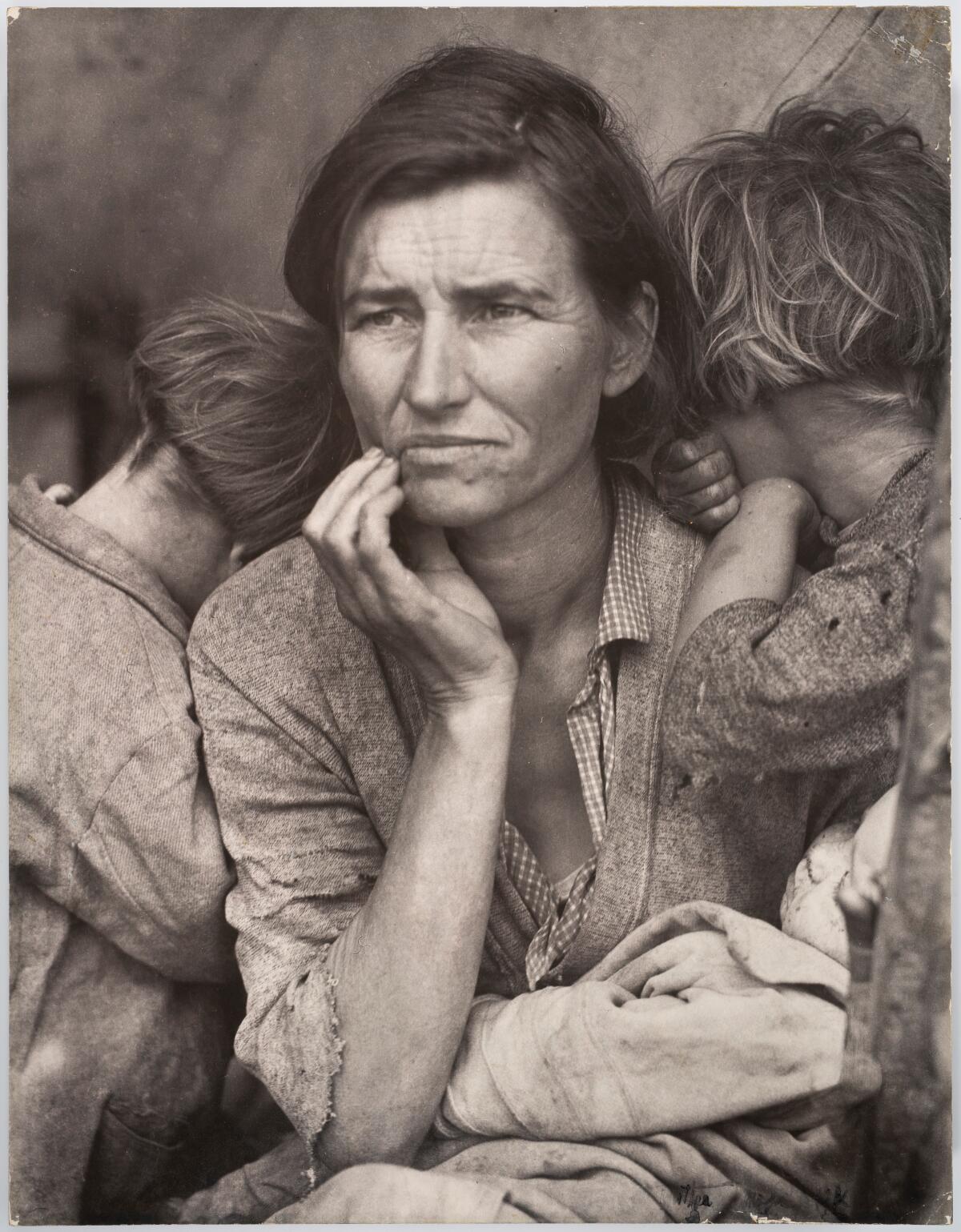
Dorothea Lange, “Migrant Mother,” Nipomo, Calif., 1936. Gelatin silver print, 18 3/4 x 14 1/2 in.
(Lucas Museum of Narrative Art, PKY.1062)
Exhibitions currently on deck include a variety of themed shows such as one on the architecture of the building; one titled “Everyday Life,” dedicated to visual stories about “childhood, community, family, love, motherhood, play, school, sports and work”; another titled “Civic Life” featuring “artists’ portrayals of experience in the courthouse, the polling place, the political headquarters”; an exhibit titled “Narrative Forms” highlighting “narrative art across genres of adventure, fantasy, romance and science fiction” by artists including Julie Bell, Boris Vallejo, Ken Kelly, Georges Méliès, John C. Berkey and Jeffrey Catherine Jones; and children’s literature illustrations by Beatrix Potter, Leo Politi, E.H. Shepard and Jacob Lawrence.

George Hughes, “Home at Last,” cover for the Saturday Evening Post, Sept. 1, 1951. Oil on board, 30 x 24 in.
(Lucas Museum of Narrative Art, PKY.993. © SEPS by Curtis Licensing)
There will also be exhibitions devoted to the work of individual artists and genres such as comics and graphic stories from illustrators Mœbius, Marie Severin, Jack Kirby, Alison Bechdel, Jim Lee, Frank Miller and Rafael Navarro; illustrations and book covers by Frank Frazetta; the work of fairy tale and children’s illustrator Jessie Willcox Smith; the lush art of Maxfield Parrish; a selection of work by iconic American artist Norman Rockwell; selected works of Thomas Hart Benton; and early 20th century book illustrations by N.C. Wyeth.
A news release about the inaugural exhibitions noted that they are drawn from the museum’s founding collection of more than 40,000 works.
“The exhibitions trace the evolution of human culture through storytelling, from ancient sculptures of gods and goddesses to Renaissance paintings to photographs, comics and modern cinema,” the release says. “Many exhibitions are organized by theme, focusing on myths about love, family, community and adventure that connect every generation. These shared stories, told over and over in many forms, bind us together and define our human experience.”

Ernie Barnes, “The Critic’s Corner,” 2007. Acrylic on canvas, 23 1/2 x 35 3/8 in.
(Matt Kroening / Lucas Museum of Narrative Art)
The road to the opening of the Lucas Museum has been winding. In 2017, Lucas first announced his decision to build his museum in L.A., with construction beginning the following year. The building was initially scheduled to open in 2021 — a goal that was pushed to 2023 due to COVID-19 pandemic-induced delays. From there, the debut was pushed to 2025, and finally 2026. The museum announced its final opening date last November.
Lucas’ role at his namesake museum has also not always been clear, and the museum’s development has been marked by a series of high-profile staff shakeups. The museum’s original director and chief executive, Sandra Jackson-Dumont, stepped down from her role in early 2025 after less than five years. She didn’t speak publicly about her departure but the museum issued a statement that her decision was based on a “new organizational design” that would split her job into two positions, with Lucas responsible for content direction.
Three months later, the museum laid off 15 full-time employees, a number of whom were from the education and public programming team. Seven part-time, on-call employees were also eliminated. The layoffs were described to The Times in harrowing terms by two employees who asked to remain anonymous.
In December — soon after the museum announced its opening date — news broke that chief curator Pilar Tompkins Rivas had stepped down from her role.
To date, no new chief curator has been named, but a rep for the museum wrote in an email that Lucas “is responsible for curatorial and content direction for the museum and continues to work closely with the curatorial team on his decades-long vision to celebrate storytelling and narrative art.”