lucas

2026 marks an explosion of L.A. museum openings including Lucas Museum

This year marks a veritable museum-palooza as Los Angeles debuts four new major arts complexes, with three in the wings likely to open in advance of the 2028 Summer Olympics.

Immerse yourself in a psychedelic explosion at Meow Wolf, plan an afternoon liaison with Van Gogh at LACMA’s new David Geffen Galleries, inhale the scent of nature inside Refik Anadol’s AI arts museum, Dataland, or simply geek out over George Lucas’ jaw-dropping collection of “Star Wars” memorabilia.

Whatever your arts craving may be, this astoundingly rich new lineup of new local museums has you covered.

LACMA’s David Geffen Galleries

The new David Geffen Galleries, opening in 2026, are composed entirely of Brutalist concrete.

The new David Geffen Galleries, opening in 2026, are composed entirely of Brutalist concrete.

(Christopher Knight / Los Angeles Times)

The Los Angeles County Museum of Art’s David Geffen Galleries are set to debut this April to members, before opening for general admission at the beginning of May. The $720-million Geffen Galleries will display 2,500-3,000 objects from LACMA’s collection.

The building, designed by Pritzker Prize-winning architect Peter Zumthor, is described by supporters as a “concrete sculpture” and will host 90 exhibition galleries across 110,000 square feet. The Wilshire Boulevard museum’s inaugural exhibition will organize artwork by the Pacific, Indian and Atlantic Oceans and the Mediterranean Sea instead of by medium or period.

“The idea is for you to make your own path — not to speak at you, but to let you wander like you would through a park or a place,” LACMA Director and Chief Executive Michael Govan said in an interview with The Times. “That change in attitude, and how the building is built, is really exciting.”

Some of the most-anticipated works on display include Georges de La Tour’s “The Magdalen With the Smoking Flame” (1640), Henri Matisse’s “La Gerbe” (1953) and Vincent Van Gogh’s “Tarascon Stagecoach” (1888).

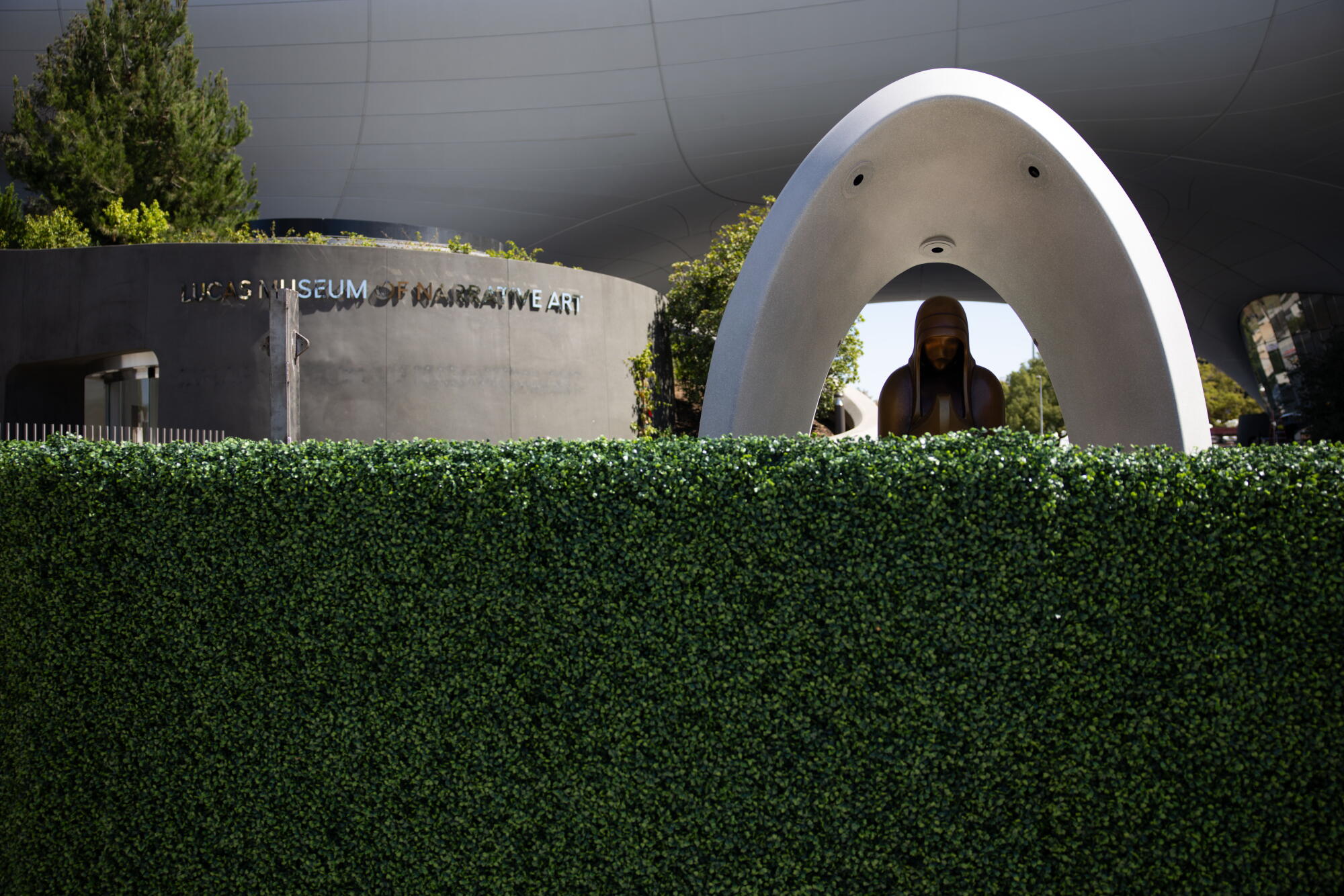
Lucas Museum of Narrative Art

Los Angeles, CA - May 19: The gardens at the Lucas Museum designed by Studio-MLA on Monday, May 19, 2025 in Los Angeles, CA.

The gardens at the Lucas Museum, designed by Studio-MLA, on Monday, May 19, 2025.

(Jason Armond / Los Angeles Times)

After more than 10 years of anticipation, George Lucas and Mellody Hobson’s museum will open in Exposition Park this September. With over 10,000 square feet of galleries, the museum will feature a wide array of artwork and pop culture ephemera, including Lucas’ personal trove of “Star Wars” film franchise treasures, “Peanuts” comic strips, “Alice’s Adventures in Wonderland” illustrations, a Richard Sargent painting and covers of the Saturday Evening Post.

Lucas donated his collection to curate the Lucas Archives, which, in addition to “Star Wars,” will encompass props and production art from Lucasfilm projects, such as the “Indiana Jones” franchise.

One of the museum’s defining features is its massive green-roof garden designed by Mia Lehrer and her landscape architecture firm Studio-MLA.

“This brings everything together,” Lehrer said in an interview with The Times. “Design, ecology, storytelling, infrastructure, community. It’s the fullest expression of what landscape can be.”

Meow Wolf

Rainbow lighting lands on the facade of an art piece that looks like a white building.

A work-in-progress piece set to be featured in Meow Wolf L.A. as seen during a walk through at the group’s warehouse in Santa Fe on Oct. 15, 2025.

(Gabriela Campos/For The Times)

Meow Wolf’s L.A. location will reimagine a ’90s movie theater with its takeover of the Cinemark at West L.A.’s Howard Hughes entertainment complex outside Culver City. Meow Wolf’s sixth permanent exhibition comes on the heels of the immersive art creator’s 52,000-square-foot psychedelic art installation in Las Vegas, which was disguised as a dystopian grocery store called Omega Mart and promptly went viral on TikTok.

Complete with sci-fi elements, a meditative space and a 30-foot-tall mushroom tower, Meow Wolf’s new location will open at the end of 2026. Although organizers have kept much of the exhibition under wraps, visitors can expect to be transfixed by a thoroughly Los Angeles tale.

“It’s cool that we’re creating a story about a pilgrimage, because L.A. is that for so many artists, especially people involved in storytelling,” Shakti Howeth, Meow Wolf‘s creative director, told The Times. “It’s one of those places that’s built on layers and layers of dreams, and we’re really exploring that here. Not only dreams but broken dreams — the compost that can happen when you digest broken dreams.”

Refik Anadol’s Dataland

Los Angeles, CA: New media artist Refik Anadol will open his new AI museum, DATALAND.ART, in the Grand L.A.

Refik Anadol’s Infinity Room is meant to be a multisensory experience.

(Dataland)

Opening this spring at the Frank Gehry-designed Grand L.A., Dataland dubs itself the world’s first museum of AI arts. Turkish American artist Refik Anadol designed his own AI model, named the Large Nature Model, which only sources material with permission from original creators, making it what Anadol calls “ethical” AI. Partners include the Smithsonian and the Cornell Lab of Ornithology.

“I’m calling this new art form not AR, not VR, not XR — so we are still finding a name for it. The best name so far, and people love it, is generative reality,” Anadol told The Times.

Dataland will feature five galleries, including the Infinity Room, which Anadol first created in 2014 as a student at UCLA. In another exhibit, he trained an AI model on half a million scents and built a machine to push those scents into the gallery to create a totally immersive viewing experience.

Opening Later

The Armenian American Museum and Cultural Center of California

Slated to complete construction in downtown Glendale in late 2026, the 51,000-square-foot Armenian American Museum has been in the works for more than a decade. With a $67-million budget, the museum will include permanent and temporary exhibitions, as well as an auditorium, learning center, archives collection and a demonstration kitchen.

The museum is an initiative of the Armenian Genocide Centennial Committee Western US, and planning began as the group prepared to mark the the 100th anniversary of the Armenian Genocide in 2015. The museum is adorned with the 36 letters of the Armenian alphabet and a glass hazarashen skylight, inspired by traditional roofs in homes across the Armenian Highlands.

“The Armenian American Museum was once an idea, then a vision, and today is rising before our eyes,” museum Executive Chairman Berdj Karapetian said in a statement. “This progress is the result of an extraordinary collective effort by Armenians and non-Armenians here in California, across the United States and around the world.”

The Samuel Oschin Air and Space Center

The Samuel Oschin Air and Space Center in Los Angeles, CA

The Samuel Oschin Air and Space Center in Los Angeles is a major expansion of the California Science Center.

(Myung J. Chun / Los Angeles Times)

A solid opening date has not yet been announced, but the $400-million Samuel Oschin Air and Space Center at the California Science Center in Exposition Park is busily preparing for liftoff. Construction on the building began in 2022. The shiny new building will be home to the Korean Air Aviation Gallery, Kent Kresa Space Gallery and the Samuel Oschin Shuttle Gallery, which will host the Space Shuttle Endeavour.

Endeavour will be displayed in launch position, making it the tallest authentic spacecraft displayed vertically in the world, with a height of 20 stories. One of three surviving space shuttles, Endeavour made 25 successful missions into space.

The center is also expected to have 20 planes and jets, including a Boeing 747, a mock flight deck and a pair of introductory films produced by J.J. Abrams’ company Bad Robot, one of which will end with a simulated launch.

“It is an amazing experience, and we want to really build it up,” Jeffrey N. Rudolph, president and chief executive of the California Science Center, told The Times. “It’s not just about the hardware but about the people and the educational aspects.”

The Broad Expansion

Exterior rendering of the future Broad expansion from Hope Street.

Exterior rendering of the future Broad expansion from Hope Street.

(The Broad. © Diller Scofidio + Renfro (DS+R))

Opening in 2028, the Broad expansion will contain 70% more gallery space, two outdoor courtyards, a live programming space and views of the museum’s art storage vault. First announced in 2024, the $100-million addition is slated for completion before the 2028 Summer Olympics.

Located in downtown L.A., the expansion was deemed necessary after the museum significantly exceeded visitor projections. The new building will invert the existing Broad museum’s architectural design, with a smooth, gray structure attached to the original construction.

“The idea is that it adds new facets to the visitor’s journey through the expanded Broad,” said Joanne Heyler, founding director and president of the Broad, in an interview with The Times. “In a way, the existing building is always sort of talking to you. And there will be a similar thing happening with the expansion, but just a slightly different conversation, like you’re listening to its sibling.”

Source link

Iran claims US and Israel using copycat ‘Lucas’ drones to frame it | Military

NewsFeed

Ebrahim Zolfaghari, spokesperson for Iran’s Khatam al-Anbiya Central Headquarters, accused the US and Israel of orchestrating a ‘diabolical plot’, claiming they copied Iran’s Shahed-136 drone design and repurposed it as a modified ‘Lucas’ drone to falsely blame Tehran for drone attacks across the region.

Source link

LUCAS Kamikaze Drones Lauded As “Indispensable” By U.S. Admiral In Charge Of Iran War

Responding to a question from The War Zone at a press conference at CENTCOM headquarters in Tampa, Florida, the admiral leading the war against Iran praised the Low-Cost Uncrewed Combat Attack System (LUCAS) kamikaze drone. Based on the Iranian Shahed-136, these weapons were used in combat for the first time just six days ago. They were fired against unspecified Iranian targets in the opening salvos of the Operation Epic Fury joint U.S.-Israeli attack on Iran and repeatedly since.

The War Zone has advocated for the procurement of this exact class of drone by the American military and today, Adm. Brad Cooper backed up that assessment.

War Secretary Pete Hegseth examines a Shahed-clone kamikaze drone at the Pentagon, (US Army)

“LUCAS, indispensable,” Cooper told us when we asked how effective they have been and how much they’ve helped preserve magazine depth, given their comparative low cost and faster and easier production.

America’s stockpile of offensive and defense munitions remains a concern as Epic Fury drags on, even though War Secretary Pete Hegseth, who also spoke at the press conference, downplayed it. More on that later in this story.

A Tomahawk cruise missile cost roughly between $2 million to $2.5 million a piece. Air launched cruise missiles currently in service cost over a million a piece, although work is being done to reduce that number considerably. There is still a tradeoff in warhead size, response time, and survivability, but cheaper weapons in greater quantities that can deliver a payload over hundreds of miles are badly needed as part of a arsenal mix that includes more advanced types.

US, UK and allies strike Houthi rebels in Yemen.
File photo of TLAM launch. USN

“Costing approximately $35,000 per platform, LUCAS is a low-cost, scalable system that provides cutting-edge capabilities at a fraction of the cost of traditional long-range U.S. systems that can deliver similar effects,” Navy Capt. Tim Hawkins, a CENTCOM spokesperson, told TWZ back in December. “The drone system has an extensive range and the ability to operate beyond line of sight, providing significant capability across CENTCOM’s vast operating area.”

U.S. CENTRAL COMMAND AREA OF RESPONSIBILITY (Nov. 23, 2025) Low-cost Unmanned Combat Attack System (LUCAS) drones are positioned on the tarmac at a base in the U.S. Central Command (CENTCOM) operating area, Nov. 23. The LUCAS platforms are part of a one-way attack drone squadron CENTCOM recently deployed to the Middle East to strengthen regional security and deterrence. (Courtesy Photo)
Low-cost Unmanned Combat Attack System (LUCAS) drones are positioned on the tarmac at a base in the U.S. Central Command (CENTCOM) operating area. (Courtesy Photo)

Moreover, the LUCAS design includes features that allow for “autonomous coordination, making them suitable for swarm tactics and network-centric strikes,” a U.S. official told us in December. As we have explained in detail in the past, the swarming capabilities combined with some of the drones being equipped with Starlink terminals, means extremely advanced cooperative tactics and dynamic targeting are possible, all while keeping humans in the loop.

The video below is said to show a LUCAS drone, recovered largely intact in Iraq. Its beyond-line-of-sight satellite datalink can be seen detached and hanging by a cable.

Locals in Iraq appear to have recovered a crashed and almost entirely intact Low-Cost Unmanned Combat Attack System (LUCAS), an American copy of the Iranian Shahed-136 Attack Drone, which is confirmed to have been used recently by Task Force Scorpion Strike during U.S. attacks on… pic.twitter.com/SEqO6627en

— OSINTdefender (@sentdefender) March 2, 2026

Cooper highlighted how the U.S. has reworked the Iranian Shahed, which have been wreaking havoc during this conflict, killing six U.S. troops and causing destruction across the Middle East.

“We captured it, pulled the guts out, sent it back to America, put a little ‘Made in America on it,’ brought it back here and we’re shooting it at the Iranians.”

The U.S. Navy personnel in the Middle East have test-launched a Low-Cost Uncrewed Combat Attack System (LUCAS) long-range kamikaze drone from the Independence class Littoral Combat Ship (LCS) USS Santa Barbara.
LUCAS kamikaze drone. (Courtesy photo) NAVCENT/C5F/U.S. Army Spc. Kayla Mc Guire

In a video message earlier this week, Cooper said that the U.S. has fired “countless one-way attack drones” to great effect.

Thursday, we asked him what kinds of targets LUCAS drones have been used against and he offered a short response.

“Good ones,” he said.

We asked Cooper to respond to stories that have emerged saying the Pentagon and at least one Gulf ally are talking to Ukraine about procuring their low-cost Shahed interceptors. He deferred to Cooper.

“I’m not familiar with the particular offer, but the interceptors in general, we’ve had a number of new capabilities being fielded,” the CENTCOM commander explained. “Obviously, I’m not going to talk about it from the operational perspective of what those are, but I think you have seen over a period of time us kind of get on the other side of this cost curve on drones in general.”

“If I just walk back a couple of years, remember what you used to always hear, we’re shooting down a $50,000 drone with a $2 million missile,” he added. “These days, we’re spending a lot of time shooting down $100,000 drones with $10,000” weapons.

Before Cooper answered our questions, Hegseth repeated the Pentagon’s assertion that it has the weapons it needs to outlast Iranian missile and drone barrages.

“We’ve got no shortage of munitions,” Hegseth proclaimed. “Our stockpiles of defensive and offensive weapons allow us to sustain this campaign as long as we need to again, our munition status only increases as our advantage increases our capabilities.”

As we recently pointed out, Iran’s ability to launch missiles and drones at U.S., Israeli, and other allied targets in the Middle East has been severely degraded, curbing concerns, even if to just a small degree, about America’s magazine depth.

However, as we have often noted, one of the big concerns about Epic Fury is whether Iranian missile and drone barrages would outlast the ability of the U.S. and allies to defend against them. Despite six days of intensive attacks, Tehran still possesses thousands of missiles and drones, though a significant number of these weapons and their launchers — specifically the longer range ballistic missile types —have been destroyed or prevented from being accessed by crews.

The effort to eliminate the Iranian regime’s mobile missile launch capabilities continues. We are finding and destroying these threats with lethal precision. pic.twitter.com/AkGRYOjnOz

— U.S. Central Command (@CENTCOM) March 5, 2026

Though Iran has been severely pummeled by both the U.S. and Israel, it is unknown how much longer the conflict will grind on. President Donald Trump had stated that it could last four or five weeks. Now the time table is very murky, with the administration indicating it could last much longer. Regardless, the more it drags out, the more munitions the U.S. will expend, but at least it knows it can quickly build more LUCAS drones, if need be.

Contact the author: howard@thewarzone.com

Howard is a Senior Staff Writer for The War Zone, and a former Senior Managing Editor for Military Times. Prior to this, he covered military affairs for the Tampa Bay Times as a Senior Writer. Howard’s work has appeared in various publications including Yahoo News, RealClearDefense, and Air Force Times.


Source link