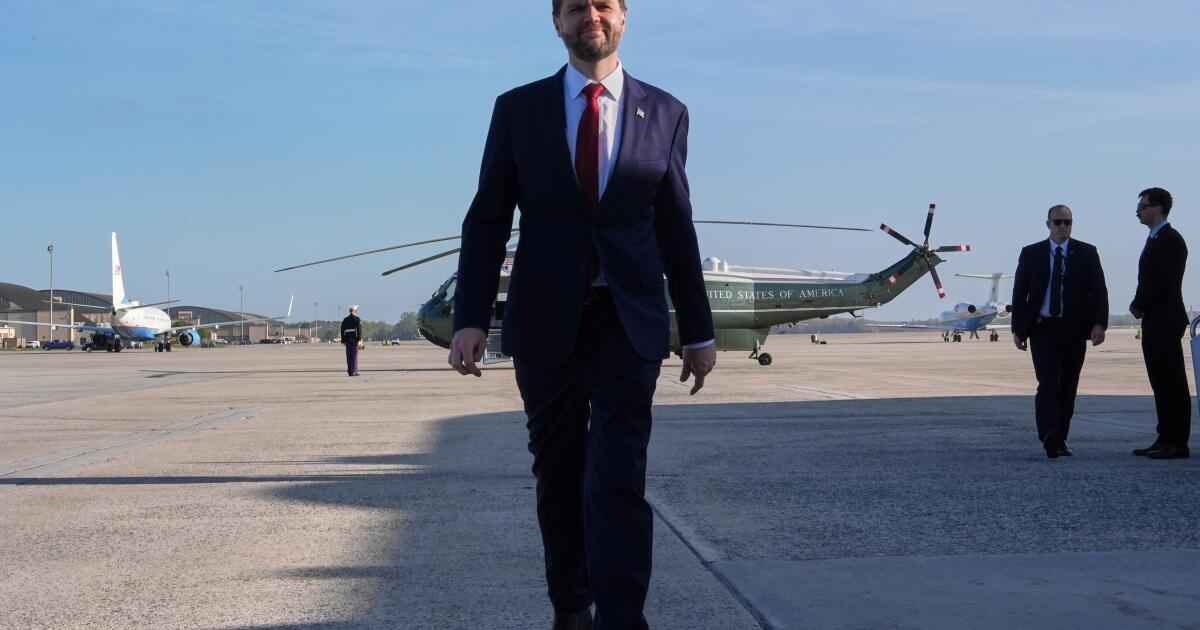
WASHINGTON — Vice President JD Vance departed Friday for Islamabad, Pakistan, to open the first direct negotiations aimed at ending the war between the United States and Iran.
Together with a delegation of deeply mistrusting negotiators from Tehran, Vance is tasked with striking a lasting peace between rival nations which have failed to keep promises made days ago in a delicate last-minute ceasefire. Ongoing military activity in the Middle East and disagreements over Iran’s control of key shipping routes have left the diplomatic effort vulnerable to collapse before the talks even begin.
“If the Iranians are willing to negotiate in good faith, we’re certainly willing to extend the open hand,” Vance told reporters before boarding Air Force Two. “If they’re gonna try and play us, then they’re gonna find that the negotiating team is not that receptive.”
On Tuesday, President Trump called off his plans to unleash “hell” on Iran based on assurances that it lift its blockade of the Strait of Hormuz, but traffic through the vital waterway was still at a trickle Friday, as more than 600 ships remained stranded in the Persian Gulf, according to marine tracking data. Trump accused Iran on Thursday of doing a “very poor job, dishonorable some would say,” of allowing oil through the strait.
“The Iranians don’t seem to realize they have no cards, other than a short term extortion of the World by using International Waterways. The only reason they are alive today is to negotiate!” he wrote on Truth Social Friday.
Meanwhile, Lebanon has emerged as the central dispute threatening to derail the talks before they begin.
Hours after the ceasefire took effect, Israel launched what Lebanese officials described as its heaviest wave of strikes since the war began, killing at least 303 people, according to local health officials.
Jerusalem argues the Lebanese front is still on the table, but Iran and Pakistan disagree.
“The Iran–U.S. Ceasefire terms are clear and explicit: the U.S. must choose — ceasefire or continued war via Israel. It cannot have both,” Iranian Foreign Minister Abbas Araghchi said earlier this week. “The world sees the massacres in Lebanon. The ball is in the U.S. court, and the world is watching whether it will act on its commitments.”
Vance has acknowledged a “legitimate misunderstanding” over whether Lebanon was included in the ceasefire terms, telling reporters Washington never made that promise.
Separate negotiations regarding Lebanon are expected next week in Washington, Lebanese President Joseph Aoun confirmed Friday. Israeli Prime Minister Benjamin Netanyahu has also OK’d the talks, but said a ceasefire is not possible.
Parliament Speaker Mohammad Bagher Qalibaf and the Iranian delegation arrived early Saturday in Islamabad, Iranian state media reported. Hours earlier he said a ceasefire in Lebanon “must be fulfilled before negotiations begin.”
Bagher Qalibaf added a second condition — the release of frozen Iranian assets — which he suggested must be returned before Tehran takes its seat at the bargaining table. Little is known about the halted Iranian funds overseas, but such assets are typically held back as a result of U.S.-imposed sanctions.
The vice president’s role in peace talks has grown in recent weeks. Administration officials have cast Vance as one of the few leaders Tehran would be willing to engage with directly. With a global economy upended by Trump’s far-reaching military ambitions, a victory in Islamabad could spike Vance’s standing as a prospect to lead the GOP post-Trump.
That’s if he’s able to take pressure off American wallets with an agreement that liberates Iran’s grip over the strait, which has choked much of the world’s oil supply,
Americans have continued to feel the fallout at the gas pump and grocery stores, as U.S. inflation climbed to 3.3% in March, the highest annual rate in nearly two years, according to the data released Friday by the Bureau of Labor Statistics.
Monthly prices rose 0.9%, a sharp increase from February’s 0.3% monthly rise, when annual inflation sat at 2.4%, the new data showed.
The White House characterized the rising inflation as a short-term disruption caused by the Iran war, while noting that the administration is “diligently working to mitigate” rising costs.
“As the Administration ensures the free flow of energy through the Strait of Hormuz, the American economy remains on a solid trajectory thanks to the Administration’s robust supply-side agenda of tax cuts, deregulation, and energy abundance,” White House spokesperson Kush Desai wrote on X.
Britain announced a meeting next week with dozens of countries to coordinate efforts to reopen the Strait of Hormuz. The summit will focus countering Iran’s proposal to charge transit tolls to allow ships through the waterway.
In a televised address to the nation, Pakistan’s Prime Minister Shehbaz Sharif spoke of a “devastating storm of inflation,” if peace talks don’t succeed in liberating the Middle East’s oil supply. He characterized the current stage as a “make-or-break moment.”
“We will make every possible effort to ensure the success of the peace process,” he said.