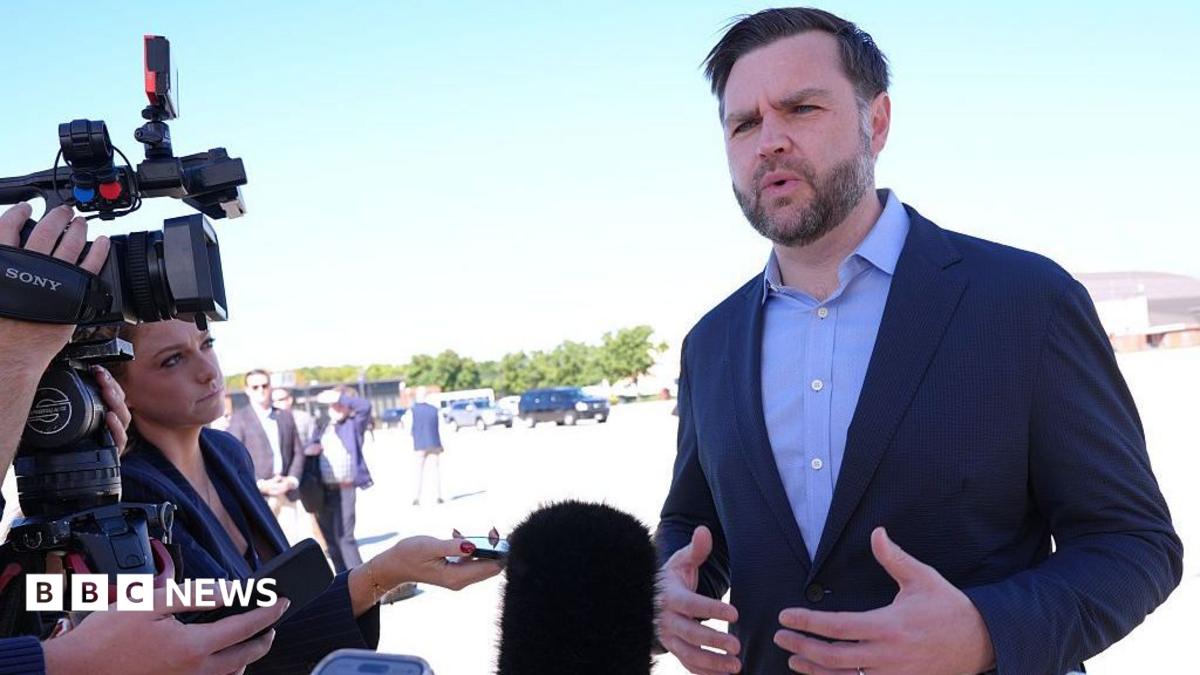
Vance

JD and Usha Vance welcome a baby boy, the first child born to a sitting VP in more than 150 years

Vice President JD Vance and his wife, Second Lady Usha Vance, announced the birth of their fourth child, the first born to a sitting vice president in more than 150 years.

Born Sunday, Alec Neel Vance joins older siblings Ewan, 9; Vivek, 6; and Mirabel, 4.

Vance announced the birth Sunday on social media with a statement signed by him and his wife.

“We are excited to announce that our baby boy, Alec Neel Vance, was born this morning. Usha and the baby are happy and healthy, and our kids are overjoyed to meet their little brother,” the statement said.

They thanked doctors and staff at the Walter Reed National Military Medical Center and with the White House medical team.

The Republican vice president’s growing family is in keeping with his passionate advocacy for Americans to have more children. He has also suggested that the 2025 killing of conservative activist Charlie Kirk, who was his friend, factored into the decision to have another child.

Vance, a former U.S. Marine, repeatedly expressed alarm about declining birth rates in America as he launched his political career in 2021 with a bid for a U.S. Senate seat from Ohio. As vice president, he said in Washington at the 2025 March for Life anti-abortion rally, “I want more babies in the United States of America.”

The vice president, who’s 41, has been accompanied on overseas trips by Usha Vance, 40, and their children, with the kids often pajama-clad as they board Air Force Two for the overnight flights.

Usha Vance, the daughter of immigrants from India, had already been the subject of some public fascination because of her husband. Her pregnancy, which was announced in January, amplified that spotlight since it is rare for occupants of the United States’ highest public offices to add to their families while serving.

The last time a sitting vice president became a new father was in the 1800s.

Schuyler Colfax and his second wife, Ellen Wade, had a son, Schuyler Colfax III, in 1870 when Colfax was serving as vice president, according to the White House Historical Assn. Decades before that, John C. Calhoun and his wife, Floride Bonneau, had a son, William, in 1829 when Calhoun was vice president, the association said.

Usha Vance recently came under scrutiny after The New York Times’ fashion critic called attention to the stomach-hugging, coral maternity dress she wore for a Father’s Day episode of “Storytime with the Second Lady,” a video podcast she launched during the pregnancy.

The Times wrote that the attention that Vance, Miller and Leavitt had put on their pregnancies offered “an image of idealized womanhood that gives literal shape to the pronatalist movement,” which encourages couples to have as many children as possible to counter declining birth rates.

The second lady responded on social media, writing, “Now that we know the political significance of my $8.75 coral maternity dress from Old Navy, can’t wait to hear what the New York Times has to say about my elastic-waistband pants and compression socks! In the meantime, enjoy my pregnancy fashion (or lack thereof) and a good story with your kids on Storytime with the Second Lady.” She later shared the receipt for the dress, and her husband applauded her frugality.

“She bought a $50 dress for $8.75. America: meet your next director of the federal budget!” the vice president wrote on social media.

Superville writes for the Associated Press.

Source link

Usha Vance, Vice President JD Vance welcome birth of 4th child

July 19 (UPI) — Second lady Usha Vance gave birth Sunday to her fourth child, JD Vance announced, making him the first sitting vice president in more than 150 years to welcome the birth of a child.

“We are excited to announce that our baby boy, Alec Neel Vance, was born this morning,” JD said in a statement.

“Usha and the baby are happy and healthy, and our kids are overjoyed to meet their little brother.”

The Vances have three other children: two sons, Ewan and Vivek, ages 9 and 6, respectively; and a 4-year-old daughter, Mirabel.

“The incredible military doctors and staff members of Walter Reed [National Military Medical Center] and the White House Medical Center and the White House Medical Unit have been a blessing,” JD continued.

“We are deeply thankful for all they have done for our family.”

Usha — a lawyer who resigned from Munger, Tolles & Olson on the day her husband was tapped to be Donald Trump‘s running mate in 2024 — announced her fourth pregnancy in January with a due date of late July.

With the birth, the Vances became the first vice presidential couple to welcome a child while in office since Vice President Schuyler Colfax’s wife, second lady Ellen Maria Colfax, gave birth to Schuyler Colfax III in 1870.

President Donald Trump delivers a prime-time address to the nation from the East Room of the White House on Thursday. Pool photo by Saul Loeb/UPI | License Photo

Source link

US Vice President JD Vance and his wife announce birth of fourth child | News

JD and Usha Vance welcome a baby boy, the first child born to a sitting vice president in more than 150 years.

United States Vice President JD Vance and his wife, Usha, have announced the birth of their fourth child.

In a statement, Vance and his wife said their son was born on Sunday at Walter Reed National Military Medical Center in Bethesda, Maryland.

Recommended Stories

list of 3 itemsend of list

“We are excited to announce that our baby boy, Alec Neel Vance, was born this morning,” the statement said.

“Usha and the baby are happy and healthy, and our kids are overjoyed to meet their little brother,” it added.

Vance, an Ohio native, and Usha, the daughter of Indian immigrants, met while attending Yale Law School, where they graduated in 2013.

Their first son, Ewan, was born in 2017, followed by another son, Vivek, in 2020. The couple’s daughter, Mirabel, was born in 2021.

Alec Neel Vance is the first child born to a vice president in more than 150 years.

The last time a sitting vice president became a new father was in the 1800s.

Schuyler Colfax and his second wife, Ellen Wade, had a son, Schuyler Colfax III, in 1870, when Colfax was serving as vice president, according to the White House Historical Association.

Vance, a former US Marine, is a passionate advocate for Americans to have more children. He repeatedly expressed alarm about declining birth rates in the US as he launched his political career in 2021 with a bid for a US Senate seat from Ohio.

As vice president, he said in Washington at the 2025 March for Life anti-abortion rally, “I want more babies in the United States of America.”

The newest addition to Vance’s family was part of a recent mini baby boom among top members of President Donald Trump’s administration.

White House deputy chief of staff Stephen Miller’s wife, Katie, recently gave birth to the couple’s fourth child, and White House Press Secretary Karoline Leavitt had her second child with her husband, Nicholas Riccio, in May.

Source link

Vance Says Some Israeli Officials Tried to Influence US on Iran Deal

U.S. Vice President JD Vance has accused some members of the Israeli government of attempting to influence American public opinion to undermine Washington’s agreement with Iran, highlighting growing public differences between the two allies over Middle East policy.

Speaking on a podcast with Joe Rogan released on Wednesday, Vance defended the U.S.-brokered deal that ended last month’s conflict with Iran, despite criticism from Israeli officials and some U.S. lawmakers who argue the agreement leaves Tehran’s missile and nuclear capabilities largely intact.

Vance accuses Israeli officials of influence campaign

Vance said he was certain that some figures within the Israeli government sought to steer U.S. policy toward continuing military operations against Iran.

“I know beyond a shadow of a doubt that there have been people within the Israeli government who are trying to actually shift us away from that policy because they want to continue the military campaign,” Vance said.

Stay ahead of the geopolitical week.

MD Briefing delivers expert analysis across five global fronts — the Indo-Pacific, energy, geoeconomics, European security, and the Middle East — every Monday morning. Free.

He added that although he maintains good relationships with some Israeli officials, others were trying to shape American public opinion.

“There are some people within their system that we know beyond a shadow of a doubt are manipulating and trying to change American public opinion to keep the war going on indefinitely,” he said.

Defends Iran ceasefire agreement

Vance argued that the agreement reached last month was the right decision, despite criticism that it failed to place sufficient limits on Iran’s ballistic missile programme or provide a clear roadmap for dismantling its nuclear facilities.

The deal has also been criticised in Israel for restricting its military campaign against Iran-backed Hezbollah in Lebanon.

The vice president said attempts by foreign governments to influence U.S. policy are common and not unique to Israel.

“It doesn’t bother me that Israel tries to do this. It frankly doesn’t even bother me that Russia or some of these other countries do it,” Vance said.

“What does bother me is when those operations, those influence campaigns, actually affect American political judgment.”

Growing public differences with Israel

The remarks add to increasingly visible disagreements between the Trump administration and Israeli leaders over how to handle Iran.

In June, Vance sharply criticised Israeli opponents of the Iran agreement, arguing that President Donald Trump remained Israel’s strongest ally despite objections from some members of the Israeli government.

Israeli officials have argued that the agreement does not adequately address Iran’s nuclear ambitions or ballistic missile programme, concerns they say are widely shared across Israel’s political and security establishment.

Would US have entered the conflict?

Asked whether the United States would have become involved in the recent conflict with Iran without Israeli influence, Vance replied, “Yes, yes I do.”

He added that President Trump independently believes Iran should never obtain a nuclear weapon.

“I think the president, separate from any influence from Israel, believes very strongly, and again I agree with this, that Iran should not have a nuclear weapon,” Vance said.

The Israeli Prime Minister’s Office did not immediately respond to requests for comment.

Why it matters

Vance’s comments expose unusually public tensions between senior U.S. and Israeli officials over the future of Middle East policy. They also underscore ongoing debate within Washington over the extent of foreign influence on U.S. decision-making and the long-term strategy toward Iran.

What to watch

The remarks are likely to draw scrutiny from both Israeli officials and members of the U.S. Congress as the Trump administration seeks to preserve the Iran agreement while managing its close security partnership with Israel. Further disagreements over Iran and regional military operations could test the traditionally strong U.S.-Israel alliance in the months ahead.

With information from Reuters.

Source link

Vice President JD Vance’s visit gives ‘The View’ a ratings boost

The June 16 appearance by Vance gave the program its most-watched episode since November 2024.

The first appearance by Vice President JD Vance on ABC’s “The View” delivered the most-watched edition of the talk show since November 2024.

The June 16 program averaged 3.3 million viewers, according to Nielsen data. The figure was well above the average of 2.6 million viewers for “The View” in the 2025-26 season.

Vance appeared on the liberal-leaning program to promote his new book on his decision to become a Catholic. While the co-hosts mostly questioned him on the Trump administration’s policies on immigration and race, the discussion was cordial.

The panel of co-hosts — Whoopi Goldberg, Joy Behar, Ana Navarro, Sunny Hostin and Alyssa Farah Griffin — did not ask Vance to address the program’s ongoing tension with the Federal Communications Commission.

FCC Chairman Brendan Carr has questioned whether “The View” should have the status of news programs, which are exempt from giving equal time to the opponents of political candidates who appear as guests.

ABC has asked the FCC to rule on the status of “The View,” which received an exemption from the rarely enforced equal time provision in 2002. ABC has maintained that “The View” books politicians based on newsworthiness and not partisanship.

The FCC is currently taking comments from the public on the matter. ABC is running on-air spots urging viewers to support the program.

“‘The View’ has welcomed your favorite guests and covered the issues you care about for nearly 30 years,” the spot says. “Now the FCC wants to control who is allowed to appear on the show.”

The National Republican Senatorial Committee and the National Republican Congressional Committee submitted comments Monday, asserting that “The View” takes advantage of its exemption and favors Democratic candidates and permits “only rare appearances by Republican-aligned figures.”

ABC has told the FCC that “The View” has invited politicians from both sides of the aisle to appear on “The View,” including Health Secretary Robert F. Kennedy, Jr., Secretary of State Marco Rubio and entrepreneur Elon Musk. They have declined the invitation as did Vance before his appearance last week.

The letter from the GOP committees also cited the ideological leanings of the co-hosts, saying they are “not selected for their journalistic talent or excellence in commentary, but for their partisan tilt.”

Over the last two decades, “The View” has used five liberal hosts and filled one seat designated for a conservative voice. The right-leaning co-host role has had the most turnover.

“The View” has been the most-watched daytime program for the last nine years. As a live, topical program, it has remained an important media platform while the rest of the talk show genre has largely faded due to diminishing audiences.

Carr’s targeting of “The View” is part of his ongoing criticism of broadcast platforms that annoy President Trump, who has urged that TV station licenses be pulled when he’s been unhappy with coverage.

Source link

JD Vance touts progress on key issues in US-Iran negotiations | Conflict

NewsFeed

US Vice President JD Vance has touted significant progress in talks with Iran over its nuclear programme and Israel’s war on Lebanon, while refusing to commit to an Israeli withdrawal from Lebanese territory. He said Trump is trying to bring ‘permanent peace’ to a region that’s been ‘a basket case for a long time’.

Source link

VP Vance: U.S. seeking to ‘transform’ relationship with Iran in Switzerland talks

U.S. Vice President JD Vance (L), Pakistani Prime Minister Shehbaz Sharif (C), and Qatari Prime Minister Mohammed bin Abdulrahman bin Jassim Al Thani speak ahead of talks between the United States and Iran at the Buergenstock resort in Obbuergen, near Lucerne, Switzerland, on Sunday. Photo by Urs Flueeler/EPA

June 21 (UPI) — U.S. Vice President JD Vance said the United States is looking “to transform our relationship” with Iran but warned Sunday’s renewed talks in Switzerland wouldn’t bring about an immediate resolution to the war.

Vance was joined by President Donald Trump‘s go-to negotiators in the peace talks — Steve Witkoff and Jared Kushner — in the gathering at the Bürgenstock lakeside resort, CNN reported. Pakistani and Qatari mediators were also in attendance, The New York Times reported.

“Never before has the Iranian and American leadership met at such a high level,” Vance told reporters ahead of the talks.

“What the president has asked us to do is turn over a new leaf to transform our relationship with the people of Iran, and to extend an outstretched hand that says to the people of Iran that if your leadership is willing to give up being a driver of regional instability, if they are willing to give up nuclear weapons ambitions for the long term, then the United States is willing to fundamentally transform our relationship with that country,” he said.

“We’ve already made great progress over just the last few hours, and I expect that we will make additional progress in the hours to come.”

Sunday’s gathering in Switzerland is the latest in a series of negotiations between the two countries — and mediators — to attempt to bring an end to a war that began with U.S. and Israeli strikes on Iran on Feb. 28.

Trump signed a peace agreement with Iran on Wednesday while he was in France for the G7 Summit. The 14-point pact included the immediate cessation of fighting by all sides — including in Lebanon — plans to reopen the Strait of Hormuz and an easing of financial restrictions on Iran.

Iran, however, said it closed the strait again Saturday, accusing Israel of launching a fresh round of strikes on Hezbollah, the Iranian-backed militant group in Lebanon. The strikes killed at least 22 people.

Though the fighting between Israel and Hezbollah has been central to a peace agreement between the United States and Iran, neither of the parties were involved in Sunday’s talks in Switzerland.

Source link

Rubio lets Vance take the fall as Iran deal questions mount

Secretary of State Marco Rubio stood silent and stone-faced behind Donald Trump on Wednesday as the president joked of passing the buck if his deal with Iran, under increasingly withering criticism and scrutiny, ultimately falls apart.

The blame, Trump said, would likely fall on his vice president, JD Vance, who led the negotiations toward a memorandum of understanding with Iran and will sign the agreement this week in Switzerland — a ceremony that will generate indelible images for a politician openly considering a run for the White House.

The controversial diplomatic breakthrough poses a quandary for Vance, whose aides see Rubio as his most viable challenger for the Republican presidential nomination should the secretary choose to run.

“If it works out, I’m going to take the credit,” Trump said of the Iran deal, with Rubio by his side.

“If it doesn’t work out, I’m blaming JD,” he joked. “You better be careful, JD!”

Silent secretary

Rubio, who also serves as the president’s national security advisor, has remained effectively mum since news of a preliminary peace deal was announced by the administration on Sunday.

His absence has drawn notice across foreign policy circles — not only because Rubio has served as chief architect of the administration’s global strategy thus far, but also because he has become one of the president’s most effective communicators, both at home and abroad.

By contrast, Vance, on a scheduled press tour promoting his new book, has emerged as the face of an agreement that appears to be fracturing a Republican Party already divided over America’s role in the world.

The administration’s internal divide over Iran extends beyond the war to broader U.S. support for its historic allies, including Israel in the Middle East, Canada and Mexico in this hemisphere, and Ukraine and Europe against a revanchist Russia.

“Rubio has always been a hawk on Iran, and Vance has always been an appeaser,” said Danielle Pletka, a senior fellow at the American Enterprise Institute, describing the vice president as positioning himself “as Trump without the flaws.”

“Rubio has a harder job because he’s more of a traditional Republican,” she said, adding that a competitive presidential run by the secretary might require him to pitch “a return to normalcy.”

No guarantee of success

Behind closed doors, Rubio advocated against the deal in its current form, citing intelligence reports that found it highly unlikely Tehran would give up its nuclear ambitions, according to two sources familiar with the matter. Rubio’s internal skepticism was first reported by Axios.

The deal kicks down the road highly technical discussions over the mechanics of unwinding Iran’s nuclear program — with no guarantee of success — while granting Tehran immediate relief, lifting a U.S. naval blockade of Iranian ports that will allow Iranian imports and exports to resume.

In exchange, Iran has only agreed in principle not to pursue nuclear weapons — a vow it has made multiple times before — and to do its “best” to return commercial shipping traffic through the Strait of Hormuz back to prewar levels. It commits in the deal to refrain from implementing a toll system in the strait, according to U.S. officials, for a mere 60-day period.

“This agreement is a road map for Iran to become a rising, stronger power in the [Persian] Gulf — stronger than it is even today,” said Robert Pape, a political science professor at the University of Chicago.

“That is going to be an issue for the balance of power with Israel, which before the Iran war was the rising power. Now it’s lost that paradigm,” Pape said. “And this is going to be an issue with the future disposition of American forces in the region, because the [memorandum of understanding] states quite clearly that Iran is expecting those forces to withdraw.”

Positioning by the vice president

Despite mounting skepticism, Vance has embraced his role in ending a war that a powerful faction of Trump’s base aggressively opposed from the start.

“I think there are some people who just want the bombing to continue, regardless of whether it accomplishes anything for Americans,” Vance told CBS News on Wednesday.

“I do think there are people,” he added, “who sometimes confuse the ends with the means.”

Because the preliminary Iran deal leaves key details unresolved, further negotiations virtually ensure the agreement remains in flux through the election season — potentially thrusting the talks into the center of the presidential primary campaign.

“Given the distance between the parties on the core nuclear issues, as well as the Trump administration’s poor track record with coercive diplomacy, I fully expect the 60-day window for talks to be extended, as the [memorandum of understanding] text permits, taking this issue to the heart of the midterms and beyond,” said Reid Pauly, a professor of nuclear security and policy at Brown University.

“There will be a lot of incentive in the administration,” Pauly added, “to distance oneself from this fiasco.”

As a guest on Megyn Kelly’s podcast this week, Vance acknowledged the political realities of Trump’s base splintering over the Iran war, noting that a coalition of isolationists — as well as those advocating what he called a more “aggressive” foreign policy — had together swept Trump back into office.

The war may be breaking that coalition apart, he said.

“We have a constituency right now that is saying, we’re going to send boots on the ground — they want Donald Trump to send hundreds of thousands of ground troops into Iran,” Vance told the former Fox News host.

“Those are Republicans,” Kelly said.

“We need people to be pushing back from inside the tent,” Vance replied.

What else you should be reading

The must-read: He graduated high school with honors. ICE detained him the next day
The deep dive: What we know about two SoCal men arrested in alleged plot to attack White House UFC fight
The L.A. Times Special: L.A. defies the skeptics for a World Cup marked by unity, mutual respect, fearlessness

More to come,
Michael Wilner

Was this newsletter forwarded to you? Sign up here to get it in your inbox.

Source link

Vance demands Justice Department probe of Minnesota officials as White House presses ‘war on fraud’

Vice President JD Vance is pressing federal prosecutors to investigate Minnesota Gov. Tim Walz and state Atty. Gen. Keith Ellison over allegations they failed to stop widespread social services fraud, amplifying concerns the White House will use a new Justice Department division to target political rivals.

Vance, who has been tapped to lead the Republican Trump administration’s anti-fraud efforts as he seeks to raise his political profile as a potential 2028 presidential candidate, cited in a letter to the Justice Department a report from the Republican-led House Oversight Committee that alleges Walz and Ellison were aware of pervasive misuse of government programs for years and let it flourish.

The Justice Department didn’t immediately respond to questions Tuesday about whether it would open an investigation. It was unclear what, if any, potential violations of federal law could support a probe into the Democratic Minnesota officials, who have characterized a separate Justice Department investigation involving state leaders as politically motivated.

A spokesperson for Walz didn’t immediately respond to a message seeking comment. Ellison called the allegations unfounded and said there’s no evidence his office ignored wrongdoing or failed to act as required by law. He dismissed Vance’s referral as “a political stunt from an administration that uses the machinery of government to target its perceived opponents while extending leniency to those aligned with its interests.”

“It is deeply troubling to see official powers and public resources diverted away from serving the people and instead aimed at pursuing political adversaries,” Ellison said in a statement. “That is not what government is for, and it diminishes public trust in our institutions.”

Vance’s referral to the Justice Department’s new National Fraud Enforcement Division marks an escalation in the Trump administration’s stated “war on fraud” in government programs that officials have said would not be political or partisan.

The new division has drawn intense scrutiny over the potential for political influence given its close relationship with President Trump’s White House, which announced its formation in January and initially said its leader would answer directly to the president instead of the typical Justice Department command.

In his referral, Vance wrote that officials in Minnesota or anywhere else in the country “must be held accountable” if they facilitated fraud, prevented officials from stopping it or retaliated against whistleblowers who tried to report it.

“Minnesota state officials are not above the law,” Vance wrote in a post on X.

Richer writes for the Associated Press.

Source link

Vance says US, Iran have made “a lot of progress” towards deal | Newsfeed

NewsFeed

US Vice President JD Vance says Washington and Tehran have made “a lot of progress” towards a ceasefire extension agreement, including talks on reopening the Strait of Hormuz. However, he says disagreements remain over Tehran’s enriched uranium stockpile.

Source link

Vance hosts event with Republican state attorneys general

May 26 (UPI) — Vice President JD Vance hosted a meeting Tuesday afternoon with state attorneys general as part of his task force on fraud.

The event was largely attended by only Republican officials, however, because the task force invited attorneys general from the Democratic party with less notice than their Republican peers, Politico reported.

The Democratic attorneys general were invited to the meeting Friday, with a deadline to respond by Saturday. Republicans were invited about a week earlier. The 24 Democrats affected by this wrote Vance a letter declining the invite, CNBC reported.

“While we would appreciate the opportunity to engage in serious discussions, the invitation was provided with less than one business day’s notice with no agenda,” the letter said. “This short notice does not match the spirit of collaboration that has long defined our joint efforts with federal partners. Accordingly, we respectfully decline to attend at this time.”

When President Donald Trump announced Vance’s role as “fraud czar” in April, he said the investigations would center on Democrat-run states.

Vance on Tuesday said that in two months, the task force has “exposed billions of dollars in benefits that had been stolen from the American people.”

“We referred over $22 billion in fraudulent small business loans back to the Treasury for collection,” he said. “We deferred more than $1.3 billion in fraudulent Medicaid reimbursements that were coming from various states, particularly California. We put a six-month hold on enrollments for new hospice and home health care providers, because so many of the newer hospice providers were not actually providing hospice services but were just focused on fraud.”

About 15 Republican attorneys general attended, as did Federal Trade Commission Chairman Andrew Ferguson and White House adviser Stephen Miller.

In a press release, the White House said Trump and Vance are “unleashing an unrelenting, full-scale assault on the fraudsters, scammers and corrupt operators who have looted billions from American taxpayers.” The release included a list of alleged fraud cases and actions, including many instances focused on Minnesota and California. No Republican-led states were cited.

President Donald Trump leaves the White House on Tuesday. Trump is traveling to Walter Reed National Military Medical Center for his annual physical. Photo by Will Oliver/UPI | License Photo

Source link

Vance speaks about Iran conflict, ‘anti-weaponization’ fund in press briefing

May 19 (UPI) — Vice President JD Vance took questions from reporters Tuesday at a White House press briefing

, reiterating President Donald Trump‘s repeated assertion that the conflict in Iran is meant to keep the country from developing a nuclear weapon but that it is “not a forever war.”

“We want to keep the number of countries that have nuclear weapons small, and that’s why Iran cannot have a nuclear weapon,” he said during the briefing, “on top of all the other things that we might be worried about, that they themselves could use it, that they could use it in leverage and economic control or economic negotiations.”

Vance was the second person, following U.S. Secretary of State Marco Rubio, to stand in for White House press secretary Karoline Leavitt, who is on maternity leave.

Iran was a dominant topic of the briefing. Vance said the United States has made progress in negotiations despite Iran’s position being “fractured,” but that U.S. forces are ready to attack again if necessary.

“We’re going to take care of business and come home,” he said.

Rubio and Vance are both considered presidential candidate contenders for Republicans in 2028, but the vice president demurred at a question

suggesting the press briefing role could be a sort of audition for candidacy.

“I’m a vice president,” he said. “I really like my job, and I’m going to try to do as good a job as I can.”

Vance also dealt with questions about the Justice Department’s new $1.776 billion “anti-weaponization fund,” which was created to compensate those who say they were unfairly targeted by former presidential administrations.

Some officials have criticized the fund as a way for the government to pay Trump allies who say they were targeted during the Biden administration. Earlier Tuesday, acting Attorney General Todd Blanche said he could not rule out payments to convicted Jan. 6 rioters.

“We’re not trying to give money to anybody who attacked apolice officer,” Vance said at the briefing. “We’re trying to compensate people where the book was thrown at them, they were mistreated by the legal system.”

Source link

Vance says $1.3 billion in Medicaid payments to California will be deferred over fraud concerns

Vice President JD Vance said Wednesday that the Trump administration is deferring $1.3 billion in Medicaid reimbursements to California over concerns the state is allowing “fraudsters” to drive up costs to taxpayers, including by pushing unnecessary medications on unsuspecting patients.

“There are California taxpayers and American taxpayers who are being defrauded because California isn’t taking its program seriously. But also, you have people who’ve been prescribed medications that they don’t even need,” Vance said. “Sometimes they’ve had drugs put into their bodies that they don’t need because fraudsters have actually encouraged false prescriptions and false administration and medications.”

Vance, standing alongside Dr. Mehmet Oz, the administrator for the Centers for Medicare and Medicaid Services, said the administration is also sending letters to all 50 states informing them that if they do not “effectively and aggressively prosecute Medicaid fraud in their states,” they will see federal funding cut off as well.

“We want California to get serious about this fraud,” said Vance, who President Trump named his “fraud czar” last month.

Oz called out what he said was widespread fraud in hospice services and similar in-home care programs nationally — and particularly in the Los Angeles region — and announced a six-month moratorium on new Medicare enrollment for hospices and home health agencies.

“A third of all these programs in the entire country are in Los Angeles. Ask yourself, how is that possible? It’s not,” Oz said. “They’re not that many people dying in Los Angeles. We’re not talking about California, just Los Angeles.”

He said he and others in the administration determined that “at least half of the hospices, in the entire area around Los Angeles, are fraudulent,” and had shut down 800 of them that last year had “charged the federal taxpayer $1.4 billion,” which “will no longer be paid.” That is a major increase from the 450 providers the administration said it had suspended as of last month.

The announcement was the latest attempt by the Trump administration to highlight and rein in fraud in federal healthcare benefits programs, particularly in blue states. The actions were met with immediate push back from California officials.

“We hate fraud. But that’s NOT what this is,” Gov. Gavin Newsom’s office posted on the social media site X. “Vance and Oz are attacking programs that keep seniors and people with disabilities OUT of nursing homes. Pretty sick.”

Newsom’s office said that the growth of In-Home Supportive Services placements in California was “simple,” and due to California “keeping more people OUT of far more expensive nursing homes!”

Such services cover assistants who help people with daily tasks such as bathing, laundry or cooking; provide needed care such as injections under the direction of a medical professional; and accompany them to and from doctor’s appointments. A 2020 report by the California state auditor found that nearly three-quarters of IHSS caregivers assist a family member.

Newsom’s office wrote IHSS care costs $30,000 a year, while nursing home care costs $137,000 a year. “SAVING TAXPAYERS: $107K per person,” it wrote.

California Atty. Gen. Rob Bonta also criticized the administration’s moves.

“Once again, California appears to be targeted solely for political reasons,” Bonta said. “The Trump administration is planning to defer over $1 billion in Medicaid funding for vital programs that helps seniors and people with disabilities remain safely in their homes.

“My team is carefully reviewing all available information. We have not hesitated to challenge unlawful actions by the Trump administration, and we will continue to act whenever Californians’ rights or access to critical services are threatened,” he said.

Democratic Sen. Alex Padilla also lashed out at the Trump administration.

“The Trump Administration is attacking California over claims that they can’t back up,” Padilla wrote on social media. “Let’s be real, this isn’t about fraud — it’s about punishing a state that didn’t vote for him. Political retribution plain and simple.”

Fraud in California’s hospice industry has been a problem for years.

Authorities in the state promised to crack down on the issue after a Times investigation in late 2020 revealed that unscrupulous providers were billing Medicare for hospice services and equipment for patients who were not actually dying — with the hospice industry in the state exploding in size.

California’s Medicaid program, known as Medi-Cal, is expected to cost about $222 billion for the budget year starting July 1, including both state and federal funding. Roughly 15 million Californians, more than a third of the state, are on Medi-Cal.

Vance, a potential 2028 presidential hopeful, has taken up his work as “fraud czar” with vigor, traveling around the country to drive home the idea that the Trump administration is working diligently to bring down healthcare costs by addressing waste, fraud and abuse that is rampant across the system.

He has said that waste and abuse is particularly prevalent in Democratic-led states such as California, New York and Minnesota.

“We have red states and blue states that go after fraud aggressively, but we also, unfortunately, have some states, mostly blue states, unfortunately, that do not take Medicaid fraud very seriously,” he said Wednesday.

Vance specifically threatened to cut off what he said is billions in federal funding for state-run fraud control units that are meant to prosecute people who abuse the system, but which he said aren’t doing the work. “This is a tool that we want the states to use, but unfortunately, a lot of states aren’t using these tools at all,” he said.

The focus on fraud comes against a backdrop of criticisms that other policy measures pushed by the administration have driven healthcare costs up or made it harder for people to access healthcare — including cuts to Obamacare subsidies and new work requirements in Medicaid, which are expected to strain hospitals around the country and led to millions of people losing healthcare coverage.

Democrats and Republicans have argued over who is to blame for rising healthcare costs, and Vance and Oz have clashed with California leaders before.

In January, Newsom filed a civil rights complaint against Oz after he posted a video accusing Armenian crime groups of carrying out widespread healthcare fraud in Los Angeles. In the video, Oz was shown driving around Van Nuys, saying about $3.5 billion worth of Medicare fraud had been perpetrated by hospice and home care businesses — and “run, quite a bit of it, by the Russian Armenian mafia.”

Newsom called Oz’s claims “baseless and racist.”

The administration previously launched investigations into potential healthcare fraud in at least five states — California, Florida, Maine, Minnesota and New York — and halted some $243 million in Medicaid payments to Minnesota over fraud concerns.

The Centers for Medicare & Medicaid Services has also acknowledged using errant figures to justify a fraud probe in New York, deepening concerns in the administration’s methods for identifying problematic activity.

Vance said the deferral of funds to California and the letters warning other states to get serious is not about political retribution, but a wake up call. He said the Trump administration wants to help states root out fraud and abuse, including with new technologies — but can’t do so if they are not “willing to help themselves” first.

“We don’t want to turn off any money. What we want to do is ensure that people are taking fraud seriously. We want to protect Medicaid, we want to protect Medicare,” Vance said. “But we can’t do that if the states that are administering those programs are allowing those programs to be fleeced by fraudsters.”

The Associated Press contributed to this article.

Source link

Pope Leo’s American roots give him unique political power

Addressing reporters on a recent flight to Algeria, Pope Leo XIV invoked the Gospel, called himself a peacemaker and pledged to keep speaking out on behalf of the downtrodden.

“Too many people are suffering in the world today,” he said. “Too many innocent people are being killed, and I think someone has to stand up.”

Pontiffs have a tradition of weighing in on global strife, and Leo’s words were in keeping with long-standing church teaching. Appearing in front of reporters in this fashion was also not new: Pope John Paul II began taking questions from journalists on the papal plane in the 1970s.

But the first American pope was in fact wading into an unprecedented political tempest — responding to a series of broadsides from President Trump that drew Leo into debates over the war with Iran, immigration policies and more, all while Catholics in the U.S. and around the world looked on.

Missionaries hold the American flag in St. Peter's Square

Missionaries from Austin, Texas, gather for prayer in St. Peter’s Square on May 11, 2025.

(Marco Di Lauro / Getty Images)

With no permanent peace deal in sight to end the war, two of Trump’s top lieutenants — Vice President JD Vance and Secretary of State Marco Rubio, both Catholics and potential 2028 presidential candidates — have also been pulled into the fray. On Thursday, Rubio met Pope Leo at the Vatican in what he said was a long-planned diplomatic visit. Next month, Vance will release a memoir, “Communion: Finding My Way Back to Faith,” detailing his 2019 conversion to Catholicism.

Trump’s invective has not abated, even in the week his chief diplomat met the pontiff. Ahead of Rubio’s visit, Trump repeated his claim that Leo was “just fine” with Iran developing a nuclear weapon. In response, Leo said that his critics should go after him “truthfully,” noting that the Catholic Church has spoken out against all nuclear weapons.

Against the backdrop of this sparring, Rubio sought to downplay the drama after his official visit to the Holy See, which lasted about two hours. On X, he said the meeting with Leo focused on their “shared commitment to promoting peace and human dignity.”

The episode has revealed the unique power Leo holds on the U.S. stage, with his inherent understanding of the country’s politics and an ability to deliver his message in an accent that at times reveals his Chicago roots.

“He’s speaking in English and he’s American,” said Father James Martin, a Jesuit priest and author, most recently of the memoir “Work in Progress.” “People can’t dismiss him as not understanding the United States.”

For weeks, Leo has been asked to respond to a cascade of insults from Trump, including accusations that he is “weak on crime,” that he was chosen as pope because of Trump, and that the leader of the world’s 1.4 billion Catholics should “get his act together.”

In measured tones, Leo has repeatedly said he does not want to fight with the president. He counters that he is merely preaching the Gospel. On that flight in April, the pope told journalists: “I do not look at my role as being political, a politician. I don’t want to get into a debate with him.”

He added: “I will continue to speak out loudly, looking to promote peace, promoting dialogue and multilateral relationships.”

He may not be a politician, but Leo’s preaching, ranging from Iran to immigration and global warming, has touched a nerve with Trump. In the U.S., Catholics often serve as a powerful swing vote and hold a wide range of views on those issues. But even in a time of deep division and political malaise, enthusiasm for the pontiff, born and raised in the Chicago area, is hard to dismiss.

Leo’s ascendancy comes as engagement with the Catholic Church appears to be growing in the United States. Though comprehensive data are hard to come by, parishes are reporting renewed interest.

Mark Gray, a senior research associate at the Center for Applied Research in the Apostolate at Georgetown University, said there was evidence of an increase in baptisms, a trend that appeared to predate Leo’s election as pope last May.

Some of the new American converts lean more conservative, experts said, part of a broader rise in traditionalism. Amid tensions over whether the church should focus more on traditional issues of morality, such as abortion and marriage, or global concerns like war and migration, Leo has stressed that all are welcome and that he wants the church to function as a big tent.

Making history

U.S. presidents have long sought to court the pope, mindful of the country’s sizable Catholic population and its potential as a swing vote in elections. Woodrow Wilson was the first president to meet with the pope, in 1919, during talks after the end of World War I. Since Dwight Eisenhower made a trip to Rome in 1959, every president has traveled to meet the pope, some more than once.

That includes Trump, who traveled to see Pope Francis in 2017, accompanied by First Lady Melania Trump and his daughter Ivanka Trump. He also attended Francis’ funeral in 2025.

Asked if there was any precedent for Trump’s clash with the pope, Steven Millies, a professor of public theology at Catholic Theological Union in Chicago, invoked an English king who changed the course of church history: “Henry VIII invites a comparison,” he said. Henry rejected Catholicism in the 1500s and founded a new church in order to ratify a divorce rejected by the pope.

Though Trump — who is not Catholic — has not suggested any such schism, he certainly appears to have discarded most niceties. The president has not apologized for any of his comments, though he did, after widespread backlash, take down a social media post that appeared to depict him as Christ.

Trump is constitutionally blocked from seeking another term, so picking a fight with Pope Leo may not have lasting political implications for him. But it’s a different story for Vance and Rubio, both of whom may need to appeal to the country’s Catholic voters to further their ambitions.

In the 2024 election, the Catholic vote tilted more decisively to the right, with 55% supporting Trump compared with 43% for Kamala Harris, according to the Pew Research Center. Four years earlier, Catholics were evenly divided, with 50% supporting Joe Biden, a practicing Catholic, and 49% backing Trump.

Rubio noted as he headed to Rome that “obviously we had some stuff that happened” between the White House and the Vatican. Vance, who has frequently expressed his support for the pope but is also known for his often-punchy defense of the president’s positions, drew some derision in April when he was asked at a conference about Trump’s comments and suggested that Leo should “be careful when he talks about matters of theology.”

Secretary of State Marco Rubio, right, gestures while speaking with Pope Leo XIV

Pope Leo XIV exchanges gifts with U.S. Secretary of State Marco Rubio in the pope’s private library at the Vatican on Thursday.

(Vatican Media via Associated Press)

He later modified his tone, posting on X: “Pope Leo preaches the gospel, as he should, and that will inevitably mean he offers his opinions on the moral issues of the day. The President — and the entire administration — work to apply those moral principles in a messy world. He will be in our prayers, and I hope that we’ll be in his.”

Still, the rift could cloud the upcoming release of Vance’s memoir, overshadowing a book meant to burnish a potential 2028 bid with questions about Trump’s antagonism toward the pontiff.

Two Catholics have served as president — Biden and John F. Kennedy. During an era of stronger anti-Catholic sentiment, Kennedy famously gave a speech as a candidate emphasizing the separation of church and state. Biden was more openly devout, attending Mass every weekend and quoting Catholic hymns in his speeches. Vance is the second Catholic vice president, following Biden’s two terms as President Obama’s deputy.

In a statement, White House spokeswoman Taylor Rogers said Trump’s social policies were a boon for U.S. Catholics and alluded to electoral politics without mentioning the pope. “President Trump has great respect for the more than one billion Catholics around the world, especially the Catholic Americans who helped power his landslide election victory in 2024,” she said.

The Midwestern pontiff

It’s been a year since the man born Robert Prevost in 1955 stepped out onto the Vatican balcony as pope, a role that predates the United States by nearly 2,000 years. The first American pope’s compatriots quickly seized on his Midwestern upbringing (he’s a White Sox fan) and relatable family dynamics (one of his two brothers supports Trump). In a nod to his Chicago roots, an Iowa-based clothing store, Raygun, began selling a T-shirt bearing the slogan “Da Pope.”

Leo also served for years as Bishop of Chiclayo in Peru, building a global profile that helped propel him to the papacy. It hasn’t stopped Chicagoans from claiming him as one of their own — even showing up at the Vatican with Chicago-style deep-dish pizza.

Known as “Bob” before becoming Pope Leo, the new pontiff chose a name that clearly signaled his intentions as a leader, invoking memories of Leo XIII, an intellectual considered a pioneer of modern Catholic social teaching and an advocate for workers. Millies said the choice signaled that Leo wants to refocus on justice and care for others as well as the rising threats around the globe. Leo has cited artificial intelligence as one of those challenges.

With a more low-key presence than his predecessor, Pope Francis, some observers have labeled Leo as quiet. But as his tug of war with Trump shows, his messages are frequently not subtle. In fact, his reserved style may be a reflection of his Midwestern roots.

Pope Leo XIV presides over the Prayer Vigil for Peace at St. Peter's Basilica

Pope Leo XIV presides over the Prayer Vigil for Peace at St. Peter’s Basilica, on April 11.

(Antonio Masiello / Getty Images)

This mild manner comes across in public statements that nonetheless make a lasting impact.

Last fall, Leo questioned Trump’s decision to rename the Department of Defense as the Department of War. “Let us hope it is just a way of speaking,” he said. More recently, he took aim at the president’s preferred method of communication, his social media site Truth Social. Asked about Trump’s vitriol on the platform, Leo said: “It’s ironic — the name of the site itself. Say no more.”

Perhaps no message has been clearer than the pope’s decision on how to spend the Fourth of July this year. For the nation’s 250th birthday, as Trump hosts a giant celebration, the pope will be an ocean away. His plans? Visiting Lampedusa, an Italian island that serves as a stop for migrants traveling to Europe.

Lucey writes for Bloomberg.

Source link

Contributor: ‘Trump 2028’ could be a vote for Ivanka, Eric or Don Jr.

With President Trump continuing to tank in the polls, the parlor game we know as “2028 Republican primary speculation” is back in full swing among the chattering classes.

Vice President JD Vance — who would normally be considered the heir apparent, and who just happened to make a campaign stop in Iowa recently — now finds his “America First” brand positioning complicated by Trump’s Iran misadventure. So much for an easy glide path to the nomination.

Secretary of State Marco Rubio would seem to benefit from Vance’s stumbles, but in a political moment that fetishizes “authenticity,” Rubio risks coming across like a man who irons his blue jeans. Add to that his reputation as a foreign policy hawk in a party that increasingly wants out of “forever wars,” and he’d be the ideal presidential candidate for … 2004.

All of which has opened the door to more imaginative speculation. “If Pat Buchanan and Roger Ailes had a baby,” former “Meet The Press” host Chuck Todd recently quipped, “it would be Tucker Carlson.”

Ailes, of course, was the media-savvy evil genius who took Fox News to No. 1. And while “Pitchfork Pat’s” populist presidential campaigns weren’t ultimately victorious, he is credited with paving the way for Trump’s eventual 2016 victory.

As this comparison suggests, Carlson could make a formidable Republican presidential candidate. The hitch? Carlson and Trump have recently been trading blows, which is not where any potential Republican candidate wants to be.

For all of his polling woes, Trump still enjoys an 85% approval rating among Republicans, according to the recent Washington Post-ABC News-Ipsos poll. And his recent defeat of Indiana Republican legislators who dared defy him over gerrymandering only underscores the point: Trump’s grip on the Republican Party remains firm.

Even if you dismiss talk of a third Trump term as overwrought constitutional fan fiction, it’s hard to imagine a Republican nominee emerging without Trump’s blessing — let alone in defiance of it.

Which brings us to the latest theory making the rounds: Trump isn’t going to pass this torch to anyone lacking the proper surname.

In this telling, Vance is the loyal, if naive, assistant manager waiting for the boss to retire and hand him the keys to the office — only to discover it’s a family business and the ne’er-do-well son has just pulled into the parking lot in a Ferrari.

Enter Donald Trump Jr., whose chief qualification is name recognition so strong it could probably win a Republican primary on its own.

Add to that daddy’s endorsement, and as the Bulwark’s Jonathan V. Last has noted about Vance and Rubio, “Challenging Don Jr. would turn them into enemies of the people.”

But that doesn’t mean this is a slam dunk for Junior.

As British-American journalist Sarah Baxter recently wrote, “like Logan Roy, the patriarch in the television drama Succession, Trump loves playing his children off against each other. He thinks it instills a healthy killer instinct in his privileged offspring.”

This is to say that Junior isn’t the only potential heir lurking in the wings.

Last year, for example, Eric Trump told a journalist: “I think I could do it. And by the way, I think other members of our family could do it too.”

Which brings us to the wildest speculation of all: Ivanka Trump.

Now, to be sure, Ivanka has kept a polite distance from politics (and her father) in recent years, and she doesn’t exactly electrify the MAGA faithful. But she was always her father’s favorite, and her aforementioned liabilities could be overcome with a sufficiently enthusiastic paternal endorsement.

And once she became the standard bearer, Ivanka could market herself as both continuity and “change” — a neat trick, if she can pull it off.

In that sense Republicans could keep the Trump brand while offering a kinder, gentler, fresher face — all while making GOP history with a female presidential nominee.

This, of course, raises the question: Why would Ivanka — or any of the Trumps — want to be part of a political dynasty?

Among the many reasons, the Trump family is raking in cash. Lots of it. And as long as the next president could conceivably be a family member — a possibility that remains operable even if a Trump family member were to lose the general election in 2028 — the spigot will remain on.

That’s one of the reasons that, although Vance would normally be Trump’s obvious successor, the smart money might actually be to bet on someone with the last name “Trump.”

Now, if this dynastic denouement sounds far-fetched, of course it is. But so was electing a thrice-married casino magnate to the presidency in 2016. And so reelecting him in 2024.

We’re living in an era when the seemingly improbable isn’t just possible — it might even be likely.

Matt K. Lewis is the author of “Filthy Rich Politicians” and “Too Dumb to Fail.”

Source link