A flight attendant has shared several plane safety tips that could make your next trip more comfortable – including the one item you should absolutely never wear
The flight attendant urged people never to wear one thing (stock photo)(Image: GETTY)
You could be picking up all sorts of germs by wearing the wrong clothes on a flight.
When travelling by plane, whether it’s for a work trip or holiday, you usually want to be as comfortable as possible. No matter how long your flight is, sitting in a cramped space surrounded by strangers isn’t ideal, so you normally want to make sure your outfit is something you can feel relaxed in for at least a few hours, if not longer.
But one flight attendant has said there’s one thing you should absolutely never wear on a plane, regardless of how comfortable you think it is. Charity Moore is a flight attendant who regularly posts travel tips on social media, and in a recent video, she shared several things she wishes more people did on flights.
Among her tips, Charity said there’s one thing you should absolutely never wear on a plane, as it puts your body in direct contact with the seats – which aren’t always the most hygienic things to be sitting on.
1. Wear the right clothes
Charity insisted you should never wear anything that exposes your legs on a plane, including shorts and skirts. She advocated for wearing trousers at all times, because she’s seen some “diabolical” things happen on plane seats that aren’t always cleaned as thoroughly as you might like.
Content cannot be displayed without consent
She said: “I am letting you know, from a flight attendant, the amount of things I have seen on the seat. Wear pants. Shorts, skirts, dresses, absolutely not. Wear full pants. None of your skin should be touching that seat. I don’t care if you come on board and disinfect it. Nope, nope, nope. Wear full pants. Trust me, I have seen some diabolical things.”
2. Disinfect the seatbelts
The flight attendant also said that while she often sees passengers using antibacterial wipes on things like the tray table, she hardly ever sees anyone clean the seatbelt – which she believes is the most important part.
She explained: “You guys all come on board with your little Clorox wipes and your little disinfectants, and you start wiping everything down. That little tray table in front of you [and] the back of your seat. I don’t really get why you’re wiping the back of your seat, because if you’re wearing clothes, nothing really touches that.
“What you should be wiping that nobody wipes is that seatbelt. The metal part, because everybody touches it, but also you should be wiping the fabric part of the seatbelt, because everybody pulls on that. The amount of throw up, baby vomit, bodily fluids, liquids that have spilt, and random stuff that ends up on those seatbelts. Wipe them down, babe.”
3. Exercise proper toilet hygiene
Charity claimed that not enough passengers have proper toilet etiquette when using the bathroom on a plane. This includes washing your hands once you’ve done your business, making sure you flush the toilet, and even closing the door behind you once you’re finished.
Amazon cabin bag meets Ryanair requirements for less than £15
This article contains affiliate links, we will receive a commission on any sales we generate from it. Learn more
Travellers keen to beat the bag charges without breaking the budget have made an Amazon travel bag a bestseller. Rated 4.7 stars out of 5 from almost 3,000 reviews, the Xkdoai bag comes in six colours with prices from £14.99, saving 29% on the usual price.
While these might seem like obvious things you would do after any toilet visit, whether it’s on a plane or not, the flight attendant insisted a large portion of passengers don’t do them.
She also said if you’ve taken your shoes off at your seat to make yourself more comfortable, you should not go to the toilet without putting your shoes back on.
The attendant noted: “It is never ever water on the floor in the lav. And your socks are like two big sponges.”
4. Bring food
Charity’s final piece of advice is to bring food with you. She said it’s a “huge misconception” that you can’t bring food through security, and encouraged people to bring snacks or even a fully prepared meal with them to help them survive their plane journey.
In the UK, food items and powders are allowed in your hand luggage, but may obstruct images on X-ray machines, so your bags might need to be checked again manually by security, which could cause you delays.
You are generally not allowed to bring liquid or gel-like foods such as soup, sauces, jams, and yoghurts in your hand luggage, and may not be able to bring certain fresh produce, like fruits, vegetables, meat, and dairy, across some international borders, so always make sure you check the rules before you fly.
In most cases, you will be able to bring snack boxes with things like sweets, chocolate, and crisps onto a flight. You should usually avoid packing nuts into your snack box, as you may be asked not to open these if a passenger has an allergy.
Famine was confirmed in two places in 2025 – areas of the Gaza Strip and Sudan – the first such dual confirmation since formal famine reporting began, according to the Global Report on Food Crises (GRFC) 2026.
The annual report, produced by a coalition of 18 humanitarian and development partners, found that acute food insecurity remained widespread in 2025.
Recommended Stories
list of 4 itemsend of list
Across 47 countries and territories experiencing food crises, 22.9 percent of their populations – or about 266 million people – experienced acute food insecurity last year, a marginal rise from 22.7 percent in 2024 but nearly double the 11.3 percent recorded in 2016.
The proportion of analysed populations facing acute hunger has now stayed above 20 percent every year since 2020. In absolute terms, the number of people affected has grown from 108 million in 2016 to 265.7 million in 2025, having peaked at 281.6 million in 2023.
The GRFC cautioned that the slightly lower headline figure compared with 2024 mainly reflects a reduction in the number of countries covered – from 53 to 47 – rather than any real decline in needs.
Famine, catastrophe and emergency
Famine – the most extreme classification under the hunger-monitoring Integrated Food Security Phase Classification (IPC) system – was confirmed in parts of the Gaza Strip and Sudan in 2025. The risk of famine remained in other areas of Gaza, Sudan and South Sudan, and those projections extended into 2026.
According to the IPC, famine is when:
At least 20 percent of households face extreme food shortages.
Acute malnutrition affects more than 30 percent of the population.
The death rate due to starvation or hunger-related causes exceeds two deaths per 10,000 people per day.
(Al Jazeera)
Six countries and territories had populations facing “catastrophic conditions”, or Phase 5, the highest level in the IPC’s classification of food insecurity. They numbered 1.4 million people, a more-than ninefold increase since 2016.
The Gaza Strip was the worst affected, with 640,700 people facing famine conditions, equivalent to 32 percent of its population, the highest share recorded globally. Sudan followed with 637,200 people, or 1 percent of its population.
Four other countries recorded catastrophic food shortages among specific groups of people: South Sudan – 83,500 (1 percent of the population), Yemen – 41,200 (0.1 percent), Haiti – 8,400 (0.1 percent) and Mali – 2,600 (0.01 percent).
Additionally, more than 39 million people in 32 countries were in Phase 4, or emergency conditions, representing 3.8 percent of the population analysed, a marginal increase from 2024.
Conflict remains the main driver of hunger
Conflict and violence were the primary drivers of acute food insecurity in 19 countries where 147.4 million people were affected. They represented more than half of those facing acute hunger globally.
Weather extremes were the primary driver in 16 countries, affecting 87.5 million people, while economic shocks led in 12 countries, with 29.8 million people affected.
Against that backdrop, humanitarian and development financing for areas facing food crises declined in 2025, falling back to levels last seen in 2016-2017, the report said.
As for 2026, the report said that based on a partial picture as of March, severity levels remain critical in multiple contexts. It added that the escalation of conflict in the Middle East exposes food-crisis countries to direct and indirect risks of global agricultural and food market disruptions.
A generation of malnourished children
An estimated 35.5 million children were acutely malnourished in 2025 across 23 countries experiencing nutrition crises, including just under 10 million with severe acute malnutrition, the most life-threatening form.
A further 25.7 million children suffered from moderate acute malnutrition. About 9.2 million pregnant and breastfeeding women were also acutely malnourished across 21 countries with available data.
(Al Jazeera)
Displacement is concentrated in food-crisis countries
The number of forcibly displaced people in the 46 countries covered fell slightly in 2025 to 85.1 million.
About 62.6 million of them were internally displaced across 34 countries, and 22.5 million were refugees and asylum seekers in 44 countries.
Without a sustained push to address the structural drivers of hunger, the world’s most fragile countries will continue to bear a disproportionate share of the global hunger burden well into 2026, the report concluded.
Disruption to fuel and fertiliser supplies due to the Strait of Hormuz closure will hit crop yields, UNDP chief warns.
Published On 23 Apr 202623 Apr 2026
The Iran war will push more than 30 million people back into poverty, with the knock-on effects of the conflict likely to increase food insecurity in the coming months, the United Nations has warned.
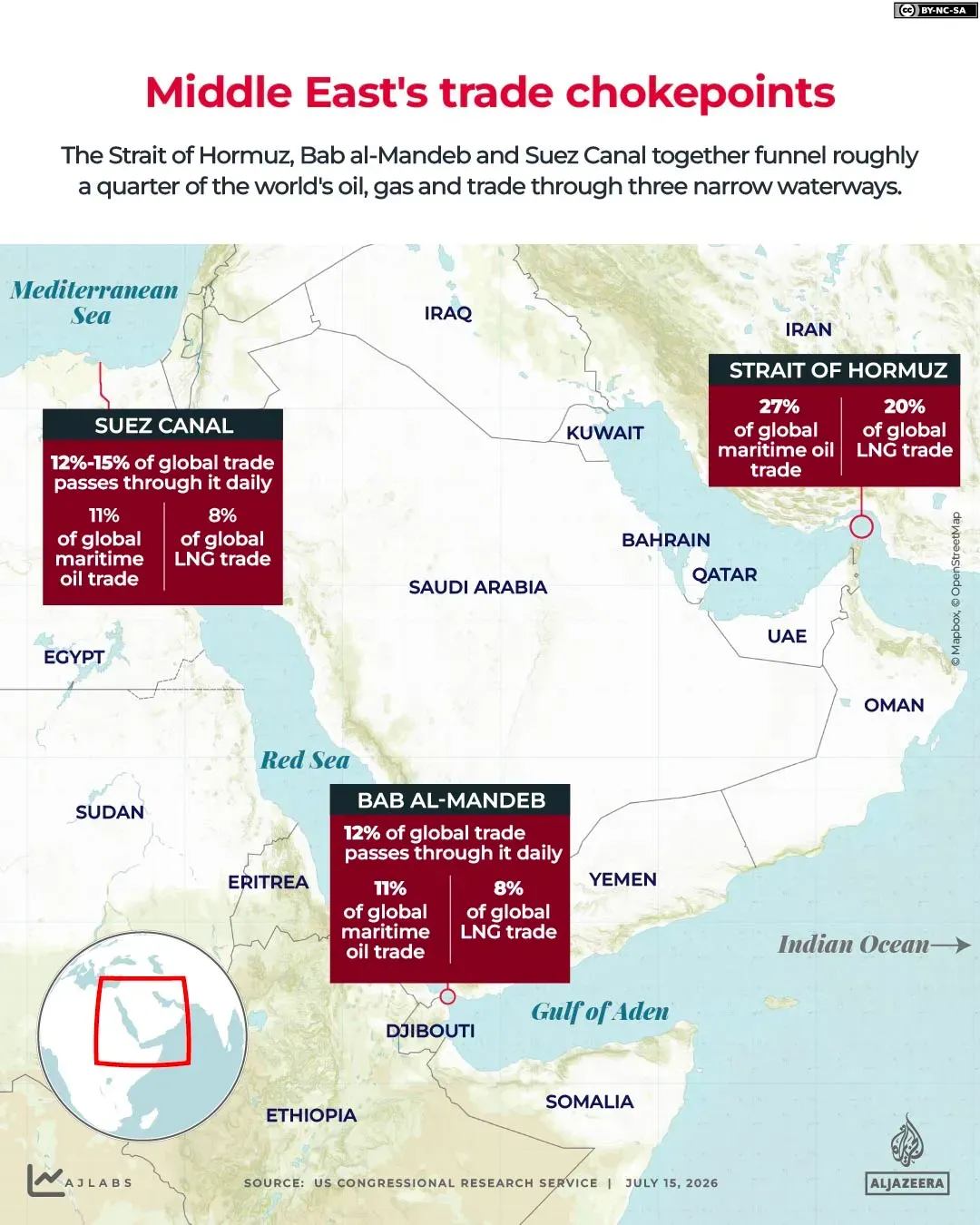
Disruption to fuel and fertiliser supplies due to the ongoing blocking of cargo vessels through the Strait of Hormuz has already lowered agricultural productivity and will hit crop yields later this year, the UN’s development chief said on Thursday.
Recommended Stories
list of 4 itemsend of list
“Even if the war would stop tomorrow, those effects, you already have them, and they will be pushing back more than 30 million people into poverty,” said Alexander De Croo, administrator of the United Nations Development Programme (UNDP).
He also warned of other fallouts of the United States-Israeli war on Iran, including energy shortages and falling remittances.
Much of the world’s fertiliser is produced in the Middle East, and one-third of global supplies passes through the Strait of Hormuz, where Iran and the US are jostling for control.
The UN’s Food and Agriculture Organization (FAO) last week warned that a prolonged crisis in the strait could lead to a global food “catastrophe”.
India, Bangladesh, Sri Lanka, Somalia, Sudan, Tanzania, Kenya, and Egypt are among the countries most at risk, according to the FAO.
“Food insecurity will be at its peak level in a few months – and there is not much that you can do about it,” De Croo said.
Straining humanitarian efforts
The knock-on effects of the Iran conflict have already wiped out 0.5 percent to 0.8 percent of global gross domestic product (GDP), according to De Croo, who noted, “Things that take decades to build up, it takes eight weeks of war to destroy them.”
De Croo, the former prime minister of Belgium, also warned that the Middle East crisis is straining humanitarian efforts in other parts of the world, with the sector already facing funding cuts.
The US-Israeli attacks on Iran, which began on February 28, have also choked up key humanitarian aid routes, delaying life-saving shipments to some of the world’s worst crises.
“We will have to say to certain people, really sorry, but we can’t help you,” De Croo said. “People who would be surviving on help will not have this, and will be pushed into even greater vulnerability.”
As well as announcing a new rule, Ryanair is in the process of installing more self-service bag-drop kiosks, with 95% of the airports it operates from to have them by October
The airline has issued a baggage update (Image: Getty Images)
Ryanair is changing its luggage rules, it announced today.
From November 10, all check-in and bag drop services at all airports it operates from will close 60 minutes prior to scheduled departure, up from 40 minutes currently.
The budget airline claims this is to provide “more time for passengers to get through airport security and passport queues” which will “reduce the very small number of passengers who currently miss their flight departure as they are getting stuck in these airport queues.”
The change means the 20% of Ryanair passengers who check their bag will have slightly more time to get through airport security and passport queues and arrive at their departure gate before boarding starts.
Ryanair is in the process of installing more self-service bag-drop kiosks, with 95% of the airports it operates from to have them by October.
Ryanair CMO, Dara Brady, said: “From Tuesday 10 November next, Ryanair customers will see airport check-in and bag drops close 60 minutes before scheduled departure, instead of today’s 40 minutes. This will allow these 20% of our customers (who check in a bag) more time to clear through airport security and passport queues, and get to their departure gate on time, especially during busy travel periods when some of these airport queues can be longer.
“We are also installing self-service kiosks at over 95% of Ryanair airports before October. This means a quicker bag-drop service, less queuing at airport desks, and an even more punctual service for the 20% of our customers who still wish to check in a bag, while the 80% (who don’t check in a bag) will be unaffected by this small 20-minute change, as they will continue to check in online before they arrive at the departure airport and they go straight through airport security to their departure gate.”
Over the past week, Ryanair passengers have been affected by the new entry/exit system (EES), which has led to long queues at some European airports. Passengers scheduled to fly from Milan Bergamo to Manchester were left behind due to difficulties at passport control.
The system was rolled out across all Schengen Area border checkpoints on April 10. Over the last few weeks it has meant that passengers have taken longer to get through airport security and some have even missed flights as a result.
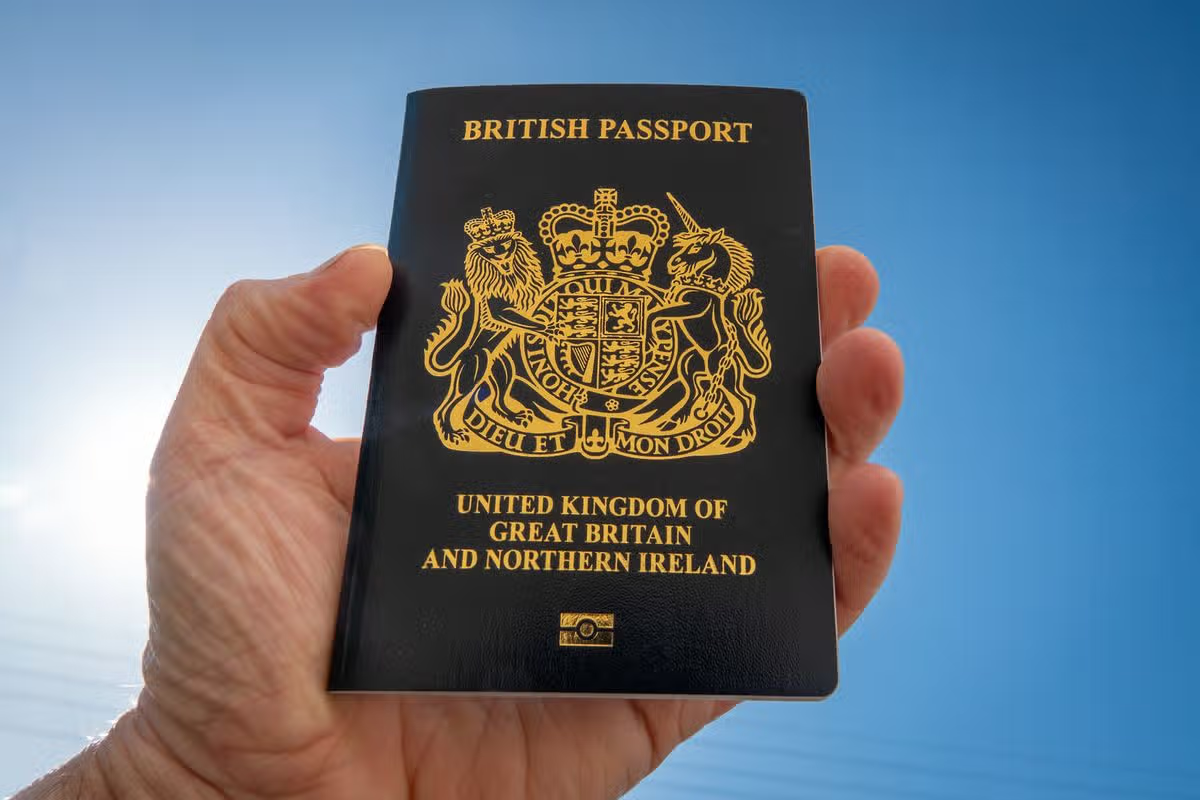
EES requires non-EU nationals, including British citizens, to register biometric data. This includes facial scans and fingerprints, which are subsequently verified each time they cross a European Schengen Area border. EES is operated by the respective border control authority in each nation rather than by airports or airlines.
Ryanair has since addressed the incident at Milan Bergamo airport. Its spokesperson said: “Should these passengers have presented at the boarding gate desk before it closed, they would have boarded this flight.”
HOLIDAYMAKERS are being warned not to do one common activity at the beach.
Beach days are always fun, especially in the summer with the family – but the public are being warned to never dig a large hole in the sand in one part of the UK.
Sign up for the Travel newsletter
Thank you!
The coastguard is warning beachgoers to not dig holes on the beachCredit: Getty
This is because a large hole can collapse in on itself and could pose the risk of trapping someone, including kids and pets.
The fresh warning comes from the coastguard at Cleethorpes, a popular seaside town destination with a four-mile beach, traditional pier and family-friendly activities, making it the ideal day out.
According to the BBC, Cleethorpes Coastguard deputy station manager Shaun Lee said: “It’s like an avalanche effect, where the sand just keeps collapsing and collapsing, and then people just get completely buried in it.
He explained that when a hole is dug with steep sides, the wet sand will dry out and make it looser and as a result, more prone to collapsing.
He added: “We don’t want to be the fun police – just be aware of what you are doing if you are digging holes.”
Also in Lincolnshire, last year coastguards filled a hole in Sandilands Beach that was nearly two metres deep.
At the time, the coastguards said they filled the hole “for safety reasons”.
Last June, the coastguard filled a hole on Weymouth Beach as well, which was around 1.5metres deep.
It took the coastguard three people and 30 minutes to fill.
Senior Coastal Operations Officer Allan Norman, at HM Coastguard, said: “Buckets and spades are a lot of fun – but most of us wouldn’t dream of digging a 5ft deep hole at a park where youngsters are running about and people walk in the evening.
“It’s the same at busy beaches: deep holes can be hard to spot in the sand and pose the risk of someone falling in and being injured, particularly little children and older people.
“There’s also the danger of the sand collapsing on top of you, causing injury and suffocation.
“These incidents require whole teams of rescuers.
“We’d just ask people to stay aware of who else is on the beach and the potential risks of digging too deep.”
Last year, coastguards filled a hole in Sandilands Beach that was nearly two metres deepCredit: Mablethorpe Coastguard
Even though beachgoers are warned against creating large holes at the beach, it doesn’t mean you can’t dig them at all.
Allan advises to just not dig it deeper than waist height and to avoid digging tunnels, which are even more likely to collapse.
He added that you should fill the hole in before you leave the beach.
If you do happen to be caught in a situation where you get stuck in a large hole on the beach, GOV.UK recommends creating a circle of people around the hole, who dig with their hands to create an outer circle.
Then create another circle of people behind that circle, but they will be removing the sand dug from the first circle.
By creating multiple circles, it will make the original hole bigger and more shallow and as a result, it will be less likely to collapse.
Brazilian President Luiz Inacio Lula da Silva speaks during a media tour at the Hanover Fair 2026 Hanover, Germany, on Monday. Photo by Hannibal Hanschke/EPA
April 20 (UPI) — Brazilian President Luiz Inácio Lula da Silva has warned about the deterioration of the international order and the paralysis of the United Nations in a message published on X.
He urged strengthening multilateralism while on an official visit to Germany, where he also promoted the trade agreement between the European Union and Mercosur.
“It is useless to have one’s house in order in a world that is in disorder. The prevalence of force over law is the greatest threat to international peace and security,” Lula wrote in a message that addresses multiple global conflict hotspots.
De nada adianta estar com a casa em ordem em um mundo em desordem. A prevalência da força sobre o direito é a mais grave ameaça à paz e à segurança internacional.
Estamos profundamente preocupados com os riscos de retomada do conflito no Irã e de escalada no Líbano. A…— Lula (@LulaOficial) April 20, 2026
Lulu expressed concern over “the risks of a new conflict in Iran” and a possible escalation in Lebanon, as well as the situation in Palestine, where he said that “the survival of the Palestinian state and its people remains under threat.”
He also mentioned the war in Ukraine, noting that “the long-awaited peace remains distant.”
In his message, Lula criticized the lack of international action.
“Between the actions of those who provoke wars and the silence of those who prefer to remain quiet, the United Nations is once again paralyzed,” he said. He added that Brazil and Germany have defended for decades a reform of the Security Council that restores its legitimacy.
“Revitalized multilateralism is the only path to restore diplomacy and cooperation as tools for peace and sustainable development,” he said, and concluded with a broader call: “Humanity must recover the idea that peace is morally necessary and politically possible.”
The message aligns with a series of recent statements by the Brazilian leader on the global order and the role of major powers.
In an interview published Thursday by the Spanish newspaper El País, Lula criticized U.S. President Donald Trump over his rhetoric toward other countries and questioned the use of threats in foreign policy.
“Trump does not have the right to wake up in the morning and threaten a country,” Lula said, also calling for greater responsibility from international leaders to preserve peace.
In the same interview, he defended dialogue as the main diplomatic tool and warned about the risk of global escalation.
“I do not want a war with the United States. I decided to be very patient,” he said, explaining that his government prioritizes negotiation and national interests over ideological differences.
He also questioned the use of tariffs by Washington and said that the arguments to apply measures against Brazil “were not true.”
Lulu already has raised the need to reform international institutions.
“The time has come to redefine the United Nations to give it credibility,” he said, in line with his most recent call on social media.
In Germany, Lulu participated in the opening of the Hannover Industrial Fair alongside Chancellor Friedrich Merz.
Both leaders highlighted the free-trade agreement between the European Union and Mercosur, whose provisional entry into force is scheduled for May 1.
Merz said the agreement “will make all participating economies stronger, more independent and more resilient.” Lula, for his part, presented it as an alternative to unilateralism.
“Mercosur and the European Union chose cooperation,” he said, adding that increased trade will boost employment and investment in both regions.
Weekly insights and analysis on the latest developments in military technology, strategy, and foreign policy.
The Air National Guard is pushing Congress to boost fighter numbers as it seeks to modernize its aging inventory. With the Air Force at large feeling the effects of years of underinvestment in new fighters, and with China presenting a massive pacing challenge, the move is the latest effort to ensure that the service can keep up in terms of numbers and capability.
According to a report from Air & Space Forces Magazine, Air National Guard adjutants general from more than 20 states sent a letter to Congress last week that requests multiyear funding for the acquisition of between 72 and 100 new fighters each year.
An F-15C assigned to the 123rd Fighter Squadron, Portland Air National Guard Base, Oregon, taxis to the runway at Nellis Air Force Base, Nevada, while an F-15EX assigned to the 85th Test and Evaluation Squadron, Eglin Air Force Base, Florida, prepares to take off. U.S. Air Force photo by William R. Lewis William Lewis
These numbers would be a significant hike compared with recent years: not since 1998 has the Air Force bought more than 72 new fighters in a single year.
“The United States Air Force is the oldest, the smallest, and the least ready in its 78-year history,” the letter states. “We must build a fighting force that will win.”
Specifically, the letter urges the minimum annual purchases of the 48 F-35As and 24 F-15EXs, with a preferred goal of 72 F-35As and 36 F-15EXs.
The 123rd Fighter Squadron was the first operational unit to receive the F-15EX. The first example for the unit is seen arriving at Portland Air National Guard Base on June 5, 2024. Oregon Air National Guard
While the letter was signed by Air National Guard leaders, these totals would be expected to furnish units of the Active, Guard, and Reserve components.
By comparison, the Air Force requested funding for 48 F-35As in Fiscal Year 2024, followed by 42 in 2025, 24 in 2026, and 38 in the proposed 2027 budget.
The Fiscal Year 2027 budget request also includes funding for the purchase of 10 F-35Bs and 37 F-35Cs for the Marine Corps and the Navy, which is already a notable uptick in planned acquisitions. At the same time, the F-35 program has faced worrisome delays in work on a new radar, as well as a host of other critical upgrades.
F-35As assigned to the 115th Fighter Wing, Truax Field, Madison, Wisconsin, receive fuel from a KC-135 Stratotanker assigned to the 128th Air Refueling Wing in Milwaukee. U.S. Air National Guard photo by Staff Sgt. Cameron Lewis Staff Sgt. Cameron Lewis
For the F-15EX, budget documents show the service requested 24 aircraft in 2024, 18 in 2025, 21 in 2026, and 24 in 2027.
A sustained annual buy of even 24 F-15EXs would represent an acceleration over current production plans for the Eagle II, after the Fiscal Year 2026 budget request increased the program of record from 98 to 129 aircraft, including funding for 21 jets in a single year. In its latest budget request, the Air Force provides no details about whether there may be any new changes to the planned total fleet size for the F-15EX.
One of those who signed the letter is Brig. Gen. Shannon Smith, head of the Idaho Air National Guard, who toldAir & Space Forces Magazine that, “We are burning these jets and the airmen over time to support the joint force to accomplish the president’s goals with Epic Fury in this conflict with Iran.”
U.S. Air Force Brig. Gen. Shannon D. Smith, pictured in 2024 when he was commander, District of Columbia Air National Guard. U.S. Air National Guard photo by Staff Sgt. Daira Jackson 113th Wing D.C. Air National Gua
On top of the demands of combat operations, Brig. Gen. Smith warned that the Air National Guard fighter fleet is rapidly aging, meaning that “Most of the money will go to keep them flying. In a few years, they’ll be struggling to be flyable, let alone be relevant.”
While plans are in place to replace A-10s and F-15Cs, even older F-35As will need replacement before too long, Smith added. More urgent is the looming requirement to supersede the more numerous F-16s.
A row of A-10Cs assigned to the 127th Wing, Michigan Air National Guard, under their shelters at Selfridge Air National Guard Base, Michigan. Photo by Terry L. Atwell/U.S. Air Force
In total, the Air National Guard has 24 fighter squadrons, 11 of which have already received new fighters or are planned to. While some Guard F-16 units have transitioned to the F-35, there is no plan in place for the Guard’s remaining 13 Viper squadrons. Taken together, the Guard’s inventory constitutes close to half of all combat-coded F-16s.
In the past, thought has been given to a new light fighter, to balance the more costly and capable F-35 and, now, the F-47, although that would be extremely costly and take years. Another option would be to start buying new F-16 Block 70/72 jets, although the production line is already burdened by multiple export orders.
Even if Congress supports the Air National Guard chiefs’ recommendations and the budget is available, getting new jets on ramps will be far from easy.
As well as boosting capabilities and ‘combat mass,’ new fighters bring other advantages in terms of reduced maintenance demands, easier access to spare parts, longer airframe life, and overall higher availability.
An F-16C fighter assigned to the Arizona Air National Guard’s 162nd Wing. Air National Guard
The issue of spare parts is a critical one. Back in 2024, we looked at how, by the Air Force’s own estimates, hundreds of its aircraft are at risk of being left grounded due to a lack of spares, thanks to a $1.5-billion shortfall in its budget request.
However, meeting the aim of 72 to 100 new fighters each year would demand a significant uptake in production capacity, which is already stretched. With that in mind, the Air National Guard projects it could still take 10 to 15 years to re-equip units now flying older fighters.
One option to re-equip Guard and Reserve units would be to cascade fighters down from the Active component, but Air National Guard chiefs warn against this, too, since it only pushes recapitalization with new fighters further down the line.
What is unclear is how the Air Force’s plans for the F-47 sixth-generation fighter might play into this.
A rendering of the F-47 developed under the Next Generation Air Dominance (NGAD) program. U.S. Air Force graphic Secretary of the Air Force Publi
At this point, however, there are still questions about how exactly the F-47 will fit into the Air Force’s future force structure and how many of the jets the service might actually procure. The jet was originally planned as a replacement for the F-22, but that appears to have changed, or is at least in limbo. It is by no means clear how long the F-22 will be around after the F-47 is introduced, but if the F-47 is delayed, it could come at the end of the F-22’s service life. If the Air Force intends to operate the two at the same time, at least for the earlier part of the F-47’s career, but delays in fielding it occur, this could also open up another gap in the combat mass.
Another factor is the service’s emerging plans for fielding its future fleets of Collaborative Combat Aircraft (CCA) drones, which are being designed from the ground up to work in close concert with current and future crewed jets. In the past, the Air Force has signaled that it wants to buy over 1,000 CCAs. However, this number is understood to cover multiple CCA increments, with Increment 1 being procured in numbers between 100 and 150 units, at least to start with.
Three examples of the YFQ-42A Dark Merlin, developed to meet the Increment 1 CCA requirement. General Atomics
Ultimately, the CCA effort aims to drastically improve the tactical jet fleet combat mass, which could offset the dwindling fighter force, and active-duty F-35 and F-22 units will get them first. Thereafter, they could be quickly rolled out to fourth-generation jets, too. On the other hand, the CCA concept still has much to prove and is not without risk.
In the background to all this are the concerns within the U.S. military leadership at large about the significant advances being made by the Chinese military and, in this case, its air arms. The People’s Liberation Army Air Force is rapidly expanding and modernizing at a scale that threatens to surpass the United States in both numbers and capability. Warning signs of a massive fighter expansion include an apparent new J-35 factory and the many Chinese CCA programs.
An underside view of the new-generation Chinese J-36 combat jet. Chinese internet via X
As long as the U.S. government continues to procure aircraft at comparatively slower rates, China has the opportunity to race ahead and is already producing advanced fighters in large quantities, creating a growing imbalance in the Indo-Pacific region.
Clearly, there are very many factors at play, not least budgetary. However, in making their case to Congress, Air National Guard bosses are once again underscoring the continued demand for crewed combat jets within the service, and at the same time, highlighting some of the challenges in keeping the fighter force at the top of its game.
Top negotiator Mohammad Bagher Ghalibaf says US naval blockade of Iran’s ports is ‘a clumsy and ignorant decision’.
Published On 18 Apr 202618 Apr 2026
Iran’s Islamic Revolutionary Guard Corps Navy (IRGC) says the Strait of Hormuz is closed and that any ship that attempts to pass through the waterway will be targeted, a dramatic reversal less than 24 hours after the critical shipping lane was reopened.
In a statement carried by Iran’s Student News Agency, the IRGC navy said on Saturday the strait will be closed until the United States lifts its naval blockade on Iranian vessels and ports. It said the blockade was a violation of the ongoing ceasefire agreement in the US-Israel war on Iran.
Recommended Stories
list of 4 itemsend of list
“We warn that no vessel of any kind should move from its anchorage in the Persian Gulf and the Sea of Oman, and approaching the Strait of Hormuz will be considered cooperation with the enemy, and the offending vessel will be targeted,” it said.
Mohammad Bagher Ghalibaf, Iran’s parliament speaker and a senior negotiator in talks between Washington and Tehran on ending the war, said in a television interview that “the Strait of Hormuz is under the control of the Islamic Republic”.
“The Americans have been declaring a blockade for several days now. This is a clumsy and ignorant decision,” he added.
The reassertion of control came just hours after Iran had briefly reopened the strait, in line with a 10-day ceasefire between Israel and Lebanon. Oil prices dropped on global markets after Iranian Foreign Minister Abbas Araghchi said on Friday that the waterway was “completely open for all commercial vessels.”
More than a dozen commercial ships passed through the waterway before the IRGC reversed course.
Iranian gunboats reportedly fired on two commercial ships on Saturday, according to United Kingdom Maritime Trade Operations (UKMTO). India’s Ministry of External Affairs also said that two Indian-flagged ships were involved in a “shooting incident” in the strait.
Some merchant vessels in the region received radio messages from the IRGC Navy, warning that no ships were being allowed through the strait.
US President Donald Trump said Tehran could not blackmail Washington by closing the waterway and warned that he would put an end to the ceasefire if a deal before its expiry on Wednesday is not reached. Trump added that the naval blockade would “remain in full force”.
Iranian Supreme Leader Mojtaba Khamenei, meanwhile, said the navy was ready to inflict “new bitter defeats” on its enemies.
‘Two competing blockades’
Al Jazeera correspondent Zein Basravi said that Iran and the US are back where they were the previous day.
“Less than 24 hours ago, world leaders were praising what they thought was a breakthrough in this conflict, hoping Iran was signalling a confidence-building measure by opening the Strait of Hormuz, potentially leading to a ceasefire deal and a permanent end to the war,” he said.
“As disappointed as people may be, this isn’t entirely surprising. What we’re seeing now is a return to square one,” he added, saying there are now “two competing blockades in place”.
Al Jazeera’s Ali Hashem, reporting from Tehran, said Iran was using the strait to send a message.
“It’s clear that Iran is dealing with a situation in which they are not sure what’s on the table. So the Strait of Hormuz is once again the only space for engagement, even if it’s a negative engagement. And it’s the space where they are sending and conveying messages to the Americans, showing their leverage,” he said.
Emergency Relief Coordinator Tom Fletcher told the UN Security Council that South Sudan is at risk of slipping into ‘full-scale famine and collapse’ as fighting intensifies and the UN peacekeeping mission is cut back.
easyJet issued an ‘important update’ earlier this month
10:32, 17 Apr 2026Updated 11:10, 17 Apr 2026
easyJet issued an alert this month(Image: Getty Images)
easyJet has issued an alert to passengers travelling to more than 100 destinations with the airline after a major rule change that has come in post-Brexit.
In an “important update” issued earlier this month, easyJet warned queue times may be affected and said: “Airports across Europe may experience longer queues at passport control whilst the new European Entry/Exit System (EES) border checks are being completed. This will mean you may need to have your biometrics taken including your face and fingerprints scanned.”
Passengers are advised to plan travel to and through the airport, factoring in that they may have to queue for longer than previously. Anyone who needs to use Bag Drop should do so as soon as it opens, and travellers should make sure they have all necessary documents to hand.
easyJet is also urging people to go through security as early as possible and to head to the gate or boarding area as soon as it is announced. The travel operator further said there may be additional checks at passport control before your gate and added: “You may experience longer queues in your arrival airport”.
Full list of easyJet destinations under the new EES
Ajaccio, Corsica (AJA) – France
Akureyri (AEY) – Iceland
Alicante (ALC) – Spain
Almeria (LEI) – Spain
Amsterdam (AMS) – Netherlands
Athens (ATH) – Greece
Barcelona (BCN) – Spain
Bari (BRI) – Italy
Basel (BSL) – Switzerland
Bastia, Corsica (BIA) – France
Berlin Brandenburg (BER) – Germany
Biarritz (BIQ) – France
Bilbao (BIO) – Spain
Bordeaux (BOD) – France
Brest Brittany (BES) – France
Brindisi (BDS) – Italy
Brussels Intl (BRU) – Belgium
Budapest (BUD) – Hungary
Burgas (BOJ) – Bulgaria
Calvi, Corsica (CLY) – France
Copenhagen (CPH) – Denmark
Corfu (CFU) – Greece
Costiera Amalfitana Salerno, Naples (QSR) – Italy
Crete Chania (CHQ) – Greece
Crete Heraklion (HER) – Greece
Dubrovnik (DBV) – Croatia
Dusseldorf (DUS) – Germany
Evenes-Lofoten (EVE) – Norway
Faro (FAO) – Portugal
Figari, Corsica (FSC) – France
Frankfurt International (FRA) – Germany
Friedrichshafen (FDH) – Germany
Fuerteventura (FUE) – Spain
Geneva (GVA) – Switzerland
Gibraltar (GIB) – Gibraltar
Gran Canaria (LPA) – Spain
Grenoble (GNB) – France
Hamburg (HAM) – Germany
Ibiza (IBZ) – Spain
Innsbruck (INN) – Austria
Kalamata (KLX) – Greece
Kefalonia (EFL) – Greece
Kittila (KTT) – Finland
Kos (KGS) – Greece
Krakow (KRK) – Poland
La Coruña (LCG) – Spain
La Rochelle (LRH) – France
Lamezia (SUF) – Italy
Lanzarote (ACE) – Spain
Lille (LIL) – France
Lisbon (LIS) – Portugal
Ljubljana (LJU) – Slovenia
Luxembourg (LUX) – Luxembourg
Lyon (LYS) – France
Madeira Funchal (FNC) – Portugal
Madrid (MAD) – Spain
Majorca Palma (PMI) – Spain
Malaga (AGP) – Spain
Malta (MLA) – Malta
Marseille Provence (MRS) – France
Menorca Mahon (MAH) – Spain
Milan Linate (LIN) – Italy
Milan Malpensa (MXP) – Italy
Montpellier (MPL) – France
Munich (MUC) – Germany
Murcia Intl (RMU) – Spain
Mykonos (JMK) – Greece
Nantes (NTE) – France
Naples (NAP) – Italy
Nice (NCE) – France
Oslo (OSL) – Norway
Paris Charles de Gaulle (CDG) – France
Paris Orly (ORY) – France
Pisa (Tuscany) (PSA) – Italy
Porto (OPO) – Portugal
Porto Santo (PXO) – Portugal
Prague (PRG) – Czech Republic
Preveza (PVK) – Greece
Pula (PUY) – Croatia
Rennes (RNS) – France
Reus (REU) – Spain
Reykjavik Keflavik (KEF) – Iceland
Rhodes (RHO) – Greece
Rimini (RMI) – Italy
Rome Fiumicino (FCO) – Italy
Rovaniemi (RVN) – Finland
Salzburg (SZG) – Austria
Santa Cruz de la Palma (SPC) – Spain
Santiago de Compostela (SCQ) – Spain
Santorini (JTR) – Greece
Sardinia Cagliari (CAG) – Italy
Sardinia Olbia (OLB) – Italy
Scandinavian Mountains (SCR) – Sweden
Seville (SVQ) – Spain
Sicily Catania (CTA) – Italy
Sicily Lampedusa (LMP) – Italy
Sicily Palermo (PMO) – Italy
Skiathos (JSI) – Greece
Sofia (SOF) – Bulgaria
Split (SPU) – Croatia
Strasbourg (SXB) – France
Tenerife South (TFS) – Spain
Thessaloniki (SKG) – Greece
Toulouse (TLS) – France
Tromsø (TOS) – Norway
Turin (TRN) – Italy
Valencia (VLC) – Spain
Venice Marco Polo (VCE) – Italy
Verona (VRN) – Italy
Vienna (VIE) – Austria
Zadar (ZAD) – Croatia
Zante Zakynthos (ZTH) – Greece
Zurich (ZRH) – Switzerland
The EES applies to 29 countries: Austria, Belgium, Bulgaria, Croatia, Czechia, Denmark, Estonia, Finland, France, Germany, Greece, Hungary, Iceland, Italy, Latvia, Liechtenstein, Lithuania, Luxembourg, Malta, Netherlands, Norway, Poland, Portugal, Romania, Slovakia, Slovenia, Spain, Sweden, and Switzerland. The above list of airports are the Schengen area destinations you can fly to with easyJet from the UK, as of the airline’s website at the time of publication.
BRITS have been warned to book their summer getaways now or face a massive spike in prices as the Middle East conflict sends fuel costs soaring.
The boss of easyJet today sounded the alarm after revealing the war has already cost the budget airline £25million in fuel hikes.
Sign up for the Travel newsletter
Thank you!
EasyJet reported that the conflict has created “near-term uncertainty around fuel costs and customer demand” as families hesitate to bookCredit: AFP
The Luton-based carrier has been hit hard by rising oil prices after Iran tightened its grip on tankers passing through the Strait of Hormuz.
Holidaymakers are being told that if these high costs persist, the extra bill will be passed directly onto passengers through higher fares across the entire industry.
EasyJet reported that the conflict has created “near-term uncertainty around fuel costs and customer demand” as families hesitate to book.
Official figures show that bookings for the peak summer months of June through to September have already dipped compared to last year.
The airline is braced for a massive headline loss of between £540million and £560million for the six months leading up to the end of March.
Investors reacted with panic to the news as shares in the company tumbled by as much as 9% in early trading on Thursday.
EasyJet chief executive Kenton Jarvis admitted the firm has struggled.
He said: “Our H1 financial performance worsened year on year, impacted by the conflict in the Middle East and the competitive environment in some markets.”
Despite the gloom, the airline boss insisted that planes are still taking off as normal following the busiest Easter period on record.
He added: “Following our busiest Easter holiday period ever, the operational ramp up into peak summer continues as planned.”
Mr Jarvis claimed the company has the cash reserves to survive the crisis.
He said: “EasyJet’s financial strength from our investment grade balance sheet and £4.7billion of liquidity mean we are well placed to navigate current geopolitical challenges while remaining focused on our medium term targets.”
Experts are worried that the war could eventually lead to fuel shortages and forced cancellations, but the airline insists airports are currently “operating as normal” with supplies secured until mid-May.
Everything now rests on whether the crisis in the Middle East escalates or cools down in the coming weeks.
A quick resolution could see prices drop, but a long-term war could see holiday demand dry up as fuel is rationed around the world.
The Foreign, Commonwealth & Development Office (FCDO) has issued an update for a sun-soaked holiday hotspot and warned that there have ‘been fatal accidents’ in the area
16:58, 15 Apr 2026Updated 17:00, 15 Apr 2026
The Foreign Office has issued a fresh warning for the tropical island(Image: Getty Images)
The Foreign Office has issued a travel warning for a hugely popular holiday destination that welcomes thousands of Brits every year.
On Wednesday, 15 April, the Foreign, Commonwealth & Development Office (FCDO) updated its travel advice for the Maldives. They warned about swimming safety in the Indian Ocean, with the Maldives renowned as a hotspot for snorkelling, swimming and watersports due to its crystal-clear turquoise waters.
While the waters around the Maldives are appealing, the FCDO warned that they “can have strong tidal currents that can drag you away from the shoreline.” They noted that more than eight Brits have drowned in the area since 2021, and urged everyone to be aware of the risks and understand how to minimise them.
In an updated warning, they said: “You should read the security information provided by your tour operator and make yourself aware of local swimming conditions on arrival at the resort. Keep in regular contact with resort staff to see if these conditions change.
“Only swim in well supervised areas, areas designated as safe for tourists, or where lifeguards are available. Pay attention to warning signs or flags and avoid swimming in areas with strong currents, high waves or dangerous underwater conditions. If something does not feel right, get out of the water at the earliest opportunity.”
They further highlighted: “Being aware of the potential dangers will help you to stay safe. Always take local advice before going into the sea.
“There have been fatal accidents involving boat propellers in the South Ari Marine Protected Area (SAMPA) and nearby whale shark tourism sites. Regulations requiring propeller guards are not yet fully enforced. Take extra care when swimming or snorkelling near boats and follow local safety instructions.
The FCDO doesn’t advise against travel to the Maldives, but it has warned that “escalation in the Middle East has caused widespread travel disruption”. This has resulted in airspace closures, delayed and cancelled flights, which could impact “connections to and from the Maldives.”
For anyone planning a trip to the Maldives, the Foreign Office advises the following before travelling:
“Check travel advice for any countries or territories you are transiting through
Check for the latest updates from your airline or tour operator before travelling
Review your travel insurance policy to confirm what is covered
Monitor local and international media and sign up for FCDO travel advice email alerts”
In further travel advice for safety in the Maldives, the FCDO highlight that terrorist attacks “cannot be ruled out”. They state: “Attacks could be indiscriminate, including in places visited by foreign nationals. Stay aware of your surroundings, keep up to date with local media reports and follow the advice of local authorities.”
A US musician has revealed he’s been scammed out of his entire £300,000 retirement fund in a shocking blow.
Singer G Love revealed that he had accidentally installed some malicious software onto his computer which resulted in scammers taking all of his cash.
Sign up for the Showbiz newsletter
Thank you!
Performer G Love has revealed he has fallen victim to a scamCredit: GettyHe has seen his entire retirement fund wiped outCredit: Getty
The performer took to X – formerly Twitter – to speak out on the incident that saw his entire retirement fund stolen.
He wrote: “I had a really tough day today I lost my retirement fund in a hack/Scam when I switched my @Ledger over to my new computer and by accident downloaded a malicious ledger app from the @Apple store.
“All my BTC gone in an instant.”
The singer appeared to be referring to his bitcoin investments in the tweet.
The FCDO has all the latest travel warnings listed online, advising against all travel to multiple countries
10:08, 12 Apr 2026Updated 10:18, 12 Apr 2026
An FCDO warning can affect your travel insurance(Image: Getty )
The Foreign, Commonwealth and Development Office (FCDO) provides regularly updated travel guidance for British nationals heading abroad. It’s vital to check the latest FCDO advice before your trip, as it could affect your holiday plans and travel insurance.
Choosing to travel against FCDO warnings can invalidate your travel insurance. You may also find that consular assistance is severely limited should you face an emergency. On its travel advice page, the government agency says: “No travel can be guaranteed safe. Read all the advice in this guide.”
To safeguard British nationals travelling overseas for work or pleasure, the FCDO provides up-to-date travel advice for every country worldwide. It’s essential to consult this guidance before every journey.
Should the FCDO consider a situation dangerous, it may advise against all travel or only non-essential travel to a particular country or specific regions within it. Alongside travel warnings, the FCDO provides useful information, including entry requirements, crime statistics, local laws and customs, and details regarding any forthcoming strikes or industrial action that could disrupt your holiday.
It’s important to be aware that if the FCDO issues a warning against all travel or all but essential travel to your chosen destination before your departure, your travel insurance is unlikely to provide cover. Consequently, any claims you make will in all probability be rejected.
Travel insurance is designed to safeguard you against unexpected and unforeseen risks. However, heading to a destination that the FCDO has declared dangerous carries a considerably greater risk than jetting off to a generally regarded safe country.
Should the FCDO issue a warning while you are already in an affected region, you will remain covered under the medical and personal accident sections of your travel insurance policy. However, this is provided you comply with the latest FCDO guidance for British nationals in that area.
While most travel insurance policies do not cover trips taken against official advice, there are a handful of exceptions. These particular policies were originally designed to protect individuals travelling to high-risk areas for professional reasons, such as journalists and aid workers. But, they are increasingly being taken up by leisure travellers keen to press ahead with their plans during the COVID-19 pandemic.
Political instability, natural disasters, and safety concerns are among the factors that can prompt an FCDO warning. The FCDO has issued numerous travel advisories, advising against “all travel” and “all but essential travel” to certain nations or regions across Europe, Africa, Asia, and South America.
Of the 226 countries featured on the FCDO’s travel advice page, certain destinations are currently marked as ‘do not travel’ zones owing to various concerns that ‘can not guarantee safety’, including security threats, health risks, and legal differences from Britain. Your travel insurance may be rendered invalid if you travel contrary to FCDO guidance concerning the following nations, as of April 2026.
Afghanistan
The FCDO advises against all travel to Afghanistan, saying: “Your travel insurance could be invalidated if you travel against advice from the FCDO.” The government agency says the security situation is volatile and tensions between Afghanistan and Pakistan have previously resulted in violent clashes in border regions.
It adds: “Travel throughout Afghanistan is extremely dangerous and a number of border crossings are not currently open. There is a heightened risk of British nationals being detained in Afghanistan. If you are a British national and you are detained in Afghanistan, you could face months or years of imprisonment. FCDO’s ability to help you is extremely limited and support in person is not possible in Afghanistan. For more details about the risks in Afghanistan, see Safety and security.”
Belarus
FCDO advises against all travel to Belarus. You face a significant risk of arrest if you have at any time engaged in any activity now considered illegal by the Belarusian regime. There is also a low risk that direct conflict linked to the war in Ukraine may spread to Belarus. Find out more about why FCDO advises against all travel.
Burkina Faso
FCDO advises against all travel to Burkina Faso. This is due to the threat of terrorist attacks and terrorist kidnappings, and the unstable political situation in the country.
It explains: “There is no British Embassy in Burkina Faso and all consular support is provided from the British Embassy in Accra, Ghana. They cannot provide in-person assistance. If there is serious violence, unrest or a deterioration in the security situation, it could be difficult to leave safely.
“Do not rely on the British government to evacuate you as they may not be able to do so. Have your own plans on how you would leave the country, make sure you keep all travel documentation up to date and monitor the local situation.”
Haiti
The FCDO advises against all travel to Haiti owing to the unstable security situation. There are presently no British consular officials in Haiti and the capacity to provide consular assistance is severely restricted and cannot be delivered in person in Haiti. British nationals may receive consular services assistance at our diplomatic mission in the Dominican Republic.
The government agency says: “If you choose to travel to or stay in Haiti against FCDO advice, try to avoid all crowds and public events, and take appropriate security precautions.”
Content cannot be displayed without consent
Iran
FCDO advises against all travel to Iran. It says: “If you are a British national already in Iran, either resident or visitor, carefully consider your presence there and the risks you take by staying. British and British-Iranian dual nationals are at significant risk of arrest, questioning or detention.
“Having a British passport or connections to the UK can be reason enough for the Iranian authorities to detain you.” British nationals should:
read if you’re affected by a crisis abroad. This includes guidance on ‘how to prepare for a crisis’ with suggestions on what you might include in your emergency supplies and ‘what to do in a crisis’
sign up to FCDO Travel Advice email alerts
monitor local and international media for the latest information
stay away from areas around security or military facilities
keep your departure plans under review, and ensure your travel documents are up to date
if you are advised to take shelter, stay indoors or find the nearest safe building or designated shelter. An interior stairwell or a room with as few external walls or windows as possible may provide additional protection
Mali
FCDO advises against all travel to the whole of Mali due to the unpredictable security conditions. The FCDO says if you’re in Mali, you should leave immediately by commercial flight if you judge it safe to do so.
It explains: “The international airport in Bamako is open, and commercial flights are available. Do not try to leave Mali by overland routes to neighbouring countries, as this is too dangerous. This is due to terrorist attacks along national highways. Terrorist group Jama’a Nusrat ul-Islam wa al-Muslimin (JNIM) has implemented blockades on key routes throughout Southern and Western Mali, including the capital city of Bamako.
“These blockades are targeting fuel trucks and are enforcing checkpoints for individuals attempting to pass through them. Attacks can occur at any time. There is a high threat of kidnapping and criminal activity across Mali, including in the capital, Bamako. If you choose to remain in Mali, you do so at your own risk. You should have a personal emergency plan that does not rely on the UK government. If you are a British national already in Mali, either resident or visitor, carefully consider your presence there and the risks you take by staying.”
Niger
FCDO advises against all travel to Niger. This is due to the rise of reported terrorist and criminal kidnappings of foreign nationals, which have taken place this year in Niger.
There is an ongoing risk of terrorist attacks throughout Niger, including in the capital, Niamey. The political situation remains unstable following the July 2023 military coup. Further instability is possible.
Russia
FCDO advises against all travel to Russia due to the risks and threats from its continuing invasion of Ukraine, including:
security incidents, such as drone attacks, and Russian air defence activity
lack of flights to return to the UK
limited ability for the UK government to provide support
There is an increased risk of British nationals being detained in Russia, including if the Russian authorities suspect you of engaging in or supporting activities against Russian law, even if the activities took place outside Russia.
Russia has a track record of targeting foreign nationals and holding them in detention as leverage over other countries. FCDO’s ability to assist you in these circumstances is extremely limited. There is also a high likelihood that terrorists will try to carry out attacks, including in major cities
South Sudan
The FCDO strongly advises against all travel to South Sudan owing to the threat of armed violence and criminal activity. The political and security situation remains unpredictable. Political tensions are high, and the security situation across the country could deteriorate rapidly and unpredictably.
If the unstable security situation deteriorates, routes into and out of South Sudan may be blocked. Juba airport may close or be inaccessible. Flights may be cancelled at short notice. Regional developments may also affect international transport. For example, in 2019 and 2023, events in Sudan caused South Sudan’s airspace to close temporarily. Consular assistance to British nationals is severely limited in South Sudan. In-person consular assistance is not available.
Syria
FCDO advises against all travel to Syria due to unpredictable security conditions and the threat of terrorist attacks. Regional escalation poses significant security risks and has led to travel disruption. British nationals should:
read If you’re affected by a crisis abroad. This includes guidance on “how to prepare for a crisis” with suggestions on what you might include in your emergency supplies and “what to do in a crisis”
follow advice from the local authorities and sign up to receive information and alerts
sign up to FCDO Travel Advice email alerts
monitor local and international media for the latest information
stay away from areas around security or military facilities
keep your departure plans under review, and ensure your travel documents are up to date
if you are advised to take shelter, stay indoors or find the nearest safe building or designated shelter. An interior stairwell or a room with as few external walls or windows as possible may provide additional protection
Yemen
FCDO advises against all travel to the whole of Yemen due to the unpredictable security conditions. If you’re in Yemen, you should leave immediately.
It says: “Support for British people is severely limited in Yemen. British Embassy services in Sana’a are suspended, and all diplomatic and consular staff have been withdrawn. The UK government cannot help British nationals leaving Yemen. There are no evacuation procedures in place.
“FCDO cannot offer advice on the safety of travelling to any potential departure point. The UK government’s ability to help with onward travel is severely limited and you’ll be expected to cover the cost of visas, accommodation, insurance and onward travel yourself. If you choose to remain in Yemen, you should minimise movement around the country and within cities and towns, monitor developments in the local security situation and follow other precautions in this travel advice.”
If you’re a British national in Yemen and need help from the UK government, you can call FCDO on 020 7008 5000 (24 hours).
1 of 2 | A 2024 Christmas service attended by South Korea’s then Ruling People Power Party acting leader Rep. Kweon Seong-dong (2-L) and main opposition Democratic Party leader Rep. Lee Jae-myung (2-R – now President) among other members of their parties, at Yoido Full Gospel Church, in Seoul. Photo by YONHAP / EPA
April 10 (Asia Today) — A South Korean Christian group called for an end to political entanglement with religion ahead of upcoming local elections, warning such practices could undermine the church.
The group, Start with Me Forum, issued a declaration after holding its fifth forum in Seoul on Thursday, urging believers to reject improper ties between faith and politics.
“Prayer must not become lobbying for a candidate, and offerings must not be turned into political funds,” the group said. “If the faith community becomes a vote bank, the church will collapse.”
The forum was led by Rev. Ryu Young-mo, who emphasized the need to break what he described as a long-standing pattern of using religion for political power.
Participants said the risk of religion being used as a political tool is increasing ahead of the June 3 local elections, calling for “painful self-reflection” within the Protestant community.
The declaration rejected both political forces seeking to influence religious groups for votes and religious organizations aligning with politics for institutional benefits, stressing the need to uphold the separation of church and state.
At the same time, the group opposed a proposed bill aimed at preventing church-state collusion, arguing it could infringe on religious freedom as well as freedoms of expression and association.
Speakers at the forum also highlighted broader concerns about religious involvement in politics. Professor Tak Ji-il said inappropriate ties with political power are not limited to fringe groups but affect mainstream churches as well.
“It is urgent for churches to establish safeguards to prevent irrational behavior carried out in the name of orthodoxy,” he said.
The forum included discussions on patterns of political participation among Korean Protestant churches and historical debates over church-state separation.
The organization was founded in 2017 to promote reform within the Korean church and encourage greater social responsibility among believers.
WASHINGTON — Vice President JD Vance departed Friday for Islamabad, Pakistan, to open the first direct negotiations aimed at ending the war between the United States and Iran.
Together with a delegation of deeply mistrusting negotiators from Tehran, Vance is tasked with striking a lasting peace between rival nations which have failed to keep promises made days ago in a delicate last-minute ceasefire. Ongoing military activity in the Middle East and disagreements over Iran’s control of key shipping routes have left the diplomatic effort vulnerable to collapse before the talks even begin.
“If the Iranians are willing to negotiate in good faith, we’re certainly willing to extend the open hand,” Vance told reporters before boarding Air Force Two. “If they’re gonna try and play us, then they’re gonna find that the negotiating team is not that receptive.”
On Tuesday, President Trump called off his plans to unleash “hell” on Iran based on assurances that it lift its blockade of the Strait of Hormuz, but traffic through the vital waterway was still at a trickle Friday, as more than 600 ships remained stranded in the Persian Gulf, according to marine tracking data. Trump accused Iran on Thursday of doing a “very poor job, dishonorable some would say,” of allowing oil through the strait.
“The Iranians don’t seem to realize they have no cards, other than a short term extortion of the World by using International Waterways. The only reason they are alive today is to negotiate!” he wrote on Truth Social Friday.
Meanwhile, Lebanon has emerged as the central dispute threatening to derail the talks before they begin.
Hours after the ceasefire took effect, Israel launched what Lebanese officials described as its heaviest wave of strikes since the war began, killing at least 303 people, according to local health officials.
Jerusalem argues the Lebanese front is still on the table, but Iran and Pakistan disagree.
“The Iran–U.S. Ceasefire terms are clear and explicit: the U.S. must choose — ceasefire or continued war via Israel. It cannot have both,” Iranian Foreign Minister Abbas Araghchi said earlier this week. “The world sees the massacres in Lebanon. The ball is in the U.S. court, and the world is watching whether it will act on its commitments.”
Vance has acknowledged a “legitimate misunderstanding” over whether Lebanon was included in the ceasefire terms, telling reporters Washington never made that promise.
Separate negotiations regarding Lebanon are expected next week in Washington, Lebanese President Joseph Aoun confirmed Friday. Israeli Prime Minister Benjamin Netanyahu has also OK’d the talks, but said a ceasefire is not possible.
Parliament Speaker Mohammad Bagher Qalibaf and the Iranian delegation arrived early Saturday in Islamabad, Iranian state media reported. Hours earlier he said a ceasefire in Lebanon “must be fulfilled before negotiations begin.”
Bagher Qalibaf added a second condition — the release of frozen Iranian assets — which he suggested must be returned before Tehran takes its seat at the bargaining table. Little is known about the halted Iranian funds overseas, but such assets are typically held back as a result of U.S.-imposed sanctions.
The vice president’s role in peace talks has grown in recent weeks. Administration officials have cast Vance as one of the few leaders Tehran would be willing to engage with directly. With a global economy upended by Trump’s far-reaching military ambitions, a victory in Islamabad could spike Vance’s standing as a prospect to lead the GOP post-Trump.
That’s if he’s able to take pressure off American wallets with an agreement that liberates Iran’s grip over the strait, which has choked much of the world’s oil supply,
Americans have continued to feel the fallout at the gas pump and grocery stores, as U.S. inflation climbed to 3.3% in March, the highest annual rate in nearly two years, according to the data released Friday by the Bureau of Labor Statistics.
Monthly prices rose 0.9%, a sharp increase from February’s 0.3% monthly rise, when annual inflation sat at 2.4%, the new data showed.
The White House characterized the rising inflation as a short-term disruption caused by the Iran war, while noting that the administration is “diligently working to mitigate” rising costs.
“As the Administration ensures the free flow of energy through the Strait of Hormuz, the American economy remains on a solid trajectory thanks to the Administration’s robust supply-side agenda of tax cuts, deregulation, and energy abundance,” White House spokesperson Kush Desai wrote on X.
Britain announced a meeting next week with dozens of countries to coordinate efforts to reopen the Strait of Hormuz. The summit will focus countering Iran’s proposal to charge transit tolls to allow ships through the waterway.
In a televised address to the nation, Pakistan’s Prime Minister Shehbaz Sharif spoke of a “devastating storm of inflation,” if peace talks don’t succeed in liberating the Middle East’s oil supply. He characterized the current stage as a “make-or-break moment.”
“We will make every possible effort to ensure the success of the peace process,” he said.
A UK airline has scrapped some flights from mid-April to early June following the US and Israeli attacks on Iran, which has sent the price of aviation fuel soaring
Rising jet fuel costs could be partially passed onto flyers(Image: Getty Images)
A UK airline has cancelled flights due to the impact of the Iran war, while Ryanair is warning that up to 10% of services could be binned.
Aurigny of Guernsey has scrapped some flights from mid-April to early June following the US and Israeli attacks on Iran, which has sent the price of aviation fuel soaring, the Independent reports.
The airline, which links up the Channel Islands with the UK, described the cuts as “proactive measures to address the impact of global instability”, also adding a “temporary fuel adjustment surcharge” of £2 on all new bookings.
Demand for flights has fallen 13% in May, Aurigny has said, leading the airline to cancel some departures to and from Guernsey.
Aurigny’s chief commercial officer, Philip Saunders, told the Independent: “While a small island community, we are not immune from the realities presented by the global travel ecosystem. Current global events are impacting consumer confidence and changing travel behaviours. Furthermore, significant increases in global oil prices are now filtering through to aviation.
“Unfortunately, we have to pass on some of the resulting costs to customers to ensure sustainable air services to and from Guernsey.”
European jet fuel prices hit a record $1,900 per metric ton on Thursday, according to specialized publication Argus. It warned of potential shortfalls in the coming months.
Argus project that Portugal could run out of jet fuel in four months, Hungary in five, Denmark in six, Italy and Germany in seven, and France and Ireland in eight.
Last week, the chief executive of Ryanair warned that the airline may not be able to run its full summer schedule due to the cost of fuel if the Strait of Hormuz remains closed.
Michael O’Leary predicts that European airlines will begin canceling scheduled flights “by the end of April” if the key shipping lane is not opened.
“The Strait of Hormuz has been closed for 30 days. If it remains closed for 60 or 90 days, then we’re all facing an unknown scenario, and we are certainly looking at maybe having to cancel 5%–10% of flights through May, June and July,” he told ITV.
O’Leary explained that airlines won’t be able to choose which routes to cancel as cuts will depend on which airports suffer fuel shortages.
Later speaking to SkyNews, the Ryanair boss added: “Fuel suppliers are constantly looking at the market. We don’t expect any disruption until early May, but if the war continues, we do run the risk of supply disruptions in Europe in May and June, and we hope the war will finish sooner than that and the risk to supply will be eliminated,” he told Sky News.
“We think there is a reasonable risk, some low level, maybe 10% to 25% of our supplies might be at risk through May and June, so like everyone else in this industry, we hope the war ends sooner rather than later.
“If the war finishes by April and the Strait of Hormuz reopens, then there is almost no risk to supply.”
U. S. President Donald Trump announced in a social media post that if the Strait of Hormuz is not reopened by Tuesday, the U. S. will target Iran’s power plants and bridges.
He called it “Power Plant Day, and Bridge Day” in Iran, emphasizing the importance of the shipping lane that has been closed since attacks by the U. S. and Israel more than a month ago.
Trump stated, “Open the Fuckin’ Strait, you crazy bastards, or you’ll be living in Hell – JUST WATCH! ” He also mentioned that he would hold a news conference on Monday in the Oval Office following the rescue of two U. S. pilots downed in Iran.
The rise is largely symbolic as some key members are unable to raise production amid the US-Israel war on Iran.
Published On 5 Apr 20265 Apr 2026
The Organization of the Petroleum Exporting Countries (OPEC) has agreed to increase oil output quotas by 206,000 barrels per day for May, a rise that is largely symbolic as some of its key members are unable to raise production due to the US-Israeli war on Iran.
The war has effectively blocked the Strait of Hormuz – the world’s most important oil route – since the end of February and cut exports from OPEC+ members Saudi Arabia, the United Arab Emirates (UAE), Kuwait and Iraq.
Recommended Stories
list of 3 itemsend of list
In a statement on Sunday, eight members of OPEC+, including Saudi Arabia, Russia, Iraq, the UAE, Kuwait, Kazakhstan, Algeria, and Oman, agreed to increase May quotas during a virtual meeting.
“The countries will continue to closely monitor and assess market conditions, and in their continuous efforts to support market stability,” the statement read.
“The eight countries also expressed concern regarding attacks on energy infrastructure, noting that restoring damaged energy assets to full capacity is both costly and takes a long time, thereby affecting overall supply availability,” it added.
While the quota increase represents less than two percent of the supply disrupted by the closure of the strait, OPEC+ sources told the Reuters news agency that the pledge had signalled readiness to raise output once the waterway reopens.
Crude prices have surged to a four-year high amid the war, close to $120 a barrel, leading to higher prices for transport fuels.
On Thursday, JPMorgan said oil prices could spike above $150, an all-time high, if oil flows through the Strait of Hormuz remain disrupted into mid-May.
May’s increase is the same as the eight members had agreed on for April at their last meeting on March 1. But amid the war, oil supply disruption on record is estimated to have removed as much as 12 to 15 million bpd or up to 15 percent of global supply.
(Al Jazeera)
With the strait still closed, Iran has allowed some countries in the region to use the waterway.
Iran has said Iraq was exempt from any transit restrictions through the strait, with shipping data on Sunday showing a tanker loaded with Iraqi crude passing through the waterway.
Oman’s Foreign Ministry announced on Sunday that deputy foreign minister-level talks were being held with Iran to discuss options to ensure the smooth transit of vessels through the Strait of Hormuz.
US President Donald Trump threatened to escalate attacks and target Iranian civilian infrastructure, including bridges and power plants, if the Strait of Hormuz is not reopened by Monday.