warns

China is America’s Military Equal Now And In Any Future Fight, Marine General Warns

The general in charge of keeping the United States Marine Corps sustained in a fight dismisses the notion that China poses a near-peer threat to the U.S. It’s far more serious and will make the currently paused conflict with Iran pale by comparison should the two superpowers come to blows, said Lt. Gen. Stephen Sklenka, the USMC Deputy Commandant for Installations and Logistics. 

“There is no threat that looms larger than the People’s Republic of China,” Sklenka said during the 2026 Modern Day Marine Expo in Washington, D.C.. “Don’t listen to this garbage about them being a near peer. They’re a peer because they rival us in nearly every single measure of national influence.”

The People's Liberation Army PLA Rocket Force formation attends a military parade in Beijing, capital of China, Sept. 3, 2025. China on Wednesday held a grand gathering to commemorate the 80th anniversary of the victory in the Chinese People's War of Resistance against Japanese Aggression and the World Anti-Fascist War. (Photo by Guo Yu/Xinhua via Getty Images)
The People’s Liberation Army PLA Rocket Force formation attends a military parade in Beijing, capital of China, Sept. 3, 2025. (Photo by Guo Yu/Xinhua via Getty Images) Xinhua News Agency

As the “lead strategist” and former Deputy Commander of U.S. IndoPacom, Sklenka said he “got to be pretty familiar with how General Secretary Xi was thinking and what his intentions are.”

The Chinese leader’s “vision is to upend the international structure [and] supplant us as the global leaders. And in many ways, it’s been Xi’s thinking, his vision, that has helped my own thinking about the demands of modern warfare, particularly when waged in the Pacific and particularly waged against a peer adversary, something that’s new to all of us.”

BEIJING, CHINA - SEPTEMBER 03: A display shows China’s President Xi Jinping delivering a speech during a military parade marking the 80th anniversary of victory over Japan and the end of World War II, in Tiananmen Square on September 03, 2025, in Beijing, China. China's Victory Day military parade serves as a powerful display of national pride and military power. This year's parade carries heightened geopolitical weight with the attendance of leaders like Vladimir Putin, Kim Jong Un and Masoud Pezeshkian, underlining China's diplomatic alliances as it presents itself as an alternative global leader. (Photo by Lintao Zhang/Getty Images)
China’s President Xi Jinping wants to supplant the U.S. as a global leader, a U.S. Marine Corps general warns. (Photo by Lintao Zhang/Getty Images) Lintao Zhang

Epic Fury offers some sobering lessons, Sklenka noted. While the U.S. is able to pour forces into theater via uncontested skies and largely uncontested seas, Iran was still able to inflict a great deal of pain on America and its allies during the fighting. It still is economically through an ongoing closure of the Strait of Hormuz. A fight with China would be far worse, Sklenka cautioned.

“We’re about two months into combat operations with Epic Fury. We’ve got service members who have tragically been wounded and killed by Iran. They’ve launched hundreds of drones and ballistic missiles at our bases and our allies throughout the region – Israel, Saudi Arabia, Qatar, Kuwait, Jordan – reinforcing the point that the bases that we have, they’re no longer administrative garrison sanctuaries. We really need to start looking at our bases as war fighting formations, just as critical of a war fighting formation as our divisions, wings and [Marine Expeditionary Units] MEUs.”

We’ll talk more about that later in this story.

You can see damage to U.S. bases in the Middle East in the following satellite images.

JUST IN 🇮🇷🇺🇸: New Satellite Photos from Iran Show Damage on U.S. Bases from Iran’s Strikes

Bases Include:
• Al-Kharj, Saudi Arabia 🇸🇦
• Harir Air Base, Iraq 🇮🇶
• Ali al-Salem, Kuwait 🇰🇼 https://t.co/2PYWuk7Iou pic.twitter.com/DYcevTNuHa

— Ryan Rozbiani (@RyanRozbiani) March 16, 2026

Iran has “illustrated how a mid-tier power can hold a significantly superior force at risk” Sklenka suggested. “As a learning organization, we ask ourselves, ‘how do we carry every lesson from this fight forward, and how do we ensure that we’re equally prepared to dominate the conflict with China?’”

“Think about the complexities and complications that we’re [facing] with Iran, and then ask yourself, ‘how are we going to respond and act when we’re going up against a nation that’s number two in national GDP?’” he added. “The fact is that Iran doesn’t have anywhere near China’s economic might. They don’t have their industrial base. They certainly don’t have their military modernization trajectory.”

KC-135 seen with battle damage repairs landing at RAF Midlenhall.
A KC-135 Stratotanker aerial refueling jet seen over RAF Mildenhall after being peppered with shrapnel during an Iranian attack on Prince Sultan Air Base in Saudi Arabia last month. (Andrew McKelvey)

“Over the last 10 to 15 years, the Chinese manufacturing base has been out-producing us” Sklenka posited. “Xi is on a wartime footing. There’s no doubt about that. It’s underpinned by an industrial base that’s out producing the world in ships and steel, precious minerals and satellites, munitions.”

China’s “shipbuilding capacity is reported to be 230 times the capacity that the United States has,” the general continued. “They more than doubled their nuclear powered submarine construction, their arsenal of ballistic and cruise missiles is undergoing a rapid expansion.”

First made-in-China aircraft carrier, the Shandong, enters service thumbnail

First made-in-China aircraft carrier, the Shandong, enters service


“Their nuclear stockpile is the fastest growing in the world. They’re pursuing innovative, intelligentized warfare tactics,” Sklenka pointed out. “They’re using artificial intelligence, drone swarms, exploring the cognitive and innovative domains to achieve their dominance. They’re building a military design to dominate the Pacific, and I believe ultimately beyond the Pacific.”

The nuclear missile formation passes through Tian'anmen Square during a military parade in Beijing, capital of China, Sept. 3, 2025. China on Wednesday held a grand gathering to commemorate the 80th anniversary of the victory in the Chinese People's War of Resistance against Japanese Aggression and the World Anti-Fascist War. (Photo by Yan Linyun/Xinhua via Getty Images)
The nuclear missile formation passes through Tian’anmen Square during a military parade in Beijing, capital of China, Sept. 3, 2025. China on Wednesday held a grand gathering to commemorate the 80th anniversary of the victory in the Chinese People’s War of Resistance against Japanese Aggression and the World Anti-Fascist War. (Photo by Yan Linyun/Xinhua via Getty Images) Xinhua News Agency

China’s intent, Sklenka added, “is clear. They want to regain that self-identified moniker of the Middle Kingdom, and they want to resume what they believe is their rightful place in the world. They’re not interested in sharing that position with us or with anybody else. General Secretary Xi’s view is that it’s their time, and this is the context. I bring that all up for our transformation.”

“None of us in uniform today have ever had to operate in a world where a legitimate peer simultaneously contests us in every single domain,” said Sklenka. “We are talking terrestrially and non-terrestrially, kinetically and non-kinetically. We’re going to have to fight to get to that fight, and we’re going to have to embrace these challenges and not operate under the auspices of how we did in the 80s and 90s. History is proven, and our current operations are confirmed, that the society that can project and sustain power and sustain their forces most effectively, ultimately, they prevail.”

China has now formally commissioned its first catapult-equipped aircraft carrier, the Fujian, into service.
China has now formally commissioned its first catapult-equipped aircraft carrier, the Fujian, into service. (Chinese Ministry of National Defense)

Looking to the future, Sklenka echoed warnings that TWZ has made for years about the vulnerability of U.S. military installations, both home and abroad. No increases in magazine depth, additional weapons systems or advancements with AI and other new technologies will ultimately matter “if you can’t get off the installation in the first place,” he stated. “The ability to mobilize and deploy is underpinned by the readiness of our installations. It’s a concept that we’re just now really starting to wrestle with.”

“Our bases, posts and stations…are the front lines of decisive terrain. And I’m not just talking about those in the first island chain. This isn’t just [Marine Corps Installations Pacific] MCIPAC. Our CONUS installations are subject to non-kinetic attacks. Non kinetic-attacks, they’re going to be just as debilitating and just as strategically consequential as any kinetic attack that’s going to be out there. And they’re going to carry an air of non-attrition that’s designed to both confuse decision makers and sow chaos during the most critical phases of the fight, the beginning, the first shots of that next war.”

Mysterious drones flew over Langley Air Force Base in Virginia for weeks in December 2023. (A satellite image of Langley Air Force Base. Google Earth)

That first salvo, Sklenka said, is most likely not going to be delivered by a missile or bomber.

“They’re likely not going to be fired in the South China Sea or in the Taiwan Strait,” he explained. “They’re going to be a cyber attack against a power grid on our base, a disinformation campaign targeting military families or a drone swarm coming off one of our installations.”

The localized drone attack concern is exactly what TWZ has long predicted and became a reality last year in Russia and Iran. Last June, Ukraine launched Operation Spider Web, an audacious near-field attack on Russian air bases, destroying a large number of strategic bombers with remotely operated drones set up in trucks placed near those installations.

Spider Web was followed about two weeks later by an operation Israel carried out, using drones pre-positioned inside Iran to attack the Islamic Republic’s air defenses.

You can see video of one attack during Operation Spider Web below.

“I think our installations have to start being treated as warfighting platforms,” Sklenka proclaimed. “We need the best solutions for counter UAS. We got to quit talking about it, start delivering that. We need resilient power. You have to be able to absorb when our communications are cut and continue those communications actions. We need hardened infrastructure and a hard network.”

His plea for hardening infrastructure runs counter to thinking by some U.S. military leaders, particularly in the Pacific, who have downplayed the need to do more to physically harden existing bases. You can read more about that in our story here.

Sklenka had other suggestions for protecting installations.

“We need integrated base defense, and we need industry’s help to do all this,” he urged. “We’re not going to be just fighting from our bases. In many cases, we’re going to be fighting for those bases. That’s a concept that’s new to us. We got to start embracing that.”

Contact the author: howard@thewarzone.com

Howard is a Senior Staff Writer for The War Zone, and a former Senior Managing Editor for Military Times. Prior to this, he covered military affairs for the Tampa Bay Times as a Senior Writer. Howard’s work has appeared in various publications including Yahoo News, RealClearDefense, and Air Force Times.


Source link

European airlines could go bust by September if fuel crisis continues, airline boss warns

AIRLINES across Europe could collapse by September if the fuel crisis continues, the boss of Wizz Air has warned.

The ongoing war in Iran has seen the closure of the Strait of Hormuz, one of the world’s busiest shipping routes.

This has meant a shortage in fuel, including jet fuel, which has resulted in prices per barrel doubling in price.

Wizz Air chief executive József Váradi has since warned that airlines will be forced into closing if the prices remain high.

He told the Telegraph: “Airlines go bust two times a year, in September and February [and] airlines with weak liquidity positions will come under immense pressure in September time.

“At the moment, all airlines are selling against summer demand, which is the highest-priced capacity during the year – but you run out of steam by the end of June.”

PLANE MAD

Nine airlines that have cancelled flights as Iran war fuel crisis continues


HOL-D OFF

Brits warned summer holidays ARE at risk of being cancelled as jet fuel runs low

He added that airlines will be fine during summer as they are “making money” due to demand.

However, he said that winter was not the same, which will see a “flood of capacity removed” in September and October.

In the worst chaos scenario – which he called an “Armageddon situation,” Wizz Air could cancel up to 30 per cent of flights.

Lots of airlines have already cancelled flights in recent weeks.

This includes: 

  • Lufthansa – 20,000 cancelled up to September
  • United – around 250 a month cancelled
  • Air New Zealand – around 1,000 cancelled
  • Scandinavian Airlines – around 1,000 cancelled
  • KLM – 160 cancelled
  • Cathay Pacific – two per cent of flights up to June 30

Here are what all the other UK airlines are saying about the fuel crisis.

Source link

Budget airline warns of more flight cancellations this summer

AN AIRLINE that recently axed flights has warned Brits to expect more cancellations in the future.

Earlier this month, Norse Atlantic axed all its flights from London Gatwick to Los Angeles in America due to rising fuel prices.

Norse Atlantic Airways Boeing 787 Dreamliner aircraft landing at MXP Milano Malpensa International Airport.
Norse Airways is warning travellers of more flight cancellations due to rising fuel costs Credit: Getty

And now the airline has warned of even more cancellations.

Eivind Roald, CEO of Norse Atlantic Airways, said to BBC Newsnight: “From our side we will continue flying from London Gatwick and from Athens and Rome this summer, we don’t have any plans to cancel more flights.

“When it comes to our competitors, I can’t really say, I assume you will see more cancellations coming, we often see it coming in short haul flights in Europe.

“The long haul flights are still there.”

Read more on travel inspo

CHEAP BREAKS

UK’s best 100 cheap stays – our pick of the top hotels, holiday parks and pubs


HOLLA

Never pay full price for hols again… 25 apps, sites & clubs for huge discounts

He also said that travellers “will see that things will be changed” including some companies’ “existence”.

The CEO then added that he was confident jet fuel prices would fall in six to nine months time.

Even though the airline hasn’t announced more cancellations yet, the London Gatwick to Los Angeles route was only introudced by the airline in 2023.

And at that time, it operated seven flights per week from London Gatwick to Los Angeles.

The route was due to re-start next month, but instead will be cancelled for the entire season until October.

As a result, Norse will only have four long-haul routes this summer, including London Gatwick to New York and London Gatwick to Orlando.

A number of other airlines have also made the decision to cancel some flights or increase prices.

For example, earlier this month KLM said it was axing 160 flights across Europe over the next month due to the fuel crisis.

Despite the airline not yet having a shortage of fuel, the cancellations will impact flights travelling to and from Amsterdam Schiphol Airport in the Netherlands.

Lufthansa also announced that its subsidiary airline CityLine is stopping all operations due to both the Iran War and recent strike action.

The airline would fly to Frankfurt and Munich from the UK.

As for long haul flights, Virgin Atlantic had raised the price of flights.

Those now travelling in economy have to pay an extra £50, those in premium economy have to pay an extra £180 and those in business class will need to pay an additional £360.

In other flight news, a closed UK airport has revealed the latest details about being able to reopen as part of huge £193million project.

Plus, a UK travel company has gone bust with all holidays cancelled – but Brits won’t get any refunds.

Aerial view of Terminal 3 at Manchester Airport, with 6 Ryanair and 1 Flybe aircraft parked up.
It comes as a number of other airlines have cancelled flights in recent months due to rising fuel costs Credit: Alamy

Source link

Never wear 1 item of clothing on plane as flight attendant warns it’s ‘gross’

A flight attendant has shared several plane safety tips that could make your next trip more comfortable – including the one item you should absolutely never wear

You could be picking up all sorts of germs by wearing the wrong clothes on a flight.

When travelling by plane, whether it’s for a work trip or holiday, you usually want to be as comfortable as possible. No matter how long your flight is, sitting in a cramped space surrounded by strangers isn’t ideal, so you normally want to make sure your outfit is something you can feel relaxed in for at least a few hours, if not longer.

But one flight attendant has said there’s one thing you should absolutely never wear on a plane, regardless of how comfortable you think it is. Charity Moore is a flight attendant who regularly posts travel tips on social media, and in a recent video, she shared several things she wishes more people did on flights.

Among her tips, Charity said there’s one thing you should absolutely never wear on a plane, as it puts your body in direct contact with the seats – which aren’t always the most hygienic things to be sitting on.

1. Wear the right clothes

Charity insisted you should never wear anything that exposes your legs on a plane, including shorts and skirts. She advocated for wearing trousers at all times, because she’s seen some “diabolical” things happen on plane seats that aren’t always cleaned as thoroughly as you might like.

Content cannot be displayed without consent

She said: “I am letting you know, from a flight attendant, the amount of things I have seen on the seat. Wear pants. Shorts, skirts, dresses, absolutely not. Wear full pants. None of your skin should be touching that seat. I don’t care if you come on board and disinfect it. Nope, nope, nope. Wear full pants. Trust me, I have seen some diabolical things.”

2. Disinfect the seatbelts

The flight attendant also said that while she often sees passengers using antibacterial wipes on things like the tray table, she hardly ever sees anyone clean the seatbelt – which she believes is the most important part.

She explained: “You guys all come on board with your little Clorox wipes and your little disinfectants, and you start wiping everything down. That little tray table in front of you [and] the back of your seat. I don’t really get why you’re wiping the back of your seat, because if you’re wearing clothes, nothing really touches that.

“What you should be wiping that nobody wipes is that seatbelt. The metal part, because everybody touches it, but also you should be wiping the fabric part of the seatbelt, because everybody pulls on that. The amount of throw up, baby vomit, bodily fluids, liquids that have spilt, and random stuff that ends up on those seatbelts. Wipe them down, babe.”

3. Exercise proper toilet hygiene

Charity claimed that not enough passengers have proper toilet etiquette when using the bathroom on a plane. This includes washing your hands once you’ve done your business, making sure you flush the toilet, and even closing the door behind you once you’re finished.

Amazon cabin bag meets Ryanair requirements for less than £15

This article contains affiliate links, we will receive a commission on any sales we generate from it. Learn more
Ryanair bag

£20.99

£14.99

Amazon

See the deal

Travellers keen to beat the bag charges without breaking the budget have made an Amazon travel bag a bestseller. Rated 4.7 stars out of 5 from almost 3,000 reviews, the Xkdoai bag comes in six colours with prices from £14.99, saving 29% on the usual price.

While these might seem like obvious things you would do after any toilet visit, whether it’s on a plane or not, the flight attendant insisted a large portion of passengers don’t do them.

She also said if you’ve taken your shoes off at your seat to make yourself more comfortable, you should not go to the toilet without putting your shoes back on.

The attendant noted: “It is never ever water on the floor in the lav. And your socks are like two big sponges.”

4. Bring food

Charity’s final piece of advice is to bring food with you. She said it’s a “huge misconception” that you can’t bring food through security, and encouraged people to bring snacks or even a fully prepared meal with them to help them survive their plane journey.

In the UK, food items and powders are allowed in your hand luggage, but may obstruct images on X-ray machines, so your bags might need to be checked again manually by security, which could cause you delays.

You are generally not allowed to bring liquid or gel-like foods such as soup, sauces, jams, and yoghurts in your hand luggage, and may not be able to bring certain fresh produce, like fruits, vegetables, meat, and dairy, across some international borders, so always make sure you check the rules before you fly.

In most cases, you will be able to bring snack boxes with things like sweets, chocolate, and crisps onto a flight. You should usually avoid packing nuts into your snack box, as you may be asked not to open these if a passenger has an allergy.

Source link

Major English train station warns of closure during busy bank holiday weekend

A MAJOR train station in England has announced its closure over a busy bank holiday weekend.

Passengers are urged to plan their journeys ahead as the station will be shut.

Exterior of Lime Street railway station in Liverpool, England, showing its glass and steel arched roof and a stone facade.
Liverpool Lime Street station will be shut over the early May bank holiday Credit: Geography Photos/Universal Images Group via Getty Images

One of the North West‘s busiest stations will be closed over the early May bank holiday.

Liverpool Lime Street station will stop its overground services on Sunday, May 3, and into the morning of Monday, May 4.

Engineers will be carrying out major upgrade works around the station during the closure.

Along with replacing outdated signalling infrastructure in the Edge Hill area, workers will be maintaining overhead power cables and track points.

JET SET

Jet2 addresses price hike fears amid jet fuel shortages ahead of summer holidays


PLANE EXPLAIN

Jet2, TUI, BA, Virgin, Ryanair & easyJet – UK airlines on the fuel crisis

This means that overground lines in and out of Lime Street will be disrupted.

Paul Owen, Liverpool area director for Network Rail, said: “We would like to thank passengers for their patience while this vital work takes place.

“Replacing older signalling infrastructure with new equipment will reduce disruption on the railway and create smoother, more reliable journeys.”

Local Merseyrail trains will continue to run while other routes will be diverted or replaced by bus.

Travellers are advised to check with their train operator or on the National Rail Enquiries website for the latest information.

Passengers should allow extra time for travel and expect delays or changes to their journeys.

Source link

Global hunger report warns of rising malnutrition and famine risks | Infographic News

Famine was confirmed in two places in 2025 – areas of the Gaza Strip and Sudan – the first such dual confirmation since formal famine reporting began, according to the Global Report on Food Crises (GRFC) 2026.

The annual report, produced by a coalition of 18 humanitarian and development partners, found that acute food insecurity remained widespread in 2025.

Recommended Stories

list of 4 itemsend of list

Across 47 countries and territories experiencing food crises, 22.9 percent of their populations – or about 266 million people – experienced acute food insecurity last year, a marginal rise from 22.7 percent in 2024 but nearly double the 11.3 percent recorded in 2016.

INTERACTIVE_FAO_GLOBAL_REPORT_2025_APRIL23_2026-02-1777011588

The proportion of analysed populations facing acute hunger has now stayed above 20 percent every year since 2020. In absolute terms, the number of people affected has grown from 108 million in 2016 to 265.7 million in 2025, having peaked at 281.6 million in 2023.

The GRFC cautioned that the slightly lower headline figure compared with 2024 mainly reflects a reduction in the number of countries covered – from 53 to 47 – rather than any real decline in needs.


Famine, catastrophe and emergency

Famine – the most extreme classification under the hunger-monitoring Integrated Food Security Phase Classification (IPC) system – was confirmed in parts of the Gaza Strip and Sudan in 2025. The risk of famine remained in other areas of Gaza, Sudan and South Sudan, and those projections extended into 2026.

According to the IPC, famine is when:

  • At least 20 percent of households face extreme food shortages.
  • Acute malnutrition affects more than 30 percent of the population.
  • The death rate due to starvation or hunger-related causes exceeds two deaths per 10,000 people per day.
INTERACTIVE - Famine Gaza measurement
(Al Jazeera)

Six countries and territories had populations facing “catastrophic conditions”, or Phase 5, the highest level in the IPC’s classification of food insecurity. They numbered 1.4 million people, a more-than ninefold increase since 2016.

The Gaza Strip was the worst affected, with 640,700 people facing famine conditions, equivalent to 32 percent of its population, the highest share recorded globally. Sudan followed with 637,200 people, or 1 percent of its population.

Four other countries recorded catastrophic food shortages among specific groups of people: South Sudan – 83,500 (1 percent of the population), Yemen – 41,200 (0.1 percent), Haiti – 8,400 (0.1 percent) and Mali – 2,600 (0.01 percent).

Additionally, more than 39 million people in 32 countries were in Phase 4, or emergency conditions, representing 3.8 percent of the population analysed, a marginal increase from 2024.

INTERACTIVE_FAO_GLOBAL_REPORT_2025_APRIL23_2026-01-1777011625

Conflict remains the main driver of hunger

Conflict and violence were the primary drivers of acute food insecurity in 19 countries where 147.4 million people were affected. They represented more than half of those facing acute hunger globally.

Weather extremes were the primary driver in 16 countries, affecting 87.5 million people, while economic shocks led in 12 countries, with 29.8 million people affected.

Against that backdrop, humanitarian and development financing for areas facing food crises declined in 2025, falling back to levels last seen in 2016-2017, the report said.

As for 2026, the report said that based on a partial picture as of March, severity levels remain critical in multiple contexts. It added that the escalation of conflict in the Middle East exposes food-crisis countries to direct and indirect risks of global agricultural and food market disruptions.

A generation of malnourished children

An estimated 35.5 million children were acutely malnourished in 2025 across 23 countries experiencing nutrition crises, including just under 10 million with severe acute malnutrition, the most life-threatening form.

A further 25.7 million children suffered from moderate acute malnutrition. About 9.2 million pregnant and breastfeeding women were also acutely malnourished across 21 countries with available data.

Interactive_WorldFoodDay_October16_2025-01-1760613556
(Al Jazeera)

Displacement is concentrated in food-crisis countries

The number of forcibly displaced people in the 46 countries covered fell slightly in 2025 to 85.1 million.

About 62.6 million of them were internally displaced across 34 countries, and 22.5 million were refugees and asylum seekers in 44 countries.

Without a sustained push to address the structural drivers of hunger, the world’s most fragile countries will continue to bear a disproportionate share of the global hunger burden well into 2026, the report concluded.

Source link

US-Israeli war on Iran will push 30 million back into poverty, UN warns | US-Israel war on Iran News

Disruption to fuel and fertiliser supplies due to the Strait of Hormuz closure will hit crop yields, UNDP chief warns.

The Iran war will push more than 30 million people back into poverty, with the knock-on effects of the conflict likely to increase food insecurity in the coming months, the United Nations has warned.

Disruption to fuel and fertiliser supplies due to the ongoing blocking of cargo vessels through the Strait of Hormuz has already lowered agricultural productivity and will hit crop yields later this year, the UN’s development chief said on Thursday.

Recommended Stories

list of 4 itemsend of list

“Even if the war would stop tomorrow, those effects, you already have them, and they will be pushing back more than 30 million people into poverty,” said Alexander De Croo, administrator of the United Nations Development Programme (UNDP).

He also warned of other fallouts of the United States-Israeli war on Iran, including energy shortages and falling remittances.

Much of the world’s fertiliser is produced in the Middle East, and one-third of global supplies passes through the Strait of Hormuz, where Iran and the US are jostling for control.

The UN’s Food and Agriculture Organization (FAO) last week warned that a prolonged crisis in the strait could lead to a global food “catastrophe”.

India, Bangladesh, Sri Lanka, Somalia, Sudan, Tanzania, Kenya, and Egypt are among the countries most at risk, according to the FAO.

“Food insecurity will be at its peak level in a few months – and there is not much that you can do about it,” De Croo said.

Straining humanitarian efforts

The knock-on effects of the Iran conflict have already wiped out 0.5 percent to 0.8 percent of global gross domestic product (GDP), according to De Croo, who noted, “Things that take decades to build up, it takes eight weeks of war to destroy them.”

De Croo, the former prime minister of Belgium, also warned that the Middle East crisis is straining humanitarian efforts in other parts of the world, with the sector already facing funding cuts.

The US-Israeli attacks on Iran, which began on February 28, have also choked up key humanitarian aid routes, delaying life-saving shipments to some of the world’s worst crises.

“We will have to say to certain people, really sorry, but we can’t help you,” De Croo said. “People who would be surviving on help will not have this, and will be pushed into even greater vulnerability.”

Source link

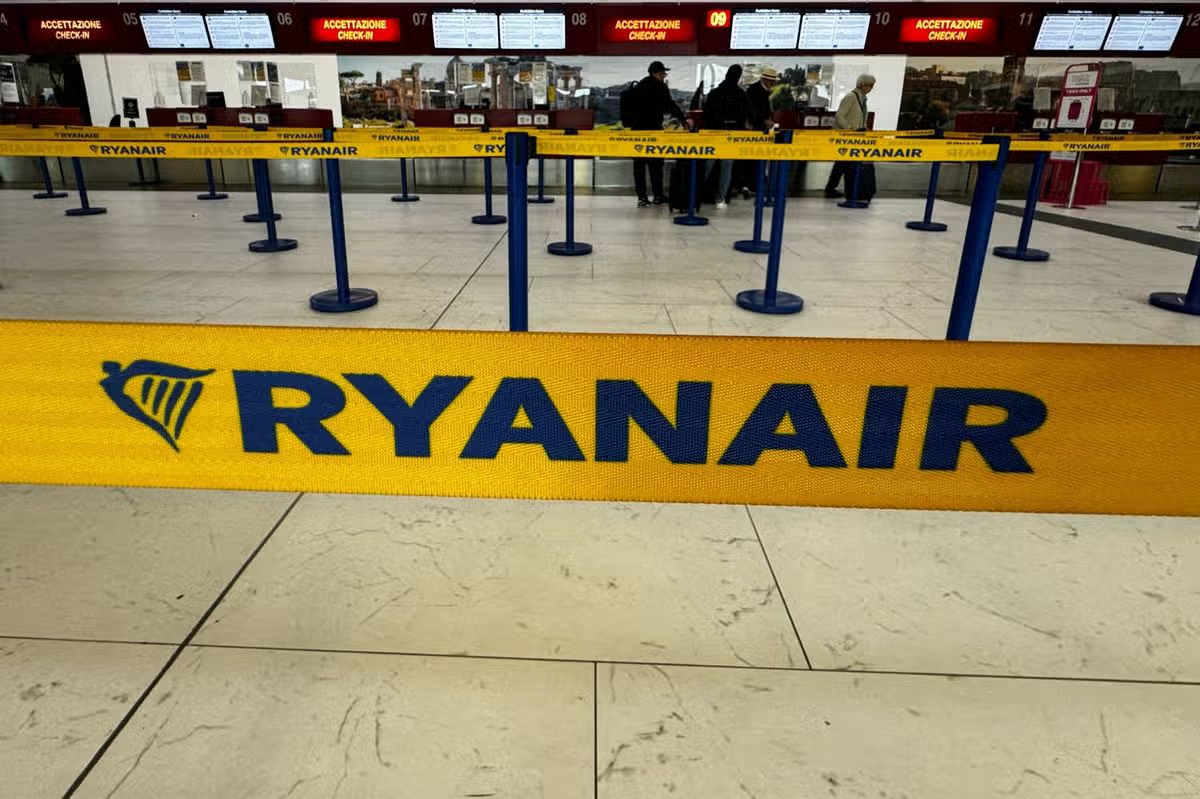
Ryanair warns passengers it’s changing its luggage rules in 2026

As well as announcing a new rule, Ryanair is in the process of installing more self-service bag-drop kiosks, with 95% of the airports it operates from to have them by October

Ryanair is changing its luggage rules, it announced today.

From November 10, all check-in and bag drop services at all airports it operates from will close 60 minutes prior to scheduled departure, up from 40 minutes currently.

The budget airline claims this is to provide “more time for passengers to get through airport security and passport queues” which will “reduce the very small number of passengers who currently miss their flight departure as they are getting stuck in these airport queues.”

The change means the 20% of Ryanair passengers who check their bag will have slightly more time to get through airport security and passport queues and arrive at their departure gate before boarding starts.

READ MORE: Ten airlines add extra charges amid jet fuel crisis and flight cancellations – full listREAD MORE: Key date for pet owners as dogs set to be banned from over 600 UK beaches

Ryanair is in the process of installing more self-service bag-drop kiosks, with 95% of the airports it operates from to have them by October.

Ryanair CMO, Dara Brady, said: “From Tuesday 10 November next, Ryanair customers will see airport check-in and bag drops close 60 minutes before scheduled departure, instead of today’s 40 minutes. This will allow these 20% of our customers (who check in a bag) more time to clear through airport security and passport queues, and get to their departure gate on time, especially during busy travel periods when some of these airport queues can be longer.

“We are also installing self-service kiosks at over 95% of Ryanair airports before October. This means a quicker bag-drop service, less queuing at airport desks, and an even more punctual service for the 20% of our customers who still wish to check in a bag, while the 80% (who don’t check in a bag) will be unaffected by this small 20-minute change, as they will continue to check in online before they arrive at the departure airport and they go straight through airport security to their departure gate.”

Over the past week, Ryanair passengers have been affected by the new entry/exit system (EES), which has led to long queues at some European airports. Passengers scheduled to fly from Milan Bergamo to Manchester were left behind due to difficulties at passport control.

The system was rolled out across all Schengen Area border checkpoints on April 10. Over the last few weeks it has meant that passengers have taken longer to get through airport security and some have even missed flights as a result.

EES requires non-EU nationals, including British citizens, to register biometric data. This includes facial scans and fingerprints, which are subsequently verified each time they cross a European Schengen Area border. EES is operated by the respective border control authority in each nation rather than by airports or airlines.

Ryanair has since addressed the incident at Milan Bergamo airport. Its spokesperson said: “Should these passengers have presented at the boarding gate desk before it closed, they would have boarded this flight.”

Source link

Popular beach resort warns families to avoid digging holes in the sand

HOLIDAYMAKERS are being warned not to do one common activity at the beach.

Beach days are always fun, especially in the summer with the family – but the public are being warned to never dig a large hole in the sand in one part of the UK.

The coastguard is warning beachgoers to not dig holes on the beach Credit: Getty

This is because a large hole can collapse in on itself and could pose the risk of trapping someone, including kids and pets.

The fresh warning comes from the coastguard at Cleethorpes, a popular seaside town destination with a four-mile beach, traditional pier and family-friendly activities, making it the ideal day out.

According to the BBC, Cleethorpes Coastguard deputy station manager Shaun Lee said: “It’s like an avalanche effect, where the sand just keeps collapsing and collapsing, and then people just get completely buried in it.

He explained that when a hole is dug with steep sides, the wet sand will dry out and make it looser and as a result, more prone to collapsing.

Read more on travel inspo

GO ON

All the little-known websites for cheap or FREE tickets to gigs, theatre & festivals


HOL YES

I’m a travel editor & mum-of-3… my favourite family holidays from just £3pp a night

He added: “We don’t want to be the fun police – just be aware of what you are doing if you are digging holes.”

Also in Lincolnshire, last year coastguards filled a hole in Sandilands Beach that was nearly two metres deep.

At the time, the coastguards said they filled the hole “for safety reasons”.

Last June, the coastguard filled a hole on Weymouth Beach as well, which was around 1.5metres deep.

It took the coastguard three people and 30 minutes to fill.

Senior Coastal Operations Officer Allan Norman, at HM Coastguard, said: “Buckets and spades are a lot of fun – but most of us wouldn’t dream of digging a 5ft deep hole at a park where youngsters are running about and people walk in the evening.

“It’s the same at busy beaches: deep holes can be hard to spot in the sand and pose the risk of someone falling in and being injured, particularly little children and older people.

“There’s also the danger of the sand collapsing on top of you, causing injury and suffocation.

“These incidents require whole teams of rescuers.

“We’d just ask people to stay aware of who else is on the beach and the potential risks of digging too deep.”

Last year, coastguards filled a hole in Sandilands Beach that was nearly two metres deep Credit: Mablethorpe Coastguard

Even though beachgoers are warned against creating large holes at the beach, it doesn’t mean you can’t dig them at all.

Allan advises to just not dig it deeper than waist height and to avoid digging tunnels, which are even more likely to collapse.

He added that you should fill the hole in before you leave the beach.

If you do happen to be caught in a situation where you get stuck in a large hole on the beach, GOV.UK recommends creating a circle of people around the hole, who dig with their hands to create an outer circle.

Then create another circle of people behind that circle, but they will be removing the sand dug from the first circle.

By creating multiple circles, it will make the original hole bigger and more shallow and as a result, it will be less likely to collapse.

In other beach news, here are our 26 must-visit UK beaches for 2026 – including tropical-feel spots and family-friendly finds.

Plus, here’s the UK’s warmest beach that’s also home to two of the ‘most idyllic holiday homes’ and you can stay from just £30pp a night.

Holes can collapse and end up trapping people Credit: Getty

Source link

Brazil’s Lula warns of global disorder, calls for U.N. reform

Brazilian President Luiz Inacio Lula da Silva speaks during a media tour at the Hanover Fair 2026 Hanover, Germany, on Monday. Photo by Hannibal Hanschke/EPA

April 20 (UPI) — Brazilian President Luiz Inácio Lula da Silva has warned about the deterioration of the international order and the paralysis of the United Nations in a message published on X.

He urged strengthening multilateralism while on an official visit to Germany, where he also promoted the trade agreement between the European Union and Mercosur.

“It is useless to have one’s house in order in a world that is in disorder. The prevalence of force over law is the greatest threat to international peace and security,” Lula wrote in a message that addresses multiple global conflict hotspots.

Lulu expressed concern over “the risks of a new conflict in Iran” and a possible escalation in Lebanon, as well as the situation in Palestine, where he said that “the survival of the Palestinian state and its people remains under threat.”

He also mentioned the war in Ukraine, noting that “the long-awaited peace remains distant.”

In his message, Lula criticized the lack of international action.

“Between the actions of those who provoke wars and the silence of those who prefer to remain quiet, the United Nations is once again paralyzed,” he said. He added that Brazil and Germany have defended for decades a reform of the Security Council that restores its legitimacy.

“Revitalized multilateralism is the only path to restore diplomacy and cooperation as tools for peace and sustainable development,” he said, and concluded with a broader call: “Humanity must recover the idea that peace is morally necessary and politically possible.”

The message aligns with a series of recent statements by the Brazilian leader on the global order and the role of major powers.

In an interview published Thursday by the Spanish newspaper El País, Lula criticized U.S. President Donald Trump over his rhetoric toward other countries and questioned the use of threats in foreign policy.

“Trump does not have the right to wake up in the morning and threaten a country,” Lula said, also calling for greater responsibility from international leaders to preserve peace.

In the same interview, he defended dialogue as the main diplomatic tool and warned about the risk of global escalation.

“I do not want a war with the United States. I decided to be very patient,” he said, explaining that his government prioritizes negotiation and national interests over ideological differences.

He also questioned the use of tariffs by Washington and said that the arguments to apply measures against Brazil “were not true.”

Lulu already has raised the need to reform international institutions.

“The time has come to redefine the United Nations to give it credibility,” he said, in line with his most recent call on social media.

In Germany, Lulu participated in the opening of the Hannover Industrial Fair alongside Chancellor Friedrich Merz.

Both leaders highlighted the free-trade agreement between the European Union and Mercosur, whose provisional entry into force is scheduled for May 1.

Merz said the agreement “will make all participating economies stronger, more independent and more resilient.” Lula, for his part, presented it as an alternative to unilateralism.

“Mercosur and the European Union chose cooperation,” he said, adding that increased trade will boost employment and investment in both regions.


Source link

Air Guard Warns Of Dire Consequences If At Least 72 Fighters Aren’t Bought Annually

The Air National Guard is pushing Congress to boost fighter numbers as it seeks to modernize its aging inventory. With the Air Force at large feeling the effects of years of underinvestment in new fighters, and with China presenting a massive pacing challenge, the move is the latest effort to ensure that the service can keep up in terms of numbers and capability.

According to a report from Air & Space Forces Magazine, Air National Guard adjutants general from more than 20 states sent a letter to Congress last week that requests multiyear funding for the acquisition of between 72 and 100 new fighters each year.

An F-15EX Eagle II Fighter Jet assigned to the 85th Test and Evaluation Squadron, Eglin Air Force Base, Florida, takes off and an F-15C Eagle assigned to the 123rd Fighter Squadron, Portland Air National Guard Base, Oregon, taxis to the runway at Nellis Air Force Base, Nevada, Oct. 20, 2021. Aircraft from Nellis AFB, Eglin AFB Florida, and the Oregon Air National Guard are providing support for the Test and Evaluation of the F-15EX in operationally realistic scenarios to determine how effective and suitable the aircraft is at accomplishing its air-to-air mission for future Air Force use. (U.S. Air Force photo by William R. Lewis)
An F-15C assigned to the 123rd Fighter Squadron, Portland Air National Guard Base, Oregon, taxis to the runway at Nellis Air Force Base, Nevada, while an F-15EX assigned to the 85th Test and Evaluation Squadron, Eglin Air Force Base, Florida, prepares to take off. U.S. Air Force photo by William R. Lewis William Lewis

These numbers would be a significant hike compared with recent years: not since 1998 has the Air Force bought more than 72 new fighters in a single year.

“The United States Air Force is the oldest, the smallest, and the least ready in its 78-year history,” the letter states. “We must build a fighting force that will win.”

Specifically, the letter urges the minimum annual purchases of the 48 F-35As and 24 F-15EXs, with a preferred goal of 72 F-35As and 36 F-15EXs.

The 123rd Fighter Squadron was the first operational unit to receive the F-15EX. The first example for the unit is seen arriving at Portland Air National Guard Base on June 5, 2024. Oregon Air National Guard

While the letter was signed by Air National Guard leaders, these totals would be expected to furnish units of the Active, Guard, and Reserve components.

By comparison, the Air Force requested funding for 48 F-35As in Fiscal Year 2024, followed by 42 in 2025, 24 in 2026, and 38 in the proposed 2027 budget.

The Fiscal Year 2027 budget request also includes funding for the purchase of 10 F-35Bs and 37 F-35Cs for the Marine Corps and the Navy, which is already a notable uptick in planned acquisitions. At the same time, the F-35 program has faced worrisome delays in work on a new radar, as well as a host of other critical upgrades.

F-35 Lightning II aircraft assigned to the 115th Fighter Wing, Truax Field, Madison, Wisconsin receive fuel from a KC-135 Stratotanker assigned to the 128th Air Refueling Wing in Milwaukee during their initial flight to Truax Field April 25, 2023. This aerial refueling marks the first time the Wisconsin Air National Guard units have refueled together with the Wisconsin based fifth-generation fighter. (U.S. Air National Guard photo by Staff Sgt. Cameron Lewis)
F-35As assigned to the 115th Fighter Wing, Truax Field, Madison, Wisconsin, receive fuel from a KC-135 Stratotanker assigned to the 128th Air Refueling Wing in Milwaukee. U.S. Air National Guard photo by Staff Sgt. Cameron Lewis Staff Sgt. Cameron Lewis

For the F-15EX, budget documents show the service requested 24 aircraft in 2024, 18 in 2025, 21 in 2026, and 24 in 2027.

A sustained annual buy of even 24 F-15EXs would represent an acceleration over current production plans for the Eagle II, after the Fiscal Year 2026 budget request increased the program of record from 98 to 129 aircraft, including funding for 21 jets in a single year. In its latest budget request, the Air Force provides no details about whether there may be any new changes to the planned total fleet size for the F-15EX.

One of those who signed the letter is Brig. Gen. Shannon Smith, head of the Idaho Air National Guard, who told Air & Space Forces Magazine that, “We are burning these jets and the airmen over time to support the joint force to accomplish the president’s goals with Epic Fury in this conflict with Iran.”

U.S. Air Force Brig. Gen. Shannon D. Smith, outgoing commander, District of Columbia Air National Guard, gives remarks at the change of command ceremony at Joint Base Andrews, Maryland, May 18, 2024. Smith relinquished command to U.S. Air Force Col. Matthew R. McDonough. Prior to serving as commander of the DCANG, Smith served as Chief of Staff at Idaho Air National Guard, Joint Force Headquarters, Gowen Field, Idaho. (U.S. Air National Guard photo by Staff Sgt. Daira Jackson)
U.S. Air Force Brig. Gen. Shannon D. Smith, pictured in 2024 when he was commander, District of Columbia Air National Guard. U.S. Air National Guard photo by Staff Sgt. Daira Jackson 113th Wing D.C. Air National Gua

On top of the demands of combat operations, Brig. Gen. Smith warned that the Air National Guard fighter fleet is rapidly aging, meaning that “Most of the money will go to keep them flying. In a few years, they’ll be struggling to be flyable, let alone be relevant.”

While plans are in place to replace A-10s and F-15Cs, even older F-35As will need replacement before too long, Smith added. More urgent is the looming requirement to supersede the more numerous F-16s.

A row of A-10Cs assigned to the 127th Wing, Michigan Air National Guard, under their shelters at Selfridge Air National Guard Base, Michigan. Photo by Terry L. Atwell/U.S. Air Force

In total, the Air National Guard has 24 fighter squadrons, 11 of which have already received new fighters or are planned to. While some Guard F-16 units have transitioned to the F-35, there is no plan in place for the Guard’s remaining 13 Viper squadrons. Taken together, the Guard’s inventory constitutes close to half of all combat-coded F-16s.

In the past, thought has been given to a new light fighter, to balance the more costly and capable F-35 and, now, the F-47, although that would be extremely costly and take years. Another option would be to start buying new F-16 Block 70/72 jets, although the production line is already burdened by multiple export orders.

Even if Congress supports the Air National Guard chiefs’ recommendations and the budget is available, getting new jets on ramps will be far from easy.

As well as boosting capabilities and ‘combat mass,’ new fighters bring other advantages in terms of reduced maintenance demands, easier access to spare parts, longer airframe life, and overall higher availability.

An F-16C fighter assigned to the Arizona Air National Guard’s 162nd Wing. Air National Guard

The issue of spare parts is a critical one. Back in 2024, we looked at how, by the Air Force’s own estimates, hundreds of its aircraft are at risk of being left grounded due to a lack of spares, thanks to a $1.5-billion shortfall in its budget request.

However, meeting the aim of 72 to 100 new fighters each year would demand a significant uptake in production capacity, which is already stretched. With that in mind, the Air National Guard projects it could still take 10 to 15 years to re-equip units now flying older fighters.

One option to re-equip Guard and Reserve units would be to cascade fighters down from the Active component, but Air National Guard chiefs warn against this, too, since it only pushes recapitalization with new fighters further down the line.

What is unclear is how the Air Force’s plans for the F-47 sixth-generation fighter might play into this.

Shown is a graphical artist rendering of the Next Generation Air Dominance (NGAD) Platform. The rendering highlights the Air Force’s sixth generation fighter, the F-47. The NGAD Platform will bring lethal, next-generation technologies to ensure air superiority for the Joint Force in any conflict. (U.S. Air Force graphic)
A rendering of the F-47 developed under the Next Generation Air Dominance (NGAD) program. U.S. Air Force graphic Secretary of the Air Force Publi

In 2023, then-Secretary of the Air Force Frank Kendall said that the service was working around a future force planning construct that included 200 of the sixth-gen combat jets.

At this point, however, there are still questions about how exactly the F-47 will fit into the Air Force’s future force structure and how many of the jets the service might actually procure. The jet was originally planned as a replacement for the F-22, but that appears to have changed, or is at least in limbo. It is by no means clear how long the F-22 will be around after the F-47 is introduced, but if the F-47 is delayed, it could come at the end of the F-22’s service life. If the Air Force intends to operate the two at the same time, at least for the earlier part of the F-47’s career, but delays in fielding it occur, this could also open up another gap in the combat mass.

Another factor is the service’s emerging plans for fielding its future fleets of Collaborative Combat Aircraft (CCA) drones, which are being designed from the ground up to work in close concert with current and future crewed jets. In the past, the Air Force has signaled that it wants to buy over 1,000 CCAs. However, this number is understood to cover multiple CCA increments, with Increment 1 being procured in numbers between 100 and 150 units, at least to start with.

Three examples of the YFQ-42A Dark Merlin, developed to meet the Increment 1 CCA requirement. General Atomics

Ultimately, the CCA effort aims to drastically improve the tactical jet fleet combat mass, which could offset the dwindling fighter force, and active-duty F-35 and F-22 units will get them first. Thereafter, they could be quickly rolled out to fourth-generation jets, too. On the other hand, the CCA concept still has much to prove and is not without risk.

In the background to all this are the concerns within the U.S. military leadership at large about the significant advances being made by the Chinese military and, in this case, its air arms. The People’s Liberation Army Air Force is rapidly expanding and modernizing at a scale that threatens to surpass the United States in both numbers and capability. Warning signs of a massive fighter expansion include an apparent new J-35 factory and the many Chinese CCA programs.

An underside view of the new-generation Chinese J-36 combat jet. Chinese internet via X

As long as the U.S. government continues to procure aircraft at comparatively slower rates, China has the opportunity to race ahead and is already producing advanced fighters in large quantities, creating a growing imbalance in the Indo-Pacific region.

Clearly, there are very many factors at play, not least budgetary. However, in making their case to Congress, Air National Guard bosses are once again underscoring the continued demand for crewed combat jets within the service, and at the same time, highlighting some of the challenges in keeping the fighter force at the top of its game.

Contact the author: thomas@thewarzone.com

Thomas is a defense writer and editor with over 20 years of experience covering military aerospace topics and conflicts. He’s written a number of books, edited many more, and has contributed to many of the world’s leading aviation publications. Before joining The War Zone in 2020, he was the editor of AirForces Monthly.


Source link

Iran reasserts control of Hormuz Strait as Trump warns against ‘blackmail’ | US-Israel war on Iran News

Top negotiator Mohammad Bagher Ghalibaf says US naval blockade of Iran’s ports is ‘a clumsy and ignorant decision’.

Iran’s Islamic Revolutionary Guard Corps Navy (IRGC) says the Strait of Hormuz is closed and that any ship that attempts to pass through the waterway will be targeted, a dramatic reversal less than 24 hours after the critical shipping lane was reopened.

In a statement carried by Iran’s Student News Agency, the IRGC navy said on Saturday the strait will be closed until the United States lifts its naval blockade on Iranian vessels and ports. It said the blockade was a violation of the ongoing ceasefire agreement in the US-Israel war on Iran.

Recommended Stories

list of 4 itemsend of list

“We warn that no vessel of any kind should move from its anchorage in the Persian Gulf and the Sea of Oman, and approaching the Strait of Hormuz will be considered cooperation with the enemy, and the offending vessel will be targeted,” it said.

Mohammad Bagher Ghalibaf, Iran’s parliament speaker and a senior negotiator in talks between Washington and Tehran on ending the war, said in a television interview that “the Strait of Hormuz is under the control of the Islamic Republic”.

“The Americans have been declaring a blockade for several days now. This is a clumsy and ignorant decision,” he added.

The reassertion of control came just hours after Iran had briefly reopened the strait, in line with a 10-day ceasefire between Israel and Lebanon. Oil prices dropped on global markets after Iranian Foreign Minister Abbas Araghchi said on Friday that the waterway was “completely open for all commercial vessels.”

More than a dozen commercial ships passed through the waterway before the IRGC reversed course.

Iranian gunboats reportedly fired on two commercial ships on Saturday, according to United Kingdom Maritime Trade Operations (UKMTO). India’s Ministry of External Affairs also said that two Indian-flagged ships were involved in a “shooting incident” in the strait.

Some merchant vessels in the region received radio messages from the IRGC Navy, warning that no ships were being allowed through the strait.

US President Donald Trump said Tehran could not blackmail Washington by closing the waterway and warned that he would put an end to the ceasefire if a deal before its expiry on Wednesday is not reached. Trump added that the naval blockade would “remain in full force”.

Iranian Supreme Leader Mojtaba Khamenei, meanwhile, said the navy was ready to inflict “new bitter defeats” on its enemies.

‘Two competing blockades’

Al Jazeera correspondent Zein Basravi said that Iran and the US are back where they were the previous day.

“Less than 24 hours ago, world leaders were praising what they thought was a breakthrough in this conflict, hoping Iran was signalling a confidence-building measure by opening the Strait of Hormuz, potentially leading to a ceasefire deal and a permanent end to the war,” he said.

“As disappointed as people may be, this isn’t entirely surprising. What we’re seeing now is a return to square one,” he added, saying there are now “two competing blockades in place”.

Al Jazeera’s Ali Hashem, reporting from Tehran, said Iran was using the strait to send a message.

“It’s clear that Iran is dealing with a situation in which they are not sure what’s on the table. So the Strait of Hormuz is once again the only space for engagement, even if it’s a negative engagement. And it’s the space where they are sending and conveying messages to the Americans, showing their leverage,” he said.

Source link

Full list of airports as easyJet warns of ‘longer queues’

easyJet issued an ‘important update’ earlier this month

easyJet has issued an alert to passengers travelling to more than 100 destinations with the airline after a major rule change that has come in post-Brexit.

In an “important update” issued earlier this month, easyJet warned queue times may be affected and said: “Airports across Europe may experience longer queues at passport control whilst the new European Entry/Exit System (EES) border checks are being completed. This will mean you may need to have your biometrics taken including your face and fingerprints scanned.”

Passengers are advised to plan travel to and through the airport, factoring in that they may have to queue for longer than previously. Anyone who needs to use Bag Drop should do so as soon as it opens, and travellers should make sure they have all necessary documents to hand.

easyJet is also urging people to go through security as early as possible and to head to the gate or boarding area as soon as it is announced. The travel operator further said there may be additional checks at passport control before your gate and added: “You may experience longer queues in your arrival airport”.

Full list of easyJet destinations under the new EES

  • Ajaccio, Corsica (AJA) – France
  • Akureyri (AEY) – Iceland
  • Alicante (ALC) – Spain
  • Almeria (LEI) – Spain
  • Amsterdam (AMS) – Netherlands
  • Athens (ATH) – Greece
  • Barcelona (BCN) – Spain
  • Bari (BRI) – Italy
  • Basel (BSL) – Switzerland
  • Bastia, Corsica (BIA) – France
  • Berlin Brandenburg (BER) – Germany
  • Biarritz (BIQ) – France
  • Bilbao (BIO) – Spain
  • Bordeaux (BOD) – France
  • Brest Brittany (BES) – France
  • Brindisi (BDS) – Italy
  • Brussels Intl (BRU) – Belgium
  • Budapest (BUD) – Hungary
  • Burgas (BOJ) – Bulgaria
  • Calvi, Corsica (CLY) – France
  • Copenhagen (CPH) – Denmark
  • Corfu (CFU) – Greece
  • Costiera Amalfitana Salerno, Naples (QSR) – Italy
  • Crete Chania (CHQ) – Greece
  • Crete Heraklion (HER) – Greece
  • Dubrovnik (DBV) – Croatia
  • Dusseldorf (DUS) – Germany
  • Evenes-Lofoten (EVE) – Norway
  • Faro (FAO) – Portugal
  • Figari, Corsica (FSC) – France
  • Frankfurt International (FRA) – Germany
  • Friedrichshafen (FDH) – Germany
  • Fuerteventura (FUE) – Spain
  • Geneva (GVA) – Switzerland
  • Gibraltar (GIB) – Gibraltar
  • Gran Canaria (LPA) – Spain
  • Grenoble (GNB) – France
  • Hamburg (HAM) – Germany
  • Ibiza (IBZ) – Spain
  • Innsbruck (INN) – Austria
  • Kalamata (KLX) – Greece
  • Kefalonia (EFL) – Greece
  • Kittila (KTT) – Finland
  • Kos (KGS) – Greece
  • Krakow (KRK) – Poland
  • La Coruña (LCG) – Spain
  • La Rochelle (LRH) – France
  • Lamezia (SUF) – Italy
  • Lanzarote (ACE) – Spain
  • Lille (LIL) – France
  • Lisbon (LIS) – Portugal
  • Ljubljana (LJU) – Slovenia
  • Luxembourg (LUX) – Luxembourg
  • Lyon (LYS) – France
  • Madeira Funchal (FNC) – Portugal
  • Madrid (MAD) – Spain
  • Majorca Palma (PMI) – Spain
  • Malaga (AGP) – Spain
  • Malta (MLA) – Malta
  • Marseille Provence (MRS) – France
  • Menorca Mahon (MAH) – Spain
  • Milan Linate (LIN) – Italy
  • Milan Malpensa (MXP) – Italy
  • Montpellier (MPL) – France
  • Munich (MUC) – Germany
  • Murcia Intl (RMU) – Spain
  • Mykonos (JMK) – Greece
  • Nantes (NTE) – France
  • Naples (NAP) – Italy
  • Nice (NCE) – France
  • Oslo (OSL) – Norway
  • Paris Charles de Gaulle (CDG) – France
  • Paris Orly (ORY) – France
  • Pisa (Tuscany) (PSA) – Italy
  • Porto (OPO) – Portugal
  • Porto Santo (PXO) – Portugal
  • Prague (PRG) – Czech Republic
  • Preveza (PVK) – Greece
  • Pula (PUY) – Croatia
  • Rennes (RNS) – France
  • Reus (REU) – Spain
  • Reykjavik Keflavik (KEF) – Iceland
  • Rhodes (RHO) – Greece
  • Rimini (RMI) – Italy
  • Rome Fiumicino (FCO) – Italy
  • Rovaniemi (RVN) – Finland
  • Salzburg (SZG) – Austria
  • Santa Cruz de la Palma (SPC) – Spain
  • Santiago de Compostela (SCQ) – Spain
  • Santorini (JTR) – Greece
  • Sardinia Cagliari (CAG) – Italy
  • Sardinia Olbia (OLB) – Italy
  • Scandinavian Mountains (SCR) – Sweden
  • Seville (SVQ) – Spain
  • Sicily Catania (CTA) – Italy
  • Sicily Lampedusa (LMP) – Italy
  • Sicily Palermo (PMO) – Italy
  • Skiathos (JSI) – Greece
  • Sofia (SOF) – Bulgaria
  • Split (SPU) – Croatia
  • Strasbourg (SXB) – France
  • Tenerife South (TFS) – Spain
  • Thessaloniki (SKG) – Greece
  • Toulouse (TLS) – France
  • Tromsø (TOS) – Norway
  • Turin (TRN) – Italy
  • Valencia (VLC) – Spain
  • Venice Marco Polo (VCE) – Italy
  • Verona (VRN) – Italy
  • Vienna (VIE) – Austria
  • Zadar (ZAD) – Croatia
  • Zante Zakynthos (ZTH) – Greece
  • Zurich (ZRH) – Switzerland

The EES applies to 29 countries: Austria, Belgium, Bulgaria, Croatia, Czechia, Denmark, Estonia, Finland, France, Germany, Greece, Hungary, Iceland, Italy, Latvia, Liechtenstein, Lithuania, Luxembourg, Malta, Netherlands, Norway, Poland, Portugal, Romania, Slovakia, Slovenia, Spain, Sweden, and Switzerland. The above list of airports are the Schengen area destinations you can fly to with easyJet from the UK, as of the airline’s website at the time of publication.

Source link

Book summer holidays NOW, warns easyJet boss as Iran war fuels fare hike misery

BRITS have been warned to book their summer getaways now or face a massive spike in prices as the Middle East conflict sends fuel costs soaring.

The boss of easyJet today sounded the alarm after revealing the war has already cost the budget airline £25million in fuel hikes.

EasyJet planes on the tarmac at Roissy Charles de Gaulle Airport, north of Paris.
EasyJet reported that the conflict has created “near-term uncertainty around fuel costs and customer demand” as families hesitate to book Credit: AFP

The Luton-based carrier has been hit hard by rising oil prices after Iran tightened its grip on tankers passing through the Strait of Hormuz.

Holidaymakers are being told that if these high costs persist, the extra bill will be passed directly onto passengers through higher fares across the entire industry.

EasyJet reported that the conflict has created “near-term uncertainty around fuel costs and customer demand” as families hesitate to book.

Official figures show that bookings for the peak summer months of June through to September have already dipped compared to last year.

PLANE BAD

Spanish airport to CLOSE for over a month with all flights cancelled


PINT-SIZED

My favourite up-and-coming EU country has £2.60 pints and summer highs of 30C

The airline is braced for a massive headline loss of between £540million and £560million for the six months leading up to the end of March.

Investors reacted with panic to the news as shares in the company tumbled by as much as 9% in early trading on Thursday.

EasyJet chief executive Kenton Jarvis admitted the firm has struggled.

He said: “Our H1 financial performance worsened year on year, impacted by the conflict in the Middle East and the competitive environment in some markets.”

Despite the gloom, the airline boss insisted that planes are still taking off as normal following the busiest Easter period on record.

He added: “Following our busiest Easter holiday period ever, the operational ramp up into peak summer continues as planned.”

Mr Jarvis claimed the company has the cash reserves to survive the crisis.

He said: “EasyJet’s financial strength from our investment grade balance sheet and £4.7billion of liquidity mean we are well placed to navigate current geopolitical challenges while remaining focused on our medium term targets.”

Experts are worried that the war could eventually lead to fuel shortages and forced cancellations, but the airline insists airports are currently “operating as normal” with supplies secured until mid-May.

Everything now rests on whether the crisis in the Middle East escalates or cools down in the coming weeks.

A quick resolution could see prices drop, but a long-term war could see holiday demand dry up as fuel is rationed around the world.

Source link

Foreign Office warns tourist spot on islands loved by Brits can be ‘fatal’

The Foreign, Commonwealth & Development Office (FCDO) has issued an update for a sun-soaked holiday hotspot and warned that there have ‘been fatal accidents’ in the area

The Foreign Office has issued a travel warning for a hugely popular holiday destination that welcomes thousands of Brits every year.

On Wednesday, 15 April, the Foreign, Commonwealth & Development Office (FCDO) updated its travel advice for the Maldives. They warned about swimming safety in the Indian Ocean, with the Maldives renowned as a hotspot for snorkelling, swimming and watersports due to its crystal-clear turquoise waters.

While the waters around the Maldives are appealing, the FCDO warned that they “can have strong tidal currents that can drag you away from the shoreline.” They noted that more than eight Brits have drowned in the area since 2021, and urged everyone to be aware of the risks and understand how to minimise them.

READ MORE: Strict new hand luggage rule comes into force today affecting at least 580,000 BritsREAD MORE: Another major airline warns flights could soon be grounded because of fuel crisis

READ MORE: Foreign Office alerts Brits after eight UK deaths at holiday hotspot

In an updated warning, they said: “You should read the security information provided by your tour operator and make yourself aware of local swimming conditions on arrival at the resort. Keep in regular contact with resort staff to see if these conditions change.

“Only swim in well supervised areas, areas designated as safe for tourists, or where lifeguards are available. Pay attention to warning signs or flags and avoid swimming in areas with strong currents, high waves or dangerous underwater conditions. If something does not feel right, get out of the water at the earliest opportunity.”

They further highlighted: “Being aware of the potential dangers will help you to stay safe. Always take local advice before going into the sea.

“There have been fatal accidents involving boat propellers in the South Ari Marine Protected Area (SAMPA) and nearby whale shark tourism sites. Regulations requiring propeller guards are not yet fully enforced. Take extra care when swimming or snorkelling near boats and follow local safety instructions.

“See water safety on holiday from the Royal Life Saving Society.”

The FCDO doesn’t advise against travel to the Maldives, but it has warned that “escalation in the Middle East has caused widespread travel disruption”. This has resulted in airspace closures, delayed and cancelled flights, which could impact “connections to and from the Maldives.”

For anyone planning a trip to the Maldives, the Foreign Office advises the following before travelling:

  • “Check travel advice for any countries or territories you are transiting through
  • Check for the latest updates from your airline or tour operator before travelling
  • Review your travel insurance policy to confirm what is covered
  • Monitor local and international media and sign up for FCDO travel advice email alerts”

In further travel advice for safety in the Maldives, the FCDO highlight that terrorist attacks “cannot be ruled out”. They state: “Attacks could be indiscriminate, including in places visited by foreign nationals. Stay aware of your surroundings, keep up to date with local media reports and follow the advice of local authorities.”

For more information on travel advice to the Maldives, visit the Foreign Office website.

Do you have a travel story to share? Email webtravel@reachplc.com

Source link