A HUGE multi-million pound upgrade is set to transform two popular holiday parks in the UK.
The two holiday parks are Parkdean’s Skipsea Sands Holiday Park in East Yorkshire and Thorness Bay Holiday Park on the Isle of Wight.
Parkdean Resorts has announced a huge £70million investment project in its parksCredit: Parkdean ResortsTwo parks will get upgraded in 2027Credit: Parkdean Resorts
At Skipsea Sands Holiday Park, there will be number of new activities including an indoor adventure climbing experience, indoor adventure golf and off-road driving experiences for children aged four and over.
The play areas, both indoors and outdoors, will be expanded including the bounce park, sports court and a Bear Grylls themed escape room.
Sign up for the Travel newsletter
Thank you!
The park will also add a Scoops Ice Cream shop and Joe’s American Grill as well as have a new outdoor entertainment space with seating.
The £5million investment is set to be completed by Easter 2027.
Steve Richards, CEO at Parkdean Resorts, said: “We’re committed to investing £5million in Skipsea Sands Holiday Park, upgrading our accommodation and further enhancing the holiday experience for guests and owners in East Yorkshire.
“From exciting new activities that include adventure golf and high ropes to an enhanced food and drink offering, there will be even more for families and holidaymakers to enjoy.”
Then, as for Thorness Bay Holiday Park on the Isle of Wight, the £6millon transformation will include a new high ropes, indoor adventure golf and off-road driving experiences for children aged four and over as well.
Just like Skipsea, the indoor and outdoor play areas will be improved too, with a bounce park, sports court and a Bear Grylls themed escape room.
The park will also gain a new two-storey building that will be home to the Hat-Tricks sports bar with interactive darts, pool and shuffleboard.
Food and drinks spots will also be expanded at the park with a new Scoops Ice Cream parlour, a Joe’s American Grill and Thunderbird Strip Shack.
They will get expanded play areas as well as new attractionsCredit: Parkdean ResortsAttractions includes sports bars, Bear Grylls escape rooms and high ropes coursesCredit: Parkdean Resorts
And once again similar to Skipsea’s expansion, there will be new outdoor areas for entertainment and dining.
Steve Richards, CEO at Parkdean Resorts, said: “This investment reflects our continued commitment to supporting local jobs, tourism and economic growth in the communities where we operate.
“We look forward to welcoming guests to a new and improved Thorness Bay from Easter 2027.”
A number of other Parkdean Resorts parks have recently undergone upgrades including Highfield Grange Holiday Park in Essex and Vauxhall Holiday Park in Great Yarmouth.
Vauxhall Holiday Park revealed its £5million upgrade earlier this year, with a new sports bar, darts and indoor adventure golf.
The holiday park has also been upgraded to include more kids’ play zones as well as high rope courses.
The character of Dina Katzman in IAMA Theatre Company’s world premiere of “Bobby Robotowitz” — which takes place in two secret venues on opposite sides of town — thinks that the movies “Her” and “WALL-E” and the musical “Maybe Happy Ending” are pro-robot propaganda. She hates how they make her feel for something that can’t feel.
But Amy Rosoff — who plays Dina in the show’s Westside production (Erin Alexis plays her on the Eastside) — loves “WALL-E” (so do her kids). When she first read the script, she was dying to play Dina but also felt so much for Bobby, the titular AI chatbot (played on the Westside by James Luster and the Eastside by Drew Rausch).
When the playwright Matt Schatz wrote Bobby, he didn’t write him as a chatbot; he wrote him as a human character. Schatz sees this play — running through Nov. 2 on the Westside and Nov. 5 to Nov. 23 on the Eastside — as really about two humans — or two human-like things.
“This is a work of art about artificial intelligence that’s ultimately about the importance of art, about the importance of human-made things,” Schatz said during a recent interview in the lovely environs of one of the secret locations. “I think great plays and great stories ask questions and don’t provide answers. And I think some of us are indifferent about AI, but I think most of us are ambivalent about AI.”
“Bobby Robotowitz” follows Dina, a flailing novelist, mother and wife, as she begins chatting with Bobby, whom she finds an unlikely confidant. (He “always listens, never judges and somehow seems to understand her better than most people,” as the show’s marketing declares. Plus, he says he’s Jewish. What could go wrong?) This IAMA production, in association with InHouse Theatre, finds unique resonance in its site-specificity. The secret Westside venue is near Pico-Robertson and the Eastside option is in Silver Lake. Guests get an address when they buy a ticket.
“It’s deliciously subversive to do something super analog about technology, and to sort of force people to be in this space and connecting with each other when interacting with something that’s people’s dirty little secret,” said Cara Greene Epstein, the executive director of IAMA. “AI, especially for artists, is so charged. And so what does it look like to let someone into your space, and into those little corners of your mind?”
IAMA Theatre Company executive director Cara Greene Epstein said that IAMA is always looking for plays that “speak to the now,” and that “Bobby Robotowitz” was a prime example.
(Ariana Drehsler / For The Times)
Rosoff, Luster, Schatz, Greene Epstein and director Casey Stangl met for a roundtable discussion at the Westside location — a beautiful private home, soaked in natural sunlight during the morning hours, but likely with its own particular charms during nighttime shows. The walls are full of vibrant paintings, and lined with plants, statuettes and candles.
InHouse has spent 12 years making site-specific work in real spaces, rather than in any fixed theater — but because this is someone’s real living space, both casts have been rehearsing (sometimes together) at IAMA’s black box theater in Atwater Village. The Westside cast will rehearse twice in this space, then give 13 performances (as will the Eastside cast) to 35 seats in the living room. Greene Epstein compared it to a Tibetan sand mandala, created, enjoyed, then wiped away. (“Bobby Robotowitz” is part of a National New Play Network (NNPN) Rolling World Premiere; L.A. will see it first, but then it goes to partner theaters Woolly Mammoth in D.C., City Theatre in Pennsylvania, Luna Stage in New Jersey and Theatre Lab in Florida.)
The intimacy of the space mirrors that of the play. The audience is simultaneously inside someone’s home and head: Dina’s head in this case, but also — to whatever extent possible — Bobby’s.
“I’m really interested in not what it looks like to communicate with technology, but what it feels like,” Schatz said. “And what it feels like is any other communication. He’s a chatbot, but really he’s a character like any other character ever written. He has desires and wants and he changes. … We’ve been having conversations for millions of years longer than we’ve been on any phone or anything like that, and so it’s built in to have this feeling of what it feels like to communicate with somebody, to fight with somebody, to argue with somebody, to flirt with somebody.”
Luster and Rosoff both tried talking directly to ChatGPT (the model Bobby is based on) as research for their roles. Rosoff had previously asked it to help edit text to invite friends to the play, so when she talked to it later, it asked whether this was research for “Bobby Robotowitz.”
Talking to the chatbot was almost addicting, she thought. She just kept going, and her kids were tugging at her. “I’m talking!” she said, then realized: She wasn’t actually talking — not to a real person, anyway. But she was absorbed, ignoring her own life. She wound up burning what she had been cooking.
James Luster plays Bobby in the Westside cast, and Amy Rosoff plays Dina in the Westside cast. Their characters form a symbiotic relationship; Bobby learns and grows as Dina does.
(Ariana Drehsler / For The Times)
Luster, who was drawn to the immense challenge of playing “something that’s not something,” wanted to find out what motivated it. “They’re very insistent they don’t have feelings; it doesn’t have wants,” he said. “And so the character is humanized because Dina is humanizing it.” Bobby evolves as Dina does.
“These large language models — the AI, the chatbots, Claude, AI, ChatGPT — they’re all built on essentially reflecting ourselves back to each other,” Stangl said. So even though the play is ostensibly about AI, “it’s actually really about who we are as people and how we need connection, how we crave it, how we are starved for it right now, and exhausted in our lives, and so connection by any means necessary, basically.”
Greene Epstein referred to AI as the “ultimate mirror,” which can warp into a high-tech narcissism. Bobby is a yes-man extraordinaire, telling Dina exactly what she wants to hear. All artists are looking for outside validation, Greene Epstein said. How do you learn to not need that crutch, to trust yourself and hear your inner voice again?
By the end, Bobby begins to have his own wants, curiosities and desires, Luster said — all filtered through a desperation to help and connect with Dina. “It’s always about her, even as his own curiosity [grows] about what it means to be human and what it means to be helpful and what it means to make mistakes, too — the human nature of fallibility. Everyone does it, but what does that mean for somebody who is not supposed to?”
Over the course of the play, Dina becomes less human and Bobby becomes more human (to a point), Schatz said. He’s curious about the tension between how human a robot can be and how robotic a human can be. But, as Greene Epstein pointed out, perhaps one of the only certainties that theater artists have is in the fact that AI can’t show up in real time and space (like the Westside location) to, well, act.
Casey Stangl, right, first saw “Bobby Robotowitz” at the Perlberg New Play Festival in Palm Beach, Fla., and knew she wanted to direct it. Playwright Matt Schatz said that every director at that festival came up to him afterward but that he picked Casey to work with.
(Ariana Drehsler / For The Times)
“You can’t replace the experience of going through a play with someone together, whether you’re an audience member or the artist, of experiencing from Shakespeare’s stories to beyond,” Rosoff said. “You’re getting little snippets of life, and to experience that with a group of people is really powerful, and a computer can’t replace that.”
Last year, the musical “Maybe Happy Ending” — about two human-like helper robots — won the Tony Award for best scenic design, including for its high-tech automated aspects. There’s a lot of movement in theater right now toward the hyper-technical, Stangl said.
“But I also think that there is also a hunger and a definite audience for things that are more immersive or connected, so that people feel like they’re actually touching real things and breathing the air together — that theater version of touching grass,” she said. “I think we’re really tapping into that desire to be hyperlocal, hyper-real and connected.”
Bobby Robotowitz
Where: Two secret locations disclosed upon ticket purchase, one Westside (Pico-Robertson) and one Eastside (Silver Lake)
When: 8 p.m., now through Nov. 2 (Westside) and Nov. 5 to 23 (Eastside); pay-what-you-can community nights on Oct. 30 (Westside) and Nov. 13 (Eastside)
Tickets: Preview $35, early bird $45, limited availability $65
The Kelly Clarkson wooden bird feud continues to soar as the New York City novelty shop accused of disrespecting the “Voice” star sets a whopping $15 million price for the hand-cranked singing automata bird.
The one-of-a-kind chirping bird, known as Molly, is at the center of a media frenzy after shop owners at Art of Play — a high-end “curiosity shop” in Brooklyn that sells luxury playing cards, puzzles and other amusements — refused to part ways with the permanent fixture after a sale inquiry from Clarkson led to an alleged un-pheasant interaction she later called out online.
Now it appears that shop owners are changing their perch — and price point — with shop co-owner Adam Rubin confirming to NBC News that Molly is now valued at $15 million.
Rubin told the news outlet that if the business parts ways with the wooden puppet, store employees will receive a $15,000 bonus and the bird’s artist, Bliss Kolb of Seattle, will receive $1 million. The store would also use the profits to build a display dedicated to Molly.
But it appears that the bickering feud is not over yet.
Rubin was seen speaking to an unnamed individual about the incident in a video obtained by the California Post, originally published Tuesday.
“If it is this intense to be mentioned by Kelly Clarkson, imagine how intense it is to be Kelly Clarkson every single day,” Rubin said of the music artist. “I have sympathy for her … but it’s so hard to forgive her actions after she walked out the door.”
Clarkson did not respond to The Times’ request for comment.
Ruffled feathers
The interaction involving Clarkson first came to light on Saturday after the “Because of You” singer took to social media to call out a distasteful experience she had at Art of Play, which she compared to the scene in the 1990 film “Pretty Woman” where Julia Roberts’ character is treated poorly by retail workers.
“Just drove all the way to Brooklyn to check out this store I thought looked really rad and had a few things in mind to buy and literally was looked at as if I couldn’t afford it and was told he could find something comparable for me,” Clarkson wrote on X. “Wow, dude. You’re an idiot and just lost a huge sale. But y’all should go check out Art of Play in Brooklyn if you enjoy being treated like Julia Roberts character in Pretty Woman. For sure, check it out.”
Many fans sympathized with Clarkson’s shopping experience and took to social media to denounce the actions taken by the shop.
In response, Art of Play later shared in a Sunday Instagram post that the item the “Since U Been Gone” singer had expressed interest in was Molly, a singing and dancing bird which plays an important role in the magic shows hosted at the shop.
“Molly is permanently attached to the wall and isn’t for sale,” the Sunday post on Instagram read. “Imagine our surprise when our small local business was suddenly attacked by 8 million people who have never visited our store. It’s been a surreal experience to be the focus of such widespread outrage after just one mention by a celebrity.”
After the boutique’s statement, Clarkson doubled down on her claims on her Instagram stories with photos featuring a price tag on the bird that contradicted the shop’s first statement.
“Cool, cool. Sure, it wasn’t for sale. That’s the narrative Art of Play is gonna go with,” Clarkson wrote in a post shared to her Instagram Stories Sunday. “[S]o the whole conversation we had when I asked you if it was for sale whilst pointing to the price tag hanging on the wall with the title Singing Bird didn’t happen as you elevator eyed me saying in a condescending tone ‘yes, it’s for sale but it costs 15,000 dollars so if you’d like me to find something comparable for you I can.’ That all never happened and now it’s not for sale.”
“Okay, cool,” the post continued. “So you’re not only rude, you’re also a liar. Got it.”
Although there are some online social media photos that show no visible price tag next to Molly, internet sleuths were able to locate other images with a visible sticker price to the side.
While the singer said that she loves and supports small businesses, she added “but you don’t get a free pass to treat people less than in your store just because you are a small business.”
“It’s not that hard to be kind,” Clarkson wrote. “I never blast people but you my friend were an exception. Your store is really cool. Unfortunately, you aren’t.”
Art of Play responded to the former talk show host by issuing another statement on Instagram Sunday, which included additional details about “the 5 minutes [Clarkson] spent in the store.”
According to Art of Play, it had explained to Clarkson that Molly “is permanently attached to the wall and serves as a de facto mascot” for the shop and while the piece is not for sale, “a nearly identical automaton is owned by the creator of the machines.” Its artist, Kolb, told owners that “he would be willing to part with Molly’s twin for $15,000.”
The shop also claims they offered to show Clarkson another model made by a Germany clockmaking shop that was available to take home the same day for about $2,000 but “[s]he did not stick around long enough to see it.”
“We’ve reached out to Kelly directly to try and clear the air,” the post added. “We really do wish her the best and hope that someday we can all laugh about this misunderstanding.”
Fowl play
Clarkson knew her millions of fans would “weaponize themselves” and “debase themselves on behalf of a millionaire they’d never met,” Rubin said in the video clip published Tuesday.
According to Rubin, online criticisms against the store emerged 15 minutes after Clarkson left the store.
“People way more famous than Kelly Clarkson have come in here and been treated just the same as everybody else,” he added.
The incident is “a perverse distortion of reality” after the store received thousands of hateful online comments and phone calls calling for an apology, Rubin said, who added that the singer’s actions have resulted in online attacks to store employees’ personal social media accounts and the doxxing of neighboring businesses.
“We didn’t know this was going to happen but Kelly Clarkson did it,” said Rubin. “And she needs to be held accountable for her actions.”
Rubin also added that what upset Clarkson was that “she didn’t get special treatment,” and that every person who enters the store is treated equally, even if they are a celebrity.
“The fact that anyone thinks we owe her an apology,” Rubin said, “when she threw a Molotov cocktail into our store and wallets on fire — they’re saying we owe her an apology? This is asymmetrical social warfare.”
QUENTIN Tarantino is swapping the big screen for the stage with his first West End play.
The Popinjay Cavalier is written and directed by the Pulp Fiction filmmaker, with Sacha Baron Cohen taking on the leading role.
The Popinjay Cavalier is written and directed by Quentin TarantinoCredit: GettyThe play opens in London’s West End in February 2027Credit: instagram/@popinjayplay
And theatre fans don’t have long to wait to get their hands on tickets. Here’s everything you need to know.
What time do The Popinjay Cavalier tickets go on sale?
Prices start at £25, while more than 16,000 tickets across the run will cost less than £50.
The show is booking until June 13, 2027.
Demand is likely to be high given Quentin Tarantino’s huge film following and Sacha Baron Cohen’s first major leading role on a West End stage.
Anyone hoping to go should have the official ticket page ready before the sale opens.
When is The Popinjay Cavalier on in London?
The Popinjay Cavalier begins previews at the Phoenix Theatre in London’s West End on February 23, 2027, while its official opening night is on March 18.
At the time of writing, the limited run is booking until June 13, 2027.
MILWAUKEE — The Dodgers executed their game plan and lost. The Milwaukee Brewers executed their game plan and won.
Back in California, Dodgers fans screamed at their television sets. This is postseason baseball, where the best pitchers take center stage and runs are at a premium.
Why don’t the Dodgers at least try to mimic the Brewers? Would a stolen base or a sacrifice bunt every so often kill the Dodgers?
“I think we should play Dodger baseball,” shortstop Mookie Betts said. “So, whatever Dodger baseball is, that’s what we should do. We should not try and play Milwaukee Brewers baseball.”
And what is Dodger baseball?
“It’s a very complex thing,” Betts said. “We pitch. We play defense. We hit. We’ve got to figure out a way to get some timely hits. If we’ve got to steal a base, we’ll steal a base. But we don’t need to change our identity.”
In the big picture, no need to overreact to the Dodgers’ 2-1 loss in the National League Championship Series opener.
But take a close look at the bottom of the fifth inning, when the Brewers scored the decisive run. With the score tied 1-1, Garrett Mitchell walked to start the inning, and Cooper Pratt sacrificed him to second. Luis Lara singled him home, scoring a runner in scoring position.
Joey Ortiz then grounded into what would have been a double play, had the Brewers not started Lara from first base. That was huge: Ortiz was out at first but, by staying out of the double play, the Brewers forced Dodgers starter Tarik Skubal to throw an additional 15 pitches to secure that third out.
That forced the Dodgers to remove Skubal from the game after he made 26 pitches in the fifth inning, and 81 overall.
“They’re willing to give up an out to get a guy in scoring position to get a hit,” Dodgers manager Dave Roberts said.
The Dodgers have not dropped a sacrifice bunt this postseason. In their World Series championship run last year, they dropped five sacrifice bunts: two by outfielder Andy Pages, who wasn’t hitting; two by light-hitting backup catcher Ben Rortvedt; and one by infielder Miguel Rojas.
This is Dodger baseball: The Dodgers hit 50 more home runs this season than the Brewers, who finished last in the NL in homers.
The Brewers had more than twice as many stolen bases as the Dodgers and more than twice as many sacrifice bunts. The Dodgers’ NLCS roster accounted for six sacrifices this season, including three by infielder-outfielder Tommy Edman.
Brice Turang, who bats second for Milwaukee, homered off Skubal in the fourth inning Sunday and sacrificed in the eighth.
If you want to say the Dodgers should slug away and play for the big inning, fine. If you want to say the Dodgers should be reluctant to bunt in October with players not asked to bunt during the regular season, Edman isn’t buying that.
“It’s definitely tough,” Edman said. “But it’s definitely something that we should all be able to do. If you’re a big leaguer, you should be able to do everything on the field that you’re asked to do. If that’s what the situation of the game calls for, we should be able to do it.”
The Brewers have played five postseason games, scoring 15 runs. They have won four games, three of them by one run. If the Dodgers can take a few big swings, they could get mighty comfortable.
The Dodgers also have played five postseason games, scoring 15 runs. But here’s a defining difference: In each of their five games, the Brewers have two hits with runners in scoring position.
In their five games, the Dodgers have a total of two hits with runners in scoring position.
This is the place where you, gentle reader, remind me that I said the Dodgers executed their game plan. What the heck?
They did, actually: They thought their best chance to win was to run up the pitch count on Milwaukee ace Jacob Misiorowski and get him out of the game early.
Seven of the first nine batters did not swing at the first pitch. More than half the at-bats off Misiorowski took at least four pitches.
They fouled off 20 pitches and got him out of the game after 4⅓ innings, so the Milwaukee bullpen would have to cover more innings than he would.
“We lost, so it didn’t really work,” Betts said. “But we did a good job with some good at-bats and fouled off some pitches and made him work. That’s really all you can do.”
The Brewers have scored five of their 15 runs via the home run, the Dodgers 11 of 15. Do the Dodgers need to mix in some small ball and change their approach at bat?
“I don’t think guys are going up there trying to hit home runs,” Betts said. “Guys are going up there just trying to have good at-bats. Sometimes, you get ‘em. Sometimes you don’t. But we are playing against a really good team. We just have to put it behind us and just come out and play Dodger baseball.”
It’s time for Dodger baseball. Lose Game 2, and the Dodgers will be two defeats from a bitter winter.
The drama surrounding Cristiano Ronaldo’s international future took another turn after Portugal head coach Jorge Jesus left the door open for the 41-year-old superstar’s return following his abrupt departure from the national team’s training camp.
The sentiment is shared by the Portuguese Football Federation president Pedro Proenca, who believes the episode is a mere misunderstanding that could be resolved internally.
Recommended Stories
list of 3 itemsend of list
But how did the apparent rift start, and will Ronaldo ever play again for Portugal?
What happened between Ronaldo and Jesus?
Ronaldo left the Portugal squad late on Wednesday, shortly after the head coach’s news conference, where Jesus confirmed that the five-time Ballon d’Or winner would be left out of his starting lineup for the match against Denmark, marking a second consecutive Nations League game absence.
Ronaldo’s decision to walk out came as a shock, as he had been due to train with his teammates at the Parken Stadium in Copenhagen.
Portugal’s leading scorer had already spent the entirety of the 2-1 Nations League win away to Norway on September 27 on the bench, having captained the side in the 1-0 home victory over Wales three days before.
The game in Oslo was the first time since November 2024 that Ronaldo had not featured for Portugal despite not being injured or suspended.
What has Ronaldo said?
Ronaldo appeared to indicate that the reasons behind Jesus’s decision to bench him ran deeper and hinted at a departure from the national team he has graced for more than two decades.
“In due course, I will tell the truth to all the Portuguese people about my reasons for leaving the national team, to which I have always been dedicated,” Ronaldo said in a cryptic Instagram post, announcing his sudden exit from the camp.
Spanish sports daily Marca said Jesus and Proenca followed Ronaldo to Copenhagen airport in an attempt to persuade him to stay with the squad, before the player boarded his private jet.
There were reports that Portuguese Prime Minister Luis Montenegro had even discussed the issue of Ronaldo’s involvement with the coach on Wednesday.
Jesus insisted that there was no rift between them, although the 72-year-old, who was appointed in July, acknowledged that his captain was disappointed to remain on the bench against Norway.
How did Portugal play without Ronaldo?
Despite his absence, Nations League title holders Portugal won, defeating Denmark 4-2 in Copenhagen and Norway 2-1 in Porto. They also became the first team to qualify for the quarterfinals, ensuring a top-two finish in Group A4.
Forward Goncalo Ramos stepped up in Ronaldo’s absence, scoring three goals to be the team’s joint top scorer along with Joao Felix, while the AC Milan player also bagged an assist.
What did Portugal’s coach say about Ronaldo?
On Sunday, coach Jesus said Ronaldo could return to the national team if he chooses to.
“If he wants to, he’ll return to the national team. We can talk before the next call-up, but Cris is the one who’s going to decide,” said Jesus, who also coached Ronaldo at Saudi Arabian club Al-Nassr.
“He’s the one who should decide how he wants to end his time with the national team. In my first call-up, I said, ‘I need you, I need you to be close to me, playing or not playing, I need you’. And now I’m saying the same thing.”
Jesus expects the forward to be available for the next international window if he wants to return.
What have the Portugal players said about Ronaldo?
Midfielder Bruno Fernandes said on Saturday he had spoken to Ronaldo and dismissed suggestions of a rift within Portugal’s squad.
“I had a chat with him and what I said to him is what I’ll repeat here: the most important thing is that, whatever happens, Cristiano Ronaldo will never cease to be the greatest symbol of our national team, of our football and of the country,” Fernandes told a news conference.
“For what he has achieved not only in Portugal, but all over the world. He has a place reserved not only amongst the all-time greats, but also in the hearts of all Portuguese people.”
“The most important thing is that we stop stirring up trouble; there are no divisions within the national team. It is one team and will remain so, despite any noise that may come from outside.”
Fernandes called for unity after a tumultuous few days in which Portugal fans’ opinions have been split over Ronaldo’s decision.
“We are outside of this controversy, but what I ask is that the country does not divide itself, does not make choices, that it respects all sides, but, at the same time, Cris is and will be the biggest icon of our national team. He deserves everyone’s respect, regardless of who likes him more or [who likes him] less,” Fernandes added.
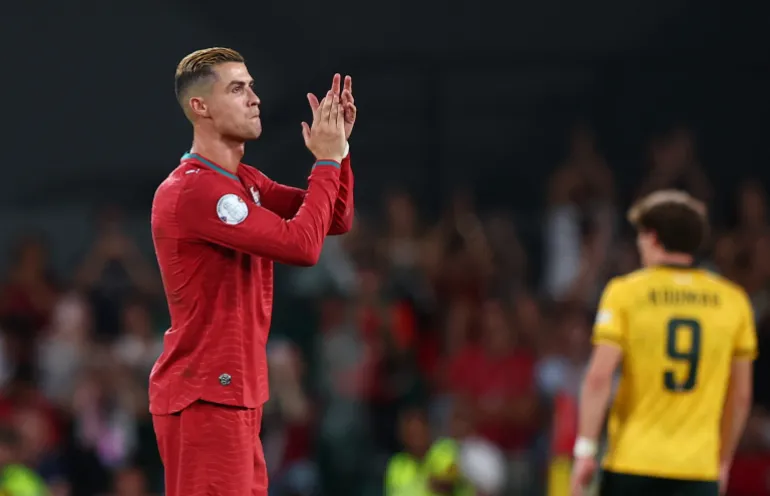
Portugal’s Cristiano Ronaldo applauds fans as he is substituted against Wales [File: Pedro Nunes/Reuters]
When was Ronaldo’s last match for Portugal and how did he perform?
Ronaldo featured just once for Portugal during this year’s Nations League, playing 67 minutes in their 1-0 home win over Wales.
It was a frustrating night for the Al-Nassr forward, who misfired several times. He found the side netting once and shinned an inviting volley high over from close range.
Around the hour mark, Ronaldo slid the ball into the Wales net but, to his evident disbelief, was ruled offside.
He was still shaking his head when Jesus substituted him seven minutes later.
Will he play for Portugal again?
The jury is still out.
Ronaldo, who made his Portugal debut in 2003 at the age of 18, has said this will “probably” be his final year in football. The forward has been a fixture of the national team for more than two decades and has played at six World Cups.
Former Real Madrid and Manchester United attacker Ronaldo is Portugal’s record scorer and most-capped player, with 146 goals in 234 international appearances.
He reached the World Cup semifinals in 2006 and captained his country to glory at Euro 2016. Ronaldo and Portugal were eliminated by eventual winners Spain in the last 16 of this year’s World Cup.
When is Portugal’s next match?
Portugal have completed their quota of four Nations League fixtures in this extended international window.
Their upcoming matches are in the next window: a home game with Norway on November 14 and an away match against Wales three days later.
Those matches will wrap up Portugal’s league phase in the Nations League, which they have won twice.
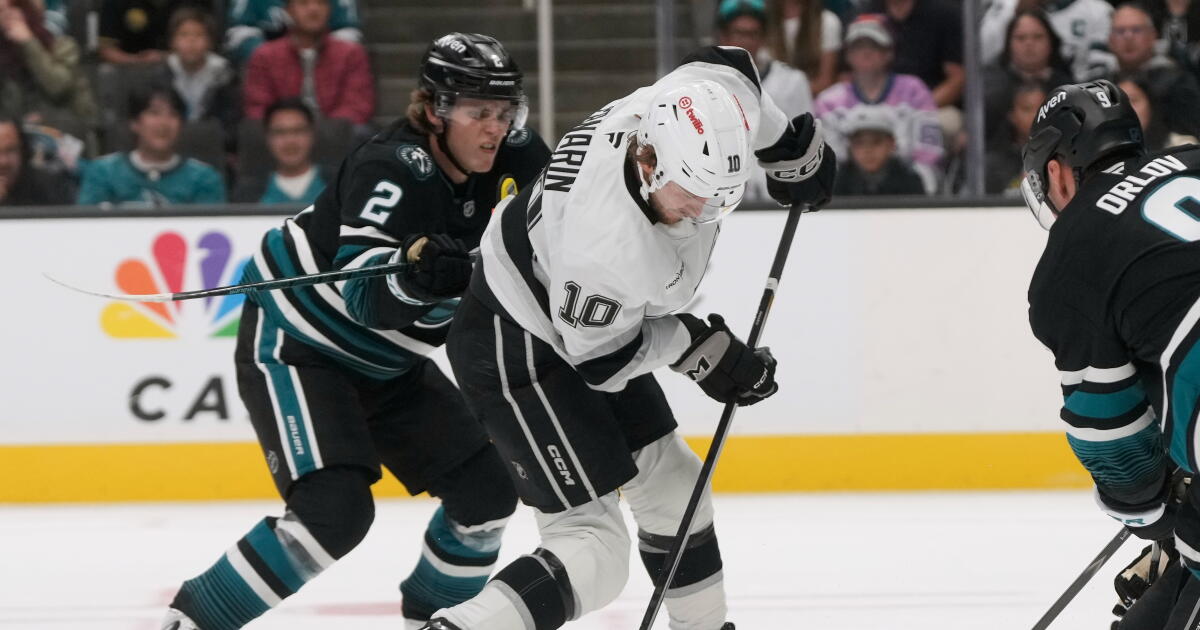
SAN JOSÉ — Igor Chernyshov scored his second goal of the game with 1:42 remaining in overtime and the San José Sharks beat the Kings 5-4 on Saturday night for their second straight win to open the season.
The Kings rallied from two goals down in the third to tie the game and controlled play for most of the overtime. But San José came out on top when Chernyshov beat Anton Forsberg on a one-timer off a pass from Macklin Celebrini, who has five assists in two games.
After not getting a win in the first five games the past four seasons, the Sharks have back-to-back overtime wins to begin this season after beating Florida 4-3 in the opener Thursday night.
Tyler Toffoli, Kiefer Sherwood and Nolan Allan also scored for San José. Yaroslav Askarov made 31 saves.
Chernyshov gave San José a 4-2 lead early in the third when he scored on a breakaway but the Kings responded. Haula scored to make it a one-goal game and Panarin got the equalizer with 5:01 remaining after a poor clearing attempt by Allan.
The Kings struck first when Kempe scored on a one-timer off a pass from Panarin on the power play in the first. The Sharks took control with three goals in the second starting when Toffoli tapped in a perfect feed from rookie Ivar Stenberg on the power play. It was the first career point for the 19-year-old Stenberg.
The Kings got one back with 1.3 seconds left in the period when Byfield scored on the power play.
Up next for Kings: vs. Florida at Crypto.com Arena on Tuesday night.
Washington, DC – Democrats have the momentum; Republicans are surging in defence and cash.
That narrative has emerged ahead of the United States midterm elections in November, as races across the country enter their final stretch.
Recommended Stories
list of 3 itemsend of list
With control of the US House of Representatives and the US Senate at stake, Democrats begin October with a surprisingly rosy outlook as more congressional seats are seen as in play.
Republicans, meanwhile, appear to be in damage control, pouring millions of dollars into races once seen as secure victories while injecting more funding into a handful of marquee showdowns.
The party’s standard bearer, President Donald Trump, who has embraced the notion of the election being a referendum on his leadership, enters the final month with staggeringly low approval ratings.
The most recent Associated Press-NORC polling, released on Thursday, showed Trump with 31 percent approval, the lowest during either of his two terms. Only 26 percent of respondents approved Trump’s handling of the economy, dipping two points below his predecessor, former President Joe Biden’s lowest rating on the topic.
Surveys continue to show voters rank the economy as their top issue, with topics like gas prices, made higher by the US-Israel war with Iran, dominating their concerns. Immigration and corruption have also regularly ranked high.
“The broad stroke is that Americans are disappointed, bordering on angry that President Trump hasn’t delivered on the core promises he made when he won re-election,” according to Henry Olsen, a senior fellow at the conservative Ethics and Public Policy Center in Washington, DC.
House looking solid for Dems
Political trackers have long projected Democrats will take control of the US House of Representatives in the November 3 vote.
Winning a majority in the 435-member chamber from Republicans would give the party renewed legislative power to assert leverage over Trump, while launching investigations into his administration’s dealings. Top Democrats have already signalled that probes into Trump’s family business dealings would be top priorities.
Two election non-partisan prediction authorities, the Cook Political Report and the University of Virginia’s Sabato’s Crystal Ball, have recently assessed that the likelihood of Democrats taking the House has only increased.
The Cook Political Report recently shifted 15 House races in the direction of Democrats, moving some considered “toss-ups” to “leans Democrat” and some previously considered “lean Republican” to “toss-ups”.
One such shift was for a Texas border district represented by Republican Monica De La Cruz. Her district was emblematic of a wider Latino shift towards Trump in 2024. Once seen as holding the advantage over her challenger, Democrat Bobby Pulido, Cook now rates her race as a “toss-up”.
All told, the political analysis clearinghouse now predicts Democrats are on track to win 5 to 15 House seats.
Senate in play
With 30 days left to go, “there’s much more drama in the Senate than the House races”, according to Kyle Kondik, the managing editor at Sabato’s Crystal Ball.
Once considered a pipe dream for Democrats, who need a net gain of at least four seats to win a slim majority, the 100-member chamber has moved within a more comfortable striking distance.
Unlike in the House, where every seat is up for re-election, only 35 Senate seats are up for grabs in this cycle, creating a far narrower pathway to control.
“The trajectory of the polling since Labor Day (September 7) has generally been that a bad Republican environment is just getting worse,” Kondik said, adding that “the Senate just seems to get more and more competitive as the cycle has gone on”.
To be sure, the quality of polling can vary across the country, with Kondik cautioning that gauging the political temperature of the Midwest has been particularly challenging for pollsters.
Still, in North Carolina, former Democratic Governor Roy Cooper is expected to trounce former Republican National Committee chairman Michael Whatley in the race for a Senate seat currently held by Republicans. Top conservative donors have already begun to divert funds from the contest.
Surveys have consistently shown Democrats leading in three other races for seats currently held by Republicans: Democrat James Talarico against Republican Ken Paxton in Texas; Democratic challenger Sherrod Brown against Republican incumbent Senator John Husted in Ohio; and Democratic Mary Peltola against Republican Dan Sullivan in Alaska.
Races for Republican held seats in Iowa, between Republican Ashley Hinson and Democrat Josh Turek, and in Maine, between Republican incumbent Susan Collins and Democratic challenger Troy Jackson, remain separated by less than one point, according to Real Clear Politics polling averages.
Democrats, meanwhile, have consistently led in polling in Senate races in Georgia, New Hampshire and Michigan for seats the party currently holds.
Big money in the race
For Republicans, salvation could be in the spending, with this year’s race continuing a US phenomenon of small fortunes poured into politics.
All told, at least $4bn had been spent on gubernatorial and congressional midterm advertising buys as of September 17, putting the race on track to become “perhaps the most expensive midterm on record”, according to Michael Franz, co-director of the Wesleyan Media Project.
Republicans entered September with a considerable funding edge. The Republican National Committee had $125.6m on hand, with the Democratic National Committee trailing far behind with $16.9m and $17.6m in debt.
When accounting for the three major committees associated with both groups, the Republican Party had $233.4m in cash, according to a CNBC analysis, while the Democratic Party had $130.4m.
Trip Yang, a Democrat strategist based in New York City, told Al Jazeera such spending can be deployed to help boost a candidate’s name recognition or to tear down a competitor.
According to AdImpact, Republicans and their allies were set to spend $888m on advertising from mid-September to election day, with Democrats and their supporters set to spend $666m.
The firm found pro-Republican ad spending would be particularly pronounced in the key Senate races in Ohio, Texas and Michigan, outpacing Democratic spending by at least $24m in each state.
Trump’s unpopularity, Yang said, means “Republicans spending millions or hundreds of millions of dollars improving their candidates’ images by itself may not be enough”.
“If you’re a little bit handicapped because your president is so toxic, you try to spend your hundreds of millions of dollars attacking the Democrats to make it more of a food fight,” he said.
A New York Times analysis estimated by the end of August at least $1bn in so-called “dark money” had been poured into the midterms. The term refers to spending where the donor’s identity is shielded, typically through nonprofit and shell-company donations to Super PACs.
Industry groups, including those supporting Crypto, AI and online betting firms, are expected to be top spenders in key races, although their support tends to cut across partisan lines.
Trump, meanwhile, has pledged to spend between $400m and $500m from his MAGA Inc Super PAC, though it has so far spent about $15m to support Paxton’s Senate bid in Texas.
Pro-Paxton ad reservations far outpaced Talarico in September, according to AdImpact data analysed by NPR, with $94m spent compared with $30m to support the Democrat.
The Trump factor
Trump has pledged to spend the final days before the election in non-stop campaign mode, after urging supporters during his Republican Midterm Convention in Dallas, Texas, to “vote like I’m on the ballot”.
His plan to criss-cross the country for rallies underscores a “base turnout” strategy meant to energise voters already loyal to the party, according to conservative analyst Olsen.
“But the Republican problem is a persuasion problem with people in the middle,” Olsen said. “[Trump’s campaigning] might help with some turnout … but their real problem is persuasion, and it’s not something that’s going to help with that in the slightest.”
Polls have spelt trouble for Republicans when it comes to swaying independents, with a PBS News, NPR and Marist poll from September 23 showing unaffiliated voters breaking for Democrats at 57 percent compared with 32 moving towards Republicans.
US President Donald Trump participates in a midterm election rally for Oklahoma Republican gubernatorial candidate Mike Mazzei at the Choctaw Event Center in Durant, Oklahoma, US, October 1, 2026. [Nick Oxford/Reuters]
The scenario has created a dilemma for some top Republican candidates over whether to break from the president on his most controversial actions, according to Lee Miringoff, the director of the Marist University Institute for Public Opinion.
Senate candidates Ashley Hinson in Iowa, Jon Husted in Ohio and Mike Rogers in Michigan all recently put daylight between themselves and Trump on the war with Iran.
One Republican House candidate, Representative Maria Elvira Salazar, has criticised Trump’s aggressive immigration enforcement policies as she seeks to rally Latino voters in South Florida.
Trump, in turn, reposted a social media message calling Salazar a “backstabber”.
“You need to have, you know, something else going for you other than endorsement of Trump,” said Miringoff. “Some Republicans are starting to have self-preservation kick in because they’re concerned.”
What can change?
Achieving a wide-scale shift in public opinion remains a tall order for Republicans in the final stretch of the race.
Many of the defining issues are unlikely to change before November, with Trump signalling a possible escalation with Iran following the vote as he has downplayed the prospect of short-term affordability relief.
At the same time, the US president has also not ruled out actions that rights groups say could upend voter turnout. Most recently, he refused to commit to not invoking the Insurrection Act or declaring a state of emergency surrounding the vote during an interview with Time magazine.
Miringoff said he believed that the “potential for more than just a marginal shift is there”, as he assessed some Democratic candidates have struggled to present clear visions beyond opposition to Trump.
“The result isn’t formed in concrete,” he said, “to the degree that there’s going to be a lot of money still spent.”
Analyst Olsen saw less remaining wiggle room for the party.
“Republicans have the time and the resources to change the outcome with respect to a few close Senate races,” Olsen said. “But to change direction, they would need something that would be apocal.”
Santa Margarita High football coach Carson Palmer said special teams is the Eagles’ best phase of play. Not the elite defense, which had seven sacks and held Mater Dei to seven points on Friday night. Not the offense led by his son Fletch, who completed 65% of his passes for 155 yards.
No, he was adamant that it is the special teams unit. Two plays from junior free safety Jake Martin proved his coach right.
Twice Mater Dei attempted a field goal and twice the kick was missed. Martin juked out blockers late in the first half to deflect the first attempt, keeping the score at 7-7. Then, he helped preserve a seven-point lead in the fourth quarter as his pressure on the outside forced a second miss.
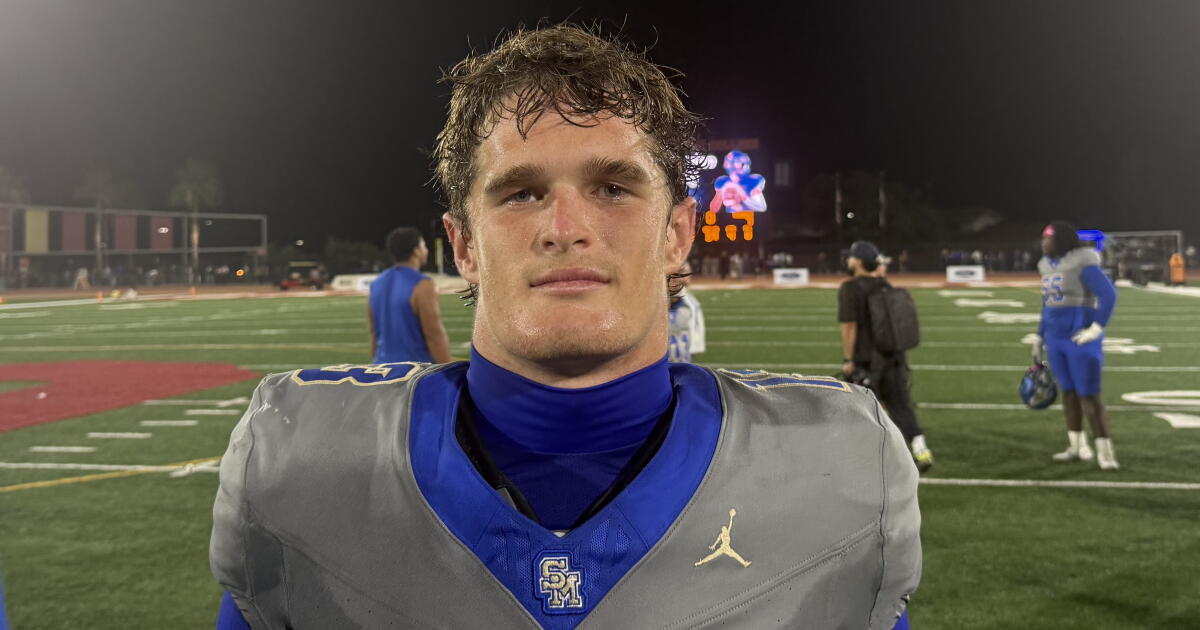
“We’re unbreakable,” Martin said after the Eagles’ 14-7 win. “We’re trying to go back-to-back. This is the team that’s going to do it.”
The chances of a second straight CIF Open Division state championship look good so far. Winning the Trinity League opener at Saddleback College kept the Eagles undefeated at 6-0. Mater Dei dropped to 4-2.
Of course, the Eagles’ offense and defense made plenty of important plays.
The game was sealed with an interception from freshman safety Jayden Jack, as Mater Dei freshman quarterback Paytyn Guess heaved the ball to the end zone with the Monarchs out of timeouts and out of options. That, coupled with a big sack from sophomore defensive lineman Kingston Jimmerson, killed the momentum on the visitors’ final drive.
It wasn’t a bad night for the young quarterback, though, as Guess staked his claim to the starting role for the Monarchs.
Mater Dei rotated three quarterbacks in nonleague play, and coach Raul Lara kept his cards tight to his chest before the game. The starter was Guess, who took more than 90% of the snaps on a night when he finished 16 for 22 for 163 yards with one interception and no touchdowns.
“He’s dynamic, but the problem with him is that he’s a freshman who just came into the program and is getting his feet wet,” Lara said before kickoff.
The impressive Santa Margarita front exposed those growing pains. Guess held on to the ball too long and took too many hits.
His playmaking ability did give Mater Dei a chance until the final moments, as he scrambled around and found senior wide receiver Gavin Honore down the sideline. The inconsistency on offense, though, has been a source of frustration for Lara.
“It all comes down to execution. We have to execute,” he said. “When we have the opportunity to make a play, we need to make that play and take advantage of it.”
Mater Dei’s defensive line had a solid game, holding Santa Margarita star sophomore running back Adrian Petero to 41 yards on 11 carries, although he scored his team’s first touchdown.
It was Santa Margarita’s junior quarterback who had the decisive play as Palmer found junior wide receiver Grant Van Raaphorst in the back of the end zone for a six-yard touchdown in the third quarter.
Mater Dei sophomore running back Asir Nembhard had the only touchdown for his team, which gave the Monarchs their only lead of the night in the first quarter.
Before the game, Palmer said tat he tells his players to never take an opponent too lightly nor build it up too much. The former NFL quarterback played in a division with the prime Pittsburgh Steelers and Baltimore Ravens, so he knows a thing or two about a competitive schedule like the Trinity League offers.
“We’ve got a target on our back after last year, and we know that,” Palmer said. “We know that we are highlighted on other teams’ schedules.”
He also emphasized that his team could improve in every aspect of the game. That is certainly a scary prospect for foes facing the No. 1 team in the state.
Star receiver Puka Nacua will play against the Philadelphia Eagles on Sunday in Philadelphia, but star defensive lineman Aaron Donald is out because of a back issue, Rams coach Sean McVay said Friday.
Donald, a three-time defensive player of the year, has not practiced this week following the Rams’ loss to the Denver Broncos on Sunday in Denver. McVay said Donald, 35, was experiencing back soreness.
“He’s as tough as it gets. Just not feeling good enough,” McVay said, adding, “He would do it and he could probably go be productive but part of our job is to protect these tough dudes like him from themselves.”
Donald has played in two games since ending a two-year retirement in late August. He did not make the trip to Australia for the season opener against the San Francisco 49ers, but made three tackles in the Rams’ 28-6 victory over the New York Giants at SoFi Stadium.
Donald had one tackle and one quarterback hit in the 30-26 loss to the Broncos.
“He’s working as hard as he can to get himself feeling as good as possible and we’re hopeful and optimistic that good days are ahead,” McVay said.
Nacua sat out the last two games because of a hip injury that caused hip, groin and abdominal soreness.
McVay said Nacua has been “strong, looks sturdy, looks explosive,” during practice this week.
“I think it will really just be a feel for the overall conditioning,” McVay said, adding that he hopes “the magic of the [game] jersey” will help Nacua have a productive game against the Eagles.
Tight end Terrance Ferguson (ankle) and cornerback Jaylen Watson (shoulder) will not play on Sunday, McVay said. Tight end Colby Parkinson (shoulder, knee) and edge rusher Josaiah Stewart (groin) are questionable.
Rams place Terrance Ferguson on injured reserve
Rams tight end Terrance Ferguson jogs back to the locker room against the Giants on Sept. 21.
(Kyusung Gong / Associated Press)
The Rams opened the season with five tight ends on the roster, which some might have regarded as a surplus.
But the Rams need the depth.
On Friday, the team put Terrance Ferguson on injured reserve because of an ankle injury.
Ferguson, a 2025 second-round draft pick, was injured Sept. 21 against the Giants, but he played through it against the Broncos.
Ferguson has seven catches for 63 yards and a touchdown.
Ferguson must sit out at least the next four games against the Eagles, Buffalo Bills, Arizona Cardinals and Las Vegas Raiders. He is eligible to return for the Nov. 1 game against the Chargers.
The Rams began the season with five tight ends on the roster. Tyler Higbee and Davis Allen are at full strength. Max Klare, a second-round draft pick from Michigan, could get his first action on offense against the Eagles.
Rams release punt returner Xavier Smith
Rams wide receiver Xavier Smith runs the ball against the Kansas City Chiefs during a preseason game in August.
(Charlie Riedel / Associated Press)
What a difference a day makes.
Less than 24 hours after Rams special teams coordinator Bubba Ventrone said the team was not going to replace punt returner Xavier Smith, the team released him.
“We just need better production out of that position,” McVay said, adding that some of the “decisions” that Smith made in last Sunday’s loss to the Denver Broncos proved costly.
“We’ve got to make better decisions,” McVay said. “We’ve got to be able to field it.”
Receiver Alex Bachman is expected to be promoted from the practice squad to handle punt returns. McVay said he was “optimistic that I think we’re going to see some good stuff from Alex on Sunday.”
Smith, 29, is a third-year pro who signed with the Rams as an undrafted free agent and worked his way into a role as a kick returner and rotational receiver.
Smith appeared to be on his way to overcoming a major error in last season’s NFC championship game, when he lost a fumble in the 31-27 defeat by the Seattle Seahawks.
But through three games, Ventrone on Thursday described Smith’s performance as “inconsistent.”
“We need to do a better job of tracking the ball, judging the ball, fielding the ball when necessary, not fielding it in other situations,” Ventrone told reporters. “He knows that and hopefully we’ll get the improvements that we need in that area.”
Ventrone was asked if there was any thought about replacing Smith as the punt returner.
“No, we have a lot of trust in ‘X’, I really do,” Ventrone said. “He’s put in a lot of time and effort in training camp and obviously moving into the season. I think that he’ll do the necessary things to be able to sustain at that position for us.”
But on Friday morning, the Rams announced they had waived Smith.
McVay said the Rams “weren’t thinking” about making a change when Ventrone spoke to reporters Thursday.
“As you get a chance to kind of take a step back, evaluate the totality of our group, what’s the best way to try to be able to put together all three phases, did feel like that was in the best interest of the group,” McVay said, adding, “and that decision was made kind of later [Thursday night].”
Both men used NSFW language toward each other that was picked up by Prime Video’s “Thursday Night Football” cameras and/or microphones.
The exchange took during the Steelers’ first drive in their eventual 27-24 road loss to the Cleveland Browns. Before a first down play from the Cleveland 20-yard line, Rodgers could be seen staring at the Pittsburgh sideline with his arms spread out, apparently waiting to receive the play from McCarthy.
Then the four-time league MVP exploded.
“What the f—?” Rodgers screamed toward the sideline. “Call it!”
The broadcast then cut to a shot of McCarthy, who could be seen saying the words, “f— a—hole,” in apparent reference to his quarterback.
Asked about that moment during his postgame news conference, McCarthy expressed regret for the language he used.
“I think what’s said on the field, the way I grew up in this game, usually stays on the field,” McCarthy said. “That’s not the case today, I understand that. But any negative communication on my part, I wish I wouldn’t use those words.”
Later in the same drive, Rodgers appeared to shake his head and roll his eyes while waiting for a play to be called. Speaking to reporters after the game, he indicated that the crowd noise affected the communication between the sideline and field.
“It was loud,” Rodgers said, “so some of the calls, it was hard to hear, for sure.”
The “TNF” cameras did catch a much more pleasant interaction between the two men, after the 42-year-old veteran kept the ball on a 1-yard sneak for a successful 2-point conversion to tie the game at 24-24 late in the fourth quarter.
McCarthy coached the Green Bay Packers from 2006 to 2018 and Rodgers was his starting quarterback for 11 of those seasons. During that stretch, they led the team to one Super Bowl victory (against the Steelers) and four NFC championship game appearances. Rodgers also earned two of his four NFL MVP awards during McCarthy’s tenure.
There was some well-documented tension between the two men during that time as well. But Rodgers has cited the Steelers’ hiring of McCarthy this offseason as a reason he decided to put off retirement for one more year.
“I’d gone into the offseason thinking it was probably going to be it, and I’d be totally fine with it — I feel good about my career,” Rodgers told The Athletic in August. “But once he got hired, then my mindset changed a little bit.”
He added: “Absence makes the heart grow much fonder, in this case.”
McCarthy said in the same article: “Just to be able to take this final lap with him, it’s awesome. You always want to do a great job, but now to do it with him in his last chapter, it’s special.”
When Lincoln Riley hired Gary Patterson to be his third defensive coordinator in five seasons, the USC head coach naturally pointed to Patterson’s impressive track record.
His reputation, after all, was as one of the great defensive minds in the modern history of college football, a coach who, at Texas Christian, knew how to get more out of lesser talent. It stood to reason that he could do the same at USC, where they’d just signed the nation’s No. 1 recruiting class. And through the spring and summer, that appeared to be the case, as coaches and players alike raved about their new coordinator, who earlier this year was enshrined in the College Football Hall of Fame.
But as the Trojans approach the midway point of an increasingly tense campaign, Patterson and his defense have fallen drastically short of those expectations.
As USC welcomes Washington to the Coliseum with its season on the brink, its defense is currently allowing more than 6.14 yards per play, good for 115th nationally. The secondary, which has struggled with consistent miscommunication, is allowing 8.4 yards per pass play — more than either of former coordinator Alex Grinch’s defenses allowed at USC. And big plays are becoming a big problem. Only three defenses the country have allowed more explosive plays of 20-plus yards than USC (23), which is also in line with Grinch’s defenses.
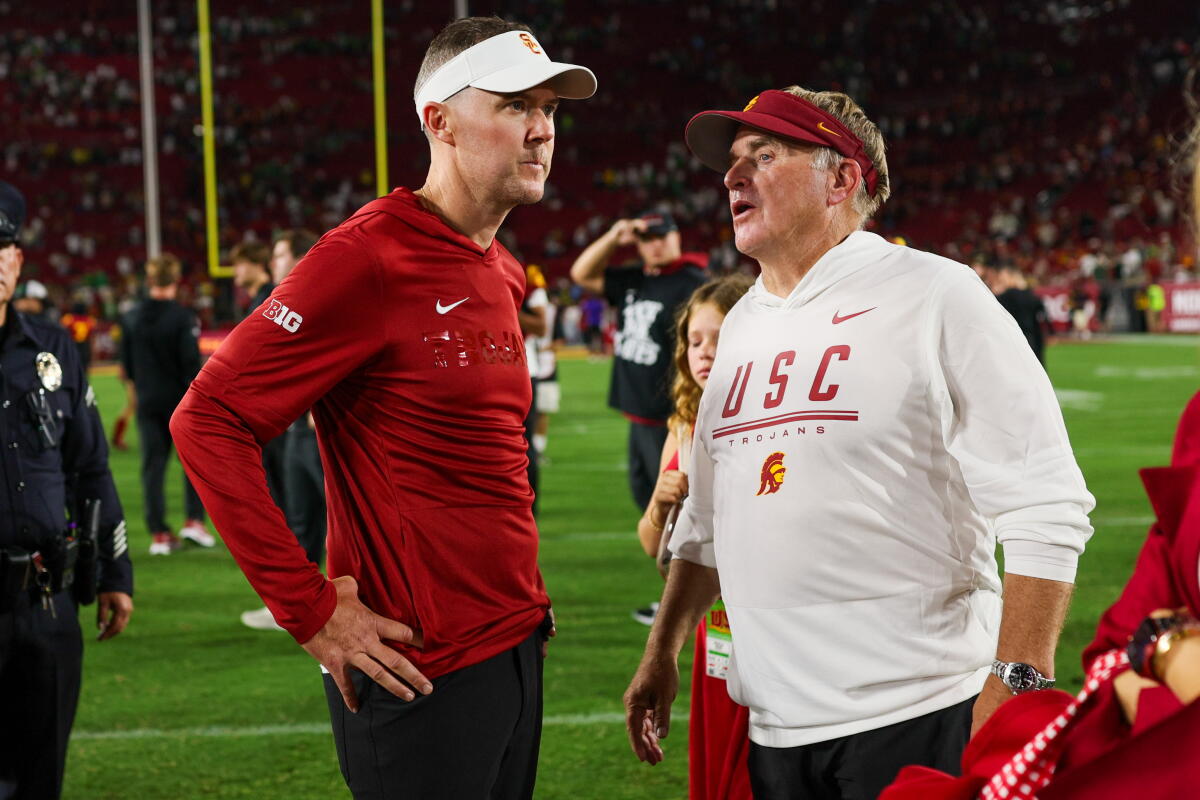
USC coach Lincoln Riley and defensive coordinator Gary Patterson talk after a loss to Oregon at the Coliseum on Saturday.
(Ronaldo Bolanos/Los Angeles Times)
And all this despite the fact four of the Trojans’ first five games were against opponents who were expected to struggle against USC’s far superior talent.
Patterson has yet to answer questions about those early results. That’s because unlike Riley’s first two defensive coordinators at USC, who spoke at least weekly, Patterson has not spoken to reporters since the preseason.
Without any explanation from him for USC’s early issues, the numbers don’t exactly paint a promising portrait of Patterson’s season. But while Riley acknowledged that the defense has “had some breakdowns at all levels” and must “play tighter in all areas,” the coach insisted Thursday that the Trojans were close to reaching their potential on defense, again reassuring that there was “a lot of good on tape” on that side of the ball.
“We don’t necessarily need any level of the defense to make this massive jump,” Riley said. “We just need each level to play a little bit better and each level to play a little bit better together.”
Outside of USC’s Week 1 shutout of Fresno State, though, the Trojans haven’t looked particularly good at any level of the defense. The pass rush has been lacking, with only three sacks across USC’s four other games. And on the back end, the Trojans continue to be caught flat-footed, with defensive backs out of position.
One former USC defensive back, Max Williams, posited on social media that the Trojans’ secondary appeared to be getting the defensive calls too close to the snap of the ball. In another social media breakdown by a former Trojan player, former quarterback Max Browne suggested that USC’s defensive backs were often out of position before the play began, putting them behind.
Those problems have seemingly been exacerbated the past two weeks in Big Ten play, as Rutgers and Oregon combined to pile up 964 yards on USC’s defense. And the Ducks did it with a backup quarterback at the helm in Dylan Raiola, who converted all seven of his third- and fourth-down pass attempts.
Patterson’s defense will have another tough test this week in Washington quarterback Demond Williams Jr., who’s just as much a threat with his legs as his arm. The Trojans already had trouble with a dual-threat quarterback earlier this season, allowing Louisiana’s Lunch Winfield to rush for 94 yards during a Week 2 Trojans win.
Any further struggles from here for USC’s defense could spiral in a hurry. The Trojans travel to Penn State next weekend and still have No. 5 Indiana and No. 6 Ohio State on the schedule. They’ll have to win two of those three, plus all their other games, if they still hope to contend for the College Football Playoff.
Those hopes hinge largely on Patterson, who Riley bet before the season would finally bring him salvation on the defensive end.
Riley still has faith that bet will pay off. Mostly because “there’s very few that have been through as much as he has.”
“Trust me, nobody takes it more personal than him or takes more responsibility than he does,” Riley said of Patterson. “He’s done this for a long time. He’s done it at a high level. And there’s nobody, you know, more committed to getting it fixed.”
Michael Harris II hit a three-run homer in the first inning, Ray Kerr threw 3 1/3 scoreless innings and the Atlanta Braves beat the Philadelphia Phillies 6-2 on Thursday night in the decisive Game 3 of their National League wild-card series.
Ozzie Albies hit a two-run homer in the fourth and Matt Olson added a solo shot in the seventh for the Braves, who advance to a best-of-five Division Series against the two-time defending World Series champion Dodgers.
The Braves won a postseason series for the first time since winning the 2021 World Series and earned their first playoff series win against the Phillies. Philadelphia beat Atlanta in the 1993 NLCS and the 2022 and 2023 NLDS.
Phillies right-hander Aaron Nola was pulled after giving up three runs in 1 2/3 innings. Nola walked Ronald Acuña Jr. and Matt Olson with one out in the first before giving up the homer to Harris, who hit into two double plays in Wednesday’s 4-3 loss in 10 innings which forced Thursday night’s game.
Kerr made his postseason debut in only his fourth career start. Braves manager Walt Weiss wanted a left-hander to face Phillies left-handed hitters Kyle Schwarber and Bryce Harper at least once.
Kerr gave up only one hit — to Schwarber in the first — and one walk — to Schwarber in the fourth. Right-hander Grant Holmes followed Kerr and gave up one run in two innings to earn the win.
Kerr left to a standing ovation from the sellout crowd and acknowledged the cheers by lifting up his arm as he approached the dugout.
Left-hander Chris Sale, the starter in Atlanta’s 5-3 win in Tuesday’s series opener, struck out Harper to end the eighth and closed out the win in the ninth by striking out Bryan De La Cruz and pinch-hitter Otto Kemp.
Phillies right-hander Zack Wheeler, the winning pitcher in Sunday’s 7-3 victory over Tampa Bay that clinched the wild-card spot, walked Austin Riley in the fourth before giving up Albies’ homer to right field that gave Atlanta a 5-0 lead. Wheeler gave up two runs in four innings. Jonathan Bowlan, Philadelphia’s fourth pitcher, gave up Olson’s homer to center field.
Kerr, 32, flourished in the postseason spotlight. He pitched in only nine games after being recalled by Atlanta on Aug. 16. He underwent Tommy John surgery in 2024 and didn’t pitch in 2025.
Philadelphia’s 2022 World Series loss to Houston began a streak of five straight postseason appearances with progressively quicker exits — the NL Championship Series, two NLDS exits and now the wild-card loss.
A game of rock, paper, scissors was used to determine when the elite female and male races will take place at next year’s unique two-day London Marathon.
Men’s world record holder Sabastian Sawe was beaten by women’s wheelchair world record holder Catherine Debrunner – both 2026 London Marathon champions in their respective races – in the contest.
As a result, the elite men and men’s wheelchair races are set for Saturday, 24 April, with the women’s events taking place the following day on the traditional Sunday.
Hugh Brasher, chief executive of London Marathon Events, said: “Sabastian and Catherine’s rock, paper, scissors battle was an entertaining way to decide which day would host each elite race.
“Splitting the elite races will allow us to shine an even brighter spotlight on the extraordinary athletes taking part.”
Earlier this year, organisers of the event confirmed the London Marathon will be held across two days in what is said to be a momentous one-off edition of the event.
The decision was made to enable more people to take part, after a record 1.33 million people entered the ballot for next year.
In 2027 a record-breaking 100,000 participants will take part and it is estimated that more than £150m will be raised for charitable causes.
The women’s championship categories will line-up behind the women’s elite field for the first time in the London race.
“Our outstanding elite women’s wheelchair field will begin the action just ahead of them, creating a true celebration of women’s marathon racing,” Brasher added.
The main events on both days will be a mixed field of male, female and non-binary participants.
It was housed in a former 1920’s Art Deco building that used to serve as a cinema.
Sign up for the Travel newsletter
Thank you!
The picture house showed its last film in 1978 then opened as a bingo hall before JDWetherspoonssnapped it up in 1996.
But, new life is set to be breathed into the Grade II listed building as developers have revealed plans to transform it into a soft play, according to News Shopper.
Planning permission was approved back in January, with developers now working through a series of conditions to ensure the original features in the building are protected.
A multi-level play structure, party rooms, café facilities and an on-site manager’s flat is set to feature in the building.
Meanwhile, accessible toilets, buggy parking and areas for staff are also set to be built.
However, fans of the building need not worry as its original cinema entrance and distinct features will be protected.
No opening date has been confirmed for the soft play area, but works continue to be underway.
According to documents obtained by The Times via the California Public Records Act, Inglewood High School confirmed to the Southern Section that its football coach, Mil’Von James, played three ineligible players during a game in Austin, Texas, last month.
The reason, according to the letter sent to the Southern Section office, was, “The coach stated that he was not aware CIF eligibility rules applied to a game in Texas.”
That raises the question how many more times Inglewood has used ineligible players for out-of-state football games under James, the head coach since 2019. Last season on Sept. 25, 2025, the team played in Midland, Texas, three days before sit-out transfer players became eligible. Inglewood won 43-42. One of the players on the team who had not been cleared to play was Masyn Harvey, a quarterback transfer and holder on PATs.
Harvey, now playing for a prep school team, declined to return a request for comment if he had played.
If Harvey did play, Inglewood should have forfeited its win last season to Midland. Because Inglewood lost to Westlake of Austin on Aug. 28, a forfeit was moot for this season. Inglewood informed the Southern Section that it imposed a two-game suspension as punishment to James, who returned to coach last week in a win over Downey. The school said it would extend the sit-out period by another week to those players who participated while not cleared.
As for corrective action, the school stated, “Going forward, all ineligible players, across all sports, will be in street clothes on the sideline and must check in with the game administrator prior to the start of each game. We will send all coaches, across all sports, a weekly email listing ineligible players and the reasons for their ineligibility.
“At the start of each season, we will re-train all coaches on eligibility criteria and the clearance process and require them to sign an acknowledgment confirming they understand.”
James has a history of using ineligible players. He was dismissed at Hawkins High in 2016. The Los Angeles Unified School District did not share why James was fired, calling it a confidential personnel matter. LAUSD dismissed James soon after the discovery of ineligible players, resulting in Hawkins forfeiting all of its games to finish 0-13. Since then, the City Section established a rule that teams must exchange rosters before games to verify that players are eligible.
The Southern Section declined comment, but according to a letter response from an assistant commissioner, “Based on your self-report, preventative measures and the corrective actions taken, we will consider this matter closed.”
A controversial pass-interference call cost the Rams dearly in their defeat by the Denver Broncos, but coach Sean McVay said Monday that neither he nor the team would play the victim card.
With just over a minute left in the game, Rams cornerback Josh Wallace battled with Broncos receiver Pat Bryant before intercepting a Bo Nix pass at the Rams’ seven-yard line. Had the play stood, it would have preserved a second consecutive Rams victory.
But officials cited Wallace for pass interference, giving the Broncos another set of downs. Nix eventually scored a touchdown to give the Broncos a 30-26 lead and an eventual victory that dropped the Rams to 1-2.
Share via
Gary Klein breaks down what went wrong for the Rams in a 30-26 loss to the Denver Broncos on Sunday night.
“I’m not going to play the victim card,” McVay said during a videoconference with reporters. “Doesn’t really matter. It is what it is. That was the call that was made, and there was a lot of opportunities that we had to be able to close the door on that game. … I wouldn’t have any additional coaching points for how Josh plays through the cycle of the snap.
“But I’m not going to make excuses either and we’re not going to play the victim card.”
“I told Josh, ‘Hey, nothing you can do. Refs got to call their calls. We can’t control that,’” McDuffie said. “But, I mean, looking back at it, I don’t know what they saw but I thought it was a great play. Got the interception for us.
“But like I said, whatever the refs saw they saw and threw the flag and ain’t much we can do about it, so it’s really just on to the next week.”
The Rams play the Eagles on Sunday in Philadelphia.
They will probably do so without cornerback Jaylen Watson, who left against the Broncos after suffering a dislocated right shoulder.
Watson will not be placed on injured reserve, McVay said, “but will probably be out for this week. We’ll see if we can kind of get him strengthened and harness it. It’s something that he’s dealt with before.”
Tight end Terrance Ferguson sustained an ankle sprain and is probably out against the Eagles. Tight end Colby Parkinson’s (shoulder) status will be evaluated this week.
Receiver Puka Nacua, who has been sidelined the last two games because of a hip injury, went through a lengthy on-field workout before the game against the Broncos.
Will he play against the Eagles?
”I’m hopeful,” McVay said, adding, “We’ll continue to see, but if he is able to progress the way that we hope there’s optimism that he’ll be able to play this week.”
McVay apologized for taking only a few questions during a postgame news conference after the defeat by the Broncos.
“I understand my role and responsibility is to be able to talk whether it’s after a win or whether we don’t get the results that we want,” McVay said, adding that the brevity resulted from a mix-up in timing. “There was a pause in any sort of questions and obviously an emotional game and so that was kind of what led to that.
“But if there was any misinterpretation, do apologize for that.”
Hi, and welcome to another edition of Prep Rally. I’m Eric Sondheimer. League play begins this week in high school football for the best of the best. That means get ready for some great matchups in the Trinity League, the Mission League, the Alpha League, the Marine League and many others.
Get our high school sports newsletter
Prep Rally is devoted to the SoCal high school sports experience, bringing you scores, stories and a behind-the-scenes look at what makes prep sports so popular.
By continuing, you agree to our Terms of Service, which include arbitration and a class action waiver. You agree that we and our third-party vendors may collect and use your information, including through cookies, pixels and similar technologies, for the purposes set forth in our Privacy Policy such as personalizing your experience and ads.
League play begins
Coach Carson Palmer of Santa Margarita will try to help his team win a Trinity League title.
(Craig Weston)
St. John Bosco’s Koa Malau’ulu looks to pass while pressured against Bishop Gorman.
(Ian Maule/ LA Times)
It’s time for a dose of reality. Lots of teams are off to great starts with nonleague schedules designed to get them enough early wins to be able to get an at-large playoff berth in case they stumble in league play.
League play begins, so some of the unbeaten teams are about to be no longer unbeaten.
Santa Margarita was the best team in the state in 2025, but the Eagles didn’t win the Trinity League. St. John Bosco was the champion, and with league play beginning Friday, both schools have ambitions to finish on top.
Santa Margarita (5-0) plays Mater De (3-2) in its opener at Saddleback College and St. John Bosco (4-1) hosts JSerra (4-1). The other league game is Servite (3-2) facing Orange Lutheran (3-2) at Orange Coast College.
What’s different this season is that any of the six Trinity teams look capable of winning on a given night. But some of the teams are about to be strengthened by the addition of sit-out period transfer students that become eligible effective Monday.
The Mission League is all about which team will finish second to unbeaten Sierra Canyon (5-0). A good Friday opener has Chaminade (5-0) hosting Sherman Oaks Notre Dame (5-0).
The new Alpha League will feature weekly battles with Mission Viejo, San Clemente, Edison, Yorba Linda, Los Alamitos and San Juan Hills. The likely title decider on Oct. 16 has Mission Viejo at San Clemente.
Harvard-Westlake has started 5-0, but the Wolverines receive their first major test with a Del Rey League opener against Salesian on Friday.
In the City Section, Birmingham, which has won every West Valley League title since 2018, faces unbeaten Cleveland on Friday at home in a West Valley League opener. San Pedro and Banning have their annual Marine League rivalry game Friday at Banning.
Marshall takes a 5-0 record into the start of Northern League play at Franklin.
Freedom day arrives
It’s freedom day on Monday for Southern Section football players who have been sitting out the first half of the season after transferring without moving.
St. John Bosco can’t wait to insert offensive tackle Elisha Mueller, a transfer from Servite and one of the top prospects from the Class of 2028. Also becoming available is sophomore defensive back Kingston Fatu, a transfer from Tustin who will help a secondary that has been struggling in trying to deny big plays.
Santa Margarita adds 6-foot-3, 285-pound sophomore transfer Karras Vandermade, a defensive lineman. Servite has six players who could compete for major roles, with four on defense that will add much needed depth. Orange Lutheran gains 6-5 tight end Hudson Ploog and linebacker Jamaal Fay, who started for two years at Leuzinger. JSerra adds 6-7, 315-pound offensive lineman Wyatt Martin.
Other schools are also about to be strengthened. Unbeaten Sierra Canyon adds physical wingback/linebacker Fletcher Thomas. Unbeaten Chaminade, hoping to challenge the Trailblazers in the Mission League, picks up sophomore receiver Champ Ross and junior cornerback Jayden Woods.
Long Beach Poly fans will get their first look at Mater Dei transfer Trevor Scott, a sophomore quarterback. Quarterback Daniel Mielke becomes eligible at Chino Hills. Corona Centennial gains Brody Black, an offensive lineman from Servite. San Clemente picks up receiver Titus King, a speedster from Santa Margarita. Amir Morton, a junior running back who transferred from Sierra Canyon, is expected to provide immediate help for Crespi.
Cornerback Tadd Mitchell, a Montana commit, joins Oxnard Pacifica along with lineman Miguel Macias Santiago.
Matix Frithsmith demonstrated his versatility in Hart’s 34-17 Foothill League win over Saugus. He rushed for 218 yards and four touchdowns, including a 91-yard run. Here’s the report.
Corona Centennial traveled to Northern California to take on De La Salle and what a game it was. De La Salle won 35-32 behind Duece Jones-Drew, who rushed for 211 yards. Here’s the report.
Centennial has lost three close games to Santa Margarita, Mater Dei and De La Salle. As soon the Huskies get back to full strength with the return of standout safety/kicker Jaden Walk-Green and others, beware.
Cleveland High running back Moyosoreoluwa Odebunmi gives the thumbs-up after the Cavaliers defeated Crenshaw on the road.
(Joel Beers / For The Times)
Cleveland pulled off the upset of the week in going on the road to improve to 5-0 and beat Crenshaw. Here’s the report.
Receiver Andrew Cordero (left) and quarterback Jeremy Mellalieu have led Chaminade to a 5-0 start.
(Eric Sondheimer / Los Angeles Times)
It’s midseason in high school football, so it’s a good time to check who has lived up to expectations or come out of nowhere to be a major contributor.
When a coach takes his team out of state and plays two players who are listed on the Southern Section transfer portal as not being cleared to play and are also missing from the team’s MaxPreps roster to possibly prevent others from knowing who’s playing, is a two-game coach suspension adequate punishment?
That’s the scenario involving Inglewood football coach Mil’von James, who missed two games after the Southern Section alerted the school that James played two ineligible players during a game in Texas last month. Since Inglewood lost, forcing the school to forfeit was moot. James returned to coaching the team on Friday and told the Daily Breeze that it was an “administrative decision” for him to sit out two games.
The Southern Section has no power to discipline James, but schools and districts are expected to impose appropriate punishment for violating CIF rules.
Huntington Beach won its own tournament championship.
Los Angeles Wilson is off to a 9-1 start and could be the favorite in the City Section. Wilson at defending City Section Open Division champion Marshall on Monday is a big Northern League opener.
Carson is 8-3 and has handed the only loss to Wilson.
Girls golf
Santa Margarita keeps producing low scores in girls golf.
Santa Margarita girls golf are champions of the prestigious Lady Tritons Invitational (6th time in a row) at San Clemente Municipal GC (Par 73), hosted by San Clemente High School. 1st: Santa Margarita / 357 2nd: Peninsula HS / 380 3rd: Huntington Beach HS / 390 SMCHS Junior,… pic.twitter.com/pY4S7QRraA
— SANTA MARGARITA Catholic High School (@SMCHSEagles) September 15, 2026
The defending Southern Section Division 1 champions are stronger than ever. The team is 6-0 and 3-0 in the Trinity League.
Girls varsity golf final score: Santa Margarita Total: 175 OLutheran HS Total: 185 Trinity League Match Marbella CC – Par 36 Medalists: SM Nora Qu (33) and SM Sophia Nguyen – (33) Eagles are now: 6-0 Overall | 3-0 Trinity League pic.twitter.com/OvUqd2S4O3
— SANTA MARGARITA Catholic High School (@SMCHSEagles) September 25, 2026
All-female officiating crew
An all-female officiating crew for Orange County game on Thursday: Kristi Wilson (left, head linesman), Sarita Stamps (back judge), Mary Margaret Montgomery (referee), MaryAnne Menlove (umpire), Nina Berbiglia (line judge).
(Orange County Officials Assn.)
An all-female officiating crew is set to become a first for the Orange County Football Officials Assn. when they work a Thursday game between La Quinta and Garden Grove Santiago on Thursday night at Garden Grove High.
Notes . . .
There’s trouble brewing at Van Nuys High, where the baseball coach has been removed for building an unauthorized batting cage during the summer. Also the softball field had a protective fence demolished earlier this week that was a safety measure to protect fans and dugouts could be next demolished. Here’s the report.
El Camino Real’s boys’ soccer team, going for a third straight City Section championship, has three players committed to Cal State Northridge. Here’s the report….
In girls’ tennis, Corona del Mar defeated Portola in a rematch of last year’s Division 1 final. Here’s a report….
Orange Lutheran baseball player Evan Dugdale has committed to Oklahoma….
Junior catcher Jordan Lindsay of Birmingham has committed to Wake Forrest….
Junior pitcher Eli Martinez of Aquinas has committed to UC Santa Barbara….
Jaylen Maroney of Edison has committed to Sacramento State for women’s soccer….
Junior pitcher Julian Pardinas of La Mirada has committed to UCLA….
Junior pitcher Jayden Singer of Calabasas has committed to USC….
Junior outfielder/pitcher Noah Esquival of South Hills has committed to St. Mary’s….
Left-handed pitcher Charlie Hoye of Palos Verdes has committed to Cal Poly in San Luis Obispo….
Shooting guard Jeremiah Profit from Rancho Christian has committed to Northwestern….
Junior softball player Bailey Holder from Long Beach Poly has committed to Washington….
Junior slapper Makayla Encinas of Chino Hills has committed to UCLA….
Devon Richardson is the new basketball coach at Sun Valley Poly, replacing Joe Wyatt, who’s now the coach at North Hollywood. He was an assistant coach at L.A. Valley College and former head coach at Blair….
The Southern Section has announced its playoff schedule for fall sports. Here’s the link.…
The Orange County Football Officials Assn. announced that it will have its first all-female varsity officiating crew for an Oct. 1 game between La Quinta and Garden Grove Santiago.
Southern Section schools are required to pick a 14-day dead period each summer that all their sports teams have to follow. Now there’s a proposal to allow basketball players participate in CIF-approved recruiting events known as Section 7 and CaliLive. It will be voted on next year by the Southern Section Council….
Sophomore quarterback Marcus Washington of Cajon has committed to Kentucky….
Offensive lineman Kaden Franco of St. John Bosco has committed to Brown….
From the archives: Vernon Adams
Eastern Washington quarterback Vernon Adams Jr. in 2014.
(Elaine Thompson / Associated Press)
After being a star quarterback at Bishop Alemany, Vernon Adamswent on to play quarterback at Eastern Washington and Oregon and has made a strong career in the Canadian Football League. They season playing for the Calgary Stampeders, he has passed for 3,261 yards and 27 touchdowns.
He’s 33 and has been playing in Canada since 2016.
From The Times, a look at Orange junior quarterback Star Thomas III.
Tweets you might have missed
Two Narbonne football players have been given six-game suspensions for a fight during game with Compton. One Compton player was ejected. More Narbonne players are facing one-game suspensions for leaving the bench. Narbonne players can appeal to drop suspension to three games.
Have a question, comment or something you’d like to see in a future Prep Rally newsletter? Email me at eric.sondheimer@latimes.com, and follow me on Twitter at @latsondheimer.
Did you get this newsletter forwarded to you? To sign up and get it in your inbox, click here.
It was nearly a half decade ago now that Lincoln Riley, dressed in a slick blue suit and glossy cardinal tie, stood atop the Coliseum’s rooftop deck, grinning as he gazed out across the field below. He’d just been introduced as USC’s new head coach, and in that moment, anything felt possible for the future of Trojan football. Riley, at the time, was one of the most renowned young coaches in college football. And as he surveyed the scene, he painted the picture of a day when the Trojans were back on top and the Coliseum was hallowed ground once again.
But less than five years later, as final seconds ticked away on a 41-27 loss to Oregon on Saturday, fans trudged towards the exits, and that very same stadium sat in hushed disbelief. The Trojans’ season wasn’t over by any means — not after a single loss to No. 20 Oregon — but in that moment, the future that Riley had envisioned felt as far away as ever.
There would still be chances for Riley and his Trojans to make their statement this season. But the stakes on Saturday had arguably never been higher for USC’s coach, who spent all off-season explaining how this season would be different. There were no more excuses, no more explanations for why USC was still falling short — even he seemed to agree to that. Everything he’d been pointing towards in the distance was now here, culminating all at once.
With a gauntlet of a Big Ten schedule ahead, there was no better time for Riley to prove he had USC moving in the right direction and no better matchup to help catapult the Trojans into College Football Playoff conversation than Oregon, its newest — and still maybe most bitter — rival. The whole college football world was watching, waiting to see if USC’s coach could deliver in the most critical of moments.
Instead, the Trojans found themselves in an all-too-familiar, all-too-painful position, one they’d experienced many times before during Riley’s tenure. Mistakes piled up. Ill-timed penalties, too. And worst of all, USC’s defense still couldn’t get a stop. It gave up 505 yards to Oregon, the third-most it had allowed over the past three seasons.
The Ducks would score on six of their last seven drives, almost all of which featured their backup quarterback at the helm. That was after Oregon star quarterback Dante Moore was knocked out of the game early in the second quarter following a brutal hit by USC linebacker Desman Stephens. The hit started a shoving match between players from both teams.
Stephens, who was seen celebrating after the play, was kicked out of the game, but remained on the sideline in the second half.
Oregon quarterback Dante Moore is taken off the field on a stretcher before being transported to the hospital after taking a hit from USC linebacker Desman Stephens in the second quarter. Stephens was ejected from the game.
(Ronaldo Bolanos / Los Angeles Times)
The play would cast a pall over the whole game, but Raiola managed to throw for 289 yards and two touchdowns against USC’s defense. Jayden Maiava, meanwhile, had 326 yards and two touchdowns, but completed just 23 of 42 passes.
The rushing attack wasn’t much better, as the Trojans averaged a mere 3.6 yards per rush.
The afternoon began on a bitter note for USC. After marching down the field on a 13-play opening drive, a third-down sack forced the Trojans to settle for a field-goal attempt. But Caden Chittenden missed an easy kick wide right. It was just the latest in a string of recent special teams slip-ups for the Trojans.
The defense, however, would hold early. Even after Oregon running back Jordon Davison burst out of the backfield for a 45-yard run on the Ducks’ first play. Oregon finished that drive with a field goal, the only points either high-scoring offense managed in the first quarter.
Unable to get anything going on the ground, the Trojans turned to their stud freshman receiver to pace the offense. Five of Maiava’s first seven completions went to Kayden Dixon-Wyatt, one of which came on a 31-yard strike down the seam to the freshman, who reeled in a touchdown in spite of tight coverage.
USC quarterback Jayden Maiava passes during the first quarter against Oregon on Saturday.
(Ronaldo Bolanos / Los Angeles Times)
Oregon was mounting a response when Moore took off on a quarterback scramble. But as he slid, Stephens decked Moore with a direct hit to his helmet, even after he already gave himself up. Moore spent several minutes on the field before being loaded onto a cart and taken to Los Angeles General Medical Center by ambulance.
Raiola, the backup, would take the reins of Oregon’s offense in Moore’s place, leading the Ducks to the doorstep of the goal line. But once again USC’s defense stood tall in the red zone, holding Oregon to a field goal.
It wouldn’t have as much luck in the second half, as Raiola found a rhythm. He led the Ducks on two consecutive touchdown drives in just 11 total plays.
But USC responded with three straight scoring drives of its own, and even added a stop from its defense in between. The third — an 11-yard strike to Tanook Hines — tied the score 27-27 with less than 13 minutes remaining.
USC looked to have Oregon stopped in its tracks on the ensuing possession. Then, on a third-and-long incompletion, defensive tackle Jide Abasiri was flagged for rushing the passer. The penalty gave Oregon just the opening it needed. The Ducks scored five plays later, as Raiola lofted a prayer to the corner of the end zone that was answered by one of his wideouts, Dakorien Moore.
A failed fourth-down attempt for USC would all but end it, as Maiava’s desperation pass was swatted away, along with the Trojans’ hopes.
COLLEGE PARK, Md. — Bob Chesney’s friend nicknamed “Juice” led the effort to bus in supporters from the first-year UCLA coach’s hometown of Kulpmont, Pa., to watch the Bruins put the squeeze on Maryland in a 54-3 victory on Saturday.
Thomas Letcavage, the man known as “Juice,” brought four buses filled with 160 Chesney fans to watch their friend cook the Terrapins.
With the victory, Chesney became the second UCLA head coach to win his first four games at the helm, matching the start by College Football Hall of Fame inductee Red Sanders in 1949. But Chesney accomplished something Sanders couldn’t: beating Maryland on the road. Saturday marked UCLA’s first game here since the No. 1 Bruins fell to the fifth-ranked Terrapins in September 1955.
It was clear by halftime that another Terrapins upset wasn’t likely as the hot seat for Maryland coach Mike Locksley warmed as light rain fell consistently at SECU Stadium. After opening the season 2-0, the Terrapins’ home losses to Virginia Tech and UCLA will no doubt lead to more calls for the dismissal of Locksley, who is coming off consecutive 4-8 seasons and has an overall record of 39-51.
After failing to score on their first three possessions that included their first lost fumble of the season, the Bruins’ offense reeled off touchdowns on their next three possessions. The first was set up by UCLA defensive back Mason Rivera’s interception late in the first quarter.
Three plays after Maryland’s first turnover of the season, Wayne Knight opened the scoring with a 45-yard touchdown run. Anthony Woods and Jaivian Thomas followed with short touchdown runs as the Bruins scored 20 unanswered points to open the game. Troy Leigber added a 63-yard rushing touchdown with four minutes left in regulation.
Maryland quarterback Malik Washington tossed three more interceptions in the second half, the first two returned for touchdowns as Ta’Shawn James and Scooter Jackson scampered in from 39 and 65 yards, respectively.
UCLA quarterback Nico Iamaleava put a scare into the Bruins’ cheering section as he was slow to get up after he was hit delivering a pass to Aidan Mizellfor an 83-yard touchdown.
Iamaleava didn’t appear to be injured on the play, although with a huge lead, backup Madden Iamaleava took over the offense and helped the Bruins coast to the victory.
The rout marked the first time the Bruins have scored 50 during back-to-back games since 1993.