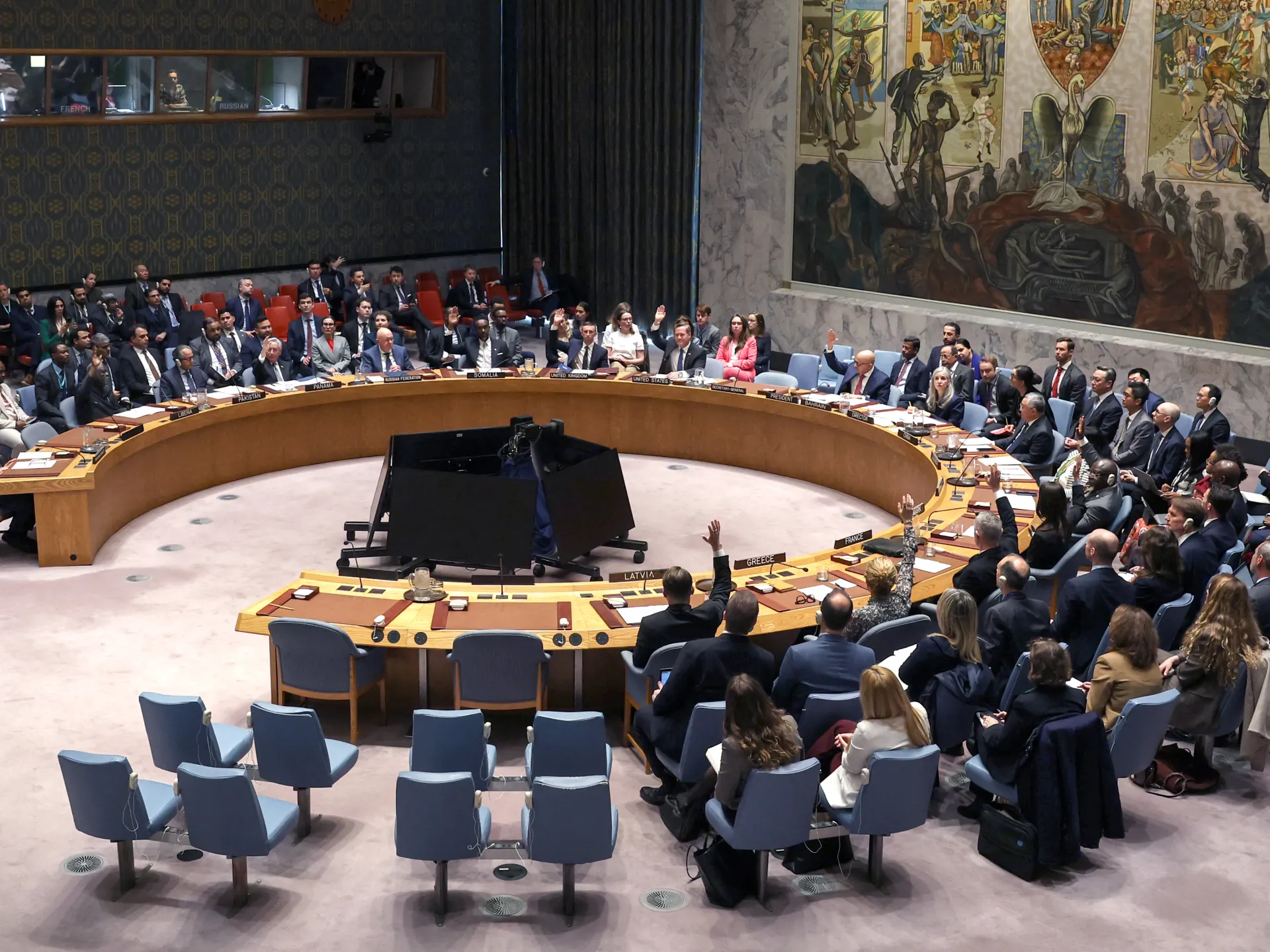
A total 11 out of 15 members supported the resolution, which was already watered down to evade vetoes.
Published On 7 Apr 2026
Russia and China have vetoed a United Nations Security Council (UNSC) resolution aimed at protecting commercial shipping in the Strait of Hormuz.
The draft text, on which a vote was held on Tuesday, was proposed by Bahrain. Eleven of the 15 members of the UNSC voted in favour, and two abstained. However, Russia and China said that the measure was biased against Iran.
Recommended Stories
list of 3 itemsend of list
Under the resolution, affected states would have been asked to “coordinate efforts, defensive in nature, commensurate to the circumstances, to contribute to ensuring the safety and security of navigation across the Strait of Hormuz”.
Shipping through the narrow waterway, through which a fifth of global oil and gas shipments previously passed, has effectively come to a standstill after Tehran threatened to attack vessels in response to the war launched against Iran by the United States and Israel on February 28.
The blockade has sent fuel prices soaring across much of the world and led some countries, particularly in Asia, to introduce restrictions on consumption and ration supplies.
A deadline set by US President Donald Trump for Iran to reopen the water passage or else face even worse bombardment is set to expire later on Tuesday, after he repeatedly issued – and delayed – similar threats.
The US ambassador to the United Nations, Mike Waltz, condemned the Russian and Chinese vetoes, saying they marked “a new low”, as Iran’s shutting of the strait was preventing medical aid and supplies from reaching humanitarian crises in the Congo, Sudan and Gaza.
“No one should tolerate that. They are holding the global economy at gunpoint. But today, Russia and China did tolerate it.”
France deplored the vetoes. “The aim was to encourage strictly, purely defensive measures to provide the security and safety for the strait without spiralling towards escalation,” its UN ambassador, Jerome Bonnafont, said.
Russia and China said the resolution was biased against Iran.
China’s UN envoy Fu Cong said adopting such a draft when the US was threatening the survival of a civilisation would have sent the wrong message.
Russia’s UN ambassador, Vasily Nebenzya, said Russia and China were proposing an alternative resolution on the situation in the Middle East, including maritime security.
Iran’s UN ambassador, Amir Saeid Iravani, praised the Chinese and Russian moves, saying “Their action today prevented the Security Council from being misused to legitimise aggression.”
The wording of the resolution had been the subject of behind-the-scenes negotiations for days.
An earlier version of the document had explicitly referred to Chapter 7 of the UN Charter, which grants the UNSC the authority to take measures ranging from sanctions to the use of military force.
But after China’s opposition, Bahrain had significantly weakened its draft, dropping any authorisation of the use of force.
An explicit reference to binding enforcement, included in an earlier draft, was also left out.