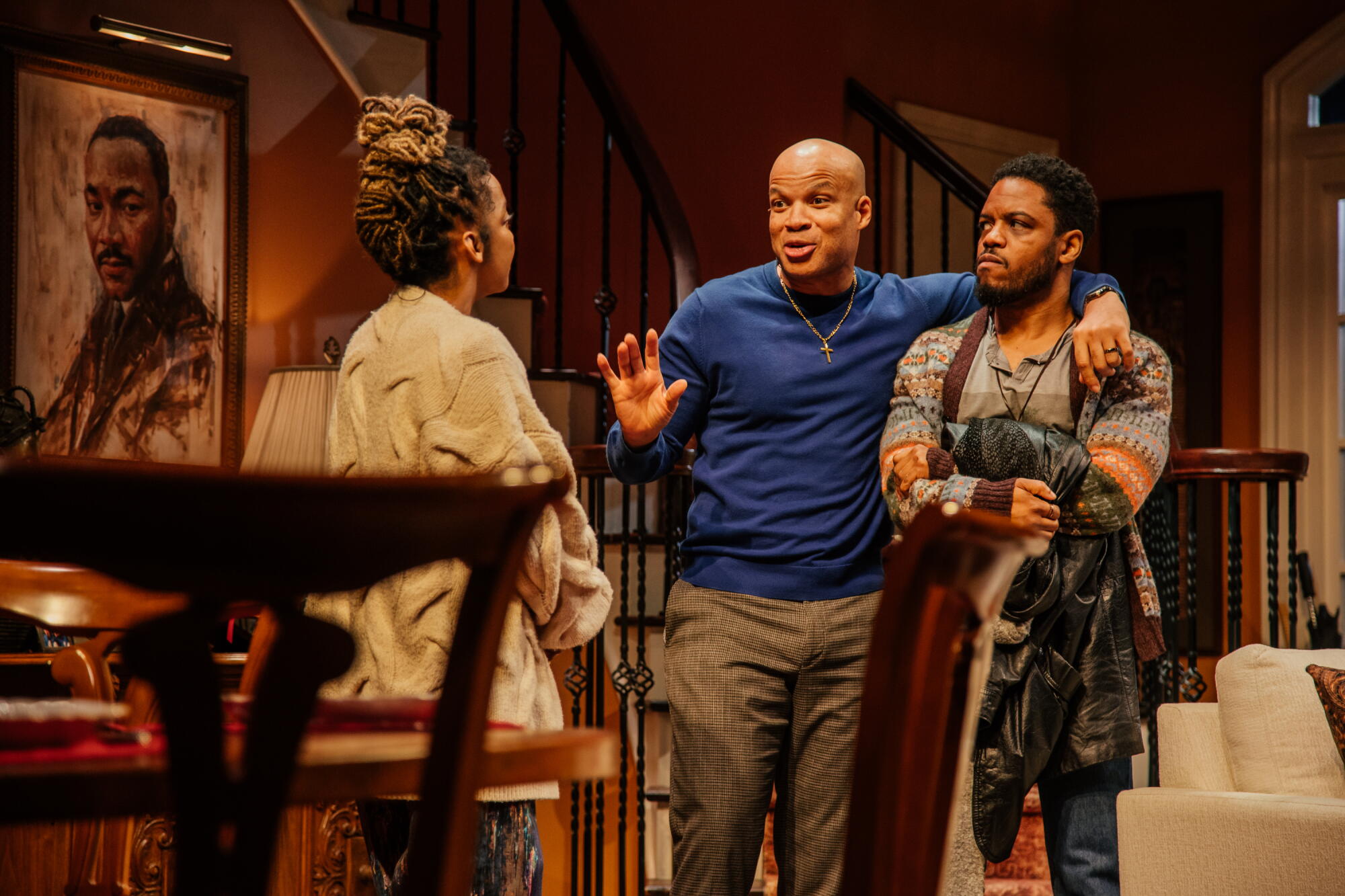
Epic family drama is at the center of the American theatrical canon. From Clifford Odets’ “Awake and Sing!,” Arthur Miller’s “Death of a Salesman,” “Eugene O’Neill’s “Long Day’s Journey Into Night” and Tennessee Williams’ “Cat on a Hot Tin Roof” to Sam Shepard’s “Buried Child,” August Wilson’s “Fences” and Tracy Letts’ “August: Osage County,” the domestic unit has served as a microcosm of the larger society.
Clashes over history, identity and legacy play out with all the fierce emotionalism that our nearest and dearest unfailingly provoke in us. The lesson couldn’t be clearer: Parents not only give us life but they initiate us into the world of tumultuous drama.
Branden Jacobs-Jenkins, a playwright as gifted as he is daring, made his Broadway debut with “Appropriate,” a family drama that shed light on the nation’s buried racial trauma. The play, which won the 2024 Tony for best revival, involves the bickering reunion of estranged siblings who make rather incriminating discoveries about their proud white Southern heritage while sorting through their father’s Arkansas plantation home.
In “Purpose,” winner of the 2025 Pulitzer Prize and the Tony Award for best play, Jacobs-Jenkins has created a family drama that can hold its own with the heavyweight works of Miller, Williams and Wilson. The grand domestic saga, which is having its Los Angeles premiere at the Geffen Playhouse, is sumptuously observed with nary a psychological hair out of place.
But for all the play’s old-fashioned excellence, “Purpose” is very much a product of a modern sensibility. The characters that Jacobs-Jenkins has gathered together haven’t had many opportunities to tell their stories on American stages.

Kara Young, Glenn Davis and Jon Michael Hill in the Broadway/Steppenwolf Theatre Company production of “Purpose” at the Geffen Playhouse.
(Jeff Lorch)
The pitch-perfect Steppenwolf Theatre Company/Broadway production, magnificently directed by Phylicia Rashad, reassembles the unimprovable New York cast. Ensemble virtuosity is one of the chief glories of this theatergoing experience. Across the board, the company is producing some of the finest stage acting I’ve seen all year.
The Jaspers are a prominent Black family in Chicago, headed by Solomon (Harry Lennix), a civil rights icon and TV-friendly reverend, who’s modeled on Jesse Jackson and shares some of the same skeletons in his closet. Rumors of children born out of wedlock won’t go away, and “Junior” (Glenn Davis), Solomon’s eldest son and a former state senator, has just been released from prison after being convicted of embezzling campaign funds and committing wire fraud.
The family has gathered to celebrate the belated birthday of Claudine (LaTanya Richardson Jackson), the matriarch of this crew and watchdog of the family name. But this homecoming, unfolding in the Jaspers’ elegant Illinois home (which scenic designer Todd Rosenthal transforms into an attractive showcase of the illustrious Black couple’s political and cultural commitments), is really in honor of Junior’s return, as Claudine makes clear.
Junior has traveled to Chicago with his wife, Morgan (Alana Arenas), who resents being there and has left her two children at home in defiance of Claudine’s wishes. Morgan has reason to be vexed. She has to serve her prison time now that Junior is out. (Their sentences were staggered because one of their sons is neurodivergent.) Her crime involves false tax returns that she feels she was railroaded into signing. The next year of her life is to be spent behind bars, and her legal career is in ruins after being disbarred.
But perhaps the most unique character in Jacobs-Jenkins’ savagely amusing, emotionally wrenching dramatic comedy is Nazareth, or “Naz” (Jon Michael Hill), whom Claudine affectionately refers to as her “weird son.” Serving double-duty as the play’s narrator, Naz left divinity school to become a nature photographer, disappointing his father, who expected him to follow in his pastoral footsteps, and confounding his mother, who can’t understand why he never brings home a girlfriend.

Harry Lennix, Alana Arenas, center, and Kara Young in “Purpose.”
(Jeff Lorch )
Solomon wonders if his son might be gay, but Naz is a more complex case. When Aziza Houston (Kara Young), his former Harlem neighbor who drove him to his parents’ home from Niagara Falls after he missed his flight, turns up to give Naz the phone charger he left in her car, Claudine immediately insists that she join the family for dinner and stay the night.
Faced with a long drive back to New York, how can Aziza say no? A snowstorm is imminent, and Claudine, eager to see Naz partnered, is adamant. The assumption is that Naz and Aziza must be in a relationship. Why else would they spend time together in “the honeymoon capital of the world.” But while she’s intimidated to be in the home of the Honorable Rev. Solomon Jasper, a “Famous Black” luminary whose picture hung on the wall of her Afrocentric elementary school, Aziza feels duty-bound to set the record straight.
She’s a queer woman and Naz happens to be asexual. (His solitariness isn’t so much a predilection as a defining feature of his identity.) Their business in Niagara Falls wasn’t amorous but reproductive: Aziza asked Naz to be a sperm donor, and he, out of the good feeling he has for a friendship struck up during the COVID pandemic, agreed.
The unexpected identity twists don’t end there. Naz, Aziza learns through Morgan’s distraught outburst at the dinner table, might be on the spectrum. What’s more, Junior blames his past behavior on a recent bipolar diagnosis, which Solomon rejects as a moral deflection, though by the end of the visit the extent of his son’s mental health challenges will be hard to deny.
Junior, whom Naz sardonically calls “the king of the pivot,” has cooked up a plan to turn his disgrace into a new career. He wants to publish the letters his mother wrote to him while he was in prison and then go on a speaking tour with her to address the subject of mass incarceration and systemic oppression.
Solomon, however, vetoes this proposal with thundering condemnation. “How are you going to be the face of prison reform when what got you in there was a bunch of white collar crimes?” Having hosted Nelson Mandela at the very table where dinner is now being served, Solomon cannot tolerate what he perceives as mendacity and the exploitation of the family name.

Harry Lennix, from left, LaTanya Richardson Jackson, Jon Michael Hill and Kara Young in “Purpose.” In this production, the combatants bring fresh perspectives to age-old family struggles.
(Jeff Lorch )
Truth-telling is what he tyrannically demands, as long as he is the one in charge of rooting out the lies. (His own secrets, once carefully managed by Junior, are now being suppressed by his wife, who can whip up an NDA as fast as she can turn out a plate of pancakes.)
The battles that are being fought in “Purpose” aren’t new, but the combatants bring novel perspectives to these age-old struggles. Who controls the family narrative? What does a child owe his parents? Why do the people who know us the longest seem to have the most difficulty in accepting who we are?
The civil rights movement supplied Solomon and Claudine with definitive purpose, but the next generation hasn’t had the same clarity. But no one in the play holds a monopoly on moral goodness. To be human is to be flawed, and even the characters with whom we are most in sympathy (Naz and Aziza) fall short of their own ideals.
“Purpose” is a spiritual drama, shaped by the differing generational worldviews of Solomon and Naz, one wanting to hew faithfully to God’s plan for him, the other wondering if perhaps the only higher plan is the one we divine from our zigzagging lives. Behind Jacobs-Jenkins’ rich human tapestry is an uncommon wisdom, born from the dialectic discovery that drama at its best makes possible.
This is a long play, but an exuberantly entertaining one. Humor and pathos are kept in impressive Chekhovian balance. (Jackson’s Claudine and Arenas’ Morgan are at their funniest when at each other’s throats.) There’s even a gun, mentioned in the first act, that plays a role in the second. But in keeping with “Uncle Vanya,” Purpose doesn’t allow melodrama to get the better of tragicomedy.
The actors are so good that it would be unfair to single out one when all are worthy of the highest praise. Young, who leaves the production after the Nov. 29 matinee (when she’ll be replaced by Nija Okoro), was honored at the Tony Awards for her stellar featured performance. But if ever there was a production that deserves a Tony for best ensemble, it is this one.
Aziza may be the character who offers Naz the closest that anyone can come to divine love. She gives him what no one else seems able to — total acceptance. But are any of us capable of receiving such a gift? And would we even know what to do with it if we were?
‘Purpose’
Where: Gil Cates Theater at Geffen Playhouse, 10886 Le Conte Ave., L.A.
When: 7:30 p.m. Wednesdays-Thursdays, 8 p.m. Fridays, 2 and 8 p.m. Saturdays, 1 and 6:30 p.m. Sundays. (Check for exceptions.) Ends December 20
Tickets: $57 – $249 (subject to change)
Contact: (310) 208-2028 or www.geffenplayhouse.org
Running time: 3 hours, including one intermission