Tony

‘Purpose’ review: Branden Jacobs-Jenkins’ riveting family drama

Epic family drama is at the center of the American theatrical canon. From Clifford Odets’ “Awake and Sing!,” Arthur Miller’s “Death of a Salesman,” “Eugene O’Neill’s “Long Day’s Journey Into Night” and Tennessee Williams’ “Cat on a Hot Tin Roof” to Sam Shepard’s “Buried Child,” August Wilson’s “Fences” and Tracy Letts’ “August: Osage County,” the domestic unit has served as a microcosm of the larger society.

Clashes over history, identity and legacy play out with all the fierce emotionalism that our nearest and dearest unfailingly provoke in us. The lesson couldn’t be clearer: Parents not only give us life but they initiate us into the world of tumultuous drama.

Branden Jacobs-Jenkins, a playwright as gifted as he is daring, made his Broadway debut with “Appropriate,” a family drama that shed light on the nation’s buried racial trauma. The play, which won the 2024 Tony for best revival, involves the bickering reunion of estranged siblings who make rather incriminating discoveries about their proud white Southern heritage while sorting through their father’s Arkansas plantation home.

In “Purpose,” winner of the 2025 Pulitzer Prize and the Tony Award for best play, Jacobs-Jenkins has created a family drama that can hold its own with the heavyweight works of Miller, Williams and Wilson. The grand domestic saga, which is having its Los Angeles premiere at the Geffen Playhouse, is sumptuously observed with nary a psychological hair out of place.

But for all the play’s old-fashioned excellence, “Purpose” is very much a product of a modern sensibility. The characters that Jacobs-Jenkins has gathered together haven’t had many opportunities to tell their stories on American stages.

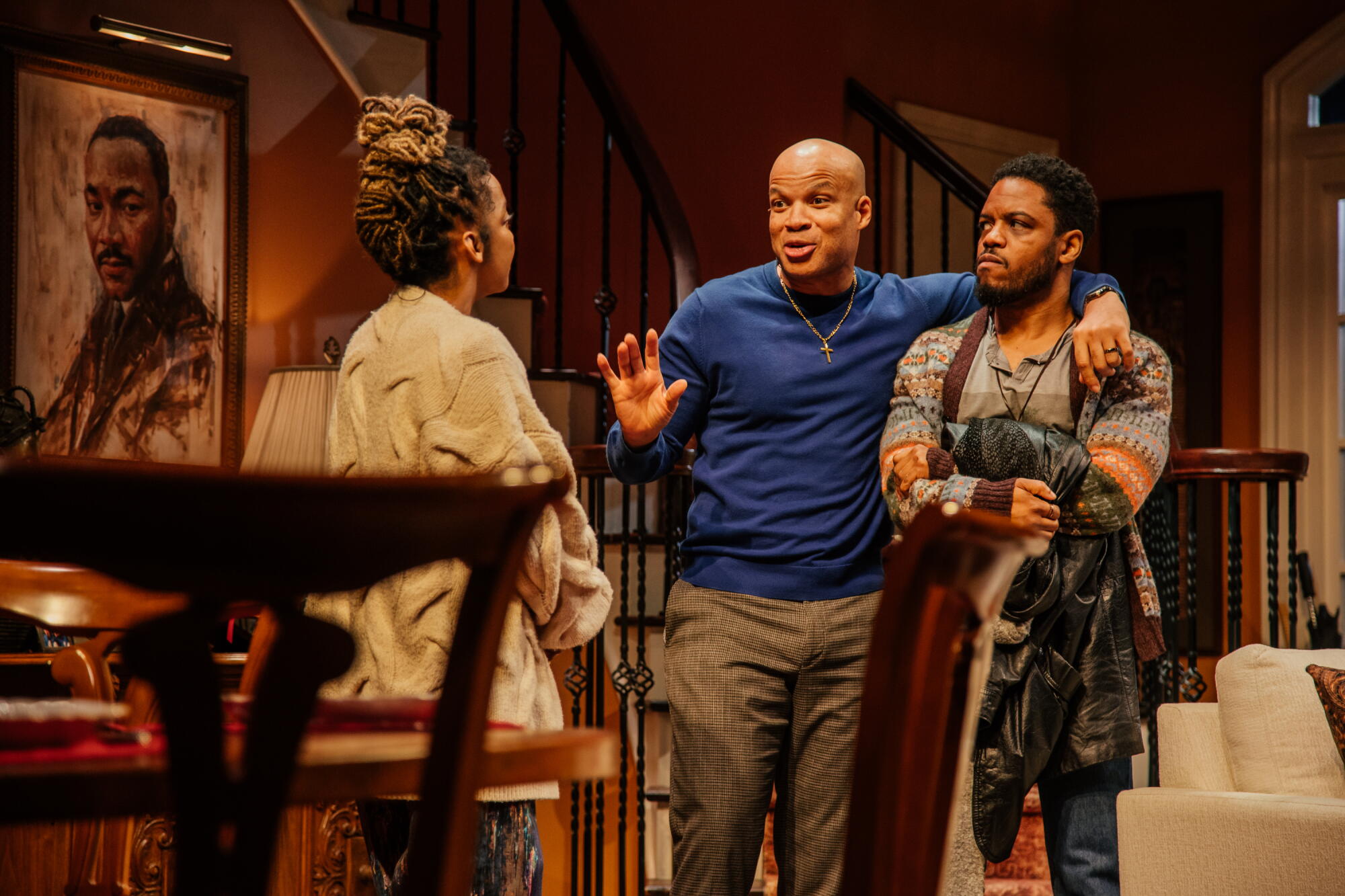
Kara Young, Glenn Davis and Jon Michael Hill in "Purpose" at the Geffen Playhouse.

Kara Young, Glenn Davis and Jon Michael Hill in the Broadway/Steppenwolf Theatre Company production of “Purpose” at the Geffen Playhouse.

(Jeff Lorch)

The pitch-perfect Steppenwolf Theatre Company/Broadway production, magnificently directed by Phylicia Rashad, reassembles the unimprovable New York cast. Ensemble virtuosity is one of the chief glories of this theatergoing experience. Across the board, the company is producing some of the finest stage acting I’ve seen all year.

The Jaspers are a prominent Black family in Chicago, headed by Solomon (Harry Lennix), a civil rights icon and TV-friendly reverend, who’s modeled on Jesse Jackson and shares some of the same skeletons in his closet. Rumors of children born out of wedlock won’t go away, and “Junior” (Glenn Davis), Solomon’s eldest son and a former state senator, has just been released from prison after being convicted of embezzling campaign funds and committing wire fraud.

The family has gathered to celebrate the belated birthday of Claudine (LaTanya Richardson Jackson), the matriarch of this crew and watchdog of the family name. But this homecoming, unfolding in the Jaspers’ elegant Illinois home (which scenic designer Todd Rosenthal transforms into an attractive showcase of the illustrious Black couple’s political and cultural commitments), is really in honor of Junior’s return, as Claudine makes clear.

Junior has traveled to Chicago with his wife, Morgan (Alana Arenas), who resents being there and has left her two children at home in defiance of Claudine’s wishes. Morgan has reason to be vexed. She has to serve her prison time now that Junior is out. (Their sentences were staggered because one of their sons is neurodivergent.) Her crime involves false tax returns that she feels she was railroaded into signing. The next year of her life is to be spent behind bars, and her legal career is in ruins after being disbarred.

But perhaps the most unique character in Jacobs-Jenkins’ savagely amusing, emotionally wrenching dramatic comedy is Nazareth, or “Naz” (Jon Michael Hill), whom Claudine affectionately refers to as her “weird son.” Serving double-duty as the play’s narrator, Naz left divinity school to become a nature photographer, disappointing his father, who expected him to follow in his pastoral footsteps, and confounding his mother, who can’t understand why he never brings home a girlfriend.

Harry Lennix, Alana Arenas, center, and Kara Young in "Purpose."

Harry Lennix, Alana Arenas, center, and Kara Young in “Purpose.”

(Jeff Lorch )

Solomon wonders if his son might be gay, but Naz is a more complex case. When Aziza Houston (Kara Young), his former Harlem neighbor who drove him to his parents’ home from Niagara Falls after he missed his flight, turns up to give Naz the phone charger he left in her car, Claudine immediately insists that she join the family for dinner and stay the night.

Faced with a long drive back to New York, how can Aziza say no? A snowstorm is imminent, and Claudine, eager to see Naz partnered, is adamant. The assumption is that Naz and Aziza must be in a relationship. Why else would they spend time together in “the honeymoon capital of the world.” But while she’s intimidated to be in the home of the Honorable Rev. Solomon Jasper, a “Famous Black” luminary whose picture hung on the wall of her Afrocentric elementary school, Aziza feels duty-bound to set the record straight.

She’s a queer woman and Naz happens to be asexual. (His solitariness isn’t so much a predilection as a defining feature of his identity.) Their business in Niagara Falls wasn’t amorous but reproductive: Aziza asked Naz to be a sperm donor, and he, out of the good feeling he has for a friendship struck up during the COVID pandemic, agreed.

The unexpected identity twists don’t end there. Naz, Aziza learns through Morgan’s distraught outburst at the dinner table, might be on the spectrum. What’s more, Junior blames his past behavior on a recent bipolar diagnosis, which Solomon rejects as a moral deflection, though by the end of the visit the extent of his son’s mental health challenges will be hard to deny.

Junior, whom Naz sardonically calls “the king of the pivot,” has cooked up a plan to turn his disgrace into a new career. He wants to publish the letters his mother wrote to him while he was in prison and then go on a speaking tour with her to address the subject of mass incarceration and systemic oppression.

Solomon, however, vetoes this proposal with thundering condemnation. “How are you going to be the face of prison reform when what got you in there was a bunch of white collar crimes?” Having hosted Nelson Mandela at the very table where dinner is now being served, Solomon cannot tolerate what he perceives as mendacity and the exploitation of the family name.

Two men and two women in a living room.

Harry Lennix, from left, LaTanya Richardson Jackson, Jon Michael Hill and Kara Young in “Purpose.” In this production, the combatants bring fresh perspectives to age-old family struggles.

(Jeff Lorch )

Truth-telling is what he tyrannically demands, as long as he is the one in charge of rooting out the lies. (His own secrets, once carefully managed by Junior, are now being suppressed by his wife, who can whip up an NDA as fast as she can turn out a plate of pancakes.)

The battles that are being fought in “Purpose” aren’t new, but the combatants bring novel perspectives to these age-old struggles. Who controls the family narrative? What does a child owe his parents? Why do the people who know us the longest seem to have the most difficulty in accepting who we are?

The civil rights movement supplied Solomon and Claudine with definitive purpose, but the next generation hasn’t had the same clarity. But no one in the play holds a monopoly on moral goodness. To be human is to be flawed, and even the characters with whom we are most in sympathy (Naz and Aziza) fall short of their own ideals.

“Purpose” is a spiritual drama, shaped by the differing generational worldviews of Solomon and Naz, one wanting to hew faithfully to God’s plan for him, the other wondering if perhaps the only higher plan is the one we divine from our zigzagging lives. Behind Jacobs-Jenkins’ rich human tapestry is an uncommon wisdom, born from the dialectic discovery that drama at its best makes possible.

This is a long play, but an exuberantly entertaining one. Humor and pathos are kept in impressive Chekhovian balance. (Jackson’s Claudine and Arenas’ Morgan are at their funniest when at each other’s throats.) There’s even a gun, mentioned in the first act, that plays a role in the second. But in keeping with “Uncle Vanya,” Purpose doesn’t allow melodrama to get the better of tragicomedy.

The actors are so good that it would be unfair to single out one when all are worthy of the highest praise. Young, who leaves the production after the Nov. 29 matinee (when she’ll be replaced by Nija Okoro), was honored at the Tony Awards for her stellar featured performance. But if ever there was a production that deserves a Tony for best ensemble, it is this one.

Aziza may be the character who offers Naz the closest that anyone can come to divine love. She gives him what no one else seems able to — total acceptance. But are any of us capable of receiving such a gift? And would we even know what to do with it if we were?

‘Purpose’

Where: Gil Cates Theater at Geffen Playhouse, 10886 Le Conte Ave., L.A.

When: 7:30 p.m. Wednesdays-Thursdays, 8 p.m. Fridays, 2 and 8 p.m. Saturdays, 1 and 6:30 p.m. Sundays. (Check for exceptions.) Ends December 20

Tickets: $57 – $249 (subject to change)

Contact: (310) 208-2028 or www.geffenplayhouse.org

Running time: 3 hours, including one intermission

Source link

Tony Iommi: Riff master of Black Sabbath’s reality

Ozzy Osbourne was rock ‘n’ roll’s Prince of Darkness — and also a much-beloved bumbling reality show dad. Inventive bassist Geezer Butler put words into Ozzy’s mouth as Black Sabbath’s main lyricist, his muscular playing anchoring the quartet’s rhythm section alongside drummer Bill Ward.

But it’s guitarist Tony Iommi whose iconic riffs built the Sabbath sound. The hugely influential aural architect found his signature style after a horrific accident at a sheet-metal plant when he was just 17. The teen was about to quit the factory, but on his last day, the tips of his middle and ring fingers of his right hand were sliced off in a piece of machinery. As a left-hander, Iommi used his right for fretting, and for creating a song’s mood and melody.

From the ominous timbre of the first song in their 1970 debut LP, “Black Sabbath,” to legendary cuts including “N.I.B.,” “Paranoid” and “Iron Man,” Iommi’s self-made fingertip “thimbles” and adaptive way of playing created unforgettable and hugely influential riffs. The guitarist’s instantly recognizable style and tone are as vital and memorable more than 50 years later on his new solo album, “From the Dark.”

Via phone from his home in the Cotswolds, England, a day before the London premiere of the concert documentary film “Ozzy & Black Sabbath: Back to the Beginning,” Iommi is humble, low-key and congenial. While he’s excited about “From the Dark,” he’s still stunned by the 2025 loss of his longtime friend and bandmate Osbourne.

He speaks with slight trepidation about his upcoming viewing of the concert documentary, which chronicles Osbourne’s final live performance and Sabbath reunion.

Tony Iommi sitting with guitar on lap

Tony Iommi’s amputated fingertips could have ended his guitar career. Instead, homemade thimbles and a new playing style helped create Black Sabbath’s defining, generations-shaping riffs.

(Ross Halfin)

“It’s weird for me,” Iommi says. “In my own heart, I don’t particularly really want to see it because it brings back so many memories with Oz of course. For me, on that last gig, seeing him not being able to move wasn’t particularly the way I’d seen him — all the years he’s been running around the stage. That’s how I know him, and then to see him sitting down on a throne…”

However, for most of the four-song final performance, which saw Sabbath reuniting with drummer Ward for the first time in more than two decades, Osbourne was not in the guitarist’s sights. “I stood at the back because Bill wanted me to stand by him. We hadn’t played live with Bill for 20 years, so Bill said, ‘Would you stand by me, if I forget anything or miss anything?’ I don’t know what I could have done, but I did do that,” Iommi says.

“[The event] was a very strange experience. It’s great for all the other bands who came to the show and supported Sabbath. That was fantastic, and they were all really nice and no egos. It was a great setup, and I was really proud of everybody coming along to be involved in it and tip their hat towards us. It was lovely, of course, for the fans.”

In rehearsal, while Osbourne was joking around, “you could see he was in pain,” recalls Iommi. “Basically, he was carried in, and we were all shocked. We just didn’t know what to say. It was a strange, strange feeling.”

When the singer died only 17 days after the concert, even his bandmates were shocked by the suddenness. “I spoke to him the night before he passed, and he said to me, ‘Oh, God, I’ve been really tired, I feel really tired. I can’t stay awake. I’m exhausted.’ I said to him, ‘You’re bound to feel it.” We’ve been rehearsing the show, it’s been a bit stressful. We’ve had a lot of things to do.’ Ozzy said, ‘But I just can’t.” I just feel tired.’ And of course, the next day he’d gone. Really, it was such a shock.”

Tony Iommi posing in black outfit with shades

At 78, the Birmingham-born guitarist is releasing From the Dark, a solo album built around his signature heavy sound and a new lineup of collaborators.

(Ross Halfin)

At that time, Iommi had the seeds of the songs that would become “From the Dark.” It began with a scent: “I did a couple of instrumental tracks for a perfume [ad campaign]. Then I thought, ‘I’ll start writing some instrumentals for an album,’ and I did three or four. Then I changed my mind and thought, ‘I want to do one with a vocalist.’ ”

If Tony Iommi were a perfume, he’d smell like cinnamon, patchouli and leather. In fact, he is one, with three unisex fragrances by Italian luxury brand Xerjoff under his name. One — with notes of rum, bergamot and Ambergris, is called Monkey Special, named after his 1964 Gibson SG guitar. “It’s not a cheap perfume, I might say,” Iommi says. “In England, they stock it in Harrods and Selfridges. It’s been very successful and very different for me to do something like that.”

Following his perfumey instrumentals, the songwriter began collaborating with journeyman Norwegian vocalist Jørn Lande, bassist Becky Baldwin and drummer Karl Brazil, who has worked with pop icons Robbie Williams and James Blunt. The latter two hail from Iommi’s and Sabbath’s hometown, Birmingham, England.

“I met Jørn years ago when I was going to do another album, and it ended up with [former Deep Purple bassist/singer] Glenn Hughes on it. But I’d done a track with Jørn, and I liked the idea. But at the time, the record company wanted to use somebody a bit more known, so I did the album with Glenn.”

Lande ended up singing on a 2010 live show following the death of second Black Sabbath singer Ronnie James Dio, stepping into the frontman’s shoes for the band, which was then going by the name Heaven & Hell. “I was really pleased with what he’d done, and I always had it in mind to use him somewhere along the line, doing an album together, and that’s how it worked out.”

Born 78 years ago, in Birmingham — the town where Sabbath first formed and later performed its final show in 2025 — Iommi remains defined by his signature look. It is hard to imagine the guitar legend without his trademark black shirt, large silver cross, blue-tinted glasses and leather coat. His playing — down-tuning his guitar to lower the pitch for a menacing and heavier sound — may have morphed very slightly over the years, but “I think you just do it naturally without even thinking about it. My writing ideas are still the same. I still come up with miserable stuff,” he says, chuckling. “I like to do riffs and whatnot, so I enjoy that.”

Tony Iommi with his band and producer

Tony Iommi with his band vocalist Jørn Lande (far right), bassist Becky Baldwin, and drummer Karl Brazil and producer Mike Exeter

(Tina Korhonen)

On “From the Dark,” lyrics are all Lande; Iommi has no interest in telling his own stories using words. Yet a new tune like “Beyond the Dead” seems as if it could be about Iommi’s 2011 diagnosis and treatment for early-stage non-Hodgkin lymphoma.

Not so, the guitarist affirms, while acknowledging that the lyrics could be read that way.

“It was about beyond the living, beyond the dead, and coming back. Really deep, but that’s good. I do love what he’s done. When somebody like Jørn comes in, as with Dio, they’d write their own lyrics, and I prefer that because they’re going to sing them,” Iommi explains. “It’s like somebody saying to me, ‘Play this and play that.’ I want to play what I feel and what’s coming from me.”

There was a time when Sabbath did take a slightly different approach to writing and recording, but it wasn’t at their own initiative. In 2001, the band recorded “13,” Sabbath’s 19th and final studio album. It was the first studio record with Osbourne since 1978’s “Never Say Die,” and producer Rick Rubin was on board for the reunion.

What did Iommi learn from Rubin?

“I learned not to use a producer again,” he quipped. “It was strange because Rick wasn’t there most of the time. He’d be there for a certain recording, then he’d disappear. I’d written a lot of the stuff, and then we’d play it, and he go, ‘I don’t like that bit, I don’t like that part,’ and then disappear.

“One Friday he phoned me up — because he wouldn’t talk to the others [Osbourne, Butler]. He wanted me to relate what he’d said to the others. He said, ‘Could you write a song over the weekend that’s like “Planet Caravan,” so we can record it on Monday?’ I went, ‘What?!!’ But it happens that I did do it.” The end result was “Zeitgeist.”

Iommi sitting at a table with guitar

Iommi is still processing Ozzy Osbourne’s death, just 17 days after Black Sabbath’s final performance, and says watching the concert film will bring back painful memories.

(Ross Halfin)

Iommi’s key plans for his new lineup and record were to make sure the players brought a healthy dose of enthusiasm. Baldwin is the first female he’s been in a band with. Iommi has a comfort zone, so he’d originally wanted Butler on the new album, which didn’t work out logistically. “Becky happened to be a big fan of Geezer, so we got Becky over to my home studio, and I did throw her in the deep end a bit,” admits Iommi. “I gave her the first track, which was ‘World Alone.’ I said, ‘Play that.’ She listened to it a bit and started playing it. It was really good. I just wanted to see what she’d be like straight away, just to see what she came up with, which was a bit horrible of me, I suppose.

“She worked out really good. The other thing is enthusiasm,” he continued. “I wanted people involved in this that really love what they do and really enjoy playing, and she constantly wants to play and be involved in the music, and it’s a great attitude.”

Another Brit superstar who also opts to play with relatively unknown, ardent players is Zeppelin’s Robert Plant. “He’s the same,” Iommi acknowledges. “We spoke about this, myself and Planty, because obviously we’ve known each other a long time. He could have easily done Zeppelin, but he wanted to do what he wanted to do.”

What a collaboration Iommi and Plant would be.

“I did say to him one time about doing something together, but again, he got his own thing, and I did [too]. Who knows? We’ve talked about it a couple of times, but he’s into a certain flavor of music that he likes to play, which is different to what I play, really. I don’t discard anything that way. If something comes up that’s a good idea and somebody’s into it, then I’m going to have a go.”

It’s been 26 years since Iommi’s debut, a self-titled solo album with a roster of guest vocalists including Osbourne, Dave Grohl, Henry Rollins and Pantera’s Philip Anselmo. “How fast it goes,” Iommi says with a chuckle. “Twenty-one years ago was my last solo album. And that’s long enough, isn’t it? But I was just busy with the Sabbath thing and then other things, including the Sabbath ballet.”

While fans would adore a tour, Iommi says he’d only do the occasional “one-off.” He will allow a moment of supposition, if pressed. “I suppose if I did something like that, I’d probably do some Dio stuff and maybe [one-time Sabbath vocalist] Tony Martin and maybe ‘Paranoid,’ ‘Iron Man.’ I haven’t really thought about it. Again, it’s not Sabbath,” he concludes. “It would be an Iommi thing, but it is part of my background. So I suppose I would play some of the old ones.”

Source link

Buatsi vs Hutchinson 2: Predictions for light-heavyweight WBC title fight from Chantelle Cameron, Tony Bellew and more

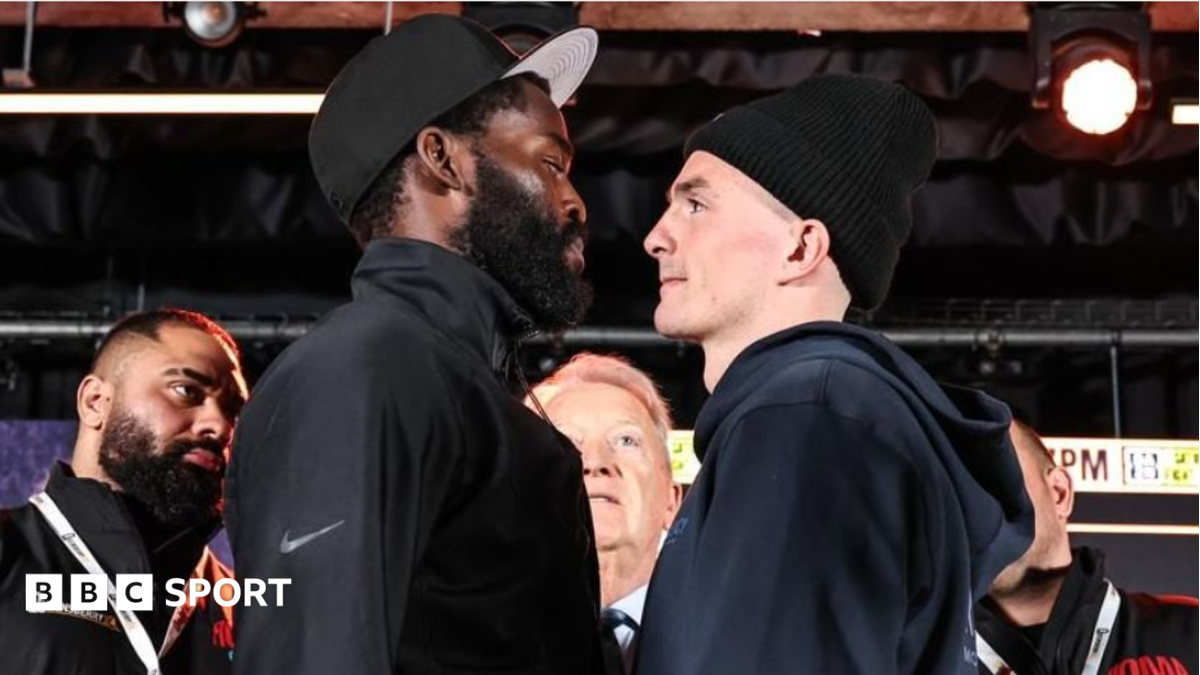
Joshua Buatsi and Willy Hutchinson renew their rivalry for the vacant WBC world light-heavyweight title in Manchester on Saturday.

The British rivals first met in a highly entertaining, hard-fought contest on the undercard of Daniel Dubois’ win over Anthony Joshua in September 2024.

Londoner Buatsi, 33, twice knocked down Hutchinson before going on to win by split decision.

Scotland’s Hutchinson, 28, suffered the second defeat of his professional career that night but two wins since have put him in a position to fight for a first world title.

Can Buatsi repeat his victory? Or will Hutchinson gain revenge in Manchester?

BBC Sport spoke to figures from across the boxing world to get their predictions.

Source link

Tony Pulis column: Why managers can learn a lot from leaders like Napoleon Bonaparte

As well as great military triumphs, I studied defeats too – they are as much a part of football management as victories, after all – and you can compare the organisational brilliance of Napoleon to the disaster of the Battle of Balaclava and the Charge of the Light Brigade.

One summer, I travelled out to Crimea to witness the scene of that tragic charge by the bravest of brave men.

Lord Raglan, the British commander-in-chief, was based on the high ground and could see everything in the Russian positions and the brigades.

His order to attack was ambiguous and although Lord Cardigan, who led the charge, questioned it, he still followed it through – leading to one of the most infamous military disasters in history.

It should never have happened but, just as in football, leadership and communication from the top was key. The instructions were passed down from Raglan to Lord Lucan to Cardigan and became garbled – too many cooks, in my opinion!

The last book which really stuck with me, in terms of inspiring me as a leader, was the story of HMS Endurance – disaster strikes during a journey through the ice fields of the southern hemisphere when the ship becomes stuck.

I cannot do justice to the deeds of Sir Ernest Shackleton in this column but his leadership of his men, along with his number two Frank Worsley, was extraordinary.

Both dovetailed in a way that gave their men the energy, desire and determination to believe and follow instructions in the most appalling conditions, never once questioning their leaders’ abilities to help them survive.

Over the years, I’ve never stopped reading about, or watching, great leaders like that – there is so much that young coaches can learn from other sports or history that will benefit then, the same way it did me.

Going to games was still the most important thing when I was between jobs, because I would always believe my own eyes when watching players.

There were times when that became more of a challenge, especially at the back end of my career, but times change and if you are not in tune with what is happening in the game then you can get dropped very quickly.

But I am sure that most of my managerial compatriots would also agree with me that experience in all walks of life can be invaluable.

I learned so much when I was out of work, about all aspects of leadership, individually and collectively.

My advice to managers out of work now is the same that I received from Jim, all those years ago – pick yourselves up and get off the sofa to get back in work as quickly as possible.

You should never be afraid of dropping down a level the way I did, too. It is better to get a job, any job, than be out of football full-stop. That hasn’t changed since my day, either.

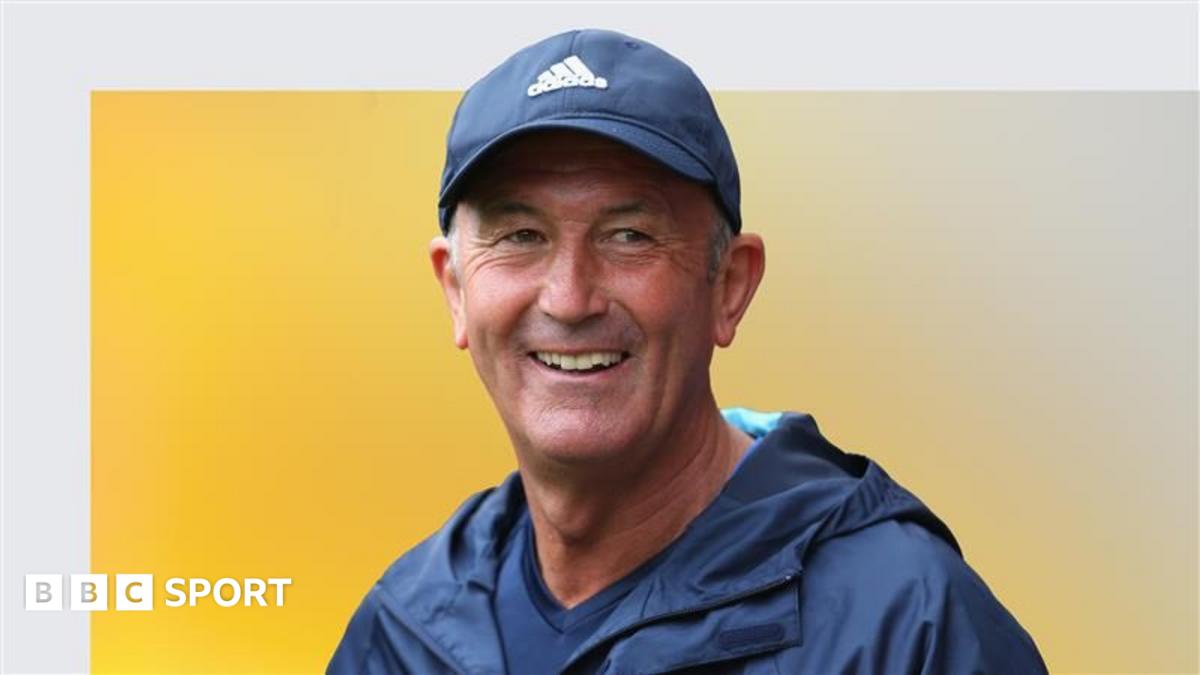
Tony Pulis was speaking to BBC Sport’s Chris Bevan.

Source link

Tony Berlant dead: Artist known for metal collages, Kate Berlant’s dad

Tony Berlant, a seminal influence in the West Coast Pop Art movement of the 1960s, died Tuesday after a long battle with Alzheimer’s disease. He was 85.

L.A. Louver, his longtime gallery, confirmed his death to The Times.

Berlant, a “painterly collage artist” who called Santa Monica his home for many decades, developed a signature style making collages using shards of printed tin instead of paper and thousands of shiny nails instead of glue. He often worked with vintage metal street signs and ads. In recent years, he printed personal photographs onto the metal, giving the colorful works story structure and an autobiographical bent.

One of his most recent shows, in fall 2018 at Hollywood’s Kohn Gallery, featured cut metal collages that blended elements of assemblage, Pop Art and abstraction. He was also known for his metal cube sculptures, which have been called quilt-like.

Berlant was a collector of both ancient Southwest pottery and Paleolithic stone objects. In fact, he co-curated two museum exhibitions: “First Sculpture: Handaxe to Figure Stone” at the Nasher Sculpture Center in Dallas and “Decoding Mimbres Painting: Ancient Ceramics of the American Southwest” at LACMA. He was also a founding member of the Mimbres Foundation, an archaeological conservancy that studies and preserves ancient Native American pottery.

Berlant was part of L.A.’s famous Ferus Gallery art scene in the 1960s, a group of “Cool School” artists that also included the late Ed Moses and Robert Irwin as well as Ed Ruscha, Larry Bell and others. The Ferus Gallery was a revolving door of experimentation at the time and helped fuse the city’s otherwise sprawling and disparate art scene.

Berlant was part of one of the earliest museum exhibitions of Pop Art in 1963, “Pop Art USA,” at the Oakland Art Museum. He showed his work alongside Robert Rauschenberg, Andy Warhol and Claes Oldenburg.

The L.A. visual art scene may be more established today, but it’s also more commercial and safer in some ways. However Berlant firmly believed that L.A. still retains its defining creative spirit.

“My New York friends tend to think of the ’60s as a kind of golden moment that’s now been erased by commercial focus,” Berlant told The Times in 2018. “But I think L.A. is [still that]. It never left. I just assume that there’s all kinds of fantastic artists working that I’ve never heard of because they pop up here and there, and I see them, and I’m just really excited by that. It’s what makes you feel good about a place.”

Tony Berlant stands in front of his collaged-metal self portrait.

Tony Berlant stands in front of his collaged-metal self portrait for his show “Fast Forward” at the Kohn Gallery in Hollywood in 2018.

(Patrick T. Fallon / For The Times)

Berlant’s work is included in the permanent collection of LACMA as well as the Hirshhorn Museum and Sculpture Garden in Washington and the Art Institute of Chicago.

He is survived by his wife, Helen Berlant; daughter, comedian Kate Berlant; and brother, Jeff Berlant.

Source link