Ozzy Osbourne was rock ‘n’ roll’s Prince of Darkness — and also a much-beloved bumbling reality show dad. Inventive bassist Geezer Butler put words into Ozzy’s mouth as Black Sabbath’s main lyricist, his muscular playing anchoring the quartet’s rhythm section alongside drummer Bill Ward.
But it’s guitarist Tony Iommi whose iconic riffs built the Sabbath sound. The hugely influential aural architect found his signature style after a horrific accident at a sheet-metal plant when he was just 17. The teen was about to quit the factory, but on his last day, the tips of his middle and ring fingers of his right hand were sliced off in a piece of machinery. As a left-hander, Iommi used his right for fretting, and for creating a song’s mood and melody.
From the ominous timbre of the first song in their 1970 debut LP, “Black Sabbath,” to legendary cuts including “N.I.B.,” “Paranoid” and “Iron Man,” Iommi’s self-made fingertip “thimbles” and adaptive way of playing created unforgettable and hugely influential riffs. The guitarist’s instantly recognizable style and tone are as vital and memorable more than 50 years later on his new solo album, “From the Dark.”
Via phone from his home in the Cotswolds, England, a day before the London premiere of the concert documentary film “Ozzy & Black Sabbath: Back to the Beginning,” Iommi is humble, low-key and congenial. While he’s excited about “From the Dark,” he’s still stunned by the 2025 loss of his longtime friend and bandmate Osbourne.
He speaks with slight trepidation about his upcoming viewing of the concert documentary, which chronicles Osbourne’s final live performance and Sabbath reunion.

Tony Iommi’s amputated fingertips could have ended his guitar career. Instead, homemade thimbles and a new playing style helped create Black Sabbath’s defining, generations-shaping riffs.
(Ross Halfin)
“It’s weird for me,” Iommi says. “In my own heart, I don’t particularly really want to see it because it brings back so many memories with Oz of course. For me, on that last gig, seeing him not being able to move wasn’t particularly the way I’d seen him — all the years he’s been running around the stage. That’s how I know him, and then to see him sitting down on a throne…”
However, for most of the four-song final performance, which saw Sabbath reuniting with drummer Ward for the first time in more than two decades, Osbourne was not in the guitarist’s sights. “I stood at the back because Bill wanted me to stand by him. We hadn’t played live with Bill for 20 years, so Bill said, ‘Would you stand by me, if I forget anything or miss anything?’ I don’t know what I could have done, but I did do that,” Iommi says.
“[The event] was a very strange experience. It’s great for all the other bands who came to the show and supported Sabbath. That was fantastic, and they were all really nice and no egos. It was a great setup, and I was really proud of everybody coming along to be involved in it and tip their hat towards us. It was lovely, of course, for the fans.”
In rehearsal, while Osbourne was joking around, “you could see he was in pain,” recalls Iommi. “Basically, he was carried in, and we were all shocked. We just didn’t know what to say. It was a strange, strange feeling.”
When the singer died only 17 days after the concert, even his bandmates were shocked by the suddenness. “I spoke to him the night before he passed, and he said to me, ‘Oh, God, I’ve been really tired, I feel really tired. I can’t stay awake. I’m exhausted.’ I said to him, ‘You’re bound to feel it.” We’ve been rehearsing the show, it’s been a bit stressful. We’ve had a lot of things to do.’ Ozzy said, ‘But I just can’t.” I just feel tired.’ And of course, the next day he’d gone. Really, it was such a shock.”

At 78, the Birmingham-born guitarist is releasing From the Dark, a solo album built around his signature heavy sound and a new lineup of collaborators.
(Ross Halfin)
At that time, Iommi had the seeds of the songs that would become “From the Dark.” It began with a scent: “I did a couple of instrumental tracks for a perfume [ad campaign]. Then I thought, ‘I’ll start writing some instrumentals for an album,’ and I did three or four. Then I changed my mind and thought, ‘I want to do one with a vocalist.’ ”
If Tony Iommi were a perfume, he’d smell like cinnamon, patchouli and leather. In fact, he is one, with three unisex fragrances by Italian luxury brand Xerjoff under his name. One — with notes of rum, bergamot and Ambergris, is called Monkey Special, named after his 1964 Gibson SG guitar. “It’s not a cheap perfume, I might say,” Iommi says. “In England, they stock it in Harrods and Selfridges. It’s been very successful and very different for me to do something like that.”
Following his perfumey instrumentals, the songwriter began collaborating with journeyman Norwegian vocalist Jørn Lande, bassist Becky Baldwin and drummer Karl Brazil, who has worked with pop icons Robbie Williams and James Blunt. The latter two hail from Iommi’s and Sabbath’s hometown, Birmingham, England.
“I met Jørn years ago when I was going to do another album, and it ended up with [former Deep Purple bassist/singer] Glenn Hughes on it. But I’d done a track with Jørn, and I liked the idea. But at the time, the record company wanted to use somebody a bit more known, so I did the album with Glenn.”
Lande ended up singing on a 2010 live show following the death of second Black Sabbath singer Ronnie James Dio, stepping into the frontman’s shoes for the band, which was then going by the name Heaven & Hell. “I was really pleased with what he’d done, and I always had it in mind to use him somewhere along the line, doing an album together, and that’s how it worked out.”
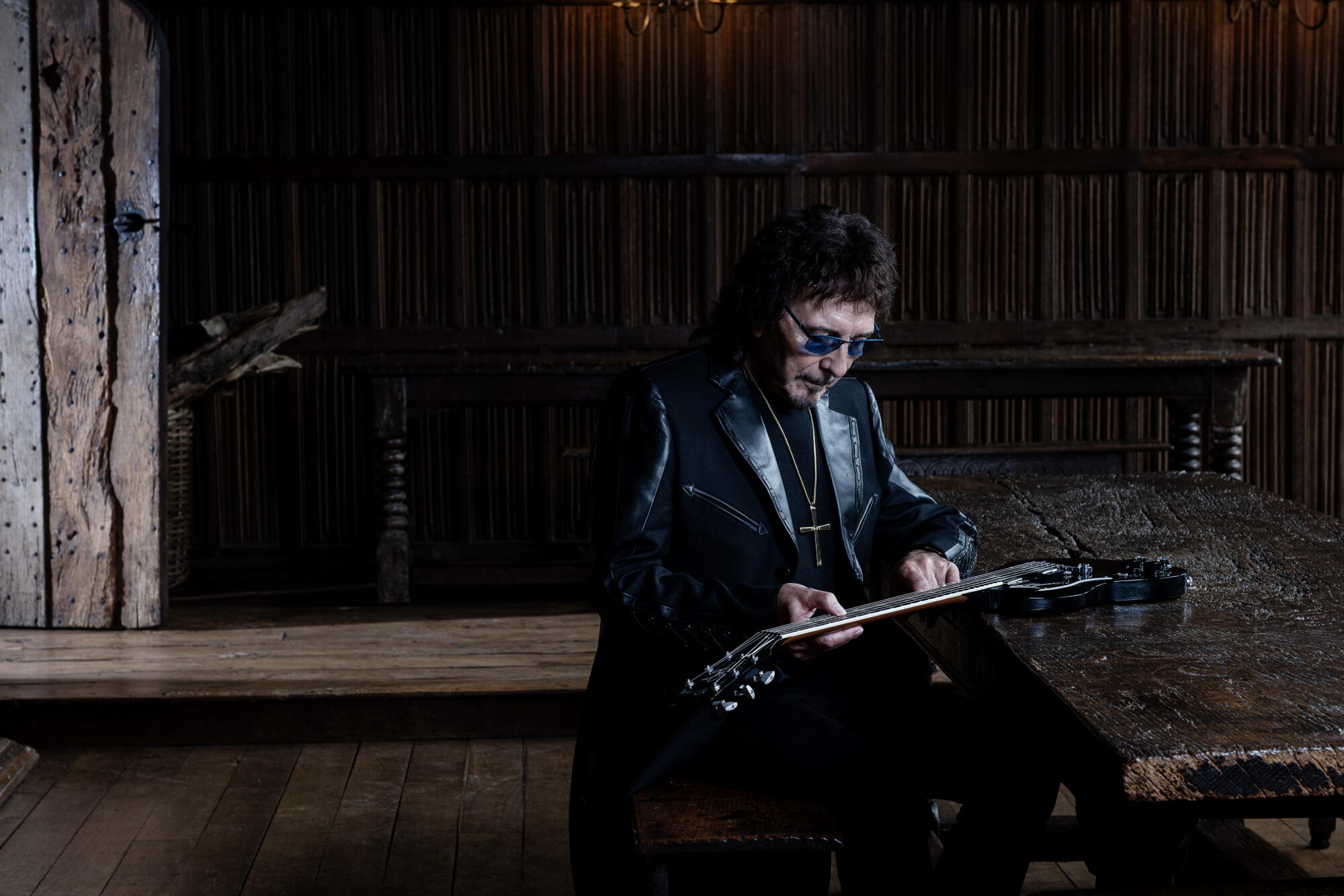
Born 78 years ago, in Birmingham — the town where Sabbath first formed and later performed its final show in 2025 — Iommi remains defined by his signature look. It is hard to imagine the guitar legend without his trademark black shirt, large silver cross, blue-tinted glasses and leather coat. His playing — down-tuning his guitar to lower the pitch for a menacing and heavier sound — may have morphed very slightly over the years, but “I think you just do it naturally without even thinking about it. My writing ideas are still the same. I still come up with miserable stuff,” he says, chuckling. “I like to do riffs and whatnot, so I enjoy that.”

Tony Iommi with his band vocalist Jørn Lande (far right), bassist Becky Baldwin, and drummer Karl Brazil and producer Mike Exeter
(Tina Korhonen)
On “From the Dark,” lyrics are all Lande; Iommi has no interest in telling his own stories using words. Yet a new tune like “Beyond the Dead” seems as if it could be about Iommi’s 2011 diagnosis and treatment for early-stage non-Hodgkin lymphoma.
Not so, the guitarist affirms, while acknowledging that the lyrics could be read that way.
“It was about beyond the living, beyond the dead, and coming back. Really deep, but that’s good. I do love what he’s done. When somebody like Jørn comes in, as with Dio, they’d write their own lyrics, and I prefer that because they’re going to sing them,” Iommi explains. “It’s like somebody saying to me, ‘Play this and play that.’ I want to play what I feel and what’s coming from me.”
There was a time when Sabbath did take a slightly different approach to writing and recording, but it wasn’t at their own initiative. In 2001, the band recorded “13,” Sabbath’s 19th and final studio album. It was the first studio record with Osbourne since 1978’s “Never Say Die,” and producer Rick Rubin was on board for the reunion.
What did Iommi learn from Rubin?
“I learned not to use a producer again,” he quipped. “It was strange because Rick wasn’t there most of the time. He’d be there for a certain recording, then he’d disappear. I’d written a lot of the stuff, and then we’d play it, and he go, ‘I don’t like that bit, I don’t like that part,’ and then disappear.
“One Friday he phoned me up — because he wouldn’t talk to the others [Osbourne, Butler]. He wanted me to relate what he’d said to the others. He said, ‘Could you write a song over the weekend that’s like “Planet Caravan,” so we can record it on Monday?’ I went, ‘What?!!’ But it happens that I did do it.” The end result was “Zeitgeist.”

Iommi is still processing Ozzy Osbourne’s death, just 17 days after Black Sabbath’s final performance, and says watching the concert film will bring back painful memories.
(Ross Halfin)
Iommi’s key plans for his new lineup and record were to make sure the players brought a healthy dose of enthusiasm. Baldwin is the first female he’s been in a band with. Iommi has a comfort zone, so he’d originally wanted Butler on the new album, which didn’t work out logistically. “Becky happened to be a big fan of Geezer, so we got Becky over to my home studio, and I did throw her in the deep end a bit,” admits Iommi. “I gave her the first track, which was ‘World Alone.’ I said, ‘Play that.’ She listened to it a bit and started playing it. It was really good. I just wanted to see what she’d be like straight away, just to see what she came up with, which was a bit horrible of me, I suppose.
“She worked out really good. The other thing is enthusiasm,” he continued. “I wanted people involved in this that really love what they do and really enjoy playing, and she constantly wants to play and be involved in the music, and it’s a great attitude.”
Another Brit superstar who also opts to play with relatively unknown, ardent players is Zeppelin’s Robert Plant. “He’s the same,” Iommi acknowledges. “We spoke about this, myself and Planty, because obviously we’ve known each other a long time. He could have easily done Zeppelin, but he wanted to do what he wanted to do.”
What a collaboration Iommi and Plant would be.
“I did say to him one time about doing something together, but again, he got his own thing, and I did [too]. Who knows? We’ve talked about it a couple of times, but he’s into a certain flavor of music that he likes to play, which is different to what I play, really. I don’t discard anything that way. If something comes up that’s a good idea and somebody’s into it, then I’m going to have a go.”
It’s been 26 years since Iommi’s debut, a self-titled solo album with a roster of guest vocalists including Osbourne, Dave Grohl, Henry Rollins and Pantera’s Philip Anselmo. “How fast it goes,” Iommi says with a chuckle. “Twenty-one years ago was my last solo album. And that’s long enough, isn’t it? But I was just busy with the Sabbath thing and then other things, including the Sabbath ballet.”
While fans would adore a tour, Iommi says he’d only do the occasional “one-off.” He will allow a moment of supposition, if pressed. “I suppose if I did something like that, I’d probably do some Dio stuff and maybe [one-time Sabbath vocalist] Tony Martin and maybe ‘Paranoid,’ ‘Iron Man.’ I haven’t really thought about it. Again, it’s not Sabbath,” he concludes. “It would be an Iommi thing, but it is part of my background. So I suppose I would play some of the old ones.”