Meet UCLA receiver Semaj Morgan, who started a foundation at age 17
It never has been about the glory for Semaj Morgan.
Not the touchdowns. Not the name, image and license deals. And not even the 2024 national championship he won with Michigan.
For the UCLA wide receiver, all of that plays second fiddle to giving back to his community in Detroit and touching the lives of the people around him through the Semaj J. Morgan Foundation — an initiative he started when he was 17 years old.
“My foundation is definitely the best thing that I do. It’s great being a football player, but being able to give back and show people that I really care for others and not just about football and money, I want to be able to pour back into the people that support me and show me love,” Morgan said. “A lot of people don’t get to wake up every day and know that there’s going to be food around. A lot of people in the city of Detroit don’t even know if they’re going to eat at all.”

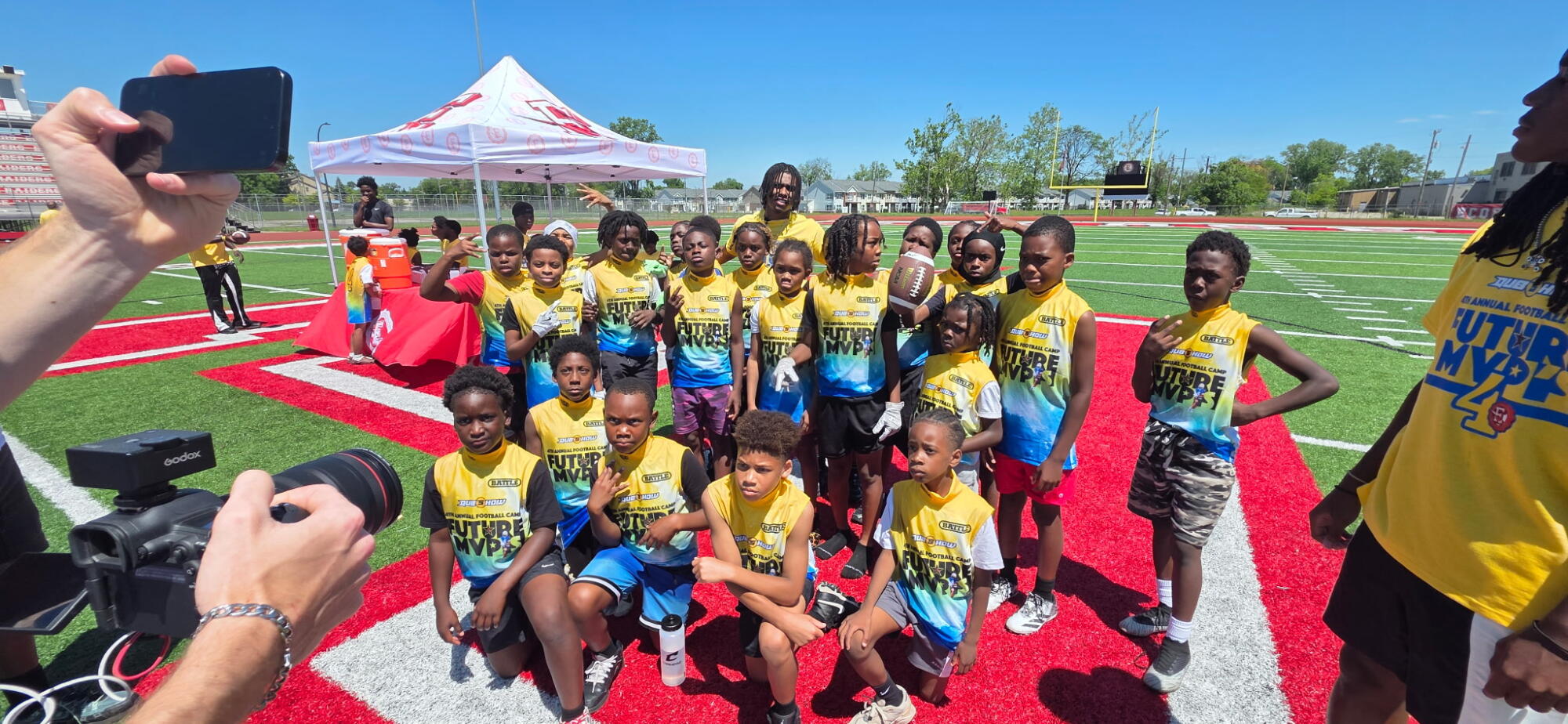
UCLA receiver Semaj Morgan is surrounded by children he has helped through his foundation.
(Courtesy of the Morgan family)
Morgan decided he wanted to start the foundation when he handed out toys with the Dream Team Male Mentoring group, telling his dad, Semaj T. Morgan, that community service was his calling. But at 17, he was too young to have his name on the paperwork, so his parents opened the foundation for him.
Since the foundation’s launch in February 2023, Morgan has hosted turkey drives, during which he gives away 2,000 turkeys, 2,000 food bags and 1,000 hot meals along with hats, coats, scarves and gloves, in an effort to tackle the health and food gaps in his community.
Morgan also has spearheaded back-to-school giveaways, handing out backpacks and supplies to children.
“We don’t do it just to do it. We do it because we’re trying to close the educational gap that our kids in Detroit suffer from,” Morgan’s father said.
“When you have a kid that’s going to school with the same notebooks and pens and highlighters and erasers that their counterparts have, now they have more confidence when they go to school.”
Morgan received a grant from the Ballmer Group, founded by Clippers owner Steve Ballmer and his wife, for the foundation’s DiscoverWorks Summer program. The initiative serves 250 families, giving students the opportunity to get their test scores up in the morning and go on field trips in the afternoon, alongside other enrichment activities such as robotics and mentoring.

UCLA quarterback Nico Iamaleava celebrates with Semaj Morgan after scoring a touchdown against Purdue at the Rose Bowl on Sept. 19.
(Ronaldo Bolanos/Los Angeles Times)
But the endeavor closest to Morgan’s heart is the foundation’s Mother’s Day and Father’s Day events.
“These are mothers and fathers who lost their sons to gun violence. Semaj is their son, and he takes his NIL money, and he takes them to dinner, buys them gifts as if their son was here,” Morgan’s father said. “These are parents that a lot of these children’s murders have not been solved, so this is a way for us to bless these parents, let them know that they’re not forgotten. There’s never a dry eye in the room.”
The events — which started out with 10 moms and five dads and are up to 35 moms and 20 dads — are particularly special to Morgan, who was friends with some of the sons of the parents involved. Morgan said that seeing the parents and hearing their testimonies puts everything in his life into perspective.
While Morgan is humble about the effect his foundation has had on the people around him, others are taking notice.

UCLA receiver Semaj Morgan holds up a Michigan state Senate certificate recognizing his foundation’s work to support people in Detroit.
(Courtesy of Morgan familiy)
Morgan was recognized on the Michigan House floor by state Sens. John DaMoose and Rosemary Bayer for the community service that he’s led in Detroit.
And during the 2024-25 academic year, Morgan was nominated for the inaugural Big Ten Jackie Robinson Community & Impact Award by his previous school, Michigan, for his philanthropic work.
“He understands his mission and call in life, and that’s to bless other people. He’s not about him; he’s about other people, and it’s very rare that you see individuals at such a young age understand their mission and cause in life,” Morgan’s father said.
“Football is one thing, but when he’s giving out turkeys, food bags, hats and coats, he has a bigger smile than getting in the end zone because he understands these people need help.”
Morgan’s desire to help others was inspired by Curtis Blackwell — Morgan’s travel football coach and president of Sound Mind Sound Body Sports Academy. Morgan’s father said Blackwell always urged players to give back to others.
Blackwell, who coached Arizona Cardinals cornerback Will Johnson, Buffalo Bills cornerback Maxwell Hairston and former Michigan safety Makari Paige alongside Morgan, stresses education before football and places an equal emphasis on academics, athletics and life skills.
And because Michigan does not get the same high school football exposure as Texas, Florida or California, Blackwell was keen on getting his players on college visits, leading to Morgan receiving more than 25 offers — a direct result of the travel the team made to raise players’ exposure.
“Growing up in a single-parent home, I was fortunate to get a scholarship to college, and it was because of my coaches. And had it not been for my coaches, I don’t know where I would be,” Blackwell said. “If we as coaches are the best people to really influence young people, they will listen to their coach more than their mom, their teacher. And so if we can get the coaches to be the teachers off the field, we could really change their attitude.”
Blackwell was astounded that Morgan was the pupil who took the program’s mission the furthest, surpassing the efforts of NFL players and affecting people well before he’s turned 21.
“You don’t have to wait till you get to the NFL to make an impact. You don’t have to wait till you retire to give back. You can do something every step along the way, and that’s what we teach to our kids — lift as you climb,” Blackwell said. “Semaj took that and ran with it. He has a really big heart and he’s a person that is a giver, not a taker. He’s going to give you the shirt off his back.”

UCLA receiver Semaj Morgan catches a touchdown pass against Purdue at the Rose Bowl Stadium on Sept. 19.
(Kevin Terrell / Getty Images)
Morgan earned his bachelor’s degree at Michigan and is working on his master’s degree at UCLA while playing football and running his foundation from the West Coast. But he may miss his first foundation event when UCLA travels to Ann Arbor to play his former school in November, although coach Bob Chesney already gave him permission to stay in Michigan after the team leaves.
Morgan’s greatest achievement that weekend may not involve the scoreboard at the Big House.
“I might not have done the best on the field last year, but being able to come home knowing that I’m touching people’s lives, that’s the biggest thing for me,” Morgan said. “To do this at such a young age, and grow so rapidly and touch so many lives, it’s great for me. After football, I want to continue to give back to people. I eventually want to be able to start football programs.”