


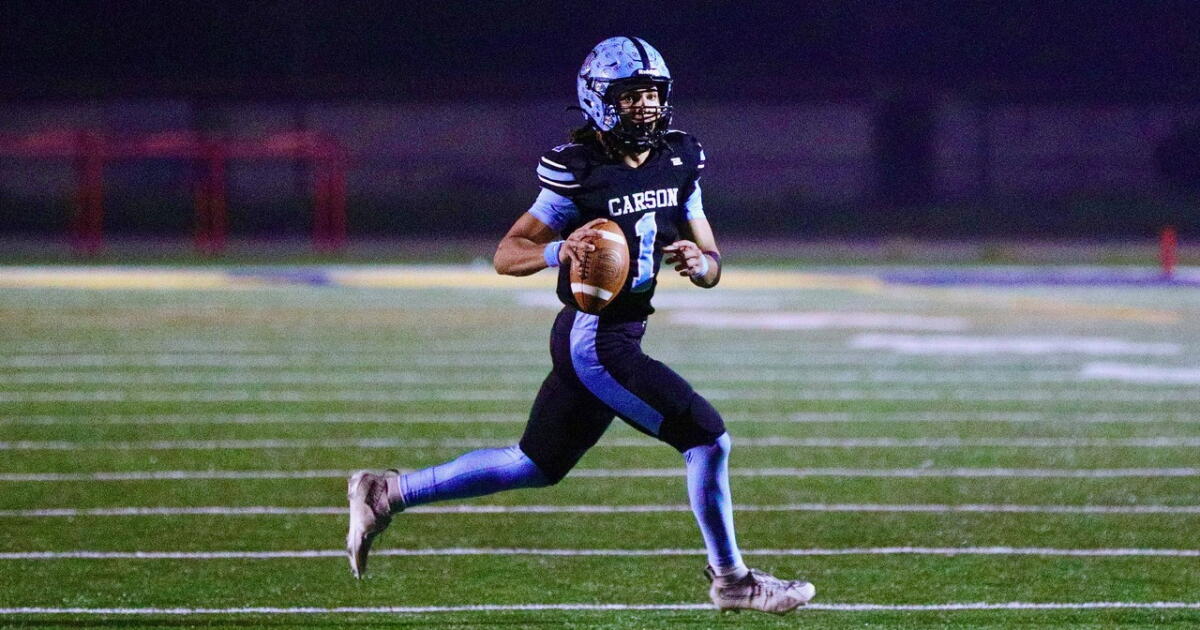
The Times’ top 10 City Section high school football rankings
The Times’ top 10 high school football rankings from the City Section:
1. CARSON (7-1). It’s Marine League title decision night on Friday vs. San Pedro.
2. CLEVELAND (8-0). Cavaliers produced two 100-yard rushers last week in win over Taft.
3. SAN PEDRO (6-1). QB Seth Solorio needs time to throw in showdown with Carson.
4. KING/DREW (5-3). Golden Eagles on verge of first Coliseum League title.
5. BIRMINGHAM (3-5). Patriots’ offense is starting to improve.
6. CRENSHAW (5-3). Cougars struggled in second half of loss to King/Drew.
7. KENNEDY (8-0). Matthew Quintanilla having big season rushing.
8. GARFIELD (7-1). Ceasar Reyes has passed the 2,000 yards rushing mark.
9. MARSHALL (8-0). Barristers are headed to showdown with Eagle Rock next week.
10. PALISADES (4-3). Dolphins in position to win Western League title.

US leaving oil-for-security approach, not Middle East: Envoy Tom Barrack | Military News
Doha, Qatar — The United States is moving away from its traditional security-for-oil relationship with the Middle East and no longer seeks to dominate the region, senior US diplomat Tom Barrack has said.
However, it was not abandoning the Middle East, he added, speaking at the Global Security Forum in Doha on Tuesday — but rather reassessing its role, after years of attempts to reshape governments across the region.
Recommended Stories
list of 3 itemsend of list
“The US no longer wants to own,” said Barrack, who serves as US Ambassador to Turkiye and Special Envoy for Syria. “The bargain is not to control, but to not leave. We’re not leaving.”
Barrack acknowledged that regional countries were increasingly recognising the limits of US involvement.
“Everybody is saying: OK, I can’t rely on America to solve all my problems,” he said.
Barrack questioned the effectiveness of previous interventions, saying that the US had been involved in 23 regime changes across the wider Middle East.
“Every time we try and intervene, change the person or the regime, it seems to have been a mistake,” he said.
His comments come as Washington and Tehran try to negotiate an end to the US-Israeli war on Iran that has destabilised the region and disrupted global energy supplies.
Political analyst Luciano Zaccara described Barrack as probably “the most realistic of Trump’s allies” in his assessment of US involvement in the Middle East.
He told Al Jazeera that Barrack had effectively acknowledged that regime change, one of Trump’s stated objectives in the war on Iran, was unlikely to succeed.
Zaccara said Barrack’s reference to regime changes in the Middle East was an acknowledgement “that what the US has been doing in the region has not been working, regardless of which administration it was”.
According to Zaccara, Barrack had stopped just short of suggesting that Trump needed to retreat from “the maximalist demands” he had made of Iran.
US-Iran negotiations ongoing
Qatar says negotiations between Tehran and Washington are continuing despite growing fears of renewed fighting.
Ministry of Foreign Affairs spokesperson Majed al-Ansari, speaking separately at the Global Security Forum, said mediators were continuing to exchange messages between the warring parties, with regional partners involved in efforts to reach a deal.
“We are working between the parties, continuing our job as mediator with our partners and others in the region,” he said.
Al-Ansari said the lack of public information about the negotiations should not be interpreted as a lack of progress.
“The fact that we’re not hearing about it is a good sign that we’re doing our job properly,” he said.
The diplomatic efforts come as Iran’s seven-day proposal to end the war remains on the table, with the US yet to give its response.
The plan envisages reopening the Strait of Hormuz and resuming nuclear negotiations in exchange for US concessions, including lifting the naval blockade on Iranian ports and easing economic sanctions on Tehran.
Analyst Negar Mortazavi said the diplomatic door remained open, but negotiations were stalled over the terms and sequencing of an agreement.
“Tehran wants to end the war, but it is not prepared to surrender under military or economic pressure,” she told Al Jazeera on the sidelines of the forum in Doha.
The Strait of Hormuz remains a major flashpoint, with attacks on commercial shipping raising concerns over global energy supplies. Before the US-Israeli war on Iran, one-fifth of the world’s oil and gas supplies transited through the strait.
Mortazavi said the escalation was part of Tehran’s strategy to maintain leverage against Washington despite its military disadvantages.
“Iran’s leverage has diminished but has not disappeared,” she said. “Moving tankers is not the same as restoring safe, predictable and normal maritime traffic.”
According to Mortazavi, Tehran wants to increase the economic and political costs of the war for Trump, while signalling to future US administrations that military action against Iran carries consequences.
But she warned that continued escalation posed serious risks to Iran and the wider region.
“Ultimately, neither military escalation nor economic pressure is likely to produce Iranian capitulation,” she said.
Fighting in Yemen
Qatar’s Ministry of Foreign Affairs spokesperson also reaffirmed Doha’s support for Riyadh in the fighting against Yemen’s Houthi armed group, saying it backed Saudi Arabia in “defending their sovereignty against this attack”.
Fighting intensified in September after the Houthis seized areas along Yemen’s Red Sea coast, including the port city of Mocha. In response, forces loyal to Yemen’s internationally recognised government launched an offensive, dubbed “Dawn of Yemen”, on October 4, backed by Saudi air strikes.
The Houthis have retaliated with missile and drone attacks on Saudi airports, oil facilities and military installations. Strikes on Riyadh’s King Khalid international airport earlier this month killed at least 14 people and wounded hundreds.

We Finally Know The B-21 Raider’s True Wingspan
Thanks to Google Earth, we can finally put this one to bed. Since the B-21’s unveiling, people have made wild claims about its wingspan, specifically how tiny it is. This was never the case, as we have reported continuously since we first set eyes on it. Many AI-generated and enthusiast-made B-21 fact sheets have gone viral on social media showing wingspans under 130 feet, which only helped propel the nonsense. Now we can definitively say, give or take a few feet, the B-21 spans 152 feet and is 61 feet long. This puts it at about 12% smaller in terms of wingspan than the B-2, and about the same — 12% smaller — when it comes to length.
The image in question, taken of Edwards AFB and dated June 20, 2026, was recently uploaded to Google Earth. While we have seen satellite images of the B-21 going about its business before, this one was published in the public domain and had enough resolution, when paired with Google Earth’s excellent measurement tools, to get conclusive measurements.

Since we first saw the B-21 at Plant 42 in Palmdale, California, during its unveiling, which TWZ attended, we put the top-end size at 155 feet wingspan-wise. That analysis has only narrowed over the years. I have had many emails, social media threads, and other engagements with folks claiming the aircraft was in the sub-130-foot wingspan range. Now we can finally put those battles behind us.
So what does the size tell us? Nothing we don’t already know. The B-21 was always going to be smaller than the B-2. Our analysis from many years ago has stayed the same — the aircraft would be designed with a premium on range and affordability, as well as very low observability, over massive payload. This resulted in the aircraft you see today. It is smaller, but with design priorities that have shifted from its predecessor’s, and 12% smaller in pure dimensions makes total sense considering what Northrop Grumman was trying to achieve. Above all else, it points to the B-21 having an extreme unrefueled range, with improved aerodynamics for high-altitude cruise, more gas for its size, and two efficient engines instead of four.

As for its length, the B-21 is nearly the same length as an F-15 fighter, which sounds bizarre for a large bomber. However, flying wings are visual transformers, looking like compact UFOs side-on and massive head-on or from the planform view.
As far as what else we can discern from the Google Earth image? Not much. We get a bit of a better view of the B-21’s exhaust configuration, but nothing is really revelatory there. The exhausts are deeply buried with large planar exhaust exit ‘ramps’ and have a large chevron trailing edge over the exhaust aperture itself. We have seen some pretty detailed images of this general arrangement from the rear that have been posted on social media. We do see the exhaust pathway as black in color, a feature that was edited out in the official top-down photo of the B-21 seen above, which was released in April, and this is something we mentioned at the time.
Regardless, at least we can say with total confidence that the B-21 is smaller than its progenitor, but not by all that much — about 12% to be more exact.
Contact the author: Tyler@twz.com

‘Laughing’ Russell Brand ‘sexually assaulted radio worker in “sloppy & frenzied” attack as his entourage watched’
“LAUGHING” Russell Brand sexually assaulted a radio worker in a “violent, sloppy and frenzied” attack as his entourage stood by and watched, a court heard.
The comedian, 51, is accused of forcing six women into sexual acts and kissing and groping them in an “obsessive” campaign to sleep with 5,000 women.
On the fifth day of his trial, jurors heard from a woman who was in her 20s working at a radio station in the mid-2000s when Brand allegedly sexually assaulted her.
She told Southwark Crown Court Brand was a “perfect stranger” to her at the time and said his alleged assault was “violent”, “sloppy” and “frenzied”.
Describing the alleged attack, she added: “It was hard, I would say it was sloppy, he kissed my mouth, he just was kissing me and it was hard, it was very hard.
“He was kissing me all down my neck, his hands at the same time were all over me.”


Asked about where his hands were, she said: “He touched my bum, he touched my breast, he had his hand on my waist and his other hand was just pinning me against the wall, and his body was just pressed up against me.”
The woman added: “It was rough, it was very, very rough. It was hard, I would say that his whole body was pressed against me, the kisses were hard and sloppy, going down my neck
“The reason I used the word frenzied is because it was just, it was violent.”
She said four members of Brand’s entourage including a woman were in the room at the time but “did nothing”.
The woman wept as she told jurors: “I wonder why those people didn’t do anything to stop him.”
She also told the court she had locked eyes” with the other woman and was “pleading with her” to stop what was allegedly happening.
The woman said she was “stunned” and “in a haze” but managed to push Brand away and told him to “f*** off”.
She added: “I remember he made like a sound, that was like funny – ha ha – like that.”
Jurors heard Brand allegedly preyed on the complainants between 1999 and 2009 in a bid to satisfy his “voracious” sexual appetite.
One of the women was allegedly raped in a hotel room in Bournemouth in 1999 after a Labour conference.
The woman said Brand had suddenly “changed” from being “camp, friendly, and effeminate” to “monster-like”.
Jurors were also shown pictures that Brand allegedly made one of the women take moments before he raped her.
The images – released by police – show the comedian topless in a pair of white trousers blowing a kiss to the camera.
She told police she remembers feeling “frightened” after Brand forced her to take the pictures of him on her camera.
She added: “I took pictures of him on my camera – he made me take them.
“I was frightened. I remember feeling ‘what on earth have I got myself into’ – and then he did rape me.
“He pushed me onto the bed. He did take my trousers off.”
She previously claimed he emerged topless from the toilet and “was prancing around the room, a bit like an ostrich, doing silly walks like Basil Fawlty”.
The woman later added: “I found his body quite snake-like and disgusting. It made me feel sick, if I’m being honest.”
Another alleged victim who claimed she was targeted by Brand while working at MTV in 2001 also gave evidence.
At the time he was the flagship presenter at the video music channel, jurors heard.
The woman said Brand was “pleading” for her to join him in the toilet before he “grabbed me by the arm and started to pull me in, saying ‘come on, come in with me’.”
She described Brand as a “wild-eyed maniac” during the alleged assault and said she was left “bewildered” and “confused”.
Prosecutor Riel Karmy-Jones KC dubbed the comedian a “sexual predator” who was “ruthless, calculated and manipulative”.
She also said women have told police he was “childlike in his expectation that his every desire should be met”.
The court heard the alleged offences took place when Brand’s “public profile was taking off”.
He allegedly prayed on women in a number of locations – including workplaces, a toilet cubicle in a bar and at his home address.
The fifth alleged victim met Brand after seeing his show at the Hammersmith Apollo in London with a friend in 2009.
He allegedly told her his age range was from “16 to death” before she was invited to a backstage bar where they kissed and had a threesome.
The woman claims she went to his home the next day where Brand told her: “Your hair smells funny”.
He then made her take a shower and wash her hair while he watched through a glass shower cubicle, it was said.
Ms Karmy-Jones said once in the bedroom, they had consensual sex but afterwards Brand “flipped” the woman on to her front and on all fours and allegedly penetrated her anally.
Afterwards, jurors heard the comedian told her to “clean up the mess you have made”.
The sixth woman worked for Channel 4 when she met Brand while he was filming a project.
She said she was informed Brand was “unhappy” and the situation would not improve unless she gave him a massage, jurors were told.
The woman claimed he walked up to a chair she was sitting on and placed his head directly into her groin area.
Brand has denied three counts of rape, three of sexual assault and one count of indecent assault against six women.
The trial continues.

1-800-Flowers.com closes on asset sales (FLWS:NASDAQ)

L Feddes/iStock via Getty Images
1-800-FLOWERS.COM (FLWS) announced that it has completed the previously announced $45M sale of PersonalizationMall.com and Things Remembered to PlanetArt, LLC, a leading global technology platform for personalized, made-on-demand e-commerce products.
The company said the completion of the transaction represents another
I found a walkable Italian city with fewer crowds in winter — not Florence or Pisa
Tuscany is often sold on Florence and Pisa, but a walled city I visited in late September stood out for its piazzas, rooftop views and brilliant food. With averages of 15°C in November and 12°C in December — and far fewer crowds — it’s ideal for a winter break.

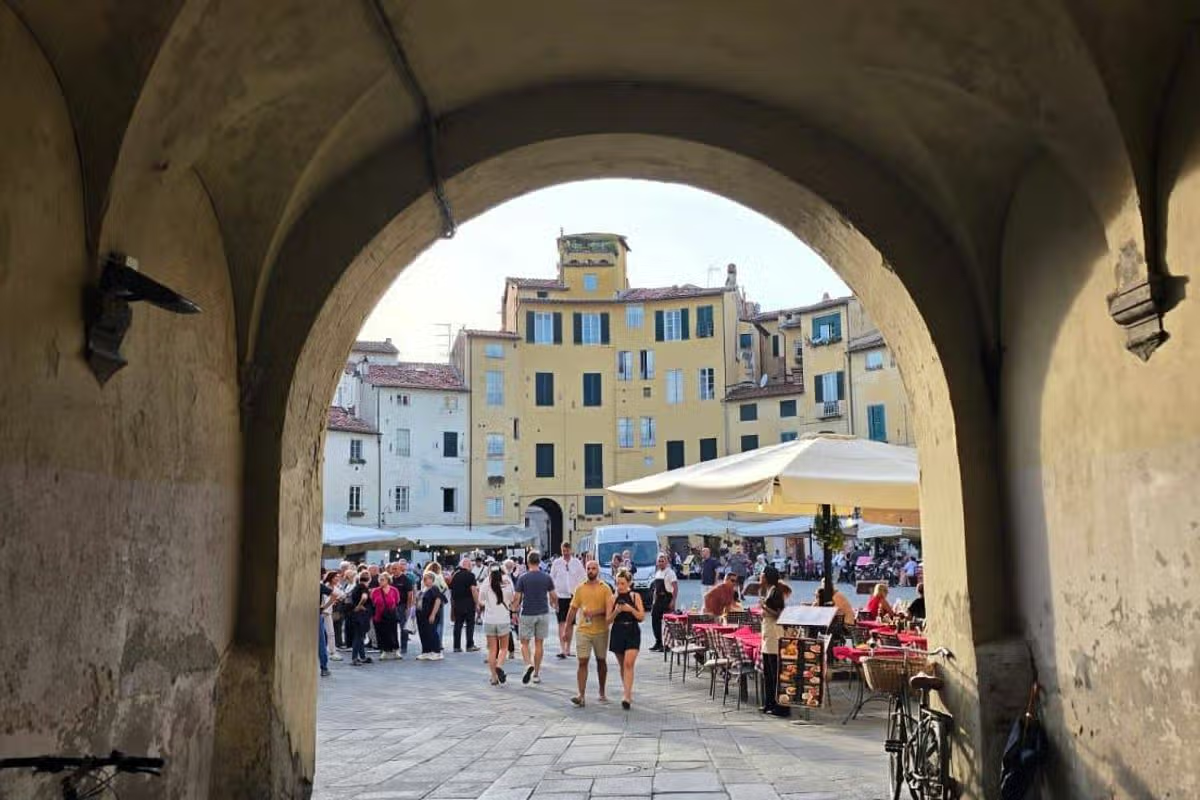
One Italian city is often overlooked for the likes of Florence or Pisa(Image: Chloe Dobinson)
Nestled in the heart of Italy, Tuscany is celebrated for its gently rolling hills, charming medieval villages, vast vineyards and iconic Renaissance masterpieces. Boasting mouth-watering local food and a relaxed pace of life, the region has something for every holidaymaker seeking the very best of Italian culture.
Tourists can spend their mornings strolling through ancient towns, savour unhurried lunches with vineyard views, and watch the sun dip below the horizon with a glass of locally produced wine in hand. Having visited the region in late September, I find it equally worthwhile to head there in November and December as a winter getaway.
Average temperatures in the city are around 15°C in November and 12°C in December.
Tuscany is made up of 10 provinces, with its capital, Florence, celebrated for its extraordinary Renaissance heritage, iconic artwork and breathtaking architecture.
Other provinces include: Arezzo, Grosseto, Livorno, Massa-Carrara, Pistoia, Prato and Siena.
Florence and Pisa tend to be the first places that spring to mind when Tuscany is mentioned, yet one destination I discovered on my travels left a lasting impression — Lucca.
What is Lucca famous for?
The historic city walls
Among Lucca’s most treasured landmarks is its four-kilometre circuit of Renaissance walls, built between the 16th and 17th centuries. Originally constructed for defensive purposes, the walls today serve as a tree-lined public walkway, giving visitors the opportunity to stroll or cycle while soaking up sweeping views of the ancient city below.
Ensure our latest travel stories always appear at the top of your Google Search by making us a Preferred Source. Click here to activate or add us as a Preferred Source in your Google search settings
Piazza dell’Anfiteatro
Piazza dell’Anfiteatro stands as one of Lucca’s most striking landmarks. Constructed on the foundations of an ancient Roman amphitheatre, the oval-shaped piazza is surrounded by vibrant buildings, cafés and eateries, creating an idyllic spot to unwind and absorb the city’s ambience.
I stopped for lunch and took in the delightful views across the square. Prices here are typically a touch steeper, though that’s hardly surprising.
I opted for boar ravioli at €9.60 (£8.07). It might not seem expensive, but the serving was modest, leaving me rather peckish afterwards. Worth remembering when dining in a popular tourist area.
Torre Guinigi
The medieval Torre Guinigi ranks among Lucca’s most peculiar attractions, instantly recognisable for the oak trees flourishing in its rooftop garden. Visitors can ascend to the top for panoramic views over the city’s terracotta rooftops and the surrounding Tuscan countryside.
Lucca Cathedral
The Cathedral of San Martino is celebrated for its ornate Romanesque design, beautifully decorated marble frontage and impressive collection of sacred artworks.
Other significant religious sites include the Basilica of San Frediano, distinguished by its eye-catching mosaic exterior, and the Church of San Michele in Foro, positioned in a historic piazza at the city’s centre. When is the best time to visit Tuscany?
Lucca tends to be far less crowded during the winter months, making it an ideal period to discover its museums, historic churches and traditional eateries.
The city is perfectly suited to those who prefer to explore on foot. We covered the whole place in just half a day without relying on public transport, though a full day or longer is recommended if your schedule allows. That said, visitors should be ready for chillier temperatures and a higher likelihood of rain.
How to get to Lucca?
The most straightforward route from the UK to Lucca is to fly into Pisa, then continue onwards by train, taxi, or hire car.
By car, the trip typically takes around 30 to 45 minutes, depending on traffic.
By train, passengers can hop on a service from Pisa Centrale to Lucca railway station, with the journey usually taking around 25 to 30 minutes. Extra time should be factored in to travel from the airport to Pisa Centrale.
Direct return flights from London to Pisa are priced at around £31 in November and £32 in December (at the time of writing).

Tiny Victorian train station with trackside bar & Airbnb crowned best in the UK
A SMALL station in Manchester that first opened in the 1800s has been crowned the best in the country at the ‘World Cup of Stations’.
It has trackside seating, an Airbnb upstairs and beat 150 stations across the country for the title.
‘The World Cup Of Stations’ was launched in honour of 200 years of railways in Britain and brings attention to the stories behind the stations and how much they’ve changed and brought communities together.
This year there was 150 nominations from across the country, but Irlam in Salford took the title with 4786 votes.
Irlam Station first opened in 1873 and was used for many years although its station building fell into disrepair in the 1980s.
The station itself remained opened to passengers and now sees as many as 350,000 passengers each year.


11 years ago, the station house was restored as part of a £2million project and reopened in March 2015.
It’s much more than a simple station now, as inside is a railway-themed café-bar with train carriage booths.
The 142-year-old signal box has been restored and reopened.
There’s a heritage hub too which has railway artefacts including formerly used locomotives.
In The Station garden is an homage to Harry Potter‘s Platform 9 and three quarters, as well as James the Tank Engine.
Also outside in the Station Art Park are 3D sculptures which ‘reflect the area’s history‘ including a seating area and Hobbit-style cottage.

Back inside the station house is Irlam Café Bar which serves up breakfast, main meals from burgers to toasted sandwiches, salads and even Sunday roasts.
Afternoon tea can be booked from £18.95 and train enthusiasts will love that you can enjoy this in the Signal Box.
It’s also a bar so there are plenty of drinks to try too and seats outside for trainspotting.
Above the train station is an Airbnb – the apartment can sleep up to four people across two bedrooms and guests enter through the Station Master’s Door.
One guest wrote in their review: “The apartment is located in a train station which makes this very special place.”
Another called it a “unique space perfect for train enthusiasts.”
A three-night stay for four in November can be booked for £404 – or £33.67pppn.
Tricia Williams, Managing Director of Northern, said: “The station has a unique charm and is well worth a visit. You can enjoy a meal in the café, take a tour of the gardens to see some amazing 3D artwork and visit the heritage hub.”
The other final four stations in the running were Cardoss in Argyll & Bute, Brookwood in Surrey, Yatton in Somerset and Berney Arms in Norfolk.
Last year’s winner was Ashington in Northumberland which closed in the 1960s and then reopened in 2024.

Trump’s attack on California voting is false, and a bit funny
In what may be one of the most comical self-owns in recent politics, the esteemed attorneys of the U.S. Department of Justice announced Monday that despite the extravagant and terrifying misuse of their investigative power under the Trump administration, they have so far been able to identify only 28 people in all of California who may have voted illegally.
“The announcement today by the United States DOJ makes the point that there is no widespread voter fraud,” California Atty. Gen. Rob Bonta said after the news conference announcing the results of “Operation Protect the Vote.”
Twenty-eight people out of about 23 million registered voters in the state — and not all of them even tried to vote, according to the feds. That’s about 1 in 820,000 folks allegedly registering or voting illegally, a rate that roughly matches how often people in the United States get struck by lightning in a given year.
So much for Trump’s endless claims that there is a vast, organized conspiracy between Democrats and undocumented people to have them vote in large numbers to steal elections. I’ll point out here that none of those charged Monday have been accused of colluding with one another or with Democratic overlords.
All the power of the government — investigative, technological, legal — has been thrown at finding these mysterious, diabolically clever ballot baddies. And now, thanks to Bill Essayli, first assistant U.S. attorney for the Central District of California, and his colleagues across this great state, we now know that all 28 of them will be held accountable, if the government can prove wrongdoing. And let’s be clear — people who vote illegally should be held accountable.
But wait, there’s more, because this election-stealing plot by immigrants certainly doesn’t stop at the state line. Seamus Hughes of Court Watch, an excellent site that tracks federal litigation, reported Monday that since the start of this administration, 169 people have been charged federally with illegally registering or voting.
That number includes the new California cases, so it means an additional 141 potentially illegal voters have been charged across the U.S. — all told about 1 in 1.25 million registered voters being accused of illegally registering or voting, making this crime slightly less likely than guessing a six-digit pin code on the first try.
There. Is. No. Election. Stealing.
But that’s where the funny part ends, because this attack on California elections is serious and just getting started.
The federal government, you’ve probably read, is suing California, claiming it gave the state a janky thumb drive with 20,000 names of registered voters that it sort of strongly suspects maybe aren’t legal voters. Important note here: The government has been very careful not to claim that these people voted illegally, just that it might be so based on questionable data, which I’ll get to in a minute.
The feds gave the state a silly 48-hour deadline to agree to change constitutional law, dump common sense and sequester these 20,000 ballots, if they were even returned, to double-check they were cast by valid voters.
When California rightfully refused — because elections are run by states, not the federal government — the federal government sued on the thinnest of legal grounds. It basically claimed that voting illegally is illegal, and if California doesn’t do exactly what Trump wants, it could be violating the Supremacy Clause of the Constitution by impeding the feds from enforcing the crime of voter fraud.

First Assistant U.S. Atty. Bill Essayli speaks at a news conference Monday at which officials announced that 28 people in California had been charged with voter fraud.
(David Butow / For The Times)
Which is basically arguing that if the state government fails to stop voter fraud using the flawed methods Trump likes, then the state is somehow stopping federal authorities from prosecuting voter fraud themselves. But didn’t they just enforce it with 28 cases?
Get ready, because “state-facilitated voter fraud,” is a new right-wing thing.
California is “being complicit in non-citizens voting in our elections, and as they were warned last week, not only is it a civil violation, but they could also face criminal consequences,” Essayli said, which if it happened would give Trumped-up charges a whole new meaning.
Essayli said state officials are not being “good faith actors,” but I’ll argue that shoe is on the other foot. The list of 20,000 alleged, suspected, maybe-maybe-not illegal voters was likely drawn from the Systematic Alien Verification for Entitlements (SAVE) program, created by Elon Musk’s Department of Government Efficiency, if you can remember that unfortunate relic.
It sought to draw data from more than a dozen government databases that were not only not compatible with such information sharing, but which had been kept separate until now for privacy reasons. Americans in general did not want the government collecting unified, know-all records of every citizen.
Luckily for us, I guess, the SAVE system can’t actually create reliable, unified records. It confuses people, convolutes them, merges records of people with similar names, and in general has been deemed unreliable by data experts.
In September, the good folks at the UCLA Voting Rights Project joined with the Coalition for Humane Immigrant Rights to sue the federal government over its use of that system to target naturalized citizens for removal from voter rolls. Turns out, the government appears to be targeting immigrants who are now citizens with these voter fraud accusations.
As I wrote about a few weeks ago, naturalized citizens make up about 1 in 10 eligible voters, and nearly a quarter of them live in California. But they also live in swing states such as Michigan, where Democrat Abdul El-Sayed may draw such voters, and in other places such as Georgia and Nevada where races might be decided by only a few votes.
These arrests and lawsuits while voting is already underway in the midterms are a not-subtle form of voter suppression. Imagine being a naturalized citizen in the Central Valley, where ICE is driving rampant fear and where Republican Rep. David Valadao is running against Democrat Randy Villegas in California’s 22nd Congressional District — one of the nation’s most closely contested races.
Would you consider sitting this election out just in case your ballot draws the frightening eye of the federal government? Even knowing that your vote is legal, what if you lived in a mixed-status household? Would it be worth risking voting if it meant a knock at the door from immigration checking on your status, and maybe finding that family member who lacks it?
Why take the risk?
“Basically, what they’re doing now is just completely harassing and intimidating naturalized citizens who are legally eligible to vote through these actions,” said Matt Barreto, co-founder of the Voting Rights Project.
And if the vote isn’t suppressed enough to give Trump the results he wants, these prosecutions and lawsuits feed the beast of conspiracy, giving Trump fodder to claim the results are fake, the election stolen.
And round and round we go, reckoning with Trump’s claims that lightning is striking everyone, everywhere, all at once, because the vote didn’t go his way.

The new Lakers have much to prove, no chance of winning it all
Their face is gone, LeBron James getting kicked to a Philly curb.
Their voice is gone, longtime public address announcer Lawrence Tanter dying last month at age 76 after more than four decades of dulcet downtown tones.
A big piece of their heart is also gone, Jeanie Buss mired in an ugly court fight to maintain her last remaining sliver of influence in the wake of this summer’s sale to Bob Iger and Joshua Kushner.
Meet the 2026-27 Lakers, a team that will look different, sound different, feel different, play different and behave different from their recent predecessors in every way but one.
They’re still not winning a championship.
They’re still not getting to the conference finals.

Lakers guard Luka Doncic enters this season as the face of the franchise after LeBron James’ departure.
(Luke Hales / Getty Images)
They’re still destined to a sixth seed and a first-round knockout in the impossible West, a mediocre finish that is sure to convince new ownership to make massive changes — look out Rob Pelinka and JJ Redick! — and start all over again next season.
So call this a gap year.
They’ve graduated from LeBron, but they’re still not quite sure what they want to do with the rest of their life.
They’re planning on majoring in Luka Doncic, minoring in Austin Reaves and specializing in Walker Kessler, but there are flaws in all three, and the rest of the proposed curriculum is an unknown collection of ideas that have yet to be put together in a cogent package.
For now, the league’s biggest roster overhaul includes names that are just names, the likes of Quentin Grimes, Collin Sexton, Matisse Thybulle, Ziaire Williams, Sandro Mamukelashvili and Kevon Looney. Who knows where they will fit? Who knows what they can do?
Noticeably missing are the names Rui Hachimura, Luke Kennard and Marcus Smart, all decent contributors last season, and that’s too bad.
Then there’s the name Bronny James, whose future here took a nosedive when his pops moved to Philadelphia and he had a lousy training camp. Who knows how long Bronny will stick around, but at least the Lakers are out of the LeBron family drama business, which is good, because this team will create enough drama on its own.
First, there’s Doncic, and the risk in building around him, considering he’s missed an average of 20 games a season the last three years. He’s appeared in a total of five playoff games since leading the Dallas Mavericks to the Finals three years ago. He’s 27, but sometimes he trudges around the court like he’s 50.

Lakers guard Bronny James dribbles during a preseason game against the Kings at Crypto.com Arena on Oct. 8.
(Luke Hales / Getty Images)
Now that this is Doncic’s team, will he act like it?
Every centerpiece player in Laker history — from Mikan to West to Kareem to Magic to Kobe to Shaq to Pau to LeBron — has carried their group to a championship. They’ve not been considered a true Laker until they have done so. In the case of LeBron, one was not even enough.
Is Doncic prepared to shoulder this burden? He says yes. He says he’s done this before, although he’s never won an NBA title, so, um …
“It feels great,” he told reporters at media day last month. “Obviously, it’s a new challenge. I was in this position in my career a lot of times, so it’s not new to me. But I feel great. I feel excited, and like I said, I’m ready to go. It’s been a long time since I played basketball, so I’m ready.”
He got off to a good start this summer when he flew the team to his native Slovenia to spend a few days bonding. He is already acting like a captain. Now he needs to play every day like one.
“I see myself in this role, nothing new, but it’s very important,” Doncic said. “Everybody on the whole team, you know, look up to me, I have to look up to them. And it’s just, there should be many leaders, you know. You should be able to hold each other accountable.”

Lakers guard Austin Reaves dribbles past the Kings’ Nique Clifford during a preseason game at Crypto.com Arena on Oct. 8.
(Luke Hales / Getty Images)
Many leaders? Probably only two, Doncic and his newly minted $180-million running mate Reaves.
The Lakers were 30-11 when the two gunners were on the court last season, and no NBA duo averaged more points, but, again, this year is different.
Last year they both had LeBron as a safety net. This year, it’s all on them.
Just like Doncic, Reaves said he is ready to help guide his new teammates on this arduous journey.
“The expectation here of being a Laker is higher than it is anywhere in the world,” Reaves said. “The media presence, you know, every day something is going to come out about us, and just being able to know how to navigate that and help others navigate that is the main thing. One second we’re going to be the best team in the world. And the next you lose two in a row, you’re the worst team, you can’t figure it out. So, helping these guys understand that none of that really matters, it’s all about what goes on within these walls, is the main thing.”
Actually, for Reaves, the main thing is the postseason, where he has mightily struggled, even taking into account the slight guard usually enters each spring with all sorts of bumps and bruises. He’s been a lousy playoff shooter. He’s been a clumsy playoff playmaker.
But one of the greatest undrafted free agents in recent league history appreciates and embraces every chance to change the narrative, and he’ll have no greater chance than this season.
“You’re going to have failures within this long season,” he said. “But every single night you’re going to have an opportunity when you take the floor, especially for this organization, for this fan base to show the world what you’re capable of. So, you’re going to have every single opportunity to do good with the opportunities that you’re given.”
No Laker, it seems, will have a greater nightly opportunity to write his legacy than Kessler, who was acquired this summer from the Utah Jazz for the princely sum of two first-round picks and two first-round pick swaps.
He is being projected as a perfect lob and pick-and-roll partner for Doncic and a long-awaited rim protector, but let’s be real.
He played in five games last year and never started a full season in his four years in Utah and even for a perpetually tanking team, that’s not a big resume. What sort of NBA center he will be is anybody’s guess.
The Lakers are guessing huge, and at least he sounds like he’s ready for it.

Laker Walker Kessler fouls the Warriors’ Yaxel Lendeborg during a preseason game on Oct. 13 in Las Vegas, Nev.
(Ethan Miller / Getty Images)
“And as far as the belief that they’ve shown in me, I mean, it makes me excited for this year,” he said. “It makes me feel like I can run through the wall for this organization, this team, my teammates, so yeah, I’m just so excited.”
Good thing about that wall, because with this unsettled bunch, there will be plenty of them.
But, hey, at least one looming question has been answered. During media day, new power forward Mamukelashvili gracefully explained how to pronounce his last name.
“So, a lot of people think it’s hard, but I don’t think so,” he said. “It is Mamu-kela-shvili. So if you take like, I feel like, two letters at a time, and “shvili” at the end, it’s not that hard.”
If only the rest of this season would go so smooth.
South Korea to pull more embassy staff from Ukraine after POW row | Conflict News
Earlier this month, South Korea recalled its ambassador from Kyiv after Zelenskyy disclosed the prisoner transfer.
Published On 20 Oct 2026
South Korea’s Ministry of Foreign Affairs says it will withdraw additional embassy personnel from Ukraine following Kyiv’s lack of “constructive response” in a dispute about North Korean prisoners of war (POWs).
Seoul had told Kyiv of its position via multiple channels but had not received a sufficient response from Ukraine, ministry spokesperson Park Doo-soon said on Tuesday.
Recommended Stories
list of 3 itemsend of list
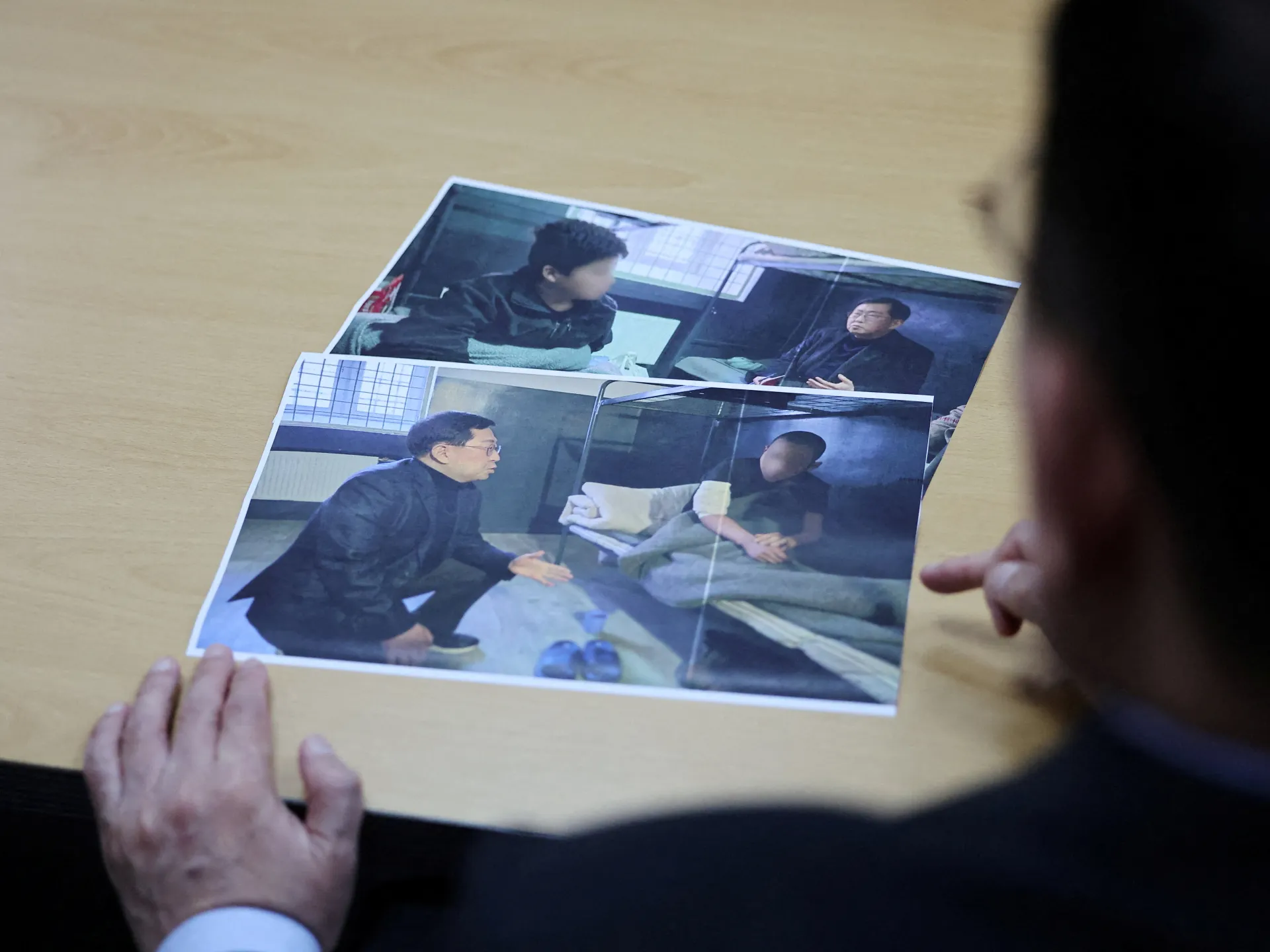
Earlier this month, South Korea recalled its ambassador from Kyiv after President Volodymyr Zelenskyy told the United Nations General Assembly (UNGA) that Ukraine had transferred two captured North Korean soldiers to the South.
The disclosure angered Seoul, which said the operation should have remained confidential to protect the soldiers’ families in North Korea.
“This measure was taken because we judged it necessary to facilitate an amicable resolution of the issue and restore trust between the two countries,” Park told a regular press briefing, without saying how many staff members would leave.
A charge d’affaires would stay on in Kyiv to maintain diplomatic communication along with all consular staff to protect South Korean nationals, Park added.
Persistent threats of air strikes across Ukraine had also made it difficult to ensure staff safety, he said.
Seoul previously summoned the Ukrainian ambassador and threatened unspecified “further measures”.
‘Situation resolved’
Ukraine has insisted that “diplomacy must prevail over emotions” in relations between the countries, and also said Kyiv considered “the situation resolved”.
South Korea’s Foreign Minister Cho Hyun said earlier this month that Ukraine had sent a message that “included words of apology” over Zelenskyy’s disclosure, but it fell short of “the level” Seoul had in mind.
Under South Korea’s constitution, all North Koreans are considered citizens of the Republic of Korea, as the country is officially known, and those who reach its territory and seek to defect are generally allowed to stay.
Albertans reject referendum on independence from Canada | Politics
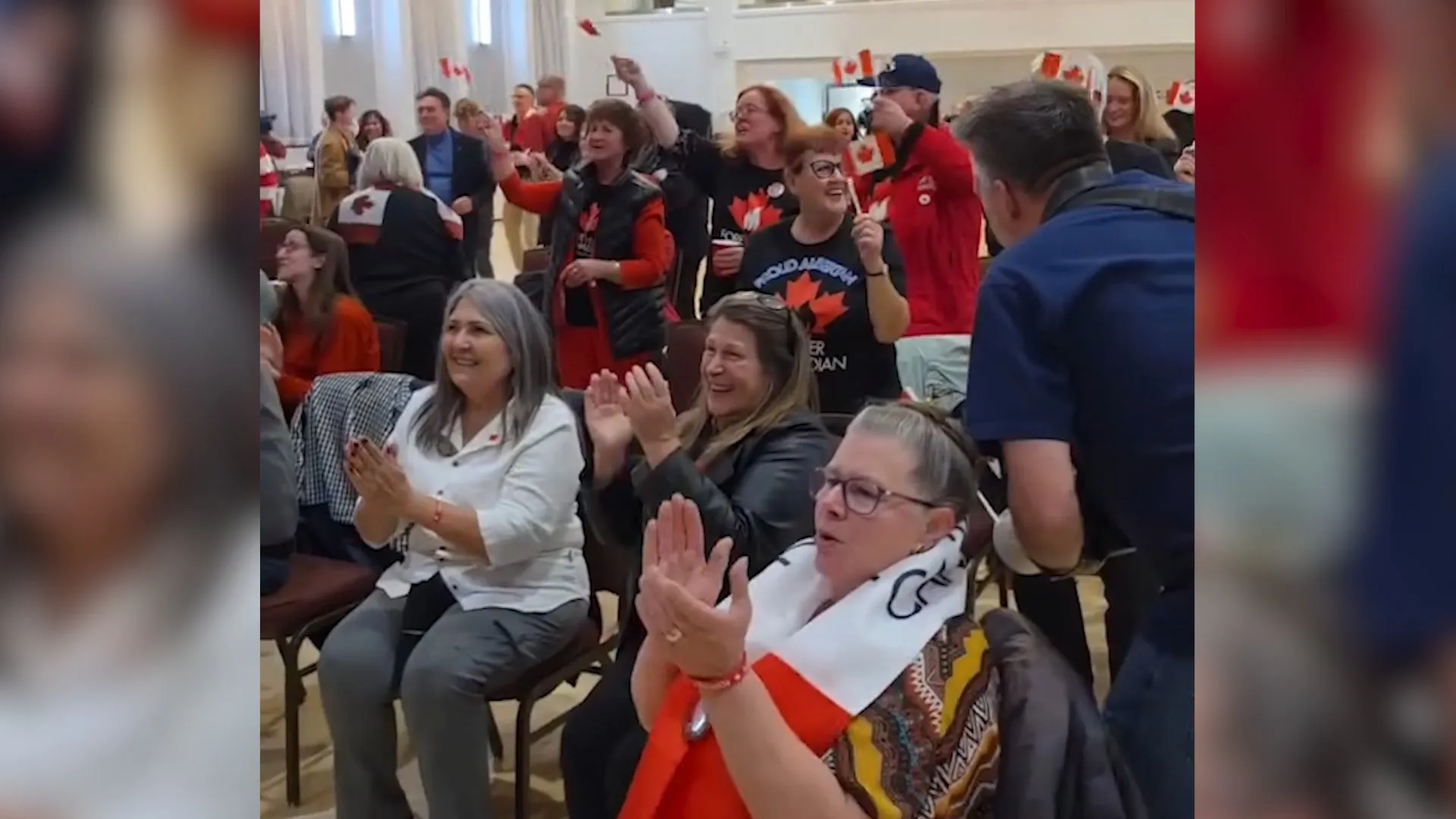
Around 76 percent of voters in the Canadian province of Alberta have rejected a proposal to hold a referendum on independence, according to unofficial results. It’s a victory for Prime Minister Mark Carney but more than 300,000 backed the proposal, and separatists say their grievances remain.
Published On 20 Oct 2026

Strictly, EastEnders and Love Island stars look ready for bed as they leave boozy awards party in taxi
CELEBRITIES attending last night’s Pride Of Britain Awards looked like they were ready for bed as they poured themselves out of the boozy after party.
Stars from big shows like Strictly Come Dancing, Love Island and EastEnders appeared to be all partied out, as they jumped into waiting cabs.
Just hours earlier they had all looked perfectly groomed as they glistened and shimmered on the red carpet at the Pride of Britain Awards.
But fast forward to the end of the night, and the stars leaving the after party at JW Marriott Grosvenor House looked like they had been enjoying the free bar.
Love Island icon Ekin-Su Culculogiu was in great spirits as she left the after party in her stunning gown.
The former Islander giggled, as she strutted out of the star-studded bash in London.
Read more Pride Of Britain


However, Strictly Come Dancing contestant Lacey Turner looked like she couldn’t wait to get into her PJs.
The EastEnders actress was seen heading to a waiting cab with sleepy eyes.
Fellow Strictly star Dani Dyer appeared to have been enjoying herself at the boozy bash.
The former Love Island champ left the party with a huge beam on her face as she waved out of her cab.
Katie Price‘s eldest kids Princess and Junior Andre were seen looking happy as they waved to fans in their cab.
The siblings are often spotted partying together, and it appeared they had enjoyed themselves last night.
Christine McGuinness was seen resting against a wall in her striking pink floral ball gown after enjoying the party.
But she later was seen beaming as she got into her taxi to head home to bed.
Despite looking a little sleepy, actress Helen Flanagan still looked glam in her shoulderless gown and long black gloves.
Strictly head judge Shirley Ballas was also spotted leaving the boozy bash and waved to onlookers as she headed home.
Hosted by Carol Vorderman and Ashley Banjo, Pride of Britain brings together royalty, world leaders, and hundreds of famous faces including music legends, sporting icons, Hollywood stars and TV favourites to celebrate the winners.
The Pride of Britain Awards 2026 will air on TV on Thursday at 8pm on ITV

SoftBank 5-Year CDS climbs to 432 bps on AI debt, acquisition concerns (SFTBY:OTCMKTS)
SoftBank Group’s (SFTBY) 5-year credit default swaps have climbed to 432 basis points, their highest level in four years, as worries mount over AI-related funding and a possible large acquisition. The spread has widened by more than 30 basis points since it

Tuesday 8 September Feast of Our Lady of Victories around the world
This article provides a historical and theological overview of the Nativity of Mary, a feast celebrated on September 8th. The author explains that while the Bible does not record Mary’s birth, the tradition stems from second-century apocryphal writings detailing her parents, Joachim and Anne. The celebration began in fifth-century Jerusalem at the Basilica of Saint Anne and eventually spread through the Byzantine Empire to Rome and Western Europe. Notably, Mary is one of only three figures in Christianity whose actual birth is honored with a feast day because she was born without original sin. Although historically significant, the event is now sometimes overshadowed by the Feast of the Assumption in August. Additionally, the source mentions various contemporary global headlines spanning politics, military technology, and entertainment to provide a broader news context for the date.

How to have the best Sunday in L.A., according to ‘Weird Al’ Yankovic

National treasure and musical icon “Weird Al” Yankovic may have once titled an album “Straight Outta Lynwood” to pay homage to the Los Angeles suburb where he was raised, but he’s lived in the same Hollywood Hills home since 2001, the year he married his wife Suzanne.
Though he says the two are “homebodies,” they do enjoy getting out and exploring L.A. When he was bored during the pandemic, Yankovic made it his mission to find the city’s best culinary offerings for categories like doughnuts and chocolate chip cookies. What else would you expect from the guy who made “Eat It”?

In Sunday Funday, L.A. people give us a play-by-play of their ideal Sunday around town. Find ideas and inspiration on where to go, what to eat and how to enjoy life on the weekends.
Yankovic gets most of his food recommendations by either word of mouth or scrolling Instagram reels. “I’ll see something that looks delicious and I’ll go, ‘Oh, where’s that?’” he says. “Sometimes it’s in Tokyo, but if it’s in L.A., I’ll make a note and maybe check it out sometime.”
When Yankovic spoke to us, he was wrapping up his Bigger & Weirder tour, which spanned two years and included 165 concerts. His last appearance of the year takes place on Halloween at the Greek Theatre. The one-time event will feature a showing of “UHF,” the 1989 cult classic film that he co-wrote and starred in, along with a live orchestral performance of its score conducted by John Du Prez, a Q&A session and surprise guests.
This interview has been lightly edited and condensed for length and clarity.

8 a.m.: Planning ahead for breakfast
I wake up, fall out of bed, drag a comb across my head. Then I find my way to the kitchen for a little breakfast.
My favorite breakfast treat is Courage Bagels. I wouldn’t actually go to Courage Bagels on a Sunday morning, so the standard protocol is every six to eight weeks I drive out there and just get a big bag full of assorted loosies, as we call them. Then I immediately go home and slice them in half and wrap them in cling wrap and put them in an airtight Ziploc baggie and throw them in the freezer.
Then whenever I want one, I just take it out, I sprinkle a little water on it, toast it, cover it with Violife vegan cream cheese, a little slice of tomato, a little onion, some fresh ground pepper, some Maldon salt, a little Graza drizzle and maybe a little lemon twist.
A lot of New Yorkers might say, ‘Oh, that’s not a real bagel’ — because it’s not a real New York bagel, they call it a Montreal-style bagel — but it’s what I like.

10 a.m.: Sunday service
I go to church. I don’t manage to go to church when I’m on the road, but when I’m at home, I do.
Noon: Old and newer favorites
After church, since I’m already out and about, I pick up a little lunch to go. If I’m in the mood for Indian, I’d probably go with Curry Kingdom on Santa Monica. It’s a really small hole-in-the-wall place with great food.
If I want Thai, I’d probably do Toi on Sunset, which is one of my old standbys. I’ve been going there for decades. I love the food. I love the funky rock ‘n’ roll vibe. We probably eat in more than we take out there. If I’m dining with the family, we try to get the low table in the back where you can sit on the floor. You’re not allowed to take off your shoes, they make that very clear.

1 p.m.: Members only
There’s honestly nothing better than a Sunday afternoon nap, so that would be a big attraction for me. But if there’s something cool playing at the Directors Guild or the Writers Guild, my wife and I love doing that. The DGA is maybe the best place in L.A. to actually watch a movie. I’ve had both of the movies that I’ve done in my life screened at the DGA and I’ve never seen them look better or sound better.
I am a member of the Directors Guild and the Writers Guild. I pay my dues, so I want to take advantage of that and see as many movies there as possible. And honestly, my wife and I will go there even if it’s a bad movie because we’re just entertained by seeing the illusion of motion created by a rapidly projected series of still images.

3 p.m.: All who wander
We might do a little of what we call tumbleweeding. That’s what we call rolling around town with no set destination in mind, just going wherever the wind blows us. We just get in the car and see where we wind up.
A lot of times we’ll wind up in Silver Lake or Little Tokyo. We love to stop there and grab a little mochi candy or matcha ice cream to keep us awake.
6 p.m.: Pizza or Postmates
By that point, we’re probably ready for dinner. I hesitate to plug them because it’s already virtually impossible to get reservations there, but Pizzeria Sei has absolutely the best pizza you can get west of New York City. Their Special Margherita’s my go-to. It’s Neopolitan-style with a bit of Japanese flair. My wife and I always comment after dinner that you can eat there until you’re absolutely stuffed and you never feel gross afterwards.
But again, reservations are hard to come by, so another good option is our favorite Mexican food place, which is the Gardens of Taxco. It was off of Santa Monica Boulevard for forever. Sadly it closed down a few years ago, but you can still order their food from Postmates. The only difference is now Jaime won’t be serenading you with “Bésame Mucho” while you’re eating your quesadilla.

8 p.m.: Choose your own post-dinner adventure
My wife and I just love staying home. We celebrate whenever plans get canceled, that kind of thing. So if we’re staying at home, sometimes we’ll just grab a blanket and go into the den and get cozy on the couch and binge something on our big TV. I’ve seen a lot of shows on the road and my wife will get jealous that I watched without her, so I’ll watch the whole series again at home with her.
If we feel more energetic, because I’m not really a gym guy, I do like to walk. My wife and I are trying to stay healthy together. We never really feel like exercising, but we force ourselves, so we will drive to Beverly Hills and do the walking path along Santa Monica Boulevard, which is quite lovely. It goes through a cactus garden. It’s also fun to FaceTime our daughter while we’re walking. She’s living on the Lower East Side in New York, but we talk to her pretty much every day, and that’s a nice time to touch base with her.
We’ll walk for a couple hours, and if we’re in the mood for a drink or a treat, we’ll head across the street to heytea or Go Greek. Go Greek is a big favorite of ours, and it’s crazy busy in the evenings, but it’s definitely worth waiting for.
And if we’re feeling social, something we absolutely love is doing a ding dong. Maybe that only makes sense to a small handful of people, but it’s basically a musical dinner party, and the one that we go to is full of really cool and talented people like Eric Idle, Peter Asher, Mike Geier (who’s Puddle’s Pity Party, who I’m touring with currently), and a bunch of other amazingly talented musicians. We all just bring our instruments and have a potluck dinner, and then we’ll just sit around in someone’s living room singing old Beatles songs all night long. It’s the absolute best. It’s one of those things I can’t believe I get to do.

Late night: Rock ‘n’ roll hours
Right now, I’m sort of on my rock ‘n’ roll schedule, I tend to stay up pretty late at night anyway, and my wife has got a more normal schedule. If we can go to bed at the same time, that’s great, but if not, my wife will head to the bedroom and I’ll stay in the den with my headphones on and I’ll play video games until the wee morning hours. When I finally get tired of shooting people in the face, then I’ll snuggle in next to her and fall asleep.

Coming soon to L.A.: A bookshop that’s like stepping into a fairy tale
Genres Book Society, a new bookshop coming to L.A., is hiding a few secrets. The first indication that something a bit fantastical is going on here is the fact that the boutique store has a mascot.
Look up upon entering the space, and you’ll meet Lore. Lore is a dragon, and this dragon is made of books. The striking sculpture will hover over a cozy space with modular bookshelves that are arranged on a floor covered in book quotes. Peer closely and you’ll see the quotes are designed in the shape of a tree.
A story is being built, a narrative that signifies that Genres aims to be not just a bookshop, but a place that feels like a real-life fairy tale. For this bookstore is also concealing a speakeasy of sorts, a secluded cafe and bar with multiple themed spaces and a two-story tree with glowing books growing out of its branches.
Stories, Genres is telling us, are life.
“This is for people who want to enter into story worlds,” says Ann Morrow Johnson of design firm Gensler. Johnson, a former creative with Walt Disney Imagineering, leads Gensler’s entertainment and experiences division, which is designing the bookshop.
She wants guests to feel transported into a fantasy universe, and understands how to make that happen. For instance? “Adding just a little bit of theatricality and sparkle helps create an invitation of suspension of disbelief,” she says.

The centerpiece of Genre’s bookstore, shown in an artist’s rendering, will be a dragon named Lore.
(Gensler)
Genres, on track to open in mid-2027 near the intersection of Melrose and Fairfax avenues, is tapping into a local trend of heavily designed thematic spaces with a penchant for fantasy. Think, for instance, of the Witch’s Cottage in North Hollywood, or the Last Canteen in the shadow of Universal Studios Hollywood. Consider it the latest evolution of the themed restaurant, and a way to bring the heavily theatrical worlds of theme parks closer to home. Johnson, for instance, says the firm’s research with the the Immersive Experience Institute has shown a hunger in younger generations to embrace spaces such as the Rainforest Cafe.
“People are seeking out a moment,” Johnson says. “Those more theatrical, highly scenic spaces are more likely to get you off your phone. Little moments of delight center you.”
Genres was dreamed up Clare Grant and Karissa Marston, who brought the project to Gensler and tapped them to lead its design. Grant, an actor/producer, says the idea came to her while experiencing the regret of missing a retreat hosted by her girlfriends, who had rented a cabin to read the latest edition in the fantasy “Crescent City” series.
“Just having a newborn, I was like, ‘Why can’t I go read this book in a fantasy-themed cabin?’ That’s literally my dream,” Grant says. “Then I started thinking about it. Why don’t I have something like this in Los Angeles, where I can pop in for an afternoon or evening where someone is handing me drinks and food in an immersive space?”
Marston, it turns out, who has experience in hospitality and marketing with an emphasis on fandom, was already dreaming of such a space. The two of them crafted a business plan for a bookstore, one that wouldn’t look out of place in a sword and sorcery fantasy novel, with a hidden speakeasy.
“I was in Paris, and I went to the Shakespeare bookstore, and it was truly the most magical experience I have ever had,” Marston says. “I walked in and felt so immersed in the books and the history and I went up to the second floor and sat up there and wept. I was like, ‘I never want to leave this place. I only ever want to feel this way and be surrounded by books and people who love books.’”
Their vision is grand. The bookstore, they hope, will become a gathering spot for authors in the fantasy and sci-fi realms. And they talk of the speakeasy as not just being a safe eatery to sit and read all day, but also a future venue for, say, immersive theater. The two-story space will house multiple themed rooms, either for hanging out and hiding, or for potential events.
“I think it’s safe to say that if you wanted to be transported to outer space, you would be pleasantly surprised,” Marston says. “Or if you wanted to escape to Dracula’s castle or some of these other really big genres that you have, readers will be pleasantly surprised at the worlds that we are building.”
Johnson says Genres will be flexible enough to welcome introverts who want to dream away the day with a book, but can also be a home for a baby shower in addition to an author signing or a theatrical event. That’s in part why the shop and ground floor of the speakeasy have a familiar fantasy vibe, one not out of place in, say, the fairy tales of the Brothers Grimm, albeit with the welcoming tone of Disney.

Genres’ founders cited “A Midsummer Night’s Dream” as an inspiration for the bookshop’s bar, depicted in an artist’s rendering.
(Gensler)
“The focal point of the space is this sort of epic woodland fantasy,” Marston says. “When we first brought this to Gensler, and showed them our inspo deck, we kept saying ‘A Midsummer Night’s Dream.’”
That’s key, as everything in the space will spring from the written word. Genres, in that sense, also feels refreshing, emphasizing actual books and tactile media at a cultural moment when AI is often dominating conversations. Grant and Marston speak of being influenced by passionate social media creators who celebrate books, wanting to build a community as much as an event space. A prerequisite to be a bartender, says Marston, will need to be a love of books.
“We’re calling all our bartenders book-tenders,” Marston says. “Not only will they be well-versed in all things spirits and cocktails, but they are also someone who can give you the next book recommendation. These are very specialized employees. They can curate cocktails and books for you.”
Consider Genres a place for dinner and drinks, but one where story is always on the menu.
“People are craving more than dinner,” Grant says. “They want experience. They want magical memories that can get them through harder moments because nothing is easy right now. People want to spend money on something that is more than just dinner or going to a bar. Like whimsy.”

Closed UK airport that once had flights to Spain reveals ‘major milestone’ to FINALLY reopening
ONE UK airport which closed in 2022 is taking another step closer to welcoming passengers back.
Doncaster Sheffield Airport closed after becoming “commercially unviable” and has been left empty since, but it has now announced it’s set to come under public ownership.
South Yorkshire Mayor Oliver Coppard called the deal a “major milestone” towards reopening the airport.
According to reports, South Yorkshire Mayoral Combined Authority (SYMCA) will buy the airport becoming the freehold owner and landlord to the City of Doncaster Council lease.
Oliver Coppard said that the airport being bought by SYMCA would also “provide long-term control, certainty and flexibility” and attract private investment too.
The proposals are subject to approval next week.


Doncaster Sheffield Airport is preparing to reopen to passengers in 2028 as part of a £193million project.
Before it closed, the regional airport acted as a gateway to Europe for those living in the north of England.
It had airlines like TUI and Wizz Air and flew to the likes of Spain and Portugal.
When it reopens, it’s possible certain routes could be reinstated, as well as longer ones too.
The airport is home to one of the longest runways in Europe, measuring 2,893 metres, which means it could host big jets for long-haul journeys.
As of yet, no airlines have been confirmed for when the airport reopens.

Christian Foster, Director of FlyDoncaster – the company set up to manage the airport – told Sun Travel: “It does feel like the world has changed post-Covid, whereas people were focused on two weeks in Spain or Greece, nowadays we’re seeing a lot of people keen to take city breaks.”
“We’d love to fly to places like Croatia, and other destinations that are a bit more quirky like Azerbaijan.
“We’re keen to look at emerging places to visit as well, like India.“
Another plan for the airport is that when it opens, it will have local businesses rather than chains like Costa or Starbucks.
There would be a mixture of restaurants, bars and shops as well as seating.
France riots: UK Foreign Office issues travel warning as curfews imposed
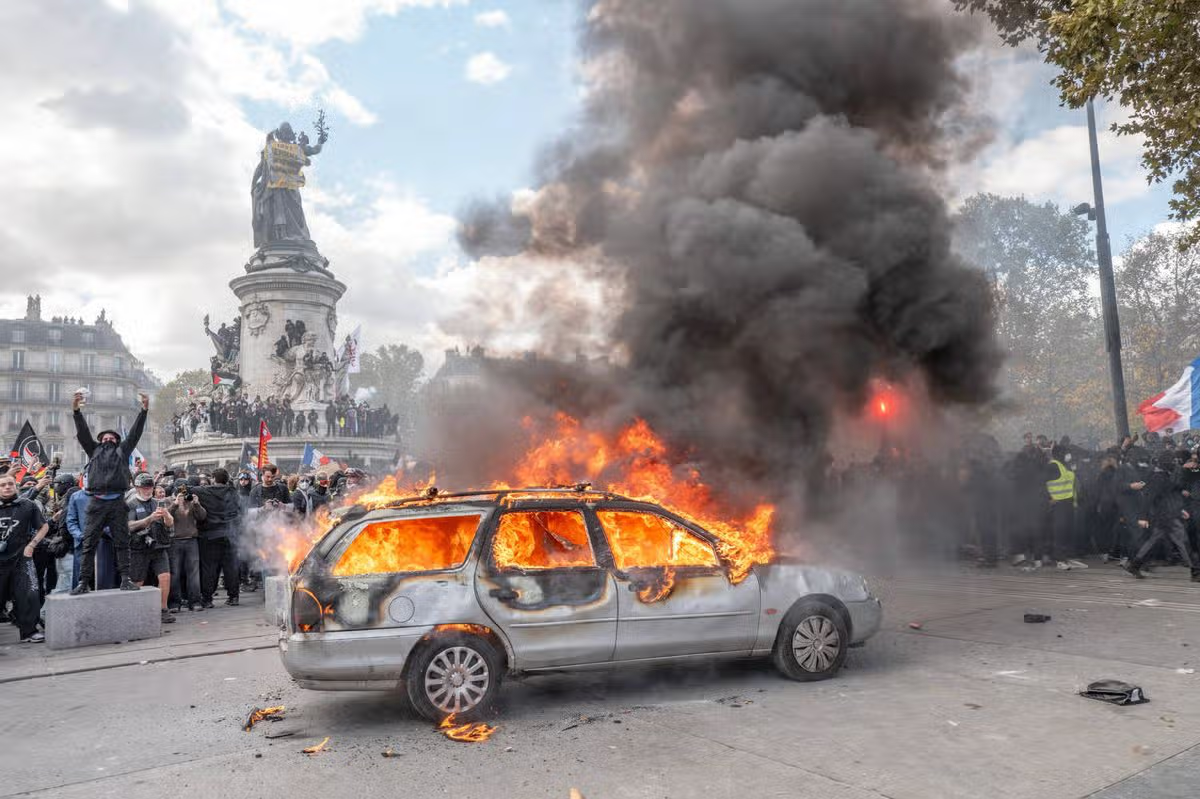
The Foreign Office has issued a travel warning for France amid the country’s worst civil unrest in years, with partial curfews now imposed in cities including Paris, Nice and Lyon after rioters clashed with police, torched cars and looted thousands of businesses.

Students clash with the police at the Republic Place,(Image: Veronique de Viguerie, Getty Images)
The Foreign Office has warned British travellers heading to France that local curfews could be introduced at short notice following some of the country’s worst civil unrest in years.
Rioters clashed with police, set cars alight and stormed public buildings, while a historic city hall was engulfed in flames. Around 2,400 people were detained over the weekend, and authorities said thousands of businesses had been damaged or looted.
The violence overshadowed peaceful demonstrations over rising living costs and poor school conditions, during which hundreds of thousands of people marched without incident.
By Monday evening, several French cities had introduced partial curfews after Prime Minister Sébastien Lecornu gave some local mayors the power to impose restrictions.
In advice issued last night, the Foreign Office told British travellers: “In response to recent events, the French government has announced that local curfews may be introduced at short notice. To find out if you are in an affected area, check local media. Follow the instructions of local authorities.”
Have you had your travel disrupted by the protests? Email webtravel@reachplc.com
The reported restrictions were:
- Paris: Movement in parts of the capital was banned from 11pm local time on Monday until 6am on Tuesday.
- Nice: A curfew for young people ran from 9pm to 6am local time (8pm to 5am BST) each night until next Sunday.
- Lyon: A curfew ran from 9pm local time on Monday until 6am on Tuesday (8pm to 5am BST).
- Coulaines: Young people were banned from being out after 11pm local time (10pm BST).
- Lille, Douai, Wattignies and Denain: Partial curfews were reported from 8pm to 6am local time (7pm to 5am BST).
President Emmanuel Macron condemned “unrestrained violence” by “insurrectionist elements from radical far-left groups, joined by numerous criminals.” Further demonstrations could follow, with high school and university student organisations calling for protests on Thursday and Saturday.
The National High School Student Coordination group urged young people to “take to the streets” and backed continued blockades and demonstrations.
Activists seeking to revive the 2018 yellow vest movement against perceived social injustices also announced nationwide protests for Saturday under the slogan “Macron must go.”
Sebastian Roché, a research professor at the Sciences Po Grenoble political institute who specialises in policing, said the damage was comparable to the yellow vest protests at their height.
“In terms of destruction and damage, it is probably close to the first two weekends of December 2018,” Roché said.
The yellow vest movement began in opposition to fuel tax rises and led to repeated demonstrations against Macron’s government. Some descended into violence, with cars burned, shops ransacked and the Arc de Triomphe vandalised during clashes in Paris.
France also experienced days of nationwide disorder in June 2023 after police killed a 17-year-old outside Paris. Rioters looted shops and set public buildings alight, with thousands detained and hundreds injured.
In 2005, three weeks of rioting prompted the government to declare a state of emergency.
Roché, who has spent more than 30 years studying policing and violence, said injuries caused by police weapons distinguished the latest unrest from previous episodes.
“We have a toll that has not been seen in the past 40 years,” he said.
He said six people, including minors, had lost hands or eyes during three weeks of protests. Officers have faced intense scrutiny over their use of grenades and other riot-control weapons during recent demonstrations.
Authorities have repeatedly blamed some of the violence on groups of “far-left radicals,” followed by criminals exploiting the unrest to loot. Lecornu described “disorder organized in an unprecedented way.”
But Roché questioned whether the far-left fringe was large or well coordinated enough to be solely responsible for violence on this scale.
He said French intelligence services estimated the movement at around 3,000 people across various factions, which lacked formal structures.
Clippers rebuild includes developing young core alongside veterans
The Clippers will have their hands full when the season opens trying to contend in the always tough Western Conference after being slapped with the harshest penalties in league history for violating salary cap circumvention rules.
With Kawhi Leonard, James Harden and Ivica Zubac gone from last season’s team, they’ll focus on developing a new core of stars, including rookie Keaton Wagler, when they open play Wednesday by hosing the Sacramento Kings at Intuit Dome.
Another positive for the team: Tyronn Lue is a proven asset as coach and he’ll be tasked with developing and blending in the younger players. Wagler spent the summer building up his body and has potential to be a strong defender.
The league’s year-long investigation is over and the Clippers have a clear path, albeit rocky, to move on and again become competitive in the West. They finished ninth in the conference last season and were eliminated by the Warriors in a play-in game.
Now fully recovered from a foot injury, two-time All-Star guard Darius Garland will be counted on to provide floor leadership. Also returning are former All-Star guard Bradley Beal, guard Kris Dunn, forward Derrick Jones Jr. and center Brook Lopez.
“I think we can surprise a lot of people,” Garland said.
Garland is fully recovered from toe and foot ligament injuries. In 19 games last season, he averaged 19.9 points with 6.4 assists. With a full offseason and training camp, Garland is expected to be one of the team’s top players.
Other young players to watch are guard Kobe Sanders, who had a productive rookie season when averaging 7.3 points and nearly 20 minutes a game as part of the rotation, and center Yanic Konan Niederhauser, who had his rookie season end early because of a foot injury but he showed promise over 41 games.

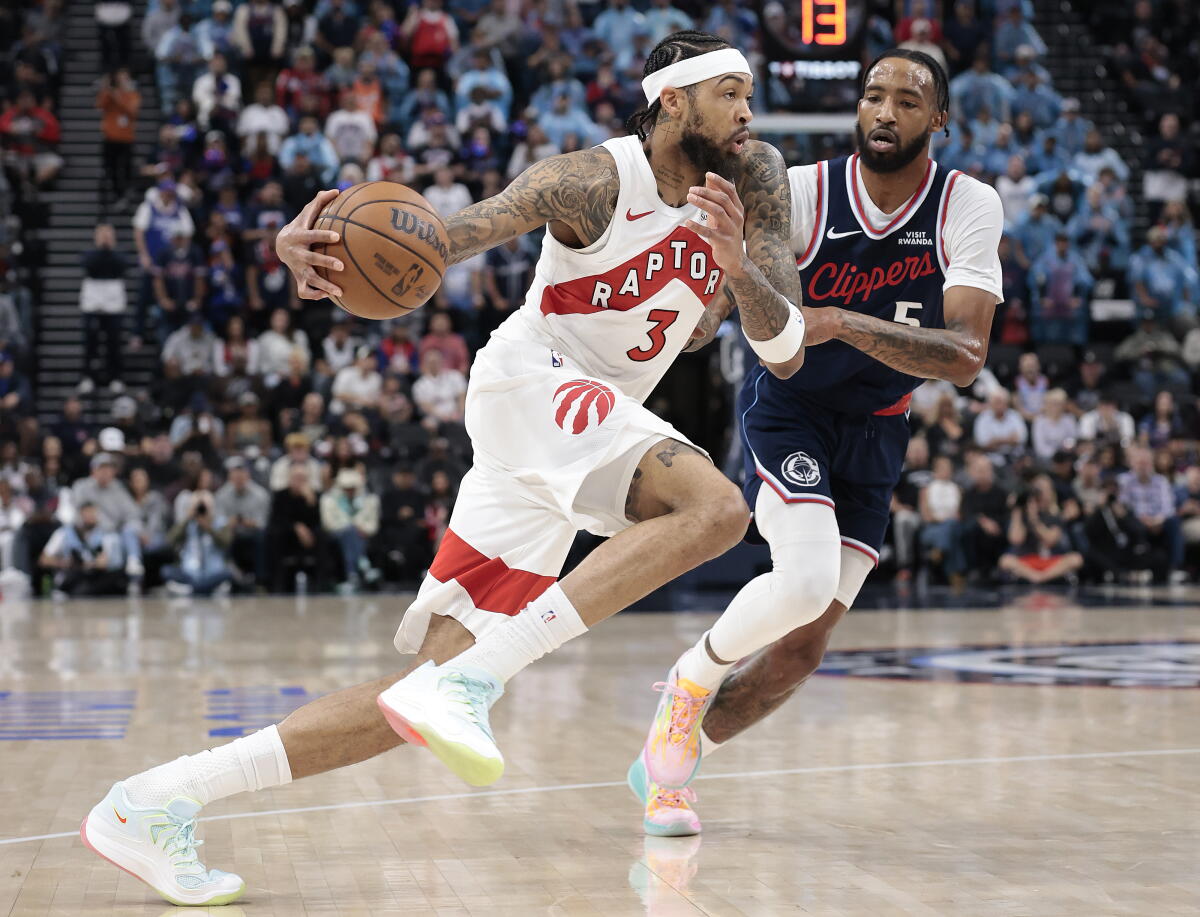
Forward Brandon Ingram, driving against Clippers forward Derrick Jones Jr. last season, is now a teammate after the Kawhi Leonard trade was completed following the salary cap circumvention investigation.
(Ronald Martinez / Getty Images)
Additions include All-Star forward Brandon Ingram and guard Gradey Dick, who were part of the Leonard trade to Toronto, wing Max Strus, guard Jalen Pickett, forward Baba Miller, forward Isaiah Jackson and forward Nick Martinelli.
“I know [there are] little to no expectations for us this year,” said Ingram, who will miss the start of the season while recovering from May surgery for a partially torn Achilles. “We have enough in the building to compete. This is what we love to do. So, we’ll go out and compete every single night, learn, go on to the next game and get better and better.”
Strus also will be out for a while after injuring his right foot during training camp.
Departed from the team are forward John Collins, guard Bogdan Bogdanovic, forward Nicolas Batum and wing Bennedict Mathurin.
Also noteworthy: owner Steve Ballmer won’t be sitting courtside after being banned by the NBA for a year as part of the team’s steep punishment for circumventing salary-cap rules. Top basketball executive Lawrence Frank has been banned for six months. The penalties included the loss of five first-round draft picks.
“I give our players a lot of credit … the leadership is great [and] the morale is great, even in these tough situations,” Lue said at the start of training camp. “That’s good to see, when you have your players coming in every day, giving everything they have; a lot of teams don’t have that.”
Staff reports contributed to this story.
French protests: Is it game over for Macron’s centrists before elections? | Protests News
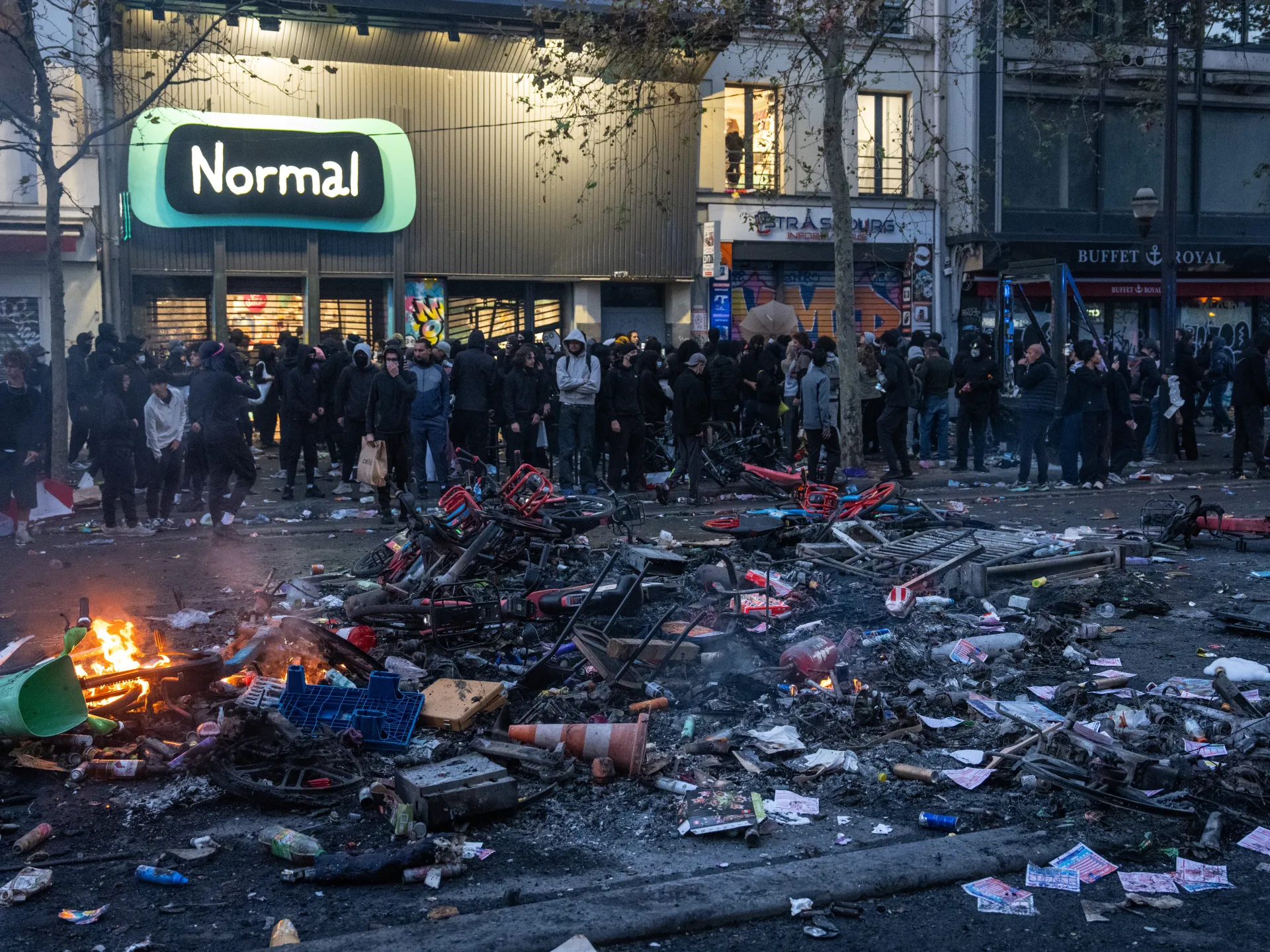
Paris, France – After nationwide protests turned violent, French President Emmanuel Macron on Sunday night tried to strike a balance between acknowledging the concerns of students demanding changes to the education system and criticising rioters.
“Those who have destroyed property must pay. Those who have looted must reimburse their victims. Those who sought to bring down the republic will be held accountable,” Macron said.
But the president’s speech was not what Yanis, a 20-year-old from Ivry-sur-Seine, a suburb just southeast of Paris, wanted to hear.
“He gave his usual ‘bla bla bla speech’ without putting forward anything concrete,” he said. “We’ll be back on the streets anyway. There will be one demonstration after another until something changes – every weekend, without a break”.
As France grapples with widespread anger that bubbled over in the form of violent protests last weekend, appetite – at least among the country’s youth – for centrist politics of the kind that Macron represents appears to be rapidly shrinking.
The unrest in France comes months before the country’s 2027 presidential election and has further sharpened political divisions, with parties seeking to present themselves as the answer to the frustration visible on the streets.
The populist-left leader Jean-Luc Melenchon has embraced the student movement with enthusiasm, while far-right firebrand Marine Le Pen has focused on the disorder that came with the demonstrations, framing it as a crisis of security and authority. The centrist Prime Minister Sebastien Lecornu has accused the extreme left of instigating violence as a “warm-up round” for the presidential election.
Polling before the election points to a contest in which both the far left and the far right could play a central role. But while the country is demanding change, there is little consensus on what that change should look like. Macron, who has been in power for two terms, will need to step aside after the election, as the constitution bars him from running again.
“Candidates have no choice but to take a stand and address young people,” said political analyst Beligh Nabli, a professor of public law at UPEC-Paris XII. “They have a political obligation to have a message aimed at young people. That message must not be empty, but it will have to answer their demands.”
Since launching their protest in mid-September, students have demanded better schools, more teachers and a more equal system. But the movement quickly spilled out of the schoolyards and into the streets, tapping into broader social and economic anxieties.
The protests have brought these issues to the centre of the political debate in a way that might not otherwise have happened, given young people’s comparatively low electoral participation and the tendency of political campaigns to focus on older voters and issues such as pensions, say analysts.
“If it wasn’t for this mobilisation, it would have been business as usual,” Nabli said. “We would have seen a kind of relative indifference from the candidates towards young people because they are not the social group that mobilises the most in elections, in contrast with those over 60.”
France Unbowed – La France Insoumise (LFI) in French – the left party led by Melenchon, has strongly supported the student movement to the point that critics have accused the party of spurring youth resentment and exploiting the unrest for political gain. Yet the party’s appeal among young voters predates the protests. Its programme addresses several of the movement’s central grievances, including investment in education, teachers’ pay and the abolition of Parcoursup, an online platform students must use for higher education applications that many say lacks transparency.
According to an OpinionWay poll for Les Echos, published on Thursday, Melenchon leads among voters aged 18 to 24, with 49 percent backing him – a 10-percentage-point increase compared with 2022.
For some young protesters, support for Melenchon reflects both opposition to the far right and frustration with the political centre.
“I’m going to vote for La France Insoumise to counter the far right, the National Rally, and the centre, which is basically going to give us a repeat of Macron’s policies,” said Lydia, 21, a student at the Ecole du Louvre who took part in a protest at the museum on Monday.
But she said she was under no illusion that the party would necessarily solve France’s problems. She also criticised what she sees as the demonisation of LFI by critics, arguing that even moderately left-wing positions are increasingly labelled extreme. “It’s becoming rather exceptional to have empathy; it’s becoming something extreme left-wing,” she said.
On the other side of the political spectrum, Le Pen and her National Rally party have sought to make the unrest a question of law and order, accusing the government of failing to be able to control the country, and its main competitor, Melenchon, of stoking violence. Le Pen remains the leading contender in the presidential race with 32 percent of the vote, while the National Rally ranked second among voters aged 18 to 24, behind France Unbowed.
“Yesterday, you saw our cities, our streets, and our country mistreated, battered, and looted,” Le Pen said in a video message on Sunday night. “We are experiencing a profound crisis of trust and authority – one that poses a threat to our democracy.” She added that France was “caught in a vice – effectively held hostage – between violence and powerlessness”.
Caught between these competing narratives is the centrist bloc of Macron, whose presidency began amid the Yellow Vest protests and is now approaching its end against the backdrop of another major wave of social unrest. That earlier movement, initially triggered by a rise in fuel taxes, grew into a broader revolt against the cost of living and what demonstrators saw as Macron’s favouring of the elite.
One of the differences between now and then is that any government coming next will not have the fiscal room to quell the unrest by handing a cheque. Last year, the government recorded a deficit of 5.1 percent of France’s gross domestic product, one of the highest among European countries. By contrast, the European Union average is 3.1 percent. Any future president will have to deal with Macron’s headache: How to save money without deepening public anger.
The current mobilisation has exposed a wider sense of disillusionment with the political establishment. The president’s popularity stands at 15 percent, the lowest ever.
In his speech on Sunday night, Macron blamed “insurrectionists from fringe far-left groups, joined by numerous criminals” for the violence. But he only briefly spoke about the students’ demands and offered no specific new policy measures to address them. Instead, he tasked Lecornu with bringing together students, teachers, unions and elected officials to develop proposals in the coming days, while promising a tougher response to violence.
The unrest presents an opportunity for his opponents to argue that his presidency has failed to address deep-rooted inequalities. At stake is the support of a generation of young people who feel let down by the state and increasingly disconnected from the political establishment – and who all sides of the political spectrum are poised to woo in the coming months before the election.
UEFA demands FIFA release key documents on World Cup sell-off plan | Football
In a letter outlining 42 questions, UEFA gives FIFA until November 2 to release documents on Infantino’s aborted plans.

Published On 20 Oct 2026
UEFA has given FIFA a deadline of November 2 to release documents relating to its president Gianni Infantino’s aborted attempts at a secretive investment plan for the World Cup and other governance issues.
The latest move in a power struggle between the global and continental governing bodies was revealed on Monday, days after European football’s top officials were disappointed by what they perceived as a lack of clarity from Infantino over the issues at a FIFA Council meeting last week.
Recommended Stories
list of 4 itemsend of list
Infantino provided no documents about the $4.2bn World Cup sell-off plan he launched and quickly dropped in July amid a fierce backlash led by Europe.
Among the 42 questions to which UEFA is demanding answers are: Infantino’s personal remuneration package, financial payments made to singer Marc Anthony, the handling of USA striker Folarin Balogun’s disciplinary case, business and political relationships involving US President Donald Trump and his family, and the operational independence of FIFA’s judicial, electoral and ethics committees.
UEFA asked US federal courts to authorise subpoenas compelling the production of documents and sworn testimony about the abandoned investment plan called FIFA Forward Enterprise.
FIFA lawyers have claimed UEFA is harassing Infantino.
Al Jazeera reached out to FIFA for a comment but did not receive a response.
Deep dissatisfaction
The formal letter, signed by UEFA general secretary Theodore Theodoridis on behalf of European FIFA Council members, stated Infantino’s apology for his actions and subsequent explanation failed to address their core concerns.
“These explanations have not begun satisfactorily to address a number of fundamental questions raised by Council members. Others remain unanswered, and the information and documentation requested have not been [provided],” the letter said.
“The withdrawal of FFE, the recognition of mistakes, and the announcement of ‘potential governance reforms’ do not answer how the relevant decisions were taken or why the FIFA Council was not involved at the appropriate stage.”
According to media reports, the letter further said: “Any refusal to disclose information or documents should be justified individually, with a clear explanation of the specific grounds relied upon.”
Tight timeline
UEFA submitted 42 detailed questions to FIFA, demanding responses by November 2 — 16 days before the nomination deadline for the presidential election on March 18, 2027.
With the next FIFA Council meeting scheduled for December 16 in Doha, Qatar — after nominations close — UEFA insisted that answers cannot wait.
“These questions require answers now. They cannot be deferred until the next meeting of the FIFA Council — nor can future governance reforms substitute for scrutiny of decisions already taken and accountability for them,” the letter emphasised.
The earlier deadline would give federations time to assess FIFA’s answers — or its failure to answer — while they can still nominate or endorse a challenger.

‘DWTS’: Jenna Dewan teases routine with Alan Bersten
Jenna Dewan is “so excited” for her next performance on “Dancing With the Stars.”
The “Rookie” actor appeared in a short video posted Sunday to the show’s Instagram Stories with her temporary partner, Alan Bersten — who is filling in for suspended pro Val Chmerkovskiy — to promote their upcoming routine.
“Hi, everybody,” Dewan said while standing beside Bersten during rehearsals. “It’s ‘Dedication Night’ and we are dancing a Viennese waltz to ‘Unchained Melody’ by the Righteous Brothers, the greatest, most romantic song ever.”
The “Step Up” star shared on social media that she is dedicating this dance to her mother.
“My mom has always been my biggest cheerleader,” Dewan wrote in her Sunday Instagram post. “The one who believed in me before I even knew what was possible for myself. Who encouraged me to dream big, to keep going, and most importantly, to never lose sight of who I am along the way.”
She added: “There’s something so beautiful and full circle about getting to honor the woman who first encouraged my love of dance, through the very thing she helped me fall in love with.”
The short teaser was shared shortly after it was announced that Chmerkovskiy would be suspended for a week for posting a message on TikTok that seemed to reference Will Smith‘s infamous 2022 Oscars slap. That incident involved Smith rushing the stage and slapping host Chris Rock with an open hand after the Oscars host made jokes about Jada Pinkett Smith.
“Keep my wife’s name out your … mouth!” Smith shouted at Rock afterward.
Chmerkovskiy’s since-deleted TikTok post appeared to be in response to judge Carrie Ann Inaba‘s harsh critique of the performance by pro Jenna Johnson, his wife, and partner Harry Shum Jr. during Tuesday’s “Super Bowl Night” episode of the show.
“You almost saw Fresh Prince enter the ballroom last night,” Chmerkovskiy reportedly wrote.
“DWTS” producers BBC Studios responded with a widely reported statement that the “well-being of everyone who works on Dancing with the Stars is non-negotiable. Val’s social media post was inappropriate and does not reflect the values or standards expected of anyone connected with the show. As a result, he will not participate in next week’s show.”
Chmerkovskiy has since apologized for his remark, saying in a statement provided to Deadline that he had merely reacted on “instinct” to “defend [his] wife.”
“In a moment where my instinct was to defend my wife, I made a poor decision to reference a meme to ‘keep my wife’s name’ out of the conversation, without stopping to think through what else that reference could imply, which was genuinely never my intention,” the statement read. “Carrie Ann certainly didn’t deserve to get caught in the middle of my bad judgment, and I hate that she was.”
The dancer also reportedly posted an apology to his Instagram Stories on Thursday.
“I want to apologize from the bottom of my heart for my recent post,” he wrote. “I have reached out to Carrie Ann to apologize directly and personally, and I also want to apologize publicly as I understand my words affect so many outside of our internal DWTS family.”
Bersten, who is filling in this week as Dewan’s partner, was previously paired with celebrity chef Giada De Laurentiis before they were eliminated earlier in the season.