



Netflix quietly removing ‘misunderstood’ film with ‘perfect mix of gore’
The feature film has been hailed a ‘cult classic’ and makes for ideal Halloween viewing – but fans don’t have long left to watch it

Film fans don’t have long left to watch the 2009 release on Netflix(Image: 20th Century Fox)
An ‘iconic’ noughties horror film is being removed from Netflix in a matter of days.
The film, released back in 2009, stars Hollywood heavyweights Megan Fox and Amanda Seyfried as two school friends who find themselves at odds after one of them is possessed by a demon and develops an appetite for boys.
The film in question is Jennifer’s Body, with Megan portraying the bloodthirsty cheerleader Jennifer Check who is sacrificed to Satan by an indie band looking to make it big, with devastating consequences. Amanda plays her nerdy best friend Anita ‘Needy’ Lesnicki, while the glittering ensemble cast also includes big names such as J.K Simmons, Adam Brody, Chris Pratt and Kyle Gallner.
Jennifer’s Body has been available on Netflix since May this year, but it is sadly about to be removed from the streaming giant. Netflix confirmed that the last available day to stream it will be November 7.
While the Rotten Tomatoes rating for the film is far from glowing – sitting at a measly 36 per cent from audiences – it still holds a special place in the hearts of many film fans. One reviewer gushed: “The perfect mix of gore, dry humour satire, original story, and, of course, an amazing soundtrack.
“As a horror/thriller superfan, this movie continues to delight even after seeing it ~10 times. Regardless of ratings it keeps playing and for good reason. A modern cult classic.”
Ensure our latest film stories always appear at the top of your Google Search by making us a Preferred Source. Click here to activate or add us as Preferred Source in your Google search settings.
Get Netflix free with Sky
This article contains affiliate links, we will receive a commission on any sales we generate from it. Learn more
Sky is giving away a free Netflix subscription with its new Sky Stream TV bundles, including the £15 Essential TV bundle. This lets members watch live and on-demand TV content without a satellite dish or aerial and includes hit shows like Stranger Things and The Last of Us.
Meanwhile a second fan of the film penned: “Genuinely love Jennifer’s Body. I feel like this movie was so misunderstood when it first came out because it’s so much more than just a horror movie. I love the mix of dark humour, gore, and the complicated friendship between Jennifer and Needy.”
They continued: “The movie also touches on female friendship, jealousy, and how women are treated, but in such a chaotic and entertaining way. Megan Fox was literally made for this role, and the whole aesthetic of the movie is everything.”
A third film fan simply said: “Cult classic for a reason,” as a fourth added: “Such an iconic 2000s movie never gets old.”
Jennifer’s Body is now streaming on Netflix. It will be removed from the platform after November 7.

Gimmick or giveback? Even some Trump supporters don’t expect to get $5,000 checks after midterms
WASHINGTON — President Trump is hoping that $5,000 checks can juice Republican turnout in November’s midterm elections — but even some of his devoted fans are doubting that government payouts would arrive.
“I mean, I guess it’s good for some people. I really don’t care,” said Jamie Alvarez, who attended Trump’s recent Alaska rally in a red, white and blue outfit. “I don’t feel like your vote should be bought. I feel like you should vote for who you feel is going to do the best job.”
Joseph Eatherton was attending that same rally and said he was “not sure if it’s necessary.” When asked whether Trump could deliver on the promised money, he said, “I don’t know, and I hate being an armchair quarterback.”
The offering of government checks has become a go-to tactic for Trump when he faces a political jam. He’s previously endorsed $2,000 in dividends from tariff revenues and large refunds from spending cuts achieved by the Department of Government Efficiency, neither of which materialized. The latest example could reveal how much voters still trust Trump as they decide control of Congress in the midterm elections on Nov. 3.
Staunch supporters such as Lucy Martinez, the president of a Republican women’s club who attended a recent Trump rally in Texas, said there’s no doubt in their minds.
“I think that I will get the $5,000,” she said. Out of all the presidents, Trump is someone “who kept his promises to his people and all the United States.”
Trump has dished out payments as elections approach
However, many voters are already embittered by his economic leadership. His critics see a president who failed to tame inflation and keep America out of overseas conflicts, and whose agenda has fueled higher prices as the war with Iran appears to be at a stalemate.
“The trust on this is already gone for most people,” said Amy Frederiksen, a former Republican Minnesota Senate majority leader who now runs a public affairs firm.
“I just don’t see the energy around that line,” she added. “Most people know that’s a blatant over-the-top promise like several he’s made in the last couple of years, and they’re not buying it.”
As the midterms approach, Trump has also pledged a $90 payment to 20 million Medicare enrollees and $500 “rebates” for people the administration says were overcharged for their Obamacare plans. He has automatically enrolled every U.S. child in “Trump accounts” to invest in stocks.
The $5,000 payouts would only occur, Trump says, if Republicans keep their majorities in the House and Senate. Trump acknowledges that the cost would exceed $1 trillion, but it’s not clear that the White House is seriously engaging with the proposal’s ramifications, from the increased deficit to the likely boost to inflation.
The White House said the payments are possible because of Trump’s trade deals, investment commitments by foreign countries, government stakes in private companies and deals for oil and minerals.
The administration’s position is that the payments will help people recover from the inflation that began in 2021 under then-President Joe Biden, though Republicans, at the time, attributed that inflation to excessive government checks tied to pandemic relief.
When The Associated Press asked several weeks ago if the administration was modeling the economic impact from the checks, Christopher Phelan, chairman of the White House Council of Economic Advisers, said he would “refrain” from answering.
Roughly half of registered voters say Donald Trump does not keep his promises to Americans, according to an AP-NORC poll from September. About 3 in 10 say Trump tries to keep his promises but is unable to, while only about 2 in 10 say he keeps his promises.
Republican voters are more accommodating. About half say Trump tries to keep his promises but is unable to, and about 4 in 10 say he keeps his promises.
Republican candidates aren’t echoing Trump’s promise
Trump is talking about the payments as a sure thing.
“If the Republicans win, you’ll each have $5,000 in your pocket and economic success for our country like we have never seen before,” he said at a Saturday rally in Kentucky. “And remember, ’cause they like to say, ‘Oh, well, maybe he won’t do that.’ Uh, I always do it.”
Campaign spending tracked by AdImpact suggests that Republicans are not running advertisements either on television or online about the promise. The few advertisements that do exist are from pro-Democratic groups such as Rolling Sea Action Fund that conclude with the voiceover, “Come on, do you really think he’s sending you a check? Yeah, right, we won’t get fooled again.”
At a Friday rally in Georgia, Trump noted that he had previously delivered a $1,776 “Trump dividend” to troops in the military. But those payments came from a congressionally approved housing supplement.
Trump claims the nation could not afford the payments if Democrats hold a chamber in Congress because the nation would be “flat broke.” But he said that one caveat is that the money could only be spent in the U.S., rather than in China, Japan or France. He joked that people should spend the check at his luxury club in Palm Beach, Florida.
“Let’s have lunch at Mar-a-Lago, where for $5,000, you’ll get one hamburger and a small dessert,” he told the crowd in Georgia.
Some in the crowd took Trump at his word that he would fight to get them the money. But they added the caveat that if he didn’t come through, it would not be his fault.
“I could use $5,000,” said Mike Boatman, a 58-year-old from Evansville, Indiana, who travels the country attending the president’s rallies. “I mean, he’s done everything he’s said he’s going to do.”
Boak, Bohrer and Barrow write for the Associated Press. Bohrer reported from Wasilla, Alaska, and Barrow reported from Dalton, Georgia. AP reporters Aaron Kessler and Linley Sanders in Washington and Lekan Oyekanmi in San Antonio, Texas, contributed to this report.
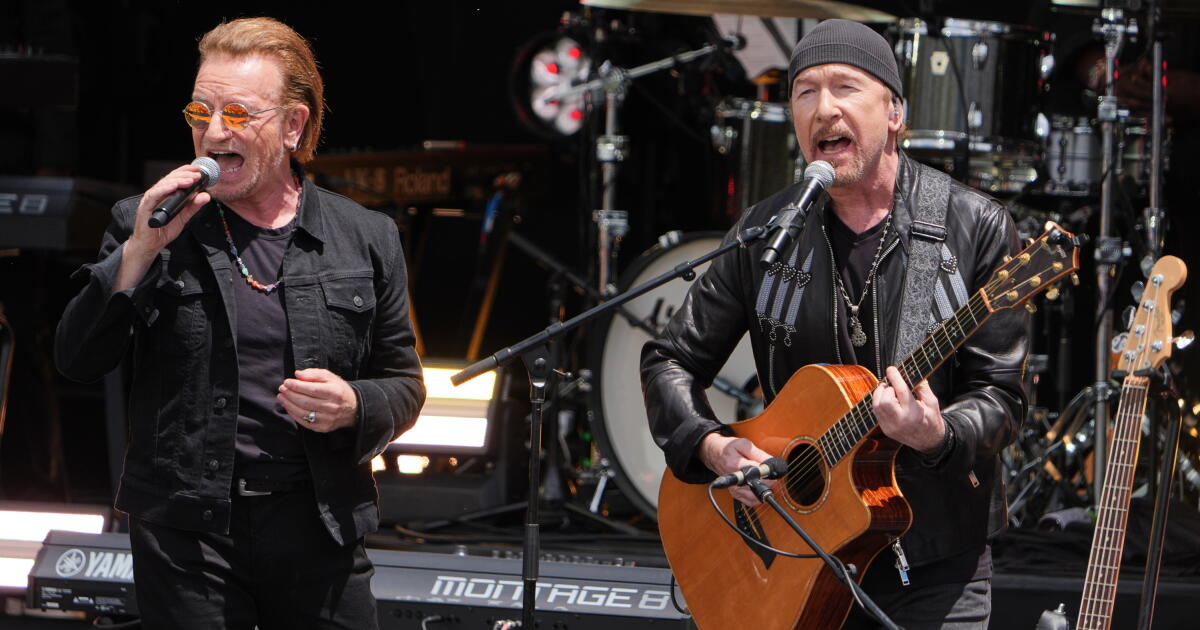
U2 to headline halftime show for Netflix’s Thanksgiving eve NFL game
U2 is coming to SoFi Stadium for the first time — and performing during a Rams game for the first time in nearly 25 years.
The legendary Irish rock band will headline the halftime show for the NFL’s first Thanksgiving eve game as the Rams host the Green Bay Packers on Nov. 25. The game will stream live on Netflix.
The only other time U2 has performed at halftime of an NFL game was at Super Bowl XXXVI on Feb. 3, 2002, when the New England Patriots defeated the then-St. Louis Rams 20-17 at the Superdome in New Orleans.
“There’s a reason U2 has headlined stadiums for decades: they don’t just perform, they deliver iconic moments audiences remember forever,” Netflix co-CEO Ted Sarandos said in a statement. “We’re thrilled that they’ll bring that same magic to the NFL stage on Netflix. It’s going to be an unforgettable night for football fans and Netflix members worldwide.”
U2’s halftime show will feature special guests, the streaming service said.
Netflix has featured big-name halftime performers during some of the previous NFL games it has streamed, including Beyoncé on Christmas day in 2024 and Snoop Dogg on Christmas last year.
U2 — which features singer Bono, lead guitarist the Edge, bass player Adam Clayton and drummer Larry Mullen Jr. — celebrated their 50th anniversary last month with a concert. The group performed at Mount Temple Comprehensive School, where the four members were students when they first got together as a band in 1976.
The band has won 22 Grammy Awards and was inducted into the Rock and Roll Hall of Fame in 2005. Its 16th studio album, Carnival de Luz, is set to drop on Nov. 13.
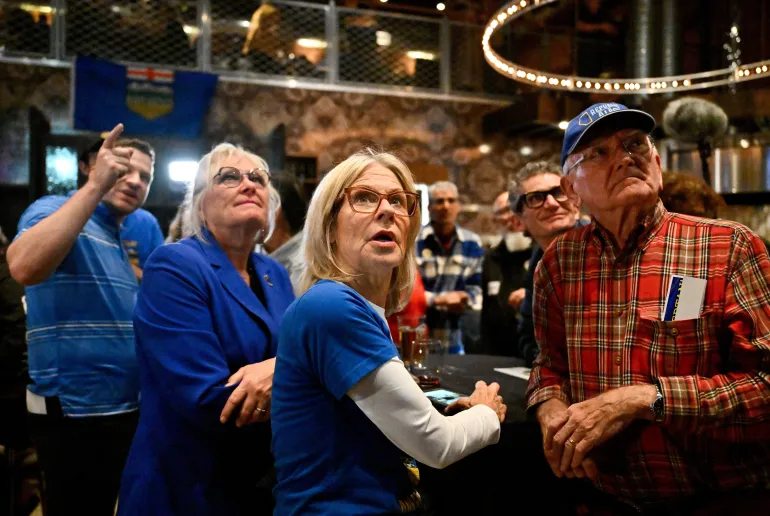
Alberta rejects separation referendum: What’s next for Canadian province? | Independence News
Voters in Alberta have chosen to remain part of Canada in a first-ever independence referendum.
Canadian state broadcaster CBC News called the results of Monday’s vote late on the same day after 48 percent of the ballots counted showed overwhelming support for the “remain” side, with 76 percent opting to stay with Canada.
The result marks a major win for Prime Minister Mark Carney, who is facing a trade and political war with the United States amid US President Donald Trump’s higher tariffs and repeated suggestions of annexing the country.
On his way into a cabinet meeting on Tuesday morning, Carney called it a “great day.”
“I’m thrilled that Albertans have chosen unity. They’ve chosen to build together. They’ve chosen to continue to take care of each other, to move forward together with purpose,” he said.
But the result also comes as a disappointment for those Albertans seeking independence for the resource-rich region following years of grievances laid at Ottawa’s door. Here’s what we know:

What was the referendum about?
The nonbinding referendum was first announced in May following a campaign and petition by a group of Albertans who want to be an independent country.
While only about one-third of Albertans were found to be pro-independence in polls, Alberta Premier Danielle Smith argued in her announcement that a referendum was necessary to respect the 300,000 Albertans who had petitioned officials for it.
In the referendum, voters answered 10 questions, including whether the government should begin a binding process to seek independence from Canada. They also answered questions on immigration, access to provincial services like education, social care and healthcare, and voter identification requirements.
Prime Minister Carney had campaigned for Albertans to vote “remain”, saying last week at a rally in Calgary that separation would be “ a dangerous bluff that will lead to years of deep division”.
“There are some outside our borders who are working to break us so they can own us,” he said.
Researchers have pointed to possible online influence campaigns by both Russian and US entities that helped amplify the call for separation and allegedly shared misleading information. Alberta PM Smith told media in August that the online activity was under observation.
What have the reactions been?
Prime Minister Carney, who grew up in the region, said “Albertans made a clear choice” in a statement he made early on Tuesday.
“They chose unity, to build together, and to take care of each other,” he said, adding that “Canadians will move forward together with renewed purpose and high ambition.”
Alberta’s Premier Smith said she was pleased to see the results and that “Albertans have voted for a stronger Alberta in a united Canada.”
Separatist leaders from the groups Let Alberta Decide, the Alberta Prosperity Project and the Pathway to Independence said they will wait for all votes to be counted before conceding.
First Nations groups turned out in strong numbers to vote to remain with Canada, with one southern Alberta polling station in an area home to the Siksika Nation temporarily running out of ballots, local media reported.
Why is Alberta important, and why are there calls for independence?
Many Albertans have long complained that their critical natural resources are funding the government in Ottawa and the commercial hubs of Toronto and Montreal, but that the province does not receive proportionate benefits.
The province, with a population of 5.1 million, holds massive oil deposits. It also holds reserves of critical and rare-earth metals including lithium, titanium and zircon, which are essential for manufacturing many tech items, from smartphones to fighter jets.
Separatist movements, some of which even support Alberta joining the US, go back to the 1940s, following the discovery of oil reserves. Some of Alberta’s premiers have had spats with Ottawa over wealth distribution.
US President Trump has made remarks about Canada becoming a US state in recent months.
Last week, he told a political rally in the US state of Arizona that Canada will “end up being the 51st state, because it’s the only way it works”.
The two countries have been embroiled in a trade war since talks fell apart in August this year and they slapped each other with tit-for-tat tariffs.
Earlier this month, tech billionaire Elon Musk called for Alberta, Saskatchewan and Quebec to separate from Canada, saying “they’d be better off”.
But the matter of Alberta’s independence gained intense scrutiny last year after pro-separatists launched a petition to pressure the government.
Alberta, alongside other western provinces of British Columbia, Saskatchewan and Manitoba, have all complained about “western alienation” by the government in the centre.
Is it over for Alberta’s independence bid?
With separatism agitations running so far back, experts say the referendum will likely not end the movement altogether.
Ahead of the vote, some separatist leaders said they would pursue another referendum if necessary, arguing that the referendum shows that independence is legally possible.
“Regardless of what happens on Monday, we’ve already won,” Keith Wilson, co-leader of Let Alberta Decide, said at a rally last week.
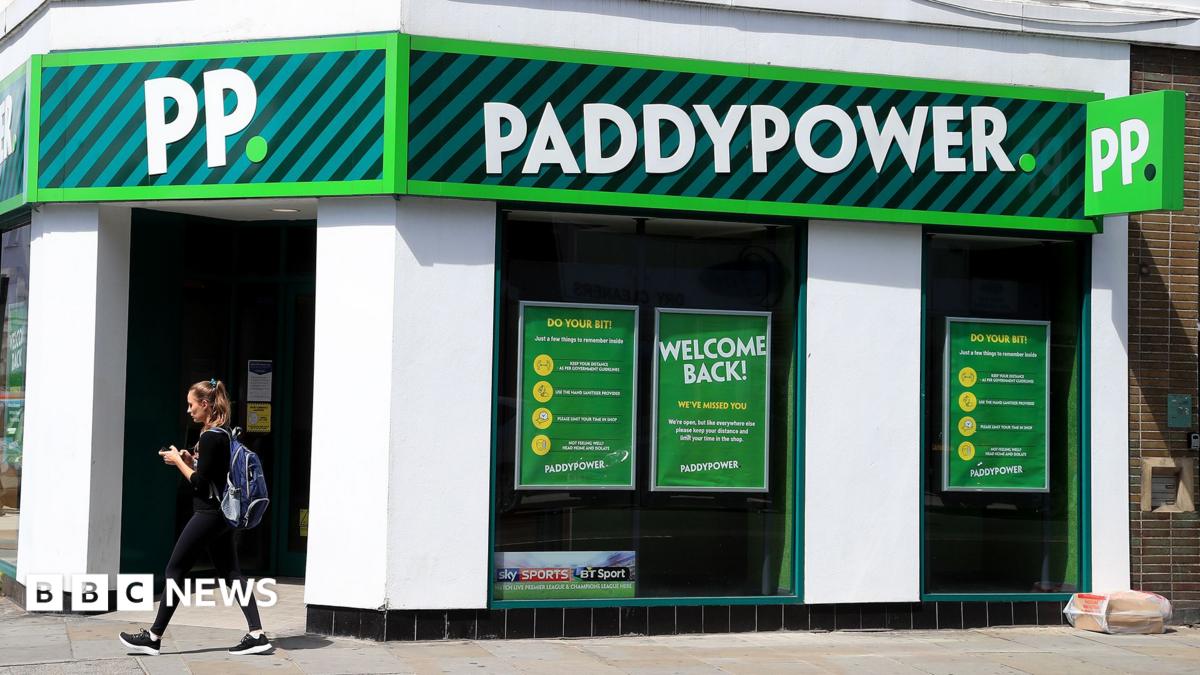
Paddy Power cuts 1,400 jobs and blames betting tax rises
Paddy Power-owner Flutter has announced plans to cut up to 1,400 jobs as its boss claimed the company “cannot fully absorb” tax rises imposed on the gambling industry.
Staff based in Leeds and Dublin, as well as workers for its UK and Ireland business at Flutter’s Portugal and Romania sites, will be most affected, but what roles are at risk has not been disclosed.
The government announced taxes rises on online casino and sports betting, with an exemption for horse racing, in the Budget last year.
Flutter boss Kevin Harrington said the tax hikes had “fundamentally changed” the economic model of the UK betting and gaming industry, arguing it had helped “fuel the unlicensed, unregulated market”.
“We continue to expect these tax increases to have a very significant impact on the overall market,” Flutter Entertainment said on Tuesday.
Flutter, which also owns Sky Bet and Betfair, employs 28,500 people across the world, including 9,000 in the UK and Ireland.
As well as its Leeds and Dublin offices, the BBC understands the cuts could also affect staff based in London and Sunderland, as well as Malta and Gibraltar.
Harrington, who is chief executive of the betting giant’s UK and Ireland business, said: “As we warned a year ago, we cannot fully absorb a rise of this magnitude without reducing our fixed cost base and therefore must restructure our business so that we can best position ourselves for the future.”
The BBC has contacted the Treasury for comment.
Flutter delisted from the London Stock Exchange in August in a blow to the UK, with its shares now solely traded in New York.
In its most recent results, the company reported a $299m (£224m) pre-tax loss for the three months to June for its entire business worldwide, compared to a $205m profit in the same period last year. Sales rose 3% to $4.3bn.
However, revenues in the UK and Ireland rose by 4% over the period, due to strong growth in online gambling games.
Some online gambling tax rises announced in last year’s Budget took effect in April. This included remote gaming duty, which is paid on online casino betting, rising from 21% to 40%.
General betting duty, paid on the profits made from various forms of sports betting, was kept at 15% in betting shops, but is set to rise from 15% to 25% online in April next year.
Betting firms had warned that cost increases would lead to job losses and betting shop closures, but MPs dismissed the warnings as “scaremongering”.
During the summer, Ladbrokes owner Entain announced job cuts, with news agency Reuters reporting 500 roles were being removed.
Punters’ winnings from gambling are not taxed in the UK, nor is VAT charged on bets.
Flutter said its restructuring plan would cost between $80m and $90m.
The company has claimed in previous financial results that the impact of UK tax rises would hit its underlying profit by $320m this year and $540m in 2027, before any savings or restructure to mitigate the impact.

Holly Hagan pays emotional tribute to late sister Darci a year after her tragic death at just 19 years old
GEORDIE Shore’s Holly Hagan has paid an emotional tribute to her late sister Darci a year on from her tragic death at just 19 years old.
It was revealed in an inquest last year that Darci Rose Gibson died from “multi-organ failure” and “MDMA overdose” after a night out at Manchester‘s Warehouse Project.
Holly told at the time how her half-sister Darci passed away “peacefully holding my hand surrounded by family and her best friends.”
She explained her family were “traumatised in every sense of the word” but were “forever grateful” for the way everyone at Manchester Royal Infirmary A&E and ICU looked after them.
Now, Holly has shared a picture of her and Darci to Instagram, alongside a lengthy caption paying tribute to her “baby girl.”
“And just like that it’s been a year. Today was the day I recorded your heartbeat on a doppler to put it into a bear for my parents,” wrote Holly.


“It was the day they checked if your heart was suitable for transplant. The day they searched the database to find a match. They day they ran two rounds of brain activity tests while we watched them find no signs of life.
“The day I went shopping for the perfect pair of pyjamas for you to be comfy and warm after donation.
“The day we took photos of all your tattoos and realised one said ‘Everyone happens for a reason’ and the one that shook us all ‘Live where your heart finds life’ whilst you were about to give your heart to someone else.”
Holly continued: ” It was the day I was on the phone to the transplant nurse at 10pm after she told me everything had gone well and your heart was on its way to the recipient.
“The day I sat on my utility floor and prayed for a stranger to live whilst trying to process that you had died.
“But it wasn’t just the day you died, it was the day you saved a life. The day you became a hero and an angel all in one.
“Not a day goes by that we don’t mention you, whether it’s when we see a butterfly, or AJ is wearing Minions socks (she loved Minions) or we’re watching Lion King and he asks if you’re with Mufasa in heaven.”
She added: “I won’t let anyone forget you. Love you so much baby girl!”
Holly’s sister Darci lived mostly out of the spotlight but she did open up on their relationship in her autobiography Not Quite a Geordie.
She wrote in the book: “When my sister Darci was born, I loved her, but she was too small for me to even bother with at that stage.
“It was only when she was a little bit older, when I would babysit, that I could really enjoy having fun with her.”
The pair were very close with Holly previously sharing a series of snaps on social media to mark Darci’s birthday – adding a sweet message.
“Happy 16th birthday to my not so little sister Darci. Love you so much twinny,” Holly penned.
Holly and Darci share the same mum, Vicki, but have different fathers.

Why Bank of America’s AML Failure Is a Wall Street Warning
Experts warn Bank of America’s hefty AML fine signals a reckoning for aging banking compliance.
When Bank of America released third-quarter financials on Oct. 14, shareholders took note of a $1.2 billion non-tax-deductible blow to earnings. The anti-money laundering, or AML, and sanctions penalty shaved 17 cents off its per-share net income.
But the fine itself may be the least of the bank’s worries.
Financial crime and AML experts told Global Finance that this penalty was not an outlier but a warning to the rest of the industry.
“If you looked at every bank in detail, you’d find problems,” ThetaRay CEO Brad Levy said in an interview. “It’s kind of like every house — when the inspector comes, there’s something wrong.”
What Happened
The Treasury Department’s Financial Crimes Enforcement Network (FinCEN) addressed the penalty. The segment cited Bank of America’s “failure to mitigate and report priority national security risks, including Chinese Money Laundering Networks and illicit finance along the southwest border.”
The fine is the third-largest in the department’s history, behind a roughly $4 billion settlement with Binance in 2023 and an approximately $3 billion settlement with TD Bank in 2024.
This particular cost includes $750 million that goes to the Office of the Comptroller of the Currency — the largest fine that regulator has ever imposed— plus $11.6 million to the Treasury’s Office of Foreign Assets Control over apparent violations of sanctions programs covering Iran, Russia, narcotics and global terrorism.
A Bank of America spokesperson issued the following statement to Global Finance: “Financial crime compliance is serious, and we are responsible for getting it right. We worked with regulators to reach these penalty resolutions stemming from violations cited in the previously reported 2024 OCC Consent Order and FinCEN’s investigation. We have invested billions of dollars in technology and dedicated thousands of employees to combat financial crime, and our team is far along with and committed to completing the work required to address the issues raised by our regulators.”
Fallout Extends Beyond Government Agencies
For Nikhil Raghuveera, CEO of Predicate, a startup that uses blockchain technology for AML enforcement, the real government-inflicted damage is not to Bank of America’s coffers but to its goodwill.
“The bank faces business and reputational damage with counterparties,” Raghuveera said. Partner institutions, clearing banks, and corporate clients typically tighten their own risk thresholds to protect themselves from secondary liability and run their own risk assessments. And a Bank Secrecy Act violation feeds directly into them, he explained.
“A large bank doesn’t lose its ability to operate, but it does face greater scrutiny and the potential loss of business opportunities,” Raghuveera added. “The regulator now sees the bank as unable to fix things itself. As a result, every new product or expansion gets reviewed through that lens.”
Regulatory Trust Broken
The hefty fine grabbed headlines, but according to Will Lawrence, CEO of San Francisco-based AML software maker Bretton AI Inc., the money matters less than what the bank has lost in regulatory trust.

Bretton AI
“For a large bank, even a significant financial penalty may be manageable,” Lawrence said in an email. “What’s much harder is operating once regulators lose confidence in the institution’s ability to manage risk.”
That can mean independent monitoring, more board scrutiny and limits on growth.
“Even without formal restrictions on growth or acquisitions, unresolved compliance issues can complicate a bank’s expansion plans,” he said. “The financial penalty may be immediate, but remediation can take years.”
Big-name banks are also vulnerable if their methods for flagging suspicious activity remain outdated.
For example, when a typical analyst pulls data from different systems, reconstructs transactions, and documents the findings, that approach often falls short against sophisticated laundering networks, Lawrence explained.
“These are not necessarily risks you can understand by looking at one transaction or one customer in isolation,” he said. “You need to connect activity across accounts, counterparties and payment channels to identify broader patterns.”
Large penalties are rarely a one-time blip, Raghuveera said. “They tend to reflect patterns: transaction monitoring that’s poorly calibrated, SARs filed late or not at all, watchlists that aren’t kept current, and compliance teams lacking the staff, tools or authority to escalate.”
24/7 Reality Check
For Lawrence, true accountability raises certain questions: Who knew about the risks? Who had the authority to address them? Was appropriate action taken?
“A bank can have sophisticated monitoring systems, but if serious issues aren’t escalated or leadership doesn’t respond, the program isn’t working,” he added.
Also, Lawrence said, a bank can’t spend its way out of the problem. Regulators want evidence that changes are working, not just new policies or software.
“A bank can hire more analysts, purchase new technology, and rewrite its policies without fundamentally improving its ability to identify financial crime,” Lawrence said. Banks have also long tracked activity counts, such as the number of alerts reviewed or cases closed. “Those numbers tell you something about workload, but not necessarily whether you’re managing risk effectively.”
Levy, who spent nearly 20 years at Goldman Sachs before joining ThetaRay, expressed a similar sentiment. To put it plainly, legacy technology hasn’t kept pace.
“Most of these systems and processes are 10 to 30 years old,” he said, stressing the need for serious internal audits to accommodate the 24/7 banking world.
“Ten years ago, you could get away with it,” he said. “In the next five, you actually can’t… the speed-up in technology is going to be breathtaking.”
Anthony Noto covers corporate finance and private credit. Contact him at anoto@gfmag.com

Prep talk: City Section commissioner knows how to improvise
Vicky Lagos, the City Section commissioner, was watching last week’s King/Drew-Crenshaw football game on the sideline when she noticed problems with the chain crew.
She proceeded to become part of it, holding the down marker and helping educate the inexperienced students.
It was another example of her versatility and ability to improvise and intervene when needed.
She became the City Section’s seventh commissioner in 2019 after being an assistant commissioner.
It’s a job that requires the ability to accept criticism, keep your cool and find solutions frequently on a daily basis.
Taking over on a chain crew to help is not on any commissioner’s to-do list.
“It was a teachable moment,” Lagos said.
This is a daily look at the positive happenings in high school sports. To submit any news, please email eric.sondheimer@latimes.com.

Indonesians protest over land-clearing fires | Protests
Students and activists protested across Indonesia over rising living costs, economic concerns and forest fires linked to land clearing for palm oil plantations.
Published On 20 Oct 2026

Three months of PM Andy Burnham: Can he sustain the ‘hope vibe’? | Politics News
London, United Kingdom – There was a moment towards the end of Andy Burnham’s conference speech in Liverpool that, through silence, spoke volumes.
The new prime minister and Labour leader fell quiet.
Recommended Stories
list of 4 itemsend of list
For 20 seconds he stood, saying nothing. He hadn’t forgotten his words. He was gathering his emotions for a passage of the speech he hadn’t been able to make it through in rehearsals without crying.
Burnham’s father had died just a couple of weeks before, and this was the section where he’d talk about it.
As the audience realised what was coming they stood, applauding, and urging him on with shouts of “Come on, lad!’ and “Come on, Andy!”
Thanking them, he composed himself and continued.
Conference speeches are theatre, and contemporary British political standards require that a leader be relatable. But there’s little doubt that Andy Burnham handled this moment with an emotional register that struck many as genuine.
His predecessor Keir Starmer sometimes came across as wooden, almost robotic and uncomfortable in front of cameras. Burnham, the seventh prime minister in 10 years, is more emotional.
He talks big ideas and grand solutions and relishes the opportunity to communicate.
In the vibes-denominated currency of modern political discourse, this matters.
The polls speak for themselves. Politico’s Poll of Polls had the Labour Party retake top spot shortly after Burnham became PM – a position it has not relinquished since. At the end of September, Ipsos found Andy Burnham to be the only politician with a positive net favourability rating.
YouGov’s polling also judges him the most popular politician in the UK at the moment.
But to keep up, Burnham must deliver tangible change before the next general election. Unless he calls one early, that will be 2029.
According to political analyst Sam Freedman, “So many in Westminster keep coming back to an early election, despite Burnham ruling it out … No one can quite figure out how Burnham keeps the hope vibe going for three more years with relatively little visible progress.”
‘Going back to what Labour was in the 50s’
In the Welsh town of Port Talbot, terraces of workers’ cottages cluster beside the UK’s largest steelworks.
Like much of Wales, Port Talbot did vote Labour for a century – until elections for the Senedd Cymru or Welsh Parliament in May.
Labour was beaten to an unprecedented third place behind Plaid Cymru’s nationalists, and the anti-immigration Reform UK.
But that was before Burnham took over.
Myles Lewis, who organises social walks for the town’s elderly, told Al Jazeera that Labour had not convinced people on immigration, and Starmer’s communication wasn’t good enough.
“[But now], it’s kind of going back to what Labour was in the 50s and 60s, where they actually looked after the working-class people. I do believe Andy Burnham can get there because I think he has the interests of the working-class people.”

In his first weeks in power, Burnham delivered a quick flurry of eye-catching, domestic, cost-of-living-focused policies.
He capped bus fares, cut the value-added tax (VAT) on electricity bills, and cut business rates for pubs.
He said that he would end street homelessness, reindustrialise the country, take services back into public control, and start the biggest build-out of social housing since World War II.
The mayor of Greater Manchester for nine years, Burnham supports the devolution of powers from Westminster to the UK’s nations and regions.
In July, he announced mayors could keep a share of business rates from April 2027 and of income tax from 2028.
And his conference speech in September set out the contours of some big political battles to come, including a national social care service, free at the point of use, paid for by changing the UK pensions’ triple lock from 2030. It would arrive next parliament. Burnham also pitched a national commission on electoral reform, with a manifesto commitment to overhaul the voting system. And he delivered a blunt verdict on Brexit: that it “has done more harm than good”. He wouldn’t rule out an in-out referendum, or a pledge for the UK to rejoin the European Union, in Labour’s next manifesto, he said.
On foreign affairs, there is less blue water between Burnham and his predecessors.
When he travelled to Ukraine in August, the UK’s new prime minister came with a headline-grabbing gift – British know-how to build the long-range SCALP missile. He was the fourth British prime minister to visit Kyiv since Russia’s full-scale invasion of Ukraine and pledge steadfast support.
On Gaza, he has said the Labour government “didn’t get it right” and should have called for a ceasefire earlier. And in September, the Burnham government announced a sanctions package against illegal West Bank settlements.
But there has been no genocide declaration, and no full arms embargo against Israel. And Burnham hasn’t overturned the Starmer government’s proscription of the Palestine Action protest group as a “terrorist” organisation.
Defence spending is also a looming problem.
The government’s formal defence pledge is 3.5 percent of gross domestic product (GDP) by 2035, and Burnham has declined to say whether he’d pay for it with tax rises or welfare cuts.
John Healey, who resigned as the UK’s defence secretary in June over underfunding, is now chancellor of the exchequer, and will not commit to the 3-percent-by-2030 target he set himself.
Burnham’s first budget comes at the end of this month. A full spending review follows next year. Much will be clearer after these.
His biggest pledges – reindustrialisation, control of public services, a new social care system – are expensive.
Burnham certainly has the vibes. The public likes them, for now. The budget will show whether he can afford them.

‘Unsolved Mysteries’ ventures into a new realm: video podcasts
It’s been nearly 40 years since the dread-filled tones of the “Unsolved Mysteries” theme song first hit network TV airwaves.
In that time, the celebrated documentary series has been through nearly every iteration of the TV business — and is about to embark on a new one.
Next week, “Unsolved Mysteries” will launch a video podcast in partnership with the audio and entertainment firm Audacy. The weekly podcast, which will be available on YouTube and on all podcast platforms, will release new episodes starting Oct. 29 that explore cases such as mysterious deaths and unexplained disappearances.
The podcast will be hosted by actor and TV host Jordan Murphy and will include interviews with the people involved in the case, “Unsolved Mysteries” co-creator Terry Dunn Meurer told me in a recent interview.
“We’re still trying to expand the brand and pivot,” she said. “It just feels like that’s where the industry is heading. The YouTube audience is the biggest audience out there, and we are looking for the biggest audience because we’re trying to help solve these cases. So the more viewers we can get with these episodes, the better.”
“Unsolved Mysteries” isn’t the only Hollywood player to bet on video podcasts. Spotify has bet big on video podcasts, and Netflix has added them to its platform, both of which are attempts to compete with YouTube, diversify their offerings and keep consumers tuned in.
For “Unsolved Mysteries,” the move is just the latest way the show has tried to evolve with the TV industry’s ups and downs.
The show debuted in 1987 as a series of specials NBC used to fill holes in its lineup, Dunn Meurer said. That kind of pinch-hitting meant there was no marketing or publicity to get audiences excited about the show, but viewers started tuning in anyway.
Eventually, the specials became a weekly show that aired on NBC for nine seasons before moving to CBS. “Unsolved Mysteries” also had a syndication run on cable channels Lifetime and Spike TV.
Throughout its TV lifetime, the show would highlight stories of mysterious disappearances, escaped fugitives, lost connections and even the occasional paranormal story. “Unsolved Mysteries” made appeals to viewers, urging them that someone out there “knows the truth” and encouraged them to write in with tips or new suggestions for investigation, which has resulted in tens of thousands of submissions over the years.
More recently, “Unsolved Mysteries” was revived on Netflix for three seasons, with a format focused on a single story. The series also previously had an audio-only podcast.
In addition to the video podcast, “Unsolved Mysteries” also recently produced a full-length documentary on new evidence surrounding the so-called Tylenol Killer, a 1982 case in which seven people died after unknowingly taking cyanide-filled pill capsules.
Though the method of delivery has changed, Dunn Meurer said the show’s mission remains the same. Over the years, the series has helped to directly solve more than 260 cases, she said, though many are so-called lost love cases of missed connections, as well as fugitive whereabouts and some murders.
“There’s so many mysteries out there that need attention, cases that have gone cold,” she said. “For me personally, it’s hard to not keep putting those stories out there and helping these families and law enforcement that need the help to solve these cases.”
‘Musk’ advertising controversy
In notable media news, the TikTok ad account for Bleecker Street’s documentary “Musk” was “permanently suspended” Friday, the day the film opened nationwide, a spokesperson for the indie studio confirmed.
But on Sunday, a spokesperson for TikTok said the account was restored “after an error.”
The documentary, directed by Alex Gibney, follows billionaire Elon Musk and the effect he has had on politics and his support for the GOP and President Trump.
The ban raised suspicions in Hollywood as TikTok is now partially owned by Oracle, which was co-founded by billionaire Larry Ellison. Ellison, who still serves as executive chairman of the tech company, is briefly mentioned in the documentary when he offers to help Musk finance his acquisition of Twitter, according to the Hollywood Reporter.
The documentary will make its streaming debut on HBO Max, which is owned by Ellison’s son, David.
In its second weekend in theaters, “Musk” grossed about $306,700 across 472 screens in the U.S. and Canada, for a $650 per-screen average. The film has notched a 97% critics rating on aggregator Rotten Tomatoes.
Stuff We Wrote
Film shoots

Number of the week

A24’s “You Can See Everything” brought in $15 million at the domestic box office over the weekend, a huge feat for the nearly three-hour documentary that delves into the life of disgraced Theranos founder Elizabeth Holmes shortly before she reported to federal prison for defrauding investors.
The documentary, directed by deadpan comic Nathan Fielder and “Primetime” filmmaker Lance Oppenheim, got a ton of buzz after its surprise debut at the Telluride Film Festival last month. The $15-million opening is even more impressive given that it was available only on 855 screens.
That was good enough for second place at the weekend box office. In first was Skydance-owned Paramount Pictures’ “Street Fighter,” which scored $31 million domestically for a worldwide gross of $51.1 million.
What I’m watching
During a busy (news) week like last week, sometimes you just need a comfort watch. For me, that’s HGTV.
There’s nothing more calming than watching people try to redo their houses into the home of their dreams. But because it’s spooky season, I ended up watching “Scariest House in America,” a hilarious home makeover competition hosted by “Parks and Recreation” comedian Retta, where homeowners show off their creepy, strange or wildly dilapidated houses in hopes of winning a renovation. After watching the travails of people who chose to live in a former jail or a self-constructed giant gingerbread house with a rickety single-person elevator, I was oddly soothed.



From beachfront island resorts to mega theme park stays
THE best hotels and resorts in Europe have been revealed and two in the UK have made the cut.
The annual World Travel Awards has named everything from beach resorts to city stays.
The good news for us Brits is that there are two in the UK – one in London and the second is a floating hotel in Edinburgh.
The Chancery Rosewood in London which opened its doors in September last year has been named Europe’s Leading New Hotel 2026.
The Grade II listed building is on Grosvenor Square and is considered one of the most expensive hotels in the country.
It has 144 suites, some of which even have steam rooms and two-person bathtubs.


On the roof are the two penthouses named Elizabeth and Charles which are 350sqm in size, and even come with private butler.
Start saving – they can cost £20,000 a night.
Otherwise the hotel has a whopping eight restaurants and bars, 24-hour in-room dining and a spa with a 25metre long swimming pool and fitness studio.
The other hotel mentioned on the list is Fingal Hotel in Scotland which was named Europe’s Leading Boutique Hotel.
It’s unlike most others as the hotel is inside the Northern Lighthouse Board ship that is permanently docked in the Port of Leith.
It has 23 custom- designed cabins onboard with super-king beds, tartan textiles,and Art Deco styling with a sun terrace, restaurant and bar.

A one-night stay for two adults starts from £279.
When it comes to hotels abroad, Ikos Odisia in Greece is one to talk about – it’s won Europe’s Leading All-Inclusive Resort at the World Travel Awards for three years in a row.
The hotel in Corfu sits on the edge of Dasia Bay – it has Mediterranean-style rooms, 10 swimming pools and a private beach.
With its ‘All Inclusive Plus’ package, guests have unlimited access to all restaurants and bars, as well as beach and pool food and beverage service with drinks, cocktails and snacks.
There’s 24-hour complimentary room service, guests can also use the Local Discovery programme which includes the use of a Tesla for one full day during the stay.
It also includes free museum tickets (one museum ticket per person, per stay) and 30-minute complimentary beachside childcare for children four and up.
Named as Europe’s Leading Luxury All-Inclusive Resort is Cullinan Belek in Turkey.
It’s been described as having true ‘glitz and glamour’ with 600 rooms in total some of which are private family villas or rooftop suites with Jacuzzis.
When one Sun Writer checked into the Cullinan Belek, she found her room came with its own pillow menu.
Her Superior Duplex room also had “top-of-the-range tech to control lights, curtains and air, plus divine Bvlgari toiletries in the two bathrooms.”
She added: “But the real treat is the swim-up infinity pool which lapped my second-floor terrace, overlooking the main resort.”
There’s a gym with a Pilates reformer stand, yoga room, Hyrox zone and the hotel has its own golf course.
Meanwhile, Almar Lido Jesolo in Italy has been named Europe’s Leading Beach Hotel.
Fifty minutes away from Venice, the hotel has 184 rooms as well as a 70metre pool heated to three different temperatures.
Even the gym overlooks the sea, otherwise head to the ocean as there is a path down to the private beach.
Another beach hotel that made it onto the award winners list is Elounda Beach Hotel & Villas which won Europe’s Leading Beach Resort.
It’s considered one of the most luxurious in Crete – the five-star resort has everything from five tennis courts and a scuba diving centre, to a swimming pool and two private beaches.
There are lots of rooms to choose from but one of the most impressive is the Island Bungalow Waterfront which has direct access to the water.
When it comes to Europe’s Leading New Boutique Hotel, the Avali by Mar-Bella Collection in Corfu has been named the best.
The hotel is on the smaller side with 76 rooms and suites, some of which have private rooftop pools.
There’s an option to go all-inclusive (which comes with unlimited ice cream) as well as 30-minutes free use of a canoe and pedalo.
It’s not all about relaxing though, the awards even highlighted the best Theme Park Hotel in Europe which went to The Land Of Legends Kingdom Hotel in Turkey.
For any fan of the theme park its ideal as guests of the hotel get included and unlimited access to the attraction.
This includes its rollercoasters and Aqua Land waterpark, and a complimentary shuttle bus and access to the private beachfront.
Next door is the newly opened Nickelodeon Hotel which opened just last year – it has character meet-and-greets throughout the day with free gaming stations and a kids’ club.
Here are all the hotels and resorts in the Winners 2026 list…

Europe’s Leading Airport Hotel 2026 – NH Lyon Airport, France
Europe’s Leading All-Suite Hotel 2026 – THE VIEW Lugano, Switzerland
Europe’s Leading All-Inclusive Resort 2026 – Ikos Odisia, Greece
Europe’s Leading Beach Hotel 2026 – Almar Lido Jesolo, Italy
Europe’s Leading Beach Resort 2026 – Elounda Beach Hotel & Villas, Greece
Europe’s Leading Boutique Hotel 2026 – Fingal Hotel, Scotland
Europe’s Leading Boutique Resort 2026 – Collegio alla Querce, Auberge Resorts Collection, Italy
Europe’s Leading Casino Resort 2026 – City of Dreams Mediterranean, Cyprus
Europe’s Leading City Hotel 2026 – Conrad Istanbul Bosphorus, Türkiye
Europe’s Leading Design Hotel 2026 – 1908 Lisboa Hotel, Portugal
Europe’s Leading Entertainment Hotel 2026 – Seven Visions Resort & Places, The Dvin, Armenia
Europe’s Leading Family Resort 2026 – Sani Resort, Greece
Europe’s Leading Heritage Hotel 2026 – Párisi Udvar Hotel Budapest
Europe’s Leading Hotel 2026 – Estoril Vintage Hotel, Portugal
Europe’s Leading Hotel & Spa 2026 – Almar Timi Ama Villasimius, Italy
Europe’s Leading Island Resort 2026 – Inchydoney Island Lodge & Spa, Ireland
Europe’s Leading Landmark Hotel 2026 – The Phoenicia Malta
Europe’s Leading Leisure Resort 2026 – Domes Zeen Chania, a Luxury Collection Resort, Greece
Europe’s Leading Lifestyle Hotel 2026 – Hyatt Regency Vilamoura Algarve, Portugal
Europe’s Leading Lifestyle Resort 2026 – SO/ Sotogrande Spa & Golf Resort, Spain
Europe’s Leading Luxury All-Suite Resort 2026 – Almar Giardino di Costanza Mazara del Vallo, Italy
Europe’ s Leading Luxury Beach Resort 2026 – Forte Village Resort Italy
Europe’s Leading Luxury Boutique Hotel 2026 – Gran Hotel Inglés, Spain
Europe’s Leading Luxury City Hotel 2026 – The Peninsula Paris, France
Europe’s Leading Luxury City Resort 2026 – 91 Athens Riviera, Greece
Europe’ s Leading Luxury Family Resort 2026 – Domes of Elounda, Autograph Collection, Greece
Europe’s Leading Luxury Hotel 2026 – Çırağan Palace Kempinski Istanbul, Türkiye
Europe’s Leading Luxury Hotel & Spa 2026 – Majestic Hotel & Spa Barcelona, Spain
Europe’s Leading Luxury Island Resort 2026 – Grand Resort Lagonissi, Greece
Europe’s Leading Luxury Resort 2026 – Domes Miramere, a Luxury Collection Resort, Corfu, Greece
Europe’s Leading Luxury Villa Resort 2026 – Elounda Beach Hotel & Villas, Greece
Europe’s Leading New Boutique Hotel 2026 – Avali, Mar-Bella Collection, Greece
Europe’s Leading New Hotel 2026 – The Chancery Rosewood, England
Europe’s Leading New Resort 2026 – AMOH, a Luxury Collection Resort, Rhodes, Greece
Europe’s Leading Theme Park Hotel 2026 – The Land Of Legends Kingdom Hotel, Türkiye
Europe’s Leading Wellness Hotel 2026 – Palazzo Fiuggi, Italy
Europe’s Leading Wine Region Hotel 2026 – L’AND Vineyards, Portugal
Europe’s Most Romantic Hotel 2026 – The Gritti Palace, a Luxury Collection Hotel, Venice, Italy
Europe’s Leading Hotel & Spa 2026 – Almar Timi Ama Villasimius, Italy
Europe’s Leading Resort 2026 – Forte Resort, Italy
Europe’s Leading Resort Villas 2026 – Dunas Douradas Beach Club, Portugal
Europe’s Leading Fully Integrated Resort 2026 – City of Dreams Mediterranean, Cyprus
Europe’s Leading Luxury All-Inclusive Resort 2026 – Cullinan Belek, Türkiye
Europe’s Leading Sports Resort 2026 – Cascade Wellness Resort, Portugal
Europe’s Leading Villa Resort 2026 – White Shell Beach Villas, Portugal

Lakers newsletter: It’s showtime: Luka Doncic, Austin Reaves lead Lakers into new era
Welcome back to The Times’ Lakers newsletter and welcome back to real NBA games.
The regular season begins Tuesday with a triple-header. It’s the first time in eight years that the Lakers are watching the opening day action at home. That could be a small sign of where the Lakers stand in the NBA pecking order now.
Not many people know what to make of this team. There are nine new players. Another ownership change is pending. The Western Conference has two juggernauts at the top.
But within this summer of change, the Lakers managed to maintain one key partnership.
Two-headed monster
With more than half of their roster wearing the purple and gold for the first time, some Lakers might still be getting on the same page after less than three weeks of practices. Meanwhile, Luka Doncic and Austin Reaves are already playing a completely different game.
“They’re always, like, playing chess out there,” guard Collin Sexton said.
After an offseason of change, it’s still the Lakers’ two most established stars who will control the season’s fate. Doncic and Reaves were 30-11 in games played together last season. In 1,092 minutes, lineups with Doncic and Reaves together outscored opponents by 8.9 points per 100 possessions, the third-best net rating on the team for any pair of regular rotation players. Their established chemistry gives the Lakers a strong foundation for the season.
“Austin and Luka, they kind of see things before it happens,” Sexton said. “And I feel like that allows them to be so good offensively and be able to score, but also to put us in the right situation to be successful as well.”
The duo that could be one of the most offensively potent pairings in the league proved that they could have success last season, helping the Lakers surge up the Western Conference standings during a magical March. Doncic scored 600 points during the month, despite missing one game because of a technical foul accumulation suspension. Reaves averaged 5.8 assists, his highest average for a month with more than six appearances last season. With LeBron James serving as the most heralded third option in the history of basketball, the Lakers went 15-2.
It was painful but a little poetic that Doncic and Reaves — whose wholesome friendship became the envy of NBA Twitter — suffered injuries during the same game to end the hot streak.
Doncic told Sports Illustrated this summer that he “regret[ted]” coming back into the game against the Oklahoma City Thunder after he felt a twinge in his hamstring during the first half. The severity of the injury kept him out for the rest of the season.
“I thought we had a team that could compete for a championship,” Doncic said during training camp. “So I was kind of disappointed, kind of let the team down, so it’s definitely motivating for this season.”
Reaves returned during the postseason after an oblique injury, but couldn’t regain his consistency. He played in a career-low 51 games last season and missed out on what could have been his first All-Star selection.
Determined to fortify his body for another long season, Reaves hired former Lakers head strength and conditioning coach Ed Streit to work with him. He hoped that having a dedicated strength coach, which stars including James and Doncic already have, would help him take “the next step,” Reaves said.
After waiting and learning behind veterans such as James and Anthony Davis, Reaves is now an undisputed top-two player on the Lakers. He signed the richest contract ever for an undrafted player this offseason. Doncic was among his most vocal supporters.
“We talked about it even middle of last year, towards the end of last year, continuing this partnership for as long as we can,” Reaves said. “I enjoy being around him so much that coming back and being a Laker was the main thing when the season ended.”
Initially Reaves didn’t know if he would establish a close bond with Doncic after the former Dallas superstar was shockingly traded. Doncic was quiet when he first arrived in L.A. Now Reaves, who loves to hate his newest best friend, is sad to admit that they’re so similar.
They share a creative style of basketball. They’re ruthless competitors. They love golf.
The most important thing is another shared obsession.
“At the end of the day, we care about winning,” Reaves said, “and that’s all that matters.”
Survey says…
In a survey of league general managers, NBA.com found that expectations for the Lakers are tepid at best.
General managers voted on the top four teams in each conference, with four points awarded for each first-place vote, three points for second place, two for third and one for fourth, and the Lakers received 10% of fourth-place votes and 1% of total available points, which placed sixth in the total score.
The San Antonio Spurs, who were also the general managers’ choice to win the NBA title, had 53% of first-place points in the Western Conference. The Oklahoma City Thunder were effectively tied in the survey, with both teams getting 34% of the available points. With two young, deep teams at the top of the conference, all roads seem to lead to an encore of last year’s Western Conference final.
But this league celebrates its parity. Eight champions in eight years? Almost nothing compared to more than the 40 years since a repeat Western Conference finals matchup. The West hasn’t had a conference finals sequel since the Lakers and Spurs in 1982 and 1983.
The season could turn unexpectedly for one of the top teams, opening the door for another team to crash the party. NBA general managers don’t think the Lakers would be first inside the velvet ropes, but executives believe the team could be an enigma. In response to a NBA.com survey question on which team’s success is the toughest to predict this season, the Lakers received the third-most votes.
The league can’t tell the type of team the Lakers will be. They at least have their goals clear.
“Realistically, I would say championship,” Doncic said at the Spectrum broadcast desk on media day. “If that’s not your goal, I don’t know what you’re doing here.”
Poll question
Where do you think the Lakers will finish in the Western Conference?
Top-two seed (1-2)
First-round home court (3-4)
Safely in the playoff (5-6)
Play-in (7-10)
Cancun by mid-April
Click here to vote in our survey
On tap
Wednesday vs. Warriors, 7 p.m. PDT
It’s here! The opener! The Lakers should be familiar with the Warriors after playing two preseason games against their in-state rivals. Rookie Yaxel Lendeborg emerged as an immediate impact player, averaging 15.6 points and 7.4 rebounds on 56.9% shooting during the preseason.
Friday vs. Clippers, 7 p.m. PDT
Old friend Rui Hachimura returns with the Clippers, who have moved on from the Kawhi Leonard Era but begin the season without Brandon Ingram (Achilles) and Max Strus (foot). Rookie guard Keaton Wagler could be one of the few bright spots for the struggling franchise this season.
Sunday at Jazz, 2 p.m. PDT
The Lakers’ first road game is a homecoming for Walker Kessler, returning to the franchise that drafted him, and a reunion with another former Laker Jaxson Hayes. Hayes, who signed a two-year, $12-million contract with the Jazz, is in line to get significant minutes for Utah after an early injury to Jusuf Nurkic (foot).
Favorite thing I ate this week

Poke from Redondo Beach’s Jus’ Poke.
(Thuc Nhi Nguyen / Los Angeles Times)
The Lakers did not bless us with a tropical training camp (looking at you, Clippers and Warriors) so a trip to Redondo Beach’s Jus’ Poke will have to be the closest I get to Hawaii for now. The poke selections are always fresh and stand out for their simplicity and execution. No superfluous toppings and sauces. Just, as the name suggests, really good poke.
In case you missed it
Lakers waive former first-round pick Dalton Knecht before season opener
Luka Doncic, JJ Redick believe revamped Lakers can contend for an NBA title
Plaschke: The new-look Lakers have much to prove and no chance of winning it all
What we learned from the Lakers’ preseason games and training camp
JJ Redick still mulling over Quentin Grimes’ role for the Lakers
Buss family asks judge to dismiss Jeanie Buss’ petition to block Lakers share sale
Ziaire Williams looks to continue providing energy boost to Lakers
Until next time…
As always, pass along your thoughts to me at thucnhi.nguyen@latimes.com, and please consider subscribing if you like our work!

Why Rubio is visiting Reliance’s oil refinery in India, the world’s largest | Global Energy Crisis News
New Delhi, India — United States Secretary of State Marco Rubio has arrived in India for a two-day visit, during which he is set to tour the Jamnagar refinery complex in Gujarat, owned by billionaire Mukesh Ambani’s Reliance Industries, a major player in global oil markets.
Reliance’s crude refinery in Prime Minister Narendra Modi’s home state is the world’s largest single-site refinery. In many ways, Reliance Industries’ businesses sit at the crossroads of the ongoing global energy crisis.
The conglomerate is central to Washington’s efforts to punish Russian energy buyers, while also trying to contain oil prices amid the war on Iran, on top of rising diesel costs in the US, where a crucial midterm election looms. Reliance has also only recently committed to a major investment in the US, which President Donald Trump’s administration has cited as an example of its successes in luring global capital.
Rubio is skipping the capital, New Delhi, at a time when the US-India bilateral relationship has been rocky, strained by a string of friction points — and an elusive trade deal.
So why is the top US diplomat visiting the world’s largest single-site oil refinery?

Where is Rubio visiting?
After meetings in Mumbai, India’s financial hub in the western state of Maharashtra, Rubio will fly to Jamnagar in neighbouring Gujarat, near the Gulf of Kutch. Jamnagar opens into the Arabian Sea and is home to Reliance Industries’ refining complex, a major hub for crude processing and fuel exports, which processes 1.4 million barrels per day (bpd).
Rubio had visited India earlier this year too, but this trip “is a little more business-focused”, the US ambassador to India, Sergio Gor, told reporters last week. A readout from Rubio’s office noted that he would “meet with business leaders to promote opportunities for commercial investment and economic cooperation”.
“[At Jamnagar] he will meet some of the folks at Reliance,” Gor said.

What’s in Jamnagar?
The world’s largest single-site oil-refining complex has a combined crude-processing capacity of 1.4 million bpd. That is nearly 1.5 percent of global refining capacity, according to the company.
The complex comprises two refineries: the original facility, commissioned in 1999 with a capacity of 660,000bpd, and a second, export-oriented refinery commissioned in 2008, adding 580,000bpd, which operates in a special economic zone.
Jamnagar imports crude from international suppliers and exports refined products to global markets. The refinery can process heavy, sulphur-rich crude that many facilities cannot handle efficiently, converting oil into higher-value products.
Reliance said last month that the complex has processed more than 216 crude grades, claiming to be “perhaps the only refinery to achieve this feat”.
The Jamnagar refinery’s capacity is also driving a sharp revival in imports of Venezuelan crude — taken over by the US earlier this year after abducting then-President Nicolas Maduro — as Washington seeks to reshape global oil trade.
Reliance is expected to account for roughly 350,000bpd to 370,000bpd of the October intake, according to estimates from analytics firm Kpler. “We will talk with Reliance about refining more Venezuelan crude,” Rubio told reporters in brief remarks on Tuesday.

Why is the refinery significant for global energy supplies?
Reliance is a central player in keeping global oil markets stable, as one of the world’s biggest suppliers of refined petroleum products. In September, for instance, six of the seven large cargo ships that docked at European Union ports carrying oil products were bearing Reliance goods.
Reliance’s biggest export is diesel, which Trump has been particularly worried about, with prices reaching historic highs in the US ahead of midterm elections early next month.
Though the data on exports by category is not public, an analysis by the Reuters news agency from trade sources noted that Reliance Industries exported 21.66 million tonnes of refined petroleum products in the first half of 2025 from Jamnagar. Diesel accounted for the largest share at 9.81 million tonnes, followed by petrol at 6.14 million tonnes and jet fuel at 2.06 million tonnes.
Europe accounted for the biggest share of the company’s exports, making up 28 percent of Reliance’s refined products during the period. Buyers include BP, ExxonMobil, Glencore, Vitol and Trafigura.
The Jamnagar refinery also shipped about $143m worth of oil products to the US last month, according to data cited by the Centre for Research on Energy and Clean Air (CREA), a think tank in Finland.
CREA noted in its report that the EU’s ban on importing petroleum products made from Russian crude from January 2026 does not adequately prevent products from refineries in third countries from entering Europe when those refineries also process Russian crude. The Jamnagar refinery is a prime example of that loophole.
Rubio’s visit to the refinery also comes as Trump faces his worst approval ratings amid inflation and rising fuel prices ahead of the midterm election in November. Just about 31 percent of Americans are happy with Trump’s performance – the lowest-ever number in his two terms, according to a Reuters/Ipsos survey.
The Trump administration has also reportedly been pushing Ukraine’s President Volodymyr Zelenskyy to stop strikes on Russian energy facilities, which have rattled the global fuel markets.
Why the refinery is important for the Russia-Ukraine war
Reliance is also a critical actor in US efforts to influence how much oil Russia sells.
Since the start of Russia’s full-fledged war on Ukraine in February 2022, India has emerged as the second-largest buyer of Russian oil after China. And Reliance is driving that surge in imports. While only 3 percent of its oil was sourced from Russia before 2022, that share rose to 50 percent by 2025.
So when Trump imposed an additional 25 percent tariff on Indian goods in August 2025 to punish New Delhi for the purchase of Russian oil, Reliance was directly affected. It cut back on Russian crude imports significantly in subsequent months, but it still made up a third of the oil processed by Jamnagar’s refinery during the July-September 2026 quarter.
That was under threat when the Trump administration appeared poised to impose a 100 percent tariff on Indian goods because of continued Russian oil imports, under a new law passed last month.
But Trump has since suspended those proposed tariffs, easing concerns for India and Reliance.
Rubio has said India has been diversifying its import mix away from Russian crude, even as it still buys millions of barrels of Russian oil every day. “You’ve got countries like India, for example, that have voluntarily diversified their energy portfolio, but are still getting a substantial amount of energy from Russia because it’s hard to pivot from one day to the next,” Rubio said on Sunday.
“But they’re also an important ally and partner of the United States.”
Is Reliance also investing in the US?
Yes, India’s richest man, Mukesh Ambani, the chairman and managing director of Reliance Industries, is investing in the US, primarily through energy-related projects.
It is backing America First Refining’s planned oil refinery at the Port of Brownsville in Texas, also the first major US refinery in about 50 years, announced by Trump in March.
The refinery is expected to cost $3bn to $4bn and process about 60 million barrels of US crude annually. Reliance has signed a 20-year agreement to buy a large share of the facility’s output, with operations expected to start around 2029.
In November 2024, Reliance’s US subsidiary also acquired a 21 percent stake in helium explorer Wavetech Helium for $12m as part of its low-carbon energy strategy.
Last month, Trump announced that India’s Essar Group — an oil major with knee-deep ties to Russia — is planning an $18bn integrated steel investment in the US through its subsidiary, Mesabi Metallics.
Didn’t Trump’s ally just lock horns with Ambani?
Despite Reliance’s investments in the US and Rubio’s upcoming visit to the Jamnagar facility, Elon Musk, the world’s richest man who is also a key Trump ally, recently hit out at Ambani.
His Starlink space telecommunications firm has struggled for years to secure a licence to operate in India.
In a series of X posts recently, Musk accused Prime Minister Narendra Modi’s government of stalling Starlink’s entry to favour market leader Ambani’s telecom firm, Jio. Musk taunted Ambani directly, addressing him as “Prime Minister Ambani” and asking whether he would “consider allowing Starlink to compete”. Starlink, Musk wrote, was being blocked by “oligarchs” protecting their “monopolistic chokehold” on Indians.
In a statement issued on X, Reliance said it has “never feared competition” and has “grown in an India that welcomes investment and innovation, homegrown or international”.

‘Horizontal revolt’: Why Albania’s young protesters want PM Rama to go | Explainer News
For several days, the streets of Tirana have witnessed a wave of antigovernment demonstrations, with demonstrators engaged in fierce clashes with security forces, while police have fired tear gas on thousands of young protesters to prevent them from scaling barricades.
Protests escalated last week after school and university students joined them, citing rising tuition fees and crumbling infrastructure.
Recommended Stories
list of 4 itemsend of list
What initially began as a targeted environmental protest in May has rapidly escalated into one of the most serious political challenges facing Prime Minister Edi Rama in his more than a decade in power.
Yet, as the unrest reaches a boiling point, a fundamental question remains: Who is behind this movement, and can it force systemic political change?

Contrary to claims by government officials that the unrest is being orchestrated by political opponents or external actors, analysts and journalists on the ground emphasise that the movement is largely decentralised and youth-driven.
Fatos Hakorja, editor-in-chief of TV Klan and Klan News, told Al Jazeera that the demonstrations have evolved organically into a broad coalition of high school students, university students, environmentalists, and aggrieved citizens.
“So far, what can be said with certainty is that the protests have been organised mainly by young people themselves,” Hakorja told Al Jazeera. “What began as the ‘Flamingo Revolution’ gradually developed into a broader student and youth protest… There is no clear evidence that a single consolidated structure stands behind the protests,” he said, referring to the May protest against a luxury resort that threatens the protected coastline.
Hakorja noted that coordination takes place dynamically across digital platforms such as WhatsApp, Telegram, and Snapchat, rather than through formal organisational hierarchies.
Albanian political analyst and publicist Ben Andoni echoed this view, describing the situation not merely as a standard protest, but as “a genuine, horizontal revolt”.
“The protest has turned into a rebellion for the past seven days. It was a protest before, but it has never taken on the character of a movement. If it were so, there would be a leadership group and some short-, medium-, and long-term goals,” Andoni told Al Jazeera.
“It is a horizontal movement, where people are mobilised by TikTok groups and social networks, but not by true cultural and political organisations. That is also a handicap or a source of pressure for Rama’s government, which seeks to negotiate, but finds no single counterpart standing in its way.”

From the ‘Flamingo Revolution’ to broad structural discontent
The roots of the current unrest are multifaceted, blending localised grievances with deep-seated frustration over governance, economic stagnation, and corruption.
The initial spark – dubbed the “Flamingo Revolution” – was ignited by environmental opposition to controversial luxury development projects, notably in the protected area of Zvernec and the planned resort investment on Sazan Island by the firm of Jared Kushner, United States President Donald Trump’s son-in-law.
The flamingo, native to these coastal lagoons, quickly became a symbol of resistance against the perceived commodification of public lands.
However, environmental concerns swiftly converged with student anger over high tuition fees, inadequate dormitory conditions, and low educational competitiveness. Beneath these immediate triggers lies a much deeper structural crisis.
“Problems of corruption, nepotism, and a lack of perspective are the main reasons that drove people to protest,” Andoni explained.
“The protest summarised the entire range of problems that Albania has, and brought them to the doorstep of a government that has crossed lines regarding corruption, inequality, and particularly a lack of empathy for the people.
“Among some protesters, especially on social media, there is also a narrative that Rama is placing the country’s interests at the service of private interests, his personal hold on power, or foreign interests, including Israeli interests. These claims have not been proven, but they seem to have increased the anger of some young people and part of the wider population,” Hakorja added.
Rama has strongly rejected the allegations, calling them conspiracy theories and dismissing them as manipulated disinformation spread through social media by “foreign hands”, aimed at destabilising the government and undermining the country’s public institutions.
Rejection of the entire political class
A defining feature of the uprising is the protesters’ explicit rejection of the ruling Socialist Party (SP) and the traditional opposition, including the Democratic Party (PD) led by Sali Berisha.
While Prime Minister Rama has accused the opposition of taking over the movement, and opposition supporters have joined the crowds on the ground, experts stress that opposition leaders exercise no direct control over the demonstrators. In fact, several opposition MPs who attempted to address the crowds faced open hostility and rejection.
“A large number of these young people seem to feel unrepresented by the whole political class,” Hakorja told Al Jazeera.
“They see the political system as disconnected from their reality and as a system that protects the interests of a minority more than it addresses the problems of the majority of citizens.”
This widespread cynicism has resulted in an uncompromising stance. Demonstrators have demanded the immediate resignation of Prime Minister Rama and the formation of a technical government, refusing official offers of dialogue due to a total breakdown of trust in state institutions.
The deep cynicism towards Albania’s political class stems from a widespread feeling that leaders are entirely indifferent to citizens’ daily struggles. Young people face rampant corruption, high unemployment, and an economy that drives huge brain drain.
This disconnect is further spurred by years of government apathy towards crumbling public education, high tuition fees, and poor dormitory conditions.
Furthermore, controversial state-backed developments – such as the planned luxury resort by Kushner’s firm – serve as prime examples for citizens who believe the political establishment consistently trades national resources and public goods for private and foreign interests.
Heavy-handed security and growing fatigue
Faced with a leaderless movement that refuses to negotiate, the Albanian government has increasingly relied on security forces to maintain control.
Police have been accused of brutality as they have used tear gas, water cannons, and rubber bullets to quell the protesters. At least 167 people have been arrested, including minors.
In a move that highlights the administration’s reliance on law enforcement, Prime Minister Rama announced a 2,500-euro ($2,800) bonus for police officers on the front lines, alongside substantial salary increases set for 2027.
Hakorja pointed out that the government is treating the crisis predominantly as a matter of public order and security.
He also highlighted troubling incidents, such as the appearance of unidentified civilians armed with wooden sticks inside the Socialist Party headquarters. While these individuals remained inside to protect the building as protesters hurled stones and attacked the entrance, their presence – including individuals holding public positions – led to fears of informal, non-state security responses operating alongside or outside official police forces.
What lies ahead?
As both sides brace for further escalation, the immediate outlook remains uncertain. Without clear leadership to negotiate terms, or intervention from international partners such as the European Union and the US, the deadlock threatens to prolong political instability.
According to Andoni, the Rama administration has used force as its main instrument, as it has suffered a severe loss of moral authority and legitimacy.
“Demonstrators remain persistent and aggressive, while Rama plays the card of force through the police,” Andoni told Al Jazeera, adding that “fatigue” is impacting the young protesters.
“It seems that young people may execute a tactical withdrawal first by temporarily stepping back from the streets due to exhaustion, leaving the weight and burden of proof on Mr Rama” – placing the ultimate responsibility on the prime minister to prove that his government has the legitimacy, capability, and sincere intent to carry out deep reforms and resolve a crisis that police force has only further escalated.
Whether this youth-led rebellion marks the beginning of a new political era in Albania or subsides under policing and exhaustion, it has irrevocably exposed the deep rift between Albania’s youth and its governing political establishment.


Loose Women’s Brenda Edwards opens up on ‘unfortunate’ baby loss for first time
The beloved TV star opened up about her difficult journey to motherhood

Loose Women’s Brenda Edwards shared a heartbreaking admission in the latest episode of the ITV show(Image: ITV)
Loose Women star Brenda Edwards has opened up about her pregnancy loss before welcoming her first child Jamal Edwards.
The singer and presenter returned to our screens on Tuesday afternoon (October 20), alongside fellow panellists Coleen Rooney, Kaye Adams, Janet Street-Porter and Ruth Langsford.
As the ITV stars discussed their individual journeys to motherhood, 57-year-old Brenda revealed she suffered a miscarriage before the birth of Jamal., who died aged 31 in 2022.
Brenda started by explaining that she always dreamed of having two children. “I did grow up saying ‘by the time that I’m 27, I want to have a job, I want to have a husband. I want to have two children.’ It was always two children. I wasn’t going for a football [team] or anything,” she said.
She went on to admit that her excitement to become a mother was partially due to losing her own parents at just four years old. Brenda explained: “There was a little bit of me that wanted to have children [and] to raise them because I wasn’t raised by my mum and dad. I was four when my parents died but I was kind of thinking ‘I’d like to go past that age that we were.'”
The Luton-born actress went on to give birth to her late son Jamal at 21 years old, then her daughter Tanisha. However, she unfortunately miscarried before Jamal was born.
She shared: “I was 21 when I had Jamal and then Tanisha and then I did finally get married at 27,” before adding: “I did unfortunately have a miscarriage before Jamal came.
“And when that happened, it really made me think ‘Oh my god, that would have been so lovely. What would that have been like if I hadn’t [miscarried]?’ So I see children as a blessing.”
Ensure our latest Loose Women stories always appear at the top of your Google Search by making us a Preferred Source. Click here to activate or add us as Preferred Source in your Google search settings.
It comes four years after Brenda’s son Jamal sadly died after suffering a cardiac arrhythmia. The Loose Women presenter recently paid tribute to him on what would have been his 36th birthday.
Posting a series of childhood photos on Instagram, she wrote: “Jamms 36 years ago today you were born, the sun was shining bright just like your beautiful smile. These photographs capture so many beautiful memories that will never be forgotten. I miss you each and every second of every day!! I love you always and forever.”
If you have been affected by this story, advice and support can be found at Sands. You can call them on 0808 164 3332 or email helpline@sands.org.uk .
Loose Women airs 12:30pm on ITV1 from Monday to Friday

Global Salon: Building the Rails for a $3.5 Trillion Empire
Apex Group’s Peter Hughes on AI hype, tokenization, private credit and what Jeff Bezos got wrong.
Peter Hughes founded Apex Group Ltd. in Bermuda in 2003. Today, it manages more than $3.5 trillion in assets across 52 countries, with 100-plus offices, 13,000 employees, and 90 regulatory licenses—growth built on more than 50 acquisitions over eight years and a bet Hughes made roughly five years ago that traditional finance and decentralized finance, or DeFi, were headed for convergence, not collision.
In this conversation with Global Finance, Hughes—who spent time at KPMG and Hemisphere Management before founding Apex—traces that bet from BlackRock Inc.’s decision to add bitcoin to its balance sheet to Apex’s enabling the development of the compliance-focused Layer 2 blockchain initiative, T-Rex. He pushes back on Jeff Bezos’s prediction of an artificial intelligence-driven labor shortage, defends private credit against claims that it’s a broken asset class, and argues that traditional exchanges and crypto-native platforms are racing toward the same end state.
Global Finance: Was there a critical moment or aha moment that sparked a major change in your firm?
Peter Hughes: Absolutely. Bridging traditional finance and DeFi has been my focus for five years. Before that, we serviced crypto funds investing in bitcoin, working strictly with regulated partners to manage risk. I wasn’t sure if crypto would go mainstream, but seeing BlackRock put bitcoin on its balance sheet five years ago proved it was here to stay. That was the turning point.
We later ran a project with a client, lowering a fund’s subscription minimum in Luxembourg from 1 million Swiss francs to 1,000 so more people could access it. That was great, but our real value proposition lay in our scale—we operate across 50 countries under 35 regulators.
So you take something that’s high risk, like crypto, and then you say, “Well, actually, if it’s regulated and you’ve got clean AML around it, it’s a digital asset, and then it becomes accessible for everyone.” From there, I focused on building the distribution rails. We are now approved in 20 jurisdictions for on-chain transfer agency, enabling seamless settlement of digital securities. Our target by next year is a platform giving funds access to 50 new distribution channels across wealth, retirement, retail, and crypto-native channels. As tokenized money market funds transition to a 24/7/365 operational model, the broader asset world will inevitably follow. Building these locked-in distribution rails today ensures a highly valuable position for the future.
GF: Has blockchain changed the way your business operates, and do you see it likely becoming more integral in the future?
Hughes: Blockchain is the end state for how everything ends up; crypto is just a small piece of what we service. We focus on the regulated side—digital assets backed by clean AML.
My view is that everything will move on-chain, creating cheaper fund structures and frictionless finance. But that only works in a regulated environment. We favor public, permissioned chains because you know where the money is coming from, where it’s going, and that it’s clean. We supported the launch of the Layer 2 compliance initiative, T-Rex, which is operated by an independent foundation, to validate that every transaction moving across chains is fully verified.
I’m looking toward a world where custody, administration, transfer agency, and distribution all sit on-chain and interlink seamlessly—yielding faster speeds, higher volumes, and lower costs. So we’re all-in on blockchain. Crypto is part of it, but the core focus is digital assets: regulated securities that trade 24/7/365 like crypto, but with the institutional guardrails built in.
GF: Do you expect any relaxation for crypto in China?
Hughes: It’s difficult to tell, but stablecoins will eventually replace fiat on corporate balance sheets because they function as both payment tools and yield-bearing instruments. Their growth is currently limited by regulation—like MiCA in Europe and the Genius Act and Clarity Act in the US—designed to protect traditional bank deposits. But tokenized money market funds already offer the same yield without the payment functionality. It’s only a matter of time before yield- bearing stablecoins gain widespread adoption.
GF: Will Apex pursue any more acquisitions in the near future?
Hughes: We don’t need any new acquisitions. I bought 50 businesses over an eight-year period, each designed to add a new technology, open a new geography, or add a new product set. Every one is handpicked to complement what’s already there, so you can cross-sell both ways. People look at that from the out- side and say we just buy businesses—but for the last three years, it’s really been distribution businesses and technology businesses, aimed at building the technology rails to be the distribution leg for asset managers globally. That’s the direction I’ve always been moving in not just being good infrastructure and doing a good job for clients like other asset servicers but layering in and distributing their products to help them get bigger. That’s when you go from being a vendor to a real partner—when you’re shifting their P&L upwards. In September, I announced we’ve brought in a head of product from Revolut, because I want us building products and releasing them in eight-week sprints. If you’re not moving that fast in a tech evolution like this, you get left behind. So now it’s about building the technology of the future ourselves, rather than buying it in. We’re already servicing tokenized money market funds that run 24/7/365, fully on our own tech stack—and we want to keep enhancing that.
GF: Will there be fewer workers in the future due to AI or tech innovation?
Hughes: I hosted a conference for our clients in London and told them people are running an AI race that ends in a trap—you embed AI across everything, decide you don’t need people any- more, and suddenly your AI costs go up tenfold. That kills businesses. I’m not rushing into that trap. I’m adding AI thoughtfully, so data flows seamlessly end to end instead of being pushed and pulled by people, and I’m using it to build incremental products that add value for clients. I don’t think we’ll have fewer people, and I don’t think our salary costs go down—I think the same people will service more revenue. What it does change is who we hire. Instead of people doing manual work in Excel, we can bring in people who add real thought leadership, PhDs who help us think about how to value funds for the future. It doesn’t get cheaper for us. We just get better talent.
GF: Jeff Bezos insists AI will cause a labor shortage.
Hughes: I don’t see how it leads to a shortage. In places like India, where 18 million people enter the workforce every month, it’s exactly those keying-into-dashboards, keying-into-keyboards jobs that a lot of that workforce would traditionally have done—and a lot of people there see AI as a real threat because of it. So no, I don’t agree. When the manual layer goes, even my son—he’s at university in the UK—asks me, well, what job is he going to do when he leaves? He’s not going to start as an accountant, not going to start as a lawyer, because the bottom rungs of the ladder are being taken out. Firms are only hiring the top 10% into those entry positions now, whether that’s investment banking or what- ever else. So I don’t see it. Bezos is obviously very successful, but I don’t see how he’s right on this.
GF: What’s your view of the turbulent private credit space?
Hughes: The turbulence comes from growth—the volume of investor capital coming in but coming into a format that doesn’t work: a mismatch in liquidity. If you want to get out, you can’t, and that’s a structuring problem, not a problem with underly- ing returns. I still think private credit is a great asset class—10% annualized returns with low volatility. The friction came from structuring it into interval funds, which isn’t the right structure for private credit. When people raised concerns, the response was “wait for the next valuation, in four months you’ll see there’s no problem”—but the technology exists for weekly or daily valuation. If that information had come through faster, people wouldn’t have panicked. Instead, redemptions piled up and it became a vicious circle. The asset class itself is as strong as it always was—it was the structure, and the slow information flow, that caused the problem. And there’s no real slow down here: Revolut recently announced that Ares and Apollo are making their private credit funds available on the platform, with a €1 minimum investment. That’s not just a headline—it shows both the confi- dence in the asset class and what’s now possible in terms of democratizing it.
GF: Can we say that there is also an element of democratization of finance in what you do?
Hughes: That’s been a theme for the last three or four years — democratization, giving more access. But I think the way access happens will get more appropriate and more sophisticated going forward. People talk about interval funds in the U.S. as democratizing private markets, but for me that’s the wrong structure — it’s exactly why you saw noise around private credit funds: they were structured for retail, but there was a mismatch in liquidity. I think democratization gets broader and more sophisticated from here. It started with high-net-worth and wealth; as regulators get more comfortable, it’ll extend into wealth, retirement and retail. Think about why a private equity fund is high risk: it’s illiquid, you’re locked in for seven to ten years, it has a big ticket size, and it’s valued infrequently. Take away those three barriers and it trades like a normal equity, with a normal equity’s risk profile — which means it should be accessible to retail. Regulators are starting to understand that, though it’ll take time.
Anthony Noto covers corporate finance and private credit. Contact him at anoto@gfmag.com

Six ordinary British failings that would make the French riot
THE French have a lower retirement age and free universities because they’re not afraid to set a shop on fire. They would riot over any one of these British shit sandwiches:
Southern Rail
The disgrace of Southern Rail’s late-running, extortionate service is so monumental that Britain simply cannot confront it. A Frenchman experiencing its knackered rolling stock would head straight to Whitehall with a can of patrol. Thankfully they’ve been deterred from visiting and witnessing our national disgrace by centuries of simmering hostility.
Meal deals
If you’re confused as to why the paprika crisps shelved right next to the sandwiches aren’t included in your lunchtime meal deal, think of our continental neighbours. If they were told the items in their hands were not part of the deal, the till would be through the window in moments and Boots awash with tear gas before ten minutes had passed.
Porn age-verification checks
Erotic imagery is every Frenchman’s God-given right. Every trip to the boulangerie, patisserie or tabac is enlivened by seeing at least five tits. The thought of scanning your face to gaze upon a fanny? Their reflex for writing angry signs would kick in. They’d sooner surrender to the Nazis again than give up easy access to female nudity.
Axing the triple lock
Thanks to organised violence, the French people have kept their retirement age down to 64. And that’s after a lifetime of toiling through four-day weeks with two-hour lunches. Threatening the triple lock would be good for at least one head-of-state decapitation and a fortnight of looting, if our shite high streets had anything they’d want to steal.
Oat milk
Our calling the crap we cook ‘food’ has enraged our Gallic neighbours for decades, but at least it came from solid animal-cruel sources. To make milk, milk which masquerades as being from the cow, from oats? Paris would be in flames before the furiously-discarded disposable coffee cup had hit the cobbles.
Comparative lack of riots
Traditionally, the UK holds riots during the summer. This alone would have French people taking to the street to overturn bins. ‘No riots?’ they would cry, ‘But then how can this be called a functioning democracy? We riot… for the riots!’ Not that you’ll understand, because your entire knowledge of French is ‘Hello, my name is John, thank you.’

What does Celtic’s demolition of Hearts mean for Kasper Hogh?
The same cannot be said of Duran, who is thriving in a Celtic shirt and has 14 goal contributions – nine goals and five assists – in 15 games, many of which have come while playing in a wide role.
However, O’Neill has said that the Colombia international prefers to play centrally, and Halliday believes he can offer Celtic much more in that position – but what does that mean for Hogh?
“You look at Duran as a number nine on Sunday, the part he plays in the third goal, the fourth goal,” Halliday said.
“When Jamie McCart takes a loose touch, Hogh wouldn’t be close enough or quick enough to get on to that loose ball and spring Celtic into attack. Duran isn’t just a goalscorer, he’s so much more than that – and you saw that on Sunday.
“O’Neill still reckons Hogh will score 20 goals this season. It’s hard to suggest he wouldn’t, given his previous record at Bodo/Glimt, but at this moment in time, he isn’t doing enough to be in Celtic’s attack.
“O’Neill’s searching for his best team and best front three, and the three you saw on Sunday are that.”
UK to deploy Typhoon jets to help defend Saudi Arabia from Houthi attacks | Houthis News
Ministry of Defence says warplanes will operate in ‘defensive role’ and not be used to attack Yemeni group.

Published On 20 Oct 2026
The United Kingdom has said it will deploy fighter jets to help protect Saudi Arabia from attacks by Yemen’s Houthis.
In a statement on Tuesday, the British Ministry of Defence said the Typhoon warplanes would operate in a “defensive role” and not carry out attacks against the Iranian-backed armed group.
Recommended Stories
list of 3 itemsend of list
“The UK will fly defensive counter air missions to support the protection of Saudi cities and critical national infrastructure against aerial attack, using RAF Typhoon fighter jets,” it added.
The support includes an extension of air-to-air refuelling support for Saudi air operations, the ministry added.
The announcement comes amid heavy fighting between the Houthis – also known as Ansar Allah, Arabic for Supporters of God – and Yemen’s internationally recognised government, which is backed by Saudi Arabia.
In recent weeks, the Houthis have carried out missile and drone strikes against the kingdom, including Riyadh’s main airport, while the Saudi-led coalition supporting the Yemeni government has launched air attacks on Houthi positions in Yemen.
“The continuing attacks from the Houthis on our ally Saudi Arabia are absolutely despicable. The targeting of the airport in Riyadh in particular shows the lengths the Houthis are going to escalate the situation in the region,” UK Defence Secretary Wes Streeting said.
“That’s why today I have approved further UK military support. RAF Typhoons will fly defensive air missions to help protect Saudi airspace from drones and missiles. This builds on the UK equipment and personnel we already have in the country to defend against Houthi air attacks,” he added.

World’s largest city museum to reopen after £427m revamp
NEXT MONTH the capital is set to get a HUGE new multi-million attraction with never- seen-before areas.
Opening on November 28, the £427million London Museum will be in Smithfield in the General Market.
And the best thing about the new attraction is that it will be completely free to visit.
It will be the world’s largest city museum with three different spaces documenting the past 10,000 years of the capital with over seven million objects on display.
One area will be called ‘Real Time’ and feature a covered street where visitors can explore real time data about different parts of London.
In the second space, ‘Our Time’, will be the centre of the museum with events and activities including immersive theatre.
Read more on travel inspo


Around ‘Our Time’ there will also be 13 installations about London, a restaurant and a bookshop, with festivals and markets planned for the future too.
For extra fun, after-hours DJ sessions are also planned for Fridays and Saturdays.
The main gallery will then be known as ‘Past Time’ and can be found underground.
The gallery will take visitors through London’s history with exhibits including the recent ‘Piranhas’ artwork by Banksy as well as older pieces such as Charles I’s execution vest.
Notable other objects that will be on show at the museum will include the swimming trunks worn by Tom Daley for the 2012 London Olympics and Paul Simon from The Clash’s bass guitar, which he smashed on stage.
On the lower level of the museum there will also be a giant six-metre tall window that will let visitors look through to a tunnel where the Thameslink trains pass.
In 2028, the museum will open even more areas inside the Poultry Market building with galleries including ‘Temporary Time’, ‘Imagined Time’ and ‘Deep Time’.
This building will house the museum’s temporary exhibitions, collection stores and learning centre.
In ‘Imagined Time’, there will be a platform hanging beneath the ceiling with different installations reflecting London’s past, present and imagined future.
The General Market first opened in 1883 as a meat market but has remained abandoned for the past 30 years.
The Mayor of London, Sadiq Khan, previously said: “The opening of the new London Museum will be a hugely significant moment both for London and internationally.
“Backed by one of the largest ever cultural investments in our capital, London Museum will attract millions of visitors and Londoners and reinforce our status as the cultural capital of the world.
“London Museum celebrates the past, creates opportunities in the present and will inspire future generations, as we continue to build a better London for everyone.”