


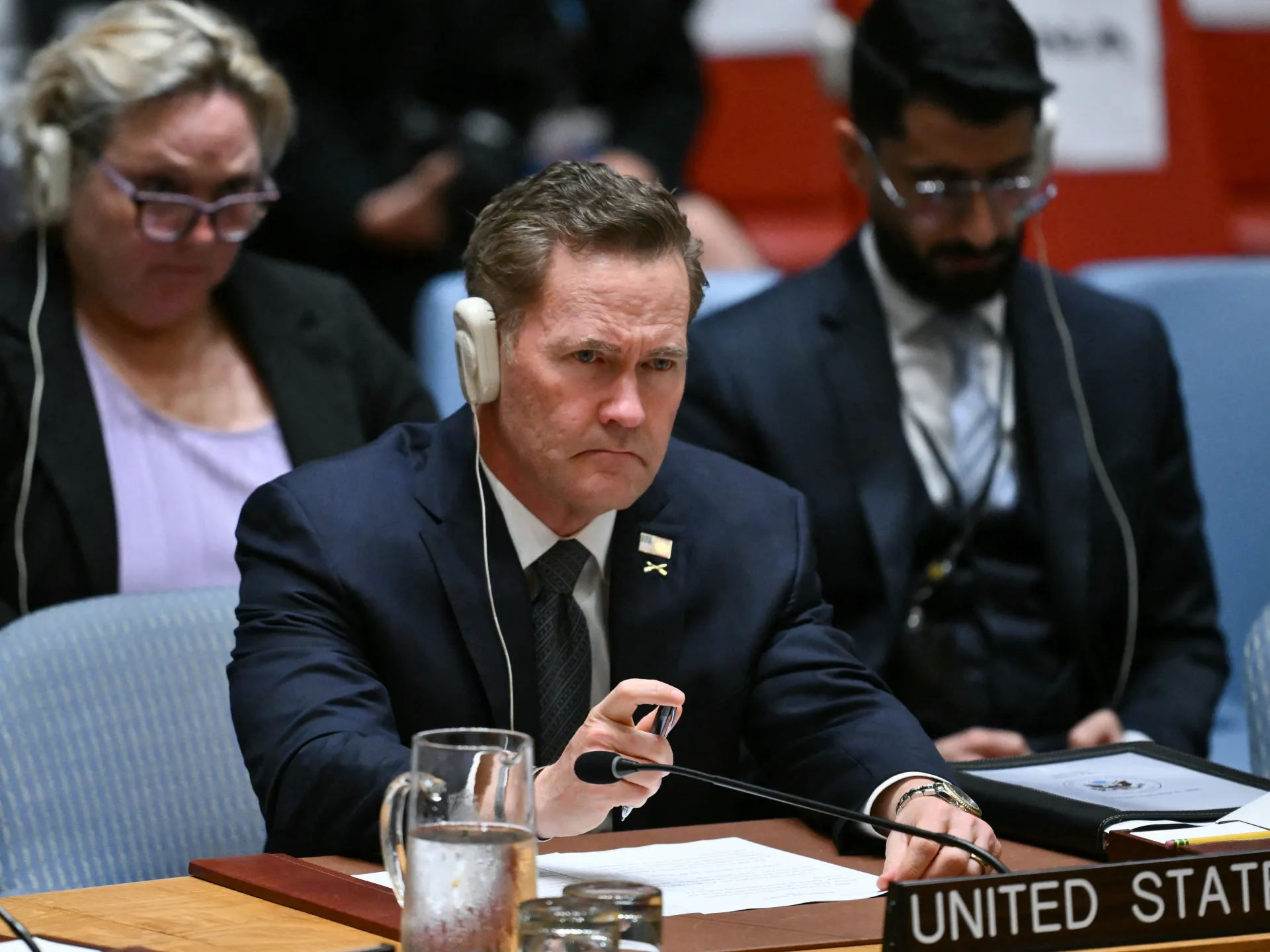
Mike Waltz: US offered to sell Iran uranium for civilian programme | US-Israel war on Iran News
As part of previous negotiations aimed at ending its war on Iran, the United States offered to sell Tehran uranium for use in a civilian programme, but Iran refused, a top US official said on Sunday.
“Heck, our negotiators even offered to sell them uranium,” US Ambassador to the United Nations Mike Waltz said on NBC’s Meet the Press. He said the agreement would have been akin to that with the United Arab Emirates, which has “a peaceful programme, right there in their neighbourhood, and they abide by international law and inspection regimes”.
Recommended Stories
list of 3 itemsend of list
Waltz said the administration of US President Donald Trump was open to allowing Iran to keep a civilian nuclear programme, provided it agreed to its obligations in accordance with international law and the Nuclear Non-Proliferation Treaty (NPT).
There were “a number of ways” President Trump was open to dealing with Iran to ensure it did not have access to highly enriched uranium, or the ability to reconstitute highly enriched uranium, including by having Tehran “hand over” any such material it currently has, Waltz said.
The UAE, a signatory to the NPT, generates electricity from a nuclear power plant and signed an agreement with the US in 2009. Under those agreements, the UAE has agreed not to produce enriched uranium domestically, and not to reprocess spent fuel on its own. Trump said Saudi Arabia and the US reached an agreement on civilian nuclear use this year, but details have not yet been made public, and the US president has also claimed the deal is contingent on Riyadh agreeing to the controversial Abraham Accords. Around the region, Egypt and Turkiye also operate civilian nuclear programmes.
Pakistan openly operates a nuclear arsenal, while experts have long believed Israel secretly possesses one of its own. Neither country is a signatory to the NPT.
A key point of contention between Iran and the US has been what should be done with the uranium that Tehran currently has, and how, or even if, to ensure any future supply of the material is not capable of being used for producing a nuclear weapon. Iran has insisted it has no plans to create a nuclear weapon, and any uranium it possesses and enriches is only for civilian purposes, including for generating electricity and use in medical treatments and scientific research.
Iran is estimated to have more than 440kg (970lb) of uranium enriched at 60 percent purity. Uranium enriched to around 90 percent purity is suitable for a nuclear weapon. Enriching uranium is a complex process that involves isolating the most radioactive isotope in a quantity of uranium. Under the 2015 Joint Comprehensive Plan of Action (JCPOA), Iran agreed to cap its uranium enrichment at 3.67 percent under strict international supervision in exchange for lifting sanctions against its economy. Trump scrapped that deal in 2018, saying it was too generous to Iran.
On September 10, the International Atomic Energy Agency (IAEA) said it was concerned over Iran’s “continued noncompliance” with the Nuclear Non-Proliferation Treaty, of which it is a signatory. Under the treaty, Iran agrees not to produce nuclear weapons and to meet IAEA safeguards to control its supply of uranium used for civilian purposes. The agency has not had access to key Iranian nuclear facilities since June 2025, when Israel and the US attacked sites in the country as part of a 12-day war.
Iranian officials have responded to the IAEA by saying the finding was made “under political pressure from the US and its allies”, and that they have not stopped respecting their treaty obligations, but could not allow inspections until facilities were safe from US and Israeli attacks.
At times, Trump has said he will destroy the enriched uranium Iran has or retrieve it by force. In April, the US president claimed to have convinced Iran to turn over the enriched uranium it had, which he referred to as “nuclear dust”. Iranian officials quickly dismissed those claims, saying enriched uranium would not be transferred outside the country under any circumstances.
On Saturday, Trump rejected a plan submitted by Iran to reopen the Strait of Hormuz within seven days, as Tehran continued to insist that only diplomacy can solve the conflict between the two countries. Speaking to reporters at the White House, Trump said on Saturday that Iran wants to make a deal to open the vital maritime corridor immediately only “because they are losing so badly”.
In an interview on Meet the Press on Sunday, Iran’s foreign minister, Abbas Araghchi, said that Iran is prepared for war to resume, “even if it comes to a doomsday war”.
He added, “If you ask us, there is no reason why we should go back to diplomacy. But I’m still trying diplomacy, because I think we shouldn’t miss any chance for peace.”
Giant pandas arrive in Atlanta as part of 10-year US-China agreement | Politics News
The two pandas, Ping Ping and Fu Shuang, arrived from southwestern China.

Published On 27 Sep 2026
Two giant pandas, Ping Ping and Fu Shuang, have arrived in the US state of Georgia on a 10-year loan as a soft-power gesture from China.
A new agreement between Zoo Atlanta and the China Wildlife Conservation Association makes Atlanta one of three zoos in the US to house giant pandas.
The diplomatic gifts departed early on Sunday from Chengdu Shuangliu International Airport in southwestern China, according to Chinese state media. They arrived after the high-level three-day Washington summit with China last week, where closed-door talks between United States President Donald Trump and Chinese President Xi Jinping yielded no major policy breakthroughs on prickly issues such as AI, trade, Taiwan and the war with Iran.
Although the pandas’ transfer had been finalised back in April, Xi officially announced the arrival timeline on Thursday at the White House, noting that the black and white mammals could reach Zoo Atlanta from the Chengdu Research Base, China’s premier hub for giant panda conservation, breeding and research, within the next few days. The dispatch of the vulnerable species aimed to signal a renewed bilateral friendship between the leaders of the world’s two biggest economies.
Ahead of their arrival, Zoo Atlanta had upgraded its panda habitats and secured a stable, long-term supply of locally grown Atlanta bamboo, which shares a near-identical climate with Chengdu.
The bears completed a 16-hour charter flight across the International Date Line, landing in Atlanta, Georgia, shortly before 7:00am (11:00am GMT).
Midway through its journey through Alaska, the FedEx Boeing 777 had spiked to the top of Flightradar24’s global tracking charts.
Steamed corn buns, bamboo shoots and carrots were prepared to keep the pandas nourished during their flight, Chinese state-run media reported. The US also mobilised a specialised care team to accompany the duo on their flight, they said.
A spokesperson for the zoo told Al Jazeera that their team had “done everything possible to accommodate them”, but a definitive timeline for their arrival – much less their public debut – remains “unconfirmed”.
“This is a thrilling day for Zoo Atlanta and a historic moment for the City of Atlanta, the state of Georgia and beyond,” Zoo Atlanta President and CEO Raymond B. King said in a statement. “We are elated to welcome Ping Ping and Fu Shuang and could not be more excited about sharing that joy with our Members, guests, city and community in the coming weeks.”
Zoo visitors will have to wait a while to see Ping Ping and Fu Shuang, officials said. The bears will be quarantined for about a month in a biosecure area of the wildlife park’s new giant panda complex. The zoo last had pandas in 2024.
Ping Ping, a male, and Fu Shuang, a female, were born in 2020.
Globally revered, the iconic furry animals have been sent across the globe for decades, serving as diplomatic emissaries loaned by China under its infamous “panda diplomacy” initiative through soft-power projection. Beijing leverages the animals’ immense public appeal to cultivate international goodwill, seal lucrative trade deals and burnish its geopolitical image abroad. Similarly, when foreign relationships fray or tensions arise, Beijing lets the loan agreements expire.
Xi has said this latest loan programme was an example of “friendship between the Chinese and Americans”.
Last week’s summit was Xi’s first visit to Washington in more than a decade and the second meeting this year with Trump.
Tangible outcomes of the meetings remain modest, restricted to a two-month extension of the trade truce, Beijing’s revival of giant panda loans and Xi’s support for Trump’s rebranding of artificial intelligence as “super intelligence”.

Deadliest Catch star Todd Meadows’ eerie last words to kids moments before falling overboard revealed in season finale
THE EERIE last words of Deadliest Catch star Todd Meadows to his children have been revealed in the season 22 finale.
Meadows, 25, was killed when he fell overboard while he and his crew mates were filming this latest series which ended on The Discovery Channel on Friday.
The rookie deckhand fell off the Aleutian Lady in a fishing accident on The Bering Sea and died from downing with possible hypothermia on February 25, 2026.
In the final episode of Season 22, a touching segment showed before and after his death, and captured his final conversation with his children just moments before the accident.
In a FaceTime call, he told his three children, all under five, that he was “being safe” and promised a fishing trip when he saw them again.
“I hope you’re being safe,” his daughter said on the call.
read more on deadliest catch

“If you’re not being safe, you better be safe.”
“Oh, I’m being safe,” he told her.
He promised his son a salmon fishing trip when he returned, telling producers on-camera that it was a “heart-wrencher” to leave his children at home for long stretches.
“It’s been one of my dreams and goals to make it up here,” he said, speaking of joining the crew for the season.
Most read in Entertainment
“That’s why I’m up here to make it and to try to support my family.”
Another part of the season finale captured the chaos surrounding the moment he fell overboard, without the actual fall or subsequent actions being shown on camera.
Captain Rick, who announced Meadows’ death, is filmed manning the vessel and asking “Everybody OK?” before the crew say that a man has gone overboard.
As he turns the boat and instructs them to ready the ring and crane, he tells the crew: “I got my eye on him.”
They successfully got Meadows out of the frigid sea and the Captain instructed them to perform CPR.
“Come on, man, come on, someone go get the AUD right now,” he says off camera with him tearfully telling the crew to “keep pumping” before a producer says, “He’s gone, Rick.”
A statement on screen read: “On February 25th, 2026, deckhand Todd Meadows went overboard.
“After six minutes and twenty-six seconds in the water, he was recovered unresponsive.”
The episode then showed the aftermath of his death and its impact on the crew.
It ends with a cut back to Meadows as he prepares food in the kitchen and answers a producer’s question about what he would want to say to his children.
“Work towards your dreams and goals, don’t let anything slow you down. If you put your mind to it, you can do anything.
“Just want my kids to know I want them to work hard and be successful in life.”
Weeks before his fall, Meadows suffered a serious head injury onboard and was sent home on medical leave before being cleared again for work on September 18.
His week of medical leave saw him go back to his family while nursing his concussion which would tragically be the last time he saw them.
“The last photo I got of him was when he was building a fire. He was listening to music in the moment and was so happy,” his mom Angela said at the time.
“That’s how I want to remember him.”
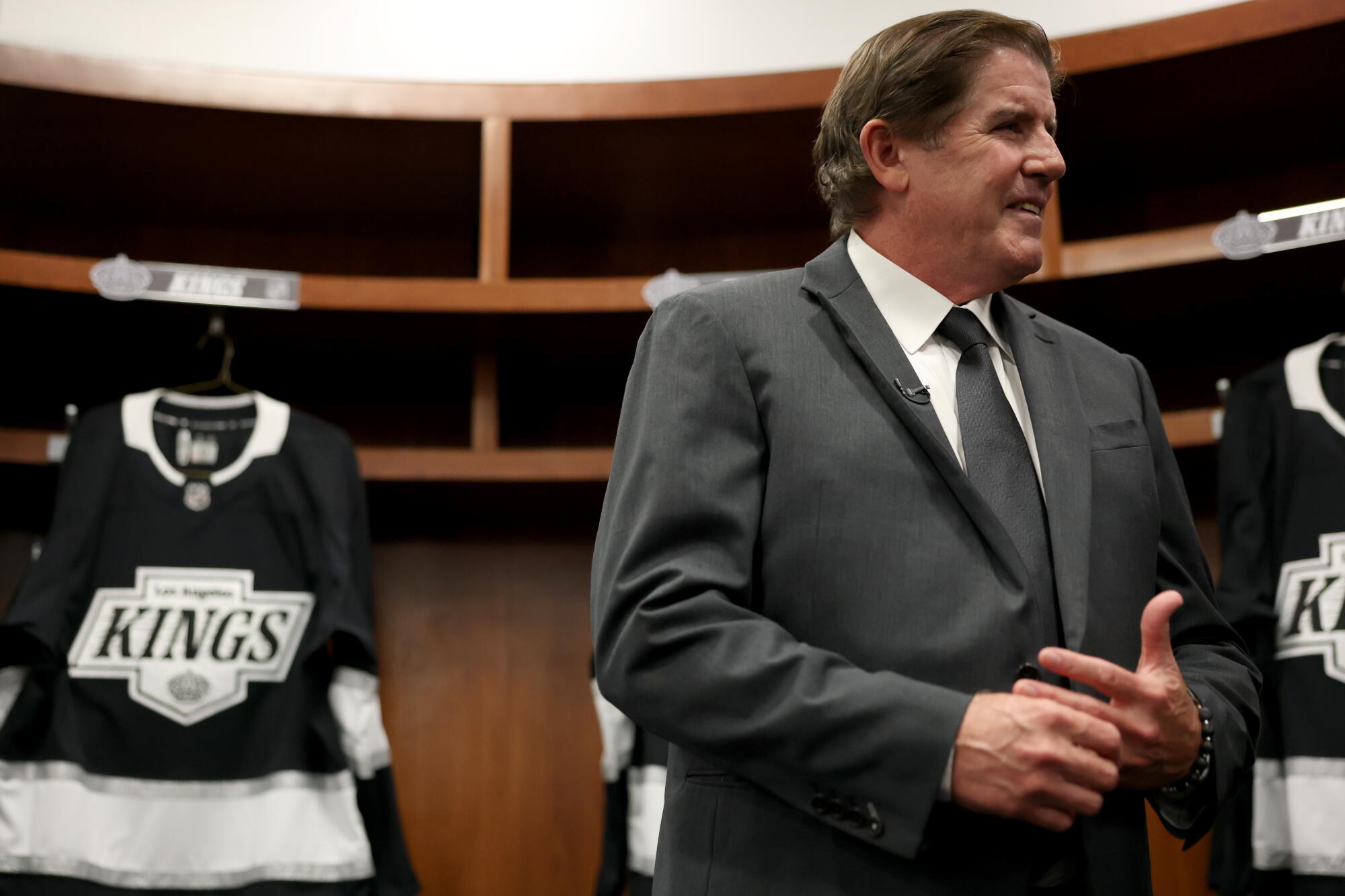
Drew Doughty and L.A. Kings aim for playoff success in new era
The Peter Laviolette Era begins for the Kings on Wednesday when the coach steps behind the bench for the first time before their season opener against the Colorado Avalanche in Denver.
And that won’t be the only difference from last season because Laviolette, the winningest American-born coach in NHL history, has inherited an aging team in transition, one he and his new staff have immediately tried to put their stamp on.
“The coaching changes brought a lot of excitement,” goaltender Darcy Kuemper said. “It’s new drills, new systems, so it kind of makes everyone turn on their brain and challenge themselves, which is fun for guys at this level.”
Not all of the changes are positive, however.

Kings coach Peter Laviolette stands in the team’s locker room at their practice facility in El Segundo in June.
(Eric Thayer / Los Angeles Times)
For the first time in 20 years, the Kings are starting a season without Anze Kopitar, the franchise leader in games, assists and points and a two-time Stanley Cup champion. That has left a big hole on the ice and in the locker room, where Kopitar’s leadership was invaluable.
Also gone are wingers Andrei Kuzmenko and Jeff Malott, who left as free agents, and center Trevor Lewis, who retired. High-scoring winger Kevin Fiala, meanwhile, will miss the first couple of months, at least, after experiencing a setback in his return from a gruesome leg injury sustained at the Milan-Cortina Olympics.
That could hurt Laviolette’s effort to transform the Kings from the defense-first system they’ve been for years into a quicker, more aggressive offensive-style team. The Kings, whose scoring has declined in each of the last four seasons, had just 225 goals in 2025-26, fourth-fewest in the NHL, while the power play converted fewer than 18% of its chances, fifth-lowest in the league.
Two of the key pieces in turning that around will be forwards Adrian Kempe, who led the team in scoring the last three seasons, and Artemi Panarin, who had his best offensive season under Laviolette with the New York Rangers, scoring 49 goals and 120 points in 2023-24. The Kings are also counting on young forwards Quinton Byfield and Alex Laferriere, both 24, to take the next step in their development.
For Laferriere, change has been the main constant in his time in Los Angeles.

Kings right wing Alex Laferriere shoots in front of Philadelphia right wing Travis Konecny on March 19.
(Jessie Alcheh / Associated Press)
“This is going to be my fourth year with my fourth different coach,” said Laferriere, who had career highs in goals (21), points (44) and average TOI (18:18) last season. “It kind of reminds me a little bit of my rookie year. It kind of gives me that fresh slate, just trying to prove myself and try to gain the coach’s belief.”
In the dressing room, the Kings have given Kopitar’s crown to defenseman Drew Doughty, who will take over as captain in his 19th NHL season. At 36, he’s the third-oldest player on one of the NHL’s oldest teams and the last holdover from the 2014 Stanley Cup team.
“I’m not changing anything about myself when it comes to leadership,” he said. “I’ve been a leader on this team for a long, long time and been the loudest voice in the locker room and the guy that people come up to.
“One thing I will change: I always had Kopi as kind of the even-keel guy, where my emotions kind of go up and down. I’m going to be more aware of that and try to keep more of an even-keel.”
Whether a new coach, a new system and a new leader will be enough to get the Kings to the playoffs for a sixth straight season remains to be seen.
Laviolette, a Stanley Cup winner with Carolina two decades ago, has missed the postseason just three times when he’s been behind the bench the whole season. But the makeover he faces with the Kings is shaping up as one of the most challenging of his career, and most of the preseason prognostications have the Kings failing to make the cut.
If Fiala comes back early and healthy and if the team adapts quickly to the change in style, those predictions may prove overly dire. If not, the transition to the Laviolette Era could be more difficult than expected.

Muslims protest planned demolition of ‘600-year-old’ mosque in India | Government News
Hundreds of Muslims have gathered in the Indian city of Ujjain to protest the partial demolition of a mosque they say is more than 600 years old. The BJP-led state government says the action is needed to widen roads ahead of the 2028 Hindu pilgrimage, which is expected to draw large crowds.
Published On 27 Sep 2026

Afghanistan says 28 fighters killed as Islamabad, Kabul trade accusations | Pakistan Taliban News
Relations strain further as Afghanistan and Pakistan trade accusations over terrorism and cross-border violence.
Published On 27 Sep 2026
Afghanistan’s Ministry of Defence said its forces killed 28 fighters in the eastern province of Nuristan who had crossed the border from Pakistan.
In a statement posted to X, the Taliban’s defence ministry confirmed it had engaged in clashes with the opposing group on Sunday.
Recommended Stories
list of 3 itemsend of list
The defence ministry alleged that most of the fighters were former Afghan government security personnel recruited by Pakistan’s intelligence services with promises of asylum and well-paid employment in foreign countries.
The defence ministry claimed the fighters included ISIL (ISIS) fighters who were supported by Pakistani militias.
Pakistan’s Ministry of Information and Broadcasting rejected the allegations, describing them in a post on X as “frivolous, baseless and devoid of any truth”.
Pakistan denied that its security forces or intelligence agencies were involved in clashes in Nuristan, had recruited or trained former Afghan security personnel, or had facilitated ISIL (ISIS) or other armed groups in Afghanistan.
Pakistan’s information ministry also said the Taliban “should take credible and verifiable action against terrorist organisations operating from its territory” and fulfil its obligation so that “Afghan soil will not be used for terrorism against Pakistan or any other country rather than attempting to deflect responsibility through fabricated accusations”.
Escalating tensions
The clashes follow increasing tension between the two countries.
Last week, Pakistan launched air strikes on 10 locations in Afghanistan it said were used to store and launch drones, some of which were used in cross-border attacks.
The Pakistani air strikes on Thursday killed at least four people, a spokesman for the Afghan Taliban government said while promising to deliver an “appropriate response”.
Pakistan has repeatedly accused Afghanistan of sheltering fighters who attack its territory, a charge Kabul denies.
Sunday’s incident also follows Pakistani air strikes in Afghanistan on September 21 that Islamabad said killed 28 fighters. Afghan officials said civilians were killed and the U.N. mission in Afghanistan confirmed three civilian deaths.

The last classical music critic at a major U.S. newspaper retires
Today marks the end of an era. Mark Swed — the last full-time classical music critic at a major American newspaper — has retired. On Thursday, members of The Times editorial staff gathered to celebrate Swed, but the mood was somewhat somber. Although we were glad for our beloved colleague, this was not a happy milestone for journalism — or classical music.
Swed is the rarest of writers: a critic with deep empathy and encyclopedic knowledge who can turn the sonic details of an orchestra playing Mahler’s Seventh Symphony into an epic journey for readers. At a time when orchestra leaders struggle to find new audiences for the art form, Swed’s writing did the job for them.
And in an era when everybody is an expert on TikTok, Swed’s informed criticism was a life raft in a sea of slop. He told us why the music mattered — in its historical context, as it related to the modern landscape, and what it meant to him personally. He made us better listeners, and most importantly, he made us curious. After reading his take, we wanted to run out to a concert, an opera or a new music festival.
That this particular kind of writing — and of seeing and explaining the world to readers — is going away with Swed, is truly a tragedy. Thankfully he is leaving of his own accord, and will hopefully continue to write a monthly column, but his loss still stings.
Like many, I watched with sorrow in February as the Washington Post slashed its staff, including its classical music critic, Michael Andor Brodeur. That blow came a little less than a year after the New York Times shook up its culture desk and reassigned its classical music critic, Zachary Woolfe, to serve as the obituaries editor. (The paper is now actively searching for a new classical music critic.)
A number of staffers spoke at Swed’s retirement lunch, and deputy A1 editor John Penner was among them. In his touching speech, Penner noted that Swed was the last of his kind, adding, “with no full-time critic writing anywhere in any newspaper about classical music, American journalism will be poorer, and its readers less informed, inspired and enlightened.”
Penner continued, saying what all of us gathered in that conference room knew to be true, “Mark’s 30 years at The Times coincided with this city’s Golden Age of classical music — the era of Salonen and Dudamel and Disney Hall. L.A. has been the most important and exciting music capital in the country, if not the world. (Why else would New York be stealing Gustavo from us now?) And central to that excitement and importance has been Mark’s writing and criticism. For my money, even when there were many music critics writing for many publications, Mark set the standard for classical music criticism, while opening our ears to new and under-appreciated music.”
Hear, hear.
I’m Arts editor Jessica Gelt wishing Swed a happy retirement and humbly asking him to come back to us now and again. This is your arts and culture news for the week.
The week ahead: A curated calendar
FRIDAY
Demand To Be Heard Festival
The Sunflower Project presents a celebration centering the voices of survivors of abuse beginning with a screening of the film “Break The Silence: The Gabby Petito Story,” followed by a panel discussion with the Gabby Petito Foundation. Saturday and Sunday is the Resident Artist Showcase, featuring the work of six survivor/artists. Also Saturday are three three arts workshops focusing on music, candle making and body movement, respectively.
Film screening, 6 p.m. Friday; 6:30 p.m. Saturday-Sunday, Resident Artist Showcase. Wisteria Theater, 7061 Vineland Ave., North Hollywood. Arts workshops, 11:30 a.m., 1 and 2:30 p.m. Art Share L.A. 801 East 4th Place, downtown L.A. towardsthesun.org
Jonah Elijah: Ambiguously Free
The first U.S. museum solo exhibition by the L.A.-based contemporary painter and mixed-media artist features work that blends personal memories with broader mythologies, religion and history to explore Black culture.
On view through December 16. Xela Institute of Art, 2176 Pacific Avenue, Long Beach. xela.art
Joshua Redman Quartet: Words Fall Short
The saxophonist performs a new program of music with his ensemble — pianist Paul Cornish, bassist Philip Norris and drummer Nazir Ebo, plus special guest Skylar Tang, an up-and-coming Bay Area-born trumpeter and composer.
7:30 p.m. The Wallis, 9390 N. Santa Monica Blvd., Beverly Hills. thewallis.org
Melrose Gallery Walk
Gallery spaces, including Hostler Burrows, Lawson-Fenning, Meg Turner, Object, Seventh House, The Window and 22RE, open their doors to celebrate the local design community. Free and open to the public.
5-8 p.m. Hostler Burrows, 6819 Melrose Ave. hostlerburrows.com
SATURDAY
Midterms: This Will Hurt Someone
Brightwork newmusic performs a program of contemporary works inspired by civic life and social change, including Ted Hearne’s “Bye Bye Huey,” Natalie Dietterich’s “Philosophy of Furniture,” Ian Dicke’s “Get Rich Quick” (with video), Matt Marks’ “This Will Hurt Someone,” Hesam Abedini’s “What Remains” and “Frederic Rzewsk’s “Coming Together” (with video).
8 p.m. Sierra Madre Playhouse, 87 W. Sierra Madre Blvd. sierramadreplayhouse.org
Aperghis Trilogy
Long Beach Opera performs three works by experimental composer Georges Aperghis: “Le corps à corps”,” Les Sept Crimes de l’amour,” “Récitations.” Directed by James Darrah Black. Christopher Rountree conducts.
7:30 p.m. The Queen Mary, 1126 Queen’s Way, Long Beach. longbeachopera.org
The Horror Show
An immersive deep dive into the movie genre presented in six themed galleries: Gothic, Psychological, Science, Slasher, Religion and Ghosts, with behind-the-scenes looks at a range of titles that includes everything from Oscar winners to drive-in classics. But first, you must pass through “The Hallway,” bwahahaha.
10 a.m.–6 p.m. Wednesday–Monday, on view through July 25, 2027. Academy Museum, 6067 Wilshire Blvd. academymuseum.org
Senon Williams: here now, now gone, gone here
A solo exhibition of the artist’s work, in which he collects materials such as nails, slips of paper, fragments of language and industrial remnants, then uses assemblage to rearrange them and discover deeper meaning.
Noon-6 p.m. Tuesday-Friday, on view through Nov. 15. The Philosophical Research Society, 3910 Los Feliz Blvd. prs.org
Promised Lands: California’s Unratified Treaties and Native Resilience
Archival materials, contemporary objects, images and voices from local tribal communities relate the complex history of the state with its indigenous people.
10 a.m.-4 p.m. Tuesday-Friday, 10 a.m.-5 p.m. Saturday-Sunday. Autry Museum of the American West, 4700 Western Heritage Way, Griffith Park. theautry.org
Rodgers & Hammerstein’s The Sound of Music Sing-A-Long
Actor and comedian Melissa Peterman hosts the annual screening of the 1965 Oscar winner for best picture complete with a costume contest and more than a few of your favorite songs.
7:30 p.m. Hollywood Bowl, 2301 N Highland Ave. hollywoodbowl.com
Daymé Arocena’s Alkemi
The Grammy nominee and Juno Award–winner blends Afro-Cuban beats with neo-soul, jazz and contemporary Latin pop.
7:30 p.m. The Wallis, 9390 N. Santa Monica Blvd., Beverly Hills. thewallis.org
San Pedro Festival of the Arts
The 20th annual event, presented by Los Angeles Choreographers & Dancers, features 20 dance companies demonstrating a variety of styles and cultural traditions.
1-4:30 p.m. Peck Park, Upper Green near the Community Center, 560 N. Western Ave. triartsp.com
Tokio Ueyama: The Hollows Between Mountains
The first museum exhibition in California of the Little Tokyo-based Japanese artist (1889–1954) features his drawings, prints, photographs and paintings as well as artists he was associated with, including Diego Rivera, Tōyō Miyatake, Edward Weston and Henrietta Shore.
11 a.m.-6 p.m. Wednesday–Sunday, on view through Feb. 28, 2027. UC Irvine Langson Orange County Museum of Art, 3333 Avenue of the Arts, Costa Mesa. langson.uci.edu
SUNDAY

Grant Gershon conducts the Los Angeles Master Chorale at Walt Disney Hall, Nov. 16, 2025.
(David Butow/For the Times)
Brahms’ Requiem
The Los Angeles Master Chorale, led by Grant Gershon, opens its silver anniversary season with a program that also includes Bruckner’s “Te Deum.”
7:30 p.m. Walt Disney Concert Hall, 111 S. Grand Ave., downtown L.A. lamasterchorale.org
WEDNESDAY
Rubén Blades & Roberto Delgado Big Band: Fotografías Tour
The Panamanian salsa greats perform classic Afro-Cuban music flavored with rock, jazz and Latin American influences. Silvana Estrada opens.
8 p.m. Hollywood Bowl, 2301 N Highland Ave. hollywoodbowl.com
Menopause The Musical: 25th Anniversary Tour
Four women at a lingerie sale share their experiences with “the change” through parody songs of pop hits.
7:30 p.m. Bank of America Performing Arts Center, 2100 E. Thousand Oaks Blvd., Thousand Oaks. bapacthousandoaks.com

The Broadway production of “The Outsiders.”
(Matthew Murphy)
The Outsiders
The Tony Award-winning musical adaptation of S.E. Hinton’s coming-of age-novel set in 1960s Tulsa arrives with Ponyboy Curtis and his fellow greasers facing off against the upper-class Socs.
Through Oct. 18. Hollywood Pantages Theatre, 6233 Hollywood Blvd., Hollywood. Oct. 20-Nov. 1. Segerstrom Center for the Arts, 600 Town Center Drive, Costa Mesa. tour.outsidersmusical.com
THURSDAY
Laura Benanti: Nobody Cares
The Broadway star sings original songs and shares stories with her trademark wit in this one-woman show. Directed by Annie Tippe.
7:30 p.m. Thursday-Saturday. 2 p.m. Saturday-Sunday. The Wallis, 9390 N. Santa Monica Blvd., Beverly Hills. thewallis.org
The Dance and the Railroad
Asian American theater collective Artists at Play and Latino Theater Company team up for a rare revival of an early David Henry Hwang play set during the 1867 Chinese railroad workers’ strike. Directed by Katherine Chou.
Previews, 8 p.m. Thursday and Oct. 2. 8 p.m. Thursday-Saturdays, 2 p.m. Sundays, through Nov. 1. Los Angeles Theatre Center, 514 S. Spring Street, downtown L.A. latinotheaterco.org
Mahler’s Symphony No. 2: Resurrection
Alexander Shelley conducts the Pacific Symphony with soprano Miah Persson, mezzo-soprano Dame Sarah Connolly and the Pacific Chorale.
8 p.m. Thursday-Oct. 2. Segerstrom Center for the Arts, 600 Town Center Drive, Costa Mesa. pacificsymphony.org
The SoCal scene

Gov. Gavin Newsom mingles with guests at the Lucas Museum of Narrative Art opening party.
(Carlin Stiehl/For The Times)
I spent my Saturday night at the Lucas Museum opening party where I got to stand in the lobby by the nifty elevators watching Gov. Gavin Newsom talk to Kim Kardashian. Later, I went to Skywalker Grill and saw U.S. Rep. Nancy Pelosi sitting at a table next to Leonardo DiCaprio and his entourage. It would be an understatement to say that the night was both bizarre and memorable.
Times theater critic Charles McNulty (the paper’s only remaining arts critic) has kept exceptionally busy this fall season. Late last week he wrote a review of “The Ford/Hill Project” At REDCAT, which transforms Senate testimony from Anita Hill and Christine Blasey Ford into a docu-play that explores the details of two of history’s most consequential Supreme Court confirmation hearings. “The restraint imposed by the production adds to its power. There’s no need to editorialize. The proceedings skewer themselves,” McNulty writes.

Huguette Caland in Stone Doorway, France, 1970.
(Huguette Caland Estate)
McNulty also drove to San Diego to see the Old Globe’s world-premiere musical adaptation of John Carney’s “Begin Again,” which explores the stories of two music-industry vets who embark on a grassroots recording project. The show features a score by rocker Pat Monahan and Train. “‘Heartwarming’ is a cliche of theater reviewing that I have studiously tried to avoid, but I’m tempted to use the word in my review of ‘Begin Again’,” McNulty writes.
McNulty penned one of his harshest reviews since last year’s take down of “Hamlet” after he went to Atwater Village Theatre to see Echo Theater Company’s world premiere production of “The Peterson Show,” by Janine Nabers. “Unfortunately, the production is hamstrung by fundamental problems in the writing, directing and acting, all pointing to a failure of control. Control of the story, control of the tone and control of the cast,” McNulty wrote of the show, which is about the impact of disgraced Bill Cosby-like star on his TV family.
Meanwhile contributor Tara Anne Dalbow wrote a beautiful story about the late, great artist Huguette Caland in advance of the largest U.S. retrospective of her work, opening Sunday at the Hammer Museum.
Ernest “Ernie” Wolfe III, owner of an eponymous gallery on Sawtelle, is dying of a traumatic brain injury and his family is looking for homes for his 15,000 pieces of African Art. Contributor Jane Horowitz writes about Wolfe‘s legacy and the (sometimes controversial) origins of his collection.
I got the scoop that the Museum of Contemporary Art has appointed Jonathan Abbott as its new director and chief executive. Abbott replaces interim director Ann Goldstein, who stepped in last July after the unexpected departure of Johanna Burton. Abbott, who begins work immediately, joins the museum as its sixth director since 2008. He formerly served for 15 years as president and chief executive of the PBS-affiliated public broadcasting station GBH in Boston.

Mary Cassatt, “Summertime,” 1894-95
(Sotheby’s / Armand Hammer Collection)
As one chapter closes with Swed’s retirement, a new one begins as we welcome our new entertainment and arts reporter, Laura Zornosa, who hit the ground running by writing three great arts stories: The first is about the private art collection of Armand Hammer (including Mary Cassatt’s “Summertime,”) coming up for auction at Sotheby’s; the second, covering opening day at the Lucas Museum where Zornosa interviewed guests on their thoughts about the place; and the third is a fun news brief about how Los Angeles Chamber Orchestra commissioned fanfares from half a dozen film composers, including John Williams and Ludwig Göransson, curated by “none other than Seth MacFarlane (best known as the creator and star of “Family Guy”).”
Enjoying this newsletter? Consider subscribing to the Los Angeles Times
Your support helps us deliver the news that matters most. Become a subscriber.
Culture news

Coy Middlebrook has been named the new artistic director of the Wallis.
(Jeff Lorch / The Wallis)
The Wallis Annenberg Center for the Performing Arts announced the appointment of longtime creative staffer Coy Middlebrook as its new artistic director. “Coy brings an extraordinary depth of knowledge about The Wallis and its audiences, along with deep relationships throughout the performing arts nationally and internationally. He understands both the artistic possibilities of this
institution and the importance of its relationship to our community. I am excited to work with him as we build a future that is artistically ambitious, deeply connected and open to everyone,” said Wallis Executive Director and Chief Executive, Jean Davidson, in a news release.
Meanwhile Theatre Commons LA (TCLA), the nonprofit organization created and launched a year ago as part of a concerted effort by some of the city’s most prominent theater leaders to unify the city’s sprawling theater scene, has announced its first Executive Director, David E. Shane. Shane previously served as director of program services at the Alliance of Resident Theatres/New York where, according to a news release, “he set the strategic vision and goals for a robust suite of programs serving over 450 of New York’s nonprofit theaters.” He is tasked with doing the same thing in L.A. and we wish him the best of luck.
— Jessica Gelt
And last but not least
The Getty Museum has acquired the recently rediscovered 17th-century painting “Portrait of the Count-Duke of Olivares” by Spanish artist Diego Velázquez (1599-1660). It will be displayed in the museum’s East Pavilion this fall. According to ArtNews, “The acquisition means a Velázquez painting will for the first time be represented in the collection of a West Coast museum.”
Bill Gates calls for federal AI safeguards beyond industry self-regulation
Bill Gates calls for federal AI safeguards beyond industry self-regulation
Source link
Manchester City charges: What punishment could club face after Premier League verdict and will they appeal?
Premier League clubs are seeking legal advice about compensation from Manchester City over the case.
One source, who held a senior executive position at two Premier League sides, said they expected clubs to submit individual compensation claims against Manchester City.
Another leading lawyer told the BBC that process could even be centralised by the league.
Premier League rules allow clubs to seek legal action against each other for compensation.
In June, Everton were told they must pay Burnley £35m after they broke PSR over a three-year period.
Burnley argued the breach impacted their chances of staying in the Premier League, and sought compensation for the losses associated with being relegated.
Everton are appealing, with sources previously saying they would “robustly and thoroughly” contest the ruling, but it provides an interesting backdrop to the Manchester City case.
There is uncertainty over a statute of limitations, which would set a cut-off point for claims.
Arsenal, Manchester United, Liverpool and Tottenham Hotspur reportedly preserved their rights to claim compensation two years ago.
This is not just about Manchester United (twice) and Liverpool, who finished as runners-up to City in their title-winning seasons.
It is about those clubs who just missed out on the Champions League, or failed to make Europe, or even those who were relegated.
And it could even result in claims over the prize money for each Premier League place, or the potential commercial earnings lost by rival clubs.
Kieran Maguire, professor of football finance at the University of Liverpool, told BBC Sport it would be considered a “denial of an opportunity” by complainants.
Maguire explained that the “statute of limitations is not referenced” in the Premier League’s traditional handbook, though that could be subject to a legal challenge from City.
But what of the compensation? Just looking at Champions League qualifying could bring huge financial claims.
“The Champions League in those days was worth a minimum of £30m,” Maguire said. “I think by the time we got to 2018, it was probably worth £60m or £70m, and that’s in prize money.
“On top of that, you could claim for loss of gate receipts, loss of sponsor bonuses. This is highly unlikely, but it’s certainly being discussed.
“Players get bonuses for qualifying for the Champions League. Those bonuses, if you talk to people connected to the elite clubs, are normally in the region of 25%.
“An average salary in those days would probably, if you go back to 2012, be in the region of £80,000 or £90,000 a week. Twenty-five percent of that is four or five million pounds a year. That’s how the issues stack up.”
Points deductions, fines, and compensation claims.
This is an extremely messy situation for the Premier League, and it does not look like being resolved anytime soon.
For Libya, the Hormuz crisis can be a trap or an opportunity | Energy
Amid the worsening global energy crisis triggered by the US-Israel war on Iran, European countries, desperate for alternative energy supplies, trade routes and partnerships, have looked across the Mediterranean for solutions.
As a result, governments across North Africa have started to reassess their strategic value. Algeria is in an especially strong position as an established gas supplier, while Egypt can offer infrastructure, refining capacity and access through the Suez Canal.
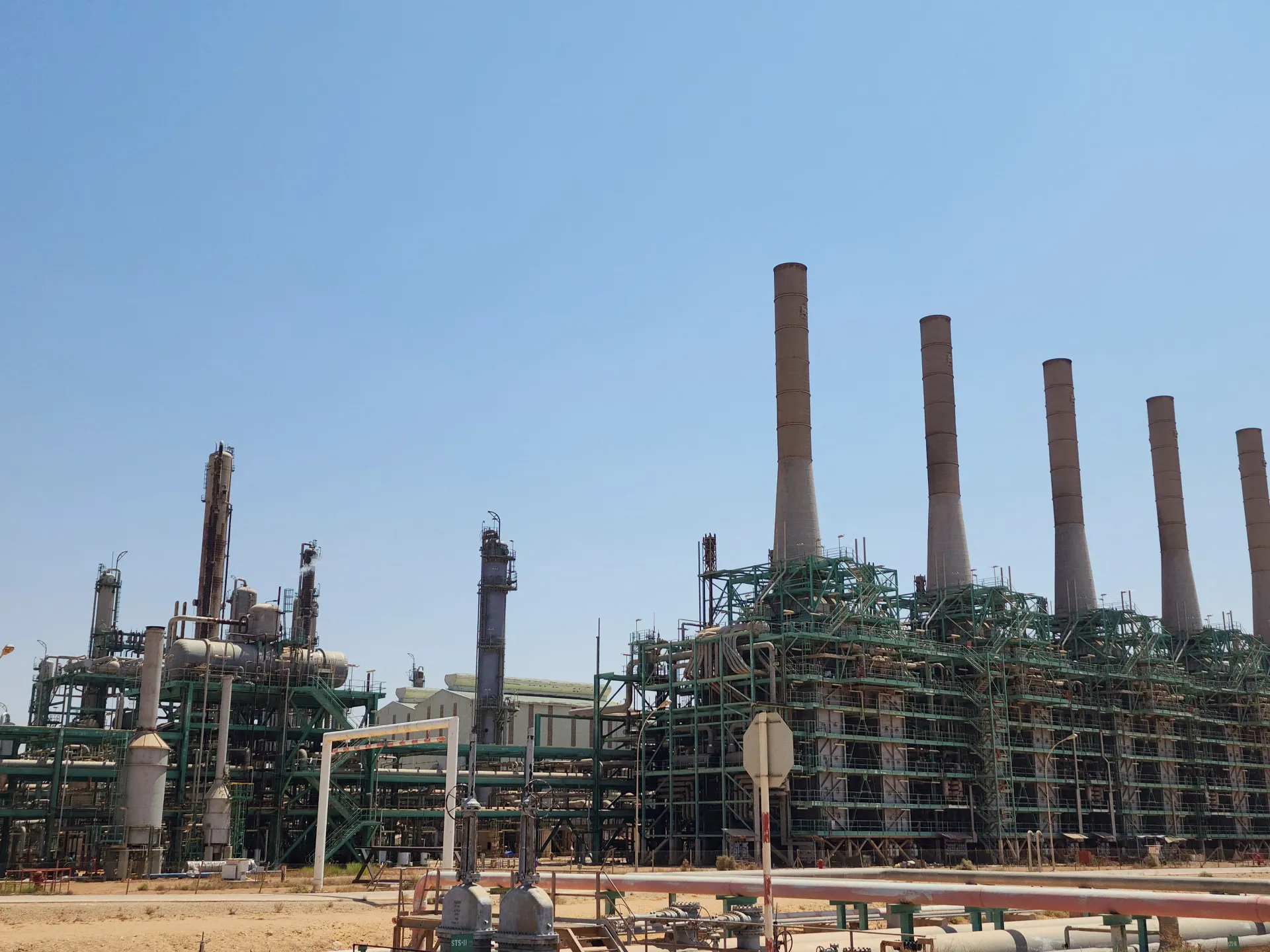
Libya has also seen its strategic value increase. It has around 48 billion barrels of proven oil reserves, the largest in Africa, and produces 1.5 million barrels of oil per day. It also has substantial natural gas reserves.
Its oil reaches international markets through the Mediterranean, while the Greenstream gas pipeline connects its Mellitah complex directly to Europe.
Libya cannot replace the Gulf in terms of oil and gas exports, but it can become a major player in diversification efforts not just in Europe but elsewhere in the world. The challenge the country faces is how to take full advantage amid structural constraints and insecurity.
Energy insecurity at home
Libya is simultaneously a major energy exporter and an energy-insecure state. Although the country possesses vast oil and gas resources, Libyans experience regular electricity blackouts due to an inefficient domestic energy system.
More than 70 percent of Libyan gas production is consumed domestically, mostly for electricity generation. Production has struggled to meet both domestic needs and export commitments. Gas exports consequently fell year on year from around 200 billion cubic feet in 2019 to 35 billion in 2025, the lowest export levels in 22 years.
At the same time, the country is flaring at least 200 billion cubic feet of gas annually due to underdeveloped infrastructure. Gas that could generate electricity, support industry or increase exports is instead being wasted.
The International Monetary Fund has estimated Libya’s total energy subsidy burden at around $17bn, equivalent to roughly 35 percent of GDP – one of the largest in the world.
Much of these funds go into subsidising imported refined fuels, as domestic refining capacity is largely underdeveloped and cannot meet demand.
The domestic energy situation is compounded by political fragmentation, institutional disputes and periodic disruptions to production due to conflict.
Increasing exports without addressing these problems risks improving energy security abroad while neglecting it at home, and that is a recipe for more instability in an already fragile nation.
Opportunity or trap?
The global energy crisis triggered by the Iran war is surely a major opportunity for Libya to increase its revenues from hydrocarbons. But it also carries a risk.
As I pointed out during the 5th meeting of the Mediterranean Energy Experts Circle earlier this month, greater demand for Libyan oil and gas could reinforce the economic model the country has struggled to escape from for decades: producing hydrocarbons, exporting them, distributing the revenues and postponing structural reform.
This model does not allow Libya to capture the full economic potential of its resource wealth. It keeps the Libyan state stuck in the all too familiar “resource curse”, which promotes economic stagnation and inefficiency.
That is why when taking advantage of heightened demand for energy, it is crucial that Libya uses the proceeds to transform its energy system.
That means capturing flared gas, modernising electricity generation and transmission, expanding domestic refining where economically viable, reforming subsidies, investing seriously in renewable energy and participating in sustainable regional energy cooperation.
Libya’s National Sustainable Energy Strategy aims to have 22 percent of electricity generation from renewable sources by 2035, an ambitious target that requires major positive shifts in security and governance conditions. Increased revenue flows can help jump-start the process.
Another important consideration is how the country should approach heightened foreign interest. Libya’s first major oil and gas licensing round since 2007 was concluded in February, with the US’s Chevron, Italy’s Eni, QatarEnergy, Spain’s Repsol, Hungary’s MOL, Nigeria’s Aiteo, and Türkiye’s TPAO securing new licences.
Commercial and geopolitical interests are rarely completely separate in energy. For Libya, this creates bargaining power—if managed coherently by the Libyans. Rather than becoming an arena in which external actors compete for individual assets and relationships, Libya could use diversified partnerships to attract investment and technology while reducing dependence on any single partner.
From energy exporter to Mediterranean energy hub
The transformation Libya seeks should not be confined to its borders. Its strategic objective should be to become an integral player in a Mediterranean energy hub by expanding cooperation with neighbouring states and leveraging existing production capacities and infrastructure.
To Libya’s east, Egypt has a large electricity system and significant refining and processing capacity. To its west, Tunisia provides access towards the wider Maghreb and increasingly towards European markets. Libya sits between them with enormous hydrocarbon resources, considerable solar potential and existing energy connections with both neighbours.
Important steps have already been taken to deepen regional energy integration. In January, Egypt and Libya signed an energy cooperation agreement covering exploration and the development of crude-oil refining. The two countries are also discussing the construction of an 800km pipeline connecting Tobruk to Alexandria. The project is worth $1bn and would carry Libyan crude directly to Egyptian refineries.
Libya and Tunisia are also expanding cooperation. Earlier this month, the Libyan-Tunisian company Joint Oil opened an international licensing round covering around 3,000 square kilometres of shared offshore acreage and development of the cross-border Zarat oil and gas discovery. Formal awards are expected by the end of April 2027.
The risk here is that expanded cooperation could develop into dependence. How to avoid that is the lesson Libya can learn from the Strait of Hormuz crisis. The country still needs sufficient domestic electricity, refining and production capacity to protect itself. Regional integration should add alternatives rather than create new vulnerabilities: more markets, more electricity connections, more processing options and more export routes.
The objective should therefore be specialisation, connectivity and redundancy all achieved in the right sequence depending on needs and conditions.
A moment for strategic redesign
The Iran war has given Libya something potentially more valuable than temporarily higher hydrocarbon prices: renewed strategic relevance. But greater strategic relevance does not automatically make the country a more reliable energy partner.
Converting the former into the latter requires a radically different approach not just to the domestic oil and gas industry, but also to overall economic development and regional geopolitics.
Libya must use this moment to pursue strategic redesign: to increase production while recovering wasted gas, improve electricity infrastructure, develop refining and renewables, strengthen regional connections and cooperation, and use competition among international partners to attract investment.
Libya already has the resources and the geography to become an even bigger player in the energy market. The question is whether it can build the rest.
The views expressed in this article are the author’s own and do not necessarily reflect Al Jazeera’s editorial stance.
Strait of Hormuz tensions linger as Iran and US move further from a deal | US-Israel war on Iran News
Tehran, Iran – Hours after US President Donald Trump rejected a diplomatic solution put forward by Iran to reopen the Strait of Hormuz, explosions were heard in the waterway, according to Iranian media.
Reports of blasts near southern Iran’s Qeshm Island in the Strait of Hormuz suggested that multiple antiship missiles and drones were fired at vessels transiting the waterway against Tehran’s wishes.
Recommended Stories
list of 4 itemsend of list
While Iranian authorities did not confirm any attacks in the Strait of Hormuz that day, shipping continues to be attacked in the waters, including an Indian cargo ship last week, which killed a sailor.
The Islamic Revolutionary Guard Corps (IRGC) maintains that the strait is closed to any ship that does not coordinate with Iranian authorities. On Sunday afternoon, it released video of what it said was a second US underwater drone seized this month.
Tehran has issued instructions to shipping companies transiting the Strait of Hormuz to use a temporary route approved by Iranian authorities and pay relevant fees. But it has also said the strait will not fully reopen until the US blockade on Iranian ports ends.
Iran’s Persian Gulf Strait Authority announced on Saturday that it would blacklist any shipping charterer company which orders crews to use routes it considers to be unauthorised.
It also published what it described as an apology from an unnamed shipowner blaming commercial pressure from its charterer for trying to pass through the strait.
Washington still insists that its warships are successfully guiding oil tankers out of the strait via a different route. US Energy Secretary Chris Wright told Fox News on Sunday that the “running average” of crude oil in transit was nearly 13 million barrels per day.
A September 19 operational update by US Central Command claimed that its forces had helped move more than one billion barrels of crude out of the Gulf over roughly two months.
The US military also says its forces have redirected 122 commercial vessels to enforce the naval blockade of Iran’s ports, halting all Iranian crude exports.
Tehran has claimed that the US is providing false information regarding Strait of Hormuz traffic to project control over the key waterway. Shipping has been severely disrupted since the US and Israel started their war on Iran on February 28.
Andreas Krieg, associate professor at King’s College London, said Iran’s strategy of launching maritime attacks has spread the economic costs of the conflict beyond its borders.
While Iran has suffered economically from war damages, the US naval blockade and sanctions, it would be a mistake “to assume that reaching that threshold produces submission”.
“The next Iranian move is therefore likely to be an attempt to increase the pain experienced by the Gulf rather than simply absorb further American pressure,” Krieg said.
“That could mean more aggressive vessel interdictions in Hormuz, attacks on energy infrastructure, greater Houthi pressure around Bab al-Mandeb and pressure from Iranian-aligned groups against alternative Saudi export routes. We are already seeing how pressure on Hormuz, the Red Sea and Saudi infrastructure can interact.”

More escalation on the way
At the United Nations General Assembly in New York, Iran projected a message of defiance while also proposing to reopen the Strait of Hormuz within a week if its seven conditions were met.
They included lifting the blockade on Iran, the release of frozen Iranian funds and an end to attacks on all fronts, including Israel’s assault on Lebanon. The demands mostly amounted to a return to the June memorandum of understanding between the US and Israel.
Tehran has added that reopening the strait must be undertaken through a bilateral arrangement already finalised with Oman, the only other country with territorial waters in Hormuz.
US President Donald Trump told reporters he rejected the offer, but Iran’s Foreign Minister Abbas Araghchi said on Sunday they were adamant about the conditions and would await an official response through mediators, such as Pakistan, Qatar and Oman.
Abolfazl Shekarchi, chief spokesman of the Iranian armed forces, warned that if the US further intervenes in the Strait of Hormuz, “it will get slapped”.
“The Americans have no way out other than withdrawing from the West Asia region. The sooner they leave, the fewer losses they will incur and the region will certainly become safe after that,” he said.
Iranian army spokesman Mohammad Akraminia said conditions were deteriorating so badly for the US that it might launch another “military aggression” on Iran.
Krieg said that as the US moves to isolate Iran via sanctions, Tehran, unable to respond with mutual financial measures against Washington, will be forced to rely on continued coercion in the Strait of Hormuz.
“The most likely level remains controlled attrition rather than an immediate return to the massive air campaign of the opening months,” Krieg said.
“Over the coming weeks, I would expect further attacks or attempted attacks on tankers, US-enabled shipping and regional infrastructure, followed by limited US strikes against IRGC maritime assets, coastal missile positions, drones or vessels involved in those operations. That tit-for-tat cycle has already re-emerged around Hormuz.”

Katherine Ryan dons sequinned gown as she steps out for the first time since apologising to Victoria Beckham
KATHERINE Ryan has been spotted out and about for the first time since issuing an apology to Victoria Beckham.
The star used the C-word when talking about Posh Spice last year during an episode of Have I Got News For You, and recently apologised for it online after facing backlash.
Katherine got dolled up in a stunning green sparkly dress to embrace her inner Elphaba on the green carpet for Wicked’s West End 20th Anniversary Gala Performance.
The dress featured sequins all over as well as dangling tassels across the shoulders.
The comedian held her hands in front of her and smiled for the camera while a buzzing crowd was forming behind her for the event.
Speaking in an episode that aired on November 7, Katherine made reference to a 2013 private email sent by David Beckham, where he allegedly used the word ‘c****’.


She said on the show: “I don’t know that we are allowed to broadcast the C-word, but you did reference Victoria Beckham earlier and we’ll allow that.”
The BBC‘s Executive Complaints Unit (ECU) have issued it’s ruling on the matter and have revealed there was no justification for Victoria being labelled with the offensive word.
Katherine has since taken to social media to issue Victoria an apology.
In a reel chatting to the camera, she began: “Hi I’m comedian Katherine Ryan and today the BBC announced their decision to uphold a complaint made by two very influential viewers about a joke that I tried to make on an episode of Have I Got News For You eleven months ago.
“At that time, though there is no defence, I was suffering from a condition called matrescence.
“I was in that building with a 10-day old baby. Should I have left the house?
“This is gonna be a tough one for the feminists because I was a woman going to work but I did call another woman a c***.
“[…] “The trouble is now that section’s been taken off iPlayer so the incident only exists in printed media, online media and then you lost the context because on the day, if you watched it, it was clearly a joke and the whole audience went ‘huhhhh’ and I said ‘whoaaaa’.”
An edited version of the episode has replaced the original on the BBC’s streaming service.
David also gifted his wife a lavish bouquet of flowers in support while the drama has been unfolding.
Victoria shared a snap of the flowers onto her Instagram story with a simple message over the top reading “I love you @davidbeckham”.
Armani open to multiple investors for planned 15% stake
Armani open to multiple investors for planned 15% stake
Source link

Poll shows Roy leads in L.A. city attorney race — with most undecided
California Deputy Atty. Gen. Marissa Roy has a lead in the race to replace Los Angeles City Atty. Hydee Feldstein Soto, who lost her seat in a historic primary rout this spring, new polling shows.
Among likely Los Angeles voters, Roy leads by 10 percentage points over her rival, Los Angeles County Deputy Dist. Atty. John McKinney, following the pair’s shocking electoral upset in June, according to a poll released last week by UC Berkeley’s Institute of Governmental Studies and co-sponsored by The Times.
The spread closely mirrors City Councilmember Nithya Raman’s breakaway lead in her bitter fight to unseat Mayor Karen Bass, who has outraised her for months.

But that’s where the similarities end.
The mayor’s contest has been called a “knife fight” for its no-holds-barred campaigning. It has also drawn sustained — and occasionally sensational — national attention since Raman’s buzzer-beating entrance in February.
By contrast, the city attorney’s race remains all but unknown: More than two-thirds of likely voters are still undecided, versus about a third who remain uncommitted in the mayor’s contest, polling showed.
L.A.’s top litigator commands a budget of nearly $200 million, plays a role in shaping city ordinances, and wages court battles on behalf of the public. The city attorney also prosecutes misdemeanors — a job most other cities keep separate. Each year, the office weighs some 120,000 violations, deciding whether to file charges and how to pursue them.
More recently, city attorneys across the country have championed activist litigation, spearheading suits against the Trump administration, among others.
Yet, few local voters know the job exists, and fewer still know the candidates by name.
Seventy percent of likely voters said they had no opinion of either McKinney or Roy — a fairly typical result for a down-ballot race, experts note.
Still, new data about voter priorities could signal how those undecideds might shake up the race in its final weeks.
Roughly a third of L.A. voters rank “moving homeless people indoors” and “crime and public safety” as top priorities, respectively; just slightly less say “fixing streets, sidewalks, streetlights and other city infrastructure” is essential.

McKinney, 58, pitches himself as a law-and-order moderate with plans to use the city attorney’s prosecutorial power to reduce disorder and move unhoused people off the streets. He manages more than 300 people at the district attorney’s office and spent decades in the courtroom securing high-profile convictions — advantages that he contends outweigh his lack of civil litigation experience.
Roy, 34, campaigns with an aura of sunny progressive pragmatism, arguing that the city can rein in ballooning liability in part by tackling its vexing infrastructure issues. She nods to the recent $17-billion settlement with Meta — a case her team at the attorney general’s office led — as evidence of the kind of ambitious, public interest litigation a large municipal attorney’s office could join.
Those disparate visions — along with crucial endorsements and influxes of cash — helped the pair define clear brands and constituencies going into the primary.
Both also got a boost from nationwide anti-incumbent fervor, staking sides across a mutual opponent whose name recognition had turned sour while rarely taking aim at each other.
But the general election is a different animal.
Although the Los Angeles electorate has been moving leftward for years, primary voters typically skew older and more conservative than those who show up for the general election, experts said.
Polls suggest that fact could create an uphill battle for McKinney, whose sway is biggest among conservatives, about 19% of the city’s electorate.
Some 21% of Republicans and nearly 30% of self-identified MAGA voters favored McKinney in the most recent poll, while Roy is favored by 25% of Democrats and by 3 in 10 voters who identify as progressive or democratic socialists.
By contrast, about a quarter of Republican voters now say they favor Bass for mayor, while Raman has a 14-point lead among Democrats. (Both are about equally underwater with MAGA voters.)
Like Raman, Roy has deep ties to the city’s insurgent democratic socialist political machine and hard-won endorsements from its progressive clubs. She has also successfully courted L.A.‘s influential unions and got an early boost from the L.A. County Democratic Party when it endorsed her this spring.
McKinney is endorsed by the city’s powerful police union and championed by L.A. County Dist. Atty. Nathan Hochman.

Netball World Cup: Scotland & Northern Ireland qualify for 2027 event
Scotland and Northern Ireland secured qualification for the Netball World Cup after a three-day event in East Kilbride.
The top two sides from the four-team tournament won their spots in the finals, which take place in Sydney, Australia, with Wales and Republic of Ireland failing to qualify.
Northern Ireland’s emphatic 73-50 win in the early match on Sunday meant they would qualify should Scotland win or draw, while Wales’ only path to qualification was through a victory over Scotland.
Heading into the final match of the tournament between the Scots and Welsh, the event hosts had their spot in the finals secured unless Wales won with an overwhelming points haul and Scotland ran out 55-48 victors.
The World Cup runs from 25 August-5 September 2027.

True Crime Reports: The Dosa King’s Deadly Obsession | Digital Series
The Dosa King built an empire. After a woman rejects him, her husband is found dead – and the pursuit of justice begins.
The Dosa King built a restaurant empire worth millions. But when a young woman rejects him, he threatens her marriage. Soon after, her husband is found dead. For nearly two decades, he fights to escape justice. Can his wealth and power protect him? Find out in Season 2 of True Crime Reports, an Al Jazeera Originals Production.
The illustrations in this video were created by artists aided by AI-powered software.
In this episode:
Episode credits:
True Crime Reports is an Al Jazeera Originals Production. Our host is Halla Mohieddeen. This episode was written by Ryan Gaffney. The Head of Podcasts is Jo de Frias. The EP of Podcasts is Alexandra Locke. Our Executive Producer is Ney Alvarez. Our Senior Producer is Fahrinisa Campana, Leo Danczak is our producer and Catherine Nouhan is our Assistant Producer. The Production Coordinator is Ashley McCarry. Fact-checking by Catherine Nouhan, Zaina Badr and Chiara Brambilla. The Senior Script Editor is Dan Hawaleshka. Our Post-Production Supervisor is Nacho Corbella. Our Video Editor is Nacho Corbella. Osama Alsaadi is our AI Animator. Alan Leer is the Supervising Sound Editor. The Sound Designer is Lizzy Andrews. Music composition by Tom Biddle. Adam Abou-Gad is our Engagement Producer.
Connect with us:
Published On 27 Sep 2026
US installation commemorates victims of South African ‘white genocide’ | Gun Violence
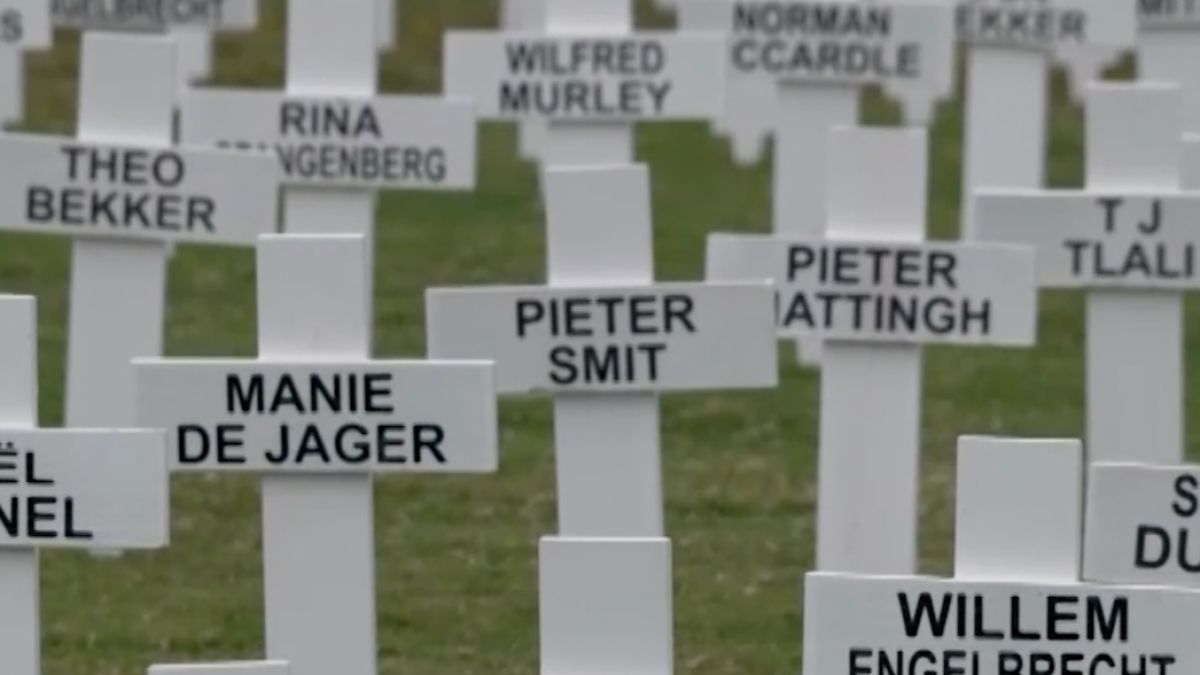
Memorial crosses installed in Washington DC have revived erroneous claims of a ‘white genocide’ against farmers in South Africa, a narrative echoed by US President Donald Trump. South Africa’s government rejects the allegation as baseless, saying crime and violence affect people across all racial groups.
Published On 27 Sep 2026
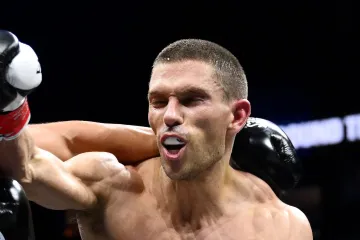
Joey Essex’s Towie brawl that left co-stars screaming goes viral 14 years on
JOEY Essex’s most explosive TOWIE brawl has resurfaced 14 years on as he prepares to step back into the boxing ring.
Back in 2012, the reality star was filmed grappling with co-star Ricky Rayment in the street as their castmates screamed for them to stop.
Footage of the showdown has recently gone viral, with one fan posting it alongside the words: “The moment Joey Essex lost his head on TV.”
The row erupted at the relaunch of Lauren Goodger’s salon after Joey became convinced Ricky had been talking about him behind his back.
Confronting his co-star, Joey snapped: “You’re chatting s**t behind my back mate.”
Ricky insisted he had been “off his nut” and tried to apologise, but the argument continued.


Joey’s sister Frankie Essex stepped in, only for Ricky to tell her: “No one’s talking about you and no one ever will talk about you.”
The pair then headed outside, where cameras caught them grappling and throwing punches as the women shouted for them to stop.
The fan who shared the clip wrote: “This was crazy.”
Another commented: “Even celebs who are meant to be cut crease perfect lose their cool sometimes.”
A third said: “I’ve never seen this before. Respect to Joey for sticking up for his relatives.”
The explosive showdown can still be watched on ITVX in series four, episode nine of The Only Way Is Essex.
It comes as Joey, 36, is now preparing to headline a Misfits Boxing show against controversial comic Dapper Laughs, whose real name is Daniel O’Reilly.
The pair will meet at London’s Copper Box Arena on Saturday, October 10.
It will be Joey’s second bout for Misfits after he beat Portuguese influencer Numeiro on points in Manchester last August.
Misfits have confirmed that Joey has three fights planned with the promotion, making the Dapper Laughs clash the next step in his boxing run.

Trending stocks on Wall Street this week amid geopolitical developments
Trending stocks on Wall Street this week amid geopolitical developments
Source link

L.A. voting rights groups mobilize to counter possible November election disruption
The once simple message, “Get out the vote,” now has a corollary: “Protect the vote.”
That message was hammered home Saturday for dozens of voting rights groups, community organizations and unions attending a rally to recruit and train poll watchers for the November election.
Organizers for several groups brought together under the banner of Love Powers L.A. offered scenarios of the threats that could materialize on Nov. 3 — from ICE raids to intimidation by the Proud Boys — and detailed strategies to counter them.
Their goal was to raise a cadre of volunteers for a Neighborhood Vote Protection Program to observe 650 polling places throughout the 11 days of voting and to turn fear and confusion sought by election deniers into a celebration of the right to vote.
“We want to make it a season of excitement,” said Jeremy Payne of the social justice group Catalyst California.


1. David Gutierrez right, of Inner City Struggle, signs up Jocelyn Elizalde, 22, and Manuel Becerra, 19, from left, to help with outreach, during an event held by Love Powers LA, representing dozens of community groups and labor unions, provide education and training to Angelenos on how to protect their vote and respond to threats of election interference at East Los Angeles College on Saturday, September 26, 2026. (Christina House/Los Angeles Times) 2. Participants including Evelyn Gonzalez, right, attend a workshop for activist dance and street activation during an event by Love Powers LA, representing dozens of community groups and labor unions, providing education and training to Angelenos on how to protect their vote and respond to threats of election interference, at East Los Angeles College on Saturday, September 26, 2026. (Christina House/Los Angeles Times)
The event kicked off with multicultural music by Native American, Korean and West African drum ensembles.
Speakers from groups as diverse as Can’t Stop California, Inner City Struggle and Strategic Concepts in Organizing and Policy Education: SCOPE detailed the threat and their programs to respond to it for 300 prospective volunteers.
“L.A. is a target for retribution and spectacle,” said John Lee, also of Catalyst California. “When they try to steal an election, it is a sign they know they are losing.”

Godfrey Plata of L.A. Forward, left, and Jung Hee Choi of We Are California present skits on how to talk to neighbors about voting during the event Saturday.
(Christina House / Los Angeles Times)
The event, involving numerous nonprofit organizations, stayed away from endorsements or political messages aimed at the coming election. But speakers didn’t hold back on their views of President Trump.
“Trump is a chicken and a loser,” said Jung Hee Choi, of the umbrella group We Are California.
Choi described two personality types, skeptics and frozen, that the group is targeting.
She urged volunteers to hold ballot parties in their homes to move skeptics “from the couch to the poll” and routine voters from the “frozen mode to the fight mode.”
“We need people out at the polls,” she said. “You are the greatest tool to fight back and grow our movement.”
The groups held their event just a day after Trump’s latest move in his attempt to reshape voting in America.
The Supreme Court upheld Trump’s expanded use of government data to search for noncitizens who are registered to vote. The impact of the decision is likely to be limited, other than to highlight Trump’s distrust of elections and his unproven claims that a large number of illegal voters are casting ballots.

Love Powers L.A., representing dozens of community groups and labor unions, provides education and training to Angelenos including Azenith Morales, Marise Roxas, and Liezl Japona, from left, of the Filipino Workers Center, on how to protect their vote and respond to threats of election interference.
(Christina House/Los Angeles Times)
Breakout sessions covered how to plan a ballot party, activist dances and street activations.
Attendee Joe Pugh, who works for the community services organization ATAP, said she planned to host a block party to push the importance of voting in South-Central.
“They’re always talking about ‘my vote doesn’t count,’” she said.
During the poll monitoring session, Emma Olson Sharkey, a partner at the Political Law Group, outlined what poll watchers should look for and what they should do about it.
Their role, she said, is not to engage. They will observe and report any attempt to intimidate voters or poll workers.
The organization provides an online report form to report incidents.
“We hope it is boring,” Payne said. “In most cases, nothing will happen.”

Spain’s last ‘secret’ island that looks more like Mykonos is just off the mainland and it’s 28C next week
WHEN it comes to the Canary Islands, your first thought would probably be Tenerife or Gran Canaria.
But what if I told you the smallest of the islands is often overlooked but is just as beautiful?
La Graciosa is the smallest inhabited Canary Island, known for its volcanic landscapes.
Tourism Lanzarote even claims that “it is the least explored and most peaceful and serene of the Canary Islands.”
There are two main villages on the island – the main fishing village and then the port of Caleta de Sebo.
And in these storybook villages, you won’t find paved roads, instead just sand-covered streets and paths.
Read more on travel inspo


If you are looking for somewhere to stay on the island, you’ll want to head to Caleta de Sebo as this is where you’ll find most of the accommodation such as guest houses, apartments and campsites.
And thanks to many of the buildings in the towns being whitewash with low roofs, visitors have previously compared La Graciosa to Mykonos.
Despite being just north of Lanzarote and separated from the holiday hotspot by a narrow strait called El Rio, La Graciosa is far less crowded.
The island only has a population of 700 and thanks its small size – 11.2-square-miles to be exact – it doesn’t take too long to explore.

The most popular way of exploring the island is by bike, with numerous trails heading to different corners of the island.
And of course, you can head to the beach.
In fact, at the beach you’ll be sat in front of Europe’s largest marine reserve, which is the ideal spot for snorkeling and diving.
White-sand beaches include Playa de las Conchas, which one visitor recently dubbed as “one of the most beautiful beaches in the Canarias”.
They added: “The colors and the scenery are astonishing.”
It takes about an hour to walk to the beach from the main port, alternatively you could cycle there.
There are also no facilities at the beach, so make sure you are prepared before visiting.
Alternatively, at the other end of the island is Playa Francesa, which is a crescent shaped beach with golden sand.
You’ll also get a view of the volcano from the beach.
To get to the island you’ll need to hop on a ferry from Orzola on Lanzarote.
It takes about 25 minutes to reach the island.
And flying to Lanzarote is super cheap – with on-way tickets costing from £15 in September, October, Novemeber and December.
And what makes the destination even better is that next week, temperatures reach up to 28C making it the ideal escape from autumnal UK.

Leo Carlsson, Anaheim Ducks aim to improve on breakout season
Joel Quenneville had one mission when he took over as coach of the Ducks last year: get them back to the playoffs.
He did much better than that. The Ducks scored a franchise-record 273 goals, spent much of the season atop the Pacific Division and knocked off the powerful Edmonton Oilers in the first round of the playoffs before falling to the Vegas Golden Knights, the eventual conference champions, in the second round.
All of which raises a question for Quenneville and the Ducks coming off a summer of upheaval and turnover: What can they do for an encore?
“Expectations are going to be higher across the board,” said Quenneville, whose team opens the season Friday in Las Vegas against the Golden Knights. “That’s healthy. But at the same time, it’s an everyday thing that that challenge is going to be out there.”
Before Quenneville arrived, the Ducks stumbled through a franchise-record seven straight losing seasons. Now many of the players in his locker room are thinking beyond just making the postseason.
“The culture change, we can really feel it,” goaltender Lukas Dostal said. “What we did last year, obviously we want to improve and move even further.
“You don’t play hockey to just think like ‘OK, we want to make the playoffs.’ You want to go as far as possible. So the sky’s the limit. I really trust this team.”
“At the end of the day, you want to win a Stanley Cup,” added new captain Mikael Granlund. “You have to have that one goal. We’re going to do everything we can to be better than last year.”
Many Ducks are certainly going to be better paid than last year. General manager Pat Verbeek had no choice but to overspend on center Leo Carlsson, signing him to a five-year, $90-million contract after the Flyers offered Carlsson the same deal. The 21-year-old, who had a career-high 29 goals and 38 assists last season, is the NHL’s highest-paid player this season.
Verbeek also re-signed restricted free agents Cutter Gauthier, (six years, $81 million) and Pavel Mintyukov (five years, $36 million) and gave center Tim Washe a $9-million contract extension. Gauthier led the team with 41 goals and 69 points last season.
“It’s a sign you’re doing something correctly,” Quenneville said of his players being rewarded. “But at the same time, I don’t think we change too much our demands. They know we work on a meritocracy and the better you do, the more you’re going to play.”

Ducks defenseman Pavel Mintyukov passes against the Utah Mammoth on March 20.
(Melissa Majchrzak / Associated Press)
All that spending left the team with nothing to offer veteran winger Chris Kreider, who was released this summer, joining an exodus that included key defensemen John Carlson, Radko Gudas, Olen Zellweger and Jacob Trouba.
The Ducks will also be without forward Troy Terry, who averaged 24 goals over the past five seasons, until well into the winter as he recovers from hip surgery.
As a result, the Ducks start with several new pieces up front and thin experience on the blue line, which isn’t a good look for a team that gave up 288 goals last season, fourth-most in the NHL.
Despite the additions of veterans A.J. Greer, a Stanley Cup winner in Florida who was acquired to add a physical presence in the attack, and Nick Jensen, 36, who was signed to stabilize the defense, the Ducks will once again have one of the youngest rosters in the NHL. But Quenneville has a history of turning young teams into champions. Nineteen years ago he took over a Chicago Blackhawks team that was the youngest in the league and led it to the conference final. A year later that team captured the Stanley Cup, the first of three Quenneville won in Chicago.
For the Ducks to match that, their summer additions will have to add up to more than the subtractions. And the investment Verbeek made in Carlsson, Gauthier and Mintyukov will have to pay off. What’s certain, however, is after last season’s breakthrough, the Ducks won’t be sneaking up on anyone.
“We made it a little harder for ourselves,” Washe said. “We’ve got a little target on our back.”