


Here’s what to pay attention to at the UNGA | United Nations
World leaders arrive in New York for UNGA 81 as wars multiply and trust in international institutions erodes. Al Jazeera’s @EmmaWithrow explains the real question is whether global rules still matter when powerful countries choose to ignore them.
Published On 22 Sep 2026

Tuesday 22 September Independence Day in Mali
Mali is a landlocked country in Western Africa. From the 11th century, the Malian Empire ruled in the upper Niger basin, extending its realm right to the Atlantic coast. Mali’s imperial influence declined in the seventeenth century as other powers in the region gained prominence.
When the Malian emperor, Mansa Musa, made his famous pilgrimage to Mecca in the fourteenth century, he traveled with over 70,000 people and up to 50 pounds of gold. He built a mosque every Friday on his entire trip. Mansa Musa left so much gold to the people along his way, he inadvertently caused inflation in the regions he passed.
In the nineteenth century, France was taking an increasingly interest while Islamic religious wars had led to creation of theocratic states in the region.
In 1898, during the so-called ‘Scramble for Africa’, France conquered Mali, making it a part of French Sudan.
In April 1959 the French Sudan merged with Senegal to form the Mali Federation. A transfer of power agreement was signed with France on 4 April 1960, which led to formal independence on 20 June 1960.
The Mali Federation proved to be very short-lived and broke up on 20 August 1960, when Senegal proclaimed its independence.
A month later, on 22 September 1960 French Sudan declared its independence from the Mali Federation as the Republic of Mali.
Typhoon Dujuan kills two in Japan, causes travel chaos near Tokyo | Aviation News
Storm is moving northeast of Japan’s eastern coast across the Pacific, leaving a path of destruction behind.
Published On 22 Sep 2026
A powerful storm has triggered evacuation advisories for more than 1.6 million people, causing widespread travel chaos, flooding and landslides near Tokyo.
On Monday, Typhoon Dujuan packed wind speeds of about 144 kilometres (89 miles) per hour as it moved 130km (80 miles) south of Katsuura, near the Japanese capital, cutting power to thousands of households.
Recommended Stories
list of 3 itemsend of list
Two people have been confirmed dead, Kyodo News reported, citing local authorities.
By early Tuesday, the storm had shifted away from the coast and was heading northeast out to sea towards the Aleutian Islands, with slightly diminished winds, the Japan Meteorological Agency (JMA) said.
In areas where warnings have been issued, “there’s a risk the rain will continue as the typhoon moves north”, the JMA’s Takuya Hosomi said.

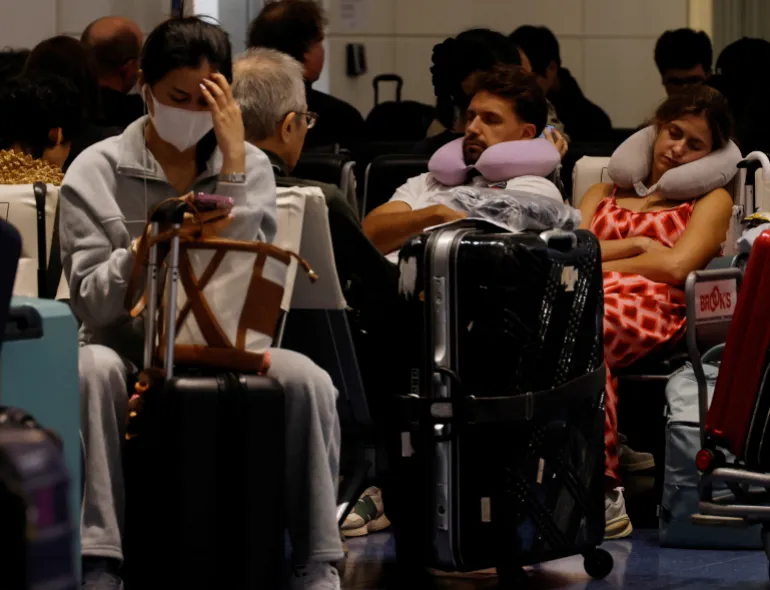
Passengers were stranded at airports after Japan Airlines cancelled 135 flights and All Nippon Airways scrapped 140 on Monday.
Some rail services were suspended, including bullet train services connecting Tokyo and Osaka, Japan Railways said.
The JMA warned on Sunday that rain and winds were expected to intensify even before the typhoon’s arrival.
“The total rainfall through Tuesday could exceed the average monthly rainfall for September, resulting in record-breaking heavy rain,” the agency said.
Social media posts showed images of flooded roads in front of Kamakura station, a popular sightseeing spot.
“There is flooding in various parts of the city, so travelling by car is dangerous,” Kamakura Mayor Takashi Matsuo said on X.
Floodwaters also inundated parts of Ichikawa, east of Tokyo.
Dujuan forced the early closure of the Tokyo Game Show, one of the world’s biggest video game trade fairs, on Monday, its final day.

A major outdoor music festival and a baseball match, both scheduled to be held in Chiba, were also cancelled.
Dujuan is Japan’s 25th typhoon this year. The country often sees strong typhoons in the late summer and early autumn.

I blagged a selfie with Kim Kardashian after gatecrashing her top secret London SKIMS party in a £35.99 knock off outfit
I CRASHED Kim Kardashian’s ultra-exclusive VIP launch of her London Skims store in a £35.99 knock-off jumpsuit – and ended up sipping dirty martinis with the A-list.
Arriving at the top-secret Regent Street bash in the pouring rain after a long day at work, I was armed with nothing but a mission and the confidence to somehow convince everyone I was wearing Kim’s Skims brand.
Amazingly, it worked.
In fact, I’d bought my entire outfit, a £35.99 Bershka gym jumpsuit, on the way there — and everyone believed it was one of Kim’s £116 creations.
And, after a humbling 30 minutes in the rain, I blagged my way inside at 7.40pm on Friday.
A couple of months ago I trekked down to an MPS Body and Paint car garage in Kent to recreate Kim’s Met Gala outfit.


Now I’d gone one step further and found myself inside her crazy world — with the crowds parting like the Red Sea as the 5ft 2in brunette bombshell stepped inside.
Security assumed I had been there from the start and began backing everyone else up behind me.
Before I knew it, I was apparently first in line for a selfie with Kim — and I certainly wasn’t about to correct them.
Kim, 45, looked incredible in a custom leather Ludovic de Saint Sernin gown and, despite my unconvincing Skims impersonation, told me: “It’s lovely to meet you, you look amazing.”
Sadly, I later heard her parrot that to every other person she met in the plush new shop, so alas the compliment wasn’t just rolled out for me.
Famed for her selfie taking, and as one of the most photographed women in the world, it came as little surprise that Kim takes this very seriously.
And as I stepped forward for my snap, I was almost blinded as one of her assistants suddenly held up a huge dazzling torch over our faces.
But after a day at work and a trek through the rain, I have never been more grateful for good lighting.
Kim had three outfit changes throughout the night and I’d already experienced one of them from the front row.
Earlier, I found myself at the front of a queue for the loo when Kim was suddenly escorted ahead of everyone.
In what felt like the longest wardrobe change in history, at least ten people were left waiting cross-legged before she eventually emerged in the same dress.
Kim later fully committed to the change and slipped into a brown leather corset and a floor-length skirt.
Her third and final look of the night was a tight-fitting, nude two-piece which drew gasps of appreciation from the seven people glued to her side at all times.
As well as two burly security guards — and her lighting flunky of course — she spent the evening with Ludovic, the man who had designed her gown, Tracy Romulus Nguyen — chief communications officer of Skims — and two other assistants who were on hand to bat away anyone trying to get more than Kim’s pre-planned compliment out of her mouth.
Three immaculate bars were dotted around the store, serving gorgeous cocktails in translucent and nude shades to match Kim’s three looks.
Staff floated around with the prettiest — and tiniest — canapes I’d ever seen, from tuna tartare to miniature potatoes smothered in caviar.
I feared I’d be starving by the end of the night, but thankfully the microscopic morsels of food were eventually replaced with much more substantial burgers and fries.
I also made good use of the bar, sipping dirty martinis with celebs including Emma Grede, Rochelle Humes, Love Island’s Lorenzo Alessi and rapper Central Cee.
Kim’s famous hairdresser and current Strictly contestant Chris Appleton was also never far from her side, checking up on her hair throughout the evening and constantly patting down stray flyaways.
Just under two hours later, Kim was whisked away to an afterparty, held in lavish private members. club Maison Estelle. She used a secret lift to escape the 200 fans who had gathered outside.
My exit was a little more down to earth and, naturally, I got my hands on two Skims goody bags before jumping on the Northern Line home.
Inside one of them was an unreleased branded tracksuit worth £220, which some cheeky party-goers have since put on eBay for almost double the price.
Given how much of an upgrade it was from my Bershka number, I’ll be holding onto mine.

Chevron plans to ramp up number of wells it drills next year, E&P executive tells FT
Chevron plans to ramp up number of wells it drills next year, E&P executive tells FT
Source link
Traffic deaths are rising. Why is the LAPD pulling over fewer drivers?
Marvin Reid can’t say how many pedestrians he’s seen get hit while trying to brave the North Hollywood intersection of Magnolia Boulevard and Tujunga Avenue. He gave up keeping count long ago.
One afternoon last spring, he watched a man get run over while walking toward a 7-Eleven on the corner. Fortunately, the man popped to his feet “like nothing ever happened” and hustled into the store, Reid said. A week or two prior, he said, an out-of-control motorist nearly plowed into the statue of Amelia Earhart that sits next to a library bearing the famous aviator’s name.
“This is really a bad spot,” said Reid, who has helped run a Jamaican food pop-up at the busy street corner for the past five years. “It doesn’t matter if it’s an old lady crossing the street with a walker.”
The number of Angelenos who die in traffic crashes now regularly outpaces those killed by homicide. From 2016 to 2023, the annual traffic death toll rose nearly 29% overall, and pedestrian deaths jumped roughly 54%. Fatal crashes fell slightly last year, but deaths still exceeded 300 in each of the last three years.
The city is rolling out 125 speed cameras in school zones, known street-racing corridors and places where speeding has contributed to a high rate of collisions — including Reid’s intersection.
But for him, the cameras aren’t a replacement for police traffic enforcement, which he said seems virtually nonexistent.
Even though LAPD squad cars are posted up outside the library “everyday,” he says, they rarely do anything about the drivers who come careening off the exit ramps from the nearby 170 Freeway.
Similar complaints are being echoed around the city. Historically, Los Angeles — like other places across the U.S. — has relied on police stops to produce road safety. But in recent years, public pressure has compelled city leaders to think more critically about whether enforcement can continue without the historical harms that has come along with it.
LAPD data show the department is far less proactive than it used to be.

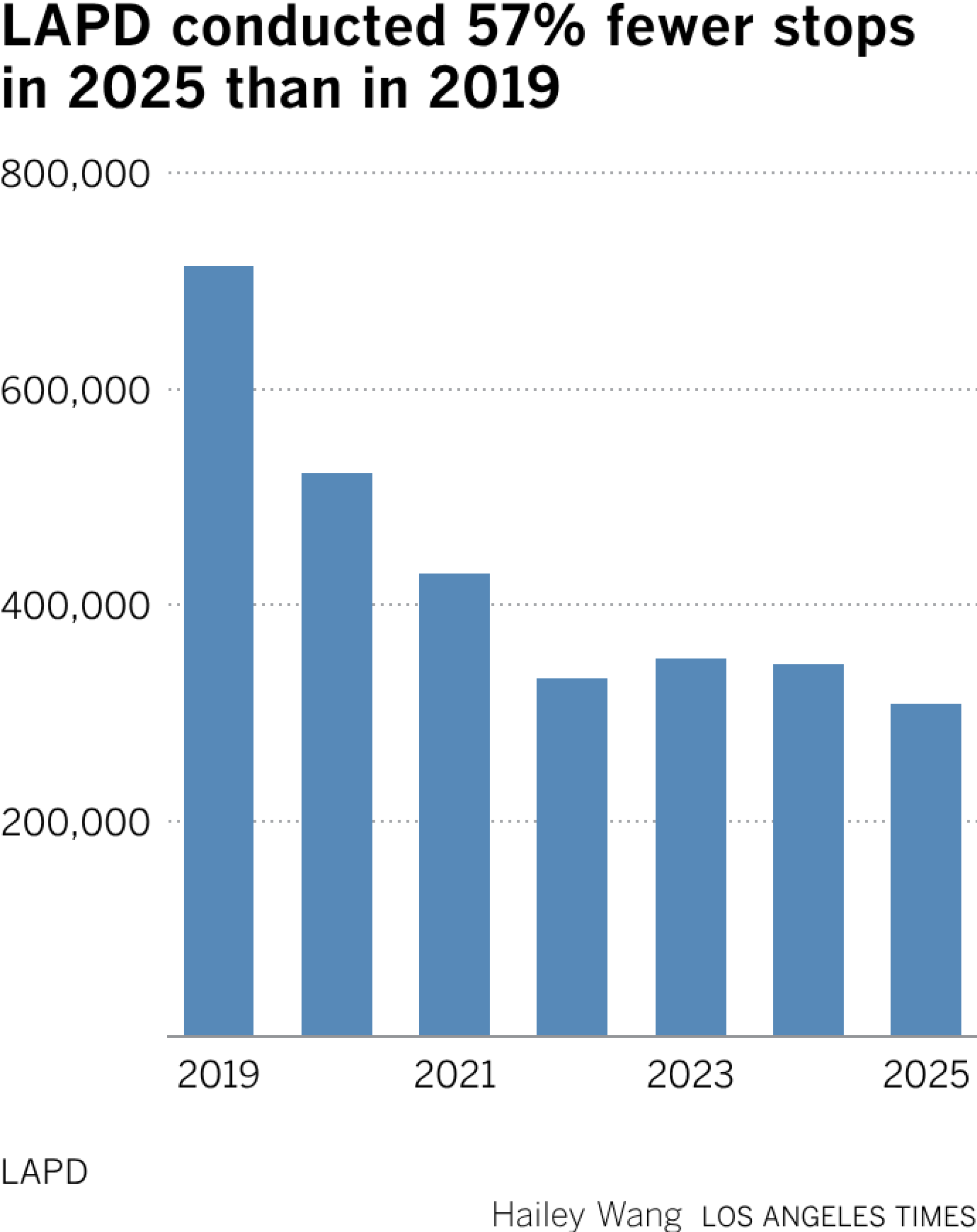
In 2019, LAPD officers made about 713,000 stops across the city; by 2025, that number had decreased to roughly 308,000 — a roughly 57% decline. A Times analysis of police stop data found that the drop-off was especially pronounced in the Central, West Valley, 77th Street and Southeast police divisions.
In some ways, the decline in stops is unsurprising. Other large U.S. cities have seen similar changes in enforcement strategies by police since the pandemic. As the department continues to shrink, LAPD commanders say they have fewer resources to devote to traffic duty. Officials have been under pressure to curb the use of so-called “pretext stops,” in which officers use a minor violation — a broken turn signal, say, or a cracked windshield — as justification to stop someone in order to investigate whether a more serious crime has occurred.
The largest declines were in the Central and 77th Street areas
Change in police stops, 2019 to 2025
LAPD
Hailey Wang LOS ANGELES TIMES
Reform activists and some city leaders argue the stops are fishing expeditions that lead to police abuses — while failing to deliver safer streets.
The practice of pulling over random vehicles, often based on little more than a hunch, has been a cornerstone of the city’s crime-fighting strategy for decades. The tactic is especially prevalent among the department’s elite Metropolitan Division and anti-gang units, several of which have come under investigation in recent years for failing to document the stops and improper searches.
Since 2019, when a Times investigation found significant racial disparities in LAPD crime suppression tactics, officials have slowed — but never abandoned — the practice of flooding neighborhoods with tactical officers to pull people over and search their vehicles.
Four years later, stops for minor violations began dropping again after LAPD overhauled its policies to limit the circumstances under which officers can make pretext stops, joining law enforcement agencies in cities like Philadelphia, Seattle and Berkeley, Calif.
Yet a report published last year found that officers are still disproportionately targeting Black and Latino drivers.
LAPD Chief Jim McDonnell and other department leaders have fought against more restrictions, arguing they risk losing an essential weapon against serious crime.
But in May, the Los Angeles City Council passed a measure urging the Police Commission, the LAPD’s policy-making body, to further limit arbitrary pull-overs for non-moving traffic violations.
Commission officials said they would wait for the results of a pair of audits by the inspector general’s office before making any further policy changes. The first report suggested that problems with the department’s gang officers were far more widespread than the department has publicly let on.
While LAPD officials had acknowledged issues in a handful of police divisions, the latest audit found that gang units citywide routinely flouted the department’s rules on pretext stops, including by often failing to obtain proper consent to search the vehicles they stopped. The inspector general’s office also found that gang officers didn’t always turn on their body-worn or dashboard cameras as required during these encounters and at times failed to properly log who they were stopping — resulting in an undercount of “both the number of detentions and the enforcement actions taken,” the report said.
The review, based on a sample of 300 stops as well as interviews with current and former gang officers, also highlighted ongoing confusion about what the department expects its officers to do when pulling someone over.
The findings of the second report — which reviewed pretext stops by officers from other units in January — are expected to be presented at an upcoming commission meeting.
The Los Angeles Police Protective League, the union for rank-and-file officers, and other proponents of pretext stops argue that elected leaders don’t grasp the consequences of doing away with the tactic, which the U.S. Supreme Court has deemed lawful.
Reform advocates have fought to deploy unarmed civilians instead of LAPD officers for traffic enforcement — as the city has already started doing for certain mental health-related calls — but the union has warned that the work is too dangerous. A state bill that would have allowed trained civilian workers to make traffic stops failed to make it through the state assembly.
With the death toll from speeding on the rise, more enforcement is needed, not less, department leaders say. The city, they argue, can’t afford to wait on alternative programs that require study, money and public buy-in that could take years.
Amid the debate over how to proceed, LAPD enforcement hasn’t vanished completely.
Even though the department no longer dispatches officers to the scenes of minor accidents, LAPD statistics show that enforcement the department’s 308-member traffic bureau has gone up. As of July, the number of traffic tickets issued had climbed 44% from the same time last year — increasing to more than 14,600 from around 10,100. Citations for impaired driving have also risen, and the department continues to crack down on street takeovers.
Still, progress toward new, non-police approaches to traffic enforcement has been frustratingly slow in Los Angeles, advocates say.
Advocates have pointed to mounting research in other cities that showed road improvements along high-injury street corridors were more effective than police at changing driver behaviors, ultimately reducing the number of traffic-related deaths and serious injuries more than the threat of being ticketed.
Supporters of so-called “self-enforcing” roads say narrowing lanes can lead to a considerable decline in crashes as drivers reduce their speed and move more cautiously than when the road is less wide. Such changes also reclaim space for protected bike lanes, public transit lines, or safer walkways — after long prioritizing convenience for cars, advocates say.
Car accidents are dangerous for everyone involved, but they have become even more hazardous for pedestrians and cyclists.
Experts cite speeding and cellphone distractions as two of the biggest problems.
Another factor is the proliferation of larger vehicles — a phenomenon known as “autobesity” — which have bigger blind spots and more likely to seriously injure a pedestrian or bicyclist.
Andres Ramirez, executive director for the transportation advocacy nonprofit People for Mobility Justice, said he’s cautiously optimism that the mayor’s promise of a “No Car” 2028 Olympic Games will help fast-track some of the most pressing road safety projects.
“The streets needs to be a lot safer for pedestrians, for bicyclists, different modes,” Ramirez said. “The most obvious way is ensuring that infrastructure projects are prioritized in communities that have long been ignored.”
No timeline on Jayden Daniels; Caleb Williams not ruled out for Week 3
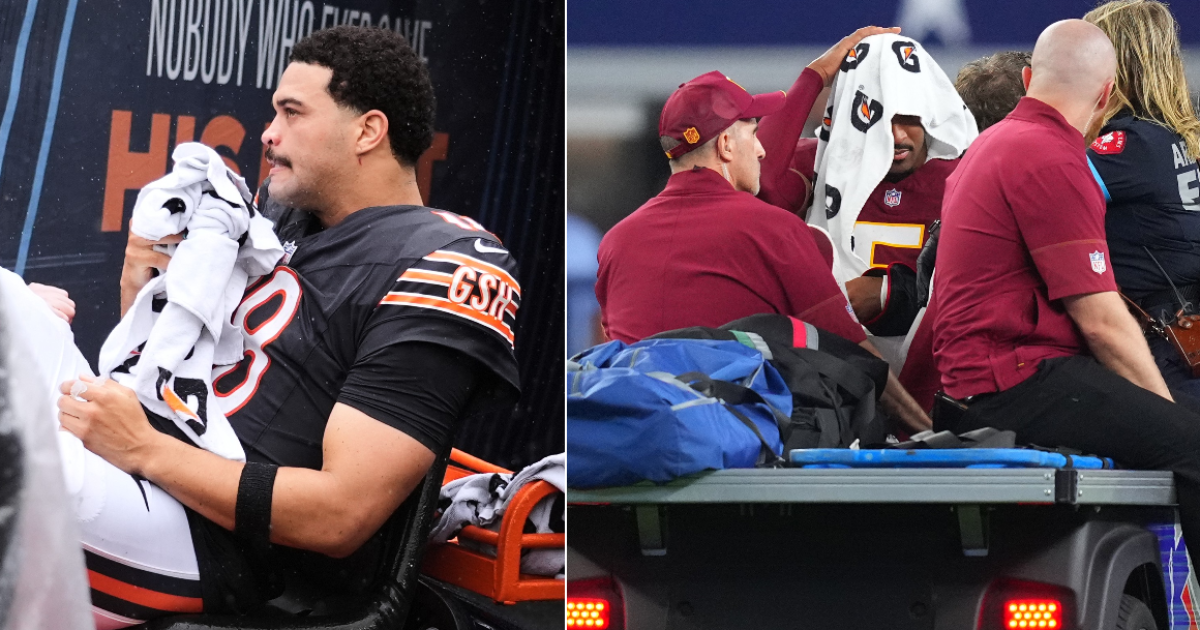
Fox Sports announcer Tom Brady might have spoken for all of us when viewing the play in which Washington Commanders quarterback Jayden Daniels dislocated his left elbow Sunday against the Dallas Cowboys.
Brady said an expletive on the air, expressing a genuine reaction to the gruesome sight of Daniels’ joint bending in the wrong direction after he planted his left hand to break a fall.
The same expression was no doubt used by countless Commanders fans who had seen their quarterback miss much of the 2025 season with the same injury to the same elbow.
Chicago Bears fans also probably reacted with similar words when star quarterback Caleb Williams was carted off the field with a hamstring injury.
The coaches of both teams had injury updates Monday about the quarterbacks who were selected first (Williams) and second (Daniels) in the 2024 draft. Bears coach Ben Johnson told WMVP in Chicago that Williams appears to have avoided a major injury but would “likely miss some time.”
Hours later, however, Johnson told reporters he wasn’t yet ruling out Williams for the Bears’ “Monday Night Football” game against the Philadelphia Eagles. He said Williams underwent an MRI scan on Monday and that the team received news that was “somewhat encouraging.”
“He’s right now working through every avenue that he’s got available to get back on track here,” said Johnson, who added that Williams probably would not practice this week. “We’ll see what that looks like. Here’s what I know: This guy’s a little bit different than the average human being. … He gets back, he has in the past, a lot faster than what people can anticipate. I’m not putting a timeline on this. We’re going to say week to week.”
Commanders coach Dan Quinn told reporters that Daniels underwent imaging that morning and would see specialists the following two days.
“We’ll go through the process from there,” Quinn said. “I know you’ll have some questions regarding timelines, but until we go through that process, I’d be guessing to give you any.”
Quinn did say that veteran backup Marcus Mariota would start Sunday against the Seattle Seahawks and that he might have an update on Daniels on Thursday or Friday.
Williams, after going 5-12 as a rookie, threw for a franchise-record 3,942 yards while leading the Bears to an 11-6 record and the NFC North title. He got hurt during Chicago’s 9-3 loss Sunday while scrambling deep in Minnesota Vikings territory midway through the fourth quarter.
Williams was replaced by Tyson Bagent, a fourth-year player who has appeared in 13 games and is 2-2 as a starter. Johnson told reporters Monday that he was confident in Bagent should he have to start any games in Williams’ place.
“If it goes that route, I feel strongly about what he’s capable of, and our team does, too,” Johnson said. “They know he’s a darn good football player.”
Daniels was an immediate star in Washington, leading the Commanders to a surprise appearance in the NFC championship game his rookie season, but he missed all but one game in the second half of last season after dislocating the same elbow Nov. 2 against the Seattle Seahawks.
He injured it Sunday on a play from the Dallas one-yard line with three seconds remaining before halftime. Left guard Chris Paul stepped on Daniels’ foot as he backed away from center and the quarterback threw a wild incomplete pass as he braced himself on the ground with his other hand.
Mariota replaced Williams in the second half and completed 11 of 16 passes for 111 yards with one touchdown.
The Associated Press contributed to this report.
FAA halts flights to major US East Coast airports amid outage | Aviation News
FAA halts East Coast flights due to equipment outage, affecting major US airports in New York, Newark, and Philadelphia.
Published On 21 Sep 2026
The United States Federal Aviation Administration (FAA) has halted flights to several busy East Coast airports amid an equipment outage, snarling more than 1,000 flights.
On Monday, the FAA issued ground stops at large commercial airports, including New York’s John F Kennedy International (JFK) and LaGuardia; Newark Liberty International in New Jersey, as well as Boston Logan and Philadelphia International Airport.
Recommended Stories
list of 4 itemsend of list
The flights were halted on the day that 130 world leaders and dozens of ministers were arriving in New York for the annual high-level meeting of the United Nations General Assembly.
US Transportation Secretary Sean Duffy said in a post on social media platform X that flights have resumed into New York’s LaGuardia and into Philadelphia, but that ground stops are still in effect at Newark, JFK, and Teterboro Airport in New Jersey. The ground stop has also been lifted in Boston.
FAA Administrator Bryan Bedford told reporters on Monday that it had “lost the primary circuit” at what is called Philadelphia TRACON, or Terminal Radar Approach Control, which controls air traffic into Philadelphia and airports across the busy northeast US airspace.
Bedford said that the backup fibre had a break and told reporters that it could take up to 13 hours to repair. He said the cut was between the city of New Brunswick, New Jersey, and Newark, New Jersey, which is home to Newark Liberty International Airport.
“An Amtrak construction crew accidentally cut into a fiber line in New Jersey which caused a telecom outage and forced FAA to pause flights in the Northeast,” Duffy said in a post on X.
Newark delays
At Newark alone, more than 1,000 flights had been delayed or cancelled. Throughout the US, there were nearly 4,000 delayed flights and 500 cancelled.
United Airlines said it would waive change fees for impacted travellers. Newark serves as a major hub for the airline.
“Flights that had been destined for Newark have either been held at their departure airport or diverted to alternative airports. Once the FAA outage is resolved, we will work to safely get our customers to their destinations and have issued a travel waiver to give our customers flexibility to manage their travel plans,” a representative for United Airlines said in a statement provided to Al Jazeera.
Newark has recorded the highest levels of delays and cancellations of any airport, according to FlightAware, which tracks flight disruptions in real time. As of 3pm Eastern Time in the US (19:00 GMT), 31 percent of departing flights from Newark had been cancelled, along with 29 percent of inbound flights. Meanwhile, 17 percent of departing flights from the United hub had been delayed, as had 17 percent of inbound flights.
A ground stop was also issued at Teterboro Airport in New Jersey, a private airport neighbouring New York City.