


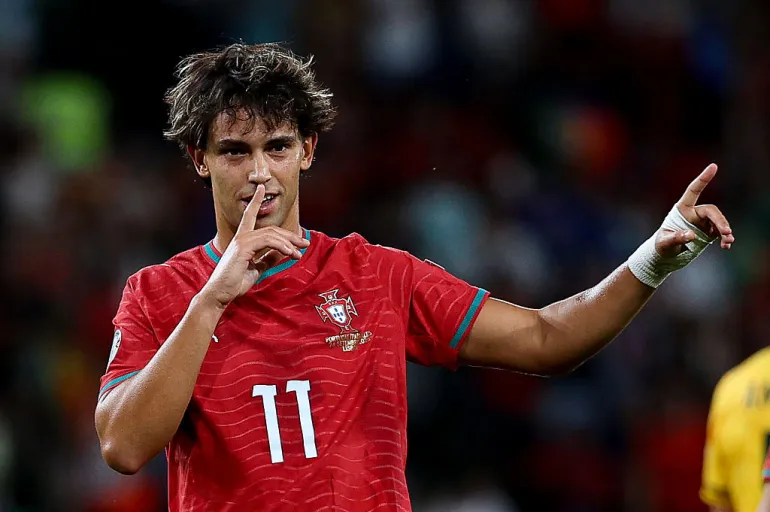
Portugal vs Norway: UEFA Nations League – Ronaldo latest, Haaland, teams | Football
Who: Portugal vs Norway
What: UEFA Nations League 2026-27, Group A4 match
Where: Estadio do Dragao, Porto, Portugal
When: Sunday, October 4, at 8:45pm local time (18:45 GMT)
How to follow: Al Jazeera Sport will bring you all the build-up and live updates from 15:45 GMT.
For the second time in a week, Portugal and Norway clash in the UEFA Nations League. But this time, things are not quite the same in the Selecao camp.
Recommended Stories
list of 4 itemsend of list
Sunday’s fixture in Porto will see the Nations League title holders play without their talisman, Cristiano Ronaldo, after the 41-year-old abruptly left their camp, raising questions about his international future.
Ronaldo’s dramatic exit and apparent rift with new coach Jorge Jesus have dominated headlines worldwide. Portuguese players have largely blocked the outside noise, however, maintaining a perfect record at the tournament where they are chasing a record-extending third crown.
Opponents Norway have won just one match, despite boasting a talented side that defied expectations with a historic quarterfinal finish at this year’s FIFA World Cup.
However, their striker Erling Haaland – one of Europe’s most lethal players – poses enough danger to put Portugal under pressure ahead of this weekend’s thrilling encounter.
What is the UEFA Nations League?
The UEFA Nations League was founded in 2018 to reduce the number of meaningless friendlies and give nations competitive matches against top-ranked teams.
In this competition, countries from across Europe participate in a league structure which features promotion and relegation.
What is the latest news on Cristiano Ronaldo?
Ronaldo left the squad late on Wednesday, shortly after a news conference in which coach Jesus confirmed the five-time Ballon d’Or winner would be left out of his starting line-up for a second consecutive Nations League game.
The 41-year-old’s decision to walk out came as a shock as he had been due to train with his teammates at the Parken Stadium in Copenhagen.
Portugal’s leading scorer with 146 goals had already spent the entirety of last weekend’s 2-1 Nations League win in Norway on the bench, having captained the side in the 1-0 home victory over Wales last Thursday.
He appeared to indicate that the reasons behind Jesus’s decision ran deeper and hinted at a departure from the national team he has graced for more than two decades.
“In due course, I will tell the truth to all the Portuguese people about my reasons for leaving the national team, to which I have always been dedicated,” Ronaldo said in a cryptic Instagram post, announcing his sudden exit from the camp.
Spanish sports daily Marca said that Jesus and Portuguese federation president Pedro Proenca followed Ronaldo to Copenhagen airport in an attempt to persuade him to stay with the squad, before the player boarded his private jet.
Jesus insisted earlier on Wednesday that there was no rift between them, although the 72-year-old, who was appointed in July, acknowledged that his captain was disappointed to remain on the bench against Norway.
How have Portugal and Norway played in the Nations League?
Portugal are on top of Group A4 on nine points, with three wins out of three. They started their campaign with a 1-0 home win over Wales, before adding a 2-1 victory over Norway in Oslo. In the last match, they thrashed Denmark 4-2 in Copenhagen.
Norway are second-bottom in the group, with only three points. They started their campaign with a 3-2 home win over fellow Scandinavians Denmark but suffered identical 2-1 defeats at home to Portugal and to Wales in Cardiff.
When did Portugal and Norway last meet?
They met in matchday two of this year’s Nations League, with Portugal beating Norway 2-1 in Oslo.
Joao Felix and Goncalo Ramos scored for Portugal, while Haaland struck the consolation goal for Norway.
Portugal vs Norway: Head-to-head
- Matches: 12
- Portugal wins: 9
- Norway wins: 1
- Draws: 2
Portugal vs Norway: Form guide
(Last five games, latest results first)
Portugal: W-W-W-L-W
Norway: L-L-W-L-W
Who are the top players to watch?
Joao Felix and Goncalo Ramos (Portugal): Al Nassr forward Felix has emerged as the reliable scorer in the Portugal setup, finding the net in each of the three games this term. Meanwhile, Ramos, playing in place of Ronaldo, has made up for CR7’s absence with goals in the last two matches.

Erling Haaland and Oscar Bobb (Norway): All of Norway’s goals in the ongoing competition have come through Haaland (three) and Bobb (two). While their partnership proved successful in the opening match, their goals were not enough in the following matches, as the Norwegians suffered back-to-back defeats. Norwegians will demand better from Haaland, especially after the Manchester City talisman’s incredible start to the club season that features seven goals in as many games.
Team news and predicted lineups
Portugal
Winger Francisco Conceicao is doubtful for the game due to a thigh injury.
Probable Portugal XI: Diogo Costa; Joao Cancelo, Ruben Dias, Renato Veiga, Nuno Mendes; Ruben Neves, Vitinha; Pedro Neto, Bruno Fernandes, Rafael Leao; Goncalo Ramos
Norway
Wing-back Julian Ryerson is doubtful with a muscle injury, while centre-back Torbjorn Heggem is suspended.
Probable Norway XI: Orjan Nyland; Julian Ryerson, Kristoffer Ajer, Torbjorn Heggem, David Moller Wolfe; Martin Odegaard, Sander Berge, Patrick Berg; Oscar Bobb, Erling Haaland, Antonio Nusa

Portugal vs Norway: TV channel, livestreaming
- Portugal
- Norway
- United Kingdom: ITV1
- United States: FOX Sports, FuboTV, ViX
- India: Sony Sports Network
- Middle East and North Africa: beIN SPORTS
- South Africa: DStv Stream
You can find your regional broadcaster on UEFA’s official broadcaster listing.

Why Charly Anne is secretly considering a return to the Welsh 5 as insiders spill on bid to take Becki Jones’ crown

IT was the row that erupted all over TikTok a year ago – with insiders insisting there was no way back for Charly Anne and the Welsh 5.
But for the first time in more than a year, The Sun can reveal how Charly is attempting to make a ‘return’ to the social media stars for a very savvy reason – and the real reason she’s still secretly fuming with Becki Jones.
The Sun were the first to lay bare the feud between Charly and the other four members of the Welsh 5 – Cory, Lea, Kane and Ieuan – last year and told how it had even led to a devastating fallout between Charly and her own mother, Trudi Anne.
The rift originally began with a row over Charly’s relationship with girlfriend Emily Woodfin, with the other four members claiming she was controlling – an accusation which both Charly and Emily deny.
But bridges were left officially burned when Trudi sided against her own daughter by uploading a series of dance videos she made with Cory and Lea as well as Becki Jones, who also fell out with Charly amid the feud.
Now it seems that Charly may finally be having something of a change of heart – but is it all for the right reasons?
Sources close to Charly have told The Sun how the Welsh influencer is secretly considering publicly reuniting with her sworn enemies as part of a savvy business decision.
Our insider told us: “Things have all gone quiet on the Welsh 5 feud front in recent months.
“Everything exploded last year and it seemed there was zero chance of reconciliation when Charly’s own mother snubbed her in favour of the others.
“But amid the silence in the months that have followed it seems that some very interesting conversations have been going on.”
One of Charly’s pals has conceded that, since separating herself from the group, potential work opportunities have begun to slowly dry up.
Industry experts suggest that, for brands, the appeal of the Welsh 5 as a group is what drew them in – with Charly now no longer having a piece of that pie.
Our source told us: “Charly views her life as a business – like many influencers do.
“She was at the top of her game amid the Welsh 5 hype but things have certainly been slower since then.
“After the split, it is almost like she has ended up becoming the ‘problem child’ – and it has put people in the industry off wanting to work with her.
“For the first time, she has quietly been considering if now could be a good time to publicly reunite with her former pals but not necessarily because she wants to build relations but in order to continue building her career.
“Charly knows deep down that if everyone is seen to be on friendly and amicable terms, the interest in her could ramp up again.
“Her followers would have a field day if she started sharing content with Cory and Lea again!”
Moreover, Charly is still feeling annoyed that her greatest rival Becki is continuing to get bigger and bigger.
Her pals admit it is a sting every time she sees Becki’s success as she always felt she was destined for the same fate.
They told us: “Charly is determined to become as well-known as Becki – even all these months on.
“If a reunion with the Welsh 5 is what it takes – she thinks she’d be ready to do it.
“But, ultimately, this is all just private talks at the moment.
“It is very much speculative thoughts that Charly is having – no one knows if it is something she will actually go through with.
“Plus, the others in the Welsh 5 might also not be ready to make amends.
“The channels for a reunion are definitely there though. They still have the same team around them, it wouldn’t take much for a few strings to be pulled behind-the-scenes.
“It has all been a bit of a mess but for the first time it seems that the mess may be ready to come to an end.
“Only time will tell but it is certainly closer than ever to happening.”
The Sun has reached out to the Welsh 5 and Charly’s reps for comment.

California Proposition 41 election voter guide: Audit proposal could block billionaire tax
p]:text-cms-story-body-color-text”>
The California Taxpayers Assn., the California Society of Certified Public Accountants, the CalAsian Chamber of Commerce and others back the proposition. They say it would result in the government spending taxpayer dollars more wisely while improving transparency.
The bulk of the contributions to support the proposition have come from Building a Better California, data from the California secretary of state’s website show. Top contributors to Building a Better California include Sergey Brin, Google’s co-founder; John Doerr, chairman of venture capital firm Kleiner Perkins; and Eric Schmidt, the former chief executive of Google.
Proposition 41 “requires more accountability, transparency and trackable progress of programs funded by our taxes, so that we stop funding failure and start funding successful outcomes,” a website for the proposition states.
From 0-3 to the playoffs: History offers Chargers some hope
On one side there’s hope. On the other, history.
Three weeks is only a sliver of the NFL season; a backsliding team has plenty of time to correct its course.
That said, only seven teams in the Super Bowl era have rebounded from an 0-3 start to make the playoffs.
That’s a sobering statistic for the Chargers, Houston Texans and Tampa Bay Buccaneers, all winless so far. As for the 0-3 Miami Dolphins, well, that isn’t quite as shocking.
“We’re searching for every possible way to give ourselves an advantage,” said Chargers coach Jim Harbaugh, whose team lost at Buffalo last Sunday despite five takeaways and a plus-four turnover differential.
The uphill climb continues for the Chargers, who play at Seattle on Sunday, with the defending Super Bowl champions itching to respond to an upset loss at Washington in Week 3.
So far, the change at offensive coordinator to former Dolphins coach Mike McDaniel has been a bust for the Chargers. Their offense has sputtered and wheezed, even as their defense has done its part to keep them in games.
Elsewhere Sunday, the Texans play host to Dallas, Tampa Bay hosts Green Bay, and Miami plays at 3-0 Minnesota.
Of those seven teams that dug themselves out of a foreboding pit, only the 1992 San Diego Chargers turned their season around after an 0-4 start — so it’s pretty much now or never for this year’s class of Sunday strugglers.
The others to make the playoffs after losing their first three games were the 1981 New York Jets, 1982 Buccaneers, 1995 Detroit Lions, 1998 Buffalo Bills, and the Texans, who pulled off the feat in 2018 and last season… and now find themselves back in that dank basement.
“We’ve been here before,” Houston quarterback C.J. Stroud told reporters this week, “so we know we can get this thing turned around.”
For those who have made that euphoric U-turn, there are life lessons to draw upon. Chief among them, don’t panic.

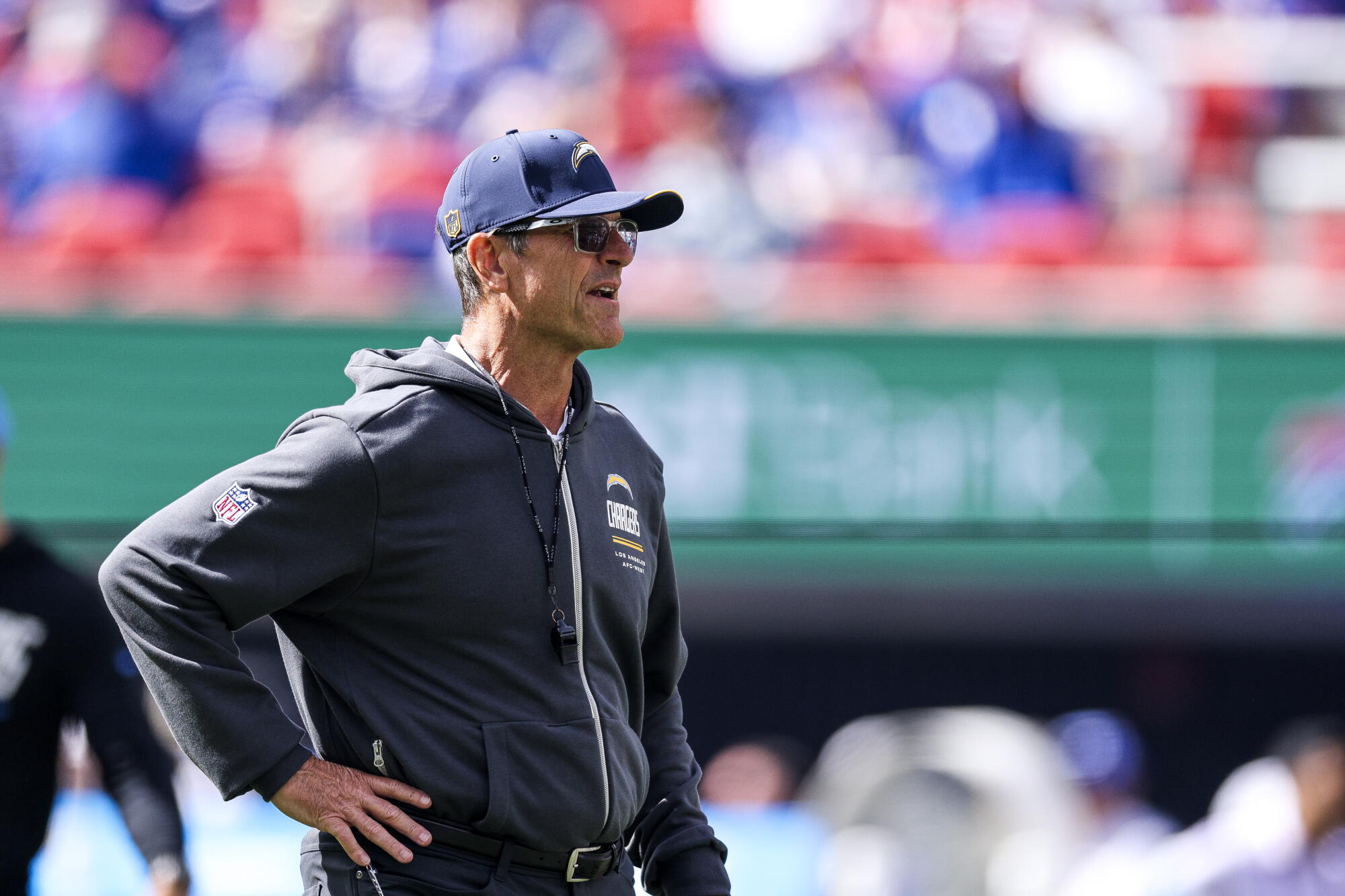
Chargers coach Jim Harbaugh stands on the field before a loss to the Buffalo Bills on Sept. 27.
(Bryan M. Bennett / Getty Images)
Former Lions linebacker Stephen Boyd recalls the composure and calm of Detroit coach Wayne Fontes, after three losses to Pittsburgh, Minnesota and Arizona — two of those by a field goal.
After the third loss, Boyd said, “Wayne Fontes walks into the meeting room with a big smile on his face and says, `Listen, here’s the deal, we’re going to give the ball to Barry [Sanders] a little bit more, and we’re going to get this turned around.’”
Sure enough, the Lions broke through the following week with a win over San Francisco on Monday night. But there were more bumps in the road for Detroit, which by November was still a dismal 3-6. Few could have predicted the club would win its final seven games.
That set the stage for a strange wild-card game against Philadelphia in which the Eagles built a 51-7 lead and held on despite the Lions scoring 30 points down the stretch. The final score: 58-37.
Three years before Fontes kept his cool under pressure, Chargers coach Bobby Ross did the same.
“There were a lot of grumblings that this was just some college coach that didn’t know what he was doing in the pros,” recalled former Chargers linebacker Gary Plummer of Ross, hired out of Georgia Tech. “There were a lot of guys that were essentially jumping off the ship.”
That team held a players-only meeting after falling to 0-3… then got clobbered, 27-0, by the Houston Oilers in Week 4.
Ross held steady, though.
“He told us that he wasn’t changing,” Plummer said. “We were still going to have physical practices. He said that was the only way he knew how to coach.”
The Chargers responded by winning four in a row. Then, after a hard-fought, two-point loss to Kansas City, the Chargers tore off another seven wins.
Defense led the way for those Chargers, allowing just 241 points that season, the fourth-fewest in the NFL.
So far this season, these Chargers are showing similar tendencies. Last Sunday, the defense played a gem of a game, and certainly through three quarters.
Hope still has a heartbeat, but that grows fainter by the loss.
Israeli reporter’s ‘verbal attack’ ends Ireland football news conference | Football
Israeli journalists asked coach Hallgrimsson about the Flydubai attack and alleged racist abuse by Ireland’s players.

Published On 3 Oct 2026
Members of an Israeli media contingent heckled Republic of Ireland head coach Heimir Hallgrimsson’s news conference prior to the UEFA Nations League football match, causing it to end abruptly amid growing political tensions and protests against the fixture.
During the media event on Saturday, an Israeli journalist asked Hallgrimsson about his views on an incident onboard a Flydubai flight to Israel earlier this week.
Recommended Stories
list of 4 itemsend of list
According to the prosecutor general of the United Arab Emirates, the Flydubai co-pilot “attempted to carry out a terrorist act”, using an axe against the pilot to take over the aircraft’s controls.
The plane carrying 174 passengers was on its way from the Dubai in the UAE to Tel Aviv in Israel on Wednesday when the copilot wounded Indian pilot Smit Machchhar, who opened the cockpit door to seek help.
The aircraft briefly plunged about 17,000 feet (5,180 metres) before it was brought back under control.
The attacker was not officially identified, but media reports quoting unnamed sources said he was an Omani national, Hamam al-Hammami.
“What do you say about the people that you support? Their ideology is based on murder,” the journalist asked, purportedly hinting at Ireland’s stance on Palestine and attempting to link it to the aviation incident.
Before the Irish team’s coach could answer, the Football Association of Ireland’s communications manager Kieran Crowley stepped in and asked the journalist to refrain from asking questions not linked to the match.
The journalist persisted, carrying on with her question before Crowley stopped her again.
“We respected your questions at the last press conference, but we are doing football questions today,” he said, referring to Israeli journalists’ pointed questions about the calls to boycott the first leg of the European match.
Icelandic coach Hallgrimsson later termed the incident a “verbal attack”.
‘You’ve just broadcast a lie’
The first leg of the fixture was played on September 27 and the FAI faced strong calls for a boycott from the Irish public and former players. The match went ahead and Ireland beat Israel 3-0 amid a tense atmosphere on the pitch.
Following the match, Israeli supporters were accused of directing racist chants towards Ireland player Adam Idah and were filmed raising military slogans, but evaded disciplinary action from the competition’s organisers.
However, another Israeli journalist turned the incident on its head during Saturday’s news conference and accused the Irish team of calling Israel’s players “monkeys” during the match.
FAI’s Crowley was quick to shut out the accusation and ended the media event.
“That’s a lie. You’ve just broadcast a lie,” Crowley said before getting up to walk away.
According to Irish media reports, the FAI is continuing to investigate allegations that Irish players Adam Idah and James Abankwah were racially abused by Israeli fans.
An Israeli supporter also led chants about his country’s military from the stands as he attempted to brush aside the team’s drubbing on the football pitch.
The day before the first leg, goalkeeper Gavin Bazunu publicly withdrew, saying he felt “it would be wrong to participate in the upcoming fixtures against Israel”.
The second leg will be played at the TSC Arena in Backa Topola in Serbia on Sunday.
Ireland’s Hallgrimsson termed it “a game with a lot of emotions attached to it”.
He said the team was focused on winning the second leg as well.
“There’s been a lot of emotions from the people in Ireland about this and obviously that affects the players as well. We want to do good, but it’s always going to be a challenge when the environment is as noisy as it is.”

Jerusalem Daily: UAE says Flydubai co-pilot attempted ‘terrorist’ attack | News
Multiple media reports have named the Flydubai co-pilot as Omani national Hamam al-Hammami, who UAE’s prosecutor general said attempted a ‘terrorist’ attack.
Al Jazeera’s Ava Warriner has the latest.
Published On 3 Oct 2026

Kim Kardashian was ‘single for five years’ as she ‘healed’ from traumatic Kanye marriage before Lewis Hamilton romance
KIM Kardashian was single for five years as she needed time to “heal” following her traumatic divorce from Kanye West.
Apart from a brief fling with comedian Pete Davidson, the reality superstar shunned dating until falling for F1 ace Lewis Hamilton earlier this year.
Kim, 45, said: “I was really single for five years. And that felt great.
“I felt like I needed my time. I wanted to completely heal and just work on myself.
“I wasn’t ready to open up. I really wasn’t even thinking about it. The universe works in your favour when you just allow it to.”
The mogul filed for divorce from Ye, 49, in February 2021 following a turbulent period driven by his erratic behavior and public breakdown.
In a new interview with The Sunday Times, the Skims founder admits she worries about exposing her four children with the rapper – North, 13, Saint, 10, Chicago, 8, and Psalm, 7 – to her stratospheric fame.
Read More on Kim Kardashian


Describing herself as an “intermediate-strict parent,” Kim bans her kids from taking part in any storyline drama on Keeping Up with the Kardashians.
She said: “I do worry about it. Each kid does what they’re comfortable with.
“So, my little ones come around when I’m filming but they don’t really do storylines.
“North loves it a little bit more than the rest. I hold her back. All she wants to do is forward-facing projects.
“And with her, since it’s more music-related, that is something that her dad and I have better communication about. We make sure that we’re aligned and that she’s in projects that we both approve.”
The star, worth £1.9 billion, recently branched out into acting with a role in the popular but critically panned Hulu drama All’s Fair.
Addressing the backlash, she added: “I am so used to it, I have a really thick skin.
“I mean, at the beginning, to the girls, my cast, I was like, ‘Wait, are we OK? Did I ruin everything?’
“And they were like, ‘Listen, we are OK.’
“I didn’t realise that in the film business as well you get so much criticism. But we had so much fun.”

Why hasn’t the Trump administration decided the fate of TPS for Salvadorans?
WASHINGTON — More than three weeks have passed since the deadline for extending or revoking temporary protections against deportation for around 170,000 immigrants from El Salvador.
The Trump administration still hasn’t reached a decision, plunging the Salvadoran community into uncertainty and raising questions about what has prompted the delay.
The deportation reprieve is known as Temporary Protected Status. About 1.3 million people from 17 countries had TPS when President Trump returned to office last year, and Salvadorans make up the largest group of remaining beneficiaries.
When the TPS expiration deadlines approached for other groups, the administration reached a decision within days of a deadline. Haitians lost their TPS protections and were encouraged to leave the country. Some have been deported.
For now, Salvadoran immigrants are stuck. Many have been able to keep their jobs, though others were laid off in the absence of an official work permit extension.
Last month, administration officials said an announcement on TPS for Salvadorans would come “at the appropriate time” and that they would retain work authorization in the meantime. Asked for updated guidance Friday, a Homeland Security spokesperson provided the same statement.
The Department of Homeland Security had been prepared to end TPS protections for Salvadorans but was stopped from doing so by the White House, Politico reported.
So what’s causing the limbo?
One theory focuses on political considerations — that extending the deportation reprieve could have made the administration appear weak on immigration to its conservative base, just ahead of next month’s consequential midterm election.
Another theory holds that ending TPS would shock El Salvador’s economy, which is heavily reliant on remittances from Salvadorans in the U.S. President Nayib Bukele, a Trump ally, advocated for more time, according to Politico.
In addition, the White House was warned that canceling TPS for Salvadorans would disrupt construction projects in Washington, D.C., the New Yorker reported and a source with knowledge of the warnings confirmed they had occurred.
A White House official, in a statement, said that “any assertion Washington D.C. construction projects had anything to do with a decision about El Salvador TPS are false.”
The Washington region has the second-largest Salvadoran population in the U.S., after Los Angeles, and the construction industry relies significantly on workers with TPS.
Trump is overseeing a sweeping aesthetic makeover of the nation’s capital, including his controversial 90,000-square-foot, $600-million ballroom complex at the White House. The president also ordered a facelift for the Lincoln Memorial Reflecting Pool, renovations at Lafayette Square, a public park across from the White House and the application of 23.75 karat gold leaf to four bronze and granite statues.
Contracts at sensitive locations such as the White House typically include requirements that workers be U.S. citizens. A White House official said there is no one with TPS status working on the East Wing Modernization construction project.
Asked about those working on the president’s other projects around the district, a Department of Interior spokesperson said contractors are obligated to ensure everyone working on any project is legally permitted to work in the U.S.
“The Department has not had any conversations about TPS or how it relates to construction projects around the city,” the spokesperson wrote in a statement.
People with TPS do work in other federal facilities.
Lauren Truslow is chief executive of 3D Enviro, a Virginia company that does hazardous materials abatement with a handful of workers affected by the TPS expiration for El Salvador. She said that after her employees’ federal badges expired last month, they were eventually reinstated until Oct. 9 — but not before missing several days of work.
TPS allows immigrants to obtain work permits and other documents. The uncertain status of TPS has led to sometime conflicting actions by government agencies or employers.
Advocates for TPS holders said some states have refused to renew their driver’s licenses, while others renewed licenses for different lengths of time. Truslow said some of her employees were only able to get federally noncompliant driver’s licenses, which they can’t use to get into federal facilities.
“At least they’re here in this community and they weren’t forced to leave,” she said. “I don’t want to look a gift horse in the mouth, but I think there were ramifications with the decision and still there’s uncertainty.”
Truslow said the government agency her company works with is unrolling a new process. After next week, her workers on that project can seek an approval extension for their badges that would last until March.
For construction companies, getting rid of TPS “would be a disaster,” said Arnoldo Diaz, co-coordinator of the National TPS Alliance, an advocacy group. “D.C. can’t function without TPS.”
Rebecca Shi, executive director of the American Business Immigration Coalition, has had ongoing conversations with Homeland Security and White House leaders about TPS. What sets Salvadorans apart, she said, is the decades of experience many bring to the construction industry, which would be impossible to quickly replace.
“Many are managers and business owners themselves, running large projects,” she said. “It’s a level of skill set and longtime loyalty that cannot be replaced overnight. Because the president has been in this industry for five decades, he instinctively knows that.”
That economic consideration, coupled with polls showing that Latino voters think Trump has gone too far with immigration enforcement, “are the much larger considerations than the president’s own pet projects,” Shi said.
Roxy Mejia, political director of a local painters union in Washingon, said 67% of the 1,500 members are Latino and many of them Salvadoran TPS holders.
Mejia said she and her father immigrated to the U.S. from El Salvador in 1985, before TPS existed. He worked on the Pentagon renovation after 9/11.
Under this administration, some Salvadorans with TPS have been declining government contract jobs out of fear of being detained, she said.
“Even the contractors have lobbied with us to keep TPS extending, because they would lose a lot of manpower in this area,” she said.

Shenzhen Open: Wu Yize beats Judd Trump to set up final against Yuan Sijun
Reigning world champion Wu Yize won six consecutive frames to beat Judd Trump 6-1 in the Shenzhen Open semi-finals.
Yize, who will leapfrog Trump in the rankings and move second in the world after the final, bounced back in dramatic fashion after losing the opening frame to set up an all-Chinese final against Yuan Sijun at the Bao’an Sports Centre on Sunday.
Yuan, 26, endured a much more difficult route to his maiden ranking final, battling through 6-5 against Englishman Jimmy Robertson.
World number two Trump, who won the Shanghai Masters in August, had gone into the Shenzhen semi-final in fine form after beating Mark Selby 5-0 in the last eight.
But after clinching the opening frame with a break of 77, the 2019 world champion handed the initiative to his opponent with a string of errors.
Wu, 22, capitalised to avenge a defeat by Trump at the last-four stage in Shanghai earlier this year, making three breaks of 50 or more in a scrappy encounter before clinching victory with a break of 110.
“When I was preparing for the evening match, I saw that Yuan had shed some tears,” Wu told World Snooker Tour.
“I believe it is his first ranking final. Hopefully, we can put on a great match for everyone. Of course, I hope I can take the trophy home, but we will both give it everything we have.”
An emotional Yuan found it much more difficult to get over the winning line, with the lead continually changing hands throughout the best-of-11 encounter before his opponent forced a deciding frame that took 50 minutes to complete and saw a total of 177 points scored.
Robertson put Yuan in a difficult snooker on the final red and clawed back 41 penalty points before himself being put in a snooker, with Yuan finally clearing to the pink to earn his place in the final of the inaugural event.
“I feel that my first ranking final has come a little bit late,” said Yuan, who started the tournament as the world number 33 but will move to the cusp of the top 16 with victory on Sunday.
“Since the pandemic in 2020, the years in between have been quite difficult, and I feel it hasn’t been easy. So after all these years, I just hope I can give myself something to show for it.”
Somalia won’t accept Israeli presence ‘under any circumstances’: President | Politics News
EXCLUSIVE
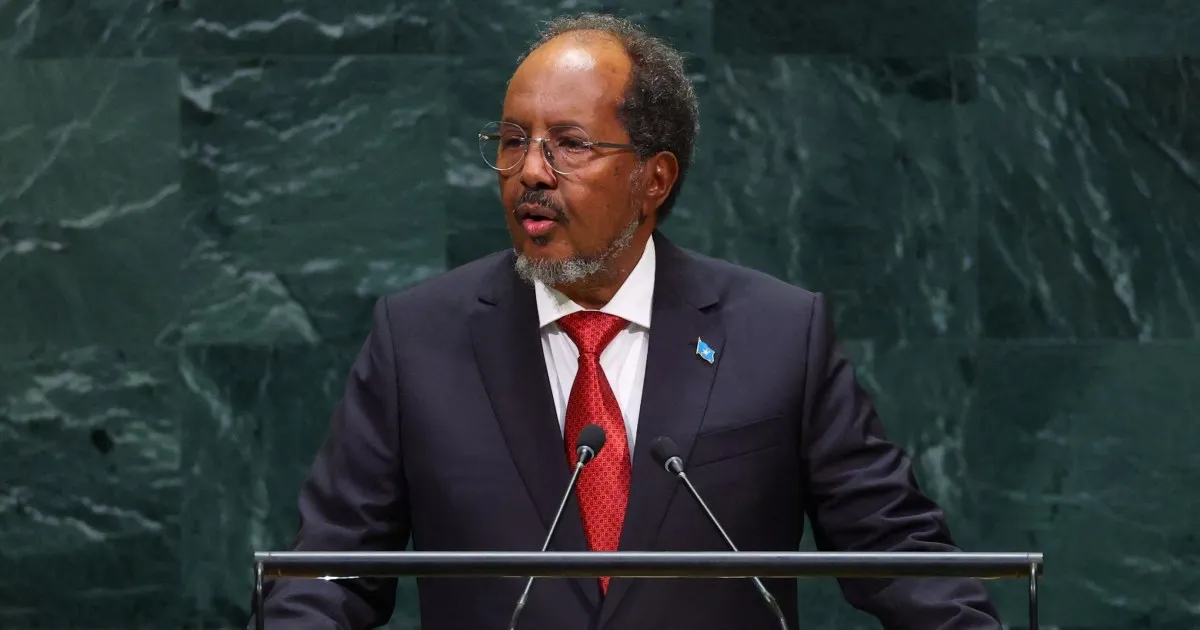
In exclusive Al Jazeera interview, President Hassan Sheikh Mohamud says attempts to pull Somalia into Middle East crises won’t succeed.
Somalia will not accept Israeli presence in the country “under any circumstances” and will resist any attempts to be pulled into the Middle East’s crises, its President Hassan Sheikh Mohamud tells Al Jazeera.
Speaking in an exclusive interview, Mohamud said that Israel was planning to establish a naval base in Berbera and use the city’s airport, adding that its real aim was to get closer to the Gulf states and Iran.
Recommended Stories
list of 3 itemsend of list
Berbera is a port city on the Gulf of Aden coast in Somaliland – the self-declared republic in northwestern Somalia that Israel recognised last year, but which is claimed by Mogadishu.
Berbera faces Yemen across the water near the strategic Bab al-Mandeb strait. The Iran-aligned Houthis have previously enforced a blockade on Israel-linked ships in the area.
“We will overcome the challenges posed to our country by Israeli moves,” Mohamud said in his wide-ranging interview.
He added that the Israeli plans fall under the “Greater Israel” project – referring to a term for various proposals, often rooted in biblical interpretations, for Israeli control over territory beyond its current borders. Some versions extend from the Nile to the Euphrates.
Israel has not adopted it as official policy, but Prime Minister Benjamin Netanyahu said in an August 2025 interview that he felt connected to the vision, prompting condemnation from Arab governments.
The Somali president described Israel as a “destabilising force” that does not abide by international law.
He also criticised Tel Aviv’s recognition of Somaliland in December.
No country other than Israel recognises Somaliland, while the region’s own residents are completely opposed to an Israeli presence, Mohamud said.
Somaliland declared independence from Somalia in 1991 and has governed itself independently for more than three decades. But it had not secured recognition from any United Nations member state until Israel’s move.
Fight against armed groups
The Somali president told Al Jazeera the United States remains his country’s strongest partner in the fight against “terrorism”, and added that al-Shabab has no presence in the major cities, leaving no possibility of the group taking control in Somalia.
Al-Shabab is a Somali armed group that emerged from the Islamic Courts Union in the mid-2000s and pledged allegiance to al-Qaeda in 2012. It has fought Somalia’s federal government for years, holds territory in parts of southern and central Somalia, and has carried out deadly attacks, including in Mogadishu and in neighbouring Kenya.
Regarding the East Africa region, Mohamud said Somalia’s relations with neighbouring Ethiopia are good, and Mogadishu does not object to Addis Ababa gaining access to the sea through Somali territory.
Ethiopia has been landlocked since Eritrea became independent in 1993 and relies largely on Djibouti’s ports for trade. In January 2024, Addis Ababa signed a memorandum of understanding with Somaliland on sea access, which Somalia condemned as a violation of its sovereignty. Somalia and Ethiopia later agreed to ease tensions.
Houthis ‘destabilising’ region
Mohamud also accused Yemen’s Houthis of “destabilising” the region and disrupting navigation in the Bab al-Mandeb strait.
His comments come as the group attempts to build on its lightning offensive that captured the country’s Red Sea coast last month.
Thus far, Yemeni government forces have been able to hold their positions on the front lines and even claimed to have inflicted heavy losses against the Houthis.
The Houthis have also intensified their attacks on Saudi Arabia, but the kingdom’s Crown Prince Mohammed bin Salman (MBS) has promised not to compromise on its security, saying the Yemeni rebels chose “chaos and destruction, threatening the Yemeni people and the region”.
The full interview with President Mohamud will be broadcast on Al Jazeera Arabic on Sunday.

‘Bordering on angry’: The state of play as US midterms enter final month | US Midterm Elections 2026 News
Washington, DC – Democrats have the momentum; Republicans are surging in defence and cash.
That narrative has emerged ahead of the United States midterm elections in November, as races across the country enter their final stretch.
Recommended Stories
list of 3 itemsend of list
With control of the US House of Representatives and the US Senate at stake, Democrats begin October with a surprisingly rosy outlook as more congressional seats are seen as in play.
Republicans, meanwhile, appear to be in damage control, pouring millions of dollars into races once seen as secure victories while injecting more funding into a handful of marquee showdowns.
The party’s standard bearer, President Donald Trump, who has embraced the notion of the election being a referendum on his leadership, enters the final month with staggeringly low approval ratings.
The most recent Associated Press-NORC polling, released on Thursday, showed Trump with 31 percent approval, the lowest during either of his two terms. Only 26 percent of respondents approved Trump’s handling of the economy, dipping two points below his predecessor, former President Joe Biden’s lowest rating on the topic.
Surveys continue to show voters rank the economy as their top issue, with topics like gas prices, made higher by the US-Israel war with Iran, dominating their concerns. Immigration and corruption have also regularly ranked high.
“The broad stroke is that Americans are disappointed, bordering on angry that President Trump hasn’t delivered on the core promises he made when he won re-election,” according to Henry Olsen, a senior fellow at the conservative Ethics and Public Policy Center in Washington, DC.
House looking solid for Dems
Political trackers have long projected Democrats will take control of the US House of Representatives in the November 3 vote.
Winning a majority in the 435-member chamber from Republicans would give the party renewed legislative power to assert leverage over Trump, while launching investigations into his administration’s dealings. Top Democrats have already signalled that probes into Trump’s family business dealings would be top priorities.
Two election non-partisan prediction authorities, the Cook Political Report and the University of Virginia’s Sabato’s Crystal Ball, have recently assessed that the likelihood of Democrats taking the House has only increased.
The Cook Political Report recently shifted 15 House races in the direction of Democrats, moving some considered “toss-ups” to “leans Democrat” and some previously considered “lean Republican” to “toss-ups”.
One such shift was for a Texas border district represented by Republican Monica De La Cruz. Her district was emblematic of a wider Latino shift towards Trump in 2024. Once seen as holding the advantage over her challenger, Democrat Bobby Pulido, Cook now rates her race as a “toss-up”.
All told, the political analysis clearinghouse now predicts Democrats are on track to win 5 to 15 House seats.
Senate in play
With 30 days left to go, “there’s much more drama in the Senate than the House races”, according to Kyle Kondik, the managing editor at Sabato’s Crystal Ball.
Once considered a pipe dream for Democrats, who need a net gain of at least four seats to win a slim majority, the 100-member chamber has moved within a more comfortable striking distance.
Unlike in the House, where every seat is up for re-election, only 35 Senate seats are up for grabs in this cycle, creating a far narrower pathway to control.
“The trajectory of the polling since Labor Day (September 7) has generally been that a bad Republican environment is just getting worse,” Kondik said, adding that “the Senate just seems to get more and more competitive as the cycle has gone on”.
To be sure, the quality of polling can vary across the country, with Kondik cautioning that gauging the political temperature of the Midwest has been particularly challenging for pollsters.
Still, in North Carolina, former Democratic Governor Roy Cooper is expected to trounce former Republican National Committee chairman Michael Whatley in the race for a Senate seat currently held by Republicans. Top conservative donors have already begun to divert funds from the contest.
Surveys have consistently shown Democrats leading in three other races for seats currently held by Republicans: Democrat James Talarico against Republican Ken Paxton in Texas; Democratic challenger Sherrod Brown against Republican incumbent Senator John Husted in Ohio; and Democratic Mary Peltola against Republican Dan Sullivan in Alaska.
Races for Republican held seats in Iowa, between Republican Ashley Hinson and Democrat Josh Turek, and in Maine, between Republican incumbent Susan Collins and Democratic challenger Troy Jackson, remain separated by less than one point, according to Real Clear Politics polling averages.
Democrats, meanwhile, have consistently led in polling in Senate races in Georgia, New Hampshire and Michigan for seats the party currently holds.
Big money in the race
For Republicans, salvation could be in the spending, with this year’s race continuing a US phenomenon of small fortunes poured into politics.
All told, at least $4bn had been spent on gubernatorial and congressional midterm advertising buys as of September 17, putting the race on track to become “perhaps the most expensive midterm on record”, according to Michael Franz, co-director of the Wesleyan Media Project.
Republicans entered September with a considerable funding edge. The Republican National Committee had $125.6m on hand, with the Democratic National Committee trailing far behind with $16.9m and $17.6m in debt.
When accounting for the three major committees associated with both groups, the Republican Party had $233.4m in cash, according to a CNBC analysis, while the Democratic Party had $130.4m.
Trip Yang, a Democrat strategist based in New York City, told Al Jazeera such spending can be deployed to help boost a candidate’s name recognition or to tear down a competitor.
According to AdImpact, Republicans and their allies were set to spend $888m on advertising from mid-September to election day, with Democrats and their supporters set to spend $666m.
The firm found pro-Republican ad spending would be particularly pronounced in the key Senate races in Ohio, Texas and Michigan, outpacing Democratic spending by at least $24m in each state.
Trump’s unpopularity, Yang said, means “Republicans spending millions or hundreds of millions of dollars improving their candidates’ images by itself may not be enough”.
“If you’re a little bit handicapped because your president is so toxic, you try to spend your hundreds of millions of dollars attacking the Democrats to make it more of a food fight,” he said.
A New York Times analysis estimated by the end of August at least $1bn in so-called “dark money” had been poured into the midterms. The term refers to spending where the donor’s identity is shielded, typically through nonprofit and shell-company donations to Super PACs.
Industry groups, including those supporting Crypto, AI and online betting firms, are expected to be top spenders in key races, although their support tends to cut across partisan lines.
Trump, meanwhile, has pledged to spend between $400m and $500m from his MAGA Inc Super PAC, though it has so far spent about $15m to support Paxton’s Senate bid in Texas.
Pro-Paxton ad reservations far outpaced Talarico in September, according to AdImpact data analysed by NPR, with $94m spent compared with $30m to support the Democrat.
The Trump factor
Trump has pledged to spend the final days before the election in non-stop campaign mode, after urging supporters during his Republican Midterm Convention in Dallas, Texas, to “vote like I’m on the ballot”.
His plan to criss-cross the country for rallies underscores a “base turnout” strategy meant to energise voters already loyal to the party, according to conservative analyst Olsen.
“But the Republican problem is a persuasion problem with people in the middle,” Olsen said. “[Trump’s campaigning] might help with some turnout … but their real problem is persuasion, and it’s not something that’s going to help with that in the slightest.”
Polls have spelt trouble for Republicans when it comes to swaying independents, with a PBS News, NPR and Marist poll from September 23 showing unaffiliated voters breaking for Democrats at 57 percent compared with 32 moving towards Republicans.

The scenario has created a dilemma for some top Republican candidates over whether to break from the president on his most controversial actions, according to Lee Miringoff, the director of the Marist University Institute for Public Opinion.
Senate candidates Ashley Hinson in Iowa, Jon Husted in Ohio and Mike Rogers in Michigan all recently put daylight between themselves and Trump on the war with Iran.
One Republican House candidate, Representative Maria Elvira Salazar, has criticised Trump’s aggressive immigration enforcement policies as she seeks to rally Latino voters in South Florida.
Trump, in turn, reposted a social media message calling Salazar a “backstabber”.
“You need to have, you know, something else going for you other than endorsement of Trump,” said Miringoff. “Some Republicans are starting to have self-preservation kick in because they’re concerned.”
What can change?
Achieving a wide-scale shift in public opinion remains a tall order for Republicans in the final stretch of the race.
Many of the defining issues are unlikely to change before November, with Trump signalling a possible escalation with Iran following the vote as he has downplayed the prospect of short-term affordability relief.
At the same time, the US president has also not ruled out actions that rights groups say could upend voter turnout. Most recently, he refused to commit to not invoking the Insurrection Act or declaring a state of emergency surrounding the vote during an interview with Time magazine.
Miringoff said he believed that the “potential for more than just a marginal shift is there”, as he assessed some Democratic candidates have struggled to present clear visions beyond opposition to Trump.
“The result isn’t formed in concrete,” he said, “to the degree that there’s going to be a lot of money still spent.”
Analyst Olsen saw less remaining wiggle room for the party.
“Republicans have the time and the resources to change the outcome with respect to a few close Senate races,” Olsen said. “But to change direction, they would need something that would be apocal.”

How a guitar tech from East L.A. made Olivia Rodrigo’s custom heart-shaped guitar
As Olivia Rodrigo kicked off the Unraveled Tour in support of her third album, “You Seem Pretty Sad for a Girl So in Love,” the internet had plenty to talk about—from her dissolving dress and flower-covered stage design to her custom-made, pink heart-shaped guitar.
The guitar was built by Luis Muñoz, a Mexican American guitar technician and luthier who operates out of a tiny repair shop in East L.A.
Originally from El Paso, Muñoz moved to Los Angeles in 2009 and took guitar repair classes in Hollywood, hoping to find his way into the music industry.
Music was always around Muñoz. He remembers discovering Slash after his family got cable television. Mesmerized by the Guns N’ Roses guitarist, who stole the spotlight with his top hat and searing guitar solos in videos for “Welcome to the Jungle” and “Sweet Child O’ Mine” on MTV’s Hot 100 music video countdown, Muñoz knew that was what he wanted to do.
He picked up his father’s old guitar and began learning to play, experimenting with the strings and teaching himself along the way.
His first opportunity came with singer-songwriter LP as a guitar technician. Muñoz admits he exaggerated his skill set to get his foot in the door, but he was determined to make the opportunity count.
“Once you’re in, you’re in,” he said.

-
Share via
Over the years, Muñoz has toured with artists including Smashing Pumpkins, Deftones, Bush, Anthrax, Fall Out Boy and his most recent touring job was with Rodrigo, after his wife, the pop star’s former bassist, told him she was looking for a new guitar tech.
Rodrigo’s heart-shaped guitar was another opportunity to put his craftsmanship on display.
“I’m sure Olivia has every guitar company in the world in her DMs, and she still trusted a small shop in East L.A.,” Muñoz wrote on Instagram, alongside photos of Rodrigo with the guitar.
“Five prototypes before I got the body right. It had to look cool, play easy, feel comfortable, and most of all, sound good. Built completely by hand, late nights after shop hours.”
Muñoz recalled the moment Rodrigo’s team reached out to request a custom-made guitar. He knew he had one shot to get it right: “In the back of my mind, I’m like, I only got one shot and it has to be made with love.”
The guitar took several months to complete and was built entirely by hand. He later hinted that it is currently one-of-one for now. After Rodrigo shared the guitar with her fans, Muñoz’s one-of-a-kind creation quickly became part of the visual identity of the tour — but for him, the significance went beyond the instrument itself.
Now retired from touring to spend more time with his family, including his 18-month-old daughter, Rosie, Muñoz says moments like seeing young fans in the crowd are what stay with him.
“One of my favorite things being on tour was seeing all the little girls lose their minds. The power of seeing that. Immediately in their head it’s like, ‘I can do that too.’ Imagine if I’m playing a tiny little role in that, yeah … all day.”

California controller election voter guide: Cohen vs. Morgan
p]:text-cms-story-body-color-text”>
As a candidate in 2022, Cohen said she’d conduct audits of homeless spending, the Department of Motor Vehicles and Employment Development Department if elected. However, her office didn’t do audits of homeless spending, a spokesperson said.
Cohen said her office sought funding from the governor and the state to conduct homeless audits but was denied. Her office clarified the request was for money for high-risk audit investments but didn’t specifically mention homelessness.
Cohen also acknowledged that she didn’t conduct reviews of the DMV and EDD, because, she said, other agencies were doing those audits and she didn’t want to duplicate their efforts.
After Cohen’s election, her office found itself in a public dispute over the state’s annual comprehensive financial report, a summary of California’s spending.
The report, published each year by the controller’s office, is used by credit agencies to monitor the state’s fiscal health and for years has been published months after it is due. Cohen blames other departments’ delays in turning over data as part of the reason for its chronic lateness.
The state auditor, a separate agency that reports to the state Legislature, launched its own audit about the timeliness of the report. In a 2025 letter, the auditor accused the controller’s office of spending more than a year “resisting an independent review” of the delayed report, which almost led to a legal showdown between the agencies.
Cohen, in an interview this year, said she succeeded in getting the report published closer to its due date. Her office also disputes the state auditor’s version of events.
Also this year, Cohen’s press officer secretly was recorded by a woman who pretended to be on a date with him. In the recording, the officer is heard saying that the office’s auditing team was cut by the state and that the office doesn’t have the resources to proactively perform audits. The recording was procured by conservative activist group O’Keefe Media.
Cohen called the recording illegal and declined to comment. The officer didn’t respond to The Times’ request for comment.

Rams vs. Eagles: How to watch, prediction and betting odds
During the offseason, Rams coach Sean McVay said that receiver Davante Adams’ name came up when the Philadelphia Eagles were shopping for trade partners for receiver AJ Brown.
Adams said at the start of training camp — months after the Eagles traded Brown to the New England Patriots — that he understood that was part of the business.
The Rams are happy that Adams remains in the fold.
Heading into Sunday’s game against the Eagles, the 13th-year pro has amassed a career-best 358 receiving yards through three games.
“Fine wine gets better with time,” offensive coordinator Nate Scheelhaase said.
Adams, 33, is coming off two consecutive 100-yard receiving performances.
With receiver Puka Nacua sidelined because of a hip injury, Adams caught eight passes for 195 yards and two touchdowns in a 28-6 victory over the New York Giants, and he had seven receptions for 137 yards in a 30-26 defeat by the Denver Broncos.
“I don’t necessarily need a 100-yard game to validate what I can do on the field,” said Adams, who is in his second season with the Rams. “Coming to a team like this where you have playmakers literally at every single position, it’s not necessary.
“If it is necessary and I’m called on, then I’ll go and answer the bell on that. Whatever my game or my role looks like for whatever the situation is, I try to live up to that.”
Adams is tied for the league lead with nine catches of 15 yards or more.
Asked if he was conscious that after catching passes in space at 33, he might not get to a faraway end zone as quickly as he did in his 20s, Adams had a good-natured response.
Adams said he has never been looked at in the same way as “a burner” such as Tyreek Hill. But he makes the most of speed and experience.
“When I see an open field, I’m running, obviously, as hard as I can to get to the end zone and try to score any time that I can,” he said. “Angles and certain things obviously influence whether or not you can get in. I don’t have a whole lot of 91-yard touchdowns in my career so I don’t know if I would have got in as a 24 or 23-year-old.
“When I see that space, I’m always pushing to get there. I’m running as hard as I can without pulling any ‘hammies’ [hamstrings] or doing anything crazy out there.”
Nacua, the NFL receptions leader last season, will return to the lineup against the Eagles. Nacua and other Rams receivers continue to be awed by Adams after his back-to-back 100-yard performances.
“It’s funny because with him being the veteran in our group and quote-unquote ‘the old guy,’ it’s been really exciting for him,” Nacua said. “There’s a breath of fresh air that I think we bring to him, but also that standard where he’s as competitive as it comes.”
Key injuries
Rams: DL Aaron Donald (back) out; CB Jaylen Watson (shoulder) out; TE Terrance Ferguson (ankle) out; TE Colby Parkinson (shoulder/knee) questionable; OLB Josaiah Stewart (groin) questionable.
Eagles: LB Zack Baun (concussion) out; WR Marquise Brown (ankle) out; TE Dallas Goedert (knee) out; OL (knee); WR DeVonta Smith (hamstring) out; S Marcus Epps (groin) out.
How to watch and listen to Rams vs. Eagles
The Rams and Philadelphia Eagles will play Sunday at 10 a.m. PDT at Lincoln Financial Field in Philadelphia. The game will be televised in California on Fox and will be available nationally via a subscription to NFL Sunday Ticket on YouTube TV. In Southern California, fans can listen to the game on 710 AM, 93.1 FM and 1330 AM (Español).
Betting lines and odds for Rams vs. Eagles

Who will win Rams vs. Eagles?
The return of Nacua — and the odds against the Rams losing to the Eagles again on a last-second blocked field goal returned for a touchdown — will help McVay get his first win against Eagles coach Nick Sirianni.
Gary Klein’s pick: Rams 27, Eagles 20

What we know about the co-pilot accused in Flydubai attack | Newsfeed
The co-pilot accused of attacking a Flydubai captain has reportedly been identified as Hamam al-Hammami, an Omani national previously barred from flying over alleged extremist views.
Published On 3 Oct 2026

At least 17 people, mostly pilgrims, killed in Kenya road crash | Transport News
The multi-vehicle crash occurred in the Salama area, 90km southeast of Nairobi, killing mostly Catholic pilgrims.
Published On 3 Oct 2026
At least 17 people, most of them Catholic pilgrims on the way to a prayer site, have been killed in a crash involving multiple vehicles on the highway to the Kenyan coastal city of Mombasa.
The crash in the Salama area, about 90 kilometres (about 55 miles) southeast of the capital Nairobi, happened after midnight, police said on Saturday.
The crash occurred when a truck driver tried and failed to overtake another truck; that caused a collision with vehicles including a van carrying pilgrims, police said.
Kenyan media reported that the pilgrims were travelling in a 14-seater minibus.
The van’s driver and 16 passengers, most of them women, died at the scene, police said.
The pilgrims were going to a prayer site in Nakuru County, west of Nairobi, said Martin Kivuva, archbishop of the Catholic Archdiocese of Mombasa.
The archbishop said in a statement that he and others were “saddened with lots of grief” over the deaths.
President William Ruto offered condolences to the families, friends, parishioners and the entire Catholic community “who are mourning this painful loss”.
Kenya’s National Transport and Safety Authority (NTSA) launched an investigation into the crash.
The NTSA said it dispatched investigators “to establish the full circumstances leading to the collision”.
But it noted that the stretch of road where the crash occurred is a known “black spot” and that “recommendations have been made to address safety concerns” regarding the route.
Road accidents are a problem across Africa. In Kenya and elsewhere in the region, the accidents are often blamed on poorly maintained vehicles, excess speed and poor road conditions.
Kenya recorded 5,009 road traffic deaths last year, while 2,150 deaths were reported in the first six months of 2026, local media reported, citing numbers from the NTSA.

The new novel ‘Proof of Progress’ captures the serendipity of a life well lived
Maria Astorini, a retired character actress and a minor star, is 37 years late delivering her memoir. But the project, which she has tried her best to forget, has been pulled out from under the rug by her publisher. Forced to deliver a manuscript, Maria writes an autobiography clocking in at a shade over 200 pages.
The result is Elizabeth Castellano’s second novel “Proof of Progress,” a wry, poignant and very funny twirl through a life that swerves past triumph and failure, boredom and joy, public life and private sorrow. I recently spoke with her about Bloomingdale’s, Calvin Trillin, and how cellphones are the enemy of good fiction.
✍️ Author Chat
”Proof of Progress” traces the life of your protagonist, Maria Astorini, from childhood to her mid-60s. It reminded me of something Bob Dylan wrote recently about growing older, which is that you finally get rid of the illusion that life is under your control.
For Maria, there is a lot of serendipity that feels like fate, of being in the right place at the right moment, or meeting the right person, which sends her off in a different direction. I like that in a novel. It was also helpful to be writing primarily about an era without phones, so that she’s able to meet a lot of people.
We’re seeing this a lot in contemporary narratives: writers setting their stories in pre-phone eras, so their characters can actually interact with each other.
She’s talking to people, she’s meeting people, so she’s able to be sent on different paths. Even meeting her husband probably wouldn’t have happened with the phone.

“Proof of Progress” is Elizabeth Castellano’s second novel.
(Harper Collins / Carl Timpone)
You have written a very funny book, and funny books don’t get the respect they deserve.
Anytime you have humor in a book, you’re not taken quite as seriously. Even in Barnes & Noble, when you look for humor, it’s on the back wall or on the floor. And that’s where you find the David Sedaris books, which is crazy. My last book was about a beach town, so I got lumped in with the beach read group. I had people who were looking for a fun beach read and then they picked up my book, and it’s about zoning code violations. I’m happy that this book is being marketed as literary and humorous. I’m in better shape in that sense.
It’s really hard to write funny. Or is it?
The best way I can describe it is like a stand-up comedian having a notebook full of jokes and anecdotes and she has to put together an HBO special. Sometimes I just had one line of something funny. I had all these ideas and thoughts and different things from old books that I was writing. I tried to put all of it together and find a character that could tell this story, and the through line that I could create from all of this material. So I wrote it backwards and out of order.
Who do you think is funny? Who do you like to read?
J.D. Salinger, David Sedaris, Maria Semple. I love Calvin Trillin. I think he’s a great writer.
Your protagonist is very late on a contract and has to rush to get the book written, which gives the narrative propulsion and momentum.
I had a two-book deal, so while I was working on the publicity for my first book, I raced to finish this book. And when I was finished, I realized it didn’t work and had to throw out the whole manuscript. I saved maybe six or seven little anecdotes from that original book. So it took another year to write. That was the inspiration for “Proof of Progress.”
Your writing career is a bit like Maria’s acting career, in that you chanced upon it.
I was a theater major. I don’t think I took one English course. Then I graduated right into the Recession of 2008. There were no jobs. Eventually, I applied to be an apprentice buyer at Bloomingdale’s, even though I hate shopping. That was the last resort. Then I decided, maybe I’ll be a writer, because it felt like something that I could do. I wrote a lot of things that were rejected before I wrote my first book, “Save What’s Left” [2023]. And that’s probably why I wrote Maria the way I did. We zig, we zag, we endure.
This Q&A was edited for length and clarity.
📰 The Week(s) in Books

Kyle MacLachlan’s new memoir is a funny, candid and self-aware reflection on his 40-year career in Hollywood.
(Christopher Patey / For The Times)
We loved him as Special Agent Cooper in “Twin Peaks” and as Jeffrey Beaumont in “Blue Velvet,” but according to Kyle Maclachlan’s new memoir, “Fictional Selves,” there is another unknown character: “Other Kyle,” the actor’s ever-present shadow figure. “There’s definitely another entity, an observer, the ego, the harder self,” MacLachlan tells Rachel Brodksy.
After a nine-year absence from fiction, John Green has returned with “Hollywood, Ending,” a darkly humorous show business cautionary tale that Green couldn’t have written “without spending a lot of time on film sets,” he tells Emily St. Martin. “I hope the book is a love letter to movies. But I also wanted to be honest about how difficult it is to make a work of art that, in order to be commercially successful, has to be loved by millions of people.”
Katya Suvorova’s memoir, “Ungrateful Immigrant Daughter,” is a “heart-wrenching tale of immigration” that “pulls back the velvety red curtain to reveal one story behind the oversexualized stereotypical post-Soviet mail-order bride narrative so ingrained in post-Cold War U.S. culture,” writes Diana Ruzova.
Finally, Vroman’s and Book Soup, two of L.A.’s most beloved bookstores, have been sold by longtime owner Joel Sheldon to tech executive Robert Hoffman, reports Suhauna Hussain.
📖 Bookstore Faves

Outpost Books is a new bookstore in South Pasadena.
(Simran Malik)
Walking into Outpost Books is like stepping into a smart book lover’s cozy den. With its southwestern-themed design and a well-curated selection of new and used books, the indie book store in South Pasadena already feels like home to this community of rabid book lovers. I spoke with owner Nicole Novembrino about her new store.
Why a bookstore?
I was a sales rep for a publisher of art books, but I looked at my life, wondering what I could do for a living that would give me real meaning and purpose. I love books, and so I decided to open a bookstore. It’s not easy, and you can second-guess yourself a million times along the way, or get a normal job. But I’m so glad I did it. Everyone in the neighborhood is so happy!
Why did you choose to open in South Pasadena?
I live in El Sereno nearby, and South Pasadena is such a great community. When we first opened, people were coming in and thanking us for opening in the neighborhood. There aren’t any other bookstores in this particular South Pasadena neighborhood. I definitely didn’t want to take any business away from other stores.
Pasadena loves its bookstores.
This is a very bookish community. The donations I’m getting from people are really smart volumes. I think I’ve had just one Nora Roberts book! The landlords are great, as well. They came to our opening and told me the store is all they could have dreamed of for the space, which is so sweet.
The kids section is really fun, with the tent and the fake tree stumps.
We have a lot of kids books with a southwestern theme. I’ve been collecting them over the years from my trips to the desert. You might find a book called “Armadillo Rodeo” in there.
How did you land on the western theme?
My mom is from New Mexico, so every family vacation was a trip to the Southwest, and I loved stopping and collecting things at the trading posts along the way. I wanted to give the store that kind of feel. I chose the name Outpost for that reason. It is a lived-in place where you can just hang out and find cool things and read.
Outpost Books, 1010 ½ Fair Oaks Ave., South Pasadena, (626) 399-0595
Bass and Raman campaigns trade charges over Hasan Piker and Jewish heritage event
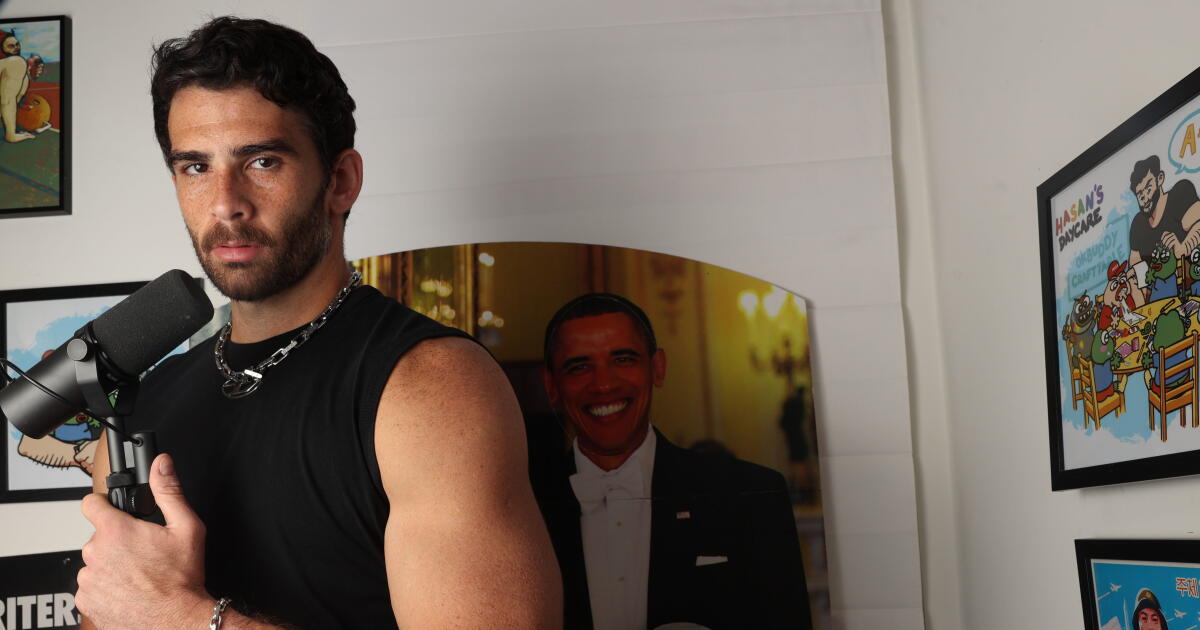
Hours before Nithya Raman took the stage at Jewish Federation L.A.’s mayoral forum this week, Mayor Karen Bass’ campaign blasted out a press release accusing the council member of skipping a City Council Jewish Heritage Month event to appear on Hasan Piker’s livestream.
The Raman camp’s response: “The Mayor is deliberately spreading misinformation that the public record directly contradicts,” said Liz Garcia, a campaign spokesperson.
Piker is a left-wing streamer on the platform Twitch and a fierce critic of Israel. Raman appeared on his stream on May 15, where he asked her if she thought Israel was committing genocide in Palestine. She said she did.
That same day, Raman missed a Jewish Heritage Month event at City Hall. Debbie Paperman, who is on the executive board of Democrats for Israel Los Angeles, said Raman told her that she had not been feeling well.
The Bass campaign, citing the fact that Raman appeared on Piker’s stream the same day, fired off an email to reporters claiming the councilmember had lied about her reasons for missing the Jewish heritage event.
The Raman campaign said that Raman was, in fact, ill.
Video from the May 15 council meeting shows Raman was present at the start of the meeting, but no longer at her seat during the heritage event, in which Councilmember Bob Blumenfield celebrated Jewish athletes. More than an hour later, Raman was back in council to make a speech and introduce other speakers for Hapa Day, celebrating people of mixed Asian and Pacific Island heritage, during which she said she wasn’t feeling well.
Raman’s team said she was still at City Hall during the Jewish Heritage Month event, but that she left council chambers due to her illness.
She felt better later that afternoon, the Raman camp said, allowing her to appear on Piker’s show.
Paperman said she wasn’t convinced. “It happened that you were sick for the multiple hours this was going on and you happened to get better to go on this psycho’s stream?” said Paperman. “I don’t believe that.”
Piker, meanwhile, shot back at the mayor for using his name to try to dissuade voters from supporting Raman.
“Karen Bass is deploying the same nasty tactic that Donald Trump used recently at a press conference, wondering out loud why any Jewish person would vote for Democrats, due to my presence in the big tent,” he told The Times in a text message.
Piker said he will vote for Raman, though he supported Bass against billionaire Rick Caruso in 2022.
“I was also a fan of [her] past work in Cuba,” he told The Times. “Karen Bass used to be quite the radical.”
Bass swings up in new poll
Bass will need to rely on undecided Republican and conservative voters to propel her to a mayoral victory, a new poll paid for by a group supporting her found.
The incumbent mayor is trailing Raman by 4 percentage points, 39% to 35%, with a quarter of the electorate still undecided, according to the initial results from an FM3 Research poll that was commissioned by the Central City Assn.’s PAC, an independent expenditure group supporting the mayor.
When the pollsters gave likely voters additional, critical information about both candidates, Bass shot up by 5 points and took a narrow lead over Raman, 40% to 39%, with 21% undecided, according to FM3.
“The undecided voters — including many that say they will refuse to make a choice between Bass and Raman by Election Day — are disproportionately: Republicans, conservatives, 65+, homeowners, Democratic women over the age of 50 and those who do not hold a college degree,” wrote the research company in a polling memorandum.
The poll surveyed 809 likely L.A. voters from Sept. 21-28. It has a 3.5% margin of error.
“The mayoral race remains a statistical tie,” said Nella McOsker, the president of the Central City Assn. “Our poll demonstrates that some of the most reliable voting blocs swing to Bass once they fully learn both candidates’ records.”
A poll conducted between Sept. 15 and Sept. 20 by the UC Berkeley Institute of Governmental Studies, co-sponsored by The Times, found Raman was ahead 39% to 28%.
Raman allies engage in trash talk
A woman walks out of her home carrying a full garbage bag, then starts venting about the high cost of trash pickup.
“Karen Bass has nearly bankrupted L.A., so the city doubled my trash fees. Isn’t L.A. expensive enough?” the woman says angrily, before slamming the lid on a black trash bin.
That message is at the heart of a campaign video created by Streets For All, a transportation advocacy group now spending about $1.2 million to promote Raman and tear down Bass.
That ad is missing a key piece of information: Raman voted to hike those trash fees several times last year, even as two of her council colleagues spoke out against them.
“I was one of two no votes,” said City Councilmember Monica Rodriguez, who is supporting Bass’ reelection, in an interview. “She never once pushed back.”
Rodriguez called the ad misleading, saying it implies that Raman was an opponent of the fee hikes.
Michael Schneider, who runs the Streets For All campaign committee, defended the 14-second spot, saying council members hiked the trash fees to make up for bad budget decisions made by the mayor — including her support for a $2.6-billion upgrade of the Convention Center.
The council boosted the trash fee to $55.95 per month last year for small apartment buildings, up from $24.33. For single-family homes, the monthly fee was also hiked to $55.95, up from $36.32.
The city’s budget advisors said the increases were needed in large part because the monthly fees had not been increased in 17 years. As a result, L.A.’s residential trash customers were not being charged the full cost of garbage pickup, leaving the city budget to cover the difference.
“Kick it in the Park” gets Olympic makeover
L.A.’s summer of 2026 will be remembered for stifling heat, innumerable Dodgers injuries and, especially, World Cup watch parties.
Teams, corporate sponsors and the city of Los Angeles welcomed in the world, producing large crowds and kumbaya moments — with fans of opposing teams partying side-by-side in (relative) peace and harmony.
Mayor Karen Bass’ “Kick it in the Park” events drew a total of 45,000 fans over the length of the quadrennial soccer tournament. A survey of about 2,000 of them registered overwhelming support for the free shindigs.
Paul Krekorian, executive director of the mayor’s Office of Major Events, declared victory in a meeting with City Council members this week. He also said that substantial planning is already underway to bring the city even more viewing parties and “activations” during the 2028 Olympics.
While the city hosted a maximum of three viewing parties a day during the World Cup, it plans to stage as many as 15 a day when the Olympics come to town. A list has been drawn up of possible locations for the festivities — spread around every corner of the city and distant from Olympic venues to avoid overcrowding.
Among the possible viewing party locations: MacArthur Park, the Greek Theatre, Pan Pacific Park, Leimert Park Plaza, Koreatown, Penmar Recreation Center, Echo Park Lake, Angels Gate Park and the Watts Towers.
Given the welter of Olympic events, it will be a challenge to schedule the parties, whose centerpieces are usually big screen projections of the live events, with food and live performances often thrown in.
State of play
— SPLIT ON GAZA: Bass and Raman split on Tuesday over whether Israel has committed genocide in Gaza during the Israel Gaza war. The two candidates gave their opinions during a forum hosted by Jewish Federation Los Angeles. Raman said she agrees with the experts who use the term, while Bass said she would not use the term genocide to describe Israel’s counteroffensive in Gaza.
— WILDFIRE FAILURES: A long-awaited independent investigation commissioned by Gov. Gavin Newsom offered the most in-depth review of the Jan. 7, 2025, Palisades and Eaton fires, describing the chaos and poor communication that made firefighting, rescues and evacuations even more difficult. The 724-page report also cited the Los Angeles Fire Department’s failure to fully extinguish the Jan. 1 Lachman fire, which reignited days later, and Los Angeles County’s failure to provide timely evacuation alerts in Altadena.
— ESTAMOS CON WHOM?: Recent polling by the UC Berkeley Institute of Governmental Studies, co-sponsored by The Times, found that likely Latino voters favor Councilmember Raman over incumbent Bass by a wide margin — 45% to 21%, with 34% undecided. That’s an even bigger lead than Raman had over Bass with voters overall in the most recent Berkeley IGS/L.A. Times poll.
— VOTER GUIDES: The Times released its much-anticipated voter guides for the November election this week, including a mayoral guide and a guide to the Council District 9 race, among many others.
— OLYMPIC OBSCURA: The nonprofit organizer of the 2028 Summer Olympics, LA28, has provided less information in its annual reports than it agreed to in a 2021 contract with the city. The group has stopped reporting the contracts it signs over $1 million, leaving taxpayers with less information about the work going into the Games. LA28 says it has provided all necessary info.
The city also asked LA28 to take out a $650-million insurance policy, and agree to cover any potential losses above that amount, should the Games be canceled by a calamity.
— LAPD BLUES: Secret recordings documenting LAPD officers making racist comments have renewed questions about whether the force, which is now less than 50% white, has made forward progress on stamping out prejudice in its ranks.
— STORM’S BREWING: L.A.’s sanitation agency is bracing for the coming ‘Super’ El Niño, which could wreak havoc with the city’s Hyperion sewage treatment plant.
QUICK HITS
- Where is Inside Safe? The mayor’s signature program went to East Hollywood in Hugo Soto-Martínez’s district on Tuesday, where they moved 61 people indoors near Beverly Boulevard and Madison Avenue. On Thursday, Inside Safe moved 27 people indoors near Louvre Street and Ralston Avenue in Pacoima in Rodriguez’s district.
- On the docket next week: On Wednesday, the City Council’s transportation committee will be discussing an independent evaluation of the city’s Vision Zero Program.
Stay in touch
That’s it for this week! Send your questions, comments and gossip to LAontheRecord@latimes.com. Did a friend forward you this email? Sign up here to get it in your inbox every Saturday morning.

Dodgers Dugout: A statistical preview of the Dodgers-Braves NLDS
Hi, and welcome to another edition of Dodgers Dugout. My name is Houston Mitchell. A good Tommy Lasorda quote: “You have got to love what you’re doing. No matter what it is. Whatever you undertake in life, if you don’t love it, and you don’t enjoy it, you are making a big mistake. You have got to love what you are doing. You have to appreciate what you are getting, and you have to do it to the best of your ability.”
It’s that time of year
The Dodgers will face the Atlanta Braves in the NLDS starting Saturday, with Game 1 set to start at 1 p.m. Pacific, with the temperature forecast to be around 100 degrees. So, bring a sweater. People have complained that the 1 p.m. start is unfair because it will be too hot, but unless it is going to be 75 degrees on the Braves side of the field, it will be even. Personally, I would have put Padres-Brewers at 1 p.m. and Dodgers-Braves at 5:30 p.m., but no sense crying over spilled milk (Editor’s note: How many clichés can this guy work into one paragraph?)
The Dodgers faced the Braves six times during the season and lost five.
May 8
at Dodgers 3, Atlanta 1
Emmet Sheehan and five relievers combined to outpitch Braves ace Chris Sale. Freddie Freeman homered.
May 9
Atlanta 7, at Dodgers 2
Blake Snell gave up five runs in three innings and the Braves got 12 hits overall, 11 of them singles. Snell went back on the IL after the game, staying there for three months. Spencer Strider started for the Braves. He is currently on the IL.
May 10
Atlanta 7, at Dodgers 2
Justin Wrobleski took one for the team, giving up all seven Braves runs in 8 2/3 innings. Bryce Elder started for the Braves, going 5 2/3 innings. Drake Baldwin and Matt Olson homered for Atlanta.
Aug. 25
at Atlanta 4, Dodgers 3
Tyler Glasnow gave up three runs in five innings and Tanner Scott gave up the go-ahead run in the bottom of the eighth. Bryce Elder got the start for the Braves, giving up three runs in six innings. The teams combined for 19 hits, but only two extra-base hits.
Aug. 26
at Atlanta 6, Dodgers 5
Roki Sasaki gave up four runs in 3 1/3 innings, but Tanner Scott got the loss when he gave up a walk-off single to Ha-Seong Kim in the bottom of the ninth. AJ Smith-Shawyer started for the Braves, giving up three runs in five innings. Matt Olson and Sean Murphy homered for Atlanta, Tommy Edman for the Dodgers.
Aug. 27
at Atlanta 1, Dodgers 0
The only run came in the first inning by Drake Baldwin, Atlanta’s leadoff hitter. Yoshinobu Yamamoto pitched 6 1/3 innings, giving up the lone run and four hits while striking out eight. Chris Sale pitched a shutout, giving up five hits and striking out 11.
Dodgers against the Braves this season
Batting
Hunter Feduccia, 3 for 5, 2 RBIs
Mookie Betts, .333/.429/.417, 14 plate appearances, 1 double, 1 RBIs
Teoscar Hernández, .333/.467/.333, 15 PA’s
Ben Rortvedt, 1 for 3
Andy Pages, .300/.364/.600, 11 PA’s, 1 homer, 2 RBIs
Tommy Edman, .273/.429/.636, 14 PA’s, 1 double, 1 homer, 3 RBIs
Alex Call, .273/.429/.364, 14 PA’s, 1 double, 1 RBI
Santiago Espinal, 1 for 5
Shohei Ohtani, .192/.192/.308, 26 PA’s, 1 double, 1 triple, 1 RBI
Freddie Freeman, .174/.240/.348, 25 PA’s, 1 double, 1 homer, 1 RBI
Will Smith, 1 for 7
Kyle Tucker, .133/.278/.200, 18 PA’s, 1 double, 1 RBI
Alek Thomas, 1 for 8, 1 RBI
Miguel Rojas, 1 for 8
Max Muncy, .118/.211/.294, 19 PA’s, 1 homer, 2 RBIs
Hyeseong Kim, 0 for 6
Kiké Hernández, 0 for 3
Alex Freeland, 0 for 7
Dalton Rushing, 0 for 5
Team, .196/.281/.299, 6 doubles, 1 triple, 4 homers, 2.5 runs per game
Pitchers
Jack Dreyer, 0.00 ERA, 2.2 IP, 2 hits, 1 walk, 1 K
Brock Stewart, 0.00 ERA, 2 IP, 2 hits, 2 walks, 1 K
Alex Vesia, 1-0, 0.00 ERA, 1.1 IP
Evan Phillips, 0.00 ERA, 1.1 IP, 1 hit, 1 K
Will Klein, 0.00 ERA, 1 IP, 1 hit,1 walk, 1 K
Kyle Hurt, 0.00 ERA, 1 IP, 2 hits, 1 K
Wyatt Mills, 0.00 ERA, 0.1 IP, 2 hits
Yoshinobu Yamamoto, 0-1, 1.42 ERA, 6.1 IP, 4 hits, 1 walk, 8 K’s
Emmet Sheehan, 1.93 ERA, 4.2 IP. 6 hits, 1 walk, 7 K’s
Edgardo Henriquez, 2.70 ERA, 3.1 IP, 2 hits, 1 walk, 5 K’s
Paul Gervase, 3.00 ERA, 3 IP, 4 hits, 1 walk, 5 K’s
Eric Lauer, 4.50 ERA, 2 IP, 2 hits, 2 walks, 1 K
Tyler Glasnow, 5.40 ERA, 5 IP, 6 hits, 7 K’s
Tanner Scott, 0-2, 6.75 ERA, 1 save, 2.2 IP, 4 hits, 1 walk, 2 K’s
Justin Wrobleski, 0-1, 7.27 ERA, 8.2 IP, 7 hits, 1 walk, 7 K’s
Roki Sasaki, 10.80 ERA, 3.1 IP, 6 hits, 2 walks, 3 K’s
Blake Snell, 0-1, 12.00 ERA, 3 IP, 6 hits, 2 walks, 5 K’s
Team, 1-5. 4.35 ERA, 1 save, 51.2 IP, 57 hits,16 walks, 55 K’s
Braves vs. Dodgers this season
Batting
Jorge Mateo, 4 for 7, 1 RBI
Ha-Seong Kim, 2 for 4, 1 RBI
Dominic Smith, 2 for 5, 1 double
Eli White, 2 for 5, 1 RBI
Drake Baldwin, .364/.481/.727, 27 PA’s, 2 doubles, 2 homers, 5 RBIs
Michael Harris II, .348/.375/.391, 25 PA’s, 1 double, 2 RBIs
Jim Jarvis, 1 for 3
Mauricio Dubón, .280/.308/.320, 26 PA’s, 1 double, 4 RBIs
Matt Olson, .261/.320/.565, 25 PA’s, 1 double, 2 homers, 4 RBIs
Ozzie Albies, .250/.269/.250, 26 PA’s, 4 RBIs
Austin Riley, .238/.292/.286, 24 PA’s, 1 double, 3 RBIs
Sean Murphy, .214/.267/500, 15 PA’s, 1 double, 1 homer, 1 RBI
Lane Thomas, 1 for 7, 1 double
Ronald Acuña Jr., 1 for 9
Mike Yastrzesmki, .083/.154/.083, 13 PA’s
Kyle Farmer, 0 for 1
Team, .278.330/.395, 9 doubles, 5 homers, 4.33 runs per game
Pitching
Spencer Strider, 1-0, 0.00 ERA, 6 IP, 1 hit, 2 walks, 8 K’s
Raisel Iglesias, 0.00 ERA, 1 save, 2 IP. 1 hit, 1 walk, 2 K’s
Didier Fuentes, 0.00 ERA, 2 IP, 1 hit, 3 walks, 1 K
Victor Mederos, 1-0. 0.00 ERA, 1.2 IP, 2 walks, 3 K’s
Dylan Dodd, 1-0, 0.00 ERA, 1.1 IP, 1 hit
Robert Suarez, 0.00 ERA, 1.1 IP, 1 walk
Aaron Bummer, 0.00 ERA, 1 IP
Chris Sale, 1-1, 11.13 ERA, 16 IP, 10 hits, 18 K’s
Bryce Elder, 1-0, 2.31 ERA, 11.2 IP, 9 hits, 4 walks, 13 K’s
AJ Smith-Shawyer, 5.40 ERA, 5 IP, 5 hits, 3 walks, 3 K’s
Dylan Lee, 9.00 ERA, 2 IP, 5 hits, 1 walk
Reynaldo López, 9.00 ERA, 2 IP, 4 hits, 1 walk, 1 K
Tyler Kinley, 18.00 ERA, 1 IP, 1 hit, 1 walk, 1 K
Team, 2.38 ERA, 53 IP, 38 hits, 19 walks, 50 K’s
How they compare
Let’s take a look at how the Dodgers and Braves compare this season:
Runs per game
Dodgers, 4.94 (fourth in the majors)
Atlanta, 4.58 (ninth)
League average, 4.48
Batting average
Dodgers, .257 (third)
Atlanta, .246 (11th)
League average, .244
On-base percentage
Dodgers, .338 (third)
League average, .318
Atlanta, .309 (28th)
Slugging percentage
Dodgers, .424 (second)
Atlanta, .409 (sixth)
League average, .400
Doubles
Dodgers, 266 (eighth)
Milwaukee, 251 (15th)
League average, 250
Triples
League average, 22
Dodgers, 18 (T19th)
Atlanta, 13 (29th)
Home runs
Dodgers, 204 (T7th)
Atlanta, 204 (T7th)
League average, 186
Stolen bases
League average, 110
Atlanta, 83 (T23rd)
Dodgers, 72 (27th)
Sacrifice bunts
League average, 23
Dodgers, 15 (T21st)
Atlanta, 11 (T26th)
Grounded into double play
Dodgers, 128 (third)
League average, 105
Atlanta, 89 (T27th)
ERA
Dodgers, 3.55 (fifth)
Atlanta, 3.63 (sixth)
League average, 4.17
Rotation ERA
Dodgers, 3.43 (second)
Atlanta, 3.76 (sixth)
League average, 4.24
Bullpen ERA
Atlanta, 3.44 (fourth)
Dodgers, 3.74 (ninth)
League average, 4.09
Pitcher strikeouts
Dodgers, 1,521 (fourth)
League average, 1,352
Atlanta, 1,350 (15th)
Pitcher walks
Dodgers, 480 (fourth fewest)
Atlanta, 529 (12th)
League average, 545
Home runs allowed
Dodgers, 172 (12th fewest)
Atlanta, 185 (17th)
League average, 186
Saves
Atlanta, 49 (T4th)
Dodgers, 46 (T7th)
League average, 42
Blown saves
League average, 23
Dodgers, 23 (T14th)
Atlanta, 20 (T21st)
Inherited runners who scored%
Atlanta, 20.9%, 36 of 172 (1st)
League average, 71 of 226, 31.4%
Dodgers, 35.8%, 69 of 174 (23rd)
The two teams are pretty evenly matched.
So who’s going to win?
The last NL team to win the World Series before the Dodgers? The Braves in 2021. They were led by some guy named Freeman.
If the Dodgers go into one of their team-wide funks, they could get swept. But here’s guessing they won’t do that in the postseason. It will be a tough series, but I’m going with…… Prediction: Dodgers in 5.
Poll results
We asked, “Which two of these four players would you pick to be on the postseason roster?”
After 18,543 votes:
Josue DePaula, 94.3%
Alex Call, 64.6%
Hyeseong Kim, 35.1%
Dalton Rushing, 6%
Up next
Saturday: Atlanta at Dodgers, 1 p.m., Fox, AM 570, KTNQ 1020
Sunday: Atlanta at Dodgers, 5 p.m., FS1, AM 570, KTNQ 1020
Tuesday: Dodgers at Atlanta, 3 p.m., FS1, AM 570, KTNQ 1020
*Wednesday: Dodgers at Atlanta, 3 p.m., FS1, AM 570, KTNQ 1020
*Friday: Atlanta at Dodgers, 5 p.m., Fox, AM 570, KTNQ 1020
All times Pacific
*-if necessary
In case you missed it
‘We are the team to beat’: How the Dodgers are preparing for showdown with Braves
Nine concerns the Dodgers should have about facing the Braves in the NLDS
Shaikin: ‘Hired gun’ Tarik Skubal opens up on the pressure, pain and lessons of October
And finally
Freddie Freeman hits a walk-off home run in the 18th inning to win Game 3 of the 2025 World Series. Watch and listen here.
Until next time …
Have a comment or something you’d like to see in a future Dodgers newsletter? Email me at houston.mitchell@latimes.com. To get this newsletter in your inbox, click here.

What to know about Brazil’s 2026 presidential election | Elections News
For the second election in a row, Brazilian voters face a choice between left-wing candidate Luiz Inacio Lula da Silva and a right-wing candidate from the Bolsonaro family.
The country’s fractious election is set to take place during a wave of successful far-right candidates across Latin America and a sensitive time in Brazil’s modern political history.
Recommended Stories
list of 3 itemsend of list
Former right-wing President Jair Bolsonaro is serving a 27-year prison sentence over his role in a coup plot following his loss to Lula in 2022. The conviction of Jair Bolsonaro and several military officers raised questions about the resilience of Brazilian democracy, revived several decades ago following a period of rule by a United States-backed military dictatorship.
An explosive corruption scandal has implicated prominent figures and institutions across the political spectrum, and observers have expressed concern about possible US intervention.
Polls suggest Lula, the current president seeking a fourth non-consecutive term, and Bolsonaro’s eldest son, Senator Flavio Bolsonaro, are in a virtual tie in a simulated run-off.
Who are the candidates, what issues have been front and centre, and what could the election mean for Brazil? Here’s what you need to know about Brazil’s 2026 presidential elections.
When is the election?
The first round of voting in the Brazilian presidential election will take place on October 4 from 8am to 5pm Brasilia time (11:00 to 20:00 GMT).
If no candidate wins the first round outright, the top two candidates will proceed to a run-off vote on October 25.
Who is Lula?
Luiz Inacio Lula da Silva, better known simply as Lula, is the country’s current president and the candidate for the Workers’ Party, or the PT.
The 80-year-old has been a central figure in Brazilian politics for decades, serving two four-year presidential terms between 2003 and 2011, and his current term, which began in 2023.
His time in office has been defined by an effort to pair political democracy, restored after a US-backed military dictatorship that ruled the country for several decades until the 1980s, with material improvement for the country’s poor through a series of social programmes meant to address inequality.
Lula has also sought to forge ties between developing, non-Western countries on the global stage.
“He has come to embody the institutionalisation and consolidation of Brazilian democracy since the end of the dictatorship,” Andre Pagliarini, an assistant professor of history and international studies at Louisiana State University and the author of a book on Lula, told Al Jazeera in a phone call.
Who is Flavio Bolsonaro?
Flavio Bolsonaro has emerged as the heir to his father’s status as leader of Brazil’s political right and Lula’s main challenger in the 2026 election. Bolsonaro is running as the candidate of the right-wing Liberal Party.
The 45-year-old is the eldest son of former President Jair Bolsonaro.
Flavio has pledged a hard stance on crime and insecurity and close collaboration with the administration of US President Donald Trump, which has designated several criminal groups in Brazil as “terrorist organisations”.
He has also promised to rein in inflation and government spending, with an adviser stating that he would implement a debt ceiling if elected.
Flavio Bolsonaro has also sought to turn his father’s conviction into a story of political persecution, denouncing his trial as illegitimate and seeking his release from prison.
“I ask God for the opportunity to walk up the ramp of Planalto Palace next year alongside President Jair Messias Bolsonaro, so that he may place the presidential sash across my chest,” he said at a campaign event in September.
“The Bolsonaro family’s pitch is that the institutions that Brazilian democracy has erected since the end of dictatorship are either rotten and unresponsive, and that we need a sharp turn away from this status quo,” said Pagliarini.
“The stakes of this election are incredibly stark because the candidates stand for such opposing visions about what Brazil’s recent history means,” he added.
What issues have defined the race?
As with many recent elections across the region, crime, insecurity and cost of living issues have dominated the Brazilian election. Corruption and concerns about US intervention in the country’s domestic affairs have also loomed over the campaign.
A Quaest survey from September 7 found that 31 percent of respondents cited violence as their biggest concern, followed by 20 percent who said corruption, 19 percent who said the economy, and 12 percent who said health.
While Brazil has seen decent economic growth and low unemployment and inflation during Lula’s third term, those mild gains have been paired with explosive levels of household debt and concerns about the rising cost of living.
A report from the Center for Economic and Policy Research, a left-leaning US-based think tank focused on economic issues, found that extreme poverty in Brazil fell by about 40 percent between 2022 and 2024, unemployment dropped to historic lows, and the country’s economic growth significantly outpaced that of most of its neighbours. But the analysis also found that households were strained by a sharp uptick in the cost of servicing debt. All in all, analysts say they amount to a view of the economy that is neither catastrophic nor particularly satisfying.
Pagliarini says that both candidates have tried to steer the election onto more favourable terrain for their issues of choice, with Lula portraying Flavio Bolsonaro as a willing accomplice in US efforts to undermine Brazilian sovereignty, and Flavio Bolsonaro accusing Lula of being corrupt and weak on crime.
What do the polls say?
Analysts say that polls reflect the state of Brazilian politics: deeply polarised but unenthusiastic.
“The general vibe is that this is a very downbeat campaign,” said Pagliarini. “There’s not a lot of enthusiasm either way, and it’s hard to tell at this stage who that favours.”
Most surveys show a close race, with Lula holding a marginal advantage over Flavio Bolsonaro that tightens further in a hypothetical run-off.
A Quaest survey from September shows Lula with 37 percent of voter intention against Flavio Bolsonaro’s 33 percent, while an AtlasIntel survey from the same period showed Lula winning 46 percent to Flavio Bolsonaro’s 43 percent.
A Datafolha poll found Lula with 40 percent and Flavio Bolsonaro with 36 percent.
Polls also show Flavio Bolsonaro favoured over Lula on issues of inflation, combating corruption, and crime and drug trafficking, while Lula is seen more favourably on issues of poverty and inequality, foreign affairs and health.
What challenges has each campaign faced?
An explosive corruption scandal, focused on disgraced banker Daniel Vorcaro, has raised questions for both campaigns and implicated members of the country’s political and economic elite across the political spectrum.
Reports found that Flavio Bolsonaro had solicited substantial funds from Vorcaro, ostensibly to finance a documentary – The Dark Horse (or O Azarao) – about his father.
Lula’s former finance minister, Guido Mantega, has also said he helped arrange a meeting with Vorcaro, Lula and the head of Brazil’s central bank to discuss banking policy. Lula has said he told Vorcaro there would be no political interference in his bank’s case, only a “technical investigation conducted by the central bank”. The Reuters news agency confirmed the meeting.
The scandal has also embroiled the country’s Supreme Court, with Alexandre de Moraes, whose central role in Bolsonaro’s coup trial turned him into a subject of ire for the political right, facing questions about his own links to the banker.
De Moraes has in turn accused a justice appointed by Bolsonaro of wrongdoing, with the court considering probes into the conduct of both justices.
What are the concerns about US intervention?
Concerns that the Trump administration could intervene or seek to influence the outcome on behalf of Bolsonaro have also loomed over the election.
The US president has frequently threatened to cut off economic assistance to Latin American countries if his preferred candidate fails to win. Trump had also used sanctions to target members of the Brazilian judiciary involved in the case against the elder Bolsonaro, which he portrayed as a “witch-hunt”. Trump also placed heavy tariffs on Brazil in a bid to have the case thrown out.
The country’s government denied visas to two US officials who sought to travel to Brazil, saying they planned to cast doubt on the integrity of Brazilian elections. Lula’s government has warned the US against meddling in the country’s domestic affairs.
Trump has himself used false claims of rampant fraud to justify efforts to remain in office despite his election loss in 2020.
A group of 31 Democratic US Congress members recently sent a letter to US Secretary of State Marco Rubio criticising “an apparent effort to interfere with, and potentially undermine” Brazilian elections.
The Reuters reported that Brazilian intelligence officials also briefed a French and German delegation in September about possible interference in the election by outside powers such as the US and Russia. The officials said that US interference ranged “from lawfare to interference that is openly acknowledged”.

Four of the best Oktoberfest events across the UK from bottomless brunches to beer tents with live oompah bands
IT’S beer season! The world-famous Oktoberfest has landed in Munich, its original location, where locals don traditional lederhosen and sip on steins of foamy nectar.
But why leave all the fun to them?


There are plenty of nods to the traditional beer-drinking event here in the UK and dress-up is often encouraged.
Whether you’re an avid pint drinker or simply want to revel in the fun, these experiences will leave you bottoms up . . . one way or another.
ALBERT’S SCHLOSS: The Bavarian-inspired Albert’s Schloss is hosting a special event until October 25 at its locations in Manchester, London, Birmingham and Liverpool.
Visitors will be able to knock back the Big Six brews served at Munich’s Oktober-fest while listening to a live oompah band blasting out traditional music.


Go on a Thursday, Friday or Saturday to witness the ceremonious wooden keg tapping, performed on stage using the traditional method – a big wooden mallet.
Expect special Bavarian sharing platters of pork knuckle, bratwurst and kraut, too.
Entry is generally free while the Das Big Six Bier Masterclass costs £55pp. See albertsschloss.com.
OKTOBERFEST UK: Don’t live near a big city? The official Oktoberfest UK travels far and wide across the country, bringing its large beer tents to mid-sized towns and coastal regions, as well as larger cities.
The events are running until October 31, with tickets still left in Milton Keynes, Portsmouth, Chelmsford and Plymouth, among other destinations.
The huge tents can hold up to 1,000 visitors and are lined with long wooden tables where punters can knock back their pints while joining live sing-alongs. Expect brass bands, massive steins, plus food vendors selling bratwurst and currywurst.
Afternoon and evening sessions last four to five hours. Tickets cost from around £15 for standing and around £25 for seated. See oktoberfestuk.co.uk.
CAMRA BEER FESTIVALS: The Campaign for Real Ale is hosting events all over the UK until early November.
Instead of German lagers, the focus will be on British cask ale, real cider and perry.
Don’t expect any lederhosen either – just like-minded beer fans.
Festivals are taking place in Berkshire, Nottinghamshire and Dorset, among many other locations.
CAMRA members can typically enter free, while prices usuallystart from £3 for non-members, depending on the location. See camra.org.uk/events.
BIERKELLER: These Bavarian-style venues – in Nottingham, Liverpool, Manchester, Birmingham, and London – are hosting special bottomless brunches until the end of the month.
Visitors have 90 minutes of unlimited draft beers and steins (there’s also prosecco, or cocktails for the non-lager drinkers of the group).
Most locations serve pretzels on arrival, followed by your pick of Bavarian dishes such as Bratwurst in a brioche or pretzel roll topped with sauerkraut, cheese frankfurters and pretzel-bun burgers.
Those visiting in the evening can get stuck into fun games such as stein-holding competitions and pretzel-tossing.
Brunches cost from £35pp at the Nottingham venue.
See thebierkeller.com.

LIVE: Croatia vs England – UEFA Nations League
Follow the updates, with build-up, predictions, team news and full match coverage, from our live text commentary stream.
Source link