There’s a hidden door in Downtown Disney. Only this one isn’t meant to be walked through.
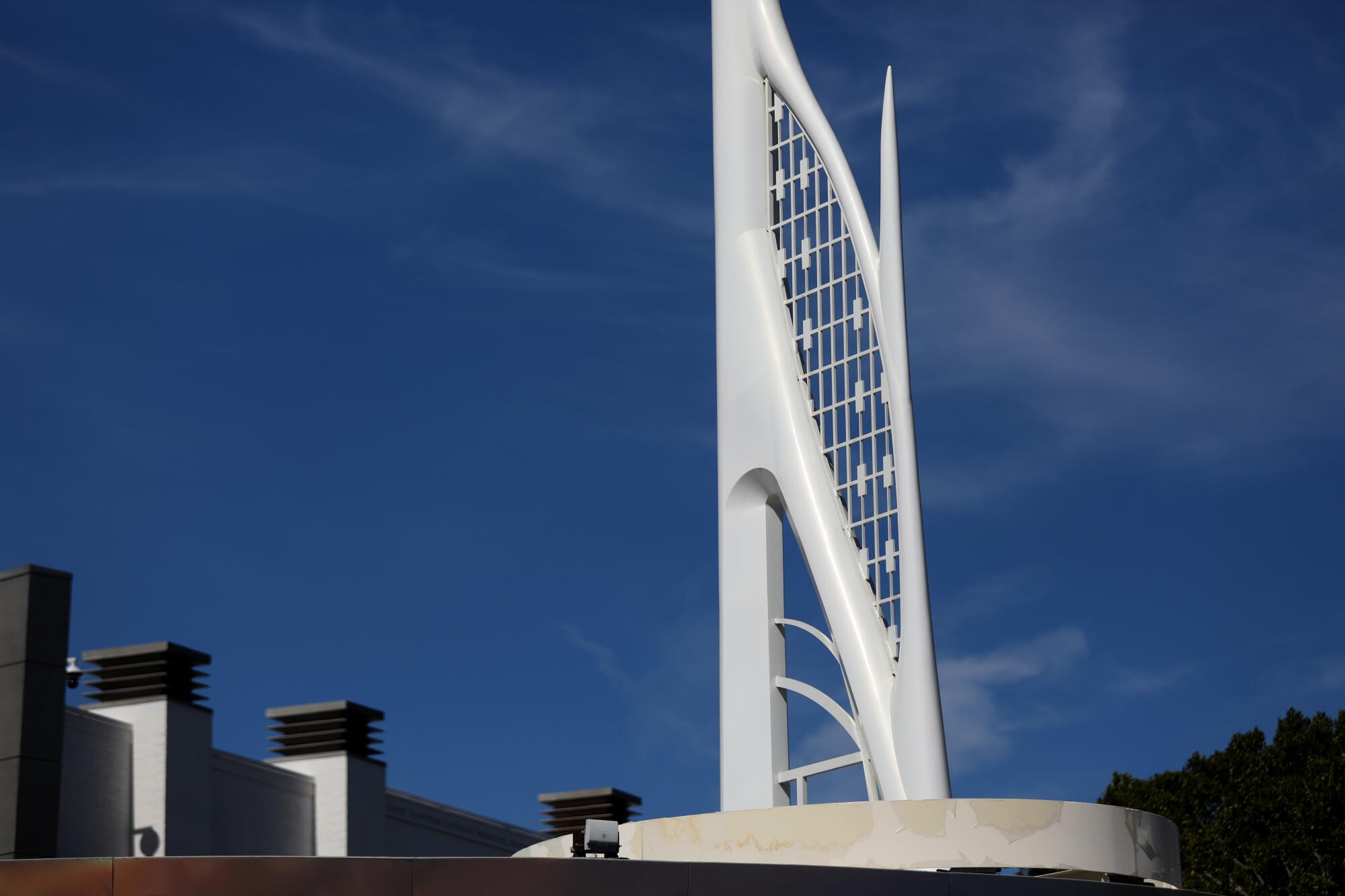
Flanking a stage near the monorail station, you’ll find a glistening white tower, the work of artist and activist Nikkolas Smith, who has adopted the term “artivist.” At first glance, the tower — one of Downtown Disney’s most striking works — appears to be a nod to Disneyland’s Midcentury art, for its curved lines and space-age optimism wouldn’t be out of place in Tomorrowland.
That’s there, says Smith, but there are also a number of more subtle inspirations.
The tower is a nod to five Black architects, trailblazers whose creations sometimes went unnoticed or overlooked. And that’s why at the base of the structure is a looping opening meant to signify a half-open doorway.

Downtown Disney’s Legacy Tower touches on the styles of different Black architects as it rises into the sky.
(Gary Coronado / For The Times)
Smith shares a distressing anecdote. “They had to learn how to read drawings upside down, because they weren’t allowed to sit next to the white clients,” Smith says, adding they also had to endure unequal pay. “So I was incorporating things like the half doorway to symbolize their struggle.”
Officially designated as the Legacy Tower, Smith himself fixates on that word — “legacy.” The term, he says, represents a thematic constant across his work. A regular collaborator on a number of Walt Disney Co. projects and a former architect with Walt Disney Imagineering, the division of the company focused on theme park experiences, Smith is something of a connector. His canvas art, full of fast-moving brush work, is often rooted in the past while urgently seeking to draw links to the present.

Artist Nikkolas Smith went viral for his portrait of Martin Luther King Jr. in a hoodie, a tribute to slain teenager Trayvon Martin.
(Nikkolas Smith)
His 2025 children’s book, “The History of We,” tells the story of how humanity can trace its roots to Africa. And one of his best-known pieces is of Martin Luther King Jr. in a hoodie, meant to evoke the image of Trayvon Martin, the slain 17-year-old whose death inspired a social justice movement. The work went viral in 2013 while Smith was still working for Imagineering. It altered his career trajectory.
“It was like, ‘I cannot just make art about churros and rides right now,’” Smith says. “There’s a time for that, and there’s also a time to talk about this.” He references his portraits related to the killings of Black men, many at the hands of police officers, such as Philando Castile and Michael Brown.
“At the end of the day, Disney understood that,” Smith adds. “They understood that I needed to make art that was extremely important at the moment, about justice or the lack of justice.”
Smith left Disney in 2019 after 11 years but has maintained a close relationship with the company, so much so that Imagineering called upon Smith to design the tower, which opened in 2023.

Artist Nikkolas Smith, left, chats with guests Ricky Yost and Martina Yost of Aubrey, Texas, who recognized Smith from a recent Disney cruise excursion.
(Gary Coronado / For The Times)
As the Legacy Tower spirals toward the sky, its patterns and and lattice work nod to the likes of James H. Garrott, Robert A. Kennard, Roy A. Sealey, Ralph A. Vaughn and Paul Revere Williams. All were active in Los Angeles — Williams, for instance, was a pivotal designer on the LAX Theme Building — and Smith interlaces decorative flourishes in varying styles that twist around one another to work up the Legacy Tower’s pointed spheres.
The door of the Legacy Tower symbolizes perseverance, Smith says. “They made it through, despite all of the obstacles they had to go through.”
Smith had studied the architects while a student at Hampton University, and has documented on his Instagram their various stylings, which range from restrained to whimsical to ornate. A section referencing Vaughn is modern minimalism, whereas an area dedicated to Sealey is full of jagged, pointed linework. All of it is held together via a coiling design that feels full of movement.

The patterns of the Legacy Tower are nods to the likes of James H. Garrott, Robert A. Kennard, Roy A. Sealey, Ralph A. Vaughn and Paul Revere Williams.
(Gary Coronado / For The Times)
“How can I show humanity’s interconnected future? That’s the idea,” Smith says. “There’s this African theme of Sankofa. If we look toward our future, we have to look at the past and value and appreciate the past. I thought it would be great if I could really commemorate some Black designers and architects as the foundation and backstory of the tower. And I was also thinking about these breezeway block patterns that you see in Leimert Park.”
And yet it also feels like something that belongs in the park. Smith says he looked at some Tomorrowland designs.
“A Midcentury Modern vibe was Walt,” Smith says, referring to park patriarch Walt Disney. “That was Walt’s thing. It all connects. I love that people can hopefully now connect both things. You can connect Tomorrowland and Walt with Paul Revere Williams.”
It’s clearly Smith’s favorite design of his for Disney, although it’s not the only space at the resort that features his artistry. During his decade-plus with Imagineering he regularly worked on teams that focused on projects at Disney California Adventure, which this year is celebrating its 25th anniversary. He was heavily involved, he says, in the evolution of Avengers Campus, contributed to a small promenade stage in Pixar Pier and helped envision the facade of Guardians of the Galaxy — Mission: Breakout!, which transformed the former Tower of Terror into a sci-fi structure.

Nikkolas Smith says elements of Downtown Disney’s Legacy Tower symbolize perseverance.
(Gary Coronado / For The Times)
Smith looks back fondly at his years at Imagineering, specifically calling out his time on the Guardians project. The former fake hotel is now full of glistening bronze pipes, a retro futurist look that former Imagineer Joe Rohde, who led the design, has said takes influence from the high-tech aesthetic of architect Renzo Piano, who worked on France’s Pompidou Centre.
“How much can we add to it? How much can we get away with gluing onto this thing?” Smith says of the Guardians facade. “What is the right amount of ‘Guardians of the Galaxy,’ without being too much? Without scaring people on the freeway?”
Today, Smith continues to focus on social justice work, and has also collaborated with filmmaker Ryan Coogler, such as completing concept designs for his Oscar-nominated film “Sinners.” Smith’s 2023 children’s book “The Artivist” documents the importance of creating art that’s in conversation with the world, believing it’s not only a source for education but for empathy. Smith’s weekly paintings speak out often against the current administration, and Smith has been particularly vocal on the ICE raids.

A selection from “The Artivist,” an illustrated book from Nikkolas Smith.
(Nikkolas Smith)
“Some people say that all art is activism, but I feel that some of the best art that is created is art that has a message,” Smith says. “And hopefully that message has to do with the humanity of all people, and for me, I like to focus on marginalized communities, and how we can value the humanity of everybody. That’s why I make picture books about the origins of humanity and the origins of this country.”
The Leimert Park resident says his wife and young son regularly visit the Disneyland Resort. And when he does, Smith says, he always takes a moment to stop by the Pixar Pier stage that he contributed to, which is often used for character meet and greets.
“They were team projects, and I do go up to them with so much pride,” he says. “I go up to the Pixar Pier promenade stage, and I just go up to it and touch it. … The beautiful thing about Disney is these creations are usually around for a lifetime.”
It turns out you can take the artivist out of Disney, but you can’t fully take the Disney out of the artivist.