guardians

Guardians rally past Rays to win Game 1 of ALCS

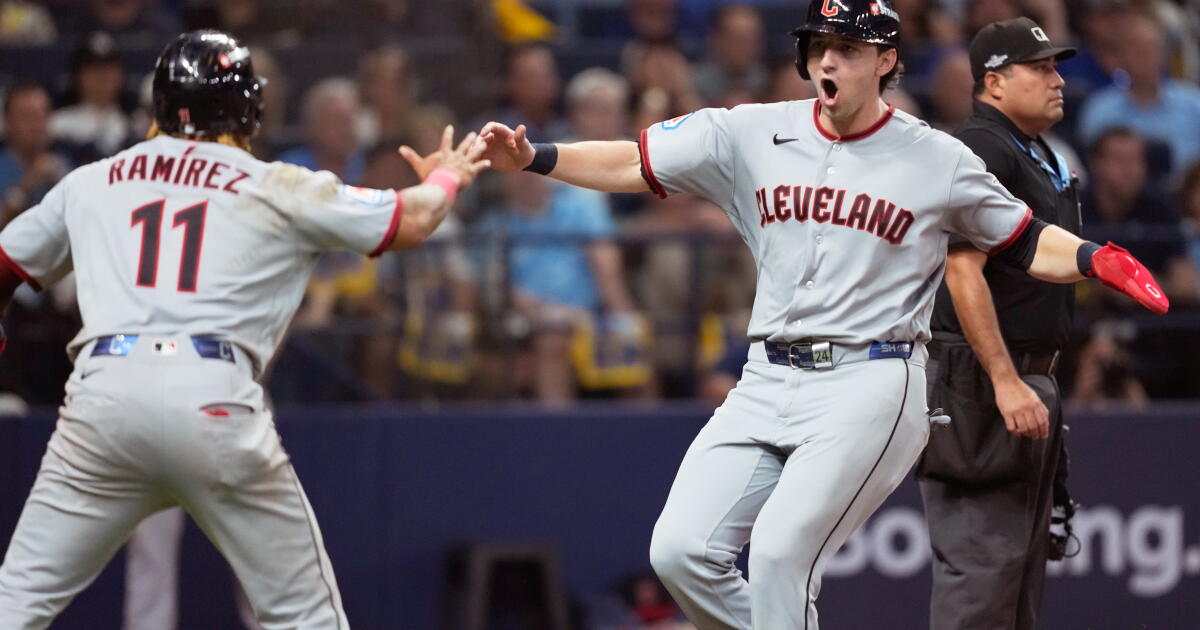
Nathaniel Lowe ended an eighth-inning tie with a two-run single after Chase DeLauter and Patrick Bailey homered off Drew Rasmussen, and the Cleveland Guardians rallied past the Tampa Bay Rays 7-3 in Game 1 of the American League Championship Series on Monday night.

Junior Caminero and Jonny DeLuca had RBI singles in the first and Cedric Mullins hit a solo homer for the Rays, who never trailed in a three-game sweep of the New York Yankees in their AL Division Series.

“It’s been a while since we lost, so I think that’s a good thing, and I know the guys will come back and respond tomorrow,” Tampa Bay manager Kevin Cash said.

Game 2 is Tuesday night at Tropicana Field. Rookie left-hander Parker Messick starts for Cleveland, and right-hander Freddy Peralta takes the mound for the Rays.

Five relievers combined for five innings of one-run, two-hit ball for the Guardians, who became only the 11th team to overcome an 0-2 deficit in a best-of-five playoff series with a victory over the Chicago White Sox on Saturday night.

Cade Smith, who pitched in all five games against Chicago, tossed a perfect ninth.

“Obviously we came off an emotional series, had a quick turnaround. But these guys come ready to play every day. Couldn’t be more proud of them,” Cleveland manager Stephen Vogt said. “We got punched early. And our pitching staff, credit to them, for stopping it and keeping us in the game as long as they did. And the offense came alive.”

Rasmussen took a 2-0 lead into the sixth before DeLauter led off with an opposite-field homer to left-center. Bailey started the seventh with a towering shot to center that went a projected 436 feet, ending Rasmussen’s night.

Rasmussen took a no-hitter into the eighth in Game 1 of the ALDS against the Yankees.

José Ramírez opened the eighth with an infield single off Tyler Wells, and DeLauter ripped a double to right. After Wells retired Jo Adell on a grounder to second, Ian Seymour entered. Lowe lined an 0-2 pitch up the middle to drive in two, giving Cleveland a 4-2 lead.

Mullins connected off Erik Sabrowski for a solo shot in the bottom half.

Ramírez, whose two-run homer lifted Cleveland to a 2-0 win in Game 5 vs. Chicago, provided an insurance run with an RBI single in the ninth off Cole Sulser. Ramírez helped the Guardians get two more by breaking for third with two outs and two strikes on Adell. Caminero ran to cover the bag and was out of position when Adell hit a sharp grounder toward third. The ball rolled into left field for a two-run double.

A crowd of 35,361 fans waved yellow rally towels and rang cowbells at Tropicana Field in the Rays’ third appearance in the ALCS in the franchise’s 29 season-history.

They were fired up when the 98-win Rays jumped ahead 2-0 in the first and Rasmussen battled to keep it there until the sixth.

Coming off that dominant performance against the Yankees, Rasmussen went six-plus tough innings. The two-time All-Star right-hander, who was four outs from a no-hitter in a 1-0 victory against New York, allowed a hit to the second batter he faced and eight total, striking out seven.

Guardians starter Foster Griffin allowed two runs and five hits in four innings.

The Rays allowed just 12 hits in three games against the Yankees but the Guardians got 14 in the series opener, including three apiece from Ramírez and DeLauter.

Glove work

The Rays helped Rasmussen with outstanding defense.

Nick Fortes threw out Ramirez trying to steal second in the first. Caminero made an excellent play to retire Adell on a hard bouncer to third. Caminero short-hopped the ball with his backhand and fired a strong throw to first.

The Guardians had a runner on first with one out in the third when second baseman Ben Williamson robbed DeLauter of a hit that prevented a first-and-third jam. Williamson, who wasn’t on the ALDS roster, made a diving grab on DeLauter’s sharp grounder, got up and threw him out.

Stranded runners

Rays slick-fielding shortstop Taylor Walls was 0 for 3 and left six runners on base. He struck out with the bases loaded to end the first, lined out with a runner on in the fourth and grounded out with runners on first and second to end the sixth.

Up next

Messick took the loss in Game 1 of the AL Division Series, giving up two runs in 4 1/3 innings. He threw 2 1/3 innings in relief in a Game 4 victory, giving up two runs. Messick had 11 strikeouts in the two appearances. He was 12-9 with a 2.56 ERA in the regular season.

Peralta gave up one run and three hits over 4 2/3 innings in Game 2 of the AL Division Series vs. the Yankees. He was 5-2 with a 3.25 ERA in 10 starts after joining Tampa Bay at the trade deadline. Peralta was 5-9 with a 4.99 ERA for the Mets this season.

Source link

Mets outspend Dodgers while Guardians, Rays, White Sox win on the cheap

It seems like a simple equation: $338 million produces 100.

That’s the Dodgers’ season-ending payroll and victory total. But to assume a franchise can merely buy a playoff berth is a stretch.

The New York Mets sit at home — or more likely at lavish vacation destinations, given their perch at the top of baseball’s payrolls at $345.8 million. They finished last in the National League East with a 74-88 record.

The Cleveland Guardians also sit at home, but are quite pleased about it. They earned a first-round bye and berth in the American League Division Series this weekend despite a payroll of only $74.2 million — baseball’s lowest and barely one-fifth that of the Mets.

Twelve of the 30 MLB teams qualified for the postseason, with four best-of-three Wild Card Series beginning Tuesday. Eight of the dozen have payrolls in the top 10, with the defending AL-champion Toronto Blue Jays joining the Mets as supreme underachievers given their No. 5-ranked payroll of $275.4 million.

Yet three playoff teams — the Tampa Bay Rays ($98.3 million) and Chicago White Sox ($98 million), in addition to the Guardians — rank among the six lowest payrolls, according to present-day salary calculations from the MLB Labor Relations Department, or LRD, obtained by USA Today.

The combined LRD payrolls of those three overachievers don’t come close to the Mets or Dodgers, highlighting the enormous disparity between the haves and have-nots that team owners point to while demanding a salary cap during ongoing collective bargaining negotiations.

Oddly, only one playoff qualifier is among the 14 mid-range payrolls of roughly $100 million to $200 million — the Milwaukee Brewers, who achieved baseball’s best record at 103-59 while paying its roster $143.5 million. The Angels are also among that group, ranking No. 15 at $179.8, not enough to keep them from losing 100 games for the first time in franchise history.

The LRD payroll tracks a team’s real-time salary commitments for the current season, accounting for the 26-man MLB roster’s base salaries plus a prorated portion of signing bonuses. LRD differs from luxury tax payrolls, which are based on the average annual value of every player contract on the 40-man roster.

Luxury tax payrolls determine whether a team exceeds the league’s luxury tax threshold and owes financial penalties. MLB is using luxury tax payrolls in the CBA negotiations over a hard salary cap and floor, proposing a $245.3-million ceiling and $171.2-million floor for 2027.

Luxury tax penalties from clubs that exceed the thresholds funnel back to low-revenue clubs through revenue sharing. A record $402,637,907 was paid in luxury tax penalties last season, with the Dodgers paying the most at a record $169.4 million. This year, the Dodgers’ luxury tax is projected at $180 million — higher than the LRD payroll of 16 teams.

The Dodgers also have the highest luxury tax payroll at $430 million, dwarfing the Mets’ $363-million number. Reasons? The Dodgers pay more in penalties because they have exceeded the luxury tax six years in a row, they have more players with massive average annual values and they took on additional penalties by acquiring starter Tarik Skubal at the trade deadline.

MLB 2026 payrolls (playoff teams in bold)

1. New York Mets: $346.8 million

2. Dodgers: $338.0 million

3. New York Yankees: $304.6 million

4. Philadelphia Phillies: $291.7 million

5. Toronto Blue Jays: $275.4 million

6. Atlanta Braves: $263.9 million

7. Houston Astros: $249.5 million

8. Chicago Cubs: $248.8 million

9. San Diego Padres: $223.9 million

10. Boston Red Sox: $210.2 million

11. Detroit Tigers: $202.1 million

12. San Francisco Giants: $197.6 million

13. Arizona Diamondbacks: $192.8 million

14. Texas Rangers: $192.5 million

15. Angels: $179.8 million

16. Seattle Mariners: $170.5 million

17. Baltimore Orioles: $169.2 million

18. Kansas City Royals: $149.8 million

19. Milwaukee Brewers: $143.5 million

20. Cincinnati Reds: $128.3 million

21. Colorado Rockies: $117.0 million

22. Minnesota Twins: $109.5 million

23. Pittsburgh Pirates: $107.6 million

24. Athletics: $98.7 million

25. Tampa Bay Rays: $98.3 million

26. Chicago White Sox: $98.0 million

27. St. Louis Cardinals: $94.7 million

28. Washington Nationals: $90.3 million

29. Miami Marlins: $83.0 million

30. Cleveland Guardians: $74.2 million

Source link

Sean Gunn retires from ‘Guardians of the Galaxy’ Rocket raccoon role

Sean Gunn has no plans to continue his motion capture role for “Guardians of the Galaxy” character Rocket raccoon.

The physical demands involved in creating Marvel Cinematic Universe’s masked bandit often included the 52-year-old actor being in a catcher’s crouch position, which hurt his ankles and feet due to constant pivoting, Gunn revealed in an interview on “The Brandon Davis Show.”

“I think it had a little bit of an effect on my physiology. My knees are fine, but since I turned 50 a couple years ago, I am retired from playing Rocket,” Gunn said in the podcast episode published Monday. “I don’t think I can do the motion reference anymore for Rocket. I think I’m too old.”

The veteran actor is now ready to pass on his deadly laser cannon to another rising star. Rocket’s creators should “give a younger actor a shot at it, right?” he said.

While actor Bradley Cooper has voiced the small, sharp-tongued creature since the first “Guardians of the Galaxy” film in 2014, Gunn has worked alongside animators behind the scenes to capture the subtle actions with motion capture technology, or mocap, which animates 2D or 3D computer characters using the actor’s physical movements.

Gunn described the process as a relay race in a 2024 interview with Adam Lupis; once a script is handed to him, he passes the baton to the visual effects team, who then tie it all together with Cooper’s voice acting.

“Rocket is sort of a character by committee in that way. I think he’s a good microcosm for movies where they get this whole community of people coming to make something with love and care,” Gunn shared in the interview with Lupis. “It’s been a crazy process.”

Alongside his role as on-set Rocket, Gunn also portrayed Ravager Clan space pirate Kraglin Obfonteri in “Guardians of the Galaxy”; its two sequels, “Vol. 2” and “Vol. 3”; “Avengers: Endgame”; and “Thor: Love and Thunder.” Rocket also appeared in 2018’s “Avengers: Infinity War.”

Source link