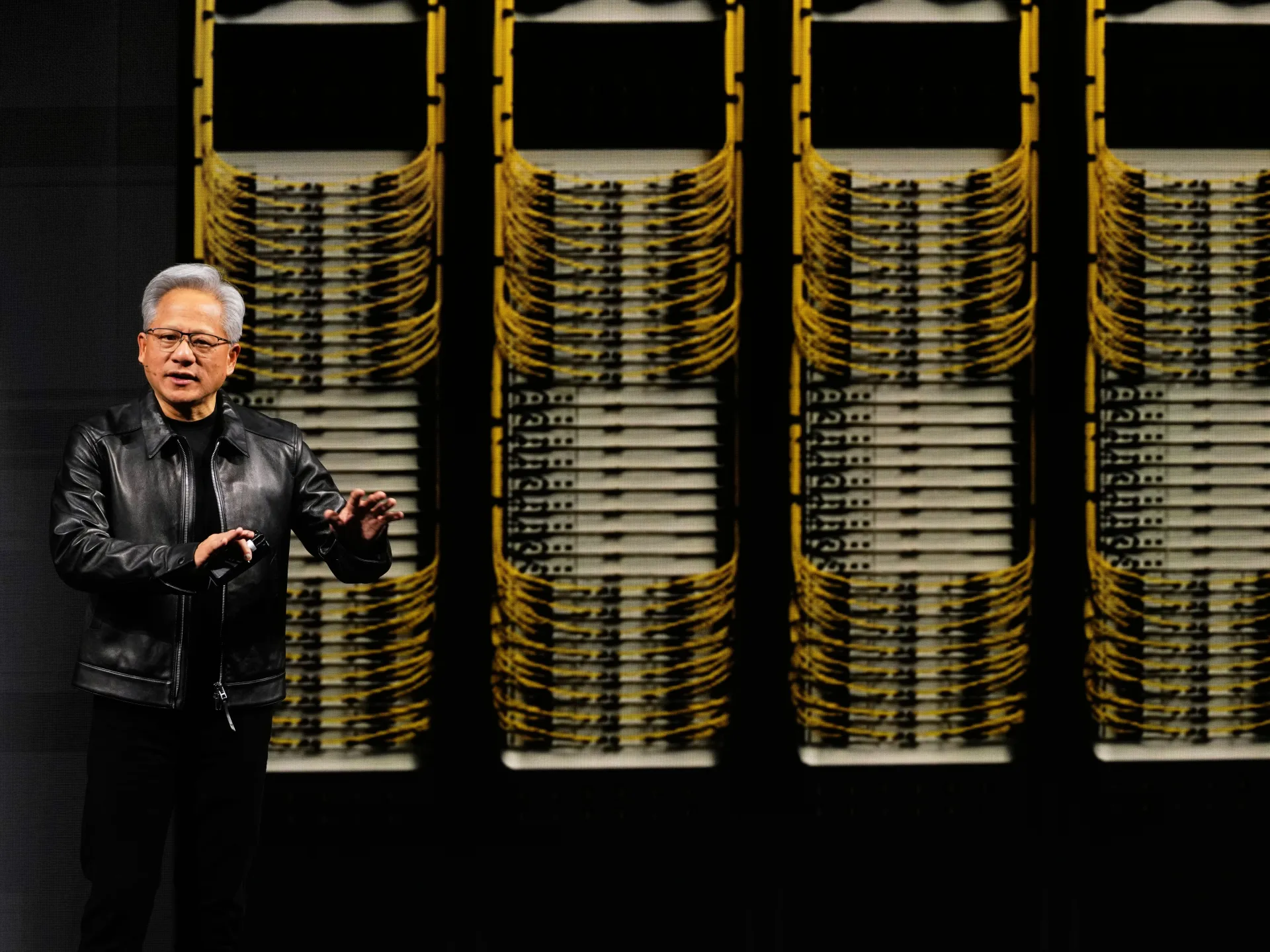
Nvidia CEO Jensen Huang’s intimate relationship with a woman accused of being a Chinese spy has highlighted divisions in Washington over the export of advanced chips to China.
Huang, the head of one of the most critical firms in the global artificial intelligence race, has long been among Silicon Valley’s most powerful voices arguing against restrictions on high-end chip sales.
Recommended Stories
list of 4 itemsend of list
For years, the tech executive lobbied United States President Donald Trump to loosen export controls, finding allies in sympathetic administration figures such as David Sacks, Trump’s former AI tsar.
Whereas hawkish voices argued that Beijing should not have access to cutting-edge US technology on national security grounds, Huang and like-minded executives argued that China already had the computing power to make strides in AI and that wider uptake of US technology would help maintain its dominance in the field.
Jensen Huang’s lobbying now faces intense scrutiny following claims that former Megaspeed executive Alice Huang — with whom he had an affair — was an intelligence agent recruited by China’s Ministry of State Security.
China’s Ministry of Foreign Affairs has denied the allegations, calling them “entirely groundless, speculative and intended to smear and malign China”.
Alice Huang has not publicly commented on the claims, which The New York Times and the Financial Times first reported, citing unnamed US intelligence officials.
Nvidia’s board of directors on Sunday launched an inquiry into Jensen Huang’s relationship, pledging to examine “all available information” while also expressing confidence in the CEO.
Jensen Huang, who cofounded Nvidia in 1993, has pledged to cooperate fully with the inquiry and expressed his commitment to protecting Nvidia and US national security.
Trump has meanwhile said the FBI too is investigating whether Huang’s affair led to any compromise on US national security.
Already, US lawmakers have invoked the controversy to push for tighter restrictions on China’s access to US chips.
Democratic Senator Elizabeth Warren and Republican Senator Jim Banks on Monday called on the US Congress to take “decisive action” and pass their AI Overwatch Act, which would empower lawmakers to scrutinise and potentially halt exports of advanced chips to China and other adversaries.
“The Commerce Department should complement these efforts with immediate action to close export control loopholes and ensure that advanced AI chips are not going to China’s military,” Warren and Banks said in a joint statement.
Democratic House Representative Bill Foster also cited Jensen Huang’s relationship in a statement on Monday in which he called on his fellow lawmakers to get his Chip Security Act “across the finish line”.
The legislation, cosponsored by Republican House Representative Bill Huizenga, aims to prevent illicit smuggling to countries such as China by implementing measures to track the location of chips sent overseas.
Advocates of tighter restrictions now have a “much stronger political argument” and are likely to make use of it, said Rui Ma, a tech industry consultant and founder of Tech Buzz China.
“Chip exports to China have been deeply divisive in Washington, and Huang has been one of the strongest advocates for keeping that market open,” Ma told Al Jazeera.
“If his influence is diminished by this investigation, regardless of its eventual findings, those pushing for tighter restrictions will be in a much stronger position,” she said.
Trump, who has forged a close relationship with Jensen Huang since returning to the White House, has taken several actions to make it easier for chip makers to do business with China, while also maintaining significant export controls.
In May last year, the US Department of Commerce announced that it would scrap the previous Biden administration’s “AI Diffusion Rule”, which would have imposed caps on chip exports to more than 100 countries, including some US allies.
In December, Trump said he had granted Nvidia approval to sell its second-most powerful chip, the H200, to China under an arrangement that would see 25 percent of sales paid to the US government.
Nvidia, which controls an estimated 80 to 90 percent of the market for graphics processing units (GPUs) used to run frontier AI, welcomed the decision at the time, saying it would “support high-paying jobs and manufacturing in America”.
On the other hand, Trump has resisted calls to allow exports of Nvidia’s top-of-the-line Blackwell chips, which deliver about 2.5 times the performance of the H200.
“I think recent events likely increase attention on export control loopholes, and add momentum to bills already being discussed in Congress, like the Chip Security Act,” Erich Grunewald, a senior researcher at the Institute for AI Policy and Strategy, a Washington, DC-based think tank, told Al Jazeera.
While export controls have spurred contentious debate, their effectiveness has been called into question amid China’s steady advances in AI development.
Authorities and analysts have documented widespread smuggling of restricted chips into China, mainly through Southeast Asia.
Chips with compute power equivalent to 1.6 million Nvidia H100s made their way to China in violation of export restrictions up to the end of 2025, according to an estimate by Epoch AI.
Chinese companies have also been able to bypass US law by remotely accessing compute capacity supplied by Nvidia-powered data centres in countries such as Singapore, Malaysia and Thailand.
Gabriel Wildau, managing director at global business advisory firm Teneo, said claims that Huang had been ensnared in an espionage campaign deserved to be treated with skepticism given the anonymous leaks and motives to discredit him and his company.
“President Trump shows no sign that he intends to disrupt the current US-China rapprochement, but he may face new pressure from Congress and hawkish voices inside his administration to address the remote access issue,” Wildau, who focuses on political risk analysis in China, told Al Jazeera.
Trump and Chinese President Xi Jinping have already met twice this year: The US president visited Beijing in May, and the Chinese leader reciprocated with a state visit to Washington in September. They are scheduled to meet again next week when Trump visits Shenzhen for the Asia Pacific Economic Cooperation (APEC) summit. And they are expected to meet a fourth time in 2026 in December, when Trump hosts the G20 summit in Miami.
“The risk is that Washington acts to close this loophole [in the aftermath of the Huang controversy], and Beijing regards the action as a violation of the bilateral truce,” Wildau said, referring to the trade truce Trump struck with Xi during their summit in South Korea last year.
Chris Clague, an associate fellow at the International Institute for Strategic Studies in London, said the revelations about Jensen Huang would inevitably undermine the “legitimate” argument in favour of allowing tech transfers between the US and China.
“This has made it a little bit easier for his detractors to poke holes in that,” Clague told Al Jazeera. “It’s indicative of the tensions that exist between the US and China, which are never going away, but it shouldn’t derail efforts at finding some sort of compromise.”