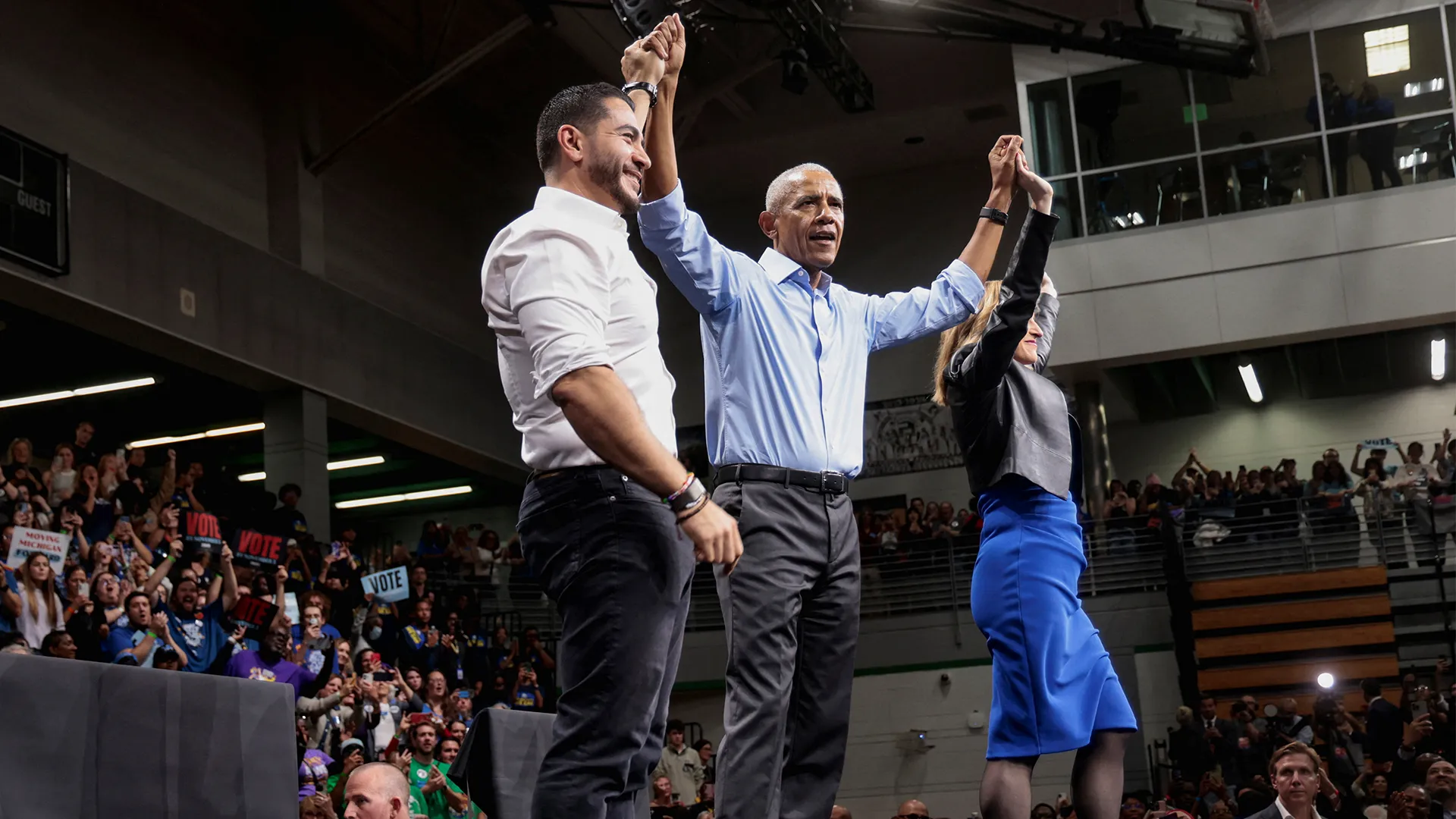
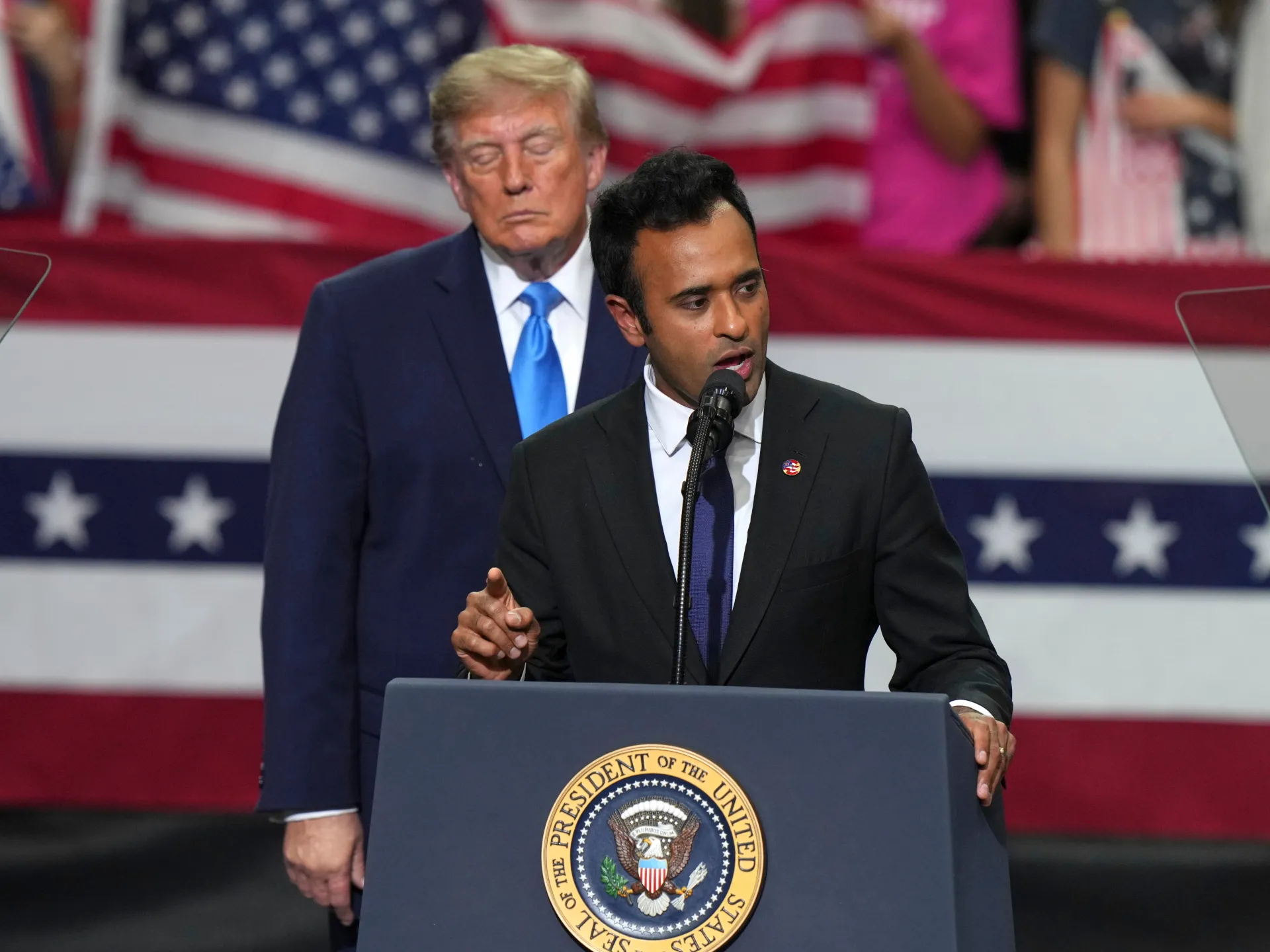
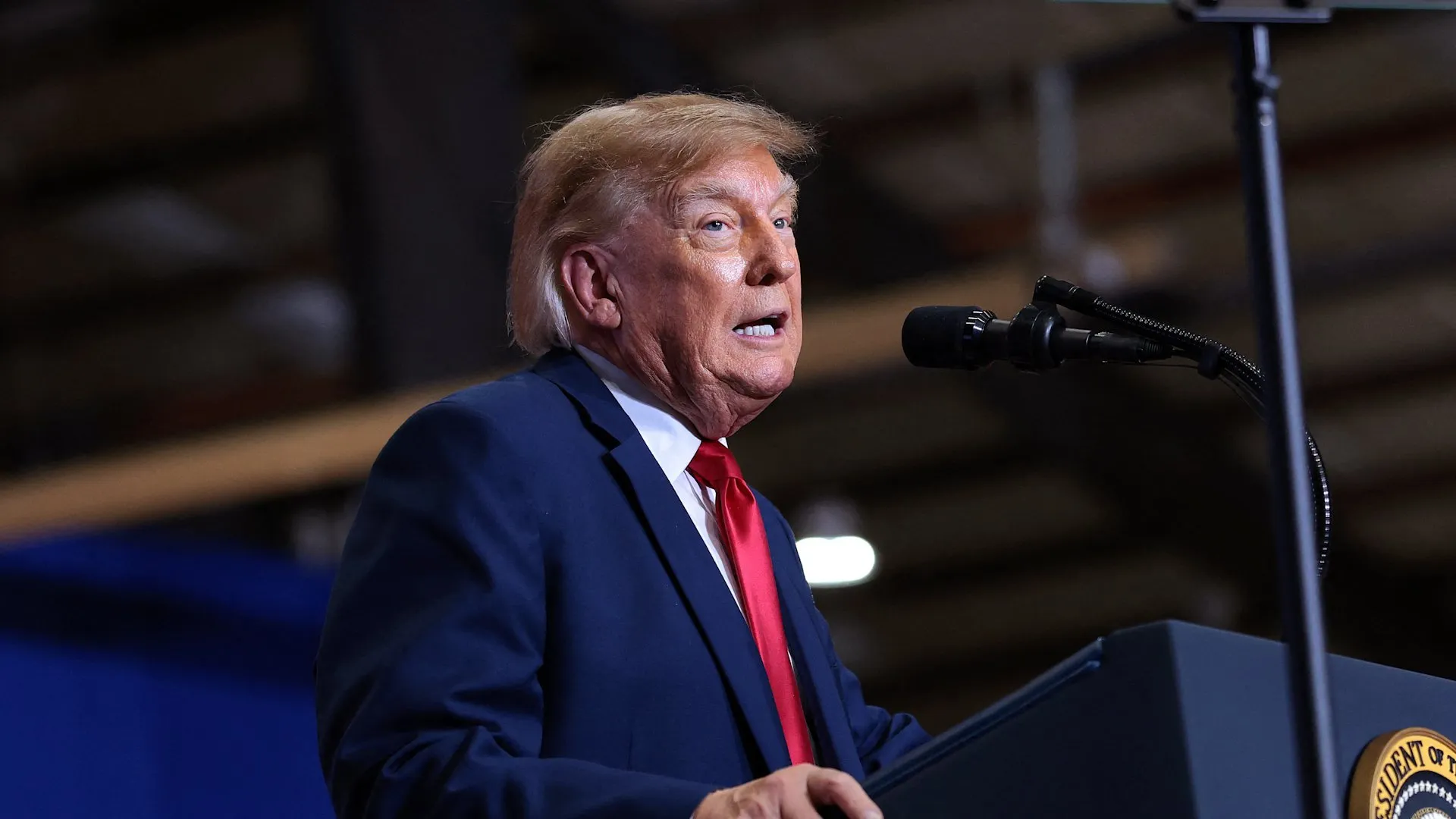
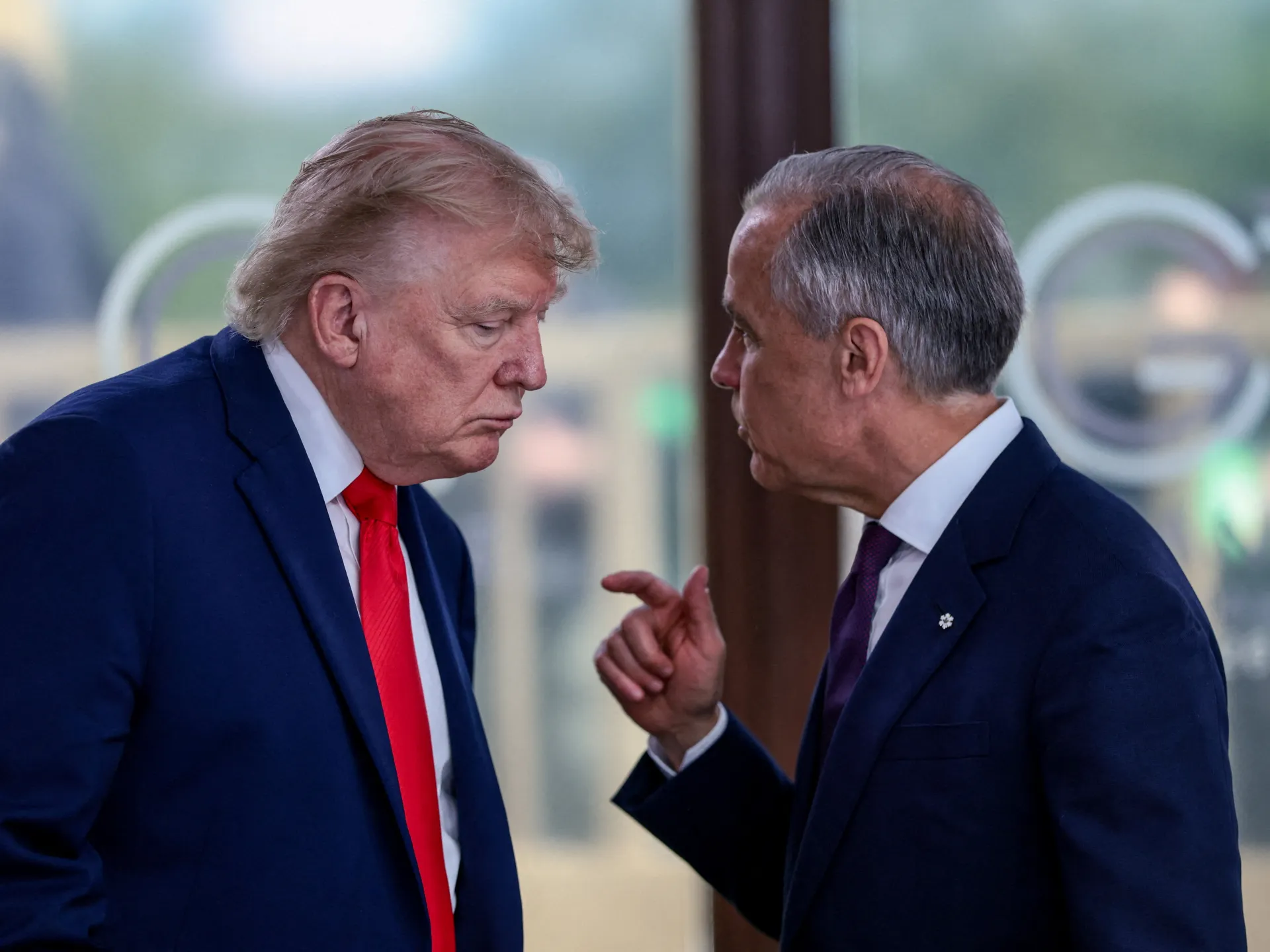
Former US President Barack Obama joined Michigan Senate candidate Abdul El-Sayed at a Detroit rally ahead of key midterms. With Black residents making up about 75% of Detroit’s population, Obama denounced attempts to portray candidates as un-American over their faith or background.
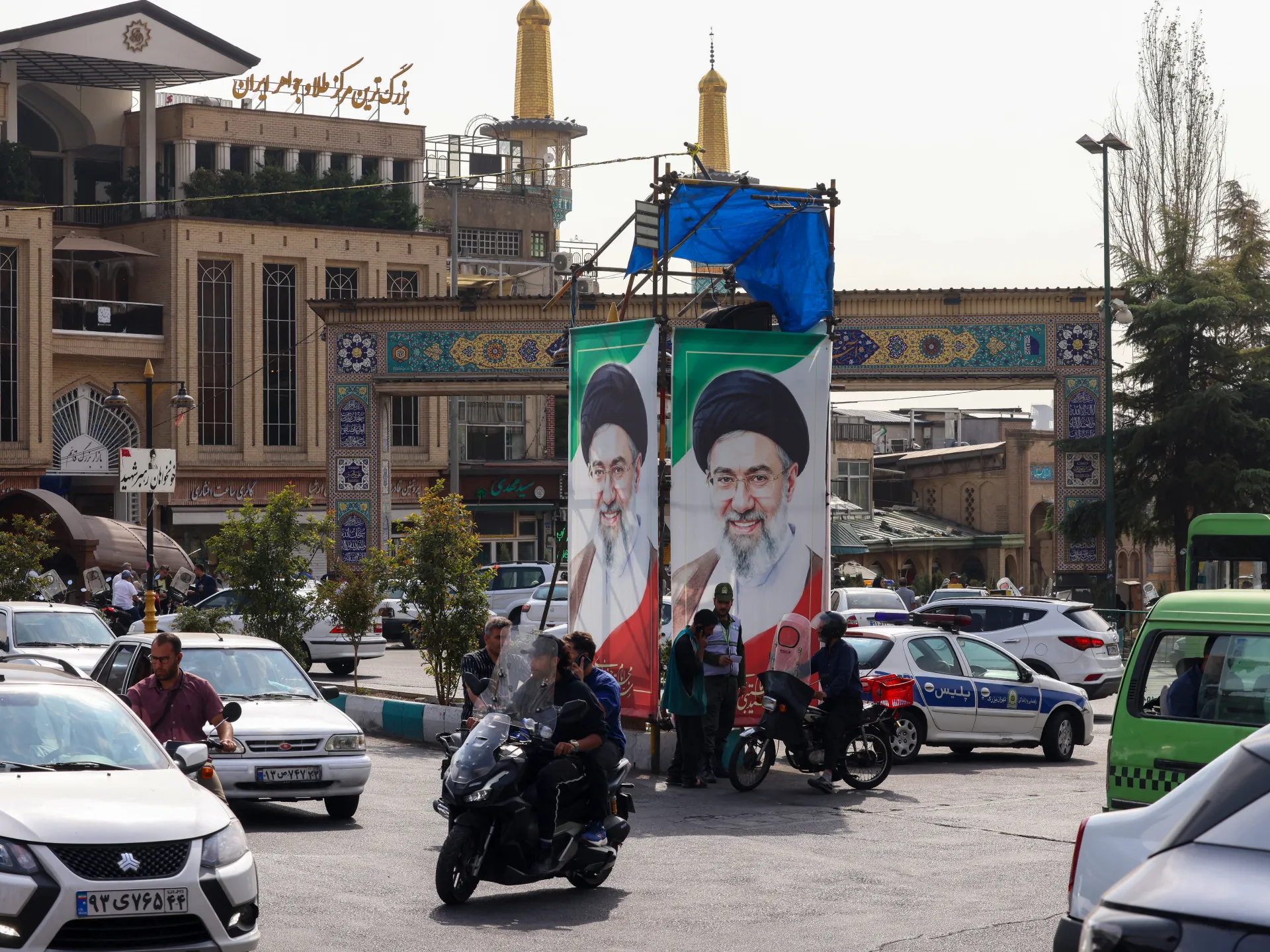
Tehran warns that even limited strikes would trigger a response ‘several times greater’.
Published On 24 Oct 202624 Oct 2026
Iranian President Masoud Pezeshkian has blamed Washington for the unravelling of an interim deal aimed at ending the war with the United States and Israel, amid growing fears that the fighting could resume imminently.
In comments broadcast by Iranian Press TV on Saturday, But Pezeshkian also said that both sides should return to the deal and “conclude it”.
Recommended Stories
list of 3 itemsend of list
His remarks come amid growing fears that military action could resume as soon as this weekend, after US President Donald Trump said on Friday that he “may do another little Epic Fury”, using the codename of the US-Israeli war against Iran that started on February 28.
Iran’s Islamic Revolutionary Guard Corps (IRGC) has warned that even limited strikes would trigger a response “several times greater”, according to comments reported by the semi-official Fars News Agency.
Iranian Armed Forces Chief of Staff Ali Abdollahi said on Saturday that the US military would not be allowed in the Gulf “under any circumstances and at any time”. Abdollahi said Trump could only “dream” of seeing US forces enter the Gulf, adding that he would take his dream to the grave.
Trump has suggested he could take further military action against Iran, while Israeli Prime Minister Benjamin Netanyahu has said he remains committed to overthrowing the country’s government.
Both leaders face elections, with Israelis set to choose their next government on Tuesday. Meanwhile, Trump’s Republican Party faces crucial midterm elections on November 3, with Democrats potentially winning control of both the House of Representatives and the Senate. Such an outcome would be a major blow to Trump, who still has more than two years left in his final term in the White House.
Iranian government spokesperson Fatemeh Mohajerani said on Saturday that Tehran would not “wait for permission to defend itself”, adding that the country “seeks peace but will respond to any aggression with severe consequences”.
“Our position is clear: we do not flee from dialogue for peace, and we do not hesitate in defending the country. Those who harbour the illusion of destroying Iran must correct their calculations,” Mohajerani wrote in a memo.
Her comments came as Iranian judiciary chief Gholamhossein Mohseni Ejei met Supreme Leader Mojtaba Khamenei. The pair discussed how to tackle corruption and pursue compensation for Iranians affected by the US-Israeli war, among other issues.
Khamenei replaced his father as supreme leader after the latter was assassinated during the opening strikes of the war on February 28. He has not been seen in public since assuming the position in early March.
Parliament Speaker and chief negotiator Mohammad Bagher Ghalibaf was reported to have met Khamenei earlier this week.
Former US president says Trump ‘chose to make a series of bad decisions’, highlighting the US-Israel war on Iran.
Published On 25 Oct 202625 Oct 2026
Former United States President Barack Obama has criticised the “cruelty and corruption” during President Donald Trump’s second term.
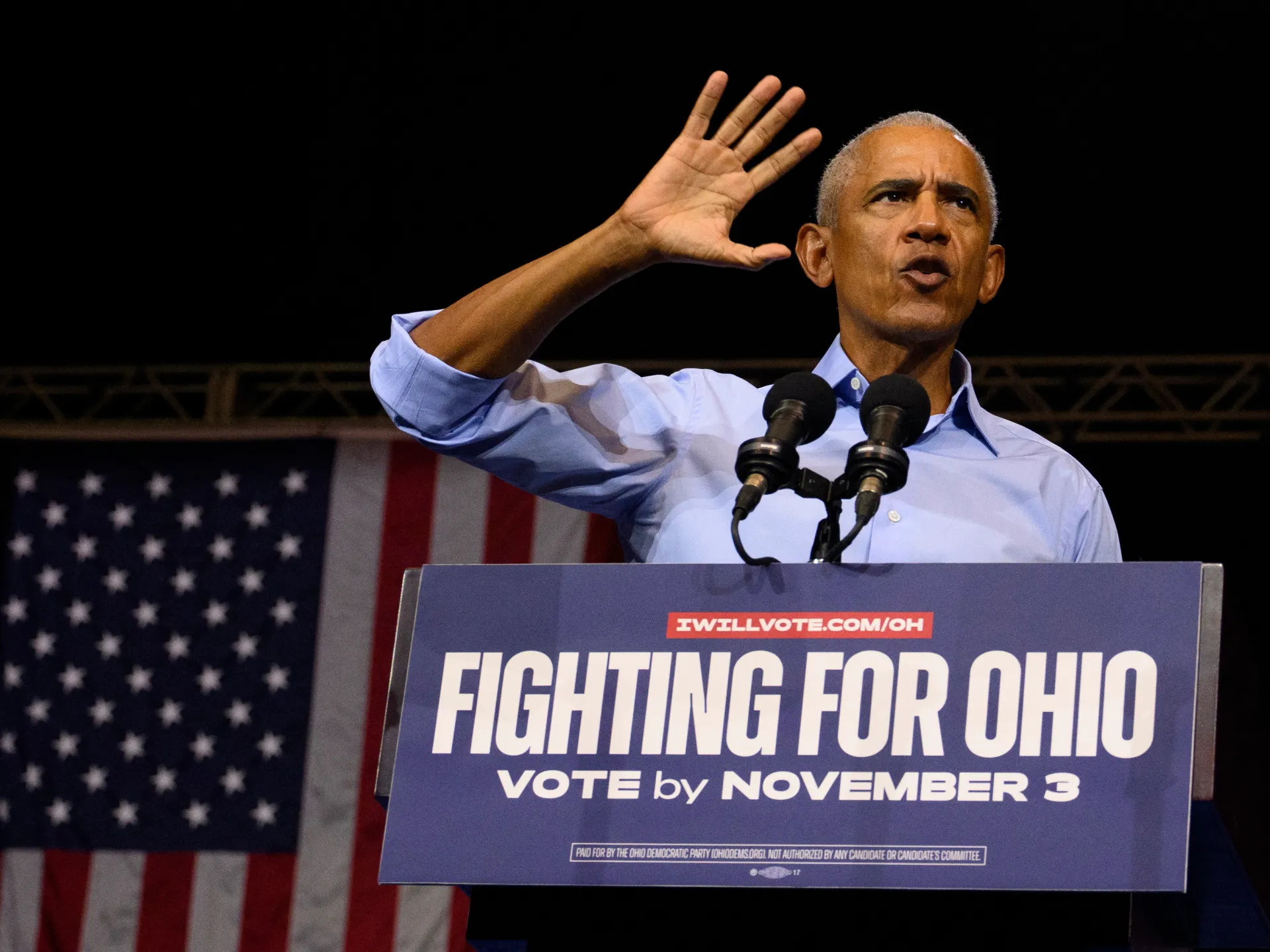
Obama slammed Trump’s foreign policies on Saturday during a midterm election campaign rally in Ohio to support the state’s Democratic candidates.
Recommended Stories
list of 3 itemsend of list
“The current president chose to make a series of bad decisions,” the 65-year-old Democrat said. “Most importantly, he decided to start an unnecessary war that nobody asked for,” he added, referring to the US-Israel war on Iran.
Obama urged Ohioans to vote against the Republican administration, saying: “After two years of chaos and cruelty and corruption and incompetence, the likes of which we have not seen in the modern era, you get a chance to say, ‘Enough is enough’.”
Heated Ohio races
The former president also addressed the recent controversy in Ohio’s gubernatorial race surrounding an attack advertisement by Republican candidate Vivek Ramaswamy against Democrat Amy Acton.
“In recent days, we’ve seen there is no line he will not cross, no low he will not sink to,” Obama said of Ramaswamy. “I don’t know what’s happened where the standards of behaviour are so low that somebody could run an ad like that.”
In the advertisement, Donna Arthur, Acton’s mother, disputes her daughter’s account of a childhood involving homelessness and sexual abuse by her stepfather, urging Ohioans not to vote for her.
Acton says she has not seen her mother since 1978. Acton’s brother has supported her account of being sexually abused by her stepfather when she was a child. The stepfather, who died in 2004, was charged with rape.
Obama backed Acton, saying that she has “spoken movingly about her painful childhood and all she’s experienced: abuse, neglect and homelessness.”
The former president shared the rally stage with Acton and Ohio’s former Democratic senator, Sherrod Brown, who will attempt a comeback against incumbent Republican Senator Jon Husted.
Polls give Democrats a slight lead in both Ohio races, but results are expected to be close.
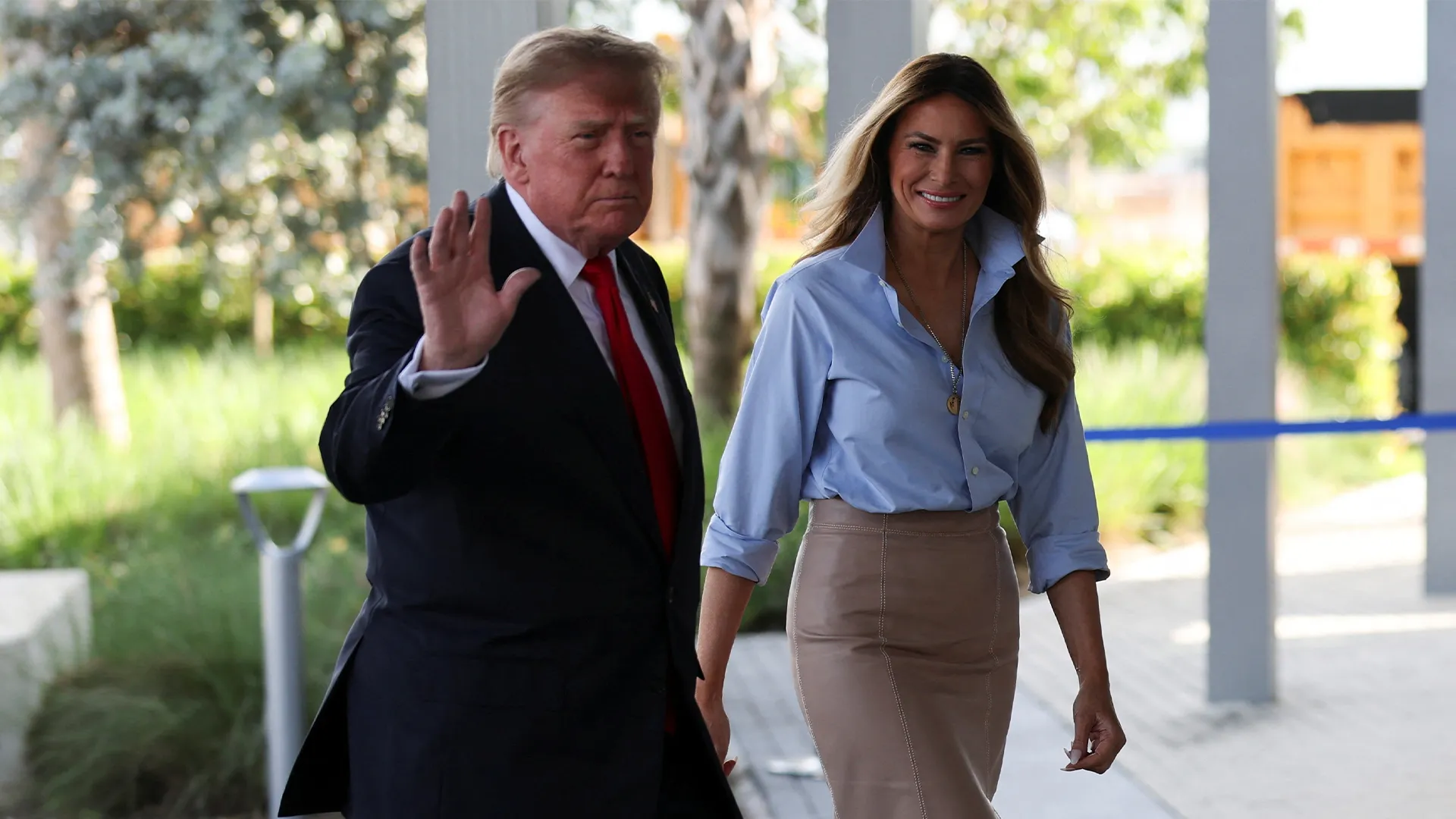
US President Donald Trump praised First Lady Melania Trump, saying she was ‘better than our professionals’ following her diplomatic efforts towards a localised ceasefire between Russia and Ukraine in Oleshky. Trump was casting his vote in the midterm elections.
More than 300 protesters and police were injured in the Albanian capital Tirana’s fiercest clashes in days.
Published On 24 Oct 202624 Oct 2026
Protesters have clashed with police in rallies in the Albanian capital of Tirana, with police firing tear gas and water cannon to disperse crowds.
Several government buildings were attacked, dozens of demonstrators arrested, and more than 300 protesters and police injured, authorities said Saturday.
Recommended Stories
list of 3 itemsend of list
Protesters and police have routinely clashed since a significant wave of protests started in mid-October over poor conditions in schools and the cost of living in the small Balkan country.
While the protests in Tirana had calmed in recent days, Saturday’s demonstration escalated the situation again, with police deploying water cannon, tear gas and rubber bullets against crowds.
Thousands of people had heeded calls from organisers for students and others around Albania to attend the rally. Various groups, including university professors, artists and opposition parties, announced their support or attendance.
The country’s Ministry of Education has become a focal point of rallies, and Saturday’s gathering saw some in the crowd throwing stones and rolling burning bins at the building.
Police had introduced heightened security around the capital on Saturday, with checks being carried out on cars heading to the city, local media reported.
Since then, public anger has turned into a broader push against corruption and the high cost of living, with protesters calling for the resignation of Socialist Prime Minister Edi Rama.
Rama has blamed “foreign actors” for the violence and accused both Russia and Iran of driving online misinformation.
The prime minister has called for dialogue, and on Saturday red cushions were laid outside the government headquarters in a symbolic gesture for talk and dialogue. Protesters later set the cushions on fire.
Protesters have blamed the entire political class for the crisis, with some also seen holding signs decrying Rama’s opposition, centre-right leader Sali Berisha.
Thousands of people attended Saturday’s antigovernment rally in Tirana [Hameraldi Agolli/AP]
Trump’s remarks come amid a fractious moment between the US president and the journalists who cover him.
Published On 24 Oct 202624 Oct 2026
United States President Donald Trump has confirmed he could move the White House press corps to a different location, possibly away from the executive residence.
In a social media post on Friday, Trump described reports that he planned to remove the White House press briefing room in favour of restoring a historic swimming pool located underneath as “Fake News”.
Recommended Stories
list of 3 itemsend of list
“I NEVER even thought to do such a stupid thing!” he wrote in a Truth Social post.
Trump, however, indicated he may relocate dozens of reporters who cover the White House “to a less obnoxious location”.
The New York Times on Tuesday reported that Trump had pitched his former press secretary, Karoline Leavitt, on an idea to move journalists out of the White House’s storied James S. Brady Press Briefing Room. That proposal did not move forward during Leavitt’s tenure, which ended on August 27.
Trump’s remarks come amid a fractious moment between him and the journalists who cover him.
Last month, Trump banned journalists from three US-based media outlets – CNN, MS NOW and POLITICO – from the White House, a move that proponents of free speech said violated First Amendment protections.
A US federal judge ruled that the order was likely unconstitutional, forcing the White House to restore the journalists’ access. The Trump administration continues to fight the ruling.
Trump has also regularly chided and denigrated members of the media he claims cover him unfairly.
The latest incident was during an Oval Office event on Tuesday when Trump attacked The Independent’s White House Correspondent Andrew Feinberg.
“What’s wrong with you? Are you a sick person? I actually think there’s something wrong with you”, Trump said as Feinberg tried to ask a question. The moment was amplified by the White House on social media.
If Trump opts to proceed with changes to the White House press briefing room, it would be the latest in a long list of controversial projects he has ordered that would transform the property.
Since returning to power last year, the US president has demolished the White House East Wing to construct a new ballroom, installed concrete pavers over the lawn centred in the White House Rose Garden and built a helipad on the South Lawn.
The Times reported Trump told aides he wanted to bring back a West Wing indoor pool constructed in 1933 for use by President Franklin D Roosevelt, who suffered from polio and often swam, according to his presidential library, to ease soreness.
In the 1970s, former President Richard Nixon had a floor constructed above the pool to accommodate a briefing room for the growing White House press corps. The pool remains beneath the floor of the briefing room.
Leavitt confirmed during a Friday interview that Trump was “flirting” with the idea of restoring the pool.
“He just, maybe, wants to restore it to all of its glory”, Leavitt said during an appearance on HBO’s “Real Time with Bill Maher”. “I don’t know if he’ll do it.”
The White House did not immediately return Al Jazeera’s request for comment.
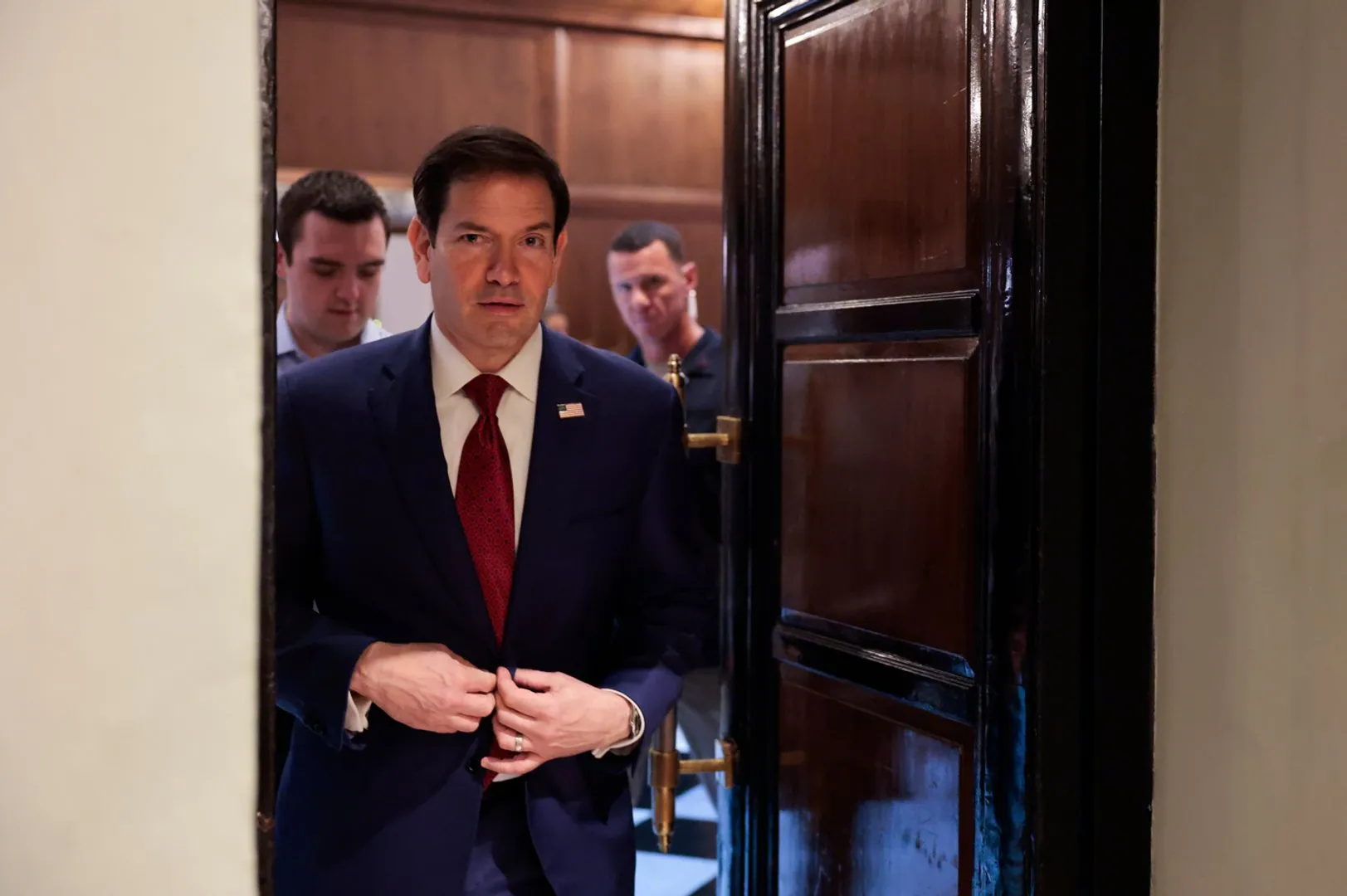
Secretary of State Marco Rubio has urged Cubans to secretly work with the CIA to topple their government. His appeal followed President Trump’s threat to send warships to Cuba after the Iran war. A 10-month US blockade has led to power outages and water shortages.
President Javier Milei’s role in cryptocurrency launch does not translate into a fraudulent scheme, judge says.
Published On 24 Oct 202624 Oct 2026
An Argentinian federal judge has dropped a criminal investigation into President Javier Milei and his sister Karina Milei over the collapse of a cryptocurrency he promoted online.
Judge Marcelo Martinez de Giorgi issued the decision on Friday, according to court records, ending an inquiry into Milei’s role in the launch of the $Libra token, which crashed after a brief rally.
Recommended Stories
list of 3 itemsend of list
“The reported events do not constitute a criminal offence,” the judge said in a ruling. He also wrote that investor losses and the rise and fall in the currency’s price were insufficient to establish fraud.
In his ruling, Martinez de Giorgi said that Milei’s institutional standing could have given the launch “greater impact” when he posted about it, but that does not translate into a fraudulent scheme.
Javier Milei recommended the little-known meme coin in a post on X in February 2025. He later deleted the post and denied any link to the cryptocurrency, whose value soon plunged.
The judge also dismissed an investigation into US businessman Hayden Davis, who described himself as a “launch adviser” for the token. Davis has acknowledged that he held close to $100m after the crash and denies any wrongdoing.
“For the first time in history, a President of the Nation was investigated with complete freedom, resulting in absolute proof of his innocence,” read a post shared on X by the official presidential office.
“The question that remains is this: Who will take responsibility for having wasted Argentine taxpayers’ money and the President of the Nation’s time in a failed attempt at an institutional coup?”
Milei’s friendship with Trump
Milei is one of US President Donald Trump’s closest allies. Trump firmly backed him a year ago and has called him his “favourite president”.
Trump made clear the support hinged on a victory for Milei’s party.
“I’m with this man because his philosophy is correct,” he said ahead of a White House lunch with the Argentinian leader last year. “If he wins, we’re staying with him. And if he doesn’t win, we’re gone.”
Earlier this month, Milei urged Trump to emerge stronger from the US midterm elections, saying the vote mattered for the West as a whole.
Austerity at home
Since taking office in 2023, Milei has laid off thousands of state employees, shut ministries, cut subsidies and reduced government-funded programmes. The measures were meant to fight high inflation, which has fallen to about 2 percent a month.
Milei says his plan is working, claiming that Argentina has grown for 27 consecutive months and is expanding at four times its historical rate.
When the coin crashed, Milei said he had acted “in good faith” and accused his political rivals of trying to exploit the situation.
Global crude prices continue to climb, with Brent benchmark hitting $117.30 a barrel to build on four-year highs as market fears grow over a potential resumption of the US-Israeli war on Iran.
It didn’t take long for that narrative to start crumbling. A year after Trump’s reelection, Latinos in California helped pass Proposition 50, which allowed Democrats to redraw the state’s congressional map in their favor to counter a successful effort by Texas Republicans to do the same — coincidentally, the Texas gerrymander was at least partially motivated by said gains with Latino voters.
Latinos also helped Democrats pick up governorships in Virginia and New Jersey in 2025 — with two-thirds of their votes going for Abigail Spanberger and Mikie Sherrill, respectively.
Whatever gains Republicans made with Latino voters appear to have vanished. Recent polls show the demographic to be experiencing buyers’ remorse, citing the increased cost of living, the Trump administration’s heavy-handed immigration enforcement tactics, involvement in wars abroad and a stagnating economy as reasons for the disillusionment.
President Trump’s approval rating among Latinos dipped to 27% in an early October NBC News survey. That same poll found that Democrats have a 24-point lead on whom Latino voters want to see in control of Congress.
But don’t expect this whiplash back to the left to be permanent.
“Latinos are completely moving away from both parties and that’s what’s created this dramatic swing of 25 points towards Trump in four years and then massive swings back.”
So how will the Latino vote shake out in two weeks? Below are five races we are keeping tabs on.
L.A. mayoral race
You don’t need to go outside the city limits to find proof that Latino voters aren’t political ideologues.
Bass once again won the Latino vote during the 2026 primaries, carrying 35 Latino-majority neighborhoods in the June 2 election — compared with seven for her current challenger, Councilmember Nithya Raman.
Notably, 34% of Latinos remain undecided heading into the Nov. 3 election.
“Latinos are about a third of the voters in L.A.,” Fernando Guerra, a professor of political science and Chicana/o studies at Loyola Marymount University, told The Times this month. “While they show preferences, they are not deeply committed to either candidate, so they are the quintessential swing voters who decide late.”
Will the embattled incumbent keep her job, or will Los Angeles become the next big city to elect a mayor backed by the Democratic Socialists of America? Latino Angelenos will decide.
California 22nd district
Will Democrats’ Proposition 50 redistricting gambit pay off? Voters of this newly reconfigured Central Valley district populated by blue-collar and agrarian Latinos will decide.
Republican David Valadao is the incumbent and is being challenged by activist and educator Randy Villegas. In 2024, voters in the district backed failed Republican Senate candidate Steve Garvey.
Political forecasts have Villegas — a progressive populist — with a narrow lead over the incumbent.
Part of his appeal, Madrid said, was his messaging.
“[His message is] the establishment’s not working and that institutions aren’t working,” Madrid said. “It’s a much more populist message. I don’t believe this is ideological one bit.”
Colorado 8th district
It doesn’t get more battleground than this congressional district located in the Denver suburbs. It is the center of Latino voting power in Colorado — Latinos account for 40% of the total electorate. .
The incumbent is Republican Gabe Evans and Trump carried the purple district by less than two percentage points.
Evans currently has a slight lead over Democratic candidate Manny Rutinel, an attorney and economist. Rutinel’s messaging has focused on the rising cost of living and the Republicans’ immigration policies.
It could get him elected. A local survey found that 56% of Latino voters in Colorado approve of Democrats in Congress, while 39% said they do not approve.
Florida 27th district
Will disassociating from Trump help this Republican incumbent keep her job?
Journalist-turned-Congress member María Elvira Salazar, a Cuban American, made headlines in September after releasing a political ad calling out the president’s immigration enforcement, alleging that Trump, who carried the majority Latino district by 15 points in 2024, had betrayed her constituents.
Elvira Salazar currently holds a narrow lead over her Democratic rival Elliott Rodriguez, who is also Cuban American.
“She’s trying to show distance and trying to show an independent streak,” Madrid said of the three-term incumbent. “She’s trying to say, ‘I’m not that.’ And you can’t do that on the economy as a Republican, because that changes all the time. What you can do as a Latino in a Latino district … is say your policies have gone too far.”
Texas
Okay, I’ll admit that I’m cheating with this one. But there’s just so much going on in Texas that it deserves its own section. The Lone Star State is ground zero for this supposed great political de-alignment.
In 2025, at the behest of Trump, Texas Republicans undertook an unprecedented mid-decade congressional redistricting in hopes of gerrymandering a map that would give the party an advantage in the 2026 midterm elections. They factored in the historic gains with Latino voters.
“They drew those districts based on what they thought were the 2024 numbers,” said Matt Barreto, a professor of political science and Chicana/o & Central American studies at UCLA. “And now those 2024 numbers are evaporating.”
The plan appears to be backfiring spectacularly, at least in south Texas.
Trump won Texas’ 15th congressional district in 2020 and 2024, and in 2022 the majority Latino electorate voted for Republican Monica De La Cruz. But polls now show that Democratic candidate and singer-turned-politician Bobby Pulido has a seven-point lead. Pulido, who bills himself as a moderate, has focused his messaging on affordability and the rising cost of living.
A similar situation is taking place in the Latino-dense 34th and 35th districts, where Republicans Eric Flores and Carlos De La Cruz, respectively, are hoping to take advantage of the redrawn Republican-friendly boundaries to flip those seats red. Both face uphill battles as polls show them neck-and-neck with their Democratic opponents.
“You now have these two districts, Texas 9th and 35th, that are 51% Latino, but now Latinos are telling us they have lost confidence in the Republican Party,” Barreto said. “What we’re seeing is very strong evidence that Latinos are shifting back even more so against Trump and Republicans because they did not deliver on any of their promises from 2024.”
In the statewide Senate and gubernatorial races, Democrats are feeling hopeful. Democratic challenger James Talarico currently has a slight lead on his Republican opponent Ken Paxton. Among Latinos, that lead was clocked at a whopping 30 points in an October Fox News survey.
But what has been Talarico’s key to connecting with Latino voters?
“He’s turning away from race and ethnic-based politics to class consciousness,” Madrid said. “[He’s acknowledged] that Latinos have had their futures taken away from them.”
The seminary student and educator has also been critical of his own party — calling it out for ineptitude, leaving voters behind — and arguing that anti-establishment messaging is enticing to Latinos who have been spurned by both major parties.
If Texas gets its first Democratic senator since 1993, it’ll be thanks to the Latino vote.
Texas Latinos’ faith in the ruling party is so low that even the state’s governor, Republican powerhouse Greg Abbott, finds himself in a tight race with Democratic challenger Gina Hinojosa. Roughly 56% of Latinos were in favor of Hinojosa over the incumbent, an October poll found.
“Latinos are the only voters voting rationally in a broken system,” Madrid said. “We’re shifting by 25 points. If you don’t pay attention to our priority issues, we’ll vote you out, that’s how the system was designed.”
Latinos appear to be swinging back to the left, but Democrats shouldn’t take those gains for granted, Madrid said.
“The Democratic Party has done nothing to win these voters back. They’re just not Republicans,” Madrid said. “And for the moment, that’s good enough.”
(Jackie Rivera / For The Times; Martina Ibáñez-Baldor / Los Angeles Times)
Join De Los for a Día de Muertos event at Hollywood Forever
Dia de los Muertos at Hollywood Forever
(Diana Ramirez / De Los)
This Saturday, join De Los at Hollywood Forever Cemetery to celebrate Día de Muertos. We’ll have an altar set up from noon to 8 p.m. where visitors can write ofrendas that will be displayed throughout the event.
There will also be a photo booth run by Las Fotos Project on site from 2 to 6 p.m.
This is an all-ages event and will feature performances by música Mexicana act DannyLux, soul singer Trish Toledo, psychedelic cumbia group Tropa Magica and indie rock band Los Shadows.
Registration and event information can be found here.
Lawyers for two accused officials say Department of Justice seeking to revive scandal before midterm vote.
Published On 23 Oct 202623 Oct 2026
Two former Federal Bureau of Investigation (FBI) agents have been charged in connection with a 2020 probe into a laptop belonging to former President Joe Biden’s son, Hunter Biden.
The former officials, Nikki Floris and Bradley Benavides, were charged with lying to Congress. They made their first court appearance in Washington, DC, on Friday.
Recommended Stories
list of 3 itemsend of list
Lawyers for the officials accused the Department of Justice of filing the charges to revive the salacious saga just days before the November 3 midterm vote, in which Republicans face an uphill battle against Democrats to maintain control of Congress.
A lawyer for Floris said she “served our nation as a dedicated FBI intelligence officer for nearly 20 years”, while accusing the Justice Department of building its case on hearsay.
“Yet today, the DOJ [Justice Department] has accused her falsely of a crime on the say-so of politicians, not on the facts,” the statement said.
“It’s no coincidence the government is filing these nonsense charges now, years later, on the eve of an election.”
Floris and Benavides had overseen the Foreign Intelligence Task Force (FITF) at the FBI when Hunter Biden’s laptop was found. The pair testified to Congress that the unit, which focuses on foreign interference in US elections, was not involved in the laptop investigation.
In a criminal complaint, federal prosecutors alleged the statements contradicted messages sent during the same period.
While launched by Trump during his first term, the FITF was heavily targeted by Republicans under former US President Joe Biden. They charged the unit was politically biased and used to cover up information about Biden’s laptop.
The unit was disbanded when Trump took office for the second time in January 2025.
Scandalous saga
The existence of the laptop became known in October of 2020, just weeks before Biden and Trump faced off in a presidential election.
Its strange origins, having been dropped off at a Delaware computer repair shop and apparently abandoned by Hunter Biden, prompted suspicion. Its contents were first reported on by the New York Post, based on information provided to Trump lawyer Rudy Giuliani.
Several former intelligence officials warned that the laptop had the hallmarks of a Russian disinformation campaign. However, the FBI later seized and verified that the laptop and its contents, including messages related to the younger Biden’s foreign business ties and explicit photos of his drug use, were authentic.
The laptop was later used to back federal gun and tax evasion charges against Hunter Biden, although no wrongdoing related to his business ties or connection with his father was found.
Trump FBI Director Kash Patel has pledged to investigate the agency’s conduct throughout Biden’s presidency. Critics have accused him of flagrant politicalisation.
“Lying to Congress by senior FBI officials strikes at the heart of our system. No one is above the law,” Patel said in a statement posted on X.
The Justice Department has historically sought to avoid public and overt investigative acts in the direct lead-up to an election that involve candidates or that risk influencing an outcome.
But officials in the last two weeks have made a series of bold moves in cases with political undertones, including a search of Democratic Representative Ilhan Omar’s house in an immigration fraud investigation.
The department also unsealed a corruption indictment on Thursday against powerful Democratic Virginia state Senator L Louise Lucas.
Trump advises the Republican gubernatorial candidate to keep running the controversial advertisement.
Published On 23 Oct 202623 Oct 2026
US President Donald Trump has backed Republican Vivek Ramaswamy amid controversy over an attack advertisement by the Ohio gubernatorial candidate against his Democratic rival.
Trump said in a social media post on Thursday that Ramaswamy should keep running the advertisement that features Democratic candidate Amy Acton’s estranged mother.
Recommended Stories
list of 3 itemsend of list
In the advertisement, Donna Arthur, Acton’s mother, disputes her daughter’s account of a childhood involving homelessness and sexual abuse by her stepfather, urging Ohioans not to vote for her.
Acton says she has not seen her mother since 1978. Acton’s brother has supported her account of being sexually abused by her stepfather when she was a child. The stepfather, who died in 2004, was charged with rape.
“Anybody whose mother spoke about a daughter in that way would normally lead to the daughter being precluded from serving in office,” Trump said.
The US president also attacked Republican Ohio Governor Mike DeWine, who advised Ramaswamy to take down the advertisement, labelling him “disloyal” to the Republican party.
‘It’s wrong’
At a gathering with reporters at the Ohio Statehouse, DeWine recalled the painful experiences of rape victims he dealt with as a county prosecutor and state attorney general.
“It’s wrong to run this ad,” he said. “And, even at this late time – my wife, Fran, saw the advertisement just run this morning on TV – I would just urge the Ramaswamy campaign to take this down.”
Acton’s brother, Philip Stearns, called the advertisement a “desperate, disgusting attack”, while Acton campaign spokesperson Addie Bullock called Ramaswamy’s decision to promote it “both despicable and entirely predictable”.
Vice President JD Vance, campaigning on Wednesday with Ramaswamy and US Senator Jon Husted, an Ohio Republican, had brushed aside the blowback.
Vance, a former senator from Ohio, expressed disgust with Republicans “whining” about the advertisement as low and in poor taste.
Ramaswamy’s campaign said it was spending $4m to promote the advertisement.
Opinion polls suggest Acton is narrowly leading Ramaswamy in a tight race to replace the term-limited DeWine.
Homeland Security targets nine states in a push to identify voting fraud, a move critics denounce as tantamount to voter intimidation.
Published On 22 Oct 202622 Oct 2026
A United States federal judge has ordered the Department of Homeland Security (DHS) to halt operations aimed at finding non-citizen voters in nine states ahead of the midterm elections.
The ruling by US District Court Judge Araceli Martinez-Olguin said the investigations likely violate a provision of the Voting Rights Act that prohibits voter intimidation. She further said the DHS may have relied on flawed data in its investigations.
Recommended Stories
list of 3 itemsend of list
That leads to “an objectively reasonable fear of law enforcement entanglements that intimidates citizens from urging or aiding others in exercising their right to vote”, she wrote.
The order applies to federal efforts targeting California, Connecticut, Georgia, Missouri, Nevada, New York, Pennsylvania, Washington and Wisconsin.
The DHS has publicised what it has described as a push to identify individuals who have committed voter fraud, with some local offices posting photos of agents knocking on the doors of suspects.
The operations come as the administration of US President Donald Trump has sought to highlight instances of voter fraud ahead of the November 3 midterm vote.
While there are recorded instances of fraud in every election cycle, such isolated cases remain exceedingly rare.
There has been no evidence to indicate that non-citizen voters have influenced the outcome of any election at any level in the country.
In a statement following Thursday’s ruling, the DHS maintained that its investigations were aimed at “removing aliens who vote and dilute the votes of US citizens”.
“We have no plans to question or investigate people we believe to be US citizens,” it said.
In their lawsuit challenging the DHS’s efforts, the California Nurses Association and National Nurses United, along with the Voto Latino Foundation, San Francisco and Santa Clara County, said that some US citizens felt they were wrongly identified and questioned as part of the investigations.
A lawyer representing the groups said it was “clear from the start that DHS built its lists on bad data, never checked how often it was wrong, and recklessly sent agents to people’s homes weeks before an election”.
Benjamin Farley, the supervisory counsel for democracy defense at the National Immigration Law Center, said the ruling sent a strong message about voter intimidation ahead of the midterm vote.
“Yesterday’s decision is a clear rebuke of the government’s efforts to scare voters away from the polls this November and a reminder that all US citizens – regardless of color, place of birth, or the nationality of their family members – have the right to participate in American elections free of intimidation,” he said.
“No armed federal agent is going to stop us from casting our vote.”
United States President Donald Trump has long touted himself as a political outsider, someone who would expose the elites’ abuse of power and shift government focus from far-off conflicts to problems at home. Phrases like “drain the swamp” and “America first” have proved to be powerful rallying cries, sparking a whole cadre of “Make America Great Again” (MAGA) Republicans.
Halfway through his final term as president, though, Trump has backpedalled on many of those ideas, cosying up to the ultra-wealthy, sidelining investigations into convicted sex trafficker Jeffrey Epstein, and launching an ongoing war with Iran.
Recommended Stories
list of 3 itemsend of list
That about-face appears to be having a real impact on Republicans running in the US midterm elections in November, said Rina Shah, a geopolitical adviser and strategist and a former senior GOP congressional aide.
“In competitive races, some are quietly distancing,” Shah said, adding that they are “talking about gas prices, local issues, or [saying] ‘I’m focused on my district’ – because the Iran war and the Epstein drip are already showing up in attack ads and soft polling.”
Here’s what you need to know about whether the Republican Party has softened its stance on these issues.
Which Republicans have broken with Trump over the Epstein files?
During his 2024 presidential campaign, Trump said he would declassify troves of files kept by the Federal Bureau of Investigation (FBI) about Epstein and his global network of contacts. Trump’s future cabinet members, too, were enthusiastic about this, with Kash Patel, now head of the FBI, saying it was time to “put on your big boy pants and let us know who the pedophiles are”.
Yet a few months after taking office, Trump began dragging his feet, sparking a backlash from influential MAGA figures. Trump began calling the entire issue a “hoax” and saying Republicans were being duped by Democrats into calling for an investigation into Epstein’s network.
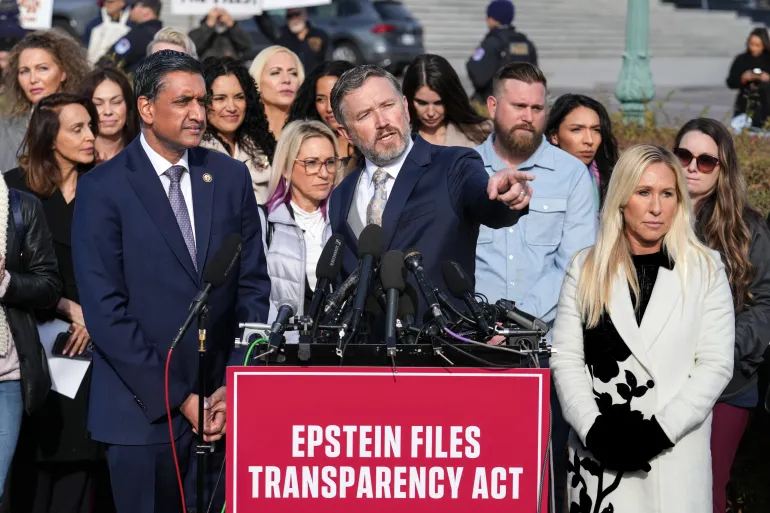
US Congressional Representatives Ro Khanna, Thomas Massie, and Marjorie Taylor Greene speak during a news conference as the US House of Representatives prepares to vote on the Epstein Files Transparency Act, at the US Capitol in Washington, DC, the United States on November 18, 2025 [File: J Scott Applewhite/AP]
Congress did eventually force the release of the files, with help from a handful of Republicans who broke with Trump. The Trump administration has released batches of the heavily redacted files, but has continued to withhold some. Meanwhile, all the Republican lawmakers who voted to mandate releases have paid a price for their insubordination, with three even losing their offices.
US Representative Marjorie Taylor Greene left her Georgia seat in January 2026, after publicly clashing with Trump over Epstein. Nancy Mace, a Republican from South Carolina, lost her bid to become the party’s candidate in her home state after Trump refused to endorse her. Colorado’s Lauren Boebert barely won the primary in her own contest after angering Trump by supporting calls for transparency from Thomas Massie, another Republican bent on exposing what the files held. Massie, of Kentucky, also drew Trump’s ire, which likely cost him the primary.
Republican presidential nominee Donald Trump participates in a fireside chat with media host Tucker Carlson at the Desert Diamond Arena, in Glendale, Arizona, the US, October 31, 2024 [File: Brendan McDermid/Reuters]
No more foreign wars?
Trump had long said he would be reducing foreign military involvement, breaking with the interventionist tendencies of other recent Republican presidents. Now he and his party face tough questions about the US-Israel war on Iran, which influential figures in the MAGA movement like political commentator Tucker Carlson have called a mistake, saying, “This is Israel’s war. This is not the United States’ war.”
Amongst disgruntled MAGA supporters, a narrative has emerged of Trump using the war to also distract from the Epstein issue. Massie, the former congressman, summed up the sentiment by saying, “Bombing a country on the other side of the globe won’t make the Epstein files go away.”
Trump has tried to downplay the war’s impact, but voters, even in the Republican Party, think he broke his own promise, driving the overall approval rating for the ratings-obsessed president down to record lows. “Seven months into an open-ended campaign with shifting goals,” said Shah, “that promise looks different to a lot of his voters.”
Few Republicans, however, have responded to that public sentiment with their votes in Congress, where Democrats have tried repeatedly to curtail Trump’s war on Iran by passing resolutions pointing out he failed to get the body’s approval.
In September, just seven Republican House members joined Democrats to pass an anti-war bill. In the Senate, similar efforts have been supported by just a handful of Republicans. Trump called the Republican lawmakers supporting the anti-war bills “unpatriotic,” and said, “They should be ashamed of themselves.”
As with the Epstein files, Trump took action against rebellious Republicans over the Iran war, for instance backing a rival of Senator Bill Cassidy, who voted in favour of the anti-war bill, in a primary in Louisiana that the Republican senator ended up losing.
What happened to Trump’s promise to “drain the swamp”?
One of Trump’s most appealing promises had been to purge the government of a “deep state” establishment he says is running the country without being accountable to the public on social issues, and fiscal and foreign policy.
Priscilla Chan, Meta founder Mark Zuckerberg, Lauren Sanchez, Amazon founder Jeff Bezos, Google CEO Sundar Pichai and Tesla CEO Elon Musk attend Donald Trump’s inauguration ceremony on January 20, 2025 [Chip Somodevilla/POOL/AFP]
In a way, Trump did keep that promise. An entire federal government division – the Department of Government Efficiency (DOGE) – forced tens of thousands of federal workers out of their jobs and dismantled institutions like the US Agency for International Development (USAID). The military threw out notions of racial, gender, and economic diversity. Everything from universities to the Smithsonian Institution was subjected to a campaign against an unqualified, diversity-obsessed elitist class.
But lobbying groups, including some supporting foreign governments, have been given a free hand, and ethics rules and watchdogs who would tackle political corruption have been weakened, said Shah, the Republican strategist.
At his presidential inauguration, Trump literally surrounded himself with the wealthiest people in the world, some of whom have gone on to play some part in his administration.
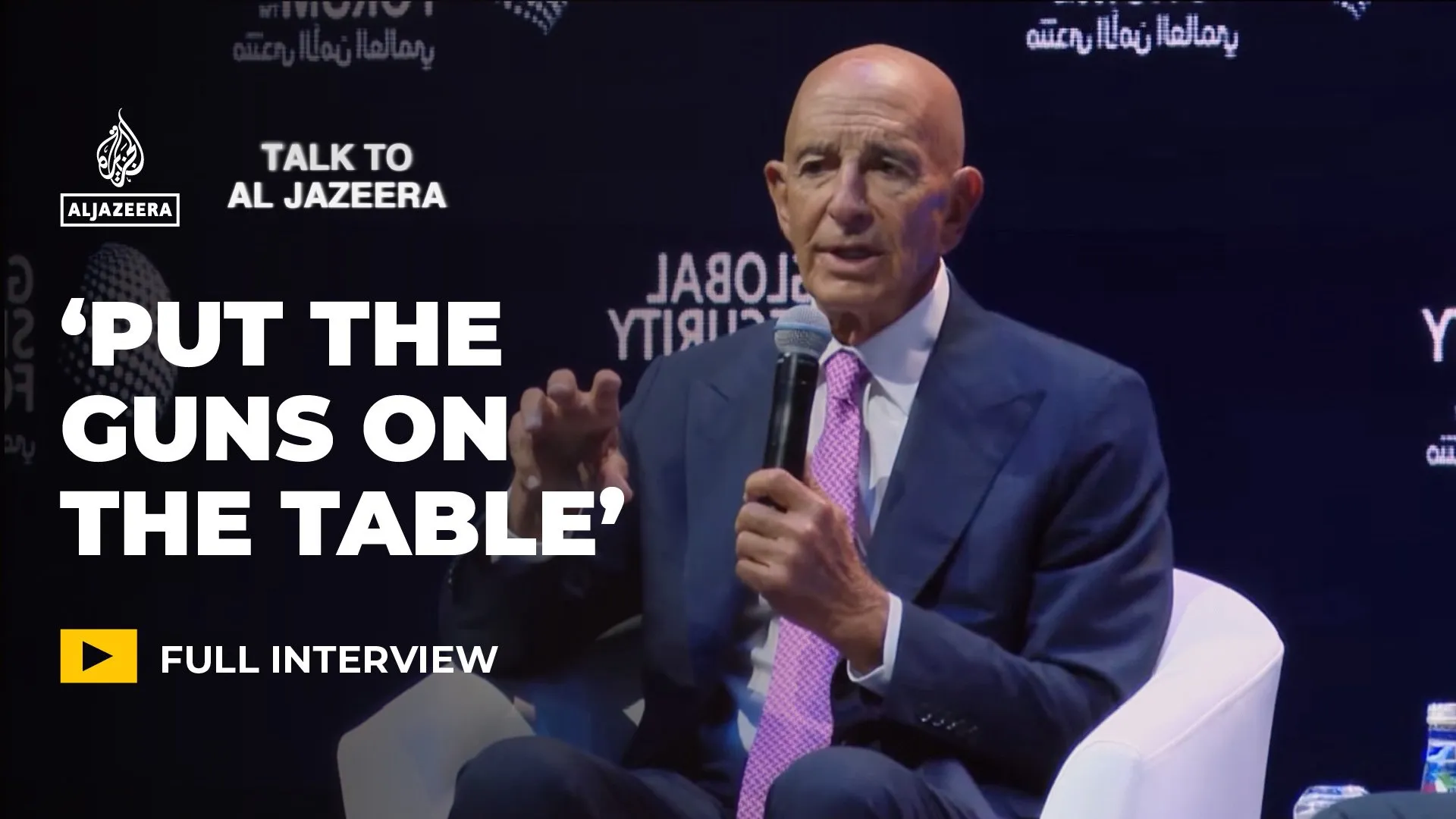
The US ambassador to Turkiye, Tom Barrack, says Washington’s relationship with the Middle East needs to change, from one of control to one of support.
The United States ambassador to Turkiye and special presidential envoy for Syria and Iraq says Washington’s relationship with the countries in the Middle East needs to change.
Tom Barrack says the US no longer seeks to dominate the region.
He won’t say whether the war in Iran was a mistake – but acknowledges the instability it caused has led to unintended consequences.
Barrack says President Donald Trump is against what he calls “forever wars”, and ending the US-Israel war on Iran will require a major compromise. According to him, each side will have to accept conditions it does not like.
However, he is worried that growing tensions could lead to miscalculation.
Barrack says trust is lacking between Washington and Tehran, and that is hampering talks to agree on a deal.
He tells Al Jazeera that countries in the region should not depend on the US to solve their problems and that they need to look out for themselves. He insists the Trump administration has not abandoned the region, but is rather re-examining its role.
Barrack admits that years of US involvement in the region demonstrate that intervention and regime change do not work. He says it is time to put down the guns and resolve disputes through negotiations and mutual respect.
US President Donald Trump praised a man who punched a protester at a midterm election rally held in Clemson, South Carolina. Trump thanked the assailant as the protester was being removed from the event.
US President Donald Trump says Congresswoman Ilhan Omar could face jail or deportation as federal authorities investigate allegations surrounding her US citizenship. Omar denies wrongdoing and accuses the administration of political intimidation. With the midterm elections approaching, what could happen next?
Neil Bush says that he will vote for Democrat James Talarico due to reservations about Republican candidate Ken Paxton.
Published On 22 Oct 202622 Oct 2026
Neil Bush, brother of former Republican President George W Bush, has said that he voted for the Democratic candidate James Talarico in a crucial race for the United States Senate.
In a social media post on Tuesday, Bush said he voted for Talarico due to concerns about the Republican candidate, Texas Attorney General Ken Paxton.
Recommended Stories
list of 3 itemsend of list
Talarico and Paxton are in a tight race for Texas’s open Senate seat. Democrats are hoping to seize control of the 100-member Senate in the November 3 midterm elections, when 35 seats will be on the ballot.
Bush’s endorsement of Talarico is the latest sign of division among Texas Republicans.
Bush comes from a prominent Republican family: not only was his brother a president, but his father, the late George HW Bush, was too.
“My concerns about his judgment and conduct are hardly mine alone,” Bush wrote. “He was impeached by the Republican-controlled Texas House, although subsequently acquitted by the Texas Senate.”
To explain his decision, Bush pointed to Paxton’s divisive track record, including efforts to support President Donald Trump’s false claims about the 2020 presidential election.
“I have been deeply troubled by Paxton’s conduct as Texas Attorney General, particularly his decision to challenge the results of the 2020 presidential election in other states in an effort to help Donald Trump remain in power,” Bush said.
“I believe that effort was an affront to our democratic institutions and the peaceful transfer of power.”
His brother, the former president, has largely receded from political life and has declined to endorse candidates in recent elections. Before serving in the White House from 2001 to 2009, George W Bush was governor of Texas.
But George W Bush’s daughter Barbara Bush has also shown her support for Talarico by donating to a political action committee backing his campaign.
Texas has long been considered a Republican stronghold, and Democrats have not won a Senate race in the state since 1988.
But polls show Talarico locked in a close race with Paxton, who defeated incumbent Senator John Cornyn in the Republican Party’s primary run-off on May 26.
In a statement, Trump criticised Cornyn as “not supportive of [him] when times were tough”, while praising Paxton as a “MAGA Warrior”.
Some Republicans have expressed frustration over Trump’s intervention on Paxton’s behalf, given the vulnerabilities posed by his state impeachment and other scandals.
A Marist poll released on October 14 found Talarico winning 47 percent of the vote compared to 45 percent for Paxton.
The United States has accused Canadian politicians of trying to influence its midterm elections, pointing to Canada’s efforts to push back against President Donald Trump’s tariff campaign.
In a fact sheet released on Wednesday, the US embassy accused Canada of being dismissive of its allegations of election interference.
Recommended Stories
list of 3 itemsend of list
“The Canadian government brushes off concerns about potential interference in U.S. elections, even as its ministers and premiers openly describe plans to influence American politics in official documents and public appearances,” the fact sheet reads.
The two countries have been locked in a trade war since the start of Trump’s second term in 2025, with Canada responding to US tariffs with import taxes of its own.
But the US embassy identified public statements about the tariffs as being attempts to sway the November 3 midterm election.
Among the politicians singled out in the fact sheet was Canadian Industry Minister Melanie Joly. The fact sheet pointed to comments Joly made in August about responding to Trump’s tariffs.
“We’re also targeting products that will target states in the US. And so we’re being wise and strategic to put political pressure,” Joly said at the time.
The embassy also took issue with Joly’s meetings with Democratic officials in Boston and Chicago in September. When asked by a reporter what she thought might happen with regard to tariffs if Democrats won the midterms, she said, “That’s exactly why I’m meeting so many governors and potential presidential candidates.”
Joly has rejected the suggestion that her actions could amount to interference, saying Canada would never meddle in US elections. She said her meetings with US politicians, both Democratic and Republican, were about building Canada’s economy.
“Fundamentally, what I’ve done in the US is to attract investments,” she told reporters on October 14.
The embassy also pointed to Ontario Premier Doug Ford’s calls for retaliatory measures on US products, as well as his government’s advertising campaign against Trump’s tariffs, launched last year.
The campaign, which featured clips of former US President Ronald Reagan criticising tariffs in a 1987 radio address, prompted Trump to call off trade talks with Canada in October 2025.
While the embassy laid out several examples of Canadian officials trying to influence US trade policy, it didn’t explain how those efforts amounted to interference.
Other instances of alleged election interference included Liberal MP Anthony Housefather saying he had campaigned in Florida on behalf of Democratic Representative Debbie Wasserman Schultz, ahead of her primary election in August.
The fact sheet also accused individual Canadians of illegally participating in US elections, naming 11 people who had been charged or sentenced for voting between 2012 and 2024.
The sheet did not, however, present any evidence linking those citizens to a Canadian government effort to involve itself in US elections.
“All Canadians should refrain from attempting to participate in or influence U.S. elections in any way,” the US embassy’s statement said. “Americans decide America’s elections.”
The fact sheet comes a week after US Ambassador to Canada Pete Hoekstra said Washington was closely watching Canada for signs of interference ahead of the midterms.
“We’re monitoring it, we’re evaluating it and if some of it becomes election interference then America will respond to it,” Hoekstra said in a podcast interview on The Really Big Show, according to The Canadian Press.
The US and Canada have long been allies, but relations have frayed since Trump returned to office.
Not only has the Republican leader triggered a trade war with Canada, but he has also repeatedly threatened to make Canada a 51st state.
There have also been reports that separatist leaders from Alberta had sought support from Trump administration officials ahead of a failed referendum on the province’s independence this week.
Ahead of Monday’s provincial vote, Canadian Prime Minister Mark Carney addressed concerns about potential US interference in the referendum, saying Canada expected foreign governments to stay out of its elections.
“Our expectation is, to be absolutely clear, on foreign governments, United States included, is we don’t get ourselves involved in their elections, they don’t get themselves involved in our elections,” he told Global News.
Al Jazeera has reached out to the Prime Minister’s Office and Global Affairs Canada for comment, as well as the office of Ontario Premier Doug Ford and Industry Minister Joly.
LEWISTON, Maine — Maine Republican Susan Collins has promoted her reputation as one of the most independent U.S. senators and she is using the waning days of the election season to sell that message to voters by campaigning with a former colleague who has endorsed her.
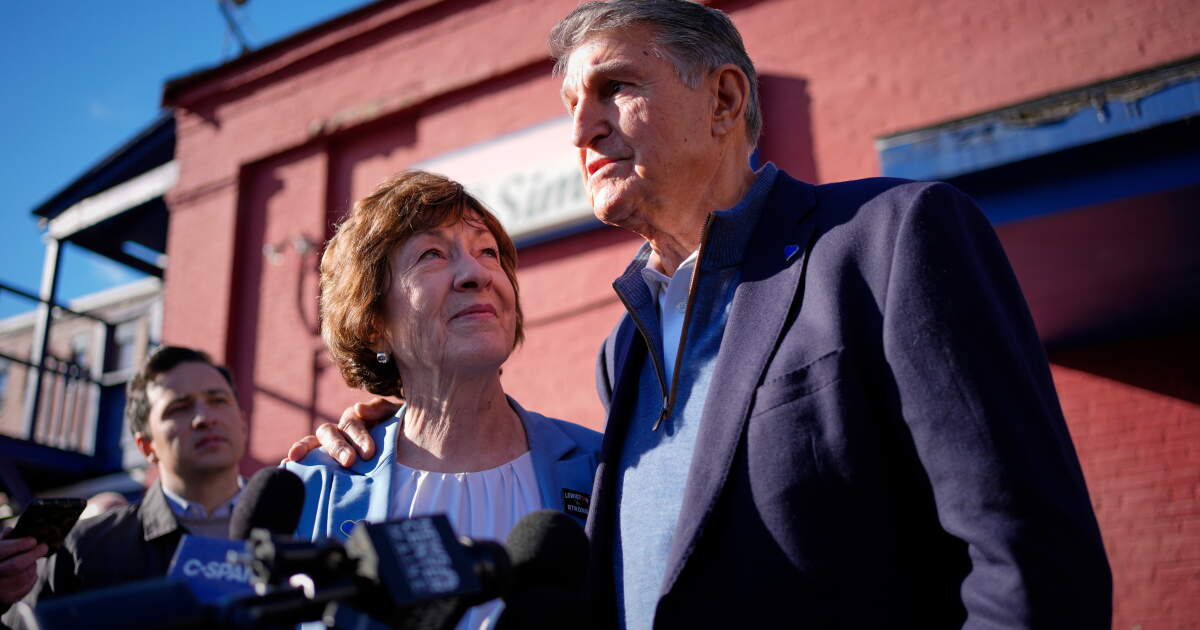
Collins is trying to fend off a challenge from Democrat Troy Jackson, a onetime state Senate president, and on Wednesday she made appearances with Joe Manchin III, a West Virginian who was a Democrat then became an independent late in his career before retiring.
After stopping for breakfast at Simones’ Hot Dog Stand in Lewiston, Collins spoke of how she and Manchin were “part of every piece of bipartisan legislation that passed and became law” during their time together in office.
Manchin said to lose Collins would be “to lose the soul of the Senate.” He praised her independent streak, her willingness to buck Republican President Trump and her record of fighting for Maine’s interests.
“This is a true blue-blooded Maine person who knows exactly where she came from,” Manchin said.
They planned a stop later at a New Balance shoe facility in Norway. Jackson, 58, is scheduled to campaign Thursday in Portland with Alexandria Ocasio-Cortez, the progressive congresswoman from New York.
Collins, 73, is in what may be her toughest reelection fight as she seeks her sixth term.
It’s only the second time that she has sought reelection in a midterm with a sitting Republican president, and the national trends are much less favorable to the GOP than they were the last time she did so, in 2002. Trump’s approval has fallen well below where it was when he took office last year, and a recent poll from the Associated Press-NORC Center for Public Affairs Research found that a strong majority of voters want change in Washington.
Collins has been working to persuade voters that she is independent of Trump and willing to break with him. In Manchin, she enlisted a politician who was one of the most moderate voices in the Senate. Manchin said in 2023 that Trump would “ destroy democracy in America” if he was elected to a second term.
Among the few dozen Collins supporters at the Lewiston event was Mike Marcotte.
“I may not have always been a fan of her complete package of votes, but when I look at the vitriol that’s in the U.S. Senate right now, we need more people like Susan Collins,” he said.
Jackson got a late start on campaigning after the party’s initial nominee exited the race but trails Collins in the money race by less than $3 million after an aggressive quarter in which he raised more than $20 million. Jackson has campaigned relentlessly and his events have drawn hundreds. Collins has largely stuck to smaller appearances.
Some of Jackson’s backers demonstrated across the street from the hot dog stand. A few held signs bearing the face of Brett M. Kavanaugh, the U.S. Supreme Court justice whom Collins voted to confirm and whose vote eventually helped overturn the constitutional right to abortion.
“Someone needs to stand up and be a check on Donald Trump and his harmful policies,” said David Sysko.
Collins has broken with Trump and Republicans over the years. She voted to convict him at his impeachment trial in 2021. Increasingly during the campaign, she has worked to distance herself from the president as Democrats argue that she is too close to him.
Collins said in early October that she is “not exactly his favorite senator,” and that she did not expect Trump to campaign in Maine. He has steered clear of the state with the Nov. 3 election nearing.
Pinning Collins to Trump is central to the Democrats’ strategy. In one ad, a nurse says the state is in a healthcare crisis “because of Susan Collins and Donald Trump,” citing Collins’ vote for Trump’s push for Medicaid cuts. Collins did vote to advance the bill but ultimately voted against it.
Trump also was a major focus of four contentious debates between the candidates this month, where Collins sought to distance herself from the president and Jackson repeatedly accused her of doing Trump’s bidding.
Asked at the final debate to name a time in which she bucked her own party and succeeded, Collins gave the example of rallying support against Trump’s nomination of Pete Hegseth, who was confirmed as Defense secretary.
Democrats seized on the moment and released a statement that said the exchange “underscores a central question in the Maine Senate race: Does Collins, a Republican in a state that disapproves of President Donald Trump and has grown bluer in recent years, stand up to her party enough to earn the independent streak she has staked her career on?”
Jackson has characterized Collins as out of touch with the struggles of working-class people in Maine. He has described Collins as a “rubber stamp” for the president and criticized her votes on Kavanaugh and Robert F. Kennedy Jr., Trump’s second-term Health secretary. Collins has said she does not regret either vote.
Republican ads against Jackson, a logger from northern Maine, have focused more on accusations of his having a volatile personality and behaving like a bully with female colleagues. Jackson has denied those accusations.
Collins distanced herself on Wednesday from a Republican super PAC attack ad that she said “should be taken down.”
The senator was a top target of Democrats in 2020 when she defeated challenger Sara Gideon by nearly 9 percentage points. Collins is the only Republican senator from New England, a distinction she has had since January 2013.