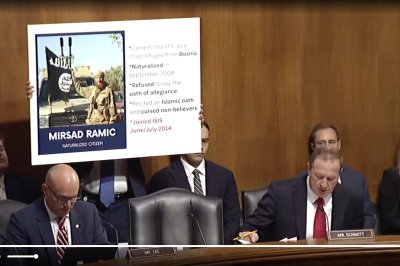

An aide to Sen. Eric Schmitt holds up a sign Wednesday depicting the radicalization of Mirsad Ramic, a naturalized U.S. citizen who was convicted in 2024 of providing material support to ISIS after traveling to Syria to join the terrorist organization. The hearing was held at the at the Dirksen Senate Office Building in Washington. Photo by Senate judiciary Committee
WASHINGTON, June 3 (UPI) — As the Justice Department increases efforts to strip some naturalized Americans of their U.S. citizenship, U.S. senators on Wednesday debated whether such efforts violate the Constitution.
Republicans argued during a Judiciary Subcommittee on the Constitution that it has been too hard to take away citizenship of naturalized citizens. But Democrats oppose increasing denaturalization and said it reflects President Donald Trump‘s broader anti-immigrant agenda.
“When someone lies during that [naturalization] process, conceals material facts, hides criminal conduct, masks allegiance to a foreign enemy or swears loyalty with mental reservation, he commits fraud against the United States,” said Sen. Eric Schmitt, R-Mo., chairman of the subcommittee.
Countered Sen. Mazie Hirono, D-Hawaii, a naturalized citizen. “It’s more than astounding, it should be unconstitutional. Let’s be clear. This has never been about law and order for the Republicans. This is all about getting immigrants. It’s about terrorizing immigrant communities.”
The Trump administration has significantly increased denaturalization efforts since the beginning of the president’s second term. Between 1990 and 2017, the government opened 11 denaturalization cases, on average, every year, according to the Immigrant Legal Resource Center.
Since January, the government has opened 34 denaturalization cases and revoked citizenship of 11 people. This is part of a larger, unprecedented push led by the United States Citizenship and Immigration Services to review 100 to 200 denaturalization cases per month.
“The Trump administration is right to revive denaturalization,” Schmitt said. Democrats, however, raised alarms that the push will have far-reaching consequences for naturalized Americans who are accused of crimes after becoming citizens.
Sen. Peter Welch, D-Vt., the top Democrat on the subcommittee, said he has no issue denaturalizing citizens who have committed fraud or misled officials during their naturalization process.
“I support that, but I don’t agree that naturalized citizens should be punished for something that happens after they become a citizen,” he said. “It’s the view of the Supreme Court. So, we do not have to reach too far back in our nation’s history to see that a familiar cycle is unfolding.”
The denaturalization campaign has marked a significant shift from previous administrations, which mainly targeted those with links to terrorist organizations or found guilty of war crimes.
But a June 2025 memo from the Department of Justice told government attorneys to expand the campaign to those involved in fraud or sex crimes. The memo later added a broad instruction that attorneys should pursue “any other cases … that the division deems to be sufficiently important.”
A law professor and an attorney pushed back against that tactic.
“The idea is to try to normalize the idea of denaturalization so that they can focus efforts against people who are kind of universally condemned,” said Cassandra Robertson, a law professor at Case Western Reserve University. “Then it’ll be a smaller step to start using denaturalization against other people.”
Robertson said that she had spoken to many naturalized citizens who now fear their citizenship may be revoked over actions like criticizing the government. She cited growing attacks from lawmakers to denaturalize public figures like New York Mayor Zohran Mamdani.
“If they’re threatening these high level people, what protection does an ordinary person have?” Robertson asked rhetorically.
David Leopold, an immigration attorney in Cleveland and former president of the American Immigration Attorney’s Association, said he sees similar fears among many of his naturalized clients. He said some have been stopped at airports and asked about their immigration history, despite having U.S. citizenship.
“This administration has succeeded in doing what a lot of authoritarian governments do, and that is spreading fear,” Leopold said.
Democrat Welch said the Trump administration’s denaturalization push seeks to advance the president’s deportation goals.
“The administration has — it is absolutely clear — a very radical goal. And that is mass deportation of immigrants from our country,” Welch said. “It’s doing real damage to our country, and as part of that effort, we’ve seen the abusive lengths that this administration is willing to go to.”
In January, Schmitt, supported by Majority Whip Tom Emmer, R-Minn., introduced the SCAM Act, which would amend the Immigration and Nationality Act to clarify the denaturalization process.
One notable expansion of the Act would lengthen the statute of limitations from five to 10 years for being able to revoke the citizenship status of naturalized Americans. The bill has yet to face votes.
“I’m proud to co-sponsor the Scam Act because I believe citizenship must be grounded in conduct that confirms rather than contradicts the promises made in connection with the naturalization process,” said Sen. Mike Lee, R-Utah.