On the same week that a court filing showed that construction on President Trump’s hotly contested triumphal arch could begin as soon as Nov. 5, another less reported development pointed to the possibility that the government might be misrepresenting its plans for Trump’s National Garden of American Heroes in West Potomac Park.
On Monday, the National Park Service held a meeting about a proposed redesign to the park, which is part of the National Mall and also where Trump wants to put his Garden of Heroes featuring more than 250 statues ranging from Humphrey Bogart to Kobe Bryant to Benjamin Franklin. Trump first proposed the idea in 2020, but it wasn’t until his second term — when he began a crusade to remake much of Washington, D.C.’s historic core according to his own predilections — that the plan looked as if it might manifest. The One Big Beautiful Bill Act even appropriated $40 million for the project.
The Garden of Heroes has remained largely in the background while preservationists focused on the demolition of the White House East Wing and the construction of a massive ballroom in its place, as well as the botched painting of the Reflecting Pool, and, of course, the gigantic triumphal arch.
But Monday’s NPS meeting about plans for West Potomac Park rang alarm bells for some when Judy Chesser, chair of the nonprofit conservation and preservation group the Committee of 100 on the Federal City, asked, “How does this relate to the Garden of Heroes that is being discussed in West Potomac?” to which the NPS spokesperson replied, “This is just an update to the tidal basin master plan we started before. This is not the Garden of Heroes.”
However, the Washington, D.C.-based education and advocacy organization Cultural Landscape Foundation noted that the rendering in NPS’ presentation and the illustrated “Pledge Agreement” from the National Garden of American Heroes Foundation contain similarities that “go way beyond coincidental.”
“Each includes a great lawn, a giant oval/circle, an amphitheater, a fountain, and a staircase to the Potomac River,” Charles A. Birnbaum, founding president and chief executive of the foundation, wrote in an email.
“In addition, the new design shown Monday amputates part of the FDR Memorial to accommodate the Oval. This is intentional. Clearly the Oval is meant to host something else or it would be re-scaled so as not to interfere with the FDR Memorial,” the email continued.
In that instance lawyers repeatedly said there were no plans to renovate the golf course (thus preventing U.S. District Judge Ana Reyes from issuing an injunction against said renovations), only to chop down hundreds of trees on the course with no notice over a holiday weekend. Reyes was irate and sources familiar with the feud say that the judge expects the case to go all the way to the Supreme Court.
Meanwhile, as of 2 p.m. PDT, Thursday, opponents of Trump’s arch have filed a motion for an injunction on the possible Nov. 5 construction, arguing that Congress needs to approve any plan moving forward. This head-snapping whirlwind of motions and counter motions is expected by critics to continue to be the norm as Trump tries to push through as many of his D.C.-based renovations as possible before a new Congress is seated in January.
“What better way to celebrate the nation’s 250th anniversary than to shut down the legally required review process, ignore some 100,000 negative public comments, and fast track the construction of a bloated and deeply unpopular monument that the president claims is for him,” wrote the Landscape Foundation’s Birnbaum in a statement about the arch.
I’m Arts editor Jessica Gelt pitching preservationists for my personal garden of heroes. This is your arts and culture news for the week.
You’re reading Essential Arts
Our critics and reporters guide you through events and happenings in the SoCal arts scene. In your inbox every Friday.
By continuing, you agree to our Terms of Service, which include arbitration and a class action waiver. You agree that we and our third-party vendors may collect and use your information, including through cookies, pixels and similar technologies, for the purposes set forth in our Privacy Policy such as personalizing your experience and ads.
The week ahead: A curated calendar
FRIDAY
American Sound Takes Flight MUSE/IQUE explores the nation’s music from Aaron Copland to Paul Simon in a concert setting infused with storytelling and cultural context. Featuring Brandon Victor Dixon, Liv Redpath and the MUSE/IQUE Orchestra, led by Artistic and Music Director Rachael Worby. 7:30 p.m. Friday, 2:30 and 7:30 p.m. Saturday. The Wallis, 9390 N. Santa Monica Blvd., Beverly Hills. thewallis.org
Bach to Broadway The 31st annual concert, featuring Pueri Cantores SGV, the St. Andrew School Choir, Los Angeles Children’s Chorus and members of the L.A. Opera and L.A. Master Chorale benefits the restoration of historic St. Andrew Church. 7:30 p.m. St. Andrew Church, 311 N. Raymond Ave., Pasadena. saintandrewpasadena.org
Ballet Festival: Jerome Robbins at the Ahmanson Theatre
(Steven Pisano / The Joyce Theater Foundation)
Ballet Festival: Jerome Robbins Three programs of the choreographer’s masterworks, curated by New York City Ballet principal dancer Tiler Peck, with dancers from New York City Ballet, Paris Opera Ballet and other major companies performing to live chamber music 7:30 p.m. Friday, 7:30 p.m. Saturday, 2 p.m. Sunday. Ahmanson Theatre, 135 N. Grand Ave., downtown L.A. musiccenter.org
Andrew Bird The acclaimed multi-instrumentalist and songwriter joins with the Los Angeles Philharmonic to mark the 20th anniversary of his album, “The Mysterious Production of Eggs,” with orchestral arrangements, plus popular songs from his catalog. 8 p.m. Walt Disney Concert Hall, 111 S. Grand Ave., downtown L.A. laphil.com
Aymeric Hainaux and François Chaignaud The musician and choreographer team up for “Mirlitons,” a marathon vocal and dance duet. 8 p.m. Friday and Saturday. The Nimoy, 1262 Westwood Blvd. cap.ucla.edu
Museum on Haunted Hill: A Celebration of Vincent Price The institution pays homage to its original patron, the noted actor, art collector, advocate and historian, with an evening of after-hours access to exhibitions, casual screenings of classic Price films, drinks and snacks, music, a photo booth and haunted decor. 5-8 p.m. Vincent Price Art Museum, East Los Angeles College, 1301 Avenida Cesar Chavez, Monterey Park. vpam.org
PLAY: A Play EmIly Mast’s unscripted conceptual performance features six players, guided by a coach, working against a clock and an evolving set of rules to examine “the invisible systems that govern power, behavior and care.” With Hugo Armstrong, Gregory Barnett, Chu-Hsuan Chang, Jessica Emmanuel, Jessica Hemingway, Aramazd Stepanian and Maxwell Transue. 7:30 p.m. Friday-Saturday, 4:30 p.m. Sunday. The Geffen Contemporary at MOCA, 152 N. Central Ave., Little Tokyo. moca.org
Sinners: Sounds That Summon This exhibition examines the standout Club Juke scene in Ryan Coogler’s Oscar-winning 2025 film focusing on the guitar played by the character Sammie Moore (Miles Caton), costumes, objects and archival material. Through March 14, 2027. California African American Museum, 600 State Drive, Exposition Park. caamuseum.org
SATURDAY
Grand Ave Arts: All Access Tenth annual celebration of L.A. downtown cultural corridor with free exhibitions, tours, performances, family-friendly activities and more from participating organizations including the Broad, Center Theatre Group, Colburn School, Classical California, Dataland, Gloria Molina Grand Park, Grand Performances, L.A. Opera, L.A. Phil, Los Angeles Central Library, Metro Art, MOCA, the Music Center and REDCAT. 11 a.m.-4 p.m. Grand Ave., between Temple and 6th Streets, downtown L.A. grandavearts.org
Kabuki in Motion: The Lion Returns U.S. Kabuki Ken Kyu Kai presents this program of kabuki dance, Nihon buyō (Japanese classical dance), and live koto and shamisen music featuring artists from Japan and California. 4:30 p.m. The Huntington, Rothenberg Hall, 1151 Oxford Road, San Marino. huntington.org
Picasso Ceramics From the Rosenbaum Collection The exhibition presents 63 original prints and limited-edition ceramics, including vessels, plates, pitchers and sculptural forms created by the artist after 1947. Through Feb. 28, 2027. Bowers Museum, 2002 N. Main St., Santa Ana. bowers.org
SUNDAY
Lucile Dollat The French organist performs music from the 16th century to the present. 7:30 p.m. Walt Disney Concert Hall, 111 S. Grand Ave., downtown L.A. laphil.com
TUESDAY
Jason Moran Presents Duke Ellington: My Heart Sings The pianist and composer performs with members of the Pacific Symphony to engage with Ellington’s work through a contemporary frame. 8 p.m. Segerstrom Center for the Arts, 600 Town Center Drive, Costa Mesa. scfta.org
The Music Man Meredith Willson’s Tony Award-winning musical comedy brings smooth-talking con man Harold Hill to River City, where his schemes are curtailed when he falls for Marian, the local librarian. Through Nov. 8. Ahmanson Theatre, 135 N. Grand Ave., downtown L.A. centertheatregroup.org
Orchestre Symphonique de Montréal with Rafael Payare The Canadian ensemble and its charismatic Venezuelan conductor (who also leads the San Diego Symphony) perform Dmitri Shostakovich’s “Symphony No. 10 in E minor, Op. 93,” plus Felix Mendelssohn’s “Violin Concerto in E minor, Op. 64” with Leonidas Kavakos. 8 p.m. Walt Disney Concert Hall, 111 S. Grand Ave., downtown L.A. laphil.com
The 39 Steps Patrick Barlow’s adaptation of Alfred Hitchcock’s 1935 spy thriller (itself an adaptation of a novel by John Buchan) about an ordinary man entangled in international intrigue. Directed by Hunter Foster. Through Nov. 22. Laguna Playhouse, 606 Laguna Canyon Road, Laguna Beach. lagunaplayhouse.com
The Who’s Tommy The band’s 1969 rock opera featuring “I’m Free,” “See Me, Feel Me,” “Sensation” and, of course, “Pinball Wizard,” is transformed into a Broadway musical by composer Pete Townshend and original director Des McAnuff. Through Nov. 15. Hollywood Pantages Theatre, 6233 Hollywood Blvd. broadwayinhollywood.com
WEDNESDAY
Nedra Ryan Taylor and Sarah Scott Davis in the play “Confederates.”
(Davis Northern)
Confederates Institutional racism, as experienced in two different eras by Black women, is the subject of Dominique Morisseau’s 2022 dramatic comedy. Best known for her three-play cycle “The Detroit Project” as well as the book for the musical about the Temptations “Ain’t Too Proud,” Morisseau juxtaposes the plight of an enslaved rebel and Union spy during the Civil War with that of a contemporary political science professor facing a threatening work environment. Fountain Artistic Director Raymond O. Caldwell directs this sharp-eyed satire examining an unbroken thread of racial and gender bias in American history. (Charles McNulty) Previews, 8 p.m. Wednesday-Thursday, play runs through Dec. 13. Fountain Theatre, 5060 Fountain Ave. fountaintheatre.com
THURSDAY
Seasons of America With Teddy Abrams & Ray Chen The world premiere of Abrams’ L.A. Phil commission, written especially for violinist Chen, along with Julia Perry’s “A Short Piece for Orchestra.” Charles Ives’ “Three Places in New England, S. 7” and George Gershwin’s “An American in Paris.” 8 p.m. Walt Disney Concert Hall, 111 S. Grand Ave., downtown L.A.laphil.com
Sasha Velour: Travesty The Season 9 winner of “RuPaul’s Drag Race” performs a new solo work that spans queer history through lip-sync performances embodying various personas including a witch burned in a field, a clown who builds a theater and patrons of an underground gay bar. 7:30 p.m. Thursday-Oct. 30. The Wallis, 9390 N. Santa Monica Blvd., Beverly Hills. thewallis.org
The SoCal scene
Katie Folger gets ready at her home before her performance of “Getting in Bed With the Pizza Man” at the Elysian Theater.
(Carlin Stiehl / For The Times)
ICYMI, the best of this week’s L.A. Times arts coverage:
A marble torso sculpted during the early Roman Empire set a new world record for ancient classical sculpture at auction earlier this week when it sold at Sotheby’s New York for $34.3 million. That was almost three times more than its pre-sale estimate of between $8 million and $12 million.
BLAINE, Wash. — The Trump administration’s top border official defended plans to build a wall and other infrastructure in Texas’ Big Bend region despite mounting opposition against the project and a court-ordered pause on construction, saying his goal of fortifying the country’s borders was “non-negotiable.”
In an exclusive interview with the Associated Press, Customs and Border Protection Commissioner Rodney Scott argued that the $46-billion wall project was justified despite a bipartisan coalition of landowners, local businesses and environmentalists who view it as a waste of taxpayer money that could be destructive to a region with historically low migrant crossings.
“Our No. 1 goal right out the gate is we have to know who and what is coming into the United States,” Scott said on Thursday. If the Big Bend region were left without a wall or other border infrastructure while other areas along the border get those fortifications, he said, “I am 100% convinced it will be completely overrun and destroyed.”
The fight over Big Bend has become a major test for how far the Republican administration is willing to go for the border wall, President Trump’s signature infrastructure project.
Scott, a former Border Patrol agent, was tapped by Trump to complete it.
His agency is responsible for executing a plan funded last summer by Republicans in Congress to line the roughly 2,000-mile border with Mexico with a mixture of 30-foot-tall steel walls, vehicle barriers, new roads and surveillance technology to prevent illegal immigration and smuggling.
The Trump administration says it is building about 12 miles a week. Scott, who gets daily progress updates, said it will be complete by the end of Trump’s second term. The primary border wall — some areas also get a secondary layer — will be done by the end of December 2027.
“We’re actually ahead of schedule,” Scott said.
1
2
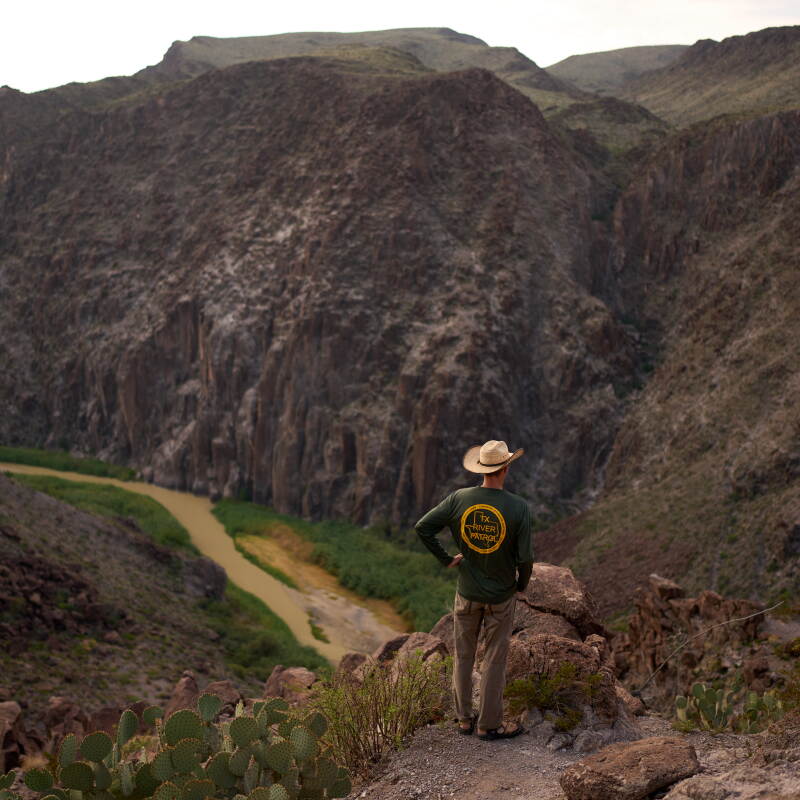
1.Charlie Angell stands on an overlook of the Rio Grande river2.Pamela Priddy, center, holds up signs with others during a weekly protest against barriers along the border in the Big Bend region, Saturday, Sept. 26, 2026, in Study Butte, Texas.(John Locher / Ap Photo/john Locher)
Big Bend is a test for the Trump administration’s plans for the wall
The wall plan has run into resistance in places like Big Bend. The Trump administration was dealt a major setback earlier this month when a judge ordered a pause on border wall construction in the region, citing what could be a likelihood that plaintiffs “will suffer serious, irreparable harm without an injunction.” The administration has asked the Supreme Court to lift the order.
The ruling included any construction in Big Bend National Park, an area that has seen a loud bipartisan outcry, including from some Republican lawmakers.
After bulldozers were spotted in the park tearing up ground in August, Scott ordered a pause on all construction-related activity there while he went to talk to people in the region. He said the agency is making other outreach to locals to discuss how to build projects so they don’t mar the park.
“We’re talking through and figuring out what is the right solution for that area,” he said.
Scott said he can’t get into specific details on what the agency’s plans are for the park because of the numerous ongoing lawsuits, but he reiterated that the project won’t include tall steel walls.
He also said that the agency’s stated goal of protecting the country and knowing what’s coming in and going out is “non-negotiable.”
He said the region’s formidable natural barriers were not enough to prevent people from entering the country illegally through other more navigable points. And he expressed concern that cartels that control smuggling from Mexico into the U.S. would exploit any opening.
CBP has come under fire for immigration enforcement tactics
Scott leads an agency of 67,000 employees responsible for controlling who and what comes into the country through official border crossings like airports or seaports and stopping illegal smuggling and migration outside those official border crossing points.
The agency came under heavy scrutiny last year when its officers were sent into cities deep inside the country to help carry out Trump’s immigration crackdown alongside Immigration and Customs Enforcement.
Agents with the Department of Homeland Security, which includes Immigration and Customs Enforcement, Border Patrol and Customs Enforcement patrol in a neighborhood after apprehending a person on Jan. 31 in St. Paul, Minn.
(Eric Thayer/Los Angeles Times)
As protests against an operation rocked Minneapolis, a Border Patrol officer and a CBP officer both fired shots in an encounter that killed a U.S. citizen, Alex Pretti. The shooting eventually prompted the Trump administration to wind down high-profile city-based crackdowns. A CBP officer who was the face of the missions, Gregory Bovino, who led a helicopter raid at a large apartment building and used chemical agents to confront demonstrators, retired earlier this year.
Scott said while CBP still helps ICE, it’s now less involved in immigration enforcement far from the country’s borders because ICE has since hired more officers to its ranks. Scott wouldn’t comment on the investigation into the Pretti killing, saying that it was being handled by the FBI and was ongoing. And when asked about Bovino’s tactics, he said the officer didn’t report to him during the operations.
Scott spoke to the AP just outside the border with Canada, where he met with border security representatives from other countries to share information about threats and trends. During his trip, he visited an operations center where he said Canadian and American law enforcement work together.
That border has far fewer threats than the U.S. border with Mexico. Scott said cartels in Mexico are increasingly sending drones into the United States to move contraband and keep tabs on Border Patrol agents. In Mexico, the cartels have been using drones to attack each other or Mexican law enforcement.
The Department of Homeland Security, which includes CBP, recently announced temporary flight restrictions targeting unauthorized drone activity in a zone extending a mile north of the U.S.-Mexico border as a way to counter cartels.
“We want to make sure,” Scott said, “that threat does not come into the United States.”
RAZORLIGHT are keen to show they’ve still got the golden touch as they prepare for their 28-date tour across the UK and Europe.
The new shows will see Johnny Borrell and Andy Burrows celebrating the 20th anniversary of their self-titled second record, which spawned hits including America, In The Morning and Before I Fall To Pieces.
Razorlight are keen to show they’ve still got the golden touch as they prepare for their 28-date tour across the UK and EuropeCredit: SuppliedThe Sun’s Ellie at the Ovo Arena Wembley with Johnny and Andy
Speaking at the Ovo Arena Wembley, where the band plays on December 4, frontman Johnny recalls: “The first time we played here was supporting the Manic Street Preachers, it was a great show.”
Buzzing to be back, drummer Andy adds: “We feel very lucky, but at the same time we also feel like we did something really cool.”
Sign up for the Showbiz newsletter
Thank you!
The tour starts in Europe and reaches the UK with Glasgow on November 26, before cities including Nottingham, Bristol and Leeds.
And time on the road means more time to make new music.
“I’m hoping we do some writing on the road because we used to do that a lot,” Johnny says.
“Now we’re going out on the tour bus again, I think we’ll have a good chance of doing that.
“We’ve got a couple of really good songs at the moment and the next step is bringing it to the band and we’ll see how it sounds.
“I like where we’re at with Razorlight at the minute, we’ve got the bit between our teeth.”
Andy says: “These shows and playing together will fuel that. It would be easy to play some gigs, earn some money and be like, ‘See you in two years.’
“But we have that drive to say, ‘F**k, we need to do this again and do it better’.”
Johnny adds: “Everyone has to bring their A-game, then we need to meld together because then it creates something incredible.”
Johnny thinks the group — which first formed in 2002 — have some exciting years ahead.
Bjorn Agren, Andy, Johnny and Carl Dalemo perform on stage in 2023Credit: GettyAndy and Johnny perform at the Camden BarflyCredit: Getty
He explains: “I think a band needs that hunger. And I think we have that right now.
“We’re writing new material and we’ve got that drive.
“I always feel most comfortable in that kind of position where I’m fighting and trying to prove something. I like being the underdog and I like taking it on. When we play live, we’re not playing along to a backing track or anything pre- recorded or a click track or something like that, which 90 per cent of bands are doing now.
“It’s depressing. People do it because it’s easier and it’s cheaper to do. Anyone can go off and do 364 days of something else, then turn up and get a haircut and look like they’re in a band, you know?
“But we’re doing it the real way.
“It doesn’t matter if you’re the biggest band in the world. It doesn’t matter if you’re like the newest, youngest band starting out.
“If you’re doing it properly and you’re doing it for the love of the music, it’s a long road and you just have to keep fighting.
“And that’s our vibe right now.”
FLUFF LUCK FOR RAYE
Raye was the big winner at the Mercury Prize do after taking home the coveted gongCredit: GettyThe singer was snapped leaving in a faux fur coat and fluffly slippers while holding her trophy out for the waiting photographersCredit: BackGridOlivia Dean left the night empty-handed but made up for her loss by partying until 3am with her pals in NewcastleCredit: BackGridA source said: ‘Olivia might have lost to Raye but she was in great spirits’Credit: Getty
RAYE was the big winner at the Mercury Prize do after taking home the coveted gong.
She received the award for her incredible second record, This Album May Contain Hope.
After the bash at Newcastle’s Utilita Arena, the star was snapped leaving in a faux fur coat and fluffy slippers while holding her trophy out for the waiting photographers.
Raye, who turns 29 today, said: “I just poured so much heart into this album, I really did. This accolade is serious and something that I always dreamed to one day receive. I just feel really grateful.
“It’s the best birthday present I could have asked for.”
Olivia Dean left the night empty-handed but made up for her loss by partying until 3am with her pals in Newcastle.
One of my mates spotted the Man I Need singer heading off with her friends to cool DIY music venue The Lubber Fiend.
They told me: “Olivia might have lost to Raye but she was in great spirits. She went dancing with her mates and was having the time of her life. She’s a great girl and a proper good laugh.”
WIGHT MOVE BY ROBBIE AND CO
Robbie Williams has been announced as a headliner for the 25th Sky Presents Isle Of Wight FestivalCredit: Getty
ROBBIE WILLIAMS, Kings of Leon and Fatboy Slim have been announced as the headliners for the 25th Sky Presents Isle Of Wight Festival.
They will be joined by a slew of stars including Becky Hill, Kaiser Chiefs, Myles Smith, Cruz Beckham& The Breakers, Courteeners, Rudimental and Scouting for Girls.
The event, which takes place across four days from June 17 next year, still has some more acts to be announced.
Tickets go on sale at 8am on Monday,
Festival director Caroline Giddings said: “There’s a real mix of artists for different generations and tastes, and there’s still more to come.
“We put a lot of thought into what happens beyond the main stages, too.”
JoJo in a good lace
Jojo Siwa wows in lace as she attends the 2026 Dancers Against Cancer Gala in Beverly HillsCredit: Shutterstock Editorial
SINGER Jojo Siwa wows in lace as she attends the 2026 Dancers Against Cancer Gala in Beverly Hills.
The former child star looked worlds away from her wild pop star persona as she walked the red carpet in a stunning white dress.
The singer was in good company at the glitzy bash, with actress Carmen Electra and singer Janet Jackson also in attendance.
JoJo is currently enjoying some downtime in America after releasing a series of singles following her stint in the Celebrity Big Brother house last year.
GEORGE MICHAEL’s estate is hosting a free screening for NHS staff of his film, The Faith Tour, at London’s Roundhouse .
The show comes 20 years after his gig at the same venue for nurses, to thank them for caring for his mum who died of cancer in 1997.
Tickets will be distributed by NHS England.
Noel Gallagher with Amelia Dimoldenberg on Chicken Shop DateCredit: Instagram/@chickenshopdate
STRIP away his rock star status and Noel Gallagher is just like us.
In the new episode of Chicken Shop Date, he tells host Amelia Dimoldenberg: “I’m pretty low-key. My children live with me. We played a gig in São Paulo to 90,000 and I got home and came downstairs to find my two lads arguing over what was left in a box of Coco Pops. I thought to myself: ‘48 hours ago I was on stage – now I am arguing with two bellends about Coco Pops.’”
A MAJOR airport is about to spend billions on a huge upgraded terminal.
Not only that, but British Airways is launching the new route in January with year-round flights every day.
Melbourne Airport is upgrading is preparing to upgrade its International TerminalCredit: Melbourne AirportThere will be more space in arrivals and departure due to a rise in demandCredit: Instagram/melbourneairportau
Melbourne Airport has announced its one step closer to its $4.5 billion (£2.35million) International Terminal expansion.
New designs show off expanded check-in, arrivals and departure areas.
Sign up for the Travel newsletter
Thank you!
It will have a larger check-in hall with high-tech, common-user systems and expanded baggage claim with additional carousels.
Five additional aircraft stands will accommodate more flights.
Throughout the International Terminal will be windows to maximise natural light for a calming atmosphere.
There will also be more retail, dining and lounge options as well we improved waiting areas for passengers.
Works will coincide along the construction of Melbourne Airport’s third runway.
Stats revealed that in January, more than 1.26million passengers travelled through the international terminal which was their busiest month on record.
Just last month the airport opened its new Pick up and Drop off zones for Terminals 1,2 and 3 and a new pedestrian bridge linking passengers to the terminals.
For anyone who lands and immediately wants a slice of Australia, the famous “kangaroo spotting trail” is right next door to the airport at Woodlands Historic Park.
Melbourne Airport had a record breaking 1.26 million international passengers in JanuaryCredit: Instagram/melbourneairportau
British Airways is launching its Melbourne route on January 9, 2027 – flights will operate year-round from London Heathrow, via Kuala Lumpur, on a daily basis.
Flights will take off from Heathrow at 9.10pm and land in Kuala Lumpur at 6.05pm the following day.
The plane will then take off again at 7.45pm and land in Melbourne the following morning at 6.40am.
Return flights will start on January 11, taking off each day at 4.35pm and landing in Kuala Lumpur at 9.35pm.
It will have also have five additional aircraft gatesCredit: Melbourne AirportIt comes after the airport upgraded its Terminals 1,2 and 3 with drop off zones and a walkwayCredit: Melbourne Airport
The flight will then take off from Kuala Lumpur at 11.15pm and land back at Heathrow the following day at 5.20am.
Assemblyman Burt Margolin (D-Los Angeles) was so concerned about reelection in his heavily Democratic 45th District that he scheduled his wedding and honeymoon in Hawaii in the midst of the campaign.
Margolin was married Sept. 27 to Dr. Laurie M. Post, a Beverly Hills clinical psychologist and daughter of motion picture director Ted Post. The couple is honeymooning in Hawaii, according to Margolin.
The 35-year-old assemblyman, elected in 1982 and reelected in 1984 with more than 60% of the vote both times, said that his marriage and honeymoon a month before the election does not mean that he is overconfident.
‘Do What Is Necessary’
“The key point is that I am not taking anything for granted,” he said in an interview. “I will be back in time to do what is necessary to win reelection. If my opponents mount a campaign, I will be in a position to respond.”
Less than a month before the Nov. 4 election, Margolin could probably just as well spend the rest of the month in the islands.
Jana Olson, the Republican candidate for Margolin’s job, is not optimistic about her chances of defeating him. “The race probably is not winnable, based on the way the district is laid out,” said Olson, a 28-year-old Toluca Lake businesswoman, adding that she expects to raise only $5,000 for the campaign.
By contrast, Margolin has amassed $55,000, none of which is as yet earmarked specifically for his reelection.
Olson’s pessimism is based on, among other factors, the registration figures. Of the 151,846 voters registered as of Sept. 23, 88,630 (58.4%) are Democrats, compared to 45,509 (30%) Republicans.
Long a Democratic stronghold, the 45th Assembly District extends from Hancock Park on the south to Burbank on the north, and includes the Fairfax and Pico-Robertson areas and portions of West Hollywood, Hollywood, the Hollywood Hills, Los Feliz, Universal City, Studio City, Toluca Lake and North Hollywood.
The district has served as the launching pad for and seemingly private reserve of the so-called Berman-Waxman organization, a Democratic political alliance named after U.S. Reps. Howard L. Berman (D-Panorama City) and Henry A. Waxman (D-Los Angeles).
In 1968 Waxman was the first member of the organization to win the 45th District seat. He was followed by Herschel Rosenthal, now a state senator, who was succeeded by Margolin.
Margolin was an aide to both Waxman and Berman before winning his first election in 1982. He is a member of the organization and Waxman’s father works as an aide in Margolin’s office, which is just down the hall from Waxman’s district office in the Miracle Mile.
A Progressive Liberal
A self-described progressive Democrat, Margolin said it is not easy for someone of his political background (generally liberal on issues, including opposition to the death penalty) to score victories against the conservative Administration headed by Gov. George Deukmejian.
“Obviously, it is more difficult to get what you want,” he said, “but it is not impossible. I have managed to get results, although they are more modest because of the governor.”
Medi-Cal Improvement
He mentioned a bill, enacted into law, that established perinatal care for low-income women under Medi-Cal. “That is the only significant increase in Medi-Cal to get by the governor,” he said.
He also authored the so-called “bottle bill” that eventually became law and established deposits for beverage bottles and cans to encourage people to return them for recycling rather than discarding them as litter.
Olson said that she “leans to conservatism” and would bring a sense of fairness, sound business practices and help to the “truly needy” if she is elected.
“I oppose rent controls because they create an artificial market whereby rents are forcibly increased,” she said. “I favor free-market principles, whereas my opponent is very liberal on all the issues.”
Like Olson, the other two candidates in the race are not optimistic about their chances. Both Sylvia F. Kushner, the Peace and Freedom Party candidate, and Donald P. Meyer, the Libertarian Party candidate, said in interviews that they do not expect to win.
Kushner, 75, a human rights organizer, said she entered the race to support programs for low-income people and senior citizens and to register her opposition to the country’s foreign policy.
“We need a state jobs program, improved health care programs and state-supported housing for low-income people,” she said. “I have also been in the peace movement for many years.”
Meyer, 36, a courier with a bachelor’s degree in psychology from the University of Minnesota, said he would like to see government reduced to the smallest possible size.
“I am opposed to most taxes,” he said. “Government should exist to prevent people from taking your money, rather than assuming the role of taxer.”
MOVE over St Pancras – there’s a new kid on the block for rail services to Europe.
Lord Sadiq Khan has revealed plans to launch trains to Europe from Stratford International Station within the next four years.
Stratford International Station could get new rail services to EuropeCredit: Alamy
Despite its name, the station has never had international services, but according to The Standard, the station is set to undergo a £20million project to launch trains to France by 2030.
One in three trains to and from France could stop at the station under the new plans – being a stop on services, rather than a new origin or destination station.
Sign up for the Travel newsletter
Thank you!
It’s predicted that the stop would add five to eight minutes to the overall journey time.
Sadiq Khan told The Standard: “We’ve been working closely with the Government to make Stratford International truly ‘international’ for the first time – opening up new opportunities for jobs, investment and tourism, while connecting one of the UK’s fastest-growing economic centres directly to Europe.
“It’s time to unlock the full potential of this station and help write the next chapter in Stratford’s remarkable success story as we continue building a better, greener, more prosperous London for everyone.”
If trains to Europe did launch at Stratford International Station, around five million people in and around London would have better access to international rail services.
Services would initially be to France with plans to expand to other destinations in the futureCredit: Getty
Services could run to Paris, Brussels, Rotterdam and Amsterdam.
And eventually, there could be trains to Germany and Switzerland as well.
The current plans are also backed by a number of businesses as well as the train drivers’ union Aslef.
Stratford International finished construction in 2006 with four platforms.
However, the two platforms for international services as well as the area for international passengers have remained abandoned for the past two decades.
In order for the area to open, more work would need to be done including making the flow of passengers through security more efficient.
The station would be able to handle around 250 to 300 passengers at a time.
Meanwhile, Virgin is set to launch services from London St Pancras also by 2030, competing with Eurostar.
A HUGE multi-million pound upgrade is set to transform two popular holiday parks in the UK.
The two holiday parks are Parkdean’s Skipsea Sands Holiday Park in East Yorkshire and Thorness Bay Holiday Park on the Isle of Wight.
Parkdean Resorts has announced a huge £70million investment project in its parksCredit: Parkdean ResortsTwo parks will get upgraded in 2027Credit: Parkdean Resorts
At Skipsea Sands Holiday Park, there will be number of new activities including an indoor adventure climbing experience, indoor adventure golf and off-road driving experiences for children aged four and over.
The play areas, both indoors and outdoors, will be expanded including the bounce park, sports court and a Bear Grylls themed escape room.
Sign up for the Travel newsletter
Thank you!
The park will also add a Scoops Ice Cream shop and Joe’s American Grill as well as have a new outdoor entertainment space with seating.
The £5million investment is set to be completed by Easter 2027.
Steve Richards, CEO at Parkdean Resorts, said: “We’re committed to investing £5million in Skipsea Sands Holiday Park, upgrading our accommodation and further enhancing the holiday experience for guests and owners in East Yorkshire.
“From exciting new activities that include adventure golf and high ropes to an enhanced food and drink offering, there will be even more for families and holidaymakers to enjoy.”
Then, as for Thorness Bay Holiday Park on the Isle of Wight, the £6millon transformation will include a new high ropes, indoor adventure golf and off-road driving experiences for children aged four and over as well.
Just like Skipsea, the indoor and outdoor play areas will be improved too, with a bounce park, sports court and a Bear Grylls themed escape room.
The park will also gain a new two-storey building that will be home to the Hat-Tricks sports bar with interactive darts, pool and shuffleboard.
Food and drinks spots will also be expanded at the park with a new Scoops Ice Cream parlour, a Joe’s American Grill and Thunderbird Strip Shack.
They will get expanded play areas as well as new attractionsCredit: Parkdean ResortsAttractions includes sports bars, Bear Grylls escape rooms and high ropes coursesCredit: Parkdean Resorts
And once again similar to Skipsea’s expansion, there will be new outdoor areas for entertainment and dining.
Steve Richards, CEO at Parkdean Resorts, said: “This investment reflects our continued commitment to supporting local jobs, tourism and economic growth in the communities where we operate.
“We look forward to welcoming guests to a new and improved Thorness Bay from Easter 2027.”
A number of other Parkdean Resorts parks have recently undergone upgrades including Highfield Grange Holiday Park in Essex and Vauxhall Holiday Park in Great Yarmouth.
Vauxhall Holiday Park revealed its £5million upgrade earlier this year, with a new sports bar, darts and indoor adventure golf.
The holiday park has also been upgraded to include more kids’ play zones as well as high rope courses.
WASHINGTON — A federal judge on Monday questioned the Trump administration’s claims surrounding its efforts to redevelop a historic Washington golf course, challenging its contention that a recent tree-cutting spree did not indicate work was moving forward on the project, which is temporarily blocked by a court order.
“There is no universe in which all of this coincidentally happened all at the same time,” U.S. District Judge Ana Reyes said during a hearing over the fate of a project that has emerged as the latest legal flashpoint in President Trump’s campaign to leave his personal imprint on the nation’s capital.
Reyes last week ordered a halt to the golf course’s redevelopment plans until at least Oct. 26 after scolding the government for starting a large-scale tree removal at the course over a holiday weekend while providing little notice to the court or the plaintiffs trying to stop the makeover.
Then, on Sunday, Trump announced plans on social media to close the golf course for 15 months, starting on Nov. 15, and redevelop the 106-year-old park and course despite a court challenge by the D.C. Preservation League and two golfers. In a post on Monday, Trump said the work would start immediately.
Plaintiffs’ attorneys challenging the golf course renovation work have asked Reyes to extend her order that temporarily paused the work. They say the work is inflicting irreversible damage and that the redevelopment would violate the congressional act that created the park where the course is located.
The hearings on the century-old golf course have grown increasingly tense and on the eve of Monday’s hearing, Reyes rejected the administration’s request for her to recuse herself from the case. The government questioned her impartiality and accused her of engaging in “egregious” behavior from the bench during last week’s emergency hearing for the case.
Trump, a Republican, referred to Reyes as a “crazed lunatic” in his social media post on Monday.
“The United States Department of Interior wants to take a terrible and very unsafe golf course, and make it into a great, safe, and prestigious golf course. They have an absolute right to do so. It’s as simple as that!” Trump wrote.
Reyes, who was nominated by Democratic President Biden, said the government has failed “by any objective measure” to demonstrate the need for her recusal from the case.
“It is easy to weaponize selective quotations to bring a baseless recusal motion. But it is much harder to meet the demanding legal standard against a full record,” she wrote.
Trump has pledged to turn the course into a world-class golf venue — part of his grand vision for Washington, D.C., where he has torn down storied structures, remade or renamed others and deployed the National Guard for more than a year.
While it has been open to Washingtonians of all income levels, opponents of Trump’s plans for the golf course have argued it will alter the character of the space and make it less affordable to people.
Monday’s hearing started with a tense confrontation between Reyes and Justice Department official Stanley Woodward, when the judge asked if other any government attorneys in the room “as officers of the court” were willing to certify that everything within a Sunday filing was truthful and legally sound under federal rules of civil procedures.
In that filing Woodward argued that there were no final plans for the park.
“First, the plan is not final because the Park Service has not completed its review and the details of the proposal are subject to change during the review process,” the filing said.
Much of the hearing revolved around Trump’s social media posts over the weekend and his appearance last June at the golf course, accompanied by golf course architects and members of the administration and why there was such a sense of urgency for the cutting of the trees.
The witnesses at the hearing, Greg Wischer, deputy chief of staff at the Interior Department, and acting National Park Service director Jessica Bowron both acknowledged that they had only learned of the National Park Service Cultural Landscape Report in September that led to the tree cutting. That NPS report was from 2019.
Anthropic (ANTHRO) plans to allocate 5% of its equity to a new fund designed to address the societal consequences of artificial intelligence, including potential job losses as businesses increasingly deploy AI-powered automation. The initiative, announced Sunday, comes as the developer of the Claude AI
BOULDER CITY, Nev. — Janelle Sorenson loves the clear night skies in Boulder City, less than an hour’s drive from the bright lights of the Las Vegas Strip. It’s a small, quiet town, and she thinks an artificial intelligence data center would ruin the community and scar the desert landscape.
So over the summer, she joined with other residents to successfully oppose plans for one of the giant computing warehouses that have popped up around the country.
But their victory was short-lived. The developers withdrew their application and instead sought adjacent land owned by the federal government — and the U.S. Bureau of Land Management signed off.
“Not only did we not get to decide anything or have a say,” Sorenson said, “we were just really kept in the dark.”
The Townsite data center was the first in the country to be approved on federal public land, though construction is stalled after a judge ruled that the government couldn’t use an old environmental review from when the project was intended to be a solar farm.
Tech companies are eager for vast tracts to build data centers that can be as large as 70 football fields, and Townsite could set a precedent for similar projects on federal property with more than a dozen others in the planning stages. President Trump has been a steadfast supporter of the AI industry, which he views as a source of economic growth and part of a global competition with China.
However, data centers have been unpopular in many communities as voters worry about higher electricity bills, declining water supplies and other effects. In Nevada, where 80% of the land is owned by the federal government, Townsite and other projects have become a dominant issue in the battleground state’s closely watched governor’s race.
Republican Gov. Joe Lombardo, one of his party’s most vulnerable incumbents, doesn’t outright oppose building data centers on public lands, as long as they have community support. He recently signed an agreement with Trump’s Republican administration to streamline infrastructure projects, which could include data centers on federal lands.
Democratic nominee Aaron Ford, the state attorney general, has pledged to oppose data centers on public lands, saying affordable housing should be the priority.
Both say the projects, whether on public or private land, must follow state rules, such as requiring data centers to cover their own energy costs and protecting water supplies, or they would lose eligibility for state tax abatements.
Voters across the political spectrum unite against data centers
Sorenson, the Boulder City resident, considers herself a liberal, but she said her conservative neighbors are on the same page as she is.
“We’re all aligned on this,” she said.
Autumn McGrath-Shook, who lives in the same town, said she recently left the GOP and registered with the Green Party over data centers, though she still identifies as conservative. Worried about the environmental impact on wildlife, she joined forces with “these crazy libs” to oppose the project.
Data centers have quickly become a “catalyzing issue” in the midterms, catching many politicians flat-footed, said David Damore, a political science professor at the University of Nevada Las Vegas.
Some state leaders who were previously supportive of data centers have rushed to respond. For example, Republican Texas Gov. Greg Abbott paused data center approvals until audits are completed, and Democratic Pennsylvania Gov. Josh Shapiro signed an executive order removing data center proposals from a fast-track permitting process and requiring them to receive local approval before seeking state approval.
In August, Ford announced his plan to pause new tax abatements for data centers while an audit is conducted to see whether the projects have fulfilled promises about producing tax revenue and economic benefits.
In September, Lombardo, who has said data centers provide enormous economic opportunity for Nevada, signed an executive order placing more guardrails on them and requiring them to pay more taxes to support schools.
The two have successfully “muddied the waters” on their data center positions, Damore said.
Lombardo criticized Ford for co-sponsoring 2015 legislation that created the state’s tax abatement program for the facilities, a measure that received bipartisan support. Ford criticized Lombardo for giving more than $200 million in tax breaks to data centers, which is connected to the legislation that Ford co-sponsored.
Ford told the Associated Press that he would use “every tool” at his disposal to prevent data centers from skirting state guardrails, including withholding tax abatements and pursuing litigation.
Lombardo, whose campaign declined to make him available for an interview, has a similar pitch. His office said he would not hesitate to confront the federal government to advocate for Nevadans.
But that’s not good enough for McGrath-Shook, who is on the fence in the governor’s race. She thinks Ford is soft on crime, but she views Lombardo as more pro-data centers.
“I would much rather vote for Lombardo than Aaron Ford in a normal world,” she said. “But with the looming data centers, it really changes the landscape — and literally.”
Data centers on public lands are the latest effort in AI race
Last year, Trump signed an executive order to accelerate permitting for AI data centers, and his administration has rolled back the National Environmental Policy Act, saying the bedrock law needlessly delays federal approval for energy and infrastructure projects.
Dan Diorio, executive vice president of state policy and government affairs for the Data Center Coalition, said the industry wants to be a part of the conversation about responsible development on federal lands.
“The good-faith actors in this space are going to be approaching that development responsibly,” he said, “ensuring that it’s going to do no harm on important federal lands.”
But environmentalists are concerned about data centers developing on federal lands to skirt environmental protections and laws and circumvent permitting processes. They’re generally opposed to using public lands for the projects in the first place.
“We believe that public lands are reserved for public good and should be protected and kept in trust for future generations,” said Olivia Tanager, director of the Sierra Club’s Toiyabe Chapter. “And the idea of using public lands for data center construction totally flies in the face of that set of values.”
She said Congress should pass legislation with new standards for environmental reviews and public engagement that could slow development.
“Short of some type of legislation to that effect,” Tanager said, “we’re staring down the barrel of having many data centers move forward on public lands over the next few years.”
Skydance-owned Paramount Pictures has taken over the lease for the Bay Theater in Pacific Palisades and intends to reopen the cinema, which has been closed since the January 2025 Palisades fire last year.
Paramount plans to upgrade the theater with state-of-the-art projection systems and in-seat food and drink service, Rick Caruso, whose company owns the Palisades Village shopping center where the Bay Theater is located, said in an interview. Caruso is founder and executive chairman of the real estate firm Caruso.
Paramount plans to show first-run theatrical movies from all studios. The theater will be operated by The Lot, a La Jolla-based luxury dine-in theater chain with four locations in California. The theater is expected to reopen later this year, Caruso said.
“The comeback of this movie theater is a great signal for all of L.A.,” he said. “Los Angeles is resilient, and we’re going to show the country that Los Angeles can bounce back from a terrible, terrible disaster, and the comeback is going to be much greater than the setback.”
Palisades Village reopened in August after more than $100 million in renovations, including major infrastructure work. The upscale outdoor mall survived the Palisades fire, but needed refurbishment to eliminate any potential contaminants from the blaze.
Caruso declined to share terms of Paramount’s lease agreement, saying only that it was long-term. Paramount declined to comment on the size of its investment in the theater.
Caruso said he brought up the Bay Theater over lunch last year with David Ellison, chief executive of Skydance, who was then working to acquire Paramount. The two were discussing that deal and Ellison’s belief in the importance of the movie theater business to the industry.
“Together with Caruso, we are proud to help bring the Bay back to life as a place for the Pacific Palisades community to gather around the shared experience of cinema,” Ellison said in a statement. “This theater has always meant more than movies alone — it’s woven into the fabric of this neighborhood, and helping restore it is a privilege.”
The Bay Theater was previously leased by Netflix, which took it over in 2021. The company used the theater to host special events, screen classic films and showcase its own original theatrical movies.
Caruso described Netflix and company Chief Executive Ted Sarandos as “incredible stewards” of the theater, adding that Sarandos was “very much a gentleman” in having the discussion about Paramount stepping in at the theater.
Ellison has long extolled his love of movies and appeared at the CinemaCon movie theater owners convention earlier this year to reiterate his commitment to theatrical releases.
Studios were barred from owning theaters for decades under the Paramount consent decrees, which a federal judge terminated in 2020. Netflix has since operated the Egyptian Theatre in Hollywood and the Paris Theater in New York.
“Through our curated offering and dedicated hospitality, we look forward to welcoming the Pacific Palisades community back to the movies, the way they were intended to be shared,” Adolfo Fastlicht, founder and chief executive of The Lot, said in a statement.
The Cuban government is pushing ahead with its plans to transition to renewable energy, amid a de facto oil blockade from the United States that has strangled the island’s economy.
In an interview with the Reuters news agency on Monday, Cuban Minister of Energy and Mines Vicente de la O Levy explained that the blockade has forced Cuba to explore domestic alternatives to foreign fuel imports.
Recommended Stories
list of 4 itemsend of list
“We are seeking our own alternative solutions, using our own resources, our sun, wind, tides, fuel, Cuban crude oil and the gas produced in our wells,” de la O Levy said.
He said 144 solar farms with a combined capacity of about 1,418 megawatts have been installed on the island in recent years.
China has been the largest supplier of solar panels to the island, and shipments have increased since the blockade began in early January.
At the time, US President Donald Trump halted all oil shipments from Venezuela, a close ally of the Cuban government.
Later that month, Trump also announced he would impose heavy tariffs on any country that exported oil to Cuba, justifying the threat by calling the island’s government a “national security” threat.
Since then, only a single oil tanker from Russia has reached Havana. The US has increased its shipments of oil to Cuba’s private sector, but it has largely barred fuel exports for nationalised industries on the communist-led island.
The government-run electrical grid, widely considered to be antiquated, relies heavily on fossil fuels. Only 40 percent of Cuba’s electricity comes from domestic oil production, according to the International Energy Agency.
As of 2023, only nine percent of the country’s energy consumption was covered by renewable sources.
De la O Levy admitted in his interview with Reuters that the country was facing difficulties. The blockade has caused shortages of medicine, water and fuel, pushing Cuba to the brink of a humanitarian crisis.
“We are surviving and moving forward, little by little, even if not at the pace we would like,” he said.
“We face long hours of blackouts and lack fuel for cooking and transportation. We lack fuel, but we are gradually making headway through our own solutions and our people.”
Cuba’s production of domestic crude oil remains stable, he added, but is almost entirely allocated to power plants.
Aris Lopez Torres, owner of the Fuego Lento restaurant, speaks with technician Josecal Duarte during the installation of solar panels on the roof of her business along Havana’s waterfront [File: Lucien Migne/Al Jazeera]
The United Nations and human rights watchdogs have criticised the oil blockade as a violation of international law.
Cuban Foreign Minister Bruno Rodriguez Parrilla also condemned the oil blockade in his speech at the UN General Assembly last month.
“It is an unusual and unprecedented action,” Rodriguez said of the blockade.
“A superpower unilaterally deprives all states of their right to export the commodities that they wish to the country that they wish.”
The US has maintained an economic embargo on Cuba for more than 60 years, since the Cold War era.
But since taking office for a second term as president, Trump has sought to squeeze Cuba’s economy further, as part of a “maximum pressure” campaign. His administration has indicated that it wants to topple Cuba’s government.
On October 7, US authorities announced they had seized 90 biodiesel fuel shipments valued at over $2.8m destined for Cuba.
“These shipments were part of an attempt to unlawfully export fuel to Cuba in violation of federal export laws,” US Immigration and Customs Enforcement (ICE) said in a statement.
But in his interview with Reuters, de la O Levy denied the Cuban government had any link to the shipments.
“No Cuban state-owned company has managed to secure a fuel contract, whether for small or large quantities,” he said.
He added that any US oil shipments to private firms fall far short of the country’s requirements.
“I would venture to say that the amount entering the country doesn’t even cover 3 percent of its fuel needs,” de la O Levy said.
Pope Leo XIV describes capital punishment as an ‘attack on the inviolability and dignity of the person’ in post on X.
Published On 10 Oct 202610 Oct 2026
Pope Leo XIV has declared that the death penalty is “inadmissible” while his home country, the United States, announces plans to livestream an execution by firing squad.
Marking World Day Against the Death Penalty on Saturday, the pope reiterated the Catholic Church’s teaching on capital punishment, writing on X that it was “inadmissible because it is an attack on the inviolability and dignity of the person”.
Recommended Stories
list of 2 itemsend of list
“The common good can be safeguarded and the requirements of justice can be met without recourse to capital punishment,” his post said.
“Effective systems of detention have been developed that protect citizens while at the same time do not completely deprive those who are guilty of the possibility of redemption,” added the leader of the Catholic Church.
The American Pope’s comments come days after US Secretary of Defense Pete Hegseth said on Thursday that the firing squad execution of Nidal Malik Hasan on December 3 will be livestreamed.
Hasan was convicted of killing 13 people and wounding 32 others in a shooting at the Fort Hood military base in 2009.
Pope Leo did not specifically refer to the planned execution, or last month’s botched execution attempt on Christa Pike, who survived two doses of the lethal injection in Tennessee.
But his post came hours after his top deputy, Cardinal Pietro Parolin, the Vatican secretary of state, told Vatican News that the plan to livestream Hasan’s execution was “unacceptable”.
It was Leo’s predecessor, Pope Francis, in 2018 who first amended official Catholic teaching to declare capital punishment “inadmissible” in all circumstances.
Previously, the Catechism of the Catholic Church, the official compendium of church teaching, said the church did not exclude recourse to capital punishment “if this is the only possible way of effectively defending human lives against the unjust aggressor.”
The planned livestream of Hasan’s execution has sparked outrage across the US political divide. Republican representative Austin Scott said he supported executing Hassan but that “livestreaming executions is what Jihadists do. America is better than that.”
Senator Mark Kelly, a Democrat on the Senate Armed Services Committee, said Hasan should “face justice”, but that public executions are “the kind of thing that Iran and the Taliban do. Is this who we want to be associated with?”
On Thursday, a Pentagon official confirmed the plans, but on Friday, Vice President JD Vance, who is a practising Catholic, expressed doubt on whether the livestream would be going ahead, telling reporters that if it is, “I’m not going to be watching it.”
Netflix plans a substantial round of layoffs as the streaming giant faces rising competition and pressure to retain its subscribers, according to people familiar with the job cuts.
The cuts are expected to affect 5% of the company‘s workforce, which could be 800 employees, according to one of the sources who was not authorized to comment. The job losses will affect the creative team including those working on features, the source said.
Netflix declined to comment. The planned cuts are believed to be the biggest at the Los Gatos company since 2022. The news was first reported by news outlet Puck.
Netflix has been under scrutiny from investors over how much time its subscribers spend on the streaming service. View hours rose only about 2% in the first half of 2026 compared with a year earlier, even as content spending climbed.
“Overall we’re not growing as fast as I want us to, and we’re working on making that move faster,” said Netflix co-Chief Executive Ted Sarandos at the Bloomberg Screentime event last week.
Netflix has noted how engagement can be measured in different ways. For example, its investment in live programming helps spur significant subscription sign-ups, even though it represents a small percentage of watch time on the streaming service, the company has said.
But some investors remain skeptical about the company’s future growth. Rival YouTube remains the leader in streaming viewing hours in the U.S. on TVs, representing 14.2% versus Netflix’s 7.8% in July, according to Nielsen. Netflix stock has also declined 43% compared to a year ago. On Friday, the stock closed at $70.30, down about 2%.
Netflix last conducted major layoffs in 2022 after the streamer reported subscriber losses for the first time in more than a decade. In May that year, the company laid off 150 workers and dozens of contractors and part-time workers in areas including its social media teams. The following month, it laid off 300 people or roughly 3% of its staff.
Recently, Netflix made changes to its games division. In August, the company closed its Hollywood-based gaming studio Night School and said it was in the process of closing its Helsinki-based gaming studio Moonloot.
An ‘epic moment’ has reportedly caught Celebrity Traitors bosses off guard and forced them to scrap huge plans they had for the series. The change will reportedly “make great TV”
Bosses have been forced to scrap a cliffhanger but what has replaces it “will make great TV”
The Celebrity Traitors bosses have been forced to scrap a cliffhanger but what has replaces it “will make great TV” according to sources.
The show sees twenty-one famous faces head to The Traitors castle, ready to play the ultimate game of deception and betrayal in the hope of winning a cash prize of up to £100,000 for a charity of their choice.
Fans quickly become invested in the show and to keep viewers hooked it has become known for it’s cliffhangers.
Tonight, viewers will tune in to watch the result of last Friday’s cliffhanger. The all-star line-up will be casting their votes on who to banish from Ardross Castle after the Withnail and I actor battled to convince them he was a faithful.
Actor Richard E. Grant was chosen by host Claudia Winkleman to be a Traitor alongside presenter Maya Jama. However, just minutes into the game, comedian Joe Lycett casually asked him what role he had been given, to which Grant immediately replied, “Traitor!”
He then spent the rest of the premiere manically back-pedaling to convince his fellow contestants that he was actually a Faithful who had simply made a bad joke.
A source told The Sun: “Cliffhangers on The Traitors have become legendary so bosses never want to disappoint and hope to have the nation on tenterhooks all week, waiting for Thursdays to come around – that’s part of the reason the format being fed out twice a week works.
“So they plot out likely moments in gameplay that will be the Friday cliffs. But during filming, something so unbelievable happened even execs didn’t see it coming.
“It forced them to throw plans out the window to accommodate the epic moment – which should make great TV.”
Production firm Studio Lambert decide what elements of the show would make good teasers during pre-production.
Speaking at the launch of the series, executive producer Sarah Fay said: “We always have an idea before going into pre-production what might be cliffhangers but we have to be so reactive because who knows what the story is going to be.
“Last year we went to deadlock [at the Round Table] when it was down to David [Olusoga] and Mark [Bonner] where it was a tie. We never knew that that was going to happen until obviously, it was happening right before our eyes.
“I think the beauty of this game as well is every episode we’ve probably got about three options of what the cliffhanger could be because it’s so nail-biting.”
The Mirror has contacted the BBC press office for comment.
The Celebrity Traitors returns tonight at 8pm on BBC One.
Blue Owl (OWL) is planning to increase the amount of insurance capital under its management, the Financial Times reported, citing comments from co-chief executive Doug Ostrover at a summit.
“We’re realising that if we had a bigger pool of capital, meaning
Days later, the United States speedily sent B-1 bombers stationed there, which were used to strike Iran in its ongoing war, back home. About a dozen had been stationed at the air base.
The foiled incident resulted in no charges and the release of five suspects, and subsequently a separate British-Iranian suspect. But the US cited concerns about more potential attacks for its decision to withdraw its fleet. Tehran has denied any link to the alleged plot to target the base.
RAF Fairford was a pit stop for US bombers during the war – but more importantly, it allowed Washington to rapidly unleash intensive strikes on Iran, say analysts.
They added that their withdrawal reduces Washington’s ability to rapidly generate and sustain bombing missions, but it will not prevent the US from continuing to strike Iran.
“The United States has lost a convenient launchpad, not its underlying strike capability,” Dania Thafer, executive director of the Gulf International Forum and a lecturer at Georgetown University, told Al Jazeera.
Long bombing campaigns made more demanding
The analysts were in agreement that the British base gave the US a faster and more efficient way to sustain strikes on Iran.
The bombers at the Fairford base were officially stationed there for defensive strikes – at the behest of the UK government – and likely had a modest targeting list, said Christoph Bergs, an analyst at the world’s oldest defence and security thinktank, the Royal United Services Institute.
“Their withdrawal reduces the capacity to quickly surge sorties against Iran, reducing the threat level somewhat,” Bergs told Al Jazeera.
Thafer explained that while the loss of the bombers does not remove the US’s ability to strike or escalate, “depending on where other assets are positioned, it could make a prolonged bombing campaign more demanding”.
The removal of B-1 bombers imposes a number of tactical costs, says Arun Dawson. He is a PhD candidate at King’s College London’s Freeman Air and Space Institute and a researcher with the UK Nuclear Deterrence Network.
Unlike the more modern B-2 stealth bomber designed to make enemy tracking difficult – which has also previously been stationed at RAF Fairford – “the B-1’s principal advantage is its conventional weapons payload – the largest of any aircraft in the US military”, Dawson told Al Jazeera. The B-1 carries at least 34 tonnes of ordnance, he said.
“This makes the B-1 particularly effective at delivering large volumes of precision-guided weapons against multiple targets during a prolonged air campaign,” said Dawson.
“In the Iran war, those targets may include air-defence infrastructure, ballistic missile sites and IRGC facilities,” he added, referring to the Islamic Revolutionary Guards Corps.
With the B-1s withdrawing, the US may now have to rely more heavily on longer-range missions from the US or other distant bases, increasing flight times, crew fatigue and the need for aerial refuelling, he explained.
Still, the US may have made the withdrawal decision based on an examination of risks, said Dawson.
“Their abrupt departure suggests that specific threats may have been directed at the aircraft, their crews or the base itself,” he said.
Washington may have also calculated that temporarily withdrawing the bombers could protect it for future operations, especially if the US does not expect the Iran war to intensify any time soon, said Dawson.
For David Des Roches, a professor at the Thayer Marshall Institute and a former Pentagon official, the B-1 withdrawal suggests that the risks outweighed the benefits of keeping the jets at the UK airbase.
The security incident last week “exposed a vulnerability” as the aircraft were “out in the open” and only about 300 yards (275 metres) from where the public could see them.
“So they were very vulnerable to, say, drone attacks or other kind[s] of mortar attacks,” he told Al Jazeera.
“Just a small drone or any kind of a drone with explosives on board could conceivably cause significant damage,” said Des Roches.
The former Pentagon official acknowledged that the deployment of the US bombers means “you lose a little bit of operational ability,” but said that given the threat seen at Fairford, “we should have had overhead cover for all of our aircraft, globally, years ago”.
Can the bombers go elsewhere?
The US has two potential options if the bombers are to be redeployed: to Diego Garcia, the remote coral atoll in the central Indian Ocean hosting both a US and UK military base; or to its many US bases in the Gulf.
Thafer pointed out that Diego Garcia offers greater protection from potential Iranian attacks, but requires longer flight distances.
Rerouting the bombers to Diego Garcia will also depend on how quickly additional aircraft can be folded into the local basing infrastructure, pointed out Bergs.
Stationing them in the Gulf closer to Iran would give them the advantage of shortened transit times, reduced tanker requirements and the ability to generate sorties more rapidly, said Dawson.
But basing in the Gulf region, the analysts agreed, will require more deliberate negotiations around risk mitigation, given that these countries have taken the brunt of Iranian counterstrikes throughout the war. They also want to avoid being seen as direct participants in a US campaign against Iran.
Fairford had therefore offered a “useful” middle ground between the two options, said Thafer.
But with Fairford no longer an option, Diego Garcia would be the more obvious choice, Dawson said, offering not only greater distance from Iran but also a more secure operating environment. It has infrastructure designed to support large-scale US air operations, he said.
US capabilities in the war ahead
For now, the withdrawal appears to blunt rather than eliminate US bombing capacity against Iran.
However, the practical impact on US military options will depend largely on whether the administration sees a need for such strikes now, or whether the threat posed by similar aircraft stationed at Diego Garcia is sufficient for the time being, said Bergs.
The expected arrival of the Theodore Roosevelt carrier strike group and the Makin Island Marine Expeditionary Force to the Middle East by November, meanwhile, will add significant US carrier-based air power in the region, said Dawson.
“Aircraft for aircraft, carrier fighters cannot substitute for the B-1’s enormous payload, but there are many more of them, giving commanders additional options for shorter-range strikes,” he said.
What this episode highlights, said the researcher, is the importance – and the vulnerability – of the US’ alliances and overseas basing.
Washington has long enjoyed access to a global network of military facilities – which has been key for its ability to project power rapidly and at scale, he said.
But if those bases face attacks or political restrictions – the implications would extend beyond the Iran war, warned Dawson.
They would affect “how the US military structures its forces, distributes its assets, generates combat power and sustains operations overseas”.
Prime Minister Andy Burnham has scrapped controversial plans to curb some jury trials.
Sir Keir Starmer’s government had introduced proposals to allow judges to make the sole decision on cases that would lead to a sentence of less than three years.
The Ministry of Justice (MoJ) said only complex fraud and financial offences would be judge-alone – and it proposes that thousands of medium-level crimes should stay with volunteer magistrates, who sit without a jury.
Justice Secretary Alex Norris said he had changed course came after hearing the “strength of feeling”. Criminal lawyers have welcomed the decision and the Conservatives say it is a “major victory” for those who fought to defend trial by jury.
Former Justice Secretary David Lammy first announced the plans in December following a recommendation in a major review of the court system in England and Wales.
The series of radical reforms, including scaling back jury trials, were presented as the best way of turning around record backlogs which, in turn, were exacerbating the prison population crisis.
The backlog – which has led to record delays for defendants and victims – currently stands at nearly 81,000 cases – having rocketed largely thanks to cuts before the pandemic and court closures during the national lockdowns. Official projections have estimated it could reach 100,000 before the next general election and, in a worst case scenario, climb to double that number by 2035.
There are, however, indications the backlog is now stabilising after the government committed unlimited funding to pay for more judges to sit in courts that were otherwise being unused.
Under the original plans, Lammy had wanted to reserve jury trials for the most serious “indictable” offences – meaning cases that are always sent to Crown Court, including murder and rape.
Less serious offences, where the sentence would be no more than three years, would be decided without a jury in the Crown Court by a judge alone. Even less serious offences would stay in magistrates’ courts, abolishing defendants’ right to ask for a trial by jury when they feel that is their best chance of beig cleared.
The proposals triggered an outcry across many parts of the criminal justice world, with many opponents saying that eroding the 800-year-old right to trial by jury would not solve the backlogs.
The American Israel Public Affairs Committee (AIPAC) is set to spend $233 million to defeat candidates in this fall’s congressional midterm elections who speak out against the government of Israeli Prime Minister Benjamin Netanyahu, warned US Senator Bernie Sanders, Anadolu reports.
The top pro-Israel lobbying firm in the US “plans to spend $233 million to defeat candidates who dare to speak out against Netanyahu’s extremist government,” Sanders said on US social media platform X on Friday.
“They spent $33 million to defeat Abdul El-Sayed in the Michigan primary. They lost. They are going to keep losing,” he said.
El-Sayed, the Democratic candidate in this year’s senatorial race in the state of Michigan, strongly opposes unconditional US military aid for Israel and has criticized the Netanyahu government’s policies in both Gaza and the occupied West Bank.
Sanders added: “NO MORE U.S. MILITARY AID FOR ISRAEL.”
In the Nov. 3 US congressional midterms, polls show Democrats broadly favored to win the House of Representatives and possibly the Senate.
As the US electorate’s view of Israel has soured, especially in light of the genocide in Gaza, many Democrats running for office this year have taken a harder line against the policies of the Netanyahu government and what many see as its efforts to displace Palestinians and frustrate any hope for peace in the Middle East.
However, no airlines have been confirmed for the airport yet.
Christian Foster, Director of FlyDoncaster – the company set up to manage the airport – told Sun Travel: “It does feel like the world has changed post-Covid, whereas people were focused two weeks in Spain or Greece, nowadays we’re seeing a lot of people keen to take city breaks.
“We’d love to fly to places like Croatia, and other destinations that are a bit more quirky like Azerbaijan.
“We’re keen to look at emerging places to visit as well, like India.“
It closed back in 2022 and has been left abandoned sinceCredit: Alamy
Inside, there are plans to fill the airport terminal with local businesses instead of your usual Costa or Starbucks.
There would be a mixture of restaurants, bars and shops.
Back in July, the airport also gained approval was given by the Civil Aviation Authority (CAA) to move forward with a public consultation.
During the public consultation, locals can express their opinions on the reopening of the airport before October 4.
In the airport’s latest update, three fire appliances have also been ordered for the airport ahead of its reopening next year and before welcoming passengers in 2028.
“Micron delivered an exceptional fiscal Q4 with significant records in revenue, gross margin and EPS, each exceeding the high end of our guidance.” (CEO & Chairman Sanjay Mehrotra)
“We
Seeking Alpha’s Disclaimer:This article was automatically generated by an AI tool based on content available on the Seeking Alpha website, and has not been curated or reviewed by humans. Due to inherent limitations in using AI-based tools, the accuracy, completeness, or timeliness of such articles cannot be guaranteed. This article is intended for informational purposes only. Seeking Alpha does not take account of your objectives or your financial situation and does not offer any personalized investment advice. Seeking Alpha is not a licensed securities dealer, broker or US investment adviser or investment bank.