EAST LANSING, Mich. — Frankie Llerandi, 21, has been unable to land a single internship in his three years at Michigan State University.
He will graduate in the spring with an economics degree and an interest in data analytics, but true adulthood seems maddeningly far away. Most of his cousins have not been able to buy a house or start a family deep into their 30s.
Kira Saiti, a 19-year-old sophomore, is more upset about the broader world than her own future. Every time she looks at her phone she sees images of violence and horror, both in the Middle East and closer to home.
“It’s kind of hard to look at that and say, ‘This world is a great place,’” she said.
Julian Bautista, 20, saw his chosen profession of environmental work decimated by Trump administration cuts, pushing the junior to decide he will leave the United States to find work in the Netherlands when he graduates. He considers what remains his home country for the next 18 months to be a failure of democracy led by what he sees as corrupt politicians.
“Throughout my life, we’ve either stagnated or declined; we haven’t improved,” Bautista said.
For many of their classmates on campus and elsewhere around the country, the present looks bleak and the future uncertain at best. Their anxiety is fueling a restlessness with a national political system that they worry is no longer capable of improving their lives or no longer interested in helping.
Two years ago, grim economic vibes helped Donald Trump win a far larger share of young voters than is typical for a Republican — 47%, according to AP VoteCast, an extensive survey of the electorate. Now, anxiety about artificial intelligence and the Iran war has been added to the mix, powering a wave of disruptive candidates on the opposite end of the political spectrum who have been embraced by college students.
Llerandi, Saiti and Bautista all support a slate of progressive, anti-establishment Democratic candidates in Michigan who are pledging to shake up the status quo. Among them are Abdul El-Sayed, a former public health official running for U.S. Senate, and Will Lawrence, a liberal activist trying to unseat Tom Barrett, the Republican congressman who represents the swing district that includes the university.
A similar trend has been playing out in Los Angeles in recent years. Four Democratic Socialists of America members are on the L.A. City Council, and one of them — Nithya Raman — is polling strongly in her campaign to unseat the more establishment Democratic mayor, Karen Bass. The city’s dearth of affordable housing has been a leading issue in the race.
The future looks bleak for many students
Anxieties about the job market, homeownership and adulthood are widespread across the East Lansing campus, even among those who are not deeply involved in politics.
“It’s just something to laugh at, but, you know, I really do want a house when I’m older,” said Praveen Amunugama, a 21-year-old biochemistry major who plans to go to graduate school in hopes the job market improves over the next two years.
His friends feel the same way.
“They want to be able to afford things, raise a good family,” he said.
Despite the economic angst among young people, at first blush the picture does not look that bad for them. The unemployment rate for those age 22 to 27 is 7.2%, higher than the broader rate of 4.1% but lower than in some moments of economic calm.
A 2024 study found members of the younger generation known as Generation Z are poised to be wealthier than millennials, who themselves are wealthier than the prior generation despite the persistent sense of economic doom that accompanied their entry into the job market during the Great Recession.
Kevin Corinth, the economist who co-wrote that study, said he understands Gen Z angst, given modern uncertainties, especially the prospect of AI reshaping various industries and data showing younger people are taking longer to leave home and start families.
“For previous generations, if you took certain paths you were likely to succeed, to do better than your parents,” said Corinth, who is at the American Enterprise Institute, a center-right think tank. For young people now, he acknowledged, that path is not as clear.
Kathryn Edwards, a Texas-based economist, noted that unemployment among recent college graduates is at 5.6%, higher than at most other times in recent history other than the Great Recession. Combined with historically high housing prices and rising costs for essentials such as food and healthcare, that is a challenging environment for young people.
“It’s pretty bad for them,” Edwards said, adding that young people are picking up on broader warning signs in the economy. “So many aspects of our current economy, I think young people have gotten right.”
They are also fully exposed to the new form of job hunting: AI-powered, digital and done almost exclusively online, where it is hard to discern real job openings from fake ones.
“Think about the amount they get spammed and scammed, and there are tons of fake jobs out there,” said Marla McGraw, assistant dean of career management in Michigan State’s business school. “They’re always coming in here going, ‘Is this real?’”
She spends a lot of time trying to buck up disenchanted students.
“Our message right now is the job market is tough, but you’re tougher,” McGraw said.
Students say political leaders are falling short
Young Americans’ optimism about the job market has plummeted since 2024, and the gap between their view of the economy and those of their elders is greater than almost anywhere in the world, according to a Gallup survey earlier this year.
They are less likely to be engaged in politics and less likely to think it is important to vote, an Associated Press-NORC Center for Public Affairs Research poll found. They also are less likely to be concerned about political violence.
That dissolution of beliefs in traditional political values worries Karlee VanAntwerp.
The 21-year-old Michigan State senior is also head of the local chapter of Turning Point, the group for young conservatives whose founder, Charlie Kirk, was killed by a gunman last year. VanAntwerp has been horrified to see Kirk’s killing mocked online, sometimes menacingly.
“Gen Z tends to be more extreme with their views,” VanAntwerp said. “It makes it hard to work with people of different political beliefs, because even if you’re in the middle, they assume you’re crazy.”
VanAntwerp sees that feeding into the despair many of her generation feel about real change ever happening.
“One administration does a bunch of stuff, another administration comes in and wipes it all out,” said VanAntwerp, who is also working for Barrett’s campaign. “It feels like we always go in circles. That contributes to the political temperature being so high, because people feel nothing changes.”
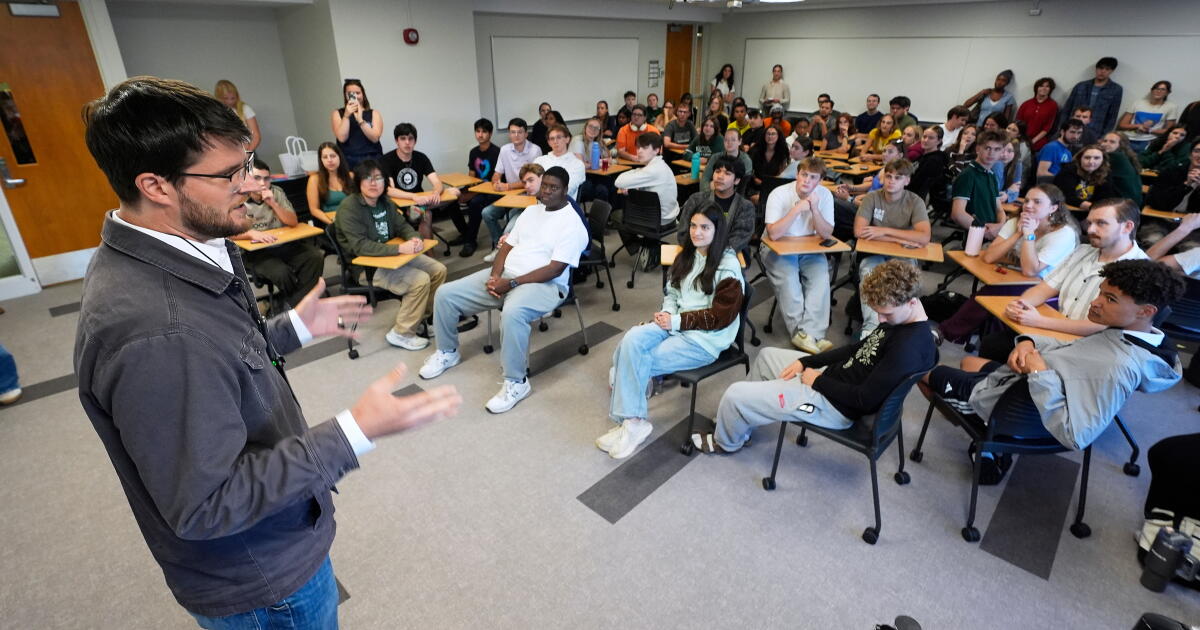
Her politics are the polar opposite of many liberal students who gathered to hear Lawrence, Barrett’s Democratic challenger, talk in a classroom one recent evening, but there was a similar desire for dramatic change. Lawrence sympathized with the glum feelings of early adulthood and urged the students not to succumb to despair.
“When I was a little younger I wanted to drop out of society, and it was organizing that gave me a path in life,” Lawrence said.
After the candidate left, however, Bautista still sounded on the verge of despair. He talked about how online influencers he trusts deride Democrats such as Senate Minority Leader Chuck Schumer of New York as “mini-me’s” because, in Bautista’s view, they are just watered-down versions of Trump.
“Our leaders are representing us less,” Bautista said. “People are desperate for big stuff.”
Ganun and Riccardi write for the Associated Press.