As a kid growing up in rural Oklahoma, I feared what lurked beneath the lake water.
I’d listen as my family spun yarns about the massive catfish they’d discovered while noodling. I was terrified that, despite their docile nature that not a single adult told me about, an alligator gar would eat me while I bobbed in the lake. Old timers would recount finding a water moccasin in their boat. And I’ve still never recovered from the concept of a “breeding ball,” which a friend’s cousin’s cousin claimed to have run into while water skiing.
Despite the fact that nothing bad ever happened to me in a lake, my fear stayed with me into adulthood. I’ve met several Californians who hold fears similar to mine, but rather than lakes, their outsized anxieties lie within the ocean. It not only keeps them from swimming at our local beaches but also from venturing beyond the shallow shoreline.

An underwater view near Terranea Resort on the Palos Verdes Peninsula.
(Allen J. Schaben / Los Angeles Times)
In this week’s edition of The Wild, our weekly outdoors newsletter, I will discuss how to safely tackle those fears and start exploring with a snorkeling kit. Get ready to learn about the incredibly diverse and colorful world that lives beneath our local waters — you’re about to feel like Ariel exploring a whole new world! Let’s dive in.
I spoke to Ralph Buck, who founded Barnacle Busters, an L.A.-based LGBTQ scuba club, with two others almost 40 years ago. Buck’s passion for helping others learn how to safely explore the ocean was so infectious that by the time we ended our call, I was seriously considering whether I should get my scuba certification (which is a story for another day).
Here’s what Buck advised regarding snorkeling.

The Wild writer Jaclyn Cosgrove snorkels among what appear to be grunion or topsmelt near the coastline of the Palos Verdes Peninsula.
(Allen J. Schaben / Los Angeles Times)
1. Get the right gear
Generally you will need the following gear to get started:
- A correctly sized mask and snorkel.
- A wetsuit (with booties, as a bonus, to protect your feet): Generally, 7 mm is a great thickness for Southern California, although our water is warmer because of our El Niño season (and climate change).
- A life jacket or flotation device: This is considered optional, as the wetsuit will help you float, but there’s absolutely no shame in being extra safe! (And if you don’t have a wetsuit, please do wear a life jacket.)
- Fins: It might be too strong to suggest they’re “optional,” but they can be awkward for those new to snorkeling and not necessary if you’re in calm enough waters or an overall strong swimmer.
- Camera: Very, very optional. While out at Santa Cruz Island two weeks ago, I took some terrible underwater photos with my iPhone and wished I’d just left it on the shore.
- Weight belt: If you want to dive, you might need a weight belt to help you go under. That said, this is a more advanced tool, and it’s good to just focus on the basics as you get more comfortable in the water.
One thing new snorkelers might not realize is the level of buoyancy that a wetsuit gives you. Both times I’ve been in the past month, I wore a 7-mm suit and loved how easy it was to float above the eel grass at Santa Cruz Island and the kelp on the coast of Palos Verdes. I love a sport that includes just lying around.

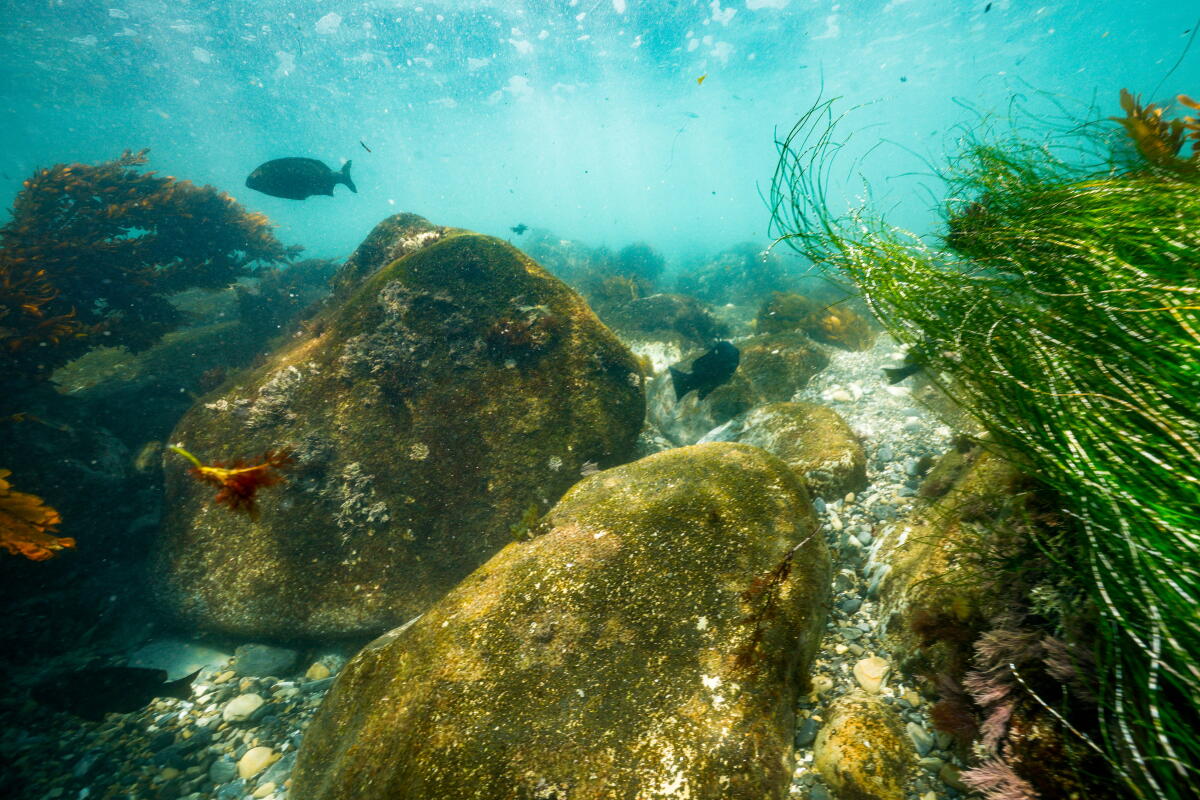
Kelp, sea grass and various algae grow beneath the water at Terranea Beach Cove in Rancho Palos Verdes.
(Allen J. Schaben / Los Angeles Times)
2. Plan for getting your wetsuit on
For anyone on the shore of Prisoners Harbor two weeks ago, they got the pleasure of watching me groan (and curse) as I maneuvered into a thick wetsuit without anything but my swimsuit on. I told my friend I knew what sausage felt like as it’s shoved into its casing.
Zach Cantrell, owner of Ventura Dive and Sport, gave me a tip I will be eternally grateful for: Bring a plastic bag or something else that will help you slide into your wetsuit, as it helps reduce the friction between your body and the wetsuit. I brought one with me when my colleague, Allen J. Schaben, and I went out last week, and getting my wetsuit on was a breeze. No human sausage vibes (or cursing).
Buck suggested other options might be pantyhose or a long-sleeved unitard. Anything to help you slide into your wetsuit!
3. Before going out, practice in a pool
“I would suggest before hitting the open water, go hop in a pool and maybe find an experienced snorkeler to go with you simply because there are some subtle little pieces to the puzzle, which are” easy to miss for a new snorkeler, Buck said.
That includes the direction to point your snorkel. If it’s pointing too far forward, you will likely find yourself breathing straight saltwater as the waves hit you. But if you point it straight up or tilt it a bit backward, it’ll help your breathing apparatus stay clear.

A variety of marine life living around the rocky bottom of Terranea Beach Cove in Rancho Palos Verdes.
(Allen J. Schaben / Los Angeles Times)
4. Never snorkel alone
You look out at the ocean and see calm waters. You hear the siren’s call. You are alone. Resist.
Despite looking like a fairly chill activity, snorkeling still comes with significant risks that will be exacerbated if swimming alone. While out with my colleague off the coast of Rancho Palos Verdes, he pointed out a massive rock that I thought I could maneuver around. I timed my movements wrong and whacked right into it. I was fine, but also glad someone had my back if I wasn’t.
5. Assess the day’s conditions
- Check the weather. If it is a particularly windy day, it’s likely not a good day for snorkeling, not only for safety reasons but also visibility.
- Check the surf. There are several websites that pull data about the height of the surf, including the L.A. County Department of Beaches & Harbors.
- Before entering, scan the shore to assess the movement of the water.
- Learn how to spot rip currents. Rip currents “most commonly form at low spots or breaks in sandbars and near structures such as groins, jetties, and piers,” according to the National Oceanic and Atmospheric Administration.
“If you’re a beginner, and the waves are higher than knee high, I would just go to brunch,” Buck said. “If the surf’s too big, your visibility is going to suck anyway.”
I do love any excuse to have waffles.

The Wild writer Jaclyn Cosgrove carefully enters the water at Terranea Cove Beach in Rancho Palos Verdes.
(Allen J. Schaben / Los Angeles Times)
6. Choose an area that’s easy to enter and exit
This includes sandy beaches, where you can easily wade into the water without losing your balance. At Prisoners Harbor, I fell over several times because the shore is covered in various fist-sized rocks. (I need to work on my balance.) Snorkeling off the Palos Verdes Peninsula, I took my time, watched the waves and slowly moved into the water as the waves allowed. I found that, when there are rocks around, walking into the water like I’m navigating a balance beam is a good approach.
Also, in terms of looking for the best spots to snorkel, look for kelp forests and rock reefs. And because you’re newer, I would stick to spots known for snorkeling.
7. Plan for fog
Buck said before the COVID-19 pandemic, the Barnacle Busters, like most diver clubs, would recommend a simple solution to fog in your goggles: Spit. They still recommend using your spit in bodies of water where your germs won’t immediately affect other swimmers like in the ocean.
You can also buy an anti-fogging agent for your goggles. If you take your goggles off at any point as you snorkel, you’ll need to reapply either spit or anti-fog spray.
While I was out snorkeling, I was amazed at how well spit worked. (And if you want to understand the science behind why this works, check out this blog post from Scuba.com.)

A garibaldi, California’s state fish, at Casino Point Dive Park on Catalina Island in 2016.
(Allen J. Schaben / Los Angeles Times)
8. Check in with yourself and your partner
You should check in with your partner every 30 seconds. That might feel like it’s way too frequent, but you’ll be amazed at how far apart you can float from your friend in that time frame. It can be as simple as making sure you see them and they see you.
9. Keep an eye out for hazards
When entering the water, you’ll want to do the “stingray shuffle” to ensure you alert any nearby rays of your presence. Around L.A. County, you’ll also want to watch out for sea urchins because their spines can prick your skin, which will require treatment if you bump into them.
As our county lifeguards point out, L.A. beaches aren’t typically places you’ll find the most dangerous jellyfish. “Jellyfish in Southern California are usually smaller in scale and have a more mild sting than other species found around the world,” according to the agency’s website.
(And don’t worry. Electric eels don’t live in the ocean.)
I asked Buck how often he and his fellow divers check for hazards like sharks.
He told me that outside of rocks, high surf and going out too deep for one’s skill level, he and his diving partners don’t think too much about hazards in our local waters.

Purple sea urchins grow on a rock near the shore of Prisoners Harbor on Santa Cruz Island in the Channel Islands National Park.
(Jaclyn Cosgrove / Los Angeles Times)
“Well, we don’t consider sharks to be a hazard at all. My husband and I blame Steven Spielberg for the irrational fear of sharks,” Buck said, referencing Spielberg’s 1975 film “Jaws” and the adverse effects the film had on white sharks.
Buck said he and his husband rarely see sharks. He does give some weight to the argument that divers in wetsuits can resemble seals and sea lions when floating on the surface.
“But in areas where you’ll probably be snorkeling, you’ll probably be snorkeling on shallow rocky reefs or shallow kelp. It’s not even a consideration for us,” he said.
Lastly, if you or your partner start to shiver, get out.

The Wild writer Jaclyn Cosgrove snorkels at Terranea Cove Beach in Rancho Palos Verdes.
(Allen J. Schaben / Los Angeles Times)
10. Don’t touch anything
Practice Leave No Trace in the ocean too. “That’s our philosophy for diving too,” Buck said. “Look, but don’t touch.”
And never feed the marine life.
11. Have fun!
Since learning to snorkel, I’ve already found two friends who also enjoy it, and I plan to ping them to go out soon. If you don’t have anyone in your circle who snorkels yet, consider joining a local club.
In a world that feels hard right now, I felt like I had a two-hour vacation as I floated above the bright green sea grass and golden yellow kelp, watching garibaldi and what appeared to be grunion or topsmelt bob and dive around me. I came out refreshed and grateful to live here.

3 things to do

The hike to Eaton Canyon Falls in the San Gabriel Mountains before the 2025 Eaton fire.
(Myung J. Chun / Los Angeles Times)
1. Learn about Eaton Canyon’s future in Arcadia
L.A. County Parks and Recreation will host From Ashes to Action: Reimagining Eaton Canyon from 5 to 7 p.m. Wednesday at the L.A. County Arboretum’s Ayres Hall (301 N. Baldwin Ave. in Arcadia). Attendees will learn about design concepts for the next Eaton Canyon nature center along with the latest work completed in the natural area. The event is free, but registration is required. Register at arboretum.org.
2. Service sage in San Pedro
Cabrillo Marine Aquarium (3720 Stephen M. White Drive) needs volunteers from 9 to 10:30 a.m. Saturday to work on its native plant garden. Participants will learn about plants as they work. All ages welcome. Learn more at cma.recreation.parks.lacity.gov.
3. Launch into Latino Conservation Week in L.A.
The Audubon Center at Debs Park will kick off Latino Conservation Week from noon to 6 p.m. Sunday at Metabolic Studio (1745 N. Spring St.). Activities include a bachata class, panel discussion and guided nature hike. Learn more at act.aubudon.org.

The must-read

Burn damage to the Torrey pine grove at Santa Rosa Island, as seen from a ferry on June 8.
(Kayla Bartkowski / Los Angeles Times)
Last week, the National Park Service announced that up to 80% of the rare Torrey pines on Santa Rosa Island in the Channel Islands National Park could die after being harmed by a wildfire in May. Times staff writer Corinne Purtill wrote that initially park officials were hopeful that because the fire, which charred through 40% of the 18,000-acre island, burned at low intensity through the grove, the trees could recover. Research found the fire hurt the mature trees’ exposed root systems. However, I am holding onto hope — for a few reasons. “Park staff have also collected more than 14,000 seeds released from the pine cones. Viable seeds will be planted and raised in a nursery until the seedlings can be planted in the grove,” Purtill wrote.
Another reason is that volunteers are already actively working to save these trees. You can help with that. The California Institute of Environmental Studies needs volunteers to help with recovery as well as with Channel Islands Restoration. You can also donate to the Channel Islands Park Foundation’s Santa Rosa fire resilience fund.
Now more than ever, it’s on us to protect our public lands.
Happy adventuring,

P.S.
While out kayaking off the coast of Santa Cruz Island last month, I yanked a plastic wrapper out of the ocean. I frequently pick up plastic snack wrappers and corners of wrappers that people have accidentally dropped on the trail. And not infrequently have I found thick plastic bags — those said to be reusable — floating in shallow water near the beach. In recent years, California lawmakers have passed laws to address our state’s plastic consumption, including the Plastic Pollution Prevention and Packaging Producer Responsibility Act, or Senate Bill 54. Starting in 2027, the state will receive $500 million every year for 10 years to address plastic pollution, and state leaders want to hear from you how to best spend that money. You can submit your thoughts through Sept. 30 using this form or send your message using the email listed on the form’s webpage. Times staff writer Susanne Rust recently wrote about how there’s a secretive multimillion-dollar campaign to crush California’s landmark plastics law. If the battle over single-use plastic in California is something you’re passionate about, consider subscribing to Boiling Point, where my Times colleagues explore what’s happening to our climate-changed world. They’ll definitely keep you posted!
For more insider tips on Southern California’s beaches, trails and parks, check out past editions of The Wild. And to view this newsletter in your browser, click here.