Amid stiff competition, the Bernese Oberland is probably the Swiss Alps – perhaps any Alps – at their best. Here, the Jungfrau, Mönch and Eiger loom in thrilling cohort, lakes dazzle in extraordinary shades, waterfalls tumble down elvish valleys and picturesque villages teeter at dizzying heights. And, this being Switzerland, everything is connected by efficient PostBuses, gondolas, mountain railways and, of course, walking trails.
Summer is the best trekking season – trails are snow-free, mountain huts are open, the weather is most settled. Route options are numerous. Cicerone’s new trekking guide, The Bernese Oberland, recommends a nine-stage, 74-mile tour of the Jungfrau region, a magnificent moderate-grade, hut-to-hut loop from the mountain village of Grindelwald.
Those shorter on time could spend a few days walking between cute, car-free Mürren and Wengen, Kleine Scheidegg (from where the Jungfraubahn railway grinds up to 3,454m), Grindelwald and Schynige Platte – the hike to this mountain ridge, with views up to snowy peaks and down to lakes Thun and Brienz, is arguably Europe’s finest day walk.
How to do it Accommodation is plentiful; berths in Swiss Alpine Club huts can be booked in advance at sac-cas.ch. Macs Adventure offers an eight-day Grindelwald Trail trip from £1,510pp.
The Alpe Adria, the ultimate pleasure trail, Slovenia and Italy
The Soča river in Slovenia, on the Alpe Adria trail. Photograph: Yuliia Burlachenko/Alamy
Distance up to 465 miles Duration 7-9+ days
If you’ve got all summer, the Alpe Adria is a hiker’s dream: more than 450 miles of leisurely ambling, from the base of Grossglockner, Austria’s highest mountain, to the shores of the Adriatic.
If you don’t have time for the whole route, go for a one week chunk in Slovenia’s Julian Alps. Despite being scenically spectacular, and cheaper than, say, Switzerland or France, Slovenia’s mountains still tend to be quieter than other regions in summer.
The section from the resort of Kranjska Gora to Cividale del Friuli, over the border in Italy, packs in the high peaks and passes of Triglav national park, the emerald-hued Soča River, mountain villages and the Isonzo Front, where Italian and Austro-Hungarian forces clashed in the first world war; old bunkers can still be seen. It’s a moderate-to-challenging 80-mile, six-day hike, but well worth the effort, with one of the best views saved for last: the final ascent over the Kolovrat mountain ridge delivers a panorama taking in both Alpine peaks and the Adriatic Sea.
Near Porto, on the coastal route to Santiago de Compostela. Photograph: Ivoha/Alamy
Distance 170 miles Duration 2 weeks
If you’re set on a summer pilgrimage to Santiago de Compostela, make it this coastal one. The route from Porto to the tomb of Saint James is the third most popular camino, offering plenty of peregrino camaraderie, but less human traffic than the busy Camino Francés. Plus Atlantic gusts keep things a little cooler, with lots of opportunities for refreshing dips.
Starting from Porto, the trail follows the coast, via fishing villages and swathes of blond sand, up to Caminha, where a boat across the River Minho deposits walkers in Spain. The trail continues to hug the coast to Vigo, the 100km-to-Santiago mark. Many pilgrims start here, the minimum distance required to earn a completion certificate. Soon after, the camino leaves the sea, finishing with an inland stretch, past the hot springs of Caldas de Reis and the hot peppers of Padrón.
How to do it Municipal pilgrims’ hostels can’t be pre-booked (they’re first come, first served). Private hostels and hotels should be booked in advance in summer. Exodus offers a 15-day self-guided Portuguese Coastal trip from £1,839pp
Along the Lech, an untamed Alpine river inAustriaand Germany
The River Lech near Forchach, Austria, with the Lechtal Alps in the distance. Photograph: PK-Photos/Getty Images
Distance 78 miles Duration 7-10 days
It feels cooler, walking by water. Which makes the river-tracing, shade-bathed Lechweg a good option for a summer stroll. The easy-to-moderate route was the first to be designated a Leading Quality Trail by the European Hiking Federation, an indicator of its excellent infrastructure and waymarking.
It follows the River Lech from its source in the mountains (at 1,793m, so the trail can only be accessed in full from mid-June to early October) near Austria’s Formarinsee lake to the Lechfall waterfall in Füssen, in Germany’s Bavarian Alps. Soon after that, the river becomes tamer, dammed to serve hydroelectric power stations. But before Füssen, the Lech – one of Europe’s last remaining stretches of wild river – runs free, its turquoise waters braiding over gravel plains, fed by Alpine streams, roaring through gorges and frothing amid pine forest and soaring peaks.
However, while the landscape feels untouched, facilities are plentiful, with a succession of mountain towns and villages offering comfy lodging, historic churches and artisans producing everything from beer to cheese.
How to do itLechweg.com has details of trails and accommodation. Walkers’ Britain offers an eight-day, self-guided Lechtal trip from £990pp.
The Beara Way, a quieter and wilder side of south-west Ireland
Uragh Stone Circle on the Beara peninsula, Ireland. Photograph: Vibbily/Alamy
Distance up to 128 miles Duration 3-10 days
South-west Ireland’s remote Beara peninsula offers a respite from summer temperatures elsewhere: cooled by Atlantic breezes, it’s rarely too hot down here. And, dangling below the better-known Dingle and Iveragh peninsulas, Beara escapes some of the crowds, too.
The Beara Way makes a loop of this rugged finger of land, using tracks, bog roads and boreens (country lanes) to negotiate hills and valleys, ancient stone circles, early Christian churches, 19th-century copper mines, even a Tibetan Buddhist retreat. The full Beara Way, beginning and ending in Glengarriff, can be done in around 10 days. Or you could spend a few days tackling a selection of the route’s 15 spin-off circular walks. These include taking Ireland’s only cable car over the sea to Dursey, to make a nine-mile loop of this largely deserted isle, or catching the ferry from Castletownbere to make a circuit of Bere, an island-cum-open air museum, home to Martello tower forts, gun batteries, a lighthouse and a harbour fortified by Vikings.
Ramsvikslandet, on Sweden’s Kuststigen trail. Photograph: Fredrik Schenholm
Distance up to 234 miles Duration 2-5+ days
The Kuststigen isn’t a continuous hike along West Sweden’s Bohuslän coast; it is 44 well-marked stages (some connected, some not, with most easily accessible by ferry or bus) showcasing this knockout shoreline’s sapphire seas, pink granite outcrops, bright-painted fishing villages and some of its 8,000 idyllic isles and skerries. This makes it an easy trail to dip into for a few days’ sea-breezy summer hiking.
The Swedish holiday season runs from July to mid-August, so go in late August to early September (or next June) when the weather will still be mild and the coast crowd-free.
Which sections to choose? Stage 22 (7 miles) loops Ramsvikslandet, a striking peninsula nature reserve known as the Kingdom of Rocks. Combine it with stage 24, the linear Kungshamn-Tullboden route (10 miles), then a ferry hop to complete stage 25, a circuit of Bohus-Malmön (6 miles), via ancient monuments and swimming lagoons. For city-accessible strolling, take the free ferry from Gothenburg’s Lilla Varholmen terminal to Hönö, to walk stages 1-3 (17 miles in total), an unfurling of flowery meadows, sandy beaches, swim spots and seabirds.
I was explaining the location of my broken-down car in Angeles National Forest to the tow truck dispatcher when I suddenly found myself shouting.
“Bear!” I yelled.
A black bear ambled across the road and into Red Box Picnic Area. I hollered at the bear, as did another person in the lot.
The bear ignored us both, focused on where it would find its dinner that night: a bear-proof trash can.
You are reading The Wild newsletter
Sign up to get expert tips on the best of Southern California’s beaches, trails, parks, deserts, forests and mountains in your inbox every Thursday
By continuing, you agree to our Terms of Service, which include arbitration and a class action waiver. You agree that we and our third-party vendors may collect and use your information, including through cookies, pixels and similar technologies, for the purposes set forth in our Privacy Policy such as personalizing your experience and ads.
In this edition of The Wild, our weekly outdoors newsletter, I will share the three bear encounters I had last week with black bears in Angeles National Forest. They were my first, second and third times to experience bruins in the San Gabriels. The third time, when a bear slapped my backpacking tent, was the most memorable moment. We’ll get to that later.
For anyone feeling rusty on the best course of action when you see a black bear in our local mountains, here’s a quick refresher on the tips I got previously from a conservation biologist.
🙅🏃Don’t run. You will look like prey.
🗣️ Let bears know you’re there. Say something loudly and calmly — don’t shriek! — like “Hey, bear!” in a deep voice.
💪 Make yourself big. Put your hands up and out — don’t shake them around — and try to get the bear’s attention without indicating that you’re scared or that you’re a threat to that bear.
👀👀👀 Keep your eye on the bear. But don’t look it in the eye. That can be perceived as threatening or like you’re trying to be dominant.
🤔 Observe its behavior and react accordingly. To learn more about this portion of my tips, check out No. 4 on my list.
🏔️ Carry bear spray. Bear spray is legal to carry in Angeles National Forest and generally on national forest land unless otherwise posted. It is prohibited in Yosemite National Park and other California national parks.
A black bear wanders along Canyon Road in March 2020 in Arcadia.
(Irfan Khan / Los Angeles Times)
Anyone who hikes in Angeles National Forest is likely familiar with Red Box Picnic Area. It’s where adventurers park to hike up to Strawberry Peak or other nearby trails, like the Gabrielino Trail, which I wrote about last week. That’s how I found myself briefly stranded in the forest.
I had spent the day hiking past gorgeous wildflowers and splashing around in the Arroyo Seco. I got back to my car around 7:30 p.m., discovered my car’s battery was dead and, after realizing I had cellphone reception, called for help.
As I waited, I chatted with a good Samaritan, an outdoors woman reading a book in her car who decided she’d wait with me until a service technician arrived.
The bear arrived in the lot around 8:30 p.m. As the sun dipped lower into the horizon, we watched the hungry fluffball knock over the brown metal trash can that was specifically designed to keep its species out.
A bear with its head inside a bear-proof trash can.
(Jaclyn Cosgrove / Los Angeles Times)
After knocking the trash can down, the bear easily shoved its arms inside. Over the next several minutes, it repeatedly shook the can toward its (adorable) face. It was kind of like watching a human shake a potato chip bag toward their mouth to get the very last bits of delicious fried starch.
My new friend and I agreed, in all our travels throughout California, we hadn’t seen anything like this. I contacted the California Department of Fish and Wildlife to ask them: How normal is it for a bear to deftly navigate the mechanisms of a trash can built to resist it?
“It’s pretty uncommon that the bears actually break in,” agency spokesman Cort Klopping said. “When I was talking to our biologist about it yesterday and a couple people in the office, the reactions were all kind of like, ‘Wow.’ Either somebody didn’t secure that thing or that bear was an absolute hulk of a bear to get into a bear-proof or bear-resistant trash can. … I was joking with the biologist that I think I’ve actually had trouble opening those.
“You were witness to what I would refer to as a pretty rare sight,” Klopping added.
I’d known there was a bear in the area when I started my hike earlier that day. At Switzer Picnic Area, I read signs posted around the picnic tables warning visitors, “Active Bear Area: Do not feed bears or leave food unattended.” The flier featured an image of a bear standing on a picnic table, eating through some family’s meal.
A sign posted at the Switzer Picnic Area in Angeles National Forest.
(Jaclyn Cosgrove / Los Angeles Times)
Angeles National Forest spokesperson Keila Vizcarra said in an email that since last August, forest officials have received at least four reports from the public and staff about two bears active in the Switzer area.
Earlier this month, recreation staff spotted two bears at the Switzer Picnic Area eating food left unattended at a picnic table. They notified state wildlife officials.
“The animals may be the same bears seen last year, but it is difficult to confirm because tag numbers are not always visible or provided; in this case, one of the bears did not appear to be tagged,” Vizcarra said.
Forest staff use various hazing methods to discourage bears and other wildlife from eating human food, like making loud noises, securing or repairing trash cans and educating visitors about how to keep their food safe from animals, she said.
“A major contributing factor continues to be unsecured or unattended food, which attracts bears from long distances,” Vizcarra said.
The bear at Red Box finished its trash-inspired tasting menu and then walked past our cars. We both honked, but it was so unfazed, I wondered aloud whether it was deaf. (It wasn’t.)
It then headed south from the parking lot, and we didn’t see it again. I had already planned to write this week’s newsletter about that experience.
Then I went backpacking as a little treat to myself.
On Friday afternoon, my dog, Maggie May, and I headed out from near Pasadena down the Gabrielino Trail with a plan to camp overnight at the Gould Mesa Trail Camp. Despite loving the outdoors, I’d never been backpacking, but after my parents bought me a tent and sleep pad for my birthday in late May, I was itching to go. Gould Mesa is close to a city. It’s next to the Arroyo Seco with water to filter and reachable by a short two-mile mostly flat hike. It felt like the perfect first trip.
About a mile in, a mountain biker warned us of a “big bear, really big bear” at the campground before he sped off. A female hiker told me the bear was average, probably 5 feet on its haunches. Others hadn’t seen it.
I was talking to another mountain biker, who was telling me the bear had been active in the area for about a month, when a man came racing down the trail, shouting about how the bear was aggressive and dangerous. The man said he’d lunged at the bear, trying to protect his food, and proceeded to make several choices that would likely be found on a “What not to do when you encounter a bear” list. Maggie and I continued onward.
We arrived at the campground around 4:30 p.m. and didn’t see anything. I asked a mother and son set up at the site next to mine about the bear, and they pointed to a large coast live oak where a small, young bear laid over a thick branch, its small feet dangling down, right above the trail. One reason hikers hadn’t seen the bear was that they’d walked right under it.
A young bear lies on the branch of a large coast live oak above the Gabrielino Trail near Pasadena.
(Jaclyn Cosgrove / Los Angeles Times)
The bear had entered the campground from near the river, and without the mother-son duo realizing that the bear was approaching them, it grabbed their food right off their picnic table. The mom told me that she considered trying to pull the food back, but the bear made noises suggesting that it preferred she didn’t. It then left the campground, and presumably after eating the meal that her son told me had “a lot of protein” in it, the bear climbed into the tree and took a nap.
I’d camped in areas with bears before, including in Kings Canyon National Park where bears came into the campground every night. This bear wasn’t being aggressive. Instead, it seemed young and like it was testing out how easy it was to get food from these weird animals — we humans — in its backyard.
I decided to stay, especially after the bear left around 7:30 p.m., and none of us saw it again. The campground was full, and two of us, myself included, had bear spray.
Maggie and I got into the tent around 9 p.m. and soon fell asleep to the sweet serenade of frogs and toads singing their nightly songs.
Then, at 2:39 a.m., I woke up to the sound of something slapping the corner of my tent next to my head.
“What the f—?” I screamed.
I lay there, heart racing, listening.
I had put my tent’s rain fly on, so I couldn’t see outside, but I could hear the bear as it left. A large whoosh-whoosh sound headed away from my tent.
For the next 20 minutes, I listened intently to every single sound the forest made. Then, after checking that my bear spray and satellite communicator were close by, I fell back asleep. In the morning, I found a small cut in my rain fly that the bear’s paw had left. My dad later suggested that I date the hole with a marker.
A small cut left after a bear swiped the rain fly of Wild writer Jaclyn Cosgrove’s backpacking tent.
(Jaclyn Cosgrove / Los Angeles Times)
Maggie and I left around 10:30 a.m. to beat the day’s heat. Once at my car and with strong cellphone reception, I must admit that I opened ChatGPT. I don’t have a bear biologist on speed dial — yet! — and I wanted to talk to someone about why the bear hit my tent.
I explained that there wasn’t any food or toiletries in my tent. I had packed everything inside a bear canister that I then placed inside the bear vault in the campground. The chatbot and I soon agreed: This bear was likely making its rounds for a late-night snack, hoping someone had dropped a marshmallow or hot dog, when it encountered my tent. Maybe my tent was in its way. Maybe it looked weird.
Later, I called Klopping with the California Department of Fish and Wildlife again.
When we’d spoke earlier in the week about the trash-can bear, I’d asked him whether that bruin was at risk of euthanasia.
I told him that Goldie, a mama bear euthanized by the state earlier this year after swiping at and injuring two people, was top of mind for me, along with Victor, a beloved bear in Mammoth who was euthanized in 2024.
Goldie was the first California black bear to be euthanized in 2026, Times staff writer Clara Harter reported. “There were two bears euthanized in 2025, three bears in 2024 and five bears in 2023, according to Fish and Wildlife,” Harter wrote.
Klopping said the trash-can bear was just out for an easy meal and would be classified as a “no harm, no foul bear,” defined by the agency as “a bear that has strayed into an area where an incident could occur, has not engaged in nuisance activity or caused property damage, and may require assistance to return to nearby suitable habitat.”
He said it was unlikely, based on what I reported, that the bear would be moved since it was already in a forest far from any neighborhood. Instead, the only action would probably be that someone secure the bear-proof trash can so it actually functions properly. (Sorry, bear.)
“As much as I don’t want to say it, this bear is doing bear things,” Klopping said. “This is a natural thing for a bear to do. It’s searching out calories to sustain itself — they’re there, readily available. This bear knows how to get to them.”
When I called Klopping back to talk about the bear (or bears) at the campground, I was more worried. I reported the incident through the agency’s website because I know its biologists use the data for several reasons, including discerning when to implement bear-resistant measures in an area or relocate a bear. But again, I worried about what would happen to the bear or bears.
A black bear peeks its head around the vault toilets in the Red Box Picnic Area in Angeles National Forest.
(Jaclyn Cosgrove / Los Angeles Times)
Klopping had told me it was rare for the agency to euthanize a bear: California Department of Fish and Wildlife received 2,735 calls and reports regarding black bears in 2025, including some duplicates where multiple people were reporting the same incident, compared with the two bear euthanizations that same year.
During our second call, he told me that a biologist would review the report I made and might call me to get additional information, but again, this wasn’t “aggressive” behavior, he said.
When bear yearlings separate from their mothers at around 18 months old — which often happens in June — Klopping said the agency will get reports of these adolescent bears wandering closer to populated areas.
“You would use the term ‘testing boundaries’ — that may have been exactly what happened here,” he said. “Odds are pretty good you probably scared it just as much as it scared you.”
I hope the bears I encountered soon return to foraging for forest delicacies that don’t come in fast-food wrappers.
As interesting as last week was, I really hope the only bears I see the rest of the summer are at the pride festivals I attend. They’re absolutely welcome to go camping with me!
3 things to do
Cyclists ride down an open street at a previous CicLAvia event.
(CicLAvia Los Angeles)
1. Frolic through the streets in South L.A. CicLAvia will host a free car-free open streets event from 9 a.m. to 4 p.m. Sunday through the Leimert and Exposition Park neighborhoods. The 3.6-mile pop-up park includes a short segment of Crenshaw Boulevard and mostly stretches along Martin Luther King Jr. Boulevard from Crenshaw to Figueroa Street. Visitors are welcome to walk, skate, bike, play and explore along the route. For more details, visit ciclavia.org.
2. Celebrate Pride along the river in Long Beach Friends of the L.A. River will co-host an LGBTQ Pride nature walk from 10 a.m. to noon Saturday through the Dominguez Gap Wetlands with the California Native Plant Society South Coast Chapter. Plant enthusiast Tory Jaimez will guide the walk, teaching participants about local ecology. Register at support.folar.org.
3. Listen to the birds in Huntington Beach We Explore Earth, a local outdoors community group, will co-host with Save Orange Hills and Friends of Shipley Nature Center a peaceful bird walk from 8:30 a.m. to 11:30 a.m. Saturday at Shipley Nature Center in Huntington Beach. Guides will help participants learn about local bird species and ecosystems. Register at eventbrite.com.
The must-read
Perched atop a tall pine tree, resident bald eagles Jackie, left, and Shadow protect their latest offspring in their 5-foot-wide nest. The nest is viewable via a live feed from the nest cam.
(Gina Ferazzi / Los Angeles Times)
Friends of Big Bear Valley, the nonprofit behind a popular eagle nest camera, is rushing to raise $10 million by July 31 to buy land that could become a lakeside gated community, leading to the destruction of crucial habitat that celebrity birds Jackie and Shadow use for foraging, along with other wildlife who call it home. Times staff writer Lila Seidman wrote that if the nonprofit can raise the money, then the San Bernardino Mountains Land Trust would conserve the roughly 63 acres and might transfer it to the U.S. Forest Service (a common practice of land conservancies). That’s if they meet the July deadline. “Failure is not an option,” said Jenny Voisard, media and website manager for Friends of Big Bear Valley. “We’re not going to let them build on it.”
Happy adventuring,
P.S.
After Goldie the bear was euthanized, lawmakers listened to the public’s demand for a more transparent process of when the California Department of Fish and Wildlife plans to kill a bear that the agency has deemed a threat to public safety. That includes Senate Bill 1135 by state Sen. Catherine Blakespear (D-Encinitas) that would “create the Wildlife Coexistence Program, which would provide public education, offer technical assistance and maintain a statewide incident reporting system. It would help communities deploy nonlethal devices to deter predators, like barriers or noise and light machines,” former Times staff writer Katie King wrote. The bill is set to have a hearing before the state Assembly’s Committee on Water, Parks and Wildlife on Tuesday at the state Capitol. Although the deadline to submit a letter to the committee has passed, residents can still attend the hearing, where they’re allowed to give their name, organization (if with one) and their position on the bill. You can still also contact your Assembly member or the committee.
For more insider tips on Southern California’s beaches, trails and parks, check out past editions of The Wild. And to view this newsletter in your browser, click here.
Flat fields of poppies and ox-eye daisies stretch out to a wide horizon. There are butterflies, vetches, salad burnet. Skylarks sing overhead and a cuckoo calls from the trees near the river. Legend has it that the poet Lord Byron swam here as a Cambridge undergraduate and, 20 years later, Charles Darwin surveyed its beetles. Heading through flowering meadows towards a nature reserve known as Byron’s Pool, I’ve walked a mile from the new £250m Cambridge South station.
Opening to passengers on 28 June, Cambridge South will be the first Great British Railways-branded station. The towering Biomedical Campus next door is Europe’s biggest medical research facility, with about 40,000 visitors a day. The station itself, with its 1,000 cycle-parking spaces, living roof and solar panels, feels like a model for sustainable transport.
The new Cambridge South station, with its living roof. Photograph: Bav Media
Like other scenic medieval cities, Cambridge itself suffers from congestion. Its cobbled alleys are crowded with tourists, its roads gridlocked with cars. But you can reach some wild and peaceful corners without adding to the traffic. There are layers of human and natural history, a newly devised art trail, bat safaris by punt and a peaceful botanic garden near the busy central station.
Cambridge has been my nearest city for the last 15 years. With lots of buses and now three stations, it’s easy to get around without a car. I’ve spent countless days exploring, and published guides to the long-distance Harcamlow Way, a 140-mile (227km) figure-of-eight walking route that loops between Cambridge and Harlow. The best rural bus routes include the busway from Cambridge North station (opened in 2017) to Fen Drayton lakes and bus 1 to Fulbourn for orchid-rich fens and chalk-flowered Saxon Fleam Dyke.
Walking and cycle paths head out in all directions from the new station at Cambridge South, and I am following one of these to Trumpington, stopping for bao buns and peach oolong tea at the Dao cafe. In the village church, I find one of England’s oldest brass monuments. Sir Roger de Trumpington, who died in 1289, is lying in prayer and full chain mail, with a little lion-clawed dog biting his broadsword. Just south of the church, archaeologists unearthed the grave of a young Anglo-Saxon woman, with a delicate gold-and-garnet cross on her chest.
Heading north through Grantchester Meadows, I have a dip in the reedy River Cam, keeping my head above the willow-shaded water. Sun glints off ripples as I swim past waterlilies, moorhens and straggling blue forget-me-nots. Walking on towards the city through Paradise nature reserve, there are birds everywhere: a cetti’s warbler sings loudly from a reedbed and a song thrush from a waterside alder. A mother duck quacks warnings from a nest-topped tree stump as ducklings paddle underneath.
Cambridge University Botanic Garden. Photograph: Travelbild/Alamy
Twenty minutes further on, Cambridge University Botanic Garden (adults from £8.60, children free) is at its fragrant best. Bees are buzzing through sage, lemon balm and lavender in the scented garden; roses sprawl above foxgloves and cranesbill. There are benches in the cow parsley under walnut and cherry trees, where I sit and listen to blackcaps and chiffchaffs. I detour five minutes up the road to buy a slice of apricot tart from Maison Clement bakery and eat it on the train home.
In the last decade or so, several hotels have (re)opened near the central station, from the right-next-door Ibis (doubles from about £80) to the fancy University Arms (from about £175), where Parker’s Tavern brasserie can pack you a gourmet picnic hamper (£45pp) with 24 hours’ notice. Nearby, one of the city’s newest offerings, Hobson by Adina, has studios from about £125.
The next day, I catch bus 13 three stops to the iron age hill fort at Wandlebury, stroll round its wooded ramparts and past flax-blue meadows, sweet with wild marjoram. The grassy track of an old Roman road runs through shady beeches and pink dog roses.
Heading back into the city, I time-travel to Victorian Cambridge, when designers such as William Morris commissioned master painter FR Leach to decorate halls and churches. I thought I’d visited nearly all the city’s 30-odd museums and galleries, but until recently I hadn’t even heard of David Parr House, which is 10 minutes’ stroll from the main station. Parr was a working-class artist, employed by Leach to paint flowers, fruit, foliage and ornate text for Arts and Crafts designers across the country. By 1886, he had saved enough to buy a terrace house on Gwydir Street, which he decorated in the style of the interiors he worked on every day. A visit to the cosy house (from £15) reveals decades of hand-painted decoration and illuminates the city’s social history.
The house is just off Mill Road, now one of Cambridge’s foodie meccas, lined with indie eateries serving noodles, souvlaki, bibimbap, bamya stew or exceptional plant-based tasting menus. Once a rough track to a windmill, Mill Road expanded with the railway into closely packed terraces. Parr’s house stands opposite an old redbrick brewery, now a stylish coffee shop. The house recently produced a new FR Leach walking map, which takes me to All Saints’ church on Jesus Lane, with its red, gold and green decor, and the Michaelhouse Cafe in a converted church, where Leach paintings can even be found in the loo. Down the road, Great St Mary’s has a360-degree view from the tower (adults £7.50).
The hand-painted interior of All Saints’ church. Photograph: Adrian Powter
After a cone of tangy blackcurrant ice-cream at Jack’s Gelato, I wander down the road to the Museum of Archaeology and Anthropology (free) to see the jewelled Trumpington cross of that young Anglo-Saxon woman, alongside a gallery of Cambridge finds, from stone-age axes to eel-catching prongs. Over the road in the Museum of Zoology (also free), I pass through sea stars and rock pythons to find Darwin’s box of neatly labelled beetles.
As the museum closes, it’s time for supper at Jordanian Little Petra: crisp-and-creamy aubergine fatteh, topped with a jewel-like layer of nuts, parsley and pomegranate seeds, and Bedouin tea, brewed with fresh mint and sage. Finally, heading to the river, swifts are whirling and screaming as the sun sinks behind the colleges.
Iain Webb, community conservation officer at the local wildlife trust, dreamed up the bat safari 15 years ago and regularly guides punts full of nature-lovers along the Cam towards Grantchester on summer evenings (£71 for two). “We need nature more than nature needs us,” says Webb. Despite all the pressures on the Cambridgeshire countryside, it’s a rich, idyllic scene.
A kingfisher flashes past, herons fly overhead with huge, slow wingbeats, and the banks are gold with carpets of buttercups. Daubenton’s bats skim low over the water, while pipistrelles swoop between dark willow branches, flickering in and out of visibility, like creatures from some parallel dimension. A few stars are coming out, the darkling air is full of birdsong, and tawny owlets are calling from a nest among the trees.
I was only about 30 minutes from my home, but there I was in the solitude of the San Gabriel Mountains without another soul on the trail.
Dozens of butterflies, likely variable checkerspots with hints of yellow and red on their wings, fluttered all around. A territorial hummingbird repeatedly buzzed past my head, resembling the sound of either the world’s largest bumblebee or a tiny angry drone zipping past my face. Western whiptails flitted across the trail and onto rocks. A cacophony of birdsong and calls filled my ears, including, per my birding app, spotted towhee, Western wood-pewee, wrentit, bushtit and a purple finch I looked long and hard to try to identify in the treetops. Later, a gray squirrel expressed its displeasure at an interloper disrupting its peace.
These are special and common experiences that I frequently find hiking along the Gabrielino Trail, a 28(ish)-mile route through the San Gabriel Mountains that runs from Chantry Flat north of Arcadia to a lush riparian area along the Arroyo Seco east of NASA’s Jet Propulsion Lab near Pasadena. Although it offers hikers an epic close-to-home backpacking experience, you do not need to complete the entire trail to enjoy it.
Because of its length and proximity to other trails, it is replete with epic day-hike opportunities and, because of that, it’s a great place to spend the summer solstice, both the mark of the beginning of summer and the longest day of the year.
You are reading The Wild newsletter
Sign up to get expert tips on the best of Southern California’s beaches, trails, parks, deserts, forests and mountains in your inbox every Thursday
By continuing, you agree to our Terms of Service, which include arbitration and a class action waiver. You agree that we and our third-party vendors may collect and use your information, including through cookies, pixels and similar technologies, for the purposes set forth in our Privacy Policy such as personalizing your experience and ads.
This weekend, we will see just over 14 hours of sunlight on Friday, Saturday and Sunday. The sun will rise around 5:40 a.m. and set just after 8 p.m. It offers hikers the opportunity to not only travel longer distances, but also take rests along the way to really savor their surroundings.
In this edition of The Wild, our weekly outdoors newsletter, I will suggest a few routes along the Gabrielino Trail. I encourage you, though, to take a look at a paper map of Angeles National Forest (available at most local outdoors gear stores) or use a mapping service such as CalTopo or onX Backcountry to discern what would be the most fun for you and your hiking party.
Before we discuss the hikes, a few safety reminders:
🙅 Don’t drink water straight from the creek (unless in a serious emergency). Always use a filter or pack your own water.
🫗 Pack more water in summer than you would in other seasons. Dehydration can evolve into a serious and life-threatening situation.
🤮 Never relieve yourself in or next to a river, as it’s a major contributor to pollution; never leave toilet paper in the woods.
🥾 Wear water-resistant or waterproof footwear with good traction, and pack extra wool socks to better ensure you won’t get blisters.
📡 Bring a cellphone with satellite messaging capabilities or a satellite communicator to ensure you can call for help; you likely won’t have cellphone reception in the San Gabriel Mountains.
🤔 Freshen up on Leave No Trace principles and how to best pack your bag for the safest best day.
Additionally, please note that the segment of the Gabrielino Trail in and around the West Fork and Devore Trail camps was damaged in recent storms. The Lowelifes Respectable Citizens’ Club, a trail maintenance crew, is repairing it and hopes to have it online soon.
OK, here’s what I recommend along the Gabrielino Trail. Have fun out there!
A hiker meditates near the Brown Mountain Dam just off the Gabrielino Trail in Angeles National Forest.
(Jaclyn Cosgrove / Los Angeles Times)
1. Gabrielino Trail near JPL to Brown Mountain Dam (or beyond)
Distance: 7.6 miles Elevation gained: About 650 feet Difficulty: On the easier end of moderate Dogs allowed? Yes Accessible alternative: Paved segment of Gabrielino Trail from Windsor Avenue
This 7.6-mile out-and-back trek takes hikers along the Arroyo Seco, under the canopy of massive coast live oaks and past aromatic native plants such as California bay laurel.
You will park in the large dirt parking lot and take the steep paved road a very short jaunt to join the trail. If hiking with a wheelchair or if you’re a hiker who prefers pavement, it’s better to park in the lot south of the dirt lot.
Once on the Gabrielino Trail, you can hike as far as you’d like. Short on time? Hike two miles to Gould Mesa campground, have a little snack (and maybe a swim) and head back.
To reach the dam, follow the trail in the northwesterly direction for about 3.4 miles from the starting point. You’ll come to an intersection where the Gabrielino Trail continues northwest, leading you away from the river. Instead, you’ll want to follow the footpath along the river to reach the man-made-but-still-lovely waterfall.
1a. Want a longer day?
If you want a longer day, you could continue on the Gabrielino Trail after your side quest to the Brown Mountain Dam waterfall and ask a friend to pick you up at this gate off Angeles Crest Highway at a specific time. This point-to-point journey will be about 7.6 miles. The extension is also much more challenging than the first 3.7 miles, as it gains about 1,500 feet over 3.9 miles. This trail through Dark Canyon can be overgrown, so please plan accordingly, including downloading a map and bringing a paper map with you. (See map)
Switzer Falls in Angeles National Forest.
(Raul Roa / Los Angeles Times)
1b. Big adventure day
For an even longer point-to-point journey, leave the Brown Mountain Dam waterfall and take the Gabrielino Trail all the way to Switzer Falls, asking a friend to pick you up at the Switzer Picnic Area at a specific time. This point-to-point route will be about 11 miles, and you will gain about 2,350 feet in elevation. This is the most rugged option, and this trail can be overgrown in places. Plan accordingly! (See map)
The Gabrielino Trail, a 28-mile trek through Angeles National Forest, passes through various plant communities and canyons, providing pockets of shade along the way.
(Jaclyn Cosgrove / Los Angeles Times)
2. Red Box to Valley Forge Trail Camp via Gabrielino Trail
Distance: 4.8 to 6.6 miles, depending on your route Elevation gained: About 1,200 feet Difficulty: Moderate Dogs allowed? Yes Accessible alternative:Mt. Wilson Observatory paved walking path
This 4.8- to 6.6-mile out-and-back trek will take you along a delightful path that always feels a little bit like a fairy wonderland to me. You’ll pass under shady oak canopies and past moss-covered rock walls. You end at the Valley Forge Trail Camp, which has lovely tall conifers and a vault toilet (that’s usually clean).
To begin, you’ll park in the Red Box Picnic Area parking lot, which can fill up on the weekends and does require you to display an Adventure Pass or other federal public lands pass. You’ll find the trail’s start down some rock steps in the southern area of the lot.
Valley Forge Trail Camp, left, and mossy rocks.
(Jaclyn Cosgrove / Los Angeles Times)
Just over two miles in, you’ll near the trail camp. Take good care to ensure you’re on the right trail. Instead of following the Gabrielino Trail, keep your eyes peeled for the trail that descends toward the riverbed. After a nice rest at the trail camp, you can take the trail or fire road back. (See map)
As of mid-June, the Red Box Picnic Area is experiencing active bear activity, so be mindful if returning to your car around dusk.
2a. For those feeling hardcore
From near Valley Forge Trail Camp, you could consider taking the very steep Valley Forge Trail, a 2.6-mile trek that gains about 1,550 feet, to the Eaton Saddle. From here, you could take the Mt. Lowe Motorway to the San Gabriel Peak Trail, head north briefly using the Mt. Disappointment Road to take the Bill Riley Trail down to Mt. Wilson Red Box Road. The downside is that you’ll have to then take the road about a third of a mile down to Red Box, and drivers zoom through here like they suddenly learned burgers at In-N-Out are free for only the next hour. That’s to say: Proceed with caution.
City lights glow after sunset in a view along the road to Mt. Disappointment in Angeles National Forest.
(Brian van der Brug / Los Angeles Times)
Additionally, parts of this trip extension might be overgrown. It is about 5.5 miles and gains 2,300 feet in elevation. It will be through a beautiful area of the forest though! (See map)
Regardless of which route you take, please make sure to check the weather, pack smart and be OK with turning around if the conditions on the trail aren’t passable. Additionally, please be mindful of trails that remain closed under the Eaton fire area closure order.
The stretch of the Gabrielino Trail between Red Box and Switzer picnic areas offers great views of nearby peaks in the San Gabriel Mountains.
(Jaclyn Cosgrove / Los Angeles Times)
3. Red Box Picnic Area to Switzer Picnic Area
Distance: About 8.6 miles Elevation gained: About 1,450 feet Difficulty: Moderate Dogs allowed? Yes Accessible alternative: West Fork National Scenic Bikeway
Earlier this week, I took this 8.6-mile moderate route, parking at the Red Box Picnic Area before heading down into the canyon on the segment of the Gabrielino Trail that runs parallel to Angeles Crest Highway. (See map)
This trail is both beautiful — lush with native plants and the last blooms of wildflower season with great views of nearby peaks — and exposed. There will be shady patches as you hike under healthy oak and maple tree canopy, but wear ample sun protection.
One of many deep pools along the rivers that run next to the Gabrielino Trail.
(Jaclyn Cosgrove / Los Angeles Times)
Although the trail runs parallel to the Arroyo Seco for a stretch, you cannot easily access the river because of a steep drop-off from the trail to the river. I didn’t cross the river until 3 miles in, and by then, I was feeling hot and ready for a quick dip.
That said, when I arrived at the Switzer Picnic Area, I felt like I’d won the lottery. I had skipped the nightmare that it has become to park here, but I still got to swim around in one of the river’s deep pools. It was 1.8 miles farther to Switzer Falls, one of the best cascades in Angeles National Forest.
Great views from the Gabrielino Trail.
(Jaclyn Cosgrove / Los Angeles Times)
***
If you have any questions or feedback about the suggested routes, you can simply reply to this email if you’re a Wild subscriber. It will go directly to me. I love hearing from you. Have fun out there and happy summer!
3 things to do
Volunteers work at a Channel Islands Restoration event.
(Channel Islands Restoration)
1. Serve the river in Santa Paula Channel Islands Restoration, a Santa Barbara-based habitat restoration nonprofit, needs volunteers from 9 a.m. to noon Sunday at Santa Clara River Preserve (1368 Mission Rock Road in Santa Paula). The preserve spans almost two miles and is about 1,000 acres. All ages and skill sets welcome. The site is ADA-friendly, and restrooms are on-site. Register at cirweb.networkforgood.com.
2. Eradicate invasive plants in Irwindale The California Native Plant Society San Gabriel Mountains Chapter needs volunteers from 8 to 10:30 a.m. Saturday to yank weeds from the Santa Fe Dam natural area. Volunteers will also learn from plant society members about the local flora and fauna. Learn more at chapters.cnps.org.
3. Investigate the invertebrates in Rowland Heights The Invertebrate Club of Southern California will host a 1.5- to 3-mile hike from 6:30 p.m. to 9 p.m. June 26 through Big Dalton Canyon. Participants will learn about scorpions, beetles and other interesting creatures. Learn more at the group’s Instagram page.
The must-read
The Malibu coastline just south of Point Dume.
(Jackie Snow)
Freelance writer Jackie Snow was feeling inspired to get outdoors. After reading my 2024 piece about walking the entire 27.4 miles of Washington Boulevard, she came up with an idea: Walking the entire L.A. County shoreline. Snow took 10 trips from November through mid-January to accomplish her goal, walking 70(ish) miles in total. She maps out in her piece how you can do that too! “I have seen whale-watch perches, burned-out Malibu lots, crowded boardwalks and magnificent waves. The coastline is both fragile and welcoming — and walkable — if you’re willing to chase the tides,” Snow wrote in her article for The Times.
Happy adventuring,
P.S.
It’s ladybug season in Los Padres National Forest. Volunteers with the Los Padres Forest Assn. recently discovered thousands of the insects while they were working on the Piedra Blanca Trail. “If you know where to look, you can find them hibernating on rocks, leaf litter, and trees in masses called ‘lovelinesses,’” the association wrote on Instagram. “But, have you ever seen the next generation hatch and fly away in the springtime?” No, but I hope to someday.
For more insider tips on Southern California’s beaches, trails and parks, check out past editions of The Wild. And to view this newsletter in your browser, click here.
I wanted to know more the moment I read “Sister Elsie Peak” on an old map.
I discovered the name while researching trails around Mt. Lukens, the highest peak in Los Angeles proper. Looking at the peak’s location on a historical map of L.A. County’s mountains, I noticed that it was previously named for a woman I’d never heard of.
Few of Southern California’s mountain peaks are named after women, so Sister Elsie Peak stuck with me. Who was she? And why was her mountain renamed to instead honor local leader Theodore Lukens?
In this edition of The Wild, our weekly outdoors newsletter, I will take you with me on my arduous journey to find the origins of the first known name for Mt. Lukens. Over the past week, I enlisted help from multiple librarians, map experts and one gracious historian (who you’ll meet later). We all scoured newspaper archives and history books, catching the fever of curiosity that seems to consume anyone who tries to find out who Sister Elsie was.
You are reading The Wild newsletter
Sign up to get expert tips on the best of Southern California’s beaches, trails, parks, deserts, forests and mountains in your inbox every Thursday
By continuing, you agree to our Terms of Service, which include arbitration and a class action waiver. You agree that we and our third-party vendors may collect and use your information, including through cookies, pixels and similar technologies, for the purposes set forth in our Privacy Policy such as personalizing your experience and ads.
What we collectively found was this: Sister Elsie was most likely not a real person, and her legend was most widely shared in the early 20th century by a local landowner who was known to embellish, including claiming that Josephine Peak near Mt. Lukens was named after his daughter. (It wasn’t.)
There appears to be no record anywhere — in newspapers, in history books, in Catholic Church records — as to the existence of a Sister Elsie or, as you’ll learn more about below, an alleged orphanage, ranch or school that she ran in the Tujunga area for Indigenous children or the broader Indigenous community.
In that same vein, I want to call something out before we begin: Stories about the relationships between colonizers and Indigenous peoples often get romanticized (see: Thanksgiving), with storytellers and early historians intentionally leaving out any details of forced assimilation or the American genocide. I cannot report anything concrete about how Sister Elsie actually treated Indigenous people in large part because I don’t believe she was real.
The sunset as viewed from a trail near Mt. Lukens in the San Gabriel Mountains.
(Jaclyn Cosgrove / Los Angeles Times)
OK, I’ve held you in suspense long enough. Let’s jump into everything under the actual sun that I could find about Sister Elsie Peak.
To begin my reporting, I contacted Times editorial library director Cary Schneider, who is always eager to help me with prospective stories (i.e. highly specific internet rabbit holes I’ve fallen down).
Cary found what might be the earliest mention in a local newspaper: A story in the Monrovia Daily News on April 23, 1910, in which a writer mentions a new trail leading to Sister Elsie Peak, but tragically gives no details of its namesake.
Next, we jump 20 years into the future when The Times and the Pasadena Star-News covered the dedication of Sister Elsie’s Well in Tujunga. Both publications described the well in their stories on April 28, 1930, as named after “the Catholic nun” who ran a school for Indigenous children “in the days of the Spanish missions.” The Times called her a “pioneer nun and teacher.”
Multiple radio towers and other infrastructure sit at the top of Mt. Lukens, as seen on a 2022 hike there.
(Jaclyn Cosgrove / Los Angeles Times)
The dedication occurred on the land of Philip Begue, a crucial character to understand in the Sister Elsie legend, as he’s believed to have either spread or made up the story, according to a local historian. Begue’s family bought land around Tujunga and La Crescenta in 1882, and later, Begue was an early pioneer and one of the first forest rangers in what would later become Angeles National Forest.
Throughout the late 1920s and 1930s, Begue seemed set on sharing the story of Sister Elsie. In 1934, he told the Pasadena Star-News that the sister “ministered to the sick and needy” Indigenous people.
A Times story on Sept. 29, 1935, announced a barbecue fundraiser for a local Catholic institution at the “old Basque rancho” owned by Begue. “The ranch on Honolulu avenue was famous in early days when Los Angeles was a pueblo and Sister Elsie had a children’s home where the ranch now stands.” The Begue family planned to cook “hundreds of pounds of meat for the affair.”
Times columnist Harry Carr offered in his column, the Lancer, a completely different take. Carr wrote on April 3, 1935, that Sister Elsie Peak was named “for a nun who lost her life trying to walk from San Fernando to San Gabriel.” No, he doesn’t provide a source for where he learned that information. Trust me: I too shook my fist at the sky.
The last rays of sun blanket across Mt. Lukens, as seen from Dunsmore Canyon in Deukmejian Wilderness Park near Glendale.
(Jaclyn Cosgrove / Los Angeles Times)
I would be remiss to mention that the oldest reference to a “Sister Elsie” in The Times’ archives appears to be an 1889 story about — buckle up — a psychic medium in Azusa. For a brief and beautiful moment, Cary and I hoped Sister Elsie Peak would turn out to be named after Elsie Wheeler, a spiritualist medium whose own story relates to an astrological tool. Alas, the peak was named before she was born (which doesn’t work unless she was a really good psychic). That said, a peak named after a mythical nun and a clairvoyant feels arguably appropriate for the highest point in L.A.
Cary also discovered one of my favorite facts about the Sister Elsie legend — that it was turned into a play titled “Sister Elsie in Tujunga.” It was written by Frances Muir Pomeroy, superintendent of summer school at Our Lady of Lourdes Catholic Church. It was said to be about “the experiences of Sister Elsie when she conducted an orphanage here many years ago,” according to a 1938 Times story.
There are other references to Sister Elsie in The Times’ archives over the next several decades, but nothing that gives concrete evidence that she actually existed.
Cary advised me to contact the Los Angeles Public Library. Librarian Kelly C. Wallace, who specializes in California history, quickly got back to me.
Knowing that Cary had already scoured The Times’ archives, Wallace sifted through the agency’s Los Angeles Area Historical Newspapers database, which contains the Los Angeles Daily Star (1870-1879), the Los Angeles Evening Post-Record (1896-1936) and the Los Angeles Star (1851-1871), along with community newspapers such as the Eagle Rock Sentinel and the Highland Park Herald. She found little there.
The trail through Stone Canyon to reach Mt. Lukens.
(Mary Forgione / Los Angeles Times)
This is especially puzzling if Sister Elsie did exist because, before the advent of television, newspapers reported seemingly everything that we now post on social media — detailed trip reports, the attendees of parties, birth announcements, and even basic road repairs.
Wallace did discover a few interesting tidbits in books, but curiously nothing before 1930.
The earliest reference that Wallace found was in the 1938 book “History of La Crescenta-La Canada Valleys” by Grace J. Oberbeck. She spoke to Begue, who spun quite the yarn:
“On El Rancho de las Hermanas, the ranch of the sisters, a group of nuns who had an orphanage not far distant, kept a herd of cows which was looked after by” local Indigenous people “who supplied milk to the school whenever needed. Sister Elsie was the much loved nun in charge of” the Indigenous dairy workers, “and her name was given to the well. Almost directly north from here towers a high peak of the Sierra Madre range and this bears the name of Sister Elsie Peak.”
Legendary outdoors writer and historian John W. Robinson, Wallace found, told the Sister Elsie story in his 1977 book “The San Gabriels,” but followed it up with a correction in his 1983 tome, “The San Gabriels II”: “The derivation of Mt. Lukens’ original name, Sister Elsie Peak, is clouded in uncertainty. Exhaustive research into Catholic Church records fails to find any evidence of a nun named Sister Elsie nor an orphanage named El Rancho de Dos Hermanas.”
You’re telling me, John!
Wallace also found an entirely different story about Sister Elsie on page 47 of “The San Fernando Valley” by Jackson Mayers, published in 1976.
“Sister Elsie, a Sister of Charity, came to Tujunga from Los Angeles between 1850 and 1875 to work with” Indigenous people “at a school and orphanage. Near Haines Canyon was Sister Elsie’s well; Sister Elsie’s Peak was named, it is said, because when troubled she would gain strength by raising her eyes to that eminence, one whose top she was to be buried. Others held that two nuns on their way from Mission San Fernando to Mission San Gabriel lost their way in Tujunga and died atop the peak.”
There is tragically no footnote on the page, so I have no idea who Mayers’ source was.
I hoped that finding out when Sister Elsie Peak was named would help, but that also proved to be a dead end.
Local historian Mike Lawler, former president of the Historical Society of the Crescenta Valley, told Realtor Sharon Hales in a 2016 interview that cartographer George M. Wheeler and his team named the mountaintop Sister Elsie Peak during their survey of California in the late 1800s.
“We don’t know why he named it Sister Elsie Peak,” Lawler said. “The reasons why he named everything are lost to history. They were destroyed in the 1906 San Francisco earthquake.”
This led me to contact the staff at the David Rumsey Map Center at Stanford University Library, as its collections are vast, and I hoped maybe they’d somehow find half a charred page of notes with Sister Elsie’s biography scrawled in quill pen.
Instead, Kristina Larsen, the center’s associate curator, came up short, finding only that a misspelling, “Sister Else Pk” was on the 1881 land classification map from Wheeler.
Evan Thornberry, the center’s head and curator, unearthed “Vignettes of California Catholicism,” a 1988 book by Monsignor Francis J. Weber, longtime archivist for the Archdiocese of Los Angeles at the San Fernando Mission.
Weber conducted an exhaustive search for the existence of Sister Elsie and found no proof of any existence of Sister Elsie or a Catholic orphanage in the Tujunga area at the time.
Weber offered my favorite suggestion for why no one can find any hint of Sister Elsie’s existence: “Maybe the good Sister was kidnapped by Martians!”
If so, I hope someone there takes better care to protect knowledge regarding the names of that planet’s mountains.
You’d think I’d give up here, right?
Instead, I contacted historian Kristine Gunnell, who wrote “Daughters of Charity: Women, Religious Mission and Hospital Care in Los Angeles, 1856-1927” (Vincentian Studies Institute).
I hoped Gunnell would have an answer, as Sister Elsie was said to be in the Sisters of Charity, an American version of the Daughters of Charity, a group that was founded in France in the 1600s with an aim of serving low-income and sick people.
The Daughters group eventually inspired American Catholic women to serve in a similar way, first forming the Sisters of Charity until the groups essentially merged. In the 1850s, as more people moved to the American West, a bishop in the L.A. area requested that Daughters of Charity come to L.A., Gunnell said.
But, there’s no Sister Elsie referenced in Gunnell’s book.
Gunnell said after hearing from me, she contacted a history professor from DePaul University who is compiling a database about all the Daughters of Charity who served in California. He found no one referred to as “Sister Elsie” between 1850 and 1900.
A 1931 news story references that Sister Elsie treated Indigenous children diagnosed with typhoid fever.
Tujunga “was only a day’s wagon ride from Los Angeles, and if these Tongva were Catholic or had Catholic connections, the sisters may have considered their request,” Gunnell wrote to me. “I was hoping that I’d be able to find a record of the typhoid outbreak in Tujunga in the 1860s or 1870s and cross reference it with the Daughters’ records. It’s a good story, and the sisters likely would’ve reported it if it’s true. However, I can’t isolate a specific outbreak.”
Later, Gunnell and I hopped on a Zoom call to commiserate.
With all of our research before us, we reached the same conclusion: A Catholic sister could have feasibly traveled to Tujunga at the request of a bishop to help Indigenous people, but currently there is no record of a woman known as Sister Elsie who did so. There’s no record of much of anything told in the Sister Elsie story. It seems, instead, to have been an urban legend of its time.
At least for now.
Hikers in Elysian Park.
(Dania Maxwell / Los Angeles Times)
3 things to do
1. Reach for the rainbow in L.A. One Down Dog, an L.A. yoga and fitness studio, will host a Pride hike from 10:30 a.m. to noon Saturday in Elysian Park. Guests will hike a loop trail through the park. For more details, register at eventbrite.com.
2. Marvel at mollusks in Malibu The Wishtoyo Chumash Foundation will host a tidepooling event from 8 a.m. to 1 p.m. June 19 near the Wishtoyo Chumash Village (33904 Pacific Coast Highway) in Malibu. Guests will learn about Wishtoyo Village, which is typically not open to the public. All experience levels welcome. Learn more at the foundation’s Instagram page.
3. Learn along the L.A. River in Downey The California Native Plant Society and Friends of the L.A. River will host a guided bike ride along the L.A. River. Naturalist Cris Sarabia will teach participants about local ecology during the ride. Binoculars will be provided. Guests should bring safety gear and water. Learn more at the group’s Instagram page. Register at folar.org.
The must-read
Burn damage to the Torrey pine grove at Santa Rosa Island.
(Kayla Bartkowski / Los Angeles Times)
The length of time that it will take for Santa Rosa Island to recover after a blaze scorched about one-third of the island remains unclear, Times staff writer Grace Toohey wrote after a recent visit to the island. The fire, which grew to 18,379 acres, is now fully contained. Firefighters faced vicious winds and, at times, 30-foot flames. “They held the line, and we have them to thank for saving housing, saving the island, saving the history of the Santa Rosa Island,” said Ethan McKinley, superintendent of Channel Islands National Park. The island has long been a respite for hikers and backpackers, including Times staff writer Lila Seidman, who shared her experiences on the island and her grief that came in the wake of the blaze. “Now fear clouds the memories: Does the rugged, magical place of my mind’s eye still exist?” Seidman wrote.
Happy adventuring,
P.S.
I have a flurry of good California animal news to share. First, three mule deer were the first animals to walk over California’s first wildlife crossing over State Route 97 in Siskiyou County. Second, scientists have feared that the population of endangered steelhead trout in the Santa Monica Mountains were killed in massive debris flows after the Palisades fire. However, researchers recently spotted the fish — and their babies — in Topanga Creek. And finally, the California Department of Fish and Wildlife shared earlier this week that five orphaned black bear cubs that were rehabilitated and released into northern California in November successfully hibernated through the winter and returned to the landscape this spring healthy and active, according to recent data reviewed by the agency’s scientists.
For more insider tips on Southern California’s beaches, trails and parks, check out past editions of The Wild. And to view this newsletter in your browser, click here.
I was alone in the forest in my favorite place for the first time in years, so I did the only logical next right thing. I lay down.
There I was, sprawled next to Millard Canyon Falls, listening as the water roaring down the cliff and cool air whooshed past my face. I gained a new perspective when I gazed at an upside-down waterfall. What’s the point of hiking if we don’t play around?
In today’s edition of The Wild, our weekly outdoors newsletter, I provide you with three great hikes where rivers and waterfalls are still flowing. It’s essential information as we head into summer and temperatures start to rise.
You are reading The Wild newsletter
Sign up to get expert tips on the best of Southern California’s beaches, trails, parks, deserts, forests and mountains in your inbox every Thursday
By continuing, you agree to our Terms of Service, which include arbitration and a class action waiver. You agree that we and our third-party vendors may collect and use your information, including through cookies, pixels and similar technologies, for the purposes set forth in our Privacy Policy such as personalizing your experience and ads.
If you were to force me to choose my favorite hike, I would stubbornly refuse to pick just one, but my list would include these three.
That’s why I really want to urge you, my dear Wild reader, to treat these places with the reverence they deserve. That includes:
Refreshing your memory on the seven “Leave No Trace” principles.
Packing a small trash bag in which you can store empty food wrappers, toilet paper and garbage you spot along the way.
Observing wildlife from a distance, including California newts, which you shouldn’t pick up because it’s rude and, more important, because they can secrete a neurotoxin through their skin that can be lethal to humans.
OK, let’s talk about where your next favorite hike will be!
Millard Canyon Falls in Angeles National Forest.
(Jaclyn Cosgrove / Los Angeles Times)
1. Millard Canyon Falls
Distance: 3.3 to 4.3 miles (see below) Elevation gained: About 900 to 1,100 feet Difficulty: Moderate Dogs allowed? Yes Accessible alternative: Paved segment of Gabrielino Trail from Windsor Boulevard
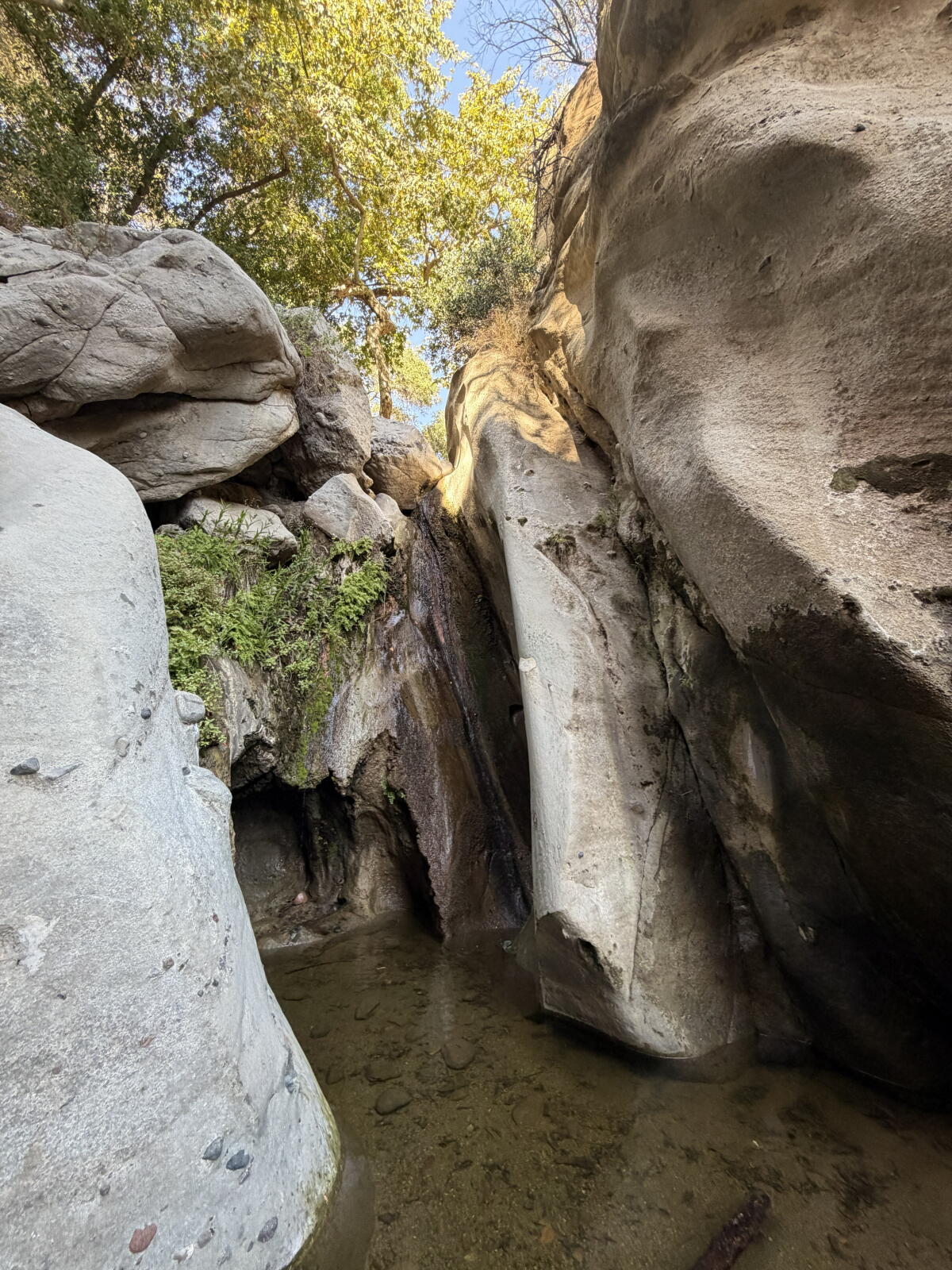
This 3.3- to 4.3-mile hike to Millard Canyon Falls will take you through lush hillsides and beneath the shade of coast live oaks and bigleaf maples as you walk alongside, and sometimes through, Millard Creek. Your journey ends at Millard Canyon Falls, a gorgeous 50(ish)-foot waterfall that gushes past massive boulders perched at the top of the cascade.
This hike is usually much shorter (about 1.5 miles), but a road closure in place since the Eaton fire lengthened it. I will explain more about the closure later. It is important to note, though, that Chaney Trail is the name of the roadway and an actual trail, both of which you’ll take on this hike.
To begin your hike, you can either parallel park nearNuccio’s Nurseries, taking care to obey all parking signage, or if those spots are all taken, park nearby and order a rideshare to drop you at the trailhead. I had cell reception with Verizon here, so it should be possible to order a ride back to your vehicle.
Millard Creek in Angeles National Forest.
(Jaclyn Cosgrove / Los Angeles Times)
From here, you have two options for reaching the Millard Canyon Falls trailhead.
1. Follow Chaney Trail road for about 1.66 miles to the Millard Canyon Falls trailhead. This route will be exposed, so you’ll need to start early if you choose this option.
2. Walk about half a third of a mile north from Nuccio’s, and then, near a bend in the road, you’ll take the Chaney Trail, a winding dirt path that I was delighted to find is in great shape. (Shout out to Restoration Legacy Crew, a volunteer trail maintenance group, for its amazing work in the Millard Canyon area!)
That trail is a bit overgrown in a few spots, so you’ll want to wear pants (or take the road). Additionally, make sure to lightly stomp before heading into overgrown areas, as this helps alert any snakes snoozing in the shade of your presence.
The view from the ground looking up at Millard Canyon Falls.
(Jaclyn Cosgrove / Los Angeles Times)
You’ll take Chaney Trail for about half a mile, pausing to catch your breath and take in the increasingly great views of the San Gabriel Valley. You will next cross over Mt. Lowe Motorway to take the Sunset Ridge Trail down. (See map for greater detail.)
You will boogie down a few switchbacks for 0.7 miles, enjoying shade provided by bay laurels and sumac trees, listening to the sweet songs of canyon wrens and spotted towhees. (That’s who was singing to me, anyway!)
You will reach the Millard Canyon campground, which is closed for overnight camping but does feature a few nice picnic tables shaded by massive coast live oaks. With the creek flowing nearby, I wouldn’t blame you if you stopped and had a little snack here.
Millard Campground in Angeles National Forest. It is closed because of damage from the Eaton fire.
(Jaclyn Cosgrove / Los Angeles Times)
That said, you have finally made it to the Millard Canyon Falls trailhead! Just northwest of the campground, you’ll find a little arrow pointing you northward onto the trail. From here, you will gain minimal elevation, and can actually just frolic. It is about half a mile to the waterfall.
As I mentioned, this trail is usually shorter and easier to access, as there’s a large parking lot near the trailhead and more parking along the roadway.
The roadway Chaney Trail was slated to reopen at the end of April. I frequently checked Los Angeles County Public Works’ road closure website, as I had planned to write about Millard Canyon once the road reopened. But when I checked the website, I saw that the reopening had been moved to the end of August. Huh?
I asked the public information officers at county Public Works about it and was told: “We are currently coordinating with our on-call emergency contractor to complete guardrail repairs on Chaney Trail, just north of the gate. Construction is anticipated to begin in July and be completed by the end of August, weather and field conditions permitting.”
Clockwise from top left: prickly phlox, golden yarrow, cliff aster and a type of larkspur. Center: A little bird on a dried out plant.
(Jaclyn Cosgrove / Los Angeles Times)
I passed a shiny new guardrail just north of the gate when I was hiking there earlier this week. I asked the agency whether there was some other guard rail missing. No, my friends. “The community raised concerns about the roadway narrowing included in this project, and we will be reconstructing the guardrail to address those concerns,” a spokesperson told me via email.
And now ends the saga of the Chaney Trail guardrail.
As for Millard Canyon, I will admit, it quite possibly is my favorite frontcountry natural areas. I was reminded of this fact when I visited this week. Although the road closure adds some steep mileage to reach the canyon, it’s worth it to me. I will be back. I hope to see you there!
The Fish Canyon Narrows near Castaic.
(Jaclyn Cosgrove / Los Angeles Times)
2. Fish Canyon to Fish Canyon Narrows
Distance: About 5.5 miles Elevation gained: About 400 feet Difficulty: Moderate Dogs allowed? Yes Accessible alternative:San Francisquito Creek Trail
To reach the Fish Canyon Narrows, you will take the Fish Canyon Trail (called Forest Route 6N32 or the Warm Springs Fish Canyon Truck Trail on some maps) on a 5.5(ish)-mile out-and-back journey. You will ascend into narrowing walls of sandstone, granite and conglomerate. A healthy stream flows throughout the canyon, giving you ample opportunity to cool off or have a picnic in a naturally occurring sound bath (which, when you’re lucky, will include a tree frog).
A quick note: This is the most rugged (read: least curated) of the three adventures mentioned in this list. There is no trail signage, and you’re in a less popular corner of Angeles National Forest. You might be entirely alone, especially if you hike this on a weekday. You should plan accordingly. Or skip it if I’ve already freaked you out. (I do this out of love!)
To begin, you’ll park on the road’s shoulder, and head east through a gate. Follow the roadway north and then south as it curves toward a dirt path. Follow the exposed dirt path northeast. You’ll trudge through multiple water crossings and be blessed with the occasional shade of sycamore trees.
The narrows are often cooler than the rest of the area. The first portion of this hike has little to no shade, so make sure to wear plenty of sun protection.
And if you leave the trail but aren’t ready to go home, head over to the swim beach at Castaic Lake. And if you’re not tired, there’s always the Cali Splash Park, a massive inflatable floating park. That’s a full day of adventure!
A hiker lies near the creek along the Icehouse Canyon Trail.
(Brian van der Brug / Los Angeles Times)
3. Icehouse Canyon Trail to Icehouse Saddle
Distance: Around 7 miles Elevation gained: 2,600 feet Difficulty: Challenging Dogs allowed? Yes Accessible alternative:West Fork National Scenic Bikeway
Icehouse Canyon Trail to Icehouse Saddle is a 7(ish)-mile trek that runs mostly parallel to the gorgeous and crystal clear Icehouse Creek, which often features several short waterfalls as the water rockets down the mountainside.
As they trek through the canyon shaded by bigleaf maple, California incense-cedar and bigcone Douglas-fir, hikers might spot wildflowers including orange-yellow western wallflowers, light purple Grinnell’s Beardtongue and red western columbine.
Icehouse Canyon is popular on weekends and is best visited on a weekday if you can swing it. You’ll need either a $5 Adventure Pass, an annual America the Beautiful pass or other federal public lands pass to park.
To begin your hike, you’ll park at or near the trailhead — in the parking lot if it’s your lucky day. Otherwise, you’ll park along the roadside, taking good care to read signage and not block anyone’s driveway. Once while walking to the trailhead, I was greeted by a local dog whose collar informed me that he was allowed to meander about and knew how to get back home. I love small mountain towns.
After you park — and remember to display your pass, as forest service workers do ticket vehicles without them — you’ll head east to the trailhead.
A visitor cools down in the creek at Icehouse Canyon.
(Jaclyn Cosgrove / Los Angeles Times)
Immediately upon entering the canyon, you’ll be greeted with stunning beauty. Try not to become too distracted by the pools of water surrounded by large boulders. (No one will know if you skip the hike and just take a dip.)
About a mile into your hike, you’ll come to a crossroad where the Chapman Trail and Icehouse Canyon Trail intersect. Continue east on the Icehouse Canyon Trail. A mile farther, you’ll start the switchback portion of the trail, where you’ll gain about 1,200 feet in 1.5 miles. It’s a beautiful suffer fest.
Icehouse Saddle will offer you incredible views of the San Gabriel Mountains and Mojave Desert. You’ll likely meet other hikers here who are planning to continue their journeys to one of several peaks reachable from the saddle, including to popular spots like Cucamonga and Ontario peaks.
Hikers meander past boulders and large pine trees.
(Brian van der Brug / Los Angeles Times)
It can be quite windy at Icehouse Saddle, so if you’re planning to have your lunch here (which I’ve done many times), consider packing a windbreaker.
The Times has been writing about hiking in Icehouse Canyon for more than 100 years, as city dwellers have long been drawn to its beauty. A July 1926 article about Icehouse Canyon started with a headline declaring, “Here’s a nice cool trip” in all caps.
“It is a trip which one will want to take more than once when its lure has gotten into the blood,” an unnamed Times journalist wrote.
May we all be so lucky to return again and again.
3 things to do
Docent Susan Hopkins leads a Pride Month hike during a previous year’s celebrations.
(L.A. County Department of Parks and Recreation)
1. Celebrate Pride across L.A. County The L.A. County Department of Parks and Recreation will host several events celebrating LGBTQ+ Pride throughout June. Almost 60 county parks are hosting events, including from 5 to 7 p.m. Thursday at Dalton Park in Azusa; from 5 to 7 p.m. Thursday at Dr. Richard H. Rioux Park in Stevenson Ranch; and from noon to 2 p.m. Saturday at Crescenta Valley Community Regional Park in La Crescenta. For a list of all events, visit parks.lacounty.gov.
2. Walk for peace in L.A. Los Angeles meditation nonprofit InsightLA will lead a free 12-mile Walk for Peace from 9 a.m. to 3 p.m. Saturday. The walk will start at Hollywood Forever Cemetery and end with community picnic at Tongva Park in Santa Monica. Register at insightla.org.
3. Repair trails in remote forest near L.A. The Lowelifes Respectable Citizens’ Club, a volunteer trail maintenance group, needs volunteers on Saturday and Sunday to help restore an overgrown segment of the Gabrielino Trail in Angeles National Forest. Volunteers will either ride gravel bikes down a 5.5-mile dirt road or hike in. Previous trail work experience not required. Register by emailing trailwork@lowelifesrcc.org.
The must-read
The aedes aegypti mosquito, called the “yellow fever mosquito,” is well-known for spreading nasty illnesses like its namesake and dengue fever.
(Sameer Neamah Mahdi / Associated Press)
Here’s a sentence I didn’t expect to write this year (or ever): Google would like to release up to 64 million sterilized male mosquitoes in California and Florida to help combat mosquito-borne illnesses such dengue, Zika, chikungunya and yellow fever. “Google says it can harness technology to optimize a concept that’s been around for decades, but hasn’t worked at a large enough scale with mosquitoes to rein in disease,” Times staff writer Lila Seidman reported. The project is called Debug —although Google could have gone with WiFly.
I’ll see myself out.
Happy adventuring,
P.S.
You’re sitting there thinking about your weekend, wondering, “Is there anywhere I could go dressed as a shark?” Why, yes, there is! The Cabrillo Marine Aquarium and Cosplay for Science will co-host the Science Entertainment Aquarium Convention from 9 a.m. to 4 p.m. Saturday at the aquarium (3720 Stephen M. White Drive in San Pedro). SeaCon 2026 will feature a beach cleanup, a fictional marine biology panel and a cosplay contest, along with much more. Learn more at the aquarium’s Instagram page. Have a jaw-some time!
For more insider tips on Southern California’s beaches, trails and parks, check out past editions of The Wild. And to view this newsletter in your browser, click here.
Los Angeles City Atty. Hydee Feldstein Soto lagged behind her two well-funded challengers based on early returns Tuesday night. But her incumbent colleague, City Controller Kenneth Mejia, appeared to be faring better in his bid to stay in office, holding a double-digit lead over finance executive Zach Sokoloff.
Progressive Marissa Roy led the field vying to serve as Los Angeles’ top lawyer in the first batch of returns surfacing around 8:20 p.m.
L.A. County Deputy Dist. Atty. John McKinney sat in second, while Feldstein Soto was positioned third. The top two finishers will advance to November’s general election. It could be days before the outcome of the race is clear. Mail-in ballots with a Tuesday postmark will be accepted by county election officials for another week.
With only two candidates running, the controller’s race will be decided this month and will not go to a runoff in November.
The city attorney’s race transformed suddenly this spring after the Los Angeles Police Department’s largest union broke with Feldstein Soto and backed McKinney. Independent expenditure campaigns have thrown $3 million behind McKinney in recent weeks, with much of that money coming from a political action committee controlled by Airbnb.
Feldstein Soto sued the rental giant for violating price gouging laws in the wake of the Palisades fire last year and has openly questioned whether McKinney would shy from aggressive litigation against Airbnb if elected.
“Special interests have gotten really accustomed to special treatment at City Hall. They get special treatment all the time,” Feldstein Soto said in a recent interview, suggesting that both McKinney and Roy had been compromised by outside spending. Independent expenditure campaigns supporting Roy also received roughly $725,000.
McKinney told The Times that if elected, he would “absolutely” sue Airbnb if necessary.
A representative for Feldstein Soto’s campaign declined to comment on the early returns late Tuesday night.
The three leading candidates often sounded like they were campaigning for different jobs.
Roy said she would run the city attorney’s office as L.A.’s “largest public interest law firm,” focusing on tenants’ rights, wage theft and other issues affecting working-class Angelenos. A deputy attorney general in the California Department of Justice, she also vowed to sue the Trump administration, linking arms with the attorney general’s office and other city attorneys in aggressive litigation to curb what many Californians see as targeted abuses of power.
McKinney talked more like he was running for city prosecutor, leaning heavily on his experience winning high-profile felony trials in the downtown courthouse. He said he would improve the way the city attorney prosecutes gun crimes and animal abusers. Despite his lack of experience as a civil litigator, McKinney also said he could bring down the city’s litigation costs, which exploded under Feldstein Soto.
“While all votes have not yet been fully counted, we feel optimistic about qualifying for the General Election in November. People want political courage. They want leadership,” McKinney said in a statement Tuesday night. “What is already clear, is that this election has been shaped by the pressing and undeniable concerns of the people of Los Angeles.”
She said she improved public safety by repairing her office’s relationship with the LAPD and filed more misdemeanors than her predecessor. Although legal costs surged, Feldstein Soto said she did her best to mitigate damage on a number of difficult cases she inherited when taking office in 2022. The rise of so-called “nuclear verdicts” in civil claims reflects a nationwide trend rather than a fault of her leadership, she said.
Feldstein Soto was endorsed by Mayor Karen Bass and U.S. Sen. Adam Schiff (D-Calif.). Roy had the support of the L.A. County Democratic Party, the city chapter of the Democratic Socialists of America and U.S. Sen. Bernie Sanders (I-Vt.). In addition to the police union, McKinney was backed by his boss, L.A. County Dist. Atty. Nathan Hochman.
The city controller’s race, normally a fairly sleepy affair, has turned into the second-highest-spending race in the city.
Mejia, 35, known for his two corgis that he often features on billboards across Los Angeles, sought to retain his seat as the city’s accountant and auditor.
His only challenger was Sokoloff, a senior vice president for asset management at Hackman Capital Partners. Sokoloff, 37, alleged Mejia did not properly utilize the controller’s office to run audits on city departments and failed to keep up the auditing pace of his predecessor.
Sokoloff’s mother, Sheryl, has spent $7.5 million on independent expenditures in the race, mostly on attack ads and mailers against Mejia. Often, the ads point to allegations that Mejia in 2023 fostered a toxic workplace and made inappropriate sexual remarks to female subordinates.
A woman who identified herself as Sheryl Sokoloff hung up on a Times reporter last week when asked about the race expenditures.
Mejia said Sokoloff’s mother — married to Jonathan Sokoloff, managing partner of private equity firm Leonard Green & Partners — was trying to bankroll the seat for her son.
Mejia has long run on accountability and transparency for the city’s budget and made public-facing databases across dozens of topics on the controller’s website in his first term.
A licensed certified public accountant, Mejia is a member of the Green Party and does not accept endorsements from political parties or politicians. He was endorsed by the Los Angeles Daily News and multiple labor unions, including the United Teachers of Los Angeles and United Auto Workers.
Sokoloff, a Democrat, was endorsed by multiple former controllers, notable Democrats — including Schiff — and the L.A. County Democratic Party, along with other business advocacy groups.
Seemingly at every single turn, a hiker blazed past me, ignoring any semblance of trail etiquette.
A house party near the mouth of the canyon blared music that reverberated throughout the hillsides, blocking any chance to hear birdsong. Although I’m nonbinary, I felt my gender rapidly evolving into grumpy old man.
“The privilege of living here,” I grumbled to myself. “Never hiking on Memorial Day ever again.”
Then, I realized just how much my own attitude was ruining what could otherwise be a beautiful day outdoors. I paused, took a few deep breaths and made myself look at the flowers, take in the smile of a passing hiker, and say a few things I felt grateful for. This gentle reframing saved the day.
You are reading The Wild newsletter
Sign up to get expert tips on the best of Southern California’s beaches, trails, parks, deserts, forests and mountains in your inbox every Thursday
By continuing, you agree to our Terms of Service, which include arbitration and a class action waiver. You agree that we and our third-party vendors may collect and use your information, including through cookies, pixels and similar technologies, for the purposes set forth in our Privacy Policy such as personalizing your experience and ads.
It was my first time hiking around Santa Ynez Canyon, and I laughed at myself for expecting serenity on Memorial Day, when seemingly half of L.A. heads to the beach and mountains for a quick escape. I had high expectations for the canyon’s Los Leones Trail. Several friends and colleagues had told me how beautiful it was. But those expectations were what put me in such a bad head space at the start of my hike.
I share this experience because I want to remind us all how lucky we are to live in a place where we can hike near the Pacific Ocean and then go swim and bounce in its waves.
In this edition of The Wild, our weekly outdoors newsletter, I will share three great hikes near some of the best (and cleanest!) beaches in Los Angeles County.
I chose trails near beaches that made our “15 best beaches in L.A. County” list this year, including two that feature tide pools. (Don’t know what a tide pool is? Check out my guide on how to explore them!)
A few quick things to remember:
Plan for hotter temperatures as summer creeps up: 🥵 Make sure to pack more water than you typically need, especially on hikes with minimal shade.
Bring your sun protection: Lately, I’ve been using my hiking umbrella that I reviewed for last year’s holiday gift guide. Its silver top deflects heat while its black underside traps harmful UV rays.
Leave no trace: Please refresh your memory of the seven “Leave No Trace” principles, including being mindful of how loud you’re talking and not playing music audibly from your phone or a speaker.
Tell someone where you’re going: Complete this form (or something like it) and leave a copy with a friend or family member, and another on your car’s dash. This will better ensure rescuers can find you, should an emergency occur.
OK, now that we’ve covered some essential safety measures, let’s dive into this week’s hikes. Soon, you could gaze upon a stretch of coastline from one of these hikes, only to go swimming later in the day at the same spot!
A popular lookout spot near the Los Leones Trail in the Santa Monica Mountains.
(Jaclyn Cosgrove / Los Angeles Times)
1. Los Leones Trail to Parker Mesa Overlook
Distance: About 7.4 miles out and back Elevation gain: About 1,500 feet Difficulty: Moderately challenging Dogs allowed? No Accessible alternative: Will Rogers State Park’s Inspiration Loop Trail Beach to visit nearby: Will Rogers State Beach at Temescal Canyon
This 7.4-mile out-and-back journey in the Santa Monica Mountains starts with taking the Los Leones Trail about 1.3 miles up before joining with East Topanga Fire Road for a steep 2.4-mile trek to the Parker Mesa Overlook.
To begin your hike, you’ll park in or around the Los Leones trailhead near Topanga State Park. Hopefully, you’ll snag a spot in the small lot near the trailhead. This reporter did not get that lucky, but I did find there was plenty of street parking, although it adds a little mileage to the trip.
There are flush toilets and water fountains near the trailhead, which always feels like a luxury. And even just from the restrooms, you can already see the deep blue ocean, a visual hint of what’s to come.
A large swath of the L.A. County coastline is visible from the East Topanga Fire Road.
(Jaclyn Cosgrove / Los Angeles Times)
You’ll find the trailhead marked by a wood and rock archway with a “Los Leones Canyon” sign. From here, you’ll hike north along steep rocky stretches. Poles and shoes with good traction are essential. I saw multiple hikers fall without them.
Immediately upon entering, it’s easy to see where last year’s Palisades fire charred several trees along the hillside. There is a little bit of mustard popping up, but it’s not overtaking the California sagebrush and other native plants just yet. I was pleased to see wildflowers still blooming in this canyon, including bush monkey flower, cardinal catchfly and just a bit of canyon sunflower. There were also several sumac and Southern California black walnut trees.
Watch out for roots and rocks along the Los Leones Trail, as I noticed several that could easily catch the feet of tired hikers headed down.
From left: Douglas nightshade, bush monkey flower, and canyon sunflower.
(Jaclyn Cosgrove / Los Angeles Times)
As mentioned, there was a loud house party at one of the houses down the canyon. Once I turned a corner about half a mile in, I could finally hear nature’s music over the All-American Rejects.
At just under 1.3 miles, you’ll find the Los Leones Trail meeting with East Topanga Fire Road (called the Paseo Miramar Trail on some maps). There’s an optional side quest here where you can take the fire road south to an overlook spot with a tree prominent on its bare hilltop.
Otherwise, you’ll take the East Topanga Fire Road northwest for about 1.8 miles before turning south to walk just over half a mile to the Parker Mesa Overlook. Along the way, you’ll find several spots to pause and take in the views.
To the east, you will see the wood frames of dozens of houses being rebuilt after the Palisades fire. It offers a sobering perspective on the long journey to getting one’s house back after wildfire.
I could also see downtown L.A., the Santa Monica Pier, the Palos Verdes Peninsula, sailboats and maybe some dolphins. (If you want to learn how to spot whales and dolphins from the trail, check out my tips on how to do just that!)
As hikers ascend the East Topanga Fire Road, the views of the Pacific Ocean grow only more expansive and panoramic.
(Jaclyn Cosgrove / Los Angeles Times)
As I left the trail, I noticed the house party had ended, as had my bad mood.
The short trails around White Point Preserve meander through coastal prairie and coast sage scrub.
(Jaclyn Cosgrove / Los Angeles Times)
2. Vista Trail & Grasslands Loop Trail
Distance: From 1.6 to 2.2 miles Elevation gain: About 250 feet Difficulty: Easy, but does include hills Dogs allowed? Yes, but not on beach Accessible alternative: Paths around the White Point Nature Education Center and some portions of the Grassland Loop Beach to visit nearby: White Point/Royal Palms Beach
This gentle 1.6-mile trek through White Point Nature Preserve in San Pedro combines two trails: Grasslands Loop Trail (0.8 miles) and the Vista Trail (0.8 miles). You’ll experience a coastal prairie, a rare habitat that used to cover an estimated 36 square miles, “extending north-south from the crest of the Ballona Bluffs to Palos Verdes and inland from the lee of the El Segundo sand dunes for three to six miles,” according to research compiled by the Urban Wildlands Group.
The White Point Nature Preserve, a 102-acre expanse, also houses a nature education center that’s open weekends from 10 a.m. to 3:30 p.m. The preserve’s trails are open daily from dawn to dusk.
Maggie May, canine hiking companion of Wild writer Jaclyn Cosgrove, trots along the trail past native plants in the White Point Preserve.
(Jaclyn Cosgrove / Los Angeles Times)
The preserve was previously owned by the U.S. military and was a Nike missile site, a Cold War-era missile defense system. The Palos Verdes Peninsula Land Conservancy now manages the L.A. city-owned property, regularly hosting volunteer opportunities to continue the conservancy’s efforts to restore the preserve’s native plant system that was destroyed by human activities.
After your hike, you can head just west of the preserve to White Point/Royal Palms Beach, which Times contributor Jenna Belhumeur wrote in our beach guide offers “some of the most diverse tide pools in Southern California.”
To begin your hike, you’ll park either in a large dirt lot at the preserve or along the street. Then, it’s choose your own adventure. If you’d like to do both loops (see map), you could head west from the parking lot, briefly walking on the Grassland Loop before joining the Vista Trail. Take the Vista Trail clockwise as it wraps around the preserve.
Catalina Island is often visible from White Point Preserve.
(Jaclyn Cosgrove / Los Angeles Times)
At the top of Vista Trail, the conservancy notes that: “Catalina Island is often visible less than 20 miles away. On the northeast portion of the trail are two gun emplacements built in 1942 as part of the US coastal defense system, each housing a 16-inch gun.” It was a clear enough day when I hiked the trail that I thought I saw a dolphin jump in the nearby water!
You can head from the Vista Trail and join back up with the Grasslands Trail to take its full loop around, too. There is also a nice path around the nature center with several educational signs about the local culture, flora and fauna.
The White Point Nature Education Center in San Pedro.
(Jaclyn Cosgrove / Los Angeles Times)
I visited the preserve on a weekday and found it to be somewhat meditative, especially when I realized there was a labyrinth near the nature center. The loudest sound was the crunching of my feet as I headed down the path, my trusted hiking dog Maggie May at my side.
The Nicholas Flat Trail in the Santa Monica Mountains, as seen last May.
(Jaclyn Cosgrove / Los Angeles Times)
3. The Willow Creek Trail to Nicholas Flat Loop
Distance: 1.8 miles (with an option to extend) Elevation gain: About 575 feet (more if you extend) Difficulty: Moderate Dogs allowed? No Accessible alternative: Nicholas Flat ADA Trail Beach to visit nearby: Leo Carrillo State Beach
The Willow Creek Trail to Nicholas Flat Loop is a 1.8-mile jaunt through coastal sage scrub at Leo Carrillo State Park that quickly rewards hikers with breathtaking ocean views.
You start near the park’s campground and take the Willow Creek Trail about 0.7 miles northeast before it jags to the west. There, you will find a sign for an ocean vista lookout point, which I recommend as long as body and spirit allow. It’s steep but does provide panoramic views of the mountains and coastline.
From here, you can either take the Nicholas Flat Trail back down to the parking lot, or you can continue on another section of the Nicholas Flat trail that takes you north and eventually to a quaint stock pond in the Nicholas Flat Natural Preserve.
The hike to the stock pond is about 2.3 miles with about 1,100 feet of elevation gained. Round trip, it will add up to 4.6 miles to your hike, depending on whether you incorporate other trails in the preserve into your hike. I’ve found this stretch of the hike to be uncrowded and serene, albeit challenging on the way up.
What I love about this hike is, it’s a buffet serving up some of the best features of the Santa Monica Mountains hikes: great views of the ocean, gorgeous wildflowers and lots of lizards and birds skirting here and there along the trail.
Over the past two weeks, users on iNaturalist have documented golden yarrow, cliff aster, Blochman’s dudleya, Plummer’s mariposa lily and other native plants still with blooms. You might be able to catch wildflowers, too, if you hike it soon!
3 things to do
Volunteers are needed to help at one of the native plant nurseries that the Santa Monica Mountains Fund manages.
(Christina Jimenez, SAMO Fund)
1. Free plants of weeds in Thousand Oaks The Santa Monica Mountains Fund needs volunteers from 9 a.m. to 2 p.m. Saturday at its Rancho Sierra Vista nursery to process cuttings, transplant seeds and tend to more than 50,000 plants being grown for local restoration. Volunteers who give at least two hours of their time will be thanked with three native plants. Participants should wear outdoor working attire and bring a reusable water bottle and sun protection. Register at eventbrite.com.
2. Learn about mobility justice in L.A. BikeLA, Los Angeles Walks and the Willowbrook Inclusion Network will host a soft launch gathering of a new community space from 3 to 5 p.m. Sunday at the Willowbrook/Rosa Parks Station. Guests can visit local vendors, including artists and small businesses, and see a portrait exhibit honoring mobility justice leaders. Learn more at the groups’ Instagram pages.
3. Celebrate the planet in Santa Ana OC Habitats, a Santa Ana-based conservation nonprofit, will host the “Earth for Everyone” festival from 12:30 to 3:30 p.m. Saturday at 1505 E. 17th Street in Santa Ana. Several local groups, including Bolsa Chica Conservancy, California Native Plants Society’s Orange County chapter and Orange County Coastkeeper, will be in attendance. Guests can play games, listen to live music, win prizes and more. Register at eventbrite.com.
The must-read
A view of the “Texas Dip” on Borrego Springs Road, near where San Diego Gas and Electric has proposed running miles of high voltage power lines and structures through a long stretch of the Anza-Borrego State Park.
(Robert Gauthier/Los Angeles Times)
One of my favorite sounds while I’m out hiking is the strange, discomforting buzz that comes from large transmission towers often found in our mountains. Just kidding! That’s one of many reasons that environmentalists are puzzled as to why San Diego Gas & Electric has proposed a 140-mile transmission line that would cut right through Anza-Borrego Desert State Park — again. As Times staff writer Hayley Smith reported, experts say the project would disrupt habitat for the park’s 1,500 plant and animal species, including bighorn sheep who already face the U.S. border wall as a migratory barrier. In 2008, a project was proposed along a similar route through the park, “but it was rejected by the California Public Utilities Commission as ‘environmentally unacceptable and infeasible’ because it would result in more than 50 significant and unavoidable impacts to the park,’” Smith wrote. It remains unclear what, if anything, has changed since then.
Happy adventuring,
P.S.
The Santa Rosa Island Fire has been devastating for many of us in the outdoors community to witness. The fire started May 15 and burned more than 18,000 acres of the island’s southeastern end. Santa Rosa is the second largest island in California at about 53,000 acres. It is a special place for many reasons, including its Torrey pines, island foxes, lizards, spotted skunks and several rare birds. Do you have any memories from hiking or camping on Santa Rosa Island that you’d like to share? Please either reply to this newsletter if you received it in your inbox, or if reading from the Times website, email me at jaclyn.cosgrove@latimes.com. We might use your responses in an upcoming article or newsletter. Thank you for sharing what makes this place special!
For more insider tips on Southern California’s beaches, trails and parks, check out past editions of The Wild. And to view this newsletter in your browser, click here.
ONE MAGICAL spot in Dorset is being compared to a Greek island due to its bright blue water.
The Blue Pool in Wareham, Dorset, is an expansive lake on a 300 acre estate.
Sign up for the Travel newsletter
Thank you!
The Blue Pool in Wareham used to be a clay pit but is now a vibrant blue lakeCredit: The Blue PoolPeople can head on a walk around the pool where they will spot hand-crafted enchanted doorsCredit: The Blue Pool
Commenting on TripAdvisor, one visitor said: “Utterly peaceful and serene, with that surreal feeling that you’re on holiday somewhere in Greece, we fell in love with the amazing views of the blue pool.”
Dating back to the 17th century, The Blue Pool is over nine metres deep and was originally a hand-quarried clay pit.
Clay extracted from the pool was then used to make ceramics.
However, in the 19th century, the pool was abandoned and subsequent rain filled it.
There’s also a play area for kidsCredit: The Blue Pool
Though, this is when the magic of the pool appeared, as the water appeared a bright turquoise colour.
The reason for this was due to light bouncing off of the clay particles in the water.
The pool then reopened to the public in 1925 and since has been a top spot for tourists.
Despite looking like a tropical paradise, there are no fish in the lake and you cannot swim in the pool.
But there is a good trail for families to explore, where you can spot hand-crafted enchanted doors and a play area with bridges and balance beams.
At the edge of The Blue Pool there is also the UK’s longest rope bridge, which stretches 50 metres and is around 10 metres off the ground.
For kids who love animals, the site is home to Iron Age pigs which visitors can feed each day at 1:30pm for just £3 per person.
You might even spot peacocks roaming as well.
And the UK’s longest rope bridgeCredit: The Blue Pool
During holidays, the park also runs different events such as an illumination trail at Christmas and pumpkin carving at Halloween.
After a day of exploring, visitors can head to the 1930s Art Deco tearooms for afternoon tea from £7.50 per person, a drink or even locally made Purbeck ice cream.
Make sure to pop to the toilet before you leave as well, as they won the Loo of the Year award several years in a row.
The Blue Pool costs £9.75 per person to visit and is dog-friendly too.
And if you want to extend your time in the local area, you can head to Dorset Adventure Park down the road, with an inflatable water park and mud trail obstacle course.
The beach isn’t too far away either, with Worbarrow Bay just a 15-minute drive away.
It costs £9.75 per person to visitCredit: The Blue Pool
The long, pebble beach is a quieter spot on the Jurassic Coast, especially compared to its popular neighbours – Lulworth Cove and Durdle Door.
For somewhere to stay, you could head to East Creech Farm Campsite, which has pitches as well as camping pods, a cottage and a farmhouse.
At the campsite, there’s also an onsite tearoom for some freshly baked cakes.
And thanks to the campsite being on a working farm, you can expect to see sheep, goats, donkeys, rhea, chickens, horses, ponies and ducks around.
A tent pitch costs from £22.50 per night and the camping pods cost from £75 per night.
I stood last week in the middle of a highway, marveling as construction workers used large excavators to repair the collapsed roadway.
I was walking a segment of Angeles Crest Highway that closed about five months ago when winter storms pummeled the roadway, ripping off hunks of pavement and collapsing large sections of the road. I wanted to survey the damage and also enjoy a car-free highway in the beautiful backcountry.
In this edition of The Wild, The Times’ weekly outdoors newsletter, I will share what I observed and include details about how you can repeat my trip. I’d say it is a rare opportunity, but it’s starting to feel, especially as human-caused climate change worsens, like Angeles Crest Highway is closed more often than it’s open.
You are reading The Wild newsletter
Sign up to get expert tips on the best of Southern California’s beaches, trails, parks, deserts, forests and mountains in your inbox every Thursday
By continuing, you agree to our Terms of Service, which include arbitration and a class action waiver. You agree that we and our third-party vendors may collect and use your information, including through cookies, pixels and similar technologies, for the purposes set forth in our Privacy Policy such as personalizing your experience and ads.
Angeles Crest Highway, completed in 1956 (in part by prison labor), is a 66-mile curvy road that climbs from around 1,300 feet to nearly 8,000 feet, taking travelers from La Cañada Flintridge to the mountain town of Wrightwood. A large segment, 55 miles, received federal distinction in 1990 as a National Scenic Byway.
For the record:
4:04 p.m. May 21, 2026A previous version of this article said Angeles Crest Highway climbs from 800 feet. The highway begins at an elevation of around 1,300 feet.
In case, like me, you’ve lost the plot of the many recent closures and reopenings of Angeles Crest Highway, here’s a brief refresher.
Winter 2022/spring 2023: Winter and early spring storms, including atmospheric rivers, blow out multiple sections of the roadway, prompting several closures, including: from near Mt. Wilson Red Box Road to Upper Big Tujunga Road; from Upper Big Tujunga Road to Islip Saddle; and from Islip Saddle to Vincent Gap.
October 2023: A 20-mile stretch from Upper Big Tujunga to Islip Saddle reopens; road remains closed from Mt. Wilson Red Box Road to Upper Big Tujunga, requiring drivers to take a detour to reach a newly open section; segment from Islip Saddle to Vincent Gap remains closed.
July 2024: Mt. Wilson Red Box Road to Upper Big Tujunga reopens, ending the need for a detour.
A portion of Angeles Crest Highway where the curved shoulder broke off.
(Jaclyn Cosgrove / Los Angeles Times)
The hiking community celebrated when that final 10-mile stretch from Islip Saddle to Vincent Gulch reopened. The closure blocked access to Dawson Saddle and made the drive to Vincent Gulch to hike the Mt. Baden-Powell trail much longer, as you had to take multiple freeways to maneuver from L.A. around the San Gabriels.
For the first time in three years, all of Angeles Crest Highway was open — for about five months.
Grape soda lupine, left, Grinnell’s beardtongue, snow plant and western wallflower.
(Jaclyn Cosgrove / Los Angeles Times)
Last December, Southern California experienced another round of a damaging atmospheric river. “More than 10 inches of rain fell in parts of the San Gabriel Mountains in Los Angeles County during a 48-hour period,” The Times reported.
Soon, photos emerged of washed-out segments of Angeles Crest Highway, and the California Department of Transportation announced that, yet again, the highway was closed, this time from 3.3 miles east of Newcomb’s Ranch to State Route 138.
Curious to see the damage for myself, I headed up the highway last week to walk a segment of the closure. My plan was to park at the large lot at the 6,000-foot snow play area and then walk along Angeles Crest Highway for about 4½ miles to Buckhorn Campground, a forested enclave where I’ve spent many nights staring up at the stars.
After having lunch at Buckhorn, I planned to backtrack to Cloudburst Summit where I would take the Pacific Crest Trail back to where I parked. The total trip is just shy of nine miles and gains about 1,200 feet in elevation.
The closed gate near the 6,000-foot snow play area in Angeles National Forest.
(Jaclyn Cosgrove / Los Angeles Times)
I walked from the lot past the closed gate, appreciating several grape soda lupine, one of my favorite native wildflowers, blooming along the hillside.
I was alone on the empty highway, a scene that was stunningly gorgeous and eerily dystopian. For the first three-fourths of a mile, the road appeared to be in good condition. But then, I trudged around a bend and observed the first segment of collapsed roadway on my trip.
For anyone considering cycling this route, I am happy to report that CalTrans and its contractors have done a nice job creating dirt and rock berms around the damaged portions of road that I observed. I mention that in case, like me, you watched the 1991 TV series “Land of the Lost” and developed an illogical fear of dropping through a crack in the road and unknowingly discovering a time portal to the Jurassic period.
I continued past this first damaged section, listening to the dark-eyed junco and mountain chickadee, laughing as the chipmunks scampered to and fro.
An excavator works to repair a segment of Angeles Crest Highway.
(Jaclyn Cosgrove / Los Angeles Times)
Soon, at 1.2 miles, I encountered construction workers driving excavators to move earth and repair a drainage area where it appeared water had rushed down the steep mountains and blasted the road away. As you hike or bike, please respect instructions from construction workers and also make sure they see you before you try to pass them.
Just a fifth of a mile farther, and I saw more portions of the roadway that had collapsed, although these sections were smaller than the area the heavy machine operators were trying to repair.
As you hike along, you’ll likely realize that the pavement warms up quickly. It’s important to either start this journey early in the day or on a cooler day — and pack plenty of water.
At about 1.75 miles in, you will reach a junction where the Pacific Crest Trail, a 2,650-mile route that spans from Mexico to Canada, intersects with the roadway. You can turn and head back to your car here if you’d like by taking the PCT. You’ll initially walk west before the trail starts moving southward.
I continued eastward on the highway, pausing at times to appreciate the vista points that you can only observe for a few seconds in a car. At one turnout, I paused to smell the delicious bark of a Jeffrey pine, which has an aroma similar to butterscotch or vanilla.
A view of the San Gabriel Mountains and desert beyond.
(Jaclyn Cosgrove / Los Angeles Times)
For about a mile-and-a-half, there’s minimal damage, enough of a break to briefly forget why the road is closed. But as you near the Buckhorn Campground entrance, you’ll find serious damage, including where the Mt. Waterman ski lifts used to take travelers up the mountain.
I turned off the highway onto the Buckhorn Campground road, finding it to be in fairly good condition — until you get to the creek crossing. A massive chunk of the road is just gone, washed away presumably by water charging down the steep hillsides. This is the only technically tricky part of the hike, and you’ll want to take good care to discern the best path here. There are a lot of branches and boulders that aren’t stable and could be napping spots for rattlesnakes.
Past here, you’ll find rocks and other debris scattered along the roadway. As I neared the campground, I noticed a Stellar’s jay observing me. Maybe it misses the days when all it had to do for food was wait for clumsy campers to drop bits of sandwiches and trail mix that it could swoop down and enjoy.
A washed-out segment of the road that leads to Buckhorn Campground in Angeles National Forest.
(Jaclyn Cosgrove / Los Angeles Times)
I sat atop a picnic table at Buckhorn, comforted that the campsites and tall old pines that I’ve camped under multiple times were still there. Although much of the campground remains intact, some campsites near the creek were washed away. I’ve always wanted to camp there. This is why you shouldn’t put off adventure!
After enjoying lunch and chatting with a few PCT hikers, including one who was lost and grateful for my map, I headed back down the highway. Just over a mile in, you’ll turn left near Cloudburst Summit onto the PCT. Your feet will thank you from this break from pavement.
As I trudged along, the quiet monotony of the day allowed me to make oh-so-brilliant observations to myself, like, “Wildflowers are like spring’s Christmas lights,” a note I left for my future self to remember. I bet you’re glad I wrote that down.
Grape soda lupine blooms along the Pacific Crest Trail in Angeles National Forest.
(Jaclyn Cosgrove / Los Angeles Times)
I was pleased to see so many wildflowers still in bloom along the trail, including several grape soda lupine plants, the alienlike snow plants and a bit of Grinnell’s beardtongue.
Returning to my car, I thought about how much I enjoyed the walk but also how special Highway 2 is, regardless of how you traverse it.
There is no timeline of when the road will reopen. The analysis from CalTrans of what it will take to repair Highway 2 is grim.
“To date, Caltrans crews have identified approximately 40 locations requiring repair, though this number may increase as assessments continue. In several areas, portions of the highway were washed out and remain temporarily inaccessible,” according to the CalTrans website.
A damaged segment of Angeles Crest Highway near the Buckhorn Campground entrance.
(Jaclyn Cosgrove / Los Angeles Times)
It’s becoming increasingly difficult to remain optimistic that we won’t see a growing number of closures along Angeles Crest Highway.
Highway 2 seems to face similar challenges to its coastal cousin, California’s Highway 1, which is increasingly plagued by storms exacerbated by human-caused climate change.
My colleague Grace Toohey spoke to an expert about Highway 1, who made a point that’s unfortunately equally applicable to the plight of Highway 2.
“If our storm and other conditions were normal, we would expect closures and losses at some points,” said Michael Beck, director of UC Santa Cruz’s Center for Coastal Climate Resilience. “The challenge is that we’re now clear that the events that are going to cause impacts — these particularly extreme events — are getting more common. … Climate change is here and now, it’s no longer a problem of the future.”
3 things to do
Hikers head up Icehouse Canyon Trail.
(Brian van der Brug / Los Angeles Times)
Editor’s note: Because of recent wildfires, events might be canceled on short notice. Check event pages before heading out.
1. Eliminate trail obstacles near Mt. Baldy The San Gabriel Mountains Trailbuilders need volunteers on Sunday to help clear fallen trees and remove overgrown brush along the Chapman Trail in Icehouse Canyon near the Mt. Baldy community. Volunteers will meet at 7:30 a.m. at the Glendora Park and Ride before heading to the worksite. Volunteers will hike between four miles and seven miles with an elevation gain of up to 2,000 feet. Register at meetup.com.
2. Mosey past movie scenes near Calabasas Retired park ranger Mike Malone will guide a three-mile moderate hike from 10 a.m. to 12:30 p.m. Sunday through Malibu Creek State Park, highlighting locations where the park served as a backdrop for film and TV productions. Malone will also share history about when the park was owned by 20th Century Fox from 1946 to 1974. Hikers should meet at 10 a.m. at the park’s main trailhead by the restrooms. Learn more at parks.ca.gov.
3. Hike along historical routes in Chatsworth A docent at Santa Susana Pass State Historic Park will host a 3½-mile hike from 8 to 11 a.m. Monday through the Santa Susana Mountains. Hikers will learn about the park’s ancient quarry, Indigenous culture and the Butterfield Overland Stagecoach route. Hikers will meet at the Andora trailhead in Chatsworth. Learn more and register at meetup.com.
The must-read
A trash interceptor made by the Dutch nonprofit the Ocean Cleanup grabs trash from Ballona Creek that could otherwise end up in the Pacific Ocean. Since its installation in 2022, the interceptor has collected more than 200 tons of trash.
(Christina House / Los Angeles Times)
It can be peaceful to take a stroll along the San Gabriel or Los Angeles rivers amid the cottonwood trees, willows and herons. But it’d be impossible not to notice the garbage too. For years, our local rivers have suffered at the hands of humans and the heaps of waste we produce. That could change. “By the 2028 Olympics, a coalition of city, county, state and private partners hopes to change that by deploying trash-intercepting devices in the Los Angeles and San Gabriel rivers, officials announced [last] Wednesday,” Times staff writer Lila Seidman wrote. “The plan is to prevent hundreds of tons of garbage from getting to the ocean.” Could our rivers be clean that soon?
Happy adventuring,
P.S.
Will Southern California’s roving wolf ever find a mate? I can’t be the only one stressing about this. BEY03F, affectionately called “bae” or “Valentine” by some, has been making headlines since early this year when she became the first wolf to enter L.A. County in more than 100 years. She has since traversed hundreds of miles and through multiple counties, with her latest travels bringing her to Sequoia National Park. This again marks the first time in a century that a wolf was documented there. BEY03F keeps making history because humans wiped out her canine kin. Will she ever find a connection that helps her repair some of the harm done?
For more insider tips on Southern California’s beaches, trails and parks, check out past editions of The Wild. And to view this newsletter in your browser, click here.
The 67-mile Backbone Trail through the Santa Monica Mountains is a bucket-list trip for many Southern California hikers.
Often, though, it’s hard to carve out time to tackle the whole thing at once. There are limited backcountry camping options, and water can be sparse on the trail. That’s why hikers, myself included, often complete it in sections, similarly to how people will hike the Pacific Crest Trail or Appalachian Trail in segments.
Last week, I ticked off a segment that runs through Latigo, Solstice and Corral canyons that my friends who frequently hike the Santa Monica Mountains have told me is a “must” to try out. I can now see why!
I am eager to share my experience with you and how this hike offers essentially everything there is to love about hiking in the Santa Monicas: incredible ocean views, massive rock formations, native wildflowers and diverse wildlife experiences — all within a short drive from L.A. How lucky are we?
You are reading The Wild newsletter
Sign up to get expert tips on the best of Southern California’s beaches, trails, parks, deserts, forests and mountains in your inbox every Thursday
By continuing, you agree to our Terms of Service, which include arbitration and a class action waiver. You agree that we and our third-party vendors may collect and use your information, including through cookies, pixels and similar technologies, for the purposes set forth in our Privacy Policy such as personalizing your experience and ads.
I often hike alone on the weekdays, and I have come to enjoy the solitude. But last week, I hiked a 9.8-mile segment of the Backbone Trail alongside almost 30 other hikers.
Hikers from the Santa Monica Mountains Trails Council’s annual Backbone Trek trudge along the trail.
(Jaclyn Cosgrove / Los Angeles Times)
It is an annual trip organized by the Santa Monica Mountains Trails Council, a volunteer-run group that maintains trails throughout the Santa Monica Mountains and nearby public lands. (The council has regular volunteer opportunities, including three trail workdays this month; RSVP required.)
This was its 21st year to offer the trip at a cost of $625 per person. Trail council volunteers set the route, provide daily hike leaders, set up camp for the group and lug most of the equipment — outside of daypacks, water and snacks — to the group’s next campsite.
The trip usually ends at the eastern terminus of the Backbone Trail in Will Rogers State Park. That area remains closed after the Palisades fire damaged the trail, destroying the Chicken Ridge Bridge. The bridge “is an important link on the [Backbone Trail] and will be the biggest single reconstruction effort for State Parks,” Rachel Glegg of the Sierra Club’s Santa Monica Mountains Task Force wrote last year.
A view from the Backbone Trail around the Newton Canyon area of the Santa Monica Mountains.
(Jaclyn Cosgrove / Los Angeles Times)
I joined the trail council‘s Backbone Trek last Wednesday as an enthusiastic interloper. I showed up late because of horrendous traffic on the 101 Freeway, earning me the trail nickname “Late Edition,” in honor of my punctuality and newspaper job. I felt immediately welcome (and forgiven).
We took a bus from Malibu Creek State Park’s lush group campsite over to the Latigo Canyon trailhead. There is a dirt parking lot there, making it an easy starting point for a day hike.
Our goal was to trek four miles east to the Corral Canyon area, where we’d have lunch among giant rock formations. Shaded by laurel sumac, oak trees and other native plants, we began our journey through the canyons. We were immediately greeted by a resplendence of wildflowers, including purple-pink woolly bluecurls, bright orange southern bush monkey flower, red bursts of cardinal catchfly and at least one Catalina Mariposa lily.
Clockwise from top left: Southern bush monkey flower, Catalina Mariposa lily, keckiella corymbosa and San Bernardino larkspur. Center: Variable checkerspot.
(Jaclyn Cosgrove / Los Angeles Times)
Because I love to dillydally, photographing flowers and taking in the views, I became fast friends with Denise Pomonik, a trail council leader who served as the day’s sweeper, making sure no one got left behind.
Pomonik, who lives in the San Fernando Valley north of the mountains, started volunteering with the council in early 2019 after seeing the 2018 Woolsey fire rip through the Santa Monica Mountains. “The more you hike an area or mountain-bike it, the more personal it gets,” Pomonik said. “I couldn’t control the fire, but I could control what I could do afterward.”
Denise Pomonik of the Santa Monica Mountains Trails Council waves from a large rock formation where the Backbone Trek group had lunch.
(Jaclyn Cosgrove / Los Angeles Times)
The council organizes the annual Backbone Trek not as a fundraiser but instead as a means of creating new land stewards who they hope will fall in love enough with the landscape to want to help protect it, either by donations, volunteerism or activism.
“The more people who fall in love with this mountain range, the more it will be protected,” said Pomonik, who works in the entertainment industry and had no prior trail work experience.
I did not anticipate how expansive the views would be, both of the Pacific Ocean to the south and the nearby peaks, hillsides and valleys to our north. I felt grateful and small.
Chatting with several of the hikers on the trip, I found they had signed up for two main reasons: adventure and healing.
A hiker on the Backbone Trek takes a photo of another as they trek along large boulders and ancient rock formations.
(Jaclyn Cosgrove / Los Angeles Times)
Vidya Oftedal, of Soldotna, Alaska, heard about the trip from a friend who serves on the trails council. Having someone else set up and haul all the gear was the biggest draw for her, she said, because then she could just simply focus on the hiking.
Oftedal, 71, said she loved pushing herself every day on the trip, finding a balance between knowing her limits and learning more about what her body can do.
“I’ve always loved the outdoors,” Oftedal said. “It speaks to me. I feel oneness with nature. Everybody is such an inspiration here. A lot of the women have done solo [trips] … and they’re all seniors like me. It’s like, ‘Wow, maybe I can pick up some courage and do things like that.’”
The camaraderie among the group was easy to see. Although many of them had been strangers just a few days prior, the hikers checked on each other and cheered one another on. After especially steep stretches, we’d pause to catch our breath, and someone would undoubtedly offer snacks to their fellow group members, including roasted fox nuts, or makhana, which the group had become especially taken with.
A raven flies over the rock formation that hikers along the Backbone Trail often say resembles an elephant’s eye.
(Jaclyn Cosgrove / Los Angeles Times)
At lunch, we sat in an area full of large, dramatic rock formations, including one that resembled an elephant’s eye. A few group members perched into small shady alcoves within the boulders. I commented that people had probably been sharing meals together in this area for thousands of years.
I was surprised by how many hikers on the trip were from Southern California but had never visited the Backbone Trail.
I spoke to Bill Edmonds, who told me he’d wanted to tackle the Backbone Trail for years. He grew up in Culver City and around the San Fernando Valley.
Edmonds said he led an active lifestyle, regularly running and skiing, and hiking with his wife, Kathy, who died last June after 51 years of marriage together.
“This has been special,” Edmonds said. “It helped me think about how much she would have enjoyed this.”
A view of the Pacific Ocean from a high point along the Backbone Trail.
I headed out as the group grabbed showers and prepared their taco dinner. I got into my car with a deeper appreciation for what the Santa Monica Mountains can provide us all, along with a few new friends — and a new trail nickname.
3 things to do
Cyclists on a previous Glow Ride hosted by People for Mobility Justice.
(People for Mobility Justice)
1. Illuminate the streets of Florence-Firestone People for Mobility Justice, an L.A.-based transportation equity collective, will host a bike ride from 6:30 to 8:30 p.m. Wednesday starting at Ted Watkins Memorial Park. Riders are encouraged to decorate their bikes with colorful and creative lights for this free Glow Ride through the streets of the Florence-Firestone neighborhood. Register at eventbrite.com.
2. Ascend to new heights in L.A. The Saturday Hike Crew will host a trek at 8:30 a.m. Saturday through Ascot Hills Park. Hikers will ascend steep hillsides to lookout points with sweeping views of L.A. Sturdy shoes are recommended. Register at eventbrite.com.
3. Pack out trash in Fullerton Friends of Coyote Hills needs volunteers at 9 a.m. Saturday to clean up a trail in Fullerton. Participants are encouraged to bring their own gloves and water. You can also bring a trash grabber if you own one. Volunteers should wear sun protection and comfortable sneakers or boots. Register at eventbrite.com.
The must-read
A sign is posted on a eucalyptus tree stating, “Stop killing our trees,” on Glenrose Avenue, where the trees were previously cut down.
(Carlin Stiehl / Los Angeles Times)
Trees in and around the Palisades and Eaton fire burn scars are dying — or being inappropriately removed — at an alarming rate, Times staff writer Noah Haggerty wrote. After a fire, surviving trees in a burn scar often need support, including watering, to survive. Neither city nor county officials prioritized such efforts in the Palisades or Eaton fire scars. Additionally, contractors have removed trees that they were authorized to take down. Builders have also pressured homeowners to cut down trees that they claimed would die anyway, although advocates say native oaks incorrectly identified as dead could have recovered.
It makes me wonder about the fates of trees along hiking trails in the burn scars.
Happy adventuring,
P.S.
Angeles National Forest is home to at least three new ursine residents. Wildlife photographer Robert Martinez documented three cubs following their mom through the forest in late April. Interestingly, the Chaney Trail Corridor Project documented a mama bear and three cubs walking through the foothills of the San Gabriel Mountains near Altadena in early May. I asked them: Could it be the same family? “In theory possible, but unlikely as the locations are more than 20 miles apart,” a volunteer from the Chaney Trail Corridor Project told me via Instagram. “Black bears with young cubs usually keep a smaller home range of just a few square miles. Both families are equally adorable though and about the same size and age!” If this news gives you a bit of the heebie-jeebies, then head over to my article where I explain how to best protect yourself if you encounter a bear while hiking. Be safe out there!
For more insider tips on Southern California’s beaches, trails and parks, check out past editions of The Wild. And to view this newsletter in your browser, click here.
I excitedly followed my uncle down the narrow dirt path along Wildhorse Creek, a canopy of oaks, maples and other deciduous trees above us.
“What’s this?” I asked, picking up a stick that looked like it’d gotten into a fight with a wood chipper.
“That’s a beaver stick,” my Uncle Dale told me, explaining that one of the cute rodents had chewed on it, probably in the midst of making a dam along the river.
“Can I keep it?” I asked, a little in awe that I could hold such a magical thing.
We were trekking along a trail that my uncle had created on my family’s land in Oklahoma. For years, the stick was in my childhood bedroom, a memento from my earliest hiking memory.
You are reading The Wild newsletter
Sign up to get expert tips on the best of Southern California’s beaches, trails, parks, deserts, forests and mountains in your inbox every Thursday
By continuing, you agree to our Terms of Service, which include arbitration and a class action waiver. You agree that we and our third-party vendors may collect and use your information, including through cookies, pixels and similar technologies, for the purposes set forth in our Privacy Policy such as personalizing your experience and ads.
Spending time hiking with my uncle helped me fall in love with the outdoors, and I hope this week’s edition of The Wild, The Times’ weekly outdoors newsletter, helps you make memorable moments with the kids in your life too.
I chose three hikes for children of all ages, including for us kids at heart. The trails are all either easy or some level of moderate. They don’t require technical skills, but curiosity, sunscreen and a reusable water bottle are all encouraged. They each feature a mix of native plants and trees and offer opportunities to see a range of wildlife.
I chose trailheads where parking isn’t too challenging (at least, I hope it isn’t). There are restrooms at two out of the three trails. You’ll want to pack snacks and water, as two of the three hikes don’t have water refill stations available.
Logistics done, let’s dive into the hikes!
The Park to Playa Trail offers panoramic views of L.A. County, including views of the Pacific Ocean and San Gabriel Mountains.
(Jaclyn Cosgrove / Los Angeles Times)
1. Park to Playa Trail to Baldwin Hills Scenic Overlook
Distance: 2.6 miles Elevation gain: 304 feet Difficulty: Easy Dogs allowed? Limited (see below) Accessible alternative: Gwen Moore Lake path at Kenneth Hahn State Recreation Area
The Park to Playa Trail is a 13-mile regional trek that starts near Leimert Park and takes hikers all the way to the Pacific Ocean. It’s also fun to break into small adventures, like the one I outline below.
You can take Park to Playa from Culver City up to the Baldwin Hills Scenic Overlook, a fun day for adults and kids (and teenagers who enjoy taking selfies with great views). If visiting Friday through Sunday, you and your kids can pop into the Baldwin Hills Scenic Overlook Visitor Center, which offers educational exhibits, maps and more.
Although Culver City Park allows dogs, canines aren’t allowed on trails in Baldwin Hills Scenic Overlook, so you and Fluffy would need to use roads or sidewalks once you enter state parkland.
To begin your hike, park in or near this Culver City Park lot. The lot offers two-hour parking. If you’d like to stay longer, you can pay to park in the 10-hour parking along the street. Either way, you’ll follow the Park to Playa Trail signs northeast out of the lot.
A wood bridge trail leads hikers to great views of L.A.
(Jaclyn Cosgrove / Los Angeles Times)
You’ll take a well-built wood bridge trail that’s shaded by several large oak and other trees. At the top of the bridge, you’ll arrive at a small picnic area with a public art piece that’s also an equatorial sundial. You’ll get your first glimpse here at the views you can expect the higher you climb.
Head north, either taking the short stairs or ramp, to then hike east past green sports fields. You’ll follow the Park to Playa Trail around a field before entering Baldwin Hills Scenic Overlook via a charming metal archway.
From here, the dirt path widens, and you’ll start to notice more native plants such as California brittlebush and a variety of sages (which offer a fun sensory experience when you pause to give them a sniff).
The Park to Playa Trail passes through the Baldwin Hills Scenic Overlook area.
(Jaclyn Cosgrove / Los Angeles Times)
Just under a mile in, you’ll reach your first large overlook. Look east toward the Hollywood Hills, and you can likely spot the Hollywood sign and Griffith Observatory. I paused here to watch a red-tailed hawk dip and fly above the city below.
Follow Park to Playa as it winds around, turning left (east) onto a separate trail that will take you up to the main overlook. You’ll soon pass the famous Culver City Stairs, which you could take the rest of the way up to the overlook, or follow the gentler dirt path before you. The path will head southeast before leading you to the overlook where it’s mandatory to pause and take it all in: the ocean, the mountains, the views of why we live here.
From the overlook, you can take the path south to the visitor center, where you’ll also find flush toilets and water fountains. You have the option to turn back around and head down with your crew to where you parked — or continue onward on Park to Playa, which if you feel adventurous, you could take to Kenneth Hahn State Recreation Area.
The Antonovich Trail runs alongside Walnut Creek in San Dimas.
(Jaclyn Cosgrove / Los Angeles Times)
2. Antonovich Trail
Distance: 7.8 miles out and back Elevation gained: 385 feet Difficulty: On the easier end of moderate Dogs allowed? Yes Accessible alternative: The Antonovich Trail, but instead of entering the trail off San Dimas Avenue, where you must navigate a steep hill, start the trail from this parking area; the trail is not paved, but it is mostly flat if you head in the westerly direction from the parking lot.
The Antonovich Trail is a 7.8-mile out-and-back trail that follows gently flowing Walnut Creek, shaded by canopies of coast live oak, fig and Southern California black walnut. Besides a steep descent from the parking lot into the canyon, the route is mostly flat.
Unfortunately, there’s no easy restroom access along the trail. If that’s a deal-breaker, then I’d recommend the Placerita Canyon and Waterfall Trail, which I wrote about here, if you’d like to hike in a similarly shaded canyon vibes. You’ll park near the Placerita Canyon Nature Center, which I’d highly recommend visiting for its educational exhibits and animal ambassadors. It has flush toilets and water fountains.
As shown on this map, there are multiple places to start the Antonovich Trail. If starting it from the lot off San Dimas Avenue, you will navigate an exposed, steep dirt path down into the canyon. As you descend, take in the views of the San Gabriel Mountains.
The trail is popular with horse riders and locals who enjoy bringing their dogs to frolic in the cool creek waters. Keep a keen eye out for birds commonly spotted here, including black phoebe, acorn woodpeckers and hawks. Also watch out for poison oak.
The path splits off into multiple unofficial trails, so keep an eye on your hiking app or map as you scurry along. The first time I hiked this trail, I was diverted from the main route a few times, including once when, to my delight, my detour brought me to a tire swing (which I tested out, flying over a nearby sparkling pool of water).
The trail appears to just abruptly end, but it actually connects to a larger local trail network.
The Devil’s Chair Trail in Devil’s Punchbowl Natural Area leads to an incredible overlook point on a small boulder.
(Jaclyn Cosgrove / Los Angeles Times)
3. The Devil’s Chair Trail
Distance: 7.4 miles Elevation gain: About 1,500 feet Difficulty: Moderate Dogs allowed? Yes Accessible alternative: Prime Desert Woodland Preserve walking trail in Lancaster
The Devil’s Chair Trail is a 7.4-mile out-and-back hike that takes visitors through ancient sandstone formations of every imaginable shape and size. It’s a great all-day adventure for adults, teenagers and older kids.
About an hour-and-a-half drive from L.A. near Pearblossom, the hike starts in the Devil’s Punchbowl Natural Area, a 1,310-acre L.A. County park with massive sandstone rock formations and a healthy desert landscape of juniper and Joshua trees, along with native wildlife, including bighorn sheep.
Upon arriving in the large parking lot, you’ll find vault toilets and a visitor check-in area. The nature center is a great stop with live snakes, bugs and other crawly creepers inside. The rosy boa and tarantula are among my favorites to view.
The Devil’s Chair Trail was previously closed because of storm damage, but reopened about two weeks ago, thanks to the diligent work of county staff.
Its trailhead is in the southeast corner of the parking lot. The first mile of this hike is arguably the hardest part because you gain 500 feet in just under a mile.
After catching your breath, you’ll turn left (or east), cross a seasonal creek and hike for just over 2½ miles on a gentle path.
As you hike along the trail, you’ll likely spot chipmunks and gray squirrels. I frequently hear a variety of birds when I hike in the park, including hawks, ravens, white-crowned sparrows and dark-eyed juncos (which are very cute).
You also get incredible views of the desert below and mountains in the distance, including nearby Table Mountain in Angeles National Forest and the Tehachapi Mountains in Kern County.
To reach the trail’s namesake, you will walk down a narrow fenced path to a small boulder, surrounded by a short fence, that overlooks the valley below. This is the aforementioned devil’s chair. It’s a great spot to take a family selfie, share snacks and reminisce. And if you’re lucky, you might spot bighorn sheep in the valley below.
***
Regardless of how you spend time in the outdoors, with your immediate or chosen family, I hope you make great memories on our public lands.
3 things to do
A guest at Clockshop’s Kite Festival flies a large octopus kite at L.A. State Historic Park.
(Gina Clyne / Gina Clyne Photography)
1. Fly a kite with friends in Chinatown Clockshop’s Kite Festival, an annual free celebration, is scheduled from 2 to 6 p.m. Saturday at L.A. State Historic Park. Visitors can attend free art and kite-making workshops, compete in a kite competition and dance to local music. This year, The Times collaborated with Clockshop to publish a newspaper kite design. We will have a booth where you can get a copy of our newspaper kite design while supplies last. RSVP and donate at clockshop.org.
2. Yank weeds in Northeast L.A. The Ascot Hills Green Team and local hiking group We Explore Earth will host a volunteer day from 8 to 10:30 a.m. Saturday at Ascot Hills Park. Participants will yank out castor bean and black mustard, two invasive species that turn into serious fire hazards when they dry out. Closed-toe shoes, long pants and a reusable water bottle are recommended. Register at eventbrite.com.
3. Restore the land in Santa Clarita TreePeople, an L.A. climate resilience nonprofit, will co-host a volunteer restoration day with CalFire from 8 a.m. to noon Saturday in San Francisquito Canyon in Santa Clarita. Volunteers will remove invasive weeds and water native plants over uneven ground. Register at treepeople.org.
The must-read
(Photo illustration by Jim Cooke / Los Angeles Times; source photo / Getty Images)
Cute animal videos are a huge part of what makes the online world go round, including a recent viral video where Big Bear’s bald eagle Shadow appears to give his famous mate Jackie a nice massage. Too bad it was fake. Times staff writer Lila Seidman wrote that deepfake wildlife videos are taking over social media, prompting much concern from animal experts. “Far from benign, some experts say the videos can skew how people view and even interact with wildlife — potentially leading to perilous encounters,” Seidman wrote. “They may also undermine viewers’ growing desire to tune into nature to escape the frenetic rhythms of daily life.”
Happy adventuring,
P.S.
Any hiker who has driven into Angeles National Forest has undoubtedly forgotten to buy a $5 day pass or mistakenly left their annual pass at home. Good news, forgetful ones! Angeles National Forest installed an automated day pass dispenser at the pull-off at the intersection of Angeles Crest Highway and Angeles Forest Highway. The lot previously housed the Clear Creek information center and sits just west of the entrance to Switzer Picnic Area. The machine only takes cards. Better to stop and grab a pass than risk a ticket!
For more insider tips on Southern California’s beaches, trails and parks, check out past editions of The Wild. And to view this newsletter in your browser, click here.
Correction: A previous version of the April 30 edition of The Wild instructed readers to take Griffith Avenue outside the Audubon Center at Debs Park. The street’s name is Griffin Avenue.
As the spines of the invasive thistle bit into my legs, I worried I had failed.
I had spent hours at my computer staring at maps of northeast Los Angeles in hopes I could develop an urban hike that used existing trails to connect at least four of the area’s parks.
But there I was, standing in a narrow footpath on a hilltop, realizing I’d essentially hit a dead end, because to get into Ascot Hills Park, I would need to trespass (not allowed) or do something dangerous (also not allowed).
I headed down the steep hillside and told myself, “It’s OK. It’s your job to fail a little.” It was time to try again!
You are reading The Wild newsletter
Sign up to get expert tips on the best of Southern California’s beaches, trails, parks, deserts, forests and mountains in your inbox every Thursday
By continuing, you agree to our Terms of Service, which include arbitration and a class action waiver. You agree that we and our third-party vendors may collect and use your information, including through cookies, pixels and similar technologies, for the purposes set forth in our Privacy Policy such as personalizing your experience and ads.
In today’s edition of The Wild, I will introduce you to a 13.5-mile urban hike that I developed and fact-checked myself from the ground. I have admittedly been a mountain hiking snob since arriving in L.A., running off to the San Gabriels or Santa Monicas any chance I get. This experience opened my eyes to the joy and potential of urban hiking. I’m so excited to share what I learned with you.
I was inspired to develop this route for a few reasons. For one, I love going to Ernest E. Debs Park and Elephant Hill Open Space, and because I could see one park from a hilltop in the other, I’d wondered: “Could these be connected?”
A view of downtown L.A. and the surrounding city, as seen from the City View Trail in Ernest E. Debs Park.
(Jaclyn Cosgrove / Los Angeles Times)
Secondly, I attended the California Trails & Greenways conference earlier this month where I learned in sessions about hikers connecting existing trails, including San Francisco’s Crosstown Trail and the American Discovery Trail, which I wrote about in last week’s Wild.
Each time I visit one of L.A.’s open spaces, I am in awe of how hard local residents fought to protect the space and how each space has a dedicated fleet of volunteers lovingly restoring it to its glory by ripping out invasive plants (like thistles) and bringing back oaks, sumac and gorgeous wildflowers.
Some quick logistics before I dive into the route:
I developed the route using CalTopo, an online mapping software with a desktop site and mobile app. You can download the trail from CalTopo to use on your Garmin or other device. I also uploaded it to my AllTrails profile.
I called the trail “River to the Hilltops” in CalTopo. I kept it simple. If you have a clever name, feel free to suggest it.
I haven’t marked everywhere you can find a restroom or water, but will try to add those as time allows. Please plan accordingly, as some stretches run through neighborhoods or open spaces where there isn’t much nearby.
There is no single place to start this route. You can start and stop this route in several spots.
Trail access and conditions can change. Please follow all posted signage (and contact me if you encounter major issues).
This route travels through several neighborhoods. Please refrain from using Bluetooth speakers and anything else that would be disruptive to residents.
At several junctures along the suggested route, you will have an option to take a different path that will essentially get you the same place. Do what’s best for you, and most important: Have fun, be safe and don’t trespass!
Elephant Hill Open Space and the San Gabriel Mountains, as seen from near Ascot Hills Park.
(Jaclyn Cosgrove / Los Angeles Times)
Now let’s talk more about the route.
To begin my “River to the Hilltops” hiking adventure, my friend Patrick and I met last week at the entrance of Flat Top Park, parking on the shoulder of the north side of Montecito Drive. Our plan was to check the route I’d mapped out from Flat Top to Rose Hill Park, Ernest E. Debs Regional Park and the Arroyo Seco. I planned to walk the rest of the route a few days later.
Neither of us had been to Flat Top, an open space of more than 120 acres with several private owners. Local residents have advocatedfor years for Flat Top to be turned into a public park. North East Trees, a local environmental justice group, manages about 37 acres of the site that feature trails and native plant installations.
A snake skin hangs atop buckwheat in Flat Top Park.
(Jaclyn Cosgrove / Los Angeles Times)
From the gate, we trekked southwest along its wide dirt path. Patrick soon spotted a buckwheat plant with a snake skin draped over it, a gift from a previous visitor for all to appreciate.
We headed onward and were greeted by the park’s panoramic views of L.A. County and the San Gabriel Mountains. It’s a quiet respite in the middle of the city.
As we left Flat Top, we spotted a large gopher snake that we both mistook for a rattler. Our day was already off to a cool start!
We traveled northeast on Montecito Drive, watching for cars while observing interesting stilt houses and one home that reminded us of Storybook architecture. Just over half a mile from Flat Top, we found the trail I’d noticed in my research. Its entrance has two barriers in the middle that I interpreted as an attempt to keep out motorized vehicles.
The narrow dirt footpath, called Rose Hill Link Trail on some maps, featured multiple Southern California black walnut trees and at least two healthy Canary Island palms. I paused Patrick mid-sentence because I really wanted to know who was providing us with such loud birdsong. It was a mix of house finch and red-whiskered bulbul.
Weeds crowd the Rose Hill Link Trail, but it remains passable.
(Jaclyn Cosgrove / Los Angeles Times)
Portions of the trail were overgrown with castor bean and other invasives, but some park workers or kind volunteers are doing their best to keep it clear enough to pass.
We took a quick detour to Rose Hill Park in search of a restroom. Both facilities with flush toilets were closed as of Saturday, but there are portable toilets with a hand-washing station.
We headed north from Rose Hill Park onto a steep, direct route to Peanut Lake, a small pond with benches, shade and turtles. We walked around the pond clockwise and took a route on the north end of the pond to continue northward.
After just a tenth of a mile from the pond, we turned left (or west) onto the aptly named City View Trail. The route started to descend steeply after just a third of a mile. I criss-crossed the path to create my own switchbacks, which helps with gaining traction and makes traveling downhill easier on your joints.
We did not take the first left turn off the City View Trail because a hiker carrying a toddler on their back told us it was kind of steep — and they seemed more hardcore than we were. Instead, you’ll find my route suggests you take the Scrub Jay Trail, the second left turn from the City View Trail.
Wild writer Jaclyn Cosgrove and friend Patrick crab-walk down the river embankment.
(Jaclyn Cosgrove / Los Angeles Times)
Patrick and I actually took a different path because I thought the map had suggested there was an entrance to the Arroyo Seco Bike Path from near South Avenue 52. I can’t recommend that option, as it involves an unofficial trail and crab-walking down the side of the concrete river bank.
Instead, you’ll essentially follow the Scrub Jay Trail to a road that leads hikers past the Audubon Center at Debs Park and onto Griffith Avenue. There’s a crosswalk you can take across to an actual entrance to the river bike path.
We ended our day here, taking a rideshare car back to our vehicles. Our driver was curious enough about our day to want to subscribe to The Wild to learn more. I felt that was a good sign!
A few days later, I walked about 9.2 miles to check the rest of the route. I walked up steep hills through South Pasadena before passing through a green space (with a significant history) and into El Sereno. Soon, after chatting with a resident feeding her beloved speckled hens some fresh fruit and complimenting a man’s classic restored truck, I arrived at Elephant Hill Open Space.
The view of downtown L.A. from a high point at the Elephant Hill Open Space in El Sereno.
The agency has worked with community activists to develop the open space’s first official hiking trail, which I had the pleasure of hiking before the grand opening this Saturday. I trekked past the L.A. Conservation Corps workers and contractors busily working to complete the new path. Boulders and oak trees along gates to tamp down illegal off-roading have been added to the space.
After saying hello to a friend who lives nearby, I took Collis Avenue for two blocks and turned onto Yoakum Street, a dirt path, up to Harriman Avenue.
I followed the path labeled “Elephant Hill/Ascot Hills Connector” on my map, where I foraged for a Diet Coke and pretzels at a convenience store and grabbed a poetry book from a free book rack outside Son of a Vet thrift shop. There are many perks to urban hiking!
Soon, I faced my next surprise.
A metal stool sits along a trail in Debs Park where hikers can see great views of L.A.
(Jaclyn Cosgrove / Los Angeles Times)
For reasons unclear to me, someone labeled a spot north of Ascot Hills as the “Ascot Hills Northern Trailhead.” Maybe they were manifesting what could someday be a great walk, because what I found was not a trail I’d repeat.
As I mentioned up top, I hoofed up through thistle and dried-out mustard, thinking I’d find a connection to the well-maintained trails I knew were in Ascot Hills Park. I got to about here, and although I could see the park’s actual trails, I could not safely or legally reach them. Cursing, whining, bemoaning, I made it back down the path that was about a 20% grade.
I stood in the neighborhood, looking like a sad weirdo with a backpack. I decided to try one last thing. It looked like, from the map, there was a northern entrance.
I headed west on Bedilion Street and then turned south onto Bowman Boulevard. After two-tenths of a mile, I turned west onto Lynnfield Street. On the fence, I noticed a wooden sign with green, white and red letters. “Victor’s Walk starts here,” it read.
A memorial for a neighbor near Ascot Hills.
(Jaclyn Cosgrove / Los Angeles Times)
“Who was Victor?” I asked a resident cleaning the street.
He told me that Victor had died recently. He’d helped Victor, who walked daily, keep the street tidy by tending to the plants and picking up trash, and he was doing his best to make his late neighbor proud. We chatted more, and he confirmed that there was a nearby way to reach Ascot Hills. (He’d helped other hikers who’d taken the thistle-filled route.)
I soon found a locked gate with access for hikers, and farther down a paved road and a razor-wire-lined fence, an opening to the park.
Ascot Hills Park in Northeast L.A.
(Jaclyn Cosgrove / Los Angeles Times)
Reaching a vista point, I took in the views of downtown L.A. and the rest of the city, grateful for my first visit to the park and the people I met along the way to get there.
Before finishing the final 2.6 miles, I stopped at the Village Mart & Deli near Ascot Hills for a sandwich.
The rest of my day included more life-affirming surprises.
Lincoln Park in Los Angeles.
(Jaclyn Cosgrove / Los Angeles Times)
I reached Lincoln Park as a Union Pacific train rumbled past. A Muslim man performed his late afternoon prayer with his mat under a shade tree. Kids played baseball in an adjacent field. I followed the concrete path to the lake, where I navigated around ducks and geese and watched a fisherman catch a bass.
Continuing north, I stopped at the Wall Las Memorias AIDS Monument and ran my fingers over the names etched into one of the panels honoring the dead. I felt chills as I took in the reverence for human life communicated in the memorial’s art and design. I hope you’ll stop by as a part of your walk too.
The entrance to the Wall Las Memorias AIDS Monument in Lincoln Park.
(Jaclyn Cosgrove / Los Angeles Times)
I had fooled myself into believing the end of my walk would be easy — like somehow I’d gently ride off into the sunset.
Instead, after taking Gates Street to North Broadway, I looked up to discover what I told a friend in a text message was my “final boss”: North Thomas Street. In just under a third of a mile, the street gains about 260 feet, similar in steepness to the start of a challenging mountain trek.
North Thomas Street, a steep road along the 13.5-mile path.
(Jaclyn Cosgrove / Los Angeles Times)
I rallied, reminding myself of the time I walked all 27.4 miles of Washington Boulevard in one day, and headed up. Just under half a mile in, I reached the top. I thrust my arms into the air and cheered like I’d won a race.
Ever since moving to L.A., I’ve been blown away by just how many people truly care about our public lands and open spaces. It has taken decades for the parks on this route to be as protected as they are, although much of the space remains threatened by development.
My route is a kind of thank-you to those of you who’ve been doing this work. I hope more people see it, appreciate it and want to show their gratitude too.
3 things to do
Stargazers observe the celestial bodies at the Star Party, hosted by the Los Angeles Astronomy Society, last year.
(Carlin Stiehl / For The Times)
1. Jump for Jupiter in Silver Lake The Los Angeles Astronomical Society will host a free star party from 8 to 10:30 p.m. Thursday at the Sunset Triangle Plaza in Silver Lake. Guests will listen to local musicians while hopping among telescopes. Learn more at the group’s Instagram page.
2. Notice the nighttime critters in Orange County We Explore Earth will host a 3-mile nocturnal wildlife hike from 7 to 9 p.m. Saturday through Black Star Canyon about 15 miles east of Santa Ana. Hikers will look for evidence like burrows, nests and tracks of tarantulas, toads, scorpions, glowworms and other nighttime creatures. The trek is along a wide dirt trail with minimum elevation gain. Register at eventbrite.com.
3. Hike in solidarity and support in Claremont Hiking With Bill, a sober hiking group, will host a hike at 7 a.m. Saturday at Claremont Hills Wilderness Park. The group aims to provide a safe, sober and supportive community outdoors experience. To learn more about the group’s exact meeting location, either email hikingwithbill935@gmail.com or visit the group’s Instagram page.
The must-read
An opening date for later this year was announced at the Wallis Annenberg Wildlife Crossing in Agoura Hills on April 22.
(Christina House / Los Angeles Times)
Apparently, social media still has the power to create sudden outrage over seemingly the most random of targets: the Wallis Annenberg Wildlife Crossing. Times staff writer Lila Seidman wrote that after a conservative think tank dubbed the bridge a $114-million “bridge to nowhere,” conservative media and politicians jumped on the opportunity to criticize the effort (and Gov. Gavin Newsom, a Democrat considering a presidential run). Curiously, the bridge is a fourth of the cost of President Trump’s White House ballroom — as the bridge’s original price has increased in part due to worsening inflation and tariff-driven price increases. The bridge is set to open Dec. 2.
Happy adventuring,
P.S.
Although I find most trails around L.A. County are largely free of litter, I have seen metallic balloons deep within the San Gabriel Mountains, far beyond wherever they were released. I wasn’t surprised when I saw, via a post from Steampunk Farms Rescue Barn, a Ranchita-based farmed animal sanctuary, that the balloons can make it far into the Mojave too. The image of a desert tortoise considering a lunch of a “Congrats, Grad!” balloon still made my stomach lurch. The organization asked readers to consider: “Don’t release balloons. Any of them — mylar, latex, ‘biodegradable,’ sky lanterns. Weight them, pop them, recycle them indoors,” among other helpful ideas.
For more insider tips on Southern California’s beaches, trails and parks, check out past editions of The Wild. And to view this newsletter in your browser, click here.
It was my first time hiking through Tilden Regional Park, a 2,079-acre wooded hilly expanse near Berkeley, and I was looking for one very specific thing: a small red, white and blue rounded triangular trail marker with a tiny map of the United States.
I’d already struck out twice, parking at the wrong trailheads, and I was really hoping the third time would be the charm. I trudged up the Upper Big Springs Trail, a wide dirt path lined with fragrant eucalyptus, pine trees and California bay laurels and, peeking out of the invasive grasses, California poppies and orange bush monkey flower.
I crested a hill after about two-thirds of a mile, and there I saw a sign, both literal and metaphorical, on a small brown post letting me know I was exactly where I needed to be. I was officially hiking along the American Discovery Trail, a contiguous 6,800-mile coast-to-coast nonmotorized route of multiuse trails that runs from Point Reyes National Seashore in Marin County to Cape Henlopen State Park in Delaware.
The American Discovery Trail sign in Tilden Regional Park near Berkeley.
(Jaclyn Cosgrove / Los Angeles Times)
“The ADT is all about connections — people to people, community to community, urban areas to wilderness,” according to a website outlining its history. “… The ADT connects five National Scenic, 12 National Historic, and 34 National Recreational Trails; passes through urban centers like Cincinnati and San Francisco; leads to 14 National Parks and 16 National Forests” and visits thousands of historic, cultural and natural sites.
I’m excited to share not only about the joy that can be found along this route, but also how you can join a relay in July across America along the trail. I certainly plan to!
You are reading The Wild newsletter
Sign up to get expert tips on the best of Southern California’s beaches, trails, parks, deserts, forests and mountains in your inbox every Thursday
By continuing, you agree to our Terms of Service, which include arbitration and a class action waiver. You agree that we and our third-party vendors may collect and use your information, including through cookies, pixels and similar technologies, for the purposes set forth in our Privacy Policy such as personalizing your experience and ads.
I’d never heard of the American Discovery Trail until last week when I attended the California Trails & Greenways conference in San Ramon. There, I met with American Discovery Trail co-founder John Fazel and John Mercurio, the trail’s California coordinator, to learn more.
The idea to create a coast-to-coast trail was born out of a 1980-81 hike across America called “HikaNation,” where several members of the American Hiking Society trekked more than 4,000 miles across the country. That adventure inspired Backpacker magazine and the American Hiking Society in 1989 to start developing the American Discovery Trail.
A view of the San Francisco Bay from the Seaview Trail in Tilden Regional Park near Berkeley. The route is a part of the American Discovery Trail.
Then, in 1991, the American Hiking Society hired a national coordinator to work with volunteer state coordinators to develop the route, and in 1996, trail advocates formed the American Discovery Trail Society to ensure their dreams became a reality.
“It’s an opportunity to get to know America up close and personal and not as a flyover,” said Fazel, who grew up in Iowa.
The San Pablo Reservior as seen from Tilden Regional Park near Berkeley.
(Jaclyn Cosgrove / Los Angeles Times)
Most people don’t complete the trail in one trip, Fazel said, as it takes months to finish and requires participants to leave the East Coast around February to ensure that enough snow has melted by the time they reach the mountains in Colorado and California.
Although the trail has existed for several years, Fazel and Mercurio admit that they don’t know exactly how much of the route is a recreational trail, sidewalk or roadway. That’s in part because it’s a technically complicated task to complete, especially for a mostly volunteer group. But it’s also because the route is ever-evolving (which is actually exciting).
“Since we got involved, small towns, counties, even states are funding millions of dollars to build trails in their area, and when they see a national trail goes across the country, they want to connect to it, and when they do, where it is on back roads, we can move it off,” Fazel said. “And it happens.”
A labyrinth in Tilden Regional Park along the American Discovery Trail.
(Jaclyn Cosgrove / Los Angeles Times )
In California, the only place hikers are on pavement for a significant amount of time is from the Antioch Bridge north to Sacramento as they travel through the Sacramento-San Joaquin Delta, Fazel said.
Mercurio said he is working with local officials to try to move the trail from this narrow roadway onto an old railroad track that’s owned by the state.
“It’s been sitting there vacant for many, many years,” Mercurio said. “Now, they should know that there’s this national trail, this coast-to-coast trail, [that] is interested in utilizing that to provide a safe way for us to make our way across the delta.”
Unlike the Pacific Crest Trail, Appalachian Trail and other multistate routes, the American Discovery Trail is not federally designated under existing law.
The National Park Service studied the American Discovery Trail in the mid-’90s and acknowledged that the American Discovery Trail doesn’t fit neatly into any of the existing categories outlined in the National Trails System Act, Mercurio said. The agency mapped out three options for Congress to consider, including creating a new category for discovery trails, he said.
A lush tree canopy along the Seaview Trail, part of the American Discovery Trail, in Tilden Regional Park.
(Jaclyn Cosgrove / Los Angeles Times)
Trail advocates have been pushing Congress for more than 25 years to create such a category. They came close in 2021 when U.S. Rep. Mark DeSaulnier (D-Concord) introduced such legislation that garnered 63 co-sponsors.
“We had people on the House resources committee who were far right and killed it,” Fazel said, adding the trail has otherwise garnered bipartisan support for decades in states it passes through.
There was a mix of suspicion and concern that the recognition of the trail would lead to eminent domain and requests for federal money, neither of which the trail’s organizers want, Fazel and Mercurio said.
“The thing is, we don’t build any trail at all,” Mercurio said. “All we do is route onto stuff that’s already there, and our presence influences local jurisdictions to create trail that would be good for our route. But they’re in this anti-federal feeling, so they just knee-jerk don’t want to support it.”
The Golden Gate Bridge as seen from Tilden Regional Park.
(Jaclyn Cosgrove / Los Angeles Times)
The duo remains optimistic that their trail will get national recognition. In the interim, they’ve got other big plans.
On July 1, as long as everything goes according to plan, the American Discovery Trail Society will launch its “America 250 Relay,” aiming to cross the Golden Gate Bridge by July 4 and ending in Delaware at the Atlantic Ocean on Thanksgiving Day.
Anyone can join to traverse the trail in a people- or horse-powered way. Participants will carry a copy of the Declaration of Independence in a celebration of America and the outdoors. (I’ve already texted two best friends to entice them to do part of the relay with me!)
A flax-leaved blue pimpernel in Tilden Regional Park.
(Jaclyn Cosgrove / Los Angeles Times)
In a time of rising authoritarianismacross the globe, it’s important we seek both joy and connection, focusing less on what we’re fed by algorithms and more on our shared humanity. I know that sounds fairly Pollyanna, but especially as a transgender American who constantly worries about whether I can safely visit my family in the Midwest, where lawmakers are seemingly seeking to outlaw my existence, I do actually mean it.
As I neared the end of the trail, a golden Labrador retriever greeted me, and after lots of head scratches, I met the dog’s owner. He and I started chatting, and soon realized that, although we belonged to different generations, we had both grown up as farm kids.
He started to tell me the story of when his dad ran himself over with a tractor.
“My dad ran himself over with a tractor too!” I said. “Did your dad start the tractor from the ground even though he’d told you a million times as a kid not to?”
“No, but he did try to get off and get back on a moving tractor,” he said, which my new friend’s father had repeatedly told him not to do.
I didn’t expect to discuss tractors and hay bales with a stranger in the East Bay, but I found that these experiences are a part of what the American Discovery Trail provides.
3 things to do
A human and canine guest travel along a previous CicLAvia event route.
(CicLAvia Los Angeles)
1. Wander the car-free streets of West L.A. CicLAvia, an L.A. nonprofit, will host a free three-mile, car-free open streets event from 9 a.m. to 4 p.m. Sunday through West L.A. The event marks the 65th open streets event the organization has held around L.A., but it’s the first time that one has been held in West L.A. The route includes portions of Santa Monica and Westwood boulevards. Attendees are invited to traverse the route in any people-powered device, although there are certain restrictions on e-bikes. Learn more at ciclavia.org.
2. Prop up the pollinators in Castaic TreePeople will host Pollinator Palooza from 9 a.m. to 1:30 p.m. Saturday at Castaic Lake. Volunteers will plant milkweed and restore habitat. The event will also feature plant giveaways, an environmental resource fair and a pollinator-themed fashion show. Learn more at treepeople.org.
3. Orient yourself in Irvine Save Orange Hills and Naturalist For You will host a hike, yoga and meditation event from 8 to 10 a.m. Sunday at Irvine Regional Park. After a short warm-up hike, guests will take part in an all-levels yoga session. Tickets are $17.85, but no one will be turned away due to lack of funds. Register at eventbrite.com.
The must-read
San Joaquin River Parkway, currently operated by the San Joaquin River Conservancy, would join various properties into an 874-acre state park, expanding recreation opportunities and greater access along the river. The park would complement nearby Millerton Lake State Recreation Area.
(California State Parks)
California could soon see the development of three new state parks in the Central Valley. State officials announced the proposed parks on Wednesday, which are Feather River Park in Yuba County, San Joaquin River Parkway near Fresno and Dust Bowl Camp in Bakersfield, Times staff writer Hayley Smith wrote. State officials also aim to expand three existing parks in Mendocino County, Nevada County and San Mateo County. “California’s state parks are nothing short of iconic — with locations like Big Sur, Southern California beaches, and the world’s tallest trees — but our state has even more to offer,” said Wade Crowfoot, California’s natural resources secretary.
Happy adventuring,
P.S.
Hikers and trail builders have until April 30 to complete the California Trails Survey, which state officials will use to help shape how nonmotorized recreational trails are developed in the state — and how officials use millions from Prop 4, often called the “climate bond” because its money is supposed to be spent to combat climate change. The survey includes two portions, one for trail users and another for trail builders and advocates. If you fit both categories, you are invited to complete both portions. Early data, released at a trails conference I attended last week, suggested that white hikers were overrepresented in the results, so please spread the word, especially to BIPOC hiking organizations in your area!
For more insider tips on Southern California’s beaches, trails and parks, check out past editions of The Wild. And to view this newsletter in your browser, click here.
HAMPTON Court Palace has everything families need for a fun day out and it’s all within the grounds of an enormous former royal home.
From seeing inside the historic building itself to the pretty gardens, a kids’ playground and there’s even a comic-book themed takeover this summer.
Sign up for the Travel newsletter
Thank you!
The playground and trail is on the grounds of Hampton Court PalaceCredit: AlamyDuring the summer kids will be able to have a go at the Beano trailCredit: Hampton Court Palace
Follow The Sun’s award-winning travel team on Instagram and Tiktok for top holiday tips and inspiration@thesuntravel.
When you’re at a loss with how to keep the kids entertained over the weekend, or the next warm day during the week – head to Hampton Court Palace in London.
Kids in particular will love its enormous playground called the Magic Garden.
It’s aimed at children under 12 and has so much to keep them entertained from climbing up the huge towers to even facing a ‘dragon’.
There’s a secret grotto with hidden pathways, plenty of slides and a sandpit, while a nearby cafe is the best spot to stop for hot drinks and snacks.
Another popular spot is the maze – which is the oldest surviving hedge maze in the country.
It covers a third of an acre on the grounds of Hampton Court Palace with plenty of twists and turns throughout.
And this summer, a new Beano-themed trail is set to launch.
From July 25 to August 23, kids will be able to see some of their favourite characters like Dennis the Menace and Gnasher.
More information about the trail says “Dennis, Minnie, Harsha, Rubi and Gnasher were late for their Bash Street School trip to Henry VIII’s palace.
“To save the day, Dennis has turned his go-kart into a time machine with Rubi’s flux capacitor – but “whoops”! it has malfunctioned and crash-landed in Hampton Court Palace.
“Now the timeline’s in a right royal muddle and Henry VIII is not amused. It’s utter chaos! It’s up to YOU to help the Beano friends fix their busted time machine.
“Grab your special Hampton Court Palace Beano comic strip story on arrival, packed with clues to track down the missing pieces scattered around the palace.”
There will even be some historic residents like Henry VIII and Elizabeth I dressed in the classic Beano red and black stripes.
During May half-term kids can enjoy The Big Bahooey which has cabaret performances, world-class street theatre and circus workshops.
To step back in time, head back in July to watch knights take on a jousting tournament – families can pick a favourite and cheer them on until the winner is crowned.
The jousting is on during on the weekends of July 11-12 and July 18-19.
The palace has pruned gardens with pretty flower beds and pondsCredit: Getty
For more family fun, check out our favourite UK holiday parks…
*If you click on a link in this box, we will earn affiliate revenue
Park Holidays UK Sand le Mere, Yorkshire
This holiday park in Yorkshire is a thriving family resort, just steps from Tunstall Beach. Entertainment is what this resort does best, with costume character performances, Link-up Bingo and cabaret shows. Accommodation ranges from fully-equipped Gold Caravans to Platinum Lodges with sun decks and luxury bedding.
This beachfront resort in St Ives, Cornwall is a true beach bum’s paradise – whether you want to laze out on the sand, or take to the waves for some surfing. Activities include disc golf, a Nerf challenge and an outdoor cinema, as well as indoor activities for the colder months like karaoke, bingo and DJ sets.
This holiday park has loads of unique activities on offer, including TikTok dance classes, alpaca feeding, a pump track for BMX riding, and taking a ride on the resort’s very own miniature railway. Throw in bug hotel and den building, pond dipping, survival skills workshops and a lake for paddleboard and pedalo hire, and you’ve got yourself an action-packed park.
Parkdean Resorts Camber Sands, Sussex This beachfront resort is a classic family favourite. If you’re not up to swimming in the sea, there’s four fantastic pools here, as well as water flumes, underwater jets, inflatable jet skis and kayak races. Plus if you’ve got any little fans of Paw Patrol or Milkshake!, you’ll be glad to know there’s Milkshake! Mornings and Paw Patrol Mighty Missions to keep your tots entertained.
If you want to steer clear of chaotic cartoons, head to the Hampton Court Gardens for a more relaxing stroll.
The formal gardens are pruned to perfection with neat hedges, immaculate lawns, ponds and pretty flower beds – especially in the Rose Garden.
During particular days of the year, the gardens are open free of charge with no pre-booking required.
This year these are May 9-10, September 12-13, October 10-11, November 21-22, December 26 (Wilderness garden only).
Then of course there’s the palace itself, which was famously the home of Henry VIII and his six wives.
The former royal residence has appeared most recently on BridgertonCredit: Getty
For those who want to learn even more about Hampton Court Palace, a free audio guide is included in the price of admission.
The tour explores the highlights when it was lived in by Henry VIII and even how the palace has appeared on the back-drop of TV and film since the 1920s.
More recently it was used in Bridgerton as the home of Queen Charlotte, and the gardens are frequently used when characters are strolling around London.
It’s also appeared in Wolf Hall: The Mirror and the Light, My Lady Jane, The Favourite starring Olivia Coleman, and Lily James‘ Cinderella.
I’ve come to resent the frenzy around superblooms.
You are reading The Wild newsletter
Sign up to get expert tips on the best of Southern California’s beaches, trails, parks, deserts, forests and mountains in your inbox every Thursday
By continuing, you agree to our Terms of Service, which include arbitration and a class action waiver. You agree that we and our third-party vendors may collect and use your information, including through cookies, pixels and similar technologies, for the purposes set forth in our Privacy Policy such as personalizing your experience and ads.
Not because I don’t love seeing our hillsides blanketed with nature’s bounty, but because it misses the point that every wildflower that bursts out of the ground is its own sort of miracle. Have you ever slowed down on the trail just to stare at an individual California poppy and considered how in the world a seed that’s a fraction of an inch (1/20 to be exact-ish) became this bright orange delicate thing before you?
For me, each wildflower I spot on the trail is an opportunity to practice gratitude. I hope I can persuade you to consider the same.
With that same energy, I’d like to teach you how I find wildflowers and other plants I love, both as a hiker and outdoors journalist. Here is what I consider as I’m searching for the best spring hikes.
A large oak tree provides shade over a trail in Franklin Canyon Park.
(Jaclyn Cosgrove / Los Angeles Times)
1. Learn the landscapes
L.A. County is home to a multitude of diverse plant habitats, with each offering its own range of wildflowers, shrubs, trees and more. And often, these landscapes can be interspersed among each other.
Hikers around L.A. commonly encounter plant habitats and ecosystems that include:
Coastal sage scrub: Found at lower elevations (generally below 3,000 feet), this fire-adapted plant community often includes bright yellow bush sunflower, sticky monkey flower (orange blooms), deerweed (orange and yellow blooms) and fragrant California sagebrush and black sage, which features white and bluish blooms; this is a great plant habitat to hike when you want to really stop and smell things.
Chaparral: Often said to be the most extensive vegetation type in California, chaparral is found throughout Southern California’s mountain ranges up to about 5,000 feet, although it does grow higher; chaparral is a “continuous cover of low-growing shrubs creating a mosaic in shades of green,” according to research by the U.S. Forest Service; common flowering plants found in chaparral include woolly bluecurls, chamise (white flowers), ceanothus (shrubs with fragrant purple, white and sometimes pink blooms) and manzanitas.
Oak woodlands: A plant habitat often found in low- to mid-elevations (generally below 5,000 feet) in foothills and valleys, this ecosystem is “officially defined as an oak stand in which at least 10% of the land is covered by oaks and other species, mostly hardwoods,” writes author Kate Marianchild in “Secrets of the Oak Woodlands”; wildflowers that often grow here include California buttercup (yellow blooms), Collinsia heterophylla (purple and white blooms), hummingbird sage (super cool plant with magenta flowers) and more.
Several coast live oaks, including this one with a swing, live along the Gabrielino Trail, left. Top right, there are several native plants and wildflowers along the Gabrielino Trail, including golden yarrow. Bottom right, Bush monkey flower, sometimes called sticky monkey flower, is a native shrub found along the Gabrielino Trail.
(Jaclyn Cosgrove / Los Angeles Times)
Riparian habitats: This is the term used to describe the lush landscape found around rivers, creeks and in moisture-rich canyons and includes riparian woodlands; it is less defined by elevation and more so is used to describe the life found around water. Wildflowers and plants that bloom include western columbine, scarlet monkey flower and miner’s lettuce (white and pale pink blooms). You can often also find California bay laurels, which have a zesty pungent smell (that not everyone loves).
Where to see it: Essentially anywhere along the 28.8-mile Gabrielino Trail, which runs parallel in several sections to the San Gabriel River and Arroyo Seco.
The snow plant (sarcodes sanguinea Torr.) is starting to come up around pine trees at the Chilao Picnic Area in the Angeles National Forest. It grows in the spring, after snow has melted, has no chlorophyll and gets its nutrition from fungi growing on conifer roots in the soil.
(Raul Roa / Los Angeles Times)
2. Go higher for late-season blooms
Thanks to our proximity to the San Gabriel Mountains, the wildflower season often extends into late spring and early summer.
In Angeles National Forest, you can easily hike above 5,000 feet and even farther into the sub-alpine regions where you’ll find mixed conifer forests and a range of wildflowers and other interesting plants. One of my favorites to spot is the snow plant, a funky red parasitic plant that “derives sustenance and nutrients from mycorrhizal fungi that attach to roots of trees,” according to the California Native Plant Society. Other blooms you might spot include various types of lupine, pumice alpine gold and some types of paintbrushes.
Grape soda lupine grows in Angeles National Forest, including here along the Cooper Canyon trail.
(Jaclyn Cosgrove / Los Angeles Times)
3. Determine whether an area has burned in recent years
Many of the most beloved areas of the Santa Monica and San Gabriel mountains have burned in recent years. The immediate aftermath is devastating to witness: blackened hillsides with shrubs and trees burned down to nubs and stumps.
But, as the ecosystem starts to heal, several wildflowers known as “fire followers” will start popping up.
“Often boasting beautiful blooms, some germinate only when their seeds are exposed to heat, while others take advantage of the charred, mineral-rich soil left behind, helping to secure the land and reduce erosion,” according to TreePeople.
I’ve found this to be true in areas that burned in the 2020 Bobcat fire, where trails burst with blooms from several types of lupine (including grape-soda lupine, my personal favorite), phacelias, including large flowered phacelia and caterpillar phacelia, and withered snapdragon.
California poppies bloom next to the California State Route 138 near the Antelope Valley California Poppy Reserve State Natural Reserve on March 12. The state’s wildflowers typically bloom from mid-March through April.
(Kayla Bartkowski / Los Angeles Times)
4. Check the data and help others do the same
Before heading out, I often head to iNaturalist, a citizen science app where users submit photos of animals, plants and other living organisms they observe. I will usually look at what other users have submitted in recent weeks. And on every hike, I typically submit at least 20 observations of wildflowers, lizards and trees I noticed. (As of today, I’ve submitted 675 observations of 341 species, including eight California poppy observations and seven black bear observations, which are really just photos of scat.)
To use iNaturalist, you can either visit its desktop site or use the app, which is available for iPhone and Android. You can easily search specific plants — although rare and endangered specimens will have their locations hidden — to discern whether any have been spotted along the trail you’re headed to. This is one of the ways I discovered an abundant showing of wildflowers in Towsley Canyon and in the Santa Monica Mountains, which hopefully is still there thanks to the recent rainfall.
As you can tell, there is much to learn about the diverse landscapes covering Southern California. I hope this newsletter prompts you to learn even more as you venture out there.
May your adventures lead you to a day full of springtime color and a deep sense of gratitude for whatever you find!
3 things to do
Violet Tiul, 12, removes invasive mustard weed at Friends of the Los Angeles River’s Habitat Restoration & Earth Month Celebration at the Sepulveda Basin Wildlife Preserve in Los Angeles on May 24, 2025.
(Carlin Stiehl / Los Angeles Times)
1. Celebrate Earth Month at the L.A. River Friends of the L.A. River needs volunteers from 8 to 11 a.m. Saturday at the Sepulveda Basin for its Earth Month habitat restoration day. Other local groups at the event will include the California Native Plant Society and the L.A. and San Fernando Valley chapters of the Audubon Society. Volunteers will yank weeds and install native plants and be rewarded with guided nature walks around the native reserve. Binoculars will be provided. Learn more at support.folar.org.
2. Explore the night sky in Joshua Tree The Mojave Desert Land Trust will host an interactive evening exploring the night skies from 7 to 10 p.m. Friday at its headquarters in Joshua Tree. Interns from the trust’s Women In Science Discovering Our Mojave (or WISDOM) will share their research findings, and afterward, guests will be treated to s’mores and a night sky viewing with a National Park Service ranger. Learn more and register at mdlt.org.
3. Hike with bats and more in Calabasas Malibu Creek State Park will host a guided night hike from 7:30 to 9 p.m. in Calabasas. Guests will learn about nocturnal animals as they hike about three miles round trip. Register at eventbrite.com.
The must-read
Carrizo Plain National Monument in San Luis Obispo County.
(Christopher Reynolds / Los Angeles Times)
If you’re feeling up for a road trip, may I suggest heading to the Carrizo Plain National Monument? Times staff writer Christopher Reynolds outlined how, even though we are past its peak wildflower season, the monument is still a gorgeous display of springtime blooms. “By the time my wife and I arrived in the first days of April, the flowers were past their peak, but the hills were still green and many meadows popped with yellow, purple and blue,” Reynolds wrote. “If I’m reading my wildflowers handbook right, these were tidy tips, Goldfields, Owl’s Clover, thistle sage, Valley Larkspur, coreopsis, phacelia and hillside daisies.”
We are so lucky to live among such rich biodiversity!
Happy adventuring,
P.S.
Would you like to meet me IRL? I am hosting “L.A. Hiking 101” at 1:45 p.m. Sunday at Mudd Hall 203 during the L.A. Times’ Festival of Books at USC. The festival is free to attend, as are several of the panels, mine included. I will share how to find some of the best hikes around L.A., what I’ve learned writing about our local wildlands and, as a fun show-and-tell, what I carry in my pack when I’m out on a day hike. Space is limited, so grab your ticket now for my talk. I am eager to hear what questions you have. See you there!
For more insider tips on Southern California’s beaches, trails and parks, check out past editions of The Wild. And to view this newsletter in your browser, click here.