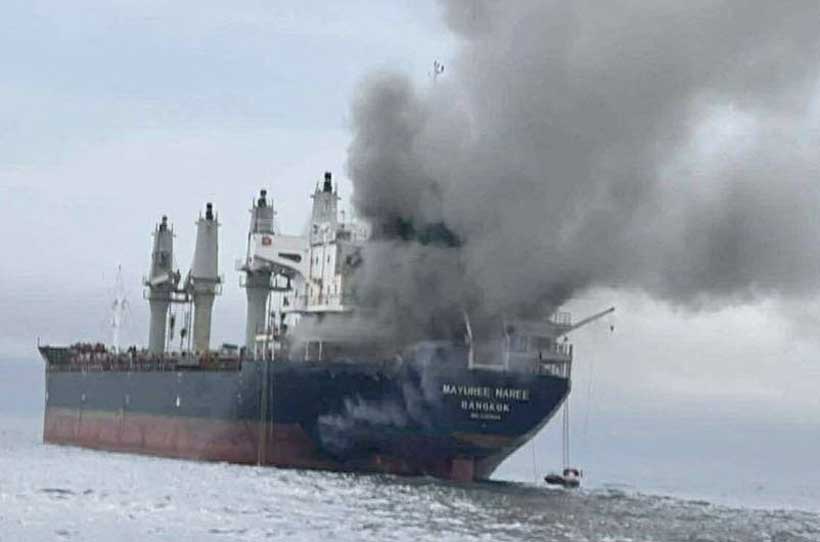
The ceasefire between the US and Iran has been in place for nearly four weeks. The Strait of Hormuz has not been at peace for a single day.
This week pushed that contradiction to its most dangerous point yet. The United States launched Project Freedom, a naval escort operation designed to guide roughly 2,000 ships stranded on either side of the Strait through to open water. Iran said any ship attempting passage without IRGC permission would be fired on. Within hours, both sides were claiming to have hit the other, the UAE was scrambling missile alerts for the first time since the ceasefire began, an oil refinery in Fujairah was on fire, and commercial aircraft bound for Dubai were turning around mid-air.
As of Tuesday evening, Trump announced Project Freedom would be paused “for a short period of time” to see if an agreement with Iran could be reached. Secretary of State Rubio told reporters the US was now in a “defensive” posture. Twenty-four hours earlier, both sides had been shooting and denying it simultaneously.
Here is what we know, what is contested, and what it means.
What Is Project Freedom and Why Did the US Launch It?
Trump announced the operation on Sunday, framing it in humanitarian terms, an effort to free the seafarers and cargo companies that had done nothing wrong and were caught between two governments fighting a war neither had formally ended. About 2,000 ships have been stranded on either side of the Strait since late February, unable to move without IRGC permission, which Iran began requiring and charging for after the ceasefire took effect.
The US had already begun a naval blockade of Iranian ports on April 13. Project Freedom was the next escalation — a direct challenge to Iran’s assertion that the Strait was now under its operational control. Trump described it as a “humanitarian gesture.” Iran described it as a violation of the ceasefire and an act of military aggression in a sensitive oil region that affects the economies of countries around the world.
Two American-flagged merchant ships successfully transited the Strait on Monday with US Navy escort. A Danish shipping company confirmed one of its vessels crossed with US military protection. But the transit did not go smoothly.
Did Iran Attack a US Warship? What the Claims Say
By Monday afternoon, the competing narratives had become almost impossible to untangle, which is itself part of the story.
Iran’s Fars News Agency reported a US warship had been hit by two Iranian drones after refusing to turn back from the Strait. CENTCOM denied any warship had been hit. US Admiral Brad Cooper said CENTCOM forces had sunk six IRGC vessels that tried to interfere with Project Freedom. Trump later said seven. Iran’s state broadcaster then reported that Tehran had launched an investigation and its preliminary conclusion was that the vessels the US claimed to have sunk were not IRGC boats at all, they were two small civilian craft carrying passengers from Oman to the Iranian coast, and five civilian passengers had been killed. The US has not commented on that claim and it has not been independently verified.
Why Iran Attacked the UAE in 2026: The Fujairah Strike Explained
The UAE’s Ministry of Defense said its air defenses engaged 15 ballistic missiles, three cruise missiles, and four drones launched from Iran on Monday, the first Iranian attacks on the UAE since the ceasefire took effect on April 8. One drone struck an oil refinery in Fujairah, wounding three Indian nationals and setting the facility ablaze. Four missile alerts were issued across the country, sending residents to shelter. Commercial aircraft bound for Dubai and Abu Dhabi turned around in mid-flight.
Iran’s position was that the Fujairah attack was not a premeditated strike on the UAE but a consequence of what it called US military adventurism in the Strait. An Iranian military official said the Islamic Republic had no preplanned programme to attack UAE facilities, and that what happened resulted from the US attempt to create an illegal passage through restricted waters. The UAE’s Foreign Ministry rejected that framing entirely, condemning what it called renewed terrorist and unprovoked Iranian attacks on civilian sites, and warning it reserves the full right to respond.
Why the Attack Claims Cannot Be Independently Verified
One detail worth noting is the shifting count of Iranian vessels supposedly sunk. Admiral Cooper said six. Trump said seven. No independent observer has confirmed either figure, and Iran has denied any IRGC boats were hit at all. This pattern: each side claiming damage inflicted while denying damage received, with no neutral verification , has run throughout the conflict and is not unique to this week’s exchange. What is different now is that the Strait is supposed to be under a ceasefire, and the exchanges are happening in a waterway where 2,000 civilian ships are anchored and waiting to see who wins the argument.
How the Hormuz Escalation Is Threatening Iran Ceasefire Talks in 2026
Trump’s decision to pause Project Freedom on Tuesday is significant precisely because of how quickly it followed the launch. The operation began Sunday. By Tuesday, with the UAE under attack, Iranian drones targeting ships in the Strait, and competing claims circulating with no resolution, the White House stepped back. Rubio reframed the entire mission as defensive rather than offensive, and a new UN Security Council resolution on freedom of navigation was announced, co-authored by Bahrain, Saudi Arabia, the UAE, Kuwait, and Qatar. A previous similar resolution was vetoed by China and Russia, and the outlook for this one is no clearer.
The pause does not resolve the underlying problem. The Strait remains contested. Iran still insists ships must seek IRGC permission and pay for transit. The US still insists the Strait is international water under international law. Two thousand ships are still stranded. And the ceasefire that is supposed to govern all of this is being tested in ways its text was never designed to handle.
The attacks this week did not happen in isolation from the negotiations still technically underway. Pakistan has been trying to bring the US and Iran back to a second round of talks after the Islamabad discussions collapsed on the nuclear question in April. Every exchange of fire, every competing claim, every missile alert in Abu Dhabi makes that second round harder to convene and harder to trust once convened.
As Shahram Akbarzadeh, a professor in Middle East and Central Asian politics at Deakin University, told Al Jazeera: “We see escalation after escalation against the backdrop of shuttle diplomacy. Such attacks, even if they are aimed to be contained, risk exploding into another major combat.” Neither the Americans nor the Iranians want a return to full-scale war, Akbarzadeh said, but neither is prepared to show weakness. “This dynamic has locked them in a perpetual conflict and in desperate need of a circuit breaker.”
The circuit breaker Pakistan offered in April produced a ceasefire. That ceasefire is now generating its own escalation cycle, in twenty-one miles of water, over a question neither side has answered: who controls the Strait of Hormuz, and on what terms does the world’s most important waterway reopen.
Two thousand ships are waiting for the answer.