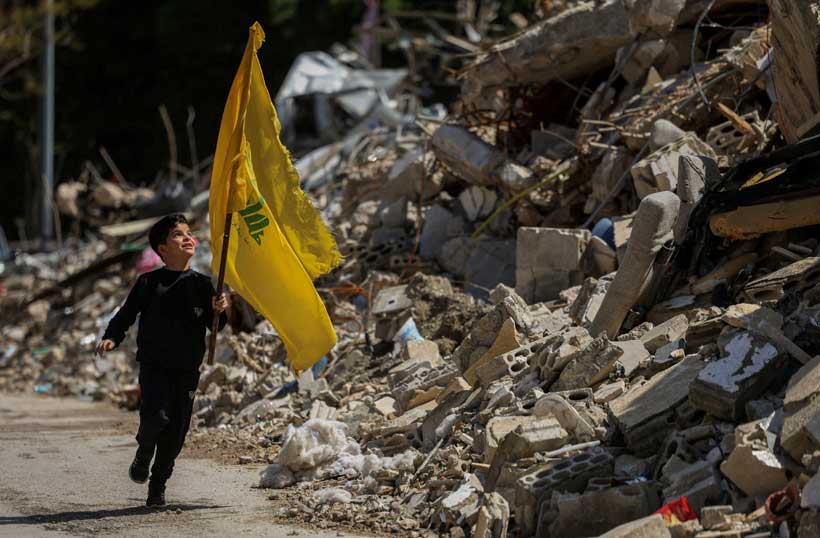
China has taken a firm stance against the Israeli escalation in Lebanon, strongly warning against the region becoming a second Gaza and considering the events a blatant violation of Lebanese sovereignty and international law. The most prominent features of the Chinese response up to April 2026 to this Israeli military escalation in southern Lebanon included condemning the targeting of civilians and emphasizing the protection of Lebanese sovereignty while rejecting Israeli violations aimed at destroying the infrastructure of southern Lebanon. The Chinese Foreign Ministry condemned the extensive Israeli raids targeting towns in southern Lebanon, stressing that Lebanon’s sovereignty and security are a red line that must not be crossed. China also emphasized the protection of Lebanese civilians, with Beijing unequivocally affirming that the protection of civilians and civilian objects in armed conflicts is a legal obligation and expressing its shock at the scale of casualties and destruction inflicted on southern villages and towns.
China’s position is based on a comprehensive vision linking the stability of southern Lebanon to a ceasefire in the Gaza Strip. Beijing believes that addressing the root causes of the conflict is the only way to prevent its spread throughout the Middle East. While condemning the destruction of Lebanese infrastructure and civilian areas, China’s Foreign Ministry denounced the Israeli airstrikes that killed hundreds of civilians and destroyed civilian infrastructure and property. Beijing categorically rejects any actions that lead to the destruction of infrastructure, considering them a violation of international law. China has consistently emphasized that Lebanon’s sovereignty, security, and territorial integrity are a red line that must not be crossed. Beijing has also declared its opposition to the Israeli ground incursion into southern Lebanon, warning that such actions exacerbate regional tensions. China has called for diplomatic solutions, urging all parties, especially Israel, to exercise maximum restraint and return to the path of political and diplomatic settlement, asserting that continued violence will not bring security to any party. China condemned the attacks targeting UNIFIL peacekeeping forces in southern Lebanon, stressing the need to ensure the safety of UN peacekeepers.
In this context, China deliberately directed veiled criticism at Washington regarding Israeli violations in southern Lebanon. China believes that the failure to contain the escalation in southern Lebanon is partly due to the military and political support provided to Israel by external powers, a clear reference to the United States, which hinders efforts to de-escalate the situation. Simultaneously, China warned of a second Gaza in southern Lebanon. Chinese Foreign Minister Wang Yi explicitly cautioned against a repeat of the Gaza tragedy in Lebanon, emphasizing that violence cannot replace right and justice. China is pressing in international forums, particularly the Security Council, for an immediate and permanent cessation of Israeli hostilities, warning against the region sliding into a full-scale war. This stance reflects China’s desire to bolster its role as a peacemaker in the Middle East and to rival American influence by adhering to political solutions and international law.
Here, China sharply criticized the American role in the Israeli war against southern Lebanon and its recent escalation in April 2026, arguing that Washington contributes to undermining regional stability through its military and political support for Israel. Beijing considered the military operations supported or participated in by the United States to be a flagrant violation of international law and the principles of national sovereignty. While warning against the militarization of the region, China criticized the expansion of the American military presence, describing it as irresponsible and warning that such steps exacerbate tensions rather than de-escalate them. Beijing believes that Washington’s approach to the international order reflects the values of the law of the jungle and fuels chaos and instability in the Middle East. While criticizing the US for its double standards, China, through its Foreign Ministry spokesperson Mao Ning, condemned the continued Israeli strikes on towns and villages in southern Lebanon despite ongoing efforts to de-escalate the situation. She emphasized that Lebanon’s sovereignty and security must not be violated.
China called on Israel to immediately withdraw from southern Lebanon, warning against a repeat of the Gaza scenario. Chinese President Xi Jinping issued direct warnings demanding the immediate withdrawal of Israeli forces from southern Lebanon, cautioning that continued military operations could lead to a humanitarian catastrophe similar to what occurred in the Gaza Strip. He also called for an end to the Israeli escalation in southern Lebanon. China maintains that violence does not solve problems but rather exacerbates crises, urging maximum restraint to de-escalate the volatile regional situation. Chinese President Xi Jinping called for the immediate withdrawal of Israeli forces from Lebanese territory, asserting that their current military presence violates Lebanon’s sovereignty and territorial integrity. President Xi explicitly warned against allowing southern Lebanon to become another Gaza, pointing to the risk of a widespread humanitarian catastrophe and the destruction of civilian infrastructure.
To halt the cycle of violence and armed conflict in southern Lebanon, Chinese President Xi Jinping proposed a four-point peace initiative to bolster stability in the Middle East. This initiative includes a call for a multilateral peace conference under the auspices of the United Nations, the re-establishment of the border along the Blue Line between southern Lebanon and Israel, and a reaffirmation of China’s rejection of any violation of Lebanese sovereignty. The Chinese Foreign Ministry has repeatedly emphasized, most notably on April 9, 2026, that Lebanon’s sovereignty and security are a (red line) that must not be crossed. These Chinese moves position Beijing as an active diplomatic alternative in the region at a time of escalating international tensions between major powers and ongoing regional conflicts. China has begun diplomatic efforts by proposing several peace initiatives to halt the cycle of armed conflict in southern Lebanon. The most prominent of these is the call for a multilateral peace conference. Beijing proposed hosting an international peace conference aimed at stabilizing the region and reinforcing the border along the Blue Line separating Israel and Lebanon, under the auspices of the United Nations. China holds Israel fully responsible, considering the ongoing fighting in Gaza to be the root cause of the instability in the Middle East. Therefore, China called on the international community, particularly the major powers, to play a constructive role in achieving a comprehensive and lasting ceasefire in southern Lebanon and the Gaza Strip. China has also supported the UNIFIL peacekeeping force in southern Lebanon, strongly condemning any attacks on UNIFIL forces as violations of UN Security Council Resolution 1701. Here, China used its influence in the UN Security Council and international forums to emphasize that any military operations outside the framework of the United Nations violate its Charter. It described the Israeli strikes on towns and villages in southern Lebanon as unauthorized actions.
Based on the preceding analysis, we understand the accuracy of China’s linking of the tensions in southern Lebanon to the war in Gaza. China called for restraint to prevent the conflict from spreading regionally, based on its principles of supporting sovereign states like Lebanon and non-interference in the internal affairs of other countries. China also called for a return to the diplomatic track to halt the cycle of violent armed conflict in southern Lebanon perpetrated by Israel. China condemned the extensive Israeli strikes, stressing that Lebanon’s sovereignty and security must not be violated. It emphasized the need to protect Lebanese civilians and civilian infrastructure during Israeli military operations and called for de-escalation and immediate steps to calm the situation and prevent further escalation of the conflict in southern Lebanon.