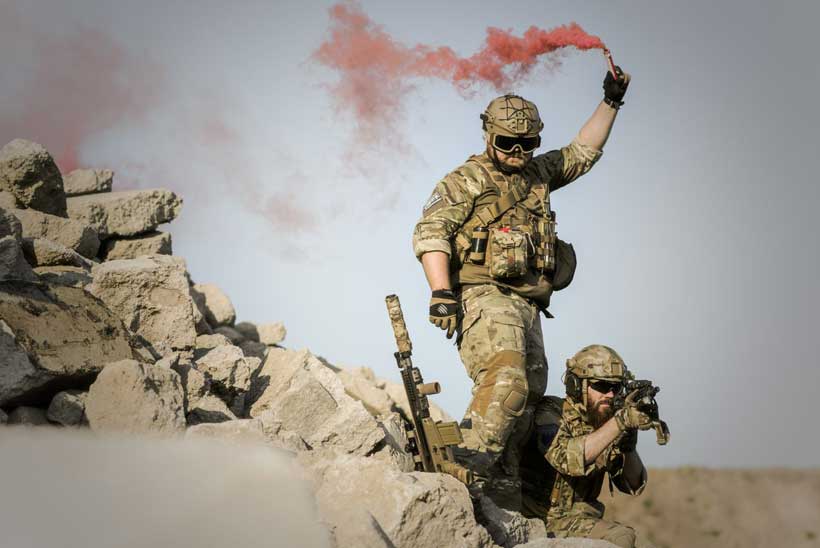
Modern conflicts are not just waged by state sponsored armed forces. In the last two decades there has been a rapid growth in the international recruitment of Private Military Companies (PMCs), used for everything from protecting top-level diplomats from harm in the Middle East to defending resource mining sites throughout Sub-Saharan Africa.
These commercial security contractors are indispensable partners to states, NGOs and corporations the world over. The growth of privatized conflict presents structural issues for international law and diplomacy.
The Loopholes of Modern Legal Systems in War
Among the most consistent and frequent challenges to global peace and security is the glaring accountability vacuum relating to non-state actors. When a uniformed state soldier is found to have committed crimes they are subject to the rigorous legal structures of the military justice system, including the Geneva Convention. By comparison, PMC operators often exist in a legal grey area.
Host nations where such operators act, often experience a level of domestic instability where their own legal systems are overstretched, or politically weak to effectively take action against powerful private security forces. The nations routinely lack either the will or capacity to pursue legal action against heavily armed foreign PMC personnel. The home states of PMCs are never eager to prosecute for alleged offences committed abroad by the corporations which they sanction. This leads to an accountability vacuum.
Stay ahead of the geopolitical week.
MD Briefing delivers expert analysis across five global fronts — the Indo-Pacific, energy, geoeconomics, European security, and the Middle East — every Monday morning. Free.
Bringing the War-Zone Back Home
Due to a lack of a central tribunal for PMC abuses, such individuals usually fall to the jurisdiction of the domestic legal system in their home country. Taking war crimes back home presents a unique challenge for a domestic legal system. When prosecuting for violent abuses committed in a distant battlefield, standard criminal codes and procedures may prove ill-suited.
Attempts by domestic prosecutors to seek convictions for offenses such as murder or assault against their country’s PMC operators has led to lengthy and complex legal proceedings. Acts normally described a felony assault charge were made all the more difficult due to a defence team pointing to the hostile environment, self-defense and chain of command arguments during combat.
Diplomatic Fallout and Tensions
A failure to investigate or hold delinquent PMCs to account will trigger severe diplomatic backlash for a country. In a state in which private security companies are operating abroad and are subject to no scrutiny or legal checks and balances, public antagonism will increase and in some circumstances relations with the country of origin of these PMCs will be strained. In a fragile international environment, years of delicate diplomacy and international co-operation can be instantly sabotaged when a foreign military acts without limits.
International Cooperation Needed for PMC Regulation
It is essential that the international community moves beyond a voluntary framework to regulate PMCs. Regulations such as the Montreux document is an excellent starting point for regulation but more robust measures such as a mandatory convention governing the behavior and prosecution of private military contractors are needed.
Diplomats must proactively create standard operating procedures for the proper handling of private security forces, to avoid jurisdictional gaps, and take steps towards creating accountability for individual wrongdoers.
On July 14 the crews of the Mombasa and the Al Bahiyah found out. Two UAE-flagged tankers were hit by Iranian cruise missiles in the southern lane, inside Omani territorial waters, according to the Emirati defense ministry. An Indian sailor was killed and eight others were hurt, six Indians and two Ukrainians, and India summoned Iran’s deputy ambassador the same day. The Revolutionary Guard said the ships had run dark and ignored repeated warnings on a mined route. They had been following the other government’s instructions.
This is what a diplomatic technique looks like when it fails in public.
The technique has a name, and for fifty years the profession has been proud of it. Constructive ambiguity, Henry Kissinger’s phrase, is the art of writing a sentence that lets two enemies sign the same page while believing opposite things. Resolution 242 called for Israeli withdrawal from “territories” occupied in 1967, and the missing definite article has been argued over for fifty-nine years. The Good Friday Agreement left the sovereignty question deliberately unfinished. Ambiguity is not a drafting failure. It is often the only reason a war stops on the day it stops.
The Islamabad Memorandum, signed on June 17 by Donald Trump and Masoud Pezeshkian and brokered by Pakistan, used the same tool. Read Paragraph 5 and you can watch it happen. Iran undertakes to use “best efforts” for the safe passage of commercial vessels “with no charge, for 60 days only,” and to open a dialogue with Oman on the strait’s future administration “in line with the applicable international law and the sovereign rights of coastal states. ” Tehran reads that as recognition that Iran determines safe passage and will price it when the clock runs out. Washington and the Gulf states read best efforts as an obligation to facilitate passage and nothing more. Fourteen points. One waterway. Two meanings, both sincere.
Stay ahead of the geopolitical week.
MD Briefing delivers expert analysis across five global fronts — the Indo-Pacific, energy, geoeconomics, European security, and the Middle East — every Monday morning. Free.
Here is what the drafters missed, and it is the reason the strikes came back and the market is repricing this week. Constructive ambiguity works on questions that can sit still. A border can stay contested for six decades because a border does nothing in the meantime. Sovereignty over Northern Ireland is not exercised on Tuesday at 4 p.m. by a specific person who has to make a call.
A strait is not like that. Before the war, roughly 130 vessels crossed Hormuz every day. That is one ship approaching the disputed sentence about every eleven minutes, each one requiring somebody to physically wave it through or turn it back. Paragraph 5 does not get to be undecided. It gets decided, hundreds of times a day, by a coastal battery commander at Bandar Abbas and a watch officer on a destroyer, neither of whom has the luxury of interpretation.
The memorandum deferred two questions to a second phase. One of them, Iran’s nuclear program, can wait, because centrifuges do not require a daily ruling. The other cannot wait an afternoon. The drafters treated them as the same kind of problem, and only one of them is shooting. JD Vance, who runs the American side of the file, conceded the point on a podcast Wednesday without appearing to notice he had made it: the nuclear negotiations he leads have stalled over the strait.
Everything since follows from that. Six consecutive nights of American strikes. A naval blockade of Iranian ports has been back in force since Wednesday, with a Curacao-flagged tanker disabled by Hellfire missiles fired into its smokestack near Kharg Island. Iran’s ambassador filed a letter at the U.N. listing 42 American violations of a text Trump declared dead on July 8 and Tehran stopped complying with on the 13th, which tells you the memorandum has become useless as a truce and indispensable as a claim. Both capitals still cite Paragraph 5. Neither will be governed by it. They are both telling the truth about a sentence that says two things.
Trump’s week makes more sense in this light than in any other. On Monday he declared the United States “guardian” of the strait and announced a 20% charge on cargo passing through it. By Tuesday the fee was gone, swapped for promises of Gulf investment, after the International Maritime Organization said there is no legal basis for mandatory tolls simply to transit a strait and shipowners refused to play. On Thursday, IRNA reported that Tehran is preparing environmental compensation fees on transiting ships. Both governments have now tried to invoice the same water in the same week, and neither can collect. That is not a strategy, and it is not a neoconservative plot. That is what happens when the document you signed does not contain the authority you thought you had bought.
He said on Tuesday that next week come the bridges. The bridges came Friday. American strikes hit six of them around Bandar Khamir and a railway junction outside Bandar Abbas, cutting Iran’s main port off from the roads inland, and collapsed the control tower at Chabahar. Iran’s health ministry counts 38 dead and more than 400 wounded since the strikes resumed. Even Trump’s own deadlines are now being decided faster than he sets them.
The market is the only participant being paid to read Paragraph 5 honestly, and its verdict is arriving. Brent touched $86 on Tuesday, a one-month high, and held above $85 through a week in which the peace was formally alive. Traffic tells it better than price. Eleven ships crossed on the day Iran declared the strait closed. Seven crossed on Wednesday. Three crossed Thursday, the fewest since May, against 130 a day before the war. One ship every eleven minutes has become one ship every eight hours.
Rory Johnston of Commodity Context makes the harder point, and it deserves more attention than it has received. The stock cushion that absorbed the spring’s supply shock has been drawn down, which means the next shock will not be padded the way the last one was. The price is not high because the war is bad. It is high because the peace is unreadable.
Americans are paying in a currency the ceasefire never touched. Thirteen of the fourteen U.S. service members killed in this war died in March, before any truce existed. What has climbed through every pause is the wounded count, now 414, most of them with traumatic brain injuries. Truces here have reliably stopped the funerals and never stopped the concussions.
The mediators still working the phones in Islamabad, Doha, and Cairo do not need a grand bargain by August 16, when the memorandum’s sixty-day clock runs out and Iran has promised to start charging. They need something duller and much harder. They need to convert one sentence into a procedure: who physically waves the ship through, on whose radio frequency, under whose flag, and with what recourse when someone gets it wrong. Not sovereignty over the strait. Traffic control of it. The nuclear file can keep. The lane cannot.
Iran released an American detainee on Wednesday, which some in Washington read as a hand reaching for a rail. Nobody has set a date for the conversation that would matter. If none is set, the war will not restart in August. It will simply stop pretending to have paused, and a ship’s master off Oman will keep making a sovereign decision on behalf of two governments that refuse to make it for him.
Constructive ambiguity is a loan against the future. Most disputes let you pay it back slowly. Hormuz charges interest by the hour.
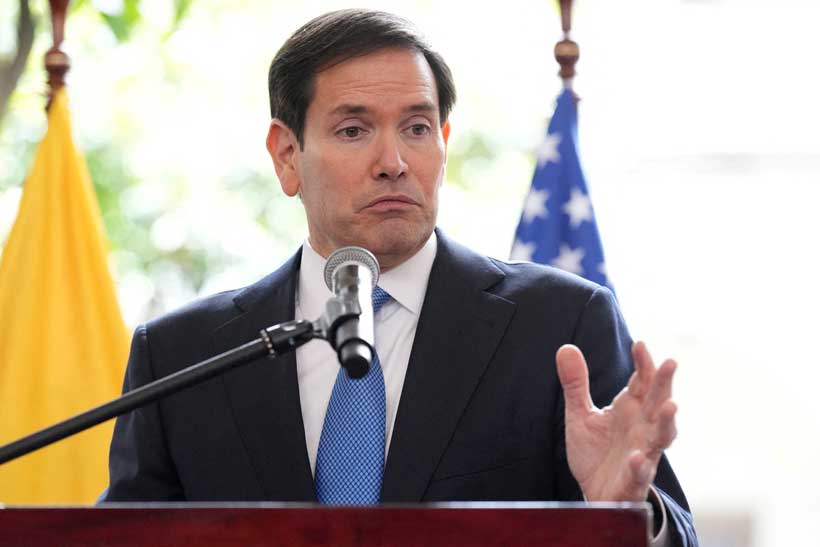
US Secretary of State Marco Rubio recently launched a public attack on the International Criminal Court (ICC), vowing to “dismantle the ICC—brick by brick.” Washington’s position is that the ICC has no authority to try officials from non-member states—such as the US itself—or their allies, and that it will not accept any international court exercising jurisdiction over American citizens without US consent. Washington therefore intends to use diplomatic pressure and sanctions to counter the Court.
If one still believes in the international community’s definition of war crimes, this looks like a political move to absolve the United States and Israel of war crimes committed in the Middle East. To that end, Washington is pressuring allies — including states that are parties to the Rome Statute — to withdraw from the ICC.
“Trump said in January, ‘I don’t need international law’ to highlight his ‘America First’ policy. He is now keeping that promise, and the ICC is just one example.”
The day before Rubio announced his intent to dismantle the ICC, fourteen countries, including the United States, publicly reaffirmed their support for the ten-year-old ruling in the South China Sea Arbitration—a decision handed down by another international arbitration body: an ad hoc Arbitral Tribunal constituted under Annex VII of the United Nations Convention on the Law of the Sea (UNCLOS), administered by the Permanent Court of Arbitration.
Stay ahead of the geopolitical week.
MD Briefing delivers expert analysis across five global fronts — the Indo-Pacific, energy, geoeconomics, European security, and the Middle East — every Monday morning. Free.
Ironically, of the fourteen countries, only the Philippines—the actual party to the case—has a direct stake in South China Sea rights. The other five countries with genuine interests in the South China Sea did not join this “cheerleading squad”: Vietnam, Malaysia, Brunei, Singapore, and Indonesia. Of these, Vietnam, Malaysia, and Brunei are, like the Philippines, “principal claimant states.”
Aside from the US and the Philippines, every other country among the fourteen marking the tenth anniversary of the ruling is an ICC member state: Australia, Canada, Estonia, Germany, Italy, Japan, Latvia, Lithuania, New Zealand, Romania, Slovenia, and the United Kingdom.
These 12 ICC member states have no stake whatsoever in South China Sea affairs, yet they support an international arbitration body — and are now being pressured by the United States to boycott another international arbitration body they themselves belong to. Fourteen countries are happy to use international law to pressure China, but when international law becomes inconvenient for the US and Israel, is that suddenly a different matter?
The Philippines finds itself in the most awkward position of all. Manila withdrew from the ICC in 2019, yet after Ferdinand Marcos Jr. took office as president, it allowed Interpol and Philippine airport authorities to arrest former president Rodrigo Duterte in 2025 and hand him directly over to the ICC for trial.
The real story behind this episode is domestic political rivalry within the Philippines, combined with Washington’s long-standing displeasure with Duterte. International institutions have played the role of “witch-hunt enforcer,” helping the US and Manila nail a political opponent to the cross.
In the past, the international community could invoke Rome Statute standards to brand Duterte’s “war on drugs” a crime against humanity. But what now?
The ICC cannot prosecute non-member states, but it can prosecute individuals—such as Benjamin Netanyahu. Moreover, under the Rome Statute’s territoriality principle, the Court has jurisdiction if the alleged crime occurred on the territory of a member state. In the Middle East case, Palestine is a state party. In the Philippine case, although Manila withdrew from the ICC in 2019, crimes committed before that withdrawal remain within the Court’s reach.
The reason the US can attack the ICC so freely is that other international arbitration bodies do not follow this same “detour through territoriality” to claim jurisdiction over non-member states, nor do they try individuals—they adjudicate sovereign states (or transnational corporate entities). As such, they strictly adhere to the most fundamental principle of international law: the principle of state consent.
Interestingly, the tribunal that presided over the South China Sea arbitration itself violated the principle of state consent by ruling on a case brought against China, which refused to participate. This is precisely why China has never recognized the ruling as having any legal basis. Yet the fourteen countries that support the ruling seem untroubled by this violation of a core principle of international law.
In other words, both the ICC and the ad hoc tribunal behind the South China Sea arbitration suffer from the same flaw: overreach. The ICC has been accused of an “idealism” that oversteps state sovereignty, while the South China Sea tribunal has been criticized for “procedural overreach”—under UNCLOS, an ad hoc tribunal has no authority whatsoever over land territorial sovereignty, yet the tribunal accepted the Philippines’ framing that “downgraded” what were really sovereignty and maritime-delimitation questions into a simple matter of “the legal status of islands and reefs” and used that framing to assert jurisdiction for itself.
Taiwan was an innocent bystander caught in the crossfire of the South China Sea arbitration. Itu Aba (Taiping Island), which is under the actual control of the Republic of China (Taiwan) and has both fresh water and the capacity to sustain human habitation, was nonetheless ruled to be a mere “”rock”—stripping it of any 200-nautical-mile exclusive economic zone.
Given that both international arbitration bodies suffer from the same problem of overreach, if one follows the US in opposing the ICC, shouldn’t one logically also oppose the South China Sea ruling? This month, the Philippine Department of Foreign Affairs launched an “urgent assessment” to awkwardly grapple with exactly this dilemma, since Manila has skin in both games—the Duterte case and the South China Sea ruling.
If Manila agrees to help dismantle the ICC, what happens to Duterte, still awaiting trial in The Hague? And if China then uses that same logic to reject the South China Sea ruling, what then? The other twelve member states that joined this “witch hunt” find themselves in an equally awkward spot.
Second only to the Philippines in embarrassment is Japan. Tokyo is the ICC’s largest financial backer; the Court’s current president, Tomoko Akane, is Japanese; and Japan has long been one of the ICC’s staunchest supporters. Is Tokyo now expected to help the US dismantle the ICC or to withdraw from it altogether?
Japan also finds itself in a glaring contradiction over the South China Sea ruling. If Taiwan-controlled Taiping Island—with an area of 510,000 square meters (roughly the size of 71 standard football pitches), fresh water, and the capacity to sustain habitation)—was ruled a mere “rock,” then how can Okinotorishima, an outcrop Japan claims sovereignty over that covers just 9.44 square meters (about the size of a double bed), possibly qualify as an “island”?
By that logic, Tokyo’s support for the South China Sea ruling effectively concedes that Okinotorishima has no exclusive economic zone at all — a self-inflicted contradiction that China has been quick to mock.
One could, therefore, say all fourteen countries backing the South China Sea ruling are applying a double standard, and that thirteen of them have no connection to the South China Sea whatsoever. Aside from the Philippines, the only country with any real claim to South China Sea interests is the United States — and the US holds international law in contempt, going so far as to vow to destroy an international arbitration institution outright.
This episode symbolizes the unraveling of the international order—a world reverting to the law of the jungle. The United States is dismantling the very international order it built, and the ones hurt most are precisely its own allies.
The Philippines and Japan have been given the responsibility of encircling China on the front line by the United States, but the footholds of the two countries are also being dismantled by the United States. In front of them, there is only the risk of opposing China and the weakening guarantee.
Above all, the United States has proven, by its own actions, that the so-called international order was never fair and never operated on a fixed standard — it was merely a temporary tool for an empire to rule the world. And when the tool stops being useful, it gets discarded, leaving its followers staring, embarrassed, at the tool still in their hands.