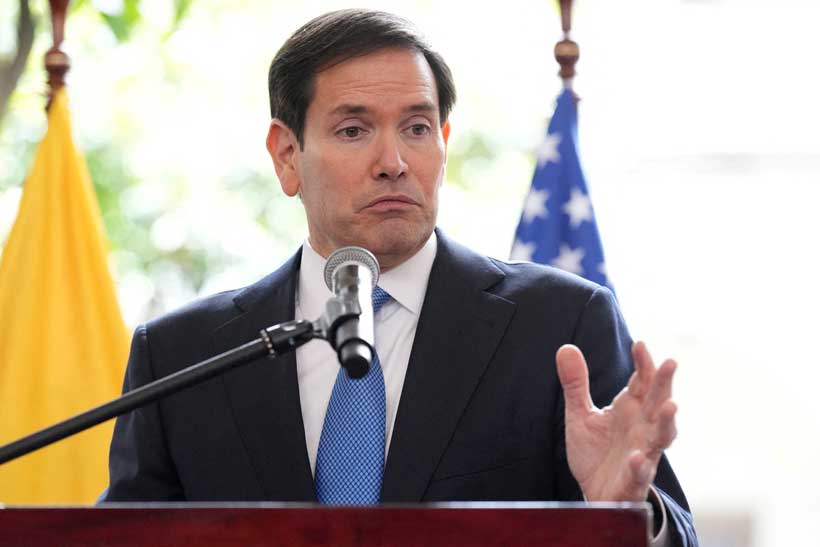
US Secretary of State Marco Rubio recently launched a public attack on the International Criminal Court (ICC), vowing to “dismantle the ICC—brick by brick.” Washington’s position is that the ICC has no authority to try officials from non-member states—such as the US itself—or their allies, and that it will not accept any international court exercising jurisdiction over American citizens without US consent. Washington therefore intends to use diplomatic pressure and sanctions to counter the Court.
If one still believes in the international community’s definition of war crimes, this looks like a political move to absolve the United States and Israel of war crimes committed in the Middle East. To that end, Washington is pressuring allies — including states that are parties to the Rome Statute — to withdraw from the ICC.
“Trump said in January, ‘I don’t need international law’ to highlight his ‘America First’ policy. He is now keeping that promise, and the ICC is just one example.”
The day before Rubio announced his intent to dismantle the ICC, fourteen countries, including the United States, publicly reaffirmed their support for the ten-year-old ruling in the South China Sea Arbitration—a decision handed down by another international arbitration body: an ad hoc Arbitral Tribunal constituted under Annex VII of the United Nations Convention on the Law of the Sea (UNCLOS), administered by the Permanent Court of Arbitration.
Stay ahead of the geopolitical week.
MD Briefing delivers expert analysis across five global fronts — the Indo-Pacific, energy, geoeconomics, European security, and the Middle East — every Monday morning. Free.
Ironically, of the fourteen countries, only the Philippines—the actual party to the case—has a direct stake in South China Sea rights. The other five countries with genuine interests in the South China Sea did not join this “cheerleading squad”: Vietnam, Malaysia, Brunei, Singapore, and Indonesia. Of these, Vietnam, Malaysia, and Brunei are, like the Philippines, “principal claimant states.”
Aside from the US and the Philippines, every other country among the fourteen marking the tenth anniversary of the ruling is an ICC member state: Australia, Canada, Estonia, Germany, Italy, Japan, Latvia, Lithuania, New Zealand, Romania, Slovenia, and the United Kingdom.
These 12 ICC member states have no stake whatsoever in South China Sea affairs, yet they support an international arbitration body — and are now being pressured by the United States to boycott another international arbitration body they themselves belong to. Fourteen countries are happy to use international law to pressure China, but when international law becomes inconvenient for the US and Israel, is that suddenly a different matter?
The Philippines finds itself in the most awkward position of all. Manila withdrew from the ICC in 2019, yet after Ferdinand Marcos Jr. took office as president, it allowed Interpol and Philippine airport authorities to arrest former president Rodrigo Duterte in 2025 and hand him directly over to the ICC for trial.
The real story behind this episode is domestic political rivalry within the Philippines, combined with Washington’s long-standing displeasure with Duterte. International institutions have played the role of “witch-hunt enforcer,” helping the US and Manila nail a political opponent to the cross.
In the past, the international community could invoke Rome Statute standards to brand Duterte’s “war on drugs” a crime against humanity. But what now?
The ICC cannot prosecute non-member states, but it can prosecute individuals—such as Benjamin Netanyahu. Moreover, under the Rome Statute’s territoriality principle, the Court has jurisdiction if the alleged crime occurred on the territory of a member state. In the Middle East case, Palestine is a state party. In the Philippine case, although Manila withdrew from the ICC in 2019, crimes committed before that withdrawal remain within the Court’s reach.
The reason the US can attack the ICC so freely is that other international arbitration bodies do not follow this same “detour through territoriality” to claim jurisdiction over non-member states, nor do they try individuals—they adjudicate sovereign states (or transnational corporate entities). As such, they strictly adhere to the most fundamental principle of international law: the principle of state consent.
Interestingly, the tribunal that presided over the South China Sea arbitration itself violated the principle of state consent by ruling on a case brought against China, which refused to participate. This is precisely why China has never recognized the ruling as having any legal basis. Yet the fourteen countries that support the ruling seem untroubled by this violation of a core principle of international law.
In other words, both the ICC and the ad hoc tribunal behind the South China Sea arbitration suffer from the same flaw: overreach. The ICC has been accused of an “idealism” that oversteps state sovereignty, while the South China Sea tribunal has been criticized for “procedural overreach”—under UNCLOS, an ad hoc tribunal has no authority whatsoever over land territorial sovereignty, yet the tribunal accepted the Philippines’ framing that “downgraded” what were really sovereignty and maritime-delimitation questions into a simple matter of “the legal status of islands and reefs” and used that framing to assert jurisdiction for itself.
Taiwan was an innocent bystander caught in the crossfire of the South China Sea arbitration. Itu Aba (Taiping Island), which is under the actual control of the Republic of China (Taiwan) and has both fresh water and the capacity to sustain human habitation, was nonetheless ruled to be a mere “”rock”—stripping it of any 200-nautical-mile exclusive economic zone.
Given that both international arbitration bodies suffer from the same problem of overreach, if one follows the US in opposing the ICC, shouldn’t one logically also oppose the South China Sea ruling? This month, the Philippine Department of Foreign Affairs launched an “urgent assessment” to awkwardly grapple with exactly this dilemma, since Manila has skin in both games—the Duterte case and the South China Sea ruling.
If Manila agrees to help dismantle the ICC, what happens to Duterte, still awaiting trial in The Hague? And if China then uses that same logic to reject the South China Sea ruling, what then? The other twelve member states that joined this “witch hunt” find themselves in an equally awkward spot.
Second only to the Philippines in embarrassment is Japan. Tokyo is the ICC’s largest financial backer; the Court’s current president, Tomoko Akane, is Japanese; and Japan has long been one of the ICC’s staunchest supporters. Is Tokyo now expected to help the US dismantle the ICC or to withdraw from it altogether?
Japan also finds itself in a glaring contradiction over the South China Sea ruling. If Taiwan-controlled Taiping Island—with an area of 510,000 square meters (roughly the size of 71 standard football pitches), fresh water, and the capacity to sustain habitation)—was ruled a mere “rock,” then how can Okinotorishima, an outcrop Japan claims sovereignty over that covers just 9.44 square meters (about the size of a double bed), possibly qualify as an “island”?
By that logic, Tokyo’s support for the South China Sea ruling effectively concedes that Okinotorishima has no exclusive economic zone at all — a self-inflicted contradiction that China has been quick to mock.
One could, therefore, say all fourteen countries backing the South China Sea ruling are applying a double standard, and that thirteen of them have no connection to the South China Sea whatsoever. Aside from the Philippines, the only country with any real claim to South China Sea interests is the United States — and the US holds international law in contempt, going so far as to vow to destroy an international arbitration institution outright.
This episode symbolizes the unraveling of the international order—a world reverting to the law of the jungle. The United States is dismantling the very international order it built, and the ones hurt most are precisely its own allies.
The Philippines and Japan have been given the responsibility of encircling China on the front line by the United States, but the footholds of the two countries are also being dismantled by the United States. In front of them, there is only the risk of opposing China and the weakening guarantee.
Above all, the United States has proven, by its own actions, that the so-called international order was never fair and never operated on a fixed standard — it was merely a temporary tool for an empire to rule the world. And when the tool stops being useful, it gets discarded, leaving its followers staring, embarrassed, at the tool still in their hands.