USMC Used Its Expeditionary Operations Playbook In Combat For First Time During Epic Fury
The 31st Marine Expeditionary Unit’s (31st MEU) recent deployment to the Middle East marked the first time the United States Marine Corps (USMC) used its Expeditionary Advanced Base Operations (EABO) concept in a combat setting, the service confirmed to TWZ on Thursday. At its core, EABO involves relatively small groups of Marines quickly establishing bases of operation in forward areas, often within the enemy’s weapons range. During operations in the fight against Iran, Marines refueled and rearmed their own aircraft, as well as those from the joint force, at these austere locales. They also set up remote sensing locations, among other actions from the EABO playbook.
This employment of EABO for Epic Fury is a highly significant development. After years of progressively evolving the EABO playbook, it was no longer an experimental exercise. This meant that Marines were forward deployed in a contested area in a region where established bases were taking heavy fire from Iranian missile and drone barrages. Troops were killed in some of these attacks and U.S. aircraft, buildings and equipment were damaged and destroyed across the Middle East. Pushing aircraft from the MEU, as well as the joint force, to FARPs (forward arming and refueling point) would have been a relevant asset preservation tactic as well as one that would help accelerate combat operations, and it’s exactly what EABO is meant to do.
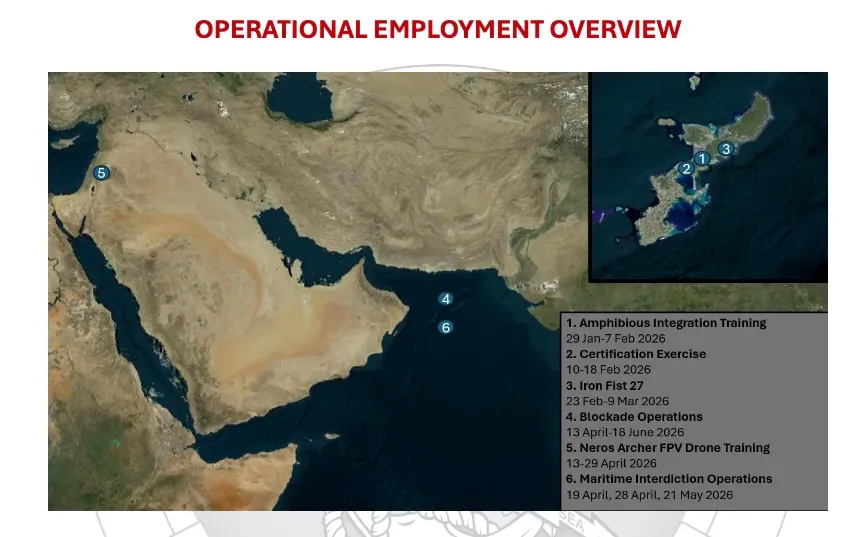
The 31st MEU’s six-month deployment began in January in the Pacific, before the unit was ordered to the Middle East in March, returning to Okinawa, Japan, in July. That’s where it is stationed as the USMC’s only continuously forward-based MEU.

“This was the first time we were able to implement EABO in combat operations since the concept was created for the force,” Capt. Steven J. Keenan, a USMC spokesperson, told us. “We have practiced it many times, but this was a first for supporting a Joint Force named operation with forward FARPs and forward bases that supported joint ops and combat power sustainment.”
EABO was first introduced in 2020 by then-Commandant Gen. David Berger in his Force Design 2030 plan for the future of the Corps. It was created with a fight against China in mind, especially utilizing small Pacific islands. The idea is to have highly mobile, low-signature forces deployed forward in austere, contested or potentially contested maritime locations. The mission is to “support sea control operation, conduct sea denial operations within the littorals, contribute to maritime domain awareness, provide forward command, control, communications, computers, combat systems, intelligence, surveillance, reconnaissance, targeting, and counter-targeting capability and forward sustainment,” according to the Marines.

The news of the first activation of the EABO concept in combat came Wednesday during a media roundtable with Col. Chris P. Niedziocha, who commanded the 31st MEU during its deployment to the Middle East in support of Operation Epic Fury. Now director of the USMC Expeditionary Warfare School, Niedziocha discussed EABO and a range of other operations during that deployment, including boarding vessels during the blockade of Iranian ports.
The 31st MEU was embarked aboard the Tripoli Amphibious Ready Group (ARG), which consisted of the America class amphibious assault ship USS Tripoli, San Antonio class amphibious transport dock ship USS New Orleans, and Whidbey Island class dock landing ship USS Rushmore. You can read more about the ARG/MEU and its assets in our initial story about the deployment to the Middle East here.

“You’re starting to see this has been validated,” the colonel said of the EABO concept during the roundtable TWZ attended virtually. “It’s still nascent, but we actually, for the first time, demonstrated what we thought we were able to do, which I think is pretty exciting. And then things like forward arming and refueling to extend the operational reach of aircraft and expeditionary reloading, and then the ever-present logistic challenge of doing something like that. So that’s pretty significant.”
“We successfully implemented critical Expeditionary Advanced Base Operations (EABO), establishing sensor expeditionary advanced bases and forward arming and refueling points (FARPs) where none existed,” the colonel added. “Through our forward logistic elements, we proved that an agile Marine Air-Ground Task Force can sustain itself and generate ready, lethal power in contested maritime environments, directly setting the theater for follow-on joint forces.”
One of the objectives of the FARPs was to reduce reliance on the Marines’ fleet of KC-130 aerial refuelers and serve as jumping-off points for its F-35B Lightning II fighters.
“There was all manner of tankers all the time, but the FARP is to extend the operational reach, and if you can do it, you reduce the load on that,” Niedziocha noted. “Because there’s some aircraft that are basically for expeditionary austere operations, especially the F-35B,” the Marine Corps’ variant of the aircraft designed for short take off and vertical landing.
“There are some trade-offs associated with the Bravo,” Niedziocha pointed out, using a slang for the jets. “There’s less internal fuel, but you have the lift [system], which gives you the option to do these kinds of things. So, the goal there was to walk that fine line between providing the full sortie over wherever you needed it, and keeping the ships far enough away to make them as survivable as possible.”

In addition to the F-35Bs and other aircraft organic to the 31st MEU, the FARPs were also used by Army helicopters, Keenan told us. Imagery posted on the Pentagon’s image distribution site also showed U.S. Army Gray Eagle drones and Marine MV-22B Osprey tiltrotor aircraft were included.


Niedziocha did not provide details about where the FARPs were set up, but a U.S. defense official told us they were “disaggregated throughout the Middle East.” The official declined to provide further information, citing operational security concerns since they are still being used.
“Throughout the deployment, the Tripoli ARG and 31st MEU successfully conducted over 1,600 mishap-free flight hours of combat aviation missions, including precision strikes, transporting 800,000 pounds of cargo, and moving 5,000 personnel,” a 31st MEU overview of the deployment explained. “The units also provided sustained combat support to joint force operations by delivering critical intelligence and refueling over 300 aircraft ashore and underway.”
The colonel also didn’t provide details about the sensor expeditionary advanced bases. According to the Marines, “a sensing expeditionary advanced base (SEAB) brings together coastal surveillance radars, electronic sensors, and Marines ashore to extend maritime domain awareness, complementing the radars and sensors already at work aboard naval ships off the coast.”
“When SEAB systems identify surface vessels in nearby sea lanes, small unmanned aircraft system (sUAS) operators launch their platforms to visually identify and track the contacts,” the Marines added. “Sensor data and imagery are transmitted in real time across the blue-green command network to decision-makers.”

This capability could have been used to track Iran’s remaining fleet of small boats that it has used to harass shipping and mine the Strait of Hormuz, as well as larger vessels trying to transport oil. Other sensors, like radars and counter-drone systems, could also help identify incoming threats and provide general situational awareness. The EABO concept was employed as part of the 31st MEU’s larger role in supporting the blockade and mine clearance efforts.
The 31st MEU interdicted four vessels during the deployment, three of which led to boardings. On April 19, Marines boarded the MV Touska; on April 28, the MV Blue Star III; and on May 19, the MT Celestial Sea.
The Touska was boarded after USS Spruance fired multiple 5-inch rounds, targeting the engine room and disabling the vessel’s propulsion. The crew of the vessel was retained for about two weeks before being repatriated.
Niedziocha told us that none of the crews offered any resistance.
“At two in the morning, when 30 Force Reconnaissance Marines fast rope onto your vessel, [you are] just compliant with a capital C. They did exactly what they were directed to do. The overmatch that you put onto that vessel is pretty surprising. And then there’s overwatch provided by UAS and manned aircraft, so you create this bubble around the vessel. So yeah, they complied.”
You can see the Touska being boarded in the following video.
Two years ago, as the EABO concept was maturing, TWZ was invited to get an exclusive look at how an advanced EABO concept would be put into action, including how squadrons operated the F-35B out of an austere combat environment while generating combat sorties. It was an unprecedented and exclusive peek into the EABO playbook and what a real fight in the Pacific with the USMC’s most advanced fighter aircraft could actually look like. You can read about that in our story here. It appears the operations in the Middle East mirrored this exercise closely.

Now back in Japan, the ARG/MEU is getting ready for a new deployment, said the colonel.
“We got back to Okinawa, I think July 22nd, and they had already begun their workup cycle in earnest to be on the water in early January to go out and do another Iron Fist [training exercise] with the Japanese, and then long periods of a crisis response,” said Niedziocha, who relinquished command in August before moving on to his new role. “Just being there, present in the First Island Chain to partner with your allies, demonstrates the resolve and commitment to deter whatever needs deterring.”
As noted earlier in this story, the EABO concept was designed with a Pacific fight in mind. Its first combat employment in the Middle East clearly offers lessons that can now be adapted to enhance EABO operations globally.
Contact the author: howard@twz.com