SAN FRANCISCO — While united against a common political enemy in the White House, the California Democratic Party remains deeply divided over how to address the state’s affordability crisis and who is best suited to lead the state in this turbulent era of President Trump.
Those fractures revealed themselves during the party’s annual convention in California’s liberal epicenter, San Francisco, where a slate of Democrats running to succeed Gov. Gavin Newsom pitched very different visions for the state.
Former Orange County Rep. Katie Porter and wealthy financier Tom Steyer were among the top candidates who swung left, with Porter vowing to enact free childcare and tuition-free college and Steyer backing a proposed new tax on billionaires. Both candidates also support universal healthcare.
San Jose Mayor Matt Mahan, the newest major candidate to enter the race, hewed toward partisan middle ground, chastising leaders in Sacramento for allowing the state budget to balloon without tangible improvements to housing affordability, homelessness and public schools.
Rep. Eric Swalwell (D-Dublin), a vociferous critic and constant target of the Trump administration, emerged from the convention with the greatest momentum after receiving the most votes for the California Democratic Party’s endorsement, with 24% of delegates backing him.
“The next governor has two jobs: one, to keep Donald Trump and ICE out of our streets and out of our lives, and two, to lower your costs on healthcare, on housing, on utilities,” Swalwell said. “Californians need a fighter and protector, and for the last 10 years, I’ve gone on offense against the worst president ever.”
Still, none of the top Democrats running for governor received the 60% vote needed to capture the endorsement, indicating just how uncertain the race remains just months away from the June primary.
Betty Yee, a former state controller and party vice chair, placed second in the endorsement vote with 17%; former U.S. Health and Human Services Sec. Xavier Becerra had 14%; and Steyer had 13%. The remaining candidates had single-digit levels of support from among the more than 2,300 delegates who cast endorsement votes.

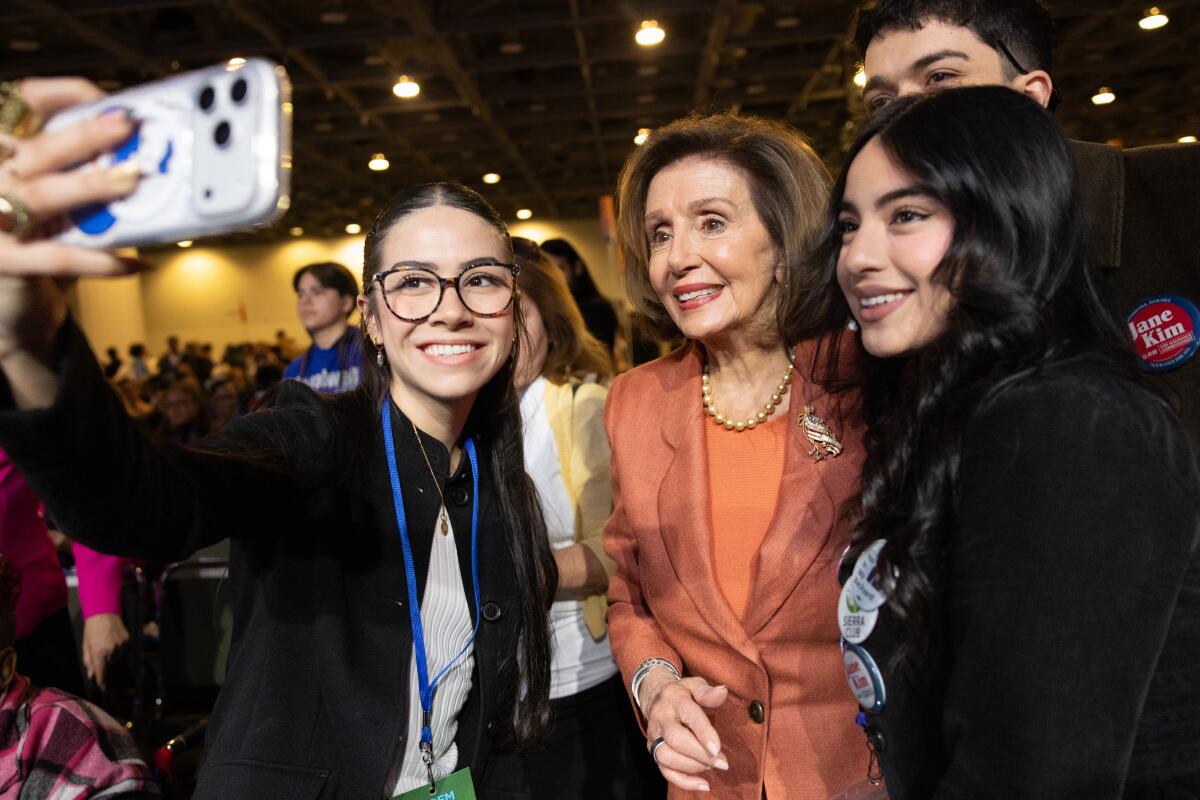
Speaker Emerita Nancy Pelosi (D-San Francisco) takes a selfie with supporters during the California Democratic Party’s annual convention at the Moscone Center in San Francisco on Saturday.
(Christina House / Los Angeles Times)
Despite anxiety and infighting over the governor’s race, many in the party agreed that the most effective way to fight Trump is to win back control of the House in November’s midterm elections.
“We’re going to win the House. There’s absolutely no question we will win the House,” said former House Speaker Nancy Pelosi (D-San Francisco) at a Young Dems event on Friday evening. “We’re going to protect the election, we’re going to win the election, and we’re going to tell people the difference that we will make.”
Thousands of delegates, party allies and guests attended the weekend California Democratic Party convention at Moscone Center in the South of Market neighborhood. The gathering included a tribute to Pelosi as she serves her final term.
Party leaders did coalesce behind one of the Democrats running to replace Pelosi, Scott Wiener, a liberal state senator who is vying be the first openly gay person to represent San Francisco in Congress.
The convention comes as party members and leaders continue to soul search after Trump’s second election. California remains a stronghold of opposition to the president, but its next governor will also have to face a growing cost-of-living crisis in a state where utility costs keep climbing and the median single-family home price is more than double what it is nationally.
Under growing pressure, the candidates for governor went on the offensive at the party gathering. Candidates sniped at each other — though rarely by name — for being too rich, too beholden to special interests or for voting in the past in support of ICE and border wall funding.
While largely panned by delegates who tend to lean further left than the typical California Democratic voter, Mahan has jolted the race by quickly raising millions from tech industry leaders and targeting moderate voters with a message of getting the state “back to basics.”
“We are at risk of losing the trust of the people of California if we don’t hold ourselves accountable for delivering better results on public education, home building, public safety,” Mahan said. “We’re not getting the outcomes we need for the dollars we’re spending.”
Mahan has raised more than $7.3 million since entering the contest in late January, according to campaign finance disclosures of large contributions. Many of the donors are tied to the tech industry, such as Y Combinator, Doordash, Amazon and Thumbtack. Billionaire Los Angeles developer Rick Caruso has also contributed the maximum allowed to Mahan’s campaign.

Technology businessman Dennis Bress, from Newport Beach, wears a pin supporting Planned Parenthood and a Yes on Proposition 50 shirt at the California Democratic Party convention at the Moscone Center on Friday in San Francisco.
(Christina House / Los Angeles Times)
Other candidates have raised concerns about the cash infusion, particularly Steyer, who has already dropped more than $37 million into his self-funded campaign and is pitching himself as a “billionaire who will take on the billionaires.”
“Here’s the thing about big donors: If you take their money, you have to take their calls,” Steyer said during his floor speech.
Delegates and party leaders said California’s next governor will have to continue leading the state’s aggressive opposition to Trump while dealing with the issues at home.
“I think people want a fighter,” said Rep. Dave Min (D-Irvine), who represents Porter’s former congressional district and has endorsed her in the governor’s race. “They want someone who’s going to stand up to Donald Trump but also fight to help average people who feel like they’re getting a raw deal in today’s America.”
Several of the candidates made the case that they could do both.
During her speech, Porter held up a whiteboard — her signature prop when grilling CEOs and Trump administration officials while she served in Congress — with “F— Trump” written on it.
“I’ll stand up to Trump and his cronies just like I did in Congress,” she said. “But this election for governor is about far more than defeating Trump.”
Porter, a law professor at UC Irvine, called on Democrats to “send a message about democracy by rejecting billionaires and corporate-backed candidates.” She also rolled out a long list of “true affordability measures” including free child care, free tuition at public universities, and single-payer healthcare, though she did not specify how she would pay for them.
Fighting back against Trump is “the floor,” said 29-year-old Gregory Hutchins, an academic labor researcher from Riverside. “We need to go higher than the floor — what can you do for the people of California? We all recognize that this is a beautiful and wonderful state, but it is very difficult to afford living here.”
Even some delegates — often the most politically active members of a party — have yet to make up their minds in the governor’s race. Nearly 9% opted not to endorse a particular candidate at the convention.
“You want that perfect candidate. You want that like, yes, this is the person,” said Sean Frame, a school labor organizer from Sacramento who is running for state Senate. “And I don’t feel like there is one candidate for me that fits all that.”
For all the focus on affordability, there were undertones of growing frustration from even reliable Democratic allies over a lack of tangible results in a state where the median home price is more than $823,000. SEIU California president David Huerta said workers have “been deferring our power to elected leadership” for too long.
“I think we need to be the ones who set the agenda and hold them accountable to that agenda,” Huerta said. “And they need to be leading from the direction of working people.”
It’s a constant battle with Democrats at state and local levels to get fair pay, said Mary Grace Barrios, who left a career in insurance to take care of her disabled adult daughter.
Barrios makes $19 an hour as an in-home caregiver to other clients in Los Angeles County. When Newsom signed a law to raise wages for most healthcare workers to $25 an hour by 2030, in-home support staff like Barrios were not included.
“It’s so important that we be given the respect and pay we need to live because we can’t live on that amount,” she said, adding that it feels like a “constant attack by people in our own party that we supported, that forgot us.”
“As citizens, you get what you vote for, right? So we have to do it. We have to make the change.”